Economic evaluations require consideration of the health effects of patient interventions on carers and family members (health spillovers), if the goal is maximizing population health, rather than just patient health (Reference Al-Janabi, Van Exel and Brouwer1). The inclusion of family member quality-adjusted life-years (QALYs) has been advocated for economic evaluations conducted under a societal perspective (Reference Sanders, Neumann and Basu2) or healthcare perspective (Reference Brouwer3). Under a societal perspective, all costs and effects of the intervention ought to be considered and typically these evaluations consider productivity effects of interventions. Under a healthcare perspective all health effects and healthcare costs ought to be considered, which in theory includes effects on, and healthcare use for, family carers and others close to the patient. The National Institute of Health and Care Excellence (NICE) recommends the use of the EQ-5D-5L instrument in cost-utility analysis for measuring the health status of patients, and the instrument may also be appropriate for measuring the health status of family members who are affected by health spillovers (4;Reference Bhadhuri, Jowett, Jolly and Al-Janabi5).
There are various mechanisms by which patient conditions can generate “health spillovers.” The mechanisms proposed to date broadly fit into three categories. The first category is the health spillover generated from providing informal care (i.e., additional unpaid support, such as personal care, to a family member or friend) (Reference Bobinac, van Exel, Rutten and Brouwer6) resulting in mental and physical strain. The second category is the mental distress experienced by family members from witnessing the suffering of the patient (Reference Bobinac, van Exel, Rutten and Brouwer6). The third category only relates to health spillovers generated by health behaviors. This mechanism concerns the imitation of patient health behavior changes by surrounding individuals; with family and household members being the individuals most likely to be affected by this type of health spillover (Reference Falba and Sindelar7–Reference Al-Janabi, Nicholls and Oyebode10). It is also important to be aware of the potential for health conditions to strengthen the relationship with the care recipient, provide a greater determination to look after one's own health, and for caregiving to make them feel useful (Reference Tarlow, Wisniewski, Belle, Rubert, Ory and Gallagher-Thompson11–Reference Wittenberg, Saada and Prosser13).
Few studies have examined the potential for health spillovers resulting from behavior change interventions (Reference Rossini, Moscatiello and Tarrini14;Reference Gorin, Wing and Fava15). A series of weight-loss trials that successfully changed dietary and physical activity behaviors in participants, found that the spouses of participants experienced very little change in their physical activity behavior, although their diets did change as a result of adjustment in shared household food habits (Reference Gorin, Wing and Fava15–Reference Schierberl, Brenchley KJ and Gorin17). However, a different study of an exercise trial intervention found that when participants were actively encouraged to recruit family members in their physical activities, there was a resultant increase in motivation in both participants and family members to take part in physical activity (Reference Rossini, Moscatiello and Tarrini14).
Looking specifically at the cost-utility analyses that have been carried out for a range of health interventions, there is an absence of consideration of health spillovers for behavioral interventions. Beyond behavioral interventions, only a handful of published trials have contemporaneously measured the spillover on family members’ health status and hence QALYs for inclusion in an economic evaluation (Reference Flood, Mugford, Stewart, Harvey, Poland and Lloyd-Smith18–Reference Sturkenboom, Hendriks and Graff20). Due to this absence of trial data on spillovers, some economic evaluations have used spillover estimates obtained from external studies related to a different health condition; for example an economic evaluation of a long-acting formulation of methylphenidate for ADHD used an estimate of spillover of meningitis (Reference Schawo, van der Kolk and Bouwmans21) and an economic evaluation of Tysabri for multiple sclerosis used an estimate of spillover of Alzheimer's disease (Reference Gani, Giovannoni, Bates, Kemball, Hughes and Kerrigan22).
An important methodological uncertainty relates to how many family/social network members should be included in an economic evaluation. Most economic evaluations including spillover consider one family member per patient (Reference Goodrich, Kaambwa and Al-Janabi23), although we are aware of two studies which included spillover for four family members per patient (Reference Schawo, van der Kolk and Bouwmans21;Reference Christensen, Trotter, Hickman and Edmunds24). More generally it has been proposed that a function could be fitted to estimate the multiplier effect of a health spillover through the whole family network (Reference Al-Janabi, Van Exel and Brouwer1). Studies do not conventionally include carer healthcare usage costs even when carer/household member QALYs are included (Reference Krol, Papenburg and van Exel25). However, household members whose health improves as a result of intervention spillover may require fewer healthcare visits. Furthermore, there are controversial elements surrounding the debate on whether to include health spillovers in economic evaluation (Reference Itzler, Chen, Lac, El Khoury and Cook26;Reference McCabe27).
This study aimed to address an important need by analyzing how data collection from multiple household members can be aligned with patient data collection in a randomized controlled trial to obtain unbiased spillover estimates for inclusion in a cost-utility analysis. The specific objectives of this study were twofold. First, to assess whether a supported self-management intervention for patients with chronic obstructive pulmonary disease (COPD) resulted in improved outcomes for patients’ household members. Second, to demonstrate how a within-trial economic evaluation of the COPD self-management intervention can be extended to incorporate health spillover effects on the main household member of the patient.
Methods
We collected data at baseline and 12 months from the adult household members of patients enrolled in a randomized controlled trial (RCT) of a COPD self-management intervention (Reference Sidhu, Daley and Jordan28). We collected data from household members concurrently with the data collection of patients in the RCT to estimate the effect of the self-management intervention on household member (and patient) outcomes. The sections that follow present: (i) information on the PSM-COPD (patient self-management of COPD) trial, (ii) the survey and analysis of household member outcomes, and (iii) the methods for including health spillovers in the economic evaluation of the intervention.
PSM-COPD Trial
PSM-COPD was a two-arm RCT of a telephone health coaching intervention to support self-management with a usual care comparator group, conducted over 12 months (Reference Sidhu, Daley and Jordan28). The patients enrolled in the RCT were individuals diagnosed with mild symptoms of their COPD (Reference Sidhu, Daley and Jordan28). COPD is a progressive and irreversible respiratory disease which usually occurs in an older population, and encompasses conditions such as chronic bronchitis and emphysema (Reference Hanania and Sharafkhaneh29). It is the third leading cause of death worldwide, after heart disease and strokes (30) and affects quality of life, with typical symptoms include frequent coughing, increasing breathlessness when active and frequent chest infections (31). Approximately 80 percent of COPD cases are attributable to cigarette smoking, and the most effective way to slow COPD progression is for the patient to reduce their smoking or completely stop smoking (31). Increased physical activity is another way for the patient to enable a slower progression of symptoms (31).
A high prevalence of anxiety symptoms among COPD family members has also been noted in the quantitative and qualitative literature (Reference Figueiredo, Gabriel, Jacome, Cruz and Marques32;Reference Ross and Graydon33), with 62 percent of mild COPD carers reporting anxiety in one study (Reference Figueiredo, Gabriel, Jacome, Cruz and Marques32). COPD family members experience anxiety and distress particularly when patients experience exacerbations of breathlessness, because the occurrence of these exacerbations are unpredictable and may lead to hospitalization and death of a patient (Reference Gabriel, Figueiredo, Jacome, Cruz and Marques34). Better self-management of COPD may, therefore, reduce anxiety in household members as well as improving lifestyles, if, for example, the whole household also exercises more or smokes less.
The telephone coaching self-management intervention was comprised of four different elements which are part of optimal care, but are often poorly implemented in routine care (Reference Khan, Dickens, Adab and Jordan35). These elements include patients on smoking cessation, increasing physical activity, using the correct inhaler technique, and managing their medication correctly including action planning for exacerbations.
Compared with usual care, the telephone coaching intervention was associated with non-significant improvements in patients’ COPD health related quality of life (primary outcome), significant improvements in physical activity at 6 months and aspects of medication management and action planning (Reference Jolly, Sidhu and Hewitt36). A within-trial cost-utility analysis of the COPD self-management intervention was carried out from a healthcare/payer perspective and included patient health-related QALYs as the only relevant outcome. This analysis produced an incremental cost-effectiveness ratio (ICER) for patients of GBP 10,271 (EUR 13,146) per QALY gained (incremental costs = GBP 76.44 (EUR 97.84), incremental QALYs = 0.007) (reported in Lambe et al., manuscript in preparation). The main trial clinical (Reference Jolly, Sidhu and Hewitt36) and economic results (Lambe et al., manuscript in preparation) are reported in more detail elsewhere.
Data Collection for the Family Impact Study
For the study described in this work, we recruited household members (≥18 years) by means of patients enrolled in the RCT, between August 2014 and January 2015. Our approach was to collect data from household members at baseline and 12 months follow-up. At the baseline clinic assessment, patients were assessed for their eligibility into the main PSM-COPD trial. Once confirmed eligible, patients were provided with information about the family impact study (FIS) sub-study and invited to participate. The patients that subsequently consented to participate were then provided with questionnaires according to the number of adult household members the patient lived with (information provided by the patients), and asked to pass on a questionnaire to each of their household members. Household members were requested to return the questionnaire by post within 4 weeks, or return a blank questionnaire to opt out of the study. At 12 months follow-up, questionnaires were posted directly to the household members, over the period August 2015 to January 2016. The timing of the follow-up data collection was also aligned with the collection of PSM-COPD patient data at 12 months follow-up. Household members were excluded from the FIS if they were only temporarily residing with the person with COPD, if they returned a questionnaire over 4 months after it was originally sent, or if they were related to a COPD patient who dropped out of the trial. We did not provide a financial incentive for either patients or household members to participate in the FIS.
Household Member Outcomes and Resource Use
We designed the baseline and follow-up household member questionnaires to measure health-related quality of life (using the EQ-5D-5L) and resource use spillovers. Additional items were included to assess mechanisms by which health and resource use spillovers were generated. In the questionnaire we collected information on household members’ age, sex, relationship to the patient, primary care use and outcomes for health status (EQ-5D-5L), physical activity (IPAQ-short), stress, and happiness.
The EQ-5D-5L is a 5-item instrument used for measuring the health-related quality of life of respondents (Reference Devlin and Brooks37). In this study, the EQ-5D-5L was scored using the 2016 UK value set (Reference Devlin, Shah, Feng, Mulhern and van Hout38). Household members’ resource use costs relating to GP or nurse visits over the preceding 3 months were captured in the 12-month follow-up questionnaire. We did not anticipate important differences in household members’ secondary care visits over the course of the trial between intervention and control groups, so did not elicit these costs. Resource use data were valued by applying unit costs of GBP 45 (EUR 57) per GP visit and GBP 14.50 (EUR 19) per nurse visit, reported by the Personal Social Services Resource Unit (a UK social care research organization) in 2015 (Reference Curtis and Burns39). As resource use was measured over the preceding 3 months, figures were multiplied by four to estimate annual costs. Costs were estimated for the year 2015. Currency has been presented as both GBP and EUR. Conversions of GBP to EUR were performed using the exchange rate reported by the European Central Bank (ECB) on January 1, 2015 (40).
The self-management intervention was postulated to generate an improvement in the health of the COPD patients and increase their levels of physical activity (Reference Sidhu, Daley and Jordan28). As part of the intervention, the COPD patients were encouraged to recruit family members and friends to participate with them in physical activities. It is also possible that household members might have increased their physical activity. Improvements in patients’ health may also result in reduced burden and stress and increased happiness in household members. It was hypothesized that if patients’ mean EQ-5D-5L scores increased from the telephone coaching intervention, household members’ mean EQ-5D-5L scores would also increase from health spillovers, albeit at a smaller magnitude than the patient EQ-5D-5L score improvement (Reference Wittenberg and Prosser8). This is because patient health improvement may be the result of health behavior improvements that may stem from the patients recruiting their household members into physical activity participation, and also the alleviated anxiety (Reference Figueiredo, Gabriel, Jacome, Cruz and Marques32), distress, and care burden in household members resulting from the patient's health improving.
Data Analysis
The main analysis carried out to evaluate outcomes of household members in the PSM-COPD trial were between-groups analyses to measure causal effects of the self-management intervention. These analyses compare outcomes at follow-up adjusted for baseline differences between household members in the intervention and usual care groups.
Between-groups analyses were carried out using the intention-to-treat principle to assess the relative impact of self-management intervention compared with usual care on household member primary outcome (EQ-5D-5L scores) and secondary outcomes (stress, happiness, smoking and physical activity). Intention-to-treat analysis means that household members were analyzed strictly according to the randomization group assigned to the related patient at baseline (Reference Hollis and Campbell41). This methodology used to estimate treatment effect is the “gold standard” procedure used for assessing outcomes in randomized controlled trials (Reference Torgerson and Torgerson42), including in assessing health spillover outcomes (Reference Meeuwsen, Melis and Van Der Aa19;Reference Stewart, Harvey, Poland, Lloyd-Smith, Mugford and Flood43). In the unadjusted and adjusted between-groups analyses, linear regression was used to regress each follow-up outcome score against the baseline outcome score and a binary variable denoting whether the household member was in the self-management or the usual care group. In the adjusted analyses, household member age and gender were also included as covariates in the linear regression, as depicted in the equation below as these are strong prognostic factors for the health outcomes of individuals (Reference Torgerson and Torgerson42).
 $$Follow-up_outcome = constant + a(baseline_outcome) + b(age) + c(gender) + d(treatment_group) + error$$
We did not include treatment center as an additional covariate for household members, as we assessed that this was an important prognostic factor for patient outcomes only rather than household member outcomes. For all regressions, we assessed whether transforming the dependent variable substantially improved the normality of the residuals using the “ladder” command in Stata; however, we did not find this to be the case for any of the transformations so none were implemented in the final regressions.
Mean changes in primary and secondary outcome scores between baseline and follow-up were also presented for the intervention and usual care groups. The statistical significance of treatment effects in analysis was assessed in the reporting of p values and 95 percent confidence intervals.
Economic Evaluation Including Household Members
The methods for including household member QALYs in the within-trial cost-utility analysis of the COPD self-management intervention are now presented. We used the multiplier approach proposed by Al-Janabi et al. (2016) which provides a theoretical framework for incorporating health spillover in economic evaluation (Reference Al-Janabi, Van Exel, Brouwer and Coast44). This approach involves adjusting patient QALYs for family spillovers generated and displaced by the intervention through the use of two multipliers. In the context of this study, this means accounting for household member QALYs in the ICER, and comparing the result to a cost-effectiveness threshold adjusted to account for household member QALYs lost from not funding an alternative health intervention. This approach requires us to be explicit about the number of individuals affected per patient, the mean spillover for these individuals and the spillover displaced from funding the intervention. Table 1 sets out the assumptions for each scenario.
Assumptions and Justifications for the Different Scenarios Used for Including Household Spillover

GP, general practitioner.
There were a very small number of patients from whom data from a second household member were collected (documented further in section “Baseline characteristics of household members”). In these cases, we only included the spouse of the patient in the analysis of household member costs and QALYs, as the spouse was expected to be the primary informal carer for the patient and also expected to form a greater concordance in health behavior change with the patient than the other household member of the patient from whom data were collected (Reference Gautun, Werner and Luras45;Reference Jurj, Wen and Li46). Therefore, we characterized all household members included in the economic analysis as the “main” household member.
For the economic evaluation only, multiple imputation (predictive mean matching) was used to impute for missing EQ-5D-5L scores and costs at baseline and 12 months from the 151 main household members who responded to the baseline survey (there were two households where data were collected from a second household member; for these, we only considered the patient's spouse to be the main household member), using the independent variables age and gender as these were the only baseline covariates for household members where there were full data (Reference Morris, White and Royston47). Predictive mean matching in this study involved imputing missing EQ-5D/cost values by “borrowing” a real value from a randomly chosen household member with complete data and similar age and gender characteristics. The postimputation variables for the 151 main household members’ EQ-5D-5L scores at baseline and 12 months were used to calculate QALYs using the commonly used “area under the curve” approach (or trapezium rule) (Reference Manca, Hawkins and Sculpher48). This approach involves multiplying the sum of EQ-5D-5L scores at baseline and at 12 months follow-up by 0.5 to calculate QALYs for each household member. We regressed household member QALYs against the treatment group variable and baseline household member EQ-5D-5L scores (Reference Manca, Hawkins and Sculpher48).
Household member incremental QALYs were adjusted through multiplying them by the proportion of household members that were assumed to experience a health spillover. To do this, we investigated four scenarios, varying assumptions regarding who experienced the spillover and whether carer health resource use was included. The main problem with the household member data was missingness, as 277 of the 428 potentially eligible main household members did not participate in this study. In scenario 1 we assumed that the spillover for the participating household members (n = 151) could be generalized to the non-participating household members. In scenario 2, we more conservatively assumed that only the household members who participated in data collection incurred spillover QALYs. In scenario 3, we used the same approach as for scenario 1, but additionally generalized the resource use from the 151 to the sample of household members. Finally, in scenario 4, we applied a spillover estimate used in scenario 1, to both the 428 main household members and sixty-three additional (second) household members of PSM-COPD patients in the ICER calculations.
To calculate the ICERs, we used as a starting point the multiplier approach to including family health spillovers (Reference Al-Janabi, Van Exel, Brouwer and Coast44), but this needed to be adapted to reflect that spillover outcomes and costs were incurred by only a proportion of households. To do this, we added the adjusted estimate of household member incremental QALYs to patient incremental QALYs in the ICER denominator (as illustrated in the equation below).
 $${\rm ICER} \;{=} \;\matrix{\displaystyle{{{\rm \Delta costs} {\rm (\,patient)}+{\rm \Delta costs(HMs){^\ast}}}}\cr {{\displaystyle{{{\rm n}\,{\rm HMs}\,{\rm assumed}\,{\rm to}\,{\rm experience}\,{\rm spillover}} \over {{\rm n}\,{\rm patients}\,{\rm in}\,{\rm trial}}}}} \over \matrix{{{\rm \Delta QALYS(\,patient)}+{\rm \Delta QALYs(HMs){^\ast}}}\cr{\displaystyle{{{\rm n}\,{\rm HMs}\,{\rm assumed}\,{\rm to}\,{\rm experience}\,{\rm spillover}} \over {{\rm n}\,{\rm patients}\,{\rm in}\,{\rm trial}}}}}}$$
Note 1: For scenario 3, we added adjusted household member incremental costs to patient incremental costs in the ICER numerator for the scenario which included household member costs as well as QALYs
Note 2: HMs = household members
We compared ICERs with adjusted estimates of the NICE cost-effectiveness threshold. The adjustments were made by dividing the NICE cost-effectiveness threshold by 1.16 for scenarios 1–3, which included one household member per patient, and 1.32 for scenario 4, which included two household members per patient (Table 1). These adjustments produced thresholds of GBP 17,241 (EUR 22,068) and GBP 15,151 (EUR 19,393) per QALY gained, respectively. It is recommended in the methodological literature that an appropriate threshold deflator is required to account for the inclusion of extra QALYs in the ICER denominator (Reference Al-Janabi, Van Exel, Brouwer and Coast44), to represent the spillovers displaced through funding the intervention (as well as mitigating the inflationary effect of including spillovers). The deflation factors were drawn from studies which indicate that patient chronic illness on average generates a carer health spillover equivalent to 16 percent of the health loss of the patient (Reference Tilford, Grosse, Robbins, Pyne, Cleves and Hobbs49;Reference Bobinac, van Exel, Rutten and Brouwer50). These studies represent empirical evidence available on the ratio of carer spillover to patient health change (Reference Morris, White and Royston47), but are conservative in the sense that the 1.16 deflator is derived from estimates of health spillovers experienced in carers of chronically ill patients and does not factor in the likely lower proportional health spillover produced from acute illness.
Results
Baseline Characteristics of Household Members
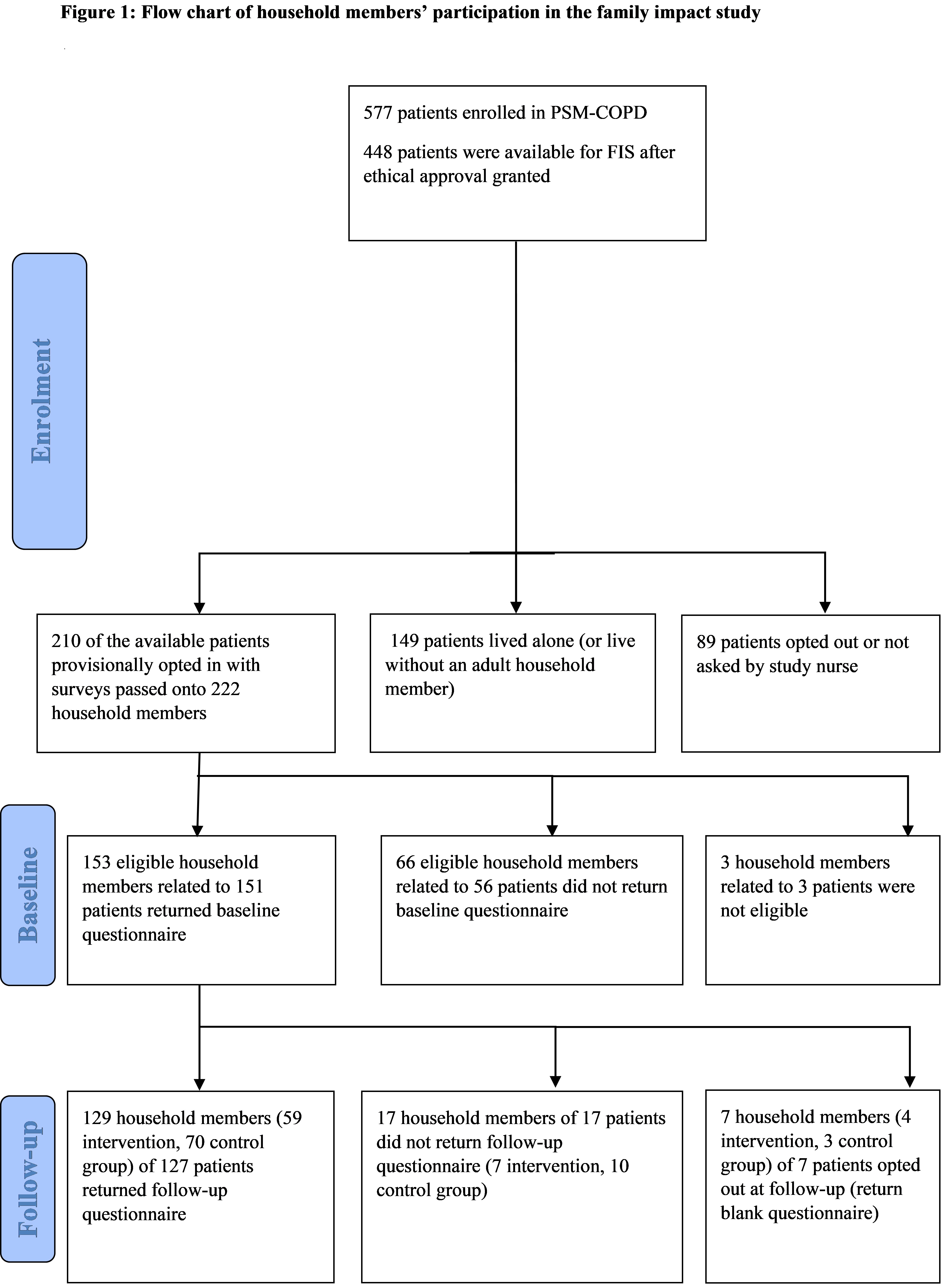
Household members’ entry into the FIS is summarized in Supplementary Figure 1. Of the 448 patients available for the FIS, 210 of the patients agreed to pass on questionnaires to household members, 149 patients lived alone or without another adult household member, and eighty-nine patients did not consent to participate in the FIS. From the 210 consenting households, 153 household members returned the survey and were included in the study at baseline (1 household member per patient for 151 patients and 2 household members per patient for two patients). A total of 129 of these household members responded at follow-up. Of the 129, 114 household members fully completed all items of the EQ-5D-5L at both baseline and follow-up.
Table 2 reports baseline characteristics for household members and patients in the intervention and usual care groups. The average age of household members was 65.7 years, 73 percent of household members were female and 93 percent of household members were the spouse of the patient. It can be seen at baseline that household members in the usual care group exhibited poorer health behaviors (smoking and exercise) than the intervention group. The mean EQ-5D-5L score was 0.85 for family members and 0.90 for patients. (Insert Table 2 here).
Descriptive Statistics for Intervention and Usual Care Samples in FIS (Baseline Data)

FIS, family impact study; SD, standard deviation.
Note. SGRQ-C (St Georges Respiratory Questionnaire for COPD) is a 0 to 100 disease-specific measure of COPD quality of life. Score of 100 indicates full COPD QoL. MRC scale is a measure of patients’ level of breathlessness (1 is an indicator of very mild breathlessness, 4 indicates severe breathlessness).
We assessed baseline characteristics for all PSM-COPD patients, that is, including patients whose household members participated in the FIS, patients whose household members did not and patients who lived alone (Supplementary Table 1). Here, we saw that demographic and clinical characteristics were broadly similar across the three groups of patients, although we observed patients living alone reported worse mean EQ-5D-5L scores, lower median physical activity and higher prevalence of smoking. Household members who were lost to follow-up were similar in most characteristics to those who were not (Supplementary Table 2), although they reported worse mean EQ-5D-5L scores at baseline of 0.80 relative to those who were not lost to follow-up (mean baseline score = 0.86).
Outcomes of Household Members
The mean health status of household members in both the control group and intervention group worsened over the 12 months, although the declines were not significant at the 5 percent level (Table 3). We conducted an unadjusted analysis for household member outcomes where we only adjusted for the baseline outcome, as well as an adjusted analysis which included additional covariates of household members’ age and gender. The EQ-5D-5L follow-up score (adjusted for baseline score) in both the unadjusted and adjusted analyses was slightly lower (-0.007 in the unadjusted analysis) for household members in the intervention group, suggesting a negative effect of the intervention on household member health status, although this difference was not statistically significant (p = .75).
Comparison of Change in EQ-5D-5L Scores between Intervention and Control for All Household Members and Spousal Household Members from Baseline to 12 Months

CI, confidence interval; SD, standard deviation.
aUnadjusted analysis assesses the intervention effect on follow-up EQ-5D-5L, adjusted for baseline EQ-5D-5L. Adjusted analysis additionally adjusts for age and gender.
Household members in the intervention group were associated with reduced physical activity of 144 MET minutes per week, and a small increase in stress level and happiness score compared with the control group (Table 4). None of these differences (in physical activity, stress and happiness over 12 months) were statistically significant (Table 4).
Comparison of Change in Physical Activity, Stress (PSS), and Happiness between Intervention and Control for Household Members

CI, confidence interval; MET, metabolic equivalent; SD, standard deviation.
Note. Unadjusted analysis assesses the intervention effect on follow-up outcome, adjusted for baseline outcome. Adjusted analysis additionally adjusts for age and gender.
Economic Evaluation Aggregating Household Member and Patient QALYs and Costs
The ICER disregarding spillover effects was GBP 10,271 (EUR 13,146) per QALY gained (this analysis is reported in section “PSM-COPD trial”). For the 151 main household members, the self-management intervention was estimated to generate mean incremental healthcare costs of GBP 13.37 (95 percent CI: -72.40 to 99.20) (EUR 17.11, 95 percent CI: -92.67 to 126.97) and mean incremental QALYs of -0.0006 (95 percent CI: -0.025 to 0.023). These estimates were not statistically significant. By assuming that the effect on incremental QALYs applies to all 428 main household members in the trial (as 428 PSM-COPD patients reported the presence of a household member), the resulting ICER that was generated is GBP 10,991 (EUR 14,068) per QALY gained (scenario 1), and this ICER increased to GBP 12,913 (EUR 16,528) per QALY gained through the additional incorporation of household member healthcare costs (scenario 3).
By assuming that change in incremental QALYs was only experienced by the responding 151 main household members, an ICER of GBP 10,554 (EUR 13,509) per QALY gained was generated (scenario 2). An ICER of GBP 11,095 (EUR 14,201) per QALY gained was estimated for the analysis which assumed that the effect on incremental QALYs applies to 491 household members (comprising of 428 main household members and 63 second household members) (scenario 4). These ICERs are below the cost-effectiveness thresholds that were proposed in the Methods section of GBP 17,241 (EUR 22,068) (scenarios 1–3) and GBP 15,151 (EUR 19,393) (scenario 4) per QALY gained.
Discussion
The aim of this study was to examine whether a COPD behavioral intervention resulted in QALY changes in patients’ household members (“household spillovers”), and to illustrate methods for including these spillovers in the economic evaluation of the intervention. Household members’ EQ-5D-5L scores were analyzed over the course of 12 months, and it was found that there was negligible change resulting from the self-management intervention, with a nonsignificant 0.007 QALY decrease resulting from the intervention. The impact of including household member incremental QALYs on cost-effectiveness was small, because the magnitude of the household member incremental QALYs estimate was less than 10 percent of the magnitude of the patient incremental QALYs estimate.
It is important to contextualize these results in terms of patient outcomes from the self-management intervention. Whilst the self-management intervention led to significant improvements in patients’ action planning, medication management and short-term physical activity, it did not produce a statistically significant effect on patients’ health related quality of life, smoking, or physical activity at 12 months (Reference Jolly, Sidhu and Hewitt36), which may explain the absence of statistical significance in household member spillover outcomes. This pattern also emerged in the three previous trials which have measured family health spillovers, where the intervention did not have a significant impact on relevant patient outcomes in these contexts either (Reference Flood, Mugford, Stewart, Harvey, Poland and Lloyd-Smith18–Reference Sturkenboom, Hendriks and Graff20).
Absence of statistical significance in household member outcomes may also be explained by the relatively small sample of household members that were recruited to the study. Furthermore, the household members of the intervention group patients were already exhibiting positive health behaviors at baseline. For instance, only 7 percent of household members in the intervention group reported being smokers, and 43 percent reported participating in high levels of physical activity. This may explain a potential lack of scope for the intervention in improving the health and health behaviors of household members.
Another issue is that, even when patient health status improves at a statistically significant level over the course of a trial, health spillovers may not do so, as health spillovers are generally much smaller in magnitude to direct patient health changes (Reference Wittenberg, Ritter and Prosser51). There is also the question of whether health measures are appropriate to capture spillover. While evidence suggests they perform adequately (Reference Bhadhuri, Jowett, Jolly and Al-Janabi5), the use of a care-related quality of life measure may offer greater sensitivity in detecting changes in domains of wellbeing influenced by the caring role (e.g., “feeling supported”, “relationships”, “fulfilment”). However, care-related quality life may not be considered relevant to economic evaluations with the underlying purpose of maximizing health-related QALYs (Reference Hoefman, Van Exel and Brouwer52).
This study highlights several methodological challenges for economic evaluations including spillover effects. First, spillover data may be partial, because some patients do not have household/family members and because some of those that do, may not respond. Second, health resource use data from household members may be considered relevant under a healthcare or a societal perspective. However, it is also very rarely considered in economic evaluation, but may (as in this case) be a more important influence on the ICER than household members’ health outcomes, Third, ICER thresholds need to reflect the fact that spillovers are displaced (as well as patient QALYs) when interventions are funded from a fixed budget. The distributional implications from the routine incorporation of spillover effects in economic evaluation are also unclear and could be further explored. For example, although the elderly are more likely to receive informal care, they are also more likely to live alone. Similarly, although mental health conditions seem to be associated with relatively big spillovers (Reference Wittenberg, Ritter and Prosser51), many people with mental health conditions are cut off from close family.
This is the first CUA to consider health spillover generated from a behavioral health intervention; previous studies have only focused on drugs and clinical treatments for patients generating QALY effects in household members (Reference Goodrich, Kaambwa and Al-Janabi23). The loss to follow-up of household members (n = 24; 16 percent) was not substantial and the characteristics of those lost to follow-up were similar to those retained. Therefore, loss to follow-up was unlikely to have resulted in substantial bias. A range of outcomes of household members were assessed in the between-groups analysis, including variables that might be associated with undetected future health spillovers. Furthermore, a novel approach was used for including household member QALYs in the economic evaluation, by adjusting the conventional NICE threshold, and adjusting for the 26 percent of PSM-COPD patients who lived alone through a 26 percent reduction of the estimate of incremental QALYs of household members.
A limitation of this study was that the sample size of household members (n = 153) was much smaller than the sample size of patients (n = 577). This meant a lack of statistical power in the analysis of household member outcomes. It may have also resulted in the moderate imbalance that was observed between the characteristics of the family members at baseline. The smaller sample size resulted from a combination of factors, with some patients living alone and recruitment of household members was by means of patients (and some patients or their household members decided not to participate). This may be an unavoidable problem in studies such as this one where household members or carers do not have face-to-face contact with the trial administrators (Reference Stewart, Harvey, Poland, Lloyd-Smith, Mugford and Flood43).
In future RCTs, where data collection from household members is feasible and spillovers are likely to be generated from the intervention, we would recommend that all patients are asked whether they consent to enrolling their household members in data collection at baseline. Furthermore, there are ways in which researchers may be able to capture spillovers more fully than in this trial. For instance, future practice may wish to consider measuring household member outcomes over a longer time period in a trial, perhaps extending beyond the follow-up data collection for patients, as it may take time before household members’ health status is impacted by spillovers from the emotional and care burden generated by illness.
Furthermore, in this study, we estimated patient incremental QALYs and household member incremental QALYs separately before aggregating the mean estimates. We considered the alternative option of carrying out an analysis of 151 patient-household member dyads to resemble the approach taken in other studies (Reference Meeuwsen, Melis and Van Der Aa19;Reference Sturkenboom, Hendriks and Graff20). These were the dyads where both the patient and their related household member completed baseline questionnaires. However, such an analysis would have involved dropping 73 percent of patients (n = 426) from the analysis as they did not have a participating household member. The advantage that a dyadic analysis has over the multiplier approach for including health spillovers is that it enables a probabilistic sensitivity analysis to be conducted to explore cost-effectiveness uncertainty. In future studies, we would recommend using a dyadic approach only where there is not a considerable number of patients who live alone or do not have an informal carer or family member participating in data collection, so that substantial amounts of patient data are not eliminated from the analysis.
In conclusion, this quantitative study found that a COPD self-management intervention aimed at improving the health of patients did not generate a large or statistically significant health spillover effects on household members over the course of 12 months. As a result, the impact of including health spillovers in the economic evaluation of the intervention was small. However, the study raises several methodological issues including the overall approaches available for including health spillover effects in an economic evaluation, the use of an appropriate factor to account for the nonexistence of household spillover for patients who live alone, and the appropriate choice of threshold when including health spillovers in a cost-utility analysis. Furthermore, the inclusion of household spillovers may make a difference to the cost-effectiveness of interventions in other contexts.
Supplementary material
The supplementary material for this article can be found at https://doi.org/10.1017/S026646231900028X.
Acknowledgments
We are grateful to the household members of the PSM-COPD trial participants for assistance for completing the questionnaires for this study. We are also grateful to Sergio Jimenez and participants at the third staff-student EuHEA in Barcelona (2016), where an earlier version of the manuscript was discussed. We also thank Manbinder Sidhu and Khaled Ahmed for their assistance with data collection, and James Martin and Tosin Lambe for their guidance with data analysis. The sponsor of the research is the University of Birmingham, which funded the lead author's doctoral studentship. There were no further sources of financial assistance that were used to conduct the study described in the manuscript, or used to assist with the preparation of the manuscript. Kate Jolly, Sue Jowett and Hareth Al-Janabi are currently employed by the University of Birmingham. The PSM-COPD study was funded by the National Institute for Health Research (NIHR) School for Primary Care Research and Collaboration for Leadership in Applied Health Research and Care (CLAHRC) West Midlands. Hareth Al-Janabi is funded by an NIHR Career Development Fellowship (CDF-2015-08-025). Arjun Bhadhuri reports a grant from Merck Sharp and Dohme, outside the submitted work. Hareth Al-Janabi reports personal fees from GSK and personal fees from Pfizer, outside the submitted work.
Conflicts of interest
Arjun Bhadhuri reports grants from Merck Sharp and Dohme, outside the submitted work. Hareth Al-Janabi reports personal fees from GSK and personal fees from Pfizer, outside the submitted work. There are no conflicts of interest to declare for Sue Jowett and Kate Jolly.