Introduction
The Ordovician is a key interval for understanding the evolutionary history and diversification of crinoids (Echinodermata) because nearly all major clades first appear in Ordovician strata (Guensburg and Sprinkle, Reference Guensburg and Sprinkle2003; Ausich et al., Reference Ausich, Kammer, Rhenberg and Wright2015; Wright et al., Reference Wright, Ausich, Cole, Peter and Rhenburg2017). After their initial diversification during the Early Ordovician, crinoids subsequently underwent a major taxonomic and morphologic radiation coincident with the Great Ordovician Biodiversification Event (GOBE) (Webby et al., Reference Webby, Paris, Droser and Percival2004), reaching peak taxonomic diversity during the Katian Stage (Ausich and Deline, Reference Ausich and Deline2012; Wright and Toom, Reference Wright and Toom2017). Following the GOBE, crinoid taxonomic diversity dramatically declined during the Hirnantian and was decimated by the end-Ordovician mass extinctions (Ausich and Deline, Reference Ausich and Deline2012; Wright and Toom, Reference Wright and Toom2017). The transition between the end-Ordovician and Silurian marks a major ecological turnover in Paleozoic crinoid faunas (Ausich et al., Reference Ausich, Kammer and Baumiller1994; Baumiller, Reference Baumiller, David, Guille, Féral and Roux1994; Wright and Toom, Reference Wright and Toom2017), which permanently altered both the diversity and relative abundance of major subclades at high taxonomic scales (Ausich et al., Reference Ausich, Kammer and Baumiller1994). Knowledge of Katian faunas is therefore critically important to understanding the evolutionary history of crinoids because they represent the culmination of ecological complexity following the GOBE and are among the final constituents of the early Paleozoic crinoid macroevolutionary fauna (Ausich et al., Reference Ausich, Kammer and Baumiller1994; Cole et al., Reference Cole, Wright and Ausich2019).
The Upper Ordovician (lower Katian) Bobcaygeon and Verulam formations from the Lake Simcoe area near Brechin, Ontario are comprised of a highly diverse, well-preserved echinoderm fauna called the “Brechin Lagerstätte” (Ausich et al., Reference Ausich, Wright, Cole and Koniecki2018; Cole et al., Reference Cole, Ausich, Wright and Koniecki2018). Crinoids from the Brechin Lagerstätte are preserved alongside a diverse Late Ordovician echinoderm community, including representative asteroids, ophiuroids, paracrinoids, “cystoids,” edrioasteroids, edrioblastoids, cyclocystoids, and homalozoans (Sumrall and Gahn, Reference Sumrall and Gahn2006; Blake and Koniecki, Reference Blake and Koniecki2018; Cole et al., Reference Cole, Ausich, Wright and Koniecki2018). Although the sedimentology, stratigraphy, and paleoecology of these Upper Ordovician strata have been studied in detail (Brett and Taylor, Reference Brett, Taylor, Hess, Ausich, Brett, Simms and Crinoids1999; Armstrong, Reference Armstrong2000), crinoids from the Brechin Lagerstätte have not had a comprehensive taxonomic evaluation since Frank Springer's (Reference Springer1911) classic monograph.
This contribution is the third paper in an ongoing series surveying crinoid echinoderms from the Brechin Lagerstätte (Ausich et al., Reference Ausich, Wright, Cole and Koniecki2018; Cole et al., Reference Cole, Ausich, Wright and Koniecki2018). This work is made possible by a number of complete or nearly complete crinoid specimens collected and made available for study by Joseph Koniecki (Ann Arbor, Michigan). Previously, we conducted a taxonomic re-evaluation of disparid, hybocrinid, and camerate species from the Brechin Lagerstätte (Ausich et al., Reference Ausich, Wright, Cole and Koniecki2018; Cole et al., Reference Cole, Ausich, Wright and Koniecki2018), including the description of five new species and one new genus. In addition to taxonomically focused studies, the spectacular preservation and completeness of the fauna has also provided a framework for a detailed, quantitative paleoecological analysis of niche differentiation and community structure in fossil crinoids (Cole et al., Reference Cole, Wright and Ausich2019). A future study in this series will consider the remaining monocyclic camerates.
In this paper, we provide a comprehensive re-evaluation of all dicyclic inadunate crinoids occurring in the Brechin Lagerstätte, and describe four new species and two new genera. Although all major clades of Ordovician crinoids are represented in the Brechin Lagerstätte, the Cladida (Eucladida and Flexibilia) are the most abundant in our collections. Remarkably, our recent (and ongoing) re-evaluation of crinoids from the Brechin Lagerstätte also indicates cladids are the most taxonomically diverse major lineage of crinoids occurring within the fauna. This pattern contrasts with the expected distribution of taxa corresponding to the Early Paleozoic Crinoid Macroevolutionary Fauna (Ausich et al., Reference Ausich, Kammer and Baumiller1994), which is traditionally considered to be dominated by disparids and diplobathrid camerates (see Cole et al., Reference Cole, Ausich, Colmenar and Zamora2017, table 1 for a summary of clade composition of Katian faunas). Although this incongruence may reflect differences between local and global biodiversity, our unexpected result highlights the importance of new species discovery and systematic revisions to understanding diversity patterns at local to global scales.
Geologic setting
Specimens were collected from the Bobcaygeon and Verulam formations (Upper Ordovician) exposed in the Lake Simcoe region near Brechin, Ontario. Laurentia was located ~20° south of the equator during the Late Ordovician (McKerrow et al., Reference McKerrow, Dewey and Scotese1991), and sediments comprising both formations were deposited in warm-water subtropical environments (Brett and Taylor, Reference Brett, Taylor, Hess, Ausich, Brett, Simms and Crinoids1999; but see Brookfield, Reference Brookfield1988 for an alternative interpretation). The Bobcaygeon Formation ranges from the Sandbian to Katian and is overlain by early Katian strata of the Verulam Formation (Cole et al., Reference Cole, Ausich, Wright and Koniecki2018). Together, these units consist of bioclastic wackestones, grainstones, and packstones interbedded with calcareous shales. The lithology of the Bobcaygeon Formation ranges from lime mudstone- to grainstone-dominant lithologies and are frequently interbedded with shale, suggesting deposition in lagoonal and shoaling settings to shallow shelf environments (Brookfield and Brett, Reference Brookfield and Brett1988; Brett and Taylor, Reference Brett, Taylor, Hess, Ausich, Brett, Simms and Crinoids1999; Armstrong, Reference Armstrong2000). In contrast, limestones in the Verulam are somewhat thinner bedded and have greater proportion of interbedded shale, indicating deposition in a distal-shelf environment (Brett and Taylor, Reference Brett, Taylor, Hess, Ausich, Brett, Simms and Crinoids1999, Armstrong, Reference Armstrong2000). Crinoid-bearing horizons occur throughout the Bobcaygeon and lower Verulam (lower Katian) (Cole et al., Reference Cole, Ausich, Wright and Koniecki2018).
As noted by Cole et al. (Reference Cole, Ausich, Wright and Koniecki2018), the stratigraphic nomenclature for the southern Ordovician of Ontario has been in a state of flux since Springer's (Reference Springer1911) classic publication and has yet to stabilize (Armstrong, Reference Armstrong2000; Paton and Brett, Reference Paton and Brett2019). Consequently, many species reported from these strata have previously been linked with a geological potpourri of named stratigraphic units, including the Hull, Kirkfield, and Cobourg formations. Paton and Brett (Reference Paton and Brett2019) recently redefined the Coboconk and Kirkfield formations, suggested the Bobcaygeon be subdivided into these units, and elevated “Bobcaygeon” to a subcategory within the Simcoe Group. Given the mercurial history of stratigraphic nomenclature of the region, we continue to follow the lithostratigraphic nomenclature of Armstrong (Reference Armstrong2000), which is also consistent with our previous work in this series (Ausich et al., Reference Ausich, Wright, Cole and Koniecki2018; Cole et al., Reference Cole, Ausich, Wright and Koniecki2018). However, we note that crinoid-bearing horizons considered Bobcaygeon herein are equivalent to the Kirkfield Formation sensu Paton and Brett (Reference Paton and Brett2019). Interested readers should see Cole et al. (Reference Cole, Ausich, Wright and Koniecki2018) and Paton and Brett (Reference Paton and Brett2019) for additional discussion on issues surrounding the current stratigraphic nomenclature, geological context, sedimentology, and paleoenvironmental interpretations of these strata.
Materials and methods
Localities
All specimens are from the vicinity of Lake Simcoe region of Brechin, Ontario. New material reported herein was primarily collected from blast piles in active quarries. Stratigraphic resolution for many specimens is coarse, but is constrained to be from an interval spanning ~15 m of upper Bobcaygeon Formation and 5 m of lower Verulam Formation, hereafter referred to as the Bobcaygeon-Verulam boundary interval (Cole et al., Reference Cole, Ausich, Wright and Koniecki2018). Consequently, the upper Bobcaygeon-Verulam boundary interval is commonly the most precise stratigraphic placement possible, as this is the fossiliferous part of the section. More precise stratigraphic data are given where possible; localities and collection horizons for all specimens are summarized in Supplemental Materials (Supplemental Data 1). Quarries from which new crinoids from the J.M. Koniecki collection were recovered include the Carden Quarry (44°34′03.35″N, 79°06′09.5″W), located 6 km east of the town of Brechin; the LaFarge Quarry (44°31′55.9″N, 79°09′04.78″W), located 2 km southeast of Brechin; the Tomlinson Quarry (44°35′04.59″N, 79°05′07.04″W), located 14 km northeast of Brechin; and the James Dick Quarry (44°29′56.2″N, 79°09′37.0″W), located 6 km south of Brechin. Because the “Kirkfield” Quarry (44°35′06.32″N, 78°58′08.16″W) has been flooded and is no longer accessible, no new specimens were collected from this historically important locality.
Repositories and institutional abbreviations
All new material for this study is reposited in the University of Michigan Museum of Paleontology (UMMP). Repositories of other specimens considered here include Geological Survey of Canada, Ottawa, Canada (GSC); Royal Ontario Museum, Toronto, Canada (ROM); and Springer Collection, U.S. National Museum of Natural History, Smithsonian Institution, Washington, D.C. (USNM).
Systematic paleontology
Classification and morphological terms
The classification of crinoid higher taxa used here follows Wright et al. (Reference Wright, Ausich, Cole, Peter and Rhenburg2017), and is based on a series of recent phylogeny-based systematic revisions to crinoid higher taxa (Ausich et al., Reference Ausich, Kammer, Rhenberg and Wright2015; Wright and Ausich, Reference Wright and Ausich2015; Cole, Reference Cole2017, Reference Cole2018; Wright, Reference Wright2017a, Reference Wright2017b; Wright and Toom, Reference Wright and Toom2017). Other aspects of suprageneric classification used herein follow Moore and Teichert (Reference Moore and Teichert1978) and Wright (Reference Wright2017a).
The phylogenetic classification of Wright et al. (Reference Wright, Ausich, Cole, Peter and Rhenburg2017) differs from previous classifications with respect to the placement of non-camerate taxa, particularly within the Cladida. Phylogenetic analyses recover disparids as sister to cladids and several groups formerly afforded high taxonomic ranks (e.g., subclasses and orders) are nested within a more inclusive clade of cladids (Guensburg, Reference Guensburg2012; Ausich et al., Reference Ausich, Kammer, Rhenberg and Wright2015; Wright, Reference Wright2017a). For example, hybocrinids are closely related to a group of cladids in the Porocrinidae (Guensburg, Reference Guensburg2012; Ausich et al., Reference Ausich, Kammer, Rhenberg and Wright2015; Wright, Reference Wright2017a), and together the Hybocrinida and Porocrinida comprise the Porocrinoidea (Wright, Reference Wright2017a). Similarly, the Flexibilia was long been thought to have been derived from an ancestor with “cladid”-like (i.e., plesiomorphic) features, such as species within the genus Cupulocrinus (Springer, Reference Springer1911, Reference Springer1920; Moore and Laudon, Reference Moore and Laudon1943; Simms and Sevastopulo, Reference Simms and Sevastopulo1993). Recent phylogenetic and morphological investigations have corroborated this hypothesis and flexibles are now considered a superorder within the Cladida (Wright, Reference Wright2017a; Wright and Toom, Reference Wright and Toom2017; Wright et al., Reference Wright, Ausich, Cole, Peter and Rhenburg2017; Peter, Reference Peter2019).
General morphological terms are based on Ubaghs (Reference Ubaghs, Moore and Teichert1978) and posterior plate homologies follow Wright (Reference Wright2015). The shorthand notation used to describe the nodal-internodal structure of heteromorphic columns is from Webster (Reference Webster1974).
Class Crinoidea Miller, Reference Miller1821
Subclass Pentacrinoidea Jaekel, Reference Jaekel1918
Infraclass Inadunata Wachsmuth and Springer, 1885
Family Metabolocrindae Jaekel, Reference Jaekel1902
Included genera
Metabolocrinus Jaekel, Reference Jaekel1902; Cyliocrinus Jaekel, Reference Jaekel1918; Eopinnacrinus Brower and Veinus, Reference Brower, Veinus and Sprinkle1982; Konieckicrinus n. gen. The Devonian genus Pagecrinus Kirk, Reference Kirk1929 was placed in the Metabolocrinidae by Moore and Teichert (Reference Moore and Teichert1978), but is no longer considered a metabolocrinid (McIntosh, Reference McIntosh1979; Webster and Webster, Reference Webster and Webster2013).
Occurrence
Upper Ordovician to Silurian (Sandbian–Wenlock); United States (Oklahoma), Canada (Ontario), Estonia, and Sweden.
Remarks
The Metabolocrindae are a rare, morphologically distinct group of early Paleozoic crinoids with dicyclic calyces and have been traditionally placed within the Cladida as defined by Moore and Laudon (Reference Moore and Laudon1943). However, their phylogenetic position within the Pentacrinoidea is currently in question. Phylogenetic analysis of early to middle Paleozoic pentacrinoid (i.e., non-camerate) taxa by Wright (Reference Wright2017a) recovered Metabolocrinus as sister to Merocrinus, which together form a clade more closely related to disparids than cladids. However, the affinity of this clade with the Disparida was not well supported in the maximum clade credibility tree (posterior probability < 0.50). We consider the Metabolocrinidae as dicyclic Inadunata, but acknowledge uncertainty in their broader phylogenetic relationships. Regardless of their phylogenetic position, the Metabolocrinidae are united by several morphological features, including the presence of pinnules, one to three rectangular primibrachials, and rays commonly comprised of two predominant rami. This combination of features is highly unusual in Ordovician inadunates and supports the monophyly of the Metabolocrinidae (Ausich, Reference Ausich1998). Future studies resolving relationships between metabolocrinids and other early crinoid lineages are warranted, but beyond the scope of this contribution.
Genus Konieckicrinus new genus
Type species
Konieckicrinus brechinensis n. gen. n. sp.
Other species
Konieckicrinus josephi n. gen. n. sp.
Diagnosis
Metabolocrinid with low bowl-shaped calyx, dicyclic, stellate plate sculpturing; brachials uniserial, primibrachials two, rectilinear, secundibrachials cuneate to slightly wedge shaped; isotomous to poorly isotomous arm branching, more common in distal crown; pinnulate; radianial present, located below and to the left of the C-ray radial; anal X present, above radianal, in lateral contact with C and D ray radials, supporting an anal sac; column circular, heteromorphic, crenulated to straight articulations between columnals, lumen circular, holdfast radicular and dendritic.
Occurrence
Upper Ordovician (Katian); Canada (Ontario).
Etymology
Konieckicrinus is named in honor Joseph Koniecki, who collected, prepared, and generously donated many specimens used for this project.
Remarks
To our knowledge, species belonging to Konieckicrinus were not recognized from material collected from the Kirkfield region.
Konieckicrinus is assigned to the Metabolocrinidae based on the presence of pinnulate arms, but differs from other metabolocrinids in having two primibrachials. The cuneate brachials of Konieckicrinus suggest close affinities with the Ordovician genus Eopinnacrinus from the Bromide Formation (Brower and Veinus, Reference Brower, Veinus and Sprinkle1982), which was placed in the Metabolocrinidae by Ausich (Reference Ausich1998). However, Konieckicrinus differs from Eopinnacrinus in having stellate rather than nodose ornamentation on cup plates, somewhat asymmetric and poorly isotomous branching above secundibrachials, and an axillary on the second rather than first primibrachial.
Species of Konieckicrinus have some of the longest reported stems from the Brechin Lagerstätte (Cole et al., Reference Cole, Wright and Ausich2019), which indicates they likely occupied the highest ecological tiers alongside the long-stemmed disparid Daedalocrinus and camerates Archaeocrinus sundayae Cole et al., Reference Cole, Ausich, Wright and Koniecki2018, Reteocrinus alveolatus Miller and Gurley, Reference Miller and Gurley1894, and Glyptocrinus ramulosus Billings, Reference Billings1856. Secondary niche differentiation among these upper-tier taxa likely relate to fan density and structure (Ausich, Reference Ausich1980; Cole et al., Reference Cole, Wright and Ausich2019), which corresponds to the primary morphological differences separating species of Konieckicrinus.
Konieckicrinus brechinensis new species
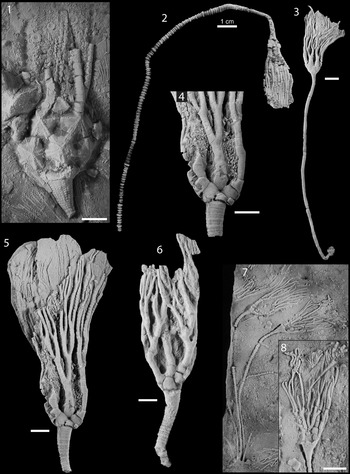
Figures 1.1, 1.2, 2.1
Species of Konieckicrinus n. gen. from the Upper Ordovician (Katian) of southern Ontario. (1, 2) Konieckicrinus brechinensis n. gen. n. sp.; (1) UMMP 74779, paratype, juvenile specimen, lateral view; (2) UMMP 74778, holotype, CD-interray view of crown; (3–8) Konieckicrinus josephi n. gen. n. sp.; (3) UMMP 74782, paratype, lateral view of crown; (4) UMMP 74781, paratype, lateral view with nearly complete stem; (5) UMMP 74783, paratype, juvenile specimen with undeformed cup; (6) UMMP 74663.1, lateral view of specimen with undeformed cup; (7, 8) UMMP 74780, holotype; (7) CD interray view of crown with partial stem preserved; (8) closeup of crown with posterior interray. All scale bars 5 mm, unless otherwise indicated.

Plate diagrams of new genera from the Brechin Lagerstätte, Ontario. (1) Konieckicrinus brechinensis n. gen. n. sp. UMMP 74778, holotype; (2) Simcoecrinus mahalaki n. gen. n. sp. UMMP 74795, holotype. Solid black lines = plate boundaries, dashed lines = plate ornamentation, jagged lines = broken plate margins, black fill = radials, diamond fill = radianal, gray fill = matrix, ruled fill = plate edges/undersides, stipple = anal plates, X = anal X.

Type specimens
Holotype UMMP 74778; paratype UMMP 74779.
Diagnosis
Species of Konieckicrinus n. gen. with numerous arm branching divisions throughout the length of the crown; isotomous to poorly isotomous branching above the secundibrachials; tertibrachials typically branching within the lower 33–50% of the total crown height.
Occurrence
Specimens reported here are from the Bobcaygeon-Verulam contact zone, Carden Quarry, Upper Ordovician (Katian), Canada (Ontario).
Description
Crown medium in size, height to width ratio ~1.8, calyx low bowl shaped, ~ 2.6 times wider than high; dicyclic, base slightly convex. Prominent stellate ornamentation on calyx plates.
Infrabasals five, visible from the side, somewhat higher than wide. Basals five, slightly higher than wide, ~1.5 times the height of infrabasals. Radials five, ~1.7 times wider than high, similar in maximum width to basals, but ~70% of their height.
Radianal subpentagonal, with stellate ornamentation, positioned beneath and to the left of the C radial, slightly smaller than basals, but similar in shape. Anal X subpentagonal to hexagonal, positioned above radianal, in contact with C ray radial, apparently supporting a column of anal sac plates, with the remaining structure of the anal sac hidden from view beneath the arms.
Radial facets peneplenary. Brachials uniserial. Primibrachial 1, rectilinear, wider than high, primibrachial 2 axillary, triangular. Secondibrachials moderately cuneate, isotomous to poorly isotomous, branching on secundibrachial 4–9. Distal branches isotomous, with subequally sized divisions arising from each axillary. Brachials in higher brachitaxes becoming slightly narrower and more wedge shaped distally.
Arms stout, pinnulate above primibrachials, arising from all successive brachials except for axillaries. Pinnules robust, multiplated, more slender than main rami.
Oral surface unexposed.
Column circular, holomeric, heteromorphic, with noditaxis sequence N3231323 in proxistele, with small spinose projections apparent on “2” nodals. Columnals increasingly approach subequal sizes more distally, becoming homeomorphic in the dististele. Where completely known, column ~3.5 times the length of the crown. Lumen circular. Holdfast consisting of a terminal radix, dendritic, with radices composed of multiple ossicles.
Etymology
Named for the town of Brechin, Ontario, which is located near where the specimens were collected.
Remarks
Konieckicrinus brechinensis n. gen. n. sp. is equivalent to “Pentacrinoidea sp. B” in the analyses of Cole et al. (Reference Cole, Wright and Ausich2019). Based on the smaller overall size and lower width/height ratio of the brachials, we consider specimen UMMP 74779 to possibly represent a juvenile (Fig. 1.1). See remarks under K. josephi n. gen. n. sp. for a species comparison.
Konieckicrinus josephi new species
Figure 1.3–1.7
Type specimens
Holotype UMMP 74780; paratypes UMMP 74781–74783 and UMMP 74663.1.
Diagnosis
Species of Konieckicrinus n. gen. with main rami along crown length predominantly comprised of secundibrachials; tertibrachials typically branching within the upper 50–70% of the total crown height, with isotomous to poorly isotomous arm branching common only in the distal crown.
Occurrence
Bobcaygeon-Verulam boundary interval, Carden and LaFarge quarries, Upper Ordovician (Katian), Canada (Ontario).
Description
Calyx small to medium size, height to width ratio ~2.0–2.5, low to medium bowl shaped, approximately twice as wide as high; dicyclic, with a convex base. Prominent stellate ornamentation on calyx plates.
Infrabasals five, visible from the side, diamond to subtriangular in shape, slightly higher than wide. Basals five, subequal to slightly higher than wide, approximately twice the height of infrabasals. Radials five, larger than other calyx plates, ~1.5 times wider than high.
Radianal beneath and to the left of the C ray radial plate, ~70% size of basals, possibly hexagonal, but with broadly subquadrangular outline. Anal X similar in size to the radianal; in sutural contact with C and D ray radials laterally and both the radianal and CD basal below. At least three additional anal sac plates with prominent stellate ornamentation visible above anal X, with higher sac plates concealed beneath the arms.
Radial facets angustary to peneplenary. Primibrachial 1 rectilinear, aborally convex, ~2.0–2.5 times as wide as high; primibrachial 2 axillary, triangular in shape. All subsequent brachials moderately cuneate. Secundibrachials more numerous than other brachitaxes, commonly more than 10 ossicles per ramus, ranging to more than 20, and comprising the majority of brachials along the length of the crown. First tertibrachials positioned ~50–70% of the total height of the crown; subsequent branching divisions isotomous to poorly isotomous, becoming more numerous distally. Tertibrachials and above slightly narrower than secundibrachials.
Pinnules present, first appearing on secundibrachial 2 and following on all successive brachials except for axillaries; robust, multiplated, ranging from more slender than main arm divisions to approaching the height of brachials in distal divisions.
Oral surface unknown.
Column circular, holomeric, crenulated to straight articulations between columnals, heteromorphic, with noditaxis sequence ranging from N3231323 to N212 in proxistele, nodals becoming homeomorphic in dististele. In complete specimens, column is at least 7.75 times the length of the crown.
Etymology
The specific name is in honor of Joseph Koniecki, who contributed specimens belonging to this species.
Remarks
Konieckicrinus josephi n. gen. n. sp. is equivalent to “Pentacrinoidea sp. A” in the analyses of Cole et al. (Reference Cole, Wright and Ausich2019).
A comparison of all known specimens of Konieckicrinus n. gen. reveals no consistent differences in size or overall shape between the two species recognized herein. The primary distinctions between species relate to the pattern of arm branching and number of secundibrachials, both of which contribute to differences in the structure of the filtration fan (Cole et al., Reference Cole, Wright and Ausich2019). Specimens belonging to K. josephi n. gen. n. sp. are distinguished from K. brechinensis n. gen. n. sp. in having a greater number of secundibrachials, commonly >15–20 per ramus, with tertibrachials and higher branching divisions only appearing in the upper ~50–70% of the crown rather than below, as in K. brechinensis n. gen. n. sp.
Family Merocrinidae Miller, Reference Miller1890
Genus Praecupulocrinus Brower, Reference Brower1992
Type species
Praecupulocrinus conjugans (Billings, Reference Billings1857); by monotypy.
Other species
See Remarks for species.
Occurrence
Upper Ordovician (Sandbian–Katian); Canada (Ontario, Quebec), North America (Illinois, Iowa, Minnesota), and questionably the United Kingdom.
Remarks
The genus Praecupulocrinus was described by Brower (Reference Brower1992) with Dendrocrinus conjugans Billings, Reference Billings1857 as the type species and placed in the Cupulocrinidae. However, phylogenetic analyses do not recover Praecupulocrinus conjugans within the Cupulocrinus + Flexibilia clade (Ausich, Reference Ausich1998; Wright, Reference Wright2017a). Ausich (Reference Ausich1998) recovered close relationships among Praecupulocrinus, Merocrinus, and Polycrinus, and placed these genera in the Merocrinidae. Although we agree with Ausich (Reference Ausich1998) that Praecupulocrinus is likely a merocrinid, we consider Praecupulocrinus as having unknown suprafamilial affinities because of uncertainty in the phylogenetic position of Merocrinus (Ausich, Reference Ausich1998; Ausich et al., Reference Ausich, Kammer, Rhenberg and Wright2015; Wright, Reference Wright2017a).
Praecupulocrinus conjugans (Billings, Reference Billings1857)
Figure 3.2, 3.4–3.8
- Reference Billings1857
Dendrocrinus conjugans Billings, p. 268.
- Reference Billings1859
Dendrocrinus conjugans; Billings, p. 41, pl. 4, figs. 1, 2.
- Reference Billings1859
Dendrocrinus cylindricus Billings, p. 44, pl. 3, figs. 8a, 8b.
- Reference Shumard1868
Dendrocrinus conjugans; Shumard, p. 365.
- Reference Shumard1868
Dendrocrinus cylindricus; Shumard, p. 365.
- Reference Bigsby1868
Dendrocrinus conjugans; Bigsby, p. 19.
- Reference Bigsby1868
Dendrocrinus cylindricus; Bigsby, p. 19.
- Reference Miller1889
Dendrocrinus conjugans; Miller, p. 238.
- Reference Miller1889
Dendrocrinus cylindricus; Miller, p. 238.
- Reference Grabau and Shimer1910
Dendrocrinus conjugans; Grabau and Shimer, p. 504.
- Reference Grabau and Shimer1910
Dendrocrinus cylindricus; Grabau and Shimer, p. 505.
- Reference Springer1911
Cupulocrinus conjugans; Springer, p. 37.
- Reference Bassler1915
Dendrocrinus conjugans; Bassler, p. 314.
- Reference Bassler1915
Cupulocrinus conjugans; Bassler, p. 314.
- Reference Bassler1915
Dendrocrinus cylindricus; Bassler, p. 314.
- Reference Bassler and Moodey1943
Cupulocrinus conjugans; Bassler and Moodey, p. 386.
- Reference Bassler and Moodey1943
Cupulocrinus cylindricus; Bassler and Moodey, p. 387.
- Reference Wilson1946
Cupulocrinus conjugans; Wilson, p. 36, pl. 6.6.
- Reference Webster1973
Cupulocrinus conjugans; Webster, p. 92.
- Reference Kolata1975
Cupulocrinus conjugans; Kolata, p. 37, pl. 6.4.
- Reference Webster1986
Cupulocrinus conjugans; Webster, p. 110.
- Reference Kolata, Brower and Frest1987
Cupulocrinus conjugans; Kolata, Brower, and Frest, p. 180.
- Reference Kolata, Brower and Frest1987
Cupulocrinus sp. aff. C. conjugans; Kolata, Brower, and Frest, p. 180.
- Reference Brower1992
Cupulocrinus conjugans; Brower, p. 111, figs. 8–11, 17.6–17.10.
- Reference Brower1992
Cupulocrinus sp. aff. C. conjugans; Brower, p. 111.
- Reference Brower1992
Praecupulocrinus conjugans; Brower, p. 111, figs. 8–11, 17.6–17.10.
- Reference Brower2006
Praecupulocrinus conjugans; Brower, p. 431, figs. 1.6, 1.7, 14, 15.
- Reference Brower2007
Praecupulocrinus conjugans; Brower, p. 1285, fig. 2.4–2.6.
- Reference Webster and Webster2013
Praecupulocrinus conjugans; Webster and Webster, p. 1881.
Porocrinus conicus and Praecupulocrinus conjugans from the Brechin Lagerstätte. (1) Porocrinus conicus, UMMP 74786, from the Carden Quarry. (2, 4–8) Praecupulocrinus conjugans: (2) UMMP 74789, crown with partial stem preserved; (4, 5) UMMP 74790, (5) lateral view of crown and (4) closeup of proximal crown; (6) UMMP 74788, posterior interray view of crown; (7, 8) UMMP74787-74787.5, six specimens including three individuals with complete stems and attachment structures (UMMP 74787–74787.2, left to right); (8) closeup of crown UMMP 74787.2 with three small specimens (UMMP 74787.3–74787.5, left to right) in the distal arms, identified as probable P. conjugans. (3) Praecupulocrinus? sp. UMMP 74791 with complete stem and crown. All scale bars 5 mm, unless otherwise indicated.

Type specimens
Syntypes GSC 1429 and GSC 1429a.
Diagnosis
Praecupulocrinus with relatively wide aboral cup, long proximal column that gradually tapers below the aboral cup, brachials with small cornices along sides, crown plates smooth (from Brower, Reference Brower1992, p. 111).
Occurrence
Praecupulocrinus conjugans was originally described from the “upper part of the Trenton Limestone” at Ottawa, Canada. These occurrences are now regarded to be Cobourg Beds (Katian). In addition, this taxon has been reported from the Rivoli and Sherwood members of the Dunleith Formation, Galena Group from Minnesota and Iowa (Sandbian). In the Brechin Lagerstätte this crinoid is known from the Bobcaygeon-Verulam boundary interval at the Carden Quarry and the LaFarge Quarries (Ordovician, Katian).
Description
Crown medium in size, sub-conical. Aboral cup low cone shaped, width to height ratio slightly more than 2.0, distal aboral cup width versus the proximal aboral cup width relatively wide; plates gently convex, smooth.
Infrabasals five, equal in size, height to width ratio ~0.6; infrabasal circlet ~20% of aboral cup height, base truncate. Basals five, hexagonal, largest plates in aboral cup, height to width ratio 1.1; basal circlet ~45% of aboral cup height. Radials five, pentagonal except C and D radials that articulate with small CD interray plates, height to width ratio ~0.78; radial circlet ~35% of aboral cup height; maximum height of radial plates at mid height, taper distally. Radial facets plenary, planate; radial facet topography unknown.
Radianal nearly pentagonal, directly below C radial, approximately as high as wide; anal X large, 1.4 times wider than high, asymmetical; all subsequent plates in anal series above calyx, convex.
Oral region and anal sac presumably comprised of small polygonal plates; other details of oral region and anal sac only known from disarticulated plates.
Arms branch with poor isotomy four times. Axillaries approximately as wide as high and approximately the same size as other brachial plates. Primibrachial 3 or 4 axillary. First secundibrachials in lateral contact medially, secundibrachial 4 or 5 axillary; first tertibrachials in lateral contact medially, tertibrachial 4–7 axillary where branched; quartibrachial 12–14 axillary. All brachials rectangular uniserial, aborally convex, deep, nonaxillary brachials approximately as high as wide.
Column circular, holomeric, heteromorphic. Proximal columnals heteromorphic, 15–30 times wider than high, tapering distally but with no clear demarcation between proxistele and mesistele. Mesistele heteromorphic with sequence N32123, nodals >2.5 times wider than high, highly convex, each subsequent internodal cycle progressively higher, narrower, and less convex; tertinternodal with flat latus and ~3 times wider than high where most differentiated. Cemented holdfast in at least small specimens.
Materials
New specimens of P. conjugans include UMMP 74787–74787.5 and UMMP 74788–74790.
Remarks
Although Brower (Reference Brower1992) tentatively placed the Scottish species Praecupulocrinus? gracilis (Ramsbottom, Reference Ramsbottom1961) in Praecupulocrinus, he considered its taxonomic affinities to be either Cupulocrinus or Praecupulocrinus?. Because this species does not occur in the Brechin Lagerstätte, we do not discuss it here.
Within the Brechin fauna, Praecupulocrinus conjugans most closely resembles species of Cupulocrinus, although phylogenetic analyses indicate they are not closely related (Ausich, Reference Ausich1998; Wright Reference Wright2017a). As noted by Brower (Reference Brower1992), Praecupulocrinus is clearly differentiated from species belonging to Cupulocrinus by multiple characters, including the shape of the aboral cup, the ratio of the distal versus proximal aboral cup width, having narrow radial facets, a proximal column that expands gradually toward the aboral cup, arms that are long and slender relative to the aboral cup, and weak patelloid processes on the proximal (but not distal) brachials.
Praecupulocrinus? sp.
Figure 3.3
Materials
UMMP 74791 (Bobcaygeon-Verulam boundary interval, Carden Quarry).
Remarks
This unusual specimen is questionably assigned to Praecupulocrinus. Although the specimen is highly complete, its taxonomic affinity is dubious because the posterior interray is not visible and the specimen exhibits several features that differ from P. conjugans. For example, the heteromorphic column of P. conjugans is characterized by a pronounced, approximately bimodal size distribution of nodals not seen in UMMP 74791. Similarly, P. conjugans has three or four primibrachials, whereas this specimen only has two primibrachials. Thus, we consider this specimen either an aberrant P. conjugans or a different species of uncertain affinity.
Parvclass Cladida Moore and Laudon, Reference Moore and Laudon1943
Superorder Porocrinoidea, Wright, Reference Wright2017a
Order Porocrinida Miller and Gurley, Reference Miller and Gurley1894
Family Porocrinidae Miller and Gurley, Reference Miller and Gurley1894
Remarks
Morphological structures having presumed respiratory significance are present in the majority of species currently assigned to the Porocrinidae (Wright et al., Reference Wright, Ausich, Cole, Peter and Rhenburg2017). Consequently, morphological differences in these structures form an important component of many genus-level diagnoses. For example, respiratory structures in Porocrinus differ from other porocrinids (e.g., Carabocrinus and Palaeocrinus) in being endothecal rather than exothecal. These respiratory structures are present throughout the calyx in genera such as Porocrinus and Palaeocrinus, but only in the proximal calyx and oral surface in Carabocrinus (Sprinkle, Reference Sprinkle and Sprinkle1982). Respiratory structures that differ in morphology or position are commonly given different anatomical terms in the literature. For example, these structures are variously called “rhombs,” “ridge canals,” or “respiratory ridges” in Carabocrinus, whereas in Porocrinus and Triboloporus they are commonly termed “goniospires” (Kesling and Paul, Reference Kesling and Paul1968; Sprinkle, Reference Sprinkle and Sprinkle1982; Brower, Reference Brower1996). For additional discussion on the anatomy, functional morphology, and paleophysiology of porocrinoid respiratory structures, see Sprinkle (Reference Sprinkle and Sprinkle1982, p. 153), Brower and Veinus (Reference Brower and Veinus1974, p. 45–51), and Brower (Reference Brower1996, p. 626).
Genus Porocrinus Billings, Reference Billings1857
Type species
Porocrinus conicus Billings, Reference Billings1857.
Other species
Porocrinus bromidensis Sprinkle, Reference Sprinkle and Sprinkle1982; P. crassus Meek and Worthen, Reference Meek and Worthen1865; P. elegans Kesling and Paul, Reference Kesling and Paul1968; P. fayettensis Slocom, Reference Slocom1924; P. kentuckiensis Miller and Gurley, Reference Miller and Gurley1894; P. lebanonensis Guensburg, Reference Guensburg1984; P. pentagonius Meek and Worthen, Reference Meek and Worthen1865; P. petersenae Kesling, Reference Kesling1972; P. plattinensis Shourd and Winter, Reference Shourd and Winter1976; P. pyramidatus Kesling and Paul, Reference Kesling and Paul1968; P. scoticus Ramsbottom, Reference Ramsbottom1961; P. shawi Schuchert, Reference Schuchert1900; P. smithi Grant, Reference Grant1881.
Diagnosis
A porocrinid with a conical to ovoid calyx; endothecal respiratory structures, circular to triangular in shape, appearing at most plate sutures throughout the calyx; radianal and anal X present in cup; arms atomous; column proxistele thickened, tapering distally.
Occurrence
Upper Ordovician (Sandbian–Katian) of Canada (Ontario), the United States (Illinois, Iowa, Kentucky, Minnesota, Missouri, Oklahoma, Tennessee, Wisconsin), and the United Kingdom (Scotland).
Porocrinus conicus Billings, Reference Billings1857
Figure 3.1
- Reference Billings1857
Porocrinus conicus; Billings, p. 279.
- Reference Billings1859
Porocrinus conicus; Billings, p. 34, pl. 2, figs. 5a–5d.
- Reference Shumard1868
Porocrinus conicus; Shumard, p. 391.
- Reference Bigsby1868
Porocrinus conicus; Bigsby, p. 23.
- Reference Quenstedt1885
Porocrinus conicus; Quenstedt, p. 954, pl. 76, fig. 27.
- Reference Miller1889
Porocrinus conicus; Miller, p. 273, fig. 400.
- Reference Zittel and von1895
Porocrinus conicus; Zittel, p. 155, fig. 304, no. a.
- Reference Steinmann1903
Porocrinus conicus; Steinmann, p. 180, fig. 250A, 250B.
- Reference Steinmann1907
Porocrinus conicus; Steinmann, p. 201, fig. 285A, 285B.
- Reference Bassler1915
Porocrinus conicus; Bassler, p. 1024.
- Reference Bassler and Quenstedt1938
Porocrinus conicus; Bassler, p. 157.
- Reference Bassler and Moodey1943
Porocrinus conicus; Bassler and Moodey, p. 637.
- Reference Moore and Laudon1943
Porocrinus conicus; Moore and Laudon, p. 131, pl. 2, fig. 7.
- Reference Moore, Laudon, Shimer and Shrock1944
Porocrinus conicus; Moore and Laudon, p. 153, pl. 53, fig. 13.
- Reference Wilson1946
Porocrinus conicus; Wilson, p. 39.
- Reference Kesling and Paul1968
Porocrinus conicus; Kesling and Paul, p. 26, pl. 6, figs. 1–5, 7, 11, 12.
- Reference Webster1973
Porocrinus conicus; Webster, p. 220.
- Reference Webster1986
Porocrinus conicus; Webster, p. 261.
- Reference Webster and Webster2013
Porocrinus conicus; Webster and Webster, p. 1837.
Type specimen
GSC 1423d.
Diagnosis
Species of Porocrinus with a subconical calyx; calyx plates with faint ridges, nearly smooth; endothecal pore structures small to medium in size, circular to subtriangular; column wide in proxistele, tapering distally.
Occurrence
Upper Ordovician (Katian); United States (Wisconsin); Canada (Ontario). The new occurrence documented here is from the Bobcaygeon-Verulam boundary interval of the Carden Quarry.
Materials
UMMP 74786 and ROMIP 50639.
Remarks
Many specimens of this unusual taxon are known, and the species was well described by Kesling and Paul (Reference Kesling and Paul1968).
Genus Carabocrinus Billings, Reference Billings1857
Type species
Carabocrinus radiatus Billings, Reference Billings1857.
Other species
Carabocrinus boltoni Ausich and Copper, Reference Ausich and Copper2010; C. crateriformis (Hall, Reference Hall1866); C. conoideus Sardeson, Reference Sardeson1925; C. dicyclicus (Sardeson, Reference Sardeson1899); C. esthonus Jaekel, Reference Jaekel1918; C. geometricus Hudson, Reference Hudson1905; C. granulosus Evans, Reference Evans1926; C. huronensis Foerste, Reference Foerste1924; C. magnificus Sardeson, Reference Sardeson1939; C. micropunctatus Brower and Veinus, Reference Brower and Veinus1974; C. oogyi Kolata, Reference Kolata1975; C. ovalis Miller and Gurley, Reference Miller and Gurley1894; C. stellifer Brower and Veinus, Reference Brower and Veinus1974; C. treadwelli Sinclair, Reference Sinclair1945; C. vancortlandti Billings, Reference Billings1859.
Diagnosis
A porocrinid with cup- to ovoid-shaped calyx; exothecal respiratory ridges present, near the calyx summit, restricted to the radials and proximal oral surface; radianal and anal X in cup, radianal divided into infer- and superradianal plates; isotomous or heterotomous arm branching.
Occurrence
Middle to Upper Ordovician (Darriwilian–Katian); Canada (Anticosti Island, Quebec; Ontario), Estonia, United States (Illinois, Iowa, Kentucky, Minnesota, New York, Ohio, Tennessee, Virginia, Wisconsin).
Remarks
Carabocrinus is a well-known and species-rich genus that has been the focus of several previous taxonomic studies, mostly recently by Brower (Reference Brower1996). The two species occurring in the Brechin Lagerstätte also occur elsewhere in Laurentia, including the Dunleith and Maquoketa formations of northern Iowa and southern Minnesota, and C. vancortlandi is also known from the Decorah and Curdsville formations of Kentucky. Both species were reviewed and thoroughly described by Brower (Reference Brower1996).
Carabocrinus radiatus Billings, Reference Billings1857
Figure 4.1, 4.2
- Reference Billings1857
Carabocrinus radiatus Billings, Reference Billings1857, p. 276.
- Reference Billings1859
Carabocrinus radiatus; Billings p. 31, pl. 2, figs. 3a–3e.
- Reference Shumard1868
Carabocrinus radiatus; Shumard, p. 357.
- Reference Bigsby1868
Carabocrinus radiatus; Bigsby, p. 18.
- Reference Miller1889
Carabocrinus radiatus; Miller, p. 182.
- Reference Grabau and Shimer1910
Carabocrinus radiatus; Grabau and Shimer, p. 504, fig. 1817.
- Reference Ruedeman1912
Carabocrinus cf. radiatus; Ruedemann, p. 86, pl., 3, fig. 6.
- Reference Bassler1915
Carabocrinus radiatus; Bassler, p. 183.
- Reference Bassler1915
Carabocrinus cf. radiatus; Bassler, p. 183.
- Reference Bassler and Quenstedt1938
Carabocrinus radiatus; Bassler, p. 60.
- Reference Bassler and Moodey1943
Carabocrinus radiatus; Bassler and Moodey, p. 356.
- Reference Moore and Laudon1943
Carabocrinus radiatus; Moore and Laudon, p. 153, pl., 53, fig. 5.
- Reference Wilson1946
Carabocrinus radiatus; Wilson, p. 38, pl., 5, fig. 5.
- Reference Webster1973
Carabocrinus radiatus; Webster, p. 78.
- Reference Brower1996
Carabocrinus radiatus; Brower, p. 615, figs. 1, 2.
- Reference Webster and Webster2013
Carabocrinus radiatus; Webster and Webster, p. 685.
Porocrinoids from the Brechin Lagerstätte. (1, 2) Carabocrinus radiatus; UMMP 74681.4, (1) posterior view and (2) closeup of cone-like periproct; (3–5) Carabocrinus vancortlandti; (3) UMMP74686.3, lateral view of crown; (4) UMMP 74686.4, juvenile specimen; (5) UMMP 74686.2, lateral view of crown with partial stem; (6–8) Illemocrinus amphiatus; (6) UMMP 74777, lateral view of crown; (7) UMMP 74775, juvenile specimen; (8) UMMP 74776, posterior view of crown. All scale bars 5 mm, unless otherwise indicated.

Type specimens
Lectotype GSC 1425; paralectotypes GSC 1425b–f.
Diagnosis
Species of Carabocrinus with a low but relatively wide calyx, with a rounded base and sides giving a subspherical outline; radial ridges three to four, radial facets narrow (after Brower, Reference Brower1996, p. 615).
Occurrence
Upper Ordovician (Darriwilian–Katian); Canada (Ontario, Quebec), United States (Iowa, Minnesota). A new specimen reported here is from the Bobcaygeon-Verulam boundary interval from the LaFarge Quarry.
Materials
UMMP 74681.4.
Remarks
Although this species is well known and a modern description was provided by Brower (Reference Brower1996), the new specimen reported here is notable in having a well preserved posterior view of the cone-like, pyramid-shaped anal sac, which bears the periproct near the summit (Fig. 4.2).
As noted by Springer (Reference Springer1911), within the Brechin fauna C. radiatus is a small, relatively rare species compared with the larger and more abundant C. vancortlandti.
Carabocrinus vancortlandti Billings, Reference Billings1859
Figure 4.3–4.5
- Reference Billings1859
Carabocrinus vancortlandti Billings, p. 32, pl. 2, fig. 4.
- Reference Shumard1868
Carabocrinus vancortlandti; Shumard, p. 357.
- Reference Bigsby1868
Carabocrinus vancortlandti; Bigsby, p. 18.
- Reference Miller1889
Carabocrinus vancortlandti; Miller, p. 231.
- Reference Weller1900
Carabocrinus vancortlandti; Weller, p. 28, fig. 9.
- Reference Bassler1915
Carabocrinus vancortlandti; Bassler, p. 183.
- Reference Bassler and Moodey1943
Carabocrinus vancortlandti; Bassler and Moodey, p. 356.
- Reference Moore and Laudon1943
Carabocrinus vancortlandti; Moore and Laudon, p. 153, pl. 53, fig. 6.
- Reference Wilson1946
Carabocrinus vancortlandi; Wilson, p. 39.
- Reference Webby, Paris, Droser and Percival1973
Carabocrinus vancortlandti; Webster, p. 78.
- Reference Brower1996
Carabocrinus vancortlandti; Brower, p. 617, figs. 4, 5.
- Reference Webster and Webster2013
Carabocrinus vancortlandti; Webster and Webster, p. 686.
- Reference Cole, Wright and Ausich2019
Carabocrinus vancortlandti; Cole et al., fig. 2h.
Type specimen
GSC 1424.
Diagnosis
Species of Carabocrinus with a large, robust, high globe-shaped calyx; ridge canals present on proximal portion of radial plates; stellate ridges ornamentation on calyx plates, variable in number; radial facets angustary, narrow, column heteromorphic.
Occurrence
Upper Ordovician (Katian); Canada (Ontario), United States (Iowa, Kentucky). New specimens documented here were collected from the Bobcaygeon-Verulam boundary interval of the Carden Quarry.
Materials
UMMP 74686.2–74686.4.
Remarks
The species is well known, occurs in multiple North American localities, and was described most recently by Brower (Reference Brower1996). Carabocrinus vancortlandi is notable for having the largest calyx of all species known from the Brechin Lagerstätte (Cole et al., Reference Cole, Wright and Ausich2019). UMMP 74686.4 is a possible juvenile specimen.
Genus Illemocrinus Eckert, Reference Eckert1987
Type species
Illemocrinus amphiatus Eckert, Reference Eckert1987; by monotypy.
Diagnosis
As for species, by monotypy.
Occurrence
Upper Ordovician (Katian), Canada (Ontario).
Illemocrinus amphiatus Eckert, Reference Eckert1987
Figure 4.6–4.8
- Reference Eckert1987
Illemocrinus amphiatus Eckert, Reference Eckert1987, p. 863, figs 1–4.
- Reference Webster1993
Illemocrinus amphiatus; Webster, p. 72.
- Reference Ausich1998
Illemocrinus amphiatus; Ausich, p. 34.
- Reference Brett, Taylor, Hess, Ausich, Brett, Simms and Crinoids1999
Illemocrinus amphiatus; Brett and Taylor, p. 69, fig. 81.
- Reference Webster and Webster2013
Illemocrinus amphiatus; Webster and Webster, p. 1337.
Type specimen
ROM 45102e.
Diagnosis
Calyx medium in size, medium bowl to globe shaped; calyx plates ornamented with stellate ridges; radianal quadrangular, positioned below and to the left of the C ray radial; anal X above and to the right of the radianal, positioned between the C and D ray radials, supporting three sac plates above; anal sac conical, stout, approximately twice the length of the calyx; arms branch isotomously on primibrachial 2; column short, pentagonal, heteromorphic, pentameric.
Occurrence
Description of the type material by Eckert (Reference Eckert1987) listed six specimens from the upper member of the Bobcaygeon Formation, but the precise horizon was not provided. New specimens reported here are from the Bobcaygeon-Verulam boundary interval of the Carden and LaFarge quarries, Upper Ordovician (Katian).
Materials
UMMP 74775–74777.
Remarks
The morphology of Illemocrinus amphiatus was thoroughly described in Eckert (Reference Eckert1987).
Eckert's (Reference Eckert1987) description of Illemocrinus amphiatus was the first new crinoid described from the Ordovician of the Lake Simcoe region following Springer's (Reference Springer1911) monograph. Illemocrinus was originally placed in the Thalamocrinidae and subsequently moved to the Euspirocrinidae by Ausich (Reference Ausich1998). However, phylogenetic analyses consistently place Illemocrinus amphiatus in a clade comprised of Carabocrinus, Porocrinus, and hybocrinids instead and, therefore, support its placement in the Porocrinoidea (Ausich, Reference Ausich1998; Guensburg, Reference Guensburg2012; Ausich et al., Reference Ausich, Kammer, Rhenberg and Wright2015; Wright et al., Reference Wright, Ausich, Cole, Peter and Rhenburg2017). Illemocrinus can be differentiated from these genera in having a dicylic calyx, elongate anal sac, and lacking morphological structures interpreted to have respiratory functions present on the calyx.
Specimen UMMP 74775 represents a subadult I. amphiatus because of its relatively small size compared to other representatives of the species.
Magnorder Eucladida Wright, Reference Wright2017a
Superorder Cyathoformes Wright et al., Reference Wright and Toom2017
Cyathoformes incertae sedis: “Cyathocrinida” Bather, Reference Bather1899
Family Euspirocrinidae Bather, Reference Bather1890
Genus Simcoecrinus new genus
Type species
Simcoecrinus mahalaki new species, by monotypy.
Diagnosis
As for species, by monotypy.
Etymology
Named after the Lake Simcoe region where specimens belonging to S. mahalaki n. gen. n. sp. were discovered.
Remarks
See remarks for species.
Simcoecrinus mahalaki new species
Figures 2.2, 5.1–5.3
New eucladids from the Brechin Lagerstätte. (1–3) Simcoecrinus mahalaki n. gen. n. sp.; (1) UMMP 74795, holotype, posterior view; (2, 3) UMMP 74794, paratype, (2) lateral view of crown with partial anal sac and stem, (3) closeup of crown and anal sac. (4–6) Dendrocrinus simcoensis n. sp.; (4, 5) UMMP 74769, holotype, (4) closeup of crown; (5) crown with nearly complete stem showing coiled distal holdfast; (6) UMMP 74768 (center) and UMMP 74768.1 (upper left), paratypes, lateral views of crowns. (7) Dendrocrinus? sp.; UMMP 74770 (left) and UMMP 74770.1 (right). All scale bars 5 mm, unless otherwise indicated.

Type specimens
Holotype UMMP 74795; paratype UMMP 74794.
Diagnosis
A euspirocrinid with a small, rounded calyx bearing stellate ridges; radial facets angustary, narrow; radianal present, hexagonal in shape; anal X pentagonal, present in cup, positioned above the radianal and in lateral contact with the C and D ray radial plates; anal sac large, elongated cone with straight sides, sac plates ornamented with radial ridges; brachials uniserial; arms branching isotomously at least three to five times; column pentagonal, pentameric.
Occurrence
Both specimens are from the Bobcaygeon-Verulam boundary interval, Carden Quarry, Upper Ordovician (early Katian).
Description
Crown small, highly elongate in shape; calyx small, bowl shaped, ~1.4 times wider than high, reaching maximum width ≥60% cup height; dicyclic. Plate surfaces ornamented with radial ridges.
Infrabasals five, visible from the side, ~25% of calyx height, pentagonal, height to width ratio ~1:1. Basals five, ~2.0–2.5 times the size of infrabasals, pentagonal, slightly wider than high with a rounded outline. Radials five, largest in calyx, ~1.5–2.0 times as wide as high.
Radianal hexagonal, slightly larger than basals, in lateral contact with the D ray radial plate and in apparent contact with the C ray plate. Anal X in cup, pentagonal, positioned above the radianal, located between the C and D ray radials.
Anal sac large, elongate cone shape, with straight sides but tapering distally, comprised of numerous subequally sized plates, each ornamented with thick, radial ridges. Distal sac plates appear to lack ornamentation.
Radial facets angustary, ~30% the width of the radial plate. Brachials uniserial, small, gently rounded. Axillaries pentagonal, non-axillaries rectilinear, brachitaxes comprised of five or more brachials. Arms thin, nonpinnulate, incompletely preserved, but apparently branching isotomously at least three to five times.
Oral surface unknown.
Column pentagonal, pentameric, varying from homeomorphic to slightly heteromorphic, with alternating thicker and thinner columnals in N1 sequence. Columnals wider than high, height to width radio ~0.32. Stem length incompletely known, but extending at least 15 times the total calyx height. Attachment structure unknown.
Etymology
The specific name is in honor of Sean Mahalak, who collected crinoid specimens from the Brechin area used in this project.
Remarks
To our knowledge this species was not previously recognized by other workers and is not known from the Kirkfield localities (e.g., Springer, Reference Springer1911). Simcoecrinus mahalaki n. gen. n. sp. is equivalent to “Eucladida sp. A” in the phylogeny of Cole et al. (Reference Cole, Wright and Ausich2019).
Simcoecrinus mahalaki n. gen. n. sp. is most similar to Eoparisocrinus crossmani Brower, Reference Brower1995a from the Galena Group of Minnesota and Iowa, but differs from Eoparisocrinus in having a more rounded bowl-shaped calyx, a larger, more elongated anal sac, thin rather than stout arms, and a pentagonal stem not clearly differentiated into nodals and internodals.
Within the Brechin fauna, Simcoecrinus n. gen. superficially appears to be similar to specimens of Plicodendrocrinus based on the size and structure of the anal sac. However, Simcoecrinus n. gen. differs from Plicodendrocrinus in posterior plating characters, having a pentameric stem, and in several “cyathocrine”-like traits, including a more rounded calyx, thin, somewhat delicate arms, and angustary radial facets. Simcoecrinus n. gen. is similar to Illemocrinus in having stellate plate ornamentation, angustary radial facets, and a pentameric stem, but differs in its much smaller calyx, highly elongated anal sac, hexagonal radianal, and having more than two primibrachials.
Cyathoformes incertae sedis: “Dendrocrinida” Bather, Reference Bather1899
Family Dendrocrinidae Wachsmuth and Springer, Reference Wachsmuth and Springer1886
Genus Dendrocrinus Hall, Reference Hall1852
Type species
Dendrocrinus longidactylus Hall, Reference Hall1852; by monotypy.
Other species
See Webster and Webster (Reference Webster and Webster2013) and discussions in Remarks for genus and D. simcoensis new species.
Occurrence
Ordovician (Sandbian) to Silurian (Ludlow); Asia, Australia, China, Europe, and United States.
Remarks
Dendrocrinus (Hall, Reference Hall1852) is among the oldest names applied to Ordovician–Silurian genera of North America. Thus, many Ordovician cladid crinoids were initially assigned to this genus. Many well-known species originally assigned to Dendrocrinus have subsequently been reassigned to new or different genera (see Brower, Reference Brower1995b; Webster and Webster, Reference Webster and Webster2013), but many lesser-known species have remained in Dendrocrinus with or without a reassessment of their proper placement in genera as presently conceived. Further, several species have been named based on very small, commonly juvenile, specimens that render comparison to genera and species impossible in some cases.
Fifteen Late Ordovician species were assigned to Dendrocrinus in Webster and Webster (Reference Webster and Webster2013) (Table 1). Of these, D.? tener Billings, Reference Billings1866 was designated a nomen dubium by Ausich and Copper (Reference Ausich and Copper2010); according to Wilson (Reference Wilson1946), D. rusticus Billings, Reference Billings1857 was only known from the holotype that has subsequently been lost; and D. acutidactylus (Billings, Reference Billings1857) and D. minutus Springer, Reference Springer and Twenhofel1928 have relatively high, narrow brachials that are characteristic of juveniles and should not be the basis for recognizing species-level taxa. Dendrocrinus problematicus (Hudson, Reference Hudson1918) is also recognized as a juvenile, and Brower (Reference Brower2010) recognized D. problematicus as a junior synonym of D. gregarius Billings, Reference Billings1857. Dendrocrinus erraticus Miller, Reference Miller1881, which has not been reevaluated since its original description (see Webster and Webster, Reference Webster and Webster2013), is regarded here as a taxon that should be assigned to Cupulocrinus. Elimination of these taxa leaves ten species that require evaluation.
Dendrocrinus simcoensis new species
Figure 5.4–5.6
Type specimens
Holotype UMMP 74769; paratypes UMMP 74768 and UMMP 74768.1.
Diagnosis
Dendrocrinus with broadly plicate calyx plates, depressions along the vertical sutures; a high cone-shaped aboral cup; radial facets 75% of the distal radial plate width; column pentalobate.
Occurrence
This new species is known from the Brechin Lagerstätte in the Bobcaygeon-Verulam boundary interval, Carden Quarry, and definitely from the Bobcaygeon Formation at the Tomlinson Quarry, Upper Ordovician (Katian).
Description
Crown small in size. Aboral cup high cone shaped, height to width ratio ~1.3; plates gently convex, smooth, slightly depressed along vertical sutures.
Infrabasals five, equal in size, 1.4 times higher than wide; infrabasal circlet ~32% of aboral cup height, base truncate. Basals five, hexagonal, approximately the same size as radial plates in aboral cup, ~1.2 times higher than wide; basal circlet ~36% of aboral cup height. Radials five, hexagonal, slightly wider than high; radial circlet ~32% of aboral cup height. Radial facets peneplenary, 75% of distal radial plate width, declivate; radial facet topography not known.
CD interray not preserved. Anal sac cylindrical, narrow, not as high as arms; composed of columns of convex plates, plates wider than high. In larger specimens, oral surface plating may be sutured to plates as high as the second primibrachials, forming a small area of fixed interray plating.
Arms branch isotomously three times. First primibrachial wider than high, primibrachial 4–9 axillary, primaxil, as wide as high. Secundibrachial 6–8 or higher axillary; tertibrachials 7–11 axillary. All brachials rectangular uniserial, aborally convex, deep, nonaxillary brachials approximately as high as wide.
Column pentastellate, holomeric, homeomorphic; holdfast with distal coil.
Remarks
Dendrocrinus simcoensis n. sp. is equivalent to “Dendrocrinus sp. A” in the analyses of Cole et al. (Reference Cole, Wright and Ausich2019).
Nineteen species-level characters have been used through the years to diagnose Ordovician and Silurian species of Dendrocrinus. However, most of these characters cannot be used to produce a thorough species-diagnostic table because many species are too poorly preserved and/or too poorly illustrated to document their entire morphology. Further, several of these taxa have not been illustrated since the nineteenth century, and at least one has never been illustrated. Regardless, six characters can be used for initial sorting of species. These include adult body size, aboral cup plate shape and sculpturing, width of the radial facet, arm branching above the primaxil, and column shape. Dendrocrinus from the Brechin fauna have a medium adult size, broadly plicate plate sculpturing, depressions along sutures between basal plates, isotomous branching above the primaxil, and a pentastellate column shape.
The only species of Dendrocrinus with a pentalobate column are D. rusticus Billings, Reference Billings1857; D. cincinnatiensis (Meek, Reference Meek1872); D.? bibrachiatus Brower and Veinus, Reference Brower, Veinus and Sprinkle1982; D.? springeri Kolata, Reference Kolata1975; and D. villosus Brower and Veinus, Reference Brower, Veinus and Sprinkle1982. However, none of these taxa has broadly plicate calyx plates with depressions along the vertical sutures, a high cone-shaped aboral cup, or radial facets that are 75% of the distal radial plate width. Thus, this taxon is a new species of Dendrocrinus. In Figure 5.5, it appears that this crinoid has a distal rhizoidal holdfast. However, what appear to be rhizoids are actually arms of another individual superimposed over the distally coiled holdfast.
Dendrocrinus? sp.
Figure 5.7
Materials
UMMP 74770 and 74770.1 (Verulam Formation, James Dick Quarry).
Remarks
Both the cup shape and arm branching patterns of these small specimens indicate a dendrocrinid-like form. However, because the plate boundaries cannot be determined with certainty, we questionably assign this specimen to Dendrocrinus. It is possible these specimens belong to Dendrocrinus simcoensis n. sp. or represent the juveniles of another species, but a taxonomic assignment cannot unambiguously be determined.
Grenprisia Moore, Reference Moore1962
Type species
Grenprisia billingsi Moore, Reference Moore1962.
Other species
Grenprisia springeri Moore, Reference Moore1962.
Diagnosis
Dendrocrinid with a high, subconical calyx; interradial plates present, small, positioned between proximal primibrachials; arms branching into numerous divisions (>60), first branching on primibrachials 3 or 4; higher divisions isotomous to heterotomous; anal sac large, comprised of small plates with stellate ornamentation; column subcircular to subpentagonal, pentameric.
Occurrence
Upper Ordovician (Katian); Canada (Ontario).
Remarks
Two species of Grenprisia are recognized and both occur in the Brechin Lagerstätte. Although both were described and illustrated by Springer (Reference Springer1911), he misidentified them as belonging to Ottawacrinus (Bather, Reference Bather1913; Moore, Reference Moore1962). To rectify Springer's misidentification, Moore (Reference Moore1962) erected the genus Grenprisia in honor of Frank Springer (by rearranging the letters of his surname) to accommodate Springer's specimens under a different name. Consequently, Ottawacrinus has since been regarded as a monospecific genus known only from the Hull Formation near Ottawa (Billings, Reference Billings1887).
Grenprisia billingsi (Springer, Reference Springer1911)
Figure 6.1, 6.3–6.7
- Reference Springer1911
Ottawacrinus billingsi Springer; p. 40, pl. 4, figs. 1–4.
- Reference Bassler1915
Ottawacrinus billingsi; Bassler, p. 926.
- Reference Bassler and Moodey1943
Ottawacrinus billingsi; Bassler and Moodey, p. 577.
- Reference Moore, Laudon, Shimer and Shrock1944
Ottawacrinus billingsi; Moore and Laudon, p. 158, pl. 53, fig. 23.
- Reference Moore1962
Grenprisia billingsi; Moore, p. 38.
- Reference Webster1973
Grenprisia billingsi; Webster, p. 143.
- Reference Brower and Veinus1978
Grenprisia billingsi; Brower and Veinus, p. 443, pl. 13, figs. 1–4.
- Reference Webster1986
Grenprisia billingsi; Webster, p. 162.
- Reference Webster and Webster2013
Grenprisia billingsi; Webster and Webster, p. 1227.
Species of Grenprisia. (1, 3, 5, 6) Grenprisia billingsi; (1, 3) UMMP 74773, (1) posterior view of crown, (3) lateral view of specimen with complete stem; (5) UMMP 74771, C-ray view of crown showing posterior plating and complete anal sac; (6) UMMP 74771.1, lateral view of crown showing interray plates between primibrachials; (2) Grenprisia springeri, UMMP 74774, posterior view of crown; (4, 7) probable Grenprisia billingsi UMMP 74772, (4) closeup of crown and proximal stem, (7) lateral view of specimen showing complete stem and holdfast. All scale bars 5 mm, unless otherwise indicated.

Type specimen
USNM S2279 (holotype).
Diagnosis
Large species of Grenprisia with heterotomous arm branching, secondary ramules present on distal arms.
Occurrence
Late Ordovician (Katian); Canada (Ontario). New specimens of G. billingsi illustrated here are from the Bobcaygeon-Verulam boundary interval in the LaFarge and Carden quarries.
Materials
New specimens of G. billingsi include UMMP 74771–74773 and UMMP 74771.1. Because the anal sac and upper region of the crown are missing in UMMP 74772, we questionably assign this specimen to G. billingsi rather than G. springeri based on its overall larger size.
Remarks
Springer's (Reference Springer1911) original description is sufficient and does not require repeating. However, the highly complete specimens reported here possess two morphological features not previously recognized in G. billingsi by either Springer (Reference Springer1911) or Moore (Reference Moore1962). First, several specimens preserve complete stem and attachment structures (Fig. 6.3, 6.7), revealing G. billingsi possessed a stem approximately four times the length of the crown that culminated in an encrusting discoidal holdfast. Second, the plating in the distal portion of the anal sac changes from being comprised of small, stacked plates with stellate ornamentation to having thicker, more irregularly shaped bulbous plates (Fig. 6.5).
Grenprisia springeri (Springer, Reference Springer1911)
Figure 6.2
- Reference Springer1911
Ottawacrinus typus Springer (non Billings, Reference Billings1887), p. 37, pl. 4, figs. 5–7.
- Reference Moore1962
Grenprisia springeri Moore, p. 38.
- Reference Webster1973
Grenprisia springeri; Webster, p. 143.
- Reference Webster1986
Grenprisia springeri; Webster, p. 162.
- Reference Webster and Webster2013
Grenprisia springeri; Webster and Webster, p. 1227.
Type specimen
USNM S2280 (holotype).
Diagnosis
Small species of Grenprisia with isotomous to poorly isotomous arm branching, lacking secondary ramules.
Occurrence
Upper Ordovician (Katian); Canada (Ontario). The new specimen illustrated here is from the Bobcaygeon-Verulam boundary interval in the LaFarge Quarry.
Materials
UMMP 74774.
Remarks
Although Springer (Reference Springer1911) incorrectly associated specimens now considered G. springeri under the name Ottawacrinus typus (see discussion in Remarks for genus and in Moore, Reference Moore1962), the description he provided is thorough, and we do not repeat it here.
Grenprisia billingsi is distinguished from G. springeri by its much larger size and heterotomous arms with secondary ramules that only branch on one side, whereas G. springeri is smaller and typically has isotomous bifurcations (Springer, Reference Springer1911). Moore (Reference Moore1962) further noted the stem of G. billingsi differs from G. springeri in having angles of the lumen in the middle of column pentamers rather than between them.
Genus Plicodendrocrinus Brower, Reference Brower1995b
Type species
Plicodendrocrinus casei (Meek, Reference Meek1871); by original designation.
Other species
Plicodendrocrinus australis, Jell, Reference Jell1999, P. collapsus (Donovan, Reference Donovan1992); P. epinettensis Ausich and Copper, Reference Ausich and Copper2010; P. granditubus (Ramsbottom, Reference Ramsbottom1961); P. martini Ausich and Cournoyer, Reference Ausich and Cournoyer2019; P. observationensis Ausich and Copper, Reference Ausich and Copper2010; P. petryki Ausich and Cournoyer, Reference Ausich and Cournoyer2019; P. proboscidiatus (Billings, Reference Billings1857); P. rugocyathus (Ramsbottom, Reference Ramsbottom1961).
Diagnosis
Dendrocrinid with prominent stellate ridges ornamenting calyx plates; radianal directly below the C ray radial; elongate, strongly plicated anal sac, column pentalobe, lacking pentameres (after Brower, Reference Brower1995b).
Occurrence
Ordovician to Lower Devonian; Australia, Canada (Ontario, Quebec), United Kingdom, United States.
Remarks
Plicodendrocrinus was proposed by Brower (Reference Brower1995b) to encompass four Ordovician species. Since Brower (Reference Brower1995b), three new species from Ordovician strata (Anticosti Island, Quebec), one new species from the Silurian of Anticosti Island, one new species from the Silurian (United Kingdom), and one new species from the Early Devonian (Australia) have also been described. Species-level diagnostic characters include aboral cup plate sculpturing and relative degree of plate plications and depression of plate sutures; width to height ratio of aboral cup; morphology of the anal sac; radial facet width; brachial shape; and columnal construction.
Plicodendrocrinus proboscidiatus (Billings, Reference Billings1857)
Figure 7.5
- Reference Billings1857
Dendrocrinus proboscidiatus Billings, p. 267.
- Reference Billings1859
Dendrocrinus proboscidiatus; Billings, p. 38, pl. 3, figs. 3a–3c.
- Reference Shumard1868
Dendrocrinus proboscidiatus; Shumard, p. 365.
- Reference Bigsby1868
Dendrocrinus proboscidiatus; Bigsby, p. 19.
- Reference Wachsmuth and Springer1880
Dendrocrinus proboscidiatus; Wachsmuth and Springer, p. 302 (77).
- non Reference Billings1887
Dendrocrinus proboscidiatus; Billings, Reference Billings1887, p. 53.
- Reference Miller1889
Dendrocrinus proboscidiatus; Miller, p. 239.
- Reference Springer1911
Dendrocrinus proboscidiatus; Springer, p. 37.
- Reference Bassler1915
Dendrocrinus proboscidiatus; Bassler, p. 397.
- non Reference Bassler1915
Dendrocrinus proboscidiatus; Bassler, p. 397.
- Reference Bassler and Moodey1943
Dendrocrinus proboscidiatus; Bassler and Moodey, p. 415.
- Reference Wilson1946
Dendrocrinus proboscidiatus; Wilson, p. 37.
- Reference Webster1973
Dendrocrinus proboscidiatus; Webster, p. 103.
- Reference Brower1995b
Plicodendrocrinus proboscidiatus Brower, p. 941, figs. 1, 2.3–2.8, 3.
- Reference Sloan2005
Plicodendrocrinus proboscidiatus; Sloan, p. 153, fig. 4-61, no. 11.
- Reference Webster and Webster2013
Plicodendrocrinus proboscidiatus; Webster and Webster, p. 1829.
Cupulocrinid, flexible, and dendrocrinid crinoids from the Brechin Lagerstätte. (1, 2) Cupulocrinus jewetti, (1) UMMP 74767, (2) UMMP 74765, specimen with regenerating arms; (3, 4) Protaxocrinus laevis, (3) UMMP 74665.1, lateral view of crown, (4) UMMP 74792, juvenile specimens; (5) Plicodendrocrinus proboscidiatus, UMMP 74784, lateral view of crown with complete anal sac; (6–8) Cupulocrinus humilis, (6) UMMP 74761, lateral view of compete crown with proximal stem; (7) UMMP 74762, posterior view of crown; (8) UMMP 74764, C-ray view of crown with the ophiuroid Stenaster obtusus Forbes, Reference Forbes1848. All scale bars 5 mm, unless otherwise indicated.

Type specimen
GSC 1431.
Diagnosis
Plicodendrocrinus with aboral cup plates typically with broad plications and plate sutures depressed; other plate sculpturing absent; width to height of aboral cup ~1.0; anal sac with straight sides; radial facet ~40% of radial plate width; brachials approximately as wide as high, broadly convex aborally; column pentalobate.
Occurrence
Plicodendrocrinus proboscidiatus was originally described from the “upper part of the Trenton Limestone” at Montreal, Canada, and Springer (Reference Springer1911) reported it from the “upper part of the Trenton Limestone” at Ottawa, Canada. These occurrences are now regarded to be Cobourg Beds (Katian). In addition, this taxon has been reported from the Rivoli, Sherwood, and Sinsinawa members of the Dunleith Formation, Galena Group from Minnesota and Iowa (Sandbian). In the Brechin Lagerstätte, P. proboscidiatus is known from the Bobcaygeon-Verulam boundary interval at the Carden Quarry and definitively from the Verulam Formation at the Carden Quarry, the Jim Dick Quarry, and at Kirkfield (Ordovician, Katian).
Description
Crown medium in size, expanding cone. Aboral cup high cone shaped, height to width ratio ~1.0, plates strongly convex with plate sutures and plate triple junctions depressed and radial ridges connecting with ridges on opposing plates.
Infrabasals five, equal in size, as high as wide; infrabasal circlet ~20% of aboral cup height, base truncate. Basals five, hexagonal, approximately as high as wide; basal circlet ~40% of aboral cup height. Radials five, hexagonal, ~1.2 times higher than wide; radial circlet ~40% of aboral cup height. Radial facets angustary, 40% or more of distal radial plate width, declivate; radial facet topography not known.
Three posterior plates in aboral cup. Radianal pentagonal, below and to the left of C radial, approximately as high as wide; anal X hexagonal to left and above radianal, ~1.5 times wider than high, larger than radianal plate. Right sac plate above anal X, proximal right corner in sutural contact with shoulder of C radial plate. Anal sac large, wide, cylindrical; plates strongly plicate, wider than high; distal end with large, presumably spinose plates.
Arms branch with poor isotomy three or four times. First primibrachial wider than high, primibrachial 4 axillary, primaxil as wide as high. Secundibrachial 6 or higher axillary; higher axillaries widely spaced and at irregular intervals. All brachials rectangular uniserial, aborally convex. One or two arm segments preserved on UMMP 74784, primibrachial four axillary, isotomous division.
Column pentalobate, holomeric, heteromorphic; proximal column sequence N1.
Materials
New specimens confidently assigned to Plicodendrocrinus proboscidiatus are UMMP 74784 and UMMP 74688.1 from the Bobcaygeon-Verulam boundary interval at the Carden Quarry. A specimen tentatively assigned to this taxon is UMMP 74785 from the James Dick Quarry, lower Verulam Formation.
Remarks
Species diagnostic characters for Plicodendrocrinus are development of stellate plate sculpturing, additional aboral cup plate sculpturing, aboral cup width to height ratio, anal sac plating, width of radial facet relative to distal aboral cup width, shape of brachials, and column shape. Plicodendrocrinus proboscidiatus is most similar to P. casei from the Katian of the Cincinnati tri-state region, but differs by having less well defined stellate sculpturing, few plates on the side of the anal sac, narrower radial facets, and brachials as wide as high.
Superorder Flexibilia Zittel, Reference Zittel and von1895
Remarks
The Flexibilia have traditionally been considered a subclass of crinoids (e.g., Moore and Teichert, Reference Moore and Teichert1978). However, since Springer (Reference Springer1911, Reference Springer1920), it has been hypothesized that flexible crinoids descended from ancestors that were placed within the Cladida, rendering the cladids paraphyletic. Simms and Sevastopulo (Reference Simms and Sevastopulo1993) recommended the Flexibilia be placed within the Cladida to eliminate paraphyly in the classification of crinoid higher taxa. Wright et al.’s (Reference Wright, Ausich, Cole, Peter and Rhenburg2017) revised classification of the Crinoidea followed Simms and Sevastopulo (Reference Simms and Sevastopulo1993) and placed the Flexibilia as a superorder within the Cladida.
Family Cupulocrinidae Moore and Laudon, Reference Moore and Laudon1943
Remarks
The Cupulocrinidae was originally erected by Moore and Laudon (Reference Moore and Laudon1943) as a monogeneric family of Ordovician crinoids from North America. However, Morenacrinus Ausich, Gil Cid, and Alonso, Reference Ausich, Gil Cid and Alonso2002 from the Darriwilian of Spain and Stewbrecrinus Jell, Reference Jell1999 from the Devonian of Australia have since been placed within the family (but see the taxonomic note in Brower, Reference Brower2001, p. 376). Because the branch-based clade definitions provided in Wright et al. (Reference Wright, Ausich, Cole, Peter and Rhenburg2017) place Cupulocrinus within the Flexibilia, the Cupulocrinidae are unlikely to represent a monophyletic group. Future work is needed to clarify the suprageneric classification of taxa currently placed in the Cupulocrinidae.
Genus Cupulocrinus d'Orbigny, 1850
Type species
Cupulocrinus heterocostalis (Hall, Reference Hall1847).
Other species
Cupulocrinus angustatus (Meek and Worthen, Reference Meek and Worthen1870); C. austrogracilis Jell, Reference Jell1999; C. canaliculatus Brower and Veinus, Reference Brower and Veinus1978; C. crossmani Brower, Reference Brower1992; C. heterobrachialis Rambsbottom, Reference Ramsbottom1961; C. humilis (Billings, Reference Billings1857); C. jewetti (Billings, Reference Billings1859); C. kentuckiensis Springer, Reference Springer1911; C. latibrachiatus (Billings, Reference Billings1857); C. leversoni Kolata, Reference Kolata1986; C. minimus Springer, Reference Springer1911; C. molanderi Kolata, Reference Kolata1975; C. plattesvillensis Kolata, Reference Kolata1975; C. sepulchrum Ramsbottom, Reference Ramsbottom1961.
Diagnosis
Cladid with a high, conical calyx; infrabasals three to five. Radianal positioned directly beneath the C ray radial, anal X above CD basal; anal sac tube-like, comprised of a vertical row of median plates, tapering. Arms branch several times, isotomously to poorly isotomously, nonpinnulate. Radial facets rectangular, wide, extending across the full width of the radial plate. Primibrachials very wide, low; patelloid processes usually developed on proximal brachials, sometimes visible on distal brachials. Column circular, tapering in the dististele, lacking a distinct attachment structure.
Remarks
Phylogenetic analyses do not support the monophyly of Cupulocrinus because at least one of the 16 currently recognized Cupulocrinus species is more closely related to flexible crinoids than other cupulocrinids (Wright, Reference Wright2017a; Wright and Toom, Reference Wright and Toom2017, Peter, Reference Peter2019). We acknowledge a comprehensive species-level revision of Cupulocrinus is needed, but beyond the scope of this contribution.
Most specimens of species assigned to Cupulocrinus have five infrabasal plates. However, Peter (Reference Peter2019) reported low frequency variation in the number of infrabasal plates for several Cupulocrinus species (3.4%). As noted by Peter (Reference Peter2019), these aberrations are potentially significant because the transition from five to three infrabasals within this lineage is associated with the origin of the Flexibilia (Springer, Reference Springer1920; Wright Reference Wright2017a; Wright and Toom, Reference Wright and Toom2017).
Cupulocrinus humilis (Billings, Reference Billings1857)
Figure 7.6–7.8
- Reference Billings1857
Dendrocrinus humilis Billings, Reference Billings1857, p. 270.
- Reference Billings1859
Dendrocrinus humilis; Billings, p. 39, pl. 3, fig. 4.
- Reference Shumard1868
Dendrocrinus humilis; Shumard, p. 365.
- Reference Bigsby1868
Dendrocrinus humilis; Bigsby, p. 19.
- Reference Miller1889
Dendrocrinus humilis; Miller, p. 238.
- Reference Springer1911
Cupulocrinus humilis; Springer, p. 28, pl. 1, figs. 8, 9.
- Reference Bassler1915
Cupulocrinus humilis; Bassler, p. 315.
- Reference Bassler and Moodey1943
Cupulocrinus humilis; Bassler and Moodey, p. 387.
- Reference Moore and Laudon1943
Cupulocrinus humilis; Moore and Laudon, p. 155, pl. 53, figs. 7, 25.
- Reference Ubaghs and Piveteau1953
Cupulocrinus humilis; Ubaghs, p. 751, fig. 14, no. b.
- Reference Webster1973
Cupulocrinus humilis; Webster, p. 92.
- Reference Kolata1975
Cupulocrinus humilis; Kolata, p. 38, pl. 6, fig. 7.
- Reference Ubaghs, Moore and Teichert1978
Cupulocrinus humilis; Ubaghs, p. T125, fig. 94, no. 2.
- Reference Lewis1981
Cupulocrinus humilis; Lewis, p. 227.
- Reference Webster1986
Cupulocrinus humilis; Webster, p. 111.
- Reference Webster1988
Cupulocrinus humilis; Webster, p. 63.
- Reference Sloan2005
Cupulocrinus humilis; Sloan, p. 153, fig. 4, no. 6.
- Reference Webster and Webster2013
Cupulocrinus humilis; Webster and Webster, p. 835.
Type specimen
The type specimen was reported lost by Springer (Reference Springer1911) and was similarly reported as missing by Wilson (Reference Wilson1946). Although these and subsequent authors described and/or illustrated specimens of C. humilis, to our knowledge a neotype has not been designated. We therefore designate USNM S 9995 as a neotype.
Diagnosis
Species of Cupulocrinus with an elongate crown; calyx conical, flat based, higher than wide, smoothly plated. Basals large, hexagonal, comprising >50% of calyx height, radials closely spaced, abutting one another except in CD interray. Anal sac rounded, without medial keel. Brachials wide, primaxil low, much wider than high. Arms branch isotomously, becoming slender in the distal crown. Patelloid process absent to weakly developed. Column somewhat thicker in the most proximal region of the stem.
Occurrence
Upper Ordovician (Katian); Canada (Ontario), United States (Kentucky, Minnesota, New York). New specimens reported here occur in the Bobcaygeon-Verulam boundary interval and definitely the Verulam Formation in both Carden and LaFarge quarries.
Materials
USNM S 9995 (neotype); USNM S 2243, new specimens assigned to C. humilis are UMMP 74660.1, UMMP 74761, UMMP 74762, UMMP 74763–74763.4, and UMMP 74764.
Remarks
Specimens assigned to Cupulocrinus humilis are among the most abundant and well-preserved echinoderm fossils occurring in the Brechin Lagerstätte (Brett and Taylor, Reference Brett, Taylor, Hess, Ausich, Brett, Simms and Crinoids1999; Cole et al., Reference Cole, Wright and Ausich2019).
Cupulocrinus jewetti (Billings, Reference Billings1859)
Figure 7.1, 7.2
- Reference Billings1859
Dendrocrinus jewetti Billings, p. 43, fig. 13.
- Reference Shumard1868
Dendrocrinus jewetti; Shumard, p. 356.
- Reference Bigsby1868
Dendrocrinus jewetti; Bigsby, p. 19.
- Reference Billings1883
Dendrocrinus jewetti; Billings, p. 51.
- Reference Miller1889
Dendrocrinus jewetti; Miller, p. 238, fig. 283.
- Reference Springer1911
Cupulocrinus jewetti; Springer, p. 28, pl. 1, figs. 10–12, pl. 3, figs. 5–7c.
- Reference Bassler1915
Cupulocrinus jewetti; Bassler, p. 315.
- Reference Bassler1915
Dendrocrinus jewetti, Bassler, p. 315.
- Reference Springer1920
Cupulocrinus jewetti; Springer, p. 88, pl. 75, figs. 2–4.
- Reference Bassler and Moodey1943
Cupulocrinus jewetti; Bassler and Moodey, p. 387.
- Reference Moore and Laudon1943
Cupulocrinus jewetti; Moore and Laudon, p. 155, pl. 53, fig. 12.
- Reference Norford, Bolton, Copeland, Cumming and Sinclair1970
Cupulocrinus jewetti; Norford et al., p. 606, pl. 4, fig. 12.
- Reference Bolton1970
Cupulocrinus jewetti; Bolton, p. 63, pl. 13, fig. 12.
- Reference Bolton, Copeland, Robertson and Card1972
Cupulocrinus jewetti; Bolton and Copeland, p. 54, pl. A, fig. 22.
- Reference Webster1977
Cupulocrinus jewetti; Webster, p. 62.
- Reference Frest and Strimple1978
Cupulocrinus jewetti; Frest and Strimple, p. 688, fig. 7, no. A.
- Reference Brower and Veinus1978
Cupulocrinus jewetti; Brower and Veinus, p. 430, pl. 14, figs. 1–4, pl. 15, figs. 4, 7.
- Reference Ubaghs, Moore and Teichert1978
Cupulocrinus jewetti; Ubaghs, p. T189, fig. 160, no. 8.
- Reference Moore, Lane, Moore and Teichert1978
Cupulocrinus jewetti; Moore and Lane, p. T627, fig. 409, no. 2a, 2b.
- Reference Lewis1981
Cupulocrinus jewetti; Lewis, p. 227.
- Reference Kolata1986
Cupulocrinus jewetti; Kolata, p. 714, fig. 2, no. 1.
- Reference Webster1986
Cupulocrinus jewetti; Webster, p. 111.
- Reference Webster1988
Cupulocrinus jewetti; Webster, p. 63.
- Reference Webster1993
Cupulocrinus jewetti; Webster, p. 45.
- Reference Brett, Taylor, Hess, Ausich, Brett, Simms and Crinoids1999
Cupulocrinus jewetti; Brett and Taylor, p. 69, fig. 80, no. e, Fig. 83.
- Reference Webster and Webster2013
Cupulocrinus jewetti; Webster and Webster, p. 835.
Type specimen
The type for C. jewetti was reported as lost in Springer (Reference Springer1911) and to our knowledge a neotype has not been designated. We designate USNM 10002 as the neotype.
Diagnosis
Species of Cupulocrinus with a conical calyx, reaching maximal width at the summit; calyx plates sculptured with ridges, weak to moderately developed. Anal sac tube like, with prominent medial keel.
Occurrence
Upper Ordovician (Sandbian–Katian); Canada (Ontario), United States (Kentucky, Wisconsin, Minnesota, Illinois). The specimens designated herein as neotype and paraneotypes were originally described by Springer (Reference Springer1911) as coming from the Kirkfield area of Ontario. New specimens reported here occur in the Bobcaygeon-Verulam boundary interval and the Verulam Formation of the Carden Quarry.
Materials
Neotype USNM S 10002, USNM S 2247; new specimens assigned to C. jewetti are UMMP 74765–74767.
Remarks
Of the two Cupulocrinus species occurring in the Brechin Lagerstätte, C. jewetti is distinguished from C. humilis in having calyx plates with ridges or folds rather than smooth, an anal sac with prominent medial keel rather than smoothly rounded, and a column that does not widen proximally.
Flexibilia incertae sedis: Order ‘Taxocrinida’ Springer, Reference Springer and Zittel1913
Genus Protaxocrinus d'Orbigny, Reference Orbigny1849
Type species
Protaxocrinus ovalis (Angelin, Reference Angelin1878).
Other species
Protaxocrinus aberrans Bouska, Reference Bouska1956; P. amii Bolton, Reference Bolton1970; P. anellus Eckert and Brett, Reference Eckert and Brett2001; P. cataractensis Eckert, Reference Eckert1984; P. elegans (Billings, Reference Billings1857); P. girardeau Springer, Reference Springer1920; P. girvanensis, Ramsbottom, Reference Ramsbottom1961; P. interbrachiatus (Angelin, Reference Angelin1878); P. laevis (Billings, Reference Billings1857); P. paraios Ausich and Copper, Reference Ausich and Copper2010; P. robustus Bassler, Reference Bassler1915; P. salteri (Angelin, Reference Angelin1878); P. sideros Ausich and Copper, Reference Ausich and Copper2010; P. tuberculatus (Miller, Reference Miller1821).
Diagnosis
Taxocrinid with an elongated crown. Infrabasals 3; CD basal enlarged, elongated; interradial plates present, small, positioned between proximal primibrachials. Radianal positioned directly under C ray radial; anal X resting on the upper right shoulder of CD basal; anal sac tube-like, comprised of a series of vertically stacked plates, in close affinity with proximal brachials in the C ray. Primibrachials 2; arms branch isotomously several times. Column circular, somewhat wider near the base of the calyx.
Occurrence
Ordovician (Katian) to Devonian (Lochkovian); Canada (Anticosti Island, Ontario, Quebec), Czech Republic; Sweden (Gotland), United Kingdom, United States (Illinois, Minnesota, Missouri, New York, Tennessee, West Virginia).
Protaxocrinus laevis (Billings, Reference Billings1857)
Figure 7.3, 7.4
- Reference Billings1857
Lecanocrinus laevis Billings, p. 278.
- Reference Billings1859
Lecanocrinus laevis; Billings, p. 47, pl. 4a, fig. 3a.
- Reference Shumard1868
Lecanocrinus laevis; Shumard, p. 379.
- Reference Bigsby1868
Lecanocrinus laevis; Bigsby, p. 21.
- Reference Wachsmuth and Springer1886
Taxocrinus laevis; Wachsmuth and Springer, p. 68 (144).
- Reference Miller1889
Lecanocrinus laevis; Miller, p. 257.
- Reference Springer1911
Protaxocrinus laevis; Springer, p. 11, pl. 3, figs. 10–11b.
- Reference Bassler1915
Protaxocrinus laevis; Bassler, p. 1056.
- Reference Springer1920
Protaxocrinus laevis; Springer, p. 346, pl. 45, figs. 2–7.
- Reference Bassler and Moodey1943
Protaxocrinus laevis; Bassler and Moody, p. 653.
- Reference Moore and Laudon1943
Protaxocrinus laevis; Moore and Laudon, p. 136, pl. 7, fig. 10.
- Reference Moore, Laudon, Shimer and Shrock1944
Protaxocrinus laevis; Moore and Laudon, p. 177, pl. 69, fig. 7.
- Reference Wilson1946
Protaxocrinus laevis; Wilson, p. 30.
- Reference Ubaghs and Piveteau1953
Protaxocrinus laevis; Ubaghs, p. 755, fig. 151.
- Reference Webster1973
Protaxocrinus laevis; Webster, p. 225.
- Reference Ubaghs, Moore and Teichert1978
Protaxocrinus laevis; Ubaghs, p. T125, fig. 95, no.1.
- Reference Webster1986
Protaxocrinus laevis; Webster, p. 267.
- Reference Brower2001
Protaxocrinus laevis; Brower, p. 375, fig. 6, nos. 1, 2.
- Reference Sloan2005
Protaxocrinus laevis; Sloan, pl. 153, fig. 4-60, no. 7.
- Reference Webster and Webster2013
Protaxocrinus laevis; Webster and Webster, p. 1899.
Type specimens
Holotype GSC 1442; paratype GSC 1442a.
Diagnosis
Small species of Protaxocrinus with a low, conical calyx; brachials rounded, secundibrachials 3–5; column heteromorphic.
Occurrence
Upper Ordovician (Katian), Canada (Ontario). The type specimen described by Billings (Reference Billings1857) is from the Cobourg beds near Ottawa. New specimens reported here are from the Bobcaygeon-Verulam boundary interval in the LaFarge and Carden quarries.
Materials
UMMP 74665.1, UMMP 74792, and UMMP 74793.
Remarks
Billings (Reference Billings1857) described two species of Protaxocrinus from the “Trenton limestone” of Ontario, P. laevis and P. elegans. All new specimens of Protaxocrinus reported herein conform to P. laevis (Billings, Reference Billings1857). To our knowledge, the original type collected from the Cobourg beds near Ottawa is the only known specimen of P. elegans. Protaxocrinus laevis can be distinguished from P. elegans in being smaller in size, proportionally shorter calyx, smooth radial plates lacking a subangular ridge, and having rounded rather than angular brachials.
Several partially to nearly complete juvenile specimens are preserved on UMMP 74792 (Fig. 7.4), possibly representing a spatfall.
Acknowledgments
We thank K. Hollis, M. Florence, D. Miller, J. Bauer, and M. Friedman for assistance with curated specimens. Joe Koniecki is thanked for generously donating specimens and providing important feedback on the manuscript. This paper benefited from access to taxonomic literature kindly provided by M. Foote. We thank B. Hunda, J. Jin, and J. Kastigar for their helpful editorial services, patience, and feedback throughout the manuscript submission process. This manuscript was greatly improved by helpful comments from B. Lefebvre, T. Guensburg, and F. Gahn. DFW was supported by a Gerstner Scholar and Lerner-Gray postdoctoral fellowship from the American Museum of Natural History (AMNH). SRC was supported by a Kathryn W. Davis postdoctoral fellowship from the AMNH and an Arthur James Boucot Award from the Paleontological Society.
Accessibility of supplemental data
Data available from the Dryad Digital Repository: http://doi.org/10.5061/dryad.3j6d0g3.