Outbreaks of highly infectious diseases have significant implications for the safety of healthcare personnel (HCP). While there is extensive scientific rigor behind infectious disease epidemiology and clinical treatment, few mechanisms rapidly identify evidence-based care processes that optimize both HCP safety and patient outcomes.Reference Ringen, Landrigan, O Stull, Duffy, Melius and McDiarmid 1 The recent outbreak of Ebola virus disease (EVD) within the United States highlights the importance of having well-defined clinical care protocols that employ risk-minimizing processes for HCPs providing care.Reference De Carli, Fusco, Puro, Ippolito and Euro 2
Safety experts recommend using simulation to study systems, test protocols, and detect safety threats. 3 When combined with risk analysis methods, healthcare simulations help identify unanticipated threats to safety. 4 Failure mode and effects analysis (FMEA) is a proactive approach to risk analysis often used in highly reliable organizations. FMEA provides a systematic way to uncover latent threats to safety and to identify potential solutions to address high-risk work-related tasks.Reference Krouwer 5 This research report describes the application of simulation and FMEA to the identification, quantification, and mitigation of risk associated with fecal management and hygienic care (patient cleaning and linen change) in EVD-infected patients. We analyzed hygienic care associated with fecal management because this is a major issue for providers caring for EVD patients and no clear evidence is available to support best practices.
METHODS
Care of an EVD patient was simulated using a standardized patient in an EVD care unit. A total of 4 teams of 2 HCPs wearing high-level personal protection equipment (PPE)Reference Ringen, Landrigan, O Stull, Duffy, Melius and McDiarmid 1 completed a clinical scenario requiring provision of hygienic care and linen change to a patient with copious, continuous watery stool. Simulations were recorded via mounted cameras, and HCP wore video glasses to facilitate the identification of risks resulting from visual field restriction.
An FMEA was executed using the video recordings and existing EVD patient care protocols.Reference Krouwer 5 A multidisciplinary team, including occupational health microbiologists, industrial hygienists, clinical experts, and human factors psychologists performed the FMEA. The analysis was designed to perform the following tasks: (1) identify discreet process steps for fecal management, (2) identify associated risks of failure, or failure modes, for each step, and (3) assign values based on the likelihood of failure occurrence (range, 1–10), severity if the failure mode had occurred (range, 1–10), and detectability if the failure mode had occurred (range, 1–10). The risk priority number (RPN) was calculated by multiplying these 3 values together. For example, when placing a peripheral intravenous line, withdrawing the needle has a moderate likelihood of failure (ie, needlestick; assigned value, 5) that can be easily detected (assigned value, 1) with a mild severity impact (assigned value, 2), resulting in an RPN of 10.
RESULTS
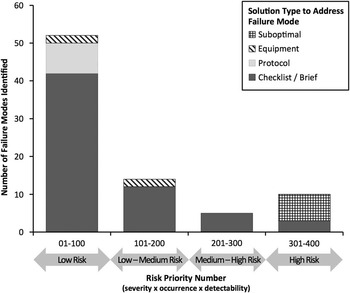
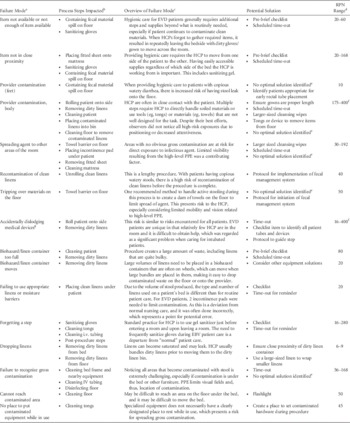
The FMEA identified 30 discrete steps and 16 unique failure modes associated with hygienic care and linen change for an EVD patient with copious watery stools (Table 1). The same failure mode was often associated with multiple steps (eg, provider contamination, Table 1). Failure modes ranged in RPN from 6 to 400 and were grouped by RPN into 4 relative risk categories (Figure 1). The solutions for each failure mode were identified and grouped into 4 categories: (1) implementation of a pre- or post-procedure checklist and brief, (2) scheduled pauses to allow patient and team reassessment (ie, time-outs), (3) development of new protocols or approaches, and (4) equipment modifications. Checklists, scheduled time-outs, and pre- or post-procedure briefs addressed 76.5% (62 of 81) of the overall failure modes, particularly those with lower RPNs.
Results of failure mode effects analysis organized to demonstrate failure modes and potential solutions to mitigate risk grouped by risk priority number.

Failure Modes Identified During Risk Analysis of Hygienic Care Provision for an Ebola Virus Disease (EVD) Patient with Copious Watery Stool

NOTE. FMEA, failure mode effects analysis; RPN, risk priority number; PPE, personal protective equipment; EVD, Ebola virus disease; HCP, healthcare personnel; i.v., intravenous.
a A total of 16 failure modes related to EVD patient hygienic care were identified. While it is possible to consolidate failure modes, we did not do so because we did not want to lose important details or nuances captured during the FMEA.
b The same failure mode was often identified for multiple process steps. We list examples of process steps identified. A total of 30 discrete process steps were evaluated.
c The overview provides a further explanation of why this particular failure mode was identified.
d The RPN range reflects that the same failure mode at a different process step may have a different risk priority, given that the occurrence, detectability, or severity vary based on the nature of the given process.
e For certain process steps, there were no potentially effective solutions identified to mitigate the failure mode or risk.
f The highest RPNs were associated with performing a task with a patient that could not assist with their care, i.e., an intubated patient.
g Examples of medical devices include i.v. tubing, indwelling urinary catheter, nasogastric tube, arterial lines, or endotracheal tube.
The FMEA identified several previously unrecognized equipment-related safety threats. For example, the biohazard waste containers were on wheels and were often moved as large volumes of linen were placed in the bin, presenting the risk that the soiled linens would be dropped. HCP often used their bodies to force the linens into the bin, thus increasing the likelihood of direct HCP contamination. Additionally, the use of linens or a solidifier to isolate the liquid stool on the floor 4 created several threats, including a fall hazard and challenges associated with removing the soiled linens from the floor. Recommendations include the use of tongs to retrieve items from the floor; however, the tongs were unwieldy and presented additional safety threats.
Of the failure modes with RPNs >300, 70% (7 of 10) were associated with failure modes attributed to observer inattention resulting in provider contamination or spread of the infectious agent. Most solutions suggested for these failure modes were deemed suboptimal because they were based on improving observer vigilance, an ineffective approach that is susceptible to fatigue.Reference Donaldson 6 In fact, the FMEA found provider fatigue to be a threat to almost every step, especially during the clean-up phase of the procedure. Scheduled time-outs and checklists were identified as possible ways to help identify fatigue and mitigate its impact on performance.
DISCUSSION
HCP safety is a major concern when caring for patients with highly infectious diseases. Preemptively assessing risk is critical in rapidly evolving situations, such as the EVD crisis. An FMEA can reduce redundancy, reduce inefficiency, and facilitate training that is ready to be integrated into practice. Using FMEA reduces non-systematic protocol and process building that can introduce practices that are unsafe for HCPs.Reference Lipol and Haq 7 This proactive approach identifies potential risks associated with human limitation, provides unique insight into other high-risk safety threats, and helps identify potentially effective solutions. We found that adherence to a checklist would address a significant number of risks associated with fecal management in EVD patients.
Our analysis revealed that combining checklists with effective team-based interventions such as team briefs and time-outs for reassessment enforces a systematic approach and encourages the development of shared situational awareness between providers.Reference Tschan, Semmer and Gurtner 8 Situational awareness supports highly effective teamwork and patient safety in highly dynamic, high-risk patient care settings.Reference Burke, Salas, Wilson-Donnelly and Priest 9 These teamwork concepts also promote adaptability, allowing HCPs to efficiently incorporate changes in protocols and procedures.
Placement of an effective fecal management system could mitigate risk associated with several failure modes by limiting continued HCP exposure to gross contamination. Currently, no clear guidelines exist regarding the factors that should trigger placement of a rectal tube or other fecal management system. This information would be helpful and could be incorporated into an existing checklist to guide decision making.
The FMEA results highlighted significant risks associated with HCP fatigue. Fatigue was a notable safety threat at almost every step; physical and mental exhaustion of both team members factored into the performances during the simulated cases. Observer inattention resulted in increased contamination of HCP PPE during the procedure; likewise, the HCP performing the procedure was less vigilant about appropriately positioning supplies to minimize potential spread of fecal waste. An omnipresent risk such as fatigue can be treated as a multiplier of existing risk during the FMEA, thus further increasing the RPNs associated with these tasks. 10 We noted that building in scheduled time-outs could also provide an opportunity for HCP to assess their level of fatigue and decrease the risk attributed to observer inattention.
HCP safety is of paramount importance yet is difficult to ensure during the emergence of healthcare crises. FMEA provides an objective, quantifiable approach to risk identification and prevention that can be rapidly deployed. Solutions such as checklists and time-outs consider human capabilities and limitations and offer possible solutions to address safety threats encountered when providing care to patients with highly infectious diseases.
ACKNOWLEDGMENTS
We would like to thank Douglas Franzen, MD, Andrew McCoy, MD, Erin Ehrmantraut, RN, Dayna Morgan, RN, MN, Robin Collier, RN, MN, and Brandi Ward, BA, for participating in the simulations for this project.
Financial support: Funding and support for this project was provided by the State of Washington, Department of Labor and Industries, Safety and Health Investment Projects, (grant no. 2014XH00293 to R.F.). The funding source had no role in the design and conduct of the study; collection, management, analysis, and interpretation of the data; or preparation, review, or approval of the manuscript.
Potential conflicts of interest: All authors report no conflicts of interest relevant to this article.