Introduction
The pandemic of severe acute respiratory syndrome coronavirus 2 (SARS-CoV-2) impacts clinical care worldwide. 1,2 Thus, wide-scale recommendations and guidelines have been issued by several international health care organisations to optimise clinical care during this pandemic. Reference Anderson, Heesterbeek, Klinkenberg and Hollingsworth3–6 Nevertheless, cancer patients require focused and individually optimised care plans considering their vulnerability and unavoidable immunocompromised status. Reference Liang, Guan and Chen7 These emerging care plans for cancer patients need to be supported by evidence-based data based on timely follow-up of their oncologic outcomes during the SARS-CoV-2 pandemic.
Data showed that cancer patients have a higher risk of coronavirus disease 19 (COVID-19) infection with subsequently higher morbidity and mortality. Reference Yu, Ouyang, Chua and Xie8–10 Also a challenge is protecting health care providers from COVID-19 and optimising care resources while the pandemic increases demand. Reference Willan, King, Hayes, Collins and Peniket11 In particular, shortages of chemotherapy and disruption of other medical product supply chains during the pandemic were found to impact oncologic outcomes. Reference Willan, King, Hayes, Collins and Peniket11,12 Another impact on cancer patients is that enrolment and follow-up of patients on clinical trials have been affected during the pandemic; protocol deviations are occurring more often. Reference Busta, Mancher, Cuff, McAdam and Keusch13,14
The available outcomes data from oncologic centres are scant and lack follow-up time. 15 Additionally, we could not ignore the impact of different medical care plans across the globe in comparing oncologic outcomes. To obtain robust data and optimise oncologic care plans during COVID-19 era, we need detailed evaluation and interrogation of the available data among cancer patients. Such an effort would help minimise the risk of infection, improve outcomes and optimise clinical resource allocation for cancer populations. This effort is also critical for patient prioritisation, multidisciplinary team involvement and selection of alternative substitute care plans and therapies. Reference Ventola16
While telemedicine may help overcome some of the abovementioned challenges, Reference Sirintrapun and Lopez17 radiotherapy (RT) as a key component of cancer therapy represents a special challenge. Reference Mukherjee, Back, Lu, Shakespeare and Wynne18 RT requires regular, often daily, treatments; patients need to be driven to the centre and treatment requires the presence of therapeutic radiographers, physicists and physicians. Furthermore, since patients frequently use the same machine, the time necessary to prepare the equipment for each individual patient presents another challenge. Also, RT may increase the risk of COVID-19 owing to RT-induced immunodeficiency and may increase morbidity due to RT-induced toxicities, for instance, intestinal pneumonitis. The picture may worsen if the patient is receiving concurrent chemotherapy/immunotherapy and RT. Herein, we are focusing on studies that addressed the impact of COVID-19 infection on cancer patients receiving RT.
Methods
This systematic review and meta-analysis was conducted according to the Preferred Reporting Items for Systematic Reviews and Meta-Analyses (PRISMA) guidelines. Reference Liberati, Altman and Tetzlaff19
Search strategy
The Ovid MEDLINE, Ovid Embase, Clarivate Analytics Web of Science, PubMed and Wiley-Blackwell Cochrane Library databases were searched for publications in the English language from 1 December 2019 to 1 September 2020. The following concepts were searched for using subject headings and keywords as needed: ‘COVID-19’, ‘severe acute respiratory syndrome coronavirus 2’, ‘SARS-CoV-2’, ‘coronavirus infections’, ‘novel coronavirus’, ‘cancer’, ‘neoplasms’, ‘tumor’, ‘leukemia’, ‘lymphoma’, ‘melanoma’, ‘carcinoma’, ‘sarcoma’, ‘oncology’, ‘radiotherapy’, ‘radiation’, ‘chemoradiotherapy’, ‘proton therapy’, ‘radiosurgery’, ‘brachytherapy’, etc. The search terms were combined by ‘or’ if they represented similar concepts and combined by ‘and’ if they represented different concepts. The complete MEDLINE search strategy is detailed in Supplementary Table 1.
Study selection and inclusion criteria
Within the results yielded by the search strategy above, we searched original studies (case reports, case series and observational studies). To be eligible, studies were required to address measurable outcomes (early mortality, hospital admission, intensive care unit [ICU] admission and mechanical ventilation) in cancer patients who underwent RT during the COVID-19 era. There was no exclusion based on patient age, sex or type of cancer. Other forms of publications including review articles, editorials, letters, guidelines, experience pieces, comments, consensus publications, abstracts and conference papers were excluded. Preprints and articles with not enough information or addressing irrelevant topics were also excluded.
Data extraction and statistical analysis
Microsoft Office 365 Excel software was used for data extraction. Categorical variables were expressed as frequency, while continuous variables were reported as mean with standard deviation. The following variables were extracted from the included papers: publication year, country where the patients were treated, sample size, mean age, male percentage, chronic obstructive pulmonary disease, diabetes, hypertension, chronic cardiovascular and cerebrovascular disease, chronic liver disease, type of additional therapy (surgery, chemotherapy, hormonal therapy, immunotherapy, targeted therapy), type of cancer, hospital mortality, length of hospital stay, hospital admission, ICU admission and use of mechanical ventilation. The primary outcome was early mortality, while secondary outcomes include length of hospital stay, hospital admission, ICU admission and use of mechanical ventilation.
The pooled event rates with 95% confidence intervals (CIs) were calculated using the DerSimonian–Laird (inverse variance) method. Meta-regression was performed to explore the effect of patients’ characteristics on early mortality. Studies were weighted by the inverse of the variance of the estimate for that study, and between-study variance was estimated with the DerSimonian–Laird estimator. The results were reported as the regression coefficient (i.e. beta).
Hypothesis testing for equivalence was set at the 2-tailed 0·05 level. Heterogeneity was based on the Cochran Q test, with I 2 values. For the primary outcome, in the case of high heterogeneity (I 2 > 75%), individual study inference analysis was performed through a ‘leave-one-out’ sensitivity analysis. Graphical inspection of funnel plots and the Egger regression test were used for assessment of publication bias. The quality of the included studies was assessed using the Newcastle–Ottawa scale. All analyses were performed using R version 3.3.3 (R Project for Statistical Computing) using the ‘meta’ and ‘metafor’ statistical packages within RStudio.
Results
Studies selected and data extracted
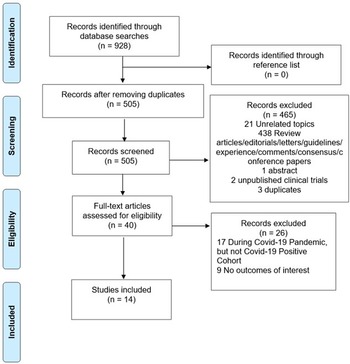
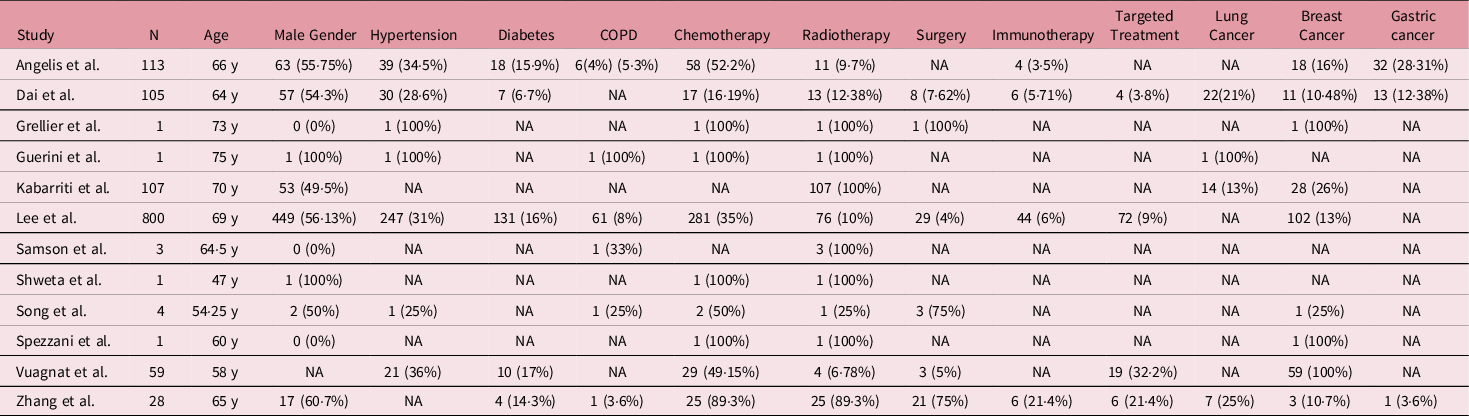
The systematic review process according to the PRISMA guidelines Reference Liberati, Altman and Tetzlaff19 is outlined in Figure 1. The literature search identified 928 potentially eligible studies. No additional articles were identified through backward snowballing. After removal of duplicates, 505 studies were screened. After exclusion of records, based on title and abstract, according to topic, publication type and further duplication, 40 full-text articles were assessed for eligibility according to population and outcomes studied. Twelve articles Reference Spezzani, Piunno and Iselin20–Reference Shweta, Rathore, Kumar and Bhatnagar31 met our inclusion criteria with a total of 1224 patients with cancer who underwent RT during the pandemic, with measurable outcomes available. All studies were published in 2020, and the sample size ranged from 1 to 800. Details of the individual studies are shown in Table 1.
PRISMA flowchart.

Overview of included patients

COPD, chronic obstructive pulmonary disease; NA, not available or applicable. Values are no. (%) unless indicated otherwise.
Overall, fever (54·5%), cough (42·2%) and dyspnoea (30·6%) were the most commonly presenting symptoms. Suspected hospital-associated transmission of COVID-19 was a frequent observation. Known COVID-19 symptoms, radiologic features and laboratory anomalies were helpful for diagnosing the infected cases. Commonly observed laboratory abnormalities included lymphopaenia, hypoproteinaemia, anaemia and elevation of C-reactive protein, lactate dehydrogenase, D dimer and erythrocyte sedimentation rate, as well as anaemia. Most of the infected cases had comorbid conditions and had received cancer therapy shortly before the COVID-19 infection. The most common cancer types were breast cancer (18·3%), haematologic malignancies (13·8%), gastric cancer (3·8%) and lung cancer (3·6%); a substantial portion was metastatic (Table 1).
Zhang et al. Reference Zhang, Zhu and Xie28 found that receipt of cancer therapy within 14 days, presence of patchy consolidation on CT and stage IV increased the risk of poor outcomes. Dai et al. Reference Dai, Liu and Liu27 showed that diagnosis of haematologic malignancies and lung cancer as well as stage IV increased the risk of death, ICU admission, infection severity and the need for invasive ventilation. Additionally, Lee et al. found that death rates were higher in patients who were male, who were of advanced age or who had comorbidities, with odds ratios of 2·3, 9·4 and 1·7, respectively. Reference Lee, Cazier and Angelis26 Also, Angelis et al. Reference Angelis, Tippu and Joshi25 identified factors associated with a higher risk of severe COVID-19 infection, including receipt of cancer therapy and presence of inflammatory infiltrates on chest CT. Furthermore, Kabarriti et al. found that mean RT dose to the lungs, recent history of RT (within 1 month to 1 year) and diagnosis of lung cancer were significantly associated with increased risk of death. Reference Kabarriti, Brodin and Maron22 More details are given in Supplementary Tables 2 and 3.
Meta-analysis
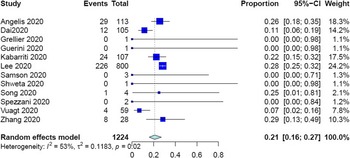
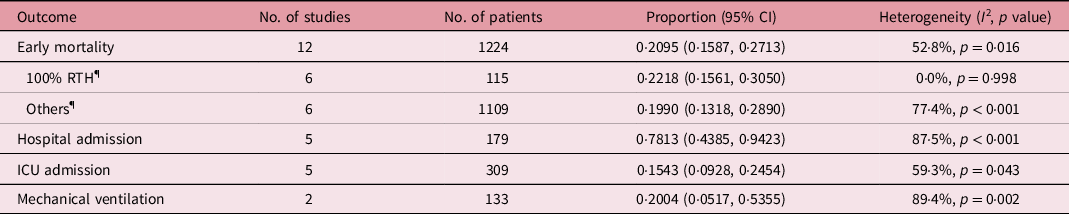
The prevalence of early mortality after COVID-19 infection was 21·0% (95% CI: 15·9%, 27·1%) (Figure 2). All 12 studies were used to obtain this result, with all 1224 patients included. A high level of heterogeneity was present among the included studies (I 2 = 52·8%, p = 0·016). Leave-one-out analysis is depicted in Supplementary Figure 1. Visual inspection of the funnel plot and the Egger test did not reveal significant asymmetry (Egger test p = 0·108; Supplementary Figure 2), suggesting no significant publication bias for the analysis. Subgroup analysis based on the percentage of patients who received RT revealed a higher incidence of early mortality (0·2218 [95% CI: 0·1561, 0·3050]) compared with that in the remaining studies (0·1990 [95% CI: 0·1318, 0·2890]) in the remaining studies, but the interaction p value was not statistically significant (p = 0·6814, Table 2 and Supplementary Figure 3).
Forest plot for early mortality after COVID-19 infection.

Outcomes summary

¶ Interaction p = 0.6814.
The prevalence of hospital admission was 78·1% (95% CI: 43·9%, 94·2%) (Supplementary Figure 4). This prevalence was derived from 5 of the included studies, with a total of 179 patients included. A high level of heterogeneity was present among these included studies (I 2 = 87·5%, p < 0·01).
The prevalence of ICU admission was 15·4% (95% CI: 9·3%, 24·5%) (Supplementary Figure 5). Five studies were used to obtain this result, with a total of 309 patients included. A high level of heterogeneity was present among these included studies (I 2 = 59·3%, p = 0·043).
The prevalence of mechanical ventilation was 20·0% (95% CI: 5·2%, 53·6%) (Supplementary Figure 6). This result was derived from 2 of the included studies, with a total of 133 patients included. A high level of heterogeneity was present among these included studies (I 2 = 89·4%, p = 0·002).
The outcomes are summarised in Table 2.
Meta-regression
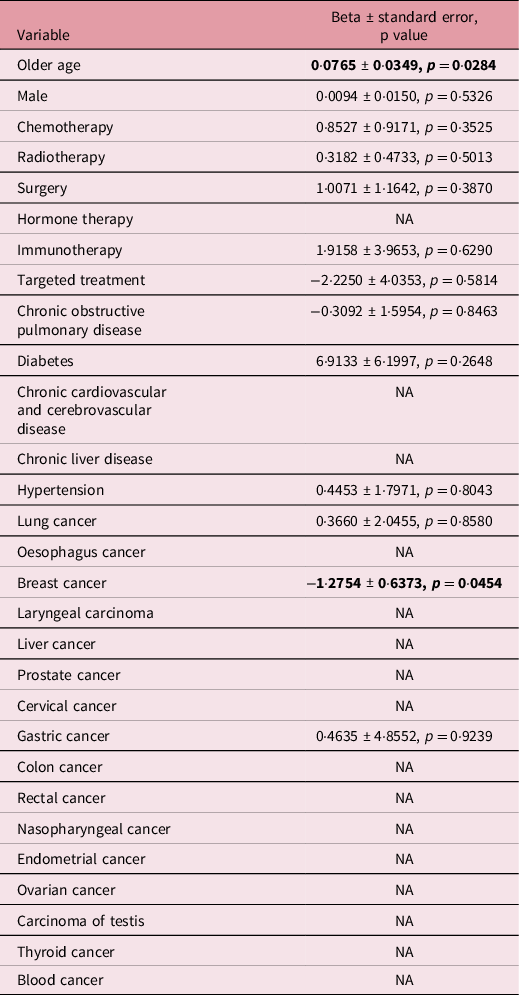
In the meta-regression analysis, older age was significantly and positively associated with early mortality (β = 0·0765 ± 0·0349, p = 0·0284), while breast cancer was negatively associated with early mortality (β = −1·2754 ± 0·6373, p = 0·0454). Early mortality did not show any significant association with any other preoperative variable on meta-regression. Meta-regression outcomes are summarised in Table 3.
Meta-regression results showing effects of different variables on the early mortality outcome

NA, not available/applicable.
Significant p value: ≤ 0.05.
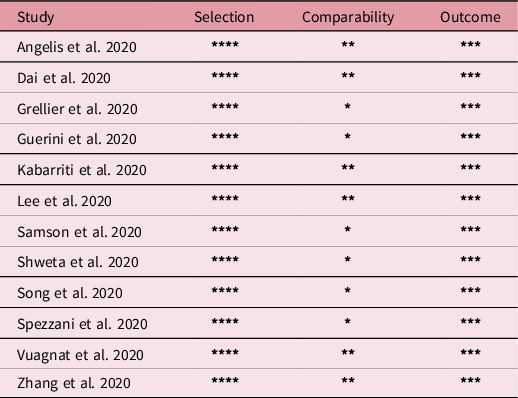
Assessment of the quality of the included studies using the Newcastle–Ottawa is shown in Table 4.
Newcastle–Ottawa assessment of the quality of included studies

Discussion
In our meta-analysis of cancer patients who were underwent RT during COVID-19 era, older age adversely impacted early mortality. Thus, oncologic care strategies including RT should account for the increased risk of morbidity and mortality due to COVID-19 alongside the risks of delays in cancer treatment due to the infection and pandemic-related modifications.
During the COVID-19 pandemic, timely cancer diagnosis and tailored treatments should be maintained without jeopardising patients’ treatment outcomes while also maintaining patient’s and care providers’ safety. The optimal timing and plans for cancer treatment and follow-up must be evaluated against the vulnerability of cancer patients to morbidities and mortality after COVID-19 infection. Thus, alternative oncologic procedures and plans during COVID-19 era that ensure safety for patients and providers need to be evaluated on an individual level. Reference Repici, Maselli and Colombo32–Reference Adams and Walls34 Although deaths have been observed less frequently after COVID-19 compared with SARS-CoV or MERS-CoV, COVID-19 is more transmissible, with each new COVID-19 case producing an average of three new secondary cases. Reference Wu, Leung and Leung35 For reducing exposure and spread of COVID-19 during the lockdown, the abovementioned care options are not always feasible.
Changes in cancer care have been observed as a result. In-person follow-up visits have been frequently replaced by teleconsultation, while physical examinations have been postponed. In addition, more treatments have been delayed or interrupted, and even if they are performed, the route of administration and length has been frequently modified. Reference Angelis, Tippu and Joshi25 Furthermore, the number of cancer patients undergoing surgeries, laboratory analyses and imaging was reduced by 22–27%, the number receiving RT decreased by 8% and the number receiving immunotherapy decreased by 16%, compared to the same period last year. Meanwhile, the use of oral chemotherapy increased by 6%. Reference Angelis, Tippu and Joshi25 Finally, patient recruitment in non-COVID-19 clinical trials has been significantly reduced. Such changes have been made to address the concerns regarding higher susceptibility of cancer patients to severe events after COVID-19 infection. Reference Dai, Liu and Liu27 A Chinese nationwide analysis shows that cancer patients are more vulnerable and at higher risk for severe complications and mortality during this pandemic. Reference Liang, Guan and Chen7 There is also the special, challenging scenario of co-occurrence of RT-induced lung damage and the detrimental COVID-19-related lung injury.
In the current meta-analysis, which focuses on outcomes after RT during COVID-19 era, we found higher prevalence of hospital and ICU admission, need for mechanical ventilation and early mortality in cancer patients. Furthermore, we performed meta-regression to analyse possible risk factors associated with early mortality in COVID-19 affected cancer patients. The age and breast cancer diagnosis found to be significantly associated with early mortality.
The importance of monitoring and follow-up of the imaging findings has been highlighted in many reports. COVID-19 has characteristic imaging findings (bilateral lung involvement of ground-glass opacity; lesions mainly located peripherally and under the adjacent pleura with diffuse distribution; interlobular/septal/pleural thickening, while some patients present with patchy consolidation that may progress later), and the persistence or resolution of these findings has prognostic value in predicting the disease course and outcomes. Reference Zhang, Zhu and Xie28,Reference Shi, Han and Jiang36
The presence of comorbidities was a consistent risk factor for poor outcomes in several studies. Reference Lee, Cazier and Angelis26–Reference Zhang, Zhu and Xie28 This finding has been supported by many other reports. Reference Zhou, Yu and Du37,Reference Liang, Guan and Li38 Additionally, advanced age has previously been identified as a predictor of poor outcomes in cancer patients with COVID-19. Reference Zhou, Yu and Du37 Patients with metastatic status were similarly at higher risk for severe events. Reference Dai, Liu and Liu27,Reference Zhang, Zhu and Xie28 Our previous meta-analysis concluded that comorbidities significantly increase the hospital mortality rate, yet age was not a predictor for higher mortality rate in cancer patients during the COVID-19 era. Reference Shmushkevich, Karim and Baudo39 This difference could be explained by differences in inclusion criteria, research questions and study duration.
The included reports in the current meta-analysis analysed the association of cancer type with oncologic outcomes. Reference Vuagnat, Frelaut and Ramtohul24,Reference Dai, Liu and Liu27 The most frequent cancer types were breast, haematologic, gastric and lung malignancies. Regarding breast cancer, two of the included studies have reported that breast cancer patients do not appear to be at higher risk of mortality from COVID-19 and have similar clinical and radiologic features of COVID-19, compared with the general population, Reference Vuagnat, Frelaut and Ramtohul24 and that breast cancer patients have the lowest COVID-19 infection severity and death rates among all patients with cancer. Reference Dai, Liu and Liu27 On the other hand, lung cancer is reported to have a more severe and longer disease course in SARS-CoV-2-infected patients, Reference Dai, Liu and Liu27 as are haematologic cancers, probably because of the decreased immunity associated with haematologic malignancies. Reference Dai, Liu and Liu27 However, in the present analysis, we were not able to sustain the previous statements.
The onset of dyspnoea due to COVID-19 was observed earlier in the course of infection in patients with lung cancer compared to the general population as well as compared to other cancer types. Reference Zhang, Zhu and Xie28,Reference Wang, Hu and Hu40 In patients with lung cancer, the cancer-related respiratory difficulties and the co-occurrence of COVID-19-associated and RT-induced interstitial pneumonitis require special monitoring and early management. Reference Dumoulin, Gietema, Paats, Hendriks and Cornelissen41,Reference Palma, Senan and Tsujino42 To address the impact of RT dose on the risk of poor outcomes after COVID-19, Kabarriti et al. Reference Kabarriti, Brodin and Maron22 included 107 cancer patients on RT in their study. They found that mean RT dose to the lungs, diagnosis of lung cancer and receipt of RT 1 month to 1 year before the COVID-19 diagnosis were predictors of a high risk of death. Prior RT was found to be associated with higher mortality risk (approximately 35%) in cancer patients. A mean lung RT dose of 7 Gy increased the risk of death after COVID-19 by 50%, while 15 Gy increased the mortality rate to approximately 75%. Of note, lung V20Gy and lung V5Gy showed similar predictive value to that of mean lung dose. RT injures lung tissues and initiates cytokine release with subsequent inflammation and fibrosis Reference Kong, Haken, Eisbruch and Lawrence43 ; thus, indication, timing and lung volume definition should be personalised when RT cannot be delayed in high-risk patients.
The combined effect of lung injury induced by RT, chemotherapy and/or immunotherapy and by COVID-19 is a challenge in patients with breast cancer as well. In a case report by Grellier et al. of a breast cancer patient who received 35 Gy on a moderate hypofractionated schedule, Reference Grellier, Hadhri and Bendavid29 the extent of the typical COVID-19 lung damage was significantly correlated with the irradiated lung volume. Given the lack of data that address the effect of RT on the severity of COVID-19-related lung injury, it is important to carefully monitor the cancer patients in need of RT that partly involves the lungs, such as RT of the whole breast and nodal areas. Options such as a prone or lateral position and a breathing-gated or hypofractionated schedule may help reduce RT-induced lung injury. Reference Zhou, Yu and Du37,Reference Lee, Chang, Kim, Keum, Suh and Kim44 Yet, these alternatives are not feasible nor adequate for high-risk patients who require full nodal coverage. Of note, Vuagnat et al. Reference Vuagnat, Frelaut and Ramtohul24 found no association between prior RT or RT sequelae and either radiologic extent of COVID-19 disease or COVID-19 outcome in breast cancer patients and found that the clinical and radiologic features of COVID-19 in these cases were similar to those previously described in non-cancer COVID-19 patients.
On the other hand, with the growing use and promising outcomes of immunotherapy, immunotherapy-induced pneumonitis (ITIP) is another challenge during the COVID-19 era, as patients on immunotherapy are more vulnerable to COVID-19, and the presenting symptoms and image features of ITIP may delay the diagnosis of COVID-19 and challenge care providers during follow-up and management. Reference Suresh, Voong and Shankar45,Reference Widmann, Nguyen, Plaickner and Jaschke46 ITIP may recall RT-induced lung injury and augment the detrimental cytokine release induced by COVID-19. Reference Schönrich and Raftery47,Reference Keffer, Guy and Weiss48 Additionally, the main treatment for ITIP is steroids and immunosuppressant agents, which again add challenges to diagnosis and management of COVID-19 infection. Reference Haanen, Carbonnel and Robert49 The case presented by Guerini et al. Reference Guerini, Borghetti and Filippi30 is an example of such challenges in a patient with lung cancer after concurrent chemoradiation therapy and during maintenance immunotherapy who contracted a COVID-19 infection. Unfortunately, the patient died.
Dai and colleagues Reference Dai, Liu and Liu27 reported the highest death rate in oncologic patients treated with immunotherapy compared to those given other treatments in their study, possibly due to a stronger cytokine storm. This result was drawn from a small group of patients, though, and our meta-analysis was not able to reach any significant association between treatment type and early mortality. Also, Song et al. Reference Song, Chen and Deng23 found that patients with severe COVID-19 infection had sequestration of lymphocytes in the lungs and other organs, with resultant low counts of CD3+ CD4+ helper T cells. These findings align with other current data that associate the severity of COVID-19 infection with low T-cell counts. Reference Xu, Fan and Wang50,Reference He, Lu and Zhang51 Another report showed that increased levels of IL-6, IL-10, IL-2 and IFN-γ in peripheral blood were associated with COVID-19 infection severity. Reference Liu, Li and Liu52
The types of treatment given also need to be considered in terms of their potential association with the risk of severe events. Dai et al. found that RT alone did not affect this risk compared with the risk of these events in the general population, yet surgery increased this risk and further increased the risk of death, ICU admission and use of invasive ventilation. Reference Dai, Liu and Liu27 Dai et al. Reference Dai, Liu and Liu27 also showed that receipt of immunotherapy is associated with a trend towards an increased risk of severe COVID-19-related symptoms. Furthermore, Angelis et al. Reference Angelis, Tippu and Joshi25 showed that receipt of chemotherapy was associated with a modest risk of severe COVID-19 infection. They also adjusted for clinical factors and categorised the chemotherapy as palliative and non-palliative. However, they mentioned in their Discussion that ‘withholding effective cancer therapy runs the very real risk of increasing cancer morbidity and mortality, perhaps much more so than COVID-19 itself’. Reference Lee, Cazier and Angelis26 The absence of a significant negative impact of chemotherapy on morbidities and mortalities after COVID-19 infection has been shown in some larger studies as well as in Vuagnat et al. Reference Vuagnat, Frelaut and Ramtohul24,Reference Anil, Arnold and Benkwitz-Beford53 Yet, Vuagnat et al. Reference Vuagnat, Frelaut and Ramtohul24 observed that patients with early breast cancer who died had been treated for a systemic disease by a CTLA-4 signalling modulator. Thus, individualised decisions are warranted, and many guidelines have been published. 54
The timing of anticancer therapy was found to impact the risk of severe events. Reference Liang, Guan and Chen7,Reference Zhang, Zhu and Xie28 Zhang et al. Reference Zhang, Zhu and Xie28 found that receipt of anticancer therapy within the past 14 days increases the risk of poor mortality after COVID-19 infection. However, Lee et al. Reference Lee, Cazier and Angelis26 found that receipt of chemotherapy, immunotherapy, hormonal therapy, targeted therapy or RT within the past 4 weeks did not impact death rates in cancer patients receiving treatment during COVID-19 era. Yet, the numbers of patients who had received immunotherapy, hormonal therapy, targeted therapy and RT were small. The timing of RT was also addressed by Kabarriti et al., Reference Kabarriti, Brodin and Maron22 and they found that receiving RT within the past 1 month to 1 year increased the severity of infection and mortality rate in cancer patients during the COVID-19 era, as this period overlaps with the acute phase of development and progression of the interstitial pneumonitis induced by RT. Reference Kong, Haken, Eisbruch and Lawrence43,Reference Mehta, McAuley, Brown, Sanchez, Tattersall and Manson55
Importantly, Shweta et al. Reference Shweta, Rathore, Kumar and Bhatnagar31 highlight additional crucial issues that need to be addressed while following cancer patients with COVID-19 infection: sense of loneliness, inability to handle their own needs away from their caregivers, and the fear and worries about false-negative polymerase chain reaction test results as well as false-positive results. This uncertainty about test results is exacerbated by the fact that cancer patients usually experience similar symptoms to those of patients with COVID-19, including dyspnoea, fever, cough and fatigue, and many cancer patients may have similar imaging features to those of COVID-19 patients. Cancer patients with COVID-19 need psychological and social support, which is as much as import as medical support.
Limitations of the included studies include that some are retrospective, nonrandomised studies with small sample sizes and short follow-up. Another limit is the heterogeneous data concerning the tumour types and treatments received; however, the differences in these features allowed us to address these features as potential predictors. Some detailed useful data are lacking owing to the urgency of publishing reports to guide clinical decisions in cancer care during the COVID-19 era. Such an urgent need to publish data pressures some authors to submit their publications as editorials, letters and conference papers, which were excluded from this meta-analysis, as were reprints. Also, none of the included studies address the issue of false-negative and -positive polymerase chain reaction tests, which may under- or over-report total COVID-19 cases in patients with cancer. Furthermore, the difference in cancer practice guidelines across the globe and inherent genetic and racial differences limit the generalisation of the results. Thus, creating a dedicated and coordinated global registry of COVID-19 cases in cancer patients is urgently needed to provide strong evidence from large cohorts that allow for risk-benefit analyses and risk-based frameworks for cancer health care.
Until such registries exist, we should continue to minimise cancer patients’ exposure to and risk from COVID-19 infection by safely optimising hospital visits, finding alternative effective cancer treatment plans and mitigating the risks of immunosuppression in cancer patients. Personalised decisions are crucial, as withholding effective cancer treatments in many cancer patients carries a risk to patients’ health that can outweigh the risk of COVID-19 infection itself.
Conclusion
During the COVID-19 era, cancer care plans should be designed after a risk-benefit assessment. Special care is needed while treating elderly patients, as age was found to negatively impact the early mortality rate after COVID-19 infection. Finally, harmonised solid data across the globe are crucial for establishing international guidelines for cancer patients who undergo RT during the COVID-19 era.
Supplementary material
For supplementary material accompanying this paper visit https://doi.org/10.1017/S1460396921000637
Acknowledgements
The authors appreciate the support from the Research Medical Library at The University of Texas MD Anderson Cancer Center, especially the great help from Sarah Bronson, ELS, for editing the draft.
Funding
None.
Conflict of Interest
None of the authors report conflicts of interest.