Introduction
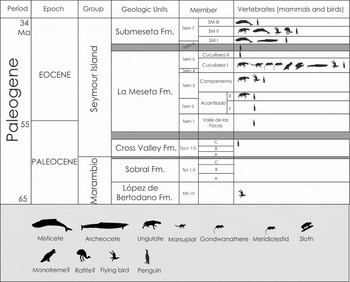
Evidence of Cretaceous and Palaeogene Antarctic terrestrial faunas comes almost exclusively from the James Ross Basin, Antarctic Peninsula (Fig. 1; Reguero & Gasparini, Reference Reguero, Gasparini, Rabassa and Borda2007; Reguero, Goin, Acosta Hospitaleche, Dutra, & Marenssi, Reference Reguero, Goin, Acosta Hospitaleche, Dutra and Marenssi2013), and the knowledge of the Palaeogene terrestrial vertebrates in Antarctica has mainly been based on fossils from horizons of the La Meseta and Submeseta formations on Seymour Island (Isla Marambio), east of the Antarctic Peninsula (Fig. 2).
Schematic geological map of the James Ross Basin, Weddell Sea, northeastern Antarctic Peninsula. White areas are either the James Ross Island Volcanic Group or snow/ice cover. Locality key: CL, Cape Lamb; DP, Dreadnought Point; SMC, Santa Marta Cove. K/Pg indicates the position of the Cretaceous–Palaeogene boundary on Seymour Island.

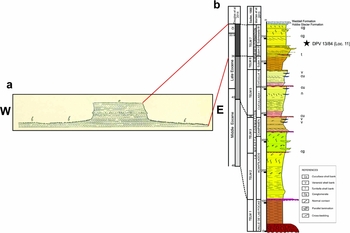
a. Geological occurrence of the vertebrate remains, sketch map after Wiman (Reference Wiman1905a, p. 2). b. Stratigraphic column of the La Meseta and Submeseta formations on Seymour Island, Antarctic Peninsula (modified from Montes et al., 2010). Chronostratigraphic interpretation of the La Meseta and Submeseta formations is based on dinocyst biostratigraphy and bivalve Sr isotope signatures (Douglas et al., Reference Douglas, Affek, Ivany, Houben, Sijp, Sluijs and Pagani2014). Strontium date values are from Dingle & Lavelle (Reference Dingle and Lavelle1998), Dutton, Lohmann, & Zinsmeister (Reference Dutton, Lohmann and Zinsmeister2002), Ivany et al. (Reference Ivany, Lohmann, Hasiuk, Blake, Glass, Aronson and Moody2008) and Reguero, Marenssi, & Santillana (Reference Reguero, Marenssi and Santillana2002).

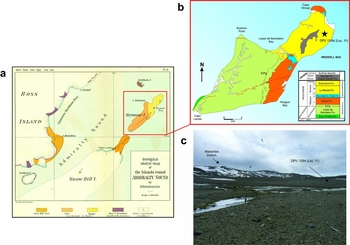
The early explorer and scientist Otto Nordenskjöld, leader of the Swedish South Polar Expedition of 1901–1903, envisioned the palaeontological and biogeographical importance of the James Ross Basin. He was the first to collect Antarctic penguin fossils. The site, indicated as ‘fossil locality no. 11’ on Nordenskjöld's map (Fig. 3), is situated about 50 m above sea level between the northeast shore and the 190 m high plateau occupying a major part of the northeast of the island. The area forms a smoothly undulating expanse covering some 100 m in length and width (see Wiman, Reference Wiman1905a, p. 2; Reference Wiman1905b, p. 248; Fig. 2). This locality was revisited in the 1980s by Argentine palaeontologists, who named it ‘DPV 13/84’ (Figs 2 and 3). Today, this is one of the most important sites for the study of fossilised penguins in Antarctic, and is key for the understanding of the evolution of the group (Acosta Hospitaleche, Reference Acosta Hospitaleche2013, Reference Acosta Hospitaleche2014; Acosta Hospitaleche & Reguero, Reference Acosta Hospitaleche and Reguero2010; Jadwiszczak & Mörs, Reference Jadwiszczak and Mörs2011; Reguero et al., Reference Reguero, Goin, Acosta Hospitaleche, Dutra and Marenssi2013).
a. Sketch map drawn by Otto Nordenskjöld (Andersson, Reference Andersson1906) showing the location of the locality no. 11 on Seymour Island. b. Geologic map of Seymour Island, Antarctic Peninsula, showing locality DPV 13/84 (black star). c. Landscape of the northeastern part of Seymour Island, showing the continuous and undulating surface exposure of the locality DPV 13/84 of the Submeseta Formation (looking east).

The present contribution provides a summary of the historical context in which Otto Nordenskjöld conducted his famous expedition to Antarctica that allowed Carl Wiman to study the important collection of penguin fossils from Seymour Island. Details are also provided about the study of these specimens through the years, and the current state of this collection.
Historical context
At the end of the 18th century Captain James Cook and other explorers had concluded that if there were a southern continent, it was not as large as anticipated and was situated in a hostile environment. The scientific interest was replaced by a period of hunting, mainly concentrated on the newly discovered islands around the Antarctic continent; the sealing voyages came to outnumber by far the scientific expeditions for the coming century (Headland, Reference Headland, Elzinga, Nordin, Turner and Wråkberg2004, p. 16).
Knowledge of the existence of fossils in Antarctica goes back to the early 19th century, when James Eigths described in situ fossilised wood from the South Shetland Islands (see Clarke, Reference Clarke1916, p. 196). With some uncertainties, the history of the first collection of Antarctic fossils centres on the Norwegian whaler Captain Carl Anton Larsen (Stilwell & Long, Reference Stilwell and Long2011, p. 26). The depletion of whales in the Arctic at the end of the 19th century had forced the industry to look for new hunting grounds. Larsen was sent to the area south of the Atlantic Ocean in the 1892–1893 season. During this whaling expedition, Larsen, at the time hunting seals on the Larsen Barrier, visited the shores of Seymour Island, situated in the Weddell Sea to the northeast of the Antarctic Peninsula (64°14′S, 56°38′W), looking for prey. On the night of 4 December 1892, a party from Larsen's whaling ship Jason landed on the east coast (south of Cross Valley) of Seymour Island (Zinsmeister, Reference Zinsmeister1988, p. 6). Fossilised wood and mollusks were found and collected (Aagaard, Reference Aagaard1930, p. 71; Destéfani, Cioccale, & Rabassa, Reference Destéfani, Cioccale and Rabassa2001, p. 238). Later that month, Larsen met up with the ‘Dundee Whaling Fleet’, a Scottish whaling expedition commissioned by The Royal Geographical Society of Edinburgh, where he met the naturalist C.W. Donald on-board the ship Active. Having been out for several months, supplies were running short for the Norwegians, especially their beloved tobacco. Some of the crew traded their fossils for this stimulant, while Larsen kept his specimens and traded his akvait instead, thus securing his fossils for the University of Oslo (Aagaard, Reference Aagaard1930, p. 84). The following season, 1893–1894, Larsen and his crew visited Seymour Island and collected more fossilised wood.
Two British scientists, G. Sharman and E.T. Newton, examined the material collected by the Norwegians and concluded that the fossils were probably from the Lower Tertiary. They published their findings in two scientific papers (Sharman & Newton, Reference Sharman and Newton1894, Reference Sharman and Newton1898). The news of Larsen's finds reached a young Otto Nordenskjöld and motivated him to organise an expedition to Antarctica (Larsson, Reference Larsson2001, p. 99; Nordenskjöld, Reference Nordenskjöld1901, Reference Nordenskjöld1904, p. xvii).
Who was Otto Nordenskjöld?
Nordenskjöld, a geologist, organised his first expedition (1895–1897) to the area between the Santa Cruz River and the Beagle Channel in Patagonia (Destéfani et al., Reference Destéfani, Cioccale and Rabassa2001, p. 232). His aim was to study the Quaternary geology and glaciology in an attempt to discover if the ice ages of the Arctic had their equivalents in the south. He also studied the phenomena of parallelism, that the fauna and flora showed many similarities between the northern and southern high latitudes. His interest also involved the Selknam Indians; he was the first scientist to visit ‘Cueva de Mylodon’, Chile, where the remains of giant ground sloths were found. It was, however, his cousin, Erland Nordenskjöld, who later carried out a thorough excavation of the cave (Nordin, Reference Nordin, Elzinga, Nordin, Turner and Wråkberg2004, p. 69). But Otto's ambition reached further than that; he came close to extending the expedition southward using a Chilean gunboat. The target was the South Shetland Islands. Unfortunately, lack of time and political unrest put a stop to his plans (Larsson, Reference Larsson2001, p. 99; Nordenskjöld, Reference Nordenskjöld1904, p. xx).
At the end of the 19th century, there was a renewed scientific interest in the south polar region. A new aim for the exploration of the Antarctic region was stated in a resolution in 1895 at the Sixth International Geographic Congress in London (Headland, Reference Headland, Elzinga, Nordin, Turner and Wråkberg2004, p. 18; Wråkberg, Reference Wråkberg2001, p. 32). One project involved a set of three expeditions that would monitor the continent for a full year (Nordenskjöld, Reference Nordenskjöld1904, p. xviii). The British participants chose the area south of the Pacific and the Germans settled for the coast in the southern Indian Ocean. Argentina had established an observatory on an island off the southern tip of South America, but needed a scientific expedition to push further south; this was where the Swedes stepped in (Destéfani et al., Reference Destéfani, Cioccale and Rabassa2001, p. 231). In January 1900, Nordenskjöld revealed his plans to go to the Antarctic. In this year he also had the chance to go on a Danish expedition to Greenland where he gathered experience in scientific work in a cold climate and learnt how to organise a polar expedition (Hjort & Ingolfsson, 2004, p. 192; Nordenskjöld, Reference Nordenskjöld1904, p. xxi; Wråkberg, Reference Wråkberg2001, p. 34). The now Danish ship Antarctic had previously been used for several Swedish Arctic expeditions. The Carlsberg Foundation generously let Nordenskjöld buy the vessel at a fair price. Captain Carl Anton Larsen was hired as a commander of the ship since he had extensive knowledge of navigation in ice-filled waters and was one of the few who had visited the area Nordenskjöld was aiming for (Andersson, Reference Andersson1941, p. 142).
Failing to secure government backing, Nordenskjöld managed to raise funds from private and commercial sources, as well as by taking out a large private loan (Goldberg, Reference Goldberg2001, p. 59). To further raise funds he rented out the Antarctic to a Swedish Arctic expedition during the summer of 1901, although this meant that he had to delay his own departure (Nordin, Reference Nordin, Elzinga, Nordin, Turner and Wråkberg2004, p. 71). Nordenskjöld also allowed the crew to engage in sealing and whaling to finance the expedition – a bloody business that would horrify the scientists and delay their work. On 16 October 1901 the ship sailed from Gothenburg, Sweden. Ahead lay an ambitious scientific programme but also adventure – more than they had bargained for!
In July 1901, the Argentine leader of the Staten Island observatory, Horacio Ballvé, had asked if it were possible to include an Argentine naval lieutenant in the Swedish expedition. Nordenskjöld welcomed the idea but became concerned when he learnt that the intention was for the Argentine to stay at the station over the winter and not remain with the ship as it went north to winter in warmer waters. This, however, changed when the two men met for the first time in Buenos Aires; the expedition leader was charmed by the young naval officer chosen for the job, José Maria Sobral (Nordenskjöld, Reference Nordenskjöld1904, p. 32). Argentina supported the Antarctic part of the joint venture by offering free coal and provisions.
Geological context of the study area
The sedimentary sequence exposed in the James Ross Basin comprises a 6–7 km thick section from Late Cretaceous to latest Eocene and probably earliest Oligocene (MacDonald et al., Reference MacDonald, Baker, Garrett, Ineson, Pirrie, Storey and Marshall1988). It forms the only marine sequence of this age interval that is exposed in Antarctica. The high-latitude biota in both the Cretaceous and Palaeogene beds are unusually rich and comparable to those from New Zealand and southeastern Australia (Reguero et al., Reference Reguero, Goin, Acosta Hospitaleche, Dutra and Marenssi2013).
The Palaeogene succession in the James Ross Basin (del Valle, Elliot, & Macdonald, Reference del Valle, Elliot and Macdonald1992) is included in the Seymour Island Group and comprises all the Palaeocene to earliest Oligocene (Crame, Francis, Cantrill, & Pirrie, Reference Crame, Francis, Cantrill and Pirrie2004; Hathway, Reference Hathway2000). The Palaeogene section, exposed mainly on Seymour Island, includes the uppermost part of the López de Bertodano Formation (Klb 10 of Sadler, Reference Sadler1988) of Danian (early Palaeocene) age, the Sobral Formation (early Palaeocene), the Cross Valley Formation (middle–late Palaeocene), the La Meseta Formation of the Thanetian (late Palaeocene)–Ypresian (early Eocene) age (Montes, Nozal, Santillana, Marenssi, & Olivero, Reference Montes, Nozal, Santillana, Marenssi and Olivero2013) and the Submeseta Formation of Lutetian (middle Eocene–earliest Oligocene) age (Montes et al., Reference Montes, Nozal, Santillana, Marenssi and Olivero2013). All these units were deposited in an incised valley (Marenssi, Santillana, & Rinaldi, Reference Marenssi, Santillana and Rinaldi1998a) (Fig. 2). The latter three units, the Cross Valley, La Meseta and Submeseta formations, yield fossilised penguins (Acosta Hospitaleche, Reguero, & Scarano, Reference Acosta Hospitaleche, Reguero and Scarano2013; Reguero et al., Reference Reguero, Goin, Acosta Hospitaleche, Dutra and Marenssi2013), but all the material described by Wiman (Reference Wiman1905a) comes from the Submeseta Formation (Fig. 2).
The new middle Eocene – earliest Oligocene Submeseta Formation (Montes et al., Reference Montes, Nozal, Santillana, Marenssi and Olivero2013) was previously considered as the Submeseta Allomember of La Meseta Formation (Marenssi, Santillana, & Rinaldi, Reference Marenssi, Santillana and Rinaldi1996, Reference Marenssi, Santillana and Rinaldi1998a). This is the youngest vertebrate bearing unit and constitutes the top of the sedimentary sequence of the basin. These beds correspond to the Facies Association III of Marenssi, Santillana, & Rinaldi (Reference Marenssi, Santillana and Rinaldi1998b), characterised by a uniform sandy lithology that indicate a tidal shelf influenced by storms. This formation is organised into three internal units (Fig. 2) named from base to top: Submeseta I, Submeseta II and Submeseta III (Montes et al., Reference Montes, Nozal, Santillana, Marenssi and Olivero2013).
The Nordenskjöld locality no. 11, or DPV 13/84, is one of the most important localities yielding penguin fossils. According to Montes et al. (Reference Montes, Nozal, Santillana, Marenssi and Olivero2013), this unit corresponds stratigraphically to Submeseta II–level 38 (Figs 3 and 4).
Timescale, stratigraphy and vertebrate fossil (mammals and birds) record for the Palaeocene and Eocene rocks in the James Ross Basin, Antarctic Peninsula, West Antarctica. Temporal and sedimentary units not to scale.

History of the first collection of penguin fossils in Antarctica
The Swedish expedition's first visit to Seymour Island took place on 17 November 1901. After reading about Larsen's fossils, Nordenskjöld was excited over the prospect of being the first geologist to collect fossils in Antarctica. However, he soon became disappointed as he only found some badly preserved bivalves and silicified wood, just as Larsen had done. Nordenskjöld did not know that he had landed on a part of the island that is uncharacteristically devoid of fossils (Nordenskjöld, Reference Nordenskjöld1904, p. 103)! The expedition continued to sail southwards to explore the eastern side of the Antarctic Peninsula until ice prevented further progress. When returning three weeks later to look for a wintering place, he rounded the northern point of Seymour Island and followed its western side southward looking for a good harbour. Although they found several places to land, they chose to go further to find an even better spot (Nordenskjöld, Reference Nordenskjöld1904, p. 165). He continued past the narrow sound that separates Seymour Island from Snow Hill Island to the south. When he saw a small triangular piece of land next to the sea protected from the southerly storms by a rock ridge and a glacier he went ashore to have a closer look. Soon he found some ammonites, which had never been found in Antarctica before (Nordenskjöld, Reference Nordenskjöld1904, p. 166). He promptly decided to build his station here (Fig. 5) – a decision he would later regret when the rich fossil beds of the island he just passed, Seymour Island, were discovered (Destéfani et al., Reference Destéfani, Cioccale and Rabassa2001, p. 239). The station was erected and the six in the wintering party (Fig. 6) – Nordenskjöld, the physician Erik Ekelöf, the meteorologist Gösta Bodman, the scientific assistant José Sobral and the two mates Ole Jonassen and Gustaf Åkerlundh – began their exploration of the area (Liljequist, Reference Liljequist1993, p. 366).
The winter station, Snow Hill Island, towards the northeast (photograph T. Mörs).

The wintering party. From left, front row: Gösta Bodman meteorologist, Otto Nordenskjöld geologist and leader, José Sobral scientific assistant. Back row: Ole Jonassen assistant, Erik Ekelöf physician, Gustaf Åkerlundh assistant (photograph G. Bodman).

On 28 April 1902, Nordenskjöld made a sledge trip to Seymour Island and found an abundance of Cretaceous specimens (Fig. 7). He now realised that the station should have been placed here instead (Nordenskjöld, Reference Nordenskjöld1904, p. 245). After the austral winter, on 21 November 1902, he returned to Seymour Island to work on the Cretaceous deposits (López de Bertodano Formation) in the southern part of the island and brought back very good fossils (Nordenskjöld, Reference Nordenskjöld1904, p. 362). On 2 December 1902, he returned again and found some badly preserved plants in the Cross Valley, and the next day, he continued along the beach to the northern part of the island. He went up to the flat area cut by valleys and dotted with small hills overlooked by the tableland (Fig. 8) (Nordenskjöld, Reference Nordenskjöld1904, p. 367). Here he found scattered bones of vertebrates (Simpson, Reference Simpson1971, p. 361). Back at the station, Ekelöf recognised the bones as bird material (Wiman, Reference Wiman1905a, p. 1). Nordenskjöld's happiness over this find was increased when, on the way back to camp, he also discovered undoubtedly Tertiary plants in Cross Valley (Cross Valley Formation, Palaeocene). These findings demonstrated that during the Tertiary the climate was temperate to subtropical, and that the specimens were of South American type (Andersson, Reference Andersson1944, p. 253). Nordenskjöld could now prove that this area had once been covered with forests where perhaps mammals roamed (Nordenskjöld, Reference Nordenskjöld1904, p. 369). On the 6 February 1903, Nordenskjöld was forced to go back to Seymour Island by boat together with Ekelöf and Jonassen. But this time they had a more gruesome task in mind than collecting fossils.
The wintering party used dog sleds for the exploration of eastern Graham Land (photograph E. Ekelöf).

Camp, probably at the penguin colony on southeast Seymour Island (photographer unknown).

During the winter, the Antarctic had conducted research in the area of the Malvinas Islands and South Georgia to stay clear of the winter ice around Antarctica. After taking on new provisions and coal in Argentina, the ship headed south to pick up the wintering party. At the tip of the Antarctic Peninsula, they met dense pack ice – conditions much worse than the previous year. As the prospect of reaching Snow Hill Island seemed uncertain three men were set ashore at Hope Bay (Bahía Esperanza) at the tip of the Antarctic Peninsula. The party was led by a late joiner of the expedition, the geologist Johan Gunnar Andersson. The other two were the cartographer Lieutenant Samuel A. Duse and the mate Toralf Grunden. Their mission was to get to the wintering station by foot and evacuate Nordenskjöld and his men back to Hope Bay if the ship did not make it there. However, unfavourable ice conditions and open water prevented the three men from reaching the station and they had to return to Hope Bay. Meanwhile, the ship tried to reach the station but got stuck in the ice. Five weeks later, on 12 February 1903, the ship was crushed by the ice and sank leaving the crew to take refuge on Paulet Island (Fig. 9) (Destéfani et al., Reference Destéfani, Cioccale and Rabassa2001, p. 254). With the ship, a substantial part of the scientific material was lost (Andersson, Reference Andersson1905, p. 72). Now the Swedish expedition was marooned in three different places without means of returning to civilisation. Fortunately the crew had left information where the winter station was situated both with the Swedish consul in Buenos Aires and in a letter to Sweden. As winter approached the men at Snow Hill Island and Hope Bay realised what the ship's crew at Paulet Island already knew, that they had to survive the winter in Antarctica – the second for Nordenskjöld and his men at the station. This was the reason behind their return to Seymour Island in February 1903. Here was the closest penguin colony – which meant food for the second winter. For a week, Nordenskjöld and his two comrades killed some 400 Adélie penguins (Pygoscelis adeliae). The two other parties of the expedition were lucky to have made their camps in the middle of penguin colonies, resulting in the same slaughter. At Hope Bay and Paulet Island they built stone huts to survive the winter, while the people at the station were quite comfortable in their house.
The sinking of the expedition vessel Antarctic on the 12 February 1903 (photographer unknown).

Next spring, the three men at Hope Bay reached the winter station after a chance meeting with Nordenskjöld on the ice on 12 October 1903 (Fig. 10). Two weeks later, on 30 October 1903, Nordenskjöld brought Andersson to Seymour Island. This time whale remains were discovered together with additional bird specimens ‘further out towards the NE point’ (Andersson, Reference Andersson1944, p. 253). On 5 November 1903, Andersson went to locality no. 11 a second time accompanied by Sobral to collect more vertebrate material (Wiman, Reference Wiman1905b, p. 248).
The three men from Hope Bay reach the winter station. From left: Thoralf Grunden, Johan Gunnar Andersson, Samuel Duse (photograph G. Bodman).

Three days later, new visitors were spotted approaching the station. This time it was a relief expedition from the Argentine corvette Uruguay under the command of Captain Julián Irizar. The collections and other effects were hastily packed since the Argentines did not want to risk getting stuck in the ice. But the surprises were not over for the day. Late in the evening, Captain Larsen and a few men arrived in a small boat that they had sailed and rowed from Paulet Island.
On her way home, the Uruguay picked up the rest of the crew from Paulet Island, and even Jurassic plant fossils collected at Hope Bay were rescued. By this time, the Sweden government had sent a relief expedition which was on its way. For a while the wintering party toyed with the idea of waiting for the Swedish ship and asking its captain to stay in the Antarctic over the summer. Battered by storms, the Uruguay returned to Buenos Aires where the expedition members and crew were received as heroes.
The route taken by the materials and the palaeontological studies
When unpacking the vertebrate material in Uppsala, the expedition geologist J.G. Andersson and the zoologist K.A. Andersson realised that the bones must have belonged to giant penguins. The fact was further confirmed when comparing it with recent material (Wiman, Reference Wiman1905a Reference Wimanb, p. 247). The task of describing the penguin and whale fossils was given to Professor Carl Wiman (1867–1944) at Uppsala University – this would be the first time he worked on vertebrates and the results were described in two well-known papers (Wiman, Reference Wiman1905a, Reference Wiman1905b).
In 1905, the giant penguin and whale material from Seymour Island was deposited at the Zoo-Palaeontological Department (today the Palaeobiology Department) at the Swedish Museum of Natural History in Stockholm, where they still reside (Holm, Reference Holm1906; Jadwiszczak & Mörs, Reference Jadwiszczak and Mörs2011).
Wiman described six species and made the first attempt to classify fossilised penguins (Fig. 11).
Fossilised penguins from Seymour Island, Antarctic Peninsula collected by the South Polar Swedish Expedition (1901–1903) and described by Wiman (Reference Wiman1905a). Left: Palaeeudyptes gunnari, NRM A.7, holotype, incomplete tarsometatarsus. Middle, top: Delphinornis larseni, NRM A.21, holotype, incomplete tarsometatarsus. Middle, bottom: Ichtyopteryx gracilis, NRM A.20, incomplete tarsometatarsus. Right: Anthropornis nordenskjoeldi, NRM A.45, holotype, incomplete tarsometatarsus. NRM, Naturhistoriska Riksmuseet of Stockholm. Scale bar = 5 cm.

Fossilised penguins were not well-known at that time, and the specimens collected by Nordenskjöld were in some cases very fragmentary, delaying the identification of the bones. Instead of trying to classify them into the known systematic context, Wiman (1905) proposed grouping the remains in eight ‘size groups’ (Wiman, Reference Wiman1905b), according to their size and robustness. Each of these categories included several specimens belonging to different individuals that shared morphological features and could be conspecific. Materials were ordered according to size starting with the largest penguin and ending with the smallest ones as follows:
Group number 1 comprised the largest, partially preserved synsacrum (holotype NRM A 23a of Orthopteryx gigas Wiman, 1905). It is a large but not very robust element, slightly curved. The synsacrum was only known for a few species of fossilised penguins, and no other skeletal element was subsequently added to this category. For this reason, comparison with other species was not possible. This taxon was considered as ‘essentially indeterminate’ by Simpson (Reference Simpson1971), whereas Jadwiszczak (Reference Jadwiszczak2009) recently stated that this bone probably belonged to Anthropornis nordenskjoeldi Wiman, 1905. However, taking into account that a synsacrum is not a taxonomically diagnostic element, O. gigas was considered a valid name but also a nomen dubium by Acosta Hospitaleche & Reguero (Reference Acosta Hospitaleche and Reguero2010).
Group number 2 remained unnamed and also consists of an incomplete synsacrum. Following the same criteria mentioned for group number 1, the synsacrum cannot be considered here a diagnostic element.
Group number 3 was identified as A. nordenskjoeldi on the basis of a tarsometatarsus and also comprises several other elements (coracoid, humerus, ulna, carpometacarpus, femur, tibiotarsus and synsacrum). Although all these elements were grouped, they do not belong to the same individual and the association here was based entirely on the similarities regarding their robustness and size.
Group number 4, recognised as Pachypteryx grandis Wiman, 1905 based on a tarsometatarsus, also contains isolated appendicular elements (tarsometatarsus, coracoid, radius, carpometacarpus, tibiotarsus).
Simpson (Reference Simpson1946) proposed that the four abovementioned groups could be put into the same category, probably assigned to A. nordenskjoeldi, an idea later supported by Marples (Reference Marples1953). However, in the current systematic scheme (for example, Chávez Hoffmeister, Reference Chávez Hoffmeister2014; Ksepka, Bertelli, & Giannini, Reference Ksepka, Bertelli and Giannini2006, and references cited therein) P. grandis is considered a synonym of A. grandis (Wiman, Reference Wiman1905a), a species distinct from A. nordenskjoeldi.
Group number 5 was based on an incomplete tarsometatarsus attributed to Eospheniscus gunnari Wiman, 1905 – currently Palaeeudyptes gunnari (Wiman, Reference Wiman1905a) Simpson, Reference Simpson1971. Other isolated elements (coracoid, humerus, ulna, femur, tibiotarsus, synsacrum) were also included here. Although materials in this group were not associated, these bones were considered as most likely belonging to P. gunnari by subsequent researchers. Specimen MLP 96-I-6-13 represents the first articulated skeleton of P. gunnari (Acosta Hospitaleche & Reguero, Reference Acosta Hospitaleche and Reguero2010), presenting an opportunity to compare elements other than the tarsometatarsus.
The innominate group number 6 was based on fragments of a humerus, coracoid, scapula and femur. In a later review, the tarsometatarsus holotype of Notodyptes wimani Marples, Reference Marples1953 (then recombined as Archaeospheniscus wimani (Marples, Reference Marples1953) Simpson, Reference Simpson1971) from the same penguin assemblage (Marples, Reference Marples1953) was also included in this set.
Group number 7 includes only the tarsometatarsus holotype of Delphinornis larseni Wiman, Reference Wiman1905a, still recognised as a valid species today (Myrcha et al., Reference Myrcha, Jadwiszczak, Tambussi, Noriega, Gazdzicki, Tatur and del Valle2002).
Finally, group number 8 is represented by a broken tarsometatarsus (NRM A 20) identified as Ichtyopteryx gracilis Wiman, Reference Wiman1905a. It is the smallest species studied by Wiman (Reference Wiman1905a, Reference Wiman1905b), but disregarded by Marples (Reference Marples1953) and Myrcha et al. (Reference Myrcha, Jadwiszczak, Tambussi, Noriega, Gazdzicki, Tatur and del Valle2002) because of its incompleteness. This species was also considered a nomen dubium (Simpson, Reference Simpson1971), but listed as a distinct species by Brodkorb (Reference Brodkorb1963). Despite Simpson's (1971) assessment, this species was subsequently considered valid by several authors, for example Bargo & Reguero (Reference Bargo, Reguero and Casadío1998) mentioned I. gracilis within the Argentine Antarctic collections. However, more recently Myrcha et al. (Reference Myrcha, Jadwiszczak, Tambussi, Noriega, Gazdzicki, Tatur and del Valle2002) excluded it from the Antarctic faunal lists arguing that the fragmentary state of the material makes a comparison impossible. Furthermore, it was recently proposed that I. gracilis and Delphinornis gracilis were synonymous species (Jadwiszczak & Mörs, Reference Jadwiszczak and Mörs2011). The preservational state of Ichthyopteryx is inadequate to erect a species, and should be considered as a nomen dubium (Acosta Hospitaleche & Reguero, Reference Acosta Hospitaleche and Reguero2010) in agreement with Simpson (Reference Simpson1971).
The whole of Nordenskjöld's collection was found at locality no. 11 (Wiman, 1905). As previously mentioned, this site, now known as fossil locality DPV 13/84, is one of the most important areas for fossilised penguins and other vertebrates in the Antarctic. Numerous specimens have been discovered there (Acosta Hospitaleche et al., Reference Acosta Hospitaleche, Reguero and Scarano2013; Tambussi, Acosta Hospitaleche, Reguero, & Marenssi, Reference Tambussi, Acosta Hospitaleche, Reguero and Marenssi2006), including the associated skeleton of P. gunnari (Acosta Hospitaleche & Reguero, Reference Acosta Hospitaleche and Reguero2010), a few penguin skulls (Acosta Hospitaleche, Reference Acosta Hospitaleche2013), hundreds of isolated penguin bones (Acosta Hospitaleche, 2014), volant birds (Tambussi & Degrange, Reference Tambussi and Degrange2013), several cetacean teeth and bones, and a complete skeleton of Llanocetus denticrenatus, the earliest known baleen whale (Fordyce, Reference Fordyce2003; Mitchell, Reference Mitchell1989), as well as remains of teleost fishes and sharks (Kriwet et al., Reference Kriwet, Engelbrecht, Mörs, Reguero and Pfaff2016). Most of these fossils are now housed in the Museo de La Plata, Argentina, and the Swedish Museum of Natural History, Stockholm.
Every year, dozens of fossils are collected in this locality, increasing the number of known specimens from this site. Most of them are fragmentary fossils, and the majority belong to penguins. Nevertheless, they constitute an important contribution to the study of fossilised birds in general and penguins in particular.