Der Verstand vermag nichts anzuschauen, und die Sinne nichts zu denken
–Immanuel KantFootnote 1This article presents a biographical reconstruction of the life of the painter Isaak Izrailevich Brodskii (1884–1939) through the lens of his painting Vladimir Lenin in Smolnyi (1930).Footnote 3 Brodskii and his work are shown against the background of the terror of the 1930s, an ideological rupture in his artistic vision and his attainment of personal success. The diaries of Pavel N. Filonov (1883–1941) help us to see Brodskii from an unusual angle. Brodskii's impulse to write articles was an impulse of “old art” (“Ars Nobilis”), collected in an exhibition that was held in the exhibition halls of Volkswagen in Berlin from October 18–27, 2002. Two portraits of Lenin by Brodksii were displayed there: Vladimir Lenin in Smolnyi and Lenin Reading Pravda (1930), from the private collection of Otto von Mitzlaff.
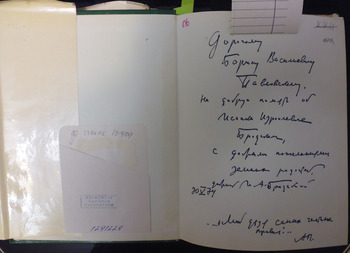
Autograph of Iurii Arkadevich Brodskii on his monograph about Isaak Izrailevich Brodskii. Cit. I. A. Brodsky, Isaak Izrailevich Brodsky (Moscow, 1973). The book is kept in the Library of the Institute of the Humanities and Arts at the Ural Federal University, Ekaterinburg.

We will come back to the first verse of Eugene Onegin later, meanwhile, we should keep in mind that Isaak Brodskii's self-portrait, which was considered to be the start of his professional career, dates from 1904. This work strikingly resembles the self-portrait of Rembrandt van Rijn in terms of its composition and painting technique.Footnote 4 This should come as no surprise, since in his youth, Brodskii tried to copy the great Dutchman not only in his art but also in his daily life: for example, he wore a Rembrandt-style beret.Footnote 5 Before 1917, the prevailing approach to education in the St. Petersburg Academy of Arts was based on the classical canons of Ancient Greece and Rome, European art of the Renaissance era, and classicism. Brodskii, who is known to be a pioneer of socialist realism in visual art, was remarkably versatile in combining the best traditions of European art, academic and salon painting, and Russian realist art.
Amongst the researchers who have developed methodologies for analyzing art as a primary source, I drew upon the works of G. Simmel and, first and foremost, H. G. Gadamer.Footnote 6 I also referred to works on the psychology of art.Footnote 7 In a broader context, the present reflections on Brodskii's art have been inspired by the philosophical writings of Immanuel Kant, Edmund Husserl, and Martin Heidegger. Throughout the article, I assume that the truth of art may form part of the scientific truth.Footnote 8 With the help of imagination or visualization, it is possible to unlock the “cognitive potential of works of art.” Imagination in this case is not “spontaneously irrational,” but a methodological instrument of cognition necessary for discovering “in full the meaning and complexity of works of art.”Footnote 9 The reduction of an “artifact” and its life (including its perception by future generations) to a “bare painting” can narrow the context of interpretation to a minimum, turning the painting into a mere poster. Taking insights from art studies into consideration alongside the painter's life allows us to enrich our understanding of a distant historical reality. As I see it, studying the work of art against the background of Brodskii's life and those of his contemporaries helps us to better understand both the painting itself and the social, cultural, and psychological context of the time in which it was created. Fernando Luis González Rey notes the subtle interaction and interrelation of social and individual psychology: “In subjectivity, nothing new is configured as a result of a direct objective influence. … Subjectivity cannot be seen as a substance, but should be seen as a certain specific human production that is impossible to reduce to behavior, symbolic or cognitive processes, or any other given category.”Footnote 10 For the interpretation of art, it is important to understand the role of subjectivity in the perception of reality. This “gap” between the self-proclaimed “documentary character” of Brodskii's art and his subjective perception of reality is of particular interest to me.
A richly illustrated album with texts written by Valentina M. Bialik devoted to Brodskii's art revived traditional approaches, highlighted new aspects in the evaluation of the painter's work, and attempted to find a personality behind the “iconic image.”Footnote 11 It is necessary to take into account the author's uncritical characterization of the historical figure of Lenin as “the proletariat leader and the genius of the revolution.” This is in keeping with the description of Brodskii's painting in the relevant article in the Great Soviet Encyclopedia (1951), where it states that the painting “conveys the charm and humanity of the great leader.”Footnote 12 We can argue that studies of the Soviet era are akin to archaeology, revealing cultural and mental layers one by one. The life and works of this painter seem to be buried under layers of Soviet ideology, myth-making and official narrative.Footnote 13 It seems as if the real painter, one of the favorite students of Il΄ia E. Repin (1844–1930), has been turned into a symbolic personality, a living icon.Footnote 14 One of the reasons for this is the uncritical attitude of some art experts to the historical context, which has led to the endurance of certain historical clichés. This is why it is necessary to analyze the facts of Brodskii's creative life in a broader historical context. Within the framework of the iconic turn, I apply a three-stage analysis to the painting.Footnote 15 First, I carry out a pre-iconographic description of the painting, that is to say a description of what is actually pictured in the painting with an account of its styles and motifs. Then I describe the meaning of the images, taking into account the historical context and genres, through iconographic analysis. Finally, I carry out an iconological interpretation of the symbolic content of the painting.Footnote 16
“My uncle has most honest principles …”
What happened to the painter in the 1920s and 1930s? Pavel Filonov's diaries, where he expressed his personal thoughts, allow us to diversify the “official” source base surrounding Brodskii himself and his contemporaries. In these diaries, we can find events that have not previously been connected to Brodskii's biography. His involvement in the upheavals of the 1930s could well have led to negative consequences in his daily life. This “involvement” meant that Brodskii, as the patriarch of socialist realism, did not live in an idyll: there were conflicts as well. Filonov, a victim of state suppression in 1936 and, more seriously, in the spring of 1937, describes the harassment that Brodskii suffered from other artists. It is no coincidence that these events were synchronous with discussions about factionalism, formalism, naturalism, and the problems of socialist realism taking place in the Moscow and Leningrad Unions of Artists during 1936–1937. These discussion occurred in the broader context of the conflict in Soviet art between 1936 and 1941, the Great Terror, and the public trials of 1936–1938.Footnote 17
The painter's behavior greatly differed depending on his surroundings (official, confidential, or intimate). For instance, in his meeting with Filonov on February 18, 1936, Brodskii deliberately evaded a discussion by saying that he “was reading practically nothing related to art.”Footnote 18 We cannot suspect Filonov of being a member of the Party, since he was a proponent of analytical art and thus was a true “anomaly” in the Leningrad art scene. Therefore, the details in his diaries can throw light on daily life in the 1930s and are a valuable source for understanding the personality of Brodskii. As an uncompromising opponent of socialist realism, Filonov can be considered an unbiased contemporary of Brodskii's. He recognized the painter's talent, but talked to him on equal terms. Although he considered Brodskii an ideological opponent, he still called him the best painter of realist art in Russia and Europe.Footnote 19 Filonov publicly attacked Brodskii during the general meetings of the Academy of Arts, which relieves him of the charge that he desired to flatter the painter. Indeed, he warned his colleagues about “provocateurs” who were trying to discredit Brodskii and do him harm.Footnote 20
Despite the confrontation between their schools, Brodskii tried to help Filonov and pleaded his case on the pages of Soviet newspapers at the first opportunity.Footnote 21 There was a dramatic change a few years later when it became impossible to print such articles because of further mass ideologization and the unification of public opinion. In 1937, Filonov stopped criticizing Brodskii, as he clearly understood the consequences that this could have for both of them. On October 8, 1937, Filonov stopped keeping his diary after the painful impression caused by the arrest of his sister's husband, the old Bolshevik Nikolai Glebov-Putilovsky.
Filonov did not feel any personal animosity towards Brodskii, who tried to get in contact with him. His opposition was of a purely professional character, related to the teaching of so-called realist art introduced by the Russian Academy of Arts after Brodskii's appointment as director in 1934. When complimenting Brodskii's painting The Ceremonial Opening of the II Congress of the Communist International in Uritskiy Palace in Leningrad (1920–1924), Filonov emphasized that Brodskii was the best artist among the “post-Itinerants.”Footnote 22 He did not tire of saying that the analytical art he, Filonov, had founded would eventually win and replace realist art as the official school. His school had enjoyed popularity at the beginning of the 1920s, after all: in 1922–1923, his lectures were circulated by hand all over the country even though socialist realism as such had not yet even been conceived.Footnote 23
When you compare the “Rembrandt-style” self-portrait of the young Brodskii and other pre-revolutionary works with the paintings created during the Soviet period, you start to realize that there were two completely different painters living in the same person. The contrast between the visual imagery in the painter's works before and after the Russian Revolutions of 1917 demonstrates what a dramatic change occurred in Brodskii's artistic vision. He broke with nearly all of his previous aesthetic principles: he changed from a delicate openness and a bright, versicolored and optimistic palette to a more “gloomy” and monotonous style: while the works were still masterfully executed, he started to employ blacks, whites, and browns that were not, strictly speaking, ideologically sound.Footnote 24
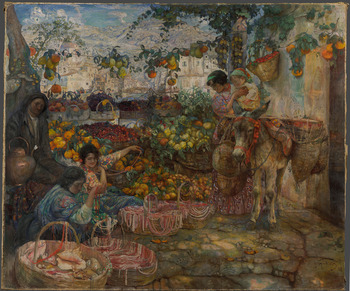
Italy (1911). Linen, Oil, 208 × 250 cm. The State Tret΄iakov Gallery. Moscow.

Valentina Bialik underlined this peculiar feature of Brodskii's work; when discussing the monumental works of painters in the Soviet period, she mentioned “the similarity and even banality of the compositions, the simplicity of coloring and uninspiring motifs.”Footnote 25 Brodskii's works from the pre-revolutionary epoch are best characterized by the words of the art critic Alexander Borovskiy:
It is a typical example of Art Nouveau . . . the Art Deco moment was foreseen by Brodskii. It is an example of good salon art and, at the same time, is impressive, bright, and very professional. We can call it salon-academic [although it] includes elements of some avant-garde symbolist trends of that period. There is a good reason that antiquarians of the past and present have always thought highly of his works; Brodskii's paintings have always been very expensive.Footnote 26
In the 1910s, Brodskii's works became commercially viable. His studio flat in Polozov Street on the Petrograd side of St. Petersburg became a fashionable salon: painters, actors, and art collectors visited it with pleasure.Footnote 27
Behind the stereotypical image of Brodskii as an apologist for the Soviet state and a founder of socialist realism, who was working in comfortable conditions while witnessing the terror picking up speed, it is impossible to see an emotional and sensible painter.Footnote 28 Leonid Heller has highlighted the unpredictability of the state in relation to artists.Footnote 29 Of course, Brodskii was a representative of the Soviet elite, but it would be incorrect to interpret events in accordance with the tradition formed in studies of Soviet totalitarianism, where Soviet society is strictly divided into two halves: the machinery of terror on the one side and the passive and suffering population on the other. We cling to the notion that every person has the potential for rebellion, which may allow him or her to turn against the mainstream. I will try to analyze in this context what the painter wanted to say and what means he used to achieve it.
Brodskii managed to successfully continue the tradition of Russian realism under new circumstances and transform it into socialist realism. The Soviet government and later, Stalin's functionaries, tolerated Filonov, although he was absolutely undesirable due to his radicalism and non-conformism. This makes sense: Brodskii's academic realism naturally complemented the aesthetics of 1930s Stalinist classicism. Since he was institutionally integrated, Brodskii represented official art and enjoyed the pleasures of life, living on a grand scale in the former palace on the Arts Square in front of the Russian Museum.Footnote 30 Still, on closer inspection, everything was much more prosaic. Seven people other than Brodskii lived in a three-room flat: his wife, her two sisters, P. P. Belousov, a young painter from Berdyansk who was studying in the Academy of Arts, Brodskii's son from his first marriage, his nephew Evgenii, and his maid. They also had two dogs and a bird.Footnote 31
Apostle of the Revolution or Antichrist?
Brodskii was one of the first painters who was allowed to portray Lenin, the leader of the Russian Revolution. The activities of the latter have polarized opinion in Russia over the last three decades: some consider him the Russian Antichrist, while others deem him the Apostle of the Russian Revolution.Footnote 32 Brodskii started to work on the image of Lenin after 1917, but he was already acquainted with the reputation of the politician. In 1911, when he visited Gor'kii in Capri, Brodskii heard the writer's enthusiastic comments about Lenin: “Alexei Maksimovich was looking forward to Lenin's visit to Capri and often referred to him as a ‘great model for a painter.’”Footnote 33 Years later, Brodskii wrote: “The personality of V.I. Lenin seemed one of a kind and very interesting to portray. I was trying to pick an occasion to meet him for a long time.”Footnote 34
In 1917, Anatolii V. Lunacharskii, the People's Commissar for Education, recommended Brodskii as an ethically and politically reliable person during one of the meetings of the Executive Committee in Gor'kii's Petrograd flat. Brodskii asked Lunacharskii to help him to draw a number of sketches of the leading figures of the October Revolution, including Lenin.Footnote 35 Brodskii, who was actively participating in exhibitions at the time, immediately came to the public's attention and was recognized as an exceptional master whose works could be very useful to the new government. In March 1919, he exhibited his first portrait of Lenin in the competition “The Great Russian Revolution” and won an award.Footnote 36 Conflicts could not be avoided, however. Viktor N. Perel΄man, a contemporary of Brodskii's, remembered that “Brodskii faced no lack of enemies,” especially among the so-called “leftist avant-gardists,” for whom he was persona non grata.Footnote 37 He was even excluded from the Association of the Artists of Revolutionary Russia. Nonetheless, Brodskii had the favor of the government, where he had defenders and patrons in the highest echelons: even Voroshilov, a member of the Committee for the Maintenance of Lenin's Memory from 1924, pleaded for him. The aforementioned committee “effected control over reproducing and copying the portraits of the leader, and gave permission to replicate his portrait, sculptures and monuments.”Footnote 38 From 1926, Sergei M. Kirov, who always displayed favor towards Brodskii, took on the leadership of the Leningrad branch of the Party.Footnote 39 Kirov, being very close to the painter, ordered premises located above Brodskii's flat to be allocated as his studio.Footnote 40
When speaking about the “socialist period” of Brodskii's art after 1917, Abram Markovich Efros called his style “academic naturalism” in 1940: this is not a very fair appraisal, but it corresponds with the general opinion of Brodskii's colleagues. Both the painter himself and Iosif A. Brodskii rejected such an interpretation, considering it too simplistic and a failure to understand socialist realist art.Footnote 41 Bialik described the official version of the portrait of Lenin in Smolnyi as the first work to be produced by “a Soviet salon.” She called the painter an “apologist” for the methods of socialist realism. I can only partially agree with this opinion.Footnote 42 At the dawn of the Revolution, Brodskii, holding true to his democratic principles, decided that his paintings on relevant social and political topics could contribute to the establishment of a new social order, the Russian democracy he saw during the first years after the Revolution.Footnote 43 In February, he painted a portrait of Aleksandr Kerenskii.Footnote 44 After the events of October 1917, Brodskii actively sought to establish contacts with the new government, and was contracted to paint a number of portraits and genre paintings depicting Soviet leaders.
Analysis of the Painting
It is time to turn to discuss the different versions of Brodskii's portrait of Lenin in Smolnyi, an integral part of Leniniana in Soviet art.Footnote 45 These versions are characterized by originality of composition, the absence of clichés, and a “non-dogmatic” interpretation of the image of Lenin. In these paintings, the latter is portrayed not only as the leader of the Russian Revolution, but also as a “humane” politician and a “hard-working” intellectual in a private setting. Brodskii remembered: “I got the idea of painting this portrait incidentally when I visited Lenin's room in Smolnyi. I left this small museum with a firm intention to paint this portrait. I painted it very promptly, during two or three weeks. I think that I did a good portrayal of Lenin. Nadezhda Konstantinovna Krupskaya shared this opinion as well. The picture is in the Central V. I. Lenin Museum, and its alternate version—in the Tret΄iakov Gallery.”Footnote 46
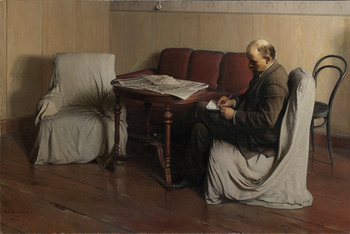
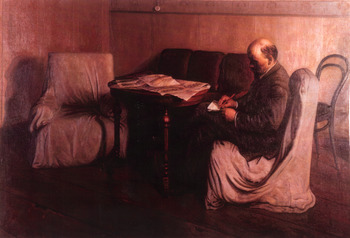
In contrast with the picture in the Tret΄iakov Gallery (Figure 3), which is filled with light and reproduces the portrayed leader and the mise-en-scène with the precision of a photograph, the “painting in the semi-darkness” from the private German collection (Figure 4) is characterized by that “artistry” which Brodskii, in his official role, treated with such disregard: it is pictorial art, not “photo realism.”Footnote 47
I. I. Brodskii. V. I. Lenin v Smol΄nom (1930). Linen, Oil, 190 × 287 сm. Tret΄iakov Gallery, acquired from author, 1937. Inv. Nr. 218.

V. I. Lenin v Smol΄nom (1930). Linen, Oil, 139 × 94 сm. Private collection in Germany. Today, the picture belongs to another private collector who shall remain anonymous.

Brodskii himself never denied that he used photography in his work, especially in the process of creating the portrait under discussion here. However, “this ‘prosaicism’ was far from cold objectivism, detached factography, and photography.”Footnote 48 The painter creatively interpreted documentary materials and drew upon live observations and sketches.
I will try to speculate on the painter's fate through a comparative analysis of Brodskii's two paintings. The “German” version of the painting is deeply distinguished from the official, well-known version kept in the Tret΄iakov Gallery. This may be accounted for by the complex development of the painter's creative method—“this painting germinated for years.”Footnote 49 The uniqueness of the “German” version may be explained by Brodskii's short-term yet intense emotional suffering after a tragic event in his life, whether the loss of a loved one, a student, or a colleague. It is noteworthy that Brodskii, as an official chronicler, made sketches of Lenin during the Second Congress of the Communist International that took place from July 19 to August 7, 1920 in the former Tauride Palace in Petrograd and during the Third Congress of the Communist International in Petrograd and Moscow from June 22 to July 12, 1921. It was Moscow where the famous photograph that provided the basis for the painting was taken.
Let us refer to the “German” version (Figure 4) as a “twin” of the painting in the Tret΄iakov Gallery. The picture has a light brown tone that gradually turns darker: it looks more like a piece of fine art than an example of photorealism. It should be noted that the well-known “Moscow” versions of the painting are usually referred to as exemplars of the latter genre. This is the first “drawback” of the German version: according to the ideologically “correct” conception of the time, Soviet artists had to create bright, vivid, and positive works. Examples of this type of pictorial art can be found among the oeuvres of such masters of Soviet art as Arkady A. Plastov (1893–1972) and Alexander I. Laktionov (1910–1972), which does not detract from their merits. The latter was Brodskii's student, who portrayed the sick painter during the last days of his life.Footnote 50
Brodskii's “German” painting is filled with a joyless and “realistic” brown color. Lenin is pictured sitting in the chair on the right, wrapped up in work, fully focused on his thoughts. There is no external world for him at this moment, or it only serves as an imperfect object for social experiments. He is writing something on a piece of paper, which he has placed habitually on his knee, as if he is used to writing in all circumstances: on the road, in the forest, or in prison. Still, this humble posture is a symbol of power: the ability to write and formulate thoughts through writing was a manifestation of the power that formed the basis for various decrees and statements that determined the life of an entire country.
The painting's composition, distribution of light, and palette give us information about the painter's plan to depict Lenin in a particular way.Footnote 51 The light falls from the window on the right, behind Lenin's back. Despite the strong source of light, the room remains in semi-darkness. The glints of light on the wall can be associated with the “world conflagration,” or the fires of Hell. The shaft of light throws objects into shadow: this gives the impression that Lenin is pictured in the kingdom of darkness.
For the iconography of Lenin, as well as for Brodskii himself, such a portrayal of the leader is quite untypical: it is the only painting where Lenin is not at the center of the composition, but is pictured on the right, showing his profile to spectators. In both portraits, Lenin's eyes are cast down and thus do not meet the gaze of the audience. However, this is where similarities between the two versions end. While the composition is the same in both versions, there are significant differences in the use of color. Whilst the official versions are executed in the neutral style of “photorealism,” in this “Berlin” version (see Figure 4) the painter adheres to the Judeo-Christian religious tradition, despite the fact that he was not a religious person. In this painting, he speaks the language of the Russian “Apocalypse”: the sinister tongues of fire glaring on the wall may symbolize both the fire of the Revolution and the fire of Apocalypse. By deploying the principle of the “golden section,” the painter remains within the framework of the classical canon, which might explain this choice of composition. The spectator's attention is attracted not only to Lenin, but also to the magazine table placed in the center of the composition. Let us take a closer look at the newspaper emphasized by the painter, as this represents the picture's counterpoint.Footnote 52
The first thing that immediately strikes the eye is their unusual texture. The paper here seems wet. It is not flat and looks unnatural; it is as if something is hidden underneath it. It is difficult to believe that this “something” might be a piece of bread or a wrapped-up fish, brought by Lenin's attentive companions, since Lenin was very pedantic, and was furthermore very sensitive to the press and wanted fresh newspapers on his table every day.Footnote 53 We should note that this characteristic detail (the unusual newspaper in the center of the composition) is clearly visible when you look at the original of the “German” painting, but not its electronic copy. When studying the original painting, it is easy to imagine that the newspaper is soaked with blood.Footnote 54 It symbolizes not only the innumerable victims of the Revolution, but also the “murder of free speech.” Freedom of the press was prohibited after the Bolsheviks rose to power.
This is suggested by the content of the newspaper. Unnaturally large capital letters spell out the phrase “the nation at arms,” whereas other versions contain the slogan “liberty, equality, and fraternity.” Such a choice of heading is highly unusual because, especially when we consider the ideological importance of paintings such as this one, special attention would have been paid to the specific images and written words used. The magic of the published text here plays a very important political role as a poster. The text in the painting, reproduced millions of times and known to every person in the Soviet Union from their elementary school years, would have been carefully thought out and controlled by the Party, as was the case for all other works of art depicting the leader of the Revolution.
Thus, the idea expressed in this painting may be characterized by the words from the New Testament: “I came not to bring peace, but to bring a sword.”Footnote 55 In the context of the 1920s and 30s, the headline “the nation at arms” symbolizes the power that was simultaneously changing and destroying civil society. It is a well-known fact that Lenin had a defiant attitude towards all press organs except the Bolshevik ones. Moreover, he felt profound contempt for all “bourgeois rights and freedoms.” Lenin, as the first unofficial censor in the Soviet Republic, gave clear instructions to Feliks Dzerzhinskii, the head of the All-Russian Special Commission for Combating Counterrevolution, Sabotage and Speculation (VCheka), to eliminate these “rights and freedoms” and to close any newspapers and magazines that did not tow the “party line.”Footnote 56
Lenin's study, a former room for maids, was very humbly furnished. All the furniture was only used by Lenin himself. In the image, the empty chair looks like it is stuck to the sofa: there is no room for anyone to squeeze past. The wrinkles in the armchair show that someone had been sitting on it, but we can only imagine this person. This composition suggests that there should be a conversation partner present. This was certainly the impression of the painter V.Z. Nizamov from Sergeev Posad, who placed a scared boy looking out from behind the armchair.Footnote 57
Thus, this room is not an area for dialogue or discussion (see Figure 4). There is only a shadow behind the armchair. The chair behind Lenin does not perform any function, remaining vacant. The position of the seat makes it seem as if Lenin is sitting “between the chairs.” The armchair in which Lenin is sitting has been taken apart by the painter: it has no arms. This artistic choice can be clearly seen when one looks at the original armchairs in the museum in Smolnyi, where both armchairs look absolutely the same: both have arms.
The light is used not to highlight the face of the main character or some important detail, which is typical of Rembrandt's paintings for example, but to darken Lenin's face.Footnote 58 Thus, the light of the Enlightenment and rationalism is being transformed into the shadows of the “dark” Enlightenment. The feet of the person in the painting are difficult to distinguish. Lenin is almost being dragged downwards, as if by the irresistible force of gravity or the lure of a subterranean world. To intensify this effect, the painter “dissects” the armchair, leaving it without arms. This is rather mysterious when we consider that Brodskii assured others that the décor of the room had been meticulously reproduced: “Everything is pictured exactly as it was in the room when Lenin lived in it. Spectators should feel the same thrill as you feel in the museum when you want to touch Lenin's belongings. I could not change anything in order to please the adherents of ‘picturesqueness.’”Footnote 59 Leaving such statements about the analysis of censorship and self-censorship to the experts, I will only say that such a treatment of the facts suggests that one cannot possibly avoid the artistic transformation of reality when attempting to reflect it more truthfully. Even such a master of realistic art as Brodskii cannot abandon this principle. In realistic art, the latter is minimized, while it is absolutized in abstract art.
Is this kind of “edgy” analysis admissible at all? Is it possible to subject a painting by the founder of socialist realism to such a “tough” interpretation? Does it not go too far? But who should determine the boundaries of the admissible if not the researcher himself? Bialik is rather convincing when she speaks about the painter's desire to add a hint of lyricism to the historical figure and to poeticize the leader of the Revolution, as we can see in the official version.Footnote 60 We can accept this point of view because Bialik and I analyze two different versions of the painting as if they were mutually exclusive. By placing these paintings and concepts alongside one another, we can see a comprehensive portrait of the painter and his personality: contradictory, empathetic, disagreeing, doubting, and suffering from the irresolvable questions of his epoch and their dreadful insights.
Let us imagine that Brodskii was indeed suffering from the kind of agony that could have had a negative influence on his visualization of Lenin. He was doing his job in an honest manner as a highly-skilled professional executing a governmental order. In this case, the light in the “German” version no longer seems apocalyptic, but warm and unobtrusive. In order to depict the “humane” leader and bring him closer to the spectator, Brodskii used warm colors and humble “petit bourgeois” décor without unnecessary pomposity: a nobleman would never sit on covered furniture.Footnote 61 On the one hand, Lenin opposed the “bourgeois” aesthetics of the “old world”: thus, one might read the composition as signifying Lenin's rise from these aesthetics, thereby symbolizing the emergence of the new from the old. This again brings him closer to the spectator.
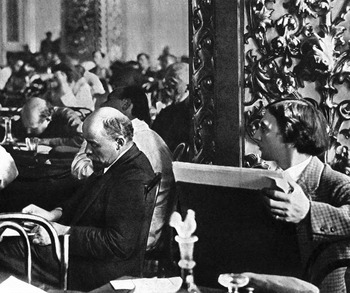
At the same time, his posture is strikingly similar to the figures of evangelists in Russian icons created in accordance with the norms of Byzantine and Old Russian pictorial art (see Figures 3 and 4).Footnote 62 It is difficult to know whether the master created this parallel on purpose. However, it could not have come at a better time. Lenin is writing something on his knee, just like the evangelists in 16th-century icons bringing the Good News to the world. By way of contrast, Lenin is bringing a new doctrine of socialism. The realism is thus intensified by the classical canon of icon painting.Footnote 63 We should note that Brodskii, in his efforts to portray reality in a “true-to-life” manner, often referred to photography. Making reference to the works of Lia Dikerman and Andrey Romanovsky, we could suppose that the photograph taken by Bulla was the prototype of the painting and that there were no other sources like Russian icons.Footnote 64
Foto: V. Bulla. V. A. Lenin in 3rd Congress of the Communist International [Comintern] (to the right I. Brodsky), Moscow (June 1921). № 106. URL: http://fotolenin.narod.ru/1921.html (last accessed March 19, 2017).

Photography was suitable for documenting the realistic aspects of the painter's work. The photograph taken by Bulla gives this kind of “alibi” to the painter. The photographer fixed the moment when Brodskii was working on his sketches during the Third Congress of the Communist International. However, the question is not about the posture in which the photographer captured Lenin and Brodskii, but the painter's choice of perspective. The bottom line here is not the “bare facts,” but the painter's decision. Spectators have the right to make comparisons with an icon. We can assume Brodskii might have had this idea in mind as well, not for the purposes of religious propaganda, but in order to strengthen the painting's impact on its audience. In this case, the photograph confirming the factual events is not direct proof of the painter's intentions.
As such, the will of the painter is primary. Despite the existence of a photograph which captures a “historical fact,” underlines the “objective” view of the researcher, and secures him from being accused of surrealistic “speculations,” the central question is why Brodskii chose this particular perspective, a bit behind and alongside Lenin.
Referring this choice of composition to the norms of socialist realism and the art of photography is appropriate, but it is not the only possible explanation. A comparison with traditional icons is also admissible and effective when trying to verify the symbolic content of the painting. Brodskii did not copy the photo; on the contrary, the photograph captured the moment when the painter made his choice. Even if he was not thinking about paraphrasing Orthodox iconography, this kind of comparison is still appropriate if we consider that Brodskii was rooted in Russian cultural, spiritual, and artistic traditions. There is no reason why he should not have tried to use this motif to strengthen the painting's influence on its recipients. It is no secret that the painter was considered to be on the “frontline of the ideological front,” fighting for the “new” consciousness. Visual art, as well as radio, theater, and cinema was intended to form a “new Soviet citizen,” which meant totally transforming the ingrained religious consciousness of the Russian people. In this context, the combination of realism and traditional icon painting makes sense. Maybe this combination was the reason why recipients were so convinced of the painting's veracity. Dmitry Pavlov, a worker from Sormovo, characterized the main impression created by the painting: “Simple as the truth.” Many spectators said that they saw the “real Ilyich” when looking at the official version of the painting (see Figure 3). The foes of Brodskii even invented a new term, “photo-Brodskyism,” by analogy with “Trotskyism” to cast his works in a negative light.Footnote 65 This was playing with fire: in 1936–1937, 15 artists were arrested on the charge of being “Trotskyist terrorists.”Footnote 66 Discussions about so controversial a notion as socialist realism could not fail to become politicized. In 1937, opposition to this school of art became a political accusation, one that shaped the lives of many artists.Footnote 67
We can say with a high degree of certainty that the “German” version of the painting (Figure 4) is not a copy because of the significant conceptual and color differences compared to the well-known official variant (Figure 3). It is an independent and original version of the painting. Judging from the size of the “German” version (it is half the size of the official versions) and the style of the painting (the color palette resembles that used in the painter's self-portrait from 1904), Brodskii was looking for the most appropriate image of the leader and was experimenting with the techniques required to render it.
Further natural changes in the perception of the painter and in his creative method are clear if we take a brief look at his works before and after 1917. I.A. Brodskii wrote that it is enough to look at Brodskii's The Ceremonial Opening of the Second Congress of the Communist International and The Shooting of the Twenty-Six Baku Comrades, which are, in my opinion, sterling examples of politicized art and propaganda “to realize what a turn was made by the painter from his pretty chamber and lyrical works of previous years. To a certain extent, it was a revolution related to the transformation of artistic thinking and the revision of his creative techniques. At first quantitative elements dominated over qualitative ones. . . . The coloring was still of an ‘illustrative’ nature. These losses were related to the search of a clear realistic language and specific features of artistic-documentary painting.”Footnote 68 This remark on the color scheme is key to the puzzle of the “German” version: evidently, Brodskii was looking for the right color scheme, and, in my opinion, was not limiting himself in this task.
Of course, Brodskii, as the director of the Russian Academy of Arts and a leading figure in the political system and socialist realism's struggle with “formalism,” bears direct responsibility for the fact that all other art movements ceased to play a significant role and that painters who were not willing to stick to the “party line” were subjected to persecution. However, might he have had the same fate if victory in the art world had been won by the representatives of Russian avant-garde? Could he have made a stand against the party line, which was to a considerable extent dependent on which of the competing schools was more convincing? Is it possible to treat such an important figure as Brodskii as only a “court painter,” gladly executing government orders to immortalize Soviet leaders?Footnote 69 I would suggest that every experienced researcher would give negative answers to these questions.
Can Brodskii be called a frustrated painter? Of course, the answer is no. He succeeded as an artist: his paintings enjoyed great popularity, brought him a large income, and were issued in millions of copies, thereby fulfilling their mission to “canonize” the leader and turn him into an “icon.”Footnote 70 In his status as a “trusted person,” he was allowed to get close to the “sancta sanctorum” of the Soviet regime—the image of the leader—and work on its (re)production. In his turn, the painter became the personification of a “Soviet holy man” and an icon. Nonetheless, his mythologization had its price: if he stopped playing the role of icon, he would pay dearly.
When reading Filonov's notes about the events of 1937, we cannot but notice his sympathetic tone in relation to Brodskii: Filonov felt bad about how the painter was bullied by students.Footnote 71 Maybe these were the followers of Filonov who blamed Brodskii for his excessive “academic naturalism,” as they would have called it. However, Filonov himself warned others against joining the opponents of Brodskii. Maybe he was blamed for his “bourgeois” lifestyle, which verged on sybaritic, and his excessive conformism, for which he was contemptuously called a “lackey.” In contrast to earlier years, Filonov was more cautious about making statements regarding the inevitable victory of analytical art over socialist realism and thus Brodskii.
The reasons for the conflict between the director of the Academy of Arts and the students were obvious: because of his status, Brodskii had to denounce the “formalists,” even though his contemporaries noted his exceptional tolerance towards other points of view.Footnote 72 His calm and even temper attracted many artists and representatives of the liberal community: “He always spoke softly and was very laconic: still his pointed remarks were always characterized by sharp irony and humor.”Footnote 73
Active students and members of the faculty of the Academy of Arts were a serious social force, one that played a negative role in Brodskii's life. It was ironic that these individuals made a stand against excessive academicism in painting, since the Itinerants, Brodskii's stylistic predecessors, had done exactly that during the “riot of fourteen painters” on November 9, 1863.Footnote 74 On April 16, 1937, Filonov wrote in his diary that the “students organized a trial of Brodskii: he was convicted and marked as a person who had failed their trust. The students rejected outright his system of administration, they declared it harmful and denied his authority.”Footnote 75 After another meeting of students and professors on April 18, Filonov wrote: “. . . this action is not finished but has just commenced; it seems that it was decided to send the resolution of the students’ and professors’ meeting to Stalin.”Footnote 76 Maybe the protection of the party leaders and Stalin himself meant that the students’ “Fronde” against Brodskii was unsuccessful: the mechanisms of patronage worked as successfully as they had before the revolution.Footnote 77
Returning to Filonov's criticism, we can say that the battles of the 1920s that had been fought by “formalists” (that is, the representatives of Russian avant-garde and, in particular, Filonov, Malevich, and other leaders of the “new art” that had revolutionized both Russian and global art) had now become a rearguard action. Despite all of Filonov's charisma and hard work, they were not able to turn around the events of the 1930s: the traditional academic art developed by Brodskii triumphed. Repin's school of realistic art scored a resounding victory in the “new Russia.”
“… When taken ill in earnest”
If we recall the verses of Pushkin which were cited at the beginning of this article, they can certainly be applied to Brodskii as he reached the day of his death on August 14, 1939. According to I.A. Brodskii, the painter had been suffering from blood cancer since 1936–37, but he did not give up or leave his job to go abroad. The “icon” of Brodskii was not dismantled. All formalities were observed and all honors were paid to the painter. In summer 1939, the 35th anniversary of his début was celebrated. The committee formed to prepare the celebration of the anniversary published a written address by Brodskii where he stated that, together with millions of working people, he was happy to live in this beautiful epoch.Footnote 78
The family of the painter, being aware of his final wishes, passed his enormous collection to the state: on October 4, 1939, the Council of People's Commissars of the USSR enacted a regulation to organize a memorial flat in Brodskii's apartment and studio: this still exists on Arts Square 3, in the former house of Count Mikhail Vilyegorsky.Footnote 79 All of this was done to canonize the founder of socialist realism in art and the painter of the most paradigmatic portraits of Lenin. Brodskii became an “icon” of socialist realism. Since the casting down of the idols in the 1980s and 90s, researchers have once more started to look at Brodskii as a “bright artist” rather than as an “icon,” arguing that “the decades of his life left a dramatic imprint on his work.”Footnote 80
Few believe that the author of the iconography of the “Great Leader” would ever have abandoned the classical canon. In my opinion, however, the “German” version of V. I. Lenin in Smolnyi is an example of such an action. Alexander Borovsky characterized Brodskii in the following way: “He was a unique character. It is easy to criticize him and easy to understand him, he is just an eternal type of a ‘government’ painter.”Footnote 81 We probably should not overdramatize Brodskii's life. In comparison with the majority of Soviet painters in the 1930s, he was more than successful, standing alongside other cultural figures treated kindly by Soviet leaders, like Alexei K. Tolstoi in literature, Isaak Dunaevsky in music, and Grigorii Alexandrov in cinema.Footnote 82
Through the example of Isaak Brodskii, I have tried to observe some aspects of relations between painters and the government, and his evolution from a painter who represented the Russian academic school into the master of socialist realism. When becoming acquainted with his rich artistic legacy, one realizes that the image of Brodskii in the cultural memory of his contemporaries is much more complex than the existing clichés.Footnote 83 The “German” version of Brodskii's V.I. Lenin in Smolnyi has a palette close to that used by the painter for his 1904 self-portrait, which is probably indicative of the fact that Brodskii was at a crossroads and was rethinking his previous creative techniques. When, in 1917, he volunteered to capture the epoch in images of the people who symbolized these times, he made a transition (at first, willingly and then, I believe, more painfully) from Kerenskii through Lenin to Stalin and his environment. Despite all the difficulties of his epoch, Brodskii managed to create a new “Soviet salon” style, which began with the official version of V. I. Lenin in Smolnyi.Footnote 84
The analysis of Brodskii's work allows us to come to the conclusion that the “German” version is an independent piece of art related to the official versions of the painting. It could be considered as an experimental work in which the master was trying to find the appropriate technique for a truthful portrayal of his character. Brodskii was attempting to create a true-to-life picture of Lenin, and this aspiration led him to experiment with different methods and conceptual approaches. I will leave it to art experts to define what elements of Russian realism are reflected in this variant and to what extent it can be referred to as an example of socialist realism.