Introduction
Insight is an important dimension of psychopathology across many psychiatric disorders. In addition to its well-recognized importance in psychotic disorders, insight is a clinically important dimension of disorders such as mood disorders, body dysmorphic disorder (BDD), obsessive-compulsive disorder (OCD), and other obsessive-compulsive and related disorders such as hoarding disorder.Reference Keller, Schatzberg and Maj 1 – Reference Mataix-Cols, Frost and Pertusa 4 For example, psychotic and nonpsychotic depression have clinically important similarities as well as some differences across a variety of domains, such as neurobiology, prognosis, and treatment response.Reference Keller, Schatzberg and Maj 1 Insight is likely an important aspect of other disorders as well, such as eating disorders, anxiety disorders, trauma and stress-related disorders, hypochondriasis, and certain other psychiatric disorders, although it has been far less studied in disorders such as these.Reference Konstantakopoulos, Tchanturia and Surguladze 5 – Reference Phillips, Price and Greenberg 7 Insight is a multidimensional construct that has somewhat varying definitions in the psychiatric literature.Reference Eisen, Phillips and Baer 8 In BDD, OCD, and certain other disorders, insight is usually considered the degree of an individual's conviction in his or her disorder-relevant belief (thus, insight is sometimes referred to as “delusionality” or “degree of delusionality”).Reference Phillips, Wilhelm and Koran 2 , Reference Leckman, Denys and Simpson 3 , Reference Konstantakopoulos, Tchanturia and Surguladze 5 , Reference Eisen, Phillips and Baer 8 , Reference Phillips, Pinto and Hart 9
In this review, we focus on a specific insight-related issue as it pertains to BDD: How should BDD's delusional and nondelusional variants be classified in the Diagnostic and Statistical Manual of Mental Disorders, 5th ed. (DSM-5)? The relationship between delusional and nondelusional BDD has been discussed and debated for many years, with some discussions appearing in the literature more than half a century ago.Reference Phillips 10 – Reference Campanella and Zuccoli 12 In more recent years, this topic has received increasing research attention (see, eg, Phillips etal. Reference Phillips, Wilhelm and Koran 2 , Reference Phillips, Pinto and Hart 9 ). The relationship between delusional and nondelusional BDD is clinically important because it has relevance for patient care. For example, do individuals with delusional BDD respond to the same treatment as those with nondelusional BDD? Do they have similar or different morbidity and prognosis? This topic is also relevant to the classification of other psychiatric disorders that have both delusional and nondelusional forms, which The Diagnostic and Statistical Manual of Mental Disorders, 4th ed. (DSM-IV) classifies in inconsistent ways.
BDD is a common disorderReference Koran, Abujaoude and Large 13 whose core feature is distressing or impairing preoccupation with one or more nonexistent or slight defects in one's physical appearance.Reference Phillips, Wilhelm and Koran 2 , Reference Phillips 10 Individuals with BDD typically describe themselves as looking ugly, abnormal, deformed, or disfigured.Reference Phillips, Wilhelm and Koran 2 , Reference Phillips 10 Those with the delusional form of BDD are completely convinced that their view of their appearance is accurate (eg, that they truly look deformed, disfigured, or abnormal). In contrast, individuals with nondelusional BDD recognize that their view of their perceived deformities may not be, or is not, accurate. One-third to 60% of individuals with BDD currently have the delusional form of BDD.Reference Phillips, Pinto and Hart 9 , Reference Eisen, Phillips and Coles 14 – Reference Phillips, McElroy and Keck 16
DSM-IV classifies some disorders’ delusional (or psychotic) variant as the same disorder as the nondelusional (nonpsychotic) variant. For example, DSM-IV classifies psychotic major depression as a type of major depressive disorder, not as a separate disorder in the psychosis section of DSM. 17 However, DSM-IV takes a quite different approach to BDD, classifying BDD's delusional variant in the psychosis section (as a type of delusional disorder, somatic type) and classifying BDD's nondelusional variant in the somatoform section. 17 However, DSM-IV allows BDD's delusional and nondelusional variants to be double coded—that is, individuals with delusional BDD beliefs can be diagnosed with both BDD and delusional disorder. It is worth noting that insight in BDD spans a broad range, which includes excellent, good, fair, and poor insight as well as “absent insight/delusional” beliefs.Reference Phillips, Wilhelm and Koran 2 , Reference Phillips, Pinto and Hart 9 The question is whether DSM-5 should (1) classify delusional BDD as the same disorder as nondelusional BDD, characterizing it with this broad range of insight, including absent insight (delusional BDD beliefs) and (2) eliminate the double-coding option.
Delusional and Nondelusional BDD in Earlier Editions of DSM
Pre-DSM-III
The Diagnostic and Statistical Manual of Mental Disorders, 1st ed. (DSM-I) and The Diagnostic and Statistical Manual of Mental Disorders, 2nd ed. (DSM-II) did not mention BDD. 18 , 19 However, authors from the 1940s and subsequent decades noted that BDD's historical precursor, “dysmorphophobia,” encompassed both nonpsychotic (ie, neurotic) and psychotic thinking, and that BDD was often characterized by overvalued ideation (which is similar to the construct of “poor insight”); see, eg, Phillips,Reference Phillips 10 Stekel,Reference Stekel 11 and Campanella and Zuccoli.Reference Campanella and Zuccoli 12
DSM-III
The Diagnostic and Statistical Manual of Mental Disorders, 3rd ed. (DSM-III) did not contain a full criteria set for BDD, but it did mention BDD as an example of an “atypical” somatoform disorder (the earlier version of DSM-IV's NOS category). 20 Nor did DSM-III clearly identify delusional BDD. Delusional BDD was variously considered an example of an atypical somatoform disorder, atypical psychosis, or atypical paranoid disorder.Reference Phillips 10 In other words, it was unclear in DSM-III whether delusional BDD should be considered a nonpsychotic disorder or a psychotic disorder.
DSM-III-R
The Diagnostic and Statistical Manual of Mental Disorders, 3rd ed., rev. (DSM-III-R) contained a full criteria set for BDD in the somatoform section, which applied to patients who had some recognition that their view of their perceived deformities was not accurate. 21 Those who had delusional beliefs about their appearance (ie, who were completely convinced that they looked abnormal or deformed) were diagnosed with delusional disorder, somatic subtype—a psychotic disorder. To clarify the distinction between these two forms of BDD, DSM-III-R's criterion B for BDD stated, “The belief in the defect is not of delusional intensity, as in Delusional Disorder, Somatic Type (i.e., the person can acknowledge the possibility that he or she may be exaggerating the extent of the defect or that there may be no defect at all).” However, the DSM-III-R text noted, “It is unclear, however, whether the two different disorders can be distinguished by whether or not the belief is a delusion (as in DSM-III-R), or whether they are merely two variants of the same disorder” (p. 256). No relevant data existed at that time.
DSM-IV
Limited data that became available during the development of The Diagnostic and Statistical Manual of Mental Disorders, 4th ed. (DSM-IV), as well as clinical observations, suggested that BDD's delusional and nondelusional variants may in fact be the same disorder.Reference Phillips 10 , Reference McElroy, Phillips and Keck 22 , Reference Phillips and McElroy 23 For example, a study of 50 BDD subjects found far more similarities than differences between subjects with delusional BDD and those with nondelusional BDD across a broad range of validators (demographics, phenomenology, course of illness, associated features, comorbid psychiatric disorders, family history, and treatment response).Reference McElroy, Phillips and Keck 22 Indeed, the DSM-IV Options Book, 24 published several years prior to DSM-IV, noted that there may be a continuum between BDD and the somatic delusions characteristic of delusional disorder. The Options Book additionally stated, “It has therefore been suggested that the proposed subtyping scheme for obsessive-compulsive disorder (i.e., with insight, with overvalued ideas, with delusions) might be adopted for BDD.” Thus, the Options Book raised the option of combining BDD's delusional and nondelusional forms into one disorder. However, the relevant DSM-IV workgroup (of which this article's first author was a member) believed that there was insufficient evidence to support this change at the time DSM-IV was published.Reference Phillips and Hollander 25
Thus, BDD's nondelusional and delusional forms remained separately classified in DSM-IV. 17 However, based on suggestions that these BDD variants may indeed be the same disorder,Reference Phillips 10 , Reference McElroy, Phillips and Keck 22 , Reference Phillips and McElroy 23 DSM-IV diminished their distinctiveness by (1) removing DSM-III-R's criterion B from BDD (which stated that the belief in the defect is not of delusional intensity), thus no longer requiring that some insight be present in BDD, and (2) allowing BDD's delusional and nondelusional forms to be double coded—that is, allowing individuals with delusional BDD to be diagnosed with both delusional disorder and BDD. 17 The DSM-IV workgroup recognized that DSM-IV's new double-coding option was somewhat problematic, in that it diagnosed the exact same symptoms as two different disorders. However, the double-coding option was intended to convey that BDD's delusional and nondelusional forms may in fact be the same disorder. Double coding was considered a compromise until DSM-5 was developed, when it was hoped that additional data would be available to resolve the issue of whether delusional and nondelusional BDD constitute different disorders or the same disorder.
Problems with DSM-IV's Classification of Delusional BDD and Nondelusional BDD
DSM-IV's approach has a number of problems, most of which have become clear since the publication of DSM-IV, based on our understanding of BDD due to advances in the field:
-
1. Many cases of delusional BDD do not actually meet diagnostic criteria for delusional disorder, because the total duration of concurrent mood episodes is often not brief relative to the duration of the delusional periods, as required by DSM criteria for delusional disorder.Reference Phillips, McElroy and Keck 16
-
2. The boundary between delusional BDD and nondelusional BDD is not always clear-cut, and insight may fluctuate or change over time.Reference Phillips 10 , Reference Phillips and McElroy 23 For example, improvement in BDD symptoms with SRI treatment is often accompanied by an increase in BDD-related insight.Reference Hollander, Allen and Kwon 26 – Reference Phillips 30 The delusional beliefs of most serotonin-reuptake inhibitor (SRI) responders before treatment are no longer delusional after treatment (Phillips KA, unpublished data). It does not make sense to think that these individuals had one disorder (a psychotic disorder) at one time (eg, before treatment) and a different disorder (BDD) at another time (eg, the end of treatment).
-
3. The optional double-coding approach is confusing, as it may not be clear which diagnosis to give to individuals with delusional BDD—delusional disorder, BDD, or both.
-
4. Double coding creates ambiguity as to how delusional BDD should be treated. Should we use standard treatment for psychotic disorders (antipsychotics) or treatments efficacious for BDD (SRIs)?Reference Hollander, Allen and Kwon 26 – Reference Phillips 30
-
5. DSM-IV's approach to BDD is inconsistent with that for major depressive disorder and bipolar disorder. A limited but emerging literature suggests that eating disorders may also be characterized by a range of insight, including delusional beliefs.Reference Konstantakopoulos, Tchanturia and Surguladze 5 , Reference Steinglass, Eisen and Attia 31 Yet DSM does not contain a separate form of eating disorders characterized by “absent insight/delusional” disorder-related beliefs in the psychosis section of the manual. This is also the case for certain other non-mood disorders (see, eg, Bosson etal. Reference Bosson, Reuther and Cohen 6 and Phillips etal. Reference Phillips, Price and Greenberg 7 ).
Evidence on the Relationship Between Delusional BDD and Nondelusional BDD
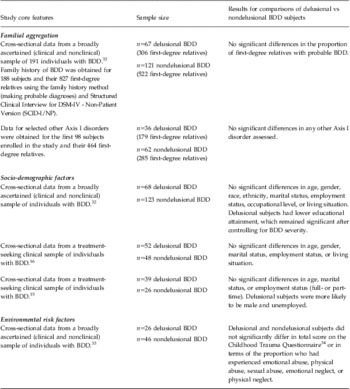
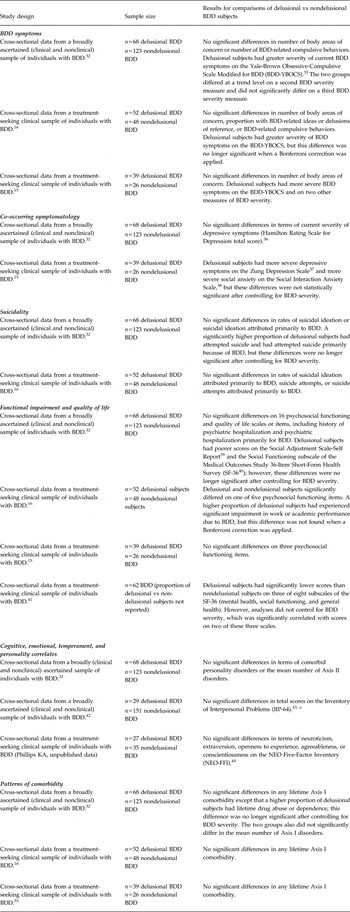
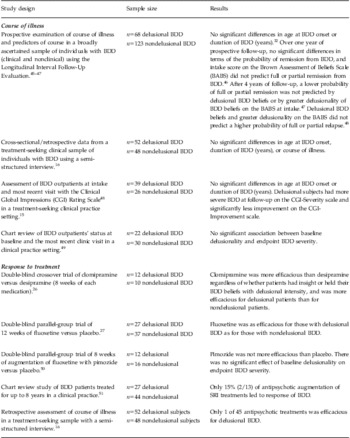
Since DSM-IV was published, studies have examined the relationship between delusional BDD and nondelusional BDD by comparing these two forms of the disorder. Tables 1–3 summarize these findings. The tables organize available data according to external validators—antecedent, concurrent, and predictive. A majority of the studies cited in Tables 1–3 classified BDD beliefs as delusional or nondelusional using the reliable and valid Brown Assessment of Beliefs Scale (BABS).Reference Eisen, Phillips and Baer 8
Evidence regarding the relationship between delusional BDD and nondelusional BDD: antecedent validators

Evidence regarding the relationship between delusional BDD and nondelusional BDD: concurrent validators

a IIP-64 subscales are domineering/controlling, vindictive/self-centered, cold/distant, socially inhibited, nonassertive, overly accommodating, self-sacrificing, and intrusive/needy.
Evidence regarding the relationship between delusional BDD and nondelusional BDD: predictive validators

Data presented in the tables indicate that there are many more similarities than differences between delusional BDD and nondelusional BDD across a broad range of features and validators, such as family history, most socio-demographic features, environmental risk factors, core BDD symptoms, co-occurring symptomatology, morbidity (suicidality, functional impairment, quality of life), cognitive and temperament/personality correlates, comorbidity, and course of illness.Reference Phillips, Menard and Pagano 32 – Reference Phillips, Grant and Siniscalchi 49 Two studiesReference Mancuso, Knoesen and Castle 15 , Reference Phillips, Menard and Pagano 32 found that on several measures, delusional subjects evidenced greater morbidity; however, this finding appeared to be accounted for by greater BDD symptom severity.
Most BDD pharmacotherapy studies have examined treatment outcomes for patients with delusional BDD beliefs versus nondelusional BDD beliefs. These studies indicate that delusional and nondelusional BDD appear to respond to the same pharmacologic treatment (Table 3).Reference Hollander, Allen and Kwon 26 , Reference Phillips, Albertini and Rasmussen 27 , Reference Phillips 50 , Reference Phillips, Albertini and Siniscalchi 51 Specifically, both delusional BDD and nondelusional BDD have been shown to respond to SRI monotherapy.Reference Hollander, Allen and Kwon 26 – Reference Phillips 30 In a placebo-controlled study of fluoxetine monotherapy, 50% of subjects with delusional BDD responded to fluoxetine versus 55% of subjects with nondelusional BDD (a nonsignificant difference).Reference Phillips, Albertini and Rasmussen 27 In a clomipramine versus desipramine crossover trial, the SRI clomipramine was more efficacious than the non-SRI desipramine, regardless of whether patients had insight or delusional BDD beliefs.Reference Hollander, Allen and Kwon 26 In fact, clomipramine monotherapy was even more efficacious for patients with delusional BDD than for those with nondelusional BDD. In addition to the studies shown in Table 3, five smaller open-label trials have examined medication response in subjects with delusional BDD versus subjects with nondelusional BDD.Reference Phillips, McElroy and Dwight 28 – Reference Phillips 30 , Reference Phillips and Menard 52 , Reference Phillips 53 Although sample sizes were small, precluding meaningful statistical analyses comparing outcomes in these two groups, these studies concur with those in Table 3 in indicating similar response rates to SRIs,Reference Phillips, McElroy and Dwight 28 – Reference Phillips 30 the antiepileptic medication levetiracetam,Reference Phillips and Menard 52 and buspirone augmentation of SRIs.Reference Phillips 53 Research on the efficacy of antipsychotics for BDD is very limited, and more research is greatly needed. However, a small placebo-controlled study of pimozide augmentation of fluoxetine in fluoxetine nonresponders and a small chart-review study suggest that antipsychotic augmentation of SRIs is not effective for either delusional BDD or nondelusional BDD.Reference Phillips 50 , Reference Phillips, Albertini and Siniscalchi 51 Furthermore, available data (largely retrospective) do not support the efficacy of antipsychotics as monotherapy for delusional BDD or nondelusional BDD (see Table 3).Reference Phillips, McElroy and Keck 16
Discussion
Available data indicate that there are far more similarities than differences between delusional BDD and nondelusional BDD across a broad range of validators and domains within those validators. Given that the approach in DSM-III, DSM-III-R, and DSM-IV was not based on scientific evidence and has substantial limitations, we recommend that (1) DSM-5 remove BDD's delusional variant from the psychosis section and classify it as the same disorder as BDD's nondelusional variant, and (2) patients with delusional BDD receive a diagnosis only of BDD, not both BDD and delusional disorder. The DSM-III-R text acknowledged the possible validity of this approach, 21 and the DSM-IV double-coding option moved BDD's classification in this direction. 17 The fact that DSM-IV already allows delusional BDD to be diagnosed as BDD (albeit double coded with delusional disorder) diminishes the magnitude of this proposed change. Most important, these proposed changes reflect the evidence that has become available since DSM-IV was developed; we are not aware of any data that support continuation of DSM-IV's approach.
We additionally propose that a dimensional insight specifier that includes BDD's delusional variant be added to BDD's diagnostic criteria.Reference Phillips, Wilhelm and Koran 2 The specifier would indicate that BDD beliefs may be characterized by good or fair insight (the individual recognizes that the BDD beliefs are definitely or probably not true, or that they may or may not be true), poor insight (the individual thinks that BDD beliefs are probably true), and absent insight/delusional BDD beliefs (complete conviction that BDD beliefs are true). BDD's delusional form would no longer receive a psychotic disorder diagnosis; it would instead be classified as BDD, “absent insight/delusional beliefs” specifier. In essence, the proposed approach for DSM-5 would create a delusional “subtype” of BDD, which was suggested two decades ago.Reference McElroy, Phillips and Keck 22 – 24 The range of insight in the proposed specifier is consistent with data indicating that a broad range of insight can characterize BDD beliefs.Reference Phillips, Pinto and Hart 9 , Reference Eisen, Phillips and Coles 14 , Reference Mancuso, Knoesen and Castle 15 , Reference Phillips and McElroy 23
This suggested approach has important implications for the diagnosis and treatment of BDD. Making delusional BDD a type of BDD rather than a psychotic disorder may perhaps prevent misdiagnosis of BDD as schizophrenia, which our clinical experience suggests may occur. This approach may also foster more appropriate treatment of BDD. Importantly, all pharmacotherapy studies of which we are aware have consistently found that delusional BDD is as likely as nondelusional BDD to respond to SRI monotherapy.Reference Hollander, Allen and Kwon 26 – Reference Phillips 30 Although data on antipsychotics are very limited, it appears that these medications as monotherapy may not be efficacious for delusional BDD (or nondelusional BDD).Reference Phillips, McElroy and Keck 16 , Reference Phillips, Albertini and Siniscalchi 51 Classifying delusional BDD as a form of the “parent” disorder (ie, BDD) may remind clinicians that delusional BDD appears to respond to the same medication as the parent disorder.
It is important to emphasize, however, that further research on the relationship between BDD's delusional and nondelusional forms is needed. This includes research on all of the validators shown in the tables—in particular, treatment outcome in delusional versus nondelusional patients with pharmacotherapy, cognitive behavioral therapy, and treatment combinations. Research is also needed in additional domains, such as genetic and environmental risk factors, neural substrates, various biomarkers (eg, neuroimaging studies), and cognitive and emotional processing abnormalities. Work in these areas may be particularly helpful in further understanding the relationship between these forms of BDD.
This issue is also relevant to other disorders that have been shown to have, or that may have, an “absent insight/delusional” form. Research on insight/delusionality is needed in a number of disorders, such as eating disorders, hypochondriasis (illness anxiety disorder), hoarding disorder, trauma and stress-related disorders, and anxiety disorders. In particular, research is needed on (1) the range of insight in these disorders, (2) the relationship between these disorders’ delusional and nondelusional forms and whether they are the same or different disorders, and (3) the relationship between level of insight and underlying neurobiology as well as important clinical variables such as illness severity, prognosis, morbidity, mortality, and treatment outcome. For example, although data are limited, some studies have found that poor insight, or denial of illness, in anorexia nervosa may be associated with poorer treatment outcome (see, eg, Saccomani etal. Reference Saccomani, Savoini and Cirrincione 54 and Greenfeld etal. Reference Greenfeld, Anyan and Hobart 55 ). Additional research is needed on whether insight/delusionality predicts not only morbidity, but also mortality, in anorexia nervosa and other disorders.
Conclusion
Available evidence indicates that across a range of validators, BDD's delusional and nondelusional variants have far more similarities than differences. Importantly, BDD's delusional and nondelusional forms appear to respond to the same pharmacologic treatment. Because the classification approach taken in DSM-III, DSM-III-R, and DSM-IV was not evidence-based due to lack of data, and given limitations and problems of this approach, we recommend that DSM-5 and the International Classification of Diseases – 11th Revision (ICD-11) classify BDD's delusional and nondelusional forms as the same disorder, with inclusion of a specifier for absent insight/delusional BDD beliefs. We believe that this approach, which was raised as an option more than 20 years ago in the DSM-IV Options Book, 24 now has sufficient evidence to support its implementation. Our hope is that this approach, if implemented in DSM-5 and ICD-11, will be useful to researchers and clinicians, and that it will improve the care of patients who suffer from this common and often-severe disorder. This increased understanding of BDD may also have useful implications for other disorders, in that it may be more valid and clinically useful to conceptualize their delusional forms as a variant of the nonpsychotic parent disorder rather than as a separate psychotic disorder. Research on this clinically relevant question is greatly needed.
Disclosures
Katharine Phillips has the following disclosures: Nat'l Inst. of Mental Health, principal investigator, salary and research funding; Janssen Research and Development, consultant; Forest Laboratories, principal investigator, medication only for an NIMH study; Transcept Pharmaceuticals, research funding; Oxford University Press, author, royalties; Guilford Press, author, royalties; Elsevier, author, honorarium; Merck Manual, author, future honorarium; academic & federal institutions, speaker or grant reviewer, honoraria and/or travel; professional organizations, speaker, honoraria and/or travel; The Free Press, author, potential future royalties; Up to Date, author, potential future royalties, honoraria. Ashley Hart has nothing to disclose. Helen Blair Simpson has the following disclosures: Janssen, research support, medication at no cost; Transcept, research support; Quintiles, consultant, consulting fees; Cambridge University Press, royalties; Up to Date, royalties. Dan Stein has the following disclosures: Eli-Lilly, advisor/speaker, consulting fees/honoraria; Glaxosmithkline, speaker, honoraria; Biocodex, consultant, honoraria to my university; Servier, consultant/speaker, honoraria to my university; Lundbeck, advisor/speaker, consulting fees/honoraria; Pfizer, analysis of database, none.