Introduction
It is a well-known paradox, particularly in developed nations, that despite higher life expectancies, women are more likely than men to experience and report poor health and functional limitation during the old-age period (Nathanson Reference Nathanson1975, Reference Nathanson1977; Waldron, Reference Waldron1976; Verbrugge, Reference Verbrugge1989). At the same time, a vast literature is available on socioeconomic interaction with health and with the gender differential in health. Socioeconomic status is positively associated with better health (Smith, et al., Reference Smith, Blane and Bartley1994; Kunst & Mackenbach, Reference Kunst and Mackenbach1994; Adler, et al., Reference Adler, Boyce, Chesney, Cohen, Folkman, Kahn and Syme1994; Macintyre & Hunt, Reference Macintyre and Hunt1997; Arber & Cooper, Reference Arber and Cooper1999; Macintyre et al., Reference Macintyre, Ford and Hunt1999), but its impact is more pronounced in the case of males than females (Lahelma & Valkomen, Reference Lahelma and Valkonen1990; Kunst et al., Reference Kunst, Geurts and Van den Berg1995; Elo & Preston, Reference Elo and Preston1996; Arber, Reference Arber1997).
In India, with its prevailing gender discrimination in intra-household resource allocation, females experience poorer health in terms of morbidity compared with males (Basu, Reference Basu1992; Kishor, Reference Kishor1993; Murthi et al., Reference Murti, Dreze and Guio1995; Arnold et al., Reference Arnold, Chloe and Roy1998). At the same time, several researchers have documented that socioeconomic status has a significant impact on reducing gender discrimination norms, as well as reducing the gender differential in health through improving women's status or autonomy within the household or within society (Das Gupta et al. Reference Das Gupta, Krishnan and Chen1995; Bloom et al., Reference Bloom, Wyij and Dasgupta2001; Jejeebhoy & Sathar, Reference Jejeebhoy and Sathar2001). Education (Bhatia & Cleland Reference Bhatia and John1995; Addai, Reference Addai1998), household living conditions (Bloom et al., Reference Bloom, Lippeveld and Wyij1999), household income (Kavitha & Audinarayana, Reference Kavitha and Audinarayana1997) and occupation (Miles & Brewster, Reference Miles and Brewster1998) have all been shown to be important in improving women's status, increasing health care and improving health status.
There are some demographic characteristics that underlie women's improved status or higher autonomy within the household and in society. Studies in India (Dyson & Moore, Reference Dyson and Moore1983; Das Gupta, Reference Das Gupta1995) have found that, after experiencing discrimination in childhood, a female suffers even greater discrimination immediately after marriage and at early reproductive age, followed by declining discrimination from late reproductive age. In the later stages of the life cycle, women start enjoying power and autonomy in the household resulting in less discrimination in intra-household resource allocation (Das Gupta, Reference Das Gupta1995). Similarly, Rahman & Rao (Reference Rahman and Rao2004) have shown, based on Bangladesh data, that age and duration of marriage have a significant impact on women's mobility; older men are more lenient in allowing their wives to go outside the home. In contrast, younger men tend to restrict their wives' outside movements more.
Nevertheless, it is very surprising to notice that the old-age period is very poorly researched as far as gender differentials in health and its interaction with socioeconomic status are concerned; all the above-mentioned studies have focused on the childhood and adulthood period. For India, in particular, very little is known about the gender differential in health of the old-age population and its interaction with socioeconomic variables in the later years of life. Understanding the gender differential in health of the old-age population is very relevant in the context of a rapidly growing old-age population worldwide, and gender differences in the proportion of old-age population where females outnumber males (United Nations Department of Economic and Social Affairs, Population Division, 2004). Specifically, understanding the determinants of gender differentials in health will help policymakers take appropriate policy measures towards reducing the gender gap and addressing the health problems of the old-age population.
The aims of this paper are, firstly, to examine the nature and extent of the gender differential in health in terms of self-assessed health and experiencing immobility at the later stage of life; and secondly, to understand the determinants of the gender differential in health, and more specifically to understand the relative importance of various explanatory variables that underlie the gender differential in health.
Data and Methods
Data
Data for this study were drawn from the National Sample Survey (NSS), 60th round data, collected by the National Sample Survey Organization (NSSO). This was conducted between January and June 2004 and included a survey on ‘morbidity and health care’ at the request of the Ministry of Health and Family Welfare of India (NSS report No. 507; NSSO, 2006).
The sample design for collecting the 60th round data was essentially a two-stage stratified design, with census villages and urban blocks as the first-stage units (FSUs) for the rural and urban areas respectively, and households as the second-stage units (SSUs). The survey period, January–June 2004, was split up into two sub-rounds of three months each. The rural and urban samples of FSUs were drawn independently in the form of two sub-samples and equal numbers of FSUs of each sub-sample were allocated for the two sub-rounds. The number of villages and that of urban blocks actually surveyed were 4755 and 2668 respectively and the numbers of households surveyed in the rural and urban areas were 47,302 and 26,566, respectively. Therefore, a total of 73,868 households were surveyed in the 60th round NSS. The survey provides information for all household members in the selected sample households. The total number of household members covered in the survey was 3,83,338. However, this study is based on only the old-age population (60+), which totals 34,831 household members. The survey mainly covered three aspects of information: morbidity and utilization of health care services including immunization and maternity care; problems of aged persons and expenditure of the households on health care services. However, for this study, the data on the health problems of aged persons (60+) were used with various socioeconomic characteristics of the household.
Dependent variables
The two dependent variables were: self-assessed health and experiencing immobility due to some health problems. Self-assessed health is the respondent's subjective assessment about his/her health; it combines biological, psychological and social elements to shape a person's perception of his/her own health. Self-assessed health has been proved to be a reliable measure of overall health and has been acknowledged by WHO as an instrument for monitoring health (De Bruin et al., Reference De Bruin, Picavet and Nassikov1996). In the NSS survey, each old-aged person was asked to state his or her status of health according to three categories: very good, good and poor. In this study's analyses, self-assessed health was made dichotomous as good self-rated health (those who reported very good or good health) or poor.
Another health indicator, i.e. experiencing immobility, was dichotomized as immobile (those who reported being confined to bed or at home due to some health problem) and mobile (those who reported that they could move on their own).
Independent variables
There are two types of independent variables: (a) those relating to the socioeconomic status of an individual; and (b) demographic characteristics of an individual. Socioeconomic variables include household economic status, caste, religion, occupational status, literacy (literate or illiterate) and place of residence (rural or urban). Demographic variables include age, marital status and sex.
Household economic status is represented by per capita monthly household expenditure, categorized for ease of understanding and to obtain a prominent health gradient, into three groups: low, medium and high. The top 33.3% of households based on per capita expenditure represent the ‘high’ group. Similarly, the next 33.3% and the rest of the households represent the ‘medium’ and ‘low’ category households respectively.
Three categories of castes considered here are Scheduled Tribe (ST), Scheduled Caste (SC) and ‘Others’ (combining ‘Other Backward Class’ and ‘General Category’). The ST and SC populations are socially and economically disadvantaged groups (IIPS, 2007). Occupationally, ST and SC populations are mostly engaged in agricultural labour or in other manual work (Dumont, Reference Dumont1970). Other Backward Classes (OBC) comprise various intermediate castes that are below the general class but higher than the ST and SC populations in terms of caste hierarchy (Sheth, Reference Sheth and Mahajan1998). However, because of their very similar economic characteristics the OBC and general populations are grouped into ‘Others’ in this study.
Similar to caste, three categories of religion (Hindu, Muslim and Others) were taken in this study. ‘Sikh’, ‘Buddhist’ and ‘Jain’ are combined into the ‘Others’ category because of their very small sample size.
Information on occupational status for the whole population was collected in the survey. Occupational statuses include: own account worker, unpaid worker, regular salaried/wage employee, casual wage labourer, attending domestic duties only, not able to work. For an easy understanding of the impact of work status on health and on the gender differential in health, three broad groups were formed: paid worker, unpaid worker and not working.
Ages of the old-aged population (60+) were categorized into three groups: 60–69 years, 70–79 years and 80+ years. Lastly, marital status was categorized into currently married, never married and widowed/separated.
Analytical methods
The first step in the analysis is to highlight the percentage reporting bad perceived heath and experiencing immobility by age group, sex, and various socioeconomic and demographic variables. In the last part of the analysis, stepwise logistic regression models were carried out to understand the determinants of the gender differential in health. For k explanatory variables and n number of individuals, the model expression is:

where P i is the probability of reporting bad perceived health, or experiencing immobility (in a separate model), i.e. Y i=1. In this model, output is coded into two categories: 1=reporting poor health or experiencing immobility and 0=not reporting poor health or not experiencing immobility. The independent variables are coded as categorical variables and all results are presented in terms of odds ratios.
The statistical software SPSS version 11.5 was used to analysis the data.
Results
Descriptive analysis
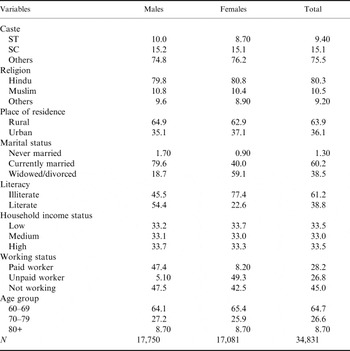
Table 1 presents the percentage distribution of the old-age population by various socioeconomic and demographic characteristics. The table shows that a majority of the old-age population belong to ‘Other’ castes (consisting of ‘Other Backward Class’ and ‘General Category’), the Hindu religion and live in a rural area. Considering the population structure of India (Registrar General of India, 2001), this is the expected picture. The most notable differences between old-age men and women are in marital status and level of literacy. It is observed that 79.6% of men are currently married, whereas for women the percentage is only 40%. Again, it is observed that a higher percentage of women were widowed/separated (although separated populations were very smaller in number) compared with men: 18.7% and 59.1% respectively. In the case of literacy, a majority of the old-age population was illiterate (61.2%). However, there was a striking gender difference in the percentage of literacy: while 45.5% of men were illiterate, the percentage of women illiterate was 77.4%.
Percentage distribution of the Indian old-age population (60+) by various background variables

Source: National Sample Survey, 2004.
Gender differential in the self-perceived bad health and immobility of the Indian old-age population (60+) by various background variables

Note: χ 2 indicates whether percentage score significantly differs between males and females.
* p<0.01;
** p<0.05.
As far as household economic status was concerned, populations were found to be distributed symmetrically across the three groups (low, medium and high). There was no gender differential in the distribution of population across household economic groups. However, for working status there was wide gender differential. Since in India males are mostly considered as the breadwinners in a family, greater percentages of males were, as expected, engaged in paid work compared with females (47.4% for males and 8.2% for females). At the same time, a greater percentage of females (49.3%) were engaged in unpaid work (mainly domestic work) compared with males (5.1%). However, a large proportion of old-age people were not doing any work (47.5% of males and 42.5% of females).
The distribution of the old-age population by age shows that a majority (64.7%) belonged to the younger old-age cohort, and the percentage of older population decreased for higher age groups. However, there was no gender differential in the distribution of population for any of the age groups; the percentages of male and female population within an age group were almost equal. This picture of an equal percentage share of males and females to the total old-age populations is different from the usual trend in developed countries, where older women dominate numerically over older men (UNFPA, 2002). Reasons for this equal percentage distribution of older men and women might be the under-reporting of females, particularly of widows, and excess mortality of females during the childhood period (Sudha & Rajan, Reference Sudha and Rajan2003).
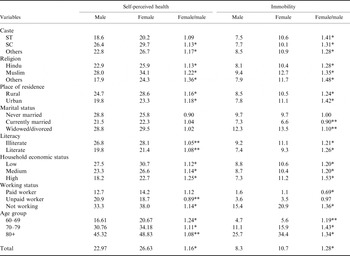
Table 2 presents the health status of the study sample in terms of self-assessed health and immobility for men and women by various socioeconomic and demographic variables. With a few exceptions, the general observation is that the percentage reporting perceived bad health and experiencing immobility was higher among the socioeconomically disadvantaged population. For instance, the percentages of bad health and immobility were found to be higher among the rural and illiterate population compared with their counterparts. Similarly, the percentage of perceived bad health and immobility decreased from low economic standard households to higher economic households. Religious variation was also clear for both health outcomes; the Muslim population perceived more bad health and immobility, followed by Hindus and Others. Variations for both health outcomes by caste were also apparent; the SC population was found to be worst as far as health status was concerned compared with the ‘Others’ category. The ST population was the exception, reporting minimal perceived bad health and immobility. Economic well-being has a significant impact on health, and this is evident from the analysis. Perceived poor health and experience of immobility were higher for unpaid workers, and even worse for non-working people. However, it has to be kept in mind that the majority of non-working old-age people might have belonged to the oldest old cohort and they were not working because of their ill health. Two other important variables influencing health are marital status and age: the currently married population was in better health compared with the never-married and divorced or separated population; the percentage of bad health or immobility increased with an increase in age.
Nevertheless, the pattern of gender differential in health by socioeconomic variables was found to be different from that of level of health per se. In general, the magnitude of the gender differential in health represented by the ratio between females' to males' rate of any health indicator was greater for socioeconomically advantaged groups. For instance, the gender differential in health in terms of both self-perceived health and immobility was lowest for the ST population followed by SC and ‘Others’. Similarly, the gender differential in health was greater for higher economic group households and among the urban population. A positive association between the gender differential in health and socioeconomic status was appearing, mainly due to different degrees of association between socioeconomic status and health for males and females. Health status improves as socioeconomic status improves, but the extent of improvement was found to be comparatively steeper for males than females, resulting in a greater gender differential in health outcomes. In the case of marital status, a significant gender difference appeared for the never-married population and for only self-assessed health (experiencing immobility was related to any gender differences by marital status); never-married males experienced worse health compared with females. This picture of relative disadvantage of never-married men compared with never-married women is compatible with earlier studies (Lillard & Waite, Reference Lillard and Waite1995; Sengupta & Agree, Reference Sengupta and Agree2002). The gender differential in health with work pattern did not show any uniform trend. While for the paid and non-working populations females experience excess poor health, for unpaid workers the gap was reversed with an excess poor health of males.
Multivariate analysis
This section deals with logistic regression analysis to examine how gender differences in self-assessed health and the likelihood of experiencing immobility interacted with various socioeconomic and demographic characteristics. Nine regression models were performed with the aim of understanding the relative importance of various socioeconomic and demographic variables in moulding the gender differential in health. The first model starts with one explanatory variable, i.e. sex, and from the next model onwards all the concerned variables were included in the analyses one-by-one and the change in odds ratio of women (against male) was observed in each step.
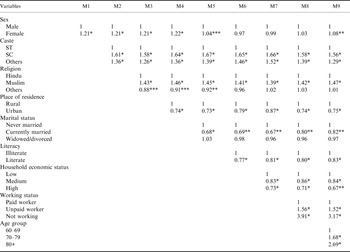
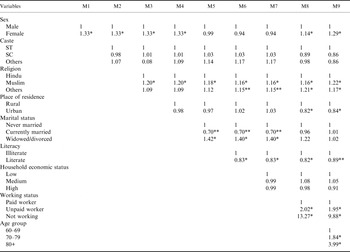
Model 1 shows the odds ratios of reporting perceived bad health (Table 3) and experiencing immobility (Table 4) for women with men as the reference category. It was found that older women were 1.21 times more likely to report perceived bad health and 1.33 times more likely to experience immobility compared with men.
Odds ratios for logistic regression of reporting self-perceived bad health of the Indian old-age population (60+)

* p<0.01;
** p<0.05;
*** p<0.1.
Odds ratios for logistic regression of experiencing immobility for men and women for the Indian old-age population (60+)

* p<0.01;
** p<0.05.
In Model 2, caste was included. It can be seen that the inclusion of caste in the model did not change the pattern of gender differential in self-assessed health and experiencing immobility (observed through the odds of sex); although it was found earlier from bivariant analysis that the gender differential in health varied by caste categories. At this point, it can be said that, probably, the very low percentage of ST and SC population to the total population had no noticeable effect on the pattern of gender differential in health of the total population.
Similar to the impact of caste categories, inclusion of religion groups into the analysis (Model 3) didn't produce any change in the gender differential in health from the previous model. However, the health gradient in terms of self-assessed health and experiencing immobility by religion group was visible from the analysis; compared with the Hindu population, the Muslim population was in worse health (the Muslim population reported 43% higher bad self-perceived health and 20% greater immobility compared with Hindus). At the same time, the ‘Others’ category reported 12% less bad health compared with the Hindu population.
Model 4 included place of residence, which increased the gender gap in self-assessed health and experiencing immobility very marginally. For self-assessed health, the odds ratio of women changed from 1.21 to 1.22 (Table 3). On the other hand, the odds ratio of experiencing immobility of women increased from 1.33 to 1.36 (Table 4).
Marital status was found to be very important in shaping the magnitude of the gender differential in health, and health per se. As can be seen from Model 5 (Tables 3 and 4), compared with the never-married and widowed/separated populations, the currently married population were more likely to report better health. The currently married population were likely to report around 32% less perceived bad health compared with the never-married and widowed/divorced population. While the widowed/divorced population experienced the highest level of immobility, followed by the never-married populations (odds ratios 0.70 and 1.42, respectively, with reference to the never-married population). This result strongly supports the existing literature in that the currently married populations experience better health compared with the never-married and widowed/separated population. The fact is that marriage promotes increased material well-being and social and psychological support leading to better health (Hu & Goldman, Reference Hu and Goldman1990; Turra et al., Reference Turra, Goldman, Seplaki, Glei, Lin and Weinstein2005). On the other hand, the socioeconomic disadvantage of widowed women puts them at risk of adverse health conditions. Widowed women are economically and socially vulnerable due to the loss of support from their husbands (UNFPA, 2002). Further, widowed women do not have a spouse to care for them at times of illness, and this could aggravate widowed women's poor health condition. Therefore, as expected, control for marital status (particularly widowed women) in the model reduced the gender differences in health substantially; while the odds ratio of women of reporting perceived bad health reduced from 1.22 to 1.04, for experiencing immobility the odds ratio reduced from 1.33 to 0.99. These reductions in odds ratios appeared to be mainly because of the gender differential in distribution of population by marital status. As can be seen from Table 2, 79.8% of men were currently married against 40% of women. Again, while 18.7% of men were widowed/separated, 59.1% of women were widowed/separated. Since the widowed/separated population reported more perceived bad heath compared with the currently married population, a reduction in the gender gap in health with control of marital status was inevitable. In other words, it can be said that a significant portion of the total gender gap in health is due to the poorer health being experienced by widowed/separated women.
Literacy is strongly associated with perceived bad health and experiencing immobility (Model 6). Compared with illiterate populations, the odds of reporting bad health and experiencing immobility were around 23% and 17% lower for the literate population respectively. Literacy also brought some marginal chance in the odds of experiencing bad health of females, indicating the impact of literacy on the gender differential in health. After controlling for literacy in the model, the odds ratio of females declined from 1.04 to 0.97 for self-assessed bad health, and for experiencing immobility the odds ratio reduced from 0.99 to 0.94. This result indicates that a proportion of the gender differential in health is explained by women's higher level of illiteracy. Since levels of perceived bad health and experiencing immobility were higher among the illiterate population, a reduction in the gender gap was expected.
There was a marginal increase in the gender differential in reporting perceived bad health with the addition of household economic status into the analyses (Model 7, Table 3); the odds ratio for women increased from 0.97 to 0.99. The marginal change in the odds of females for self-assessed bad health appeared to be mainly because of a greater gender differential in health among the higher income group compared with the lower income group. Household economic status had a strong positive association with health; compared with low economic status households the odds of reporting bad health were lower by 17% and 27% for medium and high economic group households respectively. However, for experiencing immobility, there was no change in the odds ratio of females after introducing household economic condition into the model. Even gradients in experiencing immobility by household economic condition, as found in the bivariant analysis (Table 2), vanished in the multivariate analysis after controlling for caste, religion, place of residence, marital status and literacy status.
With the inclusion of working status in Model 8, it can be seen that there was a marginal change in the odds ratio of females' perceived bad health and experiencing immobility. While odds ratio increased from 0.99 to 1.03 for reporting bad health, the odds of experiencing immobility increased from 0.94 to 1.14. This change can be attributed to the greater share of the old-aged population being in the non-working group and worse health status of females compared with males in that group. As observed in the bivariant analysis (Table 2), health gradient by work status was prominent in the multivariate analysis; both perceived bad health and experiencing immobility increased from paid worker to unpaid worker, and to the non-working population group.
Lastly, Model 9 shows that age plays an important role in the gender differential in health. With the inclusion of age groups in the analysis, the odds ratio of women of self-assessed bad health increased from 1.03 to 1.08. On the other hand, the odds ratio of women experiencing immobility increased from 1.14 to 1.29. At this point, it is very difficult to say by what mechanism age influences the gender differential in health, since the age distribution of the old-age population happened to be the same for males and females in this sample. It would have been easier to describe the underlying reason if, on average, women were older than men, as is the case in developed nations (Arber & Cooper, Reference Arber and Cooper1999). Nevertheless, right now it can only be presumed that the varying gender gap across the three age groups of the old-age population may be playing some role.
Discussion and Conclusion
The main purpose of this article was to investigate the pattern and determinants of the gender differential in the health of the old-age population in India using two measures of health: self-assessed health and experiencing immobility. The results demonstrate that older Indian women experience poorer health despite their 2 years of higher life expectancy compared with males. In India, while females experience 64.2 years of life expectancy at birth, males' life expectancy is 62.6 years (Registrar General of India, 2007). This picture is found to be compatible with the existing scenario of most developed nations as females experience poorer health despite their higher life expectancy.
As expected, health status showed an inverse association with the poor socioeconomic condition of older people. Considering the socioeconomic disadvantages of the SC population (the ST population was an exception), those from rural areas, Muslims, the illiterate and those not working (IIPS, 2007) experienced poorer health compared with their counterparts.
Apart from a structural inequality in health status, a significant difference in health outcomes by gender was also observed within each socioeconomic group. In general, gender gaps in health outcomes against older women were found to be greater in the socioeconomically advanced groups. For instance, the gender gaps in health outcomes were higher amongst higher economic group households, amongst the urban population and amongst the working-group population compared with their respective counterparts. This pattern, i.e. positive association between gender differential in health and socioeconomic status, appeared to be because of the greater relative advantage of males from the socioeconomic status over females to gain better health. It can be seen that with the advancement of socioeconomic status, both males and females gained better health, but the extent of the gain in good health was greater for males compared with females. This finding is consistent with the earlier literature: several studies have shown a stronger socioeconomic effect for men's mortality (Feldman et al., Reference Feldman, Diane, Joel and Joan1989; Lahelma & Valkomen, Reference Lahelma and Valkonen1990; Elo & Preston, Reference Elo and Preston1996) and morbidity (Kunset et al. Reference Kunst, Geurts and Van den Berg1995; Arber, Reference Arber1997) compared with that of females.
Among the demographic variables, age and marital status were taken into account in this study. As expected, it is found that currently married populations were in better health compared with the never-married and widowed/separated groups. However, within groups, a gender difference only arose for the never-married group; males were in a disadvantaged position compared with females. This result, i.e. the relative health disadvantage of never-married men compared with never-married women, was compatible with those of previous studies (Arens, Reference Arens1982; Lillard & Waite, Reference Lillard and Waite1995). Age was also found to be an important factor in determining health and the gender differential in health. It was found that reported perceived bad health and experiencing immobility increased with age. The gender differential in health decreased with an increase in age, particularly for self-assessed health; experiencing immobility did not show any uniform pattern. However, compared with the younger old-age group, the older age groups showed a greater gender differential for experiencing immobility.
The multivariate analyses helped to understand the relative importance of various socioeconomic and demographic variables that shape the gender differential in health. They demonstrated that household economic status, place of residence, marital status, religion, literacy status, working status and age group were all important in shaping the gender differential in health. However, marital status and age group were found to be the most important variables. Age has an important influence on the gender differential in health because of the varying pattern of the gender gap in health with different age groups. However, unlike in developed nations (Arber & Cooper, Reference Arber and Cooper1999), age did not provide any biased impact towards sex in India since the male and female distribution of the population by age was almost the same for India. Marital status had a strong impact on the gender differential in health due to the very high prevalence of perceived bad health and experience of immobility among widowed/separated populations and their large share of the old-age population, particularly older women. Poorer health status among widow/separated women was expected mainly because of gender asymmetry in support and care. Because of women's lower mortality rate in the old-age period (Registrar General of India, 2007) and the tendency for men to marry women younger than themselves, women were more likely than men to end their lives a widow leading to a serious gender asymmetry in the support and care of the elderly (Mason, Reference Mason1992).
In conclusion, Indian older women fare poorer in terms of both ‘self-assessed health’ and ‘experiencing immobility’ compared with their men counterparts due to their adverse socioeconomic condition and their status of widowhood. This result indicates that older women live longer with a greater burden of disease and psychological distress since self-assessed health combines all biological, psychological and social aspects of a person's health. Therefore, this study suggests that policymakers pay serious and special attention towards widowed/separated women for their socioeconomic development. Policies or programmes targeting the old-age population would not even eliminate the gender gap in health since the impact of socioeconomic status on health was found to be steeper for older men compared with their vulnerable female counterparts.