


1. INTRODUCTION
The propagation of laser beams of finite size is affected by diffraction divergence. In a non-linear medium, this effect is countered by non-linear refraction and the beam may be self-focused. In plasmas, non-linearity arises due to variety of sources, for example, Ohmic heating, ponderomotive force, relativistic mass modification, and tunnel ionization; hence, self-focusing and filamentation (Sodha et al., Reference Sodha, Ghatak and Tripathi1976; Leemans et al., Reference Leemans, Clayton, Mori, Marsh, Kaw, Dyson, Joshi and Wallace1992; Esarey et al., Reference Esarey, Sprangle, Krall and Ting1996; Borghesi et al., Reference Borghesi, Mackinnon, Gaillard, Willi, Pukhov and Mayer-ter-Vehn1998; Hafizi et al., Reference Hafizi, Ting, Sprangle and Hubbard2000; Liu & Tripathi, Reference Liu and Tripathi2001; Lushnikov & Rose, Reference Lushnikov and Rose2006) offer a fascinating study. These phenomena manifest in modifying a host of non-linear phenomena, such as parametric instabilities, harmonic generation (Sprangle & Esarey, Reference Sprangle and Esarey1991; Zhou et al., Reference Zhou, Peatross, Murnane, Kapteyn and Christov1996; Ganeev et al., Reference Ganeev, Bom, Abdul-Hadi, Wong, Brichta, Bhardwaj and Ozaki2009; Singhal et al., Reference Singhal, Arora, Rao, Naik, Chakravarty, Khan and Gupta2009), super continuum generation, self-generated magnetic fields, THz generation, and charged particle acceleration (Fuchs et al., Reference Fuchs, Antici, d'Humieres, Lefebvre, Borghesi, Brambrink, Cecchetti, Kaluza, Malka, Manclossi, Meyroneinc, Mora, Schreiber, Toncian, Pepin and Audebert2006; Wang et al., Reference Wang, Zgadzaj, Fazel, Li, Yi, Zhang, Henderson, Chang, Korzekwa, Tsai, Pai, Quevedo, Dyer, Gaul, Martinez, Bernstein, Borger, Spinks, Donovan, Khudik, Shvets, Ditmire and Downer2013; Arefiev et al., Reference Arefiev, Khudik and Schollmeier2014). While most studies on self-focusing deal with Gaussian beams, some have explored non-Gaussian beams (Misra & Mishra, Reference Misra and Mishra2009; Gill et al., Reference Gill, Mahajan and Kaur2010; Patil et al., Reference Patil, Takale, Navare, Fulari and Dongare2012). Sodha et al. (Reference Sodha, Mishra and Misra2009b ) have studied self-focusing/defocusing of dark hollow Gaussian beams in plasma considering collisional, ponderomotive, and relativistic non-linearities.
The growth of filamentation instability in plasmas has received considerable interest in the field of laser-driven fusion. Kaw et al. (Reference Kaw, Schmidt and Wilcox1973) studied the growth of a small amplitude ripple on a plane uniform wave front. The ripple modulates the refractive index of the plasma and it acquires a maximum value where amplitude is the maximum. As the beam propagates the amplitude maxima propagate with smaller phase velocity than the neighboring rays. As a consequence the wave front acquires a curvature and the beam gets focused around intensity maxima by pulling energy from its neighborhood. Thus the perturbation grows with time.
Experimental evidences (Loy & Shen, Reference Loy and Shen1969; Chiligarian, Reference Chiligarian1968; Abbi & Mahr, Reference Abbi and Mahr1971) suggest that the filamentation in non-linear media is caused by the presence of intensity spikes on a smooth looking irradiance distribution in the plane, transverse to the direction of propagation. Thus, the growth of a Gaussian ripple on a plane uniform beam has been extensively studied (Pandey et al., Reference Pandey, Tripathi and Sodha1990; Sharma et al., Reference Sharma, Verma, Prakash and Sodha2004; Sodha et al., Reference Sodha, Sharma and Agarwal2006; Sodha & Faisal, Reference Sodha and Faisal2008; Singh et al., Reference Singh, Aggarwal and Gill2009). The growth of the ring ripple on a Gaussian beam has also been investigated (Sodha et al., Reference Sodha, Konar and Maheshwari1992, Reference Sodha, Singh, Singh and Sharma1981, Reference Sodha, Sharma, Prakash and Verma2004; Asthana et al., Reference Asthana, Giulietti, Varshney and Sodha1999) in a paraxial approximation. The approach is based on the formulation of Akhmanov et al. (Reference Akhmanov, Sukhorukov and Khokhlov1968) and its development by Sodha et al. (Reference Sodha, Ghatak and Tripathi1974, Reference Sodha, Ghatak and Tripathi1976). Recently, Purohit et al. (Reference Purohit, Rawat, Chauhan and Mahmoud2015) have used higher-order paraxial theory to investigate the growth of the ring ripple and its effect on the propagation of a ring ripple in a plasma when both relativistic and ponderomotive non-linearities are simultaneously operative. However, two different beam width parameters f 0 and f 1 are required for the main beam and the ripple, respectively. We have employed a much transparent paraxial theory that employs only one beam width parameter f, which characterizes both the main laser beam and the ripple. It brings out with clarity effects of diffraction and non-linear refraction how they are affected by the ripple. Sun et al. (Reference Sun, Ott, Lee and Guzdar1987) have brought out an interesting feature of self-focusing where short pulse laser creates complete electron evacuation on the axis due to ponderomotive force-driven expulsion of electrons.
Generation of harmonics of electromagnetic waves in plasmas is an important issue in high-power laser–plasma interaction. Since most of the electromagnetic beams have Gaussian distribution of irradiance along the wave front, so there is need to take into account this non-uniformity in the theory of harmonic generation. The magnitude of the generated harmonics is higher in case of non-uniform irradiance. Sodha et al. (Reference Sodha, Faisal and Verma2009a , Reference Sodha, Mishra and Misra b ) studied the third-harmonic generation caused by the self-focusing of a Gaussian beam in a collisional plasma. Kaur et al. (Reference Kaur, Yadav and Sharma2010) have analyzed the effect of self-focusing on resonant third-harmonic generation of laser in a rippled density plasma in which the self-focusing of the laser enhances the third-harmonic power. Liu and Tripathi (Reference Liu and Tripathi2008) have studied resonant third-harmonic generation of a Gaussian laser pulse in a rippled density plasma created by machining beam.
In this paper, we examine the growth of a Gaussian perturbation of small radius on a high-power Gaussian laser beam in a plasma properly accounting for the transfer of energy from the main beam to the spike. The motivation for this study arose from a recent experiment on proton–boron nuclear fusion by Picciotto et al. (Reference Picciotto, Margarone, Velyhan, Bellutti, Krasa, Szydlowsky, Bertuccio, Shi, Mangione, Prokupek, Malinowska, Krousky, Ullschmied, Laska, Kucharik and Korn2014). They employed hydrogen enriched silicon targets with a layer of boron dopant of thickness 100 nm at a depth of 190 nm. A linearly polarized long pulse laser of temporal width 0.3 ns, wavelength 1.315 µm, spot size 80 µm, and moderate intensity 3 × 10¹⁶ W/cm2 was obliquely impinged on the target at 30° angle of incidence. The experiment reported high-yield production of alpha particles, 109 particles per steradian via proton–boron fusion. The fusion requires protons of energy 0.6 MeV. Such proton energies, according to mechanism of hot electron sheath acceleration discussed by Gitomer et al. (Reference Gitomer, Jones, Begay, Ehler, Kephart and Kristal1986) would require hot electron temperature T h~100 KeV. The given intensity is just about the border line for this temperature. Thus it appears enhancement in laser amplitude is taking-place in the large expanding plasma. One probable scenario is filamentation.
We invoke twin non-linearities, arising due to relativistic increase in electron mass and ponderomotive force-induced electron density cavitation, to cause spatial growth of a Gaussian spike on a Gaussian laser beam. In Section 2, we discuss the plasma equilibrium in the presence of a laser beam and deduce the non-linear plasma permittivity treating ions to be immobile. In Section 3, the wave equation in Wentzel-Kramers-Brillouin (WKB) and paraxial ray approximations has been solved. A function f is introduced that characterizes the spot size of the perturbation and also the amplitude of the laser on the axis of Gaussian perturbation. The equation governing f is solved numerically. In Section 4, the third-harmonic generation of a relativistic Gaussian laser beam in a plasma have been studied in the limit of normalized laser amplitude a < 1. We obtained the third-harmonic non-linear current density and solved the wave equation for the third-harmonic amplitude under paraxial ray approximation. The results are discussed in Section 5.
2. NON-LINEAR DIEECTRIC CONSTANT
Consider a singly ionized plasma of electron density
 $n_0^0 $
. A linearly polarized Gaussian laser beam with a small coaxial ripple superimposed on the main beam propagates along the z-axis through it with electric field
 $$\vec E = \hat x\,A\,(r,z)\,e^{ - i({\rm \omega} t - kz)}, $$
 $$\left. A \right \vert _{z = 0}^2 = A_{00}^{2} (1 + {\rm \alpha} \,e^{ - r^2 /r_{01}^2} )\,e^{ - r^2 /r_{00}^2}, $$
where r 00 and r 01 are the initial beam radius (spot size) of the main Gaussian laser beam and the ripple and α is the fractional intensity of the spike. For z > 0, following Akhmanov et al. (Reference Akhmanov, Sukhorukov and Khokhlov1968) and Sodha et al. (Reference Sodha, Ghatak and Tripathi1974) one may write in the paraxial ray approximation
 $$A_0^2 = (A_{00}^2 /f^2 )(1 + {\rm \alpha} e^{ - r^2 /r_{01}^2 f^2} )\,e^{ - r^2 /r_{00}^2 f^2}, $$
where f(z) is the beam width parameter to be determined later.
The laser imparts oscillatory velocity to electrons
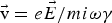 ${\vec{\rm v}} = e\vec E/mi{\rm \omega} {\rm \gamma} $
and exerts a ponderomotive force on them (primarily in the transverse direction), following Liu and Tripathi (Reference Liu and Tripathi1995)
 $$\vec F_{\rm p} = e\nabla {\rm \varphi} _{\rm p}, $$
 $${\rm \varphi} _{\rm p} = - \displaystyle{{mc^2} \over e}({\rm \gamma} - 1),$$
where γ = (1 + a
2/2)1/2, a = e|A|/mωc, c is the speed of light in vacuum, and −e and m are the charge and rest mass of an electron. As the electrons are displaced, a space charge field
 $\vec E_{\rm s} = e\nabla {\rm \varphi} _{\rm s} $
is created in the ripple region. In the quasi-steady state, the space charge force on electrons balances the ponderomotive force, that is, φs = −φp. Using this in the Poisson's equation,
 $\nabla ^2 {\rm \varphi} _{\rm s} = (e/{\rm \varepsilon} _0 )(n_{\rm e} - n_0^0 )$
, the modified electron density can be written as
 $$n_{\rm e} = n_0^0 \,\left( {1 + \displaystyle{{m{\rm \varepsilon} _0 c^2} \over {n_0^0 e^2}} \nabla ^2 {\rm \gamma}} \right),$$
where ε0 is the permittivity of free space.
The effective relative permittivity of the plasma can be written as
 $${\rm \varepsilon} = 1 - \displaystyle{{{\rm \omega} _{\rm p}^2} \over {{\rm \omega} ^2 {\rm \gamma}}} \displaystyle{{n_{\rm e}} \over {n_0^0}} = {\rm \varepsilon} _{00} + \Phi (E.E^*),$$
 $${\rm \varepsilon} _{00} = 1 - \displaystyle{{{\rm \omega} _{\rm p}^2} \over {{\rm \omega} ^2}}, $$
 $$\Phi = \displaystyle{{{\rm \omega} _{\rm p}^2} \over {{\rm \omega} ^2}} \left( {1 - \displaystyle{{n_{\rm e}} \over {n_0^0 {\rm \gamma}}}} \right).$$
The relativistic factor γ can be expanded in powers of r as
 $${\rm \gamma} = {\rm \gamma} _{00} - {\rm \gamma} _{02} \displaystyle{{r^2} \over {\,f^2}} + {\rm \gamma} _{04} \displaystyle{{r^4} \over {\,f^4}}, $$
where
 $${\rm \gamma} _{00} = \left[ {1 + \displaystyle{{a_{00}^2} \over {2f^2}} \left( {1 + {\rm \alpha}} \right)} \right]^{1/2}, $$
 $${\rm \gamma} _{02} = \displaystyle{{a_{00}^2} \over {4f^2 {\rm \gamma} _{00}}} \left( {\displaystyle{{\rm \alpha} \over {r_{01}^2}} + \displaystyle{{1 + {\rm \alpha}} \over {r_{00}^2}}} \right),$$
 $$\eqalign{ {\rm \gamma} _{04} &= \displaystyle{{a_{00}^2} \over {4f^2 {\rm \gamma} _{00}}} \left( {\displaystyle{{\rm \alpha} \over {2r_{01}^4}} + \displaystyle{{1 + {\rm \alpha}} \over {2r_{00}^4}} + \displaystyle{{\rm \alpha} \over {r_{01}^2 r_{00}^2}}} \right) \cr & \quad - \displaystyle{{a_{00}^4} \over {32f^4 {\rm \gamma} _{00}^3}} \left( {\displaystyle{{\rm \alpha} \over {r_{01}^2}} + \displaystyle{{1 + {\rm \alpha}} \over {r_{00}^2}}} \right)^2.} $$
Using Eq. (6),
 $\nabla ^2 {\rm \gamma} $
can be written as
 $$\nabla ^2 {\rm \gamma} = - 4\displaystyle{{{\rm \gamma} _{02}} \over {\,f^2}} + 16{\rm \gamma} _{04} \displaystyle{{r^2} \over {\,f^4}}, $$
From Eq. (4) one may recall that since n
e cannot be negative, one must have for the validity of the treatment
 $(c^2 /{\rm \omega} _{\rm p}^2 )\,\nabla ^2 $
 ${\rm \gamma} + 1 \gt 0$
, that is,
 $4c^2 {\rm \gamma} _{02} /{\rm \omega} _{\rm p}^2 f^2 \lt 1$
or
 $$\left( {\displaystyle{{a_{00}^2} \over {\,f^4 {\rm \gamma} _{00}}}} \right)\,\left( {1 + {\rm \alpha} + {\rm \alpha} \displaystyle{{r_{00}^2} \over {r_{01}^2}}} \right) \lt \displaystyle{{r_{00}^2 {\rm \omega} _{\rm p}^2} \over {c^2}}. $$
This inequality guarantees n e ≥ 0 at r = 0. Of course when n e > 0 at r = 0, it is so all over for all values of r.
The non-linear permittivity of the plasma can be written as
 $${\rm \varepsilon} = {\rm \varepsilon} _0 - {\rm \varepsilon} _2 \displaystyle{{r^2} \over {\,f^2}}, $$
where
 $${\rm \varepsilon} _0 = 1 - \displaystyle{{{\rm \omega} _{\rm p}^2} \over {{\rm \omega} ^2 {\rm \gamma} _{00}}} \left( {1 - 4\displaystyle{{{\rm \gamma} _{02} c^2} \over {{\rm \omega} _{\rm p}^2 f^2}}} \right),$$
 $${\rm \varepsilon} _2 = \displaystyle{{{\rm \omega} _{\rm p}^2} \over {{\rm \omega} ^2 {\rm \gamma} _{00}}} \left[ {\displaystyle{{{\rm \gamma} _{02}} \over {{\rm \gamma} _{00}}} \left( {1 - 4\displaystyle{{{\rm \gamma} _{02} c^2} \over {{\rm \omega} _{\rm p}^2 f^2}}} \right) + 16\displaystyle{{{\rm \gamma} _{04} c^2} \over {{\rm \omega} _{\rm p}^2 f^2}}} \right].$$
3. EVOLUTION OF THE SPIKE
The wave equation governing the propagation of the laser beam in a low-density plasma is
 $$\nabla ^2 \vec E + \displaystyle{{{\rm \omega} ^2} \over {c^2}} {\rm \varepsilon} \vec E = 0.$$
Substituting for
 $\vec E$
from Eq. (1) and using WKB approximation, Eq. (11) takes the form
 $$2ik\displaystyle{{\partial A} \over {\partial z}} + \nabla _ \bot ^2 A + \displaystyle{{{\rm \omega} ^2} \over {c^2}} \Phi \,A = 0,$$
where
 $k = ({\rm \omega} /c)(1 - {\rm \omega} _{\rm p}^2 /{\rm \omega} ^2 )^{1/2} $
,
 ${\rm \omega} _{\rm p} = (n_0^0 e^2 /{\rm \varepsilon} _0 m)^{1/2} $
and we have ignored the
 $\nabla (\nabla. \vec E)$
term.
We write A = A 0 exp (ikS), where A 0 and S are real functions of r and z, and separate out the real and imaginary parts of Eq. (12),
 $$\displaystyle{{\partial A_0^2} \over {\partial z}} + \nabla _ \bot ^2 SA_0^2 + \displaystyle{{\partial S} \over {\partial r}}\displaystyle{{\partial A_0^2} \over {\partial r}} = 0,$$
 $$2\displaystyle{{\partial S} \over {\partial z}} + \left( {\displaystyle{{\partial S} \over {\partial r}}} \right)^2 - \displaystyle{\Phi \over {{\rm \varepsilon} _0}} = \displaystyle{1 \over {k^2 A_0}} \nabla _ \bot ^2 A_0. $$
In the paraxial ray approximation, we expand the eikonal S as
 $$S = S_0 (z) + S_2 (z)\displaystyle{{r^2} \over 2},$$
and introduce a function f(z) such that
 $$S_2 = \displaystyle{1 \over f}\displaystyle{{df} \over {dz}},$$
where f is the beam width parameter for slowly converging/diverging fields. Using these in Eq. (13), one obtains the solution for
 $A_0^2 $
given by Eq. (2) exactly. Using Eqs (2), (15), and (16) in Eq. (14) and collecting the coefficients of r
2 on both sides, we get the equation governing f
 $$\eqalign{ \displaystyle{{d^2 f} \over {d{\rm \xi} ^2}} &= \displaystyle{1 \over {\,f^3}} \left[ {1 + \displaystyle{{\rm \alpha} \over {(1 + {\rm \alpha} )}}\left\{ {\displaystyle{{2r_{00}^2} \over {r_{01}^2}} + \displaystyle{{r_{00}^4} \over {r_{01}^4}} \displaystyle{{(3 + {\rm \alpha} )} \over {(1 + {\rm \alpha} )}}} \right\}} \right] \cr & \quad - \displaystyle{{{\rm \omega} ^2} \over {c^2}} \displaystyle{{{\rm \varepsilon} _2} \over f}r_{00}^4\comma} $$
where ξ = z/R
d,
 $R_{\rm d} = kr_{00}^2 $
. Equation (17) is a non-linear ordinary differential equation governing the behavior of dimensionless beam width parameter f as a function of normalized distance of propagation. The first term on the right-hand-side represents diffraction of the ripple imposed on the laser beam, while the second term represents non-linear self-focusing, arising due to relativistic and ponderomotive non-linearities. The focusing/defocusing of the beam is determined by the relative magnitudes of these terms. For an initially plane wave front f = 1 and df/dz = 0 at ξ = 0.
For α ≤ 0.2, r 01/r 00 ≤ 0.3, Eq. (17) takes the form
 $$\displaystyle{{d^2 f} \over {d{\rm \xi} ^2}} = \displaystyle{1 \over {\,f^3}} \left( {1 + 3{\rm \alpha} \displaystyle{{r_{00}^4} \over {r_{01}^4}}} \right) - \displaystyle{{\Omega _{\rm p}^2 a_{00}^2} \over {4{\rm \gamma} _{00}^3 f^3}} \left( {1 + {\rm \alpha} \displaystyle{{r_{00}^2} \over {r_{01}^2}} + {\rm \psi}} \right),$$
 $$\eqalign{ {\rm \psi} &= \displaystyle{1 \over {2\Omega _{\rm p}^2}} \cr & \quad \left[ {\displaystyle{{1 + a_{00}^2 /4f^2} \over {{\rm \gamma} _{00}}} + {\rm \alpha} {\rm \gamma} _{00} \displaystyle{{r_{00}^4} \over {r_{01}^4}} - \displaystyle{{2a_{00}^2} \over {\,f^4 {\rm \gamma} _{00}}} \left( {1 + {\rm \alpha} \displaystyle{{r_{00}^4} \over {r_{01}^4}}} \right)^2} \right],} $$
where Ωp = r
00ωp/c. Further, for beams of large spot size
 $\Omega _{\rm p}^2 \gg 1$
, Ψ ≪ 1. At low beam intensities
 $a_{00}^2 /2f^2 \lt 1$
, Eq. (18) simplifies to
 $$\displaystyle{{d^2 f} \over {d{\rm \xi} ^2}} = \displaystyle{1 \over {\,f^3}} \left( {1 + 3{\rm \alpha} \displaystyle{{r_{00}^4} \over {r_{01}^4}}} \right) - \displaystyle{{\Omega _{\rm p}^2 a_{00}^2} \over {4f^3}} \left( {1 + {\rm \alpha} \displaystyle{{r_{00}^2} \over {r_{01}^2}}} \right)\,,$$
giving
 $$f^2 = 1 - {\rm \beta} {\rm \xi} ^2, $$
where
 $${\rm \beta} = \displaystyle{{\Omega _{\rm p}^2 a_{00}^2} \over 4} - 1 + \displaystyle{{{\rm \alpha} \,r_{00}^2} \over {4r_{01}^2}} \left( {\Omega _{\rm p}^2 a_{00}^2 - 12\displaystyle{{r_{00}^2} \over {r_{01}^2}}} \right).$$
For self-focusing β must be positive. Ripple aids self-focusing when
 $\Omega _{\rm p}^2 a_{00}^2 \gt 12r_{00}^2 /r_{01}^2 $
. In the opposite limit, ripple suppresses self-focusing due to enhanced diffraction divergence of the axial portion of the laser beam.
We have solved Eq. (20) numerically for typical parameters. Figure 1 shows the variation of beam width parameter, f, as a function of normalized distance of propagation, ξ, for α = 0, 0.05, 0.1, a 00 = 0.5, r 01/r 00 = 0.2, (r 00ωp/c) = 100. One observes that self-focusing starts earlier and is stronger when the spike intensity is increased from zero to 0.1, that is, the spike aids self-focusing of the laser beam; higher the value of the spike amplitude, stronger the self-focusing. For 1 µm wavelength laser of spot size 100 µm, the laser travels a distance of 1256 µm as a self-focused beam.
Beam width parameter f plotted against the normalized distance of propagation ξ in relativistic plasma for different spike intensities α = 0, 0.05, 0.1 and for the following parameters a 00 = 0.5, r 01/r 00 = 0.2, r 00ωp/c = 100.

Figure 2 shows the variation of f with ξ for α = 0.1, r 01/r 00 = 0.1, (r 00ωp/c) = 100, and different values of normalized main beam amplitude, a 00 = 0.4, 0.5, 0.6. The self-focusing starts earlier when the value of the normalized amplitude of the main laser is increased due to the predominance of the non-linear term over the diffraction term. One may also note that the distance of self-focusing decreases with the increase in the intensity of the main beam. This is similar to the pinching effect of self-generated quasi-stationary magnetic field at relativistic intensity, which adds to self-focusing (Pukhov & Meyer-ter-Vehn, Reference Pukhov and Meyer-ter-Vehn1996).
Beam width parameter f plotted against the normalized distance of propagation ξ in relativistic plasma for main laser intensities a 00 = 0.4, 0.5, 0.6 and for the following parameters α = 0.1, r 01/r 00 = 0.1, r 00ωp/c = 100.

Figure 3 shows the variation of f with ξ for different values of normalized plasma density(r 00ωp/c) = 50, 75, 100 when the other parameters are: α = 0.1, a 00 = 0.5, r 01/r 00 = 0.2. The self-focusing is stronger at higher plasma density due to the enhancement in the non-linear term. Figure 4 shows the variation of f with ξ for different values of the ratio of the size of the spike to main beam radius r 01/r 00 = 0.1, 0.15, 0.2, when α = 0.1, a 00 = 0.5, (r 00ωp/c) = 100. The self-focusing starts earlier when the value of r 01/r 00 is decreased.
Beam width parameter f plotted against the normalized distance of propagation ξ in relativistic plasma for the following parameters r 00ωp/c = 50, 75, 100, α = 0.1, r 01/r 00 = 0.2, a 00 = 0.5.

Beam width parameter f plotted against the normalized distance of propagation ξ in relativistic plasma for the following parameters r 01/r 00 = 0.1, 0.15, 0.2, α = 0.1, a 00 = 0.5, r 00ωp/c = 100.

We have also plotted the normalized radial laser intensity profile as a function of r/r 00 using Eq. (2) in Figure 5a and 5b, for α = 0.1, a 00 = 0.5, r 01/r 00 = 0.2, (r 00ωp/c) = 100, at (z = 0, 0.02R d). The axial intensity increases while the radial width shrinks. The ripple becomes even narrower.
(a). Plot of the normalized radial laser intensity profiles as a function of r/r 00, for α = 0.1, a 00 = 0.5, r 01/r 00 = 0.2, (r 00ωp/c) = 100, at z = 0. (b) Plot of the normalized radial laser intensity profiles as a function of r/r 00, for α = 0.1, a 00 = 0.5, r 01/r 00 = 0.2, (r 00ωp/c) = 100, at z = 0.02R d.

4. THIRD-HARMONIC GENERATION
So far we have considered only the time average ponderomotive force on electrons. The laser also exerts a second-harmonic ponderomotive force and gives rise to third-harmonic generation. Here we study this phenomenon in the limit of a < 1.
The laser field, given by Eq. (1), imparts oscillatory velocity to electrons,
 ${\vec{\hskip2pt\rm v}}_{\rm \omega} = e\vec E_{\rm \omega} /mi{\rm \omega} {\rm \gamma} $
, and exerts a ponderomotive force on them at the second harmonic
 $$\vec F_{2{\rm \omega}} = - \displaystyle{e \over {2c}}{\vec{\rm v}}_{\rm \omega} \times \vec{\hskip4pt\rm B}_{\rm \omega} = - \hat z\displaystyle{{e^2 E_x^2} \over {2mi{\rm \omega} \,c}}{\rm \eta}, $$
where we have employed
 ${\vec{\hskip4pt\rm B}}_{\rm \omega} = c\vec k \times \vec E/{\rm \omega} $
for the magnetic field of the wave and η = kc/ω is the refractive index. The relativistic factor γ can be written as
 $${\rm \gamma} = \left( {1 - \displaystyle{{{\rm v}^{\rm 2}} \over {c^2}}} \right)^{ - 1/2} = {\rm \gamma} _0 + {\rm \gamma} _{2{\rm \omega}} e^{ - 2i\left( {{\rm \omega} t - kz} \right)}, $$
where γ
0 = (1 + |vω|2/4c
2) ≈ 1, and
 ${\rm \gamma} _{{\rm 2}{\rm \omega}} = {\rm v}_{\rm \omega} ^2 /4c^2 {\rm \gamma} _0 $
.
Using
 $\vec F_{2{\rm \omega}} $
in the equation of motion one obtains the second-harmonic oscillatory velocity
 $${\vec{\rm v}}_{{\rm 2}{\rm \omega}}^{\,\,{\rm NL}} = - \displaystyle{{\vec F_{2{\rm \omega}}} \over {2im{\rm \omega}}} = - \displaystyle{{a^2 c} \over {4{\rm \gamma} _0}} \,{\rm \eta} \,e^{ - 2i\left( {{\rm \omega} t - kz} \right)}. $$
This velocity produces second-harmonic density perturbation through the equation of continuity
 $$n_{2{\rm \omega}} ^{{\rm NL}} = n_0^0 \displaystyle{{\vec k.{\vec{\rm v}}_{{\rm 2}{\rm \omega}} ^{\,\,{\rm NL}}} \over {\rm \omega}} = - \displaystyle{{n_0^0 a^2} \over 4}{\rm \eta} \,e^{ - 2i\left( {{\rm \omega} t - kz} \right)}. $$
The density perturbation gives rise to second-harmonic space charge field
 $\vec E_{2{\rm \omega}} = - \nabla \Phi _2 $
. The field in turn produces linear perturbations in electron velocity and density
 $${\vec{\rm v}}_{{\rm 2}{\rm \omega}}^{\,\,\rm L} = \displaystyle{{e\vec E_{2{\rm \omega}}} \over {mi{\rm \omega}}}, $$
 $$n_{2{\rm \omega}} ^{\rm L} = \displaystyle{{4k^2 {\rm \chi} _2 {\rm \varepsilon} _0} \over e}\Phi _2, $$
where
 ${\rm \chi} _2 = - {\rm \omega} _{\rm p}^2 /4{\rm \omega} ^2 {\rm \gamma} _0 $
. Using density perturbations in the Poisson's equation
 $\nabla ^2 \Phi _2 = e(n_{2{\rm \omega}} ^{\rm L} + n_{2{\rm \omega}} ^{{\rm NL}} )/{\rm \varepsilon} _0 $
and replacing
 $\nabla ^2 $
by − 4k
2, we obtain
 $$n_{2{\rm \omega}} = n_{2{\rm \omega}} ^{\rm L} + n_{2{\rm \omega}} ^{{\rm NL}} = - \displaystyle{{n_0^0 a^2} \over {4{\rm \varepsilon} _2}}. $$
where ε2 = 1 + χ 2.
The response of electrons at the third harmonic is governed by the equation of motion,
 $$m\displaystyle{\partial \over {\partial t}}\left( {{\rm \gamma} _0 {\vec{\hskip2pt\rm v}}_{{\rm 3}{\rm \omega}} + \displaystyle{1 \over 2}{\rm \gamma} _{2{\rm \omega}} {\vec{\hskip2pt\rm v}}_{\rm \omega}} \right) = - e\vec E_{3{\rm \omega}} - \displaystyle{e \over 2}{\vec{\hskip2pt\rm v}}_{{\rm 2}{\rm \omega}} \times \vec B_{\rm \omega}, $$
Assuming γ 0 ≈ 1, we obtain
 $${\vec{\hskip3pt\rm v}}_{{\rm 3}{\rm \omega}} = \displaystyle{{a^3 c} \over {8i}}\left( {1 + \displaystyle{{k^2 c^2} \over {3{\rm \omega} ^2}}} \right)e^{ - 3i\left( {{\rm \omega} t - kz} \right)} \cong \displaystyle{{a^3 c} \over {6i}}e^{ - 3i\left( {{\rm \omega} t - kz} \right)}, $$
where η ≈ 1 in a low-density plasma. The third-harmonic velocity gives rise to third-harmonic current density. Besides this, the density perturbation at 2ω frequency beats with
 ${\vec{\hskip2pt\rm v}}_{\rm \omega} $
to produce non-linear current density at the third harmonic,
 $$.\vec J_{3{\rm \omega}} ^{\,\,{\rm NL}} = - \displaystyle{1 \over 2}n_{2{\rm \omega}} e\,{\vec{\hskip3pt\rm v}}_{\rm \omega} - \displaystyle{1 \over 2}n_0^0 e\,{\vec{\hskip2pt\rm v}}_{{\rm 3}{\rm \omega}} = - \hat x\,i\displaystyle{{n_0^0 e\,a^3 c} \over {48\,}}e^{ - 3i\left( {{\rm \omega} t - kz} \right)}. $$
The linear current density due to the self-consistent third-harmonic field
 $\vec E_{3{\rm \omega}} $
is
 $$\vec J_{3{\rm \omega}} ^{\,\,\rm L} = - \displaystyle{{n_0^0 e^2 \,\vec E_{3{\rm \omega}}} \over {3m\,i\,{\rm \omega}}}. $$
The wave equation governing the generation of third-harmonic field is
 $$\nabla ^2 \vec E_{3{\rm \omega}} + k_3^2 \,\vec E_{3{\rm \omega}} = - \displaystyle{{3i{\rm \omega}} \over {{\rm \varepsilon} _0 c^2}} \vec J_{3{\rm \omega}} ^{\,\,{\rm NL}}. $$
We may write
 $\vec E_{3{\rm \omega}} = \hat x\,A_{3{\rm \omega}} (r,\,z)\,e^{ - 3i\left( {{\rm \omega} t - kz} \right)} $
, where
 $k_3 = (3{\rm \omega} /c) $
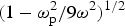 $(1 - {\rm \omega} _{\rm p}^2 /9{\rm \omega} ^2 )^{1/2} $
.
Using Eq. (28) for
 $\vec J_{3{\rm \omega}} ^{\,\,{\rm NL}} $
, Eq. (30) gives
 $$\displaystyle{{A_3} \over A} = \displaystyle{{i{\rm \beta} _1 e^{ - i\,{\rm \beta} _1 z}} \over {128}}\int\limits_0^z {\displaystyle{{a_{00}^2} \over {\,f^3}} \left( {1 + {\rm \alpha}} \right)e^{i\,{\rm \beta} _1 z} dz}, $$
where
 $${\rm \beta} _1 = - \displaystyle{4 \over 3}\displaystyle{{{\rm \omega} _{\rm p}^2} \over {{\rm \omega}c(1 - {\rm \omega} _{\rm p}^2 /{\rm \omega} ^2 )^{1/2}}}, \,\,f = (1 - {\rm \beta} \,{\rm \xi} ^2 )^{1/2}. $$
The third-harmonic power conversion efficiency is related to the amplitude ratio as
 $${\rm \eta} _{\rm p} = A_3^2 /3A^2. $$
The factor of 1/3 arises due to the reduced spot size of the third harmonic.
We have solved Eq. (31) numerically, in conjunction with Eq. (20) governing the beam width parameter, for the following parameters: a 00 = 0.4, 0.5 α = 0.1, (r 00ωp/c) = 100, r 01/r 00 = 0.2. Figure 6 shows the variation of normalized third-harmonic amplitude with the normalized distance of propagation when self-focusing effect is taken into account. The harmonic amplitude rises with distance rather rapidly due to the self-focusing of the laser beam. At higher laser amplitude, third-harmonic generation is stronger.
Ratio of third-harmonic amplitude to main laser amplitude plotted against the normalized distance of propagation ξ for the following parameters a 00 = 0.4, 0.5, r 01/r 00 = 0.2, α = 0.1, r 00ωp/c = 100.

5. CONCLUSIONS
The presence of an axial spike in a Gaussian laser beam has significant effect on the self-focusing of the beam due to relativistic and ponderomotive non-linearities. When the spike amplitude is increased, there is stronger self-focusing depending on the ratio of the size of the spike to main beam radius r 01/r 00, normalized laser amplitude a 00, and normalized plasma frequency ωp r 00/c. It is observed that self-focusing starts earlier and is stronger when the spike intensity is increased from zero to 0.1. It is also found that the self-focusing of the main beam starts earlier when the value of the normalized amplitude of the main laser beam a 00, as well as normalized plasma frequency ωp r 00/c are increased. The focusing length z = ξ R d decreases with increasing a 00. For a 00 > 1, the electrons are completely evacuated from the channel and present paraxial theory does not hold. It is also noted that self-focusing is stronger when the spike radius to main beam radius ratio r 01/r 00 is decreased. The problem is relevant in the context of proton–boron fusion experiment by Picciotto et al. (Reference Picciotto, Margarone, Velyhan, Bellutti, Krasa, Szydlowsky, Bertuccio, Shi, Mangione, Prokupek, Malinowska, Krousky, Ullschmied, Laska, Kucharik and Korn2014), as one gets intensity enhancement of the ripple by 1/f 2 ≈ 4. Thus, the effective intensity of the laser is enhanced to 1.2 × 10¹⁷ W/cm2 from 3 × 10¹⁶ W/cm2. At this intensity electron temperature is also enhanced by a similar factor; hence, 600 KeV are likely to produced that can cause proton–boron fusion.
The enhanced self-focusing of the laser beam manifests in the rise of third-harmonic generation efficiency. Third-harmonic generation could be a valuable diagnostic for filamentation. The results of the present analysis are useful in understanding the physics of intense laser plasma interaction and find the application in the high-power laser-driven fusion and particle acceleration process.
For long pulses the present treatment may be extended to study thermal self-focusing where ion motion becomes important. Thermal nonlinearity arises due to Ohmic heating and can be ignored for pulses shorter than collisional heating time.
ACKNOWLEDGMENT
The authors are grateful to Professor V. K. Tripathi, IIT Delhi, for the helpful discussions. The authors are also grateful to United Arab Emirates University for financial support under grant UPAR (2014)-31S164.



