Congenital heart disease (CHD) is the most common birth defect with nearly two of 1000 infants being affected by moderate-to-severe disease.Reference Hoffman and Kaplan 1 Many of these lesions were fatal before the surgical advancements of the 1970s and 1980s. Most congenital heart lesions now have good long-term survival, causing a rapid growth in the adult congenital population. There are now more adults than children living with CHD with over 300,000 American adults living with moderate-to-severe disease.Reference Warnes, Liberthson and Danielson 2 Although many have undergone cardiac surgery in their childhood, these procedures are rarely curative, and more than a fifth of these patients will require further intervention in adulthood.Reference Zomer, Verheugt and Vaartjes 3 These surgeries often occur in paediatric centres, which are more familiar with complex CHD.
The incidence of acute kidney injury and associated risk factors have been well described in children with CHD, as well as in adults with acquired heart disease. Rates in both populations range from 20 to 45%.Reference Englberger, Suri and Li 4 – Reference Blinder, Goldstein and Lee 8 Acute kidney injury has been associated with adverse outcomes, including an increase in duration of mechanical ventilation, longer cardiovascular ICU stays, and higher mortality within both adult and paediatric cohorts.Reference Englberger, Suri and Li 4 – Reference Loef, Epema and Smilde 9 Children are at increased risk of kidney injury given their complex cardiac anatomies and surgical repairs, which require longer cardiopulmonary bypass times.Reference Li, Krawczeski and Zappitelli 7 Adults with acquired cardiac disease may require less complex surgery, but are also at increased risk of injury due to the presence of co-morbidities such as chronic kidney disease, diabetes, hypertension, coronary artery disease, and obesity.Reference Shaw 10 At present, there are no reported data describing the incidence of acute kidney injury after surgery for adult CHD. Furthermore, there is limited knowledge about the significance of injury within this cohort.
The primary aim of this study was to describe the incidence of acute kidney injury among adults with CHD undergoing cardiac surgery with cardiopulmonary bypass at our centre. Secondary aims included determining perioperative factors that influenced acute kidney injury development and whether kidney injury was associated with outcome in this population. We hypothesised that acute kidney injury was common within this cohort, associated with identifiable risk factors and with poor clinical outcomes including prolonged mechanical ventilation and cardiovascular ICU stays.
Materials and methods
This single-centre, retrospective cohort study was reviewed and approved by the Stanford University Institutional Review Board. Written consent was waived, and all data were collected from existing electronic medical data. All consecutive adult patients (⩾18 years) who underwent cardiac surgery with cardiopulmonary bypass and had preoperative creatinine measurements were included. Patients admitted between 1 January, 2010 and 31 December, 2013 were identified using a prospectively maintained cardiovascular surgery database at Lucile Packard Children’s Hospital, Stanford University (Palo Alto, California). This is a large quaternary cardiothoracic surgical programme that treats patients of all ages who have CHD. The surgical population is composed of patients who receive outpatient care within the Stanford Health system, patients who have previously undergone surgery at our hospital, and referrals with complex congenital anomalies. Less complex congenital disease is often repaired at referring adult hospitals. Adult heart transplantation for complex CHD up to the age of 26 years is performed at Lucile Packard.
Demographic, preoperative, surgical, and clinical outcome data were collected from electronic medical records. Data collection of past medical history – that is, previous cardiac surgery, previous cardiopulmonary bypass, renal disease, diabetes, coronary artery disease, hypertension, history of arrhythmia, and preoperative medication usage – was reliant upon self-reporting and transfer of outside medical records. To account for surgical complexity and risk, a Risk Adjustment for Congenital Heart Surgery (RACHS-1) category was assigned to each patient on the basis of the primary surgical procedure performed.Reference Jenkins, Gauvreau and Newburger 11 Renal perfusion pressure was estimated as the difference between invasive mean arterial pressure and central venous pressure upon arrival to the cardiovascular ICU. Age >35 years was chosen a priori for dichotomous analysis of kidney injury given the distribution of an initial subset of patients during study design. Preoperative left ventricular dysfunction was defined as an echocardiogram report listing an ejection fraction <50% or qualitatively reported moderate or severe dysfunction. Echocardiographic images were not reviewed for the present study. Right ventricular dominant lesions (n=4) were not included in the analysis of ejection fraction.
To define acute kidney injury, we utilised serum creatinine criteria as established by the Kidney Disease: Improving Global Outcome (KDIGO) foundation.Reference Kellum and Lameire 12 As per the KDIGO classification, stage 1 injury was defined as an elevation in serum creatinine by ⩾0.3 mg/dl or 1.5–1.9 times above baseline. Stage 2 injury was defined as an increase in serum creatinine by 2–2.9 times above baseline. Stage 3 injury was defined as an increase in serum creatinine by three times above baseline, a decrease in estimated glomerular filtration rate <35 ml/minute/1.73 m2, or initiation of renal replacement therapy. According to the KDIGO definition, the 0.3 mg/dl absolute increase criteria must occur within 48 hours of bypass, whereas relative creatinine changes are required to occur within a 7-day period; however, we only collected creatinine data from the first three postoperative days to avoid including injury that developed later in the postoperative course. The KDIGO criteria have been validated in critically ill infants and adults, including cohorts after bypass.Reference Lex, Tóth and Cserép 6 , Reference Sutherland, Byrnes and Kothari 13 , Reference Bastin, Ostermann and Slack 14 Estimated glomerular filtration rate was calculated using the Cockcroft–Gault equation.Reference Cockcroft and Gault 15 We defined preoperative renal insufficiency as an estimated glomerular filtration rate <90 ml/minute/1.73 m2, the level at which the National Kidney Foundation defines decreased estimated glomerular filtration rate.Reference Levey, Coresh and Balk 16 Creatinine levels were collected preoperatively, on the first three postoperative mornings, and on the last chemistry panel before hospital discharge.
Other outcomes of interest included ventilator days, cardiovascular ICU days, fluid overload, use of renal replacement therapy, and in-hospital mortality. Fluid overload was defined as a cumulative fluid balance greater than 10% positively relative to baseline weight, and was calculated by net fluid balance divided by admission weight during the first three postoperative days. Use of renal replacement included both peritoneal dialysis and haemodialysis.
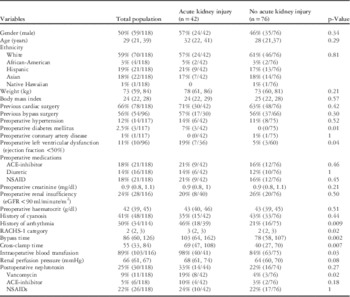
Data are presented as the mean and standard deviation for continuous variables with normal distribution and as medians and interquartile ranges for variables with non-parametric distribution. Comparisons of variables were made using the Student’s t-test, the χ2 tests, Wilcoxon’s rank sum test, or the Fisher’s exact test, as appropriate. Preoperative and intraoperative risk factors for kidney injury were identified using univariable and multivariable logistic regression models. All variables listed in Table 1 were assessed in univariable analysis. Variables were selected for entry into the multivariable model on the basis of significant univariable association (p<0.10) and clinical plausibility. All differences in statistical analysis were considered significant if p<0.05. All data analyses were conducted with JMP version 11 (SAS institute, Cary, North Carolina, United States of America).
Baseline characteristics and potential risk factors of acute kidney injury.

ACE=angiotensin-converting enzyme; eGFR=estimated glomerular filtration rate; NSAIDs=non-steroidal anti-inflammatory drugs; RACHS-1=Risk Adjustment for Congenital Heart Surgery-1
Results
Over the 3-year study period, 140 patients aged above 18 years underwent cardiac surgery at our institution. Of the 140 patients, 118 had adequate data available for review – 22 of them did not have preoperative creatinine levels available in the medical record at our institution – thus comprising the study cohort. Half of this cohort included males, and the median age was 29 (interquartile range 21, 39) years (Table 1); two-thirds had previously undergone cardiac surgery and more than half had undergone surgery requiring cardiopulmonary bypass. Preoperative renal insufficiency was present in 24% (28/116) of all patients. None of the patients had a preoperative estimated glomerular filtration rate <60 mL/minute/1.73 m2; 17 (14%) patients had preoperative co-morbidities, including 14 (12%) with hypertension, four (3%) with diabetes, and one (1%) with coronary artery disease. In addition, 11% of patients had preoperative left ventricular dysfunction, 40% of patients had a history of a neonatal cyanotic lesion, and 30% had preoperative history of arrhythmia. Only two patients had a Fontan circulation.
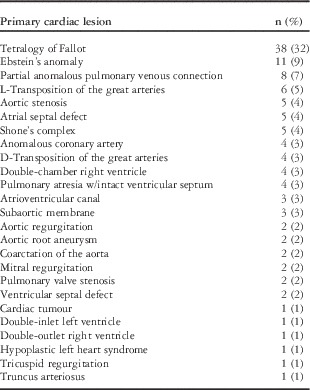
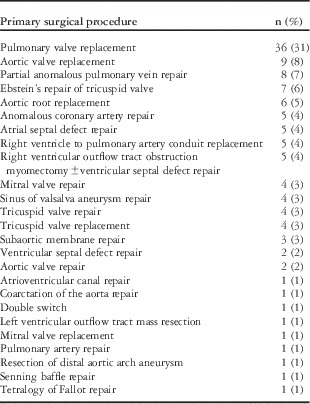
The most common primary cardiac lesion was tetralogy of Fallot (32%), followed by Ebstein’s anomaly (9%), partial anomalous pulmonary venous connection (7%), and l-transposition of the great arteries (5%) (Table 2). The most common surgery was pulmonary valve replacement (31%) followed by aortic valve replacement (8%), partial anomalous pulmonary vein repair (7%), and repair/palliation of Ebstein’s anomaly (Table 3). A total of 60 (51%) patients had a RACHS-1 category of 1 or 2, 53 (45%) patients had a score of 3, and five (4%) patients had a score of 4. There were no patients who underwent heart transplantation or Fontan revision. The median bypass time was 86 minutes, and among those who had an aortic cross-clamp (n=82) the median time was 55 minutes (Table 1). A majority of patients underwent an intraoperative blood transfusion (89%). A quarter of the patients were exposed to a nephrotoxin during the first 24 postoperative hours, most commonly a non-steroidal anti-inflammatory drug.
Primary cardiac diagnosis

Only the primary diagnosis is included – thata is, a patient with mitral regurgitation may also have a ventricular septal defect.
Primary surgical procedure

Only the primary procedure is included – that is, a patient with ventricular septal defect closure and mitral valve repair may be listed as mitral valve repair.
The median peak creatinine level was 1.1 (0.9, 1.3) mg/dl. The postoperative peak creatinine level was 0.2 (0, 0.3) mg/dl greater than the baseline preoperative level. In all, 36% (42/118) of patients had acute kidney injury. Only 5% (6/118) had KDIGO stage 2 injury, and none of the patients had stage 3 injury. None of the patients required renal replacement therapy. Postoperative estimated glomerular filtration rate was less than the preoperative estimated glomerular filtration rate (95±30 versus 115±35 ml/minute/1.73 m2; p<0.001). The final estimated glomerular filtration rate measured before discharge was unchanged from the preoperative value (122±38 versus 115±35 ml/minute/1.73 m2; p=0.11). Acute kidney injury occurred in 13% (8/60) among those with a RACHS-1 category of 1 or 2, and was 59% (34/58) among those with a RACHS-1 category of 3 or 4 (p<0.001). First diagnosis of kidney injury occurred immediately postoperatively in 13 (31%) patients, on postoperative day 1 in 27 (64%) patients, and on postoperative day 2 and 3 in one (2%) patient each. Normalisation of creatinine level was seen by postoperative day 2 in 76% (32/42) and by discharge in 90% (38/42) of patients. Of the two patients with a Fontan circulation, one developed kidney injury (stage 2).
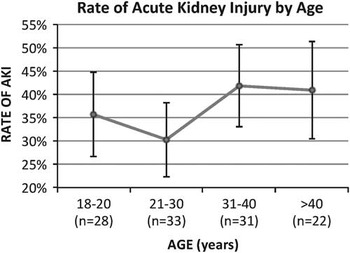
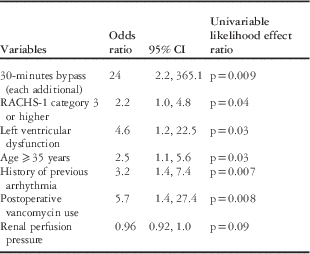
In the univariable analysis, age ⩾35 years was the only demographic variable associated with the development of kidney injury, including race and body mass index (Table 4). Kidney injury occurred in 42% of those aged 31–40 years versus 30% in those aged 21–30 years (p=NS) (Fig 1). Preoperative factors associated with the development of kidney injury included previous arrhythmia and left ventricular dysfunction. Longer bypass time and higher RACHS-1 category were the only intraoperative variables associated with kidney injury in the univariable analysis. Among postoperative nephrotoxins, vancomycin was associated with kidney injury. All other variables listed in chart 1 including preoperative renal dysfunction and single ventricle status were not associated with development of kidney injury.
Acute kidney injury (AKI) incidence by age. This figure demonstrates the varying incidence of AKI by age group. There were no significant differences in the incidence of kidney injury among age groups.

Univariable logistic regression of predictors of acute kidney injury

CI=confidence interval; RACHS-1=Risk Adjustment for Congenital Heart Surgery-1
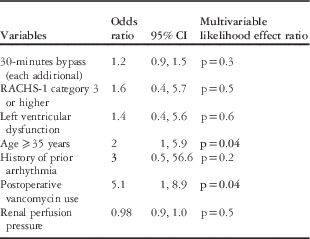
Multivariable logistic regression modelling accounted for 27% of variability (p=0.01) in the development of kidney injury, and only age ⩾35 years and vancomycin use were significant risk factors (Table 5).
Multivariable logistic regression of predictors of acute kidney injury

CI=confidence interval; RACHS-1=Risk Adjustment for Congenital Heart Surgery-1 Bold p-values are statistically significant
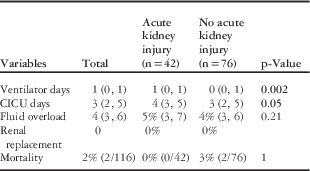
Patients who developed kidney injury had a median of 1 more day on mechanical ventilation and were in the cardiovascular ICU 1 day longer as per the univariable regression analysis (Table 6). There were only two in-hospital deaths in the cohort, and kidney injury was not related to the cause of death; postoperative bleeding and infection were the main causes. Patients with kidney injury were not statistically more likely to become 10% fluid overloaded (5 versus 4%; p=0.21). Injury was not associated with duration of ventilator use or cardiovascular ICU length of stay when controlled for age, RACHS-1 category, and bypass time in the multivariable regression analysis.
Univariable association of acute kidney injury with clinical outcomes

CICU=cardiovascular ICU Bold p-values are statistically significant
Discussion
We found that one-third of adults undergoing cardiac surgery for CHD developed acute kidney injury. Of those, ~15% had moderate injury – that is, 5% of the total population. This complication was frequent despite half of the patients undergoing low-complexity surgery such as pulmonary valve replacement. Nearly 60% of patients undergoing higher-risk (RACHS-1 3 or 4) procedures developed kidney injury. In the multivariable analysis, older age and postoperative vancomycin use were associated with an increased risk of kidney injury.
Renal disease is an important problem plaguing adults with CHD. A longitudinal study at the Royal Brompton Hospital demonstrated that nearly half of all adult congenital patients had some degree of chronic kidney disease at baseline and 10% had moderate or severe disease.Reference Dimopoulos, Diller and Koltsida 17 Moderate or severe disease was associated with mortality five times higher than the rest of the population. Buelo et alReference Buelow, Dall and Bartz 18 found stage 2 or 3 chronic kidney disease in 54% of their adult patients decades after palliation for tetralogy of Fallot. Within our study, only 24% of patients had preoperative renal insufficiency and no patient had severe disease, suggesting that our population was less affected by kidney disease at baseline than reported at these referral centres.
There is a paucity of literature describing postoperative acute kidney injury within adult CHD patients. The incidence of acute kidney injury after pulmonary valve replacement was 35% in one small study.Reference Buelow, Dall and Regner 19 A large European registry reported that 1.5% of adults undergoing congenital heart surgery experienced acute renal failure requiring renal replacement therapy,Reference Stellin, Vida and Padalino 20 which was not seen in our cohort. The incidence of kidney injury in our study was similar to that reported for adults undergoing cardiac surgery for acquired lesionsReference Bastin, Ostermann and Slack 14 , Reference McIlroy, Argenziano and Farkas 21 – Reference Robert, Kramer and Dacey 23 and children undergoing congenital heart surgery.Reference Li, Krawczeski and Zappitelli 7
Although 36% of patients met KDIGO criteria for kidney injury, most had mild disease. Although clinicians often ignore stage 1 injury, there is evidence to support its association with negative outcomes, including mortality. In a cohort of adults after cardiac surgery, Machado et alReference Machado, Nakazone and Maia 24 found that KDIGO stage 1 injury was associated with a 30-day mortality hazard ratio of 4.8. A study performed at our institution among children in an intensive care setting found that KDIGO stage 1 injury was associated with higher mortality and longer length of stay.Reference Sutherland, Byrnes and Kothari 13 Zappitelli et alReference Zappitelli, Bernier and Saczkowski 25 found that even a minor increase in creatinine was independently associated with longer length of stay and mechanical ventilation in a cohort of children after cardiac surgery. The majority of kidney injury was seen early after surgery and resolved by the second postoperative day. Similar patterns have been reported after paediatric cardiac surgery with 75% of acute kidney injury resolved within 48 hours.Reference Li, Krawczeski and Zappitelli 7 The significance of timing of postoperative kidney injury is not known, but it is noteworthy that this frequent complication was generally not long-standing in our cohort.
Univariable analysis demonstrated an association between the development of acute kidney injury and poor clinical outcomes, including ventilator and cardiovascular ICU days. Those with injury required 1 additional day of mechanical respiratory support and intensive care. This is especially noteworthy in a population in which the majority was extubated on the first postoperative day and discharged from the cardiovascular ICU by postoperative day 5. This finding supports the existing literature that demonstrates the association between kidney injury and poor clinical outcomes in adults and children after cardiac surgery.Reference Li, Krawczeski and Zappitelli 7 , Reference Blinder, Goldstein and Lee 8 , Reference Bastin, Ostermann and Slack 14 , Reference Machado, Nakazone and Maia 24 Given the short durations of ventilator dependence and cardiovascular ICU stays and a relatively small cohort, it is not unexpected that statistical significance was not demonstrated in the multivariable analysis. Surprisingly, the group with kidney injury did not have higher degrees of fluid overload as has been observed in other studies. This may be explained by the mild and reversible injury experienced by most patients in our cohort. With only two deaths in the cohort, no statistical difference in mortality was seen.
Among the many potential risk factors for acute kidney injury, we found that bypass time, left ventricular dysfunction, age ⩾35 years, RACHS-1 category, previous arrhythmia, and postoperative use of vancomycin were significant predictors of injury. Bypass time, RACHS-1 category, and nephrotoxin use are established risk factors for injury. The other risk factors such as older age, preoperative ventricular dysfunction, and history of arrhythmia may be related to worsened baseline cardiovascular health, which may affect postoperative renal perfusion. Cardiac dysfunction leading to renal injury is common in adults, and the interactions are well described by Ronco et alReference Ronco, Haapio and House 26 as a series of Cardiorenal Syndromes. Only older age and vancomycin use were significant in multivariable regression analysis. Owing to the small number of patients receiving vancomycin (n=11), we were unable to determine whether vancomycin was a surrogate for more unwell patients or if the renal insufficiency was due to nephrotoxicity of the medication. Unfortunately, most of these variables are not easily modifiable; however, these data should provide information that can be used to understand the risks of surgery and perioperative management within this population. Interestingly, baseline renal insufficiency was not a risk factor for injury. This may be because our patients only had minor insufficiency with no preoperative estimated glomerular filtration rate measured below 60 ml/minute/1.73 m2. The effect of minor insufficiency may be too small to find significance within a limited sample size. Renal perfusion pressure was also not found to be predictive of kidney injury. Unfortunately, our data were limited to a postoperative estimation, because intraoperative renal perfusion pressures were not available in our medical records. This variable should be considered in future evaluations of postoperative kidney injury.
A great deal of research has been devoted to potential therapies for acute kidney injury after cardiac surgery; however, no universal treatment has been accepted.Reference Park, Coca and Nigwekar 27 In the absence of any established treatment for kidney injury after cardiac surgery, our study supports avoidance of nephrotoxic medications, particularly in patients with risk factors such as depressed systolic function, older age, or history of arrhythmia. It may be prudent to empirically adjust the dosage of medications that undergo renal clearance in patients who are at high risk for kidney injury.
The cohort studied had limitations that might affect generalisability. Within our sampled population, there were no patients who underwent heart transplantation or Fontan revision, procedures which likely have a higher incidence of kidney injury. Furthermore, there were only two patients with Fontan circulations and a relative paucity of patients with significant adult co-morbidities. The population was largely young, and undergoing low-complexity surgery. Thus, the incidence of kidney injury may be higher in programmes that perform higher-risk surgeries such as Fontan conversions or operate on a higher-risk cohort. We do believe that our cohort is representative of the majority of referral centres, but individual programme self-assessment remains important.
Our study was limited by biases typical of retrospective studies. A majority of these patients were referred to surgery from a separate medical home. Therefore, the determination of preoperative variables such as coronary artery disease and hypertension was limited to patient reporting and second-hand medical records. The inability to include patients without values for preoperative creatinine potentially adds selection bias if patients without values of creatinine were at lower risk of kidney injury. Our incidence of kidney injury is potentially underestimated because it relies upon creatinine, an insensitive biomarker that can be diluted by fluid overload in the postoperative period.Reference Macedo, Bouchard and Soroko 28 Studies that have included definitions of kidney injury based upon novel biomarkers, or diminished urine output, have reported higher rates of clinically important renal injury.Reference McIlroy, Argenziano and Farkas 21 , Reference Haase, Devarajan and Haase-Fielitz 29
Acute kidney injury is a common complication in adults after surgery for CHD, occurring in more than a third of patients and nearly 60% of those with more complex procedures. Development of injury was associated with poor outcomes including prolonged mechanical ventilation and cardiovascular ICU stay. Although risk factors for the development of injury are largely not modifiable, this study increases the awareness of acute kidney injury among adults with CHD and underscores the importance in avoiding practices that may induce renal injury. To truly understand the scope of the problem in adult congenital heart surgery, particularly among patients with single-ventricle physiology or after cardiac transplant, further studies are necessary.
Acknowledgements
None.
Financial Support
This research received no specific grant from any funding agency or from commercial or not-for-profit sectors.
Conflicts of Interest
None.