

Introduction
Public controversies have recently emerged over anticipatory failures and “missed crises.” Financial collapses, extreme weather events, and military debacles have all raised doubts about the capacity of authorities to anticipate and manage risks. The COVID-19 pandemic starkly exposed these shortcomings, revealing the blind spots of health monitoring and policy preparedness frameworks [Lakoff Reference Lakoff2024]. Such failures highlight a broader tension within “risk society” [Beck Reference Beck1992]: institutions designed to mitigate risks may themselves generate new vulnerabilities. As a result, political scrutiny of expert bodies has intensified, with anticipatory failures increasingly used as grounds to contest, discredit, and even dismantle authorities.
Sociological research has often explained policy complacency and inaction through constructivist lenses, emphasizing how narrow ideological commitments and unrealistic technical models lead policymakers to “miss” crucial signals and approve hazardous decisions [Fligstein, Brundage and Schultz Reference Fligstein, Brundage and Schultz2017; Vaughan Reference Vaughan1996]. In this view, policymakers and experts are embedded in professional cultures, reproducing ideas and models with little reflexive distance from prevailing epistemic and organizational routines. Yet this perspective underplays their reflexive role in policy deliberation—the process by which diverse perspectives and evidence are engaged in collective decision-making. This omission is striking since many high-stakes decisions—whether adjusting interest rates or launching space shuttles—emerge from committee discussions requiring participants to contest viewpoints and negotiate consensus. Beyond ideational and technical determinants, deliberation is also shaped by committee-specific dynamics and discursive processes that structure how people interact and reach a decision. Ignoring this dimension risks overly deterministic accounts of crises, reducing deliberation and decisions to the “effects” of models or paradigms. Where important decisions are made collegially, models and frameworks alone do not shape policymaking; the context in which they are debated appears equally crucial.
This article offers a deliberative approach to elite policymaking in pre-crisis contexts by integrating two strands of research: constructivist approaches to policy deliberation [Fischer Reference Fischer2003]—and more specifically the pragmatist tradition [Gibson Reference Gibson2012; Zittoun Reference Zittoun2014]—which examines interpretive dynamics in policy formulation, and studies of narrative construction, which highlight discursive practices as tools for revising routines and justifying change under unsettled conditions [Abolafia Reference Abolafia2010; Weick Reference Weick1995]. By integrating these perspectives, this article explores the conditions under which reflexivity is encouraged or suppressed in elite policy groups in contexts of uncertainty. This framework makes three contributions. First, it shifts the level of analysis. Rather than explaining inaction by reference to what policymakers believed or what interests they served, the framework analyzes the deliberative mechanisms through which some positions consolidated and others were marginalized in the course of interaction itself. This processual view examines how participants articulate, challenge, and reinterpret positions when contradictions disrupt the taken-for-granted assumptions of models or frameworks. Second, it emphasizes the centrality of narratives: through storytelling, participants exploit tensions in existing models, justify change, and make alternatives intelligible and desirable. Third, it underscores that the success of such narrative work depends on conversational and institutional patterns that determine what can be said, how, and with what effect on deliberative dynamics. Attending to these dynamics clarifies the conditions under which policy reflexivity is enabled or curtailed in times of uncertainty.
The empirical case is the Federal Reserve’s much-criticized inaction before the 2008 subprime crisis. While the devastation of the collapse is well documented, debate continues over how the Fed failed to act [Abolafia Reference Abolafia2020; Fligstein Reference Fligstein2021]. A “thick” analysis of the June 2005 meeting—one of the most consequential pre-crisis deliberations—shows that participants recognized mounting risks and considered a range of policy options, from raising interest rates to strengthening supervision and systemic monitoring. Several members were open to revising prevailing paradigms and moving beyond flawed models, yet deliberative failures ultimately blocked meaningful action. What blocked meaningful action was not ignorance or entrenched frameworks alone but also a deliberative culture that prevented the consolidation of alternative policy narratives. This article identifies three such pathologies: skewed participation fostered by dominant leadership and manipulative rhetoric, discursive closure produced by hostility toward certain forms of evidence, and policy apathy rooted in perceptions of limited authority. Together, these dynamics explain how alternative narratives failed to coalesce despite widespread awareness of housing risks. By foregrounding deliberation, the article contributes to debates on elite policymaking, showing that the Fed’s failure cannot be reduced to cognitive blind spots or rigid models but must be understood as an interactional process through which narratives were suppressed and reflexivity curtailed. More broadly, it demonstrates how deliberative settings can entrench complacency in unsettled times, shaping whether organizations adapt or drift toward crisis.
Deliberation in Elite Policy Groups
Reflexive Deliberation
In political sociology, research on deliberation has developed mainly within the framework of “deliberative democracy,” which emphasizes reason-giving and argument exchange as key sources of legitimacy for public authorities [Elster Reference Elster1998; Habermas Reference Habermas1985]. This perspective has inspired extensive work on citizen juries, participatory budgeting, and other consultative mechanisms [Delli Carpini, Cook and Jacobs Reference Delli Carpini, Cook and Jacobs2004]. By contrast, policy deliberation within small elite groups—such as regulatory agencies—has received less attention. These bodies, including central banks, safety commissions, and emergency agencies, govern high-risk domains by drafting standards, supervising industries, and coordinating crisis responses. Decision-making typically occurs in collegial settings—boards or committees—where members assess information, confront perspectives, and weigh policy options.Footnote 1 Collective deliberation is thus integral to the routine operations of institutions like the Federal Reserve, the Environmental Protection Agency (EPA), and the Federal Emergency Management Agency (FEMA), shaping decisions that range from setting interest rates and authorizing the sale of phytosanitary products to approving building codes and land-use policies.
Elite policy groups raise distinct deliberative issues. Because they bring together unelected officials who claim autonomy from political interference, their deliberation is not primarily consultative—seeking legitimacy by integrating lay input—but reflexive, oriented toward reassessing perceptions and adjusting policies in response to changing conditions. In the Aristotelian tradition, deliberation so conceived is the necessary basis of decision and action [Fairclough and Fairclough Reference Fairclough and Fairclough2012]. Policy formulation is a particularly critical moment of deliberation because it is when actors commit to a course of action [Zittoun, Fischer and Zahariadis Reference Zahariadis, Zittoun, Fischer and Zahariadis2021]. Here, reflexive deliberation functions as a form of “epistemic vigilance” [Bourdieu Reference Bourdieu and Collier2024], requiring participants to scrutinize the limits and biases of their own models and frameworks. It is sustained through reason-giving discussions and the oral exchange of competing arguments in committee discussions. The process parallels courtroom proceedings, where jurors examine facts and evidence before reaching a verdict. A classic illustration appears in Sidney Lumet’s 12 Angry Men, where jurors shift their positions by cross-examining evidence, exploring alternative narratives, and applying inductive reasoning—ultimately overturning their initial guilty verdict.
Constructivist approaches to public policy have paid little attention to this reflexive dimension. They treat policy formulation as a largely technical, expert-driven process, dominated by prevailing models, doctrines, and frameworks. This results in a consensual and depoliticized approach to the policy formulation process [Jorgensen Reference Jorgensen, Howlett and Mukherjee2017; Wilder Reference Wilder, Howlett and Mukherjee2017]. More fundamentally, such approaches foreclose the possibility of meaningful deliberation: knowledge and models not only shape what people know (cognition) but also delimit what can be said about what they know (deliberation), trapping policymakers in a circularity from which deliberation emerges already predetermined from cognitive patterns. This reading finds substantial support in studies of risk-related decision-making, from the Cuban missile crisis [Allison and Zelikow (1971) Reference Allison and Zelikow1999] to the Challenger launch [Vaughan Reference Vaughan1996]. In such accounts, participants restate the obvious or ceremonially endorse whichever actor or ideology happens to be dominant. Deliberation is mostly reproductive rather than constitutive, conservative rather than reflexive. This view leaves little room to account for change and helps explain why structuralist sociology has rarely treated deliberation as a site of reflexivity, viewing it instead with some suspicion as a mechanism of consensus reproduction [Blondiaux and Sintomer Reference Blondiaux and Sintomer2002: 33].
A pragmatist approach offers a more promising starting point. Rejecting structural and rule-based explanations, this tradition treats agreement as an interpretive process forged in interaction itself, through justification and argument [Thévenot Reference Thévenot and Fullbrook2002]. While common frameworks and conventions remain essential to coordinating collective action and impose common criteria of comparison that allow for assessments between different policy alternatives, goals, and consequences [Storper and Salais Reference Storper and Salais1997], pragmatism holds that actors are capable of evaluating their situation and compelled to formulate justifications in order to act [Boltanski and Thévenot (1991) Reference Boltanski, Thévenot and Porter2006]. On this view, policy formulation is not the transparent application of routines or templates but a contested practice riddled with conflict, negotiation, and strategic choice about whether and how to act [Zittoun, Fischer and Zahariadis Reference Zahariadis, Zittoun, Fischer and Zahariadis2021]. Understanding policy therefore requires treating it as a discursive problem and attending to statements, argumentations, narratives, and the interactional context in which they unfold [Zittoun Reference Zittoun2009]. Interactional deliberation analysis extends pragmatism further by suggesting that statements and position-takings cannot be separated from the sequences in which they occur. In Gibson’s [Reference Gibson2011] reanalysis of the 1962 ExComm deliberations, participants’ positions—including Kennedy’s own—cannot be traced back to bureaucratic roles or interest; participants changed their minds, sometimes repeatedly, as the exchange unfolded. What mattered was the context in which they spoke: the capacity to problematize assumptions, to confront competing arguments, and to enter into genuine dialogue but also the seemingly mundane practicalities of turn-taking and interruption that determine whether any given attempt to reconsider routine gains traction. More broadly, leadership style, the ability of members to block or veto exchanges, and the collaborative or adversarial tenor of discussion all shape the likelihood that reflexivity will emerge.
Central Banks as Sites of Reflexive Deliberation
Central banks are exemplary sites for reflexive deliberation. Their governing committees meet regularly to assess economic conditions and weigh policy options. Yet the organization and tenor of these exchanges have rarely drawn sustained analysis. Most scholarship has focused on how central banks communicate externally—with markets and the public—using their authoritative knowledge position to shape expectations and engineer self-fulfilling policies [Holmes Reference Holmes2013; Wansleben Reference Wansleben2018] while internal deliberations remain underexplored. When transcripts are used, they are typically mined selectively for individual misjudgments rather than read as records of ongoing conversational dynamics. This reflects a broader assumption that members’ positions are fixed in advance, which renders deliberation derivative or ceremonial rather than a genuine forum for debate.
Economic accounts of monetary policy reinforce this perception by portraying decision-making as rule-bound and mechanical. Policy is often described as the straightforward application of frameworks such as the Taylor rule, which ties interest rate changes to economic indicators, or of doctrines like monetarism, which prescribes strict adherence to price stability [Taylor Reference Taylor2007]. Failures are thus attributed to policymakers, overlooking factors outside these rules [Tirole Reference Tirole2017]. At the Fed, this orientation was evident in the pre-crisis focus on inflation targeting, frequently cited as a reason explaining why financial stability concerns were sidelined [Reinhart and Rogoff Reference Reinhart and Rogoff2013]. Reliance on macroeconomic models grounded in questionable assumptions compounded these shortcomings [Romer Reference Romer2016]. By the 1990s, the Fed’s analytical tools had converged on the “new neoclassical synthesis” [Goodfriend Reference Goodfriend2007], whose rudimentary representations of the financial sector rendered housing bubbles and mortgage securitization largely invisible [Fligstein, Brundage and Schultz Reference Fligstein, Brundage and Schultz2017].
Sociological accounts of central banking have largely absorbed this picture, portraying central bankers as carriers of coherent ideologies and epistemic consensus upheld by scientized routines [Krippner Reference Krippner2007; Marcussen Reference Marcussen, Christensen and Laegreid2006]. Economic models, on this reading, function as expert categories producing the kind of lock-in effect that Lascoumes and Le Galès [Reference Lascoumes and Le Galès2007] attribute to policy instruments. This characterization is especially pronounced in analyses of the Great Moderation (mid-1980s to 2007), during which central banks are described as highly confident in the forecasting capabilities of their models [Beckert Reference Beckert2016]. Financial stability risks were ignored, in this account, not because of regulatory capture but because of a cognitive filter: dominant models motivated the Fed to remain passive. This passivity was reinforced by a restrictive conception of the Fed’s mandate, under which intervention was legitimate only after a crisis had materialized, rather than preemptively to smooth the cycle [Coombs and Thiemann Reference Coombs and Thiemann2022]. Regulators trusted their capacity to steer markets through the single lever of interest rates, a confidence built into the design of inflation targeting itself [Walter and Wansleben Reference Walter and Wansleben2020]. The Great Moderation is thus construed as a period of intellectual, political, and technical consistency in which central banks operated within a tightly bounded space, hopelessly beholden to the dominant frameworks and filters through which they apprehended the economy.
Recent scholarship complicates this picture. However pervasive the idea of technical rationality, insiders are neither naive believers in their models nor uniformly committed to obfuscation [Best Reference Best2022; Pénet Reference Pénet2018]. Confronted with the “uncomfortable truths” generated by contradictions between epistemic authority and empirical reality, policymakers deploy a range of strategies—strategic ignorance, secrecy, obfuscation, or burying the problem—but also, on occasion, a process of “puzzling through,” in which they accept and work through the limits of knowledge [Best Reference Best2021]. Such reflexive moments are typically attributed to the policy experimentation of the 1980s and the post-2008 period under Bernanke and Draghi, when established doctrines came under visible strain [Best Reference Best2024] and central banks reinterpreted their governmental power in more expansionist terms [Coombs and Thiemann Reference Coombs and Thiemann2022].
A similar pattern, I argue, can be observed at the Fed even during the Great Moderation, albeit in less visible form. Empirical evidence contradicts the notion that monetary policy was rigidly dictated by models. Both the Taylor rule and inflation targeting were applied inconsistently [Kilian and Manganelli Reference Kilian and Manganelli2008], and despite frequent rhetorical commitments to formal models, Fed chairs and members regularly debated and critiqued them rather than treating them as fixed principles [Golub, Kaya and Reay Reference Golub, Kaya and Reay2015; Meltzer Reference Meltzer2009: 1219]. The Fed’s meetings as early as 2003 were rife with uncertainty [Nelson and Katzenstein Reference Nelson and Katzenstein2014]. These findings underscore the pragmatic character of central banking, where judgment and interpretation coexist with formal economic theory [Abolafia Reference Abolafia, Cetina and Preda2005; Monnet Reference Monnet2024]. The deliberative contexts in which models are debated thus prove as crucial to policymaking as the technical models and policy frameworks themselves.
A thicker analysis of the Fed’s internal deliberations confirms this. As early as 2005—more than three years before Lehman’s collapse—committee members were debating housing prices and weighing the possibility of action. The transcripts show how seriously they took the prospect of a bubble. Rather than burying the problem, policymakers spoke candidly about the limits of their models and their expertise, and a slim majority agreed that there was a problem and that existing tools were inadequate. What obstructed action was not just the problematic models or the restricted mandate but also the contested dynamics of policy formulation itself: members attempted experimental and reflexive responses and developed competing policy narratives, which nonetheless failed to consolidate. Understanding why these reflexive efforts failed to produce policy change requires complementing the analysis of models and frameworks with attention to the narratives through which alternatives are articulated and to the conditions under which such narratives gain or lose traction.
Narrative Construction
Narratives are discursive tools for making sense of ambiguous environments [Weick Reference Weick1995]. Their role becomes especially significant in “unsettled” contexts—periods of rapid change or acute stress—when existing models no longer align with observed realities and discrepancies between facts and frameworks make deliberations more contentious and unpredictable.Footnote 2 In such moments, participants wage interpretive battles over whether regulation should change, and narratives are the principal tools through which these battles are fought. When gaps open between observable facts and established models, policymakers rely on storytelling to link disparate observations into coherent risk scenarios and render them discussable. As Mitchel Abolafia [Reference Abolafia2010: 355] notes, narrative construction “clarifies discrepancies and fills in absent complexities.”
Building on this insight, I argue that narrative construction is a key aspect of reflexive deliberation. Through narratives, committee members connect separate facts into generalizable arguments, making them amenable to discussion. Unlike more static forms of speechmaking—such as formal policy statements, in which members simply declare positions—narratives function as acts of institutional entrepreneurship [DiMaggio Reference DiMaggio and Zucker1988]. By leveraging contradictions in prevailing models, they provide justifications for institutional change [Lounsbury and Glynn Reference Lounsbury and Glynn2019]. Persuasive storytelling thus makes alternatives intelligible and desirable, inviting others to reconsider their views [Zahariadis Reference Zahariadis, Zittoun, Fischer and Zahariadis2021].
Not all accounts, however, read sense-making as reflexive. In a more skeptical vein, Wansleben [Reference Wansleben2024] treats narrative construction at central banks as a political resource used to discipline dissent and usher in “conservative policy innovations.” On this reading, central bankers remain locked into dominant models, and sense-making serves to rationalize existing positions rather than open them to question. The analytical stakes here mark a broader theoretical divergence: whereas this structuralist perspective treats sense-making patterns as “hopelessly endogenous to the organisations’ structural situations and their institutional positions, which in turn reflect durable constellations of power” [Wansleben Reference Wansleben2024: 143], the approach developed here follows Abolafia’s [Reference Abolafia2010: 350] constructivist position in giving greater weight to interaction than to entrenched coalitions of power: “it is through interaction and negotiation that a policy group ‘thinks’ and narrative is constructed.”
To what extent, then, can narratives effectively shape policy deliberations under uncertainty? Narrative analysis highlights intrinsic, interactional, and institutional dimensions of storytelling activities [Georgakopoulou Reference Georgakopoulou, Wodak, Johnstone and Kerswill2011]. In policy deliberations, the essential strategy for oral persuasion is cumulative and coherent argumentation [Schonhardt-Bailey Reference Schonhardt-Bailey2013: 139]. Cumulative argumentation—the ability to build on prior statements without interruption—determines whether narrative can gain the critical mass needed to focus attention and prompt action. A narrative’s persuasiveness further depends on its internal coherence, its capacity to avoid contradictions, and its linkage to actionable policy instruments. Yet these qualities are themselves conditioned by committee-specific rules and broader institutional norms, which shape whether narratives are allowed to develop, resonate, and influence decisions.
A growing body of work in gender studies has brought these conditions into sharp relief, showing how hostile sexism can obstruct reflexive deliberation in elite political settings [Karpowitz and Mendelberg Reference Karpowitz and Mendelberg2014]. Interruptions, in particular, operate as proxies of hostile behavior [Vallejo Vera and Gómez Vidal Reference Vallejo and Vidal2022], silencing speakers and dissuading others from intervening. They prove especially effective in undermining the authority of female policymakers, who are more likely than their male counterparts to “hold back” their views in the face of hostility [Bisbee, Fraccaroli and Kern Reference Bisbee, Fraccaroli and Kern2025]. This dynamic holds with particular force for central banking, a predominantly male universe in which only 7% of central bank governors between 2000 and 2017 were women [Lebaron and Dogan Reference Lebaron, Dogan, Denord, Palme and Réau2020: 98]. What is at stake extends beyond interpersonal dynamics like “manterrupting” [Och Reference Och2020]: it is reflexivity itself and the broader question of deliberative culture as an institutional property.
Structure of Deliberative Opportunities
To analyze the conditions that enable or constrain narrative construction and reflexive debate within elite policy groups, this article develops a framework centered on the structure of deliberative opportunities. It examines how discursive norms, power relations, and procedural rules shape the way narratives are generated, legitimized, and translated into collective decisions. Deliberation can foster reflexivity, but it can also produce dysfunction. I identify three recurrent pathologies: skewed participation, discursive closure, and policy apathy.
Skewed participation. Public deliberation is structured by rules of oral exchange—speaking order, turn-taking, time allocation—that shape how members engage with one another [Gibson Reference Gibson2011; Martin Reference Martin2012]. These rules, both formal and informal, are often tied to the chair’s leadership style and can be as consequential as a committee’s composition, since they determine whether exchanges unfold critically or remain constrained. At the Fed under Greenspan, such procedures were strategically deployed to suppress dissent and sideline perspectives that challenged the chairman. These patterns were particularly detrimental to women’s participation. Reflexivity is most likely when leadership styles and procedures promote equal participation, allowing all members to intervene freely rather than having contributions predetermined by rank. Under such conditions, dissenting perspectives and alternative narratives can surface and consolidate. When participation is skewed through pressures to conform to dominant actors, by contrast, critical exchanges are muted, marginal voices are silenced, and reflexive deliberation is undermined.
Discursive closure. Deliberation is also shaped by “discursive structures” [Foucault Reference Foucault and Sheridan1982] that define what is thinkable—and, crucially, sayable—within an institution. The degree of pluralism or restriction depends on the autonomy of the policy body. In central banks, a strong ethos of autonomy and internal expertise tends to privilege data generated within the institution while marginalizing external observations such as regional anecdotes, market signals, or foreign comparisons. This narrows deliberation to interpretive repertoires sanctioned internally. At the Fed before 2008, such insularity reinforced a selective vision of economic reality: arguments grounded in lived experience or external research were discounted as impressionistic or unreliable. Reflexivity is most likely when discursive boundaries are porous, allowing diverse forms of evidence to be introduced, interrogated, and cross-validated. When closure prevails, narratives that depart from dominant argumentative filters [Zittoun, Fischer and Zahariadis Reference Zahariadis, Zittoun, Fischer and Zahariadis2021: 8–9] struggle to gain traction, alternative perspectives are dismissed, and deliberation reproduces blind spots rather than unsettling them.
Policy apathy. Finally, deliberative opportunities are shaped by the policymaking process itself. As a decision-oriented practice, elite deliberation revolves around outcomes regarded as both desirable and feasible [Majone Reference Majone1989]: how policymakers discuss risks is inseparable from how they envision governing them. Exchanges often stall when proposed actions are perceived to fall outside the agency’s mandate. But policy mandates are never self-evident. They are interpretive constructs, routinely stretched or repurposed through deliberation itself, and the question of what policy can legitimately do is typically settled in the very discussions where it is invoked. Since its early years, the Fed has interpreted its mandate flexibly, acting as lender of last resort and deploying nonconventional measures when systemic risks loomed [Conti-Brown and Wishnick Reference Conti-Brown and Wishnick2020]. At the Fed in 2005, some members tried to bring rising housing prices within the central bank’s jurisdiction, but the structure of the exchange prevented their arguments from consolidating, and the discussion drifted into apathy. This pathology—compounded by the fear of contradicting the chairman—helps explain why, despite historical precedence and a mandate that could plausibly have accommodated action, supervisory intervention was not launched.
This deliberative framework builds on pragmatist and interactionist sociology [Gibson Reference Gibson2011] while also extending neoinstitutional theory. Consistent with a micro-perspective on institutions [Powell and Colyvas Reference Powell, Colyvas, Greenwood, Oliver, Sahlin and Suddaby2008], it treats interpretive processes and committee-level interactions as mechanisms through which dominant policy frames and models are reproduced or contested. At the same time, by foregrounding institutional dynamics, it situates face-to-face exchanges within broader historical norms and power relations that shape and constrain them [see also Zittoun, Fischer and Zahariadis Reference Zittoun, Fischer and Zahariadis2021: 11]. The approach rejects the assumption that deliberation is inherently beneficial. Instead, it emphasizes the structure of deliberative opportunities, recognizing that depending on institutional and situational conditions, deliberation can foster reflexivity and adaptation or exacerbate existing problems. When constrained, it can generate pathologies. Susan Stokes [Reference Stokes and Elster1998] first theorized the notion of deliberative pathologies in the context of democratic politics. This article extends her insight to elite policy settings, showing how deliberation may paradoxically reinforce organizational inertia and delay recognition of emerging crises. The next section turns to the case: a monetary policy deliberation within the Federal Reserve in the period leading up to the 2008 financial crisis.
A “Thick” Perspective on US Monetary Policy Deliberation
The Federal Reserve, as the central bank of the United States, employs multiple tools to pursue its dual objectives of monetary policy and financial stability [Friedman and Schwartz Reference Friedman and Schwartz1963]. It sets key interest rates, influencing banks’ financing costs and thereby broader economic conditions. It conducts open market operations, buying or selling Treasuries to adjust the money supply. It also supervises commercial banks, enforcing prudential rules such as capital requirements. The Federal Open Market Committee (FOMC) is the Fed’s main policymaking body, responsible for setting interest rates and overseeing open market operations, while also addressing issues of supervision and international financial stability. Meeting behind closed doors every six weeks for one or two days, the FOMC brings together 12 voting members—seven presidential appointees on the Board of Governors and five Reserve Bank presidents—alongside seven nonvoting regional presidents and numerous staff, who contribute actively without voting rights. Deliberations in the Eccles Building boardroom follow a structured format: staff present current conditions and forecasts, members engage in discussion, and a final vote is taken on the chairman’s policy proposal, typically a rate decision. The FOMC then issues a short but closely scrutinized statement explaining its rationale.
The path toward the subprime mortgage crisis crystallized during a pivotal FOMC meeting on June 29–30, 2005. This session was one of the most consequential of the pre-crisis era: for the first time, members engaged in sustained debate on the relationship between housing markets and financial innovation in a special discussion on “Housing Valuations and Monetary Policy.” The committee would not return to the subject until the collapse was already underway. Many of the risks that would later destabilize global finance were explicitly identified, yet no concrete policy action followed. This outcome, I argue, cannot be explained by technical incapacity or by a narrow reading of the mandate alone. A close reading of the 200-page transcript shows that macroeconomic models and the Fed’s mandate mattered but that their effects were mediated by the deliberative dynamics through which risks, evidence, and policy options were interpreted. Participants expressed diverse and sometimes shifting views, with some adopting narrative strategies to persuade colleagues that serious warning signs were emerging. Several members revised their positions during the exchange, underscoring its deliberative character.
This paper applies a “thick” analysis [Geertz Reference Geertz1973] to the June 2005 meeting, drawing on verbatim transcripts and supplementary documents released in 2010 under the Fed’s five-year rule. Transcripts provide a nominative record that captures not only formal statements but also informal dynamics—interruptions, hesitations, even laughter. This single-case design leverages the methodological advantages of “small n” research [Small Reference Small2009], moving beyond votes or formal statements to uncover the interpretive contexts that shaped decision-making. Thick description traces how discourse unfolded, how meanings were constructed, and how participants questioned their own perceptions and reassessed policy options in real time. It captures more than quantitative analyses tracking broad discursive patterns across meetings can reach: while distributions of keywords and topics can highlight what people talk about, they tend to miss how they talk—the interruptions, shifts of opinion, and subtle conversational cues that influence decision-making. Silence, for instance, may not indicate ignorance but rather reflect asymmetries in speech or institutional norms discouraging dissent. Thick analysis also shows how policy stances often occupy a grey zone: participants revise their views through engagement with others rather than holding fixed positions. Within the FOMC, such shifts were common, underscoring the indeterminacy of policymaking in unsettled contexts.Footnote 3 In this sense, thick analysis highlights the dramatic tensions, missteps, and unrealized possibilities that accompany crises in the making.
Analysis
This section explores the Federal Reserve’s deliberations during a critical FOMC meeting. Over two days, 18 participants, along with staff, debated whether a housing bubble existed and weighed the merits of possible policy responses. Because housing had been largely absent from previous monetary debates and little research connected housing to finance [Golub, Kaya and Reay Reference Golub, Kaya and Reay2015: 671], participants confronted a gap between observable developments and established models. They turned to narrative construction to weave fragmented evidence into coherent risk scenarios [Abolafia Reference Abolafia2010], seeking to give warnings the coherence and critical mass required for policy action. To capture this process, I coded each intervention as supporting, opposing, or remaining agnostic toward a narrative (see Table 1).
Distribution of Narratives among FOMC Members

Table 1 Long description
The table contains 10 columns: Name, Position, Degree, Fed Tenure (Years), Prior Experience, Bubble Narrative (Yes, Agnostic, No), and Policy Narrative (Yes, No).
Key data points include:
* Bies, Susan: Governor, Economics P h D, 5 years tenure, Banking and Academia experience. Bubble Narrative: Yes. Policy Narrative: Yes.
* Ferguson, Roger: Governor, Economics P h D, 9 years tenure, Corporate experience. Bubble Narrative: Agnostic. Policy Narrative: No.
* Fisher, Richard: Pres. Dallas Fed, M B A, 1 year tenure, Banking and Public Admin. experience. Bubble Narrative: Agnostic. Policy Narrative: No.
* Geithner, Timothy: Pres. N Y Fed, Economics M A, 3 years tenure, Public Admin. experience. Bubble Narrative: Agnostic. Policy Narrative: No.
* Gramlich, Edward: Governor, Economics P h D, 9 years tenure, Academia experience. Bubble Narrative: Yes. Policy Narrative: No.
* Greenspan, Alan: Chairman, Economics P h D, 19 years tenure, Banking and Public Admin. experience. Bubble Narrative: No. Policy Narrative: No.
* Guynn, Jack: Pres. Atlanta Fed, M B A, 10 years tenure. Bubble Narrative: Yes. Policy Narrative: Yes.
* Hoenig, Thomas: Pres. Kansas Fed, Economics P h D, 15 years tenure. Bubble Narrative: Agnostic. Policy Narrative: No.
* Kohn, Donald: Governor, Economics P h D, 23 years tenure. Bubble Narrative: No. Policy Narrative: No.
* Lacker, Jeffrey: Pres. Richmond Fed, Economics P h D, 10 years tenure, Academia experience. Bubble Narrative: Agnostic. Policy Narrative: No.
* Minehan, Cathy: Pres. Boston Fed, M B A, 24 years tenure. Bubble Narrative: Yes. Policy Narrative: Yes.
* Moskow, Michael: Pres. Chicago Fed, Applied economics P h D, 12 years tenure, Academia, Public Admin., and Corporate experience. Bubble Narrative: No. Policy Narrative: No.
* Olson, Mark: Governor, Economics B A, 5 years tenure, Banking and Public Admin. experience. Bubble Narrative: Yes. Policy Narrative: Yes.
* Pianalto, Sandra: Pres. Cleveland Fed, Economics M A and M B A, 18 years tenure. Bubble Narrative: Agnostic. Policy Narrative: No.
* Poole, William: Pres. St. Louis Fed, Economics P h D, 8 years tenure, Academia and Public Admin. experience. Bubble Narrative: No. Policy Narrative: No.
* Santomero, Anthony: Pres. Philadelphia Fed, Economics P h D, 6 years tenure, Academia experience. Bubble Narrative: Agnostic. Policy Narrative: No.
* Stern, Gary: Pres. Minneapolis Fed, Economics P h D, 21 years tenure. Bubble Narrative: No. Policy Narrative: No.
* Yellen, Janet: Pres. San Francisco Fed, Economics P h D, 12 years tenure, Academia experience. Bubble Narrative: Yes. Policy Narrative: Yes.
Totals (among voters in parentheses):
* Bubble Narrative Yes: 6 (4)
* Bubble Narrative Agnostic: 7 (4)
* Bubble Narrative No: 5 (3)
* Policy Narrative Yes: 5 (2)
* Policy Narrative No: 13 (9)
a Nonvoting members.
b Members categorized as agnostics refrained from taking a stance or did not address housing prices in their statements.
Several narratives emerged during the meeting. The bubble narrative warned that housing prices had become disconnected from economic fundamentals. This diagnostic frame drew on strands of evidence—some anecdotal, others regionally specific—to highlight unsustainable valuations, and its proponents extended the argument to policy responses. Three policy-oriented narratives followed, each advocating a specific approach to addressing the interactions between housing markets, financial innovation, and systemic risk. The monetary policy narrative cautioned against tightening monetary policy too rapidly, warning that higher rates could make mortgages unaffordable for households. The supervisory policy narrative advocated measures to protect consumers from abusive lending practices. Finally, the systemic risk narrative emphasized the dangers of hidden risk accumulating in secondary markets due to insufficient discipline.
None of the policy narratives survived deliberation. This failure stemmed less from committee composition—pro-bubble voices outnumbered skeptics, with many remaining agnostic (see Table 1)—than from the dynamics of deliberation itself. Participants recognized the limits of macroeconomic models and sought to move beyond them, yet risk narratives faltered for three reasons. First, proponents struggled to build cumulative argumentation under Greenspan’s coercive chairmanship and because of their relative lack of experience, both of which skewed participation. Second, housing’s marginal place in Fed traditions made narratives reliant on anecdotal or regional evidence that sat uneasily with the FOMC’s epistemic culture. As a result, arguments weakened as the discussion unfolded. Third, proposed policy solutions were framed as lying outside the committee’s mandate, fostering collective apathy and eroding engagement with the narratives.
Skewed Participation
The discussion on house prices and monetary policy took place primarily on the first day. The meeting began with an hour of staff presentations, followed by two hours of deliberation, with a coffee break in between.Footnote 4 The staff emphasized arguments supporting the bubble narrative. Economists Joshua Gallin and Andreas Lehnert raised concerns about a possible bubble fueled by soaring real estate values. Gallin presented evidence suggesting that housing prices could be overvalued by 20%. Lehnert highlighted risky innovations—such as interest-only mortgages and subprime lending—that left households and institutions “vulnerable to any fall in house prices” [7].Footnote 5 Although banks still appeared “quite healthy,” he concluded his remarks with a pessimistic note [11]:
[E]ven the most sanguine analyst quails when contemplating a historically unprecedented drop in nationwide nominal house prices. Such a drop will obviously hurt both borrowers and lenders and will also no doubt expose weaknesses that will only be obvious in hindsight.
Greenspan intervened immediately after the staff reports, asserting his authority to redirect the debate. After 18 years at the helm of the Fed, he possessed unmatched authority to steer discussion as he wished. Rather than engaging the bubble analysis, he reframed housing prices as an efficient response to “real factors” such as labor supply and land availability. Sequential constraints can significantly shape conversational dynamics [Gibson Reference Gibson2003: 21–24], and this shift disrupted the momentum of the bubble narrative, diverting attention from technological and credit risks toward broader economic fundamentals:
There are a couple of issues that I find striking here. One is how little we apparently know […] on the effect of the underlying land prices that are involved in all of these indexes. […] Do we have any insight on the land component of those sales? […] [N]o one uses them [land prices] on the grounds that [they] have nothing to do with residential land prices. But that can’t be true.
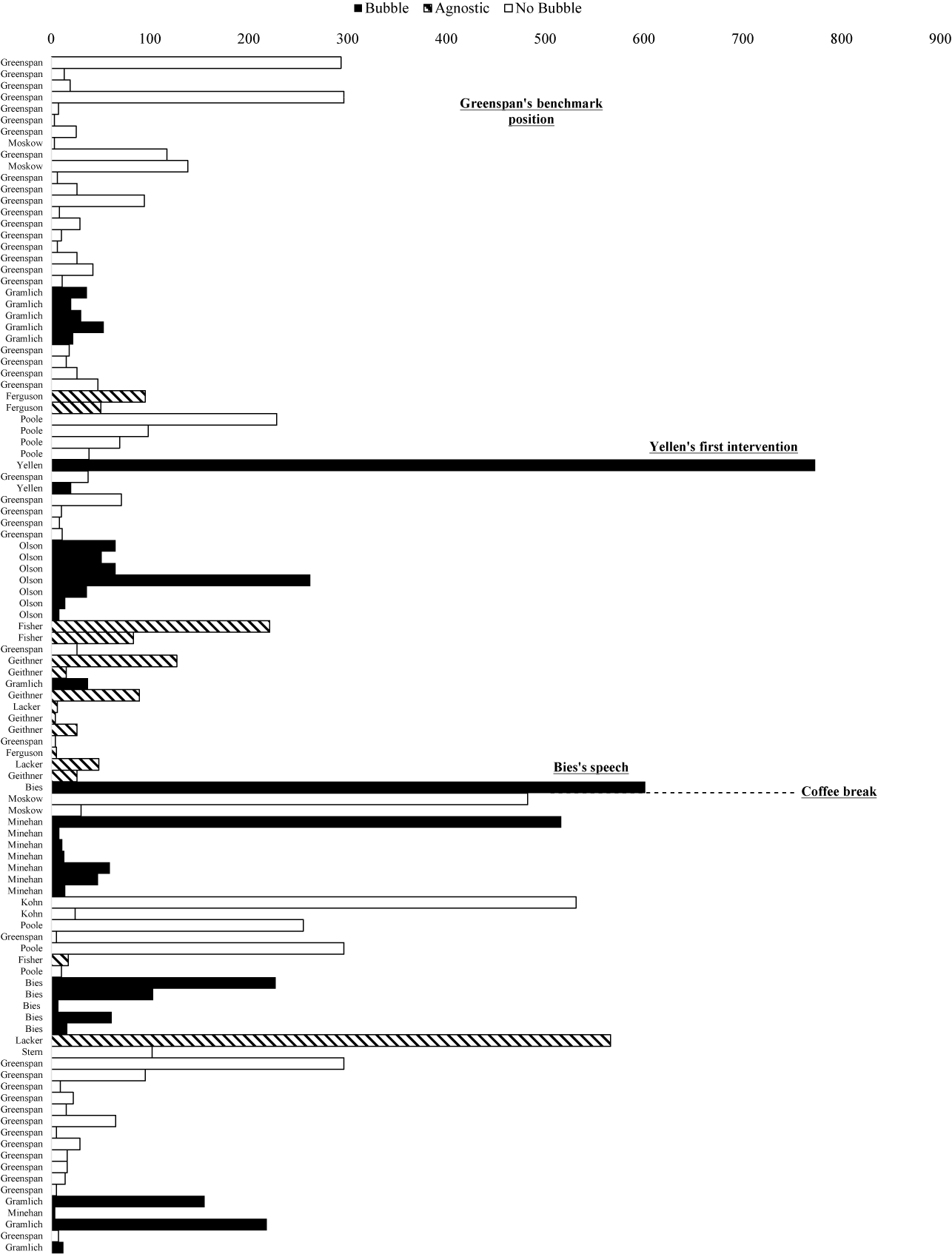
By pressing the committee to focus on land prices, Greenspan established a new reference point for debate. His framing quickly drew support from Michael Moskow and Richard Fisher, presidents of the Chicago and Dallas Reserve Banks, respectively. As Figure 1 shows, this sequencing allowed anti-bubble claims to dominate early, while bubble and policy narratives surfaced later and more fragmentarily.
Sequencing of Statements during First-Day Deliberations

Figure 1. Long description
A horizontal bar chart with the X-axis representing word counts from 0 to 900 and the Y-axis listing speakers in chronological order of deliberation. A legend at the top identifies three categories: solid black bars for Bubble, diagonal striped bars for Agnostic, and white bars with black outlines for No Bubble.
Key data points and annotations from top to bottom include:
* Greenspan’s benchmark position: Marked near the top with several white bars ranging from 10 to 300 words.
* Gramlich: A cluster of black bars around 50 words.
* Ferguson: Two Agnostic striped bars around 100 words.
* Yellen’s first intervention: A significant black bar extending to approximately 850 words, the longest in the set.
* Olson: A series of black bars varying between 20 and 300 words.
* Fisher: Two Agnostic striped bars around 220 and 80 words.
* Geithner and Lacker: Interspersed Agnostic striped bars and white bars.
* Bies’s speech: A black bar reaching 600 words, followed by a dashed horizontal line labeled Coffee break.
* Minehan: A black bar reaching 520 words.
* Kohn and Poole: Large white bars between 300 and 550 words.
* Bies: A second set of black bars, one reaching 250 words.
* Lacker: A long Agnostic striped bar reaching 650 words.
* The chart concludes with a series of white bars for Greenspan and final black bars for Gramlich and Minehan.
This pattern consolidated Greenspan’s control, centering deliberation less on potential risks than on his own framing of them. While it is not inherently problematic for a chairman to speak first, problems arise when participants feel constrained in expressing independent views. Under Greenspan’s “autocratically collegial” leadership [Blinder Reference Blinder2004: 58], consensus did not emerge inductively from debate but was anchored in the chairman’s position. Unlike the more individualistic style of the Bank of England—where members openly weighed alternatives without fear of contradicting the governor—the Fed’s preference for unanimity, reflected in the rarity of dissenting votes [Chappell, McGregor and Vermilyea Reference Chappell, McGregor and Vermilyea2005], encouraged members to temper disagreement, rely on indirect critique, and prioritize consensus over substantive discussion.
Janet Yellen, president of the San Francisco Fed, exemplifies the caution required under Greenspan’s leadership. Speaking only after he signaled opposition to the bubble narrative, she delivered the meeting’s longest statement, redirecting attention to the relationship between financial innovations and housing prices. Yellen highlighted the growing use of adjustable-rate mortgages (ARMs), often extended to subprime borrowers with poor credit histories. Her approach underscored the delicate balance of expressing concern while accommodating the chairman’s perspective. She began with a scenario consistent with staff warnings, only to temper it with a more reassuring view aligned with Greenspan’s macroeconomic outlook [36]:
One view that I think is very prevalent is that the use of credit in the form of piggyback loans, interest-only mortgages, option ARMs [adjustable-rate mortgages], and so forth, involves financial innovations that are feeding a kind of unsustainable bubble. But an alternative perspective [my emphasis] on that is that high house prices, in fact, are curtailing effective demand for housing at this point and that house appreciation probably is poised to slow. So the increasing use of creative financing could be a sign of the final gasps of house-price appreciation at the pace we’ve seen and an indication that a slowing is at hand.
While Fligstein, Brundage and Schultz [Reference Fligstein, Brundage and Schultz2017] interpreted this as adherence to the dominant macroeconomic model, a deliberative reading suggests that it was strategic diplomacy: Yellen incorporated Greenspan’s framing into her remarks while still raising concerns. Her use of impersonal phrases—“one view,” “an alternative view”—allowed her to voice a contrarian position without directly owning it. This rhetorical maneuver illustrates the pressures facing FOMC members to balance genuine analysis with consensus-driven norms. Although Yellen leaned toward the bubble frame, the immediate impact of her intervention was blunted: just as discussion turned to ARMs and piggyback loans, Greenspan interrupted with an oddly timed question about price-to-rent ratios. Although he later apologized [38], the disruption undermined her attempt at cumulative argumentation, exemplifying how his interventions eroded deliberative momentum.
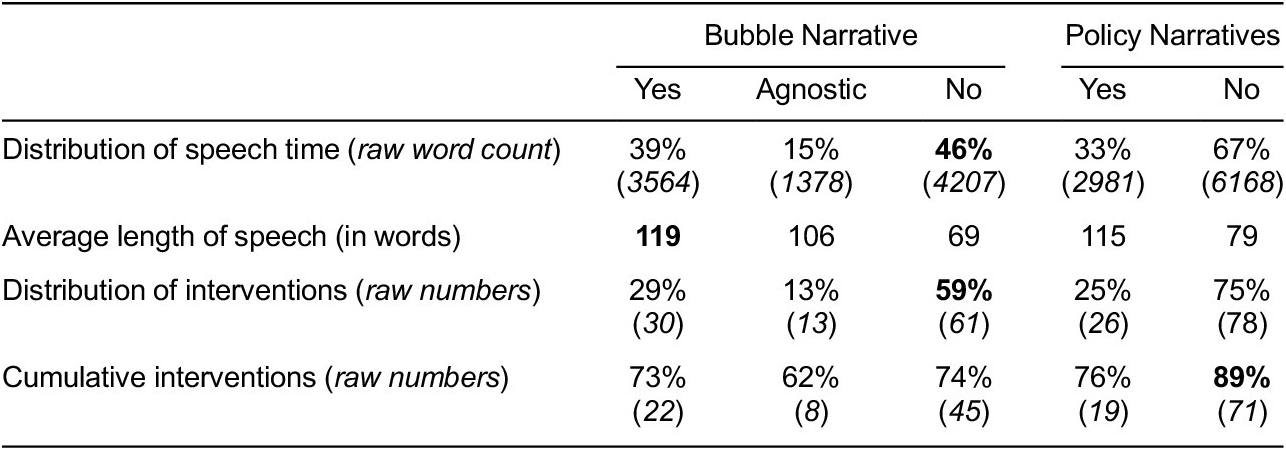
Greenspan’s dominance was reinforced by disparities of experience and influence within the FOMC. The anti-bubble coalition consisted largely of long-tenured insiders (averaging 17 years at the Fed), while the pro-bubble camp was newer (11 years, on average), often recruited from academia and banking (see Table 1). This created a classic insider-outsider dynamic [Lebaron Reference Lebaron2008: 127–128]: outsiders, drawing on professional backgrounds beyond the Fed, were more inclined to endorse risk narratives, while insiders favored conservative interpretations that preserved institutional routines they had helped establish. These differences translated into unequal deliberative resources. Though only five of 18 members, anti-bubble skeptics commanded 46% of speaking time and 59% of interventions (see Table 2). They spoke earlier, reinforced one another’s claims, and set the tone, whereas pro-bubble interventions—delivered later or near recesses—rarely accumulated into sustained argumentation.Footnote 6
Skewed Participation

Table 2 Long description
The table is organized into two main header categories: Bubble Narrative (subdivided into Yes, Agnostic, and No) and Policy Narratives (subdivided into Yes and No).
* Distribution of speech time (raw word count): Bubble Narrative shows 39 percent (3564) for Yes, 15 percent (1378) for Agnostic, and a bolded 46 percent (4207) for No. Policy Narratives show 33 percent (2981) for Yes and 67 percent (6168) for No.
* Average length of speech (in words): Bubble Narrative shows a bolded 119 for Yes, 106 for Agnostic, and 69 for No. Policy Narratives show 115 for Yes and 79 for No.
* Distribution of interventions (raw numbers): Bubble Narrative shows 29 percent (30) for Yes, 13 percent (13) for Agnostic, and a bolded 59 percent (61) for No. Policy Narratives show 25 percent (26) for Yes and 75 percent (78) for No.
* Cumulative interventions (raw numbers): Bubble Narrative shows 73 percent (22) for Yes, 62 percent (8) for Agnostic, and 74 percent (45) for No. Policy Narratives show 76 percent (19) for Yes and a bolded 89 percent (71) for No.
A striking illustration of this imbalance is Jack Guynn, president of the Atlanta Federal Reserve Bank, whose district included Florida—the epicenter of the housing boom. Despite this vantage point, he remained silent throughout the first day, missing a key opportunity to influence debate. Only at the close of the second day, during the customary round of statements, did he contribute to the bubble narrative with a deeply troubling—and ultimately prescient—assessment of the “ugly picture” developing in housing markets [117–118]:
I’m reasonably comfortable characterizing the housing feeding frenzy in some of our markets as being a bubble or a near bubble. […] My supervision and regulation staff thinks this is an accident waiting to happen in our area. […] The ugly picture […] goes something like this: the drying up of sales of new units; the painful decision of developers to go ahead and complete the construction of additional units to make them saleable, further depressing the market; and speculators who had hoped to see big capital gains walking away or defaulting on their contracts, giving their properties back to the lender.
The imbalance was also evident in speaking styles. Anti-bubble members dominated the floor with confidence, speaking assertively and interrupting freely, while pro-bubble members adopted a more cautious and tentative tone. Governor Susan Bies exemplified this dynamic. With only five years on the board after a career in audit and risk management, she offered valuable insights on mortgage innovations and financial stability but framed them hesitantly [45]:
May I say something here? I don’t have any quantitative studies on this, but based on talking to the folks who lived through it, I’d make a couple of observations.
Her cautious intervention stood in sharp contrast to the assertive tone adopted by the anti-bubble group. Gender compounded the imbalance: three of the six pro-bubble members were women, compared to an all-male anti-bubble camp. Research shows that women’s voices are often perceived as less forceful and may carry less influence in group settings [Carli Reference Carli, Harkins, Williams and Burger2017]. The contrast with Greenspan was striking. Whereas Bies prefaced her comments with disclaimers and uncertainty, the chairman appeared entirely at ease projecting his macroeconomic perspective onto the discussion without quantitative backing. His dominance resurfaced when, immediately after her intervention, he called a coffee break, halting any follow-up discussion and further undercutting her contribution.
In sum, Greenspan’s coercive chairmanship, reinforced by disparities of tenure, authority, and gender, skewed participation in favor of the anti-bubble camp. Many participants were sympathetic to risk narratives, yet their interventions lacked cumulative force and were easily fragmented. The effort was not entirely in vain: Gramlich, initially neutral, aligned with the bubble narrative by the meeting’s end [157], and Moskow, though inclined at first to support the chairman, acknowledged the possibility of localized bubbles [47]. Still, Greenspan’s grip on the deliberation prevented these shifts from altering the collective stance. Unequal access to deliberative resources meant that dissenting views surfaced only intermittently, rarely coalescing into sustained argumentation. Within this context, the Fed’s parochial discursive structures further weakened the consistency of pro-bubble arguments, helping explain why they ultimately failed to gain traction.
Discursive Closure
This FOMC meeting was unusual in that housing prices had not been a consistent theme in monetary policy. Data were sparse, fragmented, and poorly integrated into the macroeconomic models that typically guided decisions. The transcript shows genuine attempts to move beyond these limits through narrative construction, as participants sought to give coherence and weight to risk warnings. Yet the Fed’s discursive structure restricted what counted as persuasive argument. Much of the information that would later define the subprime crisis appeared as anecdotal or regional data from business leaders and financial executives. Participants expressed discomfort with such evidence, which lacked the technical sophistication of in-house macroeconomic indicators. Similar skepticism extended to data from external organizations, including foreign authorities. This narrowing of admissible evidence helps explain why narratives failed to gain consistency: despite recognition of abnormal conditions and the limits of existing models, participants struggled to translate insights into persuasive arguments, and the narratives were ultimately dismissed.
A large part of the early discussion focused on discrediting housing data on technical grounds. Greenspan’s coalition repeatedly challenged staff economists, suggesting that information was flawed because it fell outside the Fed’s in-house models. Gallin defended the bubble narrative by presenting additional evidence indicating that the surge in house prices could not be explained by fundamentals, but Greenspan repeatedly interrupted him. While clarification requests can stimulate dialogue, in this case they functioned to suppress it. Each time Gallin responded, Greenspan countered with another question, creating an interrogation-style exchange more intent on undermining than engaging the evidence. Eventually, Gallin’s frustration surfaced: “So, my final takeaway from this is that there’s no perfect way to measure house prices. All these measures have their various flaws” [27]. He added: “[E]ven if the rent series might have this problem or that problem—and it does have problems—house prices have grown quite dramatically” [31].
The stifling of discourse and the deliberate exclusion of evidence led to the dismissal of the monetary policy narrative, which warned that rising rates posed risks for households with adjustable-rate credit. Yellen cautioned that “we need to be careful not to overdo the pace of policy tightening. […] I think we should be especially attentive to this concern this time around, because the expansion does depend so heavily on just a couple of interest-sensitive sectors” [133]. Governor Mark Olson echoed this, noting that “[a] great deal of uncertainty, frankly, surrounds the interest rate risk exposure” [153]. Despite the logic and urgency of these concerns—especially given that the FOMC had been raising rates since 2004—the narrative unraveled. As Boston Fed President Cathy Minehan’s exchange with Gallin illustrates [50–53], the problem lay less in the dominance of prevailing models than in the inability to establish robust evidence. Available data were dismissed as weak or incoherent, leaving no firm basis for policy action:
Minehan: [W]here the point is, as mortgage rates start to go up, when we look at that affordability curve and start to worry about households beginning to get into trouble. […] [W]here is the breaking point? If the 10-year rate goes up 1 percentage point, say, are we going to get worried about whether people can afford their houses?
Gallin: [G]oing back to some of the conversations I’ve had with homebuilders, for what it’s worth, they indicate that they’re not going to be too worried unless we see an increase—and one that occurs fast—on the order of 100 basis points.
Minehan: So 1 percentage point, or 100 basis points, in a short amount of time.
Gallin: Yes, but that’s based just on talking to some builders, as opposed to any firm statistical analysis. So I would be very cautious. I would certainly hesitate to draw a firm conclusion about a particular increase being a tipping point or a breaking point.
The difficulty of incorporating anecdotal and regional data into policymaking extended beyond domestic sources to insights from foreign authorities. This weakened the supervisory policy narrative that relied on these insights. Governor Roger Ferguson asked whether lessons could be drawn from the Bank of England, which had used supervisory tools to moderate housing markets. Staff economist Glenn Rudebusch confirmed that these measures had tempered price appreciation abroad without major macroeconomic fallout [32]. St. Louis Fed President William Poole, however, dismissed the comparison, warning that “it would be a terrible idea in a market economy to have a government agency setting capital asset values” equating it with “wage and price controls” [33]. His rhetoric not only rejected supervisory policies as anti-market but also signaled a broader reluctance to take foreign experience seriously. This attitude was reinforced by Governor Edward Gramlich, who trivialized the warnings he had received from European central bankers in Basel as little more than “reading the press” [158].
Skepticism toward foreign experience—and even the Fed’s own history—further undermined the supervisory policy narrative. Governor Bies urged closer scrutiny of “fringe” lending practices, calling for guidance to lenders if necessary [46]. In promoting this policy narrative, she drew on her background as a bank auditor and on the institution’s long-standing tradition of issuing circulars and guidelines to regulate banks’ investments and lending practices [Meltzer Reference Meltzer2003]. Olson supported her: “the risks, as Susan [Bies] and others have mentioned, are pretty obvious [in particular] a greater risk of negative amortization” [152]. Staff economist Karen Johnson added that there was “something to be learned” [67–68] from the UK’s use of supervisory policies, which had helped banks strengthen balance sheets and encouraged households to avoid risky practices [67–68]. Yet these arguments failed to gain traction. What limited Bies, Olson, and Johnson was not the dominance of macroeconomic models—most agreed that such models were inadequate—but the problem of persuasion. Their case rested on irregular data and external precedents that the committee discounted. Without stronger evidence or institutional backing, supervisory proposals remained fragile and easily dismissed.
The challenge of advancing supervisory proposals was compounded by the use of irony as a tool of narrative suppression. During an exchange with staff economist Glenn Rudebusch, New York Fed President Timothy Geithner pressed him on the Fed’s historical use of supervisory tools, asking whether past interventions had been effective or foresightful [44–45]. The question itself underscored the absence of clear precedents, but its rhetorical impact was heightened when Greenspan and Ferguson interjected with jokes:
Geithner: What do we know about the history of the use of the supervisory tool in past periods of concern about real estate bubbles or imprudent lending? Do we have a rich history on the use of those instruments that tells us something about the efficacy or about our foresight in deploying them? […] In our history, have we used that tool to good or ill effect? Have we used it wisely and with foresight?
Greenspan: You’re biasing the answer. [Laughter]
Ferguson: The answer is obviously “yes.” [Laughter]
By turning Geithner’s inquiry into a moment of humor, senior members diverted attention from substantive evaluation and undermined the supervisory narrative without directly engaging it. This episode illustrates how skewed participation and epistemic closure worked together to suppress dissenting perspectives—not through overt rejection but by trivializing them in ways that discouraged further pursuit. In doing so, they prevented narratives grounded in anecdotal evidence and external insights from gaining consistency. Many participants instead reverted to framing risks as manageable within prevailing assumptions, reinforcing a dynamic of normalization of deviance—the tendency to downplay risky scenarios when warning signs have not yet produced visible consequences [Vaughan Reference Vaughan1996].
The transcript shows key moments of deliberation following this pattern, as in the remarks of Richmond Fed President Jeffrey Lacker [63] and staff economist David Stockton [65]:
Lacker: It seems to me likely that a confluence of several fundamental factors might rationalize [emphasis added] the current level of housing prices. So from that point of view, it’s hard for me to see how it would be reasonable to place a great deal of certainty on the notion that housing is significantly overvalued, or that there’s a bubble, or that it’s going to collapse really soon.
Stockton: [I]t takes a lot to get to a real disaster type of scenario. So even though we feel that house prices have moved out of alignment with the fundamentals, we don’t necessarily think the implications of that are that you’re going to be confronted immediately with some large problem.
The normalization of deviance was not absolute, however. Some narratives were neither rationalized nor normalized but simply abandoned, left hanging as the discussion drifted into instability. Rather than redirecting or resolving these threads, participants allowed them to dissipate without follow-up. This reveals another pathology of deliberation—apathy—which I examine in the next section.
Policy Apathy
Deliberation on policy narratives was marked by growing ambiguity over the Fed’s mandate. Many participants viewed the policies implied by the bubble narrative as lying outside the FOMC’s jurisdiction, confining the committee to a narrow focus on interest rates. This perception fostered detachment: as risk warnings accumulated, they were acknowledged but left unexplored. Negative scenarios were recognized but not pursued in this or later meetings, producing a form of discursive collapse.
This dynamic is evident in Olson’s and Bies’s attempts to extend the supervisory policy narrative and introduce the systemic risk narrative. Olson warned that mortgage terms were becoming “more flexible and less restrictive,” thereby increasing “risk exposures” for both borrowers and lenders. While he noted the absence of immediate delinquencies, he cautioned that there was “no slowing in sight” and an “undiminished appetite” for risky mortgage products [152]. Bies reinforced these concerns, drawing on her auditing background to press for closer scrutiny of foreclosures and abusive lending practices. Like a judge building a case, she sought to guide the committee toward recognizing looming dangers. Her exchange with Lehnert captures this effort [59]:
Bies: Why are so many more ARMs being generated? Is this an affordability issue? Is this a mortgage broker issue, where the brokers want to get a deal at any cost? What is happening?
Lehnert: I cannot really comment on the hype mentality or the mortgage broker who uses a high pressure sales tactic.
Bies: If some of these ARMs can’t be refinanced and foreclosures actually start to occur—where financial institutions take over the property—are there any studies out there that indicate how much foreclosure volume could hit the market before it had a material impact on local house prices?
Lehnert: We proposed doing a study jointly with a private data vendor company on precisely this topic but it didn’t really go anywhere. The question is whether foreclosure clusters can have a pernicious kind of spillover effect. I would say that lenders and loan servicers aren’t unaware of this problem. […] That’s all the reassurance I can offer you.
Lehnert’s response did not challenge Bies’s claims or normalize risk, as might be expected under a “normalization of deviance” framework. Instead, it reflected a broader climate of apathy: Bies’s and Olson’s warnings drew neither rebuttal nor support, simply fading from discussion. The apathy stemmed directly from participants’ understanding of policymaking itself: many framed supervisory and systemic risk concerns as lying outside the Fed’s mandate and therefore beyond the scope of action. The most forceful rejection of supervisory action came from Gramlich, who explicitly framed housing risks as outside the FOMC’s mandate [155–156]:
From time to time, we may shade our judgments based on some other factor that may seem relevant, which is fine. But the basic focus remains on inflation and unemployment […] and I get very irritated when I see columns suggesting that we […] should be trying to prick a housing bubble […]. There is no way to do that and still maximize the inflation/unemployment outcome. […] [O]ur best approach is most likely to do nothing.
His remarks, largely rhetorical, reinforced the view that the Fed’s remit was confined to inflation and employment. At stake here were two rival understandings of the “state-economy boundary” [Coombs and Thiemann Reference Coombs and Thiemann2022]: a reactive stance, in which central banks intervene only after a crisis has materialized, and a proactive one, in which monetary policy is mobilized to smooth the cycle. Countercyclical measures are notoriously difficult to sustain politically, since their benefits—crises averted—remain invisible and therefore resist democratic justification [Thiemann and Stellinga Reference Thiemann and Stellinga2023]. This difficulty is especially acute in housing, where credit policy bears directly on the daily lives of millions.
In 2005, however, the proposals on the table were not rate hikes but investigations—modest, low-cost measures whose political feasibility was well within reach. Committee members were suggesting experimentation, not definitive action—which is how change is typically introduced in monetary policy. Under the Home Ownership and Equity Protection Act of 1994, the Fed had the authority to require lenders to verify repayment capacity and restrict abusive practices. Effective deliberation might have enabled the FOMC, as the Fed’s principal forum, to prompt other departments to initiate such measures—introducing consumer protections, curbing predatory lending, and limiting risky mortgage issuance before rising interest rates triggered widespread foreclosures. Yet nothing was undertaken.
As the discussion progressed, several members likely saw monetary and supervisory issues as interconnected—an impression reinforced by the unusual presence at the meeting of a representative from the Division of Banking Supervision and Regulation. Yet arguments by Gramlich, Geithner, and Greenspan—the last of whom was known for his laissez-faire stance [Greenspan Reference Greenspan2002]—likely deterred others from pressing the point. Persistent dismissals of anecdotal evidence and skepticism toward foreign examples left the supervisory narrative without traction. By sidelining it, the committee effectively restricted the FOMC, the Fed’s most influential policy body, to a narrow focus on the federal funds rate. In practice, this left the committee operating like a powerful car with a clutch stuck in a single gear.
Apathy was equally evident in discussion of the systemic risk narrative. Several participants questioned whether markets could accurately price housing risk once securitization shifted exposures off bank balance sheets and into secondary markets and hedge funds. Olson pointed to “evidence of a lack of secondary market discretion, including the ability to price for risk,” warning that “the risk premium simply does not reflect the risk embedded in that product.” He hinted at systemic danger: “It’s not clear at this point if the MBS market will be an efficient distributor and disseminator of risk or if those in that market will be the last to recognize the risk that’s embedded in what they’re doing and know how to price it” [154–155]. Bies voiced similar concerns, noting both the decline in credit quality and the rising share of subprime borrowers [149–150]—remarkable in retrospect, as the term subprime would not become routine in Fed discussions until 2007:
[W]hen we look at the mix of products, more of the mortgages are subprime products. […] So, what I am concerned about from a liquidity perspective, since these are being securitized and moving into the markets—and there is plenty of appetite in the market to take these products—is the lack of [market] discipline relative to previous periods. In the ancient days, when mortgage loans stayed on the books of financial institutions, liquidity limitations forced them to choose the higher quality credits. This isn’t happening today.
No one directly challenged these concerns, but neither did they gain traction. Because the financial institutions most exposed to systemic risk—shadow banks, hedge funds, and secondary markets—lay outside the Fed’s mandate, members treated the issue as beyond their scope of action. Bies herself acknowledged this limitation [46], noting with regret that the hedge funds purchasing securitized assets remained unregulated. In this way, systemic risk was recognized yet effectively sidelined, reinforcing the broader climate of apathy that marked the meeting.
As the meeting progressed, apathy deepened. Concerns about supervisory action and systemic risk were increasingly framed as outside the Fed’s mandate and thus beyond deliberation. This dynamic mirrors what Eliasoph [Reference Eliasoph1997] calls “avoiding politics,” in which actors exclude issues they perceive as beyond their control. At the FOMC, housing risks were similarly cast as outside jurisdiction, complicating efforts by risk proponents to transform narrative construction into collective persuasion. Even if participation had been more balanced and discourse more open, policy narratives would still have struggled to generate engagement, as members confined debate to what they regarded as actionable within a narrow remit. Apathy thus emerged as the third pathology of the meeting—alongside skewed participation and discursive closure—further explaining why risk narratives failed to consolidate.
Conclusion
At the close of the meeting, the FOMC unanimously raised the federal funds rate by 25 basis points to 3.25%, continuing the tightening cycle initiated in 2004. No action was taken on housing, either then or in subsequent meetings, until the crisis erupted in 2007. This paper has argued that such inaction cannot be explained by blind reliance on models or by a restrictive mandate interpretation alone. It also reflected the deliberative committee dynamics through which recognized risks failed to become actionable policy narratives. The familiar claim that Fed members simply “missed” the crisis obscures the fact that they did perceive the key risks. Participants noted misalignments between housing prices and fundamentals, weighed the limits of their models openly, and debated three (monetary, supervisory, and systemic) policy narratives. Some even shifted positions over the course of the exchange. Yet the committee converged on a fragile consensus around inaction.
The fate of these narratives illustrates how the pathologies of deliberation blunted reflexivity. The systemic risk narrative was the easiest to dismiss, lying ostensibly outside the Fed’s mandate. The monetary policy narrative, though formally within that mandate, rested on anecdotal and external evidence that clashed with the Fed’s insular discursive culture. The supervisory narrative, as shown above, marked the clearest missed opportunity: a plausible reading of the 1994 Home Ownership and Equity Protection Act could have accommodated action, but the deliberative structure prevented the argument from consolidating.
Theoretical and Methodological Contributions
Theoretically, this article demonstrates how three pathologies of deliberation—skewed participation, discursive closure, and policy apathy—can combine to blunt reflexivity even when warning signs are clearly perceived. At the Fed, deliberation had a numbing effect: the more members debated, the further they moved from action. This was likely a feature of FOMC meetings throughout the Greenspan era. Each pathology resonates with findings in other deliberative settings. Skewed participation recurs in academic panels where junior scholars or women wield less influence [Lamont Reference Lamont2009] and in hiring committees where junior evaluators defer to senior ones [Rivera Reference Rivera2012]. In those cases, however, constraints on participation often generate not inaction but other adverse outcomes, such as hastened or biased decisions. Discursive closure characterizes international organizations that, in protecting their autonomy, insulate themselves from external feedback and lose the capacity to update their behavior [Barnett and Finnemore Reference Barnett and Finnemore2004]. Policy apathy echoes findings in policy studies showing that inaction is frequently justified by claims that intervention lies beyond an institution’s remit [McConnell and ’t Hart Reference McConnell and ’T Hart2019]. The originality of the Fed case lies in the convergence of these pathologies of deliberation within a single institutional setting and, more strikingly, within a single meeting. That convergence matters because each pathology, in isolation, might have been corrected by ordinary deliberative repair: a chairman who ceded the floor, an argumentative culture that admitted regional evidence, or a slightly more expansive reading of the mandate. What makes the June 2005 meeting analytically revealing is that all three foreclosures operated simultaneously, so that repair on any single dimension would have been insufficient.
A comparative lens sharpens the point. Thiemann and Stellinga [Reference Thiemann and Stellinga2023: 13–14] show that in France, compromise over countercyclical action on the housing boom became possible because of the absence of any actor able to singlehandedly veto decisions, which forced regulators to engage in substantive debate. Similarly, at the European Central Bank, parliamentary hearings show markedly less evidence of hostile sexism [Fraccaroli et al. Reference Fraccaroli, Giovannini, Jamet and Persson2023]. These contrasts underline that the pathologies documented here are not intrinsic to monetary policymaking but products of particular organizational arrangements.
Methodologically, this article underscores the value of thick analysis of committee deliberations for uncovering the interpretive contexts of decision-making. Pre-crisis policymaking at the Fed was not rigidly scripted but marked by debate and unrealized possibilities. Interactional dynamics—such as Greenspan’s interruptions, the silence of influential members, the timing of a coffee break—significantly shaped outcomes. These dynamics echo other disasters, such as the Challenger launch, often portrayed as inevitable products of institutional routines [Vaughan Reference Vaughan1996] but which closer scrutiny reveals were shaped by similar deliberative pathologies, including the absence of key decision-makers from the final meeting and communication failures across teleconferencing sites [Gibson Reference Gibson2012: 3]. Applying a deliberative lens to the 2008 crisis likewise raises counterfactual questions, such as how outcomes might have differed had participation been more balanced or external evidence taken seriously. Such counterfactual sensitivity does not reduce history to interaction. Rather, it underscores the micro-level dynamics of reflexivity and persuasion in policy analysis.
Toward Deliberative Reform
This analysis reframes the normative debate on central bank reform. Proposals have emphasized pluralism in economic models [Romer Reference Romer2016] or board composition [Fligstein, Brundage and Schultz Reference Fligstein, Brundage and Schultz2017], and post-2008 reforms have introduced a macroprudential approach to mitigate boom-and-bust credit cycles [Baker Reference Baker2013] alongside instrumental innovations such as stress testing [Coombs Reference Coombs2020]. These reforms address knowledge and instruments without touching deliberative culture. As I have argued, the Fed’s failure before 2008 had a significant deliberative dimension, and reforms that leave deliberative structures untouched will remain vulnerable to the same pathologies under a different guise.
The fact that deliberation failed before 2008 does not mean it is inherently ineffective. Leadership transitions after Greenspan altered some of its dynamics. Under Bernanke (2006–2014) and Yellen (2014–2018), FOMC deliberations became more open. Bernanke cultivated a more individualistic culture in which members felt freer to voice dissent [Blinder Reference Blinder2009: 176–178]. According to Bies [Reference Bies2007: 34], this improved the “quality of the dialogue.” Dissenting votes rose significantly after 2007 [Madeira and Madeira Reference Madeira and Madeira2019]. Yellen, on becoming chair, explicitly defended “diversity of views” and “better debate” as preferable to the Greenspan-era preference for unanimity [Yellen Reference Yellen2012: 31]. These shifts mitigated, though did not eliminate, the skewed participation pathology visible in 2005. Bernanke and Yellen also sought to integrate financial stability concerns across the Fed’s branches, bridging monetary and supervisory functions in board briefings—an initiative that tempered the policy-avoidance dynamic of June 2005.
A more persistent difficulty lies in discursive closure—the challenge of making persuasive use of evidence produced outside the institution. Progress on this front has been minimal: the FOMC still lacks a structured process for handling risk warnings and ensuring their persistence in decision-making. One promising avenue is the enrollment of economists and practitioners from beyond academia. Thiemann [Reference Thiemann2022] describes how “boundary walkers” operating between academic economics and central banking have helped central banks grasp macro-financial linkages previously filtered out [see also Thiemann and Priester Reference Thiemann and Priester2024]. The argument developed here extends this logic with a twist: the most consequential enrollment is not of scholars who can close gaps in academic thinking but of actors who bring unmodeled forms of expertise and economic reasoning into the deliberative room. The 2005 transcript shows how this mattered in practice. The warnings that would prove prescient came precisely from members with auditing, banking, and regional-observation backgrounds—Bies, Olson, Guynn—whose reasoning drew on less formalized styles of thinking. A Fed better equipped to engage with this kind of reasoning—practitioner knowledge, regional anecdotes, foreign precedents—would be better positioned to debate such arguments on their merits rather than dismiss them as impressionistic. Doing so requires procedures capable of sorting and testing weak signals delivered through unfamiliar argumentative forms, without requiring them to arrive prepackaged in the institution’s preferred epistemic form.
Central banks have proven most prone to experimentation and reflexivity during unsettled moments. The Great Moderation is often narrated as an exception, an era of quiet technocratic consensus that offered few opportunities for experimentation and leeway. The June 2005 transcript tells a different story: opportunities for innovation were present, but the deliberative culture under Greenspan foreclosed them. As Best [Reference Best2021: 1178] and Monnet [Reference Monnet2024: 137–146] have recently argued—and as this article has sought to show—fostering a culture of reflexivity in elite policy settings is itself an institutional project.