Introduction
There appears to be a broad movement away from centralized patterns of governance in both old and new democracies. The wave of territorial decentralization worldwide is the most common policy reform intended to increase the quality of both democracy and governance and, in some cases, to guarantee the survival of plurinational states (Keating, Reference Keating2001). An index of regional authority in 42 democracies reveals that 29 countries became more regionalized and only two became further centralized between 1950 and 2006 (Hooghe et al., Reference Hooghe, Marks and Schakel2010: 75). Much of this decentralization process has occurred among the European Union member states since the 1980s (Hooghe and Marks, Reference Hooghe and Marks2001; Loughlin, Reference Loughlin2001; Swenden, Reference Swenden2006).
Many territorial state reform initiatives have been justified by the need to respond to citizens’ demands for decentralization and by the necessity of integrating and improving the governance of existing multinational or multiethnic states, whose stability depends, at least in part, upon the majoritarian political support given by their citizens (see, e.g. Stepan, Reference Stepan2001). Certainly, there exists a very strong positive relationship between national secessionism and subsequent decentralization in Europe (Sorens, Reference Sorens2004). However, this reform does not appear to be producing widespread consensual public support for these new decentralized models (Erk and Koning, Reference Erk and Koning2009). In particular, where central governments have offered autonomy to peripheral regions with secessionist movements, the political consequences have been largely unexpected and have not reduced political conflict and divided public opinion on this issue. As a matter of fact, statistical studies have confirmed that increases in autonomy do not yield majoritarian support for the new model of the state (Sorens, Reference Sorens2004).
This unexpected consequence of decentralization reveals the so-called ‘paradox of federalism’ (Erk and Anderson, Reference Erk and Anderson2010). On one hand, decentralization produces the formal recognition of territorial identity groups and the granting of political autonomy and institutions, in order to ease tensions and thus underpin state legitimacy. On the other hand, decentralization produces the formal recognition and political visibility of national or ethnic identity political parties and increases their institutional visibility, making them stronger, more visible and more legitimate to the public, creating distinctive sub-national political arenas and, in turn, paving the way for further demands of territorial distinctiveness as well as for likely counter-reactions claiming territorial homogenization. The result is that the aim of easing territorial tensions and strengthening public support for the state territorial model could never be achieved to the extent that different positions on the decentralization issue are adopted by the most visible and significant political parties, leading citizens to hold different and sometimes even extreme opinions about the model of the state. Therefore, the particular regional/territorial party dynamics induced by the territorial decentralization process could perpetuate or even exacerbate in many cases political conflict surrounding the model of the state (individual and inter-territorial conflicts).
The present article attempts to show how the adoption among citizens of persistent and distinctive opinions about the model of the state (which increases inter-individual and interregional conflict among the public) will depend, at least to a certain degree, on the positions adopted by both the political parties representing those groups that have acquired visibility and legitimacy with decentralization and the regional party dynamics created by their electoral success (Brancati, Reference Brancati2006, Reference Bracanti2007; Reuchamps et al., Reference Reuchamps, Dodeigne, Dinardet and Gramme2012; Moreno and Obydenkova, Reference Moreno and Obydenkova2013), in addition to the state-wide parties searching for the electoral benefits, which emerge from the presence of these new distinctive sub-national party systems. To be more precise, the contention is that the dynamics of sub-national party system competition resulting from both the political positions adopted by non-state-wide parties and those of state-wide parties, affect citizens’ views and preferences by pulling them towards persistently divisive positions regarding the model of the state through an interactive process with existing national (sub-national) and ethnic identities. This process, as shall be seen, may occur regardless of citizens’ approval and support for the new decentralized institutions and their performance.
Territorial conflicts have challenged the unity of the Spanish state throughout its history (Linz, Reference Linz1973). To respond to this challenge, Spanish political elites completed a successful process of decentralization during the 1980s and 1990s, with regional governments enjoying political decision-making autonomy and budgeting capacity to the same extent as those of most federal states (Lago and Lago, Reference Lago Peñas and Lago2011: 31). However, Spain continues to be, although probably less acutely than Belgium, a clear example of centrifugal federalism (Swenden et al., Reference Swenden, Brans and de Winter2006), promoted by both state-wide and nationalist regional parties that responded to the electoral dynamics emerging from the different national and sub-national political arenas (Verge, Reference Verge2013). As a consequence, individual and interregional public disagreements about the model of the state have persisted, and have become more apparent as a consequence of further attempts to increase decentralization with a second round of regional statute reforms during the last decade.
The following pages will analyse individual preferences for different territorial models of the Spanish state, using a series of data opinion surveys collected during the last decade by the Spanish Centre for Sociological Investigations (CIS). Subsequently, the focus will centre on the analysis of the 2005 CIS data set,Footnote 1 which contains a set of variables allowing the exploration of several alternative explanations of individual public support for the current Spanish State of the Autonomies. Additionally, this survey was carried out during the so-called ‘second round’ of regional statutes reforms when a regional statutes reform was approved in Catalonia and the Community of Valencia. Also, during that year, the Spanish Parliament rejected the Basque pro-sovereignty proposal known as the Plan Ibarretxe. This period was characterized by the presence of an important nationalist, regional, and state-wide inter-party conflict concerning the model of the state, which became one of the central elements of the political agenda, especially in Catalonia and the Basque Country. Finally, this data set also contains representative regional samples of the 17 regions or autonomous communities (ACs), which will also allow the estimation of a multilevel logistic regression model including aggregate measures of the different economic, social, and political contexts of these 17 regions.
Citizens’ preferences for the territorial organization of the state in Spain
Territorial reform of the state during the Spanish transition was undertaken with the aim of satisfying legitimate aspirations to political autonomy in some regions (especially the Basque Country and Catalonia), while at the same time modernizing and democratizing an obsolete and authoritarian-style public administration (Subirats and Gallego, Reference Subirats and Gallego2002). With the creation of the so-called State of Autonomies, the Constitution of 1978 provided for a process of extensive devolution and the constitutional recognition of some specific aspects – particularly languages, traditional civil laws, and historically self-governing institutions – in some regions. Nevertheless, despite the presence of some initial asymmetries in the new structure of the state, all regions have now acquired similar representative institutions and enjoy their own constitutional statutes with quite similar properties. Spain has today highly decentralized sub-national territorial units, known as ACs (Comunidades Autónomas) in which all regional governments enjoy political decision-making autonomy and budgeting capacity to the same extent as those of most federal states (Germany, Canada, the United States and so forth; Lago and Lago, Reference Lago Peñas and Lago2011: 31). In fact, the new ACs have come to manage over 35% of public expenditure (Gil-Ruiz and Iglesias, Reference Gil-Ruiz and Iglesias2007), employ more than one million civil servants (53.2% of total public servants; Ministry of the Treasury and Public Administration, 2011), and have implemented more than three thousand laws and regulations (Subirats and Gallego, Reference Subirats and Gallego2002: 99). Regarding the delivery of public goods and services – health care, labour market policies, or education, among many – all ACs in Spain have gained autonomy in policy and budgetary decisions. Additionally, with the exception of the special fiscal territories of the Basque Country and Navarre that enjoy full fiscal autonomy, all the ACs share comparable levels of public expenditure, due to monetary transfers from central government. Finally, in most ACs, the process of regional institution building has been accompanied by the creation of public broadcasting entities under the control of regional governments. Therefore, the process of territorial state decentralization in Spain has resulted in powerful regional government institutions which, altogether, manage greater institutional resources than the central government. However, to what extent is this decentralized state endorsed by citizens’ support?
In response to this question, the distribution and evolution over time of citizens’ individual preferences for different territorial state models must be observed. These are ‘centralism’ – a state with only one central government without autonomy, ‘autonomism’ – with ACs like nowadays, ‘federalism’ – where ACs should have more autonomy than today, and ‘independentism’ – where ACs can become independent nations (Linz, Reference Linz1981).
When analysing the evolution of those preferences, the initial benefit of the process can be observed. At the beginning, a preference for a centralist state was almost as widespread as the autonomist option until the Constitution was approved in 1978 (∼45% for both options). By that time individual preferences for ‘autonomism’ and ‘federalism’ were principally apparent in regions with a distinct language, historical tradition of self-government and nationalist political parties, such as Catalonia and the Basque Country, and they were also more likely among left-leaning individuals than centralist right-leaning ones (López Aranguren, Reference López Aranguren1983). However, centralist preferences fell abruptly in 1984 (to 28%), after the first regional elections were held in the seventeen ACs, – and did so again in 1994 (to 19%), following the conclusion of the first reform of the ordinary regions’ statutes. These trends, according to Linz (Reference Linz1985), reflected the fact that none of the main state-wide parties advocated the centralist option any longer – not even the conservative Popular Alliance (Alianza Popular), an early suggestion of the agency role of Spanish state-wide parties in the individual formation of preferences.
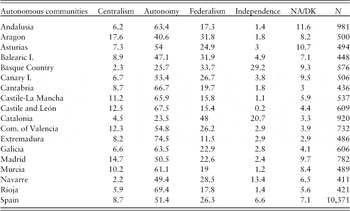
These initial positive effects were consolidated with the broadening of the ‘autonomist’ preference (from 31% in 1984 to 55% in 2005) and the further decrease of the most radical centralist positions (9%); furthermore, the decentralization process culminated in a significant increase in the ‘federal option’, which reached its highest percentage in 2005 (28%).Footnote 2 This resulted in a new conflictive scenario, dominated by the defenders of the status quo and generated by the initial decentralization process, mostly defended by the two largest state-wide parties, the more conservative centralizing party (PP) and the socialist party (PSOE) and, on the other hand, the promoters of further decentralization, mostly defended by nationalist regional parties. These divergent positions became more closely defined with the second decentralizing process (with the second reform of regional statutes), producing a significant division among the public, which took on an important interregional dimension, precisely at the time of the survey. As Table 1 shows, the conflict between these two positions was already very clear and public support for the status quo differed tremendously among regions. Unsurprisingly, the Basque Country and Catalonia are the regions with the lowest percentage of support for the status quo (25.7% and 23.5%, respectively). Additionally, and in contrast to the initial situation prior to decentralization, any account of interregional differences regarding the distribution of preferences for alternative territorial models of the state did not affect only traditional pro-nationalistic regions. For instance, it is striking that support for ‘federalism’ is almost as widespread in Aragon, a region without any nationalist/separatist tradition, as in the Basque Country (31.8% and 33.7%, respectively). However, cross-regional disparities concerning the most centralizing option are also important with some regions such as Madrid, Aragón and Castile and León at the very top of the list. The same can be said for positions in favour of the status quo, most strongly defended in Extremadura, Rioja, and Castile and León. Therefore, the decentralization process did not result in a general dominant consensual position about the model of the state, but in a new divisive conflict with strong interregional connotations.
Mass support for alternative territorial models of the state in Spain by ACs (In percentages; 2005)

Source: Authors’ elaboration, using data from CIS Data Bank (year 2005, survey number 2610).
The presence of this division regarding the model of the state resulting from decentralization contrasts with citizens’ majoritarianly positive evaluations of the ACs’ in Spain. Since the early 1990s, most Spaniards have largely agreed with the statements: ‘they have contributed to bringing public affairs closer to citizens’ and ‘they are more responsive to community problems’ (61% and 69%, respectively, in 1996).Footnote 3 It is noteworthy that, increasingly, Spaniards disagree with the statement that ACs have served to increase public spending without improving public service delivery. In 1992, 53% of citizens agreed with such a critical view, but this fell to 42% by 2005. Furthermore, citizens’ satisfaction with regional governance has grown steadily since 1992, when 34% affirmed they were very or fairly satisfied with the functioning of their own regional government. This figure rose to 54% in 2002.Footnote 4 Finally, the most significant result regarding the evaluation of the model of the Spanish state is that since the mid-1990s more than 50% of Spaniards believe the creation and development of the ACs has been rather positive and this opinion reached 68% of the population in 2005, being the majority opinion in all 17 regions. Moreover, the positive assessment of the ACs’ functioning has grown steadily; by 2005, 50% declared it had worked well or very well.Footnote 5 Thus, there is evidence that public opinion regarding the ACs’ quality of governance (mainly in terms of government responsiveness) and the efficiency of policies (as regards public service delivery) appear to be largely positive and with no significant interregional disparities. Thus, although citizens’ perceived efficacy of the new territorial institutions (ACs) might theoretically affect public support for the status quo, it did not result in general support for the new model in all Spanish regions.
Party positions on territorial politics in Spain
What exactly are the parties’ positions on decentralization in Spain? Is it possible to observe in them certain inter-party differences, which might help to describe national party sub-system dynamics in Spain? Preceding studies have already provided clear evidence about the variation in party positions regarding decentralization by analyzing party manifestos in Spain (Alonso et al., Reference Alonso, Gómez and Cabeza2011).Footnote 6 As these authors have shown, most nationalist parties tend to exhibit more radical decentralization positions than state-wide parties. For instance, the Basque Nationalist Party (Partido Nacionalista Vasco) displays the highest score (20.3), while state-wide parties such as the Spanish Socialist Worker’s Party (Partido Socialista Obrero Español) and the conservative Popular Party (Partido Popular), obtained very pro-centralizing scores of 2.9 and 1.5, respectively. Only the state-wide leftist electoral coalition the United Left (Izquierda Unida), which has defended more decentralizing positions, scored 4.4, but that was still far from the main pro-nationalist parties.
Do citizens’ perceptions of party positions on decentralization respond to such party positions? In a 2009 survey, Spaniards were asked to locate political parties on a 1 (pro-centralism) to 10 (pro-independent) decentralization scale.Footnote 7 These data confirm that the allocation citizens award to the different political parties on this issue correspond to the ranking and differences observed in Spanish regional party manifestos. The most pro-centralizing party is the PP (2.82), followed by a wide margin by the PSOE (5.07) and the IU (5.86). In the case of the PP, the location on the scale hardly varies from region to region, from 1.93 in the Basque Country to 2.23 in Catalonia.
However, there is an important difference between the two main state-wide parties. The cross-regional variation in the PSOE locations on the decentralization scale is substantially more significant, especially in the Basque Country with a very low 3.92 (1.15 points lower than the national average and 1.05 points lower than in Catalonia),Footnote 8 reflecting the above discussion of party manifesto content regarding decentralization, whereas the PSE (the PSOE formation in the Basque Country) tends to rank much lower on the decentralization issue. Accordingly, the role played by the two main state-wide parties in the regional statutes reform has also been diverse, particularly concerning the statutes of the Basque Country and Catalonia. Regarding the former, both parties at national as well as at regional level opposed the pro-nationalist statute reform proposed by the Basque Nationalist Party (PNV) in 2002 (known as the Plan Ibarretxe after the Basque President). However, the pro-nationalist Catalonian statute reform was initiated in 2004 by the coalition government led by the PSC (the regional wing of the PSOE in Catalonia) with the opposition of the PP in the Catalan and the Spanish Parliament.
Additionally, the location of citizens on the decentralization scale of nationalist regional parties is substantially higher. For instance, the score of Convergence and Union (Convergencia i Unió), the Catalan nationalist parties’ coalition on the scale is 6.87 on average, PNV achieves 7.74, the Republican Left of Catalonia (Esquerra Republicana de Catalunya, the left-wing Catalan nationalist party) scores 8.10 and Basque Solidarity (Eusko Alkartasuna, the Basque nationalist party) achieves a figure of 8.03.
In sum, according to citizens’ perceptions of nationalist regional parties’ and state-wide parties’ positions on the decentralization scale, as well as to the scores on decentralization drawn from the party regional manifestos, there are clear differences among political parties in this regard that might contribute to explaining individual and cross-regional dissension about the model of the state.
Theoretical argument and main hypotheses
The literature explaining individual preferences regarding the model of the state has mostly been dominated by a bottom-up approach, centred on either the predictive capacities of existing national and ethnic identities for devolution and its consequences for those identities, or on the effects of citizens’ satisfaction with the decentralization process (see for instance, Martínez-Herrera, Reference Martínez-Herrera2002; Mendelsohn, Reference Mendelsohn2002; Billiet et al., Reference Billiet, Maddens and Frognier2006; Pérez-Nievas and Bonet, Reference Pérez-Nievas and Bonet2006; Chernyha and Burg, Reference Chernyha and Burg2008). However, according to the institutional theory of political choice, public opinion can be structured by political parties and party elites (Sniderman and Levendusky, Reference Sniderman and Levendusky2007: 449–452). Based on this approach, there is a new literature that has tried to explain the formation of these preferences by looking at the impact of the devolution process itself on the ‘strategic calculus’ of elites and the subsequent changes in party systems and patterns of party participation in the regional government (for instance, Hesse and Wright, Reference Hesse and Wright1996; Hough and Jeffery, Reference Hough and Jeffery2006; Swenden et al., Reference Swenden, Brans and de Winter2006; Brancati, Reference Bracanti2007; Sorens, Reference Sorens2005 and Reference Sorens2010).
But how could the presence of distinctive party system competition in the different regional political arenas affect citizens’ opinions about the model of the state? The literature on the effect of elite partisan polarization on public opinion has argued that elites ‘lead’ public opinion by a combination of three elements: the levels of party conflict they promote (polarization), their capacity to frame issues and to produce different informational cues that voters use, and the intensity of voters’ partisanship (Druckman, Reference Druckman2004; Druckman et al., Reference Druckman, Peterson and Slothuus2013). As Riker (Reference Riker1990) has argued, the endogenous change in voters’ preferences is not just the product of persuasion, but the result of this framing, which is the reinterpretation of the relative saliency of the issue (heresthetics). In this case, it is the result of the prominence on the agenda of the rhetoric of decentralization/centralization in different sub-national party systems (Amat, Reference Amat2012: 450). Additionally, citizens form their opinions based on the cues they receive from political parties (especially in a context of high polarization and low information), but in any case, their effect on voters’ preferences depend on their level of party loyalty, not only because partisan voters are more influenced by party cues since more aware of parties’ positions, but also because parties’ cues on voters’ preferences are stronger as voters consider them to be more credible (Druckman et al., Reference Druckman, Peterson and Slothuus2013). Therefore, party positions on decentralization/centralization and the different party dynamics that emerge from it could be an important aspect in explaining why the decentralization process can strengthen or even foster individual and interregional divisions regarding preferences for the model of the state, being stronger among those most closely identified with political parties.
Adopting this approach, increasing attention has been paid to the role played by non-state-wide parties in the formation and polarization of citizens’ preferences for the model of the state (Safran, Reference Safran2000; Brancati, Reference Brancati2006; Reuchamps et al., Reference Reuchamps, Dodeigne, Dinardet and Gramme2012; Moreno and Obydenkova, Reference Moreno and Obydenkova2013) These contributions, however, although very important, are mostly based on aggregate data or on qualitative studies (for some exceptions, see Hierro, Reference Hierro2012; Reuchamps et al., Reference Reuchamps, Dodeigne, Dinardet and Gramme2012) and lack empirical evidence at the individual level on how non-state-wide political parties and/or party dynamics can sharpen citizens’ opinions about the configuration of the state. Additionally, the burden of the process has been heavily one-sided. The capacity to increase the importance of the structure of the state cannot only be attributed to nationalist regional parties, but also to state-wide national parties, which might also contribute to the creation of distinctive sub-national party systems and electoral competition dynamics.
The decentralization process in Spain has gone hand-in-hand with a tendency of nationalist regional parties, especially the Catalan and Basque parties, to demand greater powers for their regions in recognition of their distinctiveness, thereby increasing the level of interregional conflict and the nature of the competition among their respective party systems, resulting in the presence of different party sub-systems in the various regions (Pallarés, Reference Pallarés2008; Dinas, Reference Dinas2012). However, Spanish state-wide parties may also have contributed to intensify territorial politics by fostering and taking advantage of clearly intra-party territorial conflicts (Verge, Reference Verge2013), contributing, as a result, to the emergence of very specific sub-system party competition dynamics in each region (Pallarés and Keating, Reference Pallarés and Keating2006; Balfour and Quiroga, Reference Balfour and Quiroga2007; Colino, Reference Colino2009; Keating and Wilson, Reference Keating and Wilson2009; Orte and Wilson, Reference Orte and Wilson2009; Amat, Reference Amat2012). Therefore, the decentralization process has resulted in the creation of distinctive party system dynamics promoted and encouraged by ‘all’ Spanish parties, fostering on the one hand the escalation of regional demands and positions of resistance for greater decentralization and the adoption of militant positions of resistance on the other, resulting in a scenario of competitive devolution.
It is not argued, however, that existing national or ethnic identities do not play a role in shaping individual preferences for the model of the state; on the contrary, they do have an important ‘direct’ impact. However, there is also an important effect of party positions that additionally creates an interactive effect between those existing national identities and the effect of party politics that might foster irreconcilable individual and interregional positions regarding the territorial state model, regardless of the success of the decentralization process. Showing the effects of party politics will demonstrate that citizens’ divergent opinions regarding the Spanish territorial model of the state that has accompanied the decentralization process depends not solely on the strength of existing subjective national or regional identities or on citizens’ perceived efficacy and performance of the state model, but also on non-state-wide and state-wide party positions, and the dynamics of the party system they produce.
This argument then becomes twofold. At the individual level, it is argued that individual divisive preferences regarding the model of the state are fostered by the partisanship effect and its interactive relationship with citizens’ national identities. Three hypotheses are defended at this level:
H1: Citizens’ partisanship with a nationalist regional party increases the probability of opting for the most decentralizing options, whereas citizens’ partisanship with a state-wide party increases the probability of opting for the most centralizing options or status quo.
H2: Citizens’ partisanship with a nationalist regional party interacting with their national identities increases the probability of opting for the most decentralizing options.
H3: Citizens’ partisanship with an electorally significant state-wide party interacting with their national identities increases the probability of opting for the most centralizing options.
However, there are two contextual arguments as well; regional party system dynamics (party competition) have an indirect (contextual) effect on the distribution of regional averages of preferences for the model of the state. This is what Anderson (Reference Anderson2007: 594) has called the indirect effect of structures or institutions on behaviour (in this case, preferences). Therefore, the fourth hypothesis proposed is:
H4: Sub-national party systems with a higher presence of nationalist regional parties tend to produce higher levels of citizens’ opinions in favour of decentralization (indirect effects).
The second aggregate argument is that party system dynamics have an effect on the way individual national identities and partisanship predict individual preferences regarding the model of the state (there are cross-level interactions). This is what Anderson (Reference Anderson2007: 595) has called the contingent effect of structures or institutions on preferences. Therefore, the fifth and sixth hypotheses proposed here are:
H5: Individual partisanship (with state-wide and nationalist regional parties) favours more radical positions regarding preferences for the model of the state in contexts of party systems polarized around the nationalist territorial conflict (contingent effects).
H6: Individual national identity has greater effects on preferences for the model of the state in contexts of party systems with stronger nationalist inter-party conflict (contingent effects).
The individual level predictors of citizens’ preferences for the model of the state
In order to test hypotheses about the direct (H1) and interactive effects (H2 and H3) of partisanship on citizens’ preferences about the model of the state, an ordinal regression model with robust standard errors was estimated; this took as the dependent variable the four preferences for the model of the state in Spain. Obviously, two of the most important independent variables to test these hypotheses about the partisanship effect on preferences for the model of the state are those that measure whether respondents feel close to one state-wide party and one nationalist regional party. These two variables have been created from a set of questions aimed at measuring how close individuals feel to each political party with parliamentary representation in Spain, on a scale of 1(not close) to 5 (very close). The non-state-wide partisanship variable was created from these party proximity indicators, creating a dummy variable for each individual, giving the value of ‘0’ if he/she feels fairly close (category 3) or less close (categories 1 and 2), and ‘1’ if the respondent feels somewhat and very close (categories 4 and 5) to any of the nationalist regional parties. The same operationalization/operation was performed to measure partisanship with state-wide parties. Thus, each respondent has two dummy variables: partisanship with non-state-wide parties and partisanship with state-wide parties. The second important variable in the model is that measuring individual subjective national identities.Footnote 9
Additionally, an interactive variable was created between the latter and the two dummy variables measuring partisanship. It is expected, in line with the argument advanced here, that the interactive term between national identity and nationalist regional partisanship will be statistically significant and positive, therefore increasing the possibility of opting for a more radical decentralizing position (hypothesis H2); and significant and negative for the interaction with partisanship with a state-wide party and therefore explaining the greater propensity to adopt more centralizing positions (H3).
In order to control for the effect of other individual variables influencing an individual’s preferences for a particular model of the state, four additional control variables were added to the statistical model: left-right scale, education, age, and five categories of social class.Footnote 10 A leftist political orientation and post-secondary education have been proved to be related with national identity (i.e. they increase the probability of declaring a nationalist identity; Aguilar and Sánchez-Cuenca, Reference Aguilar and Sánchez-Cuenca2008: 115), whereas birth cohorts analysis has also demonstrated the socializing effects of autonomous institutions over time: young individuals, those born and raised during the regional institutional building process, are more prone to show support for further devolution (Chernyha and Burg, Reference Chernyha and Burg2008: 15–18; Hierro Reference Hierro2012: 113).
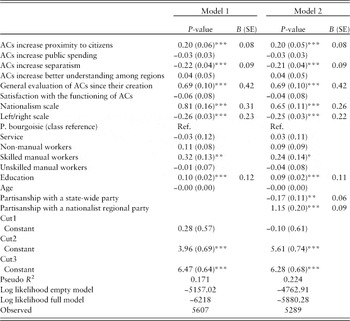
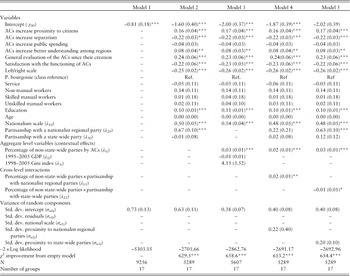
We have estimated different models. First, a baseline ordinal logistic model was estimated, including all the relevant variables except the two regarding partisanship, which are those relevant for our argument. Second, the two-party proximity dummy variables were added to the baseline model. The first baseline model (Table 2, Model 1) shows that the three best predictors for individual preferences for the model of the state are the general evaluation of the ACs, the nationalist scale, which confirms the importance of this variable in predicting orientations toward the model of the state (Mendelsohn, Reference Mendelsohn2002; Billiet et al., Reference Billiet, Maddens and Frognier2006; Chernyha and Burg, Reference Chernyha and Burg2012), and the left–right scale (leftists tend to prefer more decentralizing options), confirming the non-orthogonal relationship between the left–right dimension and the centralizing/decentralizing conflict (Dinas, Reference Dinas2012: 481–482). The second model (Table 2, Model 2), in which the two partisanship dummy variables have been included, shows that partisanship with any state-wide party further increases the tendency to support more centralizing options, whereas partisanship with nationalist regional parties tends to have the inverse effect. This last result confirms the direct effect of partisanship on predicting the most extreme positions regarding the model of the state (hypothesis H1).
Ordinal logistic models for opinions on the territorial model of the state (Robust Logistic Estimators)

*P<0.1, **P<0.05, ***P<0.01.
AC=autonomous communities.
Dependent variable: 0=centralization or defending the current ACs; 1=greater autonomy of current ACs or federal state.
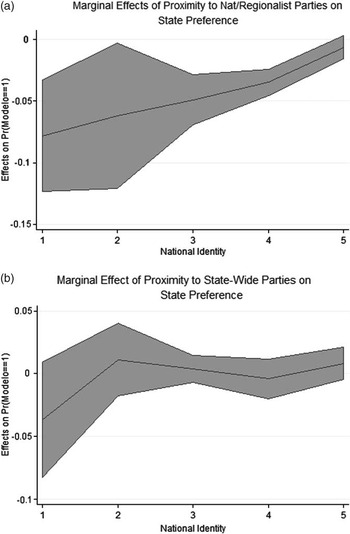
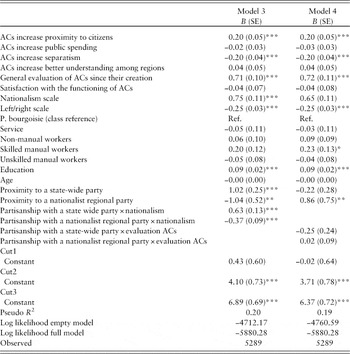
The results for the validation of hypotheses H2 and H3 (concerning the interactive effect of partisanship and national identity on the model of the state) are displayed in Table 3, Model 3. As these results show, the statistical coefficient for the interactive term of the nationalist scale and partisanship with a nationalist regional party is negative and significant. The other interactive term of the model (including the identity variable and partisanship with a state-wide party) is also significant but positive. The marginal effects of these interactions are displayed in Figure 1, confirming that nationalist regional partisanship effects on most decentralizing preferences increase almost monotonically as the degree of non-Spanish subjective national identity increases. On the other hand, the graph representing the marginal effects of state-wide partisanship shows that they only affect those individuals who most closely identify with the Spanish nation (those defending the most centralizing positions). These results show, therefore, that partisanship with some non-state-wide party interacts with existing sub-national identities, fuelling most secessionist opinions among average voters, which confirms previous results obtained in comparative aggregate studies (Brancati, Reference Brancati2006 and Reference Bracanti2007) and hypothesis H2. The effect of state-wide parties appears to be less important, questioning the plausibility of hypothesis H3 at first glance.
Predictive marginal effects of proximity to state-wide parties and nationalist regional parties as non-Spanish national identity increases.

Ordinal logistic models for opinions on the territorial model of the state with interactive effects (Robust Logistic Estimators)

*P<0.1, **P<0.05, ***P<0.01.
AC=autonomous communities.
Dependent variable: 0=centralization or defending the current ACs; 1=Greater autonomy of current ACs or federal state.
These preceding results in Model 3 contrast with those observed in Model 4 in the same Table 3. As can be seen, the evaluations of ACs might have a direct effect on preferences for the model of the state, but their effects are not conditioned by partisanship. In other words, the interaction between evaluations of the functioning of institutions and partisanship do not fuel interpersonal conflicts regarding models of the state, confirming previous studies (Chernyha and Burg, Reference Chernyha and Burg2008). This is perhaps because all major parties in the different sub-systems defend the present institutions and their performance to legitimate their demands: non-state-wide parties to justify further decentralization and state-wide parties to defend the current status quo. Additionally, these parties are incumbent in many of the existing regional governments.
Multilevel analysis of the preferences for the territorial model of the state
However, in order to support the argument advanced above, it must be proven that party competition dynamics in the different sub-national party systems (the contextual factor) also contribute to the process of polarization of public opinion concerning the model of the state. This requires two different design analyses. First, we need to show that different party competition in the Spanish regions could explain average cross-regional differences regarding these preferences (hypothesis H4). Second, we need to show that the effect of partisanship on citizens’ preferences concerning the model of the State varies according to the different dynamics of party competition in the sub-national electoral arena (hypotheses H5 and H6).
Thus, a multilevel model was estimated, using as the dependent variable a binary variable for the model of the state, grouping the responses ‘A state with only one central government without autonomous communities’ and ‘A state with autonomous communities as at present’ on the one hand, and categories ‘A state where the ACs have more political autonomy’ and ‘A state where the ACs are allowed to become independent nations’ on the other. In other words, this variable represents those who defend the former or the current status quo against those who want to go further and expand the decentralisation process.
First, an empty model or one-way ANOVA is estimated with this dependent variable and no individual level variables, leaving the intercept (σ u0j ) random. A model with a random intercept is one which estimates the variance of intercepts for each Spanish region, which represents the average of the dependent variable by each region when all the relevant individual variables are equal to zero. The variance of those intercepts in an empty model with random intercepts (ANOVA) displays how far this intercept varies across regions, so the results of this model show the cross-regional variance of average regional opinions concerning models of the state without taking into account the effect of individual level independent variables (this is why it is named an empty model). We then add to this empty model the individual independent level variables to estimate if interregional differences are diminished or eliminated as a consequence of this inclusion. If cross-regional differences (variance) on the intercepts are still significant, then we can add aggregate regional level variables to see if they disappear as a product of the new aggregate variable included in the model, which in this case will be regional party competition, to test hypothesis H4.
Thus, the two multilevel models it is proposed to estimate are now:
Model 1: this is the empty model, to estimate cross-regional differences in the intercepts:
 $$MS_{{ij}} =\gamma _{{00}} {\plus}u_{{0j}} {\plus}{\varepsilon}_{{ij}} $$
Model 2: this is the model including the individual level variables, to see whether cross-regional differences are still significant despite the inclusion of these individual level variables:
 $$MS_{{ij}} =\gamma _{{00}} {\plus}\beta _{{nj}} \left( {{\rm Individual}\,{\rm variables}_{n} } \right){\plus}u_{{0j}} {\plus}{\varepsilon}_{{ij}} $$
where MSij is the individual preference for the model of the state; γ 00 corresponds to the overall intercept estimate; β nj are the fixed slopes of all the individual variables included in the model and, more importantly, u 0j is the variance of the regional level intercepts.
The estimation of these two hierarchical logistic multilevel models confirms again the results of the preceding section concerning the importance of some individual level variables such as partisanship or the nationalism scale. The only difference is that state-wide partisanship ceases to be significant (Table 4, Models 1 and 2). It is more important, however, to notice the incapacity of all individual level variables to fully explain interregional differences. As we can see, the standard deviation of the intercept (σ u0j ) remains very high, moving from 0.73 in the empty model to 0.67 for the full individual model, showing that the inclusion in the model of explanatory individual level variables does not reduce the cross-regional variations on the intercept.
Logistic multilevel models for opinions on the territorial model of the state

*P<0.1, **P<0.05, ***P<0.01.
AC=autonomous communities.
Dependent variable: 0=centralization or defending the current ACs; 1=greater autonomy for current ACs or federal state.
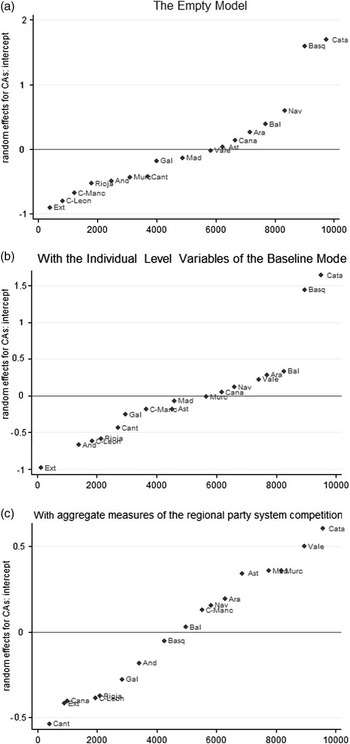
These interregional differences can be observed again in Figure 2, graphs M1 and M2. As can be seen, the differences between the most pro-decentralization regions, such as Catalonia and the Basque Country on the one hand, and the most pro-centralization ones, such as Extremadura, Andalusia, and Castile and León on the other, are scarcely reduced with the inclusion of the most important individual level predictors.
Distribution of the intercept variance (σ u0j ) by regions for the multilevel models.

Thus, at this point we need to include regional aggregate independent variables to explain cross-regional differences in the dependent variable. Among these variables, we include the percentage of non-state-wide parties in each regionFootnote 11 as a proxy of party competition dynamics regarding interregional conflict in the 17 regions of Spain, as is standard in the comparative literature measuring the effect of regional party systems (Brancati, Reference Brancati2006: 669). The last variable is, thus, included to test the effect of the dynamics of the sub-national party system. If hypothesis H4 is correct we should expect an important reduction in the random component of the intercept (σ u0j ), by adding to this model this aggregate variable. We have also included the evolution of GNP from 1995 to 2005 and the Gini index from 1998 to 2005.Footnote 12 These last two variables are added to test the contextual effect of economic growth and social inequality in explaining the random effect of the intercept. Thus, the model to estimate is the following:
Model 3: a multilevel model with the inclusion of three aggregate regional level variables:
 $$\eqalignno{ MS_{{ij}} =\, & \gamma _{{00}} {\plus}\lambda _{{1j}} \left( {{\rm percentage}\,{\rm of}\,{\rm non{\hbox-}state{\hbox -}wide}\,{\rm parties}\,{\rm by}\,{\rm ACs}} \right){\plus}\lambda _{{2j}} \left( {{\rm GDP}\,{\rm by}\,{\rm region}} \right) \cr & {\plus}\lambda _{{3j}} \left( {{\rm GINI}\,{\rm index}\,{\rm by}\,{\rm region}} \right){\plus}\beta _{{nj}} \left( {{\rm individual}\,{\rm variables}_{n} } \right){\plus}u_{{0j}} {\plus}{\varepsilon}_{{ij }} $$
where λ nj corresponds to the aggregate level variable estimates.
Table 4 presents the results of the estimation of this hierarchical logistic multilevel model (Model 3) for individual preferences for the model of the state that includes regional aggregate variables. As this model shows, the only significant aggregate level variable is the percentage of non-state-wide parties by region (λ 11). This coefficient is statistically significant and positive, showing that the greater the percentage of these regional parties in the system, the more radical are positions in favour of decentralization in the different regions. This is also reflected in the important reduction of the random effect of the intercept (σ u0j ), which is now only 0.38 (see Model 3 in Table 4). This effect can be visually confirmed by observing once more in Figure 2 (M3) the significant reduction of interregional differences. Even the Basque Country is now very close to 0 (immediately below the line).
So far we have only shown the indirect effects of party system dynamics on individual preferences for the model of the state. However, and according to hypotheses H5 and H6, the effect of partisanship on citizens’ preferences concerning the model of the state should not be uniform across all regions, responding to the different dynamics of the sub-national party systems on the division of public opinion. In order to test this possibility and show the contingent effect of partisanship, which depends on the dynamics of regional party systems, it is necessary to estimate the cross-level interactions between this aggregate measure of the party system and the two dummy variables measuring partisanship. The significance of these inter-level interactive variables, (λ 11, λ 22), will show that the effect of the individual level variables measuring partisanship is conditional on the dynamics of the party system. Thus, the expectation is that the coefficients for these interactive terms should be significant and positive for partisanship with a nationalist regional party and negative and significant for the interaction between partisanship with a state-wide party and the aggregate measure of regional party dynamics. Accordingly, the two models to estimate are the following:
Model 4
 $$\eqalignno{ MS_{{ij}} = \,& \gamma _{{00}} {\plus}\gamma _{{1j}} \left( {{\rm percentage} \ {\rm of}\,{\rm non{\hbox - }state{\hbox - }wide}\,{\rm parties} \ {\rm by} \ {\rm ACs}} \right) \cr & {\plus}\lambda _{{20}} \left( {{\rm partisanship} \ {\rm with} \ {\rm a} \ {\rm national} \ {\rm regional} \ {\rm party}_{{ij}} } \right) \cr & {\plus}\lambda _{{{\rm 22}}} \left( {{\rm percentage} \ {\rm of} \ {\rm non{\hbox - }state{\hbox - }wide} \ {\rm parties}_{{nj}} }\right \cr \left\quad{\times}{\rm partisanship} \ {\rm with} \ {\rm a} \ {\rm national} \ {\rm regional}\,{\rm party}_{{ij}} } \right) \cr & {\plus}\beta _{{nj}} \left( {{\rm individual} \ {\rm variables}_{n} } \right){\plus}u_{{0j}} {\plus}u_{{2j}} {\plus}{\varepsilon}_{{ij}} $$
where λ 2n corresponds to the different slope estimators for partisanship with a nationalist regional party.
Model 5
 $$\eqalignno{ MS_{{ij}} = \,& \gamma _{{00}} {\plus}\gamma _{{1j}} \left( {{\rm percentage} \ {\rm of} \ {\rm non{\hbox - }state{\hbox - }wide} \ {\rm parties} \ {\rm by} \ {\rm ACs}} \right) \cr & {\plus}\lambda _{{{\rm 3}0}} \left( {{\rm partisanship} \ {\rm with} \ {\rm a} \ {\rm state{\hbox - }wide} \ {\rm party}_{{ij}} } \right) \cr & {\plus}\lambda _{{{\rm 33}}} \left( {{\rm percentage} \ {\rm of} \ {\rm non{\hbox - }state{\hbox - }wide} \ {\rm parties}_{{nj}} }\right \cr \left {\times}{\rm partisanship} \ {\rm with} \ {\rm a} \ {\rm state{\hbox - }wide} \ {\rm party}_{{ij}} } \right) \cr & {\plus}\beta _{{nj}} \left( {{\rm individual} \ {\rm variables}_{n} } \right){\plus}u_{{0j}} {\plus}u_{{{\rm 3}j}} {\plus}{\varepsilon}_{{ij}} $$
where λ 3n corresponds to the average of all the regional slope estimators for partisanship with a state-wide party.
The same Table 4 (Models 4 and 5) also contains the estimators of these last two hierarchical logistic multilevel models. The results are highly revealing, confirming the presence of an important and significant coefficient for the interaction of the regional party system measurement with partisanship with a nationalist regional party (λ 11). These results confirm hypothesis H5, showing the importance of these party system dynamics (contingent effects) in increasing the individual effect of partisanship with this type of party in adopting more radical positions on the centralization issue (Brancati, Reference Brancati2006, Reference Bracanti2007). But these results also confirm the significant and negative effect of the variable measuring the interaction between regional party system competition and partisanship with a state-wide party (λ 22) on citizens preferences about the model of the state, showing that these parties also contribute to a certain degree to this polarization of public opinion favouring positions towards centralization or the status quo (hypothesis H6). It appears that once nationalist regional parties change the dynamics of party competition, as a result of decentralization, state-wide parties also contribute to polarizing the dynamics of the conflict, due to the electoral benefit they hope to obtain, at either the regional or national level.
Concluding remarks
This paper has dealt with public disagreement regarding the territorial model of the state in multinational and decentralized states, such as Spain. The preceding pages have shown that regional party positions, conditioned by the nature of the logic of competition within party systems across regions, are an important element in explaining the enduring division of Spanish citizens’ political support for the territorial model of the state, not only individually, but also cross-regionally. Decentralization in established democracies has created space for governments to use regional autonomy for partisan political purposes (Sorens, Reference Sorens2010: 77). This space has permitted non-state-wide political parties to play an important protagonist role, giving them the opportunity to extract electoral advantages from such territories, interacting with existing national or ethnic identities to polarize inter-territorial conflict, and creating sub-national party system dynamics. This appears to be the case of Spain (as the recent events in Catalonia and the electoral strategy deployed by CiU since the popular nationalist demonstration of 11 September 2012 appear to demonstrate). In Spain, however, according to the results of this analysis state-wide parties are also contributing to the polarization of the conflict by responding to the new party system dynamics created by the emergence of nationalist regional parties. This finding appears to agree with other empirical results (Martínez and Miley, Reference Martínez-Herrera and Miley2010: 22) emphasizing that the preferences of the general public are more moderate than the preferences of the influential elites of the Basque and Catalonian regional political establishments. The preceding results also confirm the relative unimportance of the new territorial institutions’ performance in altering preferences for the model of the state (Chernyha and Burg, Reference Chernyha and Burg2008: 20). The current challenges to the final solution of the model of the state in Spain are driven by party political elites, who contribute to producing divisive and enduring preferences about this issue.
However, the preceding conclusions about the role of political party dynamics should not be emphasized without placing it in a broader context. In an explanatory model of mass political support for decentralized patterns of government, this agency-centred approach should be integrated with other factors, such as institutional ones, which have proven to be essential in accounting for territorial politics. As current research into territorial politics and the nationalization of politics stresses, explanations of territorial politics must consider the relationship between institutions and agencies in order to give a satisfactory response (Brancati, Reference Brancati2006). That is to say, wherever an institutional structure (such as a majoritarian electoral system) allows or even promotes this conflict, then the influential role of political parties becomes more crucial in promoting and polarizing the conflict among citizens.
This study has shown that this is especially true for Spain. The evolution of the Spanish state model of regional autonomy also provides a clear case where the lack of institutions to handle intergovernmental cooperation at the political level (Aja, Reference Aja2001; Colino, Reference Colino2009) has fostered the prominence of political elites. Additionally, intergovernmental and multilevel political relations have also been affected by the significant political weight that some non-state-wide parties have acquired in the national arena. In fact since 1993, state-wide political parties in the central government (the PP first, and subsequently the PSOE) had an absolute majority in parliament for no more than 4 years, and thus had to obtain additional support from nationalist regional parties, in particular from Catalonia and the Basque Country. This was the case in 2005, when the PSOE was kept in power at the central level with the temporary Parliamentary support of nationalist regional parties. All the above has prepared a perfect context for political agencies to create an increasing pattern of intergovernmental conflict that continues to polarize public opinion about the current model of the state, despite the notable results obtained during the last two decades.
Funding statement
The work of this article has been made possible with the funding of the Spanish Ministry of Innovation and Science, research project reference: CSO2009-14434.
Acknowledgements
The authors want to thanks for useful comments to previous versions to Maria José Hierro and two anonymous reviewers.