In the sixteenth-century Chosŏn (1392–1910), the scope of communication expanded remarkably as people across society wrote and exchanged letters on an unprecedented scale. Social actors other than male elites, who had dominated the written culture through their exclusive knowledge of literary Chinese, began to express their thoughts and feelings in written forms during this period. Male elites also began to handle and preserve the letters that they wrote and received in completely different manners. The writing collections of male elites began to include the authors' letters more systematically, as a separate section and in large quantity. Letters were copiously produced and widely circulated; at the same time, letter writers fundamentally changed their perceptions about letters that they wrote and read.
The rise of letter writing in this period is mainly attributed to the invention of the Korean alphabet (han'gŭl) in the mid-fifteenth century. The ease of learning vernacular Korean script transformed many illiterate people into writers. In particular, elite women capitalized on the new writing system in their everyday life by exchanging letters, among the few genres available to them. Letters might have helped them stay connected with family members from whom they were parted for reasons such as marriage, expressing and confirming the mutual longing with recipients. Letters may also have been the easiest genre for women to use without encroaching on male elites' domination of literary Chinese written culture. Women's participation in letter writing using vernacular Korean script promoted the personal and social interactions between men and women as well as between women, in addition to the existing connections between elite men in literary Chinese letters.
This interaction between men and women in written communication entailed quite unexpected cultural consequences. Because male elites prized the strenuous and laborious process of learning the Confucian classics, they denigrated easy vernacular Korean script as reflecting its users' intellectual and cultural inferiority. Women letter writers used the vernacular in innovative ways, appropriating and developing unique letter forms, “spiral letters.” Instead of writing vertically in columns from the upper right to the lower left of the page, the writers of spiral letters rotated the page counterclockwise by 90 degrees two or three times to complete their messages. The inchoate form with a 90-degree spiral effect had existed in male elites' literary Chinese letters since as early as the fifteenth century. The “full-fledged” spiral letters with a 360-degree spiral effect, however, began to develop in vernacular Korean letters exchanged in domestic settings in the late fifteenth century. Because women had not received formal education with books or any other official writings, they might have written their vernacular letters in more untamed and imaginative styles. These sophisticated and elaborate visual forms of spiral letters dovetailed with the contemporary scholarly culture focusing on complex Confucian discourse. The creativity and freedom in configuring textual space appealed to male elites, who adopted these forms in their Korean letters to women as well as in literary Chinese letters among themselves. The versatility of the new forms, although applied to women's informal writings, was well suited to their own purposes. These new modes of reading and writing reflected the power relations intertwined with gender and the choice of languages. Thus their popularity across the society helped shape the new political dynamics of the era.
Besides communicating with women in written form, male elites' wide and habitual letter writing gave rise to a new networking process. For instance, long-distance academic debates through correspondence characterized the intellectual exchange among scholars in the sixteenth century. Male elites also experienced many critical changes in the academic, social, and political domains, in which the protean and innovative uses of epistles functioned as the vital driving force. The new neo-Confucian moral philosophy, which emphasized the embodiment of learning in daily practices, became popular. Some scholars found prominent Confucian masters' letters the most effective reading materials for neo-Confucian studies and self-cultivation, claiming that they were able to implement Confucian moral politics immediately. Local academies (sŏwŏn) spread in the rural areas as centers of this new scholarship. The academy scholars as a group took leadership in the local society, and their shared academic interests and active interactions synchronized their political vision, transforming them into a powerful political group. Their collective activism through diverse epistolary practices influenced state political discourses, as well as the monarch and court ministers, throughout the late Chosŏn period. Simply put, there emerged a new political community armed with a new philosophy and social foundations in sixteenth-century Korea. In the creation of this community, letters were not simply the means of communication delivering ideas, but a medium that enacted these ideas to shape the social reality.
This article will examine how the spread of letter writing and the diversification of epistolary culture perpetuated the scholarly norms, gender relations, and political culture of the Chosŏn.
A New Written Culture from New Scholarship
Letters as Neo-Confucian Texts: T'oegye's Reading of Zhu Xi's Letters
T'oegye Yi Hwang (1501–70) is arguably the most prominent neo-Confucian scholar of premodern Korea. His works have been widely read and studied, and his intellectual heirs influenced both academic and political discourses throughout the late Chosŏn period. He attained his fame by promoting the ethical principles of neo-Confucian scholarship, which characterized the lifestyle of late Chosŏn literati. Although T'oegye was not the only one advocating this new way of life, he initiated the local academy movement as the center of neo-Confucian scholarship in rural society. He thus provided scholars with the institutional basis upon which to actually discuss and practice the new learning (Chŏng Manjo Reference Manjo1997, 49–81). This new scholarly and social movement accompanied changes in the practices of writing and reading.
T'oegye had begun to seriously study neo-Confucian moral philosophy only sometime after 1543, when he acquired the collected works of Zhu Xi (1130–1200), a prominent neo-Confucian master of Song dynasty China (960–1279). The core of this new scholarship was the embodiment of learning in everyday life. This academic precept prompted T'oegye to search for the most suitable writing genre to deliver philosophical principles in discrete contexts of daily practices. Thus, he developed a keen sense of reading effects while examining writings in various genres included in the Zhu Xi collections. In particular, T'oegye found letters tremendously effective for engaging scholars pursuing the neo-Confucian lifestyle and converted letters into reading materials for neo-Confucian studies. T'oegye meticulously annotated, edited, and anthologized Zhu Xi's letters, completing this project in 1556. He titled the collection Chujasŏ chŏryo (The abbreviated essence of Master Zhu Xi's letters) and praised it as the threshold to neo-Confucian scholarship for readers at different academic levels (Yi Hwang Reference Hwang1971a, 2:42:3b–4a).
In the preface to this anthology, written in 1558, T'oegye put forward the reason he chose to edit and anthologize Zhu Xi's letters:
I carefully read this collection [The Complete Collection of Master Zhu Xi's Writings].… In particular, I have learned more in reading letters [than in reading other parts]. As for the whole content of this collection, it is hard to get its gist because it is as broad as the earth [in terms of quantity] and as deep as the sea [in terms of meanings]. As to letters, however, [Zhu Xi] made different levels of explanations according to different personalities and different degrees of scholarship of different people. It is like applying different medicines to different symptoms and measuring various things in a scale. (Yi Hwang Reference Hwang2004, 1:1a–b)
The reciprocity between the sender and the addressee embedded in letter writing caught T'oegye's attention as the quality that facilitated readers' understanding of complex neo-Confucian theories. Because letter writers treated the same academic issues differently for addressees at various academic levels, compiling these manifold explanations of the same concepts and theories made the study of neo-Confucianism much easier.
In this preface, T'oegye further elaborated on the advantages of letters by comparing them with writings in other genres. In responding to criticisms of his exclusion of Zhu Xi's writings other than letters, he asserted that many scholars had failed to understand Zhu Xi's discourse despite their best efforts. This scholarship, he continued, is too complex for ordinary scholars to figure out. In this respect, T'oegye distinguished Zhu Xi's letters from his works in other genres, which tend to discuss academic issues in “dry tones.” He claimed that the letters show how Zhu Xi helped his pupils better understand the pith of learning and encouraged them to study hard (Yi Hwang Reference Hwang2004, 1:2b–3a).
The immediacy and affinity embedded in the tone and manner of each letter created an expectation that readers who studied the letters for scholarly purposes would engage with these texts as intimates. In other words, Zhu Xi's letters present his neo-Confucian theories in a more tangible, thus much easier to comprehend, way than his writings in other genres. Whereas critics of T'oegye only considered authors' intentions when discussing the content of texts, T'oegye suggested that readers focus on learning in different ways by reading works in various genres. He had noticed that the choice of writing genre could generate entirely different effects on the reader from the same content.
T'oegye extensively discussed the specific context in which correspondence took place as its pedagogical advantage. Zhu Xi's versatile narratives to his disciples cum addressees invigorated scholarly discourses that could have easily become abstract. This capture of scholarly practices in everyday contexts also enriched the pedagogical effects of letters. Readers could envision how neo-Confucian concepts had been created and developed in the interactions between master and disciples. This deliberation increased the importance of the daily life of letter readers themselves. They realized that the embodiment of learning was going on in their seemingly trivial conversations and behaviors.
Ironically, however, T'oegye's editing process distanced these letters from their original correspondences. The letters were part of a collection that included motley writings in various genres, so editors had to recontextualize them to fit them in. The compilation of texts in a collection silenced conflicting authorial intentions imposed upon each text in favor of the coherence of the whole. Furthermore, the name of the author became more important than the peculiarities of different genres and disparate contexts. The readers' role was also amplified, because it took cooperation between compilers and readers to constitute the consistent meaning of a diverse collection. T'oegye articulated that his purpose in reading Zhu Xi's writings was to learn neo-Confucian scholarship. This clear motive prescribed the meaning of Zhu Xi's letters within the scholarly frame. The process of anthologization then excluded letters that might have fallen outside T'oegye's reading strategy. His reading practice was proactive to suit his purpose, rather than reactive to the contents of the letters.
Equally important is the relationship between form and meaning. T'oegye read Zhu Xi's letters in a book, although they originally were not written and read in this textual form. Considering the absence of letters in the bulk of Chosŏn books, when T'oegye encountered Zhu Xi's in this way, it must have made for an extraordinary reading experience. T'oegye read the letters like he read other neo-Confucian classics, rather than as letters used for communication. The shift of textual forms for the same content did not simply effect a physical changeover but also altered the text's semantic and functional values. As Roger Chartier (Reference Chartier1999, viii) observes in early modern European book culture, “The book always aims at installing an order, whether it is the order in which it is deciphered, the order in which it is to be understood, or the order intended by the authority who commanded or permitted the work.” The same letters deliver completely different connotations before and after they take book form, because readers predetermine how to interpret information according to the textual form in which it is conveyed. The early Chosŏn scholarly culture directly linked book reading to the learning process. Thus, it would not have been possible for T'oegye to read Zhu Xi's letters as a reflection of his scholarship unless they had been presented in book form. The introduction of Zhu Xi's neo-Confucianism to Chosŏn not only brought in new scholarship but also initiated new reading practices.
Reading Letters for Self-Reflection
T'oegye's attention to Zhu Xi's letters as the main texts for neo-Confucian studies also changed his understanding about the function of his own letters. He particularly reviewed their contents to check the correspondence between what he had stated and his own behaviors. In other words, T'oegye made use of his letters as a behavioral code in everyday life. He anthologized twenty-two of his own letters written between 1555 and 1560, addressed to ten different people, in a collection titled Chasŏngnok (Record for self-reflection). As he articulated there, he revisited the letters from time to time and used them as a yardstick for self-reflection. He expressed concern about his forgetfulness regarding what he had stated and pointed out discrepancies between his words and actions (Yi Hwang Reference Hwang and Chungsŏk2003, 37). This is intriguing, because self-reflection for T'oegye meant the continuous recontextualization of what he had expressly stated in his letters. The practice of writing letters thus had two implications: senders write letters to deliver their messages to addressees; yet at the same time, they write them as memoranda to themselves, to regulate their own behavior.
Confucian literati had paid immense attention to prominent masters' letters by anthologizing and commenting on them for academic purposes. Reshuffling letters into an anthology gave them a new textual meaning by stripping them of their original context. This flexibility triggered the redefinition of the readership boundary as well: now letters could be read by third parties, other than the original addressees. This change also transformed the attitude of letter writers, as they had to consider future “hidden readers.” Because T'oegye read both Zhu Xi's letters and his own letters for scholarship and self-cultivation, he might have considered anonymous readers as well as his future self beyond the addressees. This change of authorial attitude effectively expanded the exchange of words between individuals through correspondence to broader levels of the scholarly community. Thus the distinction between “the individual” and “the collective” became fluid.
Letters as an Open Discursive Space for Academic Debates
This ambiguity between the individual and the collective led Chosŏn scholars to engage in academic debates through extensive exchanges of letters as an open discursive space. As the means of long-distance communication, letters enabled scholars nationwide to participate. T'oegye is famous for his epistolary debate with Ki Taesŭng (1527–72) from 1559 to 1566, known as the Four-Seven Debate (Sach'il nonjaeng), which became the most well-known academic interaction in the Korean Confucian tradition. It consisted of a series of eight letters exchanged between these two scholars, who debated over the relation between human nature (sŏng) and human sentiments (chŏng), which would define how to achieve human perfection through self-cultivation. T'oegye argued for a distinction between human nature and human emotions respectively as the manifestation of i (Confucian principle) and ki (material force). Ki objected to this stark differentiation, because he believed there is no fundamental difference between i and ki in the actual operation of the human mind-and-heart. T'oegye heard of this criticism and sent a letter of inquiry about Ki's interpretation in 1559; this triggered the famous epistolary debate. It concluded with Ki's summary of the issue and his rather yielding remark synthesizing T'oegye's argument. However, the question remained open-ended; there was no final resolution.
Both T'oegye and Ki collaborated with other scholars to hone their arguments by sharing their mutual correspondence. So their colleagues were well aware of this debate. Ki openly circulated the letters and asked the opinions of well-known scholars from the early stages of the debate; Kim Inhu (1510–60), Yi Hang (1499–1576), and No Susin (1515–90) responded, which enriched Ki's argument. T'oegye also discussed this issue with some of his own pupils (Cho Reference Cho2010, 103–14). In this way, Confucian scholars came to appreciate public readership and collective authorship through exchanging letters. Therefore, it was no surprise that Yulgok Yi I (1536–84) and Sŏng Hon (1535–98) initiated the second round of this debate in 1572 in response to the exchange between T'oegye and Ki. The secrecy assumed between senders and addressees in their correspondence easily gave way to open access to letters in the quest for better scholarship.Footnote 1 To some degree, the letters exchanged among the Confucian literati functioned as academic periodicals, which did not exist in the Chosŏn academic environment.
When studying Zhu Xi's neo-Confucianism, T'oegye paid immense attention to the ways this new idea was presented, as well as to the idea itself. He claimed that choosing the best writing genre was of vital importance in making the complex neo-Confucian philosophy comprehensible for ordinary scholars. Writing genres shaped both the knowledge itself and its applications in society. As T'oegye was a leading public intellectual of the time, his attention to written modes influenced the ways fellow scholars and future generations studied and interpreted neo-Confucianism throughout the late Chosŏn period. In this regard, it is worth asking why Zhu Xi's version of neo-Confucianism dominated Korean scholarly culture but did not prevail in the academic discourse in China. The answer is that while this scholarship accompanied the rise of a new written culture in Korea, there was no particular attention to the written form in China. Even there, some letters were written not for communication but to fix the author's ideas in textual form, which allowed for rereading and further references. In particular, admonitory letters were indistinguishable from nonepistolary genres such as intellectual testaments in terms of function (Richter Reference Richter2006). Letters in late imperial China functioned as the supplementary means to spread knowledge that could not be incorporated into books or essays (Elman Reference Elman1984, 203); they hold no significance in the Confucian canon (Richter Reference Richter2013, 6). In the Chosŏn epistolary culture, however, letters became the main genre for neo-Confucian studies and self-cultivation. When new ideas were conveyed in the appropriate written mode, people not only understood them more easily but also put them into practice through their own writing. However ingenious and innovative certain ideas may be, they need to be presented in an appropriate medium to be applicable in social reality.
Spiral Letters
A New Mode of Reading and Writing in Chosŏn Epistolary Culture
Even before T'oegye picked letters as the central texts of neo-Confucian learning, they were a popular means of communication in Chosŏn society. The wide usage of letters accompanied the emergence of unique forms such as “spiral letters” as early as the late fifteenth century.Footnote 2 The image in figure 1 is of a spiral letter produced in 1811, which displays 360-degree spiral effects. In this letter form, both writers and readers engaged with the letter intellectually as well as physically. As seen in this image, the letter writers indented the beginning of their message radically toward the lower-left side of the paper (see figure 1-1). When the paper was filled to the lower-left edge, they turned it counterclockwise by 90 degrees and continued to write in the left half of the upper margin (see figure 1-2). When that was filled, they again turned the paper counterclockwise by 90 degrees and continued to write in the right half of the upper margin (see figure 1-3). When the paper had been completely rotated and the contents filled the page (see figure 1-4), the letter could be read from all four directions. Notably, the division of textual parts through the application of spiral effects does not necessarily correspond to changes of subject in the content of the letters. We can only assert with certainty that this spiral movement in writing letters brought about the same motion in reading them.
Yu Simch'un's (柳尋春; 1762–1834) spiral letter written in 1811 (Kukhak Chinhŭng Yŏn'gu Saŏp Ch'ujin Wiwŏnhoe Reference Wiwŏnhoe2005, 161). Effects added by the author. Photo courtesy of the Academy of Korean Studies.

The spiral form appears in both vernacular Korean letters and literary Chinese letters, and both men and women used it. Although male elites began to use the incipient form with 90-degree spiral movement in their literary Chinese letters, it was vernacular Korean letters exchanged in domestic settings that initially employed the full-fledged 360-degree spiral effect. The spiral forms developed only in Korea, not among other countries under the influence of the literary Chinese classical tradition. Moreover, even in Korea, spiral forms appeared only in letters, not in other genres. Although they were common in late Chosŏn letter writing, they were not even given a name. We can understand this textual form as a local custom, which suggests several possibilities for understanding the practices of reading and writing letters in the Chosŏn.
First, spiral letters could be interpreted as an attempt to save paper by packing the contents onto a single sheet. All existing studies referring to spiral forms unanimously present this as the sole reason for their origin, apparently due to the insufficient supply of paper (Kim Hyo Kyung Reference Kyung2005, 103–4; Lee et al. Reference Lee, Shin, Yang, Spigelman and Yim2009; Son Reference Young2011). The Chosŏn society had lacked paper even for official uses since the early fifteenth century (Kim Samgi Reference Samgi2002). The incipient spiral letters in literary Chinese produced in the fifteenth century with only 90-degree spiral movement can be understood as conservation attempts. In this case, the writers began to write vertically from the upper-right side of the paper. When the contents filled the page at the lower-left edge, they continued to write only one or two more lines on the narrow upper margin by rotating the paper counterclockwise 90 degrees. However, later letters with 180-degree or 360-degree spiral effects do not seem intended to save textual space; blank areas frequently appear. To save paper, it would have made more sense to begin to write from the very upper-right side while controlling character sizes and line spacing. Most of all, there is no logical connection between the letter writer's intention to save paper and his or her decision to rotate the page while writing. The spiral letters with 90-degree movement do not explain why letter writers ended up rotating the page by 360 degrees.
Another possibility is that spiral letters were widespread as a popular form for amusement in writing and reading. Spiral forms frequently appear regardless of the gender and social status of letter writers and the language they use. Spiral effects even appear in Koreans' letters to foreigners in vernacular Korean script. Eighty-five letters exchanged between Chosǒn interpreters and interpreters of the Sō daimyo from 1795 to 1810 were discovered in Japan in 2010 (Chŏng Sŭnghye Reference Sŭnghye2012). These include many spiral letters, implying that even Japanese interpreters who traveled back and forth between Korea and Japan were familiar with this epistolary form. These examples evince that the spiral form appealed to people across the society as a trendy letter style. However, some writers applied spiral forms and others did not, and those who favored spiral forms often wrote letters without such effects. The decision does not seem to have been governed by the contents of letters, either. Spiral letters cover a variety of subjects, including family affairs, academic debates, social issues, and political problems. However, no spiral forms of official documents registered at the state offices, such as petitions and memorials, have been found.
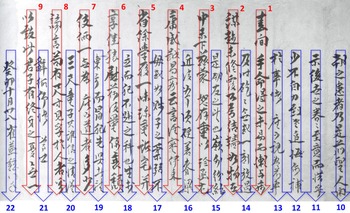
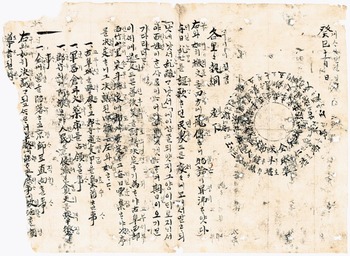
Chosŏn letter writers' sensitivity to the spatial layout of texts gave rise to another unique letter form. By the nineteenth century, “boomerang letters” were being used among male letter writers.Footnote 3 The writer began by indenting to the middle of the page and then left generous spacing between lines, as seen in the image in figure 2 (1–9). Reaching the end of the page, he returned to the beginning and continued to write in between existing lines while radically indenting them from the top of the page (10–22). In the late nineteenth century, some letter writers applied both spiral and boomerang effects on the same page, which made writing and reading practices more complex (see figure 3). In this case, they used the spiral effect first and then moved on to boomerang effects. The letter-reading process was like cracking a secret code. The late Chosŏn letter writers expected the addressees to follow this textual layout by common sense, without any instructions. Thus, writers and readers of this type of letter might confirm and reinforce their membership in the same textual community through the complex layout of textual space.
Ch'oe Ikhyǒn's (崔益鉉; 1833–1906) boomerang letter written in 1903 (Han'guk Koganch'al Yǒn'guhoe Reference Yǒn'guhoe2006, 236–37). Effects added by the author. Photo courtesy of Taunsaem Publisher.

Yu Hujo's (柳厚祚; 1798–1876) letter written in 1871 (Kukhak Chinhŭng Yŏn'gu Saŏp Ch'ujin Wiwŏnhoe Reference Wiwŏnhoe2005, 166). Effects added by the author. Photo courtesy of the Academy of Korean Studies.

Third, given that letters were widely read in communal and public settings among Confucian literati, that writers had to consider future “hidden readers,” and that there was no technology to replicate texts, spiral movement may have made the group reading of a single sheet easier and more efficient. The spiral letters divided into four parts heading in four different directions might have been read in serial order by a group of readers surrounding the given text and rotating it. The readers may also have moved themselves around the text when their group was too big, just as the spectators at modern art galleries and museums shift to view an artwork simultaneously.
The earliest full-fledged literary Chinese spiral letter that I discovered was written during the Japanese invasion in the late sixteenth century (Kukhak Chinhŭng Yŏn'gu Saŏp Ch'ujin Wiwŏnhoe Reference Wiwŏnhoe2008, 191). It was sent by a court official to the army chief recruiter on the front line in 1592. This letter discusses concern about the delay of the Chinese rescue army, which would not enter Korea at the border. The urgency of the matter might have required the writer to apply spiral effects to let officers around the chief recruiter join in reading by surrounding the given text. Spiral letters also may have been used for the opposite reason: to control readership more effectively than could be done by reading texts aloud or posting them in public. They may have been ideal for confidential small-group communication.
The image in figure 4 is Kim Hongdo's (1745–?) painting produced in the late eighteenth century. Art historians generally title it “the appreciation of a painting,” but the paper held by a group of men who surround it is blank.Footnote 4 These men could be appreciating a painting, as the art historians suggest. However, they could also be examining a blank sheet of paper for future use or reading a text together, as I propose in the usage of spiral letters. Whatever this paper really was for, the painting shows that there was a perception in the Chosŏn that a group of people could surround a single sheet of paper for their shared project.
Kim Hongdo's (1745–?) painting. Photo courtesy of the National Museum of Korea.

Moreover, ch’ǒmch'al (僉察), which literally means “together, read,” a frequently used epistolary expression since the late sixteenth century, suggests the group reading of a single letter (Han'guk Koganch'al Yǒn'guhoe Reference Yǒn'guhoe2003, 14–15). Another notable expression is kaksǒ (各書), which means “writing letters separately to each addressee.” In most cases, this expression is used in negative statements, such as “mang mi kaksǒ” (忙未各書) or “pyǒng mi kaksǒ” (病未各書), which respectively mean “too busy to write letters to each addressee” and “could not write letters to each addressee due to sickness” (Ha et al. Reference Yǒnghwi2011, 35). These phrases suggest that one letter was addressed to a group of people and read jointly or in a serial order. The communal reading of letters became popular in the late Chosǒn period, and the concurrent change in their physical form could have reflected the new reading practice.
Communal reading, which is also observed in other societies, delivered completely different social and cultural implications than private reading. For instance, several children sat around and shared a single Hebrew primer in medieval Jewish communities in Arabia and Egypt, where writing facilities were scarce and there were not enough books to meet the demand. While sharing one book, four or more Jewish children easily learned to read it sideways, upside down, and from all possible corners. Thus they became capable of reading a text turned upside down with the same fluency as a text right side up (Ahroni Reference Ahroni1994, 172; Goitein Reference Goitein1999, 181; Olszowy-Schlanger Reference Olszowy-Schlanger2003). However, spiral forms do not appear in Hebrew texts of this region. Similar reading practices did not necessarily entail analogous physical forms of texts in different reading environments.
The upside-down forms, which also required writers and readers to rotate the given page, frequently appear in the texts produced in countries under Muslim jurisdiction (see figure 5). Spiral letters of the Chosǒn, however, particularly resemble spiral texts popular in Yemen, whose writers strove for calligraphic exquisiteness by applying spiral effects. Thus, as the fourth possibility, the Chosǒn letter writers could have been concerned about calligraphic aesthetics. However, spiral letters from the Chosǒn do not appear to have been written with textual elegance in mind. There are many in which lines from different parts are mixed up in the same place. Moreover, many spiral letters even continued to the back page, which made text written on the front and back smudged due to the sheerness of the paper. The doubling of unrelated lines from different textual parts in the same place apparently has nothing to do with the stylish refinement of writing.
Yemeni spiral text (1917) and Sudanese upside-down text (1225) (Messick Reference Messick1993, 232; O'Fahey and Abu Salim Reference O'Fahey and Abu Salim2003, 72). Photos courtesy of University of California Press and Cambridge University Press.

Gender, Diglossia, and the Politics of Reading
None of the possibilities that I have offered fully explain why Chosǒn people used spiral and boomerang forms only in their letter writing. The writing norms and reading efficiency of our modern world are not applicable to these epistolary forms. Moreover, our preconceptions about Chosǒn letter writing and letter reading, based on vertical texts linearly proceeding from the upper-right side of the page to the lower-left side, do not apply to spiral letters and boomerang letters. A creative mode of reading and writing coexisted with the conventional written culture in the Chosǒn.
In my opinion, this reflects the changed power relationship between literary Chinese and vernacular Korean script, and the genders of their users. Full-fledged spiral letters began to appear in late fifteenth-century vernacular Korean letters, which were exchanged exclusively in domestic settings including women. Since the invention of vernacular Korean script in the mid-fifteenth century, male elites had disdained it as the “vulgar script” (ǒnmun) or “female script” (amk’ŭl) and used only literary Chinese, which was associated with Confucian values. The ease for all social actors—regardless of their gender, social status, and generation—in learning and mastering vernacular Korean script threatened the domination of male elites in the early Chosǒn period, which hinged upon the classical tradition of literary Chinese. Thus male elites, most famously Ch'oe Malli (?–1445), discounted the effortless attainment of vernacular Korean literacy as vile and argued that its usage would discourage people from learning literary Chinese used by Confucian sages (Sejong sillok 1955–58, 103:19a–22a). In this context, women letter writers seem to have embraced this discourse embedded in Confucian tradition; thus, they might have appropriated a peculiar textual technology to make their writings appear more sophisticated and elaborate: spiral letters (see figure 6). The resulting elevated visual and spatial complexity dovetailed with the contemporary written culture prizing strenuous learning of difficult Confucian texts. Because male elites communicated with their female family members via vernacular Korean letters, they may have been exposed to these more complex writings and ended up employing the form in their letters written in literary Chinese.
The development of full-fledged spiral letters in women's vernacular letters offers an intriguing parallel with the rise of the “feminine hand” (onnade) Kana script in medieval Japan. The widely accepted historiography demonstrates that Japanese aristocratic women who were excluded from training in Chinese writing helped create and popularize this expedient phonetic script, which subsequently sparked the rise of vernacular literature in women's everyday activities. However, Thomas LaMarre's (Reference LaMarre1994) research demonstrates that Kana was not a phonetic liberation through a new writing system but a choice between complicated and simplified calligraphic styles. In a similar vein, Tomiko Yoda (Reference Yoda2000) confirms that there is no evidence that using Kana was perceived as feminine in Heian Japan. Therefore, she warns of the danger of understanding Kana as an indication of the autonomy or dominance of “female/feminine culture.” Likewise, use of the spiral letter form does not necessarily mean that Chosǒn women attained cultural and textual autonomy, for two reasons. First, the full-fledged spiral letters seem to have been derived from the incipient form with a 90-degree spiral effect in male elites' literary Chinese letters. Second, the complexity and sophistication embedded in this form confirmed and reinforced male-dominated Confucian norms. However, women's letter writing shifted the direction of Chosǒn written culture, because male elites imported this new “spatial genre” into their literary Chinese letters for their own purposes. The unique layout of spiral letters engaged both writers and readers even before they got into the content; they had to figure out where to start and where to move on.
Madam Pak's (1700–1737) letter to her mother written in 1726 (Kukhak Chinhŭng Yŏn'gu Saŏp Ch'ujin Wiwŏnhoe Reference Wiwŏnhoe2004, 36). Effects added by the author. Photo courtesy of the Academy of Korean Studies.

The historical process in which spiral letters disappeared corroborates my argument. Spiral letters were scarcely used after the 1890s, when the introduction of modern newspapers printed with Western printing technology brought in a new written culture. As Western Protestant missionaries began to learn Korean, they applied two significant elements of Western writing to vernacular Korean script: horizontal reading and word spacing (King Reference King2004). While horizontal reading was confined to Korean primers for foreigners (Ross Reference Ross1877), word spacing prevailed more widely, along with ideas of social equality and democracy. An American missionary, Homer B. Hulbert (1863–1949), initially suggested applying word spacing to Korean in 1896 (Hulbert Reference Hulbert1896). Hulbert particularly pointed out that without word spacing, the same sentence could generate several different meanings. The first vernacular Korean newspaper, Tongnip sinmun (The independent), published in the same year, shared this new idea. The editorial in the first issue made clear that the paper was using vernacular Korean to reach a wide readership regardless of gender, status, and class. Echoing Hulbert, it stated that the continuous passages without any break in existing vernacular Korean texts made it difficult to tell whether a certain character formed a word with the preceding character or the following one. Thus, people had to read the same text several times to figure out its meaning. Despite the ease of learning vernacular Korean script, the editors opined, reading a “letter” written in vernacular Korean usually took more time than reading one written in literary Chinese (Tongnip sinmun 1896). Word spacing, which facilitated silent and solitary reading, was essential (Saenger Reference Saenger1997).
The combination of new social thought, the mass production of newspapers, and the introduction of word spacing created a general readership. Newspapers in pure vernacular Korean script with word spacing facilitated the spread of political information, thereby promoting equality. This contrasted with spiral letters, which fit the social interests of Confucian elites by adding complexity to texts to emulate the literary Chinese written culture associated with Confucianism. The disappearance of spiral letters coincided with the fall of old Confucian values and the rise of readable vernacular Korean newspapers that advocated new Western values aiming to level social stratification.
Chosŏn Intellectual Culture in the Epistolary Revolution
The use of letters as academic texts and the emergence of spiral letters coincided with changes in the social networking among rural scholars. These intellectuals began to gather around local academies to study and discuss neo-Confucian moral philosophy, and these venues also became the center of the new epistolary culture. Following the vision of T'oegye, who led the local academy movement in southeastern Korea, academy scholars read letters for their studies and extensively corresponded to exchange their views. They also published letters, including T'oegye's Abbreviated Essence of Master Zhu Xi's Letters. For instance, Yi Chŏng (1512–71), one of T'oegye's collaborators, played an active role in publication projects. His record of conduct reads, “If there were any books written by either Chinese or Korean scholars on neo-Confucianism that had not been published and introduced throughout the country, Yi and T'oegye copyedited and published them together through epistolary discussions” (Yi Chŏng Reference Chŏng1989, 2:14a–15a; emphasis added). As both central curriculum and a major means of communication for scholarly activities, letters became an indispensable genre for academy scholars.
However, this new movement did not attract all scholars. For instance, Chŏng Inhong (1535–1623) denounced it: “T'oegye collaborated with a group of scholars who were driven out by genuine Confucians due to their greed for profits and shamelessness. T'oegye corresponded with them to the extent to form [several volumes of] books [with these letters] while [pretending to] discuss neo-Confucian learning and model himself after past Confucian worthies” (Kwanghaegun ilgi 1955–58, 39:14b–17b). This criticism shows that contemporary scholars considered the extensive exchange of letters part of the new networking around academies. In particular, Chŏng pinpointed new neo-Confucian scholarship, extensive letter writing, and the subsequent publication of these letters as characteristics of scholars in T'oegye's circle. Thus a new scholarship and written culture together comprised a distinctive lifestyle and identity for a specific emerging scholar group.
The proliferation of academies and the extensive exchange of letters among academy scholars generated a new type of network between the master and his disciples or among colleagues, completely different from students' existing ties with family members and local acquaintances. Synchronizing their scholarship by reading and learning from the same Confucian classics, following the tutelage of the same teachers, practicing and answering the same questions, learning about the same great men, discussing the same ideas, practicing the same rituals, and worshipping the same Confucian worthies fostered the cohesiveness of their community.Footnote 5 Diverse information and ideas crisscrossed in epistolary practices around local academies, which became hubs of scholarly networking. The scholars as a group communicated with groups in other academies through correspondence; across regions, this communication could bind nationwide scholars as a single community. Therefore, enrolling at an academy did not simply launch rural scholars in the new neo-Confucian studies but also enlisted them in the new information network. Multilevel epistolary practices between individual scholars, between individuals and scholar groups, and among scholar groups enabled the correspondents to address political issues. The nonpolitical experiences shared among academy scholars in this way, moreover, offered similar methods for their political activism (Tilly Reference Tilly2008, 60). Local academies, not only as centers of epistolary culture but also as physical spaces for meeting, provided the optimal conditions of politicization for nonofficial rural scholars.
Collective Epistolary Practices as Contentious Politics
The academy scholars could develop into an actual political group because they had both institutional and communicative measures for mobilization. Sparked by the new political environment demanding the Confucian moral norm, this local networking system encouraged rural scholars to venture onto the national stage with a powerful political tool—joint memorials (yŏnmyŏng sangso). The decisive collective contention using joint memorials took place in 1565 and transformed the political performances of the late Chosŏn. A group of scholars from the Yŏngnam area, in southeastern Korea, presented a series of joint memorials to request the execution of a Buddhist monk, Pou (1515–65). Pou had attempted to propagate Buddhist doctrines under the auspices of Queen Dowager Munjŏng (1501–65), against the will of most Confucian literati. Upon the death of the queen dowager, voices calling for Pou's punishment were raised both inside and outside the royal court. Scholars led by T'oegye's disciple, Kim U'goeng (1524–90), intensified this issue by involving scholars from the Yŏngnam area. About three hundred scholars from forty-four prefectures (of the seventy-one in Yŏngnam) eventually joined Kim's group. They submitted joint memorials to the throne a total of twenty-two times over twenty-three days. Scholars from other rural regions had presented joint memorials to the throne on this particular issue before. However, this mobilization was the first time the collective action of nonofficial rural scholars effectively influenced the political discourse of the capital. The increased number of participants, the systematic writing practices used in mobilizing rural scholars, and the ritualistic and spectacular display of texts in public distinguish this case. As a result of the tremendous power of nonofficial scholars' outcries in court politics, Pou was finally executed in 1565.
When Kim and his group decided to mobilize the Yŏngnam scholars, they passed around circular letters (t'ongmun) to various scholar groups across the region to persuade them to join. Circular letters are a form that delivers opinions of one group to different groups (see figure 7). Although it is unknown when Korean people began to use circular letters, they became popular among scholars starting in the mid-sixteenth century, when local academies became the center of group actions. Circular letters covered a variety of subjects, including scholarly meetings, ritual issues, conflicts between different scholar groups, moral exemplars, and political mobilization (Cho Reference Cho and Haboush2009a). Through their widespread use, nonofficial scholars wielded power in the local societies, particularly around academies, while shifting their own political orientation and mode of participation to a broader, national level. As in Kim U'goeng's case, the cooperation among rural scholar groups via circular letters generated sustained campaigns to press political claims on the king and court ministers.
Yean (禮安) scholars' circular letter to Yŏngch’ŏn (永川) scholars in 1792. The senders jointly signed this circular letter, as seen in the highlighted part. Image from Han'gukhak Chung'ang Yŏn'guwŏn, G002+AKS-BB55 B02001446E (Jangseohak Royal Archives, n.d.). Effects added by the author. Photo courtesy of the Academy of Korean Studies.

Why did rural scholars raise their political voices as a group? To answer this question, we need to examine how the memorial system evolved in the political culture of premodern Korea and how Confucian scholars used it to establish their political authority. Memorials to the throne (sangso) constituted a major channel of written communication from subjects to their ruler. Memorials discussed national policies, presented moral admonitions, or offered advice on perfecting royal virtue. The memorial system was institutionalized during the Koryŏ (918–1392) dynasty (Duncan and Haboush Reference Duncan, Haboush and Haboush2009). However, its use was confined to officials until 1492, when King Sŏngjong (r. 1467–94) officially permitted the participation of nonofficial scholars in state politics through the memorial system (Sŏl Reference Sŏkkyu2002, 403–4). In most cases, however, only scholars affiliated with the National Academy, who had passed the preliminary state examinations and thus were considered would-be officials, used this new political avenue. Their power was particularly elevated during the reign of King Injong (r. 1544–45), as he regarded their voices as equally important to the opinions brought forth by officials of the Censorate (Sŏl Reference Sŏkkyu2000, 3). However, court ministers were disinclined to embrace the political opinions of nonofficial scholars. For instance, one official historian criticized scholars for vacating the National Academy to express their request for the execution of Pou. His comment states that this action was beyond their right, because ministers were working on the issue through the appropriate political method of the royal court (Myŏngjong sillok 1955–58, 31:37a). Court officials probably discounted the opinions of countryside scholars more harshly. Hence, scholars without official positions tended to form groups to make their political voices heard.
The need to rally together as a group affected the ways scholars produced their memorials. They joined their voices and collectively drafted joint memorials (Cho Reference Cho and Haboush2009b). In the case of Kim U'goeng's group, Kim as a leader wrote only five memorials out of twenty-two, and other members contributed the rest. Joint authorship also influenced the rhetoric through which the scholars claimed their political authority. The existing drafts written by Kim legitimized their collective activism as representation of the Confucian moral norm. One memorial argued that the scholars' political action stemmed from public and impartial opinion (kongnon) supported by the whole nation, while labeling the king's reluctance to execute Pou as his private and biased emotion (sajŏng). Kim made clear that if the king ended up losing the people's hearts by insisting on his prejudiced decision, the destiny of the dynasty would be at risk (Kim U'goeng Reference U'goeng1996, 2:1a–5a). In another memorial, Kim argued that scholars had come to Seoul not simply to request Pou's execution but to alert the king, who had lost the ability to discern the guidance of Heavenly principle (ch’ŏlli). The employment of Confucian rhetoric stressed the collective worthiness and thus could nullify skepticism about the political activism of rural scholars as inauthentic. Collective action became the source of these scholars' political and moral authority as a minor group vis-à-vis the individual king and court officials (Duncan Reference Duncan and Armstrong2002; Elman Reference Elman, Elman, Duncan and Ooms2002, 541; Sŏl Reference Sŏkkyu2000).
In addition to using rhetoric that emphasized the group's moral superiority to the individual monarch, Kim U'goeng and his cohorts physically manifested their collectivity and unity by systematically presenting two performances to boost the political effects of their activism. First, the group held a banquet to send off the joint memorial presenters to Seoul, and more than three hundred scholars gathered from all around the Yŏngnam area. All wore white gowns and white scholar caps, and they formed two lines facing east and west. All of them prostrated four times to the memorial, and the ten scholars who would travel to Seoul put the joint memorial on a cart. Two slaves pushed the cart forward, and the three hundred scholars bowed to it as it passed in front of them. Some participants sent them off by composing poems on the spot. The spectacular display of the form, if not the contents, of this political text to the public made it known that some rural scholars contended over state political issues and that they had mobilized to express their opinions. While highlighting the number and commitment of participants, the spectacle visually inculcated the political role of the scholarly community in the local society. It also symbolically transformed the memorial into an object to be venerated rather than merely the means to deliver ideas. Because Kim U'goeng's group had notified the magistrate of their departure for Seoul, the royal court could have been informed of both the planned presentation of the memorials and the rituals preceding the trip. The rituals thus intensified the message that the texts delivered, because the king and royal ministers had to consider the reaction of local people who had seen the performance.
The second performance created a spectacular parade on the Seoul streets. According to Kim U'goeng's daily record, his group took advantage of their procession to the royal palace as an opportunity to visually express their political action in public. They had an errand boy from the guesthouse carry the box containing the joint memorial on his shoulders. Two slaves held the box on his shoulders from either side. Four other slaves with wooden sticks drove away those who would block the way. All the scholars in the group wore black scholar caps and white gowns. In this formation, they marched to Ch'anggyŏng Palace. Kim's group also exhorted the National Academy scholars via a circular letter to join them, but those scholars decided not to do so.
Moreover, the presenters sent circular letters to their cohorts back in the Yŏngnam area, asking them to come to Seoul to show support. Kim U'goeng's record mentions about three hundred scholars who actually gathered in Seoul, so the group was not of a negligible size. Staying in Seoul for about twenty days, they frequented the royal palace and created commotion every day. One comment added by an official historian in the Sillok (Veritable record) entry says that the Yŏngnam scholars filled the area outside the royal palace day by day with wrath and rancor, and many people became concerned about the agitated situation. Because the group repeatedly displayed the collectivity, unity, and commitment of its members, this collective contention from a nonofficial sector generated actual political power. Kim U'goeng's planning, execution, and recording of these performative rituals demonstrate that he recognized their central significance in political mobilization. Close interaction between intratextual and extratextual factors empowered countryside scholars to speak up on state political issues.
The Epistolary Formation of Political Communities
The success of Kim U'goeng's case prompted both criticism and copycats in the Chosŏn scholarly community. T'oegye, who had initiated the local academy movement, expressed skepticism about the political participation of rural scholars. As a result, Kim's record does not indicate the participation of scholars from T'oegye's hometown, Yean, and adjacent Andong. One of T'oegye's letters to his grandson Yi Ando (1541–84) reads: “The letter that I received from Chŏng T'ak (1526–1605) says that one state councilor said, ‘T'oegye easily contacts young scholars in an inappropriate way. The royal court is turbulent nowadays with innumerable memorials because T'oegye agitated these scholars to present them’” (Yi Hwang Reference Hwang1971b, 3:7:21b–22a). The fact that young scholars came together as a group around academies aroused concern among court officials. T'oegye, in response, defended himself by claiming that he had not intended to incite young scholars to engage in political affairs (Yi Hwang Reference Hwang1971a, 2:40:22a–23a).
Fundamentally, T'oegye questioned the qualifications and capability of rural scholars to participate in state political discourse. His memorial presented to King Sŏnjo (r. 1567–1608) in 1568 evinces his court-centered understanding of the political process. While admonishing the king to focus on moral cultivation, he explains the tripartite governmental structure consisting of the king as the head, court ministers as the abdomen and chest, and censorial officials as the eyes and ears of the state (Yi Hwang Reference Hwang1971a, 1:6:51a). T'oegye does not even mention the possibility of nonofficial intellectuals' participation. One of his letters to Kim Pup'il (1516–77), commenting on joint memorials by Kim U'goeng's group, reveals his views:
I cannot figure out what the opinion of Yŏngnam scholars is about presenting memorials to the throne. If I may express my erroneous idea, I must emphasize that even all the royal ministers failed to persuade the king. Their account is credible because they clearly understood the course of the event by witnessing and hearing it in person. If this is the case, how can the scholars in the countryside [who cannot see and hear what happens in the royal court] know more about the event and, thus, move the mind of the king? This is why I, as an old official, remain silent on this issue, though this inactiveness appears inappropriate. However, people thought that I was wrong when I discouraged the scholars of my hometown from presenting memorials condemning Pou. (Yi Hwang Reference Hwang1971a, 2:27:33b–34a)
T'oegye thought that rural scholars were not qualified for political participation because they had limited access to information about court politics. He understood negotiation between the king and bureaucrats as the only authentic mode of deciding state political issues.
In defiance of T'oegye's political vision, Kim U'goeng's political mobilization generated lots of imitators. In a letter to Yŏngch’ŏn scholars, Kim Puryun (1531–98), one of T'oegye's disciples, stated that the scholars tended to pass around circular letters and, further, presented joint memorials to the throne, following the precedent of Kim U'goeng's group. This case had become a model for action and the symbol of collective justice for scholarly communities across the country. Kim Puryun, however, criticized that many scholar groups took this political measure whenever people did not accept their opinions (Kim Puryun Reference Puryun1989, 3:42a–43a). The widespread collective contentions in late sixteenth-century Chosŏn were products of learned and historically grounded performances (Tilly Reference Tilly2008, 4–5).
These copycats of Kim U'goeng mostly collected political information through government newsletters (chobo). In the Chosŏn political communicative system, the king was to respond to all memorials presented to him. The Office of Royal Secretariats made his responses, along with the contents of the given memorials, available in news sources, which also included royal edicts, court debates, and local news reported to the court. Clerks dispatched from government offices, local governors, and magistrates transcribed this information into the form of newsletters. In principle, these were only distributed to government offices. However, much evidence shows that officials forwarded them to their acquaintances and ex-officials. The newsletters outside of official sectors were widely circulated and frequently read in turn among the literate population (Ch'a Reference Paegŭn1980).
It appears that there had always existed a demand for political news among the intellectuals, and in 1577, some Seoul literati began to sell printed versions of the government newsletters. Both government officials and nonofficial intellectuals welcomed these, due to their timely supply of political news as well as their readability compared to the often-illegible existing handwritten newsletters. After three months, however, King Sŏnjo punished those who were involved in the sale of newsletters and prohibited selling of news, fearing the privatization of history writing and the leakage of state secrets (Kim Yŏngju Reference Yŏngju2008). The state regulation of printed newsletters, instrumental in initiating political debates, shows that the rural scholars' joint memorials generated discourse that affected the nationwide literati.
Diverse scholar groups after Kim U'goeng's case presented joint memorials on various issues; these reveal the changing sociopolitical agendas in different periods. Joint memorials from the mid-sixteenth to early seventeenth centuries mainly called for the dissemination of Confucian moral values and the honoring of past Confucian worthies consistently across the country. However, the rise of various regional scholarly groups and the subsequent division of their political voices beginning in the mid-seventeenth century led scholars to use joint memorials to further their own interests at the national level. Thus the political effects of the memorials diminished. The factional alliance between the court elites and their local cohorts toward the end of the dynasty even melted away the moral authority of rural scholars' collective activism. However, Chosŏn scholars continued to present joint memorials until the end of the dynasty. Similar to the contentious politics in early modern Europe observed by Charles Tilly, Chosŏn political actors learned and stuck with very few claim-making performances, even when these means of collective expression were no longer effective (Tilly Reference Tilly2008, xiii).
In this regard, rural scholars sought to increase the number of participants as an alternative source of political authority rather than abandoning the joint memorial system. By the end of the eighteenth century, there had emerged a joint memorial signed by more than 10,000 people. Considering that the population of Chosŏn in 1790 was about 7.4 million and the yangban elite made up only about 5 percent of the population, this level of political participation was phenomenal. The engagement of such a large number of scholars took place only seven times throughout the Chosŏn dynasty and prompted the coinage of a term, maninso, meaning a memorial signed by 10,000 people (Yi Sugŏn Reference Sugŏn1985). One of two existing drafts of maninso produced in 1855 is 325 feet long and weighs 66 pounds, and 130 sheets of paper were glued together to make it. The colossal physical form of joint memorials gave a symbolic impact to these collective textual practices. The visualization and materialization of collectivity and unity created a powerful political meaning.
The political success of rural scholars encouraged even nonelites to manipulate collective epistolary genres for political purposes. For example, concubines' sons as groups presented a series of joint memorials to abolish the social discrimination against them (Chŏng Okcha Reference Okcha1998, 38–44). In 1772, about 3,000 secondary sons from the Yŏngnam area presented a joint memorial on this issue (Yŏngjo sillok 1955–58, 119:41b). From then on, concubines' sons kept pressing the royal court to take meaningful action. By 1823, these men had succeeded in getting signatures from 9,996 people across the country, except in two northern provinces (Sunjo sillok 1955–58, 26:27b–31a). By the nineteenth century, peasants had also appropriated circular letters in planning their uprisings. The nationwide Tonghak uprising in 1894 was sparked by a circular letter passed around by its leaders one year earlier (see figure 8). Interestingly, the senders drew a circle and signed their names around the circumference in order not to expose the leader of their movement, in case government officials read this. Because the circle drawn for this purpose is in the shape of a bowl, this type of circular letter was called a sabal t'ongmun; sabal literally means “bowl.” The new mode of political communication trickled down to nonelites, and their networking was effective enough to embrace like-minded people nationwide. Besides facilitating the delivery of opinions, the new communicative forms made addressing individual political imaginaries and confirming them in groups effortless, which sparked social actors' political ambitions.
Sabal t'ongmun produced in 1893. Photo courtesy of the Donghak Peasant Revolution Foundation.

When modern newspapers were introduced in the late nineteenth century, their contents were frequently hybridized with the forms of traditional epistles. In 1898, for instance, some memorials and circular letters demonstrating the need to establish schools for women were published as articles in several newspapers including The Independent, Daily News, and Imperial Post. Writing letters and reading newspapers generated a new public forum in which different individuals and organizations exchanged their viewpoints and deliberated on the issues that concerned them. In this discursive space, the existing collective and collaborative networks of Chosŏn political epistles overlapped with and proliferated through those of newspapers (Oh Reference Oh and Haboush2009). Here, as a parallel case, it is useful to examine how telegrams were incorporated into newspapers in late nineteenth-century China, which were instrumental in spreading nationalistic political messages. In the nationalist movements of this period, political telegrams held vital significance as an effective media form, because they could have multiple senders and addressees. However, their effect had been substantially diminished to the regional level at best. As Yongming Zhou (Reference Zhou2006, 68) claims, political circular telegrams could be widely publicized and attract attention only after they were reprinted in newspapers. In the same vein, the Chosŏn political epistles could have had a broader impact when they took the form of newspaper articles. However, as these political epistles crept into newspapers, readers might have kept, read, and circulated the papers for a long period of time, following their traditional reading pattern rather than the daily publication cycle. The combination of the different temporalities embedded in Chosŏn letters and modern newspapers means that Benedict Anderson's (Reference Anderson1991) claim of “newspapers as one-day bestsellers” did not apply to the Korean context.
The propagation of modern printing technology at the turn of the twentieth century transformed circular letters from handwritten to printed forms, copies of which were distributed to members of scholarly groups. This new mode of production changed the reading of circular letters from group readings in turn and in public to individual readings. It might have caused a shift in the scholarly networking process in the rural society, because the mechanical multiplication of the texts made it no longer necessary to meet in person to share information. Modern printing methods rendered the existing reading culture obsolete, and scholarly networking delivered different sociopolitical meanings.
Conclusion
Divergent epistolary practices played vital roles in shaping cultural and political power during the Chosŏn dynasty. A new culture developed in letter writing, which involved the physical peculiarities of new letter forms, the appropriation of letters for other purposes after their communicative functions, and the rise of diverse political epistolary genres. This new written culture triggered an outburst of neo-Confucian moral thought, the creation of a new gender relationship, and the rise of elite public politics.
The ease of learning and mastering vernacular Korean script, invented in the mid-fifteenth century, allowed women, most of whom would have remained illiterate otherwise, to communicate in writing. Women writers appropriated and developed spiral letters, which made their work appear more sophisticated and complex. The form enabled them to defy male elites' denigration of the simplicity of their written culture. Moreover, male letter writers adopted spiral effects for other purposes. They also employed letters as open discursive spaces for academic debates. Some scholars developed letters into both effective instructional tools for neo-Confucian studies and an important means of self-reflection and self-cultivation. In the Chosŏn, the Confucian literati's lifestyle had already been saturated with epistolary culture, which was adaptable and collaborative. Their production and visualization of new types of political epistolary texts readily empowered them to establish influential political groups. Cultural and political power was not concentrated among a few of the highest state authorities but was diffused and enacted by diverse social actors. Choosing a written culture suited to the communicative mode and political discourse of the time figured prominently in spreading and reinforcing the ideas that gave rise to new standards of knowledge, social networks, and political culture.
Acknowledgments
I would like to acknowledge Brinkley Messick's support for this project. I am also grateful to one anonymous reader for the insightful comments and suggestions for revision.