INTRODUCTION
The incumbent party in Uganda, the National Resistance Movement (NRM), won an overwhelming victory in the general election in February 2011. At that time, the NRM had ruled the country for twenty-five years. Through an analysis of local and national politics in Uganda,Footnote 1 this study examines the impact of reserved seat quota policies on the continued dominance of the NRM. Specifically, it examines whether the policies contribute to this dominance, and asks whether it is valid to interpret the policy as primarily an instrument used to strengthen the position of the NRM. When the quota system was adopted in Uganda in 1989, the country was one of the first in Africa to reserve special seats for women, the disabled, youth, workers and the army on decision-making bodies. Uganda thus provides an opportunity to examine how the quota system has developed over time, including after the introduction of a multiparty system. As will be demonstrated, a mix of leading forces within the executive as well as local and national group activists have vested interests in retaining and expanding the reserved seat policy, and have contributed to further institutionalising the quota system.
Since 1989, the use of gender quotas has soared all over the African continent. The trend has been legitimised by international bodies such as the UN and the Inter-Parliamentary Union, as well as regional networks and intergovernmental bodies (Dahlerup Reference Dahlerup2008: 323; Tripp & Kang Reference Tripp and Kang2008: 341). While it has been claimed that at the global level the frequency of gender quotas increases with the level of democracy (Dahlerup Reference Dahlerup2007: 80; Matland Reference Matland and Dahlerup2006: 276–7), others have convincingly demonstrated that there is no positive relationship between quota systems and level of democracy (Tripp & Kang Reference Tripp and Kang2008: 355). In sub-Saharan Africa more hybrid regimes have quota arrangements than democratic regimes, and it may be argued that a strong executive can easily manipulate the quota system in order to ensure that legislative bodies are filled with the voice of the weak rather than the power of a vital opposition. This study suggests that it is useful to combine a pluralist and corporatist perspective to understand how quota policies evolve in Africa. Most countries that have adopted legislation aimed at securing the inclusion of vulnerable groups in decision-making bodies are hybrid regimes with executive dominance. Given this, quota policies may be regarded as yet another instrument of control ensuring the incumbent an advantage over the opposition, at the same time as enhancing pluralism.
Drawing on both these perspectives, the case of Uganda shows that the strategic use of quotas may evolve over time as the government interacts with groups in society and key political events unfold. Since the initial implementation of the quota system, political learning has taken place, and the executive has become aware of its strategic potential and developed new ways of exploiting the policy. Since the introduction of multiparty elections in 2006, the quota policy has favoured the incumbent and serves as an obstacle to creating a level playing field for the opposition. The policy involves few costs and great gains for the NRM leadership. It strengthens the position of the NRM vis-à-vis the opposition, reinforces existing patronage structures, and contributes to the international approval of the NRM hegemony. Even so, the quota system should not be interpreted as just another top-down project that helps the president sustain his power. It is also a system which is fought for and cherished by vulnerable groups who would not otherwise have had the opportunity to participate and influence political decisions. The reserved seats potentially also weaken party identification with the NRM, as the representatives of special interests groups may be more loyal to their own group than to the party.
THE UGANDAN REPRESENTATIVE SYSTEM
The current quota system in Uganda was introduced during what is known as the Movement years (1986–2006). The country's unique ‘no-party’ Movement history sets it apart from many neighbouring countries. Nonetheless, the similarities between the Movement system and the more common one-party or hegemonic party–state system have frequently been asserted (see Carbone Reference Carbone2003; Oloka-Onyango Reference Oloka-Onyango, Mugaju and Oloka-Onyango2000; Tripp Reference Tripp2010). Under the Movement system, candidates were elected on the basis of individual merit, and political parties were prohibited from participating in elections. The quota system was entrenched in the 1995 constitution (Republic of Uganda 1995, Art. 78), which states that parliament should include one woman representative for every district as well as representatives from the army, youth, workers, persons with disabilities and ‘other groups as Parliament may define’. Similar provisions ensure that one third of the membership of each local government in the five-levelled council systemFootnote 2 is reserved for women, and establish affirmative action for other marginalised groups (ibid., Arts. 32, 180).Footnote 3 A simple plurality electoral system is utilised for the directly elected seats at the local and national levels. Women quota representatives are elected in separate elections for women, and the women's councils parallel the local governance structure.Footnote 4
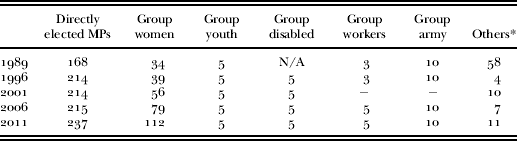
The reintroduction of multiparty elections in 2006 did not lead to any comprehensive revision of the quota system, but there were a few changes. For instance, district women representatives were elected by universal suffrage for the first time. Another more gradual change is the increasing number of women in parliament, due to the rule that the number of district seats for women in parliament corresponds to the number of districts in the country. As new districts have been formed, the number of women in parliament has increased while the number of other group representatives has remained the same (see Table 1).
Representatives in Parliament, 1989–2012
Source: Compiled by the authors, based on various sources (Green 2010: 88; Tripp 2006: 116; Rubongoya Reference Rubongoya2007: 74; Tukahebwa 2003: 50–2, and others).
* The Fifth parliament (1989–96) comprised twenty members nominated by the president and thirty-eight seats for historical members of NRM. In the other parliamentary periods the numbers refer to ex officio members of parliament. Members ex officio are appointed by the President and do not have voting rights.
In the period from 2006 to 2011, parliament included seventy-nine women district representatives (102 female representatives in total), and women constituted one third of all local councillors in Uganda. There were a total of 112 women representatives prior to the 2011 elections. According to the ‘road map’ guidelines of the Electoral Commission (2010) for the 2011 elections, 7,876 seats were reserved for women to contest at four levels of government (parliament 112, district 920, city division 249, and sub-county 6,595).
Representatives from the disabled and youth hold a fixed number of seats in parliament and local assemblies. In parliament the two groups have five seats each, one of which has to be held by a woman. At the various local levels, four seats are reserved for youth and the disabled, and two of these seats must be filled by women. The representatives of the disabled and youth are elected through electoral colleges (from within the National Union of Disabled Persons of Uganda and the National Youth Council) at all levels of governance. The workers hold five seats in parliament, but have no reserved seats in the local governance system. The worker representatives are elected by electoral colleges formed by the Free Trade Unions (Coftu) and the National Organisation of Trade Unions (Notu). The electoral guidelines also specify affirmative action in the form of the election of at least one woman from the workers quota. The remaining four should represent one region each, a rule which also applies in the election of disabled and youth representatives. The ten army representatives in parliament, two of whom must be women, are elected by the electoral colleges of the Uganda People's Defence Force (UPDF). The election process for special interest groups is complex and elections take place on various dates. The constituency mainly comprises the members of the organisations specified by parliament. An exception to this is the election of youth representatives, who from 2011 are elected by registered national youth voters between the ages of eighteen and thirty. Persons eligible to vote for special group representatives do not forfeit their right to vote for the county members of parliament and women's representatives.
THE EFFECT OF THE QUOTA SYSTEM ON ELECTORAL STRENGTH
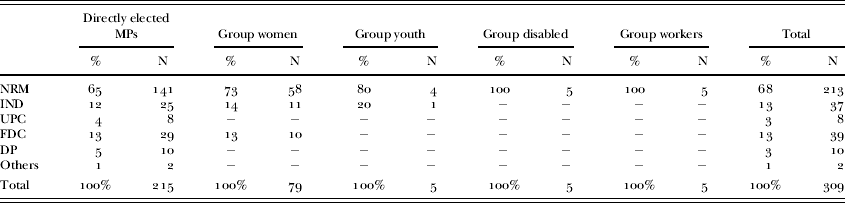
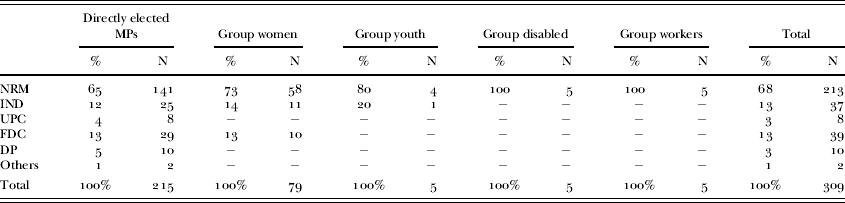
An analysis of the results of the 2006 elections shows that the quota system favours the incumbent party at all levels of governance. Table 2 illustrates how the system affected the composition of parliament in the period from 2006 to 2011. As many as 73% of the women representatives, and 93% of other group representatives, are affiliated to the NRM. As a result of the quota policy, the NRM received 3% more seats in parliament than would have been the case in its absence. This 3% was of critical importance. Excluding the affirmative action seats, the NRM had 65% of the seats in parliament; including them, it had 68%. This meant that the NRM gained the two-thirds majority it needed to amend the constitution without the consent of the opposition.
Composition of Parliament 2006–2011(in per cent)*
Source: Compiled by the authors on the basis of lists provided by the Parliament of Uganda in October 2010.
* The army representatives do not represent any party. IND means independents.
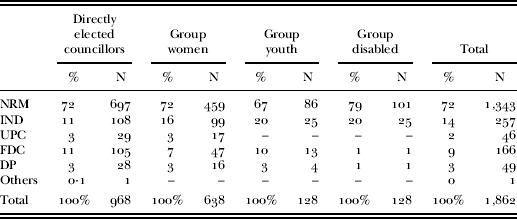
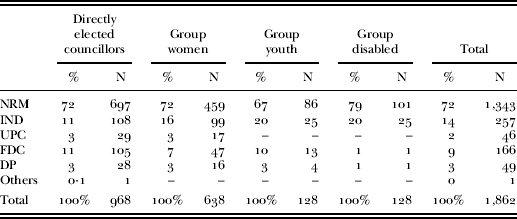
An overview of the distribution of seats at the district level after the 2006 local elections shows that the quota policy affects the strength of the NRM at the local level as well. The effect is not as high in percentage terms as in number of seats. Intriguingly, the results from the directly elected first-past-the-post elections equal, in percentages, the total results including special seats. In terms of numbers, on the other hand, the quota policy contributes to the dominance of the NRM since the total number of NRM seats is doubled due to the extra seats won through special interest group elections. This is an important distinction in a country where patronage prevails. The rise in seats implies a substantial increase in the number of politicians who can receive spoils from the government. Not all interest groups, however, are equally dominated by NRM representatives. Table 3 shows that the youth seats are most open for competition from the opposition. In this group there are quite a few (20%) successful independents.Footnote 5 Without doubt, the quota system has a positive effect on the number of NRM representatives in the political system in Uganda.
Election results March 2006, LC IV (cities) and LC V (districts)
Source: Muriaas Reference Muriaas2008.
GROUP REPRESENTATION AND EXECUTIVE DOMINANCE
The normative Western debate about the advantages of ‘mirror’ representation in a liberal democracy rests largely on a perspective of democratic fairness (Mansbridge Reference Mansbridge1999; Philips Reference Philips1995; Young Reference Young2000). The pluralist understanding of interest representation has gained momentum by creating awareness of the fact that most parliaments around the world are dominated by relatively affluent, male representatives from the dominant ethnic group in the respective country. Empirical data from various continents show that several groups tend to be under-represented in decision-making. Enhancing their representation is thought to deepen democratic legitimacy. What Pitkin (Reference Pitkin1967) termed ‘responsive representation’ has, in other words, not been considered as sufficient to assure access to power for broad sections of society. The critics of ‘responsive representation’ claim that it is not only the activities of representatives that matter, but also their characteristics. The recent trend towards mirror representation, ensuring the inclusion of marginalised groups in decision-making, is influenced by what Phillips (Reference Philips1995) refers to as the politics of presence. Phillips argues that if representatives are chosen on the basis of their beliefs or opinions, a system emerges that favours the re-election of those with money and access to the media. Mechanisms guaranteeing that the voices of marginalised, silenced or excluded groups are represented are therefore necessary (ibid.: 5). The question remains, however, how well does the pluralist ‘take’ on representation travel to the African continent?
Executive dominance or ‘untamed’ presidential power is a characteristic feature of the African state (Prempeh Reference Prempeh2008). This implies that any discussion of quota policies in this part of the world must take into account the on-going debate on the concentration of power in the executive. Given that most African presidents use their executive power to maintain control over the legislature and the electoral calendar (Rakner & van de Walle Reference Rakner and van de Walle2009: 113), and that the political playing field in many countries is inherently uneven due to unequal accesses to resources, the media and the law (Levitsky & Way Reference Levitsky and Way2010: 58), quotas are prone to be exploited by those in power. In other words, quotas may have less meaning in hybrid regimes. According to Matland (Reference Matland and Dahlerup2006: 278), special interest group representation may be of little relevance if important decisions are taken by the executive and not in the national assembly. Bauer (Reference Bauer2008: 362) points to the inherent difficulties associated with reserved seat quotas, and relates them largely to the system by which candidates are elected. Representatives in reserved seats may be demoted to a subordinate status. The problems are aggravated when countries are less than democratic. In a hybrid presidential regime like Uganda's, it may therefore be valuable to employ an instrumental approach that contrasts the pluralist understanding of interest representation with a corporatist line of thought.
In a system of corporatist interest representation, the constituent units are organised into a limited number of singular, compulsory, non-competitive, functionally differentiated and hierarchically ordered categories that are granted a deliberate representational monopoly towards the state. Quota policies are understood to be initiated from the top-down, and groups receive special treatment in exchange for control of their articulation of demands and support. Corporatism is a theoretical construct based on particular historical processes in Western democracies, and the particular phenomenon observed in Uganda and neighbouring countries varies a great deal from the prototype. What is important is that the corporatist perspective on representation takes into account that systems of interest group representation are not only a response to pressure from below, but may also be imposed from above to exercise control over civil society. As Williamson (Reference Williamson1989: 39) explains, corporatism has been favoured by authoritarian governments which realised that by establishing control over the organisation of interests, they can ‘prevent things happening’ when the status quo is eminently acceptable to them. Another relevant feature of corporatist organisation is that functional representation can be utilised to traverse vertical loyalties. Ethnic group identities are often a source of concern for African governments, and by providing for special representation based on a range of identities, a government can cut across old loyalties.
The quota discourse in Uganda largely reflects the specific challenges that reserved seat quotas may entail. In particular, the system of conducting separate elections for special interest groups has been seen as creating a two-tiered system of legislators (Goetz Reference Goetz, Goetz and Hassim2003: 118), where the special seat representatives are at risk of being viewed as second-rate or ‘token’ members. Group representatives have also been accused of being dependent on the incumbent party. This, in turn, reinforces political patronage (Goetz Reference Goetz, Goetz and Hassim2003; Hanssen Reference Hanssen2005; Tripp Reference Tripp2000, Reference Tripp, Bauer and Britton2006). The role of women quota representatives has figured most prominently in the debate. Although allegations of incompetence have been frequent, the idea that women are less qualified than their male or female counterparts in parliament has recently been challenged. A statistical analysis of data on the attributes of parliamentarians gaining office in 2006 finds that district women were not significantly different from their male and female colleagues elected without the assistance of affirmative action. Measures such as education level, rate of workforce participation, experience serving in the bureaucracy, age and marital status were considered. Strikingly, quota women were more likely to have previous electoral experience and were thus better qualified than non-quota members of parliament in this respect (O'Brien 2009: 24). The fact remains, however, that the number of women entering parliament for a directly elected constituency seat has only marginally increased. Krook and O'Brien (Reference Krook and O'Brien2010: 253) argue that group recognition always emerges through active construction of relevant political identities, and most quota systems are highly politicised. Despite the politicised nature of group representation in Uganda, it is important to stress that the quota policy not only serves the executive's interests. As will be demonstrated, a number of groups at all levels of the political system have developed vested interests in its survival. For the group representatives, there are both personal gains involved in terms of patronage, and more substantial achievements related to influence on group specific legislation and enhanced status in society. In light of this, elements from both the pluralist and corporatist perspectives are relevant in the analysis of the reserved seat system in Uganda and how it has developed over time.
THE ORIGIN OF THE UGANDAN QUOTA SYSTEM
The subsequent sections suggest that the quota system in Uganda was shaped from above by the new government's need to achieve legitimacy and to stabilise a war-torn country; but also from below by emerging national and international movements. This section first addresses the post-conflict climate in Uganda in the 1980s, and underlines how the NRM used quota policies as a nation-building strategy. Second, it puts into focus the close link between a vigorous international and national women's movement and gains in women's representation.
Introducing group representation from above
When the NRM came to power, it was in desperate need of popular support. The state was on the verge of collapse after the five-year long guerrilla war succeeding Idi Amin's terror regime (1971–9). In the ‘bush’, the NRM had built an important power base through resistance councils, but it had yet to prove it could stabilise and run the country. The new president, Yoweri Museveni, understood that he needed the backing of the population to gain legitimacy, but was reluctant to reintroduce multiparty elections. This was a consequence of his scepticism towards political parties. In his words, political parties were to blame for the ‘primitive dictatorships’ that had killed 800,000 Ugandans in the twenty years between 1966 and 1986 (Museveni Reference Museveni1997: 200–1). Museveni's condemnation of political parties, but also need for popular support and legitimacy, justified the new political order known as the Movement system. This was classified by its leaders as a ‘no-party democracy’ since candidates had to run on individual merit, and political parties were prohibited from participating in elections. In practice, it resembled a one-party state and had two central features: inclusiveness and a broad base. The latter was secured by a local governance system that reached through five levels of government, from the village to the district. Inclusiveness was served by legalising the representation of marginalised groups, such as women, youth, elders, disabled and workers at various levels of government.
The ideology behind the all-embracing local governance system and affirmative action was the need to vitalise civil society that suffocated under colonialism and the post-colonial governments (Kabwegyere Reference Kabwegyere, Mugaju and Oloka-Onyango2000: 95–6). The NRM's vision was that people should be fully involved in democratic governance on a day-to-day basis, and that politics should cover every aspect of life. The first step towards formalising the principle of inclusiveness was taken in 1989, when group representation on the basis of gender, profession and age was introduced by the government. In the 1989 parliamentary elections, the president could legally appoint twenty members of parliament and ten representatives from the army, while forty-two seats were reserved for youth, workers and women (Rubongoya Reference Rubongoya2007: 74).Footnote 6 Similar quotas for women, youth, disabled and elderly were introduced in the all-embracing local government structure. The historical imperative for change in the status of women was the important part women played in the guerrilla war. In the bush, women fought along with men, and demonstrated that they could play an integral part in the process of political transformation. In the process of turning the Resistance Councils into Local Councils, it was therefore decided that each nine-member Local Council committee should have a seat reserved for a woman representative (ibid.: 79). Parallel concessions were given to women at the national level to provide them with the opportunity to have a say in the governance of the country.
The NRM leadership also deemed the youth and workers worthy of group representation. Alongside the peasants, workers had supported the Movement in the guerrilla war. They were considered as a disadvantaged group since they constituted a small part of the Ugandan population. Given that they would find it hard to mobilise political support, it was logical that they should be included in the affirmative action programme. Equal opportunities should also be given to the youth since there was no structure for the youth in the political system (Kabwegyere Reference Kabwegyere, Mugaju and Oloka-Onyango2000: 106). The government's objective was to organise the youth into a united body that could engage them in activities beneficial to themselves and the country. The formation of a Youth Council with reserved seats in parliament and the local governance system was intended to establish a channel ‘to install a spirit of patriotism, national consciousness and a spirit of unity among the youth all over the country irrespective of their tribe, religion and ethnic background (Observer 2010b). One of the key reasons for the NRM to introduce affirmative action was to create legitimacy for the regime and embark on a process of nation-building. Youth is commonly considered to be a political group that easily takes to the streets when the population is dissatisfied with the government, and it was important for the new regime to show the youth that they were a natural ally in the Movement's transformation of society.
The controversial decision to reserve seats for army representatives illustrates that regime stabilisation was one of the most important factors behind the affirmative action policy. Army representation was introduced for the first time in 1980, after the fall of Idi Amin. Under the Movement system, those in support of army representation claimed that this could create stability in the country since it kept the army informed about the problems facing the government (Odoki Reference Odoki2005: 214). Those opposed to army representation were identified as the very same who advocated a multiparty system. Their critique was therefore overruled because party politics would be prohibited in the Movement system; hence there was no reason to fear that the army should be divided along party lines. Based on these arguments, the Constitutional Commission agreed that army representation was suitable in the interim period, until the state had built strong enough national institutions to counterbalance the army. The accommodation of the disabled in the Movement system was a legacy of the resistance and a tribute to the situation of the war veterans. This group had played a minor role in the initial years of NRM rule, but following the promulgation of the 1995 Constitution, councillors representing persons with disabilities were elected through an electoral college in all governance structures from the village to the parliament.
Advocating for quotas from below
The quota policy was partly initiated from above by the NRM, but also originated as a result of pressure exerted by the Ugandan women's movement, which in turn was encouraged and inspired by developments in the international community. The post-conflict climate has been identified as crucial in opening up political space for women in Uganda (Pankhurst Reference Pankhurst and Ross2002). Consistent with this, Winnie Byanyima (Reference Byanyima and Bystydzienski1992: 142) underscores women's involvement in the armed struggle as key for their empowerment, and contends that ‘Ugandan women were not invited to take part in the national resistance war, they forced their way in’. Tripp focuses on the autonomy of women's organisations and their pivotal role in advocating, and contributing to, advancing the position of women. The affirmative action provision in the 1995 constitution was only one of several achievements. Women's organisations had already pushed for reserved seats at the national level in 1964 (Tripp Reference Tripp2000: 23, 40).
The external environment also contributed. After the Museveni government came to power, it had strong incentives to seek international recognition and increased legitimacy, and the international environment at the time strongly favoured enhancing women's representation. The UN General Assembly designated 1975 as International Women's Year, and the first of a series of world conferences on women was held in Mexico City. One outcome of the conference was the recommendation for 1976–1985 as a UN Decade for Women. The decade sought to address the needs of women worldwide with a focus on equality, peace and development. Importantly also, the UN Convention on the Elimination of All Forms of Discrimination against Women was promulgated in 1979 and ratified by Uganda in 1985. This provided an important backdrop against which women could argue for, and further, women's political participation. For instance, Uganda became obliged to produce regular progress reports.
Several Ugandan women participated at the third and fourth World Conferences of Women in Nairobi in 1985 and Beijing in 1995. At both conferences links to the international women's movement and the new transnational women's network were established. The third World Conference in Nairobi worked to boost Ugandan activism and women's organisations. Women were inspired by the input and the connections formed, and there was extensive exchange of ideas and experiences among the participants. A new generation of organisations surfaced partly in response to the conference and the transnational and regional influences at the time, and the women's movement gained momentum (Tripp Reference Tripp2000). Women activists point to the conference as a turning point with respect to women's political empowerment, as well as in establishing autonomous women's organisations (Tripp et al. Reference Tripp, Casimiro, Kwesiga and Mungwa2009: 152–3). One of the leading Ugandan women's organisations, Action for Development, was founded in 1985 and lobbied intensively to enhance women's political participation and promote women's issues.
The fourth World Conference on women in Bejing coincided with the entrenchment of the 1995 Ugandan Constitution. International pressure and influences thus came in a period of political transition when a new legal framework was to be put in place.Footnote 7 Women's organisations played a critical role in ensuring a gender sensitive constitution. They made a concerted effort to influence the constitution-making process and were very active in providing input to the Constitutional Commission.Footnote 8 During the Constituent Assembly proceedings,Footnote 9 there were frequent meetings between women's organisations and the women on the Constituent Assembly (Matembe Reference Matembe2002: 137–8; Tamale Reference Tamale1999: 116–17). The fifty female Constituent Assembly representatives formed a non-partisan women's caucus and worked closely with women's groups. The caucus moreover coalesced with representatives from other groups such as the disabled, workers, youth and the army (Matembe Reference Matembe2002: 186; Tripp et al. Reference Tripp, Casimiro, Kwesiga and Mungwa2009: 121). In a similar vein, the political success of the disabled and the founding of the National Union of Disabled Persons of Uganda was inspired by the UN decade of Disabled Persons, 1983–92, and the World Programme of Action concerning Persons with Disabilities (Kangere Reference Kangere2003: 3).
The internationally backed domestic women's movement in particular, but also the National Union of Disabled Persons of Uganda, have played active roles in advocating group representation. The decision to include the groups was based on various rationales and the Movement system thus incorporated a hybrid approach to group recognition. Army representatives were included in order to stabilise the system; the special seats for workers resemble what one would find in a corporatist system; the inclusion of youth secured nation-building, and the inclusion of the disabled and women secured representation of disadvantaged groups. The government may have learned how to move strategically to take advantage of the system, but this has been a part of a process of political learning as the government has acted in response to grass-roots demands. Hence, the quota policy should not be interpreted as only a gift from the president to passive recipients.
LOCAL GROUP ACTIVISTS AND THE QUOTA POLICY
A unique feature of the quota system in Uganda is its comprehensiveness. Special seats for women, youth and disabled are reserved at all levels in the local government system. The fact that political activists down to the village level have a vested interest in the quota system is important for understanding how the central government became aware of how the special seats could support the party over time. In this part of the article we analyse data collected at different levels of the local government system in three districts in 2005, just after the electorate voted overwhelmingly in favour of opening up the political space to allow parties to run in elections. This analysis identifies two key reasons why local group activists had a vested interest in the continuation of the quota system, and shows why many group representatives feared that a transfer of power to opposition parties could threaten it.
Vested interest 1: access to development projects and enhanced status
Our qualitative analysis of the role of group representatives in local councils shows that it was hard for the group representatives to convince councils to adopt development projects that would benefit only one particular group. Resources were limited and as a female youth representative disclosed, ‘it is very difficult to specify the agenda to the youth and women. The other councillors have more general proposals and say that health care centres and roads will benefit all the people’ (Nassozi 2005 int.). Hence, many women councillors teamed up with the direct seat councillors representing the same constituencies, instead of trying to establish a common women-friendly agenda. Some funds were however allocated from the local councils to the group representatives, like bursaries to girls or disabled children, and sport events for youth. Although the group representatives found it hard to advocate their particular cause in the dire economic situation that most local councils were in, the councils provided the opportunity to access national and international networks. Councils thus presented a linkage to non-governmental organisations that wanted to work in the area, and access to workshops arranged by the central government. ‘The town council has extended some projects to disabled, like scholarships … The government think about us and I have gotten contacts with the government through the town council’ (Mukoza 2005 int.) Through these contacts the group representatives could finance some development projects and thus cater to the interests of their constituents.
The quota policy was not only about accessing funds, but was also a way to elevate the position of vulnerable groups in society. Many group representatives stressed this effect of the system. Before women entered politics through the quota system, ‘they were not allowed to speak in public’ (Kamaali 2005 int.). Representatives of the disabled also claimed that the quota system had changed how people looked upon them. ‘Before the government brought the disabled on board, even the parents of disabled tried to hide them. The government has carried out projects, which sensitise both the parents and the children … Now people don't even refer to them as disabled’ (Kadala 2005 int.). Group representatives and their constituents thus benefited from the quota policy in various ways.
Vested interest 2: personal gains
There were also personal gains involved in serving as a local councillor. Most obviously, getting elected could be an important career move or simply a way to earn an income. This seemed in particular to be the motivation for many youth representatives. As illustrated by a youth representative in Luwero, ‘I have no problem with the division of the district because the new ones create job opportunities for the young people’ (Sempagama 2005 int.). Some women councillors were equally satisfied with the personal gains acquired by being a member of the local council. ‘An elderly lady made me want to be a politician. She would be invited to functions and was given a front seat. I admired her. I decided to join the movement and now I'm invited to functions’ (Namansa 2005 int.). However, although the group representatives got some exposure, one should not overestimate the personal gains of the average group representative. Many were disappointed by the lack of economic gains in politics at the local level, as illustrated by one female youth representative: ‘I joined politics because I wanted to be famous … I am not going to contest again because I thought at first that there was a source of income. This was not the case’ (Namiiro 2005 int.).
Interviews with different councillors indicated that getting elected as a youth representative worked for some as a springboard to a further career in politics. It was also common for group representatives to hold important positions in the local government system, particularly at the sub-county level. One sub-county, Kagongi in Mbarara, even had a female chairperson. Loy Mpumwire was originally the vice-chairperson of the sub-county council, but when the former chairperson died, she took over the position after fierce debate. In other districts youth and disabled representatives served as speakers, and as chairs of finance and education. Many of these claimed that they would not be in politics without the quota system. ‘There are very few women in politics. Men have money and women don't. And in the elections in Uganda today, if you don't have money, I don't think people would vote for you’ (Tumwesigye 2005 int.).
Consequently, women needed a party to finance them and for most of them the NRM was the natural choice even after the reintroduction of multiparty politics. Several women were very sceptical towards opposition parties as these were not vocal about their position on the quota system. ‘We still look at the movement as our saviour. How do these other parties fit in? We [women] have been moving on political action. Men have money. We have the movement’ (Baregire 2005 int.). As women had not been active in politics during the first multiparty period, many feared further marginalisation if the old parties returned to power. ‘I think that a woman have to be in the NRM because the president has picked them up from the kitchen to where they are now’ (Lubwama 2005 int.). The NRM was simply the most attractive option for aspiring young, female and disabled politicians. It was able to finance electoral campaigns, or could at least assist its candidates with t-shirts and small gifts (like soap) that they could give voters. This was particularly important for these candidates as they were not as financially strong as most men running for directly elected seats. Consequently, they needed someone to support them, and the opposition parties were not capable of financing electoral campaigns at the local level and had not stated publicly that they wanted to maintain the quota system.
In sum, our field study finds that group representatives at the local level have vested interests in the continuation of the quota system. In this way, the reciprocal relationship between politics from below and politics from above is exposed, and it becomes clear that that the quota policy is also partly a response to local agency. Giving her view on the proliferation of districts, a local actor exemplifies this perspective well. ‘There are no proper criteria in use when people are requiring new districts. The president goes to talk to people and they say “we don't want to support you if we don't get a new district”. So he gives us a district. We are getting used to twisting the arms of the politicians' (Kabusimbi 2005 int.). The central government's strategy of using the reserved seat mechanisms after the reintroduction of the multiparty system must thus be seen in relation to the interest of those directly involved.
VESTED INTEREST AT THE NATIONAL LEVEL
At the national level, the reserved seat mechanism has been used in an increasingly active manner by the government to ensure that the strategic interests of the ruling party prevail, in the wake of major changes to the rules of the political game. By analysing data collected in 2010, this part of the analysis shows how affirmative action representatives to varying degrees are co-opted into a system of patronage. As illustrated by the example of members of parliament, there are differences between groups with respect to their willingness and ability to promote and lobby for their interests. Nonetheless, when issues advanced run counter to the interest of the NRM government, they do not succeed.
The executive securing control: district magnitude and electoral rules
As already discussed, the current system clearly favours the incumbents, and attempts to revise the quota policy to fit the new multiparty dispensation have been rejected, even though the 1995 Constitution stresses the interim character of affirmative action. Section 78 declares that the status of women representatives and representatives of special interest groups has to be reviewed every five years. In accordance with this, the electoral commission demanded that the appropriateness of the quota policy be discussed in parliament ahead of both the 2006 and the 2011 elections. The key opposition party, the Forum for Democratic Change (FDC), advocated abolishing the quota system on both occasions (FDC 2009), mostly because this arrangement was an integral part of the former Movement system. One key opposition member in parliament reflects this line of thinking when, referring to the district seats for women, he asserts that, ‘the system has been abused … They [women] believe they are in parliament because of NRM … They look at it as a favour, as a privilege. Not as a right’ (Okumu 2010 int.). Although the opposition stance on the quota system is now more clearly expressed than in advance of the 2006 elections, the composition of parliament has effectively kept it from being perceived as a real threat.
The government has taken few steps to harmonise the election of the quota representatives with the elections otherwise characteristic of a multiparty system. While the election of women representatives has been professionalised, the elections of other quota groups have not followed suit. In 2010, the electoral commission publicly demanded that new guidelines for elections of interest groups be approved by parliament for such elections to take place (New Vision 2010a). In May 2010, the national youth council act was amended to abolish the compulsory membership of youth in the village youth council in their area. New regulations for the election of workers representatives and people with disabilities were not approved until early February 2011, just a few weeks before the general election. The 2011 election road map discusses only the election of youth councils and youth representatives in detail. The election of the representatives of disabled, workers and army representatives is not mentioned. This indicates that the electoral guidelines pertaining to these groups are not as transparent as those for directly elected positions and women's seats. The lack of interest in clarifying the electoral rules can be interpreted as a means of thwarting any attempt from the opposition to make use of the structures. On the other hand, it may also be unintended neglect illustrating the marginal position of these groups in the system.
Another instrument of control is the government's policy of forming new districts, which in turn has an impact on the number of seats secured for special interest groups at all levels of government. Uganda qualifies as an ‘extreme case’ of sub-national administrative unit creation (Green 2010). The process of district creation and decentralisation is highly politicised and is understood as a way of spreading patronage to wider sections of the society. In interviews at the district level,Footnote 10 local politicians were open about the advantages of more and smaller districts. When Mbarara district was divided in 2005, some of the members of the district assembly explained the positive sides of this: ‘Mbarara is big. 200 miles. Still we get the same equipment as the smaller districts. Like for instance, they get one vehicle, and we get one, in spite of the difference in size’ (Kashaija 2005 int.). New districts have also been used to provide jobs, for instance political office at different levels of government (illustrated at the national level by the bloated cabinet and the ever-growing size of the legislature), as well as various administrative and technical posts, and has, as observed above, greatly benefited women as a group (see Goetz Reference Goetz2002: 558–9; Green Reference Green2010). The growth in districts has been paralleled by a near explosion in the number of women (at national and local levels), youth and disabled (local levels) entering the political arena.
The patronage opportunity stemming from district creation has been used to co-opt the opposition and to strengthen the government prior to elections. An opposition member expresses her frustration with the development in the following way: ‘the moment an area is carved out to be given a district then … it supports Museveni because he has favoured them by giving them a district’ (Turinawe 2010 int.). It is also apparent that the government's district policy has a large support base among women parliamentarians, especially the district representatives. In the most recent parliamentary debates on whether the quota system should be sustained, the chairperson of Uganda Women's Parliamentary Organisation, Hon. Alisemera, was quoted as saying ‘we need more districts created so that the number of women can increase from the current 32% to 50%’ (Daily Monitor 2010). A few of the district women, however, express concern with the application of the quota policy. An independent member asserts that ‘as we are increasing the number of districts … we should also look at the capacity-building and the equality of work’ (Lukwago 2010 int.). One of the longest-serving women in parliament paints a rather bleak picture of the reserved seat system. Referring to the sixth and seventh parliaments, she holds that ‘the women that were elected at that time were really instruments of support rather than independent thinkers who would promote gender issues in parliament’ (Atim-Ogwal 2010 int.). She now finds that the situation has somewhat improved.
The women's movement was at first firmly behind the affirmative action policy, but has over the years developed a more nuanced position with respect to the district seats. What was once considered as one of the greatest achievements of women's groups and women leaders is now also looked upon as partly a liability, and the increasing number of districts is seen as a problem. Reflecting on the situation, a key woman activist puts it this way: ‘the issue will be, how do we make the numbers count for us? Well, the ruling party may have its own political ends. I guess we as women should also be strategising … to say how we can use these numbers to our benefit. Because it is no use having more numbers when it is not doing anything for your cause’ (Mwesige-Assimwe 2010 int.). Critical voices are also found among the development partners active in supporting parliamentary programmes. The steady increase in districts is characterised as ‘politically motivated’ (Rukare 2010 int.), and is seen to unduly affect the power balance, to the extent that ‘the opposition has a significant disadvantage’ (Osborn 2010 int.). Furthermore, it is perceived as an obstacle to further progress on women's issues: ‘the constraint on influence of women has a relationship, I think, to affirmative action’ (Kashner 2010 int.). Hence, from a short-term perspective at least, the increase in districts and women's representatives can be seen as serving the government's ends more than women's interests.
Typically, women have been reminded about where their allegiance should be before elections (Ssali & Atoo Reference Ssali, Atoo, Kiiza, Makara and Rakner2008: 158), and the 2011 elections are no exception. The NRM spokesperson and woman district member of parliament Mary Karooro Okurut argues that NRM is the main proponent behind the considerable change in women's status: ‘Women themselves acknowledge this and know where their vote lies and they will make their sentiments categorically and unequivocally clear, come February 18, 2011.’ She further insists that the NRM and women are intimately linked: ‘The love affair, indeed the marriage, between NRM and the Ugandan woman continues unabated’ (New Vision 2010b).
A discernible pattern thus emerges, where the usage of the reserved seat quota has gradually been adjusted to changing circumstances, such as the introduction of a multiparty system, in order to suit the needs of the executive. Some element of political learning seems to have been present, in the sense that the potential of the quota policy and how it could be strategically used to maximise NRM control has only gradually been realised by the NRM leadership, after the policy's initial implementation. Although the interests of the executive appear to be the driving force behind the development, the fine-tuning of the quota system has also been in accordance with the concerns of quota representatives at all levels of the governance system, as well as other groups in society.
Group representatives' political influence
Most affirmative action representatives have strong allegiance to the NRM, to the extent that they do not even dare to challenge the status quo. Since the implementation of a multiparty system this tendency has been exacerbated. Top-down characteristics of the system are still very much present in spite of the pluralist features that have been introduced. Yet how much influence the different groups have varies considerably. In the assessments of an on-going parliamentary scorecard project, representatives of the armed forces repeatedly come out as the worst performers in terms of plenary, committee and constituency performance (AFLI 2011). The special interest group representatives who on average perform the best in parliament are district women MPs and representatives of the disabled (ibid.). They are put forward as more vocal and prominent in plenary sessions than other special interest groups like the youth, workers and the army (Bainomugisha & Mushemeza Reference Bainomugisha and Mushemeza2006: 43). Despite facing the same constraints as other affirmative action groups in terms of patronage, the representatives of the disabled have been relatively successful in advancing the interests of their constituents. Describing what she considers her most important task in parliament, a representative of the disabled stresses that ‘my role is to ensure that the legislation which is passed is disability and gender-friendly. And also to look out for programmes of government because disability issues are cross-cutting’ (Nalule 2010 int.). Representatives of the disabled have been instrumental in pushing for and ensuring enactment of disable-friendly legislation, including the Persons with Disabilities Act 2006, the Equal Opportunity Act 2006, the Employment Act 2006, and the National Council for Disability Act 2003.Footnote 11 The group has generally been able to collaborate and promote important issues, and has included experienced key actors who have been able to influence issues on their own. Prominent members of parliament include Hon. Alex Ndeezi and the late Hon. James Mwandha. While Mwandha pledged allegiance to the FDC, party politics did not seem to significantly prevent the group from furthering the interests of their constituents. As the latter underscored, ‘on matters of Persons with Disability, we have always stood together. We can act differently on other political issues like the third term issue where four of my colleagues voted in favour and I voted against the motion, but we are united for the cause of our constituencies’ (cited in Bainomugisha & Mushemeza Reference Bainomugisha and Mushemeza2006: 42).
The representatives of the armed forces clearly stand out in terms of representation. As one army representative explains, ‘most of the work we are doing is civil–military relations and demystify the use of the gun in national politics … We go back to explain to the armed wing of the country so that we remain peaceful given our history’ (Kyomugisha 2010 int.). This work also implies not getting involved in party politics. The 1995 constitution (Art. 69) stipulates that the army representatives shall be non-partisan. The strategy employed by the army group in parliament is to keep a low profile, and only focus on non-divisive national issues. One of the most experienced army representatives puts it this way: ‘There is an assumed expectation that we must always be on the government side. But we normally don't come in on issues which are controversial. When an issue is controversial we keep quiet … It is difficult to be seen opposing the government side openly, it is not good. No, for the military is under the government’ (Tumwine 2010 int.).
In the most recent parliamentary review debate on the quota system, several members of parliament claimed that army representation was inappropriate in the new multiparty setting. Hon. Alice Alaso (FDC secretary), pointed out that even if the constitution declares that the army shall be non-partisan, ‘I see all 10 army MPs smiling at me from the NRM side of the room’ (Observer 2010b). Army representative Lt Col. Felix Kulayigye challenged this statement: ‘The opposition should know that the only independent voice that represents the national interest is the army. In parliament, we side with government and not the party’ (Daily Monitor 2010). Straddling the line between neutrality and siding with the government is at best problematic in the multiparty Ugandan environment. In Uganda, following the government equals toeing the NRM line, the distinction between the government and Museveni's NRM is blurred.
The great majority of the affirmative action women in parliament are Movement. Yet opposition representatives and NRM women alike argue that women's issues are non-divisive in terms of party, and that they are able to collaborate across party lines. The Uganda Women's Parliamentary Association (UWOPA) is non-partisan, and has been an important tool for coordinating efforts and pushing for women's issues in parliament. The ability to join forces and agree on a common agenda stands in contrast to the situation at the local level, prior to the reintroduction of a multiparty system. The committee chair (NRM) on gender, labour and social services asserts: ‘Actually when it comes to women's issues there's no party, there's no party divide in it, and we find this very useful’ (Lagada 2010 int.). Opposition members tend to agree: ‘UWOPA makes us focus irrespective of party and push for women's agenda … How you are elected, whether you represent a district or a county, don't matter. You have the same agenda’ (Nampijja 2010 int.). Over controversial issues, the dividing line seems to be across gender and religion rather than party, ‘it is really between men and women rather than party. Even in the domestic relations bill the divide is not on parties. The divide is on religion and gender’ (Amongi 2010 int.).
Female politicians have been among the most sceptical towards the introduction of multiparty politics, and several women are frustrated with the workings of party politics. Many of the NRM women representatives identify the party caucus as a limitation on their ability to promote women's issues. The NRM party caucus imposes strict party discipline. An NRM representative asserts, ‘in my view parties, these party caucuses have hindered our work as women’ (Rwakimari 2010 int.). Commenting on the increased demand to toe the party line, another woman legislator (NRM) points to the sensitivity of the issues tabled: ‘it can be a challenge with certain issues that directly affect the community. A case in question is this marriage and divorce bill. Although this one is not only a party issue, even the members of the parties in the opposition are not in support [of it]’ (Turyahikayo 2010 int.). The Deputy Speaker and one of the key women activists in parliament laments: ‘the party must agree on what you are going to say and who is going to say it. So even for our important issues to get on the agenda, there's sometimes a problem. So for me, I find the multiparty system constraining to women’ (Kadaga 2010 int.).
Pro-women legislation in parliament
Women's marriage rights, and access and rights to land, have been the driving forces behind the Uganda women's movement throughout recent decades. The 1998 amendments to the Land Act were enacted without the co-ownership clause securing women equal access to land (Matembe Reference Matembe2002: 251). Attempts to include the clause also failed in 2000 and 2003. In 2000 president Museveni actively intervened and decided that it should be omitted once again due to the potential commotion it could stir, particularly among men (Tripp 2004: 7). Museveni thus exerted direct pressure to defeat the bill,Footnote 12 which was later relegated to the Domestic Relations Bill that contained contentious domestic-related laws pertaining to marriage, divorce, separation, inheritance and property rights. This move in principle made it less likely that the bill would be passed in foreseeable future. The nature of the issues is highly politicised and goes to the core of patriarchal society in that it targets unequal power structures. In this respect, it also directly imposes on government interests.
Considering the impact of reserved seats on pro-women legislation, Tripp (Reference Tripp, Bauer and Britton2006: 128) concludes that on the whole, few legislative gains were made in the period 1989–2006.Footnote 13 In the following parliamentary period, 2006–11, quite a few laws important to women were enacted, including the Anti-Trafficking in Persons Act, Female Genital Mutilation Act, and Equal Opportunities Act.Footnote 14 The greatest triumph for many female MPs is typically considered to be the Domestic Violence Act. This in part originated as the result of an initiative to split up the Domestic Relations Bill. A strategic decision was made to first channel efforts into the Domestic Violence Bill, to some extent at the expense of the remaining parts of the former bill on domestic relations. The reasons were many, but the main incentive is perhaps found in the nature of the issues involved. Domestic violence was perceived as urgent, and although it involved issues of a sensitive nature, it was considered less controversial than issues contained in the new Marriage and Divorce Bill and its counterpart, the Muslim Personal Law Bill. As the profiled opposition member Alice Alaso relates, ‘we were then advised by people who looked at it [the Domestic Relations Bill] critically, they said “this one issue is not very contentious here, so pick this one, the violence against women, package it on its own”’. She then goes on to explain why the Marriage and Divorce Bill is still pending: ‘There are issues … that are so deeply entrenched in culture. For instance polygamy, matters of marital rape, matters of co-ownership and many other such related matters. Those ones you just have to approach bit by bit. If you don't do that, you are in trouble because you will lose the whole thing’ (Alaso 2010 int.).
The number of laws relevant to women enacted in the 2006–11 period is quite surprising, given the relatively unimpressive legislative record of women so far, but must be understood against the background of the 2011 elections. Museveni and the NRM clearly needed to position themselves prior to the elections, and women had to be given a few victories to keep them in line. At the same time, these legislative achievements should not be underestimated. Hard work on the part of many actors, including UWOPA, civil society organisations, and in part development partners, account for the outcome. In particular, UWOPA has emerged as one of the most active and influential parliamentary groups. Over the years, it has become increasingly strong and organised in coordinating women members of parliament, as well as functioning as a collaborative link with external women's organisations. Nearly all legislators interviewed pointed to UWOPA as a force to be reckoned with in parliament. Female legislators have increasingly been able to exploit the restricted political space available to press their concerns, but at the same time there are distinct limits to what can be accomplished. It is highly unlikely that this legislation would have been passed had it not been in the interest of the NRM. This is also evidenced by the fact that the most contentious piece of legislation, the Marriage and Divorce Bill, is still pending.Footnote 15 This bill challenges established power structures, in the sense that it concerns the issue of property and seeks to alter basic gender and power relations in society. Thus, it also directly affects the majority of power holders who are still men.

This analysis has revealed that the incumbent National Resistance Movement has employed the reserved seat policy strategically to maintain its dominant position, but that the strategies for using the quota system have evolved gradually over time in response to key political events and the interests of group activists at local and national levels. The NRM has been able to use affirmative action to boost its electoral strength. In the 2006 general elections, the reserved seats secured the ruling party a critical two-thirds majority in parliament. Despite its interim character, the government has only further expanded and institutionalised the quota system. Apart from the election of women at district level, the executive has so far been passive in terms of professionalising and clarifying the electoral guidelines of group representatives. Another mechanism of control is the process of district formation, which in turn affects the number of seats secured for special interest groups at all levels of government. This serves as an effective way of extending patronage to wider sections of society. Although the quota policy clearly favours the NRM, this study shows that the policy cannot be viewed only as a top-down project. It has evolved over time, also in keeping with the wishes and demands of group representatives who have vested interests in its survival. At the local level, access to development projects, elevated status and personal gains in terms of income and career opportunities made the quota system attractive to group representatives. In addition, group representatives in parliament have been able to influence legislation considered important to their constituents. The recently passed Domestic Violence Act is a case in point. There are however inter-group differences.
In a dominant party system like Uganda's, quota policies can easily become yet another incumbency advantage. To a certain extent this is the case. Interest representation has been used to sustain the dominance of the NRM. The quota system creates unity among members of interest groups which would otherwise have been divided by religion and ethnicity. Loyalty to ethnicity and clan is replaced by loyalty to fellow group members and the incumbent, and is thus quite similar to a corporatist system of representation. Yet there is only restricted space available to make an impact on policies, and the introduction of a multiparty dispensation has helped to exacerbate potentially conflicting loyalties. In this context, access to networks and project funding may become just as important for group representatives as policy influence. In spite of this, group representatives, in particular representatives of the disabled and women, have made several legislative gains. Thus, it seems pertinent to reiterate the point that the government's strategy for using the reserved seat mechanism must be seen in relation to group activists' agency and interests, and that there is a reciprocal relationship between politics from above and politics from below.
Uganda has in many ways pioneered the adoption of reserved seats in sub-Saharan Africa. Although the rapid spread of quotas in the region can hardly be explained by political learning alone, the Ugandan experience may have had an impact on how actors in neighbouring countries have approached and opted to use quotas. Rwanda with its dominant party system and extensive reserved seat quotas for special interest groups has several features in common with Uganda. More specifically, the quota system seems to have been exploited by the ruling party to maximise party control. In contrast to Uganda, however, women so far have had little influence on pro-women legislation (Devlin & Elgie Reference Devlin and Elgie2008). Another neighbour, Kenya, does not seem to be consistent with this pattern. In 2010 Kenya adopted reserved seats for women and other marginalised groups at the nation level, but given the country's fragmented party system it is unclear who will actually benefit from the policy. This may indicate that the adoption of quota policies has an appeal that goes beyond the self-interests of power holders.