INTRODUCTION
Artificial light use has increased rapidly over the last century (Cinzano et al. Reference Cinzano, Falchi and Elvidge2001; Elvidge et al. Reference Elvidge, Ziskin, Baugh, Tuttle, Ghosh, Pack, Erwin and Zhizhin2009, Reference Elvidge, Sutton, Baugh, Ziskin, Ghosh and Anderson2011), causing profound changes to the night-time environment (Hölker et al. Reference Hölker, Wolter, Perkin and Tockner2010b ; Gaston et al. Reference Gaston, Davies, Bennie and Hopkins2012). Virtually all animal species evolved under reliable light–dark cycles, and artificial lighting detrimentally impacts many species and taxonomic groups (Rich & Longcore Reference Rich and Longcore2006), which in turn may have indirect harmful effects for human society (see Johnson et al. Reference Johnson, Neal, Peter and Edwards2004; Neil & Wu Reference Neil and Wu2006; Stark et al. Reference Stark, Brown, Wong, Sturtz, Elvidge, Pollack, Ryerson, Dube, Wagner and Parrish2011).
As a serious global pollutant, light has been neglected compared to other anthropogenic pressures (Falchi et al. Reference Falchi, Cinzano, Elvidge, Keith and Haim2011; Lyytimäki Reference Lyytimäki2013). Modern humans lack experience of non-light-polluted night-time environments and perceive extended use of light at night as ‘normal’ (Lyytimäki Reference Lyytimäki2013). Efforts to reduce light may therefore be viewed as unimportant, or actively opposed due to negative perceptions of naturally dark environments (see Bixler & Floyd Reference Bixler and Floyd1997; Lyytimäki & Rinne Reference Lyytimäki and Rinne2013).
Since public support is integral to the success of conservation initiatives (Jacobson & McDuff Reference Jacobson, McDuff and Sutherland1998), effective management of light pollution will require the public to positively engage with the issue (for example see Fischer & Young Reference Fischer and Young2007; Lyytimäki & Rinne Reference Lyytimäki and Rinne2013). Lorenzoni et al. (Reference Lorenzoni, Nicholson-Cole and Whitmarsh2007, p. 446) defined engagement as ‘a personal state of connection’ with an environmental issue, comprised of cognitive, affective and behavioural elements. To be engaged, knowledge and awareness (the cognitive dimension) of the issue are necessary but insufficient in isolation. People need to also care about the issue (the affective dimension), and take action (the behavioural dimension) to address it. Although this definition was formulated to explore public engagement with climate change, which has been defined as an ‘intangible’ problem of global extent, characterized by possessing less urgency and certainty than other environmental problems (Moser Reference Moser2010), we believe the definition is also appropriate for an examination of public engagement with the issue of light pollution. Whilst individual actions to reduce light may be more tangible (for example the immediate reduction in lighting that can be seen after switching lights off), an individual's contribution to reducing larger-scale light pollution for reducing impacts on marine turtles is less tangible. Moreover, the global environmental change associated with artificial lighting is not widely recognized as an environmental concern, let alone one requiring urgent attention (Lyytimäki Reference Lyytimäki2013).
Sutton and Tobin (Reference Sutton and Tobin2011) developed a framework to examine public engagement with environmental issues, which suggested that the three elements of engagement described by Lorenzoni et al. (Reference Lorenzoni, Nicholson-Cole and Whitmarsh2007) are related linearly. Under this framework, behavioural engagement is dependent upon the formation of a desire to engage, which depends upon affective engagement (concern), which in turn relies upon an individual processing any related knowledge they possess (cognitive engagement).
Sutton and Tobin's (Reference Sutton and Tobin2011) framework also incorporated a conceptualization of behavioural constraints, based on the work of Tanner (Reference Tanner1999), to investigate limits on engagement. Tanner (Reference Tanner1999) argued that environmental behaviour is limited by situational and personal factors, independent of pro-environmental attitudes. She considered that external factors, termed ‘objective constraints’, may directly impede pro-environmental behaviour. However, because individuals also act based on their own ‘personal view of reality’ (Tanner Reference Tanner1999, p. 147), internal factors, termed ‘subjective constraints’, are a second type of constraint that may limit desire for pro-environmental action. Sutton and Tobin (Reference Sutton and Tobin2011) suggested that subjective constraints act on the cognitive and affective elements of engagement, controlling the formation of a desire to engage, and objective constraints act to impede behavioural engagement in motivated individuals who have already formed a desire to engage. Overall this framework implies that a comprehensive understanding of existing cognitive, affective and behavioural engagement and related constraints will be fundamental to efforts to influence public engagement with environmental issues such as light pollution.
Marine turtles are a species well known to be disrupted by artificial lighting due to their dependence upon light cues for orientation at the nesting beach (Witherington & Martin Reference Witherington and Martin2000; Salmon Reference Salmon2003). Light pollution has also been identified as a threat impacting marine turtles across large spatial scales (Kamrowski et al. Reference Kamrowski, Limpus, Moloney and Hamann2012; Mazor et al. Reference Mazor, Levin, Possingham, Levy, Rocchini, Richardson and Kark2013). We examined community engagement with the issue of light reduction for turtle conservation near the globally important nesting beach of Mon Repos, on the Woongarra coast of Queensland (Australia), a region where marine turtles have been potentially exposed to significant levels of light pollution for many years (Limpus & Kamrowski Reference Limpus and Kamrowski2013; Kamrowski et al. Reference Kamrowski, Limpus, Jones, Anderson and Hamann2014).
Located within a conservation park, Mon Repos beach is protected from coastal development. However, reports of emerging hatchlings crawling towards the conspicuous light glow generated by the township of Bargara (census population of 6893 in 2011; Australian Bureau of Statistics 2013) located 2 km south of Mon Repos (Berry et al. Reference Berry, Booth and Limpus2013), led the Queensland Parks and Wildlife Service (QPWS) to launch the ‘Cut the Glow to Help Turtles Go’ campaign in 2008. Each year during the nesting season (November to March), local households and businesses have been provided with information and advice about reducing light usage: through leaflets, posters, community events and radio and print media. However, recent observations indicate that community light glow remains problematic for local turtles (Berry et al. Reference Berry, Booth and Limpus2013) despite reported high levels of community campaign awareness (McDonald & Fielding Reference McDonald and Fielding2010), suggesting insufficient community engagement with light reduction.
We examined the times at which residents used artificial light, determined the proportion of the community who were cognitively, affectively and/or behaviourally engaged with the local light pollution issue, and identified specific constraints limiting engagement. We also evaluated the utility of the Sutton and Tobin (Reference Sutton and Tobin2011) constraints framework for understanding engagement with light reduction. Our overarching objective was to provide information and conceptual development to facilitate public engagement with the issue of light pollution.
METHODS
Survey distribution
Questionnaires were distributed over 14 days in November 2012, at the start of the turtle nesting season when the annual ‘Cut-the-Glow’ campaigning had commenced. The target population was adult residents of Bargara. Respondents were recruited using a stratified random door-knock sampling strategy, whereby 100 streets were selected from a map of Bargara, and houses on selected streets approached between 09:00 and 19:00 each day. In total, 1010 houses on 96 streets were approached, with 494 doors answered. Once the door was answered, the researcher explained the survey aims and rationale. If the resident agreed to take part, the researcher arranged a time for collection (at least 24 hours later) rather than completing the questionnaire with each respondent. This method was used to avoid social desirability bias (where the presence of the researcher biases responses to those considered more ‘socially desirable’; Paulhus Reference Paulhus1984; Beckmann Reference Beckmann, Grunert and Thøgersen2005), whilst allowing more questionnaires to be distributed given time constraints. If there was no answer at the agreed upon collection time, the researcher left a card with a telephone number and requested the respondent call to rearrange collection. The researcher then made two further attempts to collect the survey. This procedure resulted in 352 completed surveys, giving a survey response rate of 71%.
Survey items
The questionnaire was confidential and self-administered. It contained items to assess current light use (‘At what time do you generally turn your household lights off on weeknights (Sun–Thurs)/on weekends (Fri–Sat)?’), household size (‘How many adults/children live in your residence?’); campaign awareness (‘Are you aware of the ‘Cut the Glow to help Turtles Go’ campaign?’), and perceived importance of different light producers in disrupting local turtles, on a 7-point scale from 1 = disagree to 7 = agree (‘I think the following light producers generate enough light at night to potentially affect local turtles: all residential properties/beachfront properties/properties located more than two streets back from the beachfront/bars, restaurants, takeaways/bowls club/shops/street lighting). The local lawn-bowls club offers floodlit ‘night’ bowling, which was raised as a potentially significant contributor to the glow visible at Mon Repos during informal conversations with residents prior to study commencement. The Friedman test was used to analyse perceptual differences between light producers, and post-hoc analysis involved multiple Wilcoxon signed-rank tests with a Bonferroni correction applied. Items were also included to assess respondent experience with local turtles (‘Have you ever visited Mon Repos or other beaches to observe turtles during the nesting season? If yes, how many times?’, and ‘Do you/have you ever volunteer(ed) with turtles at Mon Repos?’), as well as demographic information.
Items assessing engagement with the light glow/turtle issue were modified from Sutton and Tobin (Reference Sutton and Tobin2011). Level of cognitive engagement was measured by asking questions about the following beliefs on a 7-point scale: ‘How much of an effect does human activity have on sea turtle mortality?’ (1 = no effect to 7 = major effect); ‘How much of a negative impact does artificial lighting have on local sea turtles?’ (1 = no impact to 7 = major impact); ‘How necessary is it to reduce human use of light in areas where sea turtles nest?’ (1 = not necessary to 7 = very necessary). Level of affective engagement was measured with the following items: ‘How concerned are you about the effects of artificial light on local sea turtles?’ (1 = not concerned to 7 = very concerned); ‘If the local sea turtle population declined it would have serious consequences for me and my family’ (1 = disagree to 7 = agree); ‘How interested are you in taking action to help reduce the impact of artificial light on local sea turtles?’ (1 = not interested to 7 = very interested). The 7-point scale was collapsed into four categories to aid the display of results and discussion (for example see Sutton & Tobin Reference Sutton and Tobin2011), as follows: items scoring 2 or 3 were categorized as being considered of ‘minor’ importance by respondents (for example minor effect/minor impact/minor consequence), items scoring 4 or 5 were categorized as of ‘moderate’ importance; and items scoring 6 or 7 as of ‘major’ importance (refined from Sutton & Tobin Reference Sutton and Tobin2011). Spearman's rank correlation was used to determine whether median scores from the items assessing cognitive engagement were correlated with scores from the items assessing affective engagement.
Respondents who indicated a moderate to strong interest (affective engagement) in taking action to reduce impacts of artificial light on local turtles, by scoring 5 or higher (see Sutton & Tobin Reference Sutton and Tobin2011), were considered to have formed a desire to take light-reduction action. Behavioural engagement was measured by asking ‘Since the campaign started in 2008, during the turtle nesting season (Nov–Mar) have you taken any deliberate action to help reduce the impact of light glow on local sea turtles?’
Perceived ability to take action was measured by asking ‘Which of the following two statements best describes the extent to which you are currently helping to reduce the impact of light glow on local nesting turtles? (a) I don't do as much as I would like to or (b) I don't want to do more than I am already doing’. This item, when considered in combination with the item measuring desire to take light reduction action, essentially divides respondents into those experiencing objective versus subjective constraints on engagement. According to Sutton and Tobin (Reference Sutton and Tobin2011), engagement in individuals with a desire to take action can be considered to be primarily limited by objective constraints if they select (a), and by subjective constraints if selecting (b). The hierarchical structure of the constraints framework further implies that the engagement of individuals without a desire to engage is principally limited by subjective constraints preventing a formation of desire, regardless of respondent selection of (a) or (b). Thus, to confirm whether subjective or objective constraints were relevant to each category of respondent we asked the open-ended item ‘Please explain why you chose (a) or (b)’. Responses to this question were grouped based on constraint categories identified by Lorenzoni et al. (Reference Lorenzoni, Nicholson-Cole and Whitmarsh2007), and also by whether the limiting factors could be considered as internal (subjective) or external factors (objective) (Tanner Reference Tanner1999). Descriptive statistics were calculated for all measures and analyses appropriate for ordinal and normative data, as described within the results, were used for comparisons.
RESULTS
Respondent profile and light use
Respondents were aged from 16 to 87 years (mean 50.1 ± 16.2 SD), 61% were female. Most respondents (65%) had previously visited Mon Repos to observe turtles, but the median number of visits to Mon Repos was low (two visits, n = 210) relative to the mean length of residence in the area for these respondents (9.5 years). Only 0.04% of the respondents had ever volunteered to work with turtles at Mon Repos. In total, the survey recorded light usage of 990 residents (707 adults, 283 children), equating to 14.4% of Bargara residents, and 10% of the adult population (Australian Bureau of Statistics 2013).
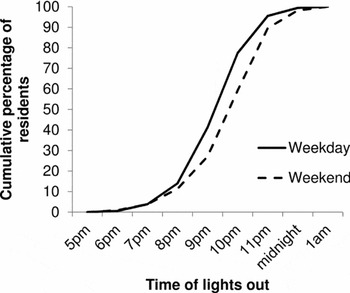
The reported average time for lights out on weekdays was 21:30, and 87.5% of households reported household lights out by 22:30 (Fig. 1). Respondents reported leaving lights on slightly later on weekend days, with the average time for lights out being 21:55, and 89.3% of households having lights out by 23:00 (Fig. 1). All lights were reported to be out by 01:00 each day.
Artificial light use at night in Bargara.

Beliefs about light-glow contributions
Respondents’ perceptions of the potential disruption of local turtles differed significantly across the various light producers (χ2 (6) = 420.5, p < 0.001; Table 1). With a significance level set at p < 0.0024 following Bonferroni correction, respondents perceived ‘beachfront properties’ as the most disruptive light source, scoring it significantly higher than all other light-producers (Z = –6.69 to –12.02, p < 0.001). ‘Local street lighting’ was scored significantly higher than all other light producers (Z = –4.54 to –8.854, p < 0.001) with the exception of ‘beachfront properties’ and ‘bars/restaurants/takeaways’ (Z = –1.1, p = 0.27). In turn, ‘bars/restaurants/takeaways’ scored significantly higher than all remaining light producers (Z = –7.008 to –9.557, p < 0.001). In contrast, ‘all residences’ scored significantly lower than all other light producers (Z = –12.02 to –5.73, p < 0.001) except the ‘bowls club’ (Z = –0.16, p = 0.87) and ‘properties more than two streets back from the beachfront’ (Z = –2.35, p = 0.019).
Respondent strength of agreement regarding whether each producer generated light potentially disruptive to local turtles (on a scale of 1 = disagree to 7 = agree), shown in descending order. Median ranked score (with each light producer ranked against all others) also shown.

The median rank of responses, relative to each light source, indicated again that ‘beachfront properties’, followed by ‘local street lighting’ and ‘bars/restaurants/takeaways’, were considered to be the light producers most likely to impact local turtles, with ‘all residences’ and the ‘bowls club’ ranked least likely (Table 1).
Awareness and engagement with light-glow reduction
Respondents were generally aware of the light reduction campaign (84%). Of those unaware of the campaign, a large proportion (36%) had lived in Bargara for less than one year, and because the campaign is seasonal, might not yet have been exposed to the message, however 12% of the long-term population (mean length of residence: 9.2 years) were unaware of the campaign.
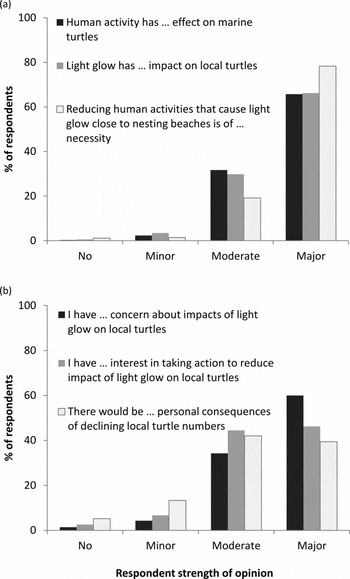
Internal reliability for the three cognitive and three affective measures was adequate (α = 0.77 and 0.75, respectively), and overall respondents showed high levels of cognitive and affective engagement with light-glow reduction (Fig. 2). The majority of respondents believed that human activity has a major effect on local turtles (65.7%), believed that light glow has a major impact on local turtles (66.2%), were highly concerned about impacts of light glow on local turtles (60%), and believed that reducing human activities that cause light glow close to nesting beaches is a major necessity (78.3%). There was a highly significant correlation between cognitive and affective engagement (rs[352] = 0.536, p < 0.001).
Responses to survey items (7-point scale) measuring (a) cognitive and (b) affective engagement with light reduction. Items scored as 1 (no effect/no impact/no consequence) are shown as ‘no’, items scoring 2 or 3 are shown as ‘minor’ (minor effect/minor impact/minor consequence), items scoring 4 or 5 shown as ‘moderate’; and items scoring 6 or 7 shown as ‘major’.

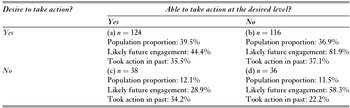
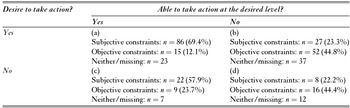
Despite the high levels of cognitive and affective engagement, 64.7% of respondents reported not taking any action in the past to reduce light. Yet, a large majority of respondents reported a desire to engage with light-glow reduction (75.3% score of > 5, n = 259). Thus, respondents desired to be behaviourally engaged, but generally were not behaviourally engaged at present. This finding was explored further by categorizing respondents according to their desire to take light-glow reduction action and their perceived ability to take action at the desired level (Table 2). According to the framework developed by Sutton and Tobin (Reference Sutton and Tobin2011), individuals falling into boxes a, c, and d (Table 2) experienced subjective constraints on engagement (either having no desire to take action [Table 2, boxes c and d], or no desire to take further action [Table 2, box a]), whilst those in box b (Table 2) experienced objective constraints (they had a desire to take action, but something prevented them from doing so).
Respondents classified according to desire to engage in light reduction and perceived ability to take action. Also shown are the percentages of respondents in each category who took past action, and who indicated a moderate-high likelihood of future engagement with light reduction.

The largest proportion of respondents were individuals who expressed a desire to engage with light-glow reduction and were able to take action at the desired level (Table 2, box a). However there was no significant difference reported in past behaviour between these individuals and individuals who were able to take action at the desired level but reported no desire to engage (χ2 (1) = 0.02, p = 0.89) (Table 2, box c).
Of the individuals who reported a desire to engage with light-glow reduction, those who reported not being able to do as much as they would like (namely those experiencing objective constraints on engagement; Table 2, box b) were more likely to have taken light-glow reduction action in the past than individuals who experienced subjective constraints on engagement (Table 2, boxes a, c, d). Similarly, box b individuals were also more likely to believe they will engage with light-glow reduction for the rest of the nesting season than were all other respondents. Individuals who felt no desire to engage and felt unable to take action at the desired level (Table 2, box d), although having the lowest likelihood of past action of all categories, also had a higher belief of future engagement than all individuals who reported an ability to take action (Table 2, boxes a and c).
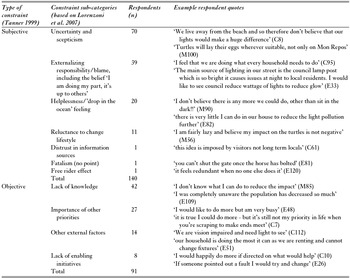
To better understand the specific constraints affecting engagement, we performed a detailed examination of respondent responses (Tables 3 and 4). Respondents who felt able to take action (Table 2, boxes a and c) were dominated by subjective constraints (Table 4), as predicted by the Sutton and Tobin (Reference Sutton and Tobin2011) framework (mainly ‘externalizing responsibility/blame’ for box a respondents, n = 30; mainly ‘uncertainty and scepticism’ and ‘externalizing responsibility/blame’ for box c respondents, n = 18). However, respondents who felt unable to take action at the desired level (Table 2, boxes b and d) were dominated by objective constraints regardless of reported ‘desire to engage’ (mainly ‘lack of knowledge’ and the related ‘lack of enabling initiatives’ for box b respondents, n = 31; and mainly ‘lack of knowledge’ and ‘importance of other priorities’ for box d respondents, n = 15).
Reported constraints on engagement with light reduction.

Respondent constraints categorized by desire and ability to engage.

DISCUSSION
Community light use, engagement and related constraints
We found high levels of cognitive and affective engagement with light reduction in our study community where a light reduction campaign was active. Thus the campaign had been effective at increasing community knowledge regarding impacts of artificial lighting on turtles, as well as promoting pro-environmental beliefs about artificial light use (see Sutton & Tobin Reference Sutton and Tobin2011). However, despite a widespread reported desire to reduce light during the nesting season, community behavioural engagement with light reduction was limited. In addition, all household lights were reported to be turned out by 01:00 each night, yet local hatchling emergence peaks between 20:00 and midnight (Limpus Reference Limpus1985), highlighting the importance of widespread local light reduction.
There was a widely-held perception that the biggest contributors to light disruptive to local turtles were sources of light beyond residents’ control, suggesting that community engagement may be limited primarily by internal factors acting to limit desire for pro-environmental action (Tanner Reference Tanner1999). Indeed, behavioural engagement with light reduction was principally limited by subjective constraints, mainly related to ‘uncertainty and scepticism’ and ‘externalizing responsibility/blame’ (Lorenzoni et al. Reference Lorenzoni, Nicholson-Cole and Whitmarsh2007). Dominant perceptions were that respondents lived too far from the beach for their lights to be an issue, or that respondents were already taking necessary action or did not produce contributing light (they believed other lights were to blame). Similarly, in Finland, public perceptions of light pollution were dominated by feelings of resignation linked to citizens’ lack of control over the most common light sources (Lyytimäki & Rinne Reference Lyytimäki and Rinne2013). Multiple studies have also found perceptions can limit engagement with pro-environmental activities (Tanner Reference Tanner1999; Lorenzoni et al. Reference Lorenzoni, Nicholson-Cole and Whitmarsh2007; Sutton & Tobin Reference Sutton and Tobin2011; Whitmarsh et al. Reference Whitmarsh, O’Neill and Lorenzoni2011). Collectively, these results highlight the importance of understanding what individuals know and believe about environmental issues, and their potential solutions, for designing effective programmes to motivate individuals to take action.
Applicability of the constraints framework
Groups of respondents who reported feeling unable to take action at the desired level (Table 2, boxes b and d) were also the two groups most likely to believe that they would engage in the future, and both were primarily limited by objective constraints. However, previous research has found the opposite; individuals are more likely to engage in environmental behaviour when they believe they have the capability to help solve environmental problems (Trigg et al. Reference Trigg, Perlman, Perry and Janisse1976; Huebner & Lipsey Reference Huebner and Lipsey1981). Moreover, respondents falling into box d reported no desire to engage, and should have therefore been primarily influenced by subjective constraints according to the framework used. The Sutton and Tobin (Reference Sutton and Tobin2011) linear model of constraints may thus be too simple.
According to Tanner (Reference Tanner1999, p. 147), objective constraints prevent behaviour, independent of perceptions regarding the action, whereas subjective constraints prevent individuals from forming a desire to act, on the basis of perceptions of what is possible, permissible or pleasurable. Experiencing an objective constraint for a particular action (such as time constraints) may influence an individual's interest and therefore their reported ‘desire’ for action. Moreover, Tanner (Reference Tanner1999) considered a lack of knowledge to be an objective constraint (dependent upon external factors). Since knowledge is a prerequisite for cognitive engagement, and lack of knowledge was one of the most commonly reported constraints in this study, cognitive engagement with light reduction for turtle conservation may be considered at least partially limited by objective constraints; rather than solely limited by subjective constraints, as implied by the framework we used. Yet, although adequate knowledge (cognitive engagement) is required in order to generate concern and interest (affective engagement) for an environmental issue (see Macey & Schneider Reference Macey and Schneider2008; Sutton & Tobin Reference Sutton and Tobin2011), having interest in a particular topic is also likely to increase motivation to seek out or be open to further topic-related information (for example see Lorenzoni et al. Reference Lorenzoni, Nicholson-Cole and Whitmarsh2007). Simply, a lack of knowledge may limit interest (affective engagement) but conversely, a lack of interest may also limit knowledge (cognitive engagement). We found a highly significant correlation between respondent measures of cognitive and affective engagement. However, respondents both with and without a desire to take action (determined based on the strength of their interest [affective engagement] in taking action) principally reported a ‘lack of knowledge’ to be the reason for their ability/inability to take action, indicating that affective engagement with light reduction may not be dependent upon cognitive engagement.
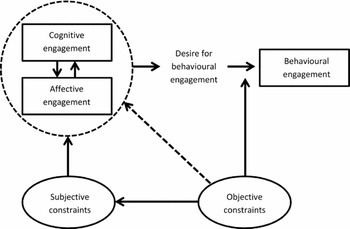
We propose a refinement to the framework developed by Sutton and Tobin (Reference Sutton and Tobin2011) (Fig. 3), in which cognitive and affective engagement are considered reciprocally linked, such that either may influence the other. This ensures the model aligns with previous research, which found cognitive influences on affective judgements (for example Dolan & Holbrook Reference Dolan and Holbrook2001), as well as affective influences on cognition (see Fischle Reference Fischle2000). Furthermore, we propose that objective constraints can lead to subjective constraints, because objective constraints can influence perceptions of what is possible and/or pleasurable, which in turn may limit cognitive and affective engagement necessary for the formation of a desire for action. Certain objective constraints may also directly limit cognitive and affective engagement, such as a lack of knowledge. Finally, objective constraints can still act at a later stage to prevent behavioural engagement with the pro-environmental issue, despite a desire for action.
Revised model of constraints on personal engagement with light reduction for turtle conservation, adapted from Sutton and Tobin (Reference Sutton and Tobin2011). Arrows indicate direction of influence. The hatched arrow represents the fact that only certain objective constraints (such as lack of knowledge) may directly impact cognitive and affective engagement.

We recognize that our proposed framework requires further research to test and refine the assumptions. For instance, our finding that affective engagement may not be dependent upon cognitive engagement may be related to the fact that light pollution is currently a relatively novel environmental issue (Lyytimäki Reference Lyytimäki2013). Thus, the framework would benefit from application to other more widely recognized, environmental behaviours. In addition, given that human behaviour is dependent upon a complex interaction of factors, such as normative influences (the behaviour and expectations of others; see Tucker Reference Tucker1999), and habits (Bamberg et al. Reference Bamberg, Ajzen and Schmidt2003; Bamberg & Schmidt Reference Bamberg and Schmidt2003), it is likely that a feedback loop exists between the different types of engagement. That is, performing the behaviour may have subsequent influences on what an individual thinks and/or feels about that behaviour (Ouellette & Wood Reference Ouellette and Wood1998) and the desire (or not) for further or sustained performance. Our data did not allow us to explore this link, but it would be a useful future research direction.
Recommendations
A range of methods exist which may facilitate engagement with environmental issues (Whitmarsh et al. Reference Whitmarsh, O’Neill and Lorenzoni2011; Whitmarsh et al. Reference Whitmarsh, O’Neill and Lorenzoni2013), and we recommend several strategies for increasing behavioural engagement in this community. First, there has been a recent call to impose legislative restrictions on light use in this locality (Pudmenzky Reference Pudmenzky2013), which emulates the widely used light reduction strategy in turtle nesting regions of the USA (see Butler Reference Butler1997). However, legislative restrictions on human light-use behaviours have been difficult to enforce and are extremely unpopular (Barschel et al. Reference Barschel, Bruce, Haggitt, Lichter and McCray2013). Given the widespread community perception that ‘local street lighting’ and ‘bars, restaurants and takeaways’ made significant contributions to light pollution, legislation imposed on commercial entities to reduce light, and to guide the replacement/installation of more ‘turtle-friendly’ street lighting, may be an effective way of reducing light without the need to legislate resident behaviour (we use the term ‘turtle-friendly’ cautiously here [see Robertson Reference Robertson2013], referring only to positioning and shielding lights appropriately; for example see Witherington & Martin Reference Witherington and Martin2000). Such a scenario would reduce light directly by lessening light produced by these sources, but it might also indirectly reduce light by helping to address constraints perceived by residents. Two of the community constraints reported most frequently were subjective: ‘uncertainty and scepticism’ and ‘externalizing responsibility/blame’. Because the majority of residents were cognitively and affectively engaged with the issue of light reduction and also reported a desire to act, an obvious, and/or publicized reduction of light by other sources may result in a concomitant lessening of the widespread subjective constraint that the most disruptive light occurs outside of respondents own control, and help establish a community norm for a darker night-time environment.
Thus, using technology and/or legislation to reduce light from other sources, as a means of altering the situation in which residents make decisions about engagement with light reduction behaviours, would likely be a valuable strategy for increasing behavioural engagement. However, should such an approach be implemented, communications to publicize actions taken by other actors must take care to avoid unwittingly deactivating norms by pointing out that some individuals or groups do not engage in light reduction efforts (for example see McDonald et al. Reference McDonald, Fielding and Louis2014).
Second, the existence of the small community proportion who engaged with light reduction without a desire to benefit turtle conservation (Table 2, box d) highlights the fact that pro-environmental behaviour is governed by complex interactions between psychological, social and environmental variables (Blake Reference Blake1999; McKenzie-Mohr & Smith Reference McKenzie-Mohr and Smith1999; Stern Reference Stern2000; Lorenzoni et al. Reference Lorenzoni, Nicholson-Cole and Whitmarsh2007; Whitmarsh et al. Reference Whitmarsh, O’Neill and Lorenzoni2013). Any public communication to increase pro-environmental engagement and stimulate desirable behaviours therefore needs to be ‘psychologically smart’ (Ockwell et al. Reference Ockwell, Whitmarsh and O’Neill2009, p. 307). In particular, communication needs to recognize that different values, concerns, benefits and barriers will exist between different audiences (Whitmarsh et al. Reference Whitmarsh, O’Neill and Lorenzoni2013): thus audiences require their own specific messages. Targeted persuasive communication techniques underpinned by theories of behaviour change have been successfully used to influence human behaviour in specific instances of natural resource management (see McKenzie-Mohr Reference McKenzie-Mohr2000; Ham et al. Reference Ham, Weiler, Hughes, Brown, Curtis and Poll2008; Brown et al. Reference Brown, Ham and Hughes2010; Steckenreuter & Wolf Reference Steckenreuter and Wolf2013). Thus, persuasive communication insights used in future campaign materials, based on community beliefs about light reduction, may be a further method to increase behavioural engagement.
We examined engagement with light reduction initiatives specifically implemented to protect marine turtles, but we did not directly assess respondents’ perceptions towards turtles. Visiting Mon Repos has been found to increase positive attitudes towards turtles as well as increasing desire for turtle conservation (Tisdell & Wilson Reference Tisdell and Wilson2001). Because the majority of respondents had visited Mon Repos, it is possible that light reduction behaviour was influenced by more positive perceptions towards turtles than would be found in a similar community elsewhere. Yet, very few respondents had ever volunteered at Mon Repos, and generally visits to view local turtles were infrequent, thus we do not believe that our sample was biased towards people with a particular interest in marine turtles. However exploring the influence of direct experience with turtles, and perceptions of, and concern about, turtles for motivating light reduction action may be a useful avenue for future research (see Ballantyne et al. Reference Ballantyne, Packer and Sutherland2011; Senko et al. Reference Senko, Schneller, Solis, Ollervides and Nichols2011). Moreover, artificial lighting has detrimental impacts on multiple species, including humans (Rich & Longcore Reference Rich and Longcore2006; Stevens Reference Stevens2009). As recognition of these impacts increases, future work should assess whether community motivation to reduce light may be improved by widening the campaign focus from the single purpose of marine turtle conservation, and/or reframing the campaign to include other benefits of darker nights, such as more pleasant lighting, cost savings related to energy use (Gallaway et al. Reference Gallaway, Olsen and Mitchell2010) or improved star-gazing opportunities (Hölker et al. Reference Hölker, Moss, Griefahn, Kloas, Voigt, Henckel, Hänel, Kappeler, Völker, Schwope, Franke, Uhrlandt, Fischer, Klenke, Wolter and Tockner2010a ).
We also recognize that although in this instance local community engagement is crucial for reducing light glow (given difficulties associated with legislating public behaviour close to nesting beaches [Barschel et al. Reference Barschel, Bruce, Haggitt, Lichter and McCray2013] and a current lack of non-disruptive lighting technologies [see Robertson Reference Robertson2013]), in different contexts different approaches to managing light will likely be required (for example Falchi et al. Reference Falchi, Cinzano, Elvidge, Keith and Haim2011; Cha et al. Reference Cha, Lee, Lee, Jung, Lee, Han and Gu2014). With continued research, methods to engage the public with light reduction initiatives will hopefully become part of a suite of management strategies which address detrimental impacts associated with this global environmental change.
CONCLUSIONS
Effectively managing public use of light at night for marine turtle conservation is a complex task which is unlikely to result from education campaigns alone. A comprehensive understanding of public engagement with the light pollution issue and identification of specific constraints on engagement provide valuable insights for the development of appropriate and targeted light mitigation strategies. The refinements we propose to the Sutton and Tobin (Reference Sutton and Tobin2011) framework of constraints may now be used and further developed to increase understanding of public engagement with critically important environmental issues.
To the best of our knowledge this is the first study to examine public engagement with reducing light at night for the protection of a threatened species. Given that effecting public light reduction behaviour is a difficult yet necessary challenge for today's environmental managers (Hölker et al. Reference Hölker, Wolter, Perkin and Tockner2010b ; Gaston et al. Reference Gaston, Bennie, Davies and Hopkins2013; Lyytimäki Reference Lyytimäki2013), this study will provide a starting point for necessary further research into how best to manage public use of artificial light.
ACKNOWLEDGEMENTS
We thank the residents of Bargara for taking part, Chad Kirby for assistance with data collection, QPWS rangers for support and consultation, and the Bargara Buzz for publicizing the survey. Advice from three anonymous reviewers greatly improved the manuscript. This research was funded by a grant from James Cook University's Graduate Research Scheme. Ruth Kamrowski is supported by the Northcote Trust Graduate Scholarship. Mark Hamann is supported by the Australian Government's NERP. This work complies with James Cook University human ethics permit No. H4079.