


Introduction
Plutella xylostella (Linnaeus) (Lepidoptera: Plutellidae) is a recurring pest on cruciferous crops around the world. In many parts of the world, it is the principal pest of cruciferous crops, and its annual cost of management is estimated to be over US $1 billion (Talekar & Shelton, Reference Talekar and Shelton1993; Sayyed et al., Reference Sayyed, Rizvi and Alvi2002). Much of the problem in control is the result of insecticide resistance, and populations of P. xylostella have a long history of evolving resistant to every insecticide used extensively against them. Plutella xylostella has developed resistance to as many as 86 insecticides including Bacillus thuringiensis based products (http://www.pesticideresistance.org/DB/species profile.php?arthropodid=395). Although some natural biological control has been achieved, the use of insecticides is still considered by farmers the primary strategy to control P. xylostella in cruciferous fields (Verkerk & Wright, Reference Verkerk and Wright1997).
In the Indo-Pakistan sub-continent, P. xylostella was first recorded on cruciferous vegetables in 1914 (Fletcher, Reference Fletcher1914). In Pakistan, Ghouri (Reference Ghouri1960) described P. xylostella as a minor pest of cruciferous vegetables but Mohyuddin & Mushtaque (Reference Mohyuddin and Mushtaque1983) and Abro et al. (Reference Abro, Soomro and Syed1992) have since reported that P. xylostella is a very serious pest on cruciferous vegetables in that country. Chemical control is the most widely used tactic for pest management, but control tactics vary widely between geographical locations (Syed et al., Reference Syed, Abro and Ahmed2004).
Resistance to insecticides is an immense practical problem associated with the chemical control of insect pests, and selection of insecticide-resistant pest populations has occurred repeatedly. Previous exposure and selection with insecticides can confer resistance to new insecticides through cross-resistance (Bisset et al., Reference Bisset, Rodriguez, Soca, Pasteur and Raymond1997), reducing the effectiveness of many new insecticides. Strategies to manage resistance to insecticides have usually been designed after resistance has developed. However, if the likelihood of resistance development to novel insecticides can be predicted before they are used, it should be possible to establish effective resistance management programmes.
The extensive use of organophosphates and pyrethroids against P. xylostella provides an ideal environment for the evolution of resistance in Pakistan (Sayyed et al., Reference Sayyed, Attique, Khaliq and Wright2005a,Reference Sayyed, Attique and Khaliqb). Selection for resistance can be intense following multiple applications of high concentrations of the insecticides used to control severe outbreaks of the pest. The history of P. xylostella resistance to pyrethroids and organophosphates is particularly well documented from Asian and American countries (Leibee & Savage, Reference Leibee, Savage, Talekar and Griggs1992; Sun, Reference Sun, Talekar and Griggs1992; Syed, Reference Syed, Talekar and Griggs1992). Organophosphates and pyrethroids were introduced in Pakistan in the 1980s for management of cotton pests, but farmers have since started using them against vegetable pests as well. Recently, we demonstrated that resistance to deltamethrin in P. xylostella from the Multan region of Pakistan was incompletely dominant, autosomal, controlled by more than one factor and, most importantly, stable in the absence of selection pressure (Sayyed et al., Reference Sayyed, Attique, Khaliq and Wright2005a,Reference Sayyed, Attique and Khaliqb). Following reports of poor efficacy of insecticides in other parts of Pakistan, we surveyed resistance to organophosphates, pyrethroids and new chemistry compounds (indoxacarb, spinosad and emamectin) in P. xylostella from three zones of the Punjab province of Pakistan to ascertain whether resistance was indeed evolving.
Materials and methods
Insects
Plutella xylostella infestations in Pakistan generally commence by late July and extend until April. Insecticide use occurs from August to March when P. xylostella is present in the field. Because insecticide use is very high on cauliflower (the average spray interval is only ten days (Sayyed et al., Reference Sayyed, Attique and Khaliq2005b)), samples were taken from cauliflower fields. Collections of about 500–1000 larvae were made by walking through the crops in each field in three different zones. The zones were: southern (Multan region), central (Lahore region) and northern (Islamabad and surrounding areas) (fig. 1). Samples were taken in November from eight field populations in the southern zone, in September from five populations in the central zone, and in August from five populations in the northern zone (fig. 1). Climatic conditions and cropping patterns were different in these zones. In the southern zone, also known as the cotton belt, temperature during the cropping season ranges between 10–35°C (night:day), and cruciferous crops are generally grown as mixed crops. In the central zone, temperatures are comparatively lower and range from 5–20°C (night:day), and cruciferous crops such as cabbage and cauliflowers are grown in small plots. The northern zone is a highland region and temperature ranges from 0–15°C (night:day) during the cropping season. Due to different cropping patterns, there is a wide range of P. xylostella infestation, which results in great variation in insecticides spray. Populations were reared in the laboratory for one generation to increase insect numbers for bioassays.
Sampling sites of Plutella xylostella in various zones of Punjab province of Pakistan.

An insecticide-susceptible population designated as Lab-Pak was established locally. The population was started with c. 500 larvae, which were collected in 2002 from Murree, Pakistan one year before commencing these studies. The area received no insecticide sprays during the three previous years (local farmers' personal communication) and, therefore, it was assumed the population would be susceptible. The larvae were reared on cauliflower plants (21±1°C with 65% humidity and L:D 16:8) in the toxicological laboratory of Syngenta Pakistan Ltd, Multan. Adults were kept in oviposition glass jars with cotton bolls soaked in artificial diet (sucrose 50 g, methyl hydro benzoate 1 g, vitamin mixture 5 ml, water 495 ml; Attique et al., Reference Attique, Khaliq and Sayyed2006).
Insecticides
The commercial formulations of different insecticides used for bioassays were: cypermethrin (Prevail® 10% a.i. w/v EC FMC Asia Pacific Inc., Hong Kong), deltamethrin (Decis® 10% a.i. w/v EC; Syngenta), bifenthrin (Talstar® 10% a.i. w/v EC FMC Asia Pacific Inc., Hong Kong), lambdacyhalothrin (Karate® 2.5% a.i. w/v EC Novartis, UK), chlorpyriphos (Dursban® 40% a.i. w/v EC Dow Agrosciences, USA), triazophos (Hostothion® 40% a.i. w/v EC Novartis, UK), profenophos (Chempro 50® 50% a.i. w/v EC Novartis, UK), indoxacarb (Steward, 35% a.i. w/v EC DuPont, Wilmington, Delaware, USA), spinosad (Tracer, 240 g l−1 SC; Dow AgroSciences, Indianapolis, Indiana, USA) and emamectin benzoate (Strategy, 19 g l−1 EC; Syngenta). Stapple (Sygenta Pakistan), a non-ionic surfactant, was used at 5 ppm to enhance the adhesiveness of insecticides.
Bioassays
Bioassays were conducted on second instar P. xylostella, using a leaf dip method (Sayyed et al., Reference Sayyed, Haward, Herrero, Ferré and Wright2000). Test solutions of pesticides were freshly prepared in distilled water with Stapple (5 μg ml−1) as surfactant. Cauliflower leaf discs (4.8 cm diameter) were immersed in test solutions for 10 s and then allowed to dry for about 1 to 1.5 h at room temperature. Control leaf discs were immersed in distilled water containing Stapple. The leaf discs were then transferred to individual plastic Petri dishes (5 cm diameter) containing a single moistened Whatman No. 1 filter paper. Each treatment (concentration) was replicated 5–7 times, including controls. Five second instars were placed on each leaf disc (replication), and the total number of larvae tested per concentration ranged from 25–35. The bioassays were kept at 21±1°C with 65% humidity and L:D 16:8 in the toxicological laboratory of Syngenta Pakistan (Ltd), Multan. Mortality was assessed after 48 h exposure to insecticides.
Data analysis
Where necessary, bioassay data were corrected for control mortality (Abbott, Reference Abbott1925). Data from the replicates were pooled and estimates of LC50 values and their 95% fiducial limits (FL) were obtained by maximum-likelihood logit regression analysis in GLIM using generalized modelling techniques, from which differences between sets were extracted by analysis of deviance (Crawley, Reference Crawley1993). Because of the inherent variability of bioassays, pair-wise comparisons of LC50 values were at the 1% significance level (where individual 95% FL for two treatments do not overlap; Litchfield & Wilcoxon, Reference Litchfield and Wilcoxon1949). The resistance ratio for each product was estimated by dividing the LC50 value for field populations by the LC50 value for the susceptible population.
Results
Toxicity of test chemicals to the susceptible population
The toxicities of emamectin and spinosad to Lab-Pak were similar but significantly greater (P<0.01) than all other compounds tested (tables 1, 2 and 3). Toxicity of pyrethroid and organophosphate insecticides tested to the Lab-Pak population were similar (table 1). The slopes of regression lines of all insecticides tested were not significantly different from each other (P>0.05).
Toxicity of selected pyrethroids to different populations of Plutella xylostella from Pakistan.

1 LC50 is mg ml−1.
2 RR=resistance ratio was calculated LC50 of field population÷LC50 of Lab-Pak.
Toxicity of selected organophosphates to different populations of Plutella xylostella from Pakistan.

1 LC50 is mg ml−1.
2 RR=resistance ratio was calculated LC50 of field population÷LC50 of Lab-Pak.
Toxicity of selected new chemistry to different populations of Plutella xylostella from Pakistan.

1 LC50 is μg ml−1.
2 RR=resistance ratio was calculated LC50 of field population÷LC50 of Lab-Pak.
Toxicity of pyrethroids to field populations of P. xylostella
The toxicity of pyrethroids tested against P. xylostella was significantly lower for field populations (P<0.01) compared with Lab-Pak (table 1). Levels of resistance to pyrethroids in P. xylostella samples from all three zones were generally high, with resistance ratios commonly in excess of 20–fold compared with Lab-Pak (table 1). The insecticides tested, i.e. cypermethrin, deltamethrin and lambdacyhalothrin, had similar toxicity to P. xylostella populations collected from eight locations in the southern zone but bifenthrin had significantly higher toxicity (P<0.01) at two locations (table 1). Similarly, in the central zone, the pyrethroids tested had similar toxicity except Lahore 3, where bifenthrin had significantly higher toxicity (P<0.01) compared with cypermethrin, deltamethrin and lambdacyhalothrin (table 1). In the northern zone at two locations, bifenthrin toxicity was similar to Lab-Pak (table 1); whereas all other insecticides, i.e. cypermethrin, deltamethrin and lambdacyhalothrin, had similar toxicity to bifenthrin at all locations. The average slopes for deltamethrin, lambdacyhalthrin and bifenthrin were not significantly different (P>0.05) than the average slope for Lab-Pak. However, the average slope of cypermethrin was significantly (P<0.05) steeper than Lab-Pak (table 1).
Toxicity to organophosphates in field populations of P. xylostella
Generally, populations of P. xylostella from all locations showed a high level of resistance to organophosphates tested compared with the level of resistance to pyrethroids. Toxicity to chlorpyriphos was significantly lower (P<0.01) than triazophos and profenophos (table 2) in all three zones. Particularly, chlorpyriphos was least toxic in the southern zone compared with triazophos and profenophos. In the central zone, toxicity of profenophos was similar but significantly higher (P<0.01) at four locations compared with location 5 (table 2). However, chlorpyrifos and triazophos had almost identical toxicity against all populations from five locations in the central zone. The population of P. xylostella collected from location 1 of the northern zone was significantly (P<0.01) more susceptible than any other population tested with organophosphates (table 2), and its susceptibility was identical to Lab-Pak. The chlorpyriphos and triazophos had similar toxicity to populations collected from five locations in the northern zone. The average slope for triazophos and profenophos were not significantly (P>0.05) different than the slope of Lab-Pak. However, the average slope of chlorpyriphos was significantly (P<0.05) steeper than Lab-Pak (table 2).
Toxicity of P. xylostella populations to new chemistry
Bioassays of 18 populations of P. xylostella with new chemistry compounds revealed that only the Lahore 2 and Multan 5 populations had evolved field resistance to indoxacarb (table 3). The LC50 of indoxacarb was significantly (P<0.01) higher than emamectin and spinosad. Spinosad has similar activities against all populations collected from the three zones except against a population from Multan 6 in the southern zone, where the toxicity of spinosad was similar to Lab-Pak (table 3). Indoxacarb was comparatively less toxic than spinosad and emamectin. The activity of indoxacarb was similar in all three zones; however, Lahore 3 in southern zone and Islamabad 1 in northern zone had LC50 identical to Lab-Pak (table 3). Although the average slope for indoxacarb was significantly (P<0.05) shallower than Lab-Pak, it was not different than spinosad and emamectin. Emamectin was the most toxic product among new chemistry compounds tested against field populations from all three zones; the toxicity was comparable with Lab-Pak (P>0.01; P>0.05).
Pairwise correlations between insecticides in different zones
Correlation between the toxicities of each pair of insecticides tested in the northern zone were positive, whereas most of insecticides tested in the southern and central zones were negatively correlated (table 4). Significantly (P<0.05) positive correlations were observed between deltamethrin and profenophos in the central zone, whereas significantly (P<0.05) positive correlations in the northern zone were observed between cypermethrin and each of lambdacyhalothrin, deltamethrin and profenophos; lambdacyhalothrin and both deltamethrin and profenophos; and between deltamethrin and profenophos (table 4).
Pairwise correlation coefficient comparisons between log LC50s of the insecticides.
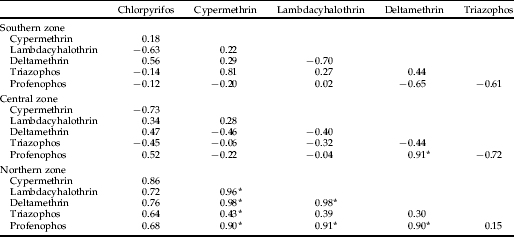
Superscripts indicate significance at 5%.
Discussion
In this study, bioassays were carried out to evaluate the insecticidal activities of representative pyrethroids, organophosphates and new chemistry compounds against various field populations of P. xylostella from three zones of the Punjab province of Pakistan. Organophosphate and pyrethroid resistance was high, generally more than ten-fold greater than the susceptible strain. It has been suggested that insects should not be considered resistant until a resistance ratio of ten is exhibited (Valles et al., Reference Valles, Koehler and Brenner1997). Accordingly, we would consider that less than ten-fold lower sensitivity to spinosad, indoxacarb and emamectin was tolerance rather than resistance. It implies that these compounds (spinosad, indoxacarb and emamectin) might be less severely compromised by resistance mechanism(s) present in P. xylostella populations in Pakistan and might, therefore, retain effectiveness against highly pyrethroid and organophosphate resistant populations. Compared with the very high levels of resistance to pyrethroids and organophosphates observed, low levels of resistance to indoxacarb at one location is not a major factor that would be likely to prevent the effective use of these new insecticides against insect pests. The mechanism(s) capable of conferring high levels of resistance to pyrethroids can cause cross resistance to indoxacarb or spinosad (Sayyed et al., Reference Sayyed, Omar and Wright2004; Sayyed & Wright, Reference Sayyed and Wright2006). The population of P. xylostella, which had shown a lower level of resistance to indoxacarb, might have a mechanism selected because of organophosphates and pyrethroids sprayed in the field. It has been shown that mixed function oxidase is involved for resistance to indoxacarb in Musca domestica Linnaeus (Diptera: Muscidae) (Shono et al., Reference Shono, Zhang and Scott2004). A mechanism of resistance to pyrethroids and organophosphates in P. xylostella is also associated with mixed function oxidase (Sun, Reference Sun, Talekar and Griggs1992). Similarly, esterases have also been reported to be associated with indoxacarb resistance in a field population of P. xylostella from Malaysia (Sayyed & Wright, Reference Sayyed and Wright2006). However, further studies are required to confirm the resistance mechanism to indoxacarb in P. xylostella from Pakistan.
The results suggest that a field population, which was reared in the laboratory for over a year and later used as a reference strain, showed a similar response to insecticides as another laboratory population from the UK (Sayyed et al., Reference Sayyed, Attique, Khaliq and Wright2005a,Reference Sayyed, Attique and Khaliqb). The slopes of the regression lines of all insecticides tested against the population were similar, suggesting less heterogeneity in the population. However, the importance of slope in individual bioassays has been questioned by Tabashnik et al. (Reference Tabashnik, Finson, Chilcutt, Cushing and Johnson1993), who suggested that variation in slope was not biologically meaningful as slope did not change as a simple and predictable function of LC50. Similarly, Chilcutt & Tabashnik (Reference Chilcutt and Tabashnik1995) suggested that slope was not a good indicator of genetic variation in susceptibility or that genetic variation in susceptibility was not related simply to LC50 or both.
This high resistance could be due to intensive use of pyrethroids and organophosphates in response to severe outbreaks of P. xylostella on cruciferous crops. High levels of resistance might be a consequence of multiple resistance mechanisms. However, significantly (P<0.01) lower resistance to lambdacyhalothrin and bifenthrin found in the population collected from location 1 of the northern zone is intriguing. It suggests that an independent mechanism of resistance may be involved. The low resistance could also reflect low usage of these compounds in this zone. Organophosphorus resistance is much more complicated than pyrethroid, since organophosphorus insecticides have very diverse molecular structures which have diverse modes of toxic action and metabolism, and thus induce different resistance responses in P. xylostella (Cheng, Reference Cheng, Talekar and Griggs1986). Pyrethroid and organophosphate resistance in P. xylostella has been attributed to oxidative detoxification and acetylcholinesterase insensitivity, respectively, and perhaps to insensitivity of the target site (Sun, Reference Sun, Talekar and Griggs1992; Schuler et al., Reference Schuler, Martinez-Torres, Thompson, Denholm, Devonshire, Duce and Williamson1998). However, further studies are required to establish resistance mechanisms to organophosphates and pyrethroids in P. xylostella from Pakistan.
In Pakistan, cruciferous crops are usually grown in mixed cropping systyems, thus P. xylostella also receives an indirect insecticide exposure as a result of insect pest control on main crops (A. Khaliq, personal observations). If the use of pyrethroids and organophosphates can be reduced/replaced, problems associated with pyrethroid and organophosphate resistance in P. xylostella are likely to decline. Many of the novel chemicals available for the control of P. xylostella and other lepidopteran pests are considered less harmful to natural enemies than pyrethroids or organophospates. Use of such novel products, for example emamectin, should also help to conserve natural enemies like Cotesia plutellae (Kurdyumov) (Hymenoptera: Braconidae).
Establishing a resistance management programme in developing countries poses a tremendous challenge and will require an integrated struggle against several decades of primary dependence on insecticides for pest management. What can be done to implement a resistance management programme? The scientific literature offers several theoretical models and recommendations to manage resistance with multiple tactics (Tabashnik & Croft, Reference Tabashnik and Croft1982; Roush & Miller, Reference Roush and Miller1986; Hoy, Reference Hoy1995). However, use of other components along with chemical insecticides, of a resistance management programme, must be increased; and these include cultural practices as well as increased use of biological control agents. Additionally, further studies are required to obtain a better understanding of resistance mechanisms affecting two or more insecticides within a single pest species. The latter may help to fine-tune the pesticide registration regulations and design a resistance management strategy.
Historically, new compounds have been introduced sequentially for control of P. xylostella to tackle existing resistance problems, but these compounds eventually become ineffective. The fate of Bacillus thuringiensis, spinosad and fipronil are recent examples which succumbed to resistance (Iqbal et al., Reference Iqbal, Verkerk, Furlong, Ong, Rahman and Wright1996; Sayyed et al., Reference Sayyed, Omar and Wright2004; Sayyed & Wright, Reference Sayyed and Wright2004). Until new selective compounds are introduced into a managed system, probably involving the alternation of a number of dissimilar products, severe resistance problems will continue; and integrated pest management systems for P. xylostella will remain, at best, only partially successful (Roush & Tabashnik, Reference Tabashnik, Roush, Roush and Tabashnik1990).
Factors involved in insecticide resistance evolution of Plutella xylostella in Pakistan
The development of insecticide resistance is influenced by genetic, behavioural, ecological and agronomic factors, which regulate the proportion of the total population selected with insecticides and the selection pressure exerted on sprayed populations (Sayyed & Wright, Reference Sayyed and Wright2004). In addition to insecticide applications selecting resistant individuals and increasing their frequency in the population, a competitive disadvantage and/or reduced fitness of resistant genotypes in the absence of insecticide pressure (Carriere et al., Reference Carriere, Ellers-Kirk, Liu, Sims, Patin, Dennehy and Tabashnik2001) has been established in P. xylostella (Sayyed et al., Reference Sayyed, Omar and Wright2004; Sayyed & Wright, Reference Sayyed and Wright2004). However, the reduced fitness of resistant genotypes seems insufficient to account for the decline in resistance frequencies (see Sayyed & Wright, Reference Sayyed and Wright2001). Although we did not perform fitness experiments in these studies, previous studies from the southern zone (Sayyed et al., Reference Sayyed, Attique and Khaliq2005b) suggested that the resistance to organosphosphate and pyrethroids fluctuated in the whole cropping season, which could be attributed to release of selection pressure.
Insect behaviour may modulate insecticide resistance dynamics. For instance, selection may favour individuals that respond to insecticide sprayings by minimizing their contact with the chemical (Haynes, Reference Haynes1988). The major behavioural factor affecting the evolution of insecticide resistance is the result of the gene flow concomitant with immigration processes regulating the gene pool of local populations (Daly, Reference Daly1993). Crow (Reference Crow1957) suggested that resistant alleles should be at a selective disadvantage relative to susceptible ones in the absence of insecticide; otherwise, they would be much more common in populations before selection. Migratory behaviour is one of the factors in rapid evolution of resistance to pesticides (Carriere et al., Reference Carriere, Ellers-Kirk, Liu, Sims, Patin, Dennehy and Tabashnik2001). Plutella xylostella is highly migratory; and its seasonal movements, which are regulated by both genetic and environmental factors, have been well documented (Chapman et al., Reference Chapman, Reynolds, Smith, Riley, Pedgley and Woiwod2002). Therefore, the population, which has evolved resistance at one place, could spread to other places by migration. In previous studies, Sayyed et al. (Reference Sayyed, Attique, Khaliq and Wright2005a,Reference Sayyed, Attique and Khaliqb) reported high level resistance to some organophosphates and pyrethroids in the southern zone. The high levels of resistance to the insecticides in the present studies in both the southern and central zones could be attributed to the migratory behaviour of P. xylostella. In March and April, the temperature in the southern zone increases to 35–40°C, at which P. xylostella struggle to survive; therefore, the adults tend to move to the slightly cooler environment of the central zone where the temperature remains below 30°C during this period. This could increase resistance levels in the insect in the central zone. However, it is unlikely that the adults will move to the northern zone as it is a mountainous region with forests, which could act as barriers for the movement of adults. In contrast, migration of a susceptible population could help to dilute the resistant genes and, thus, slow the evolution of resistance.
Additional agronomic variables may also be involved in the evolution of insecticide resistance in P. xylostella, for example cropping structure could play a major role. A relatively small area of cultivated fields is a major characteristic in all three zones. A small plot crop system often implies a high number of crops, differences in the phenological stage of the same crop in adjacent plots and a high number of farmers taking their own control decisions against P. xylostella. Hence, chemical control may vary greatly in time and space, in terms of the number of treatments, spraying dates and/or chemicals applied. Studies on identification of resistance genes, together with mechanisms of resistance, will help to understand the evolution of resistance in P. xylostella in Pakistan.
Acknowledgements
The authors are grateful to anonymous referees for their helpful comments. The facilities provided by Syngenta Pakistan Ltd to MNRA for these studies are highly appreciated. AHS was supported by BBSRC project (BB/C504927/1).


