Introduction
The western flower thrips (WFT), Frankliniella occidentalis (Pergande) (Thysanoptera: Thripidae), is an economically important pest of vegetable, fruit and ornamental crops throughout the world, primarily due to its role as virus vector. Due to the low damage threshold on some crops, especially in Tomato Spotted Wilt Virus susceptible crops, the most widely used method of WFT control is through the application of insecticides. However, the indiscriminate use of insecticides, the short generation time of F. occidentalis, its high fecundity and the haplodiploid breeding system, in which resistance genes are directly exposed to selection by insecticide treatment, have led to the development of resistance to major insecticide groups: organochlorines, organophosphates, carbamates, pyrethroids and spinosyns (Immaraju et al., Reference Immaraju, Paine, Bethke, Roob and Newman1992; Brøadsgaard, Reference Brødsgaard1994; Martin & Workman, Reference Martin and Workman1994; Robb et al., Reference Robb, Newman, Virzi, Parrella, Parker, Skinner and Lewis1995; Zhao et al., Reference Zhao, Liu, Brown and Knowles1995; Broadbent & Pree, Reference Broadbent and Pree1997; Espinosa et al., Reference Espinosa, Bielza, Contreras and Lacasa2002a; Herron & James, Reference Herron and James2005; Bielza et al., Reference Bielza, Quinto, Contreras, Torné, Martín and Espinosa2007a).
Spinosad is the first member of the Spinosyns group 5 Nicotinic Acetylcholine receptor agonists (allosteric) according to IRAC (Insecticide Resistance Action Committee) mode of action classification (Anonymous, 2005), developed by Dow AgroSciences (Sparks et al., Reference Sparks, Thompson, Larson, Kirst, Jantz, Worden, Hertlein and Busacca1995). In Spain, spinosad is widely used for the control of lepidopteran and thysanopteran pests after being introduced in 2002, with excellent initial control of F. occidentalis. Due to this high efficacy for thrips control and severe resistance problems with other insecticides (Espinosa et al., Reference Espinosa, Bielza, Contreras and Lacasa2002a,Reference Espinosa, Bielza, Contreras and Lacasab, Reference Espinosa, Contreras, Quinto, Grávalos, Fernández and Bielza2005), for most growers spinosad became almost the only insecticide used against WFT in some areas. Spinosad overuse, with more than ten applications per crop, has produced highly resistant populations in some greenhouses of southeastern Spain (Bielza et al., Reference Bielza, Quinto, Contreras, Torné, Martín and Espinosa2007a), an area of very intensive insecticide use. However, field rates of spinosad provide good WFT control in most greenhouses where spinosad is used judiciously.
Metabolic mediated detoxification was not responsible for spinosad resistance (Bielza et al., Reference Bielza, Quinto, Contreras, Torné, Martín and Espinosa2007a), in contrast with the resistance mechanism for other insecticides used against thrips – mediated by esterases (Maymó et al., Reference Maymó, Cervera, Garcerá, Bielza and Martínez-Pardo2006) or, mainly, by monooxygenases (Espinosa et al., Reference Espinosa, Contreras, Quinto, Grávalos, Fernández and Bielza2005). These results explain the lack of cross-resistance with the other insecticides used against thrips (Bielza et al., Reference Bielza, Quinto, Contreras, Torné, Martín and Espinosa2007a).
To preserve the usefulness of spinosad in F. occidentalis management, it is important to identify effective strategies for the development of a comprehensive resistance management program to retard the progress of spinosad resistance in the field.
An important component of resistance management is the rotational use of insecticides which do not show cross-resistance (Ninsin & Tanaka, Reference Ninsin and Tanaka2005). A key assumption for an effective rotation strategy is that the frequency of resistant individuals will decline during the application of an alternate insecticide (Tabashnik, Reference Tabashnik, Roush and Tabashnik1990). When an insecticide is withdrawn, susceptibility of the insect will be restored within several generations, thus allowing the insecticide to be re-incorporated into pest-management programs. However, in certain cases, resistance persists over many generations after the withdrawal of selection pressure (Nauen et al., Reference Nauen, Stumpf and Elbert2002). Since stable resistance prevents the successful re-use of an insecticide for pest management, a study on the stability of spinosad resistance in F. occidentalis in the absence of further selection was conducted.
Material and methods
Insect strains
The susceptible strain (S) of F. occidentalis was collected in 2001 (the year before spinosad introduction) from sweet pepper crops in Murcia (Bielza et al., Reference Bielza, Quinto, Contreras, Torné, Martín and Espinosa2007a). This strain was maintained in the laboratory (Espinosa et al., Reference Espinosa, Fuentes, Contreras, Bielza and Lacasa2002c) without outside gene flow or exposure to insecticide.
In 2003, six F. occidentalis strains were collected in Almeria (Spain) from greenhouses with an intense previous use of spinosad (>10 applications in six months), where resistant problems were suspected (Bielza et al., Reference Bielza, Quinto, Contreras, Torné, Martín and Espinosa2007a). These field populations of F. occidentalis were reared and bioassayed against spinosad, and survivors from doses above the lethal concentration 50 (LC50) were pooled and reared. The resulting population was exposed each month (approximately each generation) to increasing concentrations of spinosad over four months. This selected strain (R) for resistance to spinosad was maintained isolated in the laboratory.
Insecticides
A commercial formulation of spinosad (Spintor® 480 g spinosad l−1, Dow AgroSciences) was used in bioassays. Tests solutions of spinosad were freshly prepared in distilled water with Tween 20 (1‰) as surfactant.
Bioassays
Leaf-dip bioassays were conducted on one-week-old female adults of F. occidentalis. Sweet pepper leaf sections (30×5 mm) were immersed for 10 s in the test solution and then allowed to dry for 1–2 h at room temperature. Control leaf sections were immersed in distilled water containing Tween 20 (1‰). The leaf sections were then transferred to new individual plastic vials (5 ml). Ten female adult thrips were placed into each vial. The vials were closed with a piece of cellulose paper below the cap to prevent water condensation and were maintained in the vertical position at 25±2°C and a photoperiod of 16:8 h (light:dark). Five to nine concentrations, plus a control (without insecticide), were assayed for each population in three replications containing ten adult thrips per dose. Doses (between 0.0061 and 101990.4 mg spinosad l−1) were chosen to give a range of 0–100% mortality. This was assessed after 24 h, individuals which did not move were scored as dead.
Stability of resistance
Spinosad toxicity was evaluated bimonthly in five populations with different initial percentage (100, 75, 50, 25 and 0%) of resistant thrips. These populations were initiated using different proportions of WFT from the selected resistant (R) and the susceptible (S) populations of F. occidentalis. Each population was kept on green bean pods, in plastic containers (19 cm tall and 11 cm dia.) (Espinosa et al., Reference Espinosa, Fuentes, Contreras, Bielza and Lacasa2002c, Espinosa et al., Reference Espinosa, Contreras, Quinto, Grávalos, Fernández and Bielza2005). The containers were maintained under 25±1°C and 16:8 h light:dark photoperiod. At this temperature, the duration of the developmental period (egg to adult) and the mean generation time of F. occidentalis were around 16 and 24 days, respectively. The initial population (R+S) in each cage contained at least 400 larvae thrips.
Data analysis
Data were analyzed using the program POLO-PC (Russell et al., Reference Russell, Robertson and Savin1977) for Probit analysis. The lethal concentrations (LC50 and LC90) plus their 95% fiducial limits were calculated. Resistance factors (RF) at the LC50 or LC90 level (RF50 and RF90), plus their associated 95% confidence intervals (CI), were calculated as outlined in Robertson & Preisler (Reference Robertson and Preisler1992).
Results and discussion
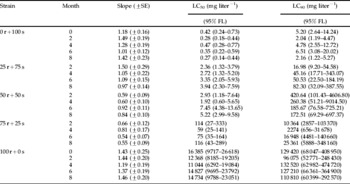
As would be expected, there were no consistent changes in susceptibility of the susceptible strain (S: 0 r+100 s), up to eight months without insecticide pressure (table 1).
Slopes and lethal concentrations (LC) of spinosad in Frankliniella occidentalis populations with initial frequencies of 0, 25, 50, 75 and 100% of resistant individuals, tested bimonthly over an eight month period.

In the resistant strain (R: 100 r+0 s), that was highly resistant to spinosad (RF50>23,000-fold), resistance was maintained up to eight months without further exposure to spinosad (tables 1 and 2). Apparently, the resistant strain was highly homogenous with the predominant genotype, rr (Bielza et al., Reference Bielza, Quinto, Fernández, Grávalos and Contreras2007b). In the absence of any immigration of susceptible genes into the population, resistance was stable for this period of time. These results could suggest that there are no significant biological disadvantages to a highly resistant lab-reared WFT population containing a low frequency of susceptible individuals. Similarly, when a highly resistant strain (RF=669-fold) of Heliothis virescens (F.) (Lepidoptera: Noctuidae), selected in the laboratory for 13 generations, was not exposed to spinosad for five generations, only minor reversion (1.4-fold) to susceptibility was observed (Wyss et al., Reference Wyss, Young, Shukla and Roe2003).
Resistant factors (95% confidence intervals) at lethal concentration 50 level towards spinosad in F. occidentalis populations with initial frequencies of 0, 25, 50, 75 and 100% of resistant individuals, tested bimonthly during eight months.

Many authors have shown that resistance is not necessarily eliminated by the cessation of pesticide treatments in F. occidentalis. Robb (Reference Robb1989) identified a strain which retained resistance to dimethoate seven years after exposure. Brøadsgaard (Reference Brødsgaard1994) obtained a moderate level of resistance to acephate (RF=95-fold), after 100 generations without selection pressure. Kontsadalov et al. (Reference Kontsedalov, Weintraub, Horowitz and Ishaaya1998) found cipermethrin resistance in a WFT lab strain reared for seven years in isolated conditions, without insecticide pressure. In a previous work (Contreras et al., Reference Contreras, Espinosa, Quinto, Grávalos, Fernández and Bielzain press), a WFT laboratory strain, very highly resistant to acrinathrin (RF>1000-fold), maintained the resistance up to eight months without further exposure to the insecticide.
When susceptible thrips were mixed with resistant thrips in the different strains (75 r+25 s, 50 r+50 s, 25 r+75 s), the resistance to spinosad declined significantly in the presence of susceptible thrips (tables 1 and 2). In the case of the population with an initial frequency of 75% of resistant thrips (75 r+25 s), spinosad resistance declined significantly two months after the mixing, in the first bioassay assessed, in the absence of selection pressure (RF50=406, table 2). However, the rate of decline was slower than in the populations with the lowest initial percentages of resistant thrips (50 r+50 s, 25 r+75 s). With successive generations, this strain did not change significantly in sensitivity and had a resistant factor of 125–430.
For the populations with an initial resistance frequency of 50% and 25% (50 r+50 s, 25 r+75 s), LC50 values decreased dramatically two months later (around two generations), with RF50s 8.4–10.4-fold, after the mixing with susceptible thrips (tables 1 and 2). With successive generations, these strains did not change significantly in sensitivity and had a resistant factor of 4.1–21.1.
Reversion to a more susceptible condition occurred very rapidly, in the first bioassay assessed two months later (ca. two generations). This is supported by the findings of Ferguson (Reference Ferguson2004), who reported a reversion of spinosad resistance over just one to three generations in field-collected populations of Liriomyza trifolii (Burgess) (Diptera: Agromyzidae). Field strains are more heterogeneous than laboratory strains owing to a bigger gene pool in field than in laboratory selections (Keiding, Reference Keiding1986). Individual field insects do not always receive sufficient exposure to insecticides; and, therefore, susceptible thrips can survive, resulting in field populations with susceptible and resistant individuals, as in our laboratory mixed populations.
Although a study in field conditions is required, our lab results suggest that spinosad resistance would not be stable under field conditions, in the early generations after the final spinosad treatment. Surviving susceptible individuals and/or immigration of susceptible ones dilute resistance through interbreeding with resistant individuals. The tendency of the resistance would be to fall quickly, particularly in the early generations, until a progressive stability was reached.
According to Roush & Croft (Reference Roush and Croft1986), the major factors that influence the rate of reversion are relative fitness differences, initial gene frequencies and the dominance relationships of the resistant and susceptible allele(s) of the phenotypes. The persistence of spinosad resistance in the isolated resistant strain, in an insecticide-free environment, indicates a low fitness cost associated with the resistance mechanism. However, more studies of fitness cost are needed to test such conjectures. Previous results (Bielza et al., Reference Bielza, Quinto, Fernández, Grávalos and Contreras2007b) showed that spinosad resistance in F. occidentalis is expressed as an almost completely recessive trait, probably controlled by one locus. The recessive nature of spinosad resistance and the apparent lack of fitness cost suggest that the main factor for reversion of spinosad resistance is the immigration of susceptible individuals. Migration occurring locally is very intense in some areas, where thrips spread among weeds, outdoors crops and greenhouses. WFT mobility is higher in plants in which inflorescences have a short life-span, as most vegetable crops.
However, for the populations with an initial frequency of resistant thrips, some level of resistance persists eight months later, even for the population with 25% of resistant thrips (RF50=14.6) (table 1). The mixed populations remained quite heterogeneous for spinosad resistance even after eight months culture, indicated by the high RF90 (table 3), particularly in the populations with a higher initial resistance frequency of 50% and 75%, with RF90 of 79.3 and 11,630-fold. A population usually takes longer to recover susceptibility than it does to acquire resistance, and resistance will probably remerge significantly faster following the reintroduction of the pesticide (May & Dobson, Reference May and Dobson1986). There are always a number of resistant survivors that could be selected in the re-use of insecticide pressures (Hoy, Reference Hoy1998; May & Dobson, Reference May and Dobson1986).
Resistant factors (95% confidence intervals) at lethal concentration 90 level towards spinosad in F. occidentalis populations with initial frequencies of 0, 25, 50, 75 and 100% of resistant individuals, tested bimonthly during eight months.

Moreover, there are not many insecticides registered that are effective against F. occidentalis, consequently growers have a small pool of unrelated insecticides to rotate. This situation results in considerable selection pressure, a pressure that will rapidly lead to evolution of thrips with even greater resistance to specific insecticides (Brødsgaard, Reference Brødsgaard1994). The problem is made worse because host crops for the pest are in continuous production, and resistant thrips populations from the host crop could migrate to new crops.
In order to mitigate these cases of resistance, an insecticide resistance management (IRM) strategy was implemented for greenhouse crops, consisting of insecticide rotation between resistance mechanisms (Espinosa et al., Reference Espinosa, Contreras, Quinto, Grávalos, Fernández and Bielza2005; Bielza et al., Reference Bielza, Quinto, Contreras, Torné, Martín and Espinosa2007a), but with a limited number of spinosad applications per crop. Dow AgroSciences, the manufacturer of spinosad, recommends an IRM strategy that limited spinosad use to a maximum of three applications per crop.
The evolution of resistance can be described by considering both genetic and ecological factors (Roush & Croft, Reference Roush and Croft1986). We have shown in this report that resistance in F. occidentalis to spinosad declined significantly in the absence of selection pressure and the presence of susceptible thrips. These results suggest that spinosad resistance probably is unstable in field conditions, mainly due to the immigration of sensitive thrips. This unstable resistance implies that the rotational use of spinosad with other insecticides, such as acrinathrin, methiocarb and formetanate, that do not show cross-resistance (Espinosa et al., Reference Espinosa, Contreras, Quinto, Grávalos, Fernández and Bielza2005; Bielza et al., Reference Bielza, Quinto, Contreras, Torné, Martín and Espinosa2007a) would be an effective approach in maintaining susceptible individuals in field populations of F. occidentalis so as to further retard the development of insecticide resistance.
However, it is clear that more investigation is needed in this area in order to further appreciate the pattern of evolution of spinosad resistance in the field and the fitness cost of the maintaining spinosad resistance in WFT populations over time.
Acknowledgements
We acknowledge anonymous referees for reviews and comments on the manuscript. This research has been supported by the Spanish Ministry of Education and Science – CICYT (AGL2005-07492-C02-01). The project was partly supported by Dow AgroSciences.