Introduction
Social, educational, material, cultural and physical factors in childhood and early adulthood have been shown to be important in determining later success both in the educational system and in the labour market (Mcintosh & Munk, Reference Mcintosh and Munk2009). These variables may also influence the chances and direction of social mobility (Blane et al., Reference Blane, Davey Smith and Hart1999). Analyses have been conducted on the relationship between movement in a social hierarchy and a wide variety of biological (Mascie-Taylor, Reference Mascie-Taylor and Boyce1984; Lasker & Mascie-Taylor, Reference Lasker and Mascie-Taylor1989; Cernerud, Reference Cernerud1995; Hart et al., Reference Hart, Davey Smith and Blane1998; Gall et al., Reference Gall, Abbott-Chapman, Patton, Dwyer and Venn2010; Krzyżanowska & Mascie-Taylor, Reference Krzyżanowska and Mascie-Taylor2011), social (Breen & Goldthorpe, Reference Breen and Goldthorpe1999, Reference Breen and Goldthorpe2001; Saunders, Reference Saunders1997, Reference Saunders2002) and economic (Blanden et al., Reference Blanden, Gregg and Macmillan2006; Andrews & Leigh, Reference Andrews and Leigh2009) aspects.
A number of social, cultural and economic variables have been identified that associate with movement between social classes, and IQ, educational level as well as childhood social background have all been implicated (Jaeger & Holm, Reference Jaeger and Holm2003; Nettle, Reference Nettle2003; Richards & Sacker, Reference Richards and Sacker2003; Deary et al., Reference Deary, Taylor, Hart, Wilson, Smith, Blane and Starr2005; Lampard, Reference Lampard2007; Wolniak et al., Reference Wolniak, Seifert, Reed and Pascarella2008; Johnson et al., Reference Johnson, Brett and Deary2010; von Stumm et al., Reference Von Stumm, Macintyre, Batty, Clark and Deary2010; Forrest et al., Reference Forrest, Hodgson, Parker and Pearce2011; Sorjonen et al., Reference Sorjonen, Hemmingsson, Lundin and Melin2011). In general, the evidence suggests that childhood intelligence, social class of origin and educational qualifications predict status attainment in adulthood. For example, a Danish study found that father's social class was the strongest predictor of educational attainment followed by father's level of education and finally cognitive ability (Jaeger & Holm, Reference Jaeger and Holm2003). Similar results have been found by Deary et al. (Reference Deary, Taylor, Hart, Wilson, Smith, Blane and Starr2005), whereas Forrest et al. (Reference Forrest, Hodgson, Parker and Pearce2011) found that childhood IQ and achieved education level were associated with upward mobility. Previous findings on the British National Child Development Study (NCDS) have revealed that individuals from lower class backgrounds have to display more merit than do individuals from higher class backgrounds to reach any given higher class level (Breen & Goldthorpe, Reference Breen and Goldthorpe1999, Reference Breen and Goldthorpe2001). On the other hand, Saunders (Reference Saunders1997, Reference Saunders2002) and Nettle (Reference Nettle2003) have suggested an individual's economic success and life opportunities more generally are determined by their own ability and effort.
Although status attainment strongly depends on education, intelligence and social class of origin, these variables only account for 35–40% of the variance in status attainment (Hauser et al., Reference Hauser, Warren, Huang and Carter1996; von Stumm et al., Reference Von Stumm, Macintyre, Batty, Clark and Deary2010). Therefore many researchers have considered a number of additional variables. For example, Hauser et al. (Reference Hauser, Warren, Huang and Carter1996) explored family structure and number of siblings, the respondent's perception of encouragement and their aspirations, whereas Biblarz et al. (Reference Biblarz, Raftery and Bucur1997) focused on different types of family structure experienced during childhood. Deary et al. (Reference Deary, Taylor, Hart, Wilson, Smith, Blane and Starr2005) and Forrest et al. (Reference Forrest, Hodgson, Parker and Pearce2011) examined height in adulthood as one of the potential predictors of status attainment. Bond & Saunders (Reference Bond and Saunders1999) and Schoon (Reference Schoon2008) analysed academic aspirations and school motivation, while DiRago & Vaillant (Reference DiRago and Vaillant2007) pointed out timely childhood development. The effects of self-esteem, locus of control and childhood behaviour disturbance were also considered by von Stumm et al. (Reference Von Stumm, Gale, Batty and Deary2009, Reference Von Stumm, Macintyre, Batty, Clark and Deary2010).
However, very few studies have analysed the influence of social background, ability and other psychological variables on occupational status in adulthood simultaneously (Hauser et al., Reference Hauser, Warren, Huang and Carter1996; Jaeger & Holm, Reference Jaeger and Holm2003; Deary et al., Reference Deary, Taylor, Hart, Wilson, Smith, Blane and Starr2005; Forrest et al., Reference Forrest, Hodgson, Parker and Pearce2011).
The present study examined the relationship between inter-generational social mobility of sons and daughters between 1958 and 1991 in relation to the following biological variables (sex, birth order) and social variables (number of children in family, father's social class, region, educational attainment of child and father, educational and cognitive test scores: reading, mathematics, verbal and non-verbal IQ tests) in a large British national cohort study.
Methods
The data used in these analyses were collected as part of the National Child Development Study (NCDS). The NCDS is a longitudinal (panel) study of all children born in England, Wales and Scotland in the week 3–9th March 1958. Subsequently the children and their families were followed up periodically in 1965, 1969 and 1974. Thereafter just the index child was followed into adulthood and there were re-studies in 1991 and 2000 (at ages 33 and 42, respectively). A total of 2169 boys and 2304 girls for whom there were complete data from birth to 33 years of age were studied. The few children from ethnic minorities were excluded from the analyses. Attrition was due to common causes (refusal, moving or death) and refusal rates were relatively low, so the cohort remained broadly representative in terms of biological, social and health characteristics from childhood to adulthood (Power & Elliott, Reference Power and Elliott2006; Atherton et al., Reference Atherton, Fuller, Shepherd, Strachan and Power2008).
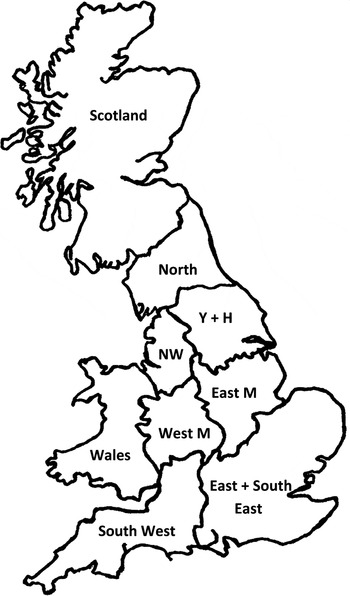
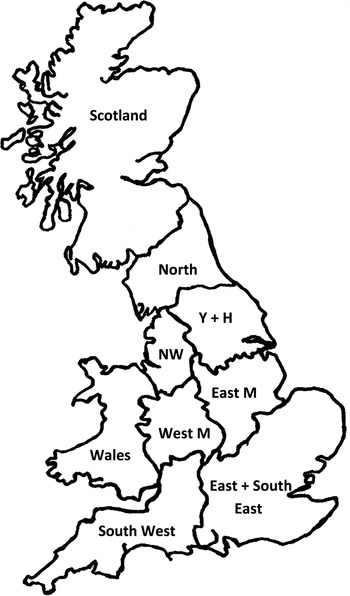
Information on a number of biosocial variables was studied. Birth order was categorized as first, second and third born and above. Father's social class in 1958 was defined using the Registrar General's classification where I refers to professional, II to intermediate (mainly managerial), III skilled worker, IV semi-skilled worker and V unskilled. The extent of social class mobility was determined inter-generationally between father and child (son or daughter). Inter-generational social mobility between 1958 and 1991 was categorized as none (no change in social class between the father's and index child's social class), upwardly mobile (where the index child moved up one or more social classes compared with their father) or downwardly mobile (where the index child moved down one or more social classes compared with their father). Because sons born in social class I can only be non-mobile or downwardly mobile and those sons born in social class V can only be non-mobile or upwardly mobile, the analyses were restricted to father's social classes II to IV. Families were placed into one of the nine standard regions comprising North, Yorkshire and Humberside, East Midlands, East and South East, South West, West Midlands, North West, Wales and Scotland (see Fig. 1).
Map of Britain showing the nine study regions (Y+H=Yorkshire+Humberside; East M=East Midlands; West M=West Midlands; NW=North West).
Education of the index child as well as father's educational level were classified as: 1, university; 2, A level(s); 3, O level(s); 4, apprenticeship or no qualifications. The reading, mathematics and verbal and non-verbal IQ test scores of the index child at age 11 were also analysed. Family size was analysed as a continuous variable and because of right skew was normalized using a logarithmic (base 10) transformation.
The ten variables did not show significant multicollinearity as defined by a correlation of above 0.90 (Tabachnick & Fidell, Reference Tabachnick and Fidell2006).
Results
Relationship between biosocial variables and inter-generational social mobility
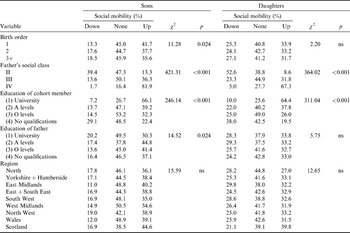
Table 1 presents the extent of inter-generational social mobility of sons and daughters in relation to five categorical biosocial variables. Birth order and social mobility were just significantly associated but only for sons (χ 2(4)=11.28, p=0.024). The main finding was that first-born sons were more likely to be socially non-mobile or upwardly mobile than expected while second- or later-born sons were more likely to be downwardly socially mobile (Table 1).
Relationship between categorical variables and inter-generational social mobility (row percentages are presented)
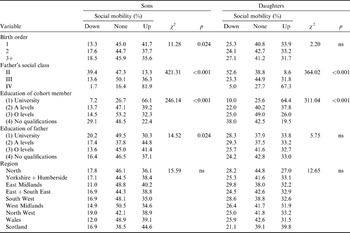
There was a significant relationship between father's social class and inter-generational social mobility of sons (χ 2(8)=421.31, p<0.001) and daughters (χ 2(8)=364.02, p<0.001) (Table 1). Children from social classes III and IV were more likely to be upwardly socially mobile than expected and those from social class II were much more likely to be downwardly socially mobile than expected (Table 1).
The results for education of the cohort members (whether sons or daughters) indicated that there was a very significant association between their educational attainment and inter-generational social mobility (χ 2(6)=246.14, p<0.001 for sons and χ 2(6)=311.04, p<0.001 for daughters). It appeared that those with higher educational qualifications (university and A levels, categories 1 and 2) were much more upwardly socially mobile than expected while children with a medium level of education and without qualifications (O levels and no qualifications, categories 3 and 4) were more likely to be non-socially mobile or downwardly mobile than expected (Table 1).
There were significant relationships between father's education and inter-generational social mobility of sons (χ 2(6)=14.52, p=0.024). Those whose fathers attained the lowest level of education were more likely to be non-socially mobile (29.0%) or upwardly mobile (23.2%) than downwardly mobile. Furthermore, sons whose fathers achieved higher educational level were much more downwardly mobile than expected (Table 1).
No regional differences were found in inter-generational social mobility (χ 2(16)=15.59, p=0.482 for sons and χ 2(16)=12.65, p=0.698 for daughters) (Table 1).
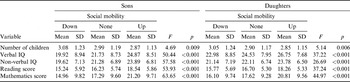
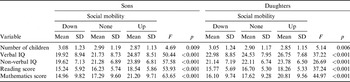
There was a significant relationship between the number of children in the family and inter-generational social mobility of the cohort members (F=4.69, p=0.009 for sons and F=5.14, p=0.006 for daughters) (Table 2). Upwardly socially mobile or non-mobile children came from families with smaller numbers of children, while children with higher number of siblings were much more likely to be downwardly mobile. The analyses of the cognitive tests revealed strong associations with social mobility, more so for sons than daughters (Table 2). There was a general tendency for mean scores to increase from downwardly socially mobile to upwardly mobile. Post hoc tests revealed that the main differences were between the upwardly mobile versus the non- and downwardly mobile; for example, for reading score, the upwardly mobile mean was 2.31 and 3.30 above the non- and downwardly mobile means, whereas the difference between the non-mobile and downwardly mobile means was only 0.99.
Relationship between continuous variables and inter-generational social mobility
Multinomial logistic regression analyses
In order to test which of the biosocial variables contributed to explaining inter-generational social mobility, a series of multinomial logistic regression analyses were undertaken for sons and daughters separately. In the first analysis all ten socio-economic and cognitive variables were included in the model. It appeared that for both sons and daughters their education and social class of their father, as well as non-verbal IQ and reading and mathematics scores for sons, were the most important variables. Overall, just over 60% of the three mobility categories were predicted for both sons and daughters, and there was better prediction of the non-mobile, followed by the upwardly and downwardly mobile groups.
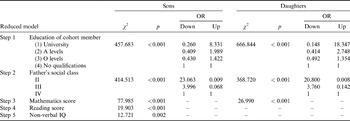
In the second analysis a stepwise multinomial logistic regression procedure was used in which the most significant predictor entered the model first followed by the second most significant predictor, and so on. The results (Table 3) revealed that for both sons and daughters the most significant predictor of mobility categories was education of the cohort member, followed by social class of the father and then mathematics score. Only in sons were reading and non-verbal IQ scores significant predictors. With this reduced model the percentage correctly predicted fell slightly in both sons and daughters with the non-mobile group being best predicted.
Results of multinomial regression analyses to predict inter-generational social mobility
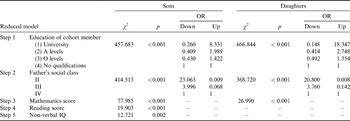
63.3% of boys and 62.2% of girls were correctly classified (boys: downwardly mobile 17.9%; non-mobile 80.9%; upwardly mobile 61.9%; girls: 34.9%; 77.4%; 64.0%, respectively).
Better-educated cohort members were more likely to be upwardly mobile than the non-qualified (1.4 to 8.3 times for sons and 1.4 to 18.4 times for daughters). Sons and daughters of fathers from higher social classes were 4.0 to 23.1 for sons and 3.8 to 20.8 for daughters times more likely to be downwardly mobile than children of fathers from lower social classes (Table 3).
Discussion
This paper examines the relationship between inter-generational social mobility (between father's social class and cohort member's own social class in adulthood) and selected variables in a British cohort study (NCDS). Among the biosocial variables analysed separately almost all of them (birth order, sibship size in the families, father's social class and his education, educational attainment of the cohort members and the results of their cognitive tests, i.e. reading, mathematics and verbal and non-verbal IQ tests) were associated with cohort member's social class.
Birth order has been considered one of the most influential environmental factors in child development (Berger & Felsenthal-Berger, Reference Berger and Felsenthal-Berger2009). First-borns tend to be larger and stronger, and have better health outcomes and socioeconomic environment than later-born siblings (Barreto & Rodrigues, Reference Barreto and Rodrigues1992; Elliott, Reference Elliott1992; Kaplan et al., Reference Kaplan, Mascie-Taylor and Boldsen1992; Li & Taylor, Reference Li and Taylor1993; Lewis & Britton, Reference Lewis and Britton1998; Modin, Reference Modin2002; Argys et al., Reference Argys, Rees, Averett and Witoonchart2006). A number of studies have found that first-borns had an academic advantage over later-borns (Zajonc & Markus, Reference Zajonc and Markus1975; Zajonc, Reference Zajonc1976; Cherian, Reference Cherian1990; Sulloway, Reference Sulloway1996; Kantarevic & Mechoulan, Reference Kantarevic and Mechoulan2005; Fergusson et al., Reference Fergusson, Horwood and Boden2006; de Haan, Reference de Haan2010) and higher IQ scores (Paulhus et al., Reference Paulhus, Trapnell and Chen1999; Bjerkedal et al., Reference Bjerkedal, Kristensen, Skjeret and Brevik2007; Boomsma et al., Reference Boomsma, van Beijsterveld, Beem, Hoekstra, Polderman and Bartels2008; Black et al., Reference Black, Devereux and Salvanes2011), but other studies have failed to confirm this finding (Steelman & Powell, Reference Steelman and Powell1985; Ha & Tam, Reference Ha and Tam2011). A significant positive relationship between birth order and social skills, such as outgoingness, getting along with others, popularity, ease in making friends, has also been found (Steelman & Powell, Reference Steelman and Powell1985).
According to Sulloway (Reference Sulloway1996) children have an innate tendency to develop the attitudes and personalities best suited for maximizing the parental resources that they get. They compete for parental investment (time, energy and material resources) by creating distinctive niches. It has been hypothesized (Sulloway, Reference Sulloway1996) that first-borns are less agreeable as compared with later-born children because first-borns occupy a dominant position in a sibling group and develop more conservative attitudes (dependent, serious, more sensitive to parents' expectations) than their younger siblings. First-borns have been found to be more extravert, self-confident, assertive and aggressive than later-borns (Sulloway, Reference Sulloway1996; Paulhus et al., Reference Paulhus, Trapnell and Chen1999; Rohde et al., Reference Rohde, Atzwanger, Butovskaya, Lampert, Mysterud, Sanchez-Andres and Sulloway2003). They are subjected to more accelerated role playing and training, and are more responsible, well-organized, supportive of authority, ‘tough-minded’ and patient in real-life decisions. Consequently, early-born children tend to be more ambitious, achievement- and success-oriented as well as motivated to attain a high social position and eminence than their later-born counterparts (Sulloway, Reference Sulloway1996; Rohde et al., Reference Rohde, Atzwanger, Butovskaya, Lampert, Mysterud, Sanchez-Andres and Sulloway2003; Healey & Ellis, Reference Healey and Ellis2007).
The findings from this study revealed that first-born sons were more likely to be socially upwardly mobile or non-mobile, while later-born sons were more likely to be downwardly socially mobile. However, in the multivariate analyses the birth order effect was not significant.
An inverse and consistent relationship between the number of siblings and health, as well as educational outcomes, has been widely reported. For example it has been found that people who have more siblings, on average, have grown up in more overcrowded accommodation, with greater exposure to early infections, and with access to a less than adequate diet (Blane et al., Reference Blane, Davey Smith and Hart1999). Consequently, a greater number of siblings is strongly related to early childhood morbidity and mortality risk (Hart & Davey Smith, Reference Hart and Davey Smith2003). Furthermore, smaller sibships are more likely to produce higher achieving and more intelligent children than larger families (Falbo & Polit, Reference Falbo and Polit1986; Blake, Reference Blake1989; Downey, Reference Downey1995; Iacovou, Reference Iacovou2001; Bradley & Taylor, Reference Bradley and Taylor2004; Parr, Reference Parr2006; Li et al., Reference Li, Zhang and Zhu2008; Booth & Kee, Reference Booth and Kee2009; Jaeger, Reference Jaeger2009; Sen & Clemente, Reference Sen and Clemente2010).
Children who come from smaller families have a better chance of being upwardly mobile compared with children from larger families. A negative relation between upward mobility and family size was found by Tomasson (Reference Tomasson1966) in a sample of 583 couples from Peoria, Springfield and Rockford, Illinois. Marjoribanks (Reference Marjoribanks1987), using longitudinal data from 310 Australians, found that sibsize was not related to the social mobility of males, but that it did influence the eventual social status of females. Decreased chance of upward mobility with increasing number of siblings has been reported by Blane et al. (Reference Blane, Davey Smith and Hart1999) in a cohort of 5645 employed men from the West of Scotland Collaborative study. Van Bavel et al. (Reference Van Bavel, Moreels, Van de Putte and Matthijs2011) investigated the association between family size and inter-generational mobility in the city of Antwerp between 1846 and 1920 and found, after controlling for confounding factors, that people with many children were more likely to end up in the lower classes.
In the current study children from families with smaller numbers of sibs were more likely to be socially non-mobile or upwardly mobile. However, similarly to birth order, the sibling size effect became non-significant in the multivariate analyses.
The role of social origin (parental social class in childhood) in health outcomes, educational attainment and social class in adulthood has been reported very often (Shavit & Blossfeld, Reference Shavit and Blossfeld1993; Davey Smith et al., Reference Davey Smith, Hart, Hole, MacKinnon, Gillis and Watt1998; Bosma et al., Reference Bosma, van de Mheen and Mackenbach1999; Breen & Jonsson, Reference Breen and Jonsson2000; Breen & Goldthorpe, Reference Breen and Goldthorpe2001; Jaeger & Holm, Reference Jaeger and Holm2003; Iannelli & Paterson, Reference Iannelli and Paterson2005; von Stumm et al., Reference Von Stumm, Gale, Batty and Deary2009). However, there is a debate among social scientists as to whether an individual's economic success and life opportunities more generally are determined by their own ability and effort (Saunders, Reference Saunders1997, Reference Saunders2002) or by their parents' socioeconomic status (Breen & Jonsson, Reference Breen and Jonsson2000; Breen & Goldthorpe, Reference Breen and Goldthorpe1999, Reference Breen and Goldthorpe2001). Breen and Goldthorpe (Reference Breen and Goldthorpe1999, Reference Breen and Goldthorpe2001), using the NCDS data, found a substantial effect of class of origin on social class at age 33, and that education substantially mediated these effects. They pointed out that individuals from lower class backgrounds have to display more merit than do individuals from higher class backgrounds to reach any given higher class level. Carneiro's et al. (Reference Carneiro, Crawford and Goodman2007) results based on the same material showed that children from both professional and non-manual family backgrounds exhibit significantly greater cognitive and non-cognitive skills than children from manual backgrounds. Jaeger & Holm (Reference Jaeger and Holm2003), using data from the Danish Youth Longitudinal Panel Survey, found father's social class to be the strongest predictor of educational attainment, followed by father's level of education and finally cognitive ability. It has been demonstrated on the data from the 2001 Scottish Household Survey, that education plays an intermediary role between class of origin and class of destination, i.e. there is still a strong direct effect of social class of origin on people's class of destination – even after taking educational attainment into account (Iannelli & Paterson, Reference Iannelli and Paterson2005). Deary et al. (Reference Deary, Taylor, Hart, Wilson, Smith, Blane and Starr2005) suggested that the correlation between childhood IQ and own social class at mid-life is stronger than the correlation with father's social class. Furthermore, the association between parental social class and class of destination is weaker for more highly educated people than for less educated people. A study using conscription data and follow-ups on 36,156 Swedish men born between 1949 and 1951 found that when adjusting for attained social position, people with a high social position of origin tend to have higher intelligence and level of education than people with a lower social position of origin (Sorjonen et al., Reference Sorjonen, Hemmingsson, Lundin and Melin2011).
The current study also found a significant relationship between father's social class and inter-generational social mobility of the cohort members. Children from social classes III and IV were more likely to be upwardly socially mobile than expected and those from social class II were much more likely to be downwardly socially mobile. In the multivariate analysis it appeared that for both sons and daughters the most significant predictor of mobility categories was education of children, followed by social class of the father.
Education has been described as ‘a vehicle for professionalization’ and associated with social mobility (Müller & Shavit, Reference Müller, Shavit, Shavit and Müller1998; Nettle, Reference Nettle2003; Cardano et al., Reference Cardano, Costa and Demaria2004; Machin, Reference Machin2004; Deary et al., Reference Deary, Taylor, Hart, Wilson, Smith, Blane and Starr2005; Iannelli & Paterson, Reference Iannelli and Paterson2005), measured either as number of years of education, level of education or IQ. In educational attainment studies, parents' educational characteristics have not been a central concern, often being viewed as one aspect of the concept of ‘family background’ (Sieben & De Graaf, Reference Sieben and De Graaf2001). Parental education correlates with several other factors such as income, occupation, culture and social resources that matter in a life-cycle perspective. Lampard's (Reference Lampard2007) examination of the direct and indirect effects of parents' education and social classes on children's occupational attainment in a British Household Panel Survey (BHPS) has shown that parental education plays a substantial role in the inter-generational transmission of advantage, and has indicated that part (but not all) of the relationship between class origin and occupational attainment can be explained in terms of the inter-generational transmission of cultural capital. Data from the Columbia County Longitudinal Study have revealed a strong relationship between parents' educational level and children's occupation. Parents' educational level when the child was 8 years old significantly predicted educational and occupational success for the child 40 years later (Dubow et al., Reference Dubow, Boxer and Huesmann2009).
Black et al. (Reference Black, Devereux and Salvanes2007) pointed out that IQ is a strong predictor of educational attainment and future labour market success. Studies of intelligence and class mobility have demonstrated that men who are upwardly mobile in socioeconomic terms tend to have higher IQ scores than their fathers, whilst those who are downwardly mobile tend to have lower scores (Waller, Reference Waller1971; Mascie-Taylor & Gibson, Reference Mascie-Taylor and Gibson1978). In the current study, higher IQ (whether sons or daughters) was associated with upward mobility in the univariate analyses and was significant for mathematics score among sons and daughters in the multivariate analyses. Reading score and non-verbal IQ were significant only among sons. Using the same NCDS data, Saunders (Reference Saunders2002) found that class of origin accounted for about 25% of the explained variance in class at age 33, whereas ability, motivation and qualifications accounted for over 60%. As has been reported by Nettle (Reference Nettle2003), attained social class in adulthood was more strongly related to GA score (the General Ability test) than parental social class. Similar results were reported by Deary et al. (Reference Deary, Taylor, Hart, Wilson, Smith, Blane and Starr2005) among men who participated in the Scottish Mental Survey of 1932 and thereafter in the Midspan Collaborative study in Scotland between 1970 and 1973. It appeared that height at mid-life, years of education and childhood IQ were significantly positively related to upward social mobility. Controlling for the effects of the individual independent variables reduced the effects, with only height and education remaining significant; childhood IQ was of borderline significance. In a birth cohort of 6281 men from Aberdeen, Scotland, von Stumm et al. (Reference Von Stumm, Macintyre, Batty, Clark and Deary2010) confirmed that education had the strongest direct effect on status attainment at mid-life. The results of the present study are also in agreement with other British data analysed by Forrest et al. (Reference Forrest, Hodgson, Parker and Pearce2011). For the Newcastle Thousand Families 1947 birth cohort childhood IQ and achieved education level were both significantly and positively related to upward inter-generational mobility at the univariate level. However, only childhood IQ was significantly associated with upward mobility between 25 and 49–51 years, whereas only education level was significantly associated with upward mobility between 5 and 25 years, which means that IQ level is more strongly connected with social class attained in middle-age rather than early adulthood (Forrest et al., Reference Forrest, Hodgson, Parker and Pearce2011).
The present data clearly show that for both sons and daughters the most significant predictor of inter-generational social mobility was their own educational level. Children (whether sons or daughters) from social classes III and IV with higher educational qualifications (having a degree or above; teaching or nursing qualification; passed A levels) were more likely to be upwardly socially mobile or non-mobile. In the light of these results, there is agreement with Saunders' (Reference Saunders1997, Reference Saunders2002) point of view that social mobility in Britain takes place largely on meritocratic principles.