Introduction
The interpretation of findings from clinical neuroAIDS research is complicated by the myriad of confounding and comorbid conditions that HIV-positive (HIV+) patients often present with, such as head injuries, other central nervous system (CNS) -relevant medical conditions, and substance use (Heaton et al., Reference Heaton, Clifford, Franklin, Woods, Ake, Vaida and Grant2010; Martin-Thormeyer & Paul, Reference Martin-Thormeyer and Paul2009; Wojna & Nath, Reference Wojna and Nath2006). As such, it has been difficult to draw definitive conclusions regarding the etiological source of neurocognitive deficits from individual studies of complicated HIV+ cohorts. Furthermore, the motoric abnormalities traditionally observed in HIV associated neurocognitive disorders (HAND) have not yet been demonstrated to be definitively HIV-related and occurring independently from confounds and comorbid conditions.
One of the most compelling confounding factors in neuroAIDS research is substance use (Gonzalez & Cherner, Reference Gonzalez and Cherner2008). It is estimated that upward of 81% of persons living with HIV/AIDS have used illicit substances in their lifetime, and many have comorbid substance use disorders, which are often chronic and involve multiple substances (Bing et al., Reference Bing, Burnam, Longshore, Fleishman, Sherbourne, London and Shapiro2001; Burnam et al., Reference Burnam, Bing, Morton, Sherbourne, Fleishman, London and Shapiro2001; NIDA, 2011). The neurobiologic and neuroimaging literatures in both HIV+ and seronegative samples firmly establish the neurotoxic impact of substances such as alcohol, cocaine, and opiates (Buttner, Reference Buttner2011; Friedman, Newton, & Klein Reference Friedman, Newton and Klein2003; Lundqvist, Reference Lundqvist2010; Venkatesan, Nath, Ming, & Song, Reference Venkatesan, Nath, Ming and Song2007). Likewise, many neurocognitive studies in the general population report performance decrements in substance users across an array of cognitive domains, but particularly those purportedly sub-served by frontal-striatal circuitry (Fernández-Serrano, Peréz-García, Río-Valle, & Verdejo-García, Reference Fernández-Serrano, Pérez-García, Río-Valle and Verdejo-García2010; Gruber, Silveri, & Yurgelun-Todd, Reference Gruber, Silveri and Yurgelun-Todd2007; Kalechstein & van Gorp, Reference Kalechstein and van Gorp2007; Scott et al., Reference Scott, Woods, Matt, Meyer, Heaton, Atkinson and Grant2007). However, neurocognitive research in substance-using HIV+ cohorts has produced mixed findings. Studies that predate the use of highly active antiretroviral therapy (HAART), surprisingly, failed to uncover significant effects of HIV infection in cohorts of active substance users, despite the generally advanced nature of inadequately treated HIV disease (Concha et al., Reference Concha, Graham, Muñoz, Vlahov, Royal, Updike and McArthur1992, Reference Concha, Selnes, Vlahov, Nance-Sproson, Updike, Royal and McArthur1997; Durvasula et al., Reference Durvasula, Myers, Satz, Miller, Morgenstern, Richardson and Forney2000; Selnes et al., Reference Selnes, Galai, McArthur, Cohn, Royal, Esposito and Vlahov1997). Results from HAART-era investigations have varied by the substance being examined and the design of the study. Byrd et al. (Reference Byrd, Fellows, Morgello, Franklin, Heaton, Deutsch and Grant2011), with an exclusively HIV+ sample (the CHARTER cohort), did not detect any effect of substance use on neurocognition when comparing groups of HIV-infected adults who varied in substance use histories. However, other investigators, who have included comparable HIV-negatives in their study designs, have reported significant effects of HIV status and sometimes, substance use, on cognition (Chana et al., Reference Chana, Everall, Crews, Langford, Adame, Grant and Masliah2006; Martin et al., Reference Martin, Pitrak, Rains, Grbesic, Pursell, Nunnally and Bechara2003; Rippeth et al., Reference Rippeth, Heaton, Carey, Marcotte, Moore, Gonzalez and Grant2004). Nevertheless, the HIV effect in HAART-era substance users remains unclear, as others have failed to detect a detrimental effect on cognition (Basso & Bornstein, Reference Basso and Bronstein2000; Devlin et al., Reference Devlin, Gongvatana, Clark, Chasman, Westbrook, Tashima and Cohen2012; Durvasula et al., Reference Durvasula, Myers, Satz, Miller, Morgenstern, Richardson and Forney2000; Gonzalez & Cherner, Reference Gonzalez and Cherner2008; Martin-Thormeyer & Paul, Reference Martin-Thormeyer and Paul2009).
Currently, it is unclear whether the lack of consistency regarding the use of illicit substances and cognition within the neuroAIDS literature is due to methodological differences or related to truly varied patterns of neurocognitive substance impacts within HIV infection. Because intravenous use of opiates is a primary disease transmission mechanism, intravenous drug users (IVDUs) have been among the most studied substance using HIV+ group (Bell, Arango, & Anthony, Reference Bell, Arango and Anthony2006; Bell, Brettle, Chiswick, & Simmonds, Reference Bell, Brettle, Chiswick and Simmonds1998; Concha et al., Reference Concha, Graham, Muñoz, Vlahov, Royal, Updike and McArthur1992; Selnes et al., Reference Selnes, Galai, McArthur, Cohn, Royal, Esposito and Vlahov1997). One shortcoming of many neurocognitive studies of HIV+ IVDUs has been the lack of attention to methadone maintenance treatment status. This opioid replacement therapy has been demonstrated to exert significant detrimental effects on motor speed, working memory, decision making, and metamemory, yet its potentially confounding influence in studies of neurocognition in HIV has largely been overlooked (Darke, McDonald, Kaye, & Torok, Reference Darke, McDonald, Kaye and Torok2012; Mintzer & Stitzer, Reference Mintzer and Stitzer2002; Soyka et al., Reference Soyka, Lieb, Kagerer, Zingg, Koller, Lehnert and Hennig-Fast2008). Similarly, studies in this area have been inconsistent in the control of other important confounding factors that could dilute results. For example, despite the demonstrated importance of reading level to cognitive test performance and differences among substance users on reading level, few studies have examined and controlled for this factor. Additional methodologic oversights include total reliance upon self-report of drug use for categorization into drug groups (absence of urine toxicology), and little to no attention to hepatitis C status or distal sensory polyneuropathy. Finally, cognitive studies are often done in disciplinary isolation and rarely combined with neurologic examinations to expand the understanding of these complicated cohorts, and to determine if objective CNS dysfunction, such as motor impairment, is impacting observed relationships.
Historically, motoric abnormalities (e.g., hyperreflexia, motor slowing, gait disturbance, limb incoordination, hypertonia) were considered a central component of the manifestation of central nervous system dysfunction in HIV-infection (Janssen, Cornblath, Epstein, & Foa, Reference Janssen, Cornblath, Epstein and Foa1991; Navia, Jordan, & Price, Reference Navia, Jordan and Price1986). In fact, motor dysfunction was included among the diagnostic criteria for HIV-associated dementia (Janssen et al., Reference Janssen, Cornblath, Epstein and Foa1991). Recently, motor abnormalities were shown to be related to HAND in a HAART-era cohort (Robinson-Papp et al., Reference Robinson-Papp, Byrd, Rivera Mindt, Oden, Cohen, Simpson and Morgello2008). However, no studies have examined the specificity of the neurologically assessed motoric impairments to HIV in complicated cohorts with other risk factors for motor abnormalities, such as substance use. For example, there is marked increased risk for neurologic abnormalities in chronic substance use for neuropathy, ataxia, stroke, cerebral volume reduction, and white matter hyperintensities (Brown, Prager, Lee, & Ramsey, Reference Brown, Prager, Lee and Ramsey1992; Koike et al., Reference Koike, Iijima, Sugiura, Mori, Hattori, Ito and Sobue2003; Liu et al., Reference Liu, Hao, Kaneko, Ouyang, Zhang, Xu and Liu2009; Neiman, Haapaniemi, & Hillbom, Reference Neiman, Haapaniemi and Hillbom2000; Richter et al., Reference Richter, Pearson, Bruun, Challenor, Brust and Baden1973; Welch, Reference Welch2011; Yeung, Bhalla, & Birns, Reference Yeung, Bhalla and Birns2011). It is not known whether the motoric symptoms of HIV might also occur in seronegative chronic substance users and the degree to which such neurologically determined symptoms might be associated with neurocognition.
In the current pilot study, we applied rigorous matching criteria to a group of chronic substance using adults, who differed on HIV status, in an effort to increase the understanding of the intersection of substance use and HIV infection on cognitive and motoric functioning. We used a comprehensive cognitive battery used in large HAART-era cohorts (Woods et al., Reference Woods, Rippeth, Frol, Levy, Ryan, Soukup and Heaton2004), and the HIV Dementia Motor Scale (Robinson-Papp et al., Reference Robinson-Papp, Byrd, Rivera Mindt, Oden, Cohen, Simpson and Morgello2008) to test whether neurologically assessed motor abnormalities were related to HIV and cognitive functioning. We used an ethnically diverse, urban sample of chronic substance users and hypothesized that impairments in cognitive domains subserved by frontal subcortical circuitry, traditionally impacted by HIV infection, would be detected in the HIV+ group and that this group would demonstrate motoric abnormalities that are uniquely associated with compromised cognition.
Methods
Participants
Baseline data for HIV+ (n = 30) participants was abstracted from the Manhattan HIV Brain Bank (MHBB U01MH083501), a longitudinal observational, organ donation study of advanced HIV disease that includes biannual neurologic, neuropsychologic (NP), and psychiatric examinations (Morgello et al., Reference Morgello, Estanislao, Simpson, Geraci, DiRocco, Gerits and Sharp2004). The HIV+ participants selected for this study were comparable to the unselected HIV+ participants in the MHBB in age, education, gender, reading level, and degree of immune compromise (p values for all comparisons >.10). HIV-negative (HIV-) participants (n = 30) were recruited specifically for the purposes of this analysis, and were not from the MHBB study. Recruitment occurred primarily through advertisements at methadone maintenance clinics, medical centers, and local businesses in East Harlem, New York. All participants were primarily English-speaking. Participants were excluded from this study if they had signs of distal sensory polyneuropathy (DSP) in their hands, history of stroke or opportunistic infection, hearing, vision, or motor impairment which impeded the completion of the NP battery, active psychosis, or no history of chronic substance use. HIV- status was confirmed via Western blot. This study was approved by the Mount Sinai School of Medicine Institutional Review Board.
Procedure and Measures
The following assessments were completed for all participants: neuromedical examination, including blood samples for laboratory and virologic determinations; neurologic examination; neuropsychological testing; and a diagnostic psychiatric interview.
Neuromedical/ Neurologic Examination
The neuromedical examination included the collection of a detailed medical history and a structured medical evaluation. Collected blood samples were tested for hepatitis C antibodies, CD4+ lymphocyte counts and HIV load (for HIV+ participants), and the presence of HIV antibodies by Western Blot (for HIV-negatives). Urine toxicology screened for amphetamine, barbiturates, benzodiazepines, cannabinoids, cocaine, opiates, phencyclidine, methadone, and propoxyphene. Illicit status was determined by review of prescribed medications. Participants with positive urine toxicology were not excluded from study but were rescheduled if they presented as behaviorally intoxicated. Methadone maintenance status was confirmed by the detection of methadone metabolites in the urine. Participants underwent a standard neurologic examination conducted by a board certified neurologist.
Neurocognitive Test Battery
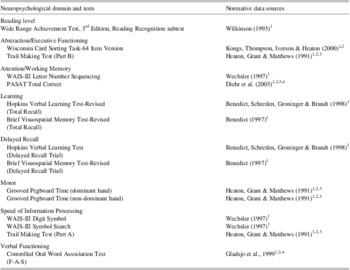
Participants were administered a battery of neuropsychological tests that assessed a broad range of cognitive abilities sensitive to HIV impairment (Woods et al., Reference Woods, Rippeth, Frol, Levy, Ryan, Soukup and Heaton2004). Specific tests and their normative references are listed in Table 1. All individual tests were grouped according to the theoretically derived domains indicated in Table 1 (Woods et al., Reference Woods, Rippeth, Frol, Levy, Ryan, Soukup and Heaton2004). Raw scores from all tests were converted to demographically adjusted T-scores that adjusted performance for the effects of age, education, sex, and ethnicity, where appropriate. Domain scores were derived from the mean T-scores of the individual tests in that particular domain, and the global score is the mean of all individual neuropsychological test T-scores.
Neuropsychological test battery and normative data

Note: Wechsler Adult Intelligence Scale (WAIS); Paced Auditory Serial Arithmetic Test (PASAT). Normative data corrects for the following demographic characteristics indicated by superscript number: 1 = age; 2 = education; 3 = gender; 4 = ethnicity.
Substance Use Assessment
The Psychiatric Research Interview for Substance and Mental disorders (PRISM), a semi-structured clinical interview, was used to assess the presence of substance use disorders (abuse and dependence) using DSM-IV diagnostic criteria (Hasin et al., Reference Hasin, Trautman, Miele, Samet, Smith and Endicott1996). Past disorders are defined as having occurred before the last 12 months, whereas current disorders occurred within the last 12 months. As mentioned above, urine toxicology was used to determine shorter-term, acute substance use.
Motor Functioning
The HIV-Dementia Motor Scale (HDMS) was used to measure the presence and severity of motor abnormalities (Robinson-Papp et al., Reference Robinson-Papp, Byrd, Rivera Mindt, Oden, Cohen, Simpson and Morgello2008). The HDMS uses elements of a standard neurologic examination to assess five motor domains: strength, tone, reflexes, coordination, and gait. The following assessments are performed in each limb: manual muscle strength testing of a proximal and distal muscle, motor tone, and a deep tendon reflex. In addition, an overall assessment of coordination and gait is made, and the presence of pathological reflexes (snout, glabellar, and extensor plantar response), is determined. A total score ranging from 0–20 is calculated with higher scores reflecting more motor abnormalities. The HDMS was developed and validated in HIV-infected populations (Robinson-Papp et al., Reference Robinson-Papp, Byrd, Rivera Mindt, Oden, Cohen, Simpson and Morgello2008); before this study, it has not been examined in HIV-negatives.
Matching Procedures
HIV-negatives were individually matched, to the degree possible, to HIV+ participants who were selected from the pool of MHBB subjects with baseline NP and psychiatric data (n = 355). The matching factors were selected based upon studies which identified variables relevant to NP test performance in HIV-infected samples and/or in normative samples (Byrd et al., Reference Byrd, Fellows, Morgello, Franklin, Heaton, Deutsch and Grant2011; Ryan et al., Reference Ryan, Baird, Mindt, Byrd, Monzones and Bank2005; Verdejo, Toribio, Orozco, Puente, & Pérez-García, Reference Verdejo, Toribio, Orozco, Puente and Pérez-García2005). Our matching process was based upon WRAT-3 Reading subtest scaled score, urine toxicology result, gender, status for current methadone maintenance therapy and hepatitis C serostatus.
Data Analysis
Demographic and medical characteristics were compared using t tests or Pearson's χ2 tests, as appropriate. Multiple regression analyses were used to determine whether HIV status accounted for a significant amount of the variance in each of the NC domains and the global score after the variance associated with the clinical/demographic variables of interest (reading level, hepatitis C status, methadone maintenance therapy status, and positive urine toxicology results) had been accounted for. As the focus of this analysis was on the neurocognitive impact of HIV, we did not examine whether the clinical/demographic variables of interest exerted influence in an independent or interactive manner. Thus, these variables were entered together into multiple regression analyses at step one, and HIV status entered independently at step 2. Multi-collinearity diagnostics were also calculated with the use of variance inflation factor (VIF) values and tolerance levels. Data from the HDMS were log10 transformed before analyses to correct for the extreme positive skew in the distribution of these data. Mann-Whitney U tests were used to compare HDMS scores between HIV+ and HIV- groups. Because HDMS has only been previously validated in HIV, to examine whether it was associated with neurocognition, we conducted separate analyses of variance/analyses of covariance (ANOVA/ANCOVAs) within each HIV grouping.
Results
Clinical Characteristics
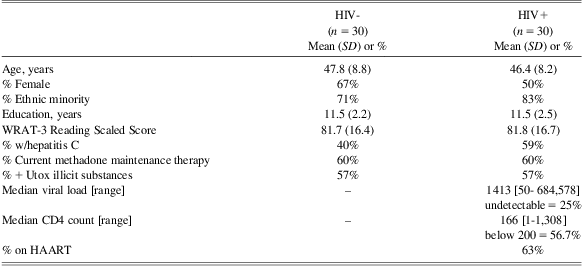
As planned with the matching procedure, the HIV+ and HIV- groups were similar in age, education, gender, ethnicity, reading level, proportion with hepatitis C, urine toxicology positive for illicit substances, and methadone maintenance therapy (all p values >.05; see Table 2). For the HIV+ group, the median CD4 count was 166 with a range of 1–1,308 and 25% had an undetectable viral load.
Demographic and clinical characteristics
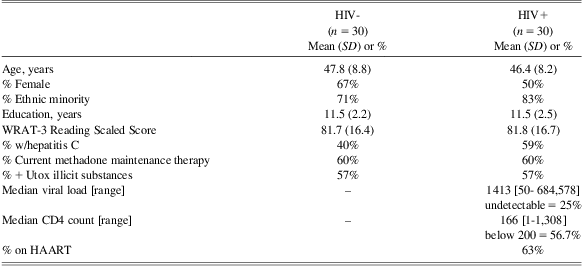
HAART = highly active antiretroviral therapy.
Substance Use Characteristics
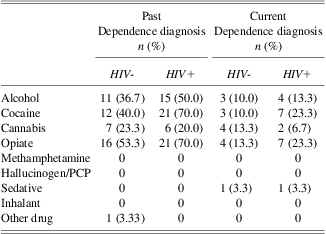
Twenty-nine of the 30 HIV-negatives met DSM-IV diagnostic criteria for lifetime dependence on at least one substance, and one seronegative participant failed to meet diagnostic criteria but admitted to long-term chronic cocaine use (17 years of near daily use of crack and/or cocaine yet denied any functional impact of this use pattern) and had a positive urine toxicology result for cocaine. All 30 HIV+ persons had a lifetime diagnosis of substance dependence on at least one substance. Polysubstance histories characterized most participants in this study as only 13% met criteria for dependence on a single substance alone while 10% met criteria for dependence on four substances. The most commonly diagnosed disorders were for misuse of combinations of alcohol, cocaine, opiates, and marijuana. The HIV+ and HIV- groups were fairly split on the recency of substance use: 40% of HIV- and 48% of the HIV+ group met criteria for past use only. The remaining proportions either met criteria for current use or had positive urine toxicology for illicit substances. Of note, 41% of HIV+ and HIV- participants with positive urine toxicology failed to meet criteria for a current dependency diagnosis for that substance. Details regarding the rate of dependency diagnoses for each class of substance are presented in Table 3.
Frequency of DSM-IV dependency diagnoses
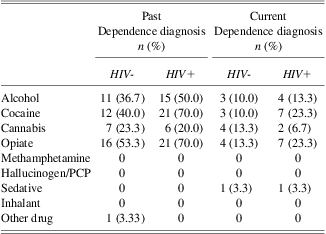
Neurocognition
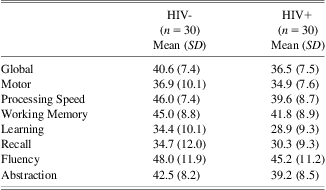
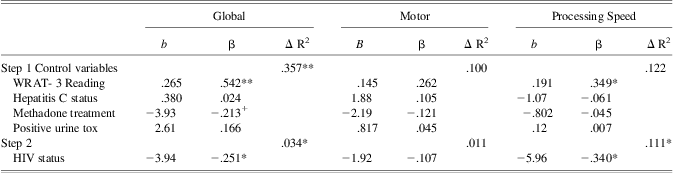
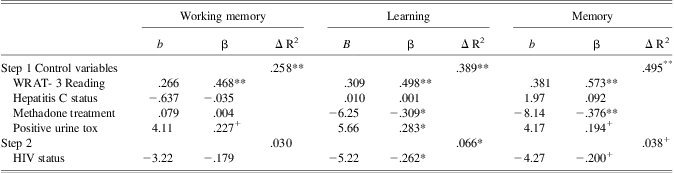
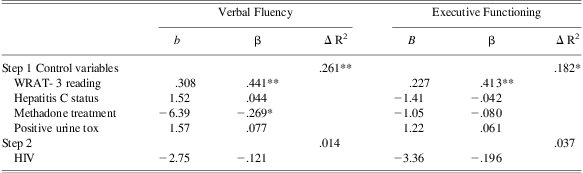
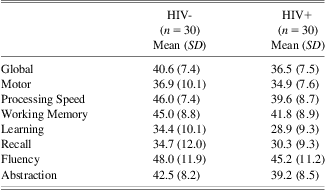
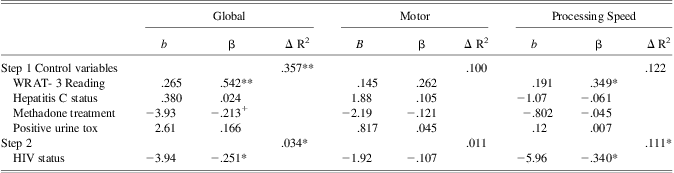
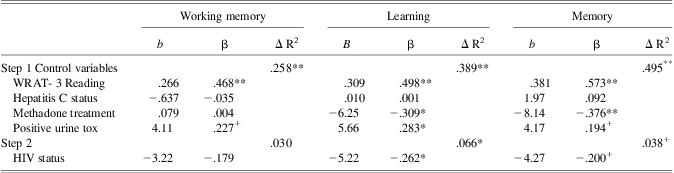
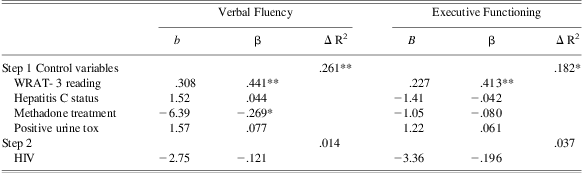
Group mean performances are displayed in Table 4. A series of stepwise linear multiple regression analyses were performed to determine the ability of HIV status to predict NC functioning after the variance associated with clinical variables was accounted for. Tables 5a–5c illustrate the results of each of the multiple regression analyses. Among the control variables entered at the first step (reading level, hepatitis C infection, methadone treatment status, and urine toxicology), reading level was the strongest and the most consistent predictor of NC functioning for all domains with the exception of motor (all beta values significant at or below the .05 level). When considered simultaneously with other control variables, current methadone treatment emerged as a significant predictor of poorer learning (p < .05), recall (p < .05), and verbal fluency (p < .05), and at the trend level, poorer global function (p < .10). Positive urine toxicology predicted better performance in learning (p < .05) and, at the trend level, predicted improved working memory (p < .10) and recall (p < .10). In contrast, hepatitis C infection was not a significant predictor of performance in any of the domains. After accounting for the set of control variables entered at step 1 of the analyses, HIV infection predicted worse NC functioning globally and in several individual domains. The overall model predicting Global NP functioning accounted for 42% of the variance (R 2 = .417; F (5,49) = 7.01; p < .0001) and the increase in R 2 associated with the addition of HIV status to the model was significant (p < .05). HIV status was also a significant predictor of processing speed, (R 2 = .232; F (5,49) = 2.96; p = .02), learning (R 2 = .455; F (5,49) = 8.18; p < .0001) and the increase in R 2 associated with the addition of HIV status to the models was significant (p < .05). For all other domains, HIV status did not significantly increase the models’ predictive power.
Neuropsychological domain t-scores
Regression analyses predicting Global and NC domain T-scores
Note. Wide Range Achievement Test–Reading subtest, 3rd Edition.
* p < .05.
** p < .01.
+p < .10.
Regression analyses predicting NC domain T-scores
Note. Wide Range Achievement Test – Reading subtest, 3rd Edition.
* p < .05.
** p < .01.
+p < .10
Regression analyses predicting NC domain T-scores
Note. Wide Range Achievement Test – Reading subtest, 3rd Edition.
* p < .05.
** p < .01.
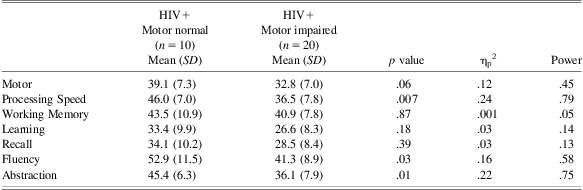
To explore whether the lower processing speed and learning performances associated with HIV infection were related to the overall severe compromised immune status of this group, we ran bivariate correlations between these factors. Results indicate that performance on tests of processing speed and learning were not significantly correlated with current CD4 count (Spearman's r(30) = .26 and .19, respectively, both p values >.10).
Motor Functioning
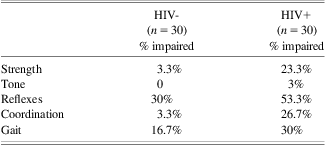
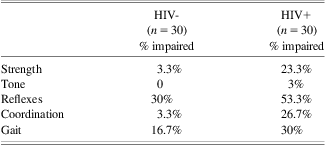
HIV-negatives did not demonstrate as many of the motoric abnormalities measured by the HDMS as HIV-positives. While 47% of the HIV- sample demonstrated some motoric abnormality, the maximum score earned by a seronegative participant was only 2. As expected, a higher proportion of HIV+ participants earned a score of 1 or more (67%) on the HDMS. This group demonstrated a greater range of impairment (up to 12 points on the HDMS) and earned a significantly higher median score on this scale (Mdn = 1) than the HIV- group (Mdn = 0; U = 296.5; p = .017). To better characterize the nature of motoric abnormalities in each group, we examined the rate of abnormalities (a score of 1 or more) in each respective subscale of the HDMS. As reflected in Table 6, HIV infected participants demonstrated abnormalities in all domains assessed by the HDMS with reflex abnormalities being most common, appearing in approximately half of all persons with HIV. For the HIV- group, where abnormalities were rare, when they were present, reflex abnormalities were most common, appearing in a third of the entire group.
Rates of impairment by HDMS domain
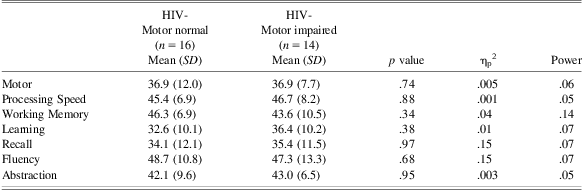
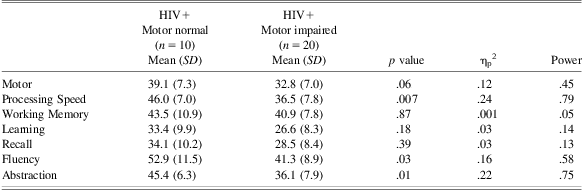
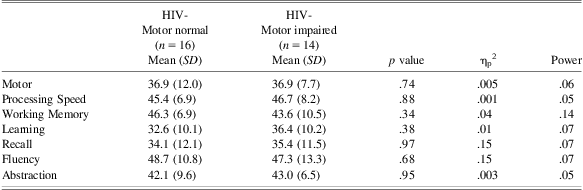
To investigate possible associations between neurologically assessed motor dysfunction and cognition, separate analyses were completed for the HIV+ and HIV- groups comparing persons with some evidence of motor dysfunction (HDMS ≥1) to those with no motor dysfunction, using ANOVA/ANCOVA, as appropriate (see Table 7a and b). Motor abnormalities were related to cognition only within the HIV positive group. For the HIV- group, no significant differences in cognitive domain scores were observed between the neurologically assessed motor impairment groups (all p values >.10). Among HIV+ participants, we first compared the motor impaired (n = 20) and motor normal groups (n = 10) on CNS relevant disease (viral load, CD4 count), demographic (age, gender, ethnicity, WRAT-3 reading score) and urine toxicology parameters to determine the need for the inclusion of any covariates in subsequent analyses. T-tests revealed a trend for the motor normal group to have higher WRAT-3 reading test scores than the motor impaired group (t(28) = -.192; p = .065). Thus, this test was used as a covariate in subsequent analyses. No other significant differences were observed among the parameters (all other p values >.10). For cognitive test performance, results from ANCOVA revealed that the HIV+ motor impaired group performed significantly worse than the HIV+ motor normal group on processing speed (F(1,27) = 10.68; p = .003), fluency (F(1,27) = 6.48; p = .02), and abstraction (F(1,27) = 7.48; p = .01). There was a trend for the motor impaired group to earn lower scores in the cognitive motor domain (p = .07). Thus, the relationship between neurologically assessed motor dysfunction and cognition was specific to the HIV positive group.
Neurocognitive test performance for HIV+ motor groups
Neurocognitive test performance for HIV- motor groups
Discussion
The results of this pilot examination revealed that in a small but well controlled sample, it was possible to detect a deleterious effect of HIV on cognition in the context of chronic polysubstance use and dependence. Additionally, we observed that, among substance users with HIV, the presence of neurologically assessed motoric abnormalities, as measured by the HDMS, was related to worse cognition, whereas no such association existed among the seronegatives, indicating selectivity for the relationship between neurologically assessed motor abnormalities and impaired cognition in HIV infection.
The finding of HIV-related cognitive impairment in this complex advanced HIV sample confirms the persistence of detrimental cognitive effects of HIV in post-HAART era substance users and is consistent with larger studies of neurocognition in generalized, non-substance abuse specific HIV+ samples (Heaton et al., Reference Heaton, Clifford, Franklin, Woods, Ake, Vaida and Grant2010). What is unique about the finding of an HIV-related NP effect among chronic substance users is that it stands in contrast to reports from some similarly designed pre- and post-HAART studies of chronic substance using groups that failed to detect worsened neurocognition with HIV infection (Basso & Bornstein, Reference Basso and Bronstein2003; Concha et al., Reference Concha, Graham, Muñoz, Vlahov, Royal, Updike and McArthur1992, Reference Concha, Selnes, Vlahov, Nance-Sproson, Updike, Royal and McArthur1997; Del Pesce et al., Reference Del Pesce, Franciolini, Censori, Bartolini, Ancarani, Petrelli and Provinciali1993; Durvasula et al., Reference Durvasula, Myers, Satz, Miller, Morgenstern, Richardson and Forney2000; Levine et al., Reference Levine, Hardy, Miller, Castellon, Longshore and Hinkin2006). For example, a recent study of HIV+ and seronegative polysubstance users did not find an effect of HIV serostatus on cognition though HCV status and HIV-related disease parameters were associated with cognitive dysfunction (Devlin et al., Reference Devlin, Gongvatana, Clark, Chasman, Westbrook, Tashima and Cohen2012). A reasonable conclusion from the collection of prior negative findings is that, in the setting of substance use, HIV infection does not exert additional damage to cognition. However, our results, obtained through a methodologically rigorous pilot study, reveal that HIV infection does in fact exert negative effects on cognition in chronic substance users and that these effects can be detected with increased methodological precision. Our findings highlight the need for greater attention to the degree to which HIV+ and seronegative samples differ on important, potentially confounding parameters before the drawing of conclusions across neurocognitive studies.
The current HIV+ sample earned significantly lower scores on tests of processing speed and encoding than the seronegatives, even after accounting for methadone status, reading level, hepatitis C, and positive urine toxicology results. The observation of an HIV effect on tests requiring rapid processing of information and encoding new information is consistent with the classic conceptualization of HIV as a subcortical disease targeting frontal-striatal circuits supporting these abilities (Baldewicz et al., Reference Baldewicz, Leserman, Silva, Petitto, Golden, Perkins and Evans2004; Llorente et al., Reference Llorente, Miller, D'Elia, Selnes, Wesch, Becker and Satz1998; Reger, Welsch, Razani, Martin, & Boone, 2002). The absence of a significant difference in neuropsychologically assessed fine motor speed was unexpected, given that slowed motoric response has been established as a cornerstone of the cognitive profile of HIV infection (Reger et al., Reference Reger, Welsh, Razani, Martin and Boone2002). The absence of a motor speed finding could be due to several reasons. It is possible that the HIV effect on fine motor speed is less robust than other domains and that the small size of this pilot study yielded decreased power to detect milder differences. It is also possible that prior reports of slowed motor speed, as measured by neuropsychological tests, have been exaggerated by the unmeasured yet confounding impact of factors such as DSP and/or methadone usage (Fellows et al., Reference Fellows, Byrd, Elliott, Robinson-Papp, Rivera Mindt and Morgello2012). Notably, the current study excluded persons with DSP and matched the HIV+ and seronegative groups on methadone status, eliminating the potential for these conditions to confound results. These two factors have been demonstrated to detrimentally impact fine motor speed in HIV+ populations (Fellows et al., Reference Fellows, Byrd, Elliott, Robinson-Papp, Rivera Mindt and Morgello2012; Mintzer & Stitzer, Reference Mintzer and Stitzer2002; Soyka et al., Reference Soyka, Lieb, Kagerer, Zingg, Koller, Lehnert and Hennig-Fast2008) and removing the variance associated with these factors likely made any additional HIV-related differences less discernible, particularly in this small sample.
The neurologically assessed motor abnormalities in strength, tone, coordination, and gait were practically absent in the seronegatives, despite chronic substance use histories, affirming their specific association with HIV infection in this sample and demonstrating their relative independence from substance use. When motoric abnormalities were present in HIV-negatives, they were most likely to be related to abnormal reflexes than other areas of motor functioning, which may be a sign of cortical damage resulting from chronic substance use (Yuan et al., Reference Yuan, Zhu, Shi, Zou, Yuan, Liu and Weng2009). To our knowledge, our study is the first report of an examination of this potential relationship in seronegative substance users. Neurologically assessed motor dysfunction was related to impaired cognition among participants with HIV but not the seronegatives. The fact that the association was specific to HIV infection suggests that similar neurologic substrates subserve cognition and motor functioning in HIV and that, to the degree possible, results from cognitive and neurologic examinations should be considered together; when impairment is observed in both areas, clinicians might gain confidence in attributing the etiology of the dysfunction to HIV versus a confounding factor, such as substance use. Thus, we believe that information on motoric functioning using a scale such as the HDMS can aid in HIV neurodiagnostics. Furthermore, the HDMS has the advantage of being free from the cultural confines and potential biases of cognitive testing.
Taken together, these findings, while preliminary, highlight important considerations for the design of clinical research studies exploring the cognitive effects of HIV and substance use in complex cohorts. The current study adds to the growing literature on substance use and cognition in the HAART era and was strengthened by correspondent neurologic examinations on all patients, allowing the simultaneous evaluation of cognitive and neurologic functioning. This study avoided the interpretive confusion from confounding factors through extensive measurement and one-to-one matching of HIV positive and seronegative persons. In fact, the measurement of potentially confounding variables and the examination of their empirical association with neurocognition revealed important relationships that have the potential to impact the results of future neuroAIDS research. First, WRAT reading scores were the strongest predictors of cognitive test performance in practically all NC domains. This finding is consistent with many prior reports of the robust relationship between NC tests and reading ability and confirms the critical importance of assuring comparable reading levels across groups being compared in HIV studies so as to not misattribute performance differences to the factor of interest rather than reading level (Manly et al., Reference Manly, Jacobs, Sano, Bell, Merchant, Small and Stern1998, Reference Manly, Byrd, Touradji, Sanchez and Stern2004; Ryan et al., Reference Ryan, Baird, Mindt, Byrd, Monzones and Bank2005).
Second, evidence of very recent illicit substance use, measured via urine toxicology results, was significantly related to improved performance in learning and trended toward better performance in working memory and recall. Controlled human research on the cognitive effects of acute intoxication is quite limited given the methodologic and ethical difficulties associated with the execution of such studies. Nonetheless, neurobiologic and neuroimaging research on the toxic impact of substances of abuse on CNS structure and function, yields the general expectation of a performance decrement secondary to exposure (Poon, Abdullah, Mullan, & Crawford, Reference Poon, Abdullah, Mullan and Crawford2007; Schlaepfer et al., Reference Schlaepfer, Lancaster, Heidbreder, Strain, Kosel, Fisch and Pearlson2006). However, our observation of a performance “benefit” in select domains in this pilot study lies in contrast to this expectation yet is not completely novel, given the high rate of stimulant use in our sample (82% of HIV+ and HIV- persons with a positive urine toxicology had evidence of recent cocaine use) and established research on the neuroactivating properties of this specific class of substances (Garavan, Kaufman, & Hester, Reference Garavan, Kaufman and Hester2008; Pace-Schott et al., Reference Pace-Schott, Morgan, Malison, Hart, Edgar, Walker and Stickgold2008; Wiegmann, Stanny, McKay, Neri, & McCardie, Reference Wiegmann, Stanny, McKay, Neri and McCardie1996). Also noteworthy is the degree of discrepancy between self-report of substance use and urine toxicology results in this sample. Of those with a positive urine toxicology, 41% did not meet a current dependency diagnosis for that substance, highlighting the added benefit of urine toxicology tests in neuroAIDS substance abuse research (Reinhard et al., Reference Reinhard, Hinkin, Barclay, Levine, Marion, Castellon and Myers2007).
Finally, we also found that current treatment with methadone, an opioid replacement therapy, was predictive of performance decrements in learning, memory, and verbal fluency. This finding supports prior research documenting the detrimental neurocognitive effects of methadone (Mintzer, Copersinok, & Stitzer, Reference Mintzer, Copersino and Stitzer2005; Verdejo et al., Reference Verdejo, Toribio, Orozco, Puente and Pérez-García2005). For example, Darke et al. (Reference Darke, McDonald, Kaye and Torok2012) reported that opioid maintenance therapies exerted a significant performance decrement in processing speed, learning, memory, and executive functioning and that this finding was separable from the effects of long-term heroin use without maintenance therapy. Considering the high rate of methadone maintenance therapy in HIV-infected samples (CDC, 2007), this factor deserves increased consideration in studies using data from participants treated with this therapy. Also important to consider, though not able to be explored in the current study, is the dosage and length of methadone treatment as these two therapeutic aspects are likely to mitigate cognitive relationships. In contrast to the relationships between NC and the factors previously discussed, hepatitis C status was not a significant predictor of performance in any of the domains.
Given the complex medical and sociocultural contexts in which many urban HIV+ persons present to clinical research settings, and the reduction of the HIV signal due to the effectiveness of therapies, neuroAIDS investigators must continue to refine methods with which to manage confounds and advance knowledge in representative cohorts. Isolating the HIV signal is likely to continue to be a challenge as infected cohorts grow older and present with even more co-morbid conditions which create interpretive “noise” in HIV signal detection.
This study is limited by its design as a pilot and suffers from methodologic challenges such as low power and potential instability of the data related to the small sample size. However, the presence of statistically significant results, in the context of low power, makes the findings even more provocative. Future studies, with larger samples, should be completed to replicate these findings and test for potential interaction effects among variables of interest. This pilot study is further limited by the absence of non-drug using HIV+ and HIV- groups. Without “control” groups, we were unable to explore the independent influence of HIV and substance use as well as potential interactions between the two factors. Additionally, the HIV+ participants in this study were in the advanced stages of their disease, which may have exacerbated the degree of neurocognitive impairment, creating stronger effects than would be seen in other cohorts. Thus, the current findings may not generalize to a healthier cohort and should be replicated in other settings.
Acknowledgments
The authors gratefully acknowledge MHBB volunteers and research staff. Research supported by awards U01MH083501 from the National Institutes of Health, M01-RR-00071 from the Clinical Research Center of the Mount Sinai School of Medicine and by the Josiah Macy Foundation, Mount Sinai School of Medicine Center for Multicultural and Community Affairs. The authors report no conflicts of interest.