
 Qp
 BdR
 Qp



1. Introduction
1.1 p-adic Hodge theory for Hodge-proper stacks
Let K be a complete discretely valued extension of
 $\mathbb Q_p$
with the ring of integers
 $\mathcal O_K$
and perfect residue field k. In [Reference Kubrak and PrikhodkoKP24] we developed some aspects of p-adic Hodge theory in the setting of Artin stacks over
 $\mathcal O_K$
. The following concept played a key role.
Definition 1.1 (Cf. [Reference Kubrak and PrikhodkoKP22]). A smooth quasi-compact quasi-separated (qcqs) Artin stack
 $\mathcal{X}$
over a Noetherian ring R is called Hodge-proper if for any
 $i,j\in \mathbb Z_{\geqslant 0}$
the cohomology
 $H^j(\mathcal X, \wedge^i \mathbb L_{\mathcal X/R})\in \mathrm{Mod}_{R}$
is a finitely generated R-module.
Our observation, that we investigated in previous works [Reference Kubrak and PrikhodkoKP22, Reference Kubrak and PrikhodkoKP24], was that Hodge-proper stacksFootnote 1 are often as good as smooth proper schemes when considering certain cohomological features (such as Hodge-to-de Rham degeneration in characteristic 0 [Reference Kubrak and PrikhodkoKP22] or some aspects p-adic Hodge theory [Reference Kubrak and PrikhodkoKP24]). This work establishes more results supporting this idea in the context of rational p-adic Hodge theory (see Remark 1.4).
Let us start by reminding some examples of smooth Hodge-proper stacks.
Example 1.2.
-
(1) A smooth proper stack
 $\mathcal{X}$
over R is Hodge-proper [Reference Kubrak and PrikhodkoKP22, Corollary 2.2.13].
-
(2) Let X be a smooth proper scheme over R with an action of a reductive group G. Then the quotient stack
$[X/G]$
is Hodge-proper [Reference Kubrak and PrikhodkoKP24, § 1.3]. -
(3) Let X be a smooth scheme with an action of G and assume that X has a G-invariant affine cover such that all intersections are affine. In this situation there is a well-defined ‘categorical quotient’ scheme
$X/\!\!/G$
. Then (see [Reference Kubrak and PrikhodkoKP24, Proposition 1.4.6]) if
$X/\!\!/G$
is proper, the stack
$[X/G]$
is Hodge-proper. This includes many examples when X is not necessary proper (see [Reference Kubrak and PrikhodkoKP22, Example 3.1.6]), e.g.
$[\mathbb A^n/\mathrm{SL}_n]$
with the tautological action. -
(4) Some smooth
$\Theta$
-stratified stacks (for the definition see [Reference Halpern-LeistnerHal22, Reference Halpern-LeistnerHal21]) are also Hodge-proper. Namely (see [Reference Kubrak and PrikhodkoKP24, Example 1.4.8]), if a smooth Artin stack
$\mathcal{X}$
with affine diagonal is endowed with a finite
$\Theta$
-stratification and all
$\Theta$
-strata are cohomologically proper (see [Reference Kubrak and PrikhodkoKP22, Definition 2.2.2]), then
$\mathcal{X}$
itself is Hodge-proper. The unstable strata in this criterion can also be replaced by their centra. The particular examples then include even more general quotient stacks
$[X/G]$
where the action is only Kempf–Ness complete.


A particularly important aspect studied in [Reference Kubrak and PrikhodkoKP24] was the potential discrepancy between the étale cohomology of the algebraic and Raynaud generic fibers of a Hodge-proper stack which one does not see in the usual smooth proper setting. Let us recall this in some detail. Namely, let K be a finite extension of
 $\mathbb Q_p$
and let
 ${C}=\widehat{\overline K}$
be the completion of the algebraic closure of K. Let
 $\mathcal O_K\subset K$
and
 $\mathcal O_{C}\subset {C}$
be the corresponding rings of integers. In [Reference Kubrak and PrikhodkoKP24] to an Artin stack
 $\mathcal{X}$
over
 $\mathcal O_{C}$
we associated three other stacks: the algebraic generic fiber
 $\mathcal X_{C}$
, its analytification
 $\mathcal X_{C}^{\mathrm{an}}$
and the Raynaud generic fiber
 $\widehat{\mathcal X}_{C}$
(the latter two are rigid-analytic stacks, see [Reference Kubrak and PrikhodkoKP24, § 3.3]). One then has natural maps (see [Reference Kubrak and PrikhodkoKP24, § 3.3, Remark 4.1.16])

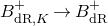
between the
 $\mathbb Z_p$
-étale cohomology. Here the map
 $\varphi_{\mathcal X}^{-1}$
is always an equivalence, while
 $\psi_{\mathcal X}^{-1}$
is a priori an equivalence only in the smooth proper case. Still, in [Reference Kubrak and PrikhodkoKP24] we have shown that the map
 $\Upsilon_{\mathcal X}$
is an equivalence when
 $\mathcal{X}$
is as in part (2) of Example 1.2, but the situation in the general Hodge-proper case remained unclear.
In this work we study the map
 $\Upsilon_{\mathcal X}$
rationally, namely when we replace
 $\mathbb Z_p$
in the coefficients with
 $\mathbb Q_p$
. We show that then the following general result holds.
Theorem 4.8. Let
 $\mathcal{X}$
be a smooth Hodge-proper stack over
 $\mathcal O_K$
. Then the map

is an equivalence.
Remark 1.3. This was stated as Conjecture 4.3.16 in [Reference Kubrak and PrikhodkoKP24]. By analogy with [Reference Kubrak and PrikhodkoKP24, Definition 4.1.18] stacks for which the map
 $\Upsilon_{\mathcal X,\mathbb Q_p}$
is an equivalence could be called
 $\mathbb Q_p$
-locally acyclic.
Let
 $G_K$
be the absolute Galois group of K. From Theorem 4.8, using the results in [Reference Kubrak and PrikhodkoKP24] one deduces that the Galois representation in étale cohomology of
 $\mathcal X_{C}$
is crystalline.
Corollary 4.9. Let
 $\mathcal{X}$
be a smooth Hodge-proper stack over
 $\mathcal O_K$
. Then for any
 $i\geqslant 0$
the
 $G_K$
-representation given by
 $H^i({\mathcal X}_{C},\mathbb Q_p)$
is crystalline.
As a consequence we also obtain all the comparisons that one usually has for a smooth proper scheme (see Remark 4.10).
Let us try to motivate Theorem 4.8 and Corollary 4.9 by putting them into some broader context with the following remarks.
Remark 1.4 (Hodge-proper is (almost) as good as proper). Let Y be a smooth scheme over K. Then using the work of de Jong on alterations [Reference de JongdJ96], Kisin showed in [Reference KisinKis02] that
 $H^n(Y_{C},\mathbb Q_p)$
is a potentially semistable
 $G_K$
-representation. However, by the Fontaine’s
 $C_{\mathrm{crys}}$
-conjecture if Y has a smooth proper model over
 $\mathcal O_K$
this representation has a finer structure: namely it is crystalline.
Let now
 be a smooth qcqs Artin stack over K. Resolving
 by a simplicial scheme and using smooth descent by a similar argument one can show that the étale cohomology
 is also a potentially semistable representation of the Galois group
 $G_K$
. However, Corollary 4.9 tells us that for the
 $G_K$
-representation
 to be crystalline it is in fact enough for
 to have a smooth Hodge-proper model over
 $\mathcal O_K$
. This gives some evidence that from the point of view of
 $\mathbb Q_p$
-étale cohomology smooth Hodge-proper stacks are as good as smooth proper schemes. Let us remark that there are some examples of smooth schemes that are Hodge-proper but not properFootnote
2
(see [Reference Kubrak and PrikhodkoKP22, § 2.3.3]).
Remark 1.5 (G-equivariant p-adic Hodge theory). In [Reference Kubrak and PrikhodkoKP24] we proved a G-equivariant variant of p-adic Hodge theory for a smooth proper
 $\mathcal O_K$
-scheme X with a reductive group action (see [Reference Kubrak and PrikhodkoKP24, § 0.4]). It is natural to ask whether the properness condition is necessary. Theorem 4.8 and Corollary 4.9 show that in fact a much milder condition is sufficient:
 $[X/G]$
should just be Hodge-proper (and smooth). This includes all the examples listed in Example 1.2.
To be more precise (see Remark 4.10 and apply to
 $\mathcal X=[X/G]$
) in this situation we have a
 $(\varphi,G_K)$
-equivariant isomorphism
 \begin{align*} H^n_{\acute{\mathrm{e}}\mathrm{t}}({[X/G]}_{{C}}, \mathbb Q_p)\otimes_{\mathbb Q_p} B_{\mathrm{crys}} \simeq H^n_{{\mathrm{crys}}}({[X/G]}_k/W(k))\bigg[\frac{1}{p}\bigg]\otimes_{K_0} B_{\mathrm{crys}}, \end{align*}
a filtered
 $G_K$
-equivariant isomorphism
 \begin{align*} H^n_{\acute{\mathrm{e}}\mathrm{t}}({[X/G]}_{{C}}, \mathbb Q_p)\otimes_{\mathbb Q_p} B_{\mathrm{dR}} \simeq H^n_{\mathrm{dR}}([X/G]/K)\otimes_K B_{\mathrm{dR}} \end{align*}
and the Hodge-Tate decomposition
 \begin{align*} H^n_{\acute{\mathrm{e}}\mathrm{t}}({[X/G]}_{{C}},\mathbb Q_p)\otimes_{\mathbb Q_p}{C} \simeq \bigoplus_{i+j=n} H^j({[X/G]}_{K},\wedge^i\mathbb L_{\mathcal [X/G]/K})\otimes_{K}{C}(-i). \end{align*}
Moreover, if K is a finite extension of
 $\mathbb Q_p$
, after a choice of isomorphism
 $\iota\colon {C}\xrightarrow{\sim}{\mathbb C}$
by [Reference Kubrak and PrikhodkoKP24, Example 4.1.5 and Proposition 4.1.6] one can identify
 $H^n_{\acute{\mathrm{e}}\mathrm{t}}({[X/G]}_{{C}},\mathbb Q_p)$
with the
 $G(\mathbb C)$
-equivariant cohomology
 $H^n_{{\mathrm{sing}}, G(\mathbb C)}(X(\mathbb C),\mathbb Q_p)$
.
1.2 Generalization: d-de Rham proper stacks
In fact, in this work we show a more subtle statement in a more general setting. Our framework is as follows.
Definition 1.6 (d-de Rham-proper stacks). Fix a positive integer
 $d\in \mathbb Z_{\geqslant 0}$
. A smooth qcqs Artin stack
 $\mathcal{X}$
over a Noetherian ring R is called d-de Rham-proper if
 $H^i_{\mathrm{dR}}(\mathcal X/R)$
is a finitely generated R-module for
 $i\leqslant d$
.
This is a d-truncated version of Definition 1.1, where Hodge cohomology is replaced by de Rham. This notion is much more general (in particular, a Hodge-proper stack is d-de Rham for any d), and the main motivation to consider it comes from the fact that there are many natural examples of d-de Rham-proper schemes that are not necessarily proper (see Lemma 2.4).
The possible expectation could be that a truncated variant of p-adic Hodge theory exists in this setting: namely, the standard properties of and comparisons between different cohomology should still be there, but maybe only up to a certain degree. This is exactly what we show.
Theorem 1.7. Let
 $\mathcal X$
be a smooth
 $(d+1)$
-de Rham-proper stack over
 $\mathcal O_K$
. Then we have the following.
-
(1) The natural map
$\Upsilon_{\mathcal X,\mathbb Q_p}\colon R\Gamma_{\acute{\mathrm{e}}\mathrm{t}}(\mathcal X_{C}, \mathbb Q_p)\rightarrow R\Gamma_{\acute{\mathrm{e}}\mathrm{t}}(\widehat{\mathcal X}_{C}, \mathbb Q_p)$
induces isomorphisms for
\begin{align*} H^i_{\acute{\mathrm{e}}\mathrm{t}}(\mathcal X_{C}, \mathbb Q_p) \simeq H^i_{\acute{\mathrm{e}}\mathrm{t}}(\widehat{\mathcal X}_{C}, \mathbb Q_p) \end{align*}
$i\leqslant d$
, and an embedding for
\begin{align*} H^{d+1}_{\acute{\mathrm{e}}\mathrm{t}}(\mathcal X_{C}, \mathbb Q_p) \hookrightarrow H^{d+1}_{\acute{\mathrm{e}}\mathrm{t}}(\widehat{\mathcal X}_{C}, \mathbb Q_p) \end{align*}
$i=d+1$
(Theorem 5.15
).
-
(2) The
$G_K$
-representation
$ H^i_{\acute{\mathrm{e}}\mathrm{t}}(\mathcal X_{C}, \mathbb Q_p) \simeq H^i_{\acute{\mathrm{e}}\mathrm{t}}(\widehat{\mathcal X}_{C}, \mathbb Q_p) $
is crystalline for
$i\leqslant d$
with Consequently, one has a
\begin{align*}D_{\mathrm{crys}}(H^i_{\acute{\mathrm{e}}\mathrm{t}}(\mathcal X_{C}, \mathbb Q_p))\simeq H^i_{\mathrm{crys}}(\mathcal X_k/W(k))\bigg[\frac{1}{p}\bigg].\end{align*}
$(G_K,\varphi)$
-equivariant isomorphism in that range of degrees (Corollary 4.9 ). -
(3) Provided
$H^i_{\mathrm{crys}}(\mathcal X/W(k))$
is p-torsion free and
$i\leqslant d$
, the Breuil–Kisin module
$H^i_{{{\Delta}}}(\mathcal X/\mathfrak S)$
corresponds to the
$G_K$
-equivariant crystalline lattice
$H^i_{\acute{\mathrm{e}}\mathrm{t}}(\widehat{\mathcal X}_{C},\mathbb Z_p)\subset H^i_{\acute{\mathrm{e}}\mathrm{t}}(\mathcal X_{C},\mathbb Q_p)$
under the Breuil–Kisin functor: (Remark 5.25).
\begin{align*} {\mathrm{BK}}(H^i_{\acute{\mathrm{e}}\mathrm{t}}(\widehat{\mathcal X}_{C},\mathbb Z_p))\simeq H^i_{{{\Delta}}}(\mathcal X/\mathfrak S) \end{align*}





We note immediately that the proof of Theorem 1.7 essentially follows the same ideas as the proof of analogous results in [Reference Kubrak and PrikhodkoKP24]. However, to get the optimal degree range in the comparisons above one needs to analyze very carefully what happens with the completed tensor products in the boundary degrees (typically d and
 $d-1$
). Condensed mathematics of Clausen–Scholze turned out to be a very convenient framework to do so.
Question 1.8. Note that in part (3) of Theorem 1.7 the crystalline lattice corresponding to prismatic cohomology is given by the cohomology of the Raynaud generic fiber of
 $\mathcal{X}$
. This poses a natural question: do the lattices
 $H^i_{\acute{\mathrm{e}}\mathrm{t}}(\widehat{\mathcal X}_{C},\mathbb Z_p)$
and
 $H^i_{\acute{\mathrm{e}}\mathrm{t}}({\mathcal X}_{C},\mathbb Z_p)$
agree inside
 $H^i_{\acute{\mathrm{e}}\mathrm{t}}({\mathcal X}_{C},\mathbb Q_p)$
(under the assumption that
 $\mathcal{X}$
is d-de Rham proper and
 $i\leqslant d$
)? We do not expect this to be true, but also do not know a counterexample.
We then apply Theorem 1.7 to the schematic setting. A quite general example of a d-de Rham-proper scheme over
 $\mathcal O_K$
can be constructed as follows: take a proper Cohen–Macauley scheme X over
 $\mathcal O_K$
and assume that the singularities
 $Z\hookrightarrow X$
have codimension
 $d+1$
in X; then the complement
 $U\colon = X\setminus Z$
is
 $(d-1)$
-de Rham proper over
 $\mathcal O_K$
. Most interesting is the case when Z is in fact contained in the closed fiber
 $X_k$
(and is of codimension d): then
 $U_C\simeq X_C$
, but the Raynaud generic fiber
 $\widehat U_C$
is given by the complement in
 $X_C$
to an ‘open tube’ around
 $Z\subset X_k$
. Thus, application of Theorem 1.7 in this situation leads to a purity-type result for erasing the latter, as well as the crystallinity of étale cohomology of
 $X_C$
in certain range.
Theorem 6.1. Let X be a proper scheme over
 $\mathcal O_K$
that is Cohen–Macauley. Let
 $Z\hookrightarrow X_k$
be a codimension d closed subscheme such that complement
 $X\backslash Z$
is smooth over
 $\mathcal O_K$
. Then the following hold:
-
(1) (purity) there are natural isomorphisms
$H^i_{\acute{\mathrm{e}}\mathrm{t}}(\widehat{(X\backslash Z)}_C,\mathbb Q_p)\simeq H^i_{\acute{\mathrm{e}}\mathrm{t}}(\widehat X_C,\mathbb Q_p)$
for
$i\leqslant d-2$
and an embedding
$H^{d-1}_{\acute{\mathrm{e}}\mathrm{t}}(\widehat{X}_C,\mathbb Q_p)\hookrightarrow H^{d-1}_{\acute{\mathrm{e}}\mathrm{t}}(\widehat{(X\backslash Z)}_C,\mathbb Q_p)$
; -
(2) (crystallineness)
$H^i_{\acute{\mathrm{e}}\mathrm{t}}(X_C,\mathbb Q_p)$
is a crystalline Galois representation for
$i\leqslant d-2$
.


Another way to phrase part (2) is that having a smooth proper scheme over K, if we found a Cohen–Macaulay model over
 $\mathcal O_K$
such that singularities are in codimension d in the closed fiber, then étale cohomology
 $H^i_{\acute{\mathrm{e}}\mathrm{t}}(\mathcal X_C,\mathbb Q_p)$
is still a crystalline
 $G_K$
-representation at least up to degree
 $d-2$
.
Question 1.9. Is the bound in Theorem 6.1(2) sharp?
1.3 Plan of the proof
The original goal of this paper was to prove Theorem 4.8: namely that for Hodge-proper stack over
 $\mathcal O_K$
the étale
 $\mathbb Q_p$
-cohomology of
 $\widehat{\mathcal X}_C$
and
 $\mathcal X_C$
agree. The general strategy for our argument was inspired by the proof of Totaro’s inequality given in [Reference Bhatt and LiBL21] by Bhatt and Li. Namely, by [Reference Kubrak and PrikhodkoKP24, Corollary 4.3.15] (at least in the case when
 $K/\mathbb Q_p$
is finite) we already knew that their dimensions agree, and so it remained to show that the map
 $H^i_{\acute{\mathrm{e}}\mathrm{t}}(\mathcal X_{C}, \mathbb Q_p) \rightarrow H^i_{\acute{\mathrm{e}}\mathrm{t}}(\widehat{\mathcal X}_{C}, \mathbb Q_p)$
is injective for any
 $i\geqslant 0$
. Our idea then was to replace ‘approximation by proper schemes’ that had been used in [Reference Bhatt and LiBL21] by taking values of some other cohomology theory. As a result we established injectivity of the above map in the more general d-de Rham-proper setting (where it holds in degrees up to d, see Proposition 4.6).
Let us briefly sketch our proof of injectivity. The key idea is to look at the ‘log-de Rham complex over
 $B_{\mathrm{dR}}$
’ that was defined in [Reference Diao, Lan, Liu and ZhuDLL+23] and that we denote by
 $\Omega^\bullet_{X,D,\log {\mathrm{dR}}}\mathbin{\widehat{\otimes}} B_{\mathrm{dR}}$
. For
 $\Omega^\bullet_{X,D,\log {\mathrm{dR}}}\mathbin{\widehat{\otimes}} B_{\mathrm{dR}}$
one has a natural ‘
 $B_{\mathrm{dR}}$
-comparison map’ (see Construction 3.17): namely, given a smooth adic space X over K with a simple normal crossings divisor D and the complement U one has a natural map

As shown in [Reference Diao, Lan, Liu and ZhuDLL+23], when X is proper the map
 $\Theta_{X,D}$
is an equivalence. Now, given an affine smooth
 $\mathcal O_K$
-scheme U one can take the Raynaud generic fiber
 $\widehat U_K$
with an empty divisor
 $D=\varnothing$
, or take the algebraic generic fiber
 $U_K$
and consider the analytification of any compactification X of
 $U_K$
by a normal crossings divisor D. For any choice of (X,D) there is a natural map of pairs
 $(\widehat{U}_K,\varnothing)\rightarrow (X^{\mathrm{an}},D^{\mathrm{an}})$
and, consequently, a transformation between maps
 $\Theta_{\widehat{U}_K,\varnothing}$
and
 $\Theta_{X^{\mathrm{an}},D^{\mathrm{an}}}$
.
We then note two things: first, that the category
 $\mathrm{Comp}(U_K)_{\mathrm{nc}}$
of compactifications as above is weakly contractible; and, second, that the functor
 $(X,D)\mapsto R\Gamma(X^{\mathrm{an}}, \Omega^\bullet_{X^{\mathrm{an}},D^{\mathrm{an}} ,\log {\mathrm{dR}}}\mathbin{\widehat{\otimes}} B_{\mathrm{dR}})$
is identified with the constant functor
 $(X,D)\mapsto R\Gamma_{\mathrm{dR}}(U_K/K)\otimes_K B_{\mathrm{dR}}$
. From this we obtain a functorial commutative square (4.1) for any U, which after right Kan extension gives a commutative square

(see Construction 4.3 and Proposition 4.5). The left vertical arrow here is an equivalence for any smooth qcqs Artin stack
 $\mathcal{X}$
, but when
 $\mathcal{X}$
is d-de Rham proper over
 $\mathcal O_K$
, the bottom horizontal one gives an isomorphism in degrees up to
 $d-1$
and an embedding in degree d (Proposition 3.9). Consequently, the composition induces an embedding in cohomological degrees up to d, which forces
 $\Upsilon_{\mathcal X,\mathbb Q_p}$
to be injective in the same range (Proposition 4.6).
To prove the
 $B_{\mathrm{crys}}$
-comparison in the case of
 $(d+1)$
-de Rham-proper stacks over
 $\mathcal O_K$
we extend some relevant results of [Reference Kubrak and PrikhodkoKP24, §§ 2 and 4] to this setting. This we do mainly in §§ 5.1 and 5.2. In this context it is only true that the truncation
 $\tau^{\leqslant d}R\Gamma_{{{{\Delta}}}}(\mathcal X/\mathfrak S)$
is coherent (Corollary 5.4), and it causes a problem for establishing the usual comparisons with other cohomology theories (such as
 ${A_{\mathrm{inf}}}$
or étale). The problem is simple: the completed tensor products are not necessarily t-exact and if one blindly follows the strategy of [Reference Kubrak and PrikhodkoKP24, §§ 2 and 4] one usually loses 1 or 2 last cohomological degrees in the comparisons. The problem is there even in the case when we tensor up with an I-completely free module: namely, if I has at least two generators the derived I-completed direct sum functor can very well be not t-exact. At least in the latter case the situation is better in the condensed world: namely, for prodiscrete I-complete solid modules derived I-completed direct sums are t-exact (see Proposition A.13). By an elaborate argument, that we perform in § 5.3, we are able to deduce the
 $B_{\mathrm{crys}}$
-comparison from a condensed version of it. To do so, we need to use a slightly unusual, but much more nicely behaved period ring
 $B_{\mathrm{max}}$
. The main property of the non-coherent part
 $\tau^{\geqslant d+1}R\Gamma_{{{{\Delta}}}}(\mathcal X/\mathfrak S)$
of prismatic cohomology that allows us to control the interplay between usual and condensed worlds is the following. Namely the dth and
 $(d-1)$
th cohomology groups of the derived reduction
 $[\tau^{\geqslant d+1}R\Gamma_{{{{\Delta}}}}(\mathcal X/\mathfrak S))/(p,u)]$
are finite-dimensional k-vector spaces. As we show in Appendix A, this property implies a good behavior with respect to completed direct sums or certain more complicated completed tensor products, and, most importantly, that the derived (p,u)-completion
 $(\tau^{\geqslant d+1}R\Gamma_{{{{\Delta}}}}(\mathcal X/\mathfrak S))^\blacktriangle_{(p,u)}$
in solid modules is still concentrated in cohomological degrees
 $\geqslant d+1$
(Proposition A.22).
Finally, in § 6 we record the applications of the above results in the case of schemes (Theorem 6.1).
1.4 Notation and conventions
-
(1) In this work, by Artin stacks we always mean (higher) Artin stacks in the sense of [Reference Toën and VezzosiTV08, § 1.3.3] or [Reference Gaitsgory and RozenblyumGR17, Chapter 2.4]: these are sheaves in étale topology admitting a smooth
$(n-1)$
-representable atlas for some
$n\geqslant 0$
. We stress that we (mostly) work with non-derived Artin stacks, i.e. they are defined on the category of ordinary commutative rings. -
(2) Some arguments in the work rely on the theory of condensed mathematics developed by Clausen and Scholze in [Reference Clausen and ScholzeCS19]. We closely follow the notation from [Reference Clausen and ScholzeCS19]. In particular, for an
$(\infty, 1)$
-category
$\mathscr C$
we denote the category of
$\mathscr C$
-valued sheaves on the pro-étale site of a point by
${\mathrm{Cond}}(\mathscr C)$
. We also denote the natural functor
$ {\mathrm{Top}} \to {\mathrm{Cond}}( {\mathscr{S}\mathrm{et}} )$
for [Reference Clausen and ScholzeCS19, Lecture I] by
$X\mapsto \underline X$
. This functor induces a fully faithful embedding
$D(\mathrm{Ab}) \hookrightarrow D({\mathrm{Cond}}(\mathrm{Ab}))$
which, by abuse of notation, we also denote by
$M \mapsto \underline M$
. -
(3) For the rest of the work, let K be a complete discretely valued nonarchimedean extension of
$\mathbb Q_p$
with the ring of integers
$\mathcal O_K$
and perfect residue field k.


2. d-de Rham and d-Hodge-proper stacks
2.1 Definition and basic properties
One can naturally introduce the following truncated analogue of Hodge-properness condition.
Definition 2.1. A smooth qcqs Artin stack
 $\mathcal{X}$
over a Noetherian ring R is called d-Hodge-proper if the Hodge cohomology
 $H^{j,i}(\mathcal X/R)\colon = H^i(\mathcal X,\wedge^j\mathbb L_{\mathcal X/R})$
is finitely generated for all
 $i+j\leqslant d$
.
Remark 2.2. In other words, a smooth qcqs Artin stack
 $\mathcal{X}$
is d-Hodge-proper if
 \begin{align*}\tau^{\leqslant d-j}R\Gamma(\mathcal X,\wedge^j\mathbb L_{\mathcal X/R})\in \mathrm{Coh}(R)\end{align*}
for any
 $j\geqslant 0$
.
Remark 2.3. Obviously, a stack
 $\mathcal{X}$
is Hodge-proper (see Definition 1.1) if and only if it is d-Hodge-proper for any
 $d\geqslant 0$
.
The d-Hodge-properness condition is much more flexible than just Hodge-properness. In particular, there are many more schemes that are Hodge-proper up to some degree, but are not themselves proper.
Lemma 2.4. Let X be a Cohen–Macauley scheme that is proper over
 $\operatorname{Spec} R$
. Assume
 $Z\subset X$
is a closed R-subscheme that has codimension
 $d+2$
. Assume that the complement
 $U\colon = X\!\setminus \!Z$
is smooth over R. Then U is Hodge-proper up to degree d.
Proof. Let
 $j\colon U\rightarrow X$
be the embedding. Since X is Cohen–Macaulay and Z has codimension
 $d+2$
we have
 $R^0j_*\mathcal O_U=\mathcal O_X$
and
 $R^ij_* \mathcal O_U=0$
for
 $0\lt i\leqslant d$
. From [Sta26, Tag 0BLT] it follows that for
 $0\leqslant i\leqslant d$
the sheaf
 $R^ij_* \mathcal F$
is coherent when
 $\mathcal F$
is finite locally free. In other words,
 $R^{\leqslant d}j_*\mathcal F\in \mathrm{Coh}(X)$
. Taking
 $\mathcal F=\Omega^k_{U/R}$
and applying Lemma 2.8 to the global sections functor
 $R\Gamma\colon \mathrm{QCoh}(X) \rightarrow D(\mathrm{Mod}_{R})$
(which is left t-exact) and
 $M=Rj_* \Omega^k_{U/R}$
we get that for any
 $k\geqslant 0$

Since X is proper over R we get
 $\tau^{\leqslant d}R\Gamma(U, \Omega^k_{U/R})\in \mathrm{Coh}(R)$
for any
 $k\geqslant 0$
. We are done by Remark 2.2.
The property that is actually used by us in the proofs is even slightly weaker, though completely analogous in spirit.
Definition 2.5. A smooth qcqs Artin stack
 $\mathcal{X}$
over a Noetherian ring R is called d-de Rham-proper if
 $H^i_{\mathrm{dR}}(\mathcal X/R)$
is finitely generated for
 $i\leqslant d$
.
Remark 2.6. In other words, a smooth qcqs Artin stack
 $\mathcal{X}$
is d-de Rham-proper if
 \begin{align*}\tau^{\leqslant d}R\Gamma_{\mathrm{dR}}(\mathcal X/R)\in \mathrm{Coh}(R).\end{align*}
The following is immediate.
Lemma 2.7. If a smooth Artin stack
 $\mathcal{X}$
over R is d-Hodge-proper it is also d-de Rham-proper.
Proof. By [Reference Kubrak and PrikhodkoKP22, Corollary 1.1.6(2)] one has a convergent (Hodge-to-de Rham) spectral sequence
 \begin{align*} E_1^{i,j}=H^j(\mathcal X,\wedge^i\mathbb L_{\mathcal X/R})\Rightarrow H^{i+j}_{\mathrm{dR}}(\mathcal X/R), \end{align*}
from which we see that if
 $\mathcal{X}$
is d-Hodge-proper, then
 $H^i_{\mathrm{dR}}(\mathcal X/R)$
is finitely generated over R for
 $i\leqslant d$
.
As we show, the following simple lemma can be used to control the ‘degree of coherence’ of complexes under certain operations.
Lemma 2.8. Let
 $\mathscr C$
and
 $\mathscr D$
be stable
 $\infty$
-categories endowed with t-structures. Let
 $F\colon \mathscr C \rightarrow \mathscr D$
be an exact functor which is left t-exact up to a shift by s.Footnote
3
Then for any
 $d\in \mathbb Z$
and any
 $M\in \mathscr C$
one has a natural equivalence

Proof. Omitted.
Proposition 2.9. Let
 $\mathcal{X}$
be a smooth stack over R that is d-Hodge-proper (respectively, d-de Rham-proper).
-
(1) Let
$R\rightarrow R'$
be a faithfully flat map of Noetherian rings. Then
$\mathcal{X}$
is d-Hodge-proper (respectively, d-de Rham-proper) if and only if the base change
$\mathcal X_{R'}\colon = \mathcal X \times_{\operatorname{Spec} R} \operatorname{Spec} R'$
is. -
(2) Let
$R\rightarrow R'$
be a map of Noetherian rings that has Tor-amplitude
$[-s,0]$
. Then the base change
$\mathcal X_{R'}$
is
$(d-s)$
-Hodge proper (respectively,
$(d-s)$
-de Rham-proper).


Proof. Consider the projection
 $q\colon \mathcal X_{R'} \rightarrow \mathcal X$
. Since
 $\mathcal{X}$
is smooth (and qcqs) and
 $R\rightarrow R'$
is of finite Tor-amplitude we can apply base change to get an equivalence

By base change for cotangent complex (and its exterior powers, see [Reference Kubrak and PrikhodkoKP24, Corollary A.2.48]) we also have
 $q^*(\wedge^i\mathbb L_{\mathcal X/R})\simeq \wedge^i\mathbb L_{\mathcal X_{R'}/R'}$
. Similarly, for de Rham cohomology we have

In point (1), by flatness of R’,
 $\tau^{\leqslant d-i}R\Gamma(\mathcal X_{R'},\wedge^i\mathbb L_{\mathcal X_{R'}/R'})\simeq \tau^{\leqslant d-i}R\Gamma(\mathcal X, \wedge^i\mathbb L_{\mathcal X/R})\otimes_R R'$
for any
 $i\geqslant 0$
and we are done by Lemma 2.10 below. The proof for de Rham cohomology is analogous. For point (2), Lemma 2.8 (applied to the tensor product
 $-\otimes_R R'$
and
 $M=R\Gamma(\mathcal X, \wedge^i\mathbb L_{\mathcal X/R})$
) gives us an equivalence

for any
 $i\geqslant 0$
and, similarly, also

Since
 $\tau^{\leqslant d-i}R\Gamma(\mathcal X, \wedge^i\mathbb L_{\mathcal X/R})\in \mathrm{Coh}(R)$
for any
 $i\geqslant 0$
by d-Hodge-properness of
 $\mathcal{X}$
we have
 $\tau^{\leqslant d-i}R\Gamma(\mathcal X, \wedge^i\mathbb L_{\mathcal X/R})\otimes_R R'\in \mathrm{Coh}(R')$
(see, e.g., the argument in [Reference Kubrak and PrikhodkoKP24, Lemma 1.1.6]), which then also holds for the
 $(d-s-i)$
th truncation. This shows that
 $\mathcal X_{R'}$
is
 $(d-s)$
-Hodge-proper. The rest of the proof for the de Rham-proper condition is similar.
Lemma 2.10. Let
 $R\rightarrow R'$
be a faithfully flat map. Then a complex
 $M\in D(\mathrm{Mod}_{R})$
lies in
 $\mathrm{Coh}(R)$
if and only if
 $M\otimes_RR'$
lies in
 $\mathrm{Coh}(R')$
.
Proof. By flatness we have
 $H^i(M\otimes_RR')\simeq H^i(M)\otimes_R R'$
. In particular, M is bounded if and only if
 $M\otimes_RR'$
is. Finally, by [Sta26, Tag 03C4(2)],
 $H^i(M)\otimes_R R'$
is finitely generated over R’ if and only if
 $H^{i}(M)$
is.
3.
$\mathbb Q_p$
-étale cohomology, de Rham cohomology over
$B_{\mathrm{dR}}$
and log period sheaves


3.1 de Rham cohomology over
$B_{\mathrm{dR}}$

In this section we show that the ‘de Rham cohomology over
 $B_{\mathrm{dR}}$
’ of the Raynaud generic fiber of a d-Hodge proper stack agrees with the algebraic de Rham cohomology up to degree
 $d-1$
. We describe in detail the notion of (p,t)-completed tensor product
 $-\widehat{\otimes}_{\mathcal O_K} B_{\mathrm{dR}}$
and show that it agrees with that in [Reference Diao, Lan, Liu and ZhuDLL+23] in the cases of our interest (see Remark 3.8).
Let K be a complete discretely valued p-adic field with a perfect residue field k. As usual, we let
 $K_0:=W(k)[{1}/{p}]\subset K$
and
 $C:=\widehat{\overline{K}}$
. Let
 $e\colon = [K:K_0]$
be the ramification index. Recall Fontaine’s infinitesimal period ring
 ${A_{\mathrm{inf}}}:={A_{\mathrm{inf}}}(\mathcal O_C)$
and Fontaine’s map
 $\theta\colon {A_{\mathrm{inf}}} \twoheadrightarrow \mathcal O_{C}$
(for notation, see, e.g., [Reference Kubrak and PrikhodkoKP24, Appendix B]). As a slight variation of the construction we also consider a period ring
 $A_{\mathrm{inf}, K} \colon = \mathcal O_K \otimes_{W(k)} {A_{\mathrm{inf}}}$
. Let
 $B_{{\mathrm{dR}},K}^+\colon = (A_{\mathrm{inf}, K}[{1}/{p}])^\wedge_{\ker \theta}$
be the corresponding analogue of
 $B_{\mathrm{dR}}^+$
. Note that the natural map
 $\mathcal O_K\otimes_{W(k)}B_{\mathrm{dR}}^+ \rightarrow B_{{\mathrm{dR}},K}^+$
is an equivalence. Indeed, both sides are t-adically complete
 $B_{\mathrm{dR}}^+$
-modules and the map becomes identity modulo
 $(t)\simeq \ker \theta\subset B_{\mathrm{dR}}$
.
Recall that the embedding
 $\overline K \hookrightarrow C\simeq B_{\mathrm{dR}}^+/(t)$
lifts canonically to a map
 $\overline K\dashrightarrow B_{\mathrm{dR}}^+$
since
 $B_{\mathrm{dR}}^+$
is a strictly Henselian local ring. One then has a canonical map
 $B_{{\mathrm{dR}},K}^+\simeq \mathcal O_K\otimes_{W(k)}B_{\mathrm{dR}}^+\rightarrow B_{\mathrm{dR}}^+$
which is the tensor product of the identity map
 $B_{\mathrm{dR}}^+\xrightarrow{{\mathrm{id}}}B_{\mathrm{dR}}^+$
and the restriction of
 $\overline K\rightarrow B_{\mathrm{dR}}^+$
to
 $\mathcal O_K$
.
Remark 3.1. Note that the ring
 $B_{{\mathrm{dR}},K}^+$
is, in fact, isomorphic to the product of e copies of
 $B_{\mathrm{dR}}^+$
. Indeed, since
 $B_{\mathrm{dR}}^+$
is a
 $\overline K$
-algebra and
 $\mathcal O_K\otimes_{W(k)}\overline K\simeq \overline K^{\oplus e}$
, one has isomorphisms

The map
 $B_{{\mathrm{dR}},K}^+\rightarrow B_{{\mathrm{dR}}}^+$
in these terms is just the projection on one of the components. Note that this map is flat.
The following construction plays a key role for this paper. Below, we also consider the composition
 $B_{{\mathrm{dR}},K}^+\rightarrow B_{{\mathrm{dR}}}^+\rightarrow B_{\mathrm{dR}}$
(recall that
 $B_{\mathrm{dR}}\colon = B_{\mathrm{dR}}^+[{1}/{t}]$
).
Construction 3.2. Let M be a complex of
 $\mathcal O_K$
-modules. We define the (p,t)-completed tensor products
 $M\mathbin{\widehat{\otimes}}_{\mathcal O_K}{\kern-1.5pt} B_{\mathrm{dR}}^+$
and
 $M\mathbin{\widehat{\otimes}}_{\mathcal O_K}{\kern-1.5pt} B_{\mathrm{dR}}$
as follows:
 \begin{gather*}M\mathbin{\widehat{\otimes}}_{\mathcal O_K}{\kern-1.5pt} B_{\mathrm{dR}}^+ \colon = \bigg((M\otimes_{W(k)} {A_{\mathrm{inf}}} )_p^\wedge\bigg[\frac{1}{p}\bigg]\bigg)_{\ker \theta}^\wedge\otimes_{B_{{\mathrm{dR}},K}^+}B_{\mathrm{dR}}^+,\\ M\mathbin{\widehat{\otimes}}_{\mathcal O_K}{\kern-1.5pt} B_{\mathrm{dR}} \colon = \bigg((M\otimes_{W(k)} {A_{\mathrm{inf}}} )_p^\wedge\bigg[\frac{1}{p}\bigg]\bigg)_{\ker \theta}^\wedge\otimes_{B_{{\mathrm{dR}},K}^+}B_{\mathrm{dR}}. \end{gather*}
Remark 3.3. By construction,
 $\mathcal O_K\mathbin{\widehat{\otimes}}_{\mathcal O_K}{\kern-1.5pt}B_{\mathrm{dR}}\simeq B_{{\mathrm{dR}},K}^+\otimes_{B_{{\mathrm{dR}},K}^+}B_{\mathrm{dR}}\simeq B_{\mathrm{dR}}$
. Also, for any M we have
 $M\mathbin{\widehat{\otimes}}_{\mathcal O_K}{\kern-1.5pt} B_{\mathrm{dR}}\simeq (M\mathbin{\widehat{\otimes}}_{\mathcal O_K}{\kern-1.5pt} B_{\mathrm{dR}}^+)[{1}/{t}]$
.
The following lemma is useful later.
Lemma 3.4. The (p,t)-completed tensor product functor
 $-\mathbin{\widehat{\otimes}}_{\mathcal O_K}{\kern-1.5pt} B_{\mathrm{dR}}\colon D(\mathrm{Mod}_{\mathcal O_K}\!) \rightarrow D(\mathrm{Mod}_{B_{\mathrm{dR}}}\!)$
is left t-exact up to a shift by 1.
Proof. Note that the functor
 $M\mapsto (M\mathbin{\widehat{\otimes}}_{W(k)}{A_{\mathrm{inf}}})[{1}/{p}]/\xi^k$
is left t-exact up to a shift by 1. Indeed, for
 $k=1$
we have
 $M\mapsto (M\mathbin{\widehat{\otimes}}_{W(k)}\mathcal O_C)[{1}/{p}]$
, which is the composition of tensor product
 $-\otimes_{W(k)}\mathcal O_C$
(which is t-exact since
 $\mathcal O_C$
is p-torsion free), derived p-adic completion (which is left t-exact up to a shift by 1) and localization (which is t-exact). To get the statement for a general k one can argue by induction using the fiber sequence

Then
 $M\mathbin{\widehat{\otimes}}_{\mathcal O_K}{\kern-1.5pt} B_{\mathrm{dR}}$
is obtained by first taking limit of
 $(M\mathbin{\widehat{\otimes}}_{W(k)}{A_{\mathrm{inf}}})[{1}/{p}]/\xi^k$
over k and then the tensor product
 $-\otimes_{B_{{\mathrm{dR}},K}^+}B_{\mathrm{dR}}$
(which is t-exact by Remark 3.1). Since limits are left t-exact this gives the claim.
Remark 3.5. The map
 $\theta$
and the natural embedding
 $\mathcal O_K \hookrightarrow \mathcal O_{C}$
agree on W(k) and produce a natural morphism

One can show that there is also another formula for
 $M\mathbin{\widehat{\otimes}}_{\mathcal O_K}{\kern-1.5pt}B_{\mathrm{dR}}^+$
in terms of
 $\ker \theta_K$
-adic completion
 \begin{align*}M\mathbin{\widehat{\otimes}}_{\mathcal O_K}{\kern-1.5pt} B^+_{\mathrm{dR}} \colon = \bigg((M\otimes_{W(k)} {A_{\mathrm{inf}}} )_p^\wedge\bigg[\frac{1}{p}\bigg]\bigg)_{\ker \theta_K}^\wedge.\end{align*}
Now we can define ‘Hodge’ and ‘de Rham’ cohomology of the Raynaud generic fiber ‘over
 $B_{\mathrm{dR}}$
’.
Construction 3.6. Let U be a smooth affine scheme over
 $\mathcal O_K$
. We define
 \begin{align*}R\Gamma(\widehat U_K, \Omega^i\mathbin{\widehat{\otimes}}_{\mathcal O_K}{\kern-1.5pt} B_{\mathrm{dR}}) \colon = \Omega^i_U\mathbin{\widehat{\otimes}}_{\mathcal O_K}{\kern-1.5pt} B_{\mathrm{dR}} \quad\text{and}\quad R\Gamma_{\mathrm{dR}}(\widehat U_K /B_{\mathrm{dR}}) \colon = \Omega^\bullet_{U, {\mathrm{dR}}} \mathbin{\widehat{\otimes}}_{\mathcal O_K}{\kern-1.5pt} B_{\mathrm{dR}}.\end{align*}
We call
 $R\Gamma_{\mathrm{dR}}(\widehat U_K /B_{\mathrm{dR}})$
the de Rham cohomology of
 $U_K$
over
 $B_{\mathrm{dR}}$
. We extend this definition to all smooth Artin
 $\mathcal O_K$
-stacks via the right Kan extension. That is, for a smooth Artin stack
 $\mathcal O_K$
-stack
 $\mathcal{X}$
we have
 \begin{gather*}R\Gamma(\widehat{\mathcal X}_K, \Omega^i\mathbin{\widehat{\otimes}}_{\mathcal O_K}{\kern-1.5pt} B_{\mathrm{dR}}) \simeq \lim_{U \in \mathrm{Aff}^{\mathrm{sm}, {\mathrm{op}}}_{/\mathcal X}} R\Gamma(\widehat U_K, \Omega^i\mathbin{\widehat{\otimes}}_{\mathcal O_K}{\kern-1.5pt} B_{\mathrm{dR}}),\\R\Gamma_{\mathrm{dR}}(\widehat{\mathcal X}_K / B_{\mathrm{dR}}) \simeq \lim_{U \in \mathrm{Aff}^{\mathrm{sm}, {\mathrm{op}}}_{/\mathcal X}} R\Gamma_{\mathrm{dR}}(\widehat U_K / B_{\mathrm{dR}}).\end{gather*}
One also has an obvious version with
 $B_{\mathrm{dR}}^+$
instead of
 $B_{\mathrm{dR}}$
.
Remark 3.7. Note that for a smooth affine scheme U the complex
 $R\Gamma_{\mathrm{dR}}(\widehat U_K / B_{\mathrm{dR}})$
admits a finite Hodge filtration with associated graded pieces
 $R\Gamma(\widehat U_K, \Omega^i\mathbin{\widehat{\otimes}}_{\mathcal O_K} B_{\mathrm{dR}})$
. Passing to the limit we find a similar complete Hodge filtration on
 $R\Gamma_{\mathrm{dR}}(\widehat{\mathcal X}_K / B_{\mathrm{dR}})$
for any smooth Artin
 $\mathcal O_K$
-stack
 $\mathcal{X}$
.
Remark 3.8. We point out that the definitions in Construction 3.6 agree with those in [Reference Liu and ZhuLZ17, § 3.1] and [Reference Diao, Lan, Liu and ZhuDLL+23, Definition 3.1.1] in the case of Raynaud generic fiber of a smooth scheme. Indeed, let
 $X=\mathrm{Spa}(R,R^+)$
be a smooth affinoid adic space over
 $\mathrm{Spa}(K,\mathcal O_K).$
The complex
 $R\Gamma(X_{\mathrm{an}}, \Omega^i_X\mathbin{\widehat{\otimes}} B_{\mathrm{dR}}^+)$
(in the notation of [Reference Liu and ZhuLZ17, § 3.1]) is, by definition, given by the limit over n of the p-completed tensor products
 $\Omega^i_X\mathbin{\widehat{\otimes}}_K{\kern-1pt} B_{\mathrm{dR}}^+/t^n$
. Let
 $X=\widehat{U}_K$
be the Raynaud generic fiber of a smooth affine
 $\mathcal O_K$
-scheme
 $U\colon = \operatorname{Spec} A$
: in this case
 $(R,R^+)\simeq (A^\wedge_p[{1}/{p}],A^\wedge_p)$
. We construct the natural isomorphisms

the analogous isomorphisms
 $\Omega^i_U\mathbin{\widehat{\otimes}}_{\mathcal O_K}{\kern-1.5pt}B_{\mathrm{dR}} \xrightarrow{\sim}\Omega^i_X\mathbin{\widehat{\otimes}}B_{\mathrm{dR}}$
and
 $\Omega^i_{U,{\mathrm{dR}}}\mathbin{\widehat{\otimes}}_{\mathcal O_K}{\kern-1.5pt}B_{\mathrm{dR}}\xrightarrow{\sim} \Omega^i_{X,{\mathrm{dR}}}\mathbin{\widehat{\otimes}}B_{\mathrm{dR}}$
then follow by inverting t and considering the Hodge filtration correspondingly. Note that, by smoothness,
 $\Omega^i_U$
is a perfect A-module, and since
 $\Omega^i_X\simeq \Omega^i_U\otimes_A R$
, it is enough to consider the case
 $i=0$
; namely, of the structure sheaf. This reduces to the existence of a natural equivalence

for any
 $n\geqslant 0$
.
Since
 $R^+\simeq A^\wedge_p$
we have an equivalence

On the other hand, the tensor product on the right is defined by choosing suitable rings of definition in R, K,
 $B_{\mathrm{dR}}^+/t^n$
, tensoring them up, p-completing the result and inverting p after. Let us take
 $R^+\subset R$
,
 $\mathcal O_K\subset K$
and
 $\mathcal O_K\cdot {A_{\mathrm{inf}}}/\xi^n \subset B^+_{\mathrm{dR}}/t^n$
; then we have
 \begin{align*} R\mathbin{\widehat{\otimes}}_K{\kern-1pt} B_{\mathrm{dR}}^+/t^n\simeq (R^+\otimes_{\mathcal O_K} (\mathcal O_K\cdot {A_{\mathrm{inf}}}/\xi^n))^\wedge_p\bigg[\frac{1}{p}\bigg]. \end{align*}
On the other hand, the left-hand side can be rewritten as
 \begin{align*} ((R^+ {\otimes}_{W(k)}({A_{\mathrm{inf}}}/\xi^n))^\wedge_p \otimes_{\mathcal O_K\otimes_{W(k)}{A_{\mathrm{inf}}}/\xi^n} (\mathcal O_K\cdot {A_{\mathrm{inf}}}/\xi^n))\bigg[\frac{1}{p}\bigg]. \end{align*}
Rewriting
 $(R^+ {\otimes}_{W(k)}({A_{\mathrm{inf}}}/\xi^n)$
as
 $R^+\otimes_{\mathcal O_K} (\mathcal O_K \otimes_{W(k)} ({A_{\mathrm{inf}}}/\xi^n))$
one sees that both expressions agree before inverting p and modulo
 $p^n$
. Thus, it is just enough to see that the tensor product
 \begin{align*} (R^+ {\otimes}_{W(k)}({A_{\mathrm{inf}}}/\xi^n))^\wedge_p \otimes_{\mathcal O_K\otimes_{W(k)}{A_{\mathrm{inf}}}/\xi^n} (\mathcal O_K\cdot {A_{\mathrm{inf}}}/\xi^n) \end{align*}
is already (classically) p-complete. This follows from
 $ \mathcal O_K\cdot {A_{\mathrm{inf}}}/\xi^n$
being a finitely presented
 $\mathcal O_K\otimes_{W(k)}{A_{\mathrm{inf}}}/\xi^n$
-module.Footnote
4
We need the following basic result about
 $B_{\mathrm{dR}}$
-cohomology.
Proposition 3.9. Let
 $\mathcal{X}$
be a smooth Artin stack over
 $\mathcal O_K$
. Then we have the following.
-
(1) The natural map
is an equivalence. -
(2) So is the natural map
. -
(3) If, in addition,
$\mathcal{X}$
is d-de Rham-proper over
$\mathcal O_K$
, then the natural map induces an isomorphism
$H^i_{\mathrm{dR}}(X_K/K)\otimes_K B_{\mathrm{dR}}\simeq H^i_{\mathrm{dR}}(\widehat {\mathcal X}_K/B_{\mathrm{dR}})$
for
$i\leqslant d-1$
and an embedding
$H^d_{\mathrm{dR}}(X_K/K)\otimes_K B_{\mathrm{dR}}\hookrightarrow H^d_{\mathrm{dR}}(\widehat {\mathcal X}_K/B_{\mathrm{dR}})$
.


Proof. For the first assertion, note that by construction both sides coincide on smooth affine schemes. Hence, to prove the claim it is enough to show that both sides satisfy smooth descent. For the left-hand side this follows from the flat descent for cotangent complex (see, e.g., [Reference Kubrak and PrikhodkoKP22, Proposition 1.1.5]) and Lemma 3.11. For the right-hand side, note that by the same lemma the functor on smooth affine schemes that sends
 $U\mapsto \Omega^i_U\mathbin{\widehat{\otimes}}_{\mathcal O_K}{\kern-1.5pt} B_{\mathrm{dR}}$
also satisfies smooth descent. It is then formal that the right Kan extension also satisfies smooth descent. The proof for the second part is completely analogous.
Finally, part (3) follows from part (2) and applying Lemma 3.12 to
 $M=R\Gamma_{\mathrm{dR}}(\mathcal X/\mathcal O_K)$
.
Remark 3.10. If
 $\mathcal{X}$
is Hodge-proper over
 $\mathcal O_K$
, then it is d-Hodge and, consequently, d-de Rham proper for any
 $d\geqslant 0$
. Thus, from Proposition 3.9(3) we get that the map

is a quasi-isomorphism.
Lemma 3.11. Let
 $M^\bullet$
be a co-simplicial diagram of uniformly bounded below complexes of
 $\mathcal O_K$
-modules. Then the natural map

is an equivalences.
Proof. This follows from [Reference Kubrak and PrikhodkoKP24, Corollary C.6], since the functor
 $-\mathbin{\widehat{\otimes}}_{\mathcal O_K}{\kern-1.5pt} B_{\mathrm{dR}}$
is left t-exact up to a shift (Lemma 3.4).
Lemma 3.12. Let
 $M \in D(\mathrm{Mod}_{\mathcal O_K})$
be such that
 $\tau^{\leqslant d} M\in \mathrm{Coh}(\mathcal O_K)$
. Then the natural map

induces an isomorphism
 $H^i(M)\otimes_{\mathcal O_K}B_{\mathrm{dR}}\simeq H^i(M\mathbin{\widehat{\otimes}}_{\mathcal O_K}{\kern-1.5pt} B_{\mathrm{dR}})$
for
 $i\leqslant d-1$
and an embedding
 $H^d(M)\otimes_{\mathcal O_K}B_{\mathrm{dR}}\hookrightarrow H^d(M\mathbin{\widehat{\otimes}}_{\mathcal O_K}{\kern-1.5pt} B_{\mathrm{dR}})$
.
Proof. The map in question is an equivalence for
 $M = \mathcal O_K$
(Remark 3.3), hence it is also so for all perfect (or equivalently, coherent)
 $\mathcal O_K$
-modules. This applies in particular to
 $\tau^{\leqslant d}(M)$
. Recall that
 $-\mathbin{\widehat{\otimes}}_{\mathcal O_K}{\kern-1.5pt}B_{\mathrm{dR}}$
is left t-exact up to a shift by 1, while
 $-\otimes_{\mathcal O_K}B_{\mathrm{dR}}$
is just left t-exact since
 $B_{\mathrm{dR}}$
is p-torsion free. From Lemma 2.8 we get a commutative square

which shows that the low horizontal map is an equivalence. By passing to cohomology, this gives the statement for
 $i\leqslant d-1$
.
Note also that for any i (from left t-exactness of
 $-\mathbin{\widehat{\otimes}}_{\mathcal O_K}{\kern-1.5pt}B_{\mathrm{dR}}$
up to a shift by 1) we have a short exact sequence
 \begin{align*}0 \rightarrow H^0(H^i(M)\mathbin{\widehat{\otimes}}_{\mathcal O_K}{\kern-1.5pt} B_{\mathrm{dR}}) \rightarrow H^i(M\mathbin{\widehat{\otimes}}_{\mathcal O_K}{\kern-1.5pt} B_{\mathrm{dR}}) \rightarrow H^{-1}( H^{i+1}(M)\mathbin{\widehat{\otimes}}_{\mathcal O_K}{\kern-1.5pt} B_{\mathrm{dR}}) \rightarrow 0.\end{align*}
By the assumption, for
 $i=d$
the module
 $H^d(M)$
is still finitely generated, so
 $H^d(M)\mathbin{\widehat{\otimes}}_{\mathcal O_K}{\kern-1.5pt} B_{\mathrm{dR}}\simeq H^d(M)\otimes_{\mathcal O_K} B_{\mathrm{dR}}$
, and the short exact sequence gives that
 $H^d(M)\otimes_{\mathcal O_K}B_{\mathrm{dR}}\hookrightarrow H^d(M\mathbin{\widehat{\otimes}}_{\mathcal O_K}{\kern-1.5pt} B_{\mathrm{dR}})$
.
3.2 Log period sheaves and
$B_{\mathrm{dR}}$
-comparison map

Let X be a smooth adic space over
 $\mathrm{Spa}(K,\mathcal O_K)$
. Let
 $i\colon D \rightarrow X$
be a normal crossings divisor (see [Reference Diao, Lan, Liu and ZhuDLL+19, Example 2.3.17] for the definition). The divisor D endows X with a natural structure of a (smooth) log adic space (see [Reference Diao, Lan, Liu and ZhuDLL+23, Example 2.1.2]). We denote by
 $X_{D,{\acute{\mathrm{e}}\mathrm{t}}}$
,
 $X_{D,\mathrm{prok}\acute{\mathrm{e}}\mathrm{t}}$
the associated Kummer étale (see [Reference Diao, Lan, Liu and ZhuDLL+19, § 4.1]) and pro-Kummer étale (see [Reference Diao, Lan, Liu and ZhuDLL+19, Definition 5.1.2]) sites correspondingly.
Example 3.13. When
 $D=\varnothing$
is empty,
 $X_{D,{\acute{\mathrm{e}}\mathrm{t}}}$
and
 $X_{D,\mathrm{prok}\acute{\mathrm{e}}\mathrm{t}}$
are identified with the étale and pro-étale sites of X.
Remark 3.14. Let
 $U\colon = X\setminus D$
be the complement to D and let
 $j\colon U \rightarrow X$
be the natural embedding. Pull-back of D to U is empty,
 $U_{\varnothing,{\acute{\mathrm{e}}\mathrm{t}}}\simeq U_{\acute{\mathrm{e}}\mathrm{t}}$
, and thus one has a natural (derived) push-forward functor
 $j_{*,{\acute{\mathrm{e}}\mathrm{t}}}\colon \mathcal{S}\mathrm{hv}(U_{\acute{\mathrm{e}}\mathrm{t}},\mathbb Z/n)\rightarrow \mathcal{S}\mathrm{hv}(X_{D,{\acute{\mathrm{e}}\mathrm{t}}},\mathbb Z/n)$
between the derived categories of sheaves of
 $\mathbb Z/n$
-modules (for any
 $n\geqslant 0$
). By [Reference Diao, Lan, Liu and ZhuDLL+19, Lemma 4.6.5] for the constant sheaf
 $\mathbb Z/n\in \mathcal{S}\mathrm{hv}(U_{\acute{\mathrm{e}}\mathrm{t}},\mathbb Z/n)$
one has an equivalence
 $j_{*,{\acute{\mathrm{e}}\mathrm{t}}} \mathbb Z/n \xrightarrow{\sim} \mathbb Z/n$
; this then induces an equivalence

for the global sections. Taking
 $n=p^k$
and passing to the limit over k one also gets an equivalence

In [Reference Diao, Lan, Liu and ZhuDLL+23] the period sheaves
 $\mathbb B_{\mathrm{dR}}^+$
,
 $\mathbb B_{\mathrm{dR}}$
,
 $\mathcal O\mathbb B_{{\mathrm{dR}},\log}^+$
,
 $\mathcal O\mathbb B_{{\mathrm{dR}},\log}$
on
 $X_{D,\mathrm{prok}\acute{\mathrm{e}}\mathrm{t}}$
were introduced. While the definition of
 $\mathbb B_{\mathrm{dR}}^+$
,
 $\mathbb B_{\mathrm{dR}}$
is essentially the same as in [Reference ScholzeSch13] (see [Reference Diao, Lan, Liu and ZhuDLL+23, Definition 2.2.3]), the definition of
 $\mathcal O\mathbb B_{{\mathrm{dR}},\log}^+$
,
 $\mathcal O\mathbb B_{{\mathrm{dR}},\log}$
is more involved and takes into account the log structure in a more significant way (see [Reference Diao, Lan, Liu and ZhuDLL+23, Definition 2.2.10]). Let also
 $\Omega^{1}_{X,D,\log}$
be the sheaf of log differential 1-forms on X (see [Reference Diao, Lan, Liu and ZhuDLL+19, Definition 3.2.25]). Similarly, one defines
 $\Omega^{j}_{X,D,\log}\colon = \wedge^j_{\mathcal O_X}\Omega^{1}_{X,D,\log}$
for all
 $j\geqslant 0$
(see [Reference Diao, Lan, Liu and ZhuDLL+19, Definition 3.2.29]).
We denote by
 $\mu\colon X_{D,\mathrm{prok}\acute{\mathrm{e}}\mathrm{t}} \rightarrow X_{\mathrm{an}}$
the natural map of sites. We also consider the map
 $\mu'\colon (X_C)_{D,\mathrm{prok}\acute{\mathrm{e}}\mathrm{t}}\simeq (X_{D,\mathrm{prok}\acute{\mathrm{e}}\mathrm{t}})_{/X_C} \rightarrow X_{\mathrm{an}}$
where
 $X_C\colon = X\times_K C$
is the base change of X to
 $C\colon = \widehat{\overline K}$
. For brevity we continue to denote the pull-backs
 $\mu^*\Omega^{j}_{X,D,\log}$
and
 $\mu'^*\Omega^{j}_{X,D,\log}$
by
 $\Omega^{j}_{X,D,\log}$
.
The sheaf
 $\mathcal O \mathbb B_{{\mathrm{dR}},\log}^+$
on
 $X_{D,\mathrm{prok}\acute{\mathrm{e}}\mathrm{t}}$
has a natural log connection
 $\nabla\colon \mathcal O \mathbb B_{{\mathrm{dR}}}^+ \rightarrow \mathcal O \mathbb B_{{\mathrm{dR}}}^+\otimes_{\mathcal O_X} \Omega^1_{X,D,\log}$
(see [Reference Diao, Lan, Liu and ZhuDLL+23, 2.2.15]) which then extends to a log connection
 $\nabla\colon \mathcal O \mathbb B_{{\mathrm{dR}},\log} \rightarrow \mathcal O \mathbb B_{{\mathrm{dR}},\log}\otimes_{\mathcal O_X} \Omega^1_{X,D,\log}$
on
 $\mathcal O \mathbb B_{{\mathrm{dR}},\log}$
(see [Reference Diao, Lan, Liu and ZhuDLL+23, 2.2.17]). We then have the following.
Proposition (The Poincarà lemma [Reference Diao, Lan, Liu and ZhuDLL+23, Corollary 2.4.2]). The complex
 \begin{align*}0\rightarrow \mathbb B_{\mathrm{dR}} \rightarrow \mathcal O \mathbb B_{{\mathrm{dR}},\log} \xrightarrow{\nabla} \mathcal O \mathbb B_{{\mathrm{dR}},\log}\otimes_{\mathcal O_X} \Omega^1_{X,D,\log} \xrightarrow{\nabla} \mathcal O \mathbb B_{{\mathrm{dR}}} \otimes_{\mathcal O_X} \Omega^2_{X,D,\log} \xrightarrow{\nabla} \cdots\end{align*}
of sheaves on
 $X_{D,\mathrm{prok}\acute{\mathrm{e}}\mathrm{t}}$
is acyclic.
This gives a quasi-isomorphism
 $\mathbb B_{\mathrm{dR}}\xrightarrow{\sim} DR_{\log}(\mathcal O \mathbb B_{{\mathrm{dR}},\log},\nabla)$
in the derived categories of sheaves on
 $X_{D,\mathrm{prok}\acute{\mathrm{e}}\mathrm{t}}$
and
 $(X_C)_{D,\mathrm{prok}\acute{\mathrm{e}}\mathrm{t}}$
(here
 $DR_{\log}$
denotes the log de Rham complex).
One can also explicitly describe the push-forwards with respect to the map
 $\mu'\colon (X_C)_{D,\mathrm{prok}\acute{\mathrm{e}}\mathrm{t}} \rightarrow X_{\mathrm{an}}$
of the individual terms of the de Rham complex
 $DR_{\log}(\mathcal O \mathbb B_{{\mathrm{dR}},\log},\nabla)$
. Namely, recall the sheaf
 $\mathcal O_X\mathbin{\widehat{\otimes}} B_{\mathrm{dR}}$
([Reference Diao, Lan, Liu and ZhuDLL+23, Definition 3.1.1], see also the discussion in Remark 3.8) and consider
 $\Omega^j_{X,D,\log}\mathbin{\widehat{\otimes}} B_{\mathrm{dR}}\colon = \Omega^j_{X,D,\log}\otimes_{\mathcal O_X} \mathcal O_X\mathbin{\widehat{\otimes}} B_{\mathrm{dR}}$
(these sheaves are called
 $\Omega^j_{X,\log}\mathbin{\widehat{\otimes}} B_{\mathrm{dR}}$
in [Reference Diao, Lan, Liu and ZhuDLL+23, Definition 3.1.6]). Let
 $d_{ B_{\mathrm{dR}}}\colon \mathcal O_X\mathbin{\widehat{\otimes}} B_{\mathrm{dR}} \rightarrow \Omega^1_{X,D,\log}\mathbin{\widehat{\otimes}} B_{\mathrm{dR}}$
be the map induced by the natural log connection
 $d\colon = \mathcal O_X \rightarrow \Omega^1_{X,D,\log}$
on
 $\mathcal O_X$
and let
 \begin{align*} \Omega^\bullet_{X,D,\log {\mathrm{dR}}}\mathbin{\widehat{\otimes}} B_{\mathrm{dR}}\colon = \mathcal O_X\mathbin{\widehat{\otimes}} B_{\mathrm{dR}} \rightarrow \Omega^1_{X,D,\log}\mathbin{\widehat{\otimes}} B_{\mathrm{dR}} \rightarrow \Omega^2_{X,D,\log}\mathbin{\widehat{\otimes}} B_{\mathrm{dR}} \rightarrow \cdots \end{align*}
be the corresponding log de Rham complex.
Returning to the previous discussion, one has an equivalence

(see [Reference Diao, Lan, Liu and ZhuDLL+23, Lemma 3.3.2]), which, by the projection formula, also gives
 \begin{align*}\Omega^j_{X,D,\log}\mathbin{\widehat{\otimes}} B_{\mathrm{dR}} \xrightarrow{\sim} R\mu'_*(\mathcal O \mathbb B_{{\mathrm{dR}},\log}\otimes \Omega^j_{X,D,\log})\end{align*}
for any
 $j\geqslant 0$
. These isomorphisms then ultimately lead to equivalences

Remark 3.15. It is noted in [Reference Diao, Lan, Liu and ZhuDLL+23, Remark 2.2.11] that when the log-structure is trivial the construction of the log-period ring
 $\mathcal O\mathbb B_{{\mathrm{dR}},\log}$
still differs from that of
 $\mathcal O\mathbb B_{{\mathrm{dR}}}$
in [Reference ScholzeSch13, § 6] by a certain completion procedure. However, as noted in [Reference ScholzeSch13, § 6] all features essential for the applications (namely the Poincaré lemma and the description of the push-forward to the analytic site) remain valid, thus in fact for most of the arguments one can freely choose between any of the two versions.
Remark 3.16. If
 $D=\varnothing$
, then the complex
 $\Omega^\bullet_{X,D,\log {\mathrm{dR}}}\mathbin{\widehat{\otimes}} B_{\mathrm{dR}}$
on X agrees with
 $\Omega_{X,{\mathrm{dR}}}^\bullet\mathbin{\widehat{\otimes}} B_{\mathrm{dR}}$
(see [Reference Liu and ZhuLZ17, § 3.1] or Remark 3.8 to recall the definition). By Remark 3.8, when
 $X=\widehat{U}_K$
is the Raynaud generic fiber of a smooth affine
 $\mathcal O_K$
-scheme U, this complex agrees with the ‘de Rham cohomology over
 $B_{\mathrm{dR}}$
’
 $R\Gamma_{\mathrm{dR}}(\widehat{U}_K/B_{\mathrm{dR}})$
that we have defined in Construction 3.6.
We can now pass to the construction of the
 $B_{\mathrm{dR}}$
-comparison map.
Construction 3.17. Let X,
 $i\colon D\hookrightarrow X$
be as in the beginning of this section and let
 $U\colon = X {\kern-1pt}\setminus{\kern-1pt}D$
. Let
 $R\Gamma_{\acute{\mathrm{e}}\mathrm{t}}(U_C,\mathbb Q_p)\colon = R\Gamma_{\acute{\mathrm{e}}\mathrm{t}}(U_C,\mathbb Z_p)[{1}/{p}]$
and
 $R\Gamma((X_C)_{D,{\acute{\mathrm{e}}\mathrm{t}}},\mathbb Q_p)\colon = R\Gamma((X_C)_{D,{\acute{\mathrm{e}}\mathrm{t}}},\mathbb Z_p)[{1}/{p}]$
. By (3.2) we have an equivalence
 \begin{align*}R\Gamma_{\acute{\mathrm{e}}\mathrm{t}}(U_C,\mathbb Q_p)\xrightarrow{\sim} R\Gamma((X_C)_{D,{\acute{\mathrm{e}}\mathrm{t}}},\mathbb Q_p).\end{align*}
Having this (with a further identification
 $R\Gamma((X_C)_{D,{\acute{\mathrm{e}}\mathrm{t}}},\mathbb Z_p)\simeq R\Gamma((X_C)_{D,\mathrm{prok}\acute{\mathrm{e}}\mathrm{t}},\mathbb Z_p)$
), the map
 $\mathbb Z_p \rightarrow \mathbb B_{\mathrm{dR}}$
of sheaves on
 $X_{D,\mathrm{prok}\acute{\mathrm{e}}\mathrm{t}}$
induces a natural map
 \begin{align*}R\Gamma_{\acute{\mathrm{e}}\mathrm{t}}(U_C,\mathbb Q_p)\otimes_{\mathbb Q_p}B_{\mathrm{dR}} \longrightarrow R\Gamma(X_{D,\mathrm{prok}\acute{\mathrm{e}}\mathrm{t}},\mathbb B_{\mathrm{dR}}).\end{align*}
Composing further with the equivalence
 $R\Gamma(X_{D,\mathrm{prok}\acute{\mathrm{e}}\mathrm{t}},\mathbb B_{\mathrm{dR}}) \xrightarrow{\sim} R\Gamma(X_{\mathrm{an}}, \Omega^\bullet_{X,D,\log {\mathrm{dR}}}\mathbin{\widehat{\otimes}} B_{\mathrm{dR}})$
coming from (3.3) we get a natural map
 \begin{align*}\Theta_{X,D}\colon R\Gamma_{\acute{\mathrm{e}}\mathrm{t}}(U_C,\mathbb Q_p)\otimes_{\mathbb Q_p}B_{\mathrm{dR}} \longrightarrow R\Gamma(X_{\mathrm{an}}, \Omega^\bullet_{X,D,\log {\mathrm{dR}}}\mathbin{\widehat{\otimes}} B_{\mathrm{dR}})\end{align*}
which we call the
 $B_{\mathrm{dR}}$
-comparison map.
Example 3.18. By [Reference Diao, Lan, Liu and ZhuDLL+23, Theorem 3.2.3(3)], if X is proper the map
 $\Theta_{X,D}$
is an equivalence for any normal crossings divisor D. Moreover, by [Reference Diao, Lan, Liu and ZhuDLL+23, Lemma 3.6.2] one can make an identification
 \begin{align*} R\Gamma_{\log {\mathrm{dR}}}(X/K)\otimes_{K}B_{\mathrm{dR}} \xrightarrow{\sim} R\Gamma(X, \Omega^\bullet_{X,D,\log {\mathrm{dR}}}\mathbin{\widehat{\otimes}} B_{\mathrm{dR}}). \end{align*}
In the case of the analytification
 $X^{\mathrm{an}}, D^{\mathrm{an}}$
of a smooth proper K-scheme X with a normal crossings divisor D, one can make further natural identifications
 \begin{align*} R\Gamma_{\log {\mathrm{dR}}}(X^{\mathrm{an}}/K)\xrightarrow[\mathrm{GAGA}]{\sim} R\Gamma_{\log {\mathrm{dR}}}(X/K) \xrightarrow{\sim} R\Gamma_{\mathrm{dR}}(U/K), \end{align*}
where the first equivalence is induced by GAGA and the second is induced by the restriction of the algebraic log de Rham complex (as a complex of sheaves) to
 $U\colon = X\setminus D$
.
4. Proof of
$\mathbb Q_p$
-local acyclicity for Hodge-proper stacks

4.1 The key commutative square
Let U be a scheme over
 $\mathcal O_K$
. Let
 $U_{K}\colon = U\times_{\mathcal O_K} K$
and
 $\widehat U_K$
be the algebraic and Raynaud generic fibers of U. We have a natural map
 $\psi_U\colon\widehat U_K\rightarrow U_K^{\mathrm{an}}$
, where
 $U_K^{\mathrm{an}}$
is the analytification of
 $U_K$
(for a more detailed discussion of this situation, see [Reference Kubrak and PrikhodkoKP24, § 3.3]).
In the following we also need to consider the auxiliary data of a compactification X of
 $U_K$
by a simple normal crossings divisor D. To clarify, by this we mean a smooth proper K-scheme X with a simple normal crossings divisor
 $D \hookrightarrow X$
and an isomorphism
 $\varepsilon\colon U_K\xrightarrow{\sim }X\setminus D$
. Let
 $\mathrm{Comp}(U_K)_{{\mathrm{nc}}}$
be the category of such compactifications
 $(X,D,\varepsilon)$
. An important property of
 $\mathrm{Comp}(U_K)_{{\mathrm{nc}}}$
is that it is cofiltered.
Lemma 4.1. Let S be a smooth separated scheme of finite type over a characteristic 0 field. Then the category
 $\mathrm{Comp}(S)_{{\mathrm{nc}}}$
of compactifications of S by a simple normal crossings divisor is cofiltered.
Proof. First of all
 $\mathrm{Comp}(S)_{{\mathrm{nc}}}$
is non-empty. Indeed, by Nagata’s compactification there exists a reduced proper scheme X’ containing S as a dense open subscheme. By Hironaka’s resolution of singularities one then has a birational map
 $X\twoheadrightarrow X'$
which is an isomorphism on S and such that the complement
 $X\setminus S$
is a simple normal crossing divisor.
Let
 $X_1,X_2$
be a pair of compactifications of S by normal crossings divisors. Let
 $Z^\prime$
be the closure of S in
 $X_1 \times X_2$
. Resolving the singularities as above we find a
 $Z\twoheadrightarrow Z'$
which is an isomorphism over S and such that the complement
 $Z\setminus S$
is a simple normal crossings divisor. By construction, such Z maps both to
 $X_1$
and
 $X_2$
(using projections
 $X_1 \leftarrow Z'\rightarrow X_2$
).
Let now
 $f,g\colon X_1 \rightrightarrows X_2$
be a pair of parallel arrows in
 $\mathrm{Comp}(S)_{{\mathrm{nc}}}$
. Consider the closure
 $Z^\prime$
of the diagonal embedding
 $S \hookrightarrow X_1\times_{X_2} X_1$
. Let
 $Z\twoheadrightarrow Z^\prime$
be a resolution of singularities as above. By construction there is a map
 $e\colon Z \to Y$
such that
 $f\circ e = g\circ e$
.
Remark 4.2. In particular, it follows that the nerve
 $N(\mathrm{Comp}(S)_{{\mathrm{nc}}})$
is weakly contractible by [Reference LurieLur09, Lemma 5.3.1.20].
In the next construction for an affine smooth
 $\mathcal O_K$
-scheme U we construct the following natural commutative square.

This is the key ingredient in the proof of local acyclicity.
Construction 4.3.
-
(i) Let S be a smooth affine K-scheme and let
$S^{\mathrm{an}}$
be its analytification. By associating to
$(X,D,\varepsilon)\in \mathrm{Comp}(S)_{{\mathrm{nc}}}$
the pair
$(X^{\mathrm{an}}, D^{\mathrm{an}})$
we can further consider a complex
$R\Gamma(X^{\mathrm{an}}, \Omega^\bullet_{X^{\mathrm{an}},D^{\mathrm{an}},\log {\mathrm{dR}}}\mathbin{\widehat{\otimes}}B_{\mathrm{dR}})\in D(\mathrm{Mod}_{B_{\mathrm{dR}}})$
. This extends to a functor Note that since for any
\begin{align*} R\Gamma(-^{\mathrm{an}}, \Omega^\bullet_{-^{\mathrm{an}},-^{\mathrm{an}},\log {\mathrm{dR}}}\mathbin{\widehat{\otimes}}B_{\mathrm{dR}})\colon (\mathrm{Comp}(S)_{{\mathrm{nc}}})^{\mathrm{op}} \longrightarrow D(\mathrm{Mod}_{B_{\mathrm{dR}}}). \end{align*}
$(X,D,\varepsilon)\in \mathrm{Comp}(S)_{{\mathrm{nc}}}$
the scheme X is smooth and proper, so by (the references in) Example 3.18 there is a sequence of natural identifications which ultimately identifies
$R\Gamma(-^{\mathrm{an}}, \Omega^\bullet_{-^{\mathrm{an}},-^{\mathrm{an}},\log {\mathrm{dR}}}\mathbin{\widehat{\otimes}}B_{\mathrm{dR}})$
with the constant functor that sends any
\begin{align*}\underline{R\Gamma_{\mathrm{dR}}(S/K)\otimes_K B_{\mathrm{dR}}}\colon (\mathrm{Comp}(S)_{{\mathrm{nc}}})^{\mathrm{op}} \longrightarrow D(\mathrm{Mod}_{B_{\mathrm{dR}}}),\end{align*}
$(X,D,\varepsilon)\in \mathrm{Comp}(S)_{{\mathrm{nc}}}$
to
$R\Gamma_{\mathrm{dR}}(S/K)\otimes_K B_{\mathrm{dR}}$
.
-
(ii) Let U be an affine smooth
$\mathcal O_K$
-scheme and let
$U_K$
be the algebraic generic fiber. For any
$(X,D, \varepsilon)\in \mathrm{Comp}(U_K)_{{\mathrm{nc}}}$
we have a natural map of pairsFootnote
5
$(U_K^{\mathrm{an}},\varnothing)\rightarrow (X^{\mathrm{an}}, D^{\mathrm{an}})$
. Precomposing it with
$\psi_U\colon \widehat U_K\rightarrow U_K^{\mathrm{an}}$
we also get a map
$(\widehat U_K,\varnothing)\rightarrow (X^{\mathrm{an}}, D^{\mathrm{an}})$
, which further induces a map here, for the equivalence on the right, see Remark 3.16. Recall also the map
\begin{align*}R\Gamma(X^{\mathrm{an}}, \Omega^\bullet_{X^{\mathrm{an}},D^{\mathrm{an}},\log}\mathbin{\widehat{\otimes}} B_{\mathrm{dR}}) \longrightarrow R\Gamma(\widehat U_K, \Omega^\bullet_{\widehat U_K,\varnothing ,\log}\mathbin{\widehat{\otimes}} B_{\mathrm{dR}})\xrightarrow{\sim} R\Gamma_{\mathrm{dR}}(\widehat U_K/B_{\mathrm{dR}}); \end{align*}
$\Theta$
defined in Construction 3.17. Applying it to pairs
$(X^{\mathrm{an}},D^{\mathrm{an}})$
and
$(\widehat U_K,\varnothing)$
we get a natural commutative square where the left vertical arrow is an equivalence. Passing to colimit over
$(X,D)\in \mathrm{Comp}(U_K)_{{\mathrm{nc}}}$
, using the equivalence
$R\Gamma(-^{\mathrm{an}}, \Omega^\bullet_{-^{\mathrm{an}},-^{\mathrm{an}},\log}\mathbin{\widehat{\otimes}}B_{\mathrm{dR}})\simeq\underline{R\Gamma_{\mathrm{dR}}(U_K/K)\otimes_K B_{\mathrm{dR}}}$
in (i) and the fact that
$N(\mathrm{Comp}(U_K)_{{\mathrm{nc}}})$
is weakly contractible (Remark 4.2) we obtain a natural commutative square as follows. (4.2) -
(iii) Finally, by [Reference HuberHub96, Theorem 3.8.1] one has a natural equivalence
(see also [Reference Kubrak and PrikhodkoKP24, § 3.3 and Remark 4.1.16] to recall the precise setup). The composition
\begin{align*}\varphi_{U}^{-1}\colon R\Gamma_{\acute{\mathrm{e}}\mathrm{t}}(U_{C},\mathbb Q_p) \xrightarrow{\sim} R\Gamma_{\acute{\mathrm{e}}\mathrm{t}}(U_{C}^{\mathrm{an}}, \mathbb Q_p)\end{align*}
is, by definition, the comparison map
\begin{align*}\psi^{-1}_U\circ \varphi^{-1}_U\colon R\Gamma_{\acute{\mathrm{e}}\mathrm{t}}(\widehat U_{C},\mathbb Q_p) \longrightarrow R\Gamma_{\acute{\mathrm{e}}\mathrm{t}}(U_{C}, \mathbb Q_p)\end{align*}
$\Upsilon_{U,\mathbb Q_p}$
that appears in Remark 1.3 (see also [Reference Kubrak and PrikhodkoKP24, Construction 4.1.14] for more details). Precomposing left vertical and upper horizontal map in (4.2) with
$\varphi_U^{-1}$
we then get the natural commutative square (4.1).


Remark 4.4. It is not hard to see from the construction and identification in Remark 3.8 that the lower horizontal map
 $R\Gamma_{\mathrm{dR}}(U_K/K)\otimes_K B_{\mathrm{dR}} \rightarrow R\Gamma_{\mathrm{dR}}(\widehat U_K/B_{\mathrm{dR}})$
in diagrams (4.2) and (4.1) is exactly the map that induces an equivalence in Proposition 3.9(2) in the Hodge-proper context.
4.2 The map
$\Upsilon_{-,\mathbb Q_p}$
for d-Hodge-proper stacks

In this section we establish
 $\mathbb Q_p$
-local acyclicity of a Hodge-proper stack over
 $\mathcal O_K$
. First we extend the square (4.1) to smooth Artin
 $\mathcal O_K$
-stacks.
Proposition 4.5. Let
 $\mathcal{X}$
be a smooth qcqs Artin stack over
 $\mathcal O_K$
. Then there is a commutative square of the form

where the left vertical map is an equivalence.
Proof. Consider the right Kan extension of the commutative square in (4.1) along the embedding
 $(\mathrm{Aff}^{\mathrm{sm}}_{\mathcal O_K})^{\mathrm{op}} \hookrightarrow ({\mathscr{PS}\mathrm{tk}}_{\mathcal O_K})^{\mathrm{op}}$
. We claim that the terms appearing in this Kan extension are those in the diagram (4.3). For the lower right term this holds by definition (Construction 3.6). For the others, note that if a functor
 $F\colon (\mathrm{Aff}^{\mathrm{sm}}_{\mathcal O_K})^{\mathrm{op}} \rightarrow D(\mathrm{Mod}_{L})^{\geqslant 0}$
(where L is either K or
 $\mathbb Q_p$
) satisfies smooth descent then so does
 $F\otimes_L B_{\mathrm{dR}}$
: indeed, by [Reference Kubrak and PrikhodkoKP24, Corollary 3.1.13]
 $-\otimes_L B_{\mathrm{dR}}$
preserves totalizations of 0-coconnective objects. The functors
 $R\Gamma_{\acute{\mathrm{e}}\mathrm{t}}((-)_{C}, \mathbb Q_p)$
,
 $R\Gamma_{\acute{\mathrm{e}}\mathrm{t}}((\widehat{-})_{C}, \mathbb Q_p)$
and
 $R\Gamma_{\mathrm{dR}}((-)_K/K)$
satisfy smooth descent, thus picking a hypercover
 $|U_\bullet|\xrightarrow{\sim} \mathcal X$
(as in [Reference PridhamPri15, Theorem 4.7]) with
 $U_i$
being smooth affine schemes we reduce to the case of a smooth affine scheme, which is tautological.
Proposition 4.6. Let
 $\mathcal{X}$
be a smooth d-de Rham-proper stack over
 $\mathcal O_K$
. Then the map
 $\Upsilon_{\mathcal X,\mathbb Q_p}$
induces an embedding

for
 $i\leqslant d$
.
Proof. From the commutative diagram (4.3) and Proposition 3.9(3) it follows that in the d-de Rham-proper case the composition of left vertical and low horizontal maps in (4.3) is injective on cohomology in the range
 $i\leqslant d$
. Thus, so is the top horizontal map; the claim of the proposition follows.
Example 4.7. Recall that any d-Hodge-proper stack is d-de Rham proper, so Proposition 4.6 holds for them as well. However, there are examples (see § 4.3) of d-de Rham proper stacks that are not d-Hodge-proper, which motivates stating Proposition 4.6 in that generality.
We get the following result for Hodge-proper stacks as an immediate consequence.
Theorem 4.8. Let
 $\mathcal{X}$
be a smooth Hodge-proper stack over
 $\mathcal O_K$
. Then the natural map
 \begin{align*}\Upsilon_{\mathcal X,\mathbb Q_p}\colon R\Gamma_{\acute{\mathrm{e}}\mathrm{t}}(\mathcal X_{C}, \mathbb Q_p) \longrightarrow R\Gamma_{\acute{\mathrm{e}}\mathrm{t}}(\widehat{\mathcal X}_{C}, \mathbb Q_p)\end{align*}
is an equivalence.
Proof. Since the left vertical arrow in (4.3) is an isomorphism we have
 $\dim_{\mathbb Q_p} H^i_{\acute{\mathrm{e}}\mathrm{t}}(\mathcal X_{C}, \mathbb Q_p)=\dim_K H^i_{\mathrm{dR}}(\mathcal X_K/K)$
. Moreover, since
 $\mathcal{X}$
is Hodge-proper, we have
 \begin{align*}\dim_K H^i_{\mathrm{dR}}(\mathcal X_K/K)=\dim_{\mathbb Q_p} H^i_{\acute{\mathrm{e}}\mathrm{t}}(\widehat{\mathcal X}_{C}, \mathbb Q_p)\end{align*}
by [Reference Kubrak and PrikhodkoKP24, Proposition 4.3.14]. Thus,
 $\dim H^i_{\acute{\mathrm{e}}\mathrm{t}}(\mathcal X_{C}, \mathbb Q_p)=\dim H^i_{\acute{\mathrm{e}}\mathrm{t}}(\widehat{\mathcal X}_{C}, \mathbb Q_p)$
for any
 $i\geqslant 0$
. On the other hand, a Hodge-proper stack is d-de Rham-proper for any d, and thus by Proposition 4.6
 $\Upsilon_{\mathcal X,\mathbb Q_p}$
is injective on cohomology. So
 $\Upsilon_{\mathcal X,\mathbb Q_p}$
induces an isomorphism on cohomology, and thus is a quasi-isomorphism.
Corollary 4.9. Let
 $\mathcal{X}$
be a smooth Hodge-proper stack over
 $\mathcal O_K$
. Then for any
 $i\geqslant 0$
the Galois representation given by
 $H^i({\mathcal X}_{C},\mathbb Q_p)$
is crystalline and
 $D_{\mathrm{crys}}(H^i({\mathcal X}_{C},\mathbb Q_p))=H^i_{\mathrm{crys}}(\mathcal X_k/W(k))[{1}/{p}]$
.
Proof. From Theorem 4.8 for any
 $i\geqslant 0$
we get an isomorphism
 $H^i({\mathcal X}_{C},\mathbb Q_p)\simeq H^i(\widehat{\mathcal X}_{C},\mathbb Q_p)$
, which is automatically
 $G_K$
-equivariant. By [Reference Kubrak and PrikhodkoKP24, Theorem 4.3.25],
 $H^i(\widehat{\mathcal X}_{C},\mathbb Q_p)$
is crystalline and
 $D_{\mathrm{crys}}(H^i(\widehat{\mathcal X}_{C},\mathbb Q_p))=H^i_{\mathrm{crys}}(\mathcal X_k/W(k))[{1}/{p}]$
.
Remark 4.10. More generally, using [Reference Kubrak and PrikhodkoKP24, Proposition 4.3.35 and Theorem 4.3.38], from Theorem 4.8 we obtain for a Hodge-proper stack
 $\mathcal{X}$
over
 $\mathcal O_K$
all the comparisons that one usually has in p-adic Hodge theory. Namely, for any
 $n\geqslant 0$
we get a
 $(\varphi,G_K)$
-equivariant isomorphism
 \begin{align*} H^n_{\acute{\mathrm{e}}\mathrm{t}}({\mathcal X}_{{C}}, \mathbb Q_p)\otimes_{\mathbb Q_p} B_{\mathrm{crys}} \simeq H^n_{{\mathrm{crys}}}({\mathcal X}_k/W(k))\bigg[\frac{1}{p}\bigg]\otimes_{W(k)[{1}/{p}]} B_{\mathrm{crys}}, \end{align*}
a filtered
 $G_K$
-equivariant isomorphism
 \begin{align*} H^n_{\acute{\mathrm{e}}\mathrm{t}}({\mathcal X}_{{C}}, \mathbb Q_p)\otimes_{\mathbb Q_p} B_{\mathrm{dR}} \xrightarrow{\sim} H^n_{\mathrm{dR}}(\mathcal X/K)\otimes_K B_{\mathrm{dR}} \end{align*}
and the (
 $G_K$
-equivariant) Hodge–Tate decomposition
 \begin{align*} H^n_{\acute{\mathrm{e}}\mathrm{t}}({\mathcal X}_{{C}},\mathbb Q_p)\otimes_{\mathbb Q_p}{C} \simeq \bigoplus_{i+j=n} H^j({\mathcal X}_{K},\wedge^i\mathbb L_{\mathcal X/K})\otimes_{K}{C}(-i), \end{align*}
where
 ${C}(-i)$
denotes the
 $-i$
th Tate twist.
Remark 4.11. Note that from the proof of Theorem 4.8 it follows that all arrows in (4.3) except the right vertical one are in fact equivalences. As a result, it is also true for the right vertical one. Using the fact that all maps in the diagram are in fact filtered and
 $G_K$
-equivariant, one can obtain from this another proof of the de Rham comparison for
 $H^n_{\acute{\mathrm{e}}\mathrm{t}}(\widehat{\mathcal X}_{C},\mathbb Q_p)$
(for the previous one using prismatic cohomology, see [Reference Kubrak and PrikhodkoKP24, Proposition 4.3.35]). However, it is not clear to us how to see from the same diagram that this representation is in fact crystalline.
Remark 4.12. In fact one could produce another proof of Theorem 4.8 by identifying the right vertical map in (4.3) with the comparison map from [Reference Kubrak and PrikhodkoKP24] which was constructed via prismatic cohomology. By [Reference Kubrak and PrikhodkoKP24, Theorem 4.3.25], in Hodge-proper case the latter map is an equivalence. Consequently, for Hodge-proper
 $\mathcal{X}$
all arrows in (4.3) except the top horizontal one are equivalences and thus so is the latter.
4.3 Example: the complement to a complete intersection in
$\mathbb P^n$
.

Here we would like to illustrate the difference between d-de Rham-properness and d-Hodge-properness on a particular example.
Namely, let
 $Z\hookrightarrow \mathbb P^n_{\mathcal O_K}$
be a complete intersection given by
 $f_1=f_2=\cdots= f_d=0$
, where each
 $f_i$
is a homogeneous polynomial of degree
 $d_i$
. We also assume that Z is flat over
 $\mathcal O_K$
. Let
 $\mathcal X\colon = \mathbb P^n_{\mathcal O_K}\!\backslash Z$
. By Lemma 2.4,
 $\mathcal{X}$
is
 $(d-2)$
-Hodge-proper over
 $\mathcal O_K$
. We claim that:
–
 $\mathcal{X}$
is not
 $(d-1)$
-Hodge-proper;
–
 $\mathcal{X}$
is still
 $(d-1)$
-de Rham proper.
Denote by
 $j\colon \mathcal X \rightarrow \mathbb P^n_{\mathcal O_K}$
the natural embedding. Also, let
 $\mathcal I_Z\subset \mathcal O_{\mathbb P^n}$
be the sheaf of ideals defining Z. It is generated by the images of maps
 $\alpha_{i}\colon \mathcal O_{\mathbb P^n}(-d_i)\rightarrow \mathcal O_{\mathbb P^n}$
given by
 $f_i\in H^0(\mathbb P^n, \mathcal O_{\mathbb P^n}(d_i))$
. Since Z is a complete intersection, the sheaf
 $\mathcal O_Z\colon = \mathcal O_{\mathbb P^n}/\mathcal I_Z$
has a free Koszul-type resolution, namely
 \begin{align*}{\mathrm{Kos}_{\mathbb P^n}^*}(\alpha_1,\ldots,\alpha_d)\colon = \bigotimes_{i=1}^d (\mathcal O_{\mathbb P^n}(-d_i)\xrightarrow{\alpha_{i}} \mathcal O_{\mathbb P^n})\simeq \mathcal O_Z,\end{align*}
where
 $\mathcal O_{\mathbb P^n}(-d_i)\xrightarrow{\alpha_{i}} \mathcal O_{\mathbb P^n}$
is considered as a two-term complex concentrated in cohomological degrees 0 and
 $-1$
. For a d-tuple
 $\underline s\colon = (s_1,\ldots,s_d)\in \mathbb N^d$
denote by
 $Z^{[\underline s]}\subset \mathbb P^n_{\mathcal O_K}$
the subscheme defined by
 $f_1^{s_1}=f_2^{s_2}=\cdots=f_d^{s_d}=0$
. The subscheme
 $Z^{[\underline s]}$
is still a complete intersection, and we have
 \begin{align*}{\mathrm{Kos}}_{\mathbb P^n}^*(\alpha_1^{s_1},\ldots,\alpha_d^{s_d})\simeq \mathcal O_{Z^{[\underline s]}},\end{align*}
where
 $\alpha_{i}^{s_i}\colon \mathcal O_{\mathbb P^n}(-s_id_i)\rightarrow \mathcal O_{\mathbb P^n}$
is the map induced by
 $f_i^{s_i}$
. Sheaves
 $\mathcal O_{Z^{[\underline s]}}$
, as well as the Koszul complexesFootnote
6
 ${\mathrm{Kos}}_{\mathbb P^n}^*(\alpha_1^{s_1},\ldots,\alpha_i^{s_i},\ldots, \alpha_d^{s_d})$
naturally form an inverse system (via the termwise partial ordering on
 $\mathbb N^d$
). Also note that one has the following formula for the dual complex:
 \begin{align*}{\mathrm{Kos}}_{\mathbb P^n}^*(\alpha_1^{s_1},\ldots, \alpha_d^{s_d})^{\vee}\simeq \mathrm{Kos}_{\mathbb P^n}^*(\alpha_1^{s_1},\ldots, \alpha_d^{s_d})(s_1d_1+\cdots +s_dd_d)[-d]\end{align*}
(this follows from the isomorphism of complexes
 $(\mathcal O_{\mathbb P^n}(-s_id_i)\rightarrow \mathcal O_{\mathbb P^n})^\vee \simeq (\mathcal O_{\mathbb P^n}(-s_id_i)\rightarrow \mathcal O_{\mathbb P^n})(s_id_i)[-1]$
).
One has a fiber sequence
 \begin{align*}\underline{R\Gamma}_Z(\mathcal O_{\mathbb P^n})\rightarrow \mathcal O_{\mathbb P^n} \rightarrow Rj_*\mathcal O_{\mathcal X},\end{align*}
where
 $\underline{R\Gamma}_Z(\mathcal O_{\mathbb P^n})$
is the (sheaf of) local cohomology. We get that
 $H^i(\mathcal X,\mathcal O_{\mathcal X})$
is finitely generated if and only if
 $H^{i+1}(\mathbb P^n,\underline{R\Gamma}_Z(\mathcal O_{\mathbb P^n}))$
is. Thus, to show that
 $\mathcal{X}$
is not
 $(d-1)$
-Hodge-proper it is enough to show that
 $H^d(\mathbb P^n,\underline{R\Gamma}_Z(\mathcal O_{\mathbb P^n}))$
is not finitely generated.
The local cohomology
 $\underline{R\Gamma}_Z(\mathcal O_{\mathbb P^n})$
is given explicitly by
 \begin{align*}\underline{R\Gamma}_Z(\mathcal O_{\mathbb P^n})\simeq\mathop{\operatorname{colim}}\limits_{\underline{s}\in \mathbb N^d}\mathrm{RHom}_{\mathcal O_{\mathbb P^n}}(\mathcal O_{Z^{[\underline s]}},\mathcal O_{\mathbb P^n})\end{align*}
(see, e.g., [Sta26, Tag 0956]). Naturally, one can use Koszul resolutions to compute RHom: one sees that
 \begin{align*}\mathrm{RHom}_{\mathcal O_{\mathbb P^n}}(\mathcal O_{Z^{[\underline s]}},\mathcal O_{\mathbb P^n})\simeq{\mathrm{Kos}}_{\mathbb P^n}^*(\alpha_1^{s_1},\ldots, \alpha_d^{s_d})^{\vee}\simeq \mathcal O_{Z^{[\underline s]}}(s_1d_1+\cdots +s_dd_d)[-d].\end{align*}
In this way
 \begin{align*}\underline{R\Gamma}_Z(\mathcal O_{\mathbb P^n})\simeq\mathop{\operatorname{colim}}\limits_{\underline{s}\in \mathbb N^d} \mathcal O_{Z^{[\underline s]}}(s_1d_1+\cdots +s_dd_d)[-d].\end{align*}
In particular,
 $\tau^{\lt d} \underline{R\Gamma}_Z(\mathcal O_{\mathbb P^n})\simeq 0$
.
Note that
 $\mathcal O_{Z^{[\underline s]}}$
has a finite filtrationFootnote
7
by a poset
 $P_{\underline s}^\lt \colon = \{\underline t\in\mathbb N^d_{\geqslant 0}\mid \underline t\lt \underline s\}$
with the associated graded given by
 $\bigoplus_{\underline t\in P_{\underline s}} \mathcal O_Z(-t_1d_1-\cdots -t_dd_d)$
. For the twist
 $\mathcal O_{Z^{[\underline s]}}(s_1d_1+\cdots +s_dd_d)$
this gives a filtration with the associated graded
 $\bigoplus_{\underline t\in P_{\underline s}} \mathcal O_Z((t_1+1)d_1+\cdots +(t_d+1)d_d)$
. Moreover, for
 $\underline s'\gt \underline s$
the corresponding map on the associated graded
 \begin{align*}\bigoplus_{\underline t\in P_{\underline s}} \mathcal O_Z((t_1+1)d_1+\cdots +(t_d+1)d_d) \longrightarrow \bigoplus_{\underline t\in P_{\underline s'}} \mathcal O_Z((t_1+1)d_1+\cdots +(t_d+1)d_d)\end{align*}
is the embedding induced by
 $P_{\underline s}\hookrightarrow P_{\underline s'}$
. This way one sees that for the cokernel
 $K_{\underline s,\underline s'}$
of the above map has an associated graded given by direct sum of line bundles
 $\mathcal O_Z(\ell)$
with
 $\ell\gt \min_i(s_id_i)$
; moreover, as
 $s'\rightarrow \infty$
the number of these line bundles grows to
 $\infty$
as well. Thus, for a fixed
 $\underline s\gg 0$
and
 $\underline s'\rightarrow \infty$
we have
 $\mathrm{rk}_{\mathcal O_K}H^0(\mathbb P^n, K_{\underline s,\underline s'})\rightarrow \infty $
. Using the exact sequence
 \begin{align*}0\rightarrow H^0\bigg(\mathcal O_{Z^{[\underline s]}}\bigg(\sum_is_id_i\bigg)\!\bigg)\rightarrow H^0\bigg(\mathcal O_{Z^{[\underline s']}}\bigg(\sum_i s_i'd_i\bigg)\!\bigg)\rightarrow H^0(K_{\underline s,\underline s'})\rightarrow H^1\bigg(\mathcal O_{Z^{[\underline s]}}\bigg( \sum_i s_id_i\bigg)\!\bigg)\end{align*}
one sees that
 \begin{align*}H^d(\underline R\Gamma_Z(\mathcal O_{\mathbb P^n}))\simeq H^0\bigg(\mathop{\operatorname{colim}}\limits_{\underline s'\in\mathbb N^d}\mathcal O_{Z^{[\underline s']}}\bigg(\sum_is_i'd_i\bigg)\!\bigg)\simeq\mathop{\operatorname{colim}}\limits_{\underline s'\in \mathbb N^d}H^0\bigg(\mathcal O_{Z^{[\underline s']}}\bigg(\sum_is_i'd_i\bigg)\!\bigg)\end{align*}
has infinite rank over
 $\mathcal O_K$
, and so is not finitely generated.
We now consider the de Rham cohomology of
 $\mathcal{X}$
. We need to show that
 $H^{d-1}_{\mathrm{dR}}(\mathcal X/\mathcal O_K)$
is finitely generated over
 $\mathcal O_K$
. For any
 $k\geqslant 0$
by projection formula we have
 \begin{equation*} Rj_*\Omega^k_{\mathcal X}\simeq Rj_*j^*\Omega^k_{\mathbb P^n}\simeq Rj_*\mathcal O_{\mathcal X}\otimes_{\mathcal O_{\mathbb P^n}} \Omega^k_{\mathbb P^n}.\end{equation*}
Since
 $\tau^{\lt d}\underline{R\Gamma}_Z(\mathcal O_{\mathbb P^n})=0$
we have that
 $\tau^{\lt d-1}Rj_*\mathcal O_{\mathcal X}\simeq \mathcal O_{\mathbb P^n}$
and, consequently
 $\tau^{\lt d-1}Rj_*\Omega^k_{\mathcal X}\simeq \Omega^k_{\mathbb P^n}$
. In particular, for
 $i\gt 0$
and
 $j\lt d-1$
we get that
 $H^{i,j}(\mathcal X/\mathcal O_K)\simeq H^{i,j}(\mathbb P^n/\mathcal O_K)$
. In this way, on the first page of the Hodge-to-de Rham spectral sequence there is a single Hodge cohomology of total degree
 $d-1$
that is infinitely generated, namely
 $H^{0,d-1}(\mathcal X/\mathcal O_K)\colon = H^{d-1}(\mathcal X,\mathcal O_{\mathcal X})$
. Let
 $E_\infty^{0,d-1}\subset H^{0,d-1}(\mathcal X/\mathcal O_K)$
be the corresponding term on the infinite page; it would be enough to show that
 $E_\infty^{0,d-1}$
is finitely generated. However, we identified
 $H^{0,d-1}(\mathcal X/\mathcal O_K)$
with
 $H^d(\underline R\Gamma_Z(\mathcal O_{\mathbb P^n}))\simeq \operatorname{colim}_{\underline s'\in \mathbb N^d} H^0(\mathcal O_{Z^{[\underline s']}}(\textstyle \sum_i s_i'd_i))$
, and so it is p-torsion free since we assumed Z to be flat over
 $\mathcal O_K$
. Consequently, so is
 $E_\infty^{0,d-1}$
and thus it will be enough to show that it is finitely generated after inverting p. Note that the p-localization of the Hodge-to-de Rham spectral sequence or
 $\mathcal{X}$
exactly gives that for
 $\mathcal X_K$
. Since over a field of characteristic 0 via excision we have
 $H^i_{\mathrm{dR}}(\mathcal X_K/K)\simeq H^{i}_{\mathrm{dR}}(\mathbb P_K^n/K)$
for
 $i\lt 2d$
, we get that
 $H^{d-1}_{\mathrm{dR}}(\mathcal X_K/K)$
, and
 $E_\infty^{0,d-1}[{1}/{p}]$
in particular, are finite-dimensional.
Remark 4.13. In fact, in the proof of
 $(d-1)$
-de Rham properness we never used that the ambient scheme is
 $\mathbb P^n$
, only that it is smooth and proper. Indeed, given a codimension d locally complete intersection Z in an
 $\mathcal O_K$
-scheme
 $\overline X$
we have
 $\tau^{\lt d}\underline R\Gamma_Z(\mathcal O_{\overline X})\simeq 0$
. Moreover, if Z is flat over
 $\mathcal O_K$
, then so is the pth local cohomology sheaf
 $\mathcal H^p_Z(\mathcal O_{\overline X})$
. Then, if
 $\overline X$
is smooth and proper we already know that
 $\mathcal X\colon = \overline X\backslash Z$
is
 $(d-2)$
-Hodge-proper, so it remains to show that
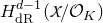 $H^{d-1}_{\mathrm{dR}}(\mathcal X/\mathcal O_K)$
is finitely generated. Here, using the same argument as above, we can reduce to
 $H^{d-1}_{\mathrm{dR}}(\mathcal X_K/K)$
, which is finitely generated since
 $H^{i}_{\mathrm{dR}}(\mathcal X_K/K)\simeq H^{i}_{\mathrm{dR}}(\overline X_K/K)$
for
 $i\lt 2d$
.
Remark 4.14. One can also see that the bound on de Rham-properness is sharp; namely, in general a scheme
 $\mathcal{X}$
as above (e.g. for
 $\mathcal X= \mathbb P^d\setminus \{*\}$
where
 $*\colon \operatorname{Spec} \mathcal O_K \hookrightarrow \mathbb P^n$
is a point) will not be d-de Rham proper. Indeed, by Proposition 2.9 it is enough to see that the reduction
 $\mathcal X_k$
can be not
 $(d-1)$
-de Rham proper. Let
 $\mathcal X= \mathbb P^d\setminus \{*\}$
, and let us assume for simplicity that
 $K=\mathbb Q_p$
, and so
 $k=\mathbb F_p$
. Then
 $\mathcal{X}$
has a lift of Frobenius, and so de Rham complex of
 $\mathcal X_{\mathbb F_p}$
as a complex of sheaves is formal. Consequently,
 $H^*_{\mathrm H}(\mathcal X_{\mathbb F_p})\simeq H^*_{\mathrm{dR}}(\mathcal X_{\mathbb F_p})$
, and so
 $H^{d-1}_{\mathrm{dR}}(\mathcal X_{\mathbb F_p})$
cannot be finitely generated (by the above discussion for Hodge cohomology).
5. A variant of p-adic Hodge theory for d-Hodge-proper stacks
5.1 Coherence properties of various cohomology
Let R be a (classical) Noetherian ring, and let
 $I=(x_1,\ldots,x_n)\subset R$
be an ideal generated by a regular sequence (so that
 $R/I\simeq \bigotimes_{i=1}^n \mathrm{cofib}(R\xrightarrow{\cdot x_i}R)$
). Assume also that R is I-adically complete (in the classical sense).
Lemma 5.1. Let
 $M\in D(\mathrm{Mod}_{R})$
be derived I-complete and assume that
 $\tau^{\leqslant d}(M\otimes_R R/I)\in \mathrm{Coh}(R/I)$
. Then
 $\tau^{\leqslant d}M\in \mathrm{Coh}(R)$
.
Proof. By induction on the number of generators we can assume that I is principal and generated by a non-zero divisor
 $x\in R$
. Note that
 $\tau^{\leqslant d}M$
is also derived I-complete; thus, e.g. by [Reference Kubrak and PrikhodkoKP24, Proposition 1.1.7], it is enough to show that
 $\tau^{\leqslant d}M\otimes_R R/I\in \mathrm{Coh}(R)$
. Since
 $\tau^{\leqslant d-1}(M\otimes_R R/I)\simeq \tau^{\leqslant d-1}(\tau^{\leqslant d}M\otimes_R R/I)$
, which is coherent, this reduces to showing that
 $H^d(\tau^{\leqslant d}M\otimes_R R/I)\simeq H^d(M)/I$
is a finitely generated
 $R/I$
-module. But by the universal coefficients formula
 $H^d(M)/I$
embeds into
 $H^d(M\otimes_R R/I)$
which is finitely generated by the assumption.
Here comes the first application.
Corollary 5.2. Let
 $\mathcal{X}$
be a d-de Rham proper stack over a perfect field k of characteristic p. Then
 \begin{align*} \tau^{\leqslant d}(R\Gamma_{\mathrm{crys}}(\mathcal X/W(k)))\in \mathrm{Coh}(W(k)). \end{align*}
Proof. By de Rham and crystalline comparisons [Reference Kubrak and PrikhodkoKP24, Propositions 2.3.20 and 2.5.7], we have
 \begin{align*}R\Gamma_{\mathrm{crys}}(\mathcal X/W(k))\otimes_{W(k)} k\simeq R\Gamma_{\mathrm{dR}}(\mathcal X/k).\end{align*}
The rest then follows from Lemma 5.1, since
 $R\Gamma_{\mathrm{crys}}(\mathcal X/W(k))$
is derived p-complete.
Remark 5.3. We note that
 $M\colon = \tau^{\geqslant d+1}R\Gamma_{\mathrm{crys}}(\mathcal X/W(k))[d+1]$
also satisfies the following finiteness condition:
 \begin{align*} \tau^{\lt 0}([M/p])\in \mathrm{Coh}(k). \end{align*}
More generally, given a stack
 $\mathcal{X}$
over
 $\mathcal O_K$
one can establish similar properties for the prismatic cohomology (over the Breuil–Kisin prism). Here, let K be a discretely valued complete field extension of
 $\mathbb Q_p$
with a perfect residue field k. For a choice of uniformizer
 $\pi\in \mathcal O_K$
we have the corresponding Breuil–Kisin prism
 $(\mathfrak S, E(u))=(W(k)[[u]], E(u))$
with
 $\mathfrak S/E(u) =\mathcal O_K$
. Recall [Reference Kubrak and PrikhodkoKP24, Definition 2.2.1] that for a prestack
 $\mathcal{X}$
over
 $\mathcal O_K$
we have the prismatic cohomology complex
 $R\Gamma_{{{\Delta}}}(\mathcal X/\mathfrak S)\in D(\mathrm{Mod}_{\mathfrak S})$
, as well as its twisted version
 $R\Gamma_{{{{\Delta}}}^{(1)}}(\mathcal X/\mathfrak S)\in D(\mathrm{Mod}_{\mathfrak S})$
, which, in the case of the Breuil–Kisin prism, is also identified with the ‘Frobenius twist’
 $\varphi_{\mathfrak S}^*R\Gamma_{{{\Delta}}}(\mathcal X/\mathfrak S)$
. The complexes
 $R\Gamma_{{{\Delta}}}(\mathcal X/\mathfrak S)$
,
 $R\Gamma_{{{{\Delta}}}^{(1)}}(\mathcal X/\mathfrak S)$
are derived (p,u)-adically complete and one has a natural ‘Frobenius map’
 \begin{align*}\varphi_{{{\Delta}}}\colon R\Gamma_{{{{\Delta}}}^{(1)}}(\mathcal X/\mathfrak S) \longrightarrow R\Gamma_{{{{\Delta}}}}(\mathcal X/\mathfrak S),\end{align*}
which becomes an equivalence after inverting E(u) in the case
 $\mathcal{X}$
is a smooth Artin stack [Reference Kubrak and PrikhodkoKP24, Remark 2.2.16].
Corollary 5.4. Let
 $\mathcal{X}$
be a smooth Artin stack over
 $\mathcal O_K$
. If the reduction
 $\mathcal X_k$
is d-de Rham proper over k, then both
 \begin{align*} \tau^{\leqslant d}R\Gamma_{{{{\Delta}}}}(\mathcal X/\mathfrak S)\in \mathrm{Coh}(\mathfrak S) \quad \text{and} \quad \tau^{\leqslant d}R\Gamma_{{{{\Delta}}}^{(1)}}(\mathcal X/\mathfrak S)\in \mathrm{Coh}(\mathfrak S). \end{align*}
Proof. The map
 $\varphi_{\mathfrak S}\colon \mathfrak S \rightarrow \mathfrak S$
is faithfully flat, so by Lemma 2.10 it is enough to show that
 $\tau^{\leqslant d}R\Gamma_{{{{\Delta}}}^{(1)}}(\mathcal X/\mathfrak S)\in \mathrm{Coh}(\mathfrak S)$
. The claim then follows from crystalline comparison [Reference Kubrak and PrikhodkoKP24, Remark 2.5.10]
 \begin{align*}R\Gamma_{{{{\Delta}}}^{(1)}}(\mathcal X/\mathfrak S)\otimes_{\mathfrak S}\mathfrak S/u\simeq R\Gamma_{\mathrm{crys}}(\mathcal X_k/W(k))\end{align*}
and Corollary 5.2.
Remark 5.5. By Corollary 5.4, we get that if the reduction
 $\mathcal X_k$
is d-de Rham proper, the
 $\mathfrak S$
-modules
 $H^i_{{{\Delta}}}(\mathcal X/\mathfrak S)$
are finitely generated if
 $i\leqslant d$
. The isomorphisms
 \begin{align*} \varphi_{{{\Delta}}}\bigg[\frac{1}{E}\bigg]\colon \varphi_{\mathfrak S}^*H^i_{{{\Delta}}}(\mathcal X/\mathfrak S)\bigg[\frac{1}{E}\bigg] \xrightarrow{\sim} H^i_{{{\Delta}}}(\mathcal X/\mathfrak S)\bigg[\frac{1}{E}\bigg] \end{align*}
then endow each of them with a Breuil–Kisin module structure. Just given the existence of this structure, we get that
 $H^i_{{{\Delta}}}(\mathcal X/\mathfrak S)[{1}/{p}]$
is a finite free
 $\mathfrak S[{1}/{p}]$
-module for
 $i\leqslant d$
(see, e.g., [Reference Bhatt, Morrow and ScholzeBMS18, Proposition 4.3]). In fact, we show that (under some torsion-free assumptions) the corresponding lattice in a crystalline Galois representation is described by étale cohomology of the Raynaud generic fiber (see Remark 5.25).
Remark 5.6. The d-de Rham properness of
 $\mathcal X_k$
also implies some important properties of prismatic cohomology in degrees higher than d, that turn out to be rather crucial later. Namely, even though
 $M\colon = \tau^{\geqslant d+1}R\Gamma_{{{{\Delta}}}^{(1)}}(\mathcal X/\mathfrak S)[d+1]$
is not an object of
 $\mathrm{Coh}(\mathfrak S)$
, it is still derived (p,u)-complete and satisfies the following finiteness condition: namely,
 $\tau^{\lt 0}[M/(p,u)]\in \mathrm{Coh}(k)$
. Indeed, let
 $C\colon = R\Gamma_{{{{\Delta}}}^{(1)}}(\mathcal X/\mathfrak S)[d+1]$
; we have
 $M\simeq \tau^{\geqslant 0}(C)$
. Note that by our assumptions on
 $\mathcal X_k$
and de Rham comparison we have
 $\tau^{\lt 0}([C/(p,u)])\in \mathrm{Coh}(k)$
. We have a fiber sequence
 $ \tau^{\lt 0}C \rightarrow C \rightarrow M $
which gives a fiber sequence
 \begin{align*} [\tau^{\lt 0}C/(p,u)]\rightarrow [C/(p,u)] \rightarrow [M/(p,u)]. \end{align*}
We have that
 $\tau^{\lt 0}C$
is coherent by Corollary 5.4, and so it follows that
 $\tau^{\lt 0}([M/(p,u)])\in \mathrm{Coh}(k)$
.
Consequently, applying
 $[-/(p,u)]$
to the fiber sequence
 $H^0(M)[0] \rightarrow M \rightarrow \tau^{\gt 0}M$
and considering the corresponding long exact sequence of cohomology we get that
 $H^{-2}([H^0(M)/(p,u)])\simeq H^{-2}([M/(p,u)])$
while there is also an embedding
 $H^{-1}([H^0(M)/(p,u)])\hookrightarrow H^{-1}([M/(p,u)])$
, and so both are finite-dimensional vector spaces over k. Recalling the definition of M we get from this that the (p,u)-torsion
 $H^{d+1}_{{{{\Delta}}}^{(1)}}(\mathcal X/\mathfrak S)[p][u]$
is a finite-dimensional k-vector space.
We record a part of the discussion in Remark 5.6 as Lemma 5.7 for future reference.
Lemma 5.7. Let
 $\mathcal{X}$
be a smooth Artin stack over
 $\mathcal O_K$
such that the reduction
 $\mathcal X_k$
is d-de Rham proper over k. Then
 $M\colon = \tau^{\geqslant d+1}R\Gamma_{{{{\Delta}}}^{(1)}}(\mathcal X/\mathfrak S)[d+1]$
satisfies
 \begin{align*} \tau^{\lt 0}([M/(p,u)])\in \mathrm{Coh}(k). \end{align*}
Let R be a p-bounded p-complete ring. The following notation is convenient.
Definition 5.8. We define the p-completed Hodge cohomology
 $R\Gamma_{\mathrm H}(\widehat{\mathcal X}/R)$
of an Artin R-stack
 $\mathcal{X}$
as the derived p-completion
 $R\Gamma_{\mathrm H}({\mathcal X}/R)^\wedge_p$
. We also denote
 \begin{align*}H^{j,i}(\widehat{\mathcal X}/R)\colon = H^i(R\Gamma(\mathcal X,\wedge^j\mathbb L_{\mathcal X/R})^\wedge_p).\end{align*}
Similarly, if
 $\mathcal{X}$
is smooth over R we define the p-completed de Rham cohomology
 \begin{align*}R\Gamma_{\mathrm{dR}}(\widehat{\mathcal X}/R)\colon = R\Gamma_{\mathrm{dR}}(\mathcal X/R)^\wedge_p.\end{align*}
Naturally, we have coherence results for
 $R\Gamma_{\mathrm H}(\widehat{\mathcal X}/R)$
and
 $R\Gamma_{\mathrm{dR}}(\widehat{\mathcal X}/R)$
implied by d-Hodge and d-de Rham-properness of the mod p reduction
 $\mathcal X_{R/p}$
of
 $\mathcal{X}$
.
Corollary 5.9. Let R be a Noetherian p-torsion-free p-complete ring and let
 $\mathcal{X}$
be a smooth qcqs Artin stack over R.
-
(1) If the reduction
$\mathcal X_{R/p}$
is d-Hodge-proper over
$R/p$
we have Equivalently,
\begin{align*}\tau^{\leqslant d}R\Gamma_{\mathrm H}(\widehat{\mathcal X}/R)\in \mathrm{Coh}(R).\end{align*}
$H^{j,i}(\widehat{\mathcal X}/R)$
is a finitely generated R-module for any
$i+j\leqslant d $
.
-
(2) If the reduction
$\mathcal X_{R/p}$
is d-de Rham-proper over
$R/p$
we have
\begin{align*}\tau^{\leqslant d}R\Gamma_{\mathrm{dR}}(\widehat{\mathcal X}/R)\in \mathrm{Coh}(R).\end{align*}


Proof. Since p is a non-zero divisor in R, we have
 $R/p\simeq \mathrm{cofib}(R\xrightarrow{\cdot p}R)$
. Thus, for any
 $M\in D(\mathrm{Mod}_{R})$
and the definition of derived p completion we have
 $M^\wedge_p\otimes_R R/p\simeq M\otimes_R R/p$
. In addition,
 $R/p$
is of Tor-amplitude
 $[-1,0]$
as an R-module. This, together with base change for Hodge and de Rham cohomology [Reference Kubrak and PrikhodkoKP22, Proposition 1.1.8], leads to equivalences
 \begin{align*} R\Gamma_{\mathrm H}(\widehat{\mathcal X}/R)\otimes_R R/p \xrightarrow{\sim} R\Gamma_{\mathrm H}({\mathcal X}_{R/p}/(R/p)), \quad R\Gamma_{\mathrm{dR}}(\widehat{\mathcal X}/R)\otimes_R R/p \xrightarrow{\sim} R\Gamma_{\mathrm{dR}}({\mathcal X}_{R/p}/(R/p)). \end{align*}
Then we are done by Lemma 5.1.
We also record a statement analogous to Corollary 5.4 but which applies to more general base prisms. We refer to [Reference Kubrak and PrikhodkoKP24, Definition 2.2.1] for the definitions of prismatic cohomology
 $R\Gamma_{{{\Delta}}}(\mathcal X/A)\in D(\mathrm{Mod}_{A})$
, as well as its twisted version
 $R\Gamma_{{{{\Delta}}}^{(1)}}(\mathcal X/A)\in D(\mathrm{Mod}_{A})$
.
Corollary 5.10. Let (A,I) be a transversalFootnote
8
prism such that the underlying ring A is Noetherian. Let
 $\mathcal{X}$
be a qcqs smooth Artin stack over
 $A/I$
such that the reduction
 $\mathcal X_{A/(I,p)}$
is d-de Rham-proper over
 $A/(I,p)$
. Then
 \begin{align*} \tau^{\leqslant d}R\Gamma_{{{{\Delta}}}^{(1)}}(\mathcal X/A)\in \mathrm{Coh}(A). \end{align*}
If the reduction
 $\mathcal X_{A/(I,p)}$
is d-Hodge-proper over
 $A/(I,p)$
, then
 \begin{align*} \tau^{\leqslant d}R\Gamma_{{{{\Delta}}}}(\mathcal X/A)\in \mathrm{Coh}(A). \end{align*}
Proof. Note that we have isomorphisms
 \begin{align*}R\Gamma_{{{{\Delta}}}^{(1)}}(\mathcal X/A)\otimes_A A/I \xrightarrow{\sim} R\Gamma_{L{\mathrm{dR}}^\wedge_p}(\mathcal X/(A/I)) \xrightarrow{\sim} R\Gamma_{\mathrm{dR}}(\widehat{\mathcal X}/(A/I))^\wedge_p.\end{align*}
Here the first arrow is given by the de Rham comparison [Reference Kubrak and PrikhodkoKP24, Proposition 2.3.20], while the second equivalence holds for any smooth Artin
 $\mathcal{X}$
(see [Reference Kubrak and PrikhodkoKP24, Proposition 2.3.18]). Since (A,I) is transversal we can apply Corollary 5.9(2), getting that
 $\tau^{\leqslant d}R\Gamma_{\mathrm{dR}}(\widehat{\mathcal X}/(A/I))$
. The first part of the proposition then follows from Lemma 5.1.
For the second part recall that the Hodge–Tate complex
 $R\Gamma_{{{{\Delta}}}/I}(\mathcal X/A)\colon = R\Gamma_{{{{\Delta}}}}(\mathcal X/A)\otimes_A^{\mathbb L} A/I$
has a natural conjugate filtration with the associated graded
 $\mathrm{gr}_i = R\Gamma(\mathcal X, \wedge^i\mathbb L_{\mathcal X/(A/I)})^\wedge_p\{-i\}[-i]$
(see [Reference Kubrak and PrikhodkoKP24, § 2.4]). Since
 $\mathcal{X}$
is smooth this filtration is exhaustive [Reference Kubrak and PrikhodkoKP24, Proposition 2.4.3]) and induces a convergent spectral sequence
 $E^{i,j}=H^{j,i}(\widehat{\mathcal X}/(A/I))\{-i\}\Rightarrow H^{i+j}_{{{{\Delta}}}/I}(\mathcal X/A)$
(see [Reference Kubrak and PrikhodkoKP24, § 4.3.3]). Recall that the twist
 $\{-i\}$
here is just tensoring with the invertible
 $A/I$
-module
 $((I/I^2)^\vee)^{\otimes i}$
and so does not change coherence. It is then enough to show that
 $H^{j,i}(\widehat{\mathcal X}/(A/I))$
is finitely generated for
 $i+j\leqslant d$
, which follows from Corollary 5.9(1).
5.2 Some integral p-adic Hodge theory in a d-de Rham-proper setting
In this section we adapt some results of [Reference Kubrak and PrikhodkoKP24, §§ 2 and 4] about prismatic cohomology of Hodge-proper stacks to the setting of stacks that are only d-Hodge (or rather d-de Rham) proper.
In this section we mostly assume that the base prism
 $(A,I)=(\mathfrak S,E(u))$
is a Breuil–Kisin prism. The goal is to establish a truncated version of integral p-adic Hodge theory in the setting of d-de Rham-proper stacks over
 $\mathcal O_K$
. The main reference to some relevant background material is [Reference Kubrak and PrikhodkoKP24, § 4.3].
Let
 $\pi\in \mathcal O_K$
be the uniformizer to which the chosen Breuil–Kisin prism
 $(\mathfrak S,E(u))$
corresponds (so
 $\pi$
is the image of u under the identification
 $\mathfrak S/E(u)\xrightarrow{\sim} \mathcal O_K$
). A compatible choice of
 $p^n$
-roots of
 $\pi$
in
 $\mathcal O_C$
gives an element
 $\pi^\flat\colon = (\pi,\pi^{1/p}, \pi^{1/p^2},\ldots)\in \mathcal O_C^\flat$
in the tilt
 $\mathcal O_C^\flat\colon = \lim_{x\mapsto x^p}\mathcal O_C/p$
. This then defines a homomorphism
 $s_{\pi^\flat}\colon \mathfrak S\rightarrow {A_{\mathrm{inf}}}\colon = W(\mathcal O_{C}^\flat)$
by sending
 $u \mapsto [\pi^\flat]$
. We can also compose it further with the natural map
 ${A_{\mathrm{inf}}}\rightarrow W(C^\flat)$
induced by
 $\mathcal O_C^\flat\rightarrow C^\flat\colon = \mathcal O_C^\flat[{1}/{\pi^\flat}]$
. Recall that by the étale comparison [Reference Kubrak and PrikhodkoKP24, Corollary 4.3.3] and base change we have an equivalence
 \begin{equation}R\Gamma_{\acute{\mathrm{e}}\mathrm{t}}(\widehat{\mathcal X}_{{C}}, \mathbb Z_p) \xrightarrow{\sim} (R\Gamma_{{{{\Delta}}}^{(1)}}(\mathcal X/ \mathfrak S)\mathbin{\widehat{\otimes}}_{\mathfrak S} W(C^\flat))^{\varphi_{{{{\Delta}}}} = 1}\end{equation}
for any smooth qcqs Artin
 $\mathcal O_K$
-stack
 $\mathcal{X}$
.
Remark 5.11. We use the twisted version of the étale comparison here for a future convenience. The difference only affects the natural map
 \begin{align*} R\Gamma_{\acute{\mathrm{e}}\mathrm{t}}(\widehat{\mathcal X}_{{C}}, \mathbb Z_p)\mathbin{\widehat{\otimes}}_{\mathbb Z_p}W(C^\flat) \longrightarrow R\Gamma_{{{{\Delta}}}^{(1)}}(\mathcal X/ \mathfrak S)\mathbin{\widehat{\otimes}}_{\mathfrak S} W(C^\flat), \end{align*}
namely it becomes twisted by Frobenius on
 $W(C^\flat)$
(see [Reference Kubrak and PrikhodkoKP24, Remark 4.3.7]; to apply the remark, note that by base change
 \begin{align*}R\Gamma_{{{{\Delta}}}^{(1)}}(\mathcal X/ \mathfrak S)\mathbin{\widehat{\otimes}}_{\mathfrak S} W(C^\flat)\simeq R\Gamma_{{{{\Delta}}}^{(1)}}(\mathcal X_{\mathcal O_C}/ {A_{\mathrm{inf}}})\mathbin{\widehat{\otimes}}_{{A_{\mathrm{inf}}}} W(C^\flat)).\end{align*}
Proposition 5.12. Let
 $\mathcal{X}$
be a smooth qcqs Artin stack over
 $\mathcal O_K$
such that the reduction
 $\mathcal X_k$
is d-de Rham-proper. Then we have the following.
-
(1) There is a natural equivalence
\begin{align*}\tau^{\leqslant d}R\Gamma_{{{{\Delta}}}^{(1)}}(\mathcal X/\mathfrak S)\otimes_{\mathfrak S} W(C^\flat)\xrightarrow{\sim} \tau^{\leqslant d}(R\Gamma_{{{{\Delta}}}^{(1)}}(\mathcal X/\mathfrak S)\mathbin{\widehat{\otimes}}_{\mathfrak S}W(C^\flat)).\end{align*}
-
(2) The natural map
is also an equivalence.
\begin{align*} \tau^{\leqslant d}R\Gamma_{\acute{\mathrm{e}}\mathrm{t}}(\widehat{\mathcal X}_{{C}}, \mathbb Z_p)\otimes_{\mathbb Z_p} W(C^\flat) \longrightarrow \tau^{\leqslant d}(R\Gamma_{{{{\Delta}}}^{(1)}}(\mathcal X/ \mathfrak S)\mathbin{\widehat{\otimes}}_{\mathfrak S} W(C^\flat)) \end{align*}
-
(3) Consequently, one has isomorphisms
for all
\begin{align*} H^i_{\acute{\mathrm{e}}\mathrm{t}}(\widehat{\mathcal X}_C,\mathbb Z_p)\otimes_{\mathbb Z_p}W(C^\flat) \xrightarrow{\sim} H^i_{{{{\Delta}}}^{(1)}}(\mathcal X/\mathfrak S)\otimes_{\mathfrak S}W(C^\flat) \end{align*}
$i\leqslant d$
.


Proof.
-
(1) First let us show that the natural map
$\tau^{\leqslant d}R\Gamma_{{{{\Delta}}}^{(1)}}(\mathcal X/\mathfrak S)\rightarrow R\Gamma_{{{{\Delta}}}^{(1)}}(\mathcal X/\mathfrak S)$
induces an equivalence Denote
\begin{align*} \tau^{\leqslant d} R\Gamma_{{{{\Delta}}}^{(1)}}(\mathcal X/\mathfrak S)\mathbin{\widehat{\otimes}}_{\mathfrak S}W(C^\flat) \xrightarrow{\sim} \tau^{\leqslant d} (R\Gamma_{{{{\Delta}}}^{(1)}}(\mathcal X/\mathfrak S)\mathbin{\widehat{\otimes}}_{\mathfrak S}W(C^\flat)). \end{align*}
$M\colon = R\Gamma_{{{{\Delta}}}^{(1)}}(\mathcal X/\mathfrak S)$
. Note that the p-completed tensor product functor
$-\mathbin{\widehat{\otimes}}_{\mathfrak S}W(C^\flat)$
is t-exact up to a right shift by 1 since
$W(C^\flat)$
is flat over
$\mathfrak S$
. We have a fiber sequence and so to get the claim it is just enough to show that
\begin{align*} \tau^{\leqslant d} M \mathbin{\widehat{\otimes}}_{\mathfrak S}W(C^\flat)\longrightarrow M\mathbin{\widehat{\otimes}}_{\mathfrak S}W(C^\flat) \longrightarrow \tau^{\gt d}M\mathbin{\widehat{\otimes}}_{\mathfrak S}W(C^\flat) \end{align*}
$H^d(\tau^{\gt d}M\mathbin{\widehat{\otimes}}_{\mathfrak S}W(C^\flat))$
is 0. Note that By Remark 5.6
\begin{align*}H^d(\tau^{\gt d}M\mathbin{\widehat{\otimes}}_{\mathfrak S}W(C^\flat))\simeq H^d(H^{d+1}(M)[-d-1]\mathbin{\widehat{\otimes}}_{\mathfrak S}W(C^\flat))\simeq H^{-1}(H^{d+1}(M)\mathbin{\widehat{\otimes}}_{\mathfrak S}W(C^\flat)).\end{align*}
$H^{d+1}(M)$
satisfies the conditions of Corollary A.11, and so the latter group is 0. Since
$\tau^{\leqslant d} R\Gamma_{{{{\Delta}}}^{(1)}}(\mathcal X/\mathfrak S)\in \mathrm{Coh}(\mathfrak S)$
by Corollary 5.4, the tensor product
$\tau^{\leqslant d} R\Gamma_{{{{\Delta}}}^{(1)}}(\mathcal X/\mathfrak S)\otimes_{\mathfrak S}W(C^\flat)$
is already p-complete. We get a natural equivalence as desired.
\begin{align*} \tau^{\leqslant d}R\Gamma_{{{{\Delta}}}^{(1)}}(\mathcal X/\mathfrak S)\otimes_{\mathfrak S} W(C^\flat)\xrightarrow{\sim} \tau^{\leqslant d}(R\Gamma_{{{{\Delta}}}^{(1)}}(\mathcal X/\mathfrak S)\mathbin{\widehat{\otimes}}_{\mathfrak S}W(C^\flat)), \end{align*}
-
(2) We keep the notation
$M\colon = R\Gamma_{{{{\Delta}}}^{(1)}}(\mathcal X/\mathfrak S)$
. We have a fiber sequence As we saw in the proof of part (1),
\begin{align*} (\tau^{\leqslant d} M\mathbin{\widehat{\otimes}}_{\mathfrak S}W(C^\flat))^{\varphi_{{{\Delta}}}=1} \rightarrow (M\mathbin{\widehat{\otimes}}_{\mathfrak S}W(C^\flat))^{\varphi_{{{\Delta}}}=1} \rightarrow (\tau^{\gt d} M\mathbin{\widehat{\otimes}}_{\mathfrak S}W(C^\flat))^{\varphi_{{{\Delta}}}=1}. \end{align*}
$\tau^{\gt d} M\mathbin{\widehat{\otimes}}_{\mathfrak S}W(C^\flat)\simeq \tau^{\gt d}(M\mathbin{\widehat{\otimes}}_{\mathfrak S}W(C^\flat))$
is d-coconnected, and thus so is
$(\tau^{\gt d} M\mathbin{\widehat{\otimes}}_{\mathfrak S}W(C^\flat))^{\varphi_{{{\Delta}}}=1}$
. Moreover,
$\tau^{\leqslant d} M\mathbin{\widehat{\otimes}}_{\mathfrak S}W(C^\flat)\simeq \tau^{\leqslant d} M\otimes_{\mathfrak S}W(C^\flat)$
is coherent and so
$(\tau^{\leqslant d} M\mathbin{\widehat{\otimes}}_{\mathfrak S}W(C^\flat))^{\varphi_{{{\Delta}}}=1}$
lies inFootnote
9
$D(\mathrm{Mod}_{\mathfrak S})^{\leqslant d}$
. Together, this shows that Moreover, by [Reference BhattBha18, Lemma 8.5] (again crucially using that
\begin{align*} \tau^{\leqslant d}(M\otimes_{\mathfrak S}W(C^\flat)^{\varphi_{{{\Delta}}}=1})\xrightarrow{\sim}(\tau^{\leqslant d} M\otimes_{\mathfrak S}W(C^\flat))^{\varphi_{{{\Delta}}}=1}. \end{align*}
$\tau^{\leqslant d} M\mathbin{\widehat{\otimes}}_{\mathfrak S}W(C^\flat)$
is coherent) we get that the natural map is an equivalence. It remains to note that by (5.1) there is a natural equivalence
\begin{align*} \tau^{\leqslant d}(M\otimes_{\mathfrak S}W(C^\flat)^{\varphi_{{{\Delta}}}=1})\otimes_{\mathbb Z_p}W(C_p^\flat) \longrightarrow \tau^{\leqslant d} M\mathbin{\widehat{\otimes}}_{\mathfrak S}W(C^\flat)\end{align*}
\begin{align*} \tau^{\leqslant d}R\Gamma_{\acute{\mathrm{e}}\mathrm{t}}(\widehat{\mathcal X}_C,\mathbb Z_p)\xrightarrow{\sim} \tau^{\leqslant d}(M\mathbin{\widehat{\otimes}}_{\mathfrak S}W(C^\flat)^{\varphi_{{{\Delta}}}=1}). \end{align*}
-
(3) From parts (1) and (2) we get an equivalence
The statement of part (3) then follows by passing to cohomology.
\begin{align*} \tau^{\leqslant d}R\Gamma_{\acute{\mathrm{e}}\mathrm{t}}(\widehat{\mathcal X}_C,\mathbb Z_p)\otimes_{\mathbb Z_p}W(C^\flat) \xrightarrow{\sim} \tau^{\leqslant d} R\Gamma_{{{{\Delta}}}^{(1)}}(\mathcal X/\mathfrak S)\otimes_{\mathfrak S}W(C^\flat). \end{align*}


We also need the following lemma which controls the (classical) base change of prismatic cohomology to
 ${A_{\mathrm{inf}}}$
.
Lemma 5.13. Let
 $\mathcal{X}$
be a stack over
 $\mathcal O_K$
such that its reduction
 $\mathcal X_k$
is d-de Rham proper. Then we have a natural isomorphism
 \begin{align*} \tau^{\leqslant d}R\Gamma_{{{{\Delta}}}^{(1)}}(\mathcal X/\mathfrak S)\otimes_{\mathfrak S}{A_{\mathrm{inf}}}\simeq \tau^{\leqslant d}R\Gamma_{{{{\Delta}}}^{(1)}}(\mathcal X_{\mathcal O_C}/{A_{\mathrm{inf}}}). \end{align*}
Proof. By base change for prismatic cohomology [Reference Kubrak and PrikhodkoKP24, Proposition 2.2.17] we have
 \begin{align*} R\Gamma_{{{{\Delta}}}^{(1)}}(\mathcal X_{\mathcal O_C}/{A_{\mathrm{inf}}})\simeq R\Gamma_{{{{\Delta}}}^{(1)}}(\mathcal X/\mathfrak S)\mathbin{\widehat{\otimes}}_{\mathfrak S}{A_{\mathrm{inf}}}.\end{align*}
Note that
 ${A_{\mathrm{inf}}}$
is a (p,u)-completely free module over
 $\mathfrak S$
. Indeed, picking a basis
 $\{x_s\}_{s\in S}$
of
 $\mathcal O_C^\flat/\pi^\flat$
over k and lifts
 $\tilde{x}_i\in {A_{\mathrm{inf}}}$
(under the projection
 ${A_{\mathrm{inf}}}\rightarrow \mathcal O_C^\flat/\pi^\flat$
) we get a map
 \begin{align*}\widehat{\bigoplus_{s\in S}}\mathfrak S \longrightarrow {A_{\mathrm{inf}}},\end{align*}
which is an isomorphism modulo (p,u), and thus is itself an isomorphism by Nakayama’s lemma. Moreover, by Remark 5.6 we have that
 $M := \tau^{\geqslant d+1}R\Gamma_{{{{\Delta}}}^{(1)}}(\mathcal X/\mathfrak S)[d+1]$
satisfies the condition of Proposition A.13,, and thus
 . Since the completed tensor product is right t-exact, we get from this that
 \begin{align*}\tau^{\leqslant d} R\Gamma_{{{{\Delta}}}^{(1)}}(\mathcal X_{\mathcal O_C}/{A_{\mathrm{inf}}})\simeq \tau^{\leqslant d} (R\Gamma_{{{{\Delta}}}^{(1)}}(\mathcal X/\mathfrak S)\mathbin{\widehat{\otimes}}_{\mathfrak S}{A_{\mathrm{inf}}}) \simeq \tau^{\leqslant d} (R\Gamma_{{{{\Delta}}}^{(1)}}(\mathcal X/\mathfrak S))\mathbin{\widehat{\otimes}}_{\mathfrak S}{A_{\mathrm{inf}}}.\end{align*}
By the assumption on
 $\mathcal X_k$
we have
 $\tau^{\leqslant d}(R\Gamma_{{{{\Delta}}}^{(1)}}(\mathcal X/\mathfrak S))\in\mathrm{Coh}(\mathfrak S)$
, and so the classical tensor product
 $\tau^{\leqslant d} (R\Gamma_{{{{\Delta}}}^{(1)}}(\mathcal X/\mathfrak S))\otimes_{\mathfrak S}{A_{\mathrm{inf}}}$
is already derived (p,u)-complete. In this way we get an isomorphism
 \begin{align*}\tau^{\leqslant d} (R\Gamma_{{{{\Delta}}}^{(1)}}(\mathcal X/\mathfrak S))\otimes_{\mathfrak S}{A_{\mathrm{inf}}}\xrightarrow{\sim} \tau^{\leqslant d} R\Gamma_{{{{\Delta}}}^{(1)}}(\mathcal X_{\mathcal O_C}/{A_{\mathrm{inf}}}),\end{align*}
as desired.
Corollary 5.14. Let
 $\mathcal{X}$
be a stack over
 $\mathcal O_K$
such that its reduction
 $\mathcal X_k$
is d-de Rham proper. Then for any
 $0\leqslant i\leqslant d$
we have a
 $G_K$
-equivariant isomorphism
 \begin{align*} H^i_{\acute{\mathrm{e}}\mathrm{t}}(\widehat{\mathcal X}_C,\mathbb Z_p)\otimes_{\mathbb Z_p}{A_{\mathrm{inf}}}\bigg[\frac{1}{\mu}\bigg]\xrightarrow{\sim} H^i_{{{{\Delta}}}^{(1)}}(\mathcal X_{\mathcal O_C}/{A_{\mathrm{inf}}})\otimes_{A_{\mathrm{inf}}} {A_{\mathrm{inf}}}\bigg[\frac{1}{\mu}\bigg] \end{align*}
that extends to a
 $(G_K,\varphi)$
-equivariant isomorphism
 \begin{align*} H^i_{\acute{\mathrm{e}}\mathrm{t}}(\widehat{\mathcal X}_C,\mathbb Z_p)\otimes_{\mathbb Z_p}B_{\mathrm{crys}} \xrightarrow{\sim} H^i_{{{{\Delta}}}^{(1)}}(\mathcal X_{\mathcal O_C}/{A_{\mathrm{inf}}})\otimes_{A_{\mathrm{inf}}} B_{\mathrm{crys}}. \end{align*}
Proof. Recall that the map
 $\mathfrak S\rightarrow {A_{\mathrm{inf}}}$
is flat [Reference Bhatt, Morrow and ScholzeBMS18, Lemma 4.30]. Thus, from Lemma 5.13 we get that for any
 $0\leqslant i\leqslant d$
there is an isomorphism
 $H^i_{{{{\Delta}}}^{(1)}}(\mathcal X_{\mathcal O_C}/{A_{\mathrm{inf}}})\simeq H^i_{{{{\Delta}}}^{(1)}}(\mathcal X/\mathfrak S)\otimes_{\mathfrak S}{A_{\mathrm{inf}}}$
. Applying Proposition 5.12(3) we then get a
 $\varphi$
-equivariant isomorphism
 \begin{equation} H^i_{\acute{\mathrm{e}}\mathrm{t}}(\widehat{\mathcal X}_C,\mathbb Z_p)\otimes_{\mathbb Z_p}W(C^\flat)\xrightarrow{\sim} H^i_{{{{\Delta}}}^{(1)}}(\mathcal X_{\mathcal O_C}/{A_{\mathrm{inf}}})\otimes_{A_{\mathrm{inf}}} W(C^\flat),\end{equation}
which is in fact induced by the étale comparison map
 \begin{align*} R\Gamma_{\acute{\mathrm{e}}\mathrm{t}}(\widehat{\mathcal X}_C,\mathbb Z_p) \longrightarrow R\Gamma_{{{{\Delta}}}^{(1)}}(\mathcal X_{\mathcal O_C}/{A_{\mathrm{inf}}})\mathbin{\widehat{\otimes}}_{{A_{\mathrm{inf}}}} W(C^\flat) \end{align*}
and thus is
 $G_K$
-equivariant.
By Remark 5.5,
 $H^i_{{{{\Delta}}}}(\mathcal X/\mathfrak S)$
is a Breuil–Kisin module in the range
 $0\leqslant i\leqslant d$
and this way
 $H^i_{{{{\Delta}}}^{(1)}}(\mathcal X_{\mathcal O_C}/{A_{\mathrm{inf}}})\simeq H^i_{{{{\Delta}}}^{(1)}}(\mathcal X/\mathfrak S)\otimes_{\mathfrak S}{A_{\mathrm{inf}}}$
is a Breuil–Kisin–Fargues module. Then by [Reference Bhatt, Morrow and ScholzeBMS18, Lemma 4.26] the isomorphism in (5.2) restricts to an isomorphism
 \begin{align*} H^i_{\acute{\mathrm{e}}\mathrm{t}}(\widehat{\mathcal X}_C,\mathbb Z_p)\otimes_{\mathbb Z_p}{A_{\mathrm{inf}}}\bigg[\frac{1}{\mu}\bigg]\xrightarrow{\sim} H^i_{{{{\Delta}}}^{(1)}}(\mathcal X_{\mathcal O_C}/{A_{\mathrm{inf}}})\otimes_{A_{\mathrm{inf}}} {A_{\mathrm{inf}}}\bigg[\frac{1}{\mu}\bigg], \end{align*}
which is also
 $G_K$
-equivariant, since
 $G_K$
-action on
 $W(C^\flat)$
preservesFootnote
10
 ${A_{\mathrm{inf}}}[{1}/{\mu}]\subset W(C^\flat)$
. This then automatically extends to a
 $(G_K,\varphi)$
-equivariant isomorphism
 \begin{align*} H^i_{\acute{\mathrm{e}}\mathrm{t}}(\widehat{\mathcal X}_C,\mathbb Z_p)\otimes_{\mathbb Z_p}{A_{\mathrm{inf}}}\bigg[\frac{1}{\mu},\frac{1}{\varphi(\mu)}, \frac{1}{\varphi^2(\mu)},\ldots\bigg]\xrightarrow{\sim} H^i_{{{{\Delta}}}^{(1)}}(\mathcal X_{\mathcal O_C}/{A_{\mathrm{inf}}})\otimes_{A_{\mathrm{inf}}} {A_{\mathrm{inf}}}\bigg[\frac{1}{\mu},\frac{1}{\varphi(\mu)}, \frac{1}{\varphi^2(\mu)},\ldots\bigg], \end{align*}
where localization
 ${A_{\mathrm{inf}}}[{1}/{\mu},{1}/({\varphi(\mu)}), {1}/({\varphi^2(\mu)}),\ldots]$
is the minimal
 $\varphi$
-invariant subring of
 $W(C^\flat)$
containing
 ${A_{\mathrm{inf}}}[{1}/{\mu}]$
. The
 $G_K$
-equivariant embedding
 ${A_{\mathrm{inf}}}[{1}/{\mu}]\rightarrow B_{\mathrm{crys}}$
extends to a
 $(G_K,\varphi)$
-equivariant embedding
 \begin{align*} {A_{\mathrm{inf}}}\bigg[\frac{1}{\mu},\frac{1}{\varphi(\mu)}, \frac{1}{\varphi^2(\mu)},\ldots\bigg] \rightarrow B_{\mathrm{crys}}. \end{align*}
Taking base change under this morphism we arrive at
 $(G_K,\varphi)$
-equivariant isomorphisms
 \begin{align*}H^i_{\acute{\mathrm{e}}\mathrm{t}}(\widehat{\mathcal X}_C,\mathbb Z_p)\otimes_{\mathbb Z_p}B_{\mathrm{crys}} \xrightarrow{\sim} H^i_{{{{\Delta}}}^{(1)}}(\mathcal X_{\mathcal O_C}/{A_{\mathrm{inf}}})\otimes_{A_{\mathrm{inf}}} B_{\mathrm{crys}}.\end{align*}
We can now prove an analogue of Theorem 4.8 in the d-de Rham proper context.
Theorem 5.15. Let
 $\mathcal{X}$
be a
 $(d+1)$
-de Rham proper stack over
 $\mathcal O_K$
. Then the map
 \begin{align*}\Upsilon_{\mathcal X,\mathbb Q_p}\colon R\Gamma_{\acute{\mathrm{e}}\mathrm{t}}(\mathcal X_{C}, \mathbb Q_p)\rightarrow R\Gamma_{\acute{\mathrm{e}}\mathrm{t}}(\widehat{\mathcal X}_{C}, \mathbb Q_p)\end{align*}
induces an isomorphism
 \begin{align*} H^i_{\acute{\mathrm{e}}\mathrm{t}}(\mathcal X_{C}, \mathbb Q_p) \simeq H^i_{\acute{\mathrm{e}}\mathrm{t}}(\widehat{\mathcal X}_{C}, \mathbb Q_p) \end{align*}
for
 $i\leqslant d$
and an embedding
 \begin{align*} H^{d+1}_{\acute{\mathrm{e}}\mathrm{t}}(\mathcal X_{C}, \mathbb Q_p) \hookrightarrow H^{d+1}_{\acute{\mathrm{e}}\mathrm{t}}(\widehat{\mathcal X}_{C}, \mathbb Q_p) \end{align*}
for
 $i=d+1$
.
Proof. With Proposition 4.6 in hand, it is enough to show that
 \begin{align*}\dim H^i_{\acute{\mathrm{e}}\mathrm{t}}(\mathcal X_{C}, \mathbb Q_p)\geqslant \dim H^i_{\acute{\mathrm{e}}\mathrm{t}}(\widehat{\mathcal X}_{C}, \mathbb Q_p)\end{align*}
for
 $i\leqslant d$
. By Proposition 2.9(2) we have that the reduction
 $\mathcal X_k$
is d-de Rham proper. By Remark 5.5 we have that
 $H^i_{{{{\Delta}}}^{(1)}}(\mathcal X/\mathfrak S)[{1}/{p}]$
is a free
 $\mathfrak S[{1}/{p}]$
-module for
 $i\leqslant d$
. Inverting p in Proposition 5.12(3) and comparing the dimensions of both sides over
 $W(C^\flat)[{1}/{p}]$
we get that
 \begin{align*}\dim_{\mathbb Q_p} H^i_{\acute{\mathrm{e}}\mathrm{t}}(\widehat{\mathcal X}_{C}, \mathbb Q_p) = \mathrm{rk}_{\mathfrak S[{1}/{p}]}H^i_{{{{\Delta}}}^{(1)}}(\mathcal X/\mathfrak S)\bigg[\frac{1}{p}\bigg]\end{align*}
for
 $i\leqslant d$
.
Denote
 $H^i_{\mathrm{dR}}(\widehat{\mathcal X}_K/K)\colon = H^i_{\mathrm{dR}}(\widehat{\mathcal X}/\mathcal O_K)[{1}/{p}]$
. By de Rham comparison [Reference Kubrak and PrikhodkoKP24] we have an equivalence
 $R\Gamma_{\mathrm{dR}}(\widehat{\mathcal X}/\mathcal O_K)\simeq [R\Gamma_{{{{\Delta}}}^{(1)}}(\mathcal X/\mathfrak S)/E(u)]$
. This gives a short exact sequence
 \begin{align*} 0\longrightarrow H^i_{{{{\Delta}}}^{(1)}}(\mathcal X/\mathfrak S)\bigg[\frac{1}{p}\bigg]/E\longrightarrow H^i_{\mathrm{dR}}(\widehat{\mathcal X}_K/K)\longrightarrow \bigg(H^{i+1}_{{{{\Delta}}}^{(1)}}(\mathcal X/\mathfrak S)\bigg[\frac{1}{p}\bigg]\bigg)[E]\longrightarrow 0 \end{align*}
for all i. In particular, for
 $i\leqslant d$
we get that
 \begin{align*}\dim_K H^i_{\mathrm{dR}}(\widehat{\mathcal X}_K/K)\geqslant \mathrm{rk}_{\mathfrak S[{1}/{p}]}H^i_{{{{\Delta}}}^{(1)}}(\mathcal X/\mathfrak S)\bigg[\frac{1}{p}\bigg]= \dim_{\mathbb Q_p} H^i_{\acute{\mathrm{e}}\mathrm{t}}(\widehat{\mathcal X}_{C}, \mathbb Q_p). \end{align*}
On the other hand, we claim that for
 $i\leqslant d$
we have an isomorphism
 \begin{align*}H^i_{\mathrm{dR}}(\widehat{\mathcal X}_K/K)\simeq H^i_{\mathrm{dR}}({\mathcal X}_K/K).\end{align*}
Indeed, derived p-completion is t-exact up to a right shift by 1 and so
 \begin{align*}\tau^{\leqslant d}R\Gamma_{\mathrm{dR}}(\widehat{\mathcal X}/\mathcal O_K)\simeq \tau^{\leqslant d}((\tau^{\leqslant d+1}R\Gamma_{\mathrm{dR}}({\mathcal X}/\mathcal O_K))^\wedge_p)\end{align*}
by Lemma 2.8. However, by our assumption
 $\tau^{\leqslant d+1}R\Gamma_{\mathrm{dR}}({\mathcal X}/\mathcal O_K)$
is coherent and so automatically p-complete. It follows that
 $\tau^{\leqslant d}R\Gamma_{\mathrm{dR}}(\widehat{\mathcal X}/\mathcal O_K)\simeq \tau^{\leqslant d}R\Gamma_{\mathrm{dR}}({\mathcal X}/\mathcal O_K)$
, and consequently
 \begin{align*}H^i_{\mathrm{dR}}(\widehat{\mathcal X}_K/K)\simeq H^i_{\mathrm{dR}}({\mathcal X}_K/K)\end{align*}
for
 $i\leqslant d$
. Finally, from the left vertical isomorphism in Proposition 4.5 we know that
 \begin{align*}\dim_{\mathbb Q_p}H^i_{\acute{\mathrm{e}}\mathrm{t}}(\mathcal X_{C}, \mathbb Q_p) =\dim_K H^i_{\mathrm{dR}}({\mathcal X}_K/K)\end{align*}
for all i. We get that
 \begin{align*} \dim H^i_{\acute{\mathrm{e}}\mathrm{t}}(\mathcal X_{C}, \mathbb Q_p)\geqslant \dim H^i_{\acute{\mathrm{e}}\mathrm{t}}(\widehat{\mathcal X}_{C}, \mathbb Q_p) \end{align*}
for
 $i\leqslant d$
as desired.
Remark 5.16. Let us record a fact with a similar flavor to Remark 5.6. By de Rham comparison for prismatic cohomology we have a short exact sequence
 \begin{align*}0\longrightarrow H^i_{{{{\Delta}}}^{(1)}}(\mathcal X/\mathfrak S)/E(u)\longrightarrow H^i_{\mathrm{dR}}(\widehat{\mathcal X}/\mathcal O_K)\longrightarrow H^{i+1}_{{{{\Delta}}}^{(1)}}(\mathcal X/\mathfrak S)[E(u)]\longrightarrow 0.\end{align*}
If
 $\mathcal{X}$
is
 $(d+1)$
-de Rham proper over
 $\mathcal O_K$
, then
 $\mathcal X_{\mathcal O_K/p}$
is d-de Rham proper over
 $\mathcal O_K/p$
and so
 $H^{d}_{\mathrm{dR}}(\widehat{\mathcal X}/\mathcal O_K)$
is a finitely generated
 $\mathcal O_K$
-module. Consequently, we also get some partial information about
 $H^{d+1}_{{{{\Delta}}}^{(1)}}(\mathcal X/\mathfrak S)$
: namely, its E(u)-torsion
 $M\colon = H^{d+1}_{{{{\Delta}}}^{(1)}}(\mathcal X/\mathfrak S)[E(u)]$
is finitely generated over
 $\mathcal O_K$
. However, from the proof of Theorem 5.15 one can see more: namely, M dies after we invert p,
 $M[{1}/{p}]=0$
. Indeed,
 $M[{1}/{p}]$
is the last term in the short exact sequence
 \begin{align*}0\longrightarrow H^{d}_{{{{\Delta}}}^{(1)}}(\mathcal X/\mathfrak S)\bigg[\frac{1}{p}\bigg]/E(u)\longrightarrow H^{d}_{\mathrm{dR}}(\widehat{\mathcal X}_K/K)\longrightarrow \bigg(H^{d+1}_{{{{\Delta}}}^{(1)}}(\mathcal X/\mathfrak S)\bigg[\frac{1}{p}\bigg]\bigg)[E(u)]\longrightarrow 0\end{align*}
and we saw that
 $\dim_K H^{d}_{{{{\Delta}}}^{(1)}}(\mathcal X/\mathfrak S)[{1}/{p}]/E(u)\simeq \dim_{\mathbb Q_p} H^d_{\acute{\mathrm{e}}\mathrm{t}}(\widehat{\mathcal X}_{C}, \mathbb Q_p)$
, as well as the equalities
 \begin{align*}\dim_{\mathbb Q_p} H^{d}_{\acute{\mathrm{e}}\mathrm{t}}(\widehat{\mathcal X}_{C}, \mathbb Q_p)=\dim_{\mathbb Q_p} H^{d}_{\acute{\mathrm{e}}\mathrm{t}}({\mathcal X}_{C}, \mathbb Q_p)=\dim_K H^{d}_{\mathrm{dR}}({\mathcal X}_K/K)=\dim_K H^{d}_{\mathrm{dR}}(\widehat{\mathcal X}_K/K).\end{align*}
Thus,
 $\dim_K M[{1}/{p}]=0$
, meaning that
 $M[{1}/{p}]=0$
.
Let us also record the following analogue of [Reference Kubrak and PrikhodkoKP24, Proposition 4.3.14] for d-Hodge-proper stacks. Let
 $K_0\colon = W(k)[{1}/{p}]$
.
Corollary 5.17. Let
 $\mathcal{X}$
be a smooth
 $(d+1)$
-de Rham proper stack over
 $\mathcal O_K$
. Then for any
 $0\leqslant i\leqslant d$
 \begin{align*} \dim_{K_0} H^i_{\mathrm{crys}}(\mathcal X_k/W(k))\bigg[\frac{1}{p}\bigg]=\dim_K H^i_{\mathrm{dR}}(\mathcal X_K/K) = \dim_{\mathbb Q_p} H^i_{\acute{\mathrm{e}}\mathrm{t}}(\widehat{\mathcal X}_C,\mathbb Q_p)=\dim_{\mathbb Q_p} H^i_{\acute{\mathrm{e}}\mathrm{t}}({\mathcal X}_C,\mathbb Q_p). \end{align*}
Proof. All equalities except the first follow from the proof of Theorem 5.15. In addition, we showed that
 $H^i_{\mathrm{dR}}(\widehat{\mathcal X}_K/K)\simeq H^i_{\mathrm{dR}}(\mathcal X_K/K)$
for
 $i\leqslant d$
. Thus, the first equality follows from the Berthelot–Ogus isomorphism (Proposition C.4, which after restricting to the point
 gives an isomorphism
 $R\Gamma_{\mathrm{crys}}(\mathcal X_k / W(k))\otimes_{W(k)} K \simeq R\Gamma_{\mathrm{dR}}(\widehat{\mathcal X}_K/ K)$
).
5.3 Fontaine’s
$C_{\mathrm{crys}}$
-conjecture for d-de Rham proper stacks

In this subsection we prove that for
 $i\leqslant d$
the ith rational étale cohomology of the generic fiber of a
 $(d+1)$
-de Rham-proper stack over
 $\mathcal O_K$
is crystalline. We deduce it from a comparison between truncated prismatic and crystalline cohomology for which we use the simplified period ring
 $B_{\mathrm{max}}$
.
Construction 5.18 (Rings
 $A_{\mathrm{max}}$
and
 $B_{\mathrm{max}}$
). The period ring
 $A_{\mathrm{max}}$
is defined as the p-completion
 $({A_{\mathrm{inf}}}[{\xi}/{p}])^\wedge_p$
. It can be equivalently described as the completion of
 ${A_{\mathrm{inf}}}[{\xi}/{p}]={A_{\mathrm{inf}}}[{[p^\flat]}/{p}]$
given by power series
 \begin{align*}A_{\mathrm{max}}\colon = \bigg\{\!\sum_{i\in \mathbb Z} [x_i]\cdot p^i\mid x_i\in \mathcal O_C^\flat, \text{ s.t. }(\mathrm{val}_\flat(x_i)+ i)\geqslant 0 \text{ and } (\mathrm{val}_\flat(x_i)+i) \rightarrow +\infty \text{ as } i\rightarrow -\infty\! \bigg\},\end{align*}
where
 $\mathrm{val}_\flat$
is the natural valuation on
 $\mathcal O_C^\flat$
satisfying
 $\mathrm{val}_\flat([p^\flat])=1$
. We define the period ring
 $B_{\mathrm{max}}$
as
 $A_{\mathrm{max}}[{1}/{p}]$
. Since for
 $x_i\in \mathcal O_C^\flat$
one has
 $\mathrm{val}_\flat(x_i^p)=p\cdot \mathrm{val}_\flat(x_i)$
, Frobenius on
 $\mathcal O_C^\flat$
induces a map
 $\varphi\colon A_{\mathrm{max}}\rightarrow A_{\mathrm{max}}$
which is in fact an embedding and has the image
 \begin{align*}\varphi(A_{\mathrm{max}})\simeq \bigg\{\!\sum_{i\in \mathbb Z}[x_i]\cdot p^i \text{ with } (\mathrm{val}_\flat(x_i)+ pi)\geqslant 0\text{ and } (\mathrm{val}_\flat(x_i)+pi) \rightarrow +\infty \text{ as } i\rightarrow -\infty \!\bigg\}.\end{align*}
We also have natural
 $G_K$
-actions on
 $A_{\mathrm{max}}$
and
 $B_{\mathrm{max}}$
induced by that on
 $\mathcal O_C^\flat$
. Note that it commutes with
 $\varphi$
.
Recall (see, e.g., [Reference CarusoCar19, § 3.2.2]) that any element
 $x\in A_{\mathrm{crys}}$
has a (unique) expression as
 \begin{align*}x=\sum_{i\in \mathbb Z}[x_i]p^i \quad\text{with } x_i\in \mathcal O_C^\flat \text{ such that } \mathrm{val}_\flat(x_i)- \nu(i) \geqslant 0 \text { and } \mathrm{val}_\flat(x_i)- \nu(i)\rightarrow +\infty \text{ as } i\rightarrow -\infty,\end{align*}
where
 $\nu(i)=0$
if
 $i\geqslant 0$
and if
 $i\leqslant 0$
one puts
 $\nu(i)$
to be the minimal integer n such that
 $\mathrm{val}_p(n!)+i\geqslant 0$
. It is not hard to see that for
 $i\leqslant 0$
one has
 \begin{align*}-ip \geqslant \nu(i)\geqslant -i\end{align*}
and, in this way, comparing the convergence conditions one gets natural
 $G_K$
-equivariant embeddings
 \begin{align*}\cdots \subset\varphi(A_{\mathrm{crys}})\subset\varphi(A_{\mathrm{max}})\subset A_{\mathrm{crys}} \subset A_{\mathrm{max}} \quad \text{and} \quad \cdots \subset \varphi(B_{\mathrm{crys}})\subset\varphi(B_{\mathrm{max}})\subset B_{\mathrm{crys}} \subset B_{\mathrm{max}}.\end{align*}
Consequently, we have embeddings
 $\cdots \subset \varphi(B_{\mathrm{crys}})^{G_K}\subset\varphi(B_{\mathrm{max}})^{G_K}\subset B_{\mathrm{crys}}^{G_K}\subset B_{\mathrm{max}}^{G_K}$
of
 $G_K$
-invariants. One has
 $B_{\mathrm{crys}}^{G_K}\simeq K_0$
and
 $\varphi\colon B_{\mathrm{crys}} \rightarrow B_{\mathrm{crys}}$
maps it to itself via Frobenius on
 $K_0$
; in particular,
 $\varphi(B_{\mathrm{crys}})^{G_K}\simeq B_{\mathrm{crys}}^{G_K}$
, and consequently
 $\varphi(B_{\mathrm{max}})^{G_K}\simeq K_0 \simeq B_{\mathrm{max}}^{G_K}$
. More generally, having a finite-dimensional
 $G_K$
-representation V over
 $\mathbb Q_p$
we get maps
 \begin{align*}(V\otimes_{\mathbb Q_p}\varphi(B_{\mathrm{max}}))^{G_K}\subset (V\otimes_{\mathbb Q_p}B_{\mathrm{crys}})^{G_K} \subset (V\otimes_{\mathbb Q_p}B_{\mathrm{max}})^{G_K}\end{align*}
and, since
 $\varphi$
induces a
 $G_K$
-equivariant isomorphism
 $B_{\mathrm{max}}\xrightarrow{\sim}\varphi(B_{\mathrm{max}})$
, we get that the equality of dimensions
 \begin{align*}\dim_{K_0}(V\otimes_{\mathbb Q_p}\varphi(B_{\mathrm{max}}))^{G_K}=\dim_{K_0}(V\otimes_{\mathbb Q_p}B_{\mathrm{max}})^{G_K}\end{align*}
implies that
 \begin{align*}\dim_{K_0}(V\otimes_{\mathbb Q_p}B_{\mathrm{crys}})^{G_K} = \dim_{K_0}(V\otimes_{\mathbb Q_p}B_{\mathrm{max}})^{G_K}.\end{align*}
In particular, V crystalline if and only if it is
 $B_{\mathrm{max}}$
-admissible: namely,
 \begin{align*}\dim_{K_0}(V\otimes_{\mathbb Q_p}B_{\mathrm{max}})^{G_K}=\dim_{\mathbb Q_p}V.\end{align*}
Construction 5.19 (Ring
 $\mathfrak S_{\mathrm{max}}$
). Let e be the ramification index of
 $\mathfrak S_{\mathrm{max}}$
. We define the ring
 $\mathfrak S_{\mathrm{max}}$
as the p-adic completion
 \begin{align*} \mathfrak S_{\mathrm{max}}\colon =\bigg(\mathfrak S\bigg[\frac{u^e}{ p}\bigg]\bigg)_p^\wedge. \end{align*}
Picking a uniformizer
 $\pi\in \mathcal O_K$
with minimal polynomial E(u) we have
 $E(u)\equiv u^e \mod p\mathfrak S$
and so one also has
 $\mathfrak S_{\mathrm{max}} \simeq \mathfrak S[{E(u)}/{p}]^\wedge_p$
. Via the choice of
 $\pi^\flat\in \mathcal O_C^\flat$
we have a map
 $\mathfrak S\rightarrow {A_{\mathrm{inf}}}$
sending u to
 $[\pi^\flat]$
. Since
 $\mathrm{val}_\flat([\pi^\flat]^e)=1$
, this map naturally extends to a map
 \begin{align*} \mathfrak S_{\mathrm{max}} \rightarrow A_{\mathrm{max}}. \end{align*}
Remark 5.20. Note that
 $u^e\in p\cdot \mathfrak S_{\mathrm{max}}$
. Thus, (p,u)-adic topology on
 $\mathfrak S_{\mathrm{max}}$
is equivalent to p-adic one. Similarly,
 $(p,[p^\flat])$
-adic topology on
 $A_{\mathrm{max}}$
is equivalent to p-adic one.
With this notation the key result of this section is as follows.
Theorem 5.21. Let
 $\mathcal{X}$
be a smooth
 $(d+1)$
-de Rham-proper stack over
 $\mathcal O_K$
. Then there is a
 $(G_K,\varphi)$
-equivariant equivalence
 \begin{align*}(\tau^{\leqslant d} R\Gamma_{{{{\Delta}}}^{(1)}}(\mathcal X_{\mathcal O_C}/{A_{\mathrm{inf}}}))\otimes_{{A_{\mathrm{inf}}}} B_{\mathrm{max}} \simeq (\tau^{\leqslant d} R\Gamma_{\mathrm{crys}}(\mathcal X_k/ W(k)))\otimes_{W(k)} B_{\mathrm{max}}.\end{align*}
We prove this theorem in the remaining sections using a bit of condensed mathematics. Before introducing some necessary notation let us deduce from Theorem 5.21 the crystallineness of the
 $G_K$
-representation given by the étaleFootnote
11
cohomology
 $H^i_{\acute{\mathrm{e}}\mathrm{t}}(\widehat{\mathcal X}_{\mathbb C},\mathbb Q_p)$
.
Recall that a finite-dimensional
 $\mathbb Q_p$
representation V is called crystalline if the dimension of
 $D_{\mathrm{crys}}(V)\colon = (V\otimes_{\mathbb Q_p}B_{\mathrm{crys}})^{G_K}$
over
 $K_0$
is equal to the dimension of V.
Corollary 5.22 (Fontaine’s
 $C_{\mathrm{crys}}$
-conjecture for de Rham-proper stacks). Let
 $\mathcal{X}$
be a smooth
 $(d+1)$
-de Rham-proper stack over
 $\mathcal O_K$
. Then
 $H^i_{\acute{\mathrm{e}}\mathrm{t}}(\mathcal X_C,\mathbb Q_p)\simeq H^i_{\acute{\mathrm{e}}\mathrm{t}}(\widehat{\mathcal X}_C,\mathbb Q_p)$
is a crystalline Galois representation for
 $i\leqslant d$
. Moreover,
 $D_{\mathrm{crys}}(H^i_{\acute{\mathrm{e}}\mathrm{t}}(\mathcal X_C,\mathbb Q_p))\simeq H^i_{\mathrm{crys}}(\mathcal X_k/W(k))[{1}/{p}]. $
Proof. Recall that for
 $0\leqslant i\leqslant d$
we have
 $H^i_{{{{\Delta}}}^{(1)}}(\mathcal X_{\mathcal O_C}/{A_{\mathrm{inf}}})\simeq H^i_{{{{\Delta}}}^{(1)}}(\mathcal X/\mathfrak S)\otimes_{\mathfrak S}{A_{\mathrm{inf}}}$
by Lemma 5.13, and so by Remark 5.5 we have that
 $H^i_{{{{\Delta}}}^{(1)}}(\mathcal X_{\mathcal O_C}/{A_{\mathrm{inf}}})[{1}/{p}]$
are free modules over
 ${A_{\mathrm{inf}}}[{1}/{p}]$
. Thus applying cohomology to both sides of the isomorphism in Theorem 5.21 we get
 $(G_K,\varphi)$
-equivariant isomorphisms
 \begin{align*} H^i_{{{{\Delta}}}^{(1)}}(\mathcal X_{\mathcal O_C}/{A_{\mathrm{inf}}})\otimes_{A_{\mathrm{inf}}} B_{\mathrm{max}}\simeq H^i_{\mathrm{crys}}(\mathcal X_k/W(k))\otimes_{W(k)}B_{\mathrm{crys}}. \end{align*}
Recall that by Corollary 5.14 we have a
 $(G_K,\varphi)$
-equivariant isomorphisms
 \begin{align*} H^i_{\acute{\mathrm{e}}\mathrm{t}}(\widehat{\mathcal X}_C,\mathbb Q_p)\otimes_{\mathbb Q_p}B_{\mathrm{crys}}\xrightarrow{\sim} H^i_{{{{\Delta}}}^{(1)}}(\mathcal X_{\mathcal O_C}/{A_{\mathrm{inf}}})\otimes_{A_{\mathrm{inf}}} B_{\mathrm{crys}}. \end{align*}
Tensoring it further by
 $B_{\mathrm{max}}$
we then get
 $(G_K,\varphi)$
-equivariant isomorphisms
 \begin{align*} H^i_{\acute{\mathrm{e}}\mathrm{t}}(\widehat{\mathcal X}_C,\mathbb Q_p)\otimes_{\mathbb Q_p}B_{\mathrm{max}}\xrightarrow{\sim} H^i_{{{{\Delta}}}^{(1)}}(\mathcal X_{\mathcal O_C}/{A_{\mathrm{inf}}})\otimes_{A_{\mathrm{inf}}} B_{\mathrm{max}}\xrightarrow{\sim} H^i_{\mathrm{crys}}(\mathcal X_k/W(k))\otimes_{W(k)}B_{\mathrm{max}}. \end{align*}
Put
 $V\colon = H^i_{\acute{\mathrm{e}}\mathrm{t}}(\widehat{\mathcal X}_C,\mathbb Q_p)$
. By the discussion in the end of Construction 5.18 we then have
 \begin{align*} D_{\mathrm{crys}}(V)\simeq (V\otimes_{\mathbb Q_p}B_{\mathrm{max}})^{G_K}\simeq (H^i_{\mathrm{crys}}(\mathcal X_k/W(k))\otimes_{W(k)}B_{\mathrm{max}})^{G_K}\simeq H^i_{\mathrm{crys}}(\mathcal X_k/W(k)\otimes_{W(k)}K_0, \end{align*}
since the
 $G_K$
-action on
 $H^i_{\mathrm{crys}}(\mathcal X_k/W(k))$
is trivial and
 $B_{\mathrm{max}}^{G_K}\simeq K_0$
. Since
 $H^i_{\mathrm{crys}}(\mathcal X_k/W(k)\otimes_{W(k)}K_0\simeq H^i_{\mathrm{crys}}(\mathcal X_k/W(k)[{1}/{p}]$
, from Corollary 5.17 we get
 \begin{align*} \dim_{\mathbb Q_p}V=\dim_{K_0}H^i_{\mathrm{crys}}(\mathcal X_k/W(k)\bigg[\frac{1}{p}\bigg]= \dim_{K_0} D_{\mathrm{crys}}(V), \end{align*}
and so V is crystalline.
Remark 5.23. By general theory of admissible rings of Fontaine, from Corollary 4.9 we get that for any
 $i\leqslant d$
there is a natural
 $(G_K,\varphi)$
-equivariant isomorphism
 \begin{align*} H^i_{\acute{\mathrm{e}}\mathrm{t}}(\mathcal X_{C}, \mathbb Q_p)\otimes_{\mathbb Q_p}B_{\mathrm{crys}} \xrightarrow{\sim} H^i_{\mathrm{crys}}(\mathcal X_k/W(k))\otimes_{W(k)} B_{\mathrm{crys}}. \end{align*}
Remark 5.24. By a method similar to one in [Reference Kubrak and PrikhodkoKP24, § 4.3.3] it should be possible to show that for
 $i\leqslant d$
the filtered K-vector space
 $D_{\mathrm{dR}}(H^i_{\acute{\mathrm{e}}\mathrm{t}}(\mathcal X_C,\mathbb Q_p))$
is given by
 $H^i_{\mathrm{dR}}(\mathcal X_K/K)$
together with Hodge filtration. This then would formally imply the Hodge–Tate decomposition in the same range of degrees.
Remark 5.25. Let
 $\mathcal{X}$
be a smooth
 $(d+1)$
-de Rham-proper stack over
 $\mathcal O_K$
and let
 \begin{align*}H^i_{\acute{\mathrm{e}}\mathrm{t}}(\widehat{\mathcal X}_C,\mathbb Z_p)_{\mathrm{free}}\colon = H^i_{\acute{\mathrm{e}}\mathrm{t}}(\widehat{\mathcal X}_C,\mathbb Z_p)/H^i_{\acute{\mathrm{e}}\mathrm{t}}(\widehat{\mathcal X}_C,\mathbb Z_p)_{\mathrm{tors}} \subset H^i_{\acute{\mathrm{e}}\mathrm{t}}(\widehat{\mathcal X}_C,\mathbb Q_p).\end{align*}
By Corollary 5.22, for d-de Rham-proper stacks, for
 $i\leqslant d$
this is a lattice in a crystalline
 $G_K$
-representation. Following the same argument as in [Reference Kubrak and PrikhodkoKP24, Remark 4.3.27] one can identify the corresponding Breuil–Kisin module
 ${\mathrm{BK}}(H^i_{\acute{\mathrm{e}}\mathrm{t}}(\widehat{\mathcal X}_C,\mathbb Z_p)_{\mathrm{free}})$
with the free Breuil–Kisin module
 $H^i_{{{{\Delta}}}}(\mathcal X/\mathfrak S)_{\mathrm{free}}$
associated to
 $H^i_{{{{\Delta}}}}(\mathcal X/\mathfrak S)$
(see [Reference Bhatt, Morrow and ScholzeBMS18, Proposition 4.3] for the definition). If
 $H^i_{{{{\Delta}}}}(\mathcal X/\mathfrak S)$
is free over
 $\mathfrak S$
, then by Proposition 5.12
 $H^i_{\acute{\mathrm{e}}\mathrm{t}}(\widehat{\mathcal X}_C,\mathbb Z_p)$
is p-torsion free and the statement becomes
 \begin{align*} {\mathrm{BK}}(H^i_{\acute{\mathrm{e}}\mathrm{t}}(\widehat{\mathcal X}_C,\mathbb Z_p))\simeq H^i_{{{{\Delta}}}}(\mathcal X/\mathfrak S). \end{align*}
The following lemma gives a sufficient condition for
 $H^i_{{{{\Delta}}}}(\mathcal X/\mathfrak S)$
to be a free
 $\mathfrak S$
-module.
Lemma 5.26. Let
 $\mathcal{X}$
be a
 $(d+1)$
-de Rham-proper stack over
 $\mathcal O_K$
. If
 $i\leqslant d$
and
 $H^i_{\mathrm{crys}}(\mathcal X_k/W(k))$
is p-torsion free, then
 $H^i_{{{\Delta}}}(\mathcal X/\mathfrak S)$
is free as an
 $\mathfrak S$
-module.
Proof. In the proof all tensor products are assumed to be non-derived (unless noted otherwise). First note that
 $H^i_{{{\Delta}}}(\mathcal X/\mathfrak S)$
is free over
 $\mathfrak S$
if and only if
 $H^i_{{{{\Delta}}}^{(1)}}(\mathcal X/\mathfrak S)$
is. More generally let C be a complex of
 $\mathfrak S$
-modules such that
 $H^i(C)$
is finitely generated over
 $\mathfrak S$
and
 $H^i(C)[1/p]$
is free over
 $\mathfrak S[1/p]$
(e.g.
 $C=R\Gamma_{{{{\Delta}}}^{(1)}}(\mathcal X/\mathfrak S)$
). We claim that if
 $H^i(C\otimes_{\mathfrak S}^{\mathbb L} W(k))$
is p-torsion free, then
 $H^i(C)$
is free. Indeed, since
 $H^i(C)\otimes_{\mathfrak S} W(k)$
is a submodule of
 $H^i(C\otimes^{\mathbb L}_{\mathfrak S} W(k))$
it follows that
 $H^i(C)\otimes_{\mathfrak S} W(k)$
is p-torsion free (equivalently, free as a W(k)-module) as well. Hence, it is enough to prove the following assertion: let M be a finitely generated
 $\mathfrak S$
-module such that:
–
 $M[1/p]$
is free over
 $\mathfrak S[1/p]$
;
–
 $M\otimes_{\mathfrak S} W(k)$
is free over W(k).
Then M is free over
 $\mathfrak S$
.
But under these assumptions
 \begin{align*} \dim_k M\otimes_{\mathfrak S} k & = \mathrm{rank}_{W(k)} M\otimes_{\mathfrak S} W(k) = \mathrm{rank}_{W(k)[1/p]} M\otimes_{\mathfrak S} W(k)\bigg[\frac{1}{p}\bigg] \\ & = \mathrm{rank}_{\mathfrak S[1/p]} M\otimes_{\mathfrak S} \mathfrak S\bigg[\frac 1 p\bigg] = \dim_{\operatorname{Frac} \mathfrak S} M\otimes_{\mathfrak S} \operatorname{Frac} \mathfrak S \end{align*}
and thus M is free by the semicontinuity of stalks.
5.3.1 Condensed prismatic and crystalline cohomology.
First, we set up some notation. We denote by
 $X\mapsto \underline X$
the natural functor
 $ {\mathrm{Top}} \rightarrow {\mathrm{Cond}}$
. It commutes with products and so sends topological groups/rings to group/ring objects in condensed sets. We consider the full subcategory
 ${\mathrm{Solid}} \subset {\mathrm{Cond}}(\mathrm{Ab})$
of solid abelian groups; recall that it is closed under all limits and colimits. The restriction of the functor
 $A\rightarrow \underline A$
to discrete topological groups factors through
 ${\mathrm{Solid}}$
, inducing a fully faithful embedding
 $\mathrm{Ab}\rightarrow {\mathrm{Solid}}$
. It then also extends to a fully faithful embedding
 $D(\mathrm{Ab})\rightarrow D({\mathrm{Solid}})$
between derived categories which by slight abuse of notation we still denote by
 $M\mapsto \underline{M}$
. For brevity, having an
 $\mathbb E_{\infty}$
-ring A in
 $D({\mathrm{Solid}})$
we sometimes denote by
 $D(A):=\mathrm{Mod}_A(D({\mathrm{Solid}}))$
the category of A-modules. It is endowed with the symmetric monoidal structure given by the solid tensor product
 .
Next we recall some standard definitions and results about derived completions in the setting of presentable stable categories.
Definition 5.27. Let R be a commutative ring equipped with a finitely generated ideal I and let
 $\mathscr C$
be a presentable stable R-linear
 $(\infty, 1)$
-category. An object
 $M \in \mathscr C$
is called derived I-complete if for every
 $f\in I$
the limit
 \begin{equation}T(M, f) := \lim_{\leftarrow}{({\cdots \xrightarrow{\,\,\,\cdot f\,\,\,} M \xrightarrow{\,\,\,\cdot f\,\,\,} M\xrightarrow{\,\,\,\cdot f\,\,\,} M} )}\end{equation}
vanishes. We denote the full subcategory of
 $\mathscr C$
spanned by derived I-complete objects by
 $\mathscr C_{I\text{-}\mathrm{comp}}$
. The inclusion functor
 $\mathscr C_{I\text{-}\mathrm{comp}} \hookrightarrow \mathscr C$
admits a left adjoint
 $M \mapsto M_I^\wedge$
(see [Reference LurieLur18, Chapter 7.3]). Moreover, by [Reference LurieLur18, Corollary 7.3.3.3] it is enough to check the vanishing of (5.3) only for generators of the ideal I.
Remark 5.28. For
 $f\in I$
let
 $\alpha_f\colon \mathbb Z[x] \to R$
be a homomorphism determined by
 $x \mapsto f$
. Note that the limit (5.3) vanishes if and only if
 \begin{align*}\lim_{\leftarrow}(\cdots \xrightarrow{\,\,\,\cdot x\,\,\,} M \xrightarrow{\,\,\,\cdot x\,\,\,} M \xrightarrow{\,\,\,\cdot x\,\,\,} M) \simeq 0,\end{align*}
where we consider M as a
 $\mathbb Z[x]$
-module via
 $\alpha_f$
. In particular, M is derived I-complete if and only if for all
 $f \in I$
it is derived x-complete as
 $\mathbb Z[x]$
-module.
The completion functor can be explicitly described. For a set
 $\{f_i\}_{i\in I}$
of elements of R and an object
 $M \in \mathscr C$
we denote
 \begin{align*}\mathrm{Kos}(M;\{f_i\}_{i\in I}):= M\otimes_{\mathbb Z[x_i]_{i\in I}} \mathbb Z,\end{align*}
where M is considered as a
 $\mathbb Z[x_i]_{i\in I}$
-module via the homomorphism
 $\mathbb Z[x_i]_{i\in I}\rightarrow R$
sending
 $x_i$
to
 $f_i$
and all
 $x_i$
act on
 $\mathbb Z$
by 0. Note that
 $\mathrm{Kos}(M;\{f_i\}_{i\in I})$
is naturally a module over the derived ring
 $\mathrm{Kos}(R;\{f_i\}_{i\in I})$
. In the case
 $M\in \mathrm{Mod}_R$
, the complex
 $\mathrm{Kos}(M;\{f_i\}_{i\in I})$
can be explicitly computed by the ‘Koszul complex’
 \begin{align*}\cdots \xrightarrow{\,\quad\,} \bigoplus_{i \lt j} M \xrightarrow{\,\quad\,} \bigoplus_i M \xrightarrow{(f_i\cdot )_{i\in I}} M,\end{align*}
where we fix some auxiliary total ordering on I (see [Sta26, Tag 0621]). Then for
 $I=(x_1,\ldots, x_s)\subset R$
there is a natural equivalence (see [Sta26, Tag 091N])
 \begin{equation}M^\wedge_I \simeq \lim\limits_{\stackrel{\longleftarrow}{n}} \mathrm{Kos}(M;x_1^n,\ldots,x_s^n).\end{equation}
Now we specialize to the condensed setting.
Construction 5.29.
-
(1) Let R be a commutative ring with a finitely generated ideal J. For
$M\in D(\mathrm{Mod}_R)$
we define
$M^\blacktriangle_J$
to be the derived J-completion of
$\underline M$
(in the sense of Definition 5.27) as an object of
$\mathscr C = \mathrm{Mod}_R (D({\mathrm{Solid}}))$
. Note that it is naturally a module over the solid ring
$R^\blacktriangle_J \in \mathrm{CAlg} (D({\mathrm{Solid}}))$
, so the assignment
$M\mapsto M^\blacktriangle_J$
is a functor to the category of derived J-complete solid
\begin{align*}(-)^\blacktriangle_J\colon D(\mathrm{Mod}_R)\longrightarrow (\mathrm{Mod}_{R^\blacktriangle_J}(D({\mathrm{Solid}})))_{J-\mathrm{comp}}\end{align*}
$R^\blacktriangle_J$
-modules.
-
(2) Let (R,J) be as above and let S be an R-algebra. Then we define
\begin{align*} S^\blacktriangle_J \colon = R^\blacktriangle_J\otimes_R S. \end{align*}
-
(3) When it is clear from the context what J is, we sometimes omit it to lighten the notation. We occasionally call the operation
$(-)^\blacktriangle\colon = (-)^\blacktriangle_J$
solid J-completion.


Remark 5.30. In the case
 $(x_1,\ldots,x_s)$
is a regular sequence,
 $\mathrm{Kos}(\underline R;x_1^n,\ldots,x_s^n)\simeq \underline{R/(x_1^n,\ldots,x_s^n)}$
and
 $R^\blacktriangle_J\simeq \underline {R^\wedge_J}\in {\mathrm{Solid}}$
where
 $R^\wedge_J$
is considered as a topological ring via J-adic topology.
Remark 5.31. We note that since evaluation on the singleton
 commutes with all limits and colimits, one has isomorphisms
 $R^\blacktriangle_J(*)\simeq R^\wedge_J$
and
 $M^\blacktriangle_J(*)\simeq M^\wedge_J$
where
 $(-)^\wedge_J$
is the derived J-completion. Similarly,
 $S^\blacktriangle_J(*)\simeq R^\wedge_J\otimes_R S$
.
Remark 5.32. Note that the solid module
 $M^\blacktriangle_J$
only depends on the pro-system
 \begin{align*}\{[M/(x_1^n,\ldots,x_s^n)]\}_n\end{align*}
and not M itself. Consequently,Footnote
12
the functor
 $(-)^\blacktriangle_J\colon D(\mathrm{Mod}_{R})\rightarrow D(R^\blacktriangle_J)_{J\text{-}\mathrm{comp}}$
factors through the usual derived completion
 $(-)^\wedge_{J}\colon D(\mathrm{Mod}_{R}) \rightarrow D(\mathrm{Mod}_{R})_{J\text{-}\mathrm{comp}}$
.
Lemma 5.33. The functor
 $(-)^\blacktriangle_J\colon D(\mathrm{Mod}_R)\rightarrow D(R^\blacktriangle_J)_{J\text{-}\mathrm{comp}}$
is right t-exact. If
 $J=(x_1,\ldots,x_s)\subset R$
is generated by s elements it is also left t-exact up to a shift by s.
Proof. Indeed,
 $(-)^\blacktriangle_J$
is the composition of fully faithful embedding
 $\underline{(-)}\colon D(\mathrm{Mod}_R)\rightarrow D(\underline(R))$
(where R is endowed with discrete topology) which is t-exact and the derived J-adic completion in
 $D(\mathrm{Mod}_R)$
which is right t-exact. Indeed,
 $M^\wedge_J\simeq (((M^\wedge_{x_1})^\wedge_{x_2})\ldots)^{\wedge}_{x_s}$
. Now, having
 $M\in \mathrm{Mod}_{\underline R}({\mathrm{Solid}})\subset D(\underline(R)$
and
 $x\in R$
the complex
 $[M/x]$
has two cohomology modules:
 $H^0([M/x])=M/x$
and
 $H^1([M/x])=M[x]$
(x-torsion). Since in the derived limit
 $\lim_{n\in \mathbb N}$
(applied to objects in the heart) we only have two terms
 $\lim^0$
and
 $\lim^1$
, we get the only non-zero term in
 $H^{\gt 0}(M^\wedge_x)$
could be given by
 $\lim^1_nM/x^n$
, which is zero by Mittag–Leffler since maps
 $M/x^n\rightarrow M/x^{n-1}$
are surjective.
For the second statement note that the functor
 $M\mapsto \underline{[M/(x_1^n,\ldots,x_s^n)]}$
is left t-exact up to a shift by s, while the homotopy limit
 $\lim\limits_{\stackrel{\longleftarrow}{n}}$
is left t-exact.
Warning 5.34. The functor
 $(-)^\blacktriangle_J$
need not be left t-exact even if we restrict to the subcategory of derived J-complete modules
 $D(\mathrm{Mod}_R)_{J\text{-}\mathrm{comp}} \subset D(\mathrm{Mod}_R)$
. Indeed, for an abelian group M the value of
 $\underline M$
on a pro-finite set
 $S = \lim\limits_{{\longleftarrow}} {S}_i$
is
 \begin{align*}\underline M(S) = \mathrm{Cont}(S, M) \simeq \lim\limits_{\longrightarrow} M^{S_i} \simeq \lim\limits_{\longrightarrow}(\mathbb Z^{S_i}\otimes_{\mathbb Z} M) \simeq \mathrm{Cont}(S, \mathbb Z)\otimes_{\mathbb Z} M,\end{align*}
where in the second equivalence we have used that the topology on M is discrete. It is known that
 $\mathrm{Cont}(S, \mathbb Z)$
is a free abelian group, say
 $\mathrm{Cont}(S, \mathbb Z) \simeq \bigoplus_A \mathbb Z$
for some set A. It follows that
 \begin{align*}\underline M(S) \simeq \bigoplus_A M.\end{align*}
The evaluation on S functor preserves limits, so
 \begin{align*}M_J^\blacktriangle(S) \simeq (\underline M(S))_J^\wedge\simeq \bigg(\!\bigoplus_A M\!\bigg)_J^\wedge.\end{align*}
It follows that the left t-exactness of
 $(-)^\blacktriangle_J$
is equivalent to the left t-exactness of J-completed infinite direct sums. This holds, e.g., for principal J, see Lemma A.1.
Nevertheless, the functor
 $(-)^\blacktriangle_J$
still satisfies some ‘left t-exactness’ properties if we restrict to objects with special finiteness conditions (see Proposition A.22).
We now consider a variant of prismatic and crystalline cohomology in this setting.
Definition 5.35 (Solid (p, I)-completed prismatic cohomology). Let (A, I) be a bounded prism. Then we can consider the corresponding solid ring
 $A^\blacktriangle\colon = A^\blacktriangle_{(p,I)}$
. We define functors
 \begin{align*}R\Gamma_{{{{\Delta}}}}^\blacktriangle(- / A), R\Gamma_{{{{\Delta}}}^{(1)}}^\blacktriangle(- / A) \colon {\mathscr{PS}\mathrm{tk}}_{A/I}^{\mathrm{op}} \longrightarrow \mathrm{Mod}_{A^\blacktriangle}(D({\mathrm{Solid}}))\end{align*}
as the application of constr:blacktriangle(2) to functors
 \begin{align*}R\Gamma_{{{{\Delta}}}}(- / A), R\Gamma_{{{{\Delta}}}^{(1)}}(- / A) \colon {\mathscr{PS}\mathrm{tk}}_{A/I}^{\mathrm{op}} \longrightarrow \mathrm{Mod}_{A}(D(\mathrm{Ab}))\end{align*}
(see [Reference Kubrak and PrikhodkoKP24, Definition 2.2.1]). Namely,
 \begin{align*}R\Gamma_{{{{\Delta}}}}^\blacktriangle(\mathcal X/ A) \colon = R\Gamma_{{{{\Delta}}}}(\mathcal X/ A)^\blacktriangle_{(p,I)}, \quad R\Gamma_{{{{\Delta}}}^{(1)}}^\blacktriangle(\mathcal X/ A) \colon = R\Gamma_{{{{\Delta}}}^{(1)}}(\mathcal X/ A)^\blacktriangle_{(p,I)}.\end{align*}
Remark 5.36. Since A is bounded, the derived (p,I)-completion of A is identified with the classical one. So in this case
 $A^\blacktriangle$
in fact lands in
 ${\mathrm{Solid}}\subset D({\mathrm{Solid}})$
, and is the solid ring
 $\underline A^{\mathrm{top}}$
represented by A with (p,I)-adic topology.
Definition 5.37 (Solid PD-completed crystalline cohomology). Let
 $S \hookrightarrow T$
be a PD-thickening, where
 $T=\operatorname{colim} T_n$
is a formal scheme with
 $T_n$
being the nth PD-neighborhood of S. Let
 $A \colon = \mathcal O(T)\colon = \lim_n \mathcal O(T_n)$
be the global functions on T and
 $A^\blacktriangle\colon = \lim_n^0 \underline{\mathcal O(T_n)}\in {\mathrm{Solid}}$
the corresponding completion in solid rings, where
 $\mathcal O(T_n)$
is considered as discrete topological group. We define the functor
 \begin{align*}R\Gamma_{\mathrm{crys}}^\blacktriangle(-/T) \colon {\mathscr{PS}\mathrm{tk}}_{S}^{{\mathrm{op}}} \longrightarrow \mathrm{Mod}_{A^\blacktriangle}(D({\mathrm{Solid}}))\end{align*}
as the limit in
 $D({\mathrm{Solid}})$
 \begin{align*}R\Gamma_{\mathrm{crys}}^\blacktriangle(-/T) \colon = \lim\limits_{\stackrel{\longleftarrow}{n}} \underline{R\Gamma_{\mathrm{crys}}(-/T_n)},\end{align*}
where
 $R\Gamma_{\mathrm{crys}}(-/T_n)$
is the right Kan extension of the crystalline cohomology functor from smooth S-schemes to prestacks.
Remark 5.38. In the following we only consider a special case when
 $T=\mathrm{Spf} A$
is a p-adic formal scheme. In this case there is a natural equivalence
 $R\Gamma_{\mathrm{crys}}^\blacktriangle(\mathcal X/T) \simeq (R\Gamma_{\mathrm{crys}}(\mathcal X/T))_p^\blacktriangle\in D(\mathrm{Mod}_{A^\blacktriangle_p}({\mathrm{Solid}}))$
.
With this definition one can formally deduce the base change and the comparison between condensation of the prismatic and crystalline cohomology from the ‘discrete’ version.
Proposition 5.39 (Base change). Let
 $(A,I) \to (B, IB)$
be a morphism of bounded prisms such that the (p,IB)-completed tensor product functor
 $- \mathbin{\widehat{\otimes}}_A B$
is left t-exact up to a shift. Also assume that
 $\mathcal{X}$
is qcqs syntomic Artin stack. Then the natural maps

are equivalences.
Proof. By Corollary A.27, the solid tensor product
 is naturally isomorphic to the solid (p,I)-completion
 $(R\Gamma_{{{{\Delta}}}}(\mathcal X/A)\mathbin{\widehat{\otimes}}_A B)^\blacktriangle_{(p,I)}$
, where the tensor product inside the brackets is also (p,I)-completed. By [Reference Kubrak and PrikhodkoKP24, Proposition 2.2.17],
 $R\Gamma_{{{{\Delta}}}}(\mathcal X/A)\mathbin{\widehat{\otimes}}_A B\simeq R\Gamma_{{{{\Delta}}}}(\mathcal X_{B/IB}/B)$
and we get the comparison. The proof for twisted cohomology is completely analogous, using the same reference.
Proposition 5.40 (Crystalline comparison). If
 $\mathcal{X}$
is smooth and
 $I = (p)$
, then there is a natural equivalence
 \begin{align*}R\Gamma_{{{{\Delta}}}^{(1)}}^\blacktriangle(\mathcal X/A)\simeq R\Gamma_{\mathrm{crys}}^\blacktriangle(\mathcal X/A).\end{align*}
Proof. This follows from the crystalline comparison
 $R\Gamma_{{{{\Delta}}}^{(1)}}(\mathcal X/A)\simeq R\Gamma_{\mathrm{crys}}(\mathcal X/A)^\wedge_p$
(see [Reference Kubrak and PrikhodkoKP24, Proposition 2.5.7]) by applying
 $(-)^\blacktriangle$
.
Remark 5.41. One can also ‘topologize’ the étale cohomology of a stack and (formally) upgrade the étale comparison of prismatic and étale cohomology to condensed setting, but we will not need and so do not discuss this here.
Notation 5.42. In the following, we consider instances of Construction 5.29 in the following situations.
-
– W(k),
$\mathfrak S_{\mathrm{max}}$
,
$A_{\mathrm{crys}}$
,
$A_{\mathrm{max}}$
with
$J=(p)$
, and the corresponding p-localizations
$K_0$
,
$\mathfrak S_{\mathrm{max}}[{1}/{p}]$
,
$B_{\mathrm{crys}}$
,
$B_{\mathrm{max}}$
. We denote the corresponding solid rings simply by
$W(k)^\blacktriangle$
,
$\mathfrak S_{\mathrm{max}}^\blacktriangle$
,
$A_{\mathrm{crys}}^\blacktriangle$
,
$A_{\mathrm{max}}^\blacktriangle$
and
$K_0^\blacktriangle$
,
$\mathfrak S_{\mathrm{max}}^\blacktriangle[{1}/{p}]$
,
$B_{\mathrm{crys}}^\blacktriangle$
,
$B_{\mathrm{max}}^\blacktriangle$
. -
–
$\mathfrak S$
,
$\mathfrak S\langle T\rangle\colon = \mathfrak S[T]^\wedge_{(p,u)}$
,
${A_{\mathrm{inf}}}$
with
$J=(p,u)$
and
$(p,[\pi^\flat])$
correspondingly. Similarly, we denote the corresponding solid rings by
$\mathfrak S^\blacktriangle$
,
$\mathfrak S\langle T\rangle^\blacktriangle$
,
$A_{\mathrm{inf}}^\blacktriangle$
.


Furthermore, we also need the following.
Remark 5.43. As a slight variation on Proposition 5.39, let us record that, given a qcqs syntomic Artin stack
 $\mathcal{X}$
over
 $\mathcal O_C$
, there is also a natural (in particular,
 $(G_K,\varphi)$
-equivariant) equivalence

Note that even though the natural map
 ${A_{\mathrm{inf}}} \rightarrow A_{\mathrm{crys}}$
does not define a map of prism, the composition
 ${A_{\mathrm{inf}}}\xrightarrow{\varphi} {A_{\mathrm{inf}}} \rightarrow A_{\mathrm{crys}}$
does define a map of prismsFootnote
13
 $({A_{\mathrm{inf}}}, \xi)\rightarrow (A_{\mathrm{crys}},p)$
. Applying Proposition 5.39 we get an equivalence

where by
 $\mathcal X^{(1)}_{A_{\mathrm{crys}}/p}$
we mean the base change of
 $\mathcal X$
to
 $A_{\mathrm{crys}}/p$
under the composite map
 ${A_{\mathrm{inf}}}\xrightarrow{\varphi} {A_{\mathrm{inf}}} \rightarrow A_{\mathrm{crys}} \twoheadrightarrow A_{\mathrm{crys}}/p$
. For affine schemes, by [Reference Bhatt and ScholzeBS22, Theorem 5.2] (applied to
 $A\colon = A_{\mathrm{crys}}$
and
 $I=(\xi,p)$
, and then taking further solid p-completion) we have a natural (
 $\varphi$
-equivariant) equivalence
 \begin{align*} R\Gamma_{{{\Delta}}}^\blacktriangle(X^{(1)}_{A_{\mathrm{crys}}/p}/A_{\mathrm{crys}})\simeq R\Gamma_{\mathrm{crys}}^\blacktriangle(X_{A_{\mathrm{crys}}/(\xi,p)}/A_{\mathrm{crys}}), \end{align*}
where on the right
 $X_{\mathcal O_C/p}$
is the base change of an affine
 $\mathcal O_C$
-scheme X via the map
 $\mathcal O_C\simeq {A_{\mathrm{inf}}}/\xi \rightarrow A_{\mathrm{crys}}/(\xi,p)$
. Moreover,
 $A_{\mathrm{crys}}/(\xi,p)$
is the PD-envelope of
 $\mathcal O_{C^\flat}$
along the kernel of
 $\mathcal O_{C^\flat} \twoheadrightarrow \mathcal O_{C^\flat}/ \pi^\flat \simeq \mathcal O_C /p$
, thus by invariance of crystalline cohomology under PD-thickenings there is a further natural equivalence
 \begin{align*}R\Gamma_{\mathrm{crys}}^\blacktriangle(X_{A_{\mathrm{crys}}/(\xi,p)}/A_{\mathrm{crys}}) \simeq R\Gamma_{\mathrm{crys}}^\blacktriangle(X_{\mathcal O_{C}/p}/A_{\mathrm{crys}}).\end{align*}
Right Kan extending the composite equivalence we can then identify
 \begin{align*} R\Gamma_{{{\Delta}}}^\blacktriangle(\mathcal X^{(1)}_{A_{\mathrm{crys}}/p}/A_{\mathrm{crys}}) \simeq R\Gamma_{\mathrm{crys}}^\blacktriangle(\mathcal X_{\mathcal O_{C}/p}/A_{\mathrm{crys}}). \end{align*}
It remains to note that since
 $\varphi$
is an isomorphism on
 ${A_{\mathrm{inf}}}$
we can also identify the left-hand side as

Remark 5.44. [

as a completed direct sum] Note that, by construction, the underlying
 $\mathfrak S^\blacktriangle$
-module of
 $\mathfrak S\langle T\rangle^\blacktriangle$
is given by the (p,u)-completed direct sum
 $\widehat\oplus_{i\in \mathbb N} \mathfrak S^\blacktriangle\cdot T^i$
. Thus, for any derived (p,u)-complete
 $\mathfrak S^\blacktriangle$
-module
 $M\in D(\mathfrak S^\blacktriangle)_{(p,u)\text{-}\mathrm{comp}}$
one has

as
 $\mathfrak S^\blacktriangle$
-modules. Indeed, there is a natural map

, then by Corollary A.27 the right-hand side is (p,u)-complete and so the map factors through the completion
 $\widehat\bigoplus_{i\in \mathbb N} M \cdot T^i$
. Moreover, it is an isomorphism modulo (p,I) since tensor product commutes with direct sums.
Remark 5.45. In addition, one has a strict exact sequence

of topological
 $\mathfrak S$
-modules where the topology is (p,u)-adic on
 $\mathfrak S\langle T\rangle$
and
 $\mathfrak S$
, p-adic on
 $\mathfrak S_{\mathrm{max}}$
and the map on the left is given by multiplication by
 $pT-u^e$
. This then gives a short exact sequence
 \begin{align*}0\longrightarrow \mathfrak S\langle T\rangle^\blacktriangle \xrightarrow{\cdot (pT-u^e)} \mathfrak S\langle T\rangle^\blacktriangle \longrightarrow \mathfrak S_{\mathrm{max}}^\blacktriangle \longrightarrow 0\end{align*}
of solid
 $\mathfrak S^\blacktriangle$
-modules. Indeed, terms in the sequence are represented by the corresponding topological groups. Then the first arrow is an embedding since the functor
 $V\rightarrow \underline{V}$
is left exact and to see that the second arrow is a surjection one can use [Reference AndreychevAnd21, Lemma 3.1].
5.3.2 Proof of the comparison.
Having introduced the necessary notation we can now formulate a more precise form of Theorem 5.21 which we actually prove.
Proposition 5.46. Let
 $\mathcal{X}$
be a smooth
 $(d+1)$
-de Rham proper stack over
 $\mathcal O_K$
. Then there is a
 $(G_K,\varphi)$
-equivariant equivalence

Proof. Recall that
 $B_{\mathrm{crys}}^\blacktriangle\simeq A_{\mathrm{crys}}^\blacktriangle[{1}/{p}]$
as a solid ring. Following Remark 5.43, after inverting p in (5.5) we get a
 $(G_K,\varphi)$
-equivariant equivalence

Combining this with the Berthelot–Ogus isomorphism (Proposition C.6) we obtain a
 $(G_K,\varphi)$
-equivariant equivalence
 \begin{equation*}R\Gamma_{{{{\Delta}}}^{(1)}}^\blacktriangle(\mathcal X_{\mathcal O_C}/{A_{\mathrm{inf}}})\otimes^{\mathbin{\blacksquare}}_{A_{\mathrm{inf}}^\blacktriangle} B_{\mathrm{crys}}^\blacktriangle \simeq R\Gamma_{\mathrm{crys}}^\blacktriangle(\mathcal X_k/ W(k)) \otimes^{\mathbin{\blacksquare}}_{W(k)^\blacktriangle} B_{\mathrm{crys}}^\blacktriangle.\end{equation*}
Finally, by tensoring it further with
 $B_{\mathrm{max}}^\blacktriangle$
over
 $B_{\mathrm{crys}}^\blacktriangle$
we obtain a
 $(G_K,\varphi)$
-equivariant equivalence
 \begin{equation}R\Gamma_{{{{\Delta}}}^{(1)}}^\blacktriangle(\mathcal X_{\mathcal O_C}/{A_{\mathrm{inf}}})\otimes^{\mathbin{\blacksquare}}_{A_{\mathrm{inf}}^\blacktriangle} B_{\mathrm{max}}^\blacktriangle \simeq R\Gamma_{\mathrm{crys}}^\blacktriangle(\mathcal X_k/ W(k)) \otimes^{\mathbin{\blacksquare}}_{W(k)^\blacktriangle} B_{\mathrm{max}}^\blacktriangle.\end{equation}
Thus, to deduce the assertion it would be enough to show that the natural maps
 \begin{gather*}(\tau^{\leqslant d} R\Gamma_{\mathrm{crys}}^\blacktriangle(\mathcal X_k/ W(k)))\otimes^{\mathbin{\blacksquare}}_{W(k)^\blacktriangle} B_{\mathrm{max}}^\blacktriangle \longrightarrow \tau^{\leqslant d} (R\Gamma_{\mathrm{crys}}^\blacktriangle(\mathcal X_k/ W(k)) \otimes^{\mathbin{\blacksquare}}_{W(k)^\blacktriangle} B_{\mathrm{max}}^\blacktriangle),\\(\tau^{\leqslant d} R\Gamma_{{{{\Delta}}}^{(1)}}^\blacktriangle(\mathcal X_{\mathcal O_C}/{A_{\mathrm{inf}}}))\otimes^{\mathbin{\blacksquare}}_{A_{\mathrm{inf}}^\blacktriangle} B_{\mathrm{max}}^\blacktriangle \longrightarrow \tau^{\leqslant d} (R\Gamma_{{{{\Delta}}}^{(1)}}^\blacktriangle(\mathcal X_{\mathcal O_C}/{A_{\mathrm{inf}}})\otimes^{\mathbin{\blacksquare}}_{A_{\mathrm{inf}}^\blacktriangle} B_{\mathrm{max}}^\blacktriangle)\end{gather*}
are equivalences.
To see that the first arrow is an equivalence, note that
 $A_{\mathrm{max}}$
is p-completely free as a W(k)-module. Indeed, pick a k-basis
 ${\{x_s\}}_{s\in S}$
of
 $A_{\mathrm{max}}/p$
, lifting it to
 $A_{\mathrm{max}}$
we get a map
 $\bigoplus_{s\in S}W(k)\cdot x_s\rightarrow A_{\mathrm{max}}$
which becomes an isomorphism after p-completion. Consequently,
 $A_{\mathrm{max}}^\blacktriangle\simeq \widehat \bigoplus_{s\in S}W(k)^\blacktriangle$
as a
 $W(k)^\blacktriangle$
-module. Then (by a similar argument to Remark 5.44) the tensor product functor
 $-\otimes^{\mathbin{\blacksquare}}_{W(k)^\blacktriangle} A_{\mathrm{max}}^\blacktriangle$
is given by p-completed direct sum when restricted to p-complete derived category
 $D(W(k)^\blacktriangle)_{p\text{-}\mathrm{comp}}$
. Thus, it is t-exact when restricted further to the essential image of the functor
 $(-)^\blacktriangle\colon = (-)^\blacktriangle_p\colon D(\mathrm{Mod}_{W(k)})\rightarrow D(W(k)^\blacktriangle)_{p\text{-}\mathrm{comp}}$
by Proposition A.12. Since
 $B_{\mathrm{max}}^\blacktriangle\colon = A_{\mathrm{max}}^\blacktriangle[{1}/{p}]$
is a filtered colimit of free
 $A_{\mathrm{max}}^\blacktriangle$
-modules, it is flat over
 $A_{\mathrm{max}}^\blacktriangle$
, hence the composite functor
 $-\otimes^{\mathbin{\blacksquare}}_{W(k)^\blacktriangle} B_{\mathrm{max}}^\blacktriangle=(-\otimes^{\mathbin{\blacksquare}}_{W(k)^\blacktriangle} A_{\mathrm{max}}^\blacktriangle)\otimes_{A_{\mathrm{max}}^\blacktriangle} B_{\mathrm{max}}^\blacktriangle$
is t-exact on the essential image of
 $(-)^\blacktriangle$
. Consequently, first arrow is an equivalence.
The second arrow requires a more involved analysis. Noting that
 ${A_{\mathrm{inf}}}$
is a (p,u)-completely free
 $\mathfrak S$
-module (again, by picking a basis of
 ${A_{\mathrm{inf}}}/(p,u)$
over
 $k\simeq \mathfrak S/(p,u)$
), similarly to the discussion above we get that the tensor product
 $-\otimes_{\mathfrak S^\blacktriangle}A_{{\mathrm{inf}}}^\blacktriangle$
is t-exact when restricted to the essential image of solid (p,u)-completion functor
 $(-)^\blacktriangle\colon = (-)^\blacktriangle_{(p,u)}\colon D(\mathrm{Mod}_{\mathfrak S})\rightarrow D(\mathfrak S^\blacktriangle)_{(p,u)\text{-}\mathrm{comp}}$
. Thus, factorizing
 $\mathfrak S^\blacktriangle\rightarrow B_{\mathrm{max}}^\blacktriangle$
as
 $\mathfrak S^\blacktriangle \rightarrow A_{\mathrm{inf}}^\blacktriangle \rightarrow B_{\mathrm{max}}^\blacktriangle$
, using the above t-exactness and prismatic base change for
 $(\mathfrak S,E(u))\rightarrow ({A_{\mathrm{inf}}},\xi)$
we can identify the second arrow with
 \begin{align*}(\tau^{\leqslant d} R\Gamma_{{{{\Delta}}}^{(1)}}^\blacktriangle(\mathcal X/\mathfrak S))\otimes^{\mathbin{\blacksquare}}_{\mathfrak S^\blacktriangle} B_{\mathrm{max}}^\blacktriangle \longrightarrow \tau^{\leqslant d} (R\Gamma_{{{{\Delta}}}^{(1)}}^\blacktriangle(\mathcal X/\mathfrak S)\otimes^{\mathbin{\blacksquare}}_{\mathfrak S^\blacktriangle} B_{\mathrm{max}}^\blacktriangle).\end{align*}
Finally, note that
 $A_{\mathrm{max}}$
is p-completely free as a
 $\mathfrak S_{\mathrm{max}}$
-module. Indeed,
 $\mathfrak S_{\mathrm{max}}/p\simeq k[u,t]/u^e$
, where
 $t \colon = {u}/{p} \mod p$
. Similarly,
 $A_{\mathrm{max}}/p\simeq \mathcal O_C^\flat[t]/[\pi^\flat]^e$
, and the map
 $\mathfrak S_{\mathrm{max}}/p\rightarrow A_{\mathrm{max}}/p$
sends u to
 $\pi^\flat$
. A basis of
 $\mathcal O_C^\flat/[\pi^\flat]$
over k then gives a basis of
 $A_{\mathrm{max}}/p$
as an
 $\mathfrak S_{\mathrm{max}}/p$
-module; its lift to
 $A_{\mathrm{max}}$
then provides a p-complete basis over
 $\mathfrak S_{\mathrm{max}}$
. Hence, as previously, the functor
 $-\otimes^{\mathbin{\blacksquare}}_{\mathfrak S_{\mathrm{max}}^\blacktriangle}\!\!\!\!B_{\mathrm{max}}^\blacktriangle$
is t-exact when restricted to the essential image of solid p-completion functor
 $(-)^\blacktriangle_p\colon D(\mathrm{Mod}_{\mathfrak S_{\mathrm{max}}})\rightarrow D(\mathfrak S_{\mathrm{max}}^\blacktriangle)_{p\text{-}\mathrm{comp}}$
. Thus, in the end it just remains to show that the natural map
 \begin{align*}(\tau^{\leqslant d}R\Gamma_{{{{\Delta}}}^{(1)}}^\blacktriangle(\mathcal X/\mathfrak S))\otimes^{\mathbin{\blacksquare}}_{\mathfrak S^\blacktriangle} \mathfrak S_{\mathrm{max}}^\blacktriangle\bigg[\frac{1}{p}\bigg] \longrightarrow \tau^{\leqslant d} \bigg(R\Gamma_{{{{\Delta}}}^{(1)}}^\blacktriangle(\mathcal X/\mathfrak S)\otimes^{\mathbin{\blacksquare}}_{\mathfrak S\blacktriangle} \mathfrak S^\blacktriangle_{\mathrm{max}} \bigg[\frac{1}{p}\bigg]\bigg)\end{align*}
is an equivalence.
Consider the fiber sequence
 \begin{align*}\tau^{\leqslant d}R\Gamma_{{{{\Delta}}}^{(1)}}(\mathcal X/\mathfrak S)\rightarrow R\Gamma_{{{{\Delta}}}^{(1)}}(\mathcal X/\mathfrak S)\rightarrow \tau^{\geqslant d+1}R\Gamma_{{{{\Delta}}}^{(1)}}(\mathcal X/\mathfrak S).\end{align*}
Applying the functor
 \begin{align*}M\mapsto M^\blacktriangle\otimes^{\mathbin{\blacksquare}}_{\mathfrak S^\blacktriangle}\mathfrak S^\blacktriangle_{\mathrm{max}}[{1}/{p}],\end{align*}
and noting that by Lemma 5.33
 $(\tau^{\leqslant d}R\Gamma_{{{{\Delta}}}^{(1)}}(\mathcal X/\mathfrak S))^\blacktriangle\simeq \tau^{\leqslant d}R\Gamma_{{{{\Delta}}}^{(1)}}^\blacktriangle(\mathcal X/\mathfrak S)$
, we reduce to showing that
 \begin{align*}\tau^{\leqslant d}\bigg((\tau^{\geqslant d+1}R\Gamma_{{{{\Delta}}}^{(1)}}(\mathcal X/\mathfrak S))^\blacktriangle\otimes^{\mathbin{\blacksquare}}_{\mathfrak S^\blacktriangle}\mathfrak S^\blacktriangle_{\mathrm{max}}\bigg[\frac{1}{p}\bigg]\bigg)\simeq 0.\end{align*}
This follows from Lemma 5.47 applied to
 $M\colon = (\tau^{\geqslant d+1}R\Gamma_{{{{\Delta}}}^{(1)}}(\mathcal X/\mathfrak S))[d+1]$
. It satisfies the conditions of the lemma by Lemma 5.7 and Remark 5.16.
Lemma 5.47. Let
 $M \in D^{\geqslant 0}(\mathrm{Mod}_{\mathfrak S})_{(p,u)\text{-}\mathrm{comp}}$
be a derived (p,u)-complete
 $\mathfrak S$
-module and let
 $M^\blacktriangle\colon = M_{(p,u)}^{\blacktriangle}\in D(\mathfrak S^\blacktriangle)$
denote its solid (p, u)-completion. Then, if
 $\tau^{\lt 0}[M/(p,u)]\in \mathrm{Coh}(k)$
and E(u)-torsion
 $(H^0(M)[{1}/{p}])[E(u)] \simeq 0$
, one has
 \begin{align*}\tau^{\lt 0}\bigg(M^{\blacktriangle} \otimes^{\mathbin{\blacksquare}}_{\mathfrak S^\blacktriangle} \mathfrak S_{\mathrm{max}}^\blacktriangle\bigg[\frac{1}{p}\bigg]\bigg) \simeq 0.\end{align*}
Proof. First, note that by our assumption on M and Proposition A.22 we have that
 $M^\blacktriangle\in D({\mathrm{Solid}})^{\geqslant 0}$
, or, in other words,
 $\tau^{\lt 0}({M^\blacktriangle})\simeq 0$
. Thus, it remains to show that the same holds after tensoring with
 $\mathfrak{S}_{\mathrm{max}}^\blacktriangle[{1}/{p}]$
. By Remark 5.45 there is a short exact sequence of condensed
 $\mathfrak S$
-modules
 \begin{align*} 0\longrightarrow \mathfrak S\langle T\rangle^\blacktriangle \xrightarrow{\cdot (pT-u^e)} \mathfrak S\langle T\rangle^\blacktriangle \longrightarrow \mathfrak S^\blacktriangle_{\mathrm{max}} \longrightarrow 0. \end{align*}
By Remark 5.44 and Proposition A.13 the functor
 $-\otimes^{\mathbin{\blacksquare}}_{\mathfrak S} \mathfrak S\langle T\rangle$
is t-exact on the essential image of
 $(-)^\blacktriangle$
. Thus, from the above short exact sequence we get that
 \begin{align*} \tau^{\lt -1}({M^\blacktriangle} \otimes^{\mathbin{\blacksquare}}_{\mathfrak S^\blacktriangle} \mathfrak S_{\mathrm{max}}^\blacktriangle) \simeq 0. \end{align*}
It remains to show that
 $H^{-1}({M^\blacktriangle} \otimes^{\mathbin{\blacksquare}}_{\mathfrak S^\blacktriangle} \mathfrak S_{\mathrm{max}}^\blacktriangle)[{1}/{p}]\simeq 0$
.
Let
 $N\colon = H^{-1}({M^\blacktriangle} \otimes^{\mathbin{\blacksquare}}_{\mathfrak S^\blacktriangle} \mathfrak S_{\mathrm{max}}^\blacktriangle)$
. We claim that N is a finitely presented
 $\mathfrak S_{\mathrm{max}}^\blacktriangle$
-module. Indeed, first note that N is derived p-complete by Corollary A.27. Thus, by Lemma A.21 it is enough to check that the cohomology of
 $[N/p]$
are finitely generated modules over
 $\mathfrak S_{\mathrm{max}}^\blacktriangle/p\simeq \underline{k[u,t]/u^e}$
(here t is the class of
 ${u}/{p}$
modulo p, and the topology on
 $k[u,t]/u^e$
is trivial). We have a fiber sequence
 \begin{equation}N[1]\longrightarrow {M^\blacktriangle} \otimes^{\mathbin{\blacksquare}}_{\mathfrak S^\blacktriangle} \mathfrak S_{\mathrm{max}}^\blacktriangle \longrightarrow \tau^{\geqslant 0}({M^\blacktriangle} \otimes^{\mathbin{\blacksquare}}_{\mathfrak S^\blacktriangle} \mathfrak S_{\mathrm{max}}^\blacktriangle)\end{equation}
in
 $\mathrm{Mod}_{\mathfrak S}(D({\mathrm{Solid}}))$
, which gives a fiber sequence
 \begin{align*}[N/p][1]\longrightarrow [({M^\blacktriangle} \otimes^{\mathbin{\blacksquare}}_{\mathfrak S^\blacktriangle} \mathfrak S_{\mathrm{max}}^\blacktriangle)/p] \longrightarrow [\tau^{\geqslant 0}({M^\blacktriangle} \otimes^{\mathbin{\blacksquare}}_{\mathfrak S^\blacktriangle} \mathfrak S_{\mathrm{max}}^\blacktriangle)/p].\end{align*}
The complex
 $[N/p]$
has at most two nonzero cohomology:
 $H^0$
and
 $H^{-1}$
. From the fiber sequence above, using that
 $[\tau^{\geqslant 0}({M^\blacktriangle} \otimes^{\mathbin{\blacksquare}}_{\mathfrak S^\blacktriangle} \mathfrak S_{\mathrm{max}}^\blacktriangle)/p]\in D^{\geqslant -1}({\mathrm{Solid}})$
, we see that
 \begin{align*}H^{-1}([N/p])\simeq H^{-2}(([{M^\blacktriangle} \otimes^{\mathbin{\blacksquare}}_{\mathfrak S^\blacktriangle} \mathfrak S_{\mathrm{max}}^\blacktriangle)/p]) \quad \text{and} \quad H^{0}([N/p])\hookrightarrow H^{-1}([({M^\blacktriangle} \otimes^{\mathbin{\blacksquare}}_{\mathfrak S^\blacktriangle} \mathfrak S_{\mathrm{max}}^\blacktriangle)/p]).\end{align*}
Note that the map
 $\mathfrak S\rightarrow \mathfrak S_{{\mathrm{max}}}/p$
is given by the composition of the projection
 $W(k)[[u]]\twoheadrightarrow k[[u]]\twoheadrightarrow k[u]/u^e$
and the unique
 $k[u]/u^e$
-algebra map
 $k[u]/u^e\rightarrow k[t,u]/u^e$
. Thus, we can identify
 \begin{align*}[({M^\blacktriangle} \otimes^{\mathbin{\blacksquare}}_{\mathfrak S^\blacktriangle} \mathfrak S_{\mathrm{max}}^\blacktriangle)/p]\simeq \underline{[M/(p,u^e)]\otimes_{{k[u]/u^e}} {k[u,t]/u^e}}\end{align*}
and, consequently,
 \begin{align*}\tau^{\lt 0}([({M^\blacktriangle} \otimes^{\mathbin{\blacksquare}}_{\mathfrak S} \mathfrak S_{\mathrm{max}})/p])\simeq \underline{\tau^{\lt 0}([M/(p,u^e)]\otimes_{{k[u]/u^e}} {k[u,t]/u^e})}.\end{align*}
Since
 $\tau^{\lt 0}[M/(p,u)]\in \mathrm{Coh}(k)$
by our assumptions on M and
 $[M/(p,u^e)]$
has a k-step filtration with associated graded pieces given by
 $[M/(p,u)]$
, one sees that
 $\tau^{\lt 0}[M/(p,u^e)]\in \mathrm{Coh}(k[u]/u^e)$
. Since
 $k[u,t]/u^e$
is flat over
 $k[u]/u^e$
, from this we get that both
 $H^{-1}([N/p])$
and
 $H^{0}([N/p])$
are finitely generated
 $\underline{k[t,u]}$
-modules, and so N itself is finitely presented.
By Lemma A.21, we then see that N comes as the image of the functor
 \begin{align*}\mathrm{Mod}_{\mathfrak S_{\mathrm{max}}}^{{\mathrm{fg}}}\longrightarrow\mathrm{Mod}_{\mathfrak S_{\mathrm{max}}^\blacktriangle}({\mathrm{Solid}})\end{align*}
given by
 $L\mapsto \underline{L}\otimes_{\underline{\mathfrak S_{\mathrm{max}}}} \mathfrak S_{\mathrm{max}}^\blacktriangle$
(where here
 $\mathfrak S_{\mathrm{max}}$
and L are considered with discrete topology). More explicitly, we have
 $N\simeq \underline{N(*)}\otimes_{\underline{\mathfrak S_{\mathrm{max}}}} \mathfrak S_{\mathrm{max}}^\blacktriangle$
where
 $*\in {\mathrm{Cond}}$
is the singleton. In particular, we get that to show that
 $N[{1}/{p}]=0$
it is enough to show that the discrete
 $\mathfrak S_{{\mathrm{max}}}[{1}/{p}]$
-module
 $N(*)[{1}/{p}]$
is 0.
First, let us show that
 $N(*)[{1}/{p}]$
is locally free. Note that
 $\mathfrak S_{{\mathrm{max}}}[{1}/{p}]\simeq K_0\langle u, v\rangle/({pv=u^e})$
is a ring of functions on a rational open domain
 $X({u^e}/{p})=\{x\in X, \text{ s.t. } |u^e(x)/p| \leqslant 1\}\subset X=\mathrm{Sp}(K_0\langle u \rangle)$
in a closed disc X of radius 1 over
 $K_0$
. As such it is a principal ideal domain (it is a Dedekind domain and [Reference Fresnel and der PutFdP03, Theorem 2.7.6] tells us that the Picard group is zero). Thus, it will be enough to show that the
 $\mathfrak S_{{\mathrm{max}}}[{1}/{p}]$
-module
 $N(*)[{1}/{p}]$
is I-torsion free for any maximal ideal
 $I\subset \mathfrak S_{{\mathrm{max}}}[{1}/{p}]$
. Since I is automatically principal, the I-torsion
 $N(*)[{1}/{p}][I]$
is given by
 $H^{-1}([N(*)[{1}/{p}]/I])$
and so it will be enough to show that the latter group is 0. Any maximal ideal of
 $\mathfrak S_{{\mathrm{max}}}[{1}/{p}]$
is given by the kernel of a surjective homomorphism
 $\mathfrak S_{\mathrm{max}}\twoheadrightarrow L$
onto some finite extension
 $L/K_0$
that sends
 $u\in \mathfrak S_{\mathrm{max}}$
to some element
 $x\in L$
such that
 $x^e/p\in \mathcal O_L$
. In particular, x itself should lie in
 $\mathcal O_L$
and so I is generated by the minimal polynomial
 $f_x\in W(k)[u]$
of x over W(k). Note that in this way
 $f_x$
in fact lies in
 $\mathfrak S$
and that also
 $\mathfrak S[{1}/{p}]/(f_x)\simeq L$
. Thus, the functor
 $-\otimes^{\mathbin{\blacksquare}}_{\mathfrak S^\blacktriangle} \mathfrak S_{\mathrm{max}}^\blacktriangle[{1}/{p}]/(f_x)$
can be rewritten as
 $-\otimes^{\mathbin{\blacksquare}}_{\mathfrak S^\blacktriangle}\mathfrak S^\blacktriangle[{1}/{p}]/(f_x)$
; this way from the fiber sequence (5.7) we get a fiber sequence
 \begin{equation}\bigg[N\bigg[\frac{1}{p}\bigg]\bigg/f_x\bigg][1]\longrightarrow \bigg[{M^\blacktriangle}\bigg[\frac{1}{p}\bigg] \bigg/f_x\bigg] \longrightarrow \bigg[\bigg((\tau^{\geqslant 0}{M^\blacktriangle}) \otimes^{\mathbin{\blacksquare}}_{\mathfrak S^{\blacktriangle}} \mathfrak S_{\mathrm{max}}^\blacktriangle\bigg[\frac{1}{p}\bigg]\bigg)\bigg/f_x\bigg].\end{equation}
Neither of the last two terms have
 $H^{-2}$
, and so we get that
 $H^{-1}([N[{1}/{p}]/I])=0$
. Consequently,
 \begin{align*}H^{-1}\bigg(\bigg[N(*)\bigg[\frac{1}{p}\bigg]\bigg/I\bigg]\bigg)=H^{-1}\bigg(\bigg[N\bigg[\frac{1}{p}\bigg]\bigg/I\bigg]\bigg)(*)=0.\end{align*}
Thus,
 $N(*)[{1}/{p}]$
is locally free and (since
 $\operatorname{Spec}\mathfrak S_{{\mathrm{max}}}[{1}/{p}]$
is obviously connected) to show that it is 0 it is enough to show that so is its reduction
 $N(*)[{1}/{p}]/I$
modulo any ideal
 $I\nsubseteq R$
is 0. Note that
 $\mathfrak S_{\mathrm{max}}/E(u)\simeq \mathcal O_K$
via the map sending u to
 $\pi$
; since e is the ramification index of K the element
 $\pi^e/p\in \mathcal O_K$
, and so the map above is well-defined. Using the fiber sequence (5.8) for
 $f_x=E(u)$
we also get that
 $N[{1}/{p}]/E(u)\simeq H^0([N[{1}/{p}]/E(u)])$
embeds into
 $H^{-1}({M^\blacktriangle}[{1}/{p}] /E(u))$
. Thus, since evaluation at
 is t-exact, to check that
 $N(*)[{1}/{p}]/E(u)$
is 0 it is enough to show that
 $H^{-1}({M^\blacktriangle}[{1}/{p}] /E(u))(*)$
is. But since the original M was (p,u)-complete by Remark 5.31 we have
 \begin{align*}{M^\blacktriangle}\bigg[\frac{1}{p}\bigg] /E(u)(*)\simeq M\bigg[\frac{1}{p}\bigg]/E(u),\end{align*}
and so
 $H^{-1}$
in question is exactly given by
 $(H^0(M)[{1}/{p}])[E(u)]$
, which is 0 by our assumptions on M.
Proof of Theorem 5.21. We obtain the isomorphism in Theorem 5.21 from the isomorphism in Proposition 5.46 by evaluating the latter on the point. By Remark 5.3 we have that
 \begin{align*}M\colon = (\tau^{\geqslant d+1}R\Gamma_{\mathrm{crys}}(\mathcal X_k/W(k)))[d+1]\end{align*}
satisfies
 $\tau^{\lt 0}([M/p])\,\in\,\mathrm{Coh}(k)$
, and so
 $(\tau^{\geqslant d+1}R\Gamma_{\mathrm{crys}}(\mathcal X_k/W(k)))_p^\blacktriangle\,\in\, D^{\geqslant d+1}(W(k)^\blacktriangle)$
by Proposition A.22. Since
 $(-)^\blacktriangle$
is right t-exact, from this we get that
 \begin{align*}\tau^{\leqslant d}R\Gamma_{\mathrm{crys}}^\blacktriangle(\mathcal X_k/W(k))\simeq (\tau^{\leqslant d}R\Gamma_{\mathrm{crys}}(\mathcal X_k/W(k)))^\blacktriangle.\end{align*}
Thus, by Corollary A.27 we have
 \begin{align*}(\tau^{\leqslant d}R\Gamma_{\mathrm{crys}}^\blacktriangle\mathcal X_k/W(k))\otimes^{\mathbin{\blacksquare}}_{W(k)^\blacktriangle}B_{\mathrm{max}}^\blacktriangle\xrightarrow{\sim} ((\tau^{\leqslant d}R\Gamma_{\mathrm{crys}}(\mathcal X_k/W(k)))\mathbin{\widehat{\otimes}}_{W(k)}A_{\mathrm{max}})^\blacktriangle\bigg[\frac{1}{p}\bigg],\end{align*}
where the tensor product on the right is p-completed. Consequently, we have a natural equivalence
 \begin{align*}((\tau^{\leqslant d}R\Gamma_{\mathrm{crys}}^\blacktriangle(\mathcal X_k/W(k)))\otimes^{\mathbin{\blacksquare}}_{W(k)^\blacktriangle}B_{\mathrm{max}}^\blacktriangle)(*)\xrightarrow{\sim} ((\tau^{\leqslant d}R\Gamma_{\mathrm{crys}}(\mathcal X_k/W(k)))\mathbin{\widehat{\otimes}}_{W(k)}A_{\mathrm{max}})\bigg[\frac{1}{p}\bigg]\end{align*}
for the value on the point
 . Since by Corollary 5.2 we have
 $\tau^{\leqslant d} R\Gamma_{\mathrm{crys}}(\mathcal X_k/W(k))\in \mathrm{Coh}(W(k))$
, the tensor product
 $\tau^{\leqslant d}R\Gamma_{\mathrm{crys}}(\mathcal X_k/W(k))\otimes^{\mathbin{\blacksquare}}_{W(k)}A_{\mathrm{max}}$
is already p-complete and we get a natural equivalence
 \begin{align*} ((\tau^{\leqslant d}R\Gamma_{\mathrm{crys}}^\blacktriangle(\mathcal X_k/W(k)))\otimes_{W(k)^\blacktriangle}^{\mathbin{\blacksquare}} B_{\mathrm{max}}^\blacktriangle)(*)\xrightarrow{\sim} (\tau^{\leqslant d}R\Gamma_{\mathrm{crys}}(\mathcal X_k/W(k)))\otimes_{W(k)}B_{\mathrm{max}}. \end{align*}
On the other hand, since the tensor product
 $-\otimes_{\mathfrak S^\blacktriangle}A_{{\mathrm{inf}}}^\blacktriangle$
is t-exact when restricted to the essential image of solid (p,u)-completion functor
 $(-)^\blacktriangle\colon = (-)^\blacktriangle_{(p,u)}\colon D(\mathrm{Mod}_{\mathfrak S})\rightarrow D(\mathfrak S^\blacktriangle)_{(p,u)\text{-}\mathrm{comp}}$
we have an equivalence
 \begin{align*}(\tau^{\leqslant d} R\Gamma_{{{{\Delta}}}^{(1)}}^\blacktriangle(\mathcal X/\mathfrak S))\otimes^{\mathbin{\blacksquare}}_{\mathfrak S^\blacktriangle} B_{\mathrm{max}}^\blacktriangle \xrightarrow{\sim} (\tau^{\leqslant d} R\Gamma_{{{{\Delta}}}^{(1)}}^\blacktriangle(\mathcal X_{\mathcal O_C}/{A_{\mathrm{inf}}}))\otimes^{\mathbin{\blacksquare}}_{A_{\mathrm{inf}}^\blacktriangle} B_{\mathrm{max}}^\blacktriangle .\end{align*}
In addition,
 $\tau^{\leqslant d} R\Gamma_{{{{\Delta}}}^{(1)}}^\blacktriangle(\mathcal X/\mathfrak S)\simeq (\tau^{\leqslant d} R\Gamma_{{{{\Delta}}}^{(1)}}(\mathcal X/\mathfrak S))^\blacktriangle$
by Lemma 5.33. Thus, by Corollary A.27 we can rewrite the left-hand side as
 $((\tau^{\leqslant d} R\Gamma_{{{{\Delta}}}^{(1)}}(\mathcal X/\mathfrak S))\mathbin{\widehat{\otimes}}_{\mathfrak S}A_{\mathrm{max}})^\blacktriangle[{1}/{p}]$
, where the tensor product is (p,u)-completed (or, equivalently, just (p)-completed, since
 $u^e\in (p)$
in
 $A_{\mathrm{max}}$
). By Corollary 5.4 we have
 $\tau^{\leqslant d} R\Gamma_{{{{\Delta}}}^{(1)}}(\mathcal X/\mathfrak S)\in \mathrm{Coh}(\mathfrak S)$
and so the tensor product
 $(\tau^{\leqslant d} R\Gamma_{{{{\Delta}}}^{(1)}}(\mathcal X/\mathfrak S))\otimes_{\mathfrak S}A_{\mathrm{max}}$
is already p-complete. By Lemma 5.13 we can then rewrite the left-hand side further as
 \begin{align*}((\tau^{\leqslant d} R\Gamma_{{{{\Delta}}}^{(1)}}(\mathcal X_{\mathcal O_C}/{A_{\mathrm{inf}}}))\otimes_{{A_{\mathrm{inf}}}}A_{\mathrm{max}})^\blacktriangle\bigg[\frac{1}{p}\bigg].\end{align*}
Consequently, evaluating at the point, we get that the natural map
 \begin{align*}(\tau^{\leqslant d} R\Gamma_{{{{\Delta}}}^{(1)}}(\mathcal X_{\mathcal O_C}/{A_{\mathrm{inf}}}))\otimes_{A_{\mathrm{inf}}} B_{\mathrm{max}} \longrightarrow ((\tau^{\leqslant d} R\Gamma_{{{{\Delta}}}^{(1)}}^\blacktriangle(\mathcal X_{\mathcal O_C}/{A_{\mathrm{inf}}}))\otimes^{\mathbin{\blacksquare}}_{A_{\mathrm{inf}}^\blacktriangle} B_{\mathrm{max}}^\blacktriangle)(*)\end{align*}
is an equivalence. Finally, in this way we get a commutative diagram

that provides the desired isomorphism in Theorem 5.21.
6. Applications for schemes
Here we record some applications of the above results about étale cohomology of d-de Rham-proper stacks that lead to some new results in p-adic Hodge theory for schemes.
Let X be a scheme over
 $\mathcal O_K$
and let
 $Z\hookrightarrow X_k$
be a closed subscheme of the special fiber. Then the geometric Raynaud generic fiber
 $\widehat{(X/Z)}_C\subset \widehat X_C$
can be viewed as a complement (of a sort) in
 $\widehat{X}_C$
to an open tubular neighborhood around Z (meaning, in particular, that on the level of classical points of the corresponding rigid-analytic spaces we throw out the ‘residue discs’ around all points of Z).
Theorem 6.1. Let X be a proper scheme over
 $\mathcal O_K$
that is Cohen–Macauley. Let
 $Z\hookrightarrow X_k$
be a codimension-d closed subscheme of the special fiber that contains the singularities of X (meaning that the complement
 $X\setminus Z$
is smooth over
 $\mathcal O_K$
). Then:
-
(i) (purity) there are natural isomorphisms
$H^i_{\acute{\mathrm{e}}\mathrm{t}}(\widehat{(X\backslash Z)}_C,\mathbb Q_p)\simeq H^i_{\acute{\mathrm{e}}\mathrm{t}}(\widehat X_C,\mathbb Q_p)$
for
$i\leqslant d-2$
and an embedding
$H^{d-1}_{\acute{\mathrm{e}}\mathrm{t}}(\widehat X_C,\mathbb Q_p)\hookrightarrow H^{d-1}_{\acute{\mathrm{e}}\mathrm{t}}(\widehat{(X\backslash Z)}_C,\mathbb Q_p)$
; -
(ii) (crystallinity)
$H^i_{\acute{\mathrm{e}}\mathrm{t}}(X_C,\mathbb Q_p)$
is a crystalline Galois representation for
$i\leqslant d-2$
, and
\begin{align*} D_{\mathrm{crys}}(H^i_{\acute{\mathrm{e}}\mathrm{t}}(X_C,\mathbb Q_p)) \simeq H^i_{\mathrm{crys}}((X\backslash Z)_k/W(k))\bigg[\frac{1}{p}\bigg]. \end{align*}


Proof. By Lemma 2.4
 $X\backslash Z$
is
 $(d-1)$
-Hodge-proper, and so also
 $(d-1)$
-de Rham-proper over
 $\mathcal O_K$
. Note that
 $H^i_{\acute{\mathrm{e}}\mathrm{t}}(\widehat X_C,\mathbb Q_p)\simeq H^i_{\acute{\mathrm{e}}\mathrm{t}}(X_C,\mathbb Q_p)$
since
 $H^i_{\acute{\mathrm{e}}\mathrm{t}}(X_C,\mathbb Q_p)\simeq H^i_{\acute{\mathrm{e}}\mathrm{t}}((X_C)^{\mathrm{an}},\mathbb Q_p)$
by [Reference HuberHub96, Theorem 3.8.1] (with
 $(X_C)^{\mathrm{an}}$
denoted as
 $(X_C)^{rig}$
in [Reference HuberHub96]) and
 $\widehat X_C\simeq (X_C)^{\mathrm{an}}$
since X is proper. Also note that
 $(X\backslash Z)_C\simeq X_C$
, since Z lies in the closed fiber, and so
 $H^i_{\acute{\mathrm{e}}\mathrm{t}}(\widehat X_C,\mathbb Q_p)\simeq H^i_{\acute{\mathrm{e}}\mathrm{t}}((X\backslash Z)_C,\mathbb Q_p)$
. In this way, part (1) is a corollary of Theorem 5.15 while part (2) is a corollary of Corollary 5.22, both applied to
 $X\backslash Z$
.
Remark 6.2. Part (2) of Theorem 6.1 can be reformulated as follows. Let X be a smooth proper scheme over K. Assume that it has an integral model
 $\overline X$
over
 $\mathcal O_K$
that is Cohen–Macauley and such that the singularities of
 $\overline X$
are of codimension d in the closed fiber. Then
 $H^i_{\acute{\mathrm{e}}\mathrm{t}}(X_C,\mathbb Q_p)$
is a crystalline
 $G_K$
-representation for
 $i\leqslant d-2$
. In other words, we see that the existence of an integral Cohen–Macauley model such that singularities are of large codimension forces the étale cohomology to be crystalline up to a certain degree (depending on the codimension).
Appendix A. Some homological algebra of complete modules
A.1 Some lemmas about derived completion
Here we prove some results on t-exactness of completed tensor products in certain situations. They will ultimately lead us to the correct bounds on the cohomological degrees in §§ 5.2 and 5.3.
Recall that for a ring R we denote by
 $\mathrm{Mod}_R$
the abelian category of R-modules, while by
 $D(\mathrm{Mod}_R)$
we denote the unbounded derived category of
 $\mathrm{Mod}_R$
(considered as an
 $\infty$
-category). For a finitely generated ideal I we denote by
 $D(\mathrm{Mod}_R)^\wedge_I\subset D(\mathrm{Mod}_R)$
the full subcategory of derived I-complete modules.
Lemma A.1. Let R be a ring and let
 $x\in R$
be an element. Let
 $\{M_\alpha\}$
be a set of derived x-complete R-modules. Then the derived completed direct sum
 $\widehat \bigoplus_\alpha M_\alpha$
is still concentrated in cohomological degree 0.
Proof. We need to show that
 $H^{-1}(\widehat \bigoplus_\alpha M_\alpha) \simeq 0$
. By Milnor’s exacts sequence
 \begin{align*}H^{-1}\bigg(\widehat \bigoplus_\alpha M_\alpha\!\bigg)\simeq \lim\limits_{\stackrel{\longleftarrow}{n}} H^{-1}\bigg(\!\bigoplus_\alpha [M_\alpha/x^n]\bigg) \simeq \lim\limits_{\stackrel{\longleftarrow}{n}} \bigoplus_\alpha H^{-1} ([M_\alpha/x^n]).\end{align*}
Since direct sums embed into direct products and since limits preserve injections we have
 \begin{align*}\lim\limits_{\stackrel{\longleftarrow}{n}} \bigoplus_\alpha H^{-1} ([M_\alpha/x^n]) \hookrightarrow \lim\limits_{\stackrel{\longleftarrow}{n}} \prod_\alpha H^{-1} ([M_\alpha/x^n]) \simeq \prod_\alpha \lim\limits_{\stackrel{\longleftarrow}{n}} H^{-1}([M_\alpha/x^n]) \simeq 0,\end{align*}
where the right-hand side vanishes by derived x-completeness of M.
Corollary A.2. The x-completed direct sum functor
 \begin{align*} -^{\widehat\oplus_S}\colon D(\mathrm{Mod}_{R})^\wedge_x \longrightarrow D(\mathrm{Mod}_{R})^\wedge_x \end{align*}
is t-exact.
Corollary A.3. Let k be a perfect field of characteristic p. Then the p-completed tensor product functor
 \begin{align*} -\mathbin{\widehat{\otimes}}_{\mathbb Z_p}W(k)\colon D(\mathrm{Mod}_{\mathbb Z_p})^\wedge_p \longrightarrow D(\mathrm{Mod}_{W(k)})^\wedge_p \end{align*}
is t-exact.
Proof. Note that the forgetful functor
 $\mathrm{obl}\colon D(\mathrm{Mod}_{W(k)})^{\wedge}_{p} \rightarrow D(\mathrm{Mod}_{\mathbb {Z}_{p}})^{\wedge}_{p}$
is conservative and t-exact. Thus, it is enough to show the claim for the composition
 $\mathrm{obl}\!\circ(-\,{\widehat{\otimes}}_{\mathbb Z_{p}}W(k))$
. Pick a basis
 $\{v_s\}_{s\in S}$
of k over
 $\mathbb F_p$
, where S is some indexing set. Consider a
 $\mathbb Z_p$
-submodule
 $F_A\colon =\bigoplus_{s\in S}\mathbb Z_p\cdot [v_s] \subset W(k)$
, where
 $[-]\colon k \dashrightarrow W(k)$
is the Teichmüller lift; it is easy to see that W(k) is the derived p-completion of
 $F_S$
. Thus, composition of
 $-\mathbin{\widehat{\otimes}}_{\mathbb Z_p}W(k)$
with obl can be identified with the p-completed direct sum
 $-^{\widehat\oplus_S}$
. We are done by the corollary above.
We now consider a slightly more complicated context. Namely, let
 $\mathfrak S\colon = W(k)[[u]]$
for some perfect field k of characteristic p. We endow
 $\mathfrak S$
with the (p,u)-adic topology. We would like to have an analogue of Lemma A.1 where we take
 $R=\mathfrak S$
and replace the ideal (x) by (p,u). However, unfortunately it seems that the analogous statement just does not hold. Nevertheless, it does hold if we make some further assumptions on M.
Proposition A.4. Let
 $\{M_\alpha\}$
be a set of derived (p,u)-complete
 $\mathfrak S$
-modules. Assume that
 $\tau^{\lt 0}(M_\alpha\otimes^{\mathbb L}_{\mathfrak S}\mathfrak S/(p,u))\in \mathrm{Coh}(k)$
for all
 $\alpha$
. Then the (p,u)-completed direct sum
 $\widehat\bigoplus_\alpha M_\alpha$
is concentrated in degree 0.
Proof. We need to show that
 \begin{align*}H^{-1}\bigg(\lim\limits_{\longleftarrow} {}_{n,m} \bigoplus_S [M_\alpha/(p^n, u^m)]\bigg) \simeq H^{-2}\bigg(\lim\limits_{\longleftarrow} {}_{n,m} \bigoplus_\alpha M_\alpha/(p^n, u^m)\bigg) \simeq 0.\end{align*}
By Milnor’s exact sequence this amounts to the following vanishings:
 \begin{align*}H^{-1} & \simeq 0 \ \Leftrightarrow\ \lim\limits_{\longleftarrow}{}_{n,m}H^{-1}\bigg(\!\bigoplus_\alpha[M_\alpha/(p^n, u^m)]\bigg)\simeq 0 \ \text{and}\ \lim\limits_{\longleftarrow} {}_{n,m}^1H^{-2}\bigg(\!\bigoplus_\alpha [M_\alpha/(p^n, u^m)]\bigg) \simeq 0,\\H^{-2} & \simeq 0 \ \Leftrightarrow\ \lim\limits_{\longleftarrow}{}_{n,m} H^{-2}\bigg(\!\bigoplus_\alpha [M_\alpha/(p^n, u^m)]\bigg) \simeq 0.\end{align*}
Since direct sums embed into direct products and since limits preserve injections we have for
 $i\in \{-1, -2\}$
 \begin{align*}\lim\limits_{\longleftarrow} {}_{n,m}H^{i}\bigg(\!\bigoplus_\alpha[M_\alpha/(p^n, u^m)]\bigg) & \simeq \lim\limits_{\longleftarrow} {}_{n,m} \bigoplus_\alpha H^{i}([M_\alpha/(p^n, u^m)])\hookrightarrow \\ \hookrightarrow \lim\limits_{\longleftarrow} {}_{n,m} \prod_\alpha H^{i} ([M_\alpha/(p^n, u^m)]) & \simeq \prod_\alpha \lim\limits_{\longleftarrow} {}_{n,m} H^{i} ([M_\alpha/(p^n, u^m)]) \simeq 0,\end{align*}
where the right-hand side vanishes by the derived (p,u)-completeness of M. Hence, it is left to prove the vanishing of
 $\lim\limits_{\longleftarrow} {}_{n,m}^1 H^{-2}$
. Note that
 \begin{align*}H^{-2}\bigg(\!\bigoplus_\alpha [M_\alpha/(p^n, u^m)]\bigg) \simeq \bigoplus_\alpha M_\alpha[p^n, u^m].\end{align*}
However, by Lemma A.6 the diagram
 $\{\bigoplus_\alpha M[p^n, u^m]\}_{n,m}$
is pro-zero (since the composition of
 $(N+1)$
successive vertical or horizontal maps is given by multiplication with
 $p^{N+1}$
or
 $u^{N+1}$
, hence vanishes), so its
 $\lim^1$
is zero.
Definition A.5. Given a ring R with an element
 $x\in R$
, for a classical module
 $M\in \mathrm{Mod}_{\mathfrak S}$
we denote by
 $T_x(M)$
the x-adic Tate module of M:
 \begin{align*} T_x(M)\colon = {\lim_n}^0(\cdots \xrightarrow{\cdot x}M[x^n]\xrightarrow{\cdot x} M[x^{n-1}]\xrightarrow{\cdot x} \cdots \xrightarrow{\cdot x}M[x]). \end{align*}
Note that
 $T_x(M)\simeq H^{-1}(M^\wedge_x)$
, where
 $M^\wedge_x$
is the derived x-adic completion. In particular, if
 $M\in \mathrm{Mod}_{\mathfrak S}$
is derived x-adically complete, then
 $T_x(M)=0$
.
Lemma A.6. Let
 $M\in \mathrm{Mod}_{\mathfrak S}$
be a derived (p,u)-complete module such that
 $\tau^{\lt 0}(M\otimes^{\mathbb L}_{\mathfrak S}\mathfrak S/(p,u))\in \mathrm{Coh}(k)$
. Then
 $M[p^\infty, u^\infty] = M[p^N, u^N]$
for some
 $N\geqslant 0$
.
Proof. Note that
 $H^{-2}(M\otimes^{\mathbb L}_{\mathfrak S}\mathfrak S/(p,u))\simeq M[p][u]$
and so by our assumption on M,
 \begin{align*}\dim_k M[p,u] =: d \lt \infty.\end{align*}
In addition,
 $M\otimes_{\mathfrak S}^{\mathbb L}\mathfrak S/p$
is derived u-complete, and thus so is M[p]. Since
 \begin{align*}T_u(M[p])\simeq T_u(M[p][u^\infty]),\end{align*}
by Lemma A.7 we get that the k[[u]]-module
 $M[p][u^\infty]$
is of finite length.
Let
 $M_n\colon = M[p^n][u^\infty]$
and
 $N_n\colon = M_n/M_{n-1}$
. We have
 $N_1=M_1=M[p][u^\infty]$
. Multiplication by p induces an embedding
 $N_i\hookrightarrow N_{i-1}$
, providing a chain of inclusions
 $\cdots \hookrightarrow N_i\hookrightarrow N_{i-1}\hookrightarrow \cdots \hookrightarrow N_1$
. Since
 $N_1$
is of finite length, this chain stabilizes starting from some n. In addition, each
 $M_i$
is of finite length, in particular
 $M_i= M_n[p^N][u^N]$
for some
 $N\gg 0$
. If
 $N_n=0$
,
 $M[p^\infty][u^\infty]= M_n$
, we are done. If
 $N_n\neq 0$
, take the quotient
 $M'=M/M_{n-1}$
. Module
 $M_{n-1}$
is coherent, in particular derived (p,u)-complete; consequently, so is M’. Let
 $M_i'\colon = M'[p^i]$
and
 $N_i'\colon = M'_i/M'_{i-1}$
; note that
 $N_i'\simeq N_{i+n-1}$
. Since multiplication by p induces an isomorphism
 $N_{i+1}\simeq N_{i}$
for
 $i\geqslant n$
, it induces isomorphisms
 $N'_{i+1}\simeq N'_{i}$
for all
 $i\geqslant 1$
and so map
 $M'_i\xrightarrow{\cdot p} M'_{i-1}$
is surjective for all i (indeed, by the above, multiplication by p is a surjection on the associated graded for the filtration
 $M'_1\hookrightarrow M'_2\hookrightarrow\cdots$
). Since
 $N'_1\simeq N_n\neq 0$
we get that the p-adic Tate module
 $T_p(M')\neq 0$
, and thus M’ is not derived p-complete, contradiction.
Lemma A.7. Let M be a
 $u^\infty$
-torsion k[[u]]-module of infinite length such that
 $\dim_k M[u]\lt \infty$
. Then
 $T_u(M)\neq 0$
.
Proof. The proof is similar to that in the end of Lemma A.6. Let
 $M_n\colon = M[u^n]$
and
 $N_n\colon = M_n/M_{n-1}$
. We have
 $N_1=M_1=M[u]$
and multiplication by u induces a chain of embeddings
 $\cdots \hookrightarrow N_n \hookrightarrow N_{n-1}\hookrightarrow \cdots \hookrightarrow N_1$
. Since
 $\dim_k N_1\lt \infty$
this chain stabilizes starting from some n. If
 $N_n=0$
, then
 $M=M_n$
is of finite length, contradicting our assumptions on M. If
 $N_n\neq 0$
, consider
 $M'\colon = M/M_{n-1}$
. We have a fiber sequence
 $(M_{n-1})^\wedge_u \rightarrow M^\wedge_u \rightarrow (M')^\wedge_u$
, which gives a left-exact sequence
 \begin{align*}0\longrightarrow T_u(M) \longrightarrow T_u(M') \longrightarrow M_{n-1}\end{align*}
since
 $M_{n-1}$
is finitely generated, and so is derived u-complete. Let
 $M_i'\colon = M'[u^i]$
and
 $N_i'\colon = M'_i/M'_{i-1}$
; note that
 $N_i'\simeq N_{i+n-1}$
. We now have that multiplication by u gives isomorphisms
 $N'_i\xrightarrow{\sim}N'_{i-1}$
for all i. It follows that the map
 $M'_i\xrightarrow{\cdot u} M'_{i-1}$
is surjective for all i, and since
 $M'_1\simeq N_n$
is non-zero we get
 $T_u(M')\neq 0$
. Moreover, if we put
 $d\colon = \dim_k M'_1$
, then one has a non-canonical isomorphism
 $T_u(M')\simeq k[[u]]^{\oplus d}$
and, since
 $M_{n-1}$
is finite, this forces
 $T_u(M)$
to be isomorphic to
 $ k[[u]]^{\oplus d}$
as well, in particular to be non-zero.
Consider the p-adic completion
 $\mathfrak S\langle {1}/{u}\rangle\colon = \mathfrak S[{1}/{u}]^{\wedge}_p$
. We would also like to have an analogue of Lemma A.1 for the p-completed tensor product functor
 $-\mathbin{\widehat{\otimes}}_{\mathfrak S}\mathfrak S\langle {1}/{u}\rangle$
. Similarly to the completed direct sum, this functor is a composition of a filtered colimit of (p,u)-complete modules and derived completion. However, the colimit here is more complicated and this reduces the generality in which
 $-\mathbin{\widehat{\otimes}}_{\mathfrak S}\mathfrak S\langle {1}/{u}\rangle$
is t-exact, as the following examples show.
Example A.8. Consider an
 $\mathfrak S$
-module
 $N=\mathfrak S[{u}/{p}]/\mathfrak S$
. Explicitly, it is generated by elements
 $x_i\colon = {u^i}/{p^i}$
for
 $i\geqslant 0$
and with relations given by
 $x_0=0$
and
 $p\cdot x_i=u\cdot x_{i-1}$
. It is easy to see that N is u-torsion free and that
 $p^nN=u^nN$
. In addition,
 $p^n$
-torsion
 $N[p^n]$
is generated by
 $x_1, \ldots, x_n$
, so it is finitely generated and, in particular, derived u-complete. It is also not hard to see that it is u-torsion free. We claim that the derived (p,u)-completion
 $M\colon = N^\wedge_{(p,u)}$
coincides with the classical p-completion of N which can be identified with
 $\mathfrak S\langle {u}/{p}\rangle/\mathfrak S$
. Indeed, the derived p-completion
 $N^\wedge_p$
maps to the classical p-adic completion
 $\mathfrak S\langle {u}/{p}\rangle/\mathfrak S$
with the fiber given by the two-term Milnor complex
 \begin{align*} \prod_n N[p^n] \xrightarrow{\mathrm{Id} - (\cdot p)} \prod_n N[p^n], \end{align*}
where
 $(\cdot p)$
maps
 $(n_1,n_2,n_3,\ldots)$
to
 $(pn_2,pn_3,\ldots)$
. Both source and target are derived u-complete and u-torsion free. Moreover, multiplication with p is 0 modulo u, and so the induced map
 $\prod_n N[p^n]/u \rightarrow \prod_n N[p^n]/u$
is simply the identity. By the derived Nakayama lemma we get that the above two-term complex is quasi-isomorphic to 0. Finally, we have
 $M\simeq (N^\wedge_p)^\wedge_u$
, but
 $N^\wedge_p\simeq \mathfrak S\langle {u}/{p}\rangle/\mathfrak S$
is u-torsion free and classically u-complete; thus, it is already derived u-complete as well.
We now claim that
 $M\mathbin{\widehat{\otimes}}_{\mathfrak S}\mathfrak S\langle {1}/{u}\rangle$
is no longer concentrated in degree 0. Indeed,
 $H^{-1}(M\mathbin{\widehat{\otimes}}_{\mathfrak S}\mathfrak S\langle {1}/{u}\rangle)$
is given by the p-adic Tate module
 $\lim^0_n (M\mathbin{\widehat{\otimes}}_{\mathfrak S}\mathfrak S\langle {1}/{u}\rangle)[p^n]$
, which is no longer zero. Indeed, we have
 ${1}/{p^n}=x_n\cdot {1}/{u^n}$
and so
 $(\ldots, x_3/u^3,x_2/u^2,x_1/u)$
gives a non-zero element of
 $H^{-1}(M\mathbin{\widehat{\otimes}}_{\mathfrak S}\mathfrak S\langle {1}/{u}\rangle)$
.
Remark A.9. One can also show that the derived solid (p,u)-adic completion
 $ M^\blacktriangle_{(p,u)}\in D({\mathrm{Solid}})$
taken in (derived) condensed abelian groups lies in the heart
 ${\mathrm{Solid}}\subset D({\mathrm{Solid}})$
, but the derived p-completed tensor product
 $M^\blacktriangle_{(p,u)}{\otimes^{\mathbin{\blacksquare}}}_{{\mathfrak S}^\blacktriangle} \mathfrak S\langle {1}/{u}\rangle^\blacktriangle$
does not (since by Example A.8
 $H^{-1}\neq 0$
for the value on the point
 $*$
). Thus, it is not true in the condensed setting that the p-completed tensor product
 $-{\otimes^{\mathbin{\blacksquare}}}_{{\mathfrak S}^\blacktriangle} \mathfrak S\langle {1}/{u}\rangle^\blacktriangle$
is t-exact as a functor on derived (p,u)-complete solid
 ${\mathfrak S}^\blacktriangle_{(p,u)}$
-modules. In particular, the condition on M that
 $M^{\blacktriangle}\in D({\mathrm{Solid}})^\heartsuit$
in this case is not sufficient.
Nevertheless, the finiteness assumptions on M that we had in Proposition A.4 still turn out to be enough.
Proposition A.10. Let
 $M\in \mathrm{Mod}_{\mathfrak S}$
be a derived (p,u)-complete module such that
 $\tau^{\lt 0}(M\otimes^{\mathbb L}_{\mathfrak S}\mathfrak S/(p,u))\in \mathrm{Coh}(k)$
. Then the p-completed tensor product
 $ M\mathbin{\widehat{\otimes}}^{\mathbb L}_{\mathfrak S} \mathfrak S\langle {1}/{u}\rangle $
is concentrated in cohomological degree 0.
Proof. First, if we have a map
 $M\xrightarrow{f} M'$
with M’ satisfying the same conditions as M and the fiber
 $\mathrm{fib}(f)\in \mathrm{Coh}(\mathfrak S)$
(equivalently, kernel and cokernel of f are finitely generated), then the assumptions and the conclusion of the proposition holds for M if they hold for M’. For the assumptions it is clear. For the conclusion, indeed, by coherence,
 $\mathrm{fib}(f)\mathbin{\widehat{\otimes}}^{\mathbb L}_{\mathfrak S} \mathfrak S\langle {1}/{u}\rangle\simeq \mathrm{fib}(f){\otimes}^{\mathbb L}_{\mathfrak S} \mathfrak S\langle {1}/{u}\rangle$
and the latter is concentrated in cohomological degrees 0 and 1, since M and M’ lie in the heart and
 $\mathfrak S\langle {1}/{u}\rangle$
is flat over
 $\mathfrak S$
. The claim then follows by inspecting the long exact sequence of cohomology.
Recall that, by Lemma A.6 we have
 $M[p^\infty][u^\infty] = M[p^N][u^N]$
for some
 $N\geqslant 0$
. Note that by our assumptions, M[p][u] and, consequently,
 $M[p^N][u^N]$
are finitely generated. Thus, by the above we can replace M by
 $M/M[p^N][u^N]$
and assume that
 $M[p^\infty]$
is u-torsion free.
Let
 $M_n\colon = M[p^n]$
; since
 $M[p^\infty]$
is u-torsion free,
 $M_n$
is also u-torsion free. We need to show that
 $H^{-1}(M\mathbin{\widehat{\otimes}}_{\mathfrak S}\mathfrak S\langle {1}/{u}\rangle)$
vanishes, where
 \begin{align*} H^{-1}\bigg(M\mathbin{\widehat{\otimes}}_{\mathfrak S}\mathfrak S\bigg\langle \frac{1}{u}\bigg\rangle\bigg) \xrightarrow{\sim} \lim_n \bigg(\cdots \xrightarrow{\cdot p} M_2\otimes_{\mathfrak S}\mathfrak S\bigg[\frac{1}{u}\bigg]\xrightarrow{\cdot p}M_1\otimes_{\mathfrak S}\mathfrak S\bigg[\frac{1}{u}\bigg]\bigg). \end{align*}
Define
 $N_n\colon = M_n/M_{n-1}$
; these are k[[u]]-modules. By our assumptions on M,
 $N_1=M_1=M[p]$
is finitely generated and u-torsion free, and so is isomorphic to
 $k[[u]]^{\oplus s}$
for some s. Multiplication by p induces an embedding
 $N_n\hookrightarrow N_{n-1}$
for all n, ultimately giving a sequence of embeddings
 $\cdots\hookrightarrow N_n \hookrightarrow N_{n-1} \hookrightarrow \cdots \hookrightarrow N_1$
. Since
 $N_1\simeq k[[u]]^{\oplus s}$
, all
 $N_i$
are necessarily free; starting from some
 $r\gg 0$
the rank
 $\mathrm{rk} N_r$
stabilizes. Replacing M by the quotient by
 $M_r$
(which is finitely generated) we can assume that all
 $N_i$
are isomorphic to
 $k[[u]]^{\oplus s}$
for a given s.
Our goal now is to show that if
 $s\neq 0$
, then either M is not derived p-complete, or
 $M/p$
is too big: namely, either the u-torsion
 $(M/p)[u]$
is infinitely generated,Footnote
14
or there is a u-divisible element in
 $M/p$
killed by u (and thus
 $M/p$
is not derived u-complete). Note that we have an embedding
 $M[p^\infty]/pM[p^\infty]\hookrightarrow M/pM$
. Moreover, for each n we have an embedding
 $\iota_{n-1}\colon M_{n-1}/pM_n\hookrightarrow M_n/pM_{n+1}$
, and
 $M[p^\infty]/pM[p^\infty]=\operatorname{colim}_n (M_{n-1}/pM_n)$
. If
 $\iota_{n}$
are isomorphisms starting from some r, then replacing M by
 $M/M_r$
we can assume that the maps
 $M_n \xrightarrow{\cdot p} M_{n-1}$
are surjective for all n and thus the (p-adic) Tate module of M is non-zero. It follows that
 $H^{-1}(M^\wedge_p)\neq 0$
and so M is not derived p-complete: a contradiction. We get that
 $\iota_r$
is a strict embedding for infinitely many r.
Let
 $L_n:= M_{n-1}/pM_n$
. Note that
 $L_n/L_{n-1}\simeq M_n/(M_{n-1}+pM_{n+1})\simeq N_n/N_{n+1}$
is a finitely generated
 $u^\infty$
-torsion module. We get that
 $L\colon = M[p^\infty]/pM[p^\infty]$
has an infinite filtration
 $0\hookrightarrow L_1 \hookrightarrow L_2 \hookrightarrow \cdots \subset L$
such that
 $L_i/L_{i-1}$
are finitely generated
 $u^{\infty}$
-torsion modules and infinitely many of these quotients are non-zero. Consider u-torsion
 $L_i[u]$
; starting from some r,
 $L_i[u]\simeq L_{i+1}[u]$
for
 $i\geqslant r$
, otherwise
 $\dim_k L[u]=\infty $
, and we are done since
 $L[u]\hookrightarrow M/p[u]$
, but
 $\mathrm{Tor}^1_{\mathfrak S}(M,k)\twoheadrightarrow (M/p)[u]$
should be finite-dimensional. On the other hand, if L[u] is finite-dimensional, then by Lemma A.7 the u-adic Tate module
 $T_u(L)$
is non-zero. Since
 $T_u$
is a left-exact functor (in the sense of abelian categories) it follows that
 $T_u(M/p)$
is non-zero, which is a contradiction, since
 $M\otimes^{\mathbb L}_{\mathfrak S}\mathfrak S/p$
and, consequently,
 $M/p$
should be derived u-adically complete.
We apply the above proposition in the following context. Namely, let
 $K/\mathbb Q_p$
be a complete discretely valued extension of
 $\mathbb Q_p$
with a perfect residue field k. Consider the p-completed algebraic closure
 $C=\widehat{\overline K}$
and its tilt
 $C^\flat$
. Choice of a uniformizer
 $\pi$
and a collection
 $\pi^\flat \colon =(\ldots, \pi^{1/p^2},\pi^{1/p},\pi)\in \mathcal O_C^\flat$
of compatible
 $p^n$
-roots of
 $\pi$
gives a unique W(k)-linear map
 $\mathfrak S \rightarrow W(C^\flat)$
which sends u to the Teichmüller lift
 $[\pi^\flat]$
.
Corollary A.11. Let
 $M\in \mathrm{Mod}_{\mathfrak S}$
be a derived (p,u)-complete module such that
 $\tau^{\lt 0}(M\otimes^{\mathbb L}_{\mathfrak S}\mathfrak S/(p,u))\in \mathrm{Coh}(k)$
. Then the p-completed tensor product
 $ M\mathbin{\widehat{\otimes}}_{\mathfrak S}W(C^\flat) $
is concentrated in cohomological degree 0.
Proof. Note that the p-completed tensor product functor
 $-\mathbin{\widehat{\otimes}}_{\mathfrak S}W(C^\flat)$
decomposes as the composition of
 $-\mathbin{\widehat{\otimes}}_{\mathfrak S}\mathfrak S\langle{1}/{u}\rangle$
and
 $-\mathbin{\widehat{\otimes}}_{\mathfrak S\langle{1}/{u}\rangle}W(C^\flat)$
. Then by Proposition A.10
 $M\mathbin{\widehat{\otimes}}_{\mathfrak S}\mathfrak S\langle {1}/{u}\rangle$
is concentrated in degree 0 (and is derived p-complete), while
 $-\mathbin{\widehat{\otimes}}_{\mathfrak S\langle{1}/{u}\rangle}W(C^\flat)$
(considered as a functor to
 $\mathfrak S\langle {1}/{u}\rangle$
-modules) can be rewritten as a p-completed direct sum (indeed, pick a basis
 $\{x_s\}$
,
 $s\in S$
, of
 $C^\flat$
over
 $k((u))\simeq \mathfrak S\langle {1}/{u}\rangle/p$
; then
 $W(C^\flat)$
as a
 $\mathfrak S\langle {1}/{u}\rangle$
-module is identified with the p-adic completion of
 $\bigoplus_{s\in S}\mathfrak S\langle {1}/{u}\rangle\cdot [x_s]\subset W(C^\flat)$
). Thus, we are done by Lemma A.1.
A.2 Solid I-completions and direct sums
We also include another proof of (a weaker form of) Proposition A.4 which uses condensed mathematics and which was suggested to us by Peter Scholze (see Proposition A.22). Some results in the following that precede the proof are then also used in the proof of
 $B_{\mathrm{crys}}$
-comparison in § 5.3. Recall our notation from Construction 5.29: for a ring R equipped with a finitely generated ideal I and
 $M \in D(\mathrm{Mod}_R)$
we denote by
 \begin{align*}M^\blacktriangle_I \colon = (\underline M)_I^\wedge \in {D({\mathrm{Solid}})}\end{align*}
the derived I-completion of M in
 $D({\mathrm{Solid}})\subset D({\mathrm{Cond}}(\mathrm{Ab}))$
. Here
 $M^\blacktriangle_I$
is naturally an
 $R^\blacktriangle_I$
-module and lands in the subcategory
 $D(R^\blacktriangle_I)_{I\text{-}\mathrm{comp}}$
of derived I-complete solid
 $R^\blacktriangle_I$
-modules.
Until the end of this section we denote by
 $\underline{-}\colon D(\mathrm{Mod}_{R})\rightarrow D({\mathrm{Solid}})$
the natural functor extending the functor
 $\underline{-}\colon \mathrm{Mod}_{R} \rightarrow {\mathrm{Solid}}$
, associating to an R-module M the solid group
 $\underline M$
represented by M with discrete topology. We completely ignore any other natural topologies that M by accident can have.
Proposition A.12. Let R be a ring equipped with a finitely generated ideal I. Consider the full subcategory
 $(D(\mathrm{Mod}_R))^\blacktriangle$
of
 $D(R^\blacktriangle_I)_{I_{\text{-}\mathrm{comp}}}$
given by the essential image of the (solid) I-completion functor
 $(-)^\blacktriangle_I\colon D(\mathrm{Mod}_R) \to D(R^\blacktriangle_I)_{I_{\text{-}\mathrm{comp}}}$
. Then for any set S the I-completed direct sum functor
 \begin{equation}\widehat \bigoplus_S \colon (D(\mathrm{Mod}_R))^\blacktriangle \longrightarrow (D(\mathrm{Mod}_R))^\blacktriangle\end{equation}
is t-exact.
Proof. For
 $M \in D(\mathrm{Mod}_R)$
we have
 \begin{align*}\underline{\mathrm{Hom}}_{D({\mathrm{Solid}})}\bigg(\prod_S \mathbb Z, M^\blacktriangle_I\bigg) & \simeq \lim\limits_{\stackrel{\longleftarrow}{n}} \underline{\mathrm{Hom}}_{D({\mathrm{Solid}})}\bigg(\prod_S \mathbb Z, [\underline M/I^n]\bigg) \\& \simeq \lim\limits_{\stackrel{\longleftarrow}{n}} \bigoplus_S [\underline M/I^n] \simeq \widehat \bigoplus_S \underline M \simeq \widehat \bigoplus_S M^\blacktriangle_I,\end{align*}
where in the second equivalence we have used the fact that for any complex of abelian groups N the natural map
 \begin{align*}\bigoplus_S \underline N \longrightarrow\underline{\mathrm{Hom}}_{D({\mathrm{Solid}})}\bigg(\prod_S \mathbb Z, \underline N\bigg)\end{align*}
is an equivalence. This follows from the fact that by [Reference Clausen and ScholzeCS19, Corollary 6.1] the product
 $\prod_S \mathbb Z$
is compact in
 $D({\mathrm{Solid}})$
, hence the functor
 $\underline{\mathrm{Hom}}_{D({\mathrm{Solid}})}(\prod_S \mathbb Z, -)$
preserves small colimits, and the basic computation [Reference Clausen and ScholzeCS19, Proof of Proposition 5.7]
 \begin{align*}\bigoplus_S \mathbb Z \xrightarrow{\sim} \underline{\mathrm{Hom}}_{D({\mathrm{Solid}})}\bigg(\prod_S \mathbb Z, \mathbb Z\bigg).\end{align*}
Since by [Reference Clausen and ScholzeCS19, Corollary 6.1] the object
 $\prod_S \mathbb Z$
is projective, we deduce the desired t-exactness of the I-completed direct sum functor.
Under additional finiteness assumptions on
 $M \in D(\mathrm{Mod}_R)$
we can also deduce the (left) t-exactness of the completed direct sum
 $\widehat \bigoplus_S M$
in
 $D(\mathrm{Mod}_R)$
(as opposed to
 $(D(\mathrm{Mod}_R))^\blacktriangle\subset D(R^\blacktriangle_I)_{I\text{-}\mathrm{comp}}$
).
Proposition A.13. Let R be a Noetherian ring equipped with an ideal I generated by a regular sequence. Let
 $M \in D^{\geqslant 0}(\mathrm{Mod}_R)$
be a derived I-complete complex of R-modules such that
 $\tau^{\lt 0}([M/I])$
is coherent over
 $R/I$
. Then for any set S the I-completed direct sum
 $\widehat\bigoplus_S M$
is still concentrated in degrees
 $\geqslant 0$
.
Proof. Since the evaluation at the point functor preserves limits and colimits we see that the I-competed direct sum functor
 $M \mapsto \widehat \bigoplus_S M$
factors as the composition

Since by Proposition A.12 the completed direct sum functor (A.1) is t-exact we deduce that if
 $M^\blacktriangle_I \in D^{\geqslant 0}({\mathrm{Solid}})$
, then so is the I-completed direct sum
 $\widehat \bigoplus_S M^\blacktriangle_I$
. Moreover, since the evaluation at the point is t-exact too, by factorization (A.2) for any M as above the I-completed direct sum
 $\widehat \bigoplus_S M$
is also concentrated in non-negative cohomological degrees. Thus, it is left to prove that if
 $M \in D^{\geqslant 0}(\mathrm{Mod}_R)$
is a derived I-complete complex of R-modules such that
 $\tau^{\lt 0}([M/I])$
is coherent over
 $R/I$
, then
 $M^\blacktriangle_I$
lies in
 $D^{\geqslant 0}({\mathrm{Solid}})$
. This is the content of Proposition A.22.
The rest of the subappendix is devoted to the proof of Proposition A.22. We first establish a few auxiliary results, useful in their own rights.
Proposition A.14. Any subgroup and any quotient group of a discrete condensed abelian group is discrete.
Proof. Let M be an abelian group and let
 $\underline M \to Q$
be a surjective map of condensed abelian groups. We claim that Q is also discrete. To see this, note that the counit of adjunction gives rise to the following commutative square.

Since the left vertical and the bottom horizontal arrows are surjective, the right vertical map q is also surjective.
It is left to prove that q is injective. In fact, we claim that for any condensed set X the natural map
 $q\colon \underline{X(*)} \to X$
is injective. To see this, let
 $S = \lim\limits_{{\longleftarrow}} {S}_\alpha$
be a pro-finite set. Unwinding the definitions we see that q(S) is given by the natural map
 \begin{align*}\lim\limits_{\stackrel{\longrightarrow}{\alpha}} X(S_\alpha) \longrightarrow X(S).\end{align*}
But note that for each
 $\alpha$
the projection
 $S \to S_\alpha$
admits a section (since the target is a disjoint union of points), hence the induced map
 $X(S_\alpha) \to X(S)$
is injective. The assertion then follows from the fact that a filtered colimit of monomorphisms of sets is a monomorphism.
Finally, let
 $N \to \underline M$
be an injection of condensed abelian groups. Then
 $N \simeq \ker(\underline M \twoheadrightarrow \underline M/N)$
. By the above we know that
 $\underline M/N$
is discrete. Since the condensation functor
 $L \mapsto \underline L$
is fully faithful and exact we deduce that N is also discrete.
Several of the next results establish some t-exactness properties of the condensed derived completion functor
 \begin{align*}(-)^\blacktriangle_I\colon \mathrm{Coh}(R) \longrightarrow \mathrm{Mod}_{R^\blacktriangle_I}(D({\mathrm{Solid}})).\end{align*}
We will also be able to describe the essential image of this functor as coherent complexes of
 $R^\blacktriangle_I$
-modules (see Notation A.17). We start with the following technical lemma.
Lemma A.15. Let R be a Noetherian ring equipped with an ideal I and assume that
 $R \simeq R_I^\wedge$
. Let M be a finitely generated R-module. Then for any set A the derived I-completed direct sum
 \begin{align*}\widehat \bigoplus_A M\end{align*}
is equivalent to the non-derived I-adically completed direct sum (in particular, it is concentrated in cohomological degree 0 and the natural map
 \begin{align*}\widehat \bigoplus_A M \longrightarrow \prod_A M\end{align*}
is injective).
Proof. Let
 $I=(f_1,f_2,\ldots, f_n)$
and let
 $I_k$
denote the ideal generated by
 $f_1,\ldots, f_k$
and let
 $\widehat \bigoplus_A^k$
denote the derived
 $I_k$
-completed direct sum. We prove by induction on k the similar assertion for
 $I_k$
-completed direct sums. The base of induction
 $k=0$
is the fact that a direct sum embeds into a direct product. For general k first note that the natural map
 \begin{equation}\widehat \bigoplus^{k,\heartsuit}_A M \longrightarrow \prod_A M,\end{equation}
where the left-hand side denotes the non-derived
 $I_k$
-adic completed direct sum, is the limit of injective maps
 \begin{align*}\bigoplus_A M/I_k^nM \longrightarrow \prod_A M/I_k^nM.\end{align*}
It follows that (A.3), being a limit of injections, is injective. Hence, it is enough to prove that the natural map
 \begin{align*}\widehat \bigoplus^k_A M \longrightarrow \widehat \bigoplus^{k,\heartsuit}_A M\end{align*}
is an equivalence.
Assume that we have already proved the assertion for the
 $I_k$
-completed direct sum. By induction,
 $\widehat \bigoplus_A^{k+1} M \simeq (\widehat \bigoplus_A^{k} M)^\wedge_{f_{k+1}}$
is concentrated in cohomological degrees
 $[-1,0]$
and by Milnor’s exact sequence
 \begin{equation}\begin{gathered}H^{-1}\bigg(\widehat \bigoplus_A^{k+1} M\!\bigg) \simeq\lim\limits_{\stackrel{\longleftarrow}{m}} {}^0\bigg(\!\bigg(\widehat\bigoplus_A^k M\!\bigg)[f_{k+1}^m]\bigg),\\\ker\!\bigg(\!H^0\bigg(\widehat \bigoplus^k_A M\!\bigg)\longrightarrow \widehat \bigoplus^{k,\heartsuit}_A M\!\bigg)\simeq \lim\limits_{\stackrel{\longleftarrow}{m}} {}^1\bigg(\!\bigg(\widehat\bigoplus_A^k M\!\bigg)[f_{k+1}^m]\bigg).\end{gathered}\end{equation}
We need to show that both of these terms vanish. By induction,
 $(\widehat\bigoplus_A^k M)[f_{k+1}^m]$
embeds into
 $(\prod_AM)[f_{k+1}^m] \simeq \prod_A M[f_{k+1}^m]$
. Since M is finitely generated and R is Noetherian it follows that
 $f_{k+1}^m$
-torsion stabilizes in
 $\widehat\bigoplus_A^k M$
. Since the transition maps in the diagram are given by multiplication with
 $f_{k+1}$
, we get that the system
 $\{(\widehat\bigoplus_A^k M)[f_{k+1}^m]\}_{m\geqslant 0}$
is pro-null and, hence, both
 $\lim{}^0$
and
 $\lim{}^1$
in (A.4) vanish.
Recall that a complex
 $N \in D(\mathrm{Mod}_R)$
is called pseudo-coherent if it is quasi-isomorphic to a bounded above complex of finite free R-modules. Equivalently, (for Noetherian R) N is pseudo-coherent if and only if it is bounded above and all of its cohomology are finitely generated R-modules. We denote the full subcategory of
 $D(\mathrm{Mod}_R)$
spanned by pseudo-coherent complexes by
 $\mathrm{PCoh}(R)$
. See [Sta26, Tag 064N] for more details.
Corollary A.16. Let R, I be as in Lemma A.15. Then the functor
 \begin{align*}\mathrm{PCoh}( R) \longrightarrow \mathrm{Mod}_{R^\blacktriangle_I} D({\mathrm{Solid}}), \quad N \mapsto N^\blacktriangle_I\end{align*}
is t-exact. Moreover, for any
 $N \in \mathrm{PCoh}(R)$
and
 $M \in \mathrm{Coh}( R)^\heartsuit$
the natural maps
 \begin{align*}\underline N\otimes_{\underline R} R^\blacktriangle_I \longrightarrow N^\blacktriangle_I, \quad \underline M \otimes^\heartsuit_{\underline R} R^\blacktriangle_I \longrightarrow M^\blacktriangle_I\end{align*}
are equivalences.
Proof. For the first assertion we need to show that the derived condensed I-completion functor
 \begin{align*}(-)^\blacktriangle_I\colon D(\mathrm{Mod}_R) \longrightarrow \mathrm{Mod}_{R^\blacktriangle_I} D({\mathrm{Solid}})\end{align*}
sends
 $\mathrm{PCoh}(R)^\heartsuit = \mathrm{Coh}(R)^\heartsuit$
to
 $\mathrm{Mod}_{R^\blacktriangle_I}({\mathrm{Solid}})$
. For
 $M \in \mathrm{Mod}_R$
the value of
 $\underline M$
on a pro-finite set S is isomorphic to
 \begin{align*}\bigoplus_A M\end{align*}
for some set A and, hence,
 \begin{align*}M^\blacktriangle_I(S) \simeq \widehat \bigoplus_A M.\end{align*}
By Lemma A.15 for finitely generated M this derived I-completed direct sum is concentrated in cohomological degree 0.
For the second assertion by shifting if necessary and using Dold–Kan we can represent N as a geometric realization
 $ | R^{\oplus n_\bullet} |$
of a simplicial diagram of finite free R-modules. Both functors
 $\underline - \otimes_{\underline R} R^\blacktriangle_I$
and
 $(-)_I^\blacktriangle$
preserve such geometric realizations. Indeed, the first preserves all colimits, while the second preserves finite geometric realizations and is t-exact, thus representing
 $| R^{\oplus n_\bullet} |$
as the colimit of finite geometric realizations
 $\mathrm{sk}_k R^{\oplus n_\bullet}$
and using that the connectivity of
 $\mathrm{cofib}( |\mathrm{sk}_k R^{\oplus n_\bullet}| \rightarrow | R^{\oplus n_\bullet} |)$
tends to infinity as
 $k\rightarrow \infty$
we get the commutation. Hence, it is enough to prove the result for
 $N = R^n$
, where it is clear since both parts are naturally equivalent to
 $(R_I^\blacktriangle)^n$
. The assertion about the abelian tensor product follows by passing to
 $H^0$
.
Notation A.17. Let R be a Noetherian ring equipped with an ideal I generated by a regular sequence. We say that
 $M\in \mathrm{Mod}_{R^\blacktriangle_I}({\mathrm{Solid}})$
is a finitely generated
 $R_I^\blacktriangle$
-module if it admits a surjection from
 $R_I^{\blacktriangle, \oplus n}$
for some
 $n\in \mathbb Z_{\geqslant 0}$
and call it a finitely presented
 $R_I^\blacktriangle$
-module if it is isomorphic to a quotient
 \begin{align*}M \simeq \mathrm{coker}(R_I^{\blacktriangle, \oplus m} \longrightarrow R_I^{\blacktriangle,\oplus n}).\end{align*}
An object
 $M \in \mathrm{Mod}_{R^\blacktriangle_I}(D({\mathrm{Solid}}))$
is called coherent (respectively, pseudo-coherent) if it is cohomologically bounded (respectively, bounded above) and all of its cohomology are finitely presented.
Proposition A.18. Let R, I be as in Lemma A.15. Then the solid I-completion functor
 \begin{align*}(-)_I^\blacktriangle \colon \mathrm{PCoh}(R) \longrightarrow \mathrm{Mod}_{R^\blacktriangle_I}D({\mathrm{Solid}})\end{align*}
is fully faithful. Its essential image is the category of pseudo-coherent
 $R_I^\blacktriangle$
-modules and the image of
 $\mathrm{Coh}(R)$
is the category of coherent
 $R_I^\blacktriangle$
-modules. Moreover,
 $M \in \mathrm{Mod}_{R_I^\blacktriangle}D({\mathrm{Solid}})$
is coherent (respectively, pseudo-coherent) if and only if
 $M(*)$
is coherent (respectively, pseudo-coherent) and the natural map
 \begin{align*}\underline{M(*)}\otimes_{\underline R}R_I^\blacktriangle \simeq M(*)^\blacktriangle_I \longrightarrow M\end{align*}
is an equivalence.
Proof. For the first assertion let
 $M \in \mathrm{PCoh}(R)$
and
 $N \in D(\mathrm{Mod}_R)^{I-\mathrm{comp}}$
be a pair of complexes. We claim more generally that the natural map
 \begin{align*}\mathrm{Hom}_{D(\mathrm{Mod}_R)}(M, N) \longrightarrow \mathrm{Hom}_{\mathrm{Mod}_{R^\blacktriangle_I}(D({\mathrm{Solid}}))}(M^\blacktriangle_I, N^\blacktriangle_I)\end{align*}
is an equivalence. Indeed, by shifting if necessary and presenting M as the geometric realization of simplicial diagram
 $R^{\oplus n_\bullet}$
as in the proof of Corollary A.16 we can reduce the assertion to the case
 $M = R^n$
. In this case the left-hand side is equivalent to
 $N^n$
and the right-hand side to
 $(N^\wedge_I)^n$
. The assertion then follows from the derived I-completeness of N.
Since the solid I-completion functor is t-exact it maps
 $\mathrm{Coh}(R)$
(respectively,
 $\mathrm{PCoh}(R)$
) to the full subcategory of coherent (respectively, pseudo-coherent)
 $R_I^\blacktriangle$
-modules by definition of the latter. Let now M be a coherent (respectively, pseudo-coherent)
 $R^\blacktriangle_I$
-complex. Since the evaluation at a point functor
 $-(*)$
is t-exact it maps M to a coherent (respectively, pseudo-coherent) complex of R-modules. By t-exactness of
 $(-)_I^\blacktriangle$
to see that the map
 \begin{align*}M(*)^\blacktriangle_I \longrightarrow M\end{align*}
is an equivalence we can assume that M is concentrated in cohomological degree 0. In this case, by definition,
 $M \simeq \mathrm{coker}((R_I^\blacktriangle)^m \to (R_I^\blacktriangle)^n)$
and the result follows from the fact that the functors
 $-(*)$
and
 $(-)^\blacktriangle_I$
preserve quotients and that
 \begin{align*}\mathrm{Hom}_{\mathrm{Mod}_{R}}(R^m, R^n) \xrightarrow{\sim} \mathrm{Hom}_{\mathrm{Mod}_{R^\blacktriangle_I}({\mathrm{Solid}})}((R^\blacktriangle_I)^m, (R^\blacktriangle_I)^n),\end{align*}
by the above (here we also use the assumption that
 $R\simeq R^\wedge_I$
).
We now pass to an abelian statement. It turns out that for a Noetherian ring R any finitely generated
 $R^\blacktriangle_I$
-module is automatically finitely presented, as in the classical situation.
Proposition A.19. Let R, I be as in Lemma A.15. Then the category of finitely presentable
 $R_I^\blacktriangle$
-modules is an abelian subcategory of
 $\mathrm{Mod}_{R^\blacktriangle_I}({\mathrm{Solid}})$
which is closed under subs, quotients, and extensions. Moreover, any finitely generated
 $R^\blacktriangle_I$
-module is finitely presented and the functors

are all equivalences. In particular,
 $M \in \mathrm{Mod}_{R^\blacktriangle_I}({\mathrm{Solid}})^{\mathrm{fp}}$
if and only if
 $M(*)$
is finitely generated and the natural map
 \begin{align*}\underline{M(*)}\otimes^\heartsuit_{\underline R} R_I^\blacktriangle \simeq M(*)^\blacktriangle_I \longrightarrow M\end{align*}
is an isomorphism.
Proof. Since the category of finitely generated R-modules is closed under extensions and since the solid I-completion functor is (derived) fully faithful by the previous proposition the category of finitely presentable
 $R_I^\blacktriangle$
-modules is also closed under extensions.
Let now M be a finitely generated R-module and let N be a
 $R^\blacktriangle_I$
-submodule of
 $M^\blacktriangle_I$
. By adjunction the natural map
 $\underline{N(*)} \longrightarrow N$
factors through
 $\underline{N(*)}\otimes^\heartsuit_{\underline R} R^\blacktriangle_I$
which can be identified with
 $N(*)^\blacktriangle_I$
by Corollary A.16. It follows that we have a commutative diagram

from which we find that
 $N(*)^\blacktriangle_I \to N$
is injective. To see that it is surjective it is enough to show that the quotient
 $N^\prime:= N/N(*)^\blacktriangle_I$
vanishes. Denote
 $M^\prime := M/N(*)$
. Then
 $N^\prime$
is a submodule of
 $(M^\prime)^\blacktriangle_I$
such that
 $N^\prime(*) \simeq 0$
. Since for a pro-finite set S the group of section
 $N^\prime(S)$
is a subset of
 $M^\prime(S)$
a section
 $s\in N^\prime(S)$
can be identified with a continuous (for the I-adic topology on M) function
 $f_s\colon S \to M$
. But since
 $N^\prime(*) \simeq 0,$
the value of
 $f_s$
on each point of S is zero, i.e.
 $s=0$
. Thus, N is finitely generated. It also follows that any finitely generated
 $R^\blacktriangle_I$
-module is automatically finitely presented.
The assertion about quotients of finitely presented
 $R_I^\blacktriangle$
-modules follows formally from the case of submodules, and fully faithfulness and t-exactness of the solid I-completion functor (Corollary A.16 and Proposition A.18). It follows that the category of finitely presentable
 $R^\blacktriangle_I$
-modules is abelian.
By the above discussion the inclusion
 $\mathrm{Mod}_{R^\blacktriangle_I}({\mathrm{Solid}})^{\mathrm{fg}} \hookrightarrow \mathrm{Mod}_{R^\blacktriangle_I}({\mathrm{Solid}})^{\mathrm{fp}}$
is an equivalence. Moreover, by definition of finitely presentable
 $R_I^\blacktriangle$
-module and by the fact that the derived I-completion functor is t-exact and fully faithful, we have an equivalence
 $\mathrm{Mod}_R^{\mathrm{fg}} \mathbin{{\xrightarrow{\,\sim\,}}} \mathrm{Mod}_{R^\blacktriangle_I}({\mathrm{Solid}})^{\mathrm{fg}}$
. This gives the last assertion.
Corollary A.20. Let R,I be as in Lemma A.15 and let
 $\{M_i\}_{i\in \mathbb N}$
be an inverse system of finitely generated R-modules such that
 $\lim^0 M_i \simeq 0$
. Then
 $\lim^0 (M_{i})_I^\blacktriangle \simeq 0$
.
Proof. The value of
 $(M_{i})_I^\blacktriangle$
on a pro-finite set S is isomorphic to the completed direct sum
 \begin{align*}\widehat \bigoplus_A M_i\end{align*}
for a certain set A and by Lemma A.15 it is concentrated in cohomological degree 0. Moreover, vertical maps in the diagram

are injective. Passing to the limits we deduce that
 $(\lim^0 M_{i,I}^\blacktriangle)(S)$
embeds into
 \begin{align*}\lim_i \prod_A M_i \simeq \prod_A \lim_i M_i \simeq0.\end{align*}
Finally, before proving Proposition A.22 we need one last auxiliary result that coherence of derived complete module can be checked after reduction.
Lemma A.21. Let R, I be as in Lemma A.15 and let
 $J \subseteq I$
be a subideal. Let
 \begin{align*}L \in D^{\lt \infty}(\mathrm{Mod}_{R^\blacktriangle_I}({\mathrm{Solid}}))^{I-\mathrm{comp}}\end{align*}
be an eventually connective I-complete complex of
 $R^\blacktriangle_I$
-modules such that all cohomology of
 $[L/J]$
are finitely generated over
 $R^\blacktriangle_I$
. Then all cohomology of L are finitely generated
 $R^\blacktriangle_I$
-modules. In particular, for each
 $m\in \mathbb Z$
the natural map
 \begin{equation} \underline{H^m(L(*))} \otimes^\heartsuit_{\underline R} R^\blacktriangle_I \longrightarrow H^m(L)\end{equation}
is an isomorphism.
Proof. By shifting if necessary, we can assume without loss of generality that
 $H^{\gt 0}(L) \simeq 0$
. By induction, it is enough to prove that
 $H^0(L)$
is finitely generated. Before proceeding further note that by Corollary A.16
 $R^\blacktriangle_I$
is concentrated in cohomological degree 0. Let now
 $\alpha\colon (R^\blacktriangle_I)^{\oplus m} \to L$
be a map inducing a surjection
 $(R^\blacktriangle_I/J)^{\oplus m} \twoheadrightarrow H^0([L/J])$
. We claim that
 $\alpha$
induces surjection on
 $H^0$
. To see this it is enough to prove that
 $H^0(C) \simeq 0$
, where C denotes the cofiber of
 $\alpha$
. By J-completeness of C and Milnor’s exact sequence we have

where
 $J_n$
denotes the ideal generated by nth powers of generators of J. By induction on n all
 $H^0([C/J_n]) \simeq 0$
. Moreover, from
 $H^0([C/J]) \simeq 0$
it follows that for all n the map
 $H^{-1}([C/J_n]) \to H^{-1}([C/J_{n-1}])$
is surjective. By Mittag–Leffler (which applies in the setting of condensed abelian groups, e.g. by [Reference Bhatt and ScholzeBS15, Propositions 4.2.8, 3.2.3(1), and 3.1.9]) it follows that the
 $\lim^1$
-term vanishes as well. This shows that
 $H^0(L)$
is finitely generated. By Proposition A.19 it is also finitely presented and the map (A.5) is an isomorphism.
Proposition A.22. Let R,I be as in Lemma A.15 and assume that
 $I=(f_1, f_2, \ldots, f_n)$
where
 $\{f_i\}$
form a regular sequence. Let
 $M \in D^{\geqslant 0}(\mathrm{Mod}_R)$
be a derived I-complete complex of R-modules such that
 $\tau^{\lt 0}([M/I])$
is coherent over
 $R/I$
. Then
 $M^\blacktriangle_I$
lies in
 $D^{\geqslant 0}({\mathrm{Solid}})$
.
Proof. For any
 $k\leqslant n$
let
 $I_k:= (f_1, \ldots, f_k)$
and denote
 $N_k := M^\blacktriangle_{I_k}$
. We prove by induction on k that
 $N_k$
is coconnective. The base of induction
 $k=0$
is clear since the condensation functor
 $M \mapsto \underline M$
is t-exact.
First we claim that
 $\tau^{\lt 0}([M/I_k])$
is coherent over
 $R/I_k$
(the case
 $k=n$
is known by assumption). Indeed, assume that the coherence of
 $\tau^{\lt 0}([M/I_{k+1}])$
is known and consider the fiber sequence
 \begin{align*}[\tau^{\lt 0}([M/I_k])/f_{k+1}] \longrightarrow [[M/I_k]/f_{k+1}] \simeq [M/I_{k+1}] \longrightarrow [\tau^{\geqslant 0}([M/I_k])/f_{k+1}].\end{align*}
Since the right-hand term has cohomology concentrated in degrees
 $[-1,\infty)$
the induced map
 \begin{align*}H^i([\tau^{\lt 0}([M/I_k])/f_{k+1}]) \longrightarrow H^i([M/I_{k+1}])\end{align*}
is injective for
 $i=-1$
and is an isomorphism for
 $i\lt -1$
. It follows that all cohomologies of
 $[\tau^{\lt 0}([M/I_k])/f_{k+1}]$
are finitely generated over
 $R/f_{k+1}$
. It follows from
 $f_{k+1}$
-completeness that
 $\tau^{\lt 0}([M/I_k])$
is coherent over
 $R/I_k$
.
Now assume that we already proved that
 $N_k$
is coconnective. Then
 $N_{k+1} \simeq (N_k)^\wedge_{f_{k+1}}$
is concentrated in cohomological degrees
 $[-1,\infty)$
and by Milnor’s exact sequence
 \begin{equation*}H^{-1}((N_k)^\wedge_{f_{k+1}}) \simeq \lim\limits_{{\longleftarrow}} {}^0 H^{-1}([N_k/f_{k+1}^n]).\end{equation*}
We claim that
 $\tau^{\lt 0}([N_k/f_{k+1}])$
is coherent over
 $R^\blacktriangle_{I_{k+1}}$
. To see this we prove by induction that
 \begin{align*}\tau^{\lt 0}([N_k/(f_i, f_{i+1}, \ldots, f_{k+1})])\end{align*}
is coherent over
 $R^\blacktriangle_{I_{k+1}}$
. The base of induction
 $i=1$
follows from the fact that
 $\tau^{\lt 0}([N_k/I_{k+1}]) \simeq [\underline M/I_{k+1}]$
is coherent over
 $R/I_{k+1}$
and, hence, over
 $R^\blacktriangle_{I_{k+1}}$
. Now assume that the assertion is proved for i and consider a fiber sequence
 \begin{align*}[\tau^{\lt 0}([N_k/(f_{i+1}, \ldots, f_{k+1})])/f_i] \to [N_k/(f_i, f_{i+1}, \ldots, f_{k+1})] \to [\tau^{\geqslant 0}([N_k/(f_{i+1}, \ldots, f_{k+1})])/f_i].\end{align*}
Again, since the right-hand term is concentrated in cohomological degrees
 $\geqslant -1$
the induced map on cohomology
 \begin{align*}H^i([\tau^{\lt 0}([N_k/(f_{i+1}, \ldots, f_{k+1})])/f_i]) \longrightarrow H^i([N_k/(f_i, f_{i+1}, \ldots, f_{k+1})])\end{align*}
is injective for
 $i\lt 0$
(and is an isomorphism for
 $i\leqslant -2$
), hence by induction all cohomologies of
 \begin{align*}[\tau^{\lt 0}([N_k/(f_{i+1}, \ldots, f_{k+1})])/f_i]\end{align*}
are finitely generated over
 $R^\blacktriangle_{I_{k+1}}$
. It follows from Lemma A.21 that
 $\tau^{\lt 0}([N_k/(f_{i+1}, \ldots, f_{k+1})])$
is coherent.
Next, since coherent
 $R^\blacktriangle_{I_{k+1}}$
modules are closed under subs, quotients, and extensions it follows by induction on n that
 $\tau^{\lt 0}([N_k/f_{k+1}^n])$
is coherent over
 $R^\blacktriangle_{I_{k+1}}$
. Moreover, since
 $N_k(*) \simeq M$
is by assumption derived
 $f_{k+1}$
-complete and coconnective we have
 \begin{align*}0\simeq H^{-1}(N_k(*)) \simeq \lim\limits_{{\longleftarrow}} {}^0 H^{-1}([N_k/f_{k+1}^n])(*).\end{align*}
It follows from Corollary A.20 that
 $\lim\limits_{{\longleftarrow}} {}^0 H^{-1}([N_k/f_{k+1}^n]) \simeq 0$
.
A.3 Complete tensor product
In this subappendix we show that for a ring R equipped with a finitely generated ideal I the I-completed tensor product functor
 $\mathbin{\widehat{\otimes}}_R$
is closely related to the solid tensor product functor
 $\otimes^{\mathbin{\blacksquare}}_{R^\blacktriangle_I}$
in
 $\mathrm{Mod}_{R^\blacktriangle_I}(D({\mathrm{Solid}}))$
. We would like to mention that most proofs here were explained to us by Peter Scholze (and, in particular, are due to him).
Proposition A.23. Let R be a ring with a finitely generated ideal
 $I \unlhd R$
. Then for a pair of bounded above derived I-complete complexes of
 $R^\blacktriangle_I$
-modules
 $X, Y \in D(R^\blacktriangle_I)^{\lt \infty}_{I_{\text{-}\mathrm{comp}}}$
their tensor product
 $X \otimes^{\mathbin{\blacksquare}}_{R^\blacktriangle_I} Y$
is also derived I-complete.
Proof. Note that for any
 $f\in I$
the natural map
 $\mathbb Z[x]\rightarrow R$
sending x to f extends to a map
 $\mathbb Z[[x]]\rightarrow R^\blacktriangle_I$
(since
 $ \mathbb Z[[x]]\simeq \mathbb Z[x]^\blacktriangle_x$
), where
 $\mathbb Z[[x]]$
is considered with x-adic topology. Note that a complex of
 $R^\blacktriangle_I$
-modules is I-complete if and only if it is (x)-complete as a
 $\mathbb Z[[x]]$
-module for each such ring morphism
 $\mathbb Z[[x]] \to R^\blacktriangle_I$
that maps x to an element of I (see Remark 5.28). So it is enough to prove that
 $X \otimes^{\mathbin{\blacksquare}}_{R^\blacktriangle_I} Y$
is (x)-complete for each such homomorphism
 $\mathbb Z[[x]] \to R^\blacktriangle_I$
.
To see the latter, note that the tensor product
 $X \otimes^{\mathbin{\blacksquare}}_{R^\blacktriangle_I} Y$
is equivalent to the geometric realization of the simplicial complex of solid
 $\mathbb Z[[x]]$
-modules with terms given by
 \begin{equation}X\otimes^{\mathbin{\blacksquare}}_{\mathbb Z[[x]]} R^\blacktriangle_I \otimes^{\mathbin{\blacksquare}}_{\mathbb Z[[x]]} R^\blacktriangle_I\otimes^{\mathbin{\blacksquare}}_{\mathbb Z[[x]]} \cdots \otimes^{\mathbin{\blacksquare}}_{\mathbb Z[[x]]} R^\blacktriangle_I \otimes^{\mathbin{\blacksquare}}_{\mathbb Z[[x]]} Y.\end{equation}
Note that by the boundedness assumption on X and Y for each
 $i\in\mathbb Z$
the i-cohomology module of the complex
 $X \otimes^{\mathbin{\blacksquare}}_{R^\blacktriangle_I} Y$
receives contribution only from finitely many terms of (A.6). Since derived complete modules are closed under (co)kernels and extensions and since
 $X \otimes^{\mathbin{\blacksquare}}_{R^\blacktriangle_I} Y$
is (x)-complete if and only if all of its cohomologies
 $H^i(X \otimes^{\mathbin{\blacksquare}}_{R^\blacktriangle_I} Y)$
are, it is enough to prove that all
 $X \otimes^{\mathbin{\blacksquare}}_{\mathbb Z[[x]]} R^\blacktriangle_I \otimes^{\mathbin{\blacksquare}}_{\mathbb Z[[x]]}\cdots \otimes^{\mathbin{\blacksquare}}_{\mathbb Z[[x]]}R^\blacktriangle_I \otimes^{\mathbin{\blacksquare}}_{\mathbb Z[[x]]} Y$
are (x)-complete. This reduces the assertion to the special case
 $R = \mathbb Z[[x]]$
,
 $I = (x)$
.
To treat this case let
 $\omega_1$
be the smallest uncountable cardinal. Since the category of derived solid
 $\mathbb Z[[x]]$
-modules
 $D(\mathrm{Mod}_{\mathbb Z[[x]]}({\mathrm{Solid}}))$
is compactly generated by objects of the form
 $\prod_I \mathbb Z[[x]]$
it is also
 $\omega_1$
-compactly generated by objects of the form
 $\bigoplus \prod_I \mathbb Z[[x]]$
, where the direct sum is at most countable. In particular, both X, Y can be written as a completion of an
 $\omega_1$
-filtered colimit of objects of the form
 $\bigoplus \prod_I \mathbb Z[[x]]$
. But note that the (x)-completion functor, being a countable limit (hence,
 $\omega_1$
-small), commutes with
 $\omega_1$
-filtered colimits. Hence, both sides of the comparison map
 \begin{align*}X\otimes^{\mathbin{\blacksquare}}_{\mathbb Z[[x]]} Y \longrightarrow X \mathbin{\widehat{\otimes}}_{\mathbb Z[[x]]}^{\mathbin{\blacksquare}} Y\end{align*}
preserve
 $\omega_1$
-filtered colimits in both variables. It follows that it is enough to prove that
 $X\otimes^{\mathbin{\blacksquare}}_{\mathbb Z[[x]]} Y$
is (x)-complete for
 $X = Y = \widehat \bigoplus_{\mathbb N} \prod_I \mathbb Z[[x]]$
.
Concretely, the completed direct sum
 $\widehat \bigoplus_{\mathbb N} \prod_I \mathbb Z[[x]]$
can be described as

where the colimit is taken over the diagram of functions
 $f\colon \mathbb N \to \mathbb N$
tending to
 $\infty$
when
 $n\to \infty$
partially ordered by the pointwise inequality. Indeed, the module above is classically x-adically complete and x-torsion free, hence is derived x-complete. Moreover, the natural embedding
 $\bigoplus_{\mathbb N} \prod_I \mathbb Z[[x]] \hookrightarrow \prod_{\mathbb N} \prod_I \mathbb Z[[x]]$
factors through a map
 \begin{align*}\alpha \colon \bigoplus_{\mathbb N} \prod_I \mathbb Z[[x]] \longrightarrow \operatorname{colim}_{f\colon \mathbb N \to \mathbb N, f(n) \to \infty} \prod_{n \in \mathbb N} x^{f(n)} \prod_I \mathbb Z[[x]].\end{align*}
So it is enough to see that
 $\alpha/(x)$
is an isomorphism, which is clear. Under this identification we have
 \begin{align*}\widehat \bigoplus_{\mathbb N} \prod_I \mathbb Z[[x]]\otimes^{\mathbin{\blacksquare}}_{\mathbb Z[[x]]} \widehat \bigoplus_{\mathbb N} \prod_I \mathbb Z[[x]] &\simeq \operatorname{colim}_{f,g\colon \mathbb N \to \mathbb N, f(n),g(n) \to \infty} \prod_{\mathbb N\times \mathbb N} x^{f(n) + g(m)} \prod_{I\times I} \mathbb Z[[x]],\\\widehat \bigoplus_{\mathbb N} \prod_I \mathbb Z[[x]]\mathbin{\widehat{\otimes}}_{\mathbb Z[[x]]}^{\mathbin{\blacksquare}} \widehat \bigoplus_{\mathbb N} \prod_I \mathbb Z[[x]] &\simeq \operatorname{colim}_{h\colon \mathbb N \times \mathbb N \to \mathbb N, h(n, m) \to \infty} \prod_{\mathbb N \times \mathbb N} x^{h(n,m)} \prod_{I\times I} \mathbb Z[[x]].\end{align*}
So it is enough to prove that among all functions
 $h\colon \mathbb N \times \mathbb N \to \mathbb N$
tending to
 $\infty$
the functions of the form
 $f(n) + g(m)$
are cofinal. Concretely, for each such h we need to construct a pair of functions f, g such that
 $h(n,m) \geqslant f(n) + g(m)$
for all
 $n,m \in \mathbb N$
. This inequality is satisfied, e.g., by
 \begin{align*}f(n) = g(n) := \bigg\lfloor \frac{\min_{\{(i,j) \mid i\geqslant n \text{ or } j\geqslant n\}}h(i,j)}{2}\bigg\rfloor.\end{align*}
Note that the category
 $D(\mathrm{Mod}_{R})_{I\text{-}\mathrm{comp}}$
is endowed with the natural symmetric monoidal structure given by the I-completed tensor product
 $-\mathbin{\widehat{\otimes}}_R-$
.
Corollary A.24. Let R be a ring and let
 $I \unlhd R$
be a finitely generated ideal. Then the functor
 \begin{align*}D^{\lt \infty}(\mathrm{Mod}_{R})_{I\hbox{-}\mathrm{comp}}\longrightarrow D(\mathrm{Mod}_{R_I^\blacktriangle}({\mathrm{Solid}})), \quad M \mapsto M^\blacktriangle_I\end{align*}
is symmetric monoidal.
Proof. For
 $M,N \in D(\mathrm{Mod}_{R})_I^\wedge$
there is a natural comparison map
 $M^\blacktriangle_I \otimes^{\mathbin{\blacksquare}}_{R^\blacktriangle_I} N^\blacktriangle_I \to (M\mathbin{\widehat{\otimes}}_{R} N)^\blacktriangle_I$
which becomes an equivalence modulo I. Hence, it is enough to prove that
 $M^\blacktriangle_I \otimes^{\mathbin{\blacksquare}}_{R^\blacktriangle_I} N^\blacktriangle_I$
is derived I-complete in
 $D(\mathrm{Mod}_{R^\blacktriangle_I}({\mathrm{Solid}}))$
, which is a content of the previous proposition.
Corollary A.25. Let R be a ring equipped with a finitely generated ideal
 $I \unlhd R$
and let S be an R-algebra. Then for each
 $M,N \in D^{\lt \infty}(\mathrm{Mod}_S({\mathrm{Solid}}))$
with condensed structure coming from derived I-complete R-lattices (i.e.
 $M \simeq (M_0)^\blacktriangle_I \otimes^{\mathbin{\blacksquare}}_{R^\blacktriangle_I} S^\blacktriangle_I$
for some derived I-complete R-module
 $M_0$
and similarly for N) their solid tensor product
 $M\otimes^{\mathbin{\blacksquare}}_{S^\blacktriangle_I} N$
is equivalent to
 $(M_0\mathbin{\widehat{\otimes}}_R N_0)^\blacktriangle_I \otimes^{\mathbin{\blacksquare}}_{R^\blacktriangle_I} S^\blacktriangle_I$
(where
 $S_I^\blacktriangle := R_I^\blacktriangle\otimes_R S$
, see Construction 5.29).
Proof. This follows from the associativity of the tensor product and the previous corollary:
 \begin{align*}M\otimes^{\mathbin{\blacksquare}}_{S^\blacktriangle_I}N &\simeq ((M_0)^\blacktriangle_I\otimes^{\mathbin{\blacksquare}}_{R^\blacktriangle_I} S_I^\blacktriangle)\otimes^{\mathbin{\blacksquare}}_{S^\blacktriangle_I} ((N_0)^\blacktriangle_I\otimes^{\mathbin{\blacksquare}}_{R^\blacktriangle_I} S^\blacktriangle_I) \\&\simeq ((M_0)^\blacktriangle_I\otimes^{\mathbin{\blacksquare}}_{R^\blacktriangle_I}(N_0)^\blacktriangle_I)\otimes^{\mathbin{\blacksquare}}_{R^\blacktriangle_I}S^\blacktriangle_I \simeq (M_0\mathbin{\widehat{\otimes}}_RN_0)^\blacktriangle_I\otimes^{\mathbin{\blacksquare}}_{R^\blacktriangle_I} S^\blacktriangle_I.\end{align*}
Example A.26. Take
 $R = \mathbb Z_p$
,
 $I = (p)$
,
 $S = \mathbb Q_p$
. Then for a pair of
 $\mathbb Q_p$
-vector spaces V, W with topology coming from (p)-complete
 $\mathbb Z_p$
-lattices
 $V_0, W_0$
the solid tensor product of their condensation
 $V^\blacktriangle_p \otimes^{\mathbin{\blacksquare}}_{\mathbb Q_p} W^\blacktriangle_p$
is equivalent to the ‘continuous’ tensor product
 $(V_0\mathbin{\widehat{\otimes}}_{\mathbb Z_p} W_0)^\blacktriangle_p\otimes^{\mathbin{\blacksquare}}_{\mathbb Z_p} \mathbb Q_p$
.
We also need the following variant of Corollary A.24.
Corollary A.27. Let R be a ring and let
 $I \unlhd R$
be a finitely generated ideal. Let
 $N \in D^{\lt \infty}(\mathrm{Mod}_R)_{I\text{-}\mathrm{comp}}$
be a complex of R-modules such that the derived I-completed tensor product functor
 $-\mathbin{\widehat{\otimes}}_R N$
has bounded cohomological amplitude. Then for each
 $M \in D(\mathrm{Mod}_{R})_{I\text{-}\mathrm{comp}}$
the natural map
 \begin{align*}M^\blacktriangle_I \otimes^{\mathbin{\blacksquare}}_{R^\blacktriangle_I} N^\blacktriangle_I \longrightarrow (M\mathbin{\widehat{\otimes}}_R N)^\blacktriangle_I\end{align*}
is an equivalence.
Proof. It is enough to show that
 $M^\blacktriangle_I\otimes^{\mathbin{\blacksquare}}_RN^\blacktriangle_I$
is I-complete. Write M as a colimit of its Whitehead tower
 $M \simeq \lim\limits_{\longrightarrow}\tau^{\leqslant n} M$
. By Corollary A.25 for each n the tensor product
 $(\tau^{\leqslant n} M)^\blacktriangle_I \otimes^{\mathbin{\blacksquare}}_{R^\blacktriangle_I} N^\blacktriangle_I$
is equivalent to
 $(\tau^{\leqslant n}(M) \mathbin{\widehat{\otimes}}_R N)^\blacktriangle_I$
, in particular it is I-complete. Moreover, since by assumption both functors
 $-\mathbin{\widehat{\otimes}}_R N$
and
 $(-)^\blacktriangle_I$
have bounded cohomological amplitude, for each
 $i\in \mathbb Z$
the cohomology
 $H^i(M^\blacktriangle_I \otimes^{\mathbin{\blacksquare}}_{R^\blacktriangle_I} N^\blacktriangle_I)$
is isomorphic to
 $H^i((\tau^{\leqslant n}(M) \mathbin{\widehat{\otimes}}_R N)^\blacktriangle_I)$
for some
 $n \gg 0$
. It follows that all cohomologies of
 $M^\blacktriangle_I \otimes^{\mathbin{\blacksquare}}_R N^\blacktriangle_I$
are derived I-complete, hence so is
 $M^\blacktriangle_I \otimes^{\mathbin{\blacksquare}}_R N^\blacktriangle_I$
.
Appendix B. Direct sums in derived complete modules are not t-exact
Let
 $R:=\mathbb Z[x_1,\ldots,x_n]$
and
 $I:=(x_1,\ldots,x_n)\subset R$
. In this appendix, given
 $n\geqslant 2$
we provide an example of a derived I-complete module
 $M\in \mathrm{Mod}_R$
such that
 $M^{\widehat{\oplus} \mathbb N}:=(M^{\oplus \mathbb N})^\wedge_I$
is no longer concentrated in cohomological degree 0. More precisely, we show that the cohomological amplitude of the functor
 $M\mapsto M^{\widehat{\oplus} \mathbb N}$
on
 $D(\mathrm{Mod}_R)_{I\text{-}\mathrm{comp}}$
is exactly
 $[-n+1,0]$
. The example was suggested to us by Sasha Petrov as a simplification of another example that the authors had in the case
 $n=2$
.
First, we give a very short reminder on the structure of classical derived complete modules in the case
 $n=1$
. Let
 $M\in \mathrm{Mod}_{\mathbb Z[x]}$
be a derived x-complete module. Then, computing
 $H^0$
of
 $\lim_n [M/x^n]$
we see that there is a natural short exact sequence
 \begin{align*}0 \rightarrow {\lim_{n\geqslant 1}}^1 (M[x^n]) \rightarrow M \rightarrow {\lim_{n\geqslant 1}}^0 (M/x^n M)\rightarrow 0.\end{align*}
The module
 $M^{\mathrm{non{-}sep}}:=\lim_{n\geqslant 1}^1 (M[x^n])\subset M$
is exactly the submodule of non-x-separated elements. We need an explicit example of M for which
 $M^{\mathrm{non{-}sep}}\neq 0$
.
Example B.1 [Reference Bhatt, Morrow and ScholzeBMS18, Remark 6.16]. Let M be the derived x-adic completion of
 \begin{align*}N = \bigoplus_{k\geqslant 1} \mathbb Z[x]/x^k.\end{align*}
In this case
 $M^{\mathrm{non{-}sep}}\neq 0$
. Indeed, representing each
 $\mathbb Z[x]/x^n$
as a cofiber of
 $\mathbb Z[[x]] \xrightarrow{x^n} \mathbb Z[[x]]$
, we can view N as the cofiber of the map
 \begin{align*}\bigoplus_{\mathbb N} \mathbb Z[[x]] \xrightarrow{(1,x,x^2,\ldots)} \bigoplus_{\mathbb N} \mathbb Z[[x]],\end{align*}
and, since derived completions commute with cofibers, the isomorphism
 \begin{align*}M\simeq \mathrm{cofib}\bigg(\widehat{\bigoplus_{\mathbb N}} \ \mathbb Z[[x]] \xrightarrow{(1,x,x^2,\ldots)}\widehat{\bigoplus_{\mathbb N}}\ \mathbb Z[[x]] \bigg).\end{align*}
The map above is injective, so M is concentrated in degree 0, and is given by the cokernel of that map. Moreover,
 $M^{\mathrm{non{-}sep}}\neq 0$
; indeed, the element
 $(1,x,x^2,\ldots )$
in the right copy of
 $ \widehat{\bigoplus}_{\mathbb N} \mathbb Z[[x]]$
is divisible by
 $x^k$
modulo the image of the above map for all
 $k\geqslant 0$
, and thus is in the kernel of the map
 $M \twoheadrightarrow M^{\mathrm{sep}}:= \lim_{n\geqslant 1}^0 (M/x^n M)$
.
The first observation is that instead of looking for a single M such that
 $M^{\widehat{\oplus} \mathbb N}$
is not concentrated in degree 0, it is enough to find any countable set
 $\{M_s\in\mathrm{Mod}_R\}_{s\in S}$
of derived I-complete modules such that
 $(\bigoplus_{s\in S} M_s)^\wedge_I$
is not concentrated in degree zero. Indeed, we can put M to be
 $H^0((\bigoplus_{s\in S}M_s)^\wedge_I)$
. Then each
 $M_s$
is a summand of M, and consequently the direct sum
 $\bigoplus_{s\in S} M_s$
is a direct summand of
 $M^{\oplus S}$
; by applying completions we get that
 $(\bigoplus_{s\in S} M_s)^\wedge_I$
is a direct summand of
 $M^{\widehat{\oplus} S}$
.
We now provide a suitable set
 $\{M_s\in \mathrm{Mod}_R\}_{s\in S}$
of derived I-complete modules. Namely, take
 $S=\mathbb N^n$
and, given
 $\underline a=(a_1,\ldots ,a_n)\in \mathbb N^b$
, set
 $M_{\underline a}:= \mathbb Z[x_1,\ldots, x_n]/(x_1^{a_1},\ldots,x_n^{a_n})$
. Let
 $N:=\bigoplus_{\underline a\in \mathbb N^n} M_{\underline a}$
and
 $\widehat N:=N^\wedge_I \in D(\mathrm{Mod}_R)$
.
Lemma B.2. We have
 $ H^{-n+1} (\widehat N)\neq 0. $
Proof. We have (5.4)
 $\widehat N\simeq \lim_{\underline s\in \mathbb N^n} \mathrm{Kos}(N; x_1^{s_1},\ldots,x_n^{s_n})$
. Note that
 $\mathbb N\xrightarrow{\Delta} \mathbb N^n$
is final (indeed, this follows from Quillen’s Theorem A), so also
 \begin{align*} \widehat N\simeq \lim_{s\in \mathbb N} \mathrm{Kos}(N; x_1^{s},\ldots,x_n^{s}). \end{align*}
Since
 $\lim_{\mathbb N}$
has only
 $\lim^0$
and
 $\lim^1$
as cohomology functors we get a short exact sequence
 \begin{align*} 0\rightarrow {\lim_{s\in \mathbb N}}^1 H^{-n}(\mathrm{Kos}(N; x_1^{s},\ldots,x_n^{s})) \rightarrow H^{-n+1}(\widehat N) \rightarrow {\lim_{s\in \mathbb N}}^0 H^{-n+1}(\mathrm{Kos}(N; x_1^{s},\ldots,x_n^{s})) \rightarrow 0. \end{align*}
Let
 $T_s:= H^{-n}(\mathrm{Kos}(N; x_1^{s},\ldots,x_n^{s}))$
. Note that
 $T_s\simeq N[x_1^s][x_2^s]\ldots [x_n^s]$
(where [x] means x-torsion) and the transition maps
 $T_s\rightarrow T_{s-1}$
are given by multiplication by
 $x_1\cdot \cdots \cdot x_n$
. It will suffice to show that
 ${\lim^1_{s\geqslant 0}} T_s \neq 0$
. Let
 $\mathbb Z[t]\rightarrow R$
be the homomorphism sending t to the product
 $x_1\cdot \cdots \cdot x_n$
; by the above we see that L only depends on the
 $\mathbb Z[t]$
-module structure on
 $T_s$
. Note that as a
 $\mathbb Z[t]$
-module N has a direct summand of the form
 \begin{align*} P:=\bigoplus_{a\geqslant 1} \mathbb Z[t]/t^a\hookrightarrow \bigoplus_{a\in \mathbb N} M_{(a,\ldots,a)} \hookrightarrow \bigoplus_{(a_1,\ldots, a_n)\in \mathbb N} M_{\underline{a}}, \end{align*}
where each map
 $\mathbb Z[t]/t^a \rightarrow \mathbb Z[x_1,\ldots, x_n]/(x_1^a,\ldots,x_n^a)\simeq M_{(a,\ldots,a)}$
sends
 $t^i$
to
 $(x_1\ldots x_n)^i$
. It then induces an embedding of the inverse system
 \begin{align*}\cdots \xrightarrow{t} P[t^4] \xrightarrow{t} P[t^3] \xrightarrow{t} P[t^2] \xrightarrow{t} P[t^1]\end{align*}
as a direct summand into the inverse system
 \begin{align*} \cdots \xrightarrow{(x_1\ldots x_n)} T_4 \xrightarrow{(x_1\ldots x_n)} T_3 \xrightarrow{(x_1\ldots x_n)} T_2 \xrightarrow{(x_1\ldots x_n)} T_1\end{align*}
as
 $\mathbb Z[t]$
-modules. By Example B.1 we have
 $\lim^1_{s\geqslant 1} (P[t^s])\neq 0$
and thus the same is true for
 $\lim^1_{s\geqslant 1} T_s$
.
Remark B.3. Note that (analogously to Lemma A.1), given a sequence
 $\{M_s\in \mathrm{Mod}_R\}_{s\in S}$
of derived I-complete modules indexed by a set S, we have
 $H^{-n}((\bigoplus_s M_s)^\wedge_I)\simeq 0$
. Indeed, the functor sending
 $M\in \mathrm{Mod}_R\mapsto H^{-n}(M^\wedge_I)$
is left t-exact, and
 $\bigoplus_s M_s$
embeds into the direct product
 $\prod_{s\in S} M_s$
, which is already derived I-complete (and in degree 0), and so
 $H^{-n} (\prod_{s\in S} M_s)=0$
. Together with the example above, we have that the cohomological amplitude of the functor
 \begin{align*} N\mapsto N^{\widehat{\oplus} S} \end{align*}
on
 $D(R)_{I\text{-}\mathrm{comp}}$
for any infinite set S is exactly
 $[-n+1,0 ]$
.
Appendix C. Berthelot–Ogus isomorphism
In this appendix we prove the Berthelot–Ogus isomorphism between rational crystalline and de Rham cohomology of smooth Artin stacks in a possibly ramified base field case. In the main part of the text we need this isomorphism to take into account the natural p-adic topology present on both sides, so we prove the equivalence in question between the crystalline and de Rham cohomology considered as objects of
 $D({\mathrm{Cond}}(\mathrm{Ab}))$
. The argument is a more or less straightforward adaptation of that from [Reference Berthelot and OgusBO83, § 2]. As above let K be a complete discretely valued field of characteristic 0 with the ring of integers
 $\mathcal O_K$
and perfect residue field k of characteristic p.
Proposition C.1. Let S be a base scheme of characteristic p and let
 $S\hookrightarrow T$
be a PD-thickening. Then for each smooth qcqs Artin S-stack
 $\mathcal{X}$
and non-negative integer n there exists a functorial morphism
 \begin{align*}V_{\leqslant n} \colon \tau^{\leqslant n} R\Gamma_{\mathrm{crys}}(\mathcal X/T) \longrightarrow \tau^{\leqslant n} R\Gamma_{\mathrm{crys}}(\mathcal X^{(1)}/T)\end{align*}
such that the composition of
 $V_n$
with the nth truncation of the pullback along the relative Frobenius
 $\varphi_{\mathcal X} \colon \mathcal X \to \mathcal X^{(1)}$
(in both orders) is equivalent to the multiplication by
 $p^n$
:
 \begin{align*}\tau^{\leqslant n}(\varphi_{\mathcal X}^*) \circ V_{\leqslant n} \simeq V_{\leqslant n} \circ \tau^{\leqslant n}(\varphi_{\mathcal X}^*) \simeq p^n.\end{align*}
Proof. Since homotopy limits are left t-exact one has
 \begin{align*}\tau^{\leqslant n} R\Gamma_{\mathrm{crys}}(-/T) \simeq \tau^{\leqslant n}(\mathrm{Ran}_{\mathrm{Aff}_{S}^{{\mathrm{sm}}, {\mathrm{op}}}}^{{\mathscr{S}\mathrm{tk}}_{S}^{{\mathrm{sm}}, {\mathrm{op}}}} \tau^{\leqslant n} R\Gamma_{\mathrm{crys}}(-/T)),\end{align*}
and similarly for
 $\tau^{\leqslant n} R\Gamma_{\mathrm{crys}}(-^{(1)}/T)$
. It follows that it is enough to construct a functorial map
 $V_n$
for smooth affine schemes over S. This is the content of [Reference Berthelot and OgusBO78, Theorem 8.20].
Now recall the definition of condensation of crystalline Definition 5.37. With this notation we have the following.
Corollary C.2. Let S be a base scheme of characteristic p and let
 $S\hookrightarrow T$
be a PD-thickening, where T is a p-adic formal scheme. Then for a smooth qcqs Artin S-stack
 $\mathcal{X}$
the pullback along the relative Frobenius
 $\varphi_{\mathcal X} \colon \mathcal X \to \mathcal X^{(1)}$
induces an equivalence of rational crystalline cohomology
 \begin{align*}R\Gamma_{\mathrm{crys}}^\blacktriangle(\mathcal X^{(1)}/T)\otimes_{\mathbb Z} \mathbb Q \xrightarrow[{\sim}]{\varphi_{\mathcal X}^{*}} R\Gamma_{\mathrm{crys}}^\blacktriangle(\mathcal X/T)\otimes_{\mathbb Z} \mathbb Q.\end{align*}
Proof. Since the embedding
 $D(\mathrm{Ab}) \hookrightarrow D({\mathrm{Solid}})$
is t-exact, since the derived p-completion functor
 \begin{align*}(-)_p^\wedge \colon D({\mathrm{Solid}}) \longrightarrow D({\mathrm{Solid}})\end{align*}
is t-exact up to a shift, and since
 $\mathbb Q$
is flat in solid abelian groups we have that
 \begin{align*}R\Gamma_{\mathrm{crys}}^\blacktriangle(-/T)\otimes_{\mathbb Z}\mathbb Q \simeq \lim\limits_{\stackrel{\longrightarrow}{n}} ((\tau^{\leqslant n} R\Gamma_{\mathrm{crys}}(-/T))_p^\blacktriangle \otimes_{\mathbb Z}\mathbb Q).\end{align*}
So it is enough to show that for all
 $n\in \mathbb Z_{\geqslant 0}$
the map
 \begin{align*}(\tau^{\leqslant n}(\varphi_{\mathcal X}^*))_p^\blacktriangle \otimes_{\mathbb Z}\mathbb Q \colon (\tau^{\leqslant n} R\Gamma_{\mathrm{crys}}(\mathcal X^{(1)}/T))_p^\blacktriangle \otimes_{\mathbb Z}\mathbb Q \longrightarrow (\tau^{\leqslant n} R\Gamma_{\mathrm{crys}}(\mathcal X/T))_p^\blacktriangle \otimes_{\mathbb Z}\mathbb Q\end{align*}
is an equivalence. But by applying the p-completion functor
 $(-)_p^\blacktriangle\colon D(\mathrm{Ab}) \to D({\mathrm{Solid}})$
to the map
 $V_{\leqslant n}$
from the previous proposition we see that
 $(\tau^{\leqslant n}(\varphi_{\mathcal X}^*))_p^\blacktriangle$
admits an inverse up to multiplication by
 $p^n$
, hence rationally becomes an equivalence.
Proposition C.3 (Nil-functoriality of the rational crystalline cohomology). Let
 $i\colon S_0 \hookrightarrow S$
be a pro-nilpotent thickening of characteristic p schemes and let
 $S \hookrightarrow T$
be a PD-thickening, where T is a p-adic formal scheme. Then there exists a functor
 \begin{align*}R\Gamma_{\mathrm{crys}}^{\blacktriangle, \prime}(-/T)\otimes\mathbb Q \colon {\mathscr{S}\mathrm{tk}}_{/S_0}^{sm, {\mathrm{op}}} \longrightarrow \mathrm{Mod}_{\mathbb Q}(D({\mathrm{Solid}}))\end{align*}
making the following diagram commutative.

Proof. By assumption
 $S \simeq \lim\limits_{{\longleftarrow}} {S}_\alpha$
, where
 $S_\alpha$
are nilpotent thickenings of
 $S_0$
. First we claim that for each
 $\alpha$
there is a functor
 \begin{align*}R\Gamma_{{\mathrm{crys}}, \alpha}^{\blacktriangle,\prime}(-/T)\otimes\mathbb Q\colon {\mathscr{S}\mathrm{tk}}_{/S_0}^{sm, {\mathrm{op}}} \longrightarrow \mathrm{Mod}_{\mathbb Q}(D({\mathrm{Solid}}))\end{align*}
making the following diagram commutative.

To construct it let
 $\mathcal I$
be the sheaf of ideals of the embedding
 $S_0 \hookrightarrow S_\alpha$
. Since
 $\mathcal I$
is nilpotent there exists an integer n large enough so that
 $\mathcal I^{p^n} = 0$
. In particular, there exists a dashed arrow
 $\rho_{\alpha, n}\colon S_\alpha \to S_0$
making the following diagram commutative

where
 $F_{S_o}$
and
 $F_{S_\alpha}$
are absolute Frobenii of
 $S_0$
and
 $S_\alpha$
, respectively. We then define the functor
 $R\Gamma_{{\mathrm{crys}}, \alpha, n}^{\blacktriangle,\prime}(-/T)\otimes \mathbb Q$
as the following composition.

We claim that there is a natural equivalence
 \begin{align*}R\Gamma_{{\mathrm{crys}}, \alpha, n}^{\blacktriangle, \prime}(-\times_{S_\alpha} S_0/T)\otimes \mathbb Q \simeq R\Gamma_{\mathrm{crys}}^\blacktriangle(-\times_{S_\alpha} S/T)\otimes_{\mathbb Z} \mathbb Q.\end{align*}
In order to construct it note that by construction the composition of the pullbacks along the embedding
 $S_0 \hookrightarrow S_\alpha$
,
 $\rho_{\alpha, n}$
and the projection
 $S \to S_\alpha$
sends an
 $S_\alpha$
-stack X to the nth relative (over S) Frobenius twist of
 $X\times_{S_\alpha} S$
. The nth relative Frobenius then induces a natural morphism
 \begin{align*}\varphi_{\alpha, n, X}\colon X\times_{S_\alpha} S \longrightarrow (X\times_{S_\alpha} S)^{(n)} \simeq ((X\times_{S_\alpha} S_0) \times_{S_0, \rho_{\alpha, n}} S_\alpha) \times_{S_\alpha} S.\end{align*}
By applying the pullback in crystalline cohomology
 $R\Gamma_{\mathrm{crys}}^\blacktriangle(-/T)\otimes_{\mathbb Z} \mathbb Q$
to
 $\varphi_{\alpha, n, -}$
we then obtain a natural transformation
 \begin{align*}R\Gamma_{\mathrm{crys}}^\blacktriangle(-\times_{S_\alpha} S/T) \otimes_{\mathbb Z} \mathbb Q \longrightarrow R\Gamma_{{\mathrm{crys}}, \alpha, n}^{\blacktriangle, \prime}(-\times_{S_{\alpha}} S_0/T)\otimes_{\mathbb Z} \mathbb Q,\end{align*}
which is an equivalence by Corollary C.2.
Moreover, since for any integer
 $m \geqslant n$
we have
 $\rho_{\alpha, m} \simeq \rho_{\alpha, n} \circ F_{S_\alpha}^{m-n}$
it follows that
 \begin{align*}(-\times_{S_0, \rho_{\alpha, m}} S_\alpha)\times_{S_\alpha} S \simeq ((-\times_{S_0, \rho_{\alpha, n}} S_\alpha)\times_{S_\alpha} S)^{(m-n)},\end{align*}
and the
 $(m-n)$
th relative Frobenius and pullback in crystalline cohomology induce a natural transformation of functors
 \begin{align*}R\Gamma_{{\mathrm{crys}}, \alpha, n}^{\blacktriangle, \prime}(-/T)\otimes \mathbb Q \longrightarrow R\Gamma_{{\mathrm{crys}}, \alpha, m}^{\blacktriangle, \prime}(-/T)\otimes \mathbb Q,\end{align*}
which is an equivalence again by Corollary C.2. We then define
 \begin{align*}R\Gamma_{{\mathrm{crys}}, \alpha}^{\blacktriangle, \prime}(-/T)\otimes \mathbb Q := \lim\limits_{{\longleftarrow}} R\Gamma_{{\mathrm{crys}}, \alpha, n}^{\blacktriangle, \prime}(-/T)\otimes \mathbb Q,\end{align*}
which is naturally equivalent to
 $R\Gamma_{{\mathrm{crys}}, \alpha, n}^{\blacktriangle, \prime}(-/T)\otimes \mathbb Q$
for any n.
Finally, since for a morphism
 $f\colon S_\alpha \to S_\beta$
and large enough n we have
 $\rho_{\alpha, n} \simeq \rho_{\beta, n} \circ f$
there is a natural equivalence
 $R\Gamma_{{\mathrm{crys}}, \alpha}^{\blacktriangle,\prime}(-/T)\otimes\mathbb Q \simeq R\Gamma_{{\mathrm{crys}}, \beta}^{\blacktriangle,\prime}(-/T)\otimes\mathbb Q$
under which the equivalence
 \begin{align*}R\Gamma_{{\mathrm{crys}},\beta}^{\blacktriangle,\prime}(-\times_{S_\beta} S_0 /T)\otimes\mathbb Q \simeq R\Gamma_{\mathrm{crys}}^\blacktriangle(-\times_{S_\beta} S/T)\otimes_{\mathbb Z} \mathbb Q\end{align*}
identifies with the restriction along the pullback
 ${\mathscr{S}\mathrm{tk}}_{/S_\beta}^{sm, {\mathrm{op}}} \to {\mathscr{S}\mathrm{tk}}_{/S_\alpha}^{sm, {\mathrm{op}}}$
of the corresponding equivalence for
 $R\Gamma_{{\mathrm{crys}},\alpha}^{\blacktriangle,\prime}(-\times_{S_\alpha} S_0 /T)$
. We conclude by passing to the colimit over
 $\alpha$
and using the fact that by [Reference Kubrak and PrikhodkoKP22, Theorem 2.1.13] the pullbacks induce an equivalence
 $\lim\limits_{\longrightarrow} {\mathscr{S}\mathrm{tk}}_{/S_\alpha}^{sm, {\mathrm{op}}} \mathbin{{\xrightarrow{\,\sim\,}}} {\mathscr{S}\mathrm{tk}}_{/S}^{sm, {\mathrm{op}}}$
.
Proposition C.4 (Berthelot--Ogus comparison). Let
 $\mathcal{X}$
be a smooth qcqs Artin stack over
 $\mathcal O_K$
. Then there exists a functorial equivalence
 \begin{align*}R\Gamma_{\mathrm{crys}}^\blacktriangle(\mathcal X_k / W(k))\otimes^{\mathbin{\blacksquare}}_{W(k)} K \simeq R\Gamma_{\mathrm{dR}}^\blacktriangle(\widehat{\mathcal X} / \mathcal O_K)\otimes^{\mathbin{\blacksquare}}_{\mathcal O_K} K.\end{align*}
Proof. The ideal (p) in
 $\mathcal O_K$
admits a (unique) PD-structure and the inclusion
 $W(k) \hookrightarrow \mathcal O_K$
is a PD-morphism. It follows from the base change for crystalline cohomology Proposition C.5 that we have a natural equivalence
 \begin{align}R\Gamma_{\mathrm{crys}}^\blacktriangle(\mathcal X_k / W(k)) \otimes_{W(k)} \mathcal O_K \simeq R\Gamma_{\mathrm{crys}}^\blacktriangle((\mathcal X_{k} \otimes_k \mathcal O_k/p) / \mathcal O_K).\end{align}
On the other hand, since
 $\mathcal{X}$
is a smooth lifting of
 $\mathcal X_{\mathcal O_k/p}$
to
 $\mathcal O_K$
by smooth descent for crystalline and de Rham cohomology and [Reference Berthelot and OgusBO78, Corollary 7.4] in the affine case we have
 \begin{equation}R\Gamma_{\mathrm{crys}}^\blacktriangle(\mathcal X_{\mathcal O_K/p} / \mathcal O_K) \simeq R\Gamma_{\mathrm{dR}}^\blacktriangle(\widehat{\mathcal X} /\mathcal O_K).\end{equation}
Moreover, since both
 $\mathcal X_{k} \otimes_k \mathcal O_k/p$
and
 $\mathcal X_{\mathcal O_K/p}$
are nil-extensions of
 $\mathcal X_k$
we have
 \begin{align*}R\Gamma_{\mathrm{crys}}^\blacktriangle((\mathcal X_{k} \otimes_k \mathcal O_k/p) / \mathcal O_K) \otimes_{\mathcal O_K} K \simeq R\Gamma_{\mathrm{crys}}^\blacktriangle(\mathcal X_{\mathcal O_K/p} / \mathcal O_K) \otimes_{\mathcal O_K} K\end{align*}
by Proposition C.3. Combining the last equivalence with the rationalizations of equivalences (C.1) and (C.2) we deduce the desired comparison.
Proposition C.5. Let
 $A \to A^\prime$
be a ring morphism of finite p-complete Tor amplitude. Then for a smooth qcqs Artin stack
 $\mathcal{X}$
over
 $A/(p)$
the natural maps
 \begin{align*}R\Gamma_{\mathrm{crys}}(\mathcal X/A)\mathbin{\widehat{\otimes}}_AA^\prime& \longrightarrow R\Gamma_{\mathrm{crys}}(\mathcal X^\prime /A^\prime),\\R\Gamma_{\mathrm{crys}}^\blacktriangle(\mathcal X/A)\otimes^{\mathbin{\blacksquare}}_{A^\blacktriangle} A^{\prime, \blacktriangle}& \longrightarrow R\Gamma_{\mathrm{crys}}^\blacktriangle(\mathcal X^\prime /A^\prime)\end{align*}
are equivalences, where
 $\mathcal X^\prime$
denotes the base change
 $\mathcal X \times_{\operatorname{Spec} A/(p)} \operatorname{Spec} A^\prime/(p)$
.
Proof. Both sides of the first arrow are derived p-complete, hence it is enough to prove the base change modulo p. In this case both parts identify with de Rham cohomology for which the base change is proved, e.g., in [Reference Kubrak and PrikhodkoKP22, Proposition 1.1.8]. By construction and Corollary A.27 the second map is a condensation of the first, hence is also an equivalence.
In the main part of the text we also use the following comparison of crystalline cohomology.
Proposition C.6. Let
 $\mathcal{X}$
be a smooth qcqs Artin stack over
 $\mathcal O_K$
. There is a natural equivalence
 \begin{align*}R\Gamma_{\mathrm{crys}}^\blacktriangle(\mathcal X_k / W(k))\otimes^{\mathbin{\blacksquare}}_{W(k)} B_{\mathrm{crys}}^\blacktriangle \simeq R\Gamma_{\mathrm{crys}}^\blacktriangle(\mathcal X_{\mathcal O_{\mathbb C_p}/p} / A_{\mathrm{crys}})\bigg[\frac 1 p\bigg].\end{align*}
Proof. By the base change for crystalline cohomology we have the natural equivalence
 \begin{align*}R\Gamma_{\mathrm{crys}}^\blacktriangle(\mathcal X_k/W(k))\otimes^{\mathbin{\blacksquare}}_{W(k)^\blacktriangle} W(\overline k)^\blacktriangle \simeq R\Gamma_{\mathrm{crys}}^\blacktriangle(\mathcal X_{\overline k}/W(\overline k)).\end{align*}
Hence, it is enough to prove a more general statement: let
 be a smooth qcqs Artin stack over
 $\mathcal O_{\mathbb C_p}/p$
. Then there is a functorial equivalence

Note that the morphism
 $\mathcal O_{\mathbb C_p}/(p) \to \overline k$
is an ind-nilpotent extension: indeed,
 $\mathcal O_{\mathbb C_p}/(p) \simeq \mathcal O_{\overline{\mathbb Q_p}}/(p)$
and
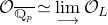 $\mathcal O_{\overline{\mathbb Q_p}} \simeq \lim\limits_{\longrightarrow}\mathcal{O}_L$
, where L runs over the poset of finite extensions of the maximal unramified extension
 $K^{\mathrm{nr}}$
of K, and for each such L the ring
 $\mathcal O_L/(p)$
is a nilpotent extension of
 $\mathcal O_{K^{\mathrm{nr}}}/(p) \simeq \overline k$
. It follows from Proposition C.3 that there is a natural equivalence

Moreover, by the base change for crystalline cohomology again we have

Acknowledgements
This paper owes its existence to Sasha Petrov who pointed us to the log-
 $B_{\mathrm{dR}}$
-cohomology of Diao, Lan, Liu, and Zhu and sketched how it could help to prove the injectivity of the map between étale cohomology of two generic fibers. The generalization to d-de Rham stacks was fundamentally inspired by conversations with Shizhang Li who pointed us to some potential applications in schematic setting (which are now Theorem 6.1). The optimal bounds for crystalline comparison would not be there without the help of Peter Scholze, who explained to the first author how condensed mathematics could be of some help here and patiently explained some basic aspects of the theory. We are also grateful to Sasha Petrov, Shizhang Li, and Haoyang Guo for the comments on different versions of the draft.
The first author would like to express his gratitude to Max Planck Institute for the excellent work conditions during his stay there. He is also grateful to Institut des Hautes Études Scientifiques where the final parts of this paper were written. The study has been funded within the framework of the HSE University Basic Research Program.
Conflicts of interest
None.
Journal information
Compositio Mathematica is owned by the Foundation Compositio Mathematica and published by the London Mathematical Society in partnership with Cambridge University Press. All surplus income from the publication of Compositio Mathematica is returned to mathematics and higher education through the charitable activities of the Foundation, the London Mathematical Society and Cambridge University Press.



