I. The Q&A Challenge
There is a common misconception among graduate students regarding the purpose of the job interview. Many seem to treat the interview as if it were designed to identify and hire outstanding graduate students. Indeed, over the course of their brief interaction with a prospective hire, faculty strive to reassure themselves of the candidate's intelligence, training, and scholarly potential. But underlying all these, I would like to argue, is a persistent concern: Will this candidate make for a good colleague? This is the primary purpose of the interview: Identifying and hiring prospective peers.
Of all the components of the interview process, the setting that conveys the greatest amount of accurate information about a candidate's aptitude in this area is not the one-on-one meeting, nor the group meals, nor even the job talk itself but rather the question and answer period following the job talk. It is this Q&A, a mere hour in a long day or two of interviewing, that constitutes the most crucial component of the entire job searching ordeal. This is also the part of the interview that terrifies students most.
How odd, then, that we focus almost exclusively on the perfection of a job talk when we prepare our graduate students for interviews.Footnote 1 The job talk is a rote speech that can be polished to perfection through sufficient repetition, given adequate time and advice. A good talk can tell us a great deal about the quality of coaching a candidate received from her advisors, about her ability to perfect a scholarly presentation given such coaching, and about her skills as a public speaker. But it says scant little about the interviewee's research or teaching skills, his intellectual curiosity or integrity, his intelligence or productivity.Footnote 2 Indeed, I suspect that students and their advisors invest as much time and effort as they do into refining their job talk not because they believe it to be the most important part of the interview but because it is the only aspect of the interview process that they can fully predict and control.
Comedian Jerry Seinfeld once quipped that a romantic date, with all its tension and pressure, amounts to an interview that lasts all night.Footnote 3 If that is so (and I will argue below that this metaphor is not quite right) then the job candidate practicing his job talk over and over, instead of preparing for the truly intimidating Q&A, resembles a petrified teenager, pruning for hours in front of the mirror in anticipation of an important first date. The true challenge, the test that both the job candidate and the teenager should be preparing for, but that neither can truly hope to master, is the challenge posed by unrehearsed dialogue. Open and free exchanges of questions and answers proffer more reliable evidence about the characteristics of one's interlocutor than rehearsed postures could ever provide.
This is exactly why the Q&A following the job talk is so important and so very intimidating. Many flaws in a job talk can and will be probed by the audience during the Q&A, providing the speaker with ample opportunity to fill in gaps and to remedy misunderstandings. When faculty members judge a candidate to have “flunked” her job talk, what they mean to say, regarding all but the most disastrous talks, is that she failed the Q&A.
The unpredictable nature of the Q&A is the first challenge posed by this segment of the interview process. A second and no less daunting challenge is posed by the adversarial nature that the Q&A segment has assumed in political science interviews, for reasons that are regrettable but not entirely clear.Footnote 4 Instead of providing an opportunity for open dialogue between a department and its potential hire, our Q&A's have devolved into orchestrated confrontations between a department, on the offense, and a candidate, on the defense. When scholars exchange ideas openly they do so to learn from one another, convey interest in one another's work, test the possibility of cooperation, examine the boundaries of the other's knowledge, and display one's own expertise. Sadly, political science job talk Q&A's are nothing of the sort. They are battles of attrition in which departments hurl their slings and arrows at candidates to see how well they “think on their feet.” This is unfortunate for, although professionalization in our discipline requires the honing of a wide variety of challenging skills, “thinking on one's feet” has never been one of them. Political scientists do their best work sitting down.
In the following pages, I argue that doing well in the interview process requires overcoming the twin challenges posed by the unpredictable and adversarial nature of the question and answer period. To succeed, a candidate must not only persuade the audience of his expertise but also convey to that audience his potential as a colleague.Footnote 5 Because collegiality can encapsulate a wide variety of qualities, I offer my own interpretation of the term, reduced to five basic components. Collegiality, as I define it, involves a respectful demeanor, an engaging character, professional behavior, attentiveness, and intellectual honesty. Students preparing for their interview can employ these five qualities as guidelines for improving their Q&A skills. The key to success, I suggest, lies in neutralizing the adversarial elements of the Q&A and in managing its unpredictable nature by confronting some of its more challenging aspects well in advance of the actual interview.
II. Knock-Knock! Who's There? Job Talk! Job Talk Who? WE Ask the Questions!
Because the Q&A segment of the interview is improvisational in nature—and despite the fact that it is confrontational in nature—it provides a significant amount of reliable information about a candidate's intellect and, equally important, character. Information on the former is readily obtainable from the candidate's file. Presumably, it was the interviewee's academic potential, as evidenced by materials in her file, that secured her the interview in the first place. Résumé, writing samples, and letters of recommendation may reveal little, however, about a candidate's personality. That is the rationale for the interview. If the outcome of the hiring process depended exclusively on a candidate's intellect, any personal contact between the candidate and the department prior to hiring would be superfluous. The interview process is about assessing the candidate's character, an assessment that culminates in the Q&A segment.
During this tense hour after the job talk, different faculty members will be scrutinizing the manner in which the candidate responds to questions in order to assess his or her potential as a colleague. What that means, exactly, will vary from observer to observer. Some will search for symptoms of confidence or insecurity. Some will want to know how well the candidate deals with stress whereas others will look for the tell-tale signs of egomania or petulance.
The character traits that I seek in a potential hire, in additional to their intellectual qualifications, can be captured in a simple thought experiment: Is this the kind of person that I would enjoy having a professional conversation with over a cup of coffee? The “coffee criterion” is deceptive in its simplicity. Many a strong scholar would make for bad company in an informal setting. A relaxed and informative exchange between colleagues requires five key qualities that I would look for in a prospective hire. First, it requires that the participants value one another's company, intellect, and opinions, a mutual respect that finds its expression in the tone and demeanor they set for their conversation. Second, it requires interlocutors that are engaging, capable of informing an energetic and stimulating exchange. Third, a conversation between colleagues should reflect the professional background of the scholars present. Fourth, the participants should demonstrate attentiveness, adapting to the changing flow of the conversation and responding concretely to the issues at hand. Finally, the scholars should exhibit intellectual integrity, espousing sincere opinions and admitting personal shortcomings.
The question and answer segment of the job talk offers multiple opportunities for displaying appropriate or inappropriate behavior along these lines. Consequently, conceiving of the Q&A as an informal but professional conversation between colleagues, rather than a battle of wits, can prove useful in preparing for the Q&A and in executing a successful Q&A. As you attempt to soothe your nerves before an important job talk, consider the following: Instead of imagining your audience naked, as some have advised, imagine your audience seated with you around a table in a café, balancing cups of coffee in their hands. Listen and respond as you would in a conversation among equals, both displaying the qualities of a colleague and demanding to be treated as such.
It is vital to steer the Q&A away from an adversarial atmosphere and to create an environment conducive to dialogue. At the same time, it is important to remember that the Q&A is part of an interview process that is designed to investigate a candidate's suitability for a job. In this sense, at least, it is very different from a conversation over coffee. The rules of this interaction oblige a candidate to field questions and to do her best to answer these questions directly and explicitly. Respectful, engaging, attentive, honest or not, a candidate who does not answer the questions he is asked will not get far.
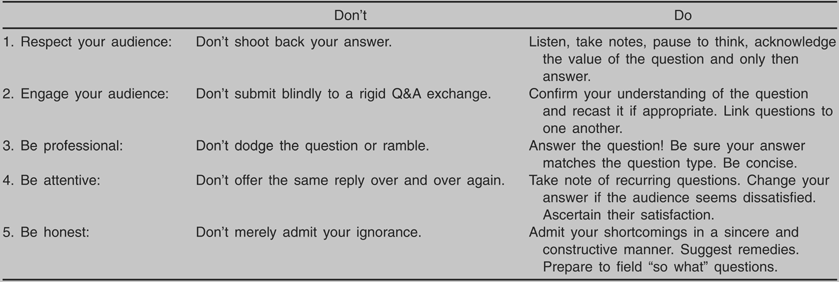
Listed briefly in Table 1, and expanded upon below, are five suggestions for leveraging the collegial conversation paradigm during a job talk Q&A.
Five Q&A Donts and Dos

III. Five Q&A Donts and Dos
1. Respect your audience: Nothing signals trouble more clearly in the course of a Q&A than a candidate who fires back answers at his interlocutors before the latter have even finished formulating their questions. It is the tell-tale sign of the insecure candidate: the tense anticipation as the question is voiced, the sudden expression of relief as the candidate realizes that the question is familiar or the answer is obvious, and the whiplash-inducing reply hurled back at the audience, capped off with a smug and satisfied grin.
This happens to be one of those rare cases in which rude and foolish behaviors coincide. After all, audience members ask questions not merely because they seek information but also because they wish to impress their peers. It is both wise and polite, in all cases, to treat the question and its source with respect, rather than signal to the audience that the question was predictable, simplistic, or uninformed. The Q&A is not a debate. The goal is not to win. Rather than crush your opponent's will, consider the benefits of a thoughtful reply that also leaves a good impression.
First, take notes as the question is being asked, paying particular heed to multi-part questions (Axelrod Reference Axelrod1985, 613). An audience member who has to repeat a question because you failed to take good notes will assume that you found her question uninteresting to begin with. Second, briefly pause to think about the answer. If the answer is obvious, use this opportunity to phrase an even better reply. Feel free to quickly jot down the outline of a reply before speaking. This signals to the interlocutor that the question poses something of a challenge or, better yet, is an interesting question that you wish to take note of for future reference. Doing so will also slow down the pace of the question and answer exchange to a conversational rhythm, putting the audience at ease.
Third, before your actual reply, acknowledge the question somehow, either by thanking the audience member who voiced it or by noting that the question is difficult or interesting (but only if it is really difficult or interesting). A particularly good question may lead you to think hard about the issues at hand and may even provide insights into your research that had not previously occurred to you. If this happens, be sure to point it out to the interlocutor. If the question unleashes a torrent of other, equally compelling, questions in your head, point one or two of those out as well. Doing so shows that you are genuinely curious and receptive to new ideas. More importantly, your response highlights that this Q&A is not merely a battle for survival but a productive exercise that is contributing to your academic growth. Even if the question is a well-familiar question that prompts none of these thoughts, you should avoid at all costs the most dim-witted of Q&A responses: “Oh, yes, this is a question I hear very often …”
By no means should your behavior here, or in response to the recommendations I make below, stem from insincere posturing. The idea is not to fake interest in questions, unnecessarily prolong the pause before answering, or doodle to emulate taking notes. The key is to create a genuine atmosphere of cordial dialogue in which an even pace, attentive listening, and polite responses are perfectly natural patterns of behavior.
2. Engage your audience: Given prevailing norms, establishing a conversational atmosphere during the Q&A will not prove an easy task. If a fluid discussion is like a game of badminton in which speakers lob ideas back and forth, political scientists tend to run their Q&A sessions like lopsided games of baseball, in which a department does all the pitching and a candidate is expected to do all the batting. This perverse structure fosters stress and anxiety rather than a productive conversation.Footnote 6
A candidate who can dismantle this confining structure will immediately notice a palpable shift in the room's atmosphere. This transformation requires no unique skills or techniques. It merely requires treating the Q&A as one would a conversation with one's colleagues. In such a conversation, questions and answers do not always follow upon one another in strict sequence. The dynamic of an engaging debate is aimed exclusively at exploring the topics at hand, through questions, answers, comments, or interjections, rather than testing the aptitude of any particular participant.
There are several subtle ways of overthrowing a rigid Q&A structure. First, be sure to ask for clarifications if a question is unclear or overly broad. This maneuver (entirely obvious in any setting but a job talk) has you aiming a question at the audience and thus displays your assertiveness as well as your stake in improving the quality of the exchange. The interlocutor will appreciate the opportunity to elaborate and clarify her comments.
Second, where appropriate, feel free to rephrase the question in your own words and confirm with the interlocutor that this paraphrasing does her question justice (Axelrod Reference Axelrod1985, 613). If the question is rather narrow, you could use this as an opportunity to “run” with the question, reframing it so as to make both the question and your answer more compelling to a broader segment of the audience. Doing so establishes, if only implicitly, your skills as a teacher. You could also recast the question in a tougher and more precise form. This will demonstrate your ability to see through the deeper meaning of a question and deal with its implications at a higher level of sophistication than even the interlocutor may have expected.
Finally, attempt from time to time to link questions to prior questions. If you can do so effortlessly, you will find yourself weaving an otherwise disjointed sequence of dialogues into a coherent discussion. Providing linkages across an hour-long conversation also places you, rather than your hosts, in control of the debate.
3. Be professional: Several concerned readers with significant Q&A experience under their belts will be relieved to see that the cardinal sin of job talks is next on my “to do” list. If the recommendations above and below amount to optional suggestions, what follows here is not. It is the prime directive for each and every job candidate: ANSWER THE QUESTION!
Yet the number of candidates who fail to answer the questions they are asked after their job talks is astonishing. In most cases, they do not dodge the questions altogether. They merely provide the answer to a different question. Such candidates offer theoretical replies to empirical questions or employ anecdotes to answer a question about theory. When asked to clarify their arguments, they wax rhapsodically about their work, problematizing this, that, and the other.
The key to answering the precise question asked is to ascertain what exactly it is the interlocutor wishes to know. Hence my suggestion, above, that the candidate reassure herself that she has the question right. If you're not sure about this, ask! Is the interlocutor requesting a clarification or an elaboration? Does he want you to apply your argument to a different field, case, or issue area? Are you being asked to link your work to a particular literature? In each instance, be sure to reply in kind. Answer empirical questions with empirical evidence and theoretical questions with theoretical insight.
Doing otherwise suggests, rightly or not, that you are either dodging the question (presumably because you are unable to answer it) or that you are stalling for time (presumably because you are able to answer this question but fear that you may not be able to answer the next one). Rambling implies evasiveness, so stick to the point. This is not your opportunity to introduce parts of your research that you could not fit into your job talk or to exhaust this topic from every possible angle. If you are in doubt about the appropriate length of reply, err on the side of brevity. Most questions require five minutes, at most, to answer.Footnote 7 Offering a relatively concise answer gives others in the audience an opportunity to pose their questions and offers you an opportunity to demonstrate the breadth of your knowledge.
4. Be attentive: Over the course of the Q&A, the audience will zero in on flaws in your argument, particularly if participants feel that you are dodging questions around a specific aspect of your work. Audience members will pose variants of the same question time and again with increasing annoyance, accompanied by the exchange of knowing glances across the room. Justly or not, some members of the audience feel that your answer on a particular issue is unsatisfying. You are coming dangerously close to failing the interview.
When this happens, acknowledge the problem along the lines outlined in section two, above. Admit to the audience that you are noticing a common theme across questions and suggest that, perhaps, you are not being as clear as you should be. Now take upon yourself the burden of providing an entirely different answer. Ideally, you should suggest a different argument to justify your claims, or at least a different way of thinking about the argument you have already provided. If you cannot do so, perhaps you might offer new evidence, different in scope or kind from previous evidence you've provided, to bolster your claim.
If, at the end of your comments, you are still concerned with the degree to which audience members find your explanations persuasive, simply ascertain, as you would in any conversation with a colleague, whether your new answer has remedied your hosts' dissatisfaction. Ask: “Did I answer your question?” or “I can see that you remain puzzled. Is there something about my answer that I need to clarify?” Though some interlocutors will initially be taken aback by your seeming defiance of conventions (as would any pitcher who finds a curve-ball pitched at him by the batter), a genuine dialogue may well emerge.
If, after an additional reply, your audience remains unhappy with your answer, express your disappointment and leave it at that. Should the more obstinate members of the audience persist in flogging this dead horse, explain patiently and politely that you have answered the question to the best of your abilities. Your inability to answer a specific question provides no reason to be cowed by the audience member who asked that question.Footnote 8
5. Be honest: Faced with a tough question to which they have no answer, many candidates opt for one of two inferior options: They either admit that they do not know the answer and leave it at that or they try to cover up their vulnerability by rambling on incoherently. The former option yields an embarrassing silence until, mercifully, someone realizes that the candidate has nothing else to say and proffers the next question. The latter simply won't work.
If you are asked a question that you cannot answer, say so explicitly. There's no harm to admitting ignorance once or twice during a talk (Axelrod Reference Axelrod1985, 613; Gould and Keeter Reference Gould and Keeter2004, 792). But follow up on your admission with a more detailed explanation. Suggest a part of the question to which you do know the answer or a variant of the question that you can address. This places your shortages in perspective. Does this question relate to a period or region that you have not covered in your research? If so, suggest a related case that you have studied that can shed light on the question. Has the interlocutor asked you to relate your ideas to a field or literature that you are not familiar with? Explain why these sources were outside your range of research and what relevant sources you've used that have provided equivalent functions. Does the question point to a flaw in your theory, game or model that you cannot explain away? Admit the flaw, explain how you will correct it, and make some conjecture about how such a correction might affect your overarching argument.
You may also wish to communicate to the audience that the impediment to your answering the question is not lack of insight but lack of evidence. Suggest the kind of information you might need to answer the question and how you might go about acquiring such information. Are there variables that you might look at, interview questions you might ask, data you might acquire or cases you could analyze that would provide answers? Had you intended to consult these sources at a later stage of your research? Even if that is not the case, signaling that you have some ideas about where to look suggests that you are halfway to finding an answer.
As always, it is crucial that your responses be sincere. A phony excuse in response to a question you cannot answer will only make matters worse. At the same time, it is equally important to realize that you can always do better than “I don't know, period.” Any genuine response you can provide will showcase your ability to overcome research obstacles and your resourcefulness in finding answers to difficult questions. Indeed, your answer might even hint at the possibility that the interlocutor has contributed to your research by prompting you to strengthen your argument.
There are only two questions to which “I don't know” is never an appropriate answer. These two questions are “why should I care about your research?” and “why should anyone care about your research?” or variants thereof, known informally as the “so what?” questions.Footnote 9 The first variant will come from a political scientist in a subfield other than your own or from a researcher in your subfield who does work that is substantially different from yours. It asks that you make your topic relevant to those in your discipline on whose work yours seems to have no direct bearing. You should have covered this in the final part of your job talk, in which implications of your argument are gradually broadened to address an increasingly expansive segment of the audience. If you haven't done so in the talk, here is your chance to do so.
The second variant is less friendly by far. It suggest that your research is fundamentally uninteresting to any political scientist, irrespective of subfield. The interlocutor might claim that a variant of your research that is either more comprehensive or more precise has already been offered by someone else. Alternatively, he might grant you the novelty of your argument but critique its relevance to important cases or policy, past, present, or future. Or, she might assert that your research addresses a relatively uninteresting or unimportant part of a larger question that has far more interesting aspects that need to be addressed.
In either case, failure to offer a satisfactory reply will spell disaster, first, because these questions are entirely predictable and, second, because they are exceedingly fundamental to any research program. An academic who cannot explain why her work should be interesting or important to others is, by definition, conducting uninteresting and unimportant work. There is simply no excuse for a candidate's inability to distinguish her work from related research in her field. If your argument sheds no light on history, current concerns, or possible development and bears no policy implications, you will want to think hard prior to your interview about how to motivate your work (or, perhaps, consider picking a different research topic altogether). Consider related research questions and justify the intrinsic value of the particular ontological and epistemological focus you have chosen in your work. Whatever the case, you simply must provide an answer to fundamental questions of this sort.Footnote 10
IV. Fighting Fire with Water
The only two ways to prepare for the challenge posed by the question and answer period of your job talk are practice and careful observation. Be attentive to the questions asked and the comments offered during your practice job talk, practice job talks given by your peers, interviews for jobs in your department, or discussions following seminars by guest speakers. Take notes about the types of questions that tend to stymie candidates, how they respond to such questions, and how you might have responded in their stead. Pay equal attention to the candidate's posture, rate of speech, and demeanor or mannerisms that seem to alienate both you and the audience. Participate in debriefings among colleagues after a job candidate has finished his talk to learn what they consider to have been the minor, major, or fatal flaws in the talk. Notice that the vast majority of these criticisms relate to the Q&A and not the job talk and draw the obvious conclusion: The bulk of your energies should focus on the Q&A segment of the interview.
Prepare for your practice job talk by composing a list of possible questions and answers. You could organize a list of questions by type (theoretical, methodological, empirical) or try to forecast variations on familiar critiques as they would apply to your work. What would an accusation of endogeneity, omitted variable bias, selection bias, or indeterminacy sound like were it leveled against your research? How will you defend yourself against these critiques or the “so what” questions? What is the greatest gap in your research and how will you answer a question that targets this flaw? You will know that you've prepared sufficiently if you receive few surprising questions from the audience during the practice Q&A.
When organizing your practice job talk, make sure that the toughest and brightest members of your department attend. Your goal in issuing invitations is to ensure that the practice job talk will be harder than any real job talk could ever be. Be sure to invite experts in your research area but also political scientists from other subfields and other fields, so as to assemble an audience that approximates that of your actual job talk.
During your practice job talk, ask friends to take notes to document your strengths and weaknesses so that you can dedicate your full attention to the talk and the Q&A. Instruct audience members to “stay in character” and refrain from providing stylistic comments before a full hour of serious and substantive Q&A have elapsed. Practice again and again until you are sufficiently confident in your Q&A skills. Although the job talk is easier to practice (if only because you can practice without an audience) it is crucial that you rehearse the Q&A as well, multiple times if necessary (Gould and Keeter Reference Gould and Keeter2004, 794). If possible, ask at least one colleague to attend multiple practice job talks and provide you with an assessment of your overall improvement trajectory.
As you observe yourself and others, you will gradually assemble a repertoire of practices that are effective in engaging an audience, too detailed and numerous to mention here. You will observe, for example, how good an impression a candidate makes when her answers to technical questions are supported by backup slides created precisely for this purpose. But you will also note the bad impression left by a candidate who, having understood the basic premise of a question, rifles through his presentation to get to a relevant slide while the interlocutor is still speaking. Eventually, interesting patterns will emerge, not readily observed by novice job-talk attendees. You will witness effective figures of speech that can put an audience at ease, as well as the types of off-putting body language or irritating repetitive behaviors that you will want to avoid.
Be sure to prepare for common contingencies. Will you field questions from the audience during the job talk or defer all questions to the Q&A? What will you do if an audience member asks an inappropriate, irrelevant, or misinformed question? How will you deal with an audience member who dominates the Q&A to the exclusion of others? Practice and good planning are the most effective ways to prepare for the unpredictable and often belligerent nature of the Q&A.
One particularly tough scenario that merits strategizing for involves the possibility that you will be interrupted frequently for questions during the talk that precedes the Q&A. Such a “Q&A in midst talk” poses a serious dilemma: How can one respond to repeated questions from the audience during the talk without losing track of the (presumably timed) talk while at the same time avoiding any slight to the persistent interlocutor? Managing the pace and content of exchanges with the audience is as important here, if not more so, than it will be during the Q&A that follows. A speaker who cannot control the audience during the talk, and in so doing demonstrate the authority required to handle a classroom full of students during a lecture, risks losing the audience's confidence well before the Q&A stage of the interview.Footnote 11
If you are faced with a barrage of questions during the “monologue” section of the talk, you have recourse to one of three responses. If the question betrays a fundamental disagreement or confusion, such that the audience will require an answer in order to make sense of the rest of the talk, you should answer the question. Your answer should be brief and to the point. If the question strikes you as potentially, but not entirely, irrelevant, you could turn to your hosts to find out whether they would like you to respond. This would also be an appropriate opportunity to express a preference, e.g.: “I'd like to postpone all answers to the end of my talk, if you don't mind.” Finally, if the question is entirely unrelated to the matter at hand, you have the option of stating your preference directly to the interlocutor. This is your opportunity to seize control of the room and, with all eyes on you, it is crucial that you do so. Thank the interlocutor for the question and then bluntly, but firmly, assert that you'd like to answer that question at the end of the talk. The more persistent the interlocutor, the more likely it is that the audience will sympathize with your plight, the more direct your response should be.
Indeed, your impressions regarding the audience's mood are a useful tool for dealing with a variety of delicate situations during your talk and Q&A. Is the audience bewildered? If so, offer to answer questions, even if no questions have been proffered and you are in mid talk. Is the audience impatient? Cut short your answer or even your talk and move to the next topic. It is tempting, but foolish, to concentrate all of one's attentions on a single source of interruption. Instead, try to gauge the entire audience for the most appropriate response.
V. Conclusion
Delivering a strong job talk is a necessary, if not sufficient, requirement for doing well in a job interview. Students preparing for their interviews should pay due attention to the Q&A that follows the talk because this segment provides an opportunity for gleaning information about their character that is not observable by other means. Specifically, the Q&A provides potential information about a candidate's respect for his colleagues, ability to engage an interlocutor, professionalism, attentiveness, and academic integrity.
Although practicing one's Q&A skills requires an attentive audience, the exercise will provide multiple benefits. Rehearsals will increase the universe of questions that a candidate is familiar with and is able to answer well. Practice will also increase a candidate's awareness of the traits that he is signaling to the audience over the course of the Q&A. All of this will serve to increase the candidate's confidence which, in turn, will be conducive to a more relaxed demeanor during the talk.
During the actual Q&A the key will be, as in Seinfeld's metaphor, to maintain composure and give expression to your genuine character. Such advice may prove as difficult to implement in the former scenario as it is in the latter, yet the two cases also share a saving grace: They are both interactive situations in which the combined preferences of both parties determine the outcome. The Q&A is a scholarly exchange, not an interrogation. It provides both the department and the interviewee with the opportunity to assess the prospects of successful collaboration. This aspect of the Q&A should assuage the concerns of candidates who worry about receiving too rough a treatment from their hosts during the interview. Should you find yourself at the receiving end of an overly hostile audience during a Q&A, ask yourself whether a department that conflates discussion with inquisition is a department that you truly wish to join.