1. Introduction
In addition to the multitude of factors that can facilitate or hinder the comprehension of written discourse, one additional possibility is that a written text may be crafted for the purposes of satirical criticism, adding another layer of complex, subtle, and figurative meaning. Moreover, misunderstanding a satirical text can have embarrassing results. Such a case occurred when a former FIFA official cited an article from the American satirical newspaper The Onion as evidence that the United States was accepting a last-minute agreement to host the World Cup in an off year (i.e., in 2015). The FIFA official cited this article to accuse the United States of the very corruption it was indicting former FIFA officials for. In reality, the satirical article invented this fictional example to exaggerate and criticize the corruption in the FIFA organization (Mackey, Reference Mackey2015; The Onion, 2015).
The purpose of this study is to investigate whether specific cognitive, demographic, and pragmatic factors influence the processing and comprehension of satirical discourse. Based on prior research and theoretical definitions of satire, factors such as the level of general knowledge, language background, and affective perceptions of humor and sincerity should all predict success in understanding a satirical message (Pfaff & Gibbs, Reference Pfaff and Gibbs1997; Prichard & Rucynski, Reference Prichard and Rucynski2019; Simpson, Reference Simpson2003; Skalicky & Crossley, Reference Skalicky and Crossley2019). To test these hypotheses, a number of different features are analyzed and compared for their influence on both the processing (i.e., timecourse of reading) and comprehension of satirical and non-satirical texts. Results from this study provide a better understanding into the mechanisms behind satire processing and comprehension and aid in explaining when and why hearers understand (or do not understand) satirical discourse.
2. Satire
Theoretically, satire is defined as a discursive practice which establishes and resolves an ironic incongruity between a satirical target, a satirical author, and a satirical audience for the purpose of criticizing or mocking the satirical target (Simpson, Reference Simpson2003). This process commonly (but not always) results in a humorous response from the satirical audience (Johnson, Del Rio, & Kemmitt, Reference Johnson, Del Rio and Kemmitt2010). Previous studies of satire have identified several variables which influence satire use, but satire still remains a relatively under-studied form of figurative language. The following sections review previously identified influences on satire detection, comprehension, and appreciation. Although these sections are presented separately, this is only for the sake of organization, as variables which affect one aspect of satire use likely influence others as well.
2.1. satire detection
The detection of satire is critical to the comprehension of satire, and this detection may occur initially or during the processing of satire, depending on different variables. For example, satire is typically described as delivering a negative and critical meaning, and thus a hearer’s perception of the overall valence of a text (i.e., positive or negative) may influence the detection (and eventual comprehension) of satirical meaning. One study compared the effects of two types of televised satire on the delivery of the same political message (LaMarre, Landreville, Young, & Gilkerson, Reference LaMarre, Landreville, Young and Gilkerson2014). One type of satire was overtly humorous (Horatian satire), while the other was more subtle, harsh, and biting (Juvenalian satire). Their results suggested that participants who viewed the Horatian satire were more likely to discount the satirical message as non-serious and humorous. These participants were also more likely to look for flaws in the political message. Conversely, participants viewing the Juvenalian satire were more likely to report difficulty detecting and understanding the political message but were less likely to seek flaws with the political message. In other words, satire that was more obviously framed as humorous led to greater scrutiny of the satirical message, whereas less-obviously framed satire led to greater difficulty separating the satirical message from the humorous tone of the satire.
Political beliefs also play a strong role in the ability to detect a satirical message. One study investigated the role of political ideologies during the interpretation of satire from The Colbert Report, an American satire of conservative pundits in the United States hosted by Stephen Colbert (LaMarre, Landreville, & Beam, Reference LaMarre, Landreville and Beam2009). In this study, participants were pre-assessed for political ideologies through self-ratings of how liberal or conservative (in the American political sense) participants perceived themselves to be. Afterwards, participants viewed clips from The Colbert Report and completed several surveys. In the surveys, participants rated how much they agreed with Colbert’s statements, their perceptions of Colbert’s political ideology and attitudes, and their perceptions of humor. Results demonstrated that participants who self-identified as politically liberal tended to rate Colbert as more humorous and better recognized the satirical intent of Colbert’s messages. Those who self-identified as politically conservative tended to describe Colbert’s messages as serious (i.e., non-satirical) with a humorous slant. Because The Colbert Report is a satire of conservative American political beliefs, LaMarre et al. (Reference LaMarre, Landreville and Beam2009) interpreted these findings to be demonstrative of the power of political ideology and its influence over the participants to “see what you want to see” (p. 212).
Recognizing a claim to insincerity is thought to be a fundamental component of satirical uptake (Simpson, Reference Simpson2003). As such, being able to recognize satirical intentions (i.e., purposefully being insincere) can aid with satire detection (and likely comprehension). This ability was investigated by Pfaff and Gibbs (Reference Pfaff and Gibbs1997), who conducted a study where participants read from a book satirizing political correctness in the United States. Pfaff and Gibbs focused specifically on the participants’ ability to infer satirical intent on the part of the author. Interviews revealed that participants identified specific linguistic features (e.g., wordiness or exaggeration) as indicative of a satirical intent. Moreover, participants who were explicitly informed of the author’s satirical intent were better at detecting and understanding the subsequent satirical message, but still incorporated their own beliefs and attitudes into their ultimate inference of the author’s intent and its relation to the satirical meaning.
Finally, cultural knowledge, language background, and definitions of satire are also an important consideration for satire detection. The role of cultural knowledge during satire detection and comprehension was tested in a recent study investigating satire recognition in a second language (Prichard & Rucynski, Reference Prichard and Rucynski2019). They did so by testing performance on a pre-test and post-test which contained satirical and odd (yet real) news headlines taken from both American and Japanese satirical and non-satirical news outlets. Prichard and Rucynski trained Japanese learners of English to recognize satirical news over a period of fifteen weeks. Their satire training procedure included analyzing satirical and non-satirical articles in class as well as discussing some signals of satirical news (e.g., news about things that are not noteworthy). A comparison of the pre-test and post-test found that participants who practiced and trained with satirical texts reported significant gains in the ability to detect satire. However, results also demonstrated that Japanese participants performed significantly worse when compared to an American comparison group, even when the satirical texts were controlled for vocabulary and cultural knowledge. The authors suggested that this was partially due to differences in cultural uses and conceptualizations of satire, with Japanese satire typically avoiding controversial topics and being used relatively less frequency when compared to American satire.
2.2. satire processing and comprehension
Many of the influences described above may also affect the subsequent online processing and comprehension of satire. In addition to those features, possessing background information about a specific topic, or having higher levels of generalized knowledge, has been shown to influence satire processing and comprehension. One study of televised Dutch political satire included a component where participants viewed satirical and non-satirical reactions to governmental budget cuts (Boukes, Boomgaarden, Moorman, & de Vreese, Reference Boukes, Boomgaarden, Moorman and de Vreese2015). In this study, approximately half of the participants read a news article discussing the budget cuts before viewing the satirical and non-satirical reactions. The findings suggested that being presented with the news article allowed for easier interpretation of the satirical message, and also that topic information contained in the article was interpreted in light of the participant’s political preferences. This interpretation influenced whether participants found the satirical news to be more humorous than the non-satirical control condition, in that participants who agreed with the policy decision found the satire to be funnier than the non-satire, whereas those who did not agree with the policy decision did not rate the satire as significantly more humorous.
Representing one of the few psycholinguistic studies of satire processing, Skalicky and Crossley (Reference Skalicky and Crossley2019) investigated reading times and humor ratings for satirical newspaper headlines taken from The Onion. Skalicky and Crossley found that age was a significant moderator for reading times of satirical headlines. Specifically, older participants read satirical headlines significantly slower than non-satirical headlines, but this effect was not present for younger participants. They also reported that increased levels of generalized world knowledge (operationalized as performance on a multiple-choice standardized test) were predictive of humor ratings of the satirical headlines. The standardized test used by the authors included multiple-choice questions related to science, world history, and literature, and as such was not only a measure of knowledge of facts and processes, but also knowledge deemed important from a Western perspective. Thus, the test was also to some extent a measure of cultural knowledge. Because this knowledge was predictive of increased perceptions of humor among the satirical headlines, Skalicky and Crossley took this as evidence that this type of knowledge facilitated satire comprehension (indirectly measured through the humorous responses).
Since world knowledge can be operationalized as a type of intelligence (i.e., crystallized intelligence), it follows that other cognitive traits may interact with the processing and comprehension of satire. One such trait is Need for Cognition (NFC), which represents the desire to perform complex cognitive tasks (Cacioppo, Petty, & Kao, Reference Cacioppo, Petty and Kao1984). While it is related to certain personality traits (e.g., openness, goal orientation) as well as fluid intelligence (problem-solving), NFC has nonetheless been validated as its own separate construct (Fleischhauer et al., Reference Fleischhauer, Enge, Brocke, Ullrich, Strobel and Strobel2010; Furnham & Thorne, Reference Furnham and Thorne2013). The role of NFC has been previously investigated during the online processing of other types of figurative language, such as metaphor and verbal irony. These studies tested the hypothesis that participants with a greater preference to engage in cognitively difficult tasks would be more proficient at processing metaphors and verbal irony (Kaakinen, Olkoniemi, Kinnari, & Hyönä, Reference Kaakinen, Olkoniemi, Kinnari and Hyönä2014; Olkoniemi, Ranta, & Kaakinen, Reference Olkoniemi, Ranta and Kaakinen2016). Results from these studies tracking eye-movements during reading suggested that higher NFC influenced metaphor processing but had no significant effect on verbal irony processing. Therefore, testing the role of NFC during satire processing and comprehension can help contextualize satire in comparison to other related forms of figurative language and determine whether NFC it has any effect on satire processing and comprehension.
2.3. satire appreciation
Aside from learned knowledge through education or culture, satire is also associated with specific affective perceptions. The most salient of these is perceptions of humor, thought to be a key element of satire understanding (Simpson, Reference Simpson2003). A review of the studies above demonstrates that humor is commonly measured as an aspect of satire comprehension and appreciation. Other studies argue that a humorous response may serve as an imperfect proxy of satire comprehension (e.g., Skalicky & Crossley, Reference Skalicky and Crossley2019). At the same time, at least one study provided evidence suggesting that a humorous response is not necessary in order for a hearer to understand a satirical message (Johnson et al., Reference Johnson, Del Rio and Kemmitt2010), and satire accompanied with a strong humorous delivery may serve to detract from the more serious and critical satirical message sought by an author (LaMarre et al., Reference LaMarre, Landreville, Young and Gilkerson2014). Therefore, it is important to continue investigating whether a humorous response is a necessary component of satire comprehension.
3. Current study
This review has identified several potential cognitive, demographic, and affective influences on different aspects of satire reception. However, most of these studies have not employed behavioral methods using measures of online processing such as reading times, and many of them have focused on interactions with political beliefs and attitudes. As such, one purpose of this study is to empirically test the attested role of these variables using such methods while also avoiding politically charged examples of satire in order to reduce the influence of political attitudes on these other variables. Based on theoretical descriptions of satire and related research in discourse studies and communication science, some specific predictions can be made regarding the role of the variables described above. For instance, greater levels of both language knowledge and general knowledge should facilitate satire processing and comprehension, but it is unknown whether this will significantly differ from non-satirical texts. Additionally, perceptions of humor, sincerity, and positivity should all serve to facilitate satire understanding when compared to non-satirical texts. The specific role of NFC (if any) is less clear, but it follows that, if engaging in satire is a cognitively challenging experience, then higher levels of NFC may influence satire processing and comprehension.
4. Method
The purpose of this study is to compare reading times (processing) and comprehension scores between satirical and non-satirical texts in light of several different cognitive, demographic, and affective variables. Differences in how these variables do or do not significantly moderate the reading times and comprehension scores of the two text types can highlight any variables which exert a specific influence on satirical understanding.
4.1. individual differences data
4.1.1. General knowledge test
The same test of general knowledge used in a previous investigation of satirical newspaper headlines was used (Skalicky & Crossley, Reference Skalicky and Crossley2019). This test is a 30-question multiple-choice test containing 10 questions each about literature, science, and world history. The test is based on SAT-level questions and was originally used to prepare high-school students in New York state to complete state-wide standardized examinations. The instructions explained the three domains of knowledge included in the test and the total number of items on the test. Each correct answer was assigned one point, for a total score of 30 points.
4.1.2. Need for cognition survey
NFC was measured using a survey designed to capture participants’ inclinations to perform cognitively complex tasks (Cacioppo et al., Reference Cacioppo, Petty and Kao1984). This 18-item survey asked participants to rate their agreement using a scale of –4 (very strong disagreement) to 4 (very strong agreement) for statements such as I like tasks that require little thought once I’ve learned them. Participants’ NFC score was the sum of all answers, with a total score range of –72 (low NFC) to 72 (high NFC).
4.1.3. Language background
Participants also included information about their language background, including total languages known, self-assessed proficiency in those languages, years of time spent living in an English-speaking country, and the age they started learning English. In addition to these answers, language distance scores were calculated for the participants using a framework devised by Miller and Chiswick (Reference Miller and Chiswick2005). To do this, a score ranging between 1 and 3 is assigned to a participant based on their first language and the overall difference between that language’s grammatical features when compared to English. The scores were inversely transformed by dividing the language distance score by 1 so that languages further away from English were represented with higher scores. First language English speakers were assigned a language distance score of zero.
4.2. satirical and non-satirical texts
Ten satirical and ten non-satirical texts were chosen from the satirical newspaper The Onion and the non-satirical online publication Science Daily, both of which are published in the United States. The genre of the texts selected was identified broadly as a scientific report article, in which a short news story is published describing the results of a recent scientific study. The Onion regularly publishes satirical versions of this genre. For example, in June of 2003, The Onion published an article titled Study Finds Jack Shit, which reported that a fictional team of researchers at John Hopkins Hospital studying cholesterol had found absolutely nothing (i.e., jack shit) after five years of research. While it is certainly possible to find no significant results after a five-year study, the dissemination of those results would be done in a more serious, professional, and academic manner. In comparison, all of the articles on Science Daily are short published summaries of real research that has been recently published.
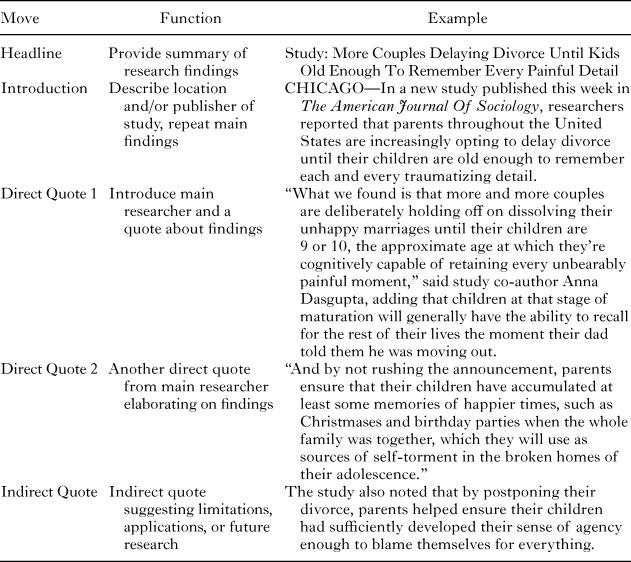
An initial genre analysis of the scientific report articles published by The Onion demonstrated that The Onion follows a consistent text structure containing identifiable rhetorical moves (i.e., discourse units) that perform specific communicative functions for this genre (Swales, Reference Swales1990, Reference Swales2004). Specifically, The Onion texts contained a five-move structure, summarized in Table 1 with examples from one of the satirical texts used in the study.
Move structure of Onion scientific report articles genre

The Science Daily articles also contained the same rhetorical moves as displayed in Table 1, but were typically much longer than The Onion reports and contained a greater number of paragraphs, quotes, and elaboration on the study.
To better match satirical and non-satirical texts, the following procedure was carried out. First, approximately 20 The Onion articles were identified by using keyword searches for study or research on the main Onion website. Articles containing any overt political content (e.g., talking directly about political figures) were avoided. After collecting this initial sample, searches were conducted on the Science Daily website for research articles reporting on the same general topics (e.g., environment, health) as in the Onion articles. While it was not possible to find exact topic matches in some instances, the texts were matched as closely as possible to a shared topic or theme (e.g., an Onion article talking about stress increasing during family vacations was paired with a Science Daily article discussing the effects of stress on pregnancy).
Once a matching number and type of Science Daily articles were collected, the Science Daily articles were modified to conform to the five-move structure presented in Table 1 by deleting and rearranging paragraphs in the articles, with care taken to maintain cohesion through the article. Additionally, some Science Daily articles did not include a research location or academic journal in their introduction move, and thus fictional yet plausible names for academic journals were included in some of the articles, along with legitimate locations where the research could have been conducted. Finally, each article from both The Onion and Science Daily was separated into five distinct paragraphs, one for each move listed in Table 1.
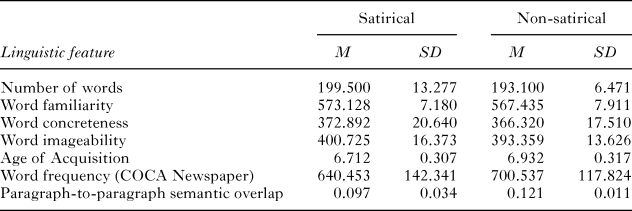
The texts were then controlled for linguistic features which are known to influence text processing speed in general, including word frequency, familiarity, concreteness, imageability, age of acquisition, total number of words, and paragraph-to-paragraph cohesion. Any texts within each group (i.e., Onion or Science Daily) containing outliers for these features were replaced until there were no visible outliers in the box-plots. Afterwards, Welch t-tests were conducted between the Onion and Science Daily texts for each linguistic feature in order to ensure no significant differences existed between the two groups. When necessary, words in the Science Daily texts only were modified using synonyms or equivalent phrases in order to reduce any significant differences between the two text groups for any particular features. Table 2 displays descriptive statistics for the linguistic features of the two text types as well as sources of the linguistic measures.
Mean and standard deviation for linguistic features of text stimuli

notes: Welch t-tests between satirical and non-satirical texts demonstrated no significant differences for any of these features. Word familiarity, concreteness, and imageability were calculated using MRC norms (Coltheart, Reference Coltheart1981). Age of Acquisition norms are based on Kuperman et al. (Reference Kuperman, Stadthagen-Gonzalez and Brysbaert2012). Frequency norms were calculated from the Corpus of Contemporary American English newspaper subsection (COCA; Davies, Reference Davies2008). Paragraph-to-paragraph cohesion was calculated using TAACO (Crossley et al., Reference Crossley, Kyle and McNamara2016).
Two sub-experiments were then created by forming two groups of 10 texts each, with each group containing five satirical and five non-satirical texts. Text topics did not repeat within each group so that no group would contain a satirical and non-satirical text discussing the same general topic. These texts were then uploaded as stimuli into two separate online surveys (see supplementary materials, available at <http://doi.org/10.1017.langcog.2019.30>).
4.3. text comprehension questions
Two types of questions were developed for the texts: one to test direct comprehension of the satirical or non-satirical meaning, and another set of questions designed to measure affective perceptions of the text (i.e., participants’ emotional reactions to the texts). The direct comprehension question was open-ended and designed to capture satirical or non-satirical comprehension by asking What was the author’s intended meaning? The affective response questions asked participants to rate each text on a four-point scale for three different features: sincerity, humor, and positivity. Specifically, participants were asked to indicate whether they Strongly Disagree, Disagree, Agree, or Strongly Agree with the following statements: The text was sincere, The text was funny, and The text was positive.
4.4. participants
Sixty-one undergraduate and graduate students were recruited from the downtown Atlanta campus of Georgia State University (46 female) in the United States. The average age was 25.56 (SD = 8.34), with a lowest age of 17 and a highest of 63. Thirty-five of the participants were undergraduate students and the remaining 26 were enrolled in either a master’s or doctoral program. Additionally, 32 of the participants were recruited from among international students enrolled in the university. The international students hailed from thirteen different countries and all spoke a language other than English as their primary language. Ten of these students were from South Korea, while the remainder hailed from Bangladesh, Brazil, China, El Salvador, France, Indonesia, Italy, Malaysia, Spain, Venezuela, Vietnam, or Zimbabwe.
4.5. procedure
Participants first completed the general knowledge and need for cognition surveys using the online survey platform Qualtrics (Qualtrics, Provo, UT). After completing these surveys, participants moved on to the satire processing and comprehension portion of the study. Table 3 reports descriptive statistics and internal consistency for the survey measures.
Internal consistency for individual differences measures

note: Chronbach’s alpha (α) was computed in R using the alpha function from the psych package (Revelle, Reference Revelle2017).
Participants were then randomly and equally assigned to one of the two sub experiments and were seated in a soundproof room containing a desktop computer with a keyboard and mouse. They initiated the experiment by first reading a series of instructions on the computer screen. Once the study began, participants read the five satirical and five non-satirical texts in a random order. Each trial began with the text fully displayed on the screen. Texts were displayed on a 22-inch monitor using 16-point black Lucida Sans Unicode font on a white background. The title of each text was centered and underlined, and each paragraph of the text was left justified and single-spaced. Participants pushed the Enter key on the keyboard when they were done reading and were then required to answer the first comprehension question, which asked them to type their interpretation of the author’s intended meaning into a text box.
After providing their answer and clicking the continue button, participants then used the mouse to complete the second set of comprehension questions by rating the text for sincerity, humor, and positivity using the four-point scale described above. After providing their ratings, the next trial began. Participants proceeded this way until all ten trials were completed. Qualtrics recorded the total time spent on each text, providing a measure of total reading time per text (i.e., the dependent variable of text processing). Qualtrics also recorded the answers provided by the participants for the authors’ intended meaning and ratings of sincerity, humor, and positivity. Average time for participants to read and rate all texts was 24.51 minutes (SD = 7.39). Participants were financially compensated for their participation.
4.5.1. Comprehension question ratings
Participants’ answers to the What was the author’s intended meaning? comprehension questions were analyzed for both the satirical and non-satirical texts. For the satirical texts, the answers were coded ‘yes/no’ to reflect whether or not the participants demonstrated comprehension of satirical meaning or intent on the part of the author. Satirical comprehension was reflected through answers that explicitly mentioned satire, humor, sarcasm, or mockery, or if they directly mentioned the implied satirical message. Non-satirical comprehension was reflected through rote repetition of the purported main point of the article, typically manifested as a repetition of the article’s headline. For example, one Onion article reported on a fictional study stating that 750,000 Americans die each year during their first attempt to exercise. The body of the article included claims that 225,000 Americans die within three minutes of jogging for the first time, and that 60% of Americans who use a gym for the first time perish after their first abdominal exercise. Thus, the article mocks the relatively poor state of health stereotypically associated with Americans but does so through the use of a fictional scientific study which reports exaggerated and false statistics.
Representative examples of comprehension responses that suggested that the participants understood the satirical meaning of this article are “A veiled criticism of the public health crisis of obesity in the U.S. through the veil of humor” and “Americans are obese, and we don’t try to correct it, or when we do we complain way too much and then stop, resuming our obese habits”. Both of these responses indicate that the participant comprehended the article’s satirical message directed at the American health crisis and attitudes towards exercise, and do not suggest the participants truly believed that 750,000 Americans are dying each year due to exercising. Because the comprehension question was relatively open-ended, some participants only reported on the purpose of the article, wherein they simply stated “humor” or “sarcasm” as their answer. These responses were also coded as evidence of satire recognition.
Representative examples of comprehension answers that suggested that the participants did not understand the satirical meaning for the same article are “750000 people each year in America die from first attempt to get back in shape” and “Those who haven’t exercised in years are at a higher risk of injury or death if they try to get back into shape”. Both of these examples do not demonstrate comprehension of the satirical message because they repeat the purported results of the fictional study reported in the article, (i.e., Americans are dying in droves each year due to attempts at getting back into shape). The coding of the answers was checked with a colleague familiar with figurative language research, and disagreements between codes were discussed and adjudicated until agreement reached 100%. In total, 32% of the answers to the satirical texts were reflective of a satirical interpretation.
For the non-satirical texts, only baseline comprehension of the article was checked in order to see if the participant understood the main point of the article. Compared to the satirical texts, 95% of the non-satirical texts were coded to indicate that the participant had understood the main point of the article. Three of the answers indicating that a participant did not understand the main point of a non-satirical text were instances of participants describing the text as humorous or sarcastic, likely due to exposure to the satirical texts during the experiment, whereas the remainder of the answers (12 total) incorrectly described the main point of the article.
4.5.2. Affective perception ratings
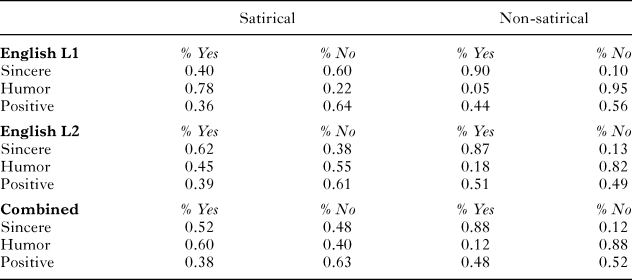
It was not possible to gauge whether the difference between the four levels of the Likert scales used to measure affective perceptions represented equal sizes (e.g., whether the difference between ‘agree’ and ‘disagree’ was the same magnitude as the difference between ‘mostly agree’ and ‘agree’). Therefore, these ratings were converted into binary categorical variables in order to avoid treating the four-point Likert scales as continuous scales in the statistical models. To do so, all ratings of Strongly Disagree and Disagree were combined into one level (no), and all ratings of Agree and Strongly Agree were combined into one level (yes). Table 4 displays the rounded proportion of the three affective ratings for each text type broken down by English first or second language (L1/L2) status as well as combined values for all participants. As can be seen, the English L1 participants had higher perceptions of humor and lower perception of sincerity for satirical texts when compared to English L2 participants, whereas ratings for the non-satirical texts and measures of positivity were more similar. In the combined data, the non-satirical texts had more consistent ratings of sincerity (mostly ‘yes’) and humor (mostly ‘no’) when compared to the satirical texts, whereas ratings of positivity were more mixed between the two text types.
Affective rating percentages for both text types

notes: L1/L2 = first/second language. Satirical N = 256, Non-satirical N = 258. Values reflect data after five participants were removed (see Section 4.6).
4.6. statistical analysis
Before conducting the statistical analyses, the integrity of the data and adherence to statistical assumptions was examined. Two participants demonstrated significant inattention to the texts during the experiment (e.g., completely skipping past texts). Additionally, one participant reported to have read all of the texts from the bottom to the top as a comprehension strategy, and two other participants indicated after the experiment that they recognized some of the texts as being from The Onion because they recalled previously reading them. Therefore, data for these five participants was excluded from the analysis, leaving a total sample of 56 participants.
Next, the predictor variables were assessed for multicollinearity through visual examination of correlations as well as using variance inflation values (VIF). There was significant multicollinearity between several of the language background questions (e.g., between English age of onset and time spent living in an English country), and thus only English age of onset was retained. Afterwards, all of the remaining variables reported no strong multicollinearity (i.e., all absolute r < .7, VIF < 2.5). Finally, the data were further controlled for extreme reading time outliers (reading times longer than 150 seconds or quicker than 30 seconds), which removed 32 trials or 5.86% of the remaining data. The resulting reading time data were approximately normally distributed with slight positive skew. The mean reading time for the remaining 514 trials was 70.54 seconds (SD = 26.41) for all of the texts (N = 514), 71.28 seconds (SD = 26.78) for the non-satirical texts (N = 258), and 69.80 seconds (SD = 26.05) for the satirical texts (N = 256).
Two analyses were then carried out examining the reading times and comprehension scores for the texts. For the reading times, a linear mixed effects (LME) model was fit in order to test differences in processing time (reading time) between satirical and non-satirical texts, and whether any of the cognitive, demographic, and affective measures influenced processing times. Next, a generalized linear mixed effects (GLME) model was constructed in order to predict whether any of these same variables were predictive of comprehension for the satirical and non-satirical texts.
The G/LME models for this study were constructed in R using the lme4 (Bates, Mächler, Bolker, & Walker, Reference Bates, Mächler, Bolker and Walker2015) and lmerTest packages (Kuznetsova, Brockhoff, & Christensen, Reference Kuznetsova, Brockhoff and Christensen2016). For the model predicting text processing, text reading time (in seconds) was entered as the dependent variable, with measures of general knowledge, need for cognition, English age of onset, language distance, affective perceptions of humor (‘yes/no’), sincerity (‘yes/no’), and positivity (‘yes/no’), and text type (satirical vs. non-satirical) as fixed effects. Text order was also included to control for task familiarity effects during the study. Participants and items were entered as crossed random effects with a random slope of text type fit on participants. All numerical predictors were standardized into z-scores so that they were scaled and centered. The model selection process included fitting a model with interactions between each predictor variable and text type. Then, the relative contribution of each interaction and main effect was assessed using a backfitting algorithm from the LMERConvenienceFunctions package (Tremblay & Ransijn, Reference Tremblay and Ransijn2015). Specifically, the bfFixefLMER_t.fnc function was used with the method set to ‘llrt’ and prune.ranefs set to ‘false’. This function takes a fully defined model and then performs model comparisons for every permutation of the model, in that each individual interaction or main effect is compared to a model containing every other predictor using log-likelihood ratio comparisons (random slopes and random effects are retained throughout). The resulting model thus contains only those features which significantly predict a dependent variable based on log-likelihood ratio tests and in light of all the other predictor variables.
The GLME model predicting satirical comprehension used the text comprehension ratings (‘yes/no’) as the dependent variable and included the same predictor variables above with the addition of text reading time (the dependent variable in the previous model). The same backfitting procedure was used as described above, participants and items were entered as crossed random effects, and all numerical predictors were z-scored. Odds ratios for the predictor variables in the GLME model, which provide a measure of the strength and direction of the predictor variables, were calculated through exponentiation of the coefficients. Additional measures of effect sizes for both of the models were obtained through the MuMIn package (Nakagawa & Schielzeth, Reference Nakagawa and Schielzeth2013), which provides two measures of explained variance: a marginal R 2 for the fixed effects only, and a conditional R 2 for both the fixed and random effects. For the GLME model, the delta calculations are reported.
5. Results
5.1. text processing
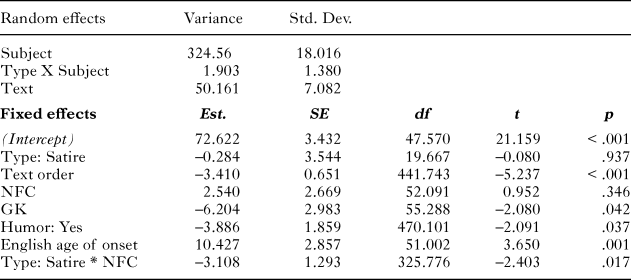
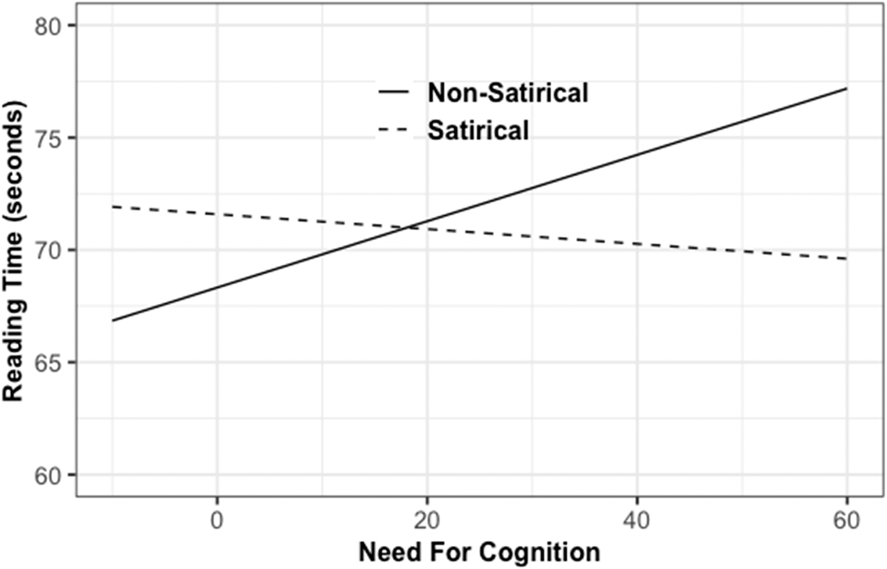
The LME model selection process resulted in a model which included significant main effects for text order, general knowledge, English age of onset, and perceptions of humor. These effects predicted that each standardized increase in text order and generalized knowledge would decrease reading times by 3.4 and 6.2 seconds, respectively, whereas each standardized increase in English age of onset would increase reading times by 10.4 seconds. Furthermore, texts perceived as funny would be read 3.8 seconds quicker than those rated as not funny. The model also included one significant interaction between text type and NFC. This interaction predicted that each standardized increase in NFC would decrease reading time by 3.1 seconds for the non-satirical texts when compared to the satirical texts. In other words, increased NFC significantly facilitated the reading time of satirical texts when compared to the non-satirical texts. Table 5 displays the fixed and random effect structure for this model, while Figure 1 visually plots the interaction between text type and need for cognition. The marginal R 2 for this model was .295, and the conditional R 2 for this model was .739.
LME model predicting reading times for satirical and non-satirical texts

notes: Est = estimate, SE = standard error. This model was obtained from a backfitting algorithm in the LMERConvenienceFunctions package, which took in a model specified with an interaction between text type and all other predictor variables. The algorithm indicated that perceptions of Sincerity and Positivity and measures of Language Distance did not contribute any significant main effects or interactions and were thus removed from the final model. Baseline level for Type was Non-Satirical, baseline level for affective perceptions was No. All numerical predictors were z-scored before being entered into the model. Marginal R 2 = .295, Conditional R 2 = .739.
Interaction between text type and Need for Cognition (raw values). Increases in NFC resulted in significantly quicker reading times for satirical texts (dashed line) when compared to non-satirical texts (solid line).

5.2. text comprehension
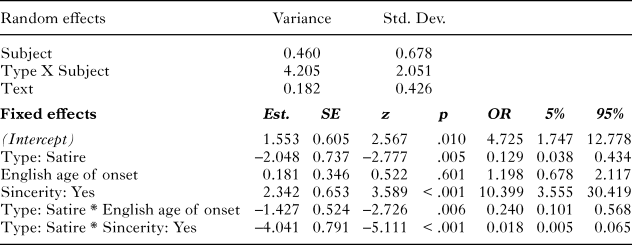
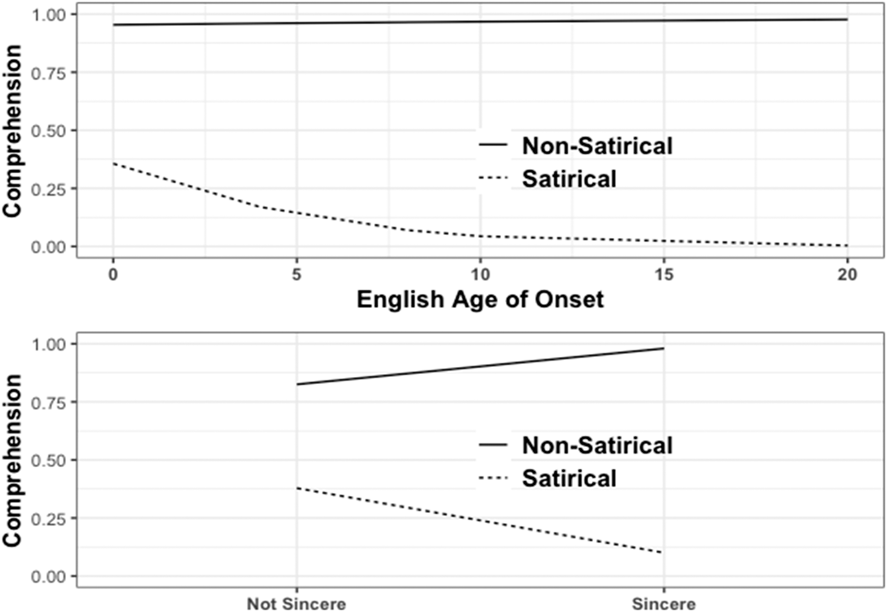
The GLME model selection process resulted in a final model which included two significant interactions. First, there was a significant interaction between text type and English age of onset, which predicted that each standardized increase in English age of onset was associated with a 4.2 times greater likelihood of not comprehending a satirical text when compared to a non-satirical text. The other significant interaction was between text type and perceptions of sincerity, which predicted that satirical texts rated as sincere would have a 55.6 times lower likelihood of being comprehended (as satirical) when compared to proper comprehension of non-satirical texts rated as sincere. For ease of description, positive odds ratios were obtained from the negative terms by dividing the odds ratio by 1. Table 6 displays the fixed and random effect structure for this model, while Figure 2 visually plots these interactions. The marginal R 2 for this model was .591, and the conditional R 2 for this model was .693 (delta method).
GLME model predicting comprehension for satirical and non-satirical texts

notes: Est = estimate, SE = standard error, OR = odds ratio. This model was obtained from a backfitting algorithm in the LMERConvenienceFunctions package, which took in a model specified with an interaction between text type and all other predictor variables. The algorithm indicated that perceptions of Humor and Positivity and measures of Language Distance, Text Order, and Text Reading times did not contribute any significant main effects or interactions and were thus removed from the final model. Baseline level for Type was Non-Satirical, baseline level for affective perceptions was No. All numerical predictors were z-scored before being entered into the model. Transformed odds ratios for the two interactions with text type are 4.167 for English age of onset and 55.556 for Sincerity (1/OR).
Top. Interaction between English age of onset (raw values) and text type. Increases in English age of onset predicted lower likelihood of satirical comprehension (dashed line) when compared to comprehension of non-satirical texts (solid line). Bottom. Interaction between perceptions of sincerity and text type. Satirical texts rated as sincere were predicted to have significantly lower likelihood of satirical comprehension when compared to satirical texts rated as not sincere.

6. Discussion
The purpose of this study was to compare the effects of specific cognitive, demographic, and pragmatic variables on the reading times and comprehension of satirical and non-satirical texts. Based on prior investigations of satire processing and comprehension, variables related to general knowledge, Need for Cognition, language background, and affective perceptions of humor, sincerity, and positivity were measured and entered into statistical models predicting both reading times and comprehension scores for satirical and non-satirical texts. It was hypothesized that higher levels of language knowledge and general knowledge should facilitate satirical text processing and comprehension, but it was unclear whether these effects would significantly differ when compared to non-satirical texts. It was also thought that perceptions of humor, sincerity, and positivity would play a stronger role in satirical text processing and comprehension when compared to non-satirical texts. Finally, the cognitive measure of Need for Cognition (NFC) was included in order to compare its effect (if any) on satire to non-satire as well as previously reported effects of NFC on metaphor but not verbal irony processing (Kaakinen et al., Reference Kaakinen, Olkoniemi, Kinnari and Hyönä2014; Olkoniemi et al., Reference Olkoniemi, Ranta and Kaakinen2016).
6.1. cognitive influences on processing and comprehension
6.1.1. General knowledge
Higher scores on the general knowledge test predicted quicker reading times for the texts in the models, but there was no significant interaction between this variable and text type, suggesting that the influence of general knowledge was not specific to satirical discourse processing in this data. Possessing greater knowledge about a text should help a reader maintain a passive, automatic method of text processing (van den Broek & Helder, Reference van den Broek and Helder2017), so it is not surprising that greater levels of general knowledge would facilitate immediate online processing for both text types, as the topics in the texts may have indexed that knowledge. The lack of a significant effect for comprehension also suggests that general knowledge exerted no specific and significant influences on satire processing. Thus, it may be the case that these effects for general knowledge, previously found for political satire, do not extend to non-political satire.
6.1.2. Need for cognition
The significant interaction between NFC and text type suggests one specific difference between satirical and non-satirical discourse processing. As Figure 1 displays, the statistical model predicted that participants with lower NFC scores would read satirical texts slower than non-satirical texts, but this effect reversed as measures of NFC increased. This suggests that higher levels of NFC facilitated the reading times for satirical texts, and this facilitation was significantly stronger for satirical texts when compared to the non-satirical texts. As mentioned above, NFC indexes one’s desire or enjoyment to engage in cognitively difficult tasks (Cacioppo et al., Reference Cacioppo, Petty and Kao1984). Therefore, it may be the case that participants who indicated enjoyment when engaging in cognitively complex tasks were better equipped to parse satirical discourse. According to Simpson’s (Reference Simpson2003) model of satire, satire partially relies on verbal irony to express a figurative and satirical meaning. However, previous research testing the role of NFC on metaphor and verbal irony processing reported no strong connections between NFC and verbal irony processing (Kaakinen et al., Reference Kaakinen, Olkoniemi, Kinnari and Hyönä2014; Olkoniemi et al., Reference Olkoniemi, Ranta and Kaakinen2016), but did report a significant association between NFC and metaphor processing (Olkoniemi et al., Reference Olkoniemi, Ranta and Kaakinen2016). The authors concluded that participants who enjoyed understanding metaphors spent more time reading them. Thus, based on these results, one might expect that a similar effect would occur with the satirical texts, in that higher levels of NFC would serve to increase, not decrease, the reading times for the satirical texts. As reported, however, the opposite effect was obtained (see Figure 1). Therefore, it appears that NFC may play a unique role during satire processing and may suggest that the effect for NFC in the current study is related to non-ironic, discourse-level aspects of the satirical texts, or an interplay between irony and the satirical context.
6.2. demographic influences on processing and comprehension
6.2.1. English age of onset
Although not a direct measure of English proficiency, participants with a higher English age of onset (i.e., those who started to learn English later in life) were predicted by the statistical model to read both text types slower, with no specific effect for satire or non-satire, demonstrating a general influence of English knowledge on reading times. Moreover, as was hypothesized, participants with lower English age of onset were significantly less likely to write an interpretation reflective of satirical comprehension for the satirical texts when compared to their ability to interpret the main point of the non-satirical texts. As Figure 2 displays, higher levels of English age of onset did not significantly impact the participants’ ability to comprehend the non-satirical texts, suggesting that obtaining the main point of the non-satirical texts was not a difficult task for any of the readers (as also evidenced by the high ceiling effect for comprehension scores of the non-satirical texts). At the same time, readers with an English age of onset of even greater than five years old were less likely to comprehend the satirical meaning of a satirical text, suggesting an association between language background and the ability to detect the satirical message.
In this manner, these results likely capture the difference between native and non-native speakers of English, as all native speakers were assigned an English age of onset score of zero. Understanding satire can be difficult and complex even for native speakers of a language. This is because a satirical message includes cultural and pragmatic information that is typically attained through lived experience and is difficult to teach explicitly, and different cultures may have different conceptualizations of satire (Prichard & Rucynski, Reference Prichard and Rucynski2019). Therefore, while English age of onset may be a partial proxy for general English proficiency, it is just as likely that English age of onset served as a measure of exposure to United States culture through an English medium. Accordingly, participants with a higher English age of onset may possess less familiarity with United States culture and therefore lack the cultural background knowledge required to fully understand or even recognize some of the satirical meanings in the Onion articles. As the satirical articles appeared structurally identical to the non-satirical articles, these participants may have used the same reading strategies as the non-satirical texts by focusing on the surface level meaning of the satirical texts.
6.3. affective influences on processing and comprehension
6.3.1. Perception of humor
Perceptions of humor predicted quicker reading times for the texts, but, in a similar manner as the measure of general knowledge and English age of onset, there was no significant interaction between perceptions of humor and text type, suggesting no influence specific to satire. Reasons for this may be attributed to recent evidence suggesting that humor may serve to facilitate text processing (Ferstl, Israel, & Putzar, Reference Ferstl, Israel and Putzar2017; Mitchell, Graesser, & Louwerse, Reference Mitchell, Graesser and Louwerse2010). Thus, the same inference may be drawn regarding a general influence of humor on both satirical and non-satirical texts, as it is possible that participants found aspects of the non-satirical texts to be humorous.
It is somewhat surprising that perceptions of humor were not significantly associated with either satirical or non-satirical comprehension, running counter to the hypotheses of this study and results from previous studies of satire. However, as has been previously reported, hearers need not find an example of satire humorous in order to understand the satirical message, and finding satire humorous does guarantee that a hearer fully comprehended the satirical message (Johnson et al., Reference Johnson, Del Rio and Kemmitt2010; LaMarre et al., Reference LaMarre, Landreville, Young and Gilkerson2014). As such, the same phenomena may have occurred in this data. Moreover, much like differences noted above in general knowledge, it may be the case that humor is more strongly associated with political satire when compared to the satirical articles used in the current study.
6.3.2. Perceptions of sincerity
Perceptions of sincerity had no significant effect on text processing, but did significantly interact with text type in the statistical model testing comprehension. This effect was relatively strong, with the likelihood of producing a written interpretation reflective of satirical comprehension for the satirical texts regarded as sincere to be 55.6 times less likely than comprehending the meaning of non-satirical texts regarded as sincere. The existence and direction of this effect align with theoretical predictions and prior research (Pfaff & Gibbs, Reference Pfaff and Gibbs1997; Simpson, Reference Simpson2003), highlighting the magnitude of the influence that perceptions of an author’s intentions have on the ability to arrive at a satirical interpretation. The ability to recognize insincerity may aid in adopting a satirical state-of-mind during satire processing or immediate comprehension. Discourse factors that may contribute to the ability to recognize this insincerity are important to consider for future research. As reported by Pfaff and Gibbs (Reference Pfaff and Gibbs1997), elements such as wordiness and exaggeration can help to key readers into these perceptions, and some examples of satirical headlines contain specific linguistic constructions that deviate from typical language use (Skalicky, Reference Skalicky2018). As such, there may have been linguistic components of the satirical texts in this study that triggered these perceptions of sincerity that were not captured when controlling the texts for other linguistic features such as word frequency. One avenue for future research in this area would be to conduct follow-up interviews or stimulated recalls with participants to better understand which features of the texts, if any, cued them into a satirical frame of mind, in a similar manner to Pfaff and Gibbs (Reference Pfaff and Gibbs1997).
6.3.3. Perception of positivity
The lack of a significant effect for perceptions of positivity for both text processing and comprehension suggests that emotional valence does not play a strong role during the interpretation of satirical discourse in this data. This may reflect the stronger overall effect for sincerity (which may have muted positivity) or might simply reflect the fact that non-satirical texts can also be negative, and that this cue does not significantly aid in satire understanding.
6.3.4. Direction of affective perceptions
It could be argued that the direction of these effects may also work in reverse, in that comprehension of satire may predict affective perceptions. Indeed, the participants all recorded their text ratings at the end of each trial, and thus these ratings included any immediate reflection that the participants had about the text while paraphrasing the meaning of the texts. In other words, participants might rate a text as less sincere only after taking the time to consider the satirical or non-satirical meaning during their written interpretation of the author’s main point. To explore this possibility, a series of three exploratory post-hoc GLMER models testing perceptions of humor, sincerity, and positivity were conducted. Results suggest that comprehension of satirical texts significantly predicted perceptions of humor and sincerity when compared to non-satirical texts, but the same was not true for perceptions of positivity (see ‘Appendix’). Therefore, although humor was not identified as a significant predictor of satire comprehension, these post-hoc tests do suggest that the two are still significantly associated with one another. These results further suggest that humor may be a sufficient but not necessary component of satire comprehension (Johnson et al., Reference Johnson, Del Rio and Kemmitt2010).
6.4. limitations and future directions
This study relied on one specific type of satire published by a relatively well-known entity in the United States (The Onion), and the results here should be interpreted in light of the specific corpus of satirical texts employed. Accordingly, there is a need to continue investigating satire comprehension using different examples of satirical texts as well as various types of satire across different mediums, such as televised satire or satirical cartoons. Other practical limitations of the study are related to the relatively low number of participants (61) and the diverse range of L1 backgrounds among the 32 international participants. Future studies may want to compare a larger number of language users from more homogenous language backgrounds. Methodologically, more fine-grained measures of online processing, such as eye-tracking, can complement the current results based on global reading times.
Additionally, the manner in which the comprehension score was operationalized could be refined in future studies. A binary ‘yes/no’ scoring system is not perfectly suited to capture the nuanced layers of satire comprehension that likely exist. Accordingly, different aspects of satire comprehension should be developed and investigated. For instance, prior figurative language research has pointed out the need to consider the role of agreement and group membership during verbal irony comprehension (van Mulken, Burgers, & van der Plas, Reference van Mulken, Burgers and van der Plas2011), and the same may be true for satire comprehension. Indeed, agreeing with the satirical message has been mentioned as a prerequisite for evoking a humorous response (Simpson, Reference Simpson2003), but a lack of agreement (or humorous) response does not guarantee one did not understand the satirical message (Johnson et al., Reference Johnson, Del Rio and Kemmitt2010), and the results here tend to support this viewpoint.
6.5. conclusion
This study investigated the role of different cognitive, demographic, and affective factors during satire processing and comprehension. Previous effects of general knowledge and humor were not found to be significant in this data, which may be attributed to the difference in satire type of the influence of other variables (although follow-up post-hoc tests still suggest an association between humor and satire comprehension). At the same time, this study identified novel effects for Need for Cognition on satire processing speed and for English age of onset and perceptions of sincerity on satire comprehension scores. These results further suggest that variables which play a role during satire processing (i.e., need for cognition) may not necessarily play a role during satire comprehension, indicating a need to model multiple layers of satire processing and comprehension in future studies.
Supplementary materials
For supplementary materials for this paper, please visit <http://doi.org/10.1017.langcog.2019.30>.
Appendix
Exploratory post-hoc analyses

Three post-hoc GLMER models were fit to test whether satire comprehension predicted affective perceptions. Significant interactions for the models testing humor and sincerity suggested that satirical comprehension of the texts significantly predicted perceptions of humor (positive) and sincerity (negative). There was no significant effect for perceptions of positivity.