Fashionable Ephemera
It has been widely noted that the academic study of fashion has had a troubled history. While throughout history, there have been many influential commentators who have recognized that fashion provides a revealing window through which to observe culture (Diderot, Simmel, Baudrillard, Carlyle, to name but a few), the subject has not until recently been accepted as a legitimate site for academic analysis. By its very definition, fashion has a short shelf life, and literature chronicling fashion trends has been seen as ephemeral.Footnote 1
This problematizes the study of fashion, since the preservation of content surrounding it has not been a priority. Fashion has suffered from its associations with commerce and industry, popular culture, women, and materiality (often seen in opposition to the intellect) – associations that have until recently failed to drive analysis and acceptance within mainstream academic discourse. While costume historians have provided important object histories, it wasn't until the mid-1990s that the theoretical analysis of fashion began to take off, fuelled by the publication of the academic journal Fashion Theory, edited by Valerie Steele.
Prior to this, there was little reason to value fashion content. Fashion photography – again, associated with commerce rather than art – would hardly have been thought worth preserving. This was particularly the case given that in the pre-digital age, preservation came at a great cost – space, time, money.
Project Background
I first contacted Niall McInerney in December 2010. McInerney's work was known to me because he was one of the few photographers licensing fashion images from the 70s through the 90s. My company, Berg Publishers, had been using his images for our books program, as we had a large fashion list. In August of the same year, Bloomsbury had launched The Berg Fashion Library (‘BFL’), an online database for students and scholars working on dress across cultures and throughout history. I had written a business plan for this product, which ultimately was the driver behind the sale of Berg to Bloomsbury in September 2008. The need for resources in this long neglected subject area seemed clear. The BFL had launched to considerable acclaim, interdisciplinary research was gaining momentum, and, as Lindsay King and Russell Clement have noted, the importance of fashion in collection development was on the rise:
As scholarly research interests become more interdisciplinary and fashion-related resources become more sophisticated, fashion emerges as progressively important area for collection development. Northwestern University Library's Art Collection staff began developing a research collection of fashion materials around 2005, motivated by widespread student and faculty interest and by the increasingly scholarly nature of many fashion-related titles appearing in catalogs and approval plans… . Earlier studies of costume and dress tended to be more interested in the cataloguing of historical or exotic clothing, while fashion in its current usage encompasses ideas like gender identity, subculture membership, luxury marketing, and trend diffusion across socioeconomic categories.Footnote 2
The BFL aimed to cover world dress comprehensively – the centerpiece was The Berg Encyclopedia of World Dress and Fashion (co-published in print with Oxford University Press in the US). Joanne Eicher, Regents Professor Emerita at the University of Minnesota and General Editor, had a vision that every country in the world should be represented, given the richness and diversity of dress's local manifestations. Eicher is a social anthropologist, and while the Encyclopedia did include historical and Western fashion content, the emphasis was very much on indigenous dress and its cultural meaning, rather than on fashion or the fashion system. ‘Dress’ – to draw an important distinction – is defined by its timelessness, fashion by its transitoriness. Valerie Steele's earlier Encyclopedia of Clothing and Fashion had covered a great deal of the latter already but had a Western focus, and greater emphasis on fashion history than the Berg Encyclopedia. (In fact, we licensed Steele's content for BFL.)
Aware that there was a value to more fashion-focused content and cognizant of its relatively light coverage in the BFL, I was on the look-out for other opportunities that would enrich and complement our portfolio. Authors had noted the importance of McInerney's archive. In fact, Central Saint Martins, University of the Arts London (UAL) had considered acquiring it (McInerney was the official Graduation Show photographer for Central Saint Martins, one of the world's top design schools, and had photographed such important designer debuts as Alexander McQueen's and John Galliano's). However, in the end, UAL decided against the purchase, due to budgetary constraints and storage issues. McInerney wanted a home for his life's work, and Bloomsbury were interested in expanding our digital product offerings. The timing was perfect.
Niall McInerney, Fashion Photographer
Niall McInerney was born in Limerick, Ireland, in 1941. At seventeen, he left Ireland for England, settling in London and holding a variety of jobs, including as stage manager in a Soho club. He began to take photographs of the club employees, having picked up lighting tips from the photographer Lewis Morley, who famously photographed a naked Christine Keeler straddling a Panton chair. (Morley had his studio in Greek Street and he and McInerney had struck up a friendship.) In the early 1970s, McInerney started a small business, Piccadilly Press, photographing groups of foreign tourists in front of London's sights.
Around this time, he started taking photographs of clothing and shop window arrangements for Willie Walters, a friend and a tenant at his Camden Town house. Walters was one of the founders of the clothes boutique Swanky Modes. At this time, McInerney also started photographing street styles, which grew to include fashion followers, fashion industry insiders, street scenes, and shop interiors in London and cities he visited for the shows.
McInerney's career as a runway photographer began in the late 1970s; he received his early commissions, generally by word of mouth, and directly from designers (Bill Gibb, John Bates and Bruce Oldfield were among his first clients). Working either directly for designers or for the fashion press, he soon established himself as one of the leading runway photographers, with a reputation for tenacity and ingenuity in getting the closest shots, often inserting himself between other photographers and the runway for the best position. Photographer Chris Moore lamented: ‘He was often shooting in front of me and I would look back at the pictures and say: There's another one of bloody Niall in a blue shirt.’Footnote 3 As Nilgin Yusuf notes: ‘He was also renowned for getting into shows whether or not he had been invited’ and he ‘understood instinctively that [backstage] images had relevance and value long before the value of “backstage” became a standard element, even a cliché, of print and digital editorial.’Footnote 4 Between the early 1980s and 2000, McInerney covered both couture and ready-to-wear shows, womenswear, menswear and some childrenswear in the four main fashion capitals. He last photographed shows in 2000 but to this day continues to take on smaller commissions, including the Central Saint Martins graduation shows.Footnote 5
Archive Contents and Strengths
The following summary is from an unpublished report written in 2006 by Marketa Uhlirova for Central Saint Martins, when they were considering purchasing McInerney's archive:
NMI's archive is a privately owned repository of photographic material containing invaluable documentation of international fashion spanning over two decades between the late 1970s and 2000. …Fashion coverage encompasses above all ready to wear and couture collections showing clothing, accessories and beauty trends, which were part of the official fashion week schedules in four major ‘fashion cities’: London, Paris, New York and Milan. In addition, there is some coverage of off-schedule unofficial shows. NMI's work is comparable to that of catwalk photographers such as Chris Moore… . To a degree there is also a similarity with some of the work of Bill Cunningham, the fashion and style photographer for The New York Times, who has consistently documented fashion insiders and socialites at fashion shows, both known and anonymous. This documentary aspect is an important part of NMI's work.Footnote 6
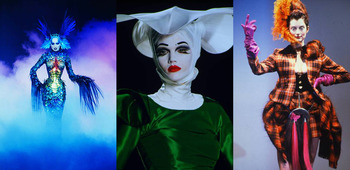
Archive highlights include (Fig. 1):
-
• Rare early designs from some of the world's most influential designers’ graduation collections, including McQueen and Galliano
-
• Comprehensive runs of Vivienne Westwood (including Naomi Campbell's famous tumble), Jean-Paul Gaultier, Chanel RTW and Haute Couture, Yves Saint Laurent RTW and Haute Couture, John Galliano, Calvin Klein, Donna Karan, Giorgio Armani, Alexander McQueen, Versace and other designers / labels between 1980/1982–2000, mostly of excellent quality, and extensive-to-complete coverage of the majority of their collections
-
• Extensive coverage of fashion elite, including editors, stylists, writers and fashion celebrities: Grace Coddington, Anna Piaggi, Suzy Menkes, Andre Leon Talley, Hamish Bowles, Isabella Blow, and Anna Wintour, for example
-
• Street style from the late seventies onwards
-
• Images from the banned Comme des Garçons show, ‘Sleep’
-
• Backstage photographs of the designers and celebrities, including supermodels at the beginning of their careers.
Left to Right: Thierry Mugler Couture A/W 1997; Dior Haute Couture by John Galliano, A/W 2000; Vivienne Westwood A/W 1997. Photographer Niall McInerney; copyright Bloomsbury Publishing Plc, images from the Fashion Photography Archive.

The Digital Business Case
The images are a complete body of work, spanning the life and career of a very active photographer. As such, the archive documents not only fashion, but the practice and methodology of a working fashion photographer. There are inevitably gaps; not every year, designer or city is comprehensively documented. In many respects, the out-takes are as important as the pictures McInerney sold – again for rarity and to provide a more comprehensive overview of fashion history during this influential period.
The value of the archive is perhaps best summed up in Uhlirova's report: ‘[It is] an excellent resource for the study of fashion. … .[it] is remarkable for excellent image quality, its scope and breadth, thoroughness, good organization and accessibility. Although it is far from complete, it represents a comprehensive documentation of runway fashion between the late 1970s and 2000.’Footnote 7
Clearly, the images themselves have enormous value. However, for educational purposes, context is needed. Without context, students would find it difficult to navigate the contents. How would they know which collections were pivotal? Which designers were the most important? Which trends were popular? What it was like to be a runway photographer over this period? What broader cultural drivers were in play?
To enhance the archive's value, we commissioned Valerie Steele to curate ‘core collections’. We are also including 150 designer biographies and 120 articles upon launch to provide historical and cultural context and a richer learning experience. The archive will be sold on both a subscription and a perpetual access basis. The content set is finite (i.e., c. 750,000 images) but it is possible that down the road we could add bolt-on ‘modules’ that are sold separately – for example, if we were to license or acquire rights to another archive from a different period.
Technical Details
McInerney was unusual in that he was working mainly for magazines, which have a longer lead time than newspapers. The lengthier deadlines enabled him to use low sensitivity Kodachrome film in a process that combined slow shutter speed with flash. Kodachrome required more development time than other films, but was higher quality and more durable.
Until the early 1990s McInerney worked with a Nikon FM camera with 50 and 85 millimetre lenses. The technology produced a sense of warm light around subjects, while remaining sharply focused. Until the early 1990s, photographers would stand alongside the runway, in front of guests and about three metres (ten feet) from the beginning of the runway. Here models would stop to pose, thereby providing an excellent opportunity to take a good picture. Another opportunity would present itself on their return to backstage. Typically there were two models at a time on the runway: one would walk down the runway while another stood at the beginning. McInerney had a technique: he would wait until models walked into a pre-focused picture so that precious time wasn't lost adjusting zoom.Footnote 8
Proximity to the models gave photographers an unrivalled view, but blocked the view from the front row, which became increasingly problematic as the participation of celebrities and elite customers grew in prominence. Sometime in 1992 or 1993, photographers were moved to a designated area at the back of the runway, much further from the models and where flash was ineffective. McInerney therefore switched to a Canon IOS1 with an auto-focus and stopped using flash, and from Kodachrome to Tangston Fujichrome film, which he used throughout the remainder of the period covered by the archive. While the adaptation was necessary, the quality of the Tangston film was not as good nor was it as stable as the Kodachrome.
Organizational, Classification and Indexing Challenges
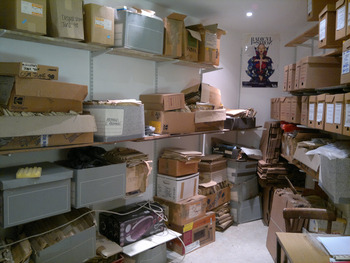
When Bloomsbury purchased the archive, the slides were stored in cardboard boxes (Fig. 2). Approximately sixty percent of these were logically ordered and in good condition. Storage for the remaining forty percent consisted of loose slides in envelopes and cardboard boxes that needed to be replaced. Outtake Kodachrome slides were kept in a series of small yellow boxes.
The Kodachrome slides made up the majority of the collection, including the rarer, more valuable photos. Some slides were unmounted. Approximately three-quarters bore labels on the mounts – designer/label, type of collection (menswear, womenswear, childrenswear), season/ date, location – or were placed in labelled viewpacks in marked brown envelopes. The labels were not always legible.
Approximately ten percent had been removed from their original boxed location and regrouped under themes, such as garment type, celebrities or supermodels, body part, or theme (‘sparkly’) because these themes were at one point topical. McInerney had no way of cross-classifying and no accession numbers. This smaller group was in ring binders. Another ten percent were returns, and placed in viewpacks in a disorganized state (‘various’). The rest were unlabelled and placed in slide boxes by designer / label and collection.
The original storage location. The organized boxes can be seen on the shelves on the right, the boxes needing to be organized are on the left.

Archive Digitization
Our first question was how to approach the mammoth task of organizing all this content. Should we digitize it all in one go, or be selective? The well-organized boxes could be sent straight out for conversion, but the other boxes would need to be replaced and slides re-filed before being removed from McInerney's storage facility (the boxes were in bad condition and the slides could have been damaged during transportation).
The case for digitizing first and then cataloguing was:
-
• The more slides digitized in one job lot, the cheaper each individual slide would be
-
• We'd be able to budget total costs more reliably because we had a good idea of the overall number of slides and would pay a set cost for each
-
• Once the slides are digitized, the process of indexing could more easily and quickly be managed, with no need for light boxes or magnifying glasses.
The case against was:
-
• Total digitization costs would almost certainly be more expensive given the duplication and outtakes, not all of which would be needed and which could not be quantified in advance.
-
• We would not be able to create a master inventory for the archive prior to digitizing because we would not know what was there – ie we could only know what we had once digitization was complete and the contents fully reviewed.
The case for cataloguing before digitization was:
-
• A new and detailed inventory could be created, which would be extremely useful for the purposes of elimination – ie we could decide only to digitize those slides we wanted, which might result in cost savings overall
-
• We would be able to make a detailed plan as to how to index the images – ie what to prioritize
The case against cataloguing in advance was:
-
• Indexers would need to be on-site to physically handle the slides, or in a separate, rented facility, which would be costly and labour-intensive
-
• Space in our London offices was at a premium – there was no available desk-space and if we rented another space off-site, the costs would likely be significant
-
• We would need to purchase light boxes, slide viewers and magnifying glasses, and have computer access in order to input the information directly into the inventory
-
• This approach would likely be much more time-consuming and indexing costs higher
In the end, we decided to digitize all slides at once, using a conversion house. This seemed simplest, and we felt the costs of non-essential digitization would be outweighed by the savings on indexing from digital copies.
The digitization project was managed in batches. We had taken a cursory inventory of the archive's contents, but given its scale, it was simply impossible to know what was included except in the broadest sense. This was further challenged by events such as McInerney's discovery of more boxes in his attic – including rare Comme des Garçons – as well as some creative classification that doubtless made perfect sense to the photographer at the time, but was deeply opaque to third parties.
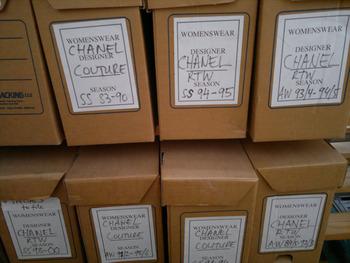
The digitization of the entire archive took three and a half years. The company we used were asked to clean the slides, record all data on the mounts in the digital files, watermark all images and save them. Indexing is still not completed but we anticipate it will be done by 2018, seven years after the archive's purchase (Fig. 3).
The well-organized boxes from the archive.

Technical Build
We wanted to build a product that would enable cross-searching and serendipitous discovery across the whole of our fashion holdings. To optimize that functionality, all fashion products had to be on a single platform. In addition to the BFL, we also had plans to put content online from Fairchild Books, an imprint we had purchased in April 2012. The Fairchild Books content is very industry-focused. We wanted students and instructors to be able to service all their fashion requirements in one place: fashion images and context about designers and the cultural context; content on dress throughout the world; and textbooks essential for their studies. Outside North America, the textbook content would be supplied on a subscription basis to institutions. Students in North America purchase their own textbooks as essential reading and we sell significant numbers through the adoption market, which is core business for Fairchild Books. We could not afford to jeopardize that business by supplying the books through libraries that certainly would not be able to compensate for the adoption revenue shortfall. For that reason the Fairchild Books Library is only available outside North America.
Authenticated users will be able to search across all the products to which they have access, or can restrict their search to a single product. The aim is to enhance discovery of content across products and drive usage. Related content highlights results across the entire platform – again, increasing the chance that content relevant to the user's interests will be discovered. We will also be putting free content outside the paywall to drive traffic.
The Fashion Photography Archive will have taken nearly six years, from the initial approach to McInerney, to launch. It has impacted on every function in our business: editorial; production; IT and digital; accounts, not including external suppliers (platform developers, data consultants, QA consultants, the conversion house, freelance indexers, academic consultants and authors). Projects of this scale require deep pockets, careful planning, and a broad range of expertise. We believe the end result will justify the effort. We have preserved and added meaning to a period of fashion history that saw the transformation of the fashion show from showcase into media spectacle, the rise of the supermodel, the ascendancy of the celebrity ‘FROW’, the disruptive influences of the great Japanese and Belgian designers – and that currently lacks a resource.
Future Developments and Partnership Opportunities
We are very interested in working with content partners to improve the Bloomsbury Fashion Central offering. The easiest way for us to do this is to ‘ingest’ digital content already tagged with the requisite metadata. As we are publishers rather than subject specialists, it is not generally possible for us to tag objects in-house; we have to freelance this. We are able to work well with museums because they typically have exportable image content that has been tagged to enable discovery. Given its provenance, we can be confident that metadata standards are high.
We prefer not to work with undigitized content. McInerney's archive was an exception, justified by its relative coherence, scale and rarity value. We would not rule out undigitized content, but costs need to be recovered, and given the nature of subscription products and pressures on library budgets, we cannot simply pass extra costs on to existing customers. The Fashion Photography Archive was possible because it was not part of the BFL, but rather a standalone product that could be monetized separately.
Requirements therefore tend be as follows:
-
• Content should preferably be available digitally
-
• Rights must be cleared (unless out of copyright)
-
• Content should have metadata accompanying it
We would consider digitizing archives or smaller content sets if the outcome resulted in a product of sufficient scale to be monetizable in and of itself.
Bloomsbury Fashion Central is a very new and extensible project and we plan to work on both functionality and content for many years to come. We welcome all comments and inquiries relating to possible collaborations, suggestions for new content or functional improvements. It is also worth mentioning that we have other visual arts/material culture products in development, in design, architecture and food, should institutions have strengths in these areas.
Acknowledgments
I would like to thank Marketa Uhlirova for sharing her unpublished report on the archive with me, and allowing me to quote from it, and my colleague Emily Ardizzone of Bloomsbury, for all her input.