Introduction
The experience of globalization keeps bringing to the fore the related questions of the fate of the Westphalian state, its present roles and resources, and its possible future. Is this incumbent political model still adequate for a global economy and for an increasingly integrated international society? If not, what entity might replace or complement it? Who might design and build it? And what would be the consequences with regard to individual rights and democracy, which are the legacy of national, constitutional settlements?
On the one hand, realists in international relations typically defend the position that, while massive changes have been observed since the 1980s, in essence the political geography of the world has not changed. Flows of people, goods and ideas have become more intense than ever, but states still rule. This position, in fact, also lies at the core of the standard approach of international trade: what is traded, and the determinants of trade may have evolved, though governance is still about trade across borders. Trade without borders is a different thing. On the other hand, many scholars and authors also insist that borders have waned, or will shortly wane. Hence, they argue, states as well would be on their way out. The development of intergovernmental and international non-governmental organizations, self-regulatory bodies, international groups of activists, and the co-operation between them are considered as portents and drivers of this evolution.
What is striking in this arguably schematic description is the difficulty of envisaging jointly the development of markets and political orders. Either markets are the driving force, and the states, or their possible successors, recede far into the analytical background. Or states remain as permanent essences and, all the fuss about globalization, markets and the expanding international division of labour might be a side attraction. While both approaches defend that the relationship between politics and markets is a core theoretical concern they propose in fact a rather narrow perspective, whereby states and markets, or politics and economics, ‘meet’ and ‘interact’ on the world scene, as if they were governed by entirely separate, self-contained principles. Both approaches appear as puzzles for the ‘contractual theories’ of the state, i.e. a foundation of both classical political philosophy (Hobbes, Locke, or Rousseau) and classical political economy (Smith). According to these views, the political and economic orders are inherently jointly founded. They derive from a constitutive bargain between emerging states and emerging citizens. While the former receives allegiance and resources, the latter benefits from a more or less extended package of rights. For example, citizens may own property, they may trade, and they may voice opinions and concerns about taxation, directly or indirectly. Starting from there, traders and citizens may extend the benefits of open market and civic participation.
In this article we rely upon a simple, and therefore schematic, model that starts from this intuition. Rather than emphasizing the notion of an original mutual commitment, we explore how the long-term evolution of individual rights and societies may be shaped by a continuing negotiation between political rulers and civil societies. First, citizens and traders bargain on rights and policies with their governments. Second, they maximize the leverage of this endowment, so that the economy and civil society may develop and become more innovative and wealthier. Third, social and economic changes lead them to bargain again with their government, on the basis of their new needs, evolving preferences, suggestions and complaints. In other words, the dynamics of the economic and social division of labour feeds back into the political order and impose changes, or perhaps even revolutions. While at a given point in time, individual and collective action is tightly constrained by the existing constitutional order, over time this franchise is renegotiable. Moreover, when this franchise is being renegotiated, nobody knows in advance what citizens and traders will do with it. Economic entrepreneurship and social activism are doomed to have unexpected outcomes. Their long-term dynamics is neither predetermined, nor easily controllable, nor even predictable.
We envisage here how this model (developed in Brousseau, Schemeil and Sgard Reference Brousseau, Schemeil and Sgard2010) may help to understand how economic and political dynamics interact in the context of globalization. More precisely, we look at how the new ‘global’ nature of their activities may lead traders and citizens to bargain with ‘their’ national political elite over the rules of the game between states: i.e., they will want to redesign the interstate order so as to be in a better position to act and transact across borders. On the one hand, in current liberal states, a wide-scale and competitive market favours division of labour and innovation, hence economic growth. Checks and balances, in the polity, ensure cohesion, partly through collective protection and redistribution to deal with negative outcomes from a market economy. On the other hand, the dynamic that led to the integration of the national economies and societies sets its own new targets in that there is no limit to the call for a deeper division of labour on a wider scale if it brings additional benefits. Other dimensions of transnationalization follow as people travel and migrate and go international to back trade and organizations. Individuals – both citizens and merchants – call then for more rights, as well as equality in rights to be able to compete, and more public goods, or at least a reduction of public bads. Indeed, the current international order relies on rights and governance capabilities established on different bases across countries. This fragmented genealogy results in inequalities among players, and missing links and failures in matter of governance so that serious misalignments cripple the provision of public goods. Political elites might respond to these calls because they need to keep not only their legitimacy, but also their capabilities in a context where an increasing number of (influential) economic and social agents have opt-out options. They can indeed invest in various jurisdictions, offshore activities to cash in on differences in regulations and taxations, or even migrate.
Various possible scenarios follow. They are characterized by alternative degrees of integration among legal orders, and thus by more or less equal individual rights across borders. They depend upon the relative abilities of social actors to voice and exit given the nature of the relationship developing between governed and rulers. The governed are themselves divided, since specialization and distribution of assets result in winners and losers in the deepening of the international integration of markets. Rulers might also be divided, depending upon their ability to benefit or not from a more global integration of the polity. They obviously consider the potential loss of power and associated benefits of the weakening of national states. Thus, alternative dynamics of equilibria may shape the current process of joint-reorganization of internal governments and international relations. Our analysis identifies the factors and conditions that would drive these alternative scenarios.
We start by pointing out how our contribution articulates with the existing literature (second section). Then we introduce our model of constitutionalization of rights, highlighting how national orders were built (third section). We rely on this model to describe the present world order and the dynamic tensions to which it is exposed (fourth section). Our presentation of the four scenarios of evolution follows (fifth section). In the conclusion, we insist on the limits of our model, which might underestimate the impact of the question of balance of strength among national elites and the issue of timing for the credibility of liberal orders.
Related literature
When considering the current legal, political and economic literature on globalization, three broad approaches – part positive and part normative – can be identified. Across these disciplines, they offer broadly comparable perspectives with regard to the construction of nation states, the prerogatives of sovereignty, the role of intergovernmental organizations (IGOs) and the autonomy of private agents.
Delegation is the paradigm that remains closest to the classical Westphalian, state-centred model. National states and governments are still in the driver’s seat even though they may pool resources and concede some authority to specialized IGOs in order to solve co-ordination problems. Hathaway (Reference Hathaway2008) or the contributions edited in Hawkins et al (Reference Hawkins, Lake, Nielson, Tierney and Hawkins2006) are good representatives of this line of thinking, especially when they draw from a standard principal/agent approach to IGO governance: in their Introduction, the latter insist indeed that the agent acts ‘on the behalf of the state’.Footnote 1 The diverse research currents that explore the development of international courts and trustees often remain well within this paradigm – the delegation contract is just more complex and binding (Alter Reference Alter and Hawkins2006; Majone Reference Majone2001). The same applies as well, we would think, when an appellate court and the rule of precedents are strongly established, that is, when a form of constitutionalization is at work as per the definition of Stone Sweet (Reference Stone Sweet1994, Reference Stone Sweet2009).
What is missing in this account is how the national authority that bargains on the international scene is actually institutionalized, legitimized, and possibly reformed at the domestic level. There is no a priori interaction between the ‘primary delegation’ game between citizens and national states, and the ‘secondary delegation’ from national governments to IGOs. At best, this interaction would only come ex post, as an ulterior qualification. Or it may never come, as in the standard realist approach where sovereignty is primarily an international concept based on force, mutual recognition, or rules. When challenged to offer a complementary concept of ‘domestic sovereignty’, these authors usually mention such principles as ‘final authority’, ‘legitimate violence’, or ‘the claim to self-government’.Footnote 2 The liberal school in international relations has long defended the position that private, domestic interests shape the perceptions and international strategies of national governments (see, for instance, Moravcsik Reference Moravcsik1997). Hence, national states are not seen as compact, rational and purely anomic agents. Although we do not dissent from this view, we try to better formalize how agents and governments both enter the international scene and act there, independently one from the other. In this sense, governments are not just the carriers of private or civic interest: they remain specific ‘sovereign’ agents, with distinct resources, although they now meet citizens and private merchants on the international scene and interact with them in a novel way. This offers a much more promising framework – in which some ‘actors’ may evolve in their very nature and eventually disappear – for envisaging how an extended bargain between states, citizens and merchants may deliver contrasted political equilibriums as time goes on.
Emergence then points to analytical frameworks that identify a specific horizontal capacity of international players – whatever they are – to directly co-ordinate in some predictable though evolutionary way. Specialists of epistemic communities and professional networks have provided a great number of case studies. The developing field of global administrative law also follows this line as authors underline the capacity of international organizations to develop their own body of law and precedents, and also to develop rules that help them adjust to each other.Footnote 3 A relatively coherent division of labour may then progressively emerge from this law-based process that has not been expressly intended by national states. Institutional entrepreneurship, the leveraging of institutional resources and expertise, or strategies to extend the agenda of IGOs may contribute further to such trends. The concept of Constitutional Pluralism, as developed in the field of European law, offers yet another example: whereas the EU construction has long been viewed as a gradual transition to an integrated, hierarchical, though probably federal legal order, these authors claim that in fact national and European laws and courts will keep competing. Hence they will adjust one to the other, though on a horizontal level where none of them will ever have a clear primacy. Indeterminacy, absence of closure, discursive interactions are all therefore parts of post-national constitutionalism.Footnote 4
While we are sympathetic with the open-ended approach of the emergence paradigm, its major drawback is the difficulty to envisage how such order may be eventually legitimized. The idea that it simply addresses citizens’ and traders’ individual concerns hardly covers the costs of legal uncertainty resulting from legal fragmentation. Moreover, the enforcement capabilities – starting with the judiciary, but encompassing also the public bureaus involved in the provision of public goods based on established rights – are out of scope. The missing link is the demand of control over the government by the society, or the establishment of ‘positive rights’ (Berlin, Reference Berlin, Hardy and Hausheer1958). We see the ‘civic’ call of citizens and the ‘economic’ call of merchants to equal rights as strong builders of legitimization of existing orders. The decentralized process of bargaining on rights is a way for rulers to legitimize their role and position, and for the various stakeholders in the society to enjoy the benefits of division of labour and competition (in all spheres, not only in the economy).
Self-determination is the third main road, where a more structured, or rational, or intentional project is adopted and fought for at the international level by explicitly political agents – namely citizens and governments. A superior example corresponds to the ‘We, the People’ moment, where a political order and a new citizenry are jointly established on individual rights and the delegation of political authority. We find here the classical American and French republican traditions (Pettit Reference Pettit1999). Moreover, there is the contemporary economic theory of fiscal federalism that discusses how the production of public goods should be distributed among different levels of government, from the local to the global (Oates Reference Oates1999 and Reference Oates2005; de Figueiredo and Weingast Reference Figueiredo, de and Weingast2005). But we could also add a long line of pamphleteers and prophets who envisaged how a global state might eventually be founded.Footnote 5
Our contribution draws from this ‘self-determination paradigm’, although the ‘bargaining-loop’ in our framework adds an explicitly materialist dimension to the dynamics of political ordering and institution building: citizens have values and collective preferences, but social change and economic interests also feed into the ongoing bargain on rights and policies. Furthermore, rights are implemented by public bureaus since they result in the provision of public goods. They are not simply interpersonal or constitutional recognitions of mutual obligations and prerogatives enforced by courts. Consequently, neither the state nor a possible, future global order can be subsumed to a ‘light’ combination of legislative and judicial bodies. Both have to be complemented by governance capabilities. Thus, the building of an international order might be hindered by both the division of labour and the available governing capabilities, while, at the same time, the needs and wishes of the governed can provide institutional entrepreneurs with the room to manoeuvre in order to build governance capabilities at a higher level of aggregation, generating legitimacy, which might allow to reverse both individual anticipations in the matter of specialization, and trust in mechanisms of governance.
Analytical model
The logic of delegation
We start from a straightforward, agent-based, institutionalist approach to describe political orders. Life in society entails co-ordination needs. In order to meet these needs, members may jointly delegate authority and resources to specialized agents, to trustees, or to governments. The potential benefits of this kind of delegation justify waiving economic resources and discretionary capacities, even though this means forgoing some occasional future first-best options. Thus, renouncing individual discretion is empowering because the range of possible exchanges is extended given social pacification and the establishment of common rules that apply to a wide social spectrum. This is the underlying paradox of the contractual theory of the state: enfranchisement is founded in delegating and renouncing opportunities; yet it supports civic participation and the social division of labour.
The point, however, is the risk of extortion by the ruler(s). In addition, there is the question of prioritizing the competing preferences of the various stakeholders in the society. Thus, regulating the government is a core element of the delegation contract, which should address all problems of contestability, accountability, and legitimacy. Safeguards against extortion and capture may take two canonical forms. Either it is de jure and institutionalized, or it is de facto through the fragmentation of regulation capabilities. These contrasted patterns lead to considerably different social and economic outcomes.
De jure and formal safeguards take the form of parliamentary representation and reverse commitments entered into by the ruler (e.g., signing a Bill of Rights) guaranteed by mechanisms of checks and balances, such as a division of powers à la Montesquieu, a federal constitution, a meritocratic bureaucracy, or delegated regulation (as in the case of a central bank). When formal commitments and safeguards are absent, or when they do not actually bind rulers, individuals tend to refuse delegation or limit its scope. Either they shirk or exit, or they abide by several protectors; the local lord, their community, and the guild or, of course, the mafia boss. Thus de facto checks and balances exist, but the transfer of resources and authority to each of these competing rulers is limited, which hinders their ability to rule. The resulting order is fragmented, and each of its components remains weak since exit options are always there. This limits the ability to guarantee the enforcement of rights and rules across society, and to provide public goods. Alternately, when delegation is concentrated in the hands of a single government bound by strong constitutional guarantees, both governance capabilities and integration may be high, resulting in an integrated civic and economic space.Footnote 6 We label the latter political orders as liberal, as opposed to the former qualified as despotic.
Note, however, that delegation does not draw from a formal once-for-all founding pact. Rather it emerges from a piecemeal, gradual, and uneventful evolution that may explain both the coexistence of several parallel and competing orders, or the emergence of hierarchized and integrated ones. The decentralized and ongoing renegotiation of rights and allegiance may lead to various forms of despotic and liberal constitutionalization, which conditions are discussed in Brousseau et al (Reference Brousseau, Schemeil and Sgard2010).
Individual rights and social integration: despotic versus liberal orders
Let us discuss these two polar orders in more detail to show how this opposition informs our understanding of the present world order and its possible evolution. The defining characteristic of a despotic order is that inequality of rights is built into the structure of the delegation contract.Footnote 7 Hence there are systematic asymmetries in access to organizations, markets, and public goods, as well as, more generally, to sources of income and influence. This state of affairs has powerful consequences. First, the despot has a limited ability to commit himself to the broader population, since he will always be suspected of favouring some or trying to deceive others. Second, the scope of the common interest is narrow, and, when a situation of competition arises, a winner-take-all pattern tends to dominate ex post with few if any rights for the losers, whether or not they are the majority.Footnote 8
Dynamically, the consequence of unequal rights is that the marginalized masses are usually inclined to resist the despot’s attempts to coerce, raise revenue, and extend his normative capacities. Unless actually threatened by local rulers, the masses would rather have most of their basic rights and common goods provided locally – that is, by kin groups, ethnic communities, guilds, warlords, mafia bosses, party cliques, and the like. Rights then tend to be contingent upon allegiance, favouritism, or personal reputation: they are personal, context-dependent, and fragile.Footnote 9 Hence, under despotic orders, rights are both unequal vertically (between the core and periphery of society) and different horizontally (across local orders or communities). This pervasive form of normative fragmentation serves in part as a check against coercion and exploitation by a larger, more distant ruler. The result, however, is widespread unregulated legal pluralism and considerable obstacles to circulation, emancipation, and competition. Take France’s Ancien Régime as an example: the legal infrastructure took the form of coutumes, or local customary laws that had been progressively written and confirmed from the mid-fifteenth century onward. On the eve of the Revolution, there were 65 coutumes générales and 300 other coutumes locales; all were enforced by the local courts and ultimately by the 15 provincial supreme courts, or Parlements. This, of course, is applied to a society that was also organized by status groups (the nobility, clergy, guilds, etc).Footnote 10
Liberal orders, in contrast, are explicitly founded on the principle of equality of rights among citizens regardless of their social, geographical, professional, ethnic, or religious background – or their wealth. Of course, the scope of those equal and impersonal rights may vary widely across societies and over time. Eighteenth-century England, for instance, guaranteed roughly equal rights in civil and economic matters even though the country was governed by only about 25,000 people. Still, the primary benefit of equal and individual rights is to emancipate individuals from their local communities, or bosses, and allow them to associate, invest, and trade across a much broader social space. Since rights are equal on both sides of the fence, individuals may take on inefficient producers, entrenched local rulers, and rent-seeking coalitions. Also, because equal rights reduce transactions costs, citizens and merchants may aggregate into larger, more competitive public arenas and markets. Therefore, the bargain on rights establishes not only the political order, but also the realm of civic and economic exchange.
Both sides of the constitutional bargains – rulers and citizens – may then enter a dynamic interaction completely different from that observed under a despotic order. On the one hand, this results in economies of scale, technological diffusion, the benefits of specialization, and, hence, economic growth. On the other hand, a broader and more equal polity makes it easier for a governor to be committed. He will not be expected (as a despot would be) to discriminate and deceive – not because he is necessarily more virtuous, but because he is facing credibility checks. This leads, in turn, to greater willingness by citizens to delegate authority and resources, resulting in a wider common interest and possibly a better supply of public goods. All things equal, liberal orders are typically associated with a more integrated civil society, a larger state, and a more dynamic economy than are despotic orders.
The dual structure of modern states
From a most schematic view, modern states revolve therefore around two dimensions: government and the production of public goods; and the trusteeship of private rights and civil liberties. In modern states (and contrary to medieval and early-modern European kingdoms), these two dimensions tend to be also institutionalized in two distinct hierarchies, a government bureaucracy and a hierarchy of norms and jurisdictions – say, a legal order.
The primary force behind the development of legal orders has been extensively discussed in classical sociology and economic history: the development of extended, impersonal relationships and organizations leads to the increasing formalization of social norms and arrangements. For instance, formal property titles and written contracts allow courts to interpret and enforce them in a predictable way, even across large jurisdictions and over long periods of time.Footnote 11
In a liberal order, the downside of legalization and enfranchisement is that a multitude of agreements, regulations, bylaws, and local delegations or private orders created at all levels of social life may constitute new obstacles to free circulation. Political devolution and free enterprise increase the capacity of citizens to self-organize, but the latter may then threaten open access and contestability. The classical response is the development of a working hierarchy of norms and jurisdictions headed by a supreme court in charge of defending constitutional rights.
In all liberal regimes, the legal order regulates, on a case-by-case basis, the balance between equality and differentiation, or between normative centralization and autonomy. It should guarantee the freedom to contract and self-organize while preserving normative coherence, open access, and the integrity of both the body politic and the markets. Federal countries make this trade-off explicit, although other types of government also need to address it. France and Great Britain, for instance, have a much more centralized government structure than Germany or Italy. But basic rights and liberties in all four countries are all established at the highest level of political organization and are ultimately enforced and defended downwards – whether one thinks of habeas corpus, voting rights, anti-trust regulation, or access to basic education. Let us therefore insist on this point: a liberal state and the rule of law rest on a strongly centralized legal order that is regulated by a centralized hierarchy of courts.
The government bureaucracy is concerned with commands, controls, tax collection, allocation of resources, and the organization of diverse production functions. It mobilizes considerably more resources than the legal order, and in many respects is much harder to organize and manage (see Brousseau et al Reference Brousseau, Schemeil and Sgard2010). It is interesting to note, however, that it might be less centralized. Its raison d’être is the provision of public good resulting from the establishment of rights. Once this provision is guaranteed by the existence of a credible and powerful legal order, the bureaucracy might be designed according to the most efficient way to provide these goods. The government can ‘make’, or delegate provision to sub-level of government or to agencies, or even to private corporations. This explains the highly contrasted organization of the provision of inter alia education, social security or R&D across countries (see, for instance, Scotchmer Reference Scotchmer2004 in the latter case).
The point here is that these two hierarchies need not remain as closely intertwined, since they have been historically found within the classical, European nation state (Padoa-Schioppa Reference Padoa-Schioppa1997). For example, today’s European Union is regulated by an integrated hierarchy of courts, while bureaucratic resources and executive power remain located, for the most part, at the national level. The EU Commission does not count for much in terms of financial or staffing resources. Although this institutional set-up that supports inter alia the single market is certainly not without tensions, there is no evidence that it is intrinsically flawed or doomed; contrary to the monetary union. In other words, the classic constitutional conjunction between the legal order and the government of public goods may not be necessary. It could be severed without endangering the liberal rule, in which case both hierarchies could be restructured – from the local to the global level – along different and independent lines. They might then better serve their intended goals: establishment of the realm of civil action by a trustee; and provision of public goods by government agents. This proposition will now be instrumental in exploring the possible evolutions of international governance discussed in the next sections.
Dynamics of world ordering
The world we live in: The neo-despotic model
Our discussion so far has unfolded implicitly within the framework of a closed society. The legal orders and bureaucratic hierarchies still have spatial borders that are certainly formalized. Interstate co-operation consists of the transactions and transfers of resources and authority whereby governments regulate how their legal orders and bureaucracies are connected or co-ordinated. A generic example may start with the recognition of the rights of foreigners to marry and inherit, or the regulation of cross-border flows of goods, people, ideas or Internet messages.Footnote 12 Until World War II, governments assumed that the authority to settle the resulting disputes was a core sovereign prerogative. Hence they set stringent conditions for confirming foreign judicial decisions, making cross-border cases a rather complicated affair. Since then, such cases have become considerably easier as a result of broader judicial comity, international arbitration, and the mutual quotation of judicial decisions. The same logic applies to the devolution of responsibilities to IGOs.Footnote 13
The overall effect has been to facilitate international transactions and increase the provision of international public goods. Today’s citizens and merchants can access resources, export assets and enter foreign markets with much more ease, or much lower transaction costs, than their predecessor fifty years ago. Beyond trade and investment, this has also led to cross-border societal integration through migration and travel, with consequences for the mixing of cultures, personal and family ties.
Yet, the gap between the scope of individual activities and collective governance capabilities remains huge, and it has wide-ranging, mostly adverse consequences. The global arena is populated by agents who remain by and large anchored in their national delegation game: they are defined primarily by the rights and delegation that they have negotiated domestically. And because, they stem from a large cross-section of more or less liberal or despotic regimes, the agents and the governments who meet on the international scene act and transact on the basis of rights and endowments that are both unequal and different. For this reason, what characterizes the international or global scene – whether one looks at governance or the division of labour – is the absence of a hierarchy of norms. Furthermore, potential missing links among systems of norms and uncertainties in the matter of enforcement are not only a source of transactions costs, they also contribute to overall inequalities, as they may represent insurmountable obstacles to some, while being powerful instruments to others. Finally, there is just no approximation of an ‘Arrovian’ definition of the common interest that would guide the provision of public goods. Even though horizontal co-ordination and mutual recognition between actors and organization are pervasive, and often most useful, they offer by and large a second-best solutions.
Moreover, the current global context feeds back at the local level and undermines the legitimacy of national governments. Their enforcement capacity is affected by the capacity of a non-negligible subset of the population to opt out of local regulatory orders and shop around internationally. This weakening of their authority leads governments to consider primarily these groups’ specific interests when public policy – in particular, fiscal policy – is designed. Quite clearly this makes the government’s claim to weigh fairly all preferences when establishing the ‘national common interest’ more suspect.
Today’s world can thus be characterized as neo-despotic because of this fractured, incomplete normative framework that is devoid of a working international hierarchy of norms. The logical consequences are not so different – all things being equal – from those suggested by France’s Ancien Régime. First, there is not even an approximation of equal individual rights across countries. Nor is there any binding rule of interaction between public and private spheres or between a notion of common good and special interests – be they the interests of individual states, single-issue militants, or private businesses. Indeed, there are few institutional checks against rent-seeking monopoly positions or strong-arm politics. Then, the circulation of people, production factors, and goods encounters many obstacles and many global public goods are provided inefficiently and/or illegitimately. Lastly, segments of the world’s population tend to coalesce in (or be captured by) local orders, some of which embody the most threatening aspects of despotism, like warlords or terrorist organizations.
These neo-despotic patterns may well evoke the neo-medievalist regime envisaged by many scholars of international relations (see Bull Reference Bull1977; Friedrichs Reference Friedrichs2001; Spruyt Reference Spruyt1994). Though it is highly suggestive the comparison between medieval city-states and the contemporary nation states is bounded by two factors. First, today’s hierarchies of norms at the national level are considerably more complex than in the past and they play a much more prominent role in the regulation of actual behaviours. Second, the packages of public goods, and their attached redistributive compacts between social interests, are also much stronger, hence much more difficult to renegotiate or to abandon. Of course, there is a wide set of single-issue organizations and self-regulated movements and alliances, attempting to promote more integrated international norms, but while they may design coalitions, they would not write covenants since they do not benefit from any mandate to deal with conflicting interests. Their pretence of political efficiency is skewed at best. As we try to envisage how an international political reordering might play out, we must still look at how ‘burghers’ and ‘merchants’ may negotiate with the ‘princes’ and challenge them.
Actors in world politics: Citizens versus elites
Since a global political order would run counter to incumbent states, it would be opposed primarily by their political and technocratic elites. These elites control many existing regulatory institutions, have a monopoly on decision making in IGOs and share a vested interest in defending the prerogatives associated with being the recipients of extended delegations. Of course, perks are a part of the story, though probably not a major one. More important should be the authority to enforce fundamental rights, to define the (national) common interest, broker redistributive arrangements between social groups, divide regulatory tasks between state and sub-state public regulators.
Yet these elites are not necessarily anti-globalization. Given they are political aggregators, they benefit from considerable room for strategic behaviour since they envisage alternative solutions to global policy challenges. Divergences or bifurcations may emerge from this point and endure. For example, risk-averse governing elites may align themselves with anti-globalization clienteles and marginal producers so that they can jointly defend an existing redistributive compact. Indeed, a significant fraction of the population in many countries has little interest in expanded international competition, so they would surely resist more rights equalization. Conversely, state elites may side with the forces of increased competition in order to spur economic growth, and hence their own fiscal revenue – just like early modern, mercantilist kings. But, in any case, elites would only relinquish sovereign prerogatives if immediately threatened with losing their delegation – they surely want to remain in control; hence the question of competition and co-operation among national political elites in the emerging international institutional framework.
At the leading edge of any movement toward global political reordering, militants are likely to be mobilized first by their material interests, i.e., private agents will seek a more unified and stronger definition of property rights; reduced transaction costs; and a number of global market infrastructures, including economic stabilization and growth-supporting public infrastructure. Still, the civic-oriented demand for more equal rights is also vocal and it will continue to find many advocates. These two classes of motives, commercial and civic, admittedly reflect different political sociologies. But there is no reason to assume they are necessarily exclusive, contrary to the textbook opposition between utilitarians and idealists. Recall the anti-despotic demands for liberty and equality in 1776 America, 1789 France, 1981 Poland, or the Arab uprisings of 2011. The economic resources in these countries were not only badly managed, but also the inequality of rights and rewards between the privileged elites and the deprived masses was unbearable. It then became critical to extend equal rights, as well as open access and competition to both the public space and the marketplace, so that outcomes on both sides would be more legitimate and more efficient. The universal character of these civic principles explains why mobilization could subsume an extremely wide array of private, sectional or communitarian interests even though all individuals would not benefit equally from an ulterior liberal reordering of society.
On this basis, two closely related factors should bear more on the future evolution of the global political order. First, all else being equal, the more civic interests dominate the debate and prioritize political rights and institutions, the more unitarian the eventual political order will be. In other words individual rights, economic and political, would become more unified across the world and the political institutions would be restructured in a more comprehensive way. Again, economic interests would necessarily be part of the very large coalition of interests that would agree or adhere to such an endeavour. And, for sure, underlying collective action problems may just not be solved, so that national elites may keep the lead. Moreover, as path-dependency dominates, national states would survive as strong entities and remain in charge of structuring the international order.
Now the national compacts and their legal orders embody the core principles or values that structure social exchange and political institutions in each country. This is the second structural factor that will bear on the dynamics of global reordering: more or less liberal (respectively despotic) polities will not envisage integration and rights equalization similarly. Being characterized by unequal and different individual rights, despotic regimes may resist open access and competition as imported principles of ordering. In other words, one should not expect despotic governments to adhere to an international order that would oblige them to extend domestically liberal principles that they reject in principle. Hence, the more cross-border integration proceeds and constrains domestic orders, the more the despotic–liberal divide becomes salient. Whereas the present neo-despotic regime can accommodate wide differences in this regard, a global federation would be exclusively liberal – a principle initially formulated by Immanuel Kant. Alternately, a principle of regionalization might arise whereby more liberal countries, with more equal rights domestically, would converge more easily among themselves than with the rest of the world.
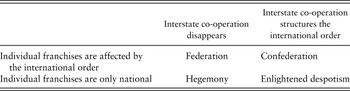
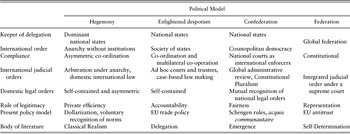
Table 1 shows how four scenarios can now be generated from the answers given to two questions: first on the role of interstate co-operation (including IGOs, etc); second on the extent to which individual franchises remain exclusively national. Table 2 summarizes these model scenarios, of which only the federation reflects a full transfer of sovereignty to a global authority. It results from the ability of political entrepreneurs to mobilize and co-ordinate a large array of interests and preferences, and then converge upon rules of global citizenship. In contrast, in a hegemonic world, individual rights would remain grounded exclusively in national delegation compacts, and binding rules of interstate co-ordination would be expressly rejected. By way of comparison, enlightened despotism is characterized by a more rationalized, self-correcting, hence effective structure of interstate co-operation. Lastly, a confederation would see a large opening of national legal orders, so that private rights would be mutually recognized and enforced across borders, although without being unified.
Four global scenarios

Four ideal types of international order

These models are ideal types in that they formalize a limited set of significant variables and relationships. As such, they do not correspond to discrete classes of observable empirical experiences: patterns characteristic of different types may coexist in reality, as, for example, in the present-day EU. Furthermore, we are deliberately non-committal regarding the dynamics of actual regimes: political orders evolve in an open-ended and historically indeterminate way, where intentionality is bounded by collective action problems and by the structure of existing delegations.
Scenarios for the emergence of a future world order
The hegemony
What happens if entrenched national elites do not promote efficiency and fail to accommodate equity-driven demands for political reform? Or if states are unable to enter constructive strategies of international reordering? The answer is that the base – traders and citizens – will take the lead. And the easiest road is then to converge individually toward a more satisfactory regulatory order. In other words, people would opt out of their domestic order and place themselves under the protection of a more efficient sovereign. Emigration and diaspora are standard examples; others include fiscal evasion, capital flight, and education in foreign colleges. Alternatively, however, agents might lobby their home authorities to adjust local norms and rules to a benchmark model so that co-ordination becomes easier and transaction costs smaller. For instance, ‘dollarization’ allows for both the decentralized, spontaneous approach and the official, formal one. Another example is the worldwide adoption of European norms for the environment and consumer security.
Since this scenario is driven by the capacity of individuals to raise credible threats of exit, institution building and collective action face considerable obstacles. For one, the ‘supply’ of rules comes from a primus inter pares state whose regulations are voluntarily adopted by outsiders without any discussion or bargaining. Delegation to the hegemonic state occurs de facto rather than de jure; it is typically informal and gradual rather than explicit and democratically agreed upon. It also raises immediate problems concerning safeguards: foreign citizens are not represented in the checks and balances or in the policy-making system of the hegemony, although they may still prefer such ‘junior’ citizenship to what their own national state offers.
One variant of this scenario may see economic and political elites opting out of a given country en masse, thereby compromising the state’s capacity to support efficient bureaucracies, a working legal order, and economic growth. This trajectory might converge asymptotically toward a world order in which a few hegemonies are surrounded by failed states. In this case, inequality in rights and in access to international public goods would be maximized across nations while the overall capacity to agree on the production of common goods would be minimized. International protectorates or notions of ‘shared sovereignty’ would be markers of such trends (Krasner Reference Krasner2004) and, as argued by Hobbes, state coalitions would primarily aim to maintain their advantage over other coalitions.
Still, the hegemonic model may also be consistent with a progressive convergence of national polities toward liberal principles, albeit with limited institutionalization of interstate relations. The conventional representation of the nineteenth-century European Concert of Nations is a good example: national governments defended a compact definition of sovereignty, domestic rules were little constrained by interstate relations, asymmetries of power were played out in the open, and dispute resolution typically followed the nonbinding rules of ‘arbitration under anarchy’ (which address only co-ordination problems, not problems of co-operation).Footnote 14 The Concert was also consistent with wide disparities regarding the character of domestic delegations contracts: there was indeed no question that Russian despotism, German militarism, and the successive political experiments in France in some way limited the capacity of the respective governments to join in. Still, governments supported extended economic exchanges and the free circulation of people, so that economic competition and emulation could bring about substantial formal convergence: ‘norm cascades’ for instance can be part of such international order (Finnemore and Sikkin Reference Finnemore and Sikkin1998).
Compared with the hegemonic model, the three next scenarios are more supportive of global integration and imply a much more consistent integration in matters of rights, norms, and the structure of legal orders.Footnote 15 Whereas the hegemonic scenario corresponds, in the literature, to classical realism, which has not much to say about ‘global governance’, the next three respond to the three analytical currents that were identified in the literature review: delegation, emergence, and self-determination.
Enlightened despotism
Under a scenario of enlightened despotism, the national governing elites succeed in maintaining their control over the international regulatory architecture while meeting many of the demands of private agents through a fairly rationalized, stable set of IGOs and treaties. Specifically, two patterns would come to the fore.
First, an enlightened despotic scenario would feature a rebalancing of international delegation from the classical multilateral model founded on agency to an increased reliance upon trustees. As defined by Alter (Reference Alter and Hawkins2006, Reference Alter2008),Footnote 16 trustees receive a mandate to regulate a well-delineated set of relations; they are not under direct and explicit control as agents would be under a principal. Trustees are typically chosen for their personal competence and professional authority, placed under specific rules of accountability, and expected to act on the basis of their personal judgment in an independent, apolitical manner. Examples include central bankers, judges, and representatives of epistemic communities. As a consequence of their mandate, trustees will also advertise their dissents with the politicians who nominated them because doing so increases trustee credibility. A traditional agent does not behave in this way. This is actually one of the easiest signals, which helps in separating them.
Indeed, the most remarkable shift vis-à-vis the traditional principal–agent framework is that a trustee does not serve the interests of those who chose her but rather the interests of third parties, those who are at the receiving end of monetary policy or dispute resolution, for example. She therefore constitutes a collective interest in the service she delivers and also delineates ‘a public’, who may become interested in entering a specific discursive interaction with her. Thus may emerge an embryonic notion of parallel delegation to this supranational entity – or, say, some form of recognition or implicit confirmation by third parties. In an admittedly fragmented way, a public–private rule of interaction may then take shape between regulator and the emerging public.
This trend is consonant more generally with the second main pattern of the Enlightened Despotic scenario: the increasing capacity of international organizations to evolve, self-adjust, and resolve bilateral disputes – for example, via developing international administrative law, formal rules of review to monitor state compliance, peer pressure, and so forth. The mutual recognition and quotation of decisions rendered in different organizations typically help them co-ordinate on stable though informal rules of interaction. In such an environment, the concepts of tipping points, co-ordination focus and generic expertise accumulated in organizations have their greatest influence (Barnett and Finnemore Reference Barnett and Finnemore2004; Reinalda and Verbeek Reference Reinalda and Verbeek1998, Reference Reinalda and Verbeek2004).
Yet compliance is never fully guaranteed, and governments may always opt in and out of arrangements depending on their short-term cost–benefit trade-offs. This pattern is of critical importance on the frontier of international policy-making – where rules and regulatory trade-offs are not settled and stalemate is a constant threat. The World Trade Organization is a straightforward example: thanks to the dispute settlement mechanism, past settlements are generally enforced and adjustable at the margins; however, any extension of free trade to new domains immediately brings out the ‘realist’ interaction of national interests (as occurs when the liberalization of services or agricultural trade is proposed).
Finally, public opinion and international civic organizations remain outside the conference buildings. Intergovernmental organizations may hold press conferences, maintain rich websites, and meet with representatives of associations, but in no case do these outsiders actually participate in formal decision-making. Hence these more competent and better co-ordinated IGOs would not help in establishing an integrated ‘international public domain’, or a corresponding international civil society in either the liberal or Gramscian sense. More generally, this evolution would support international policy-making and offer a more supportive environment to agents, though without affecting their core individual rights – they would indeed remain anchored in national delegation compacts.
These limits beyond which this scenario would not extend signal in fact the main political counterparty to the broad participation of most states in these agreements and assemblies, howsoever despotic their character. The Chinese and Russian governments, to mention just two examples, are not much concerned with the demands of (mostly Western) civic militants; but they would not admit that their own citizens may leverage internationally agreed-upon rules or rights on their domestic scene – specifically, the political one. For this reason, most despotic states, which are often willing to abide by common regulatory norms in the economic field, nevertheless maintain a strong hold on just how enlightened the contemporary neo-despotic international order may become. This level of control is ultimately reflected in the rather narrow legitimacy principle that underpins this scenario – namely, accountability.
The confederation
The confederation represents the most direct evolution into a more settled, intergovernmental regime, although it would require that individual rights are substantially though indirectly affected.
The first main feature of a confederation is the increased opening of national legal orders – that is, the mutual recognition of private rights and court judgments. Although states remain the ultimate guarantors of their respective legal orders, they also recognize the rules of justice applied by others and enforce them with minimal scrutiny (Paul Reference Paul2008; Slaughter Reference Slaughter1998; Teitz Reference Teitz2005). The demand, and therefore the private interest for such evolution are not new: protections granted to foreign merchants are as old as long-distance trade. Today, this trend, whether evidenced in Europe or beyond, is visibly constrained by adhesion of member states to a stronger concept of a community of rights and rule of law between private agents.Footnote 17 Citizens should acknowledge and accept that they could be directly affected by court judgments made abroad and under a legal order that differs from their own. This would be the condition for much easier transactions across borders. This view corresponds in a sense to the Constitutional Pluralism perspective, where national and European courts compete one against the other in the framework of a shared recognition of common judicial principles and of the essence of fundamental individual rights.
Second, IGOs in charge of producing the most important public goods (e.g., climate, trade, food security, health) increasingly take a constitutionalized form. In particular, the definition, adjudication, and enforcement of norms (i.e., the three Montesquieu powers) tend to be delegated to separate but mutually controlled bodies (Stone Sweet Reference Stone Sweet1994, Reference Stone Sweet2009). This institutional architecture is thus more comprehensive than that of the previous cases, which were characterized by straightforward agency and trusteeship. In this case, the division of authority and the procedural safeguards are much more sophisticated and binding: governments want to have more guarantees from IGOs, although these mechanisms protect as well private interests against abuse.
Quite clearly, these two patterns imply stronger mutual guarantees than in the previous ideal types regarding compliance, formal integration, and especially private rights. Hence the potential impact on the international division of labour is substantial, although ultimate delegation of sovereignty and definition of basic rights remain at the national level. Indeed, the confederative model is a project driven by the elites, and because citizen consent is solicited ex post rather than ex ante, decision makers can easily design arrangements that accommodate their vested interests. That said, extended delegation by government to IGOs might be understood as a first step toward interlinking and also as a substantial reduction of vetoing capabilities.
The federation
If the elites fail to establish an enlightened despotic regime or an elite-protecting confederation, then citizens and traders may take the initiative. At this point, if they reject the go-it-alone option of exit, then they might attempt to gain direct control of the global public sphere and to negotiate a new sovereign delegation. Unlike the previous scenarios, in which advocates for change mainly targeted transaction costs, in a federal scenario any concerns about efficiency or profits would be subsumed by the more universal principles of common good and equal rights. This outcome could lead to a citizen uprising, where affirmation of the principles of equality and liberty galvanizes action and leads to the tearing down of an unjust and inefficient order.
Given the resulting federation would include all individuals, its main feature would be its universal egalitarian character: basic rights of citizenships, property rights, and open access would be globally established so that all levels of governments (municipal, provincial, national) would have to abide by them. As a result, no legal or jurisdictional obstacles would remain to hinder the free circulation of individuals, social movements, ideas, or property. Enfranchisement – and thus the capacity to contest economic competitors and rulers – would then be maximal. Social and economic exchange could extend within a single civil realm; in this event, the present-day anarchic international order would be abolished, as it would within any nations that would adhere to such a federation.
The second remarkable feature of this scenario is its disentanglement of bureaucracies and the legal order; and hence the end of states as historically contingent entities. Indeed, a world federal order need not merge national states into some ‘global state’; it would more likely signal the emergence of an original and more promising political order.Footnote 18 On the one hand, the hierarchy of norms would be established globally, so that the realm of civic and economic action would be at last fully unified. On the other hand, this global jurisdiction would be instrumental in reallocating the provision of public goods among levels of government; equal rights also reduce transaction costs among individuals as between bureaucracies. Therefore, collective preferences and efficiency concerns (economies of scope and scale) would at last structure the division of labour among them: considerable political decentralization may (or may not) eventually be observed, as national states would lose their stranglehold on a mass of public policies.Footnote 19 For instance, social security systems may properly remain associated with national communities whereas monetary policy might be structured in terms of optimal currency areas, and local jurisdictions would likewise apply to groundwater basins and school management.Footnote 20
The overall result is that the trusteeship of rights would be global and unified, whereas bargaining on public goods with governments would be distributed among different levels of political ordering. Depending upon the extent of their respective delegation, local governments would establish their legitimacy on four principles of increasing importance: efficiency, accountability, fairness, and representation; with the last being required for taxation. Finally, citizenship would no longer be concentrated in a single constitutional delegation. Equal basic rights would indeed establish the notion of a shared global citizenship. But solidarity and the government of local commonalities may also perpetuate a sense of affiliation or allegiance.
Conclusion
This article proposes a framework for analysing the long-term evolution of political and economic orders in terms of delegation received from or withdrawn by individual agents. Empowerment and enfranchisement derives from what and how agents agree to delegate to potential rulers, hence by their capacity to negotiate binding agreements with them. This agent-based, incentive-compatible approach then shapes a core interaction between the ongoing, long-run bargain on rights and the dynamics of the social division of labour – say, organizations and markets. The distribution of rights (i.e., their being more or less equally distributed among individuals and integrated in a common hierarchy of norms) then helps to account for different long-term patterns of development in both the global polity and the global economy.
Today, however, many agents have obtained a huge individual franchise that allows them to trade and organize far beyond the borders of their native state. The consequence is that governments are not only challenged domestically. It has also become more and more difficult for them to address the new interests and preferences that emerge from this sprawling, international division of labour. The international scene is also badly managed, its normative infrastructure is fractured, and the distribution of individual rights is hugely unequal. These facts justify its characterization as neo-despotic as well as its potential for contestation, reform, or rebuilding. From this account, we derive four long-term scenarios of political reordering, one of which (the ‘federal’ scenario) would entail disappearance of the classical nation state built on the conjunction of a legal order and a government bureaucracy.
However, two broad questions have not been addressed even though they clearly hang over this discussion. First, we modestly and parsimoniously concur with Rousseau and Kant, who argued that a community of states would be built by republics only. To put it another way, integration would not be built on violence, but only as a merger of equals, among liberals. This does not preclude that despotic powers may collude at the regional level. They may then socialize constructively and negotiate for instance trade agreements among them. The point is that these would remain inter-state projects that would not be expected to affect the (narrow) rights of the respective populations. Certainly the benefits of globalization would be partially lost, but this might well deliver a potentially stable equilibrium in which several regional hegemonies, of a more or less liberal character, would be engaged in a renewed balance of powers.
The second question is suggested by the international financial crisis that began in 2007. A mass of private agents had been endowed with exceptionally large rights to invest and speculate worldwide. They then accumulated globally unsustainable stocks of financial assets whose collapse called for massive intervention by national regulators: lenders of last resort, bankruptcy courts, and national budgets. These events indicate that the time lag between an expanding, private-led division of labour and the slow-moving process of international political reordering may not be manageable. Markets, in other words, would be doomed to overextend, and then retrench without ever allowing for supportive global rules and policies to be put in place. Cycles of great reversals would dominate, although within inherited boundaries of local constitutional bargains (Polanyi, Reference Polanyi1944; Rajan and Zingales, Reference Rajan and Zingales2004).
In both cases, the issue at stake is clearly the sustainability of the great movement of liberalization inaugurated in the late eighteenth century, and boosted in the last decades of the twentieth century. Indeed our analysis highlights why the most powerful forms of global governance would come with the generalization of a liberal order at the international level. This is the condition for an equality in rights among citizens and for an efficient provision of public goods, while the latter might be very flexibly organized given the actual nature of each of these goods. It does not conclude, however, that the potential of this extended liberalization would actually be fully realized. Both drivers and inhibitors coexist.
Acknowledgements
This paper draws from two earlier working papers, entitled ‘Will the World Be Ever Governed? The Dynamics of a Global Constitutionalization Process’ and ‘Constitutions, State and Development’, that were discussed in various working groups. This version (and previous ones) benefited from the comments of Louis Bélanger, Ariel Colonomos Mike Dowdles, Pierre Hassner, John Nye and John Wallis. Anonymous referees also provided useful recommendations. We are indebted to these colleagues, though the usual caveat applies.