Emergency responders play a critical role in protecting people and property in the event of fires, natural disasters, industrial events, medical emergencies, terrorist and other criminal acts, and numerous other emergencies. They face significant risk for injury or death during emergency operations. One analysis of responders showed that career firefighters and law enforcement officers experienced injuries that required emergency department visits at rates 2-3 times higher than the general US labor force, but that emergency medical services (EMS) personnel and volunteer firefighters had injury rates more comparable to the general worker experience.Reference Reichard and Jackson 1 That analysis did not separate out people injured while responding to chemical incidents. The Agency for Toxic Substances and Disease Registry (ATSDR) has maintained surveillance systems since 1990 to track acute chemical incidents and associated injuries and deaths occurring in participating states. Surveillance data describing the incidents and the injured people, including first responders, are analyzed to develop prevention strategies. Our objective was to examine recent surveillance data from chemical incidents in which responders were injured, to develop insights that could help those endeavoring to prevent or reduce future injuries during these incidents.
METHODS
Data Sources
Data for 2002-2009 came from ATSDR’s Hazardous Substances Emergency Events Surveillance (HSEES) program. Over the years, 16 states contributed data to HSEES. These include Alabama, Colorado, Florida, Iowa, Louisiana, Michigan, Minnesota, Mississippi, New Jersey, New York, North Carolina, Oregon, Texas, Utah, Washington, and Wisconsin. Missouri also participated, but was excluded from our analysis because of miscoding of injured responders. Data for 2010-2012 were obtained from ATSDR’s National Toxic Substance Incidents Program (NTSIP), which is modeled after HSEES, but with some modifications. In all, 7 states contributed data to NTSIP: Louisiana, New York, North Carolina, Oregon, Tennessee, Wisconsin, and Utah. 2 For both programs, state health departments gathered incident information from 2 main federal data sources: the U.S. Department of Transportation’s Hazardous Material Incident Reporting System and the U.S. Coast Guard’s National Response Center. Other sources included state agencies, county health departments, media outlets, and emergency response personnel. 2
Under the HSEES system, an event (also referred to as incident) is the acute release or threatened release of at least 1 hazardous substance. A hazardous substance includes any substance which might reasonably be expected to cause adverse health outcomes. To be classified as an event, the amount of substance released must require cleanup by federal, state, or local laws, and a threatened release must result in actions (such as evacuation) to protect public health. Incidents involving petroleum only were excluded according to ATSDR authorizing legislation. Incidents involving petroleum released with a qualifying toxic substance were included.
An NTSIP incident is the uncontrolled or illegal acute release of any toxic (hazardous) substance in a set amount (usually 10 pounds or 1 gallon) or of any amount of material categorized as an extremely hazardous substance. 2 NTSIP includes incidents involving petroleum as the only substance released if a public health action is involved, such as evacuation, decontamination, or an injury; however, it excludes all threatened releases, incidents that occur in a residence that do not include a public health action, and smokestack or flare incidents that do not include a public health action or injury.
For the HSEES and NTSIP systems, a release is defined as acute if it lasts for less than 72 hours. A substance is considered hazardous if it can, based on current science or scientific studies, be reasonably expected to cause an adverse human health effect. For both systems, house fires with no abnormal amount of stored hazardous substances before the fire were excluded.
An injured person is someone who experienced at least 1 documented acute (occurring in less than 24 hours) adverse health effect or who died as a consequence of the incident. Injured people must have had at least 1 injury type or symptom related to the incident to be listed. 3 The data do not differentiate between injuries caused by the exposure to a hazardous substance and other injuries that occurred during the incident itself. In some instances, we know whether a burn is chemical or thermal and if trauma is chemical-related or not.
State health departments documented and recorded information on the time, circumstances, and place of the incidents. They also included information on the substances released, people affected (including responders), and public health actions taken. All data were entered into ATSDR’s standardized online questionnaire form, from which they were then cleaned and analyzed.
Analyses
No IRB approval was obtained for this analysis because no identifiable human subject data were used. Responders were classified as non-specified responder, career firefighter, volunteer firefighter, firefighter of unknown type, police officer, EMS, or company emergency response team (CERT) member. This classification is the function they were performing when injured at the incident scene. We excluded 42 people whom we could not identify as responders, general public, employees, or students. We plotted the annual percentages for all incidents that had injured people, all incidents that had injured responders, and percentage of injured people who were injured responders. The slope of the trend line and a coefficient of determination (R 2 goodness of fit) were generated.
We used SAS 9.4 (Cary Institute, North Carolina) for calculating frequency distributions on incidents that had injured responders. We used the following variables: fixed facility or transportation related, chemical substance name, chemical release type (up to 2 types per chemical, covering 5 release types), primary (root) contributing factors of incidents (6 categories), specific descriptive information on primary contributing factors (30 categories), injury types (up to 7 selections of 11 injury types), injury severity (8 categories), and personal protective equipment (PPE) use (none or a choice of 7 types). We stratified data on primary contributing factors, injuries, and PPE use by responder group. We examined associations between injuries and PPE use and between injuries and type of chemical released. P-values for differences in percentages were calculated at the 0.05 significance level.
RESULTS
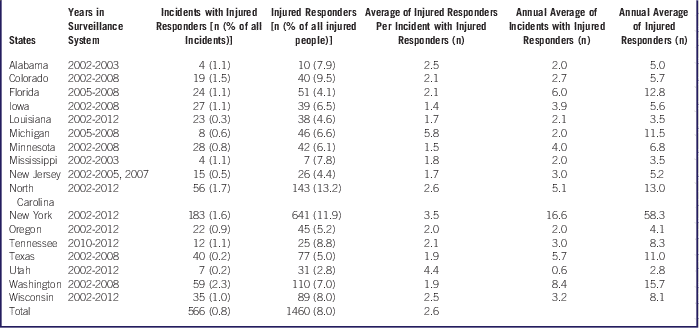
A total of 67,909 qualifying HSEES and NTSIP incidents were recorded by participating states during 2002-2012. For each participating state, Table 1 shows the years they participated in the surveillance programs, the total number of incidents with injured responders, and the total number of injured responders. It also shows the average number of injured responders per incident, annual average of incidents with injured responders, and annual average of injured responders.
Frequencies of Incidents with Injured Responders, Number of Injured Responders, Average Injured Responders Per Incident, Annual Average of Incidents with Injured Responders, and Annual Average of Injured Responders, by State, 2002-2012

Of the 67,909 total qualifying incidents, 566 (0.8%) resulted in injured responders. Most incidents with injured responders (83.4%) occurred at a fixed facility, and 16.6% occurred during transportation. Responders (1460) made up 8.0% of the total 18,255 injured people in all incidents. Washington State had the highest percentage of incidents with injured responders (2.3%), followed by North Carolina (1.7%) and New York (1.6%). The annual average number of incidents with injured responders was highest in New York (16.6), followed by Washington (8.4) and Florida (6.0). The annual average number of injured responders from these incidents was highest in New York (58.3), followed by Washington (15.7) and North Carolina (13.0), and lowest in Utah (2.8). Michigan had the highest number of injured responders per incident (5.8), followed by Utah (4.4) and New York (3.5). Of all of the injured individuals (general public, employee, responder, or student) in all incidents, 13% in North Carolina were first responders, followed by 11.9% in New York, and 9.5% in Colorado (Table 1).
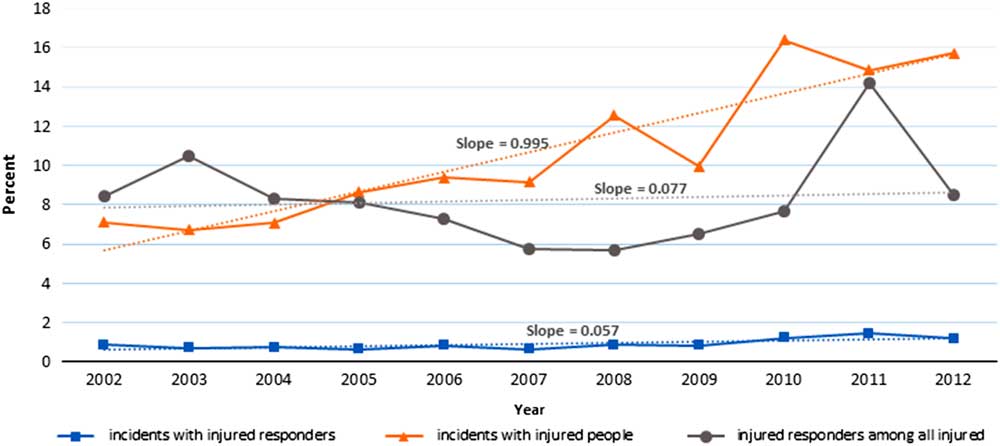
For this period, we saw no linear trend in the percentage of incidents with injured responders or the percentage of injured responders among all injured (R 2=0.49 and 0.01, respectively), even though the percentage of incidents with injured people rose (slope 0.995, R 2=0.85) (Figure 1).
Percentage of Incidents with Injured Responders, with Injured People, and Injured Responders Among All Injured, by Year, 2002-2012.

Firefighters of all types comprised 63.3% of all injured responders (33.1% career, 14.4% volunteer, and 15.8% unspecified type), followed by police officers (26.9%). Fewer EMS (3.8%), CERT (1.4%), and non-specified responders (4.7%) were injured. Of the 566 incidents with injured responders, there could be multiple responder groups at the scene. Although the data on the groups present were collected, the number of individuals from each group was not. The frequency order of the types of responder groups at the scene is the same as the types of responders injured: fire departments responded to 78.2% of the 566 incidents, law enforcement to 68.0%, EMS to 56.0%, HazMat teams (which are often part of the fire department) to 42.6%, and company response teams to 17.7%.
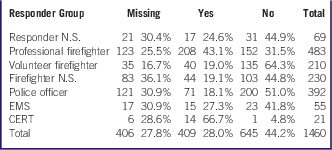
Injured responders were statistically less likely to have received HazMat training than to have received it (409/645, P<0.0001). The certification status of 405 responders (27.7%) was unknown. CERTs (66.7%) and professional firefighters (43.1%) were significantly more likely to have received HazMat training than police officers (18.1%) and volunteer firefighters (19.0%) (P<0.00001) (Table 2).
Certified HazMat Technician Training by Responder Group, 2002-2012.

Abbreviations: N.S., type not specified; EMS, emergency medical services; CERT, company emergency response team.
Injury Type and Severity
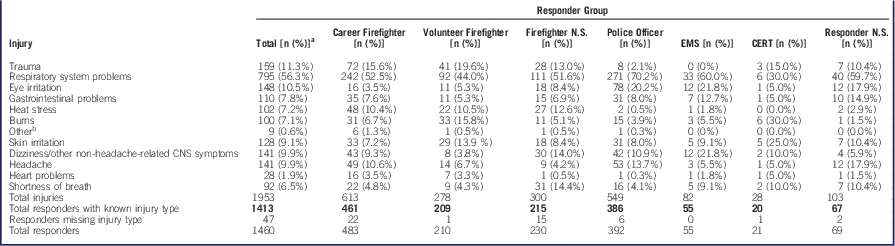
Respiratory system problems were by far the most commonly reported injury category among all responders (56.3%), followed by chemical- or non-chemical-related trauma (11.3%), eye irritation (10.5%), headache (9.9%), and dizziness or other non-headache-related central nervous system symptoms (9.9%). When injury types were stratified by responder group, we saw some notable differences. Firefighters had a significantly higher percentage of trauma than other responders (P<0.0001). Police officers had a higher percentage of respiratory system problems (70.2%) (P<0.0001). EMS personnel had a higher percentage of eye irritation (21.8%) (P<0.0035) (Table 3).
Injury Types Stratified by Responder Group, 2002-2012.

Abbreviations: CNS, central nervous system; EMS, emergency medical services; CERT, company emergency response team; N.S., type not specified.
a Percentages were calculated by column using total responders with known injury type as the denominator. Column totals are greater than 100.0% because responders could have multiple (up to 7) injuries listed.
b Other includes: hypertension, chest pain, low glucose, high blood pressure, and allergies.
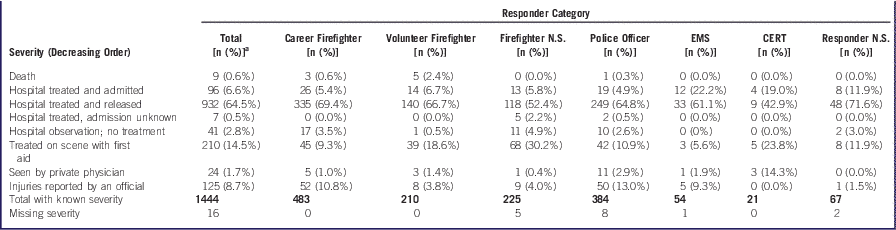
Among all the responders with known severity of injuries, 71.7% had injuries severe enough to require hospital treatment (admitted, treated and released, or admission status unknown) (Table 4). A significantly higher percentage of EMS (22.2%) and CERT members (19.0%) were injured severely enough to require admission to a hospital or to result in death than were other responders (P<0.0001 and P<0.0446, respectively) (Table 4).
Distribution of Severity of Injury Among Responders, 2002-2012.

Abbreviations: EMS, emergency medical services; CERT, company emergency response team; N.S., type not specified
a Percentages were calculated by column using the total number of injured responders with known severity as the denominator.
Personal Protective Equipment
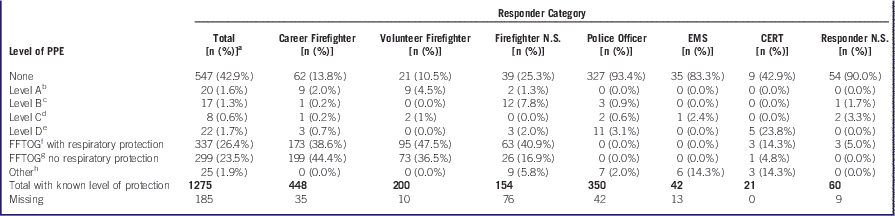
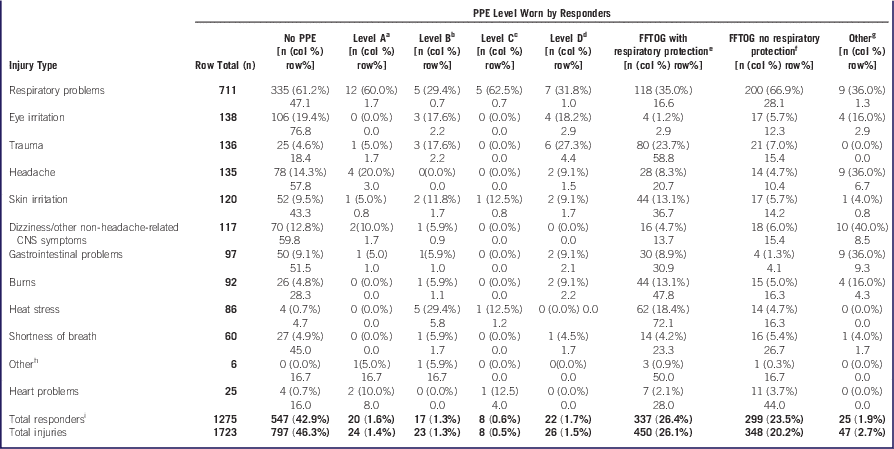
Overall, 57.1% of all injured responders with a known level of protection wore some form of PPE and 42.9% wore no PPE. The level of protection for 185 responders was unknown (Table 5). Equipment offering the highest levels of protection against hazardous materials (levels A, B, and C) was worn by only a small percentage of injured responders. Injured career firefighters who used PPE mainly wore firefighter turnout gear (FFTOG) (83%). Among these career firefighters, 173 out of 483 were using respiratory protection as part of the ensemble. For injured volunteer firefighters who wore PPE, 84% wore FFTOG. Respiratory protection was being used by 95 of the 210 injured volunteers wearing FFTOG. Most injured police officers (93.4%), non-specified responders (90.0%), and EMS personnel (83.3%) wore no PPE. For all responders who wore no PPE, respiratory system problems was the top injury category at 61.2% (Table 6). Responders who wore “Other” PPE types also reported a high percentage of respiratory problems (36%). For those responders wearing FFTOG, respiratory system problems were significantly higher in those wearing the gear without respiratory protection (66.9%) versus those wearing it with respiratory protection (35.0%, P<0.0001). Some injury types were found to occur most often among responders wearing FFTOG, including heat stress (88.4%), heart problems (72%), and trauma (74.3%). Heat stress was significantly higher in those wearing FFTOG with respiratory protection (18.4%) than those wearing FFTOG without respiratory protection (4.7%, P<0.0001).
Distribution of Personal Protective Equipment (PPE) Use by Emergency Responder Category, 2002-2012.

Abbreviations: EMS, emergency medical services; CERT, company emergency response team; N.S., type not specified.
a Percentages were calculated by column using the number of injured responders with known level of protection in that column as the denominator.
b Level A: when greatest level of protection for skin, respiratory, and eye protection is required. Includes positive-pressure full-face-piece self-contained breathing apparatus (SCBA), chemical-protective suit, gloves, boots, and disposable protective suit.
c Level B: when the highest level of respiratory protection is necessary but a lower level of skin protection is needed. Includes much of the same equipment as Level A.
d Level C: when the concentration and type of airborne substance is known. Includes respirator masks, air purifying respirators, hooded chemical-resistant clothing, and gloves.
e Level D: when minimal protection is needed. Includes a work uniform used for nuisance contamination only (coveralls, gloves, and boots).
f FFTOG (firefighter turnout gear) consists of a combination of helmet, trousers with an overall strap attached, boots, and a heavy jacket. Respiratory protection is often a SCBA, but may be of other types, depending on the situation.
g FFTOG without respiratory protection is the same as above, except that no respiratory protection being used.
h May include a hard hat, gloves, or steel-toe boots.
Distribution of Injuries Among Emergency Responders, by Level of Personal Protective Equipment (PPE) Used, 2002-2012.

Abbreviation: CNS, central nervous system.
a Level A: when greatest level of protection for skin, respiratory, and eye protection is required. Includes positive-pressure full-face-piece self-contained breathing apparatus (SCBA), chemical-protective suit, gloves, boots, and disposable protective suit.
b Level B: when highest level of respiratory protection is necessary but a lower level of skin protection is needed. Includes much of the same equipment as Level A.
c Level C: when concentration and type of airborne substance is known. Includes respirator masks, air purifying respirators, hooded chemical-resistant clothing, and gloves.
d Level D: when minimal protection is needed. Includes a work uniform used for nuisance contamination only (coveralls, gloves, and boots).
e FFTOG consists of a combination of a helmet, trousers with an overall strap attached, boots, and a heavy jacket. Respiratory protection is often a SCBA, but may be of other types, depending on the situation.
f FFTOG without respiratory protection is the same as above, except for no respiratory protection being used.
g May include a hard hat, gloves, or steel-toe boots.
h Other injury types included hypertension, chest pain, low glucose, high blood pressure, and allergy.
i PPE level was unknown for 230 types of injuries in 185 responders. Column percentages were calculated using the number of injured responders with a known type of injury. This number may be less than the total number of injuries, because each responder may have up to 7 injuries. Row percentage was calculated using the number of injured responders with known level of PPE used.
A total of 9 responders died; 5 of them were wearing FFTOG with respiratory protection and 4 were wearing none. Of the 5 with FFTOG with respiratory protection, 3 had trauma along with thermal and chemical burns and 2 had respiratory and heart problems. The 4 responders who did not wear PPE had central nervous system (CNS), heart, or respiratory system symptoms.
Chemical Information
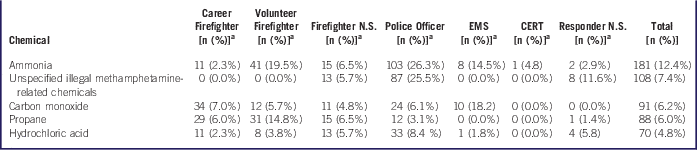
In the 566 incidents in which first responders were injured, 1169 substances were released. The majority of substances were chemicals, and very few (n=10) were pharmaceuticals used mostly for illegal drug manufacture. The chemicals associated with the most injured responders were extremely hazardous: ammonia (12.4%); unspecified, illegal, methamphetamine (meth)-related chemicals (7.4%); carbon monoxide (6.2%); propane (6.0%); and hydrochloric acid (4.8%) (Table 7). Particularly, injured volunteer firefighters were mostly associated with ammonia (19.5%) and propane-related (14.8%) incidents. Also, police officers were mostly associated with incidents involving ammonia, which could be related to thefts or other releases related to meth production (26.3%) and unspecified, illegal meth-related chemicals (25.5%).
Top 5 Chemicals Associated with Injured Emergency Responders, by Responder Group, 2002-2012.

Abbreviations: EMS, emergency medical services; CERT, company emergency response team; N.S., type not specified.
a Proportion of responders in each group to a particular chemical in relation to the total number of responders in that group.
Contributing Factors
For the 566 incidents with injured responders, human error (a mistake made by a person) was the most frequently reported primary contributing factor to the incident (36.7%), followed closely by intentional or illegal acts (34.1%). Equipment failure (a failure of process or storage vessels, valves, pipes, pumps, or other equipment) was the primary contributing factor in 25.1% of incidents with injured responders. Bad weather conditions or natural disasters (1.9%) and other factors (1.2%) were less frequently cited. The primary contributing factor for 45 (8.6%) incidents that involved injured responders was missing. Human error (45.3%) and equipment failure (36.8%) were the most frequent primary contributing factors for incidents with injured firefighters. Fires (42.2%) and explosions (16.6%) were most often specified as the primary contributing factors. An intentional or illegal act (61.9%) was the most frequent primary contributing factor for incidents with injured police officers. Illicit drug production (45.5%) was most commonly specified for police officer primary contributing factors.
DISCUSSION
The ATSDR surveillance systems collect information from many sources that can be used to protect populations from harm caused by toxic substance releases. The information provides a unique contribution to the existing knowledge on emergency responder health that federal and state agencies can use to find ways to reduce emergency responder injuries and improve their health. Unfortunately, surveillance data do not specifically collect details of how and why these injuries occurred.
The U.S. Chemical Safety Board conducts in-depth investigations of chemical incidents in which people are seriously injured. It investigated the April 17, 2013, fire and subsequent explosion of ammonium nitrate fertilizer at the West Fertilizer Company in West, Texas. A total of 9 volunteer firefighters and 1 career firefighter died in that incident. The investigators identified many gaps in responder safety. The county’s local emergency planning committee (LEPC) did not have an emergency response plan for the West Fertilizer Company. Had it been aware of the potential risks, the LEPC might have prepared a plan in accordance with the federal Emergency Planning and Community Right-to-Know Act (EPCRA). 4 Volunteer firefighters were not required to attend HazMat training, and apparently were unaware of the explosion hazard. They were caught in harm’s way when the blast occurred. 5
Causal Factors and Chemicals
From our analysis, we found that firefighters were the group most frequently injured. Most of the incidents with firefighter injuries were caused by human error or equipment failure that mainly resulted in fires and explosions. Police officers, the second most frequently injured group, were typically injured during incidents related to intentional or illegal acts, particularly during the operation of illegal drug labs. The most prevalent injury to police officers and EMS responders was respiratory irritation. Not surprisingly, the chemicals associated with this type of injury are serious respiratory hazards: ammonia; unspecified, illegal meth-related chemicals; and carbon monoxide. These chemicals can also be associated with the top causal factors (ammonia and chemicals used in illegal meth labs, and carbon monoxide with fires and explosions).
PPE and Training
Various Occupational Safety and Health Administration (OSHA) standards have been enacted to protect responders from chemical release-related injuries. These include standards specific to fire brigades, 6 respiratory protection, 7 and hazardous waste operations and emergency response (HAZWOPER). 8 CERTs are covered by these federal standards, but state and local fire departments or rescue agency employees are not directly subject to these federal regulations. Some states have their own OSHA, which must have the same or stricter regulations than the federal OSHA, and may decide to cover them. To protect public sector employees not covered by federal or state OSHA, specifically including volunteers engaged in emergency response, the U.S. Environmental Protection Agency (EPA) promulgated an identical HAZWOPER standard. 9 Theoretically, all responders should be covered by one of the HAZWOPER standards that cover emergency response planning, training, and medical surveillance. This does not appear to be the case because, in our analysis, volunteer firefighters were less likely to have training as HazMat technicians despite being present at an incident with a hazardous substance. This was also the case in the West incident.
OSHA/EPA designates the levels of PPE as A-D, with level A being the most protective and D the least. OSHA warns that the whole ensemble must take several factors into consideration, such as potential for heat stress. 10 In our study, very few injured responders were wearing levels A, B, or C HazMat gear. Level D is a basic work uniform that does not protect against chemical exposure. A pair of coveralls, or another work-type garment, along with chemical-resistant footwear with steel toes and shanks are all that is required to qualify as level D protection. Most FFTOG is considered to be level D. The majority of injured firefighters in our analysis were wearing just this basic FFTOG despite a chemical being involved.
The National Institute for Occupational Safety and Health (NIOSH) certifies respiratory protection. Respirator selection logic should be based on a given situation and properties of the contaminant, and on the limitations of each class of respirator. OSHA has a web-based, respiratory selection “e-tool” to help with these decisions. 11
Fires produce a complex mixture of chemicals, dependent on various factors. When working around active fires, firefighters should wear a self-contained breathing apparatus (SCBA). When working around fires is mission-critical, and SCBA are either unavailable or their use is incompatible with the mission at hand, then the scene should not be entered. 11 Firefighters can consult the U.S. Department of Transportation’s Emergency Response Guidebook to determine safe standoff distances and protective actions to take while waiting for responders with proper protective gear to enter. 12
Our findings indicate that wearing FFTOG with respiratory protection (versus FFTOG without respiratory protection) during fires and explosions does improve the respiratory outcome. Even so, firefighters who use proper respiratory protection during the main fire frequently discontinue use during the secondary phase when they search for possible sources of reignition;Reference Burgess, Nanson and Bolstad-Johnson 13 however, this secondary phase also carries risks for exposure-related adverse respiratory effects.Reference Burgess, Nanson and Bolstad-Johnson 13 In interviews with firefighters carried out in New York, it was found that some firefighters thought respirators hampered communication and that they were unnecessary after visible flames had been put out.Reference Welles, Wilburn and Ehrlich 14 Some studies have found that respiratory exposures in firefighters can lead to long-term health effects, such as those that occurred among responders after the World Trade Center disaster. 15 Given these findings, one option to reduce exposure is for firefighter training to stress the importance of keeping the respirator on until clearance for removal is given by the incident commander, site safety officer, or others in charge.
Firefighting is extremely strenuous physical work, and can be one of the most physically demanding human activities. In a 2014 NFPA study of all firefighter deaths, most were as a result of stress or overexertion. “Stress or overexertion” is a general category that includes deaths that are cardiac or cerebrovascular in nature, such as heart attacks, strokes, and conditions such as extreme climatic thermal exposure. 16 Wearing protective clothing and respirators, even at low work intensities, can cause significant and potentially dangerous thermoregulatory and cardiovascular stress.Reference White, Vercruyssen and Hodous 17 FFTOG with respiratory protection caused the most stress, followed by chemical protective clothing with SCBA, SCBA alone, and a control ensemble of light work clothing protective ensembles.Reference Willis, Castle and Sloss 18 This is consistent with our findings. Research suggests that wearing a whole-body cooling garment, with or without a ventilation system, can help reduce cardiovascular stress and the risk for heat-related injuries.Reference Coca, Roberge and Powell 19 Other cooling strategies include using reflective and wetted clothing. 20 NIOSH established the National Personal Protective Technology Laboratory (NPPTL) to advance federal research on personal protective technologies. 21 Our findings of responders wearing FFTOG accounting for most heat stress and heart-related injuries support the need for manufacturers and fire service organizations to continue to identify and test designs, interventions, and strategies directed at producing lighter or more breathable and less restrictive PPE. 22 In addition, physical fitness for duty must be stressed and incident commanders must ensure adequate on-scene resources, either through additional mutual aid or increased staffing to allow all personnel to rotate through rehabilitation after completing a given assignment.
PPE use was not common among responders other than firefighters. Among police officers, 93.4% wore no PPE at all, and only 3.1% wore minimal protection. The degree of protection offered by uniforms and available PPE varies among police departments.Reference Willis, Castle and Sloss 18 A high percentage of police officer injuries were respiratory problems (70.2%) and headaches (13.7%). In addition, 68.8% of injured police officers sought hospital treatment for their injuries. A low percentage of injured officers had training at the certified HazMat technician level. Our analysis showed that a large number of police officers were injured in illegal meth-lab-related incidents. One option for reducing the risk might be additional training to teach police officers to follow Standard Operating Procedures for Police and or EMS on how to avoid these situations, including recognizing and avoiding entering the site until after HazMat crews declare the scene to be safe.Reference Melnikova, Orr, Wu and Christensen 23 , 24 For personnel who are expected to be engaged in meth-lab investigations and seizures, the Drug Enforcement Agency (DEA) recommends the use of SCBA or an air purifying respirator, depending on the hazards at the site. DEA also offers modified 40-hour HAZWOPER training for DEA staff and state and local officials. 24
Among EMS responders, only 16.7% used PPE, and 14.3% wore minimal protection, such as gloves. EMS also had high rates of respiratory problems (60.0%) and eye irritation (21.8%). OSHA offers guidance that helps EMS employers decide the type of training and PPE needed. 25 The basic national entry-level training requirements for EMS responders 26 only introduces the topic of hazardous substances and response in a general fashion. To meet the requirement for first responder HAZWOPER training at either the awareness or the operations level, the trainer must augment with additional hazardous substance response information and tailor the training to the assigned duties. For operations level training, the length of training must meet minimum requirements. 26 NFPA Standard 473 27 identifies the levels of competence required from EMS personnel who respond to incidents involving hazardous materials or weapons of mass destruction. It specifically covers the requirements for basic and advanced life-support personnel in the prehospital setting. 27
On the basis of previous analyses of ATSDR data, a particular danger to EMS responders is people attempting suicide with dangerous chemicals. Their intent might not be immediately obvious, and EMS may rush unknowingly into a toxic environment or become exposed later through vomit,Reference Larson, Orr and Auf der Heide 28 other body fluids, or contaminated clothing, etc. In interviews, EMS personnel expressed concern regarding exposure to biological and chemical warfare agents, either through direct exposure or exposure while treating victims. EMS participants said they wanted better hazard assessment training, as well as better respiratory protection and protective clothing options to deal with these hazards.Reference Mathews, Leiss and Lyden 29
CERTs had the highest percentage of HazMat-trained members and a relatively moderate PPE use. They were less often involved in responses than were other groups, which might have contributed to the smaller number of injured CERTs (21) (Table 2); however, those injured had fairly serious injuries. About 62% of CERT responders had injuries serious enough to be treated at the hospital. Injuries included respiratory problems (30.0%), burns (30.0%), and skin irritation (25.0%) (Table 3). CERTs had a 57.1% rate of PPE use (Table 5). CERTs by regulation should have proper training and PPE related to the types of hazards present within the premises. 6 Some industry organizations have incident databases to collect, track, and share important lessons learned with project participants. This is one tactic the industry can use to help improve company responder safety.Reference LaTourrette, Peterson and Bartis 30
MONITORING PROGRAMS
Recognizing the need to protect responder safety, NIOSH developed the Emergency Responder Health Monitoring and Surveillance (ERHMS) system. The system provides guidelines for developing a monitoring system to track emergency responders over a full range of emergency settings and types, including chemicals. A critical function of ERHMS is to provide data to determine whether further responder health tracking is warranted, and, if so, the type of tracking that would be most appropriate. 31
Strengths
ATSDR’s surveillance systems capture information on acute hazardous substance release incidents and associates that with deaths and injuries. This is the opposite of case-based surveillance databases, which capture information on injured people and then try to determine associated causal circumstances. ATSDR’s surveillance systems, unlike other databases, do not screen on the basis of employment (eg, volunteer vs career, government vs private, number of days off work), severity, or venue of care. The ATSDR systems uniquely identify all injured people associated with each hazardous substance incident, providing a unique picture of associated responder injuries.
Limitations
This study is subject to several limitations. NTSIP states use a variety of available data sources and reporting procedures to complete the incident form. Aggregating data across states and across incidents should be interpreted with caution. In addition, the case definition was not the same for the 2 databases (HSEES and NTSIP) and might have caused some differences that we did not identify. These large surveillance databases were not designed specifically to study responders; therefore, detailed information was not collected, such as air monitoring results, or whether injuries occurred because PPE was damaged or incorrect for the hazard, or whether it was worn incorrectly or removed prematurely, or on their activity at the time of exposure. The data do not reflect information on responders who were on scene but were not injured, and on what they were wearing, for comparison purposes. The databases only capture acute health outcomes, but it is known that, in particular, respiratory illness might have long-term consequences. Responders might also underreport illness, or overreport PPE use if they might face a penalty for not following protocol. In addition, our data collectors may have assumed that responders were wearing their uniform (level D) when in fact they were not. It should not affect our findings because it is known that level D does not provide much protection in hazardous material incidents. Illegal incidents, such as those involving meth labs, have provided a challenge for HSEES and NTSIP as the data are difficult to capture, and therefore this may actually be a larger problem.Reference Melnikova, Orr, Wu and Christensen 23 Our data did not allow us to assess possible gaps in response planning, such as noted in the West incident. Collecting such information in future studies could provide valuable insights.
CONCLUSIONS
This analysis showed some unexpected findings, including the fact that many of the injuries likely resulted from the response itself, like firefighters becoming ill due to heat stress, and not the chemical directly. Another unexpected finding was that most police officers were not wearing PPE, and very few of them who responded to meth-lab-related incidents were HazMat technician-trained, despite meth labs being a well-known hazard. It is reassuring that responder injuries during chemical incidents are not rising in our surveillance population; however, efforts to prevent such injuries are apparently not having much of an effect. Additional study is needed to understand why these injuries continue to occur, so that emergency responders can be better protected in the future.
Disclaimer
The findings and conclusions in this report are those of the authors and do not necessarily represent the views of the Centers for Disease Control and Prevention/the Agency for Toxic Substances and Disease Registry.