Introduction
Miscellaneous benign and malignant lesions can occur at the lips, which form the border between the exterior skin of the face and the interior mucous membrane of the oral cavity. The lips are soft and mobile, and serve as the first barrier to the oral cavity, as well as aiding in the articulation of sound and speech. Because of their anatomical site, the lips are constantly exposed to various irritants such as ultraviolet light, chemicals, cold and heat, and minor trauma. These factors play a substantial role in the aetiology of some specific groups of lesions. Furthermore, manifestations of systemic diseases can appear as lip lesions. The lips are a site of presentation for benign and malignant lesions of various histopathological types because of the diversity of tissue types they comprise. In this respect, the lips, which are commonly grouped and analysed as part of the oral cavity, should be considered as a distinct anatomical site.
Knowledge of the epidemiology, distribution and aetiology of oral mucosal and lip lesions as a subset of oral pathologies is of great importance, in order to establish early diagnosis, and to promote primary prevention and prompt treatment. However, few retrospective studies have focused on benign lip lesions,Reference Osterne, Costa, Mota, Vidal Patrocínio, Alves and Soares1, Reference Ntomouchtsis, Karakinaris, Poulolpoulos, Kechagias, Kittikidou and Tsompanidou2 and the volume of literature in this area is largely composed of case reports of rare pathologies and case series.
This study aimed to describe the results of a retrospective analysis of a cohort of patients with benign lip lesions managed over the last 15 years at the Department of Otorhinolaryngology of Karadeniz Technical University School of Medicine.
Materials and methods
Data from 312 oral biopsy samples taken during the period 2000–2014 were collected from the histopathology report database. A total of 160 benign lip lesion cases were included in the study. The remaining 152 cases of malignant histopathology were excluded from the present analysis. Patient records of demographic variables, such as age, sex and occupation, and related features, such as lesion size, lesion site and recurrence state, were retrieved for all cases.
Data were analysed using the SPSS statistical software program, version 15.0 (SPSS, Chicago, Illinois, USA). The Kolmogorov–Smirnov test was used to check the age dataset for normality of distribution. Differences between groups were evaluated using the Student's t-test, one-way analysis of variance and Tamhane's post hoc tests. The study protocol was approved by the Committee of Ethics of Karadeniz Technical University.
Results
Analysis of the histopathology reports revealed 160 cases of benign lip lesions. The study group included 83 women (51.9 per cent) and 77 men (48.1 per cent). The ages of the patients ranged from 4 to 82 years, with an average of 38.18 years. The mean age of males was 38.8 (standard deviation (SD) = 21.6) years and that of females was 37.6 (SD = 19.7) years. There was no statistically significant difference between the mean ages (p = 0.181).
A total of 20 different histopathological types of lesions were recorded, with mucocele being the most frequent lesion (43.13 per cent). The other frequent lesions were: chronic inflammatory infiltrate (11.25 per cent), intradermal naevus (5.63 per cent), pyogenic granuloma (5.63 per cent), fibroma (5 per cent) and papilloma (5 per cent).
The lesions mainly presented in the lower lip (85 per cent), followed by the upper lip (10.6 per cent) and the commissure (4.4 per cent). It was observed that mucoceles (66 out of 69; 95.6 per cent) and actinic keratosis (6 out of 6; 100 per cent) have a higher predilection for involving the lower lip. The most frequent lesions of the upper lip were papilloma and intradermal naevus.
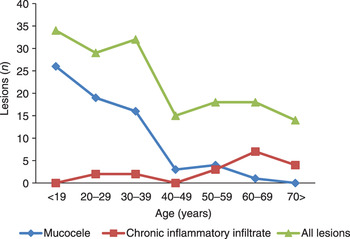
According to age distribution, mucoceles were found to be more prevalent in the second and third decades of life (Figure 1). The other group of lesions showed a relatively more homogeneous distribution across age groups. Between-group comparisons revealed that mucoceles were significantly more common in younger patients (mean, 25.10 years; p < 0.001), whereas chronic inflammatory infiltrate presented in significantly older patients (mean, 57.94 years; p < 0.005). The vast majority of mucoceles involved the lower lip (n = 66), with only three cases presenting in the upper lip.
Distribution of lesions according to age.

Lesion size ranged from 0.3 to 2.8 cm. All lesions were totally excised under local anaesthesia, with the exception of five cases where general anaesthesia was performed because of large lesion size and the need for subsequent reconstruction.
No significant association was found between lesion type and sex. However, it is noteworthy that all patients with hyperkeratosis (five out of five), and five of six patients with actinic keratosis, were male.
Only one case of pyogenic granuloma and two cases of mucocele recurred after one month. The patients were re-operated on and remained disease-free thereafter.
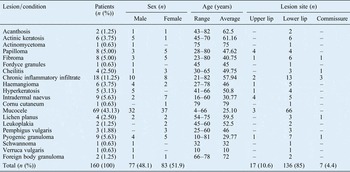
The average post-operative follow-up period was 3 months, with a range of 1–16 months. The data regarding the distribution of lesion types, lesion site, age and sex are shown in Table I.
Clinical data of study group patients

Discussion
Oral cavity lesions are encountered mostly by dental and oral health professionals as a part of their practice. Knowledge of the characteristics and distribution of lip lesions of various histological types is essential in establishing early diagnosis and treatment. The lips, which form the border between facial skin and oral mucosa, constitute a special anatomical site of the oral cavity because of the diverse tissue types of which they consist; they are a site of presentation for a wide variety of benign and malignant lesions.
The data obtained from the pathology laboratory archives do not necessarily reflect the prevalence of any type of lip lesion in the general population. However, prevalence studies are important for knowledge of health status and treatment requirements.Reference Espinoza, Rojas, Aranda and Gamonal3 The World Health Organization has recommended encouraging more research on the epidemiology of oral mucosal lesions; nevertheless, the literature in this area is limited.Reference Furlanneto, Crighton and Topping4
Most previous retrospective studies have described lip lesions in the context of oral cavity lesions. Very few studies have focused solely on benign lip lesions, and presented their prevalence and distribution according to variables such as age, sex and lesion site.Reference Osterne, Costa, Mota, Vidal Patrocínio, Alves and Soares1, Reference Ntomouchtsis, Karakinaris, Poulolpoulos, Kechagias, Kittikidou and Tsompanidou2 The current study investigated the distribution of lesions in a specific cohort of patients with benign lip lesions, and in our opinion the data presented contribute to the previous literature in this area.
Lips are one of the main sites of presentation for oral cavity lesions according to general epidemiological studies. Shulman et al. reported a prevalence of 15.4 per cent for lip lesions among 6003 oral lesions clinically detected in 17 235 adults by oral examination.Reference Shulman, Beach and Rivera-Hidalgo5 The authors found that the lips were the third most common location. Similar results were described by Torres-Domingo et al.,Reference Torres-Domingo, Bagan, Jimenez, Poveda, Murillo and Díaz6 who showed a prevalence of 11.7 per cent in 300 patients, and by Al-Khateeb,Reference Al-Khateeb7 who revealed that 16.6 per cent of 818 cases presented in the lips.
In our retrospective study, mucocele was the most frequent lesion encountered in patients referred to our department (as confirmed by histopathological examination), followed by chronic inflammatory infiltrate, intradermal naevus, pyogenic granuloma, fibroma and papilloma. The finding that mucocele was the most frequent benign lesion found in the lips is in agreement with the study of Osterne et al.Reference Osterne, Costa, Mota, Vidal Patrocínio, Alves and Soares1 They performed a retrospective analysis of 1034 lip biopsies, and categorised the lesions into 3 groups: non-malignant dysplastic lesions or malignant tumours, benign neoplasms, and reactive inflammatory lesions. Mucocele was the most common condition encountered among the inflammatory lesions (48 per cent) and in the whole study group (28.4 per cent). Other authors have also reported mucocele as being the most frequently occurring lesion of the lips.Reference Bermejo, Aguirre, Lopez and Saez8, Reference Yamasoda, Tayama, Syoji and Fukuta9 In contrast, an epidemiological study by Bouquot and Gundlach, in which 23 616 adults aged over 35 years were examined, reported haemangioma as the most frequent benign lip lesion, followed by reactive fibroma and mucocele.Reference Bouquot and Gundlach10 Despite the methodological differences, the retrospective study of Ntomouchtsis et al.Reference Ntomouchtsis, Karakinaris, Poulolpoulos, Kechagias, Kittikidou and Tsompanidou2 found haemangioma to be the most common lesion among 140 cases, similar to the findings of Bouquot and Gundlach.Reference Bouquot and Gundlach10
In our study, mucoceles were significantly more common in younger patients; the majority of those affected were in the second or third decade of life, and there was no sex predilection. This observation is in agreement with the review of Chi et al., which included 1824 oral mucocele cases.Reference Chi, Lambert, Richardson and Neville11 We observed three cases of mucocele in the upper lip (4.3 per cent); this is in contrast with the findings of Chi et al.Reference Chi, Lambert, Richardson and Neville11 and Cohen,Reference Cohen12 who reported no upper lip involvement. Our findings reveal a slightly higher percentage of upper lip mucoceles when compared to some studies in the literature, which describe an estimated prevalence of 1 per cent and 3 per cent.Reference Robinson and Hjorting-Hansen13–Reference Oliveira, Consolaro and Freitas15
In this study, chronic inflammatory infiltrate was the second most frequent lesion, and it presented significantly more frequently in older patients. Ntomouchtsis et al. reported only 1 case of chronic inflammatory infiltrate among 140 cases, which occurred in a 61-year-old patient.Reference Ntomouchtsis, Karakinaris, Poulolpoulos, Kechagias, Kittikidou and Tsompanidou2 We are not able to compare this finding as the literature lacks data related to the prevalence and age distribution of the lesion, possibly because of the scarcity of cases.
No statistically significant sex predominance was found for any type of lesion, but it should be noted that all hyperkeratosis patients (five cases), and five of six actinic keratosis patients, were male. Though the sample sizes are too small to make comparisons, the finding related to actinic keratosis is in agreement with the study of Ntomouchtsis et al., where all 24 actinic keratosis patients were male.Reference Ntomouchtsis, Karakinaris, Poulolpoulos, Kechagias, Kittikidou and Tsompanidou2
The most frequent lesions of the upper lip were papilloma and intradermal naevus, and the most frequent lesion of the commissure was chronic inflammatory infiltrate.
It was not possible to differentiate the haemangiomas as cavernous, capillary or mixed, as lesion sizes were small.
The present study involved a retrospective analysis of benign lip biopsy samples of patients from all age groups who were referred to our hospital during a specific time period. It provides valuable data on the distribution of lesions according to age, sex and site of lesion. However, studies with this methodology are not capable of examining the prevalence of benign lip lesions in the general population. Another important issue is that the prevalences of lip lesions in adults are different from those for children and adolescents; therefore, studies of adult populations may have limited applicability for children, and vice versa. In this respect, good quality epidemiological surveys, including samples representing the general population and different age groups, may yield more valid and reliable data regarding the prevalence and distribution of lip lesions.
• Knowledge of benign lip lesion distribution and epidemiology is essential for early diagnosis and prevention
• A retrospective analysis was conducted of benign lip lesions managed over 15 years at Karadeniz Technical University School of Medicine
• Mucocele was the most common lesion of 20 different histopathological types and was more common in younger patients
Although epidemiological surveys of oral mucosal lesions comprise a well-designed sampling methodology and involve trained examiners, they nonetheless have some limitations. Examiners can identify many lesions without additional diagnostic aids, but the diagnosis of some lesions is less certain, and other non-specific lesions cannot be diagnosed at all without histological confirmation. Another limitation of cross-sectional studies is that they explore associations, not causal relationships. Finally, the prevalence of lip lesions that present as acute conditions may be understated in prevalence studies.
Conclusion
Knowledge of the distribution, aetiology and epidemiology of oral mucosal pathologies is essential to promote primary prevention, early diagnosis and treatment. Future studies should be directed at multivariate models that include potentially clinically significant risk factors such as tobacco use, race and ethnicity, socioeconomic status, and climate.