Introduction
Slow worms (Anguis fragilis) are a protected reptile species in the UK, requiring translocation of animals prior to land development. Parasite communities have never been examined in UK slow worms before, yet they may be an important consideration for translocation programmes and the choosing of appropriate receptor sites. From dissections of slow worms in Eastern Europe, nine species of parasitic nematode have previously been recorded (Shimalov et al., Reference Shimalov, Shimalov and Shimalov2000; Borkovcová & Kopřiva, Reference Borkovcová and Kopřiva2005; Mihalca et al., Reference Mihalca, Gherman, Ghira and Cozma2007), with prevalence of Neoxysomatium brevicaudatum (Zeder, 1800) ranging from 11% (Shimalov et al., Reference Shimalov, Shimalov and Shimalov2000) to 43% (Borkovcová & Kopřiva, Reference Borkovcová and Kopřiva2005), and the number per host ranging between 3 and 10. Three nematode species belonging to Rhabdiasidae were reported in the same studies: Paraentomelas dujardini (Maupas 1916), Entomelas entomelas (Dujardin 1945) and Rhabdias fuscovenosus (Railliet 1899).
Our primary aim in this study was to use non-invasive faecal analysis to investigate the prevalence and intensity of gastrointestinal parasites in slow worms from the UK. Furthermore, we tested the accuracy of a polymerase chain reaction (PCR)-based approach for detecting N. brevicaudatum in faeces.
Materials and methods
Morphological identification
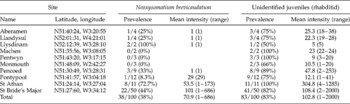
During the course of a long-term study on slow worm translocations, we collected faecal samples from 100 specimens of the slow worm (A. fragilis) between 2006 and 2009 from locations in Wales (see table 1). Animals recovered from artificial refugia were photographed, measured and weighed. During this brief handling period, approximately one-third of lizards naturally defecated and these samples were stored in sterile vials containing 90% ethanol. Once returned to the laboratory, each sample was examined under a dissecting microscope (up to × 30 magnification). Two nematode species were recovered and counted. They were cleared in beechwood creosote and examined under a high-power Olympus microscope at the Natural History Museum, London. The larger of the two was identified as N. brevicaudatum (Zeder, 1800). Parasite terminology describing distribution in the host populations is according to Bush et al. (Reference Bush, Lafferty, Lotz and Shostak1997).
Neoxysomatium brevicaudatum and unidentified gastrointestinal nematode infections (prevalence, mean intensity and range) from Anguis fragilis (n=100) in Wales, UK. Data presented from morphological screening only.

Molecular identification
Nematode DNA was extracted using the DNeasy Tissue Kit (Qiagen, Crawley, Sussex, UK) following the Animal Tissues protocol. DNA was amplified using PCR with 18S rDNA primers rift and 1500R (Tkach et al., Reference Tkach, Kuzmin and Pulis2006) using the following conditions: 1 × buffer, 2 mm MgCl2, 0.1 mm deoxynucleotide triphosphates (dNTPs; Invitrogen, Paisley, Renfrewshire, UK), 0.5 μm of each primer, 0.45 U Taq polymerase (Invitrogen) and 5 ng/μl DNA in a total volume of 25 μl, with an initial denaturation at 94°C for 3 min, 45 cycles of 94°C for 20 s, 47°C for 1 min and 72°C for 1 min, and a final extension at 72°C for 5 min. Sequencing was performed on an ABI 3100 automated capillary DNA analyser (ABI Prism model 3100, Beaconsfield, Bucks, UK). Comparison of the 588-bp sequence (accession number JF713457) for the larger nematode with those on GenBank returned a closest match of 99% similarity to Cosmocercoides dukae. Sequences of the large and small nematodes were then compared with those from 27 nematode species downloaded from GenBank (representative of two orders and eight families) using neighbour-joining analysis in Mega 3.1 (Kumar et al., Reference Kumar, Tamura and Masatoshi2004). Bootstrap analysis was performed with 1000 repetitions.
Molecular screening
DNA was extracted from ten slow worm faecal samples (collected from: Verwood, Dorset, N51:22:40, W3:13:13, n = 8; and Caerphilly, Vale of Glamorgan, N50:52:04, W1:51:15, n = 2) using the QIAamp® DNA Stool Mini Kit (Qiagen) in accordance with the manufacturer's instructions. For the initial step of the protocol, the faecal sample was vortexed and lysed in buffer for 1 min, with the remainder of the extraction process carried out on the supernatant. This brief lysis is sufficient to extract nematode DNA without significantly damaging the specimen, permitting post-extraction morphological identification under a microscope. DNA (host and parasite) extraction success was established by screening with the universal primers LCO1490 (Folmer et al., Reference Folmer, Black, Hoeh, Lutz and Vrijenhoek1994) and CI-N-1777 (Brown et al., submitted) which amplify a 287-bp fragment of the cytochrome oxidase I (COI) mitochondrial gene. PCR conditions were as described previously for the 18S rDNA primers (see above). Amplification success of DNA was confirmed by gel electrophoresis. With all extractions testing positive, N. brevicaudatum-specific primers COI-J-1764 and COI-N-1938 (Brown et al., submitted) were used to amplify a 174-bp fragment of the COI mtDNA gene from the faecal samples. PCR conditions, as described above, included an initial denaturation at 94°C for 5 min, 40 cycles of 94°C for 30 s, 66°C for 45 s and 72°C for 45 s, and a final extension at 72°C for 10 min. All PCRs were performed on a Peltier Thermal Cycler (Bio-Rad Laboratories, Hercules, California, USA).
Results
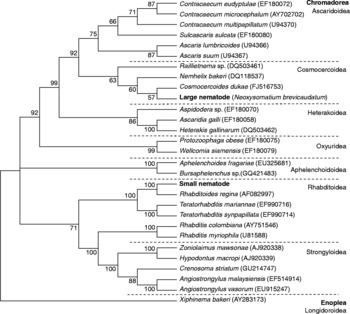
Screening of 100 faecal samples from Welsh slow worms revealed two gastrointestinal nematode species, but no other macroparasites. The larger nematodes were identified morphologically as N. brevicaudatum (Zeder, 1800) (prevalence 38%, mean intensity 70.9, range 1–686; table 1). There were insufficient morphological characters to explicitly identify the smaller, more common nematode (prevalence 83%, mean intensity 102.8, range 1–2000). However molecular identification placed it in the Rhabditae family, with the highest similarity (96%) to Rhabditoides regina (fig. 1).
Neighbour-joining tree showing the relationship of the two nematodes found in UK slow worm faeces (large nematode = Neoxysomatium brevicaudatum and small nematode = unidentified Rhabditidae) with other nematode species. GenBank accession numbers are given in parentheses and all species are grouped into two orders (highlighted in bold) and their respective superfamilies. The tree was constructed based on 588 bp of the 18S rDNA sequence and bootstrap analysis was performed with 1000 repetitions.

From a further ten slow worm faecal samples screened with N. brevicaudatum-specific COI primers, four samples (from both Dorset and Caerphilly) tested positive. Subsequent examination of the same faecal samples by microscopy recorded these four samples as having at least one N. brevicaudatum present in each (1–2 adults), in addition to the smaller nematodes (range 66–861). Of the six faecal samples that were negative by molecular screening, none were found to contain any N. brevicaudatum, but four did contain the smaller nematodes (range 28–31).
Discussion
For the first time N. brevicaudatum was recorded from UK slow worms. This parasite infects the intestine of amphibians (e.g. Bombina, Bufo, Hyla, Rana, Triturus) and occasionally reptiles (e.g. Anguis, Natrix) (see Shimalov & Shimalov, Reference Shimalov and Shimalov2000; Shimalov et al., Reference Shimalov, Shimalov and Shimalov2000; Kirin, Reference Kirin2002; Karadenız et al., Reference Karadenız, Gürkan and Koyun2005; Saglam & Arikan, Reference Saglam and Arikan2006). It has a direct life-cycle, the eggs hatching outside the host and the first-stage larvae developing and moulting twice to the infective third stage. It is probable that the final host becomes infected orally, the larvae often being found in the tissues (Vashetko & Siddikov, Reference Vashetko and Siddikov1999; Saeed et al., Reference Saeed, Al-Barwari and Al-Harmni2007). Males range from 3 to 4 mm in length, with the females slightly larger at 4–5 mm. The nematode is ovoviviparous with eggs measuring 0.09 × 0.05 mm (Ryzhikov et al., Reference Ryzhikov, Sharpilo and Shevechenko1980). It is a common pathogen of herpetofauna throughout Europe (Yamaguti, Reference Yamaguti1961; Sharpilo, Reference Sharpilo1974; Kirin & Buchvaov, Reference Kirin and Buchvaov2002; Borkovcová & Kopřiva, Reference Borkovcová and Kopřiva2005; Saglam & Arikan, Reference Saglam and Arikan2006) but has not apparently been recorded previously from slow worms in the UK. This is yet another example of the current lack of knowledge of the helminth parasites of British vertebrates.
Rhabdiasidae nematodes are parasites of vertebrates but not just gastrointestinal, in fact Rhabdias species infect the lungs of amphibians and reptiles (e.g. Kuzmin et al., Reference Kuzmin, Tkach and Snyder2003; Tkach et al., Reference Tkach, Kuzmin and Pulis2006). The Rhabdiasidae belong to the superfamily Rhabditidoidea, which includes Entomelas entomelas found in the oesophagus and rarely the lungs (Baker, Reference Baker1980). Rhabditid nematodes are common parasites of insects and molluscs. For example, R. regina infects beetles (Schulte & Poinarj, Reference Schulte and Poinarj1991) while Phasmarhabditis hermaphrodita is a common parasite of slugs (e.g. Wilson et al., Reference Wilson, Glen and George1993), which are the major prey of slow worms. Thus, it is possible that the species recovered in the current study originated from slow worm prey or it could be a free-living, bacteria-eating rhabditid which lives in faeces. Both of these explanations are unlikely, however, as records of parasites passing alive through the gut of a predator are rare (Ponton et al., Reference Ponton, Lebarbenchon, Lefèvre, Biron, Duneau, Hughes and Thomas2010) and most of the faecal samples in the current study were freshly collected from slow worms so there was no (see Jones et al., Reference Jones, Cable and Bruford2008) or very little opportunity for contamination with free-living nematodes.
Quantitatively, we would expect much higher parasitic loads from dissected animals, but non-invasive faecal sampling has provided valuable data on prevalence and a measure of parasite load. In the faecal samples screened with N. brevicaudatum-specific COI primers, prevalence was determined to be 40%, which was corroborated by microscopy. This indicates that molecular screening is as efficient as conventional methods and offers an alternative to the time-consuming and laborious process of hand-sorting, and one which does not require skilled nematode taxonomists. However, an essential prerequisite of molecular screening was the original morphological identification of the samples, as identification through sequencing alone would only have identified N. brevicaudatum to family level. Also, the current molecular approach used here could only provide information on prevalence, although other studies have shown real-time PCR as a suitable method for ascertaining intensity (e.g. Nielsen et al., Reference Nielsen, Peterson, Monrad, Thamsborg, Olsen and Kaplan2008).
Our current studies are assessing the potential fitness consequences of N. brevicaudatum and the rhabditid nematode on slow worms. If both parasites are ubiquitous in UK populations, then their presence is not a barrier for translocation exercises. However, if some populations are naïve (which unfortunately can not be assessed from the current study due to small sample sizes), it may be necessary to avoid translocations if animals are infected at either the donor or receptor sites.
Acknowledgements
This work was supported by a Cardiff University studentship to R.J. and, from the Natural Environment Research Council, a studentship (NER/S/A/2005/13133) to D.S.B. and an Advanced Research Fellowship (NER/J/S/2002/00706) to J.C.