INTRODUCTION
The Union of South Africa achieved its independence from British rule in 1910. Roughly 70 per cent of the population was African and about 20 per cent of the population was white, but the whites dominated the politics and economy of the country almost completely.Footnote 1 By 1910, whites already controlled more than 90 per cent of the land area of South Africa. Vital questions for Africans were how to regain land lost as a result of white colonization and how to increase their role and power in the politics and economy of the country while whites grappled with the question of what to do about ‘the native question’. As a step towards answering this question, the white Parliament passed the Natives Land Act (no. 27 of 1913) on 19 June. The Act's most important provision was to prohibit Africans from buying land in 93 per cent of South Africa. The Act included important anti-squatting measures to stop share-cropping and defined the boundaries of the reserves, referred to in the Act as ‘scheduled areas’.Footnote 2 These scheduled areas encompassed land which Africans had acquired by grant from the South African Republic or Orange Free State governments, previously created locations and reserves, land owned under the informal or formal trusteeship system which emerged in the nineteenth century in the Transvaal, and land purchased in the Cape and Natal.Footnote 3 Africans could buy and sell land freely in the scheduled areas while whites were prohibited from owning land in these locations. The scheduled areas amounted to approximately 10 million morgen (about 21 million acres; 1 morgen equals about 2·1 acres), just over 7 per cent of South Africa. In addition, the Land Act created the Natives Land Commission (the Beaumont Commission) to investigate which additional land should be set aside for Africans, since responsible officials knew that many of the reserves were overcrowded and that 7 per cent of the land was not enough for the rural African population. The Commission reported its recommendations in 1916.Footnote 4 While the Commission's proposals were debated in Parliament in 1917, they were not enacted. Instead, Prime Minister Louis Botha appointed provincial land committees to evaluate its recommendations. These committees reported to Parliament in 1918 but their recommendations were also not enacted into law.
The Land Act came into being following a debate about territorial segregation initiated in 1903 after the Boer War, when the South African Native Affairs Commission (Lagden Commission) collected evidence that might influence future policy towards Africans. The Lagden Commission recommended that territorial segregation should be enacted and that ‘restrictions upon the purchase of land by Natives [were] necessary’.Footnote 5 Historians identify the post-Boer War Lagden Commission as the intellectual foundation for the Natives Land Act. Following Union in 1910, a land law was to become part of a broader pattern of legislation designed to implement segregation within South African society, encompassing the workplace, cities and even inter-racial sex outside of marriage.Footnote 6 The 1913 Land Act also had political implications arising from tensions between Prime Minister Botha and J. B. M. Hertzog, who was removed from the cabinet in late 1912.Footnote 7 Hertzog's National Party, in coalition with the Labour Party, won the election in June 1924. In 1936, the white Parliament passed the Native Trust and Land Act.Footnote 8
This article focuses on government efforts to impose territorial segregation after 1913 by prohibiting African land purchases.Footnote 9 It addresses an important, unexamined question: did the Louis Botha – Jan Smuts South African Party ministries and the National Party government under J. B. M Hertzog in fact stop Africans from buying land in the Union and, therefore, succeed in bringing about territorial segregation in rural South Africa by 1936? We investigated this question, focusing on the former Transvaal province, from two complementary and interdisciplinary approaches: a historical approach based on archival sources, and a quantitative geo-analytical approach. We present data from three new or unexplored sources to support our analysis.
The first new, unexplored source is a collection of reports by the governor general to Parliament. Section 1 (1) of the Natives Land Act gave the government the right to make exceptions to the law by approving new land purchases (and leases) by Africans outside the scheduled areas. This clause is an important foundation for our analysis. However, few historians refer to any exceptions to the law.Footnote 10 Nor do many contemporaries among African leaders, editors or journalists discuss the significance of exceptions to this law.Footnote 11 In s.1 (3) of the Act, Parliament required the governor general to submit an annual report listing the number of exceptions and key particulars, such as the names of the buyers and sellers and the location of the land. Beginning in 1914 and ending in 1936 (the report for 1922 is missing) these reports in the Library of Parliament provide an important new source for our analysis.
The second new source we examined was deeds and property transfer records. The Registrar of Deeds maintains these records of all land transactions (although old volumes of the transfer records are deposited in the National Archives of South Africa, Pretoria). Using the list of purchases from the Parliamentary data, we traced the history of a significant number of the purchases, sales and sub-divisions (called ‘partitions’ in the records) from the initial owner (mainly from the middle of the nineteenth century) through 1936. From these records, we identified white and African owners, and investigated whether whites continued to own other portions of a farm after initial sale to African buyers.
The third new source is a geo-referenced data set of rural landholdings in the Transvaal that we constructed to measure the level of white – African land segregation between 1913 and 1936. This new data set resulted from the integration of information from the first two sources and the 1904 report on the acquisition and tenure of land by Africans in the Transvaal, the 1905 report of the South African Native Affairs Commission, the minutes and papers of the Native Location Commission, 1905 to 1907, and memoranda of the Department of Lands.Footnote 12 As a base map we used the farm data layer of the Environmental Potential Atlas (using a transverse Mercator projection, Hartebeeshoek, WGS84, created by the Department of Environmental Affairs and Tourism in collaboration with the University of Pretoria), based on original South African farms. This map was then altered by delineating the boundaries of the Transvaal as they were in 1913, excluding the Kruger National Park. The authenticity of the base map was further ensured through cross-referencing it with Jeppe's 1899 map of the Transvaal and the SA Topocastral map series of 1936.Footnote 13 The area of the rural Transvaal on the basis of the above map projection comprised 23,598 km2 or 27·5 million morgen, and included 13,688 farms and surveyed farm partitions (henceforth referred to as ‘rural land units’).Footnote 14 In this geo-referenced system, rural land units were classified as having either a white or a black identity on the dates representing the end of each of the twenty-four years from 1913 to 1936.
SCHOLARSHIP AND THE NATIVES LAND ACT
Historical scholarship identifies the 1913 Land Act as an exceedingly important law. Beinart and Delius note that the law ‘has been accorded pride of place in a number of analyses’ and Maylam identified the Act as the ‘most significant piece of legislation enacted during the segregation era’. This view is shared by Giliomee, Cell and Morrell.Footnote 15 However, only occasionally have scholars pursued investigations into the Land Act in the National Archives of South Africa or other manuscript collections. Analysts have tended to rely on the same scholarly sources or printed primary sources.Footnote 16 Peter Wickins and Timothy Keegan are important exceptions. Wickins, in particular, consulted a wide range of sources, making use of three collections in the National Archives, papers from the Public Record Office, House of Assembly and provincial legislative assembly debates, and letters to the Farmer's Weekly. Scholars writing on other topics, such as disease (Packard), land reform (Miller and Pope) and rural politics (Switzer), mention the Land Act because of its notoriety, but these writings rarely go beyond a brief reference in the text or a footnote.Footnote 17 More recently, the post-apartheid land restitution policy encapsulated in the Restitution of Land Rights Act (1994), which sets 1913 as the earliest date from which land claims might be recognized, has generated a large number of articles which refer to the Land Act.Footnote 18 Scholars have also noted that ‘although much has been written about the law's causes and effects, the range of interpretation is bewildering’.Footnote 19 While Wickins warns against trying to overemphasize a single cause, Robertson, Lacey and Beinart see the Act as a means of meeting the demand for agricultural labor, and Wolpe and Lacey believe that supporters of the Act responded to the needs of various sectors of ‘capital’. Keegan, Bundy and Davenport argue that the intention of the Act was to prevent squatting by Africans on white-owned land in order to abolish sharecropping.Footnote 20 In this paper, we argue that the evidence supports the conclusion that many of the Act's promoters, both in and out of Parliament, saw the Natives Land Act as a means of stopping Africans from buying land and, therefore, of promoting territorial segregation. This aim, we believe, is the underlying ‘principle’ of the Act.
South Africa's first prime minister, Louis Botha, believed in segregation. He told a group of African chiefs, in November 1913: ‘I want you to develop, and go forward on your own lines’.Footnote 21 Botha wrote to Sir Thomas Smartt, the leader of the Unionist Party, in 1917 during the debate about another land bill: ‘The principle [territorial segregation] of the Bill [Native Affairs Administration (NAA) Bill, 1917] was adopted in 1913 practically by unanimous vote and I am today firmly convinced that that principle is in the interests both of the black and white inhabitants of this country’.Footnote 22 Again, in the context of the 1917 debate, a high official at the Native Affairs Department, E. R. Garthorne, stated in a memorandum that the Native Affairs Administration Bill ‘aims at the segregation of White and Black, and thus at embodying the purposes foreshadowed in Act No. 27-1913 [the Natives Land Act]’.Footnote 23 And Botha's successor, Jan Smuts, is quoted as saying that the Natives Land Act supported the idea that ‘there should be white areas and native areas in each of which the principle of ownership should be observed’.Footnote 24
Stronger evidence emerges from speeches presented in Parliament. During the debate in 1913 on the Natives Land Bill, 45 members made speeches in the House of Assembly.Footnote 25 At least 17 of the members referred to the ‘principle’ of the Bill. All but 2 agreed that the principle was segregation of the races, which was to be achieved by the separate occupation and ownership of land. Only 2 Parliamentarians, Edgar H. Walton and Thomas Smartt, thought that the principle was to stop squatting.Footnote 26 In addition to the 17 men described above, 7 others said that they believed that the main purpose of the Bill was to promote segregation. Even in the Senate, approval of segregation was almost unanimous. Senator W. E. S. Stanford noted that the Bill passed the Senate by a vote of 22 to 7 and ‘of the seven[,] six’ dissenters ‘approved the main principle’.Footnote 27 Editors agreed. ‘The object of this Act’, wrote the editor of the South African Agricultural Journal, ‘is to provide lines of demarcation between natives and non-natives in so far as ownership of land is concerned’.Footnote 28 And the editor of the Friend declared the Bill ‘of supreme importance’, representing ‘a first and a big step towards segregation’.Footnote 29
Most historians believed that the principle of restricting African ownership was an extension of policies from the old Boer republics. Wickins, for example, asserts that ‘only in the Orange Free State had the whites appropriated the lion's share of the land in perpetuity. This principle was now extended to the rest of the country’, and Keegan emphasizes that the Act now prohibited ‘all land purchases by blacks outside specifically scheduled reserve areas’ across South Africa.Footnote 30 However, the buying restrictions in the Natives Land Act, in reality, applied only to the Transvaal and Natal. The Act could not operate in the Cape Province because the constitutional voting privilege for Africans and coloreds was based on economic qualifications which could be fulfilled by owning land. Also, the Act did not change a pre-existing Free State prohibition.Footnote 31 Equally important, S. 1 (1) gave the government the right to make exceptions to the law by approving new land purchases (and leases) by Africans outside the areas set aside for Africans by the Act. As this article will show, the exception clause resulted in Africans buying more than 3,200 farms and lots between 1913 and 1936. Moreover, the Land Act was not retroactive: no African owner with a title deed, to our knowledge, lost his land in 1913 because of the Natives Land Act. Significantly, the government approved mortgages which helped Africans to buy their land.
Using the exception clause in the process of gaining permission for purchasing a farm was not easy, and prospective buyers had to be prepared to conform to the rules and criteria laid down by the Native Affairs Department (NAD). They had to tolerate the scrutiny of the evaluation process which sometimes included interviews, inquiries about the applicants' assets, and visits by officials to the property in question.Footnote 32 At times, the prospective buyers had to make repeated submissions before officials granted their approval. NAD officials evaluated requests for permission to buy land according to several criteria. The Native Commissioner in the area had to approve and recommend the transaction; he was expected to state if the price was ‘fair and reasonable’, and to discuss the ability of the Africans to meet their financial obligations, especially if a mortgage was to be secured. A very important criterion was the location of the land: was it in an area recommended for African residence by the Natives Land Commission or the regional committees appointed, in 1917, by the prime minister to evaluate the Natives Land Commission's report?Footnote 33 As a result of a cabinet decision in 1918, officials agreed to approve a request to buy land only if the farm was located in areas both the Land Commission and a regional committee recommended. The policy changed again at the end of 1921: after 1921, requests to buy land in only one recommended area, as opposed to both, became acceptable. Requests to buy land outside a recommended area were also considered and occasionally approved. Once the Native Affairs Department approved a request, the application went to the Executive Council, which then recommended action to the governor general. The process could be completed in a matter of months or it could drag on for several years if the prospective buyers (and, sometimes, the sellers) appealed an unfavorable decision.Footnote 34 NAD officials tried to reduce the risks of purchase by scrutinizing the deeds of sale, looking for inappropriate clauses relating to price, payment terms, risks of monetary loss if the Africans defaulted, and the terms of transfer. They often demanded changes in agreements for the benefit of the African buyers before sanctioning a purchase.Footnote 35
The extent of these ‘exceptions’ is far more significant than historians have acknowledged. On 19 June 1913, the day that the Land Act took effect, a total of 591 rural land units (defined on page 44) were owned by Africans or held in trust for them.Footnote 36 Between 1913 and 1936, Africans living in the Transvaal purchased 867 rural land units, including farms, portions of farms, lots and small plots of land concentrated in a few rural areas. The 867 purchases after 1913 can be divided in the following way: between 1913 and 1924, when Louis Botha and Jan Smuts were the prime ministers, the government granted 302 approvals (35 per cent of the total) for Transvaal properties, on average about 27 per year. Between late 1924 and 1936, the Hertzog years, the government granted 565 approvals (65 per cent) for Transvaal properties, on average about 47 per year.
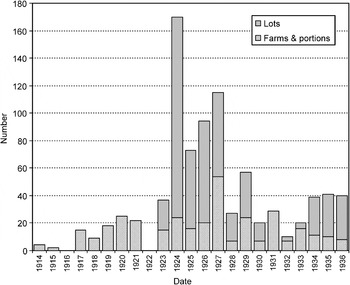
The pattern of annual approvals for purchases is indicated in Fig. 1 which shows only 6 approvals (at least 3 of which were negotiated before 19 June 1913) from 1914 to 1916, the period during which the Natives Land Commission prepared and submitted its report to Parliament. Only 24 further purchases were approved by the end of 1918. In the meantime, officials waited for two Transvaal Land Committees (appointed in 1917) to evaluate the recommendations of the Natives Land Commission, suggesting to Parliament which might be changed, usually by excising certain farms, thereby reducing the amount of land to be added to the scheduled areas. Using recommendations from the Transvaal committees as guidelines, government officials approved a larger number of requests and, between 1919 and 1924, Africans bought an additional 272 pieces of land. From 1923, land speculators, including one African company, subdivided a number of farms, mainly outside the recommended areas, into small lots and sold this land to Africans.Footnote 37 Between 1923 and 1936 the transfer of such lots comprised almost 68 per cent of all approved purchases by Africans. Land transfers to Africans peaked during the first five years of Hertzog's government (386 approvals from 1925 to 1930) but retained some momentum until 1936 (an additional 179 approvals).
African rural land purchases in the Transvaal, 1914–1936.

African buyers fell into several categories: 22 per cent were individuals; 20 per cent were small groups of partners (between 2 and 15 in number); 11 per cent of buyers were large groups (sometimes as many as 50, 75, 103 or more partners).Footnote 38 Individuals or groups constituted almost 54 per cent of the buyers. The largest number of buyers fell into the category of so-called ‘tribes’, a category complicated by the slipperiness of its meaning. Between 1913 and 1936, the word ‘tribe’ in this context could refer to a traditional society, led by a chief, or to a group of buyers, from different ethnic groups, whom the Native Affairs Department required to become a ‘tribe’ to gain approval to buy a farm. The leader of such a group was designated as a headman. The various ‘tribal buyers’ amounted to 46 per cent of buyers.Footnote 39 Africans purchased farms in twelve Transvaal magisterial districts, with five districts accounting for over 83 per cent of the purchases: Pretoria, 27 per cent; Rustenburg, 20 per cent; Pietersburg, 19 per cent; Lichtenburg, 10 per cent; and Middelburg, 7 per cent.
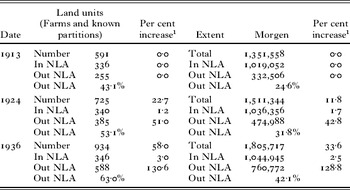
A geo-statistical analysis confirms the evidence that the 1913 Natives Land Act did not prevent Africans from acquiring land outside the scheduled areas identified by the Act. Breaking down the farms into separately transferred land units, Table 1 shows that in 1913 there were 591 African-owned land units in the Transvaal, of which 43·1 per cent were outside the scheduled areas. By 1936, blacks owned 934 land units (an increase of 58 per cent) with 63 per cent now located outside the scheduled areas. The area of African-owned land outside the Land Act areas increased by 128·8 per cent to represent 42·1 per cent of the land owned by Africans in 1936, as opposed to the mere 24·6 per cent in 1913.
African-owned land in the Transvaal in relation to the Natives Land Act (NLA), 1913–1936

1 Per cent increase from 1913 number.
Extent of total study area: 27,551,024 morgen (27·6 million morgen).
The number of land units Africans purchased in 1924 was 22·7 per cent higher than in 1913, rising to 58 per cent in 1936 (an additional 35·3 per cent above that of 1924). In terms of the area of land, an additional 11·8 per cent was added by 1924, and by 1936 the area granted was 33·6 per cent larger than in 1913 (an additional 21·8 per cent above that of 1924). These findings confirm our observation that land acquisitions by Africans, particularly land acquisitions outside the scheduled areas, continued after 1913. They also confirm that more land was transferred to Africans during the Hertzog period than during the Botha–Smuts period, even if the purchase of lots, most of which occurred after 1924, are ignored.
Prime Minister Hertzog regularly talked about segregation in his speeches and used race as a political issue in the elections of 1924 and 1929.Footnote 40 Yet, his administration approved almost twice as many purchases as had been approved under Smuts and Botha, dispelling any notion that Botha and Smuts were more sympathetic to African land hunger.Footnote 41 Even if the purchase of small lots (and the majority of these were approved during the Hertzog period) is ignored, the evidence is conclusive: 209 farms and portions of farms were purchased after 1924, at a rate of more than 17 per year, as against 134, at a rate of 12 per year, during the Botha–Smuts years of administration. An explanation for why the governments of Prime Ministers Botha and Smuts (South African Party) and J. B. M. Hertzog (National Party) approved African purchases in increasing numbers is not the main focus of this article. Briefly, Prime Minister Botha felt a sense of obligation to meet a promise, implied or directly given in 1913, to set aside more land for Africans. Botha was unwilling, in 1917, to delay introducing a Bill to enact into law the Natives Land Commission's recommendations to add about 17 million acres to the existing reserves. Parliament failed to enact that bill, the Native Affairs Administration Bill, that year or in 1918. As an alternative, Botha's government decided to deal with the land question administratively, using the exception clause to approve African requests to buy land. In addition to Botha's sense of obligation, government officials recognized that many reserves were overcrowded and that African land hunger was increasing. In 1921, two years after Botha's death, F. S. Malan, the minister in charge of Native Affairs, told Prime Minister Smuts and the minister of Lands, Denys Reitz, that the government had to be more flexible, pointing to NAD ‘embarrassments’ because the Department found ‘it difficult to deal with insistent claims of the natives in regard to land [faced with the] anomalies arising from the provisions of the existing law, which closed large areas to the natives and opened none’.Footnote 42 Malan emphasized that Africans were upset that no new land, as had been promised, had been made available since 1913.
The motivations of the Hertzog government are more difficult to explain because of limited evidence. The Hertzog papers and the Native Affairs Department records have yielded very little direct evidence to determine Hertzog's reasons for allowing more African land purchases. Since Hertzog apparently spoke extemporaneously to public audiences, reports of his speeches may have included inaccuracies and may not be reliable sources. We believe that Hertzog, like Botha and Smuts, understood the great need for more land, despite the fact that the Natives Land Act Amendment Bill of 1926 decreased the areas for African purchase outside the reserves previously recommended between 1916 and 1918. Land which the Hertzog government approved for purchase fell into two categories: land located in areas recommended by either the Natives Land Commission or the local committees, outside the reserves; and farms adjoining lands already belonging to Africans. The Hertzog government, it appears, sought to consolidate the land belonging to Africans into solid blocks.Footnote 43 We analyze the results of these practices for rural territorial segregation below.
RURAL TERRITORIAL SEGREGATION
While Professor Edgar Brookes, Col. C. F. Stallard, J. G. Keyter, a member of Parliament from the Orange Free State and other prominent whites continued to promote racial segregation on the land, Africans and a few whites questioned the degree to which rural segregation policy was working in the late 1910s, 1920s and early 1930s. Some concluded that the effort had failed. In 1917, W. Poll described the Natives Land Commission's recommendations for new land to be included in the scheduled areas where Africans could buy land under the Natives Land Act as ‘in no way segregation in the more general sense’. ‘The proposed enlargements of existing native blocks … are ultimately intermixed with white areas – or shall I say dotted all over there’.Footnote 44 Meeting with F. S. Malan, the minister in charge of Native Affairs, and Denys Reitz, the minister of Lands, in late December 1921, Prime Minister Smuts said that ‘he was not convinced of the desirability of pressing forward the policy of territorial segregation to a sudden or hasty consummation’.Footnote 45 Three years later, E. R. Garthorne, under-secretary for Native Affairs, wrote a report on segregation a few months after J. B. M. Hertzog became prime minister. Garthorne suggested that ‘initial steps might be taken towards the ultimate objective of segregation’, and concluded that ‘[m]uch must necessarily be left to the future for adjustment in the light of experience yet to be gained [emphasis added]’.Footnote 46
In contrast, in 1926, R. V. Selope Thema, African leader and columnist, put forward a motion to a meeting sponsored by the Native Affairs Commission, a government body created by the Native Affairs Act, that began, ‘This Conference, realizing that the Government have abandoned the policy of segregation … ’.Footnote 47 The resolution was unanimously adopted. A leading Johannesburg newspaper reported that: ‘Segregation has failed because black South Africa does not want it, and because white South Africa is not prepared to make the sacrifices without which it cannot succeed’.Footnote 48 Henry Burton, a former minister of Native Affairs and long-time member of the Cabinet during the years when the South African Party was in power, told an audience: ‘Even territorial segregation … has proved impracticable hitherto, to a very large extent’.Footnote 49 In 1933, African and European delegates to a conference expressed the view that the Land Act had ‘failed’ to ‘secure … segregation’.Footnote 50 Even government officials admitted that segregation was a goal that had not yet been attained; the acting secretary for Justice wrote that one aim of the new land law, the Native Trust and Land Act (1936), was to ‘bring about’ territorial segregation.Footnote 51
One important example of evidence for this which goes beyond the impressions of contemporaries concerns the existence of what government officials called ‘black spots’: black-owned land surrounded by white-owned farms. Africans on the farms labeled ‘black spots’ lived alongside white neighbors. Sketch maps produced by NAD officials or field officers show the intermingling of the races on farms. For example, the northwest portion of Wildebeestkuil 8, Pretoria District, was owned by Chief Makapan and his people, while the white Uijs family owned the middle portion. On one border of the middle portion was Syferpan 612, also owned by Makapan's people. Another map shows portions of Elandsdoorn 225 and the neighboring farms, with similar patterns.Footnote 52 Marian Lacey estimates that the black spots may have equaled more than 305,000 morgen (about 640,000 acres) in 1926.Footnote 53 In the mid 1930s (and probably earlier), selected officials noted the existence of these black spots, viewing them as an ‘evil’ to be eliminated.Footnote 54
We examined deeds and transfer records for the farms listed in the Parliamentary data and compiled ownership histories to determine whether whites also owned portions of the same farm and if these whites continued to own these properties until 1936. We found the deeds or transfer data for 218 farms in the Transvaal, a substantial majority of the farms included in the Parliamentary data. These data show that Africans had purchased 83 whole farms and 129 portions of farms (the data for 6 purchases are unclear). Of the 129, 110, equaling 85·3 per cent, were racially mixed until at least 1936: Africans and whites owned portions of the same farm. The other 19 portions (14·7 per cent) did not have white owners on the same farm by 1936. For the more important magisterial districts, the data indicating mixed ownership divide in the following manner: Pretoria, 79·5 per cent (39 out of 49 examples); Rustenburg, 92·8 per cent (26 out of 28 examples); Pietersburg, 81·3 per cent (13 out of 16 examples); Lichtenburg, 100 per cent (12 examples); Middelburg, 100 per cent (9 examples). These results indicate a high degree of mixed ownership.
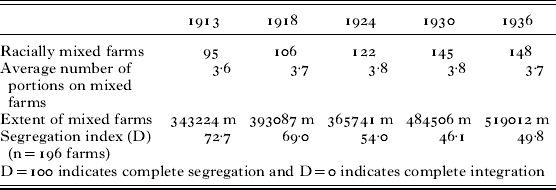
We also compared the data for racially mixed farms from the Parliamentary records, transfer and deeds records with the data set on the changing status of 13,688 land units in the Transvaal, our third source. We took into account land already in African possession in 1913 and further purchases to 1936, and found that 196 farms had white and African owners at some point between 1913 and 1936. The farms included the 110 purchases from the sample that remained racially mixed and others not in the Parliamentary data sample that also remained mixed, as well as farms that changed from territorially mixed to segregated (or from segregated to mixed and back to segregated), and possible nineteenth-century location land that comprised only part of an original farm.Footnote 55 The number of racially mixed farms increased by almost 56 per cent (from 95 in 1913 to 148 in 1936) while the average number of portions on racially mixed farms remained fairly constant (Table 2). In addition, the area of the farms with white and African owners also increased by over 51 per cent, an additional 175,788 morgen, from 1913 to 1936, indicating that the phenomenon of white and African owners on the same farm increased rather than decreased.
White and African ownership on racially mixed farms in the Transvaal, 1913–1936
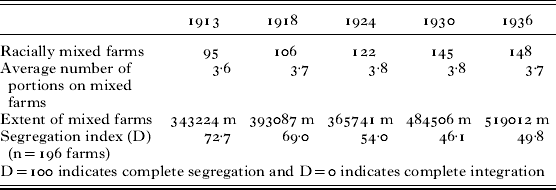
Note that the D values represent index points (and not percentages).
We tested the degree of evenness of white – African distribution on the racially mixed farms statistically with the index of dissimilarity (D), originally developed by Duncan and Duncan,Footnote 56 and used extensively in social urban studies.Footnote 57 The index of dissimilarity is a means of evaluating the relative evenness of the distribution of two ethnic categories in relation to each other in an area. In Table 2, D is an expression of the occurrence of one category of a phenomenon (in this case: the number of African-owned land units) in relation to another category of the phenomenon (the number of white-owned land units) in a sub-area (a farm) in relation to the presence of the same phenomena in all other sub-areas (farms) in a total area (all farms on which Africans and whites jointly had landholdings at one point in time between 1913 and 1936). To our knowledge, the index of dissimilarity has not been used frequently, if at all, to evaluate land segregation, and certainly not in the context of South African historiography.
Taking into account all the 196 farms that had mixed ownership status between 1913 and 1936, an increase in the dissimilarity index will point towards increasing territorial segregation, and a decrease will point towards racial mixing on these farms. The results, indicated in Table 2, show a tendency towards segregation in 1913 (D=72·7) followed by a gradual weakening of segregation in ownership on racially mixed farms, resulting in a pattern that tends towards racial mixing rather than segregation (D<50) in 1930 (46·1) and 1936 (49·8). These findings, based on the ownership histories and our statistical analysis show a pattern of territorial mixing between 1913 and 1936. In those rural areas where Africans purchased portions of farms and Africans and whites lived in close proximity on the same farms, the data demonstrate a sharp contrast to the overall contemporary territorial segregation goal.
Finally, we evaluated the success of the territorial segregation strategy in the Transvaal between 1913 and 1936 on a grand or macro scale. Analysis at this macro scale considered all 13,688 defined land units in the Transvaal, including 591 land units owned by Africans in 1913, and all acquisitions and losses, to 1936. For this macro scale analysis, we excluded the purchase of individual lots which were small plots of land concentrated in a few areas, from our geo-statistical analysis. Instead, for those farms which we described earlier as being sub-divided into lots, we recorded an entire sub-divided farm in our data base as only a single purchase when an African bought the first lot. We followed this procedure because the lots were small and were sold by speculators or companies rather than by white farmers. We applied this procedure to three farms near Wakkerstroom (Daggakraal 161, Driefontein 332, Vlakplaats 340) and three near Pretoria (Onverwacht 576, Doornkraal 629 and Witlaagte 445).Footnote 58 Again, using the index of dissimilarity (D), our analysis took into account the departure point of the level of land segregation in 1913 (high, moderate or low), and the trajectory of the segregation trend after 1913. For example, a finding that the level of land segregation was already high in 1913 and remained high, even if it leveled off, points in the direction of a successful land segregation strategy on the whole (H0). However, if the level of land segregation in 1913 was moderate or low, with the possibility to increase, then it only needs to be demonstrated that the segregation level remained at this level (or decreased) to prove the ‘failed segregation hypothesis’ (H1).
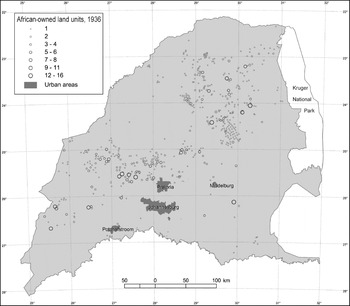
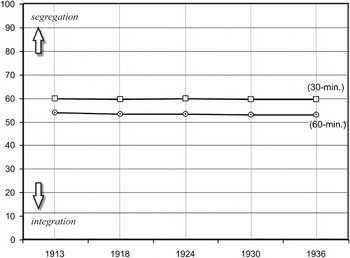
The application of D at this scale required awareness that the sub-areas into which the larger region (Transvaal) is divided for calculation should as far as possible be of the same size (the modifiable area problem), and of the grid scale dependency of D (an increase in sub-areas resulting from dividing the region into ever smaller sub-areas usually results in an increase in D).Footnote 59 To overcome the modifiable area problem, a uniform grid system was superimposed over the map of the Transvaal on which the location of land units has been geo-referenced. To accommodate the possibility of bias as a result of grid scale dependency, a grid representing 60-minute intervals and another representing 30-minute intervals of longitude and latitude was used (Fig. 2). The result, displayed in Fig. 3, shows that the level of territorial segregation between white- and African-owned land in 1913 was between D>30 and D<70 (with D=53·8 in the case of the coarser 60-minute grid for sub-areas and D=59·9 in the case of the finer grid), and therefore in the moderate range of the dissimilarity scale where D=100 is evidence of absolute territorial segregation and D=0 indicates an absolute integrated evenness of distribution. In 1936, D=52·9 in the case of the coarser 60-minute grid, while D=59·6 in the case of the finer grid. These results do not support a territorial segregation thesis. Moreover, the result that the territorial segregation level shows a slight decrease, rather than an increase, from 1913 to 1936 quantitatively shows that the Natives Land Act and the post-1913 segregation ideology had no impact on the already existing pattern of land distribution, and, in fact, that the policy to segregate white- and black-owned land between 1913 and 1936 failed on the grand scale.
African-owned rural land units in the Transvaal, 1936 (60-min. grid).

Evenness of distribution of African-owned rural land units in the Transvaal, 1913–1936.

CONCLUSION
This article has explored whether or not the aims of the 1913 Natives Land Act – to stop Africans from buying land and to bring about territorial segregation in rural South Africa – were achieved by 1936. Using three new sets of data and combining historical research results with a quantitative geo-analytical methodology, we demonstrated that Africans bought farms and lots at an increasing rate between 1913 and 1936 in the Transvaal (and the country as a whole). We showed that while territorial segregation was the most important principle underlying the Act, the Natives Land Act did not stop Africans from buying land in the Union of South Africa. More land was approved for sale during the Hertzog era than during the Botha–Smuts era and more land was owned by Africans in 1936 than in 1913. Thousands of Africans in the rural Transvaal (and tens of thousands in South Africa) became the owners of farms and lots, ranging in size from a few morgen to several thousand morgen. African initiative played a major role in this phenomenon, as Africans took advantage of the exception clause in the Land Act and the changed attitude of government officials (after 1918) towards allowing Africans to buy land. In addition, Africans and whites lived on neighboring farms in those areas where African-owned farms existed. Overall, the evenness in the spatial mix of African-owned and white-owned land units increased rather than decreased in the rural areas of the Transvaal. The failure of the Natives Land Act to stop African purchases meant that the legislative goals of the supporters of the Act went unfulfilled. The failure of government to achieve territorial segregation following the passage of the Land Act illustrates the limits of white power in the early Union period.