On 3 June 1944, the black feminist anthropologist Zora Neale Hurston wrote to her friend, Claude Barnett, mentioning her musical, Polk County. Even though Hurston, a member of the New Negro Harlem Renaissance, is well known for her ethnography of folkways, Mules and Men (1935), and her novel, Their Eyes Were Watching God (1937), her musical theatre has received relatively little scholarly attention. Mules and Men formed the basis for Polk County, in which she intervenes in the theatrical representation of black women. Although we think of her as a literary great, she was also a prolific writer of musical theatre:
Right now, I have been asked to do a play. I am bogged down in it and wonder if I know what I am doing. New York seems to like it so far. I have my fingers crossed until it sees the footlights. If I can get somewhere with this, then next time, I mean to let myself go and do what I want to do in the Negro theatre. I have always wanted to wrap something stunning around Etta Moten. She is good in PORGY AND BESS. No doubt about it. But the story is not too true to our lives and I want to do something more penetrating. (in Kaplan Reference West, Chrisler, Golden and Rozee2012:499)
Clinton Derricks-Carroll on guitar and Harriett D. Foy (Big Sweet) in Polk County at Arena Stage, Washington, DC, 5 April–12 May 2002. (Photo by Scott Suchman; courtesy of Arena Stage)

What would have been the first full-length Broadway musical by and about a black woman was written in 1944 and was supposed to premiere but was canceled.Footnote 1
Although musicals by and about black women were and remain rare, they have a genealogy that traces back to Pauline Hopkins’s Peculiar Sam; or, the Underground Railroad (1879) and Shirley Graham Du Bois’s Tom-Tom (1932). Micki Grant’s Don’t Bother Me, I Can’t Cope (1972), Vy Higginsen and Ken Wydro’s Mama, I Want to Sing! (1983), Kirsten Childs’s The Bubbly Black Girl Sheds Her Chameleon Skin (2000), and Regina Taylor’s Crowns (2002) add to the list of works that address black women’s identities. Such musicals have featured actors like Diahann Carroll, LaChanze, Audra McDonald, Tonya Pinkins, Leslie Uggams, and Lillias White who remain “both the muse and the drudge” (in the words of Harryette Mullen) of American musical theatre (in Williams Reference Williams2000:706). Hurston’s Polk County is the missing link connecting Du Bois to Grant. Based on her Mules and Men, her play The Mule Bone: A Comedy of Negro Life in Three Acts (Reference Hurston1931, with Langston Hughes), and her tall tale, “High John de Conquer” (Reference Hurston and Wall1943), Polk County “centers on the courtship, engagement, and marriage between Leafy Lee, a young new arrival to the camp, and My Honey, a worker, as well as on the friendship between Big Sweet and Leafy” (Hill Reference Hill1996:187). It was the representation of the concerns and conditions of black women that was at stake for Hurston. As Henry Louis Gates Jr. writes, “[I]t isn’t far-fetched to think that this play was an attempt to correct what she saw as the missteps and misappropriations of Porgy and Bess” (Reference Gates2011:17). Unlike Bess, Leafy Lee is a black woman who makes friends, not foes. Big Sweet, the sawmill camp’s de facto matriarch (“[Y]ou don’t know Polk County like I do / Anybody been there, tell you the same thing too”), and Leafy Lee, a “slim mulatto girl” who has traveled from New York to the sawmill camp to learn how to be a blues singer, are seen as artists equal to men ([1944] 2008:271, 296). Big Sweet teaches Leafy Lee, establishing a bond that puts women at the center of creating the blues. With Big Sweet she organizes the community of black women in south central Florida during World War II, seeking solace and support through Big Sweet’s blues, guitar picking, jooking, and work songs. The characters of Polk County came before characters like Essie Belle Johnson and Laura Wright Reed in Tambourines to Glory (1963); the seven ladies in For Colored Girls Who Have Considered Suicide/When the Rainbow Is Enuf (1974); Addaperle, Aunt Em, Dorothy, and Glinda in The Wiz (1975); Lola Day and Angel Jackson in Mr. Right Now! (1998); Cora, Keisha, Mable (“Madea”) Simmons, Maylee, and Vianne in I Can Do Bad All by Myself (1999); and Celie, Shug Avery, and Sofia in The Color Purple (2005). Hurston laid the groundwork for what black feminist sociologist Patricia Hill Collins calls safe spaces (Reference Collins2000:102), this case, musical safe spaces about black women and girls surviving and thriving, a key component of these safe spaces being that the black women and girls are the protagonists.
Hurston, an international authority on black expressive culture, knew how to manage her “theatre of cultivation,” which arouses feelings of joy and love in the body and keeps those feelings in use, near and for black people (see Sun Reference Sun2021). On the Chitlin’ Circuit, she lifted up black actors and black audiences—the very same black actors and black audiences that the so-called Nordicized Negro intelligentsia put down in culturally specific cabarets and jooks. “To those who want to institute the Negro theatre, let me say it is already established” (Hurston [1934] Reference Hurston, Cunard and Ford1996:31). She appreciated the special experience that only black actors and black audiences could provide each other. Throughout the Jim Crow period she made sure black people were seen on their local stages in ways rarely accomplished by her peers in the commercial theatre. She was at her best when she offered evidence that “black creative art is an act of love which attempts to destroy estrangement and elitism by demonstrating a strong fondness or enthusiasm for freedom and an affectionate concern for the lives of people, especially black people” (in Joyce Reference Joyce1987:343). Setting her sights on the everyday life and live performance that thrived beyond the New York theatre, she centered blackness and decentered whiteness.
What made Hurston different as a musical theatre writer was her concern about the creation of safe spaces for black women actors. She rewrote the complex, cumulative ways in which racism and sexism intersected in black women’s experiences. As a result, the worlds of her musicals were intended to be free of threatening actions and words. Absent “perennial difficulties that white audiences seem to experience when asked to empathize with black characters,” she served her public theatrical representations of black life where few white lives appeared (Wooden Reference Wooden2019:174). Her dramatic composition and theatrical representation were directed toward black actors and black audiences. Her musical dramaturgy assumed that black audiences went to nightclubs and the theatre. She geared her cultural references toward black beliefs, habits, and traditions without excuses or justifications. Her musical dramaturgy established that black actors and black audiences shared a common cultural background with her.
Hurston’s Polk County adapts the black women’s blues tradition, black women’s relationships, and black women’s voices to create the safe spaces of her musical. This is important because she asserts that black womanhood is not universal, even within the US: a black woman in the North has an altogether different set of advantages and disadvantages than a black woman in the South. Whereas other characters in Polk County leave the rural South behind in search of a new life in the urban North, Leafy Lee embarks on a reverse migration to find her roots and organize the community. Diegetic music and methexis also combine to interpellate the audience as jook joint patrons and sawmill camp laborers in the world of the musical.
From an Ethnography on the Page to a Musical on the Stage
The lack of attention given to Hurston’s musical theatre is a surprise given the available evidence about how she eked out a living as an actress, a book writer, a choreographer, and a folklorist. In Harlem Nocturne: Women Artists and Progressive Politics during World War II, Farah Jasmine Griffin notes that “black women never received as much attention and acclaim for their work as they did during World War II” (Reference Griffin2013:12). Even so, artists and scholars slighted Hurston’s musicals. “While the black community received Hurston as a literary author, there was a reluctance to support her theatrical endeavors” because of a politics of respectability (Perkins Reference Perkins1989:78). She was ahead of her time and Polk County was ahead of its time by refusing to see black women and girls as unworthy of representation or of being protagonists in musicals.
The coverage of Hurston in both black and white newspapers provided the reading public a behind-the-scenes glimpse of the process of putting Polk County on. “Americana at its best musically and traditionally” is how she was quoted in the New York Herald Tribune stating that the basis of the musical was folklore collected by her during her research into the blues, field hollers, and spirituals in 1928 in south central Florida’s turpentine camps like the Everglades Cypress Lumber Company (McC. Reference McC1944:23A). Newspapers chronicled the events leading to the cancellation of the show for unknown reasons.
There was massive coverage in the Chicago Defender, the New York Amsterdam News, and the New York Times. One of the earliest references to the musical in the press is 15 March 1944 in the Times, which refers to the production as a “Negro folk opera”:
Known for her books on Negro life, Zora Neale Hurston’s first attempt in the play-writing field is temporarily called “Polk County.” During the summer it will emerge as a Negro folk opera, with music by an unidentified composer, according to Stephen Kelen-d’Oxylion and Willard S. Karn, who have formed a partnership for its presentation. The principal role fits Ethel Waters and she has been invited to appear in it. (Zolotow Reference Zolotow1944:17)
Additional items about Polk County followed. For example, on 25 March, the Amsterdam News confirmed Hurston’s standing as a bestselling author of folklore while hinting at a prospective Chicago opening of her musical. The Amsterdam News perpetuated the error that Polk County was her first foray into theatre. It confirmed earlier reports in the Times that a composer in Hollywood was sought to compose the score and Ethel Waters was sought to star as either Big Sweet or Leafy Lee:
Mr. d’Oxylion [sic] announced that they will produce a play by Cora [sic] Neal [sic] Hurston, tentatively called “Polk County.” Although this is Miss Hurston’s first play she is one of the outstanding Negro writers in the country. Her books “Mules and Men,” “Tell My Horse,” and “Dust Tracks on a Road” published by Lippincott, had a combined sale of over a million copies. (New York Amsterdam News 1944:10)
In truth, by 1944 Hurston had written at least 14 musicals and plays, and a number of the plays had productions on Broadway and elsewhere. Eight works were not produced at the time: Meet the Mama: A Musical Play in Three Acts (1925), Color Struck: A Play in Four Scenes (1926), Spears: A Play in Two Acts (1926), The First One: A Play in One Act (1927), Cold Keener: A Review (1930),Footnote 2 Mule Bone (1931, with Langston Hughes; presented posthumously in Reference Hughes, Hurston, Bass and Gates1991 on Broadway), The Fiery Chariot (1932), and Spunk (1935). Six other musicals and plays were presented during the 1930s: Fast and Furious, which is a series of plays, four of them by Hurston (New Yorker Theatre, New York, 1931), The Sermon in the Valley (Gilpin Players, Karamu House, Cleveland, 1931, with Rowena Woodham Jelliffe), “From Sun to Sun”: A Program of Original Negro Folklore (The New School, New York, 1932), The Great Day: A Program of Original Negro Folklore with a Choral and Dramatic Cast ( John Golden Theatre, New York, 1932), “All De Live Long Day”: An Unique and Authentic Representation of Real Negro Folk Life by Talented Native Artists (Rollins College, Winter Park, 1934), and Singing Steel (South Park Way Young Women’s Christian Association [YWCA], Chicago, 1934).
The Amsterdam News featured stories about black actors appealing to black readers whereas the Times aimed news to a mass audience. On 1 July, Abram Hill, cofounder of the American Negro Theatre, announced producers Karn and Kelen-d’Oxylion’s search for “[a] beautiful girl” to act alongside Josh White (whom black audiences knew played Blind Lemon in Roark Bradford and Jacques Wolfe’s 1940 musical, John Henry):
A beautiful girl in her twenties who can sing the blues is wanted by the producer of Zora Neale Hurston’s new play, “Polk County,” which will go into rehearsal in July. The girl selected will play opposite Josh White, making the leading team in the play. It is not necessary to have stage experience, but beauty is essential. (Hill Reference Hill1944:8B)
Karn and Kelen-d’Oxylion enlisted Hill’s help in this national search for Leafy Lee. Then, in August, the Times broke the news of a delay in the production because they didn’t have a director:
Apparently there’s going to be some delay in Stephen Kelen-d’Oxylion’s plans for production of “Polk County,” the Zora Neale Hurston–Dorothy Waring comedy of Negro life at a sawmill camp. Originally casting was scheduled to get under way during the latter part of this month. To date no director has been named. (New York Times 1944:8)
Additional items in these newspapers referred to plans for the future, but there were always delays.
Translating Mules and Men from page to stage required creative license on Hurston’s part. In Mules and Men, she archives folktales and “hoodoo”Footnote 3 she collected while doing her fieldwork in the 1930s in Eatonville, Florida, “the city of five lakes, three croquet courts, three hundred brown skins, three hundred good swimmers, plenty guavas, two schools, and no jail-house” (Hurston Reference Hurston1935:20). In the musical, however, the scene and setting are Polk County. Mules and Men is autoethnography, while in the musical, the narrator is transformed into Leafy Lee, the blueswoman. In Mules and Men, Hurston recounts her experiences of being taught “John Henry” and “Let the Deal Go Down.” In the musical, these are reflected in several of the numbers: for men and women (“Cold Rainy Day”); a quartet for women (“Careless Love”); for Big Sweet and ensemble (“John Henry”); and for Sop-The-Bottom and ensemble (“Let the Deal Go Down”). These instrumental and vocal numbers are also performed in Cold Keener and one play from Fast and Furious. Black readers would have recognized the source material. For example, the stage directions for act 1, scene 2 read: “Several large boys and frying-size girls are out in the Square playing “Chick Mah Chick Mah Craney Crow” ([1944] 2008:293). Hurston had documented this children’s counting game in Mules and Men.
Polk County departs from musical theatre conventions by rethinking the roles of composer and lyricist. The use of the blues and folk music in Polk County is different from music typically used in musical theatre because masses of anonymous black men, women, and children are the artists, along with Hurston—this despite the fact that early news reports indicated that she was working with a composer. Ultimately, Polk County’s score is the blues and folk music that Hurston notated and recorded in her fieldwork. Included in the musical are the blues (“Careless Love” and “Polk County Blues”), the games that black children play (“Chick Mah Chick Mah Craney Crow”), spirituals (“Troubles Will Be Over, Amen”), and work songs (“John Henry” and “Wake Up, Jacob!”).
The music of the sawmill camp comes from diegetic and nondiegetic sources. In his study of the principles and conventions of musical theatre, Scott McMillin asserts, “The term diegetic, borrowed from film criticism, is coming to be used for numbers that are called for by the book” (Reference McMillin2006:103). When Lonnie sings the work song “Wake Up, Jacob!” at the beginning of act 1, he isn’t just breaking out in song; he is aware that he is singing and others with whom he engages in call-and-response are also aware that they are singing. When Leafy Lee observes Maudella playing the game “Chick Ma Chick Ma Craney Crow,” Leafy Lee knows that Maudella is singing and that she can hear her. When Leafy Lee builds up the courage finally to sing “The Moonlight Came into My Room (Original Waltz)” for the first time in the jook joint, she is aware that patrons are present and is singing to them. “My Honey approaches her, puts down his guitar, she steps into his arms and they waltz into the crowd as the curtain falls” say the stage directions ([1944] 2008:332). Her vocal number evolves into a dance sequence that, by representing the unity of Leafy Lee and My Honey, represents the unity of the sawmill camp.
Using diegetic music also aligns with Hurston’s plans for a Negro theatre. She prevents the inner psychologies of her characters from overdetermining the audience’s response: “Such naturalistic use of musical sources distinguishes the Hurston folk-play-with-music from the mainline American musical, in which songs are introduced in operatic fashion” (LOC n.d.). She denies the audience the voyeurist-exhibitionist relationship typical of black musical theatre as the evidence of racial authenticity. As Elin Diamond asserts, “She hoped to create a real Negro theatre, not to reveal the real Negro, who was as complex and elusive as any modern subject” (Reference Diamond2015:117). Hurston wanted none of the safari mentality that affords white watchers plenty of opportunities to see black creatures in their natural habitat.
The extent to which diegetic and nondiegetic music would have been performed still remains unclear because Hurston and Waring’s original Broadway production was canceled. But in act 2, scene 2, Big Sweet sings the lyric “Jesus, Jesus, Jesus, Jesus, Jesus” when Quarters Boss evicts her from the sawmill camp for having killed three men, after which “the strings in the orchestra take up the melody while she talks and chants against it” (in Hurston [1944] Reference Hurston, Waring, Cole and Mitchell2008:337).
Repetition and Revision of the Mammy and the Tragic Mulatto(a) Archetypes
Big Sweet and Leafy Lee appear to reinstantiate major archetypes about black women at first glance. Big Sweet, who is described by Sop-The-Bottom as “two whole women and a gang of men,” seems a combination of mammy and Sapphire, always wrathful (in Hurston [1944] Reference Hurston, Waring, Cole and Mitchell2008:282). Leafy Lee seems to hue closely to archetypes of Jezebel, always wanton, and the tragic mulatto(a). “I wonder if these men do any raping around here?” she says, according to the stage directions, “half wishful” (303). As a result of white supremacy’s denial of black women’s access to the status of white women, Cheryl West reminds us, black women “were characterized as strong, masculinized workhorses who labored with black men in the fields or as aggressive women who drove their children and partners away with their overbearing natures” (Reference West, Chrisler, Golden and Rozee2012:295).
If, as Melissa V. Harris-Perry asserts, “[w]hen they confront race and gender stereotypes, black women are standing in a crooked room, and they have to figure out which way is up,” then, inspired by Hurston’s fieldwork, which re-creates much of the rhymes and rhythms of lumbermen and -women, her Polk County is one of the instruments by which a black woman stands up to archetypes like Jezebel, mammy, Sapphire, and the tragic mulatto(a) (Reference Harris-Perry2011:29). She realigns the archetypes. In act 1, scene 1, Lonnie announces the start of the workday by singing, “Wake up, Jacob! Get on the rock! / ’Tain’t quite a day, but it’s five o’clock” ([1944] 2008:274). The lumbermen and -women are getting ready to work. As staged by director Kyle Donnelly and fight choreographer Michael Jerome Johnson in 2002Footnote 4 at the Arena Stage at the Mead Center for American Theater, Washington, DC, Big Sweet (performed by Harriet D. Foy) grabs Nunkie by his balls. Quarters Boss, a white man, reprimands Big Sweet, Lonnie’s common-law wife, for being a bully:
QUARTERS BOSS: (Sneering) Now, ain’t that just too bad? Slack talk in sawmill quarters! Humph! Well, I aims to put a stop to you bulldozing these quarters. You act like you’re some lord-god sitting on a by-god. Doing just as you damn please. Do you know you done kilt three men since you been on this job? Three men!” (Hurston [1944] 2008:335)
David Toney (Lonnie) and Harriett D. Foy (Big Sweet) in Polk County at Arena Stage, Washington, DC, 5 April–12 May 2002. (Photo by Scott Suchman; courtesy of Arena Stage)

Quarters Boss oversees the Lofton Lumber Company that employs black people only. This despite the fact that “[i]n the logging operations blacks and whites worked, rode to the logging site, and spent their free time together” (Drobney Reference Drobney1997:85). The legacy of slavery hangs over the sawmill camp.
Hurston revised the mammy and the tragic mulatto(a) archetypes that are featured, for example, in Oscar Hammerstein II and Jerome Kern’s Show Boat (Reference Hammerstein1927). That musical opens with black men singing “Cotton Blossom”: “N[…]rs all work on de Mississippi / N[…]rs all work while de white folks play—/ Loadin’ up boats wid de bales of cotton, / Gittin’ no rest till de Judgment day” (Hammerstein [1927] 2014:1). Their laboring black bodies are contrasted to the leisurely whiteness of Cap’n Andy and his traveling troupe of actors that decamps from the Cotton Blossom show boat to give the audience a teaser of the show-within-this-show they will put on.
Julie, the tragic mulatto(a), is a member of Cap’n Andy’s traveling troupe. While in act 1 she is able to conceal her ancestry, particularly but not exclusively her blackness, from her white husband, Steve, and others (both black and white), the audience receives multiple clues that she is a person of black African descent. One of these is her knowledge of black folk dance and music. In act 1, scene 2, her façade crumbles. Her knowledge of the “coon song” “Can’t Help Lovin’ Dat Man” reveals to Queenie (and the audience) who she “really” is:
QUEENIE: How come y’all know dat song?
(JULIE stops abruptly, a swift terror steals across her face, and quickly vanishes—succeeded by an expression of stolid caution)
MAGNOLIA: Why? Do you know it, Queenie?
QUEENIE: F’sho’ ah does—But ah didn’t ever hear anybody but colored folks sing dat song—sounds funny for Miss Julie to know it.
MAGNOLIA: Why Julie sings it all the time.
QUEENIE: Kin y’sing de whole thing?
JULIE: ‘Course I can—(Almost fiercely) What’s so funny about that? (She starts to sing in an attitude of defiance, then lapsing into the “Blue” spirit of the song) (Hammerstein [1927] 2014:23–24)
In spite of the fact that she is mixed-race, Julie is black in the eyes of white supremacists because of the eugenic “one-drop rule.” However, Show Boat is not a black woman’s story. The audience empathizes with Julie as a secondary character but mostly goes on a spiritual journey with Gaylord Ravenal, the rake, and Magnolia, the ingénue. Julie “only exists to give the white protagonist an emotional life lesson” (Pak Reference Pak2003). Once found out, she is forced to leave the boat: “One drop of n[…]r blood makes you a n[…]r in these parts,” Vallon, the sheriff, says (Hammerstein [1927] 2014:42). In contrast, Polk County is a defense of blackness. What distinguishes Leafy Lee from Julie is that the former seeks out relationships with black people while the latter does not. Leafy Lee is light enough to pass for white, but she chooses to become part of the all-black Polk County.
Blackness, for Hurston, was not something that brought one shame. Leafy Lee, a thinly veiled depiction of Hurston, has dreams of being a blues singer in the style of Ethel Waters (Hurston [1944] 2008:271). Leafy Lee is attracted to games the black girls play. “I wish you would teach it to me,” she says to Maudella, who replies, “Sure will because I likes to play it my own self.” Hurston demonstrates how black girls “inspire the principles of black popular music-making” (Gaunt Reference Gaunt2006:1). In fact, as Kyra D. Gaunt notes, “The games black girls play—handclapping game-songs, cheers, and double-dutch jump rope—may not ever register as a kind of popular music because the term is chiefly reserved for commercial productions often dominated by men” (1). However, Leafy Lee accords value to the games that black girls play. Her exchange with Maudella foreshadows her later exchange with Big Sweet: “You mean you want to sing Blues—sure enough Blues?” Big Sweet asks. “That’s right. Maybe I can make something out of myself if I do. Go back to New York and make enough money to take care of myself.” What brings Leafy Lee to Polk County is her desire to learn the blues, which she equates with supporting herself financially.
Creating safe spaces for black women was vital to protecting lives and property when law and social practice fell short of doing so. The time in which Polk County is set, during WWII, is contemporary to the Second Great Migration, which “brought approximately five million black migrants to northern cities, leaving these cities, and the migrants themselves, forever trans-formed” (Boehm Reference Boehm2009:3). The majority of the five million black migrants were women making the journey north in search of better employment opportunities and lives.
However, it would be a mistake to assume that the migrants were welcomed in northern cities with open arms; in fact, more often than not, the opposite was the case. The influx of black migrants to northern urban communities led to increased violence at the hands of white people: “Marked by their dress as well as their color—broad felt hats, pegged trousers, and pocket knives on gold chains—African-American and Latino youth were assaulted in Los Angeles, San Diego, Long Beach, Chicago, Detroit, and Philadelphia” (Kelley and Lewis Reference Kelley, D.G. and Lewis2005:163).
Black women migrants faced challenges that were different from those of black men. Kimberlé Crenshaw argues that “[b]ecause the intersectional experience [the ways in which forms of racism and sexism combine and overlap in black women’s experiences] is greater than the sum of racism and sexism, any analysis that does not take intersectionality into account cannot sufficiently address the particular manner in which black women are subordinated” (Reference Crenshaw1989:140). Denied work in the armed services and defense industries because of the perception that they “were peculiarly suited for domestic service but not for industrial jobs,” black women found themselves susceptible to rape and sexual violence by their employers (Kelley and Lewis 2005:158). As a result, they cultivated what Darlene Clark Hine calls a “culture of dissemblance, [which] created the appearance of openness and disclosure but actually shielded the truth of their inner lives and selves from their oppressors, and often from black men and black children” (Reference Hine1989:912).
Hurston departs from this historical record. Instead of remaining in the North seeking employment and opportunity there, actually Leafy Lee decides to travel in the opposite direction of the mass exodus:
LEAFY: Well, I come from New York, but I wasn’t born up there. Mama and Papa is both dead, so I had to go for myself. Folks always told me I could sing, and I ever wanted to sing like Ethel Waters. But I haven’t had no real good job yet. I got to sort of wandering around, and next thing I know, I was way down here. They told me if I wanted to learn to sing blues right, I ought to come learn how on a sawmill job, so I heard about here, and come on. The Bossman says I can stay here and learn all I want to. So he sent me to Miss Bunch to get myself a room. But she is away from home somewhere. I’m waiting for her to come. ([1944] 2008:298)
Hurston flips the perception that the South offers its black citizens nothing. Leafy Lee will find employment, friendship, housing, and romance with Big Sweet, Lonnie, and My Honey in the South.
Hurston’s sawmill camp impacts the way we think about the blues and folk music. Diamond argues that Polk County was “intended to rebuff works like Showboat [sic] (1927) and Porgy and Bess (1935), in which white artists placed their own version of folk vernacular into the mouths of black actors” (2015:128). The audience of Show Boat would have heard Kern’s version of black folk vernacular. John Graziano asserts, “In addition to Julie’s number, there is a spiritual, ‘Misery,’ that is sung by the black chorus, and ‘Ol’ Man River,’ which is Kern’s version of a work song” (Reference Graziano, Everett and Laird2008:100). By contrast, the music in Polk County is wholly derived from the blues and folk music Hurston collected. In spite of the fact that the blues is the DNA of American popular song, the ubiquity of the music is such that its origins are rarely, if ever, credited and known: “black popular music—blues and jazz—could only gain popular currency when white musicians played it” (Omi and Winant Reference Omi and Winant2015:6). By staging the life of a sawmill camp, Hurston discloses how the blues came to be:
LEAFY: (Deeply moved by his artistry) That’s great! I never thought to hear nothing as good as that. My Honey, you’re an artist.
LONNIE: Don’t be calling my buddy out of his name. What is a artist nohow?
LEAFY: It’s somebody can do something real fine and high and noble. And My Honey is one from way back. If he was to go to New York and pick his box like that, he would be famous, and make a lot of money besides. I wish I could sing like he can pick.
LONNIE: My Honey, look like you done got to somebody. You hear what Leafy say? ([1944] 2008:306)
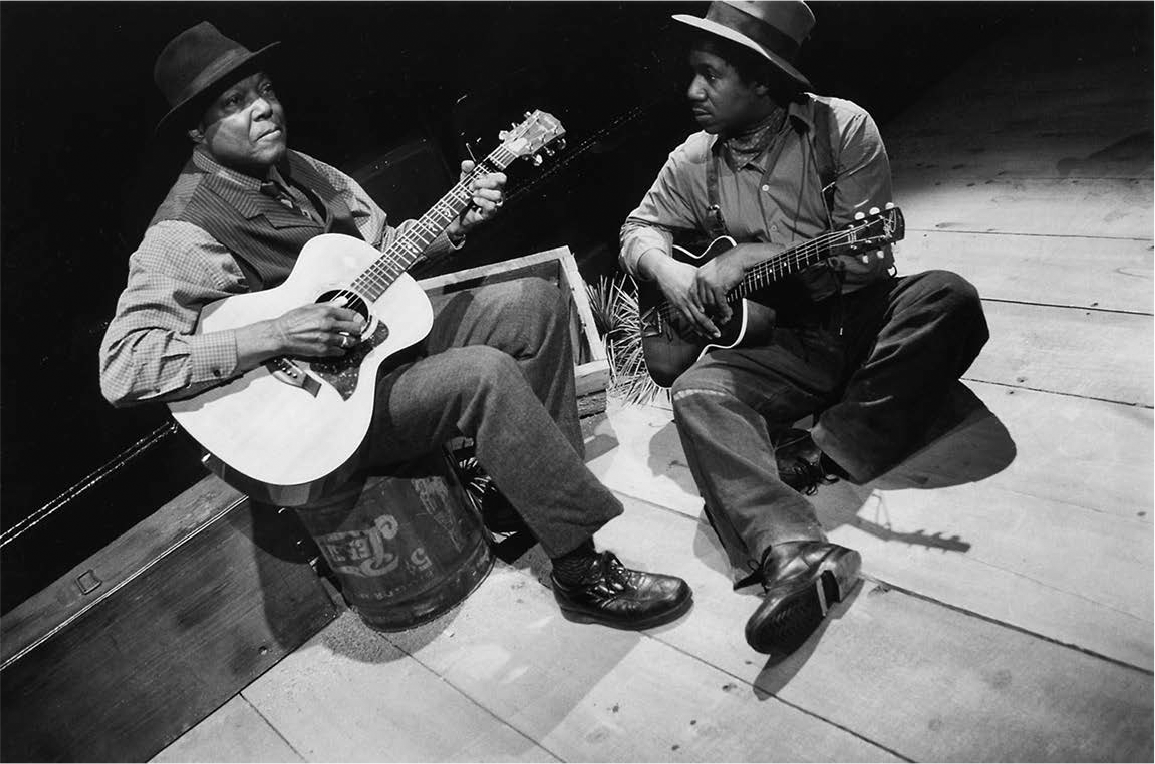
John Cephas on guitar (left) and Clinton Derricks-Carroll as My Honey in Polk County at Arena Stage, Washington, DC, 5 April–12 May 2002. (Photo by Scott Suchman; courtesy of Arena Stage)

Hurston wanted to emphasize the value of community for black folk culture. She created a black community seeking to benefit financially and materially from the music it produces.
Leafy Lee ostensibly finds herself in a world free of white supremacy by migrating from the rapidly integrating North to the rapidly segregating South. Though black people would not receive civil rights until the 1960s and though the US was a white supremacist nation at the time in which the musical is set, Polk County allows characters to experience a kind of autonomy they would not have experienced in the world outside the sawmill camp. Though Quarters Boss oversees the sawmill camp, characters form their own community separately. “Maybe white folks ain’t as smart as some folks thinks they is,” Lonnie says ([1944] 2008:334). Characters are not beholden to the white gaze whether in their own domestic spaces or in the jook joint on the sawmill camp.
Hurston uses what bell hooks calls an “oppositional gaze” with black women: “[A]ll attempts to repress our/black people’s right to gaze had produced in us an overwhelming longing to look, a rebellious desire, an oppositional gaze” (Reference hooks1992:116). Hurston roused the ire of peers who accused her of stereotyping by creating characters that spoke to her vision of how black America looked and sounded. In his review of Their Eyes Were Watching God, Richard Wright famously accused her of
exploiting that phase of Negro life which is “quaint,” the phase which evokes a piteous smile on the lips of the “superior” race. […] Miss Hurston voluntarily continues in her novel the tradition which was forced upon the Negro in the theatre, that is, the minstrel technique that makes the “white folks” laugh. Her characters eat and laugh and cry and work and kill; they swing like a pendulum eternally in that safe and narrow orbit in which America likes to see the Negro live: between laughter and tears. (Reference Wright1937:22–23)
Hurston’s critics, including but not limited to Wright, contend that the representation of the folk perpetuates racial stereotypes. I disagree. Hurston accords value to lives that white supremacy teaches people to dismiss. We need look no further than the stage directions where she writes: “But these people have given the world the blues, work songs, guitar picking in the Negro manner, and the type of piano playing which made Fats Waller famous, and is now being taken up by the world” ([1944] 2008:274). Nor is her work beholden to a “politics of respectability” as defined by Evelyn Brooks Higginbotham:
Respectability demanded that every individual in the black community assume responsibility for behavioral self-regulation and self-improvement along moral, educational, and economic lines. The goal was to distance oneself as far as possible from images perpetuated by racial stereotypes. Individual behavior, the black Baptist women contended, determined the collective fate of African Americans. (Reference Higginbotham1993:198)
The irony is that being respectable is precisely what has made black people susceptible to white supremacy. But by inhabiting the safe spaces of the black women’s blues tradition where the voices of black women are heard fortifying the relationships between black women, Big Sweet and Leafy Lee are shielded from white domination. Traditionally, black musical theatre writers and playwrights have long deployed the traditions of black critical humor and satire to keep speaking truth to power. Characters, most notably in Eubie Blake, Aubrey Lyles, Flournoy Miller, and Noble Sissle’s Shuffle Along (1921) and Eulalie Spence’s The Fool’s Errand (1927), self-govern even as they defend against white hegemonic ambitions. Hurston is not alone in cultivating joy and love as opposed to feelings of anger and fear when it comes to representing the folk.
The black women’s blues tradition aided participating artists in speaking comfortably and freely about gender and race. Hazel V. Carby describes the ways in which Ma Rainey and Bessie Smith—two of the first women to record the blues—were able to contend with becoming sexual objects:
What has been called the “Classic Blues,” the women’s blues of the twenties and early thirties, is a discourse that articulates a cultural and political struggle over sexual relations: a struggle that is directed against the objectification of female sexuality within a patriarchal order but which also tries to reclaim women’s bodies as the sexual and sensuous objects of women’s song. (Reference Carby1986:12)
The black women’s blues tradition allowed participating artists to explore artistic and commercial freedoms that would have been denied them because of their identities. Farah Jasmine Griffin describes the ways in which black women who are disproportionately disadvantaged by both gender and race manage crises not of their own making—from Marian Anderson giving a concert on Easter Sunday 1939 at Lincoln Memorial, Washington, DC, after having been refused by Daughters of the American Revolution the opportunity to rent Constitution Hall, Washington, DC; to Lillias White singing “Come Sunday” on 16 September 2001 at Riverside Church, New York, honoring the victims of the 9/11 attacks: “These various images demonstrate the way the black woman’s voice can be called upon to heal a crisis in national unity as well as provoke one,” so much so that “[i]t also seems to be a conduit between what and where we are and what and where we want to be” (Griffin Reference Griffin, Edwards, Griffin and Robert2004:104, 119). Leafy Lee understands that by coming to the sawmill camp and making a living as a blueswoman down South she will be able to provide for herself economically. Hurston’s use of black women’s vocality centers the concerns and conditions of black women generally as these black women become the soundtrack of the sawmill camp’s inhabitants.
The black women’s blues tradition creates the conditions for Big Sweet and Leafy Lee to make friends with each other. When Leafy Lee arrives, she gets the cold shoulder from others. It is only when Big Sweet takes Leafy Lee under her wing that others start to welcome Leafy Lee. Lonnie and My Honey join in teaching her. Hurston unveils their relationship as it develops by having them sing together.
Hurston’s version of “Ever Been Down Know Just How I Feel” introduces her audience to black women’s blues, which prevails amid antiblack racism and white supremacy. The 12-bar blues song’s lyrics follow what is known to folk musicians as the AAB pattern in which the first (“A”) and second (“A”) lines repeat and the third (“B”) line responds. Here, Big Sweet generates an empathic response in Leafy Lee strong enough to make her understand and mitigate generational trauma at the sawmill camp. Even though anger and fear fester because of the persistence of Jim Crow laws, the lyrics of the third line conclude: “been down so long till down don’t worry me” ([1944] 2008:345). Antiblack racism and white supremacy are strong but not strong enough to steal one’s joy and love of living and working on the sawmill camp.
However, Jim Crow threatens to destroy Big Sweet and Leafy Lee’s men even as the song’s lyrics apply defense mechanisms toward protecting the women. Not unlike Ethel Waters’s “Supper Time” (1933) from the musical As Thousands Cheer, in Polk County music forms a haunting subtext where a black woman, Big Sweet’s persona in her vocal number in the sawmill camp’s jook joint in this case, grieves her man’s lynching by a mob: “I wonder will he answer if I write / I wonder will he answer if I write / I wonder will he answer if I write” ([1944] 2008:345). The lover, in a state of denial about her beloved’s murder, denies reality as does the audience. Even though the song’s lyrics refer to the highs and lows of unrequited love, what lies beneath is the banality of evil with which every lumberman and -woman must contend. Support is ultimately what Big Sweet and Leafy Lee seek just as Hurston uses her metaphor of solitude to underscore the importance of togetherness.
Hurston’s version of “The Fox Hunt (The House that Jack Built)” demonstrates her genius with song and dance by transforming the relationship between actors and audiences. While Lonnie and My Honey play the guitar and the piano, accompanying Big Sweet and Leafy Lee, a drum gives way to an interval that creates the conditions for a dance break. Call-and-response, handclapping, foot-tapping, and singing are infectious, encouraging the audience that is being transformed into jook joint patrons to get in on the action. For this traditional nursery rhyme in which actors sing the very same melody and words one after another, adding a line to each verse, the audience learns the score because the song’s melody and words are continuously repeating. Song and dance bind actors and audiences together, each line of verse longer than the last, and demonstrate what song and dance can do.
The song’s lyrics combine with the sound of a drum offstage to represent the union of northerner Leafy Lee and southerner My Honey. Rather than simply retelling a traditional nursery rhyme in which there are cumulative verses, their song now tells of the organization of the community to function as a form of social action. Big Sweet, Leafy Lee, Lonnie, and My Honey, back and forth, sing together and apart, transforming into each other’s more appealing objects of affection. “Mama, Mama, who is Jack? / Where’s his horse and where is his shack? / Was he true a sawmill man? / Did he skin and play coon-can?” ([1944] 2008:340). The song’s performance in the jook joint is a metaphor for maintaining Big Sweet, Leafy Lee, Lonnie, and My Honey’s relationships with one another.
In domestic spaces and in the jook joint they experience the kind of freedom they do not have outside the sawmill camp. Importantly, we do not see them working as lumbermen and -women. This limits what the audience sees of the extent to which the state, in the person of Quarters Boss, surveils the black women.
Similarities and Differences between the 1944 and 2002 Scripts of Polk County
Hurston registered her 1944 manuscript with the US Copyright Office to protect her copyright. Polk County and its afterlife should be recognized as part of the second wave of Hurston studies ushered in by novelist Alice Walker, for whom Hurston remains a literary family member. In 1997, a cache of Hurston’s musicals in the Copyright Deposit Drama Collection at the Library of Congress was rediscovered. “At that time, only Polk County was at all familiar to scholars on the basis of copies in other repositories” according to the Library of Congress (LOC n.d.). The new material was the basis for the Arena Stage and the Library’s presentation of Polk County as “[a] premier concert reading featuring unpublished archival resources” in 2000 at the Coolidge Auditorium, Washington, DC, in honor of the semicentennial of the Arena Stage and the bicentennial of the Library (Arena Stage Reference Stagen.d.).Footnote 5 The centrality of black women to the life of the sawmill camp is what attracted dramaturg Cathy Madison to Big Sweet and Leafy Lee: “There were several reasons I was excited […] First, the incredibly strong black women. You would think that, because it’s set in a sawmill lumber camp, it would be about the men, but it focuses on these really fierce women” (in Bass Reference Bass2002:51). In 2002 the Arena Stage presented a new version of Polk County—directed by Kyle Donnelly, adapted by her and Madison, with a score by composer Stephen Wade—in the Arena’s main space, the Fichandler Stage. The irony is that the Arena Stage’s revised Polk County was not the musical as written. Because of its “people-of-color-blindness” (see Sexton Reference Sexton2010), the Arena Stage cut all references to “Negro” from the title of the musical. This had the effect of stripping Polk County of its racial specificity. Was this so as not to offend the predominantly black theatregoers who make up the Arena Stage, or to not scare white ticket buyers? In 2004/05, the Berkeley Repertory Theatre, Berkeley, CA, and McCarter Theatre Center, Princeton, NJ, jointly presented Polk County, including a score by composer Chic Street Man on top of new revisions by Donnelly and Madison.
Reception at the Arena Stage was mixed. In Variety, Paul Harris noted, “An exceedingly thin plot follows the group’s reaction to the arrival of an affable young white woman who seeks lodging and companionship” (Reference Harris2002:30). Referring to Leafy Lee as a “white woman,” based on nothing but the looks of the actress in the part (Gin Hammond), Harris misunderstands the tragic mulatto(a) archetype Hurston deconstructs. In the Baltimore Sun, Mary Carole McCauley finds fault with the language Hurston uses: “The script is replete with such obsolete expressions as ‘stomp-down fan-foot’—and it doesn’t help that the setting requires a thick Southern drawl. During a recent performance, I had trouble deciphering chunks of the dialogue. I could follow the broad outlines of the plot, but too often, the nuances were lost” (Reference McCauley2002:1D). McCauley, rather than embracing the dialect as characteristic of an oppositional gaze, reads it as a dramaturgical flaw. Lindsey Andrews describes the ways in which Hurston asks interpretive communities how they know what they know:
Participating in this often unseen tradition, Hurston and Combahee [River Collective] took blackness itself (in multiple valences, physical and cultural) as an epistemological virtue, and mobilized aesthetic values such as opacity, indiscernibility, improvisation, and flux in order to compose an alternative scientific legacy that does not primarily value experience retrospectively as the ‘evidence’ of/for knowledge and expertise, but instead values it as the ongoing condition of thought, as immanent, performative, embodied knowledge. (Reference Andrews2015:7)
Hurston was and remains both visible and invisible to her interpretive communities.
The video of Polk County performed in the round at the Arena Stage reveals the revisions Donnelly, Madison, and Wade made to Hurston’s characters, plot, and songs. In Polk County 1944, a desire to learn how to sing the blues motivates Leafy Lee to run away from New York. In Polk County 2002, a desire to reunite with her father who is alive and well and living in Polk County and is Quarters Boss’s cousin motivates her.
Polk County 2002 blurred the lines between diegetic and nondiegetic music by sharing the responsibility for playing the score among actors and musicians as well as reassigning songs to different characters. My Honey (Clinton Derricks-Carroll) accompanied occupants of the sawmill camp and himself on guitar where appropriate. In instrumental and vocal numbers, musical interludes, and scene changes, a band of five musicians provided additional accompaniment for actors: Morris Ardoin on accordion, fiddle, percussion, and washboard, John Cephas on guitar, Daryl Davis on piano and pump organ, Norvus Miller on trombone, and Phil Wiggins on harmonica.
The reassignment and, in some cases, elimination of instrumental and vocal numbers streamlined an otherwise unwieldly text, giving the black actors plenty to do. Instead of a quartet for women, a soloist who accompanied My Honey now sang “Careless Love.” Instead of a number for Big Sweet and ensemble, “John Henry” became a duet for Big Sweet and Leafy Lee in which the former taught the latter how to sing the blues, what Stacy Wolf calls a “female pedagogical duet” (Reference Wolf2011:50). Instead of a number for Sop-The-Bottom and ensemble, “Let the Deal Go Down” became a solo for My Honey who watched other men play a game of cards in tableaux. These instrumental and vocal numbers are not character-specific so reassigning them did not matter.
The most glaring problem with the 2002 production was the omission of Hurston’s precise dance notations. As choreographed by Dianne McIntyre and Earl White, Polk County 2002 did not feature any of the dances Hurston documented. Nor did McIntyre and White as choreographers use all of the musical staging common to black American culture to advance the plot, which included the “dances in jooks” listed by Katrina Hazzard-Gordon: “the Charleston, the shimmy, the snake hips, the funky butt, the twist, the slow drag, the buzzard lope, the black bottom, the itch, the fish tail, and the grind” (Reference Hazzard-Gordon1990:83). McIntyre and White’s choreographic labors at best had a passing resemblance to these dances, which are so important to community fellowship and courting.
What distinguished the Arena Stage production of Polk County were three black women creative team members for the regional theatre world premiere in 2002. Dramaturg Madison, then a freelance staff member at the Arena Stage, collated and cut the Hurston text; choreographer McIntyre, a veteran of Broadway, Off-Broadway, regional theatre, and the West End who has also choreographed concert dances for Alvin Ailey American Dance Theater, Dance Theatre of Harlem, Philadanco!, and Sounds in Motion, helped actors find their characters through embodiment. Hurston’s collaboration with them across space and time therefore conveyed the significance of black women serving as custodians of expressive culture on the stage.
Zora Neale Hurston and the Legacy of Alice Walker’s The Color Purple
Hurston’s artistic legacy with regard to creating safe spaces for black women comes full circle with Alice Walker’s 1982 novel The Color Purple. John Carlos Rowe asserts, “Shug Avery and Celie’s friendship in The Color Purple has certain echoes of Big Sweet’s friendship with Zora in Mules and Men, although Walker develops Shug and Celie’s friendship in ways integral to her plot” (Reference Rowe2000:358n27). Composer and lyricist Brenda Russell, musical director Linda Twine, and Alice Walker gave the original 2005 Broadway musical based on the Walker novel the black feminist credibility it required. Three black women working on musical direction, score, and source material was as important as the three black women performing featured and leading roles (see Phillips Reference Phillips2004).
The Color Purple changed public opinion about musical theatre by and about black women. A revival was first presented on 5 July 2013 at the Menier Chocolate Factory in London. This production was a big success on Broadway at the Bernard B. Jacobs Theatre from its opening on 10 December 2015 to its closing on 8 January 2017. The Color Purple is marked by gender and race but not at the expense of its womanist stance. The musical’s book by Marsha Norman revolves around a black woman who finds God in herself and in her voice in the wake of repeated episodes of childhood sexual abuse at the hands of her stepfather.
The musical—lyrics and music by Stephen Bray, Brenda Russell, and Allee Willis—built on the vernacular traditions of black African chant, black girls’ handclapping games, the blues, field hollers, gospel, jazz, prayers and sermons, rhythm and blues, spirituals, and work songs, focusing especially on black women who survived and even thrived under Jim Crow. Poor, black, and ugly in the eyes of white supremacists, Celie (2016 Tony Award® winner for acting Cynthia Erivo) organizes the community (Georgia during the period 1909–1949) after Nettie ( Joaquina Kalukango), Celie’s sister, has been forcibly ejected from their hometown after refusing the unwanted sexual advances of Mister (Isaiah Johnson), Celie’s husband. Together Shug Avery (Heather Headley), a blueswoman in the style of Bessie Smith, and Sofia (Danielle Brooks), a blustering browbeating man-eater, help her achieve her potential as proprietor of Miss Celie’s Pants, a couturier. Between writing Nettie letters and awaiting her return, Celie chooses to no longer be, as Hurston describes it, “de mule uh de world” ([1937] Reference Hurston1991:19–20). These events are given texture and tonality by both spoken and sung musical numbers supported by bass, drums, gesture, guitar, keyboard, reeds, and trumpet.
John Doyle—known for restaging Stephen Sondheim musicals—directed and choreographed the revival of The Color Purple. Doyle rethought the 2005 production in terms of his own set design, Ann Hould-Ward’s costumes, Jane Cox’s lighting, and Gregory Clarke’s sound. The set was a patchwork of furniture and woodwork that focused the audience’s attention on the actors.
If the original Broadway production successfully adapted for the stage the breathtaking panorama of Warner Brothers’ 1985 Academy Award–nominated film version of Walker’s 1982 Pulitzer Prize–winning epistolary novel, then the revival Broadway production successfully made the interactions between actors and audiences the most important part of the show. Methexis on the part of actors and audiences created the conditions for retelling the story. The audience in the theatre was designated as the faithful who were called to church by a Church Lady (Carrie Compere) with her ad-lib, “Here we go”—the “we” bringing them into the fold. In the song “Mysterious Ways” at the beginning of act 1 the Church Lady sang to us in dark vocal tones: “It’s Sunday morning […] / So make a joyful noise,” as she shook hands with those sitting in seats closest to the stage. “Joyful! / Joyful!” other Church Ladies (Bre Jackson and Rema Webb) sang to us (in Funderburg Reference Funderburg2006:113). One of them (Webb) climbed to the top of her soprano range through her chest to head voice and back. We became regulars at Harpo’s Juke Joint where Harpo (Kyle Scatliffe) gave us instructions: “Fill your glasses up and sit your asses on down.” We became Celie’s kith and kin who were welcomed back with Mister and Nettie at a large gathering for family and friends in her new home at the end of act 2.
Danielle Brooks did her part in creating safe spaces for black women as the powerful Sofia. Erivo received a standing ovation for her masterly performance as the vulnerable Celie when she sang her eleven o’clock number, “I’m Here”: “I’m beautiful / Yes, I’m beautiful / And I’m here” (in Funderburg Reference Funderburg2006:173). Headley devoted herself body and soul to the cause of breathing new life into the role of the attractive Shug Avery. Erivo and Headley’s duet at the end of act 1, “What about Love?,” a subjunctive love song in the tradition of Rodgers and Hammerstein, was the highlight. Celie was taken by surprise by Shug Avery who stole a kiss from her in a bit of stage business: “Is that me who’s floating away? / Lifted up to the clouds by a kiss / Never felt nothin’ like this” (149). They openly declared their love for each other in front of the ensemble who had entered the stage as observers but then joined in a crescendo by singing responsive alternations of the refrain “what about” in the climax and dénouement of the duet.
The House that Heirs to Hurston’s and Walker’s Musical Theatre Will Build
What remains to be seen is whether the joy and the love cultivated by Hurston and Walker thrive. Because of the uncritical acceptance of the established canon on both Broadway and in the regional theatre, many felt that Hurston fell short of the standards met by her peers. However, her vision of herself as an agent for social change reminds us that artists at their best complicate rather than complement. By foreshadowing Toni Morrison who asks in Song of Solomon, “Can’t I love what I criticize?” ([1977] Reference Morrison2004:223), Hurston demonstrated the ways in which an act of criticism was also an act of love. Seeing musicals that were more often than not white artistic representations of blackness compelled her to write musicals of her own. By looking at the theatrical representation of black women in Polk County, it is possible to see new ways to resist the intersecting oppressions of gender and race. The message of Polk County to black feminist musical theatre writers yet unborn is that it matters who writes and who tells your story.