

Introduction
Enhancing the immune system of birds against different infectious pathogens and thereby improving their growth performance is necessary to maintain the welfare of poultry production in the face of increasing demand worldwide for animal protein (Tiwari et al., 2018). To achieve this, antibiotics have been extensively used in poultry for treating and preventing infectious diseases and at sub-therapeutic levels in feed as growth promoters. However, this extensive use has resulted in drug-resistant pathogens and the accumulation of drug residues (Windisch et al., Reference WINDISCH, SCHEDLE, PLITZNER and KROISMAYR2008). Therefore, the use of antibiotics as growth promoters in poultry has been restricted in increasing numbers of countries (Ohimain and Ofongo, Reference OHIMAIN and OFONGO2012). The use of natural medicinal and herbal plants and their products as feed additives for poultry has been reported to enhance the immunity, reduce the stress and microbial load and improve the growth rate in different birds making them a promising option as alternatives to antibiotics and other chemical ingredients (Dhama et al., Reference DHAMA, KARTHIK, KHANDIA, MUNJAL, TIWARI, RANA, KHURANA, SANA ULLAH, KHAN, ALAGAWANY, FARAG, DADAR and JOSHI2018).
Astragalus membranaceus (AM) is a perennial herb belonging to the Leguminosae family. It is known as Huangqi in Chinese and Radix Astragali in Latin (Jia et al., Reference JIA, CAO, XU, JENEY and YIN2012). AM has been widely used in traditional Chinese medicine (TCM) as an immune enhancer, in treating the common cold, anorexia, fatigue, cardiovascular disorders and diarrhoea (Figure 1). The dried roots of AM contain numerous bioactive compounds such as polysaccharides, astragalosides, flavonoids, saponins, trace elements and amino acids (Zhao et al., Reference ZHAO, WANG, ZHANG, CHEN, SUI, CHEN, LIU and ZHANG2012). These various constituents are reported to be responsible for the multifunctional biological and pharmaceutical properties of the AM root, especially the polysaccharides fraction. Astragalus polysaccharides (APS) have been reported to possess immune regulating, anti-oxidant, anti-virus, anti-stress, anti-aging, anti-radiation and anti-cancer activities (Li and Zhang, Reference LI and ZHANG2009). In addition to its immunomodulatory role, APS show anti-viral, anti-bacterial and anti-parasitic activities in chickens. APS supplementation in poultry feed (220 mg/kg) has been shown to improve the humoral and cellular immunity (Li et al., Reference LI, ZHAO and WANG2009).
Astragalus membranaceus (Latin), huang qi (Chinese), membranous milk-vetch root (English), hwanggi (Korean) and ogi (Japanese) is one of the important “Qi tonifying” adaptogenic herbs from the Chinese Traditional Medicine.

The immune enhancing activities of APS have been studied both in vitro and in vivo and different mechanisms of action have been suggested. APS promoted the proliferation of lymphocytes (T and B cells) induced by lipopolysaccharide (LPS) and concanavalin A enhanced T lymphocytes transformation, natural killer (NK) cells and B lymphocyte activities, immune organs index and antibody titres, promoted the expression of cytokines (Qiu et al., Reference QIU, CUI, HU, DONG and ZHANG2009) and, hence, improved the defensive immunity. APS has been used as immunologic adjuvant in preparation of some vaccines such those used against bursal disease virus (IBDV) Newcastle disease virus (NDV) and infectious bursitis (Chen et al., Reference CHEN, SHANG, YAO, CUI, ZHANG, WANG, JIN, LI and JIN2011) due to its effective immunostimulatory impact. The present review describes the structure and chemical composition of AM and its immunomodulatory role for improving the health status of poultry and the different mechanisms by which it performs this role.
Structure and chemical composition of AM
AM has an apparently uniform chemical composition. The principle bioactive components are polysaccharides, saponins and flavonoids, in addition to other components like phenolic acids, amino acids and sucrose (Zhang et al., Reference ZHANG, XISHENG, CHEN and PING2009). The dried roots of AM contain flavonoids, polysaccharides and the saponins astragalosides as the main bioactive components responsible for its pharmaceutical activities, especially the polysaccharides. AM contains various polysaccharides such as astragalan I, II and III (APS-I, and APS-II and APS-III). APS-I is a carbohydrate chain composed of glucose and arabinose, while, APS-II is a chain of glucose, arabinose and rhamnose. APS- III is composed of D-glucose only. AM contains astragalin (Kaempferol-3-O-b-Glucoside) as the most prominent polysaccharide (Tang and Eisenbrand, Reference TANG and EISENBRAND1992).
AM contains steroidal saponins called astragalosides which have been classified in to seven classes, designated I to VII, according to the cylcoastragenol backbone (Zhu et al., Reference ZHU, HIGGS, MOREHOUSE, STREICHER, AMBROSE, WOO, KEMBLE, JALLAL and YAO2010) in addition to isoastragalosides, I-III (Zhang et al., Reference ZHANG, LIU, HSIAO, YANG, LEE, WU, CHIOU and KUO2011). The flavonoids (flavones, flavolins, flavonols and isoflavones) in AM are always presents in glycosidic or free forms (Ibrahim et al., Reference IBRAHIM, MARZOUK, HUSSEIN, KAWASHTY, MAHMOUD and SALEH2013). AM contains pigments, including astrapterocarpan, astraisoflavan, formononectin, isoliquiritigenin and 2’-3’-dihydroxy-7 4’-dimethooxyisoflavone (Lin et al., Reference LIN, HE and LINDENMAIER2000). Astragalosides IVII, calycosin, D-ß-asparagine, cycloastragenol, betaine, choline, sucrose, kumatakenin, glucuronic acid, soyasaponin and ß-sitosterol1 were found in AM as major constituents. The compounds in oil obtained from AM seeds are oleic acid, linoleic acid and linolenic acid in addition to stearic and palmitic as the major saturated fatty acids (Yin et al., Reference YIN, TANG, DAI, LIU, WU, SUN, YANG, HOFFMAN, LI and ZHANG2015).
Immunomodulatory effects of AM
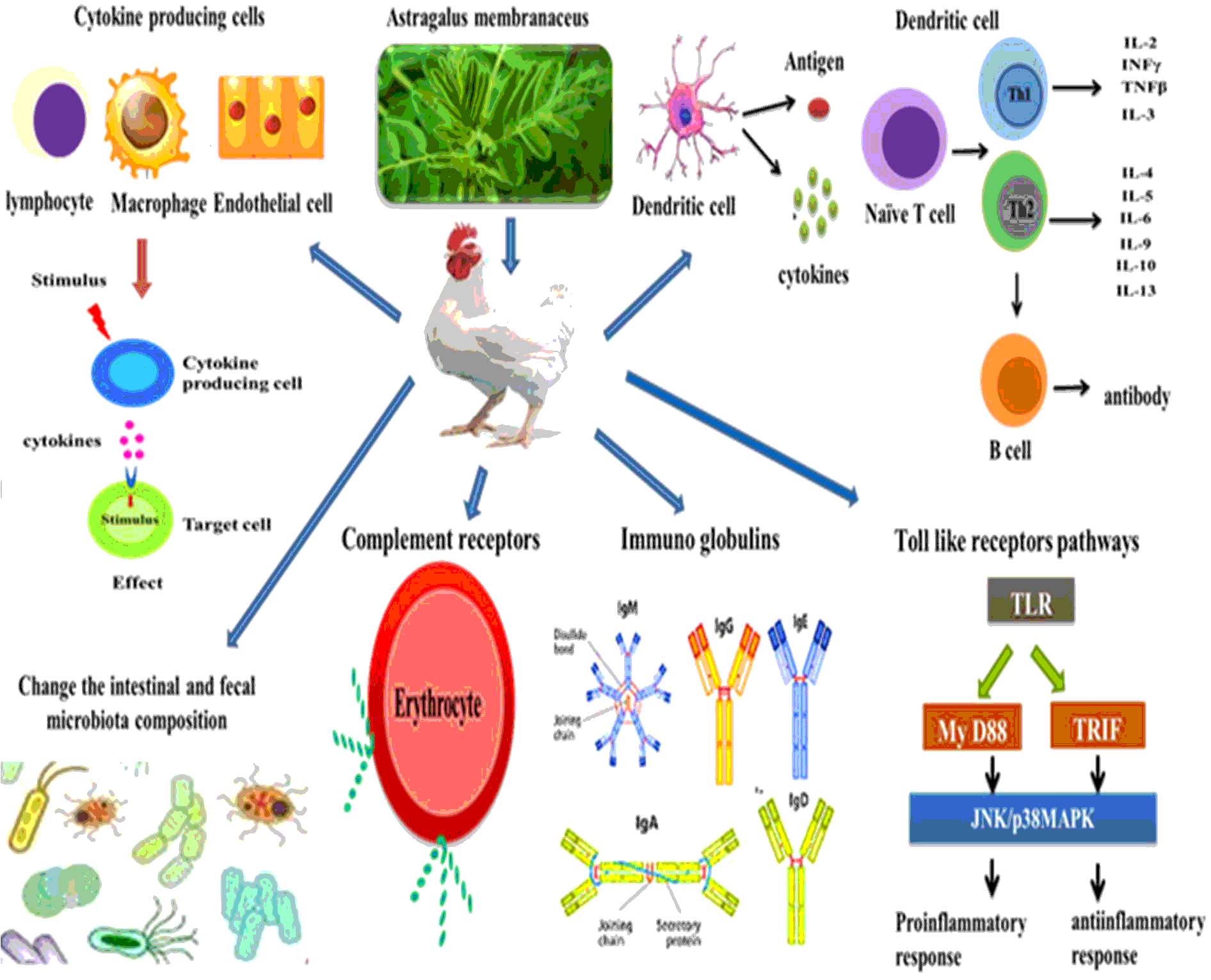
Immunomodulatory effects of AM have been demonstrated in many in vivo and in vitro studies (Table 1). In addition, Figure 2 shows mechanism of immunomodulatory activity of Astragalus membranaceus in poultry.
The mode of immunomodulatory effects of A. membranaceus and its fractions.

Mechainsm of immunomodulatory effects of Astragalus membranaceus in poultry.
Lymphocytes proliferation
Lymphocytes have an important role in the activation of humoral and cellular immunity cascades. Both B and T lymphocytes can enhance the function of the immune system, where B lymphocytes mediate humoral immune responses against infections (Qiu et al., Reference QIU, HU, CUI, ZHANG and WANG2007). T cells (thymus derived lymphocytes) take part in adaptive immunity through generation and regulation of the immune response to different antigens (Chen et al., Reference CHEN, TAN and CHAN2008). Therefore, the proliferations of lymphocytes (both B and T cells) can be used as indicators in evaluating cellular immunity status of the animal in addition to understanding the mechanism of action of various compounds.
T-lymphocytes positive to acid α-naphthylacetate esterase showed a high percentage of proliferation in blood of chicks exposed to APS (Li et al., Reference LI, ZHAO and WANG2009). APS can increase the proliferation of T-lymphocyte in chickens subjected to the immunosuppressive agent, cyclophosphamide (CY) (Guo et al., Reference GUO, LIU, HU, WANG, LI, ZHANG, QIN, LIU, LIU, ZHAO, FAN, HAN and NGUYEN2012) and in ND vaccinated chickens (Chen et al., Reference CHEN, WANG, HU, GUO, WANG, ZHAO, FAN, GUO, YANG, SAI and XING2010). Inclusion of APS in the adjuvant solution of ND vaccine (strain I) in a combination with selenoprotein and levamisole enhanced the proliferation of T cells in Hy-Line brown chickens (Sun et al., Reference SUN, XIE, HE, JIANG, NIU, BAI and LI2013). APS promoted the lymphocyte proliferation and gave beneficial effects as an adjuvant for the avian infectious bronchitis virus (IBV) vaccine, manifested by modulating the humoral and cellular immune responses of chickens (Zhang et al., Reference ZHANG, LIUB, LIUA, WANGA, LIUA, LIA and WU2017a).
APS liposome (APSL) promoted the proliferation of B and T lymphocytes singly and exhibited a synergistic effect with lipopolysaccharides (LPS) and phytohaemagglutinin (PHA) in ND vaccinated chickens indicating the ability of APSL to improve the vaccine activity and adjuvanticity of APS (Fan et al., Reference FAN, HU, WANG, LIU, ZHANG, ZHAO, LIU, LIU, YUAN and RUAN2012). APS and sulphated APS (SAPS), included at 4 or 8 mg/kg of body weight, showed immunomodulatory effects in broiler chicks challenged with LPS and modulated any negative effects of LPS, manifested as decreased daily weight gain and feed intake and reduced number of intraepithelial lymphocytes and villus height in the jejunum. Additionally, APS and SAPS could reduce the higher feed conversion ratio, nitrous oxide (NO) plasma concentration, production of NO by T lymphocytic cells and heterophil: lymphocyte (H: L) ratio induced by LPS (Wang et al., Reference WANG, LIA, SHENA, WANGA, YAOA and YANGA2015).
Cytokines
Cytokines are essential immune mediators which regulate the immune response to vaccines and natural infections. The level of cytokines increased in blood serum following vaccination and stimulation of the antigen as a result of T lymphocyte activation (Zhu et al., Reference ZHU, HIGGS, MOREHOUSE, STREICHER, AMBROSE, WOO, KEMBLE, JALLAL and YAO2010). The balance between Th1 and Th2 cells is important to maintain the normal immune functions of the organism (Qiu et al., Reference QIU, CUI, HU, DONG and ZHANG2009). There are some factors, such as interferon gamma (IFN-γ) and interleukins (IL-2, IL-4 and IL-10), which are highly correlated to Th1 and Th2 cells, which could be used as indicators to reflect the state of humoral and cellular immunity.
IFN-γ and IL-2 are secreted mainly by activated T lymphocytes (Th1 cells) and can enhance cellular immune response. IFN- γ is an essential molecule which exerts its immunoregulatory function through enhancing the immune response against pathogenic microorganisms (Fan et al., Reference FAN, LU, WANG, LIU, SONG, ZHANG, ZHAO, NGUYEN and HU2013). IL-2 is important for the differentiation and proliferation of natural killer cells (NK), promoting the secretion of immunoglobulins from B cells and the differentiation of T cells in effector T cells (Yuan et al., Reference YUAN, ROSHDY, GUO, WANG and GUO2014). Therefore, the changes in sera concentrations of IFN-γ and IL-2 can be used as indicators for cellular immune response. IL-6 can promote IgA secretion and induce B-cells proliferation (Yang et al., Reference YANG, QIN and ZHU2009). While, IL-10 can regulate the balance between pathogen response and host defence. IL-4 and IL-10 are secreted from theTh2 cells and play an important role in humoral immunity through promoting the B cell proliferation and production of antibodies (Schneider et al., Reference SCHNEIDER, KLAAS, KASPERS and STAEHELI2001).
IL-12 can activate NK and T-lymphocytes and enhance their cytotoxic activities. It can stimulate the growth and function of T cells and help naïve T cells to be differentiated into Th1cells (Hsieh et al., Reference HSIEH, MACATONIA, TRIPP, WOLF, O'GARRA and MURPHY1993). It can stimulate T and NK cells to produce IFN-γ and tumour necrosis factor-alpha (TNF-α) and reduce the suppression of IFN-γ mediated by IL-4. TNF contains in a network of chemokines and cytokines which enhanced the recruitment of the cells of immune system in the foci of infection and could interfere with the life cycle of viruses inhibiting their replication (Herbein and O'Brien, Reference HERBEIN and O'BRIEN2000).
APS increased antibody titre and promoted the secretions of IFN-γ, IL-2, IL-4 and IL-10 significantly in chickens vaccinated against ND (Chen et al., Reference CHEN, WANG, HU, GUO, WANG, ZHAO, FAN, GUO, YANG, SAI and XING2010). The same results were obtained with APS, indicating its ability to improve vaccine activity and the adjuvanticity of APS (Fan et al., Reference FAN, HU, WANG, LIU, ZHANG, ZHAO, LIU, LIU, YUAN and RUAN2012). Inclusion of APS in the adjuvant solution of ND vaccine (strain I) for Hy-Line brown chickens in combination with selenoprotein and levamisole enhanced the expressions of IL-2, and IL-6 (Sun et al., Reference SUN, XIE, HE, JIANG, NIU, BAI and LI2013). APS in combination with sulphated epimedium polysaccharide promoted immune organ development, proliferation of lymphocyte and enhanced concentrations of the IFN-and IL-2 and the antibody titre against ND (Chen et al., Reference CHEN, CHEN, QIU, HU, WANG, LIU, ZHAO, LIU and CHEN2013). The stems and leaves in ultrafined powder of AM (1 or 1.5%) could boost the immunity of Hyaline brown chicks vaccinated by ND vaccine, as manifested by the significant increase of antibody titres and the serum contents of IL-2 and IFN-γ (Xi et al., Reference XI, KANG, HAO, LI, BAO and SHI2014). In a similar way, APS could promote the humoral immunity of chickens inoculated with H9N2 avian influenza virus (H9N2 AIV) by decreasing the virus replication, increasing the antibody titre and enhancing the levels of IL-4, IL-6, IL-10, LITAF and IL-12 (Kallon et al., Reference KALLON, LI, JI, CHEN, XI, CHANG, XUE, MA, XIE and ZHANG2013).
Oral administration of APS could be used as an adjuvant during the preparation of the H5N1 vaccine for broilers, as it improved the immune response of birds by increasing the expression and the levels of IL-2, IL-10, TNF and IFN- γ, enhancing the Ig antibody level in serum in addition to improving daily weight gain (Abdullahi et al., Reference ABDULLAHI, KALLON, YU, ZHANG and LI2016). Zhang et al. (Reference ZHANG, LIUB, LIUA, WANGA, LIUA, LIA and WU2017a) used APS as an adjuvant for avian infectious bronchitis virus (IBV) vaccine to improve the humoral and cellular immunity of chickens. They found that lymphocyte proliferation, antibodies titre against IBV and mRNA expression levels IL-1β, IL-2, IL-8, and TNF-α were increased in the APS groups. The antiviral activity of APS against IBV was examined in vitro in chicken embryo kidney (CEK) cells. APS inhibited the replication of the virus and moderated IBV-induced inflammatory responses, as indicated by the reduction of mRNA expression of some cytokines (IL-6, IL-8 TNF-α and IL-1β) associated with viral replication (Zhang et al., Reference ZHANG, LIUB, LIUA, WANGA, LIUA, LIA and WUA2018).
Immunoglobulins
Immunoglobulins, particularly IgG and IgM, are essential for the immune response, opsonisation, complement activation and toxin neutralisation (Guo et al., Reference GUO, LIU, HU, WANG, LI, ZHANG, QIN, LIU, LIU, ZHAO, FAN, HAN and NGUYEN2012). These authors reported that the production and level of IgM and IgG were increased in immunosuppressed chickens administered with APS, indicating its ability to improve the humoral immune response. Inclusion of APS in the adjuvant solution of the ND vaccine (strain I) in a combination with selenoprotein and levamisole increased the level of IgG in Hy-Line brown chickens (Sun et al., Reference SUN, XIE, HE, JIANG, NIU, BAI and LI2013). APS could potentiate the immune response of ND vaccinated, 14 day old chicks through enhancing the anti ND antibody titre, increasing the number of cells secreting IgA, significantly increasing the levels of IgA showing maximum expression in the duodenum and cecum tonsil and stimulating the humoral and mucosa immune response (Qiu et al., Reference QIU, HU, DONG, WANG and ZHAO2013). Zhang et al. (Reference ZHANG, YU, SHI, LIU, ZHANG, ZHAO, LI and GE2017b) similarly reported that APS increased the serum content of IgA in chickens. Supplementation of AM root powder (AMRP) in Cobb 500 broiler feed at different levels (0, 100, 200 and 300 mg /kg diet) significantly increased the weight of immune organs and the level of IgG and improved liver and kidney function and antioxidant status of the broilers (El-Shafei et al., Reference EL-SHAFEI, AL-GAMAL, ABDELRAHMAN and ARAFA2013).
Dendritic cells (DCs)
Dendritic cells (DCs) are involved with powerful antigen activity in the immune systems, which perform essential functions in the initiation of the response of T cell against tumours and bacterial pathogens, and as messengers between the adaptive and the innate immune systems (Sun, Reference SUN2011). APS has been found to induce phenotypic maturation of DCs effectively. APS stimulated the maturation of chicken bone-marrow-derived dendritic cells (chBM-DCs) in vitro through reducing interferon regulatory factor 3 (IRF-3) expression (Lin et al., Reference LIN, KANG, LIANG, FU, YU and YANG2015).
Toll like receptors (TLRs)
Toll-like receptors (TLRs) are a group of PRRs (pattern-recognition receptors) that perform a pivotal function in induction of immune responses and recognition of potential threats. Leukocytes, including eosinophils, neutrophils , dendritic cells , macrophages and mast cells, adaptive immunity cells (B and T lymphocytes) and non-immune cells (endothelial and epithelial cells, adipocytes, fibroblasts and cardio-myocytes depend on TLRs in recognition of different pathogens (Delneste et al., Reference DELNESTE, BEAUVILLAIN and JEANNIN2007). TLRs are the main receptors in the intestine, and their ligation with the different bacterial products promotes the proliferation of intestinal epithelial cells (IECs). The immunity of intestinal mucosa could be implicated in the activation of the immune system in the organism through blood circulation (Qin et al., Reference QIN, QIU, SUN, JIAO, ZHANG, CHE, ZHAO, SHEN and YIN2016). TLR4 displays its signalling via two opposite pathways (MyD88 and TRIF). MyD88 pathway mediates the early activation of NF-kB, affecting the inflammatory responses. The TRIF pathway mediates the activation of NF-kB in the late phase, affecting the immune function in the removal of pathogens and anti-inflammatory responses in the intestinal mucosa. NF-kB is an important immunomodulatory regulator which maintains barrier integrity and the continuous replacement of epithelial cells (Kawasaki and Kawai, Reference KAWASAKI and KAWAI2014).
Detection of APS by IECs depends mainly on TLR4 signalling pathways as a principal molecular mechanism. APS activated the TLR4 related immune response and up-regulated the expression of a large number of cytokines and regulators (Wei et al., Reference WEI, XIAO, BAO, MA, LEUNG, HAN, KO, LAU, WONG and FUNG2016). Li et al. (Reference LI, LEI, YIN, GUO, WU and YANG2018a) investigated the transgenerational effects of paternal dietary supplementation with APS in chickens by supplementing Avein breeder cocks and using them in hatching experiments to obtain the broiler chicks. Dietary APS (10 g/kg) in transgenerational studies promoted the growth rate and the histology of jejunum of offspring chickens which were stimulated by the IFNα-SOCS1 pathway related endotoxin tolerance-like (ET) immune response in the intestinal mucosa. IFNα could modulate the immunity of spleen and the activities of signalling pathways related to immunity through the blood circulation (Labzin et al., Reference LABZIN, LAUTERBACH and LATZ2016). Li et al. (Reference LI, LEI, YIN, GUO, WU and YANG2018b) reported the same effects of the paternal dietary APS on promoting spleen immunity in offspring chickens and induction of ET-like immune response in the TLR4 pathway. They related these effects on the enhancement of intestinal mucosal immunity, however, the spleen activity of the TLR4 signalling pathway was not altered in breeder cocks supplemented with APS.
APS could reverse the negative effects of LPS in chickens by decreasing the upregulated NF-kB and TLR4 caused by LPS and decreasing the proinflammatory cytokines (IL-6 and IL-1β). It could ameliorate the increased mRNA expressions of hemopexin and y+LAT2 and avian uncoupling protein, α1-acid glycoprotein and enhance the digestibility of amino acids and improve protein metabolism and energy availability (Liu et al., Reference LIU, SHEN, CHAO, WANG, JUNHU, YUESHENG and XIAOJUN2015). APS activated the chicken TLR4 (chTLR4) pathway in the bursa of Fabricius in the MyD88-independent pathway through increasing the mRNA expression and protein contents of chTLR4 including chNF-κB, chTRIF, chMyD88, chIRF3, chTNF-α and chIFN-β (Zhang et al., Reference ZHANG, YU, SHI, LIU, ZHANG, ZHAO, LI and GE2017b).
Erythrocyte immune adherence
Altering the immune adherence of erythrocytes is highly important for the immune status and development of organisms and their recovery from different infections (Guo et al., Reference GUO, QIAN and ZHANG2002). Erythrocytes achieved their immune functions via the erythrocyte complement receptor type1 (E-C3b) on their membranes. E-C3b act as an inert shuttle for circulating immune complex (IC) as it directs the IC safely to the organs of reticuloen-dothelial and the monocyte phagocytic systems including spleen and liver, thereby it regulates the IC complement activation and prevents the deposition of IC in vulnerable tissues, protecting them from injury (Miyaike et al., Reference MIYAIKE, IWASAKI, TAKAHASHI, SHIMOMURA, TANIGUCHI and KOIDE2002). Hong-quan et al. (Reference HONG-QUAN, REEVE-JOHNSON and JUN-DONG2007) demonstrated that APS can enhance the immune adherence of erythrocytes of leghorn chickens infected with infectious bursal disease virus (IBDV) by enhancing the number and/or the activity of complement receptors present on the membrane of on the erythrocytes such as erythrocyte-C3b immune complex rosette rate; E-ICRR and erythrocyte-C3b receptor rosette rate; E-C3bRR. Similarly, Jiang et al. (Reference JIANG, WU, GAO, SONG and LI2010) suggested that injection of 5 and 10 mg APS for six days could enhance the erythrocyte immunological function in 26 days old Hyline white chickens inoculated with IBDV through improving the activity of E-ICRR, E-C3bRR and erythrocyte rosette forming enhancing rate (ERER).
Microbiota composition (microbial community)
Addition of crude AM at 0.5% in the feed of 11-week-old hens for 21 days was able to change the composition of faecal microorganisms, where it increased Lactobacillus spp. and decreased Romboutsia spp. (Qiao et al., Reference QIAO, ZHANG, HONGTAO, SONG and BIAN2018). APS enhanced the growth of Mycoplasma gallisepticum infected chickens through increasing the count of beneficial bacteria (Lactobacilli and Bifidobacterial spp.) and reducing harmful ones (Escherichia coli and Bacteroides spp.). In addition, APS significantly affected the microbial populations and viscosity in the caeca (Guo et al., Reference GUO, WILLIAMS, KWAKKEL, LI, LI, LUO, LI and VERSTEGEN2004). APS in the feed of Hy-Line chicks could produce a synergistic effect with probiotics on the intestinal microbiota, as it significantly increased the number of Bacillus cereus and Lactobacilli spp. However, it decreased the number of the Escherichia coli. Its synergistic effect with probiotics can affect the immune response of chicks, as manifested by increasing the ND antibody titre, promoting lymphocytic proliferation and the relative weight of immune organ and modulating histological changes (Li et al., Reference LI, ZHAO and WANG2009).
Conclusions
Medicinal and herbal plants and their derived compounds are widely used as feed additives in poultry feeding due to their antibacterial and immunomodulatory activities. Supplementing feeds with AM has shown various beneficial activities in regulating cellular and humoral immune responses in chickens, both in vivo and in vitro. This occurs through promoting the proliferation of lymphocytes (T and B cells), stimulating cytokine production through activation of macrophage and B lymphocytes and enhancing the humoral immunity by increasing the specific antibody titres. AM, especially the polysaccharide fraction, may be useful as immune potentiator and a novel adjuvant in vaccination to protect the body against some viral infections and by stimulating both cellular and humoral immunity. This can increase the number of immunoglobulin secreting cells and raise their concentrations in serum. APS could enhance the growth of immune organs and hence, increase disease resistance in birds. APS could change the immune microenvironment of intestinal immune and epithelial cells resulting in activation of the immune system. APS can enhance the immune adherence of erythrocytes in chickens during infection through enhancing the number and/or the activity of complement receptors presents on the membrane of erythrocytes such as the erythrocyte-C3b immune complex rosette rate, E-ICRR and erythrocyte-C3b receptor rosette rate or E-C3bRR. From the published data, AM and its bioactive components could be considered as one of the promising options as an effective immunomodulator in poultry diets.



