Introduction
Peristenus spretus (Hymenoptera: Braconidae), a solitary endoparasitoid of the plant bug Apolygus lucorum (Hemiptera: Miridae), has been studied for use in augmentative biological control in China. In recent years, studies on this species mainly focused on functional response, mutual interference and reproductive biology (Luo et al., Reference Luo, Li, Lu, Zhang, Haye, Kuhlmann and Wu2014, Reference Luo, Zhang and Wu2015, Reference Luo, Zhang and Wu2018).
As an endoparasitoid, P. spretus females oviposit into the body of Apolygus lucorum. The eggs hatch and the larvae live inside the host. After growing about 10 days, the larvae come out of the host and pupate and finally emerge as adults (Yu et al., Reference Yu, Shi, Huang and Chen2008; Luo et al., Reference Luo, Li, Lu, Zhang, Haye, Kuhlmann and Wu2014, Reference Luo, Zhang and Wu2015). From the perspective of genetics, the unique life cycle and ecological traits of parasitic wasps are primarily regulated by intrinsic molecular mechanisms. For example, almost all oviparous species, including insects, provision their eggs with vitellin (Vn) as a major yolk protein. Vitellogenin is a food source for the future embryo (Tufail and Takeda, Reference Tufail and Takeda2008). However, Braconidae eggs contain no classical vitellogenin (Dong et al., Reference Dong, Ye and Hu2009). Maybe this is because Vg protein is not necessary for parasitoid embryogenesis. After hatching, ample nutrition is ready for use in the host body. Now, a great deal of findings have been available concerning genetic regulation of vitellogenesis and oogenesis in insects, but most of them are based on studies of model systems such as flies and mosquitoes (Gancz and Gilboa, Reference Gancz and Gilboa2013; Xavier and Maria-Dolors, Reference Xavier and Maria-Dolors2015), not endoparasitoids (Chen and van Achterberg, Reference Chen and van Achterberg1997; Chen et al., Reference Chen, He and Ma2004). Investigating the reproductive genetics of P. spretus will contribute to an insight into its biological and ecological basis and potentially to its commercial production.
In insects, ovarian development is a complex process under the control of gonadotrophic hormones, signaling pathways and environmental cues such as temperature (Roberts, Reference Roberts1980; Xi et al., Reference Xi, Liang, Fan, Zhang and Zhang2010; Xavier and Maria-Dolors, Reference Xavier and Maria-Dolors2015). Heat shock can impact reproduction in a large number of insect species (Neuer et al., Reference Neuer, Spandorfer, Giraldo, Dieterle, Rosenwaks and Witkin2000; Gruntenko et al., Reference Gruntenko, Bownes, Terashima, Sukhanova and Raushenbach2003; Blanckenhorn and Henseler, Reference Blanckenhorn and Henseler2005; Mahroof et al., Reference Mahroof, Subramanyam and Flinn2005; Liu et al., Reference Liu, Ye and XH2006; Xu et al., Reference Xu, Shu, Qiu, Wang, Zhao, Zhang and Zhang2009). Cells or organisms respond to heat shock by the induction of heat shock proteins (HSPs) expression (Xu et al., Reference Xu, Shu, Qiu, Wang, Zhao, Zhang and Zhang2009).
HSPs are evolutionarily conserved chaperons with a primary function of preventing misfolding and denaturation of proteins due to environmental stressors, including heat, hypoxia, toxins, heavy metal and pathogens (Johnson, Reference Johnson2012). HSPs can be classified into different families based on homology and molecular mass (Lindquist and Craig, Reference Lindquist and Craig1988; Moseley, Reference Moseley1997; Feder and Hofmann, Reference Feder and Hofmann1999; Denlinger et al., Reference Denlinger, Rinehart and Yocum2001; Hoffmann et al., Reference Hoffmann, Sørensen and Loeschcke2003; Sejerkilde et al., Reference Sejerkilde, Sørensen and Loeschcke2003). The 90-kDa HSP (HSP90) encoded by the hsp83 gene is a widespread family of molecular chaperones and has several common structures consisting of three highly conserved domains in each monomer: an N-terminal nucleotide and drug-binding domain of 25 kDa, a C-terminal dimerization domain of 12 kDa, and a middle segment of 35 kDa (Minami et al., Reference Minami, Kimura, Kawasaki, Suzuki and Yahara1994, Reference Minami, Nakamura, Emori and Minami2001; Nemoto et al., Reference Nemoto, Ohara-Nemoto, Ota, Takagi and Yokoyama1995; Sato et al., Reference Sato, Fujita and Tsuruo2000; Young et al., Reference Young, Moarefi and Hartl2001; Pearl and Prodromou, Reference Pearl and Prodromou2006). Many eukaryotes have multiple HSP90 homologs, including endoplasmic reticulum, mitochondria, and chloroplast-specific isomers (Pearl and Prodromou, Reference Pearl and Prodromou2006).
HSPs are expressed by cells in response to exposure to high temperature. For instance, in Plutella xylotella, Ceratitis capitate and two leafminer species, the expression of hsp90 gene increased when exposed to high temperature (Sonoda et al., Reference Sonoda, Ashfaq and Tsumuki2006; Theodoraki and Mintzas, Reference Theodoraki and Mintzas2006; Huang and Kang, Reference Huang and Kang2007). In addition, HSPs expression level varies at different developmental stages. As an example, in the red flour beetle Tribolium castaneum, HSP90 was transiently upregulated during larval development, in prepupae, in female pupae and in adults (Knorr and Vilcinskas, Reference Knorr and Vilcinskas2011).
In recent decades, the pleiotropic roles of HSP90 have attracted much attention. In Drosophila, the HSP90 protein is required for the development of many traits and associated with oogenesis, spermatogenesis and embryogenesis (Ding et al., Reference Ding, Parkhurst, Halsell and Lipshitz1993; Yue et al., Reference Yue, Karr, Nathan, Swift, Srinivasan and Lindquist1999; Song et al., Reference Song, Fee, Lee and Wharton2007; Pisa et al., Reference Pisa, Cozzolino, Gargiulo, Ottone, Piccioni, Monti, Gigliotti, Talamo, Graziani, Pucci and Verrotti2009). During Drosophila oogenesis, Hsp90 is a translational regulator of mRNA selection and interacts with the translational inhibitor Cup to regulate the expression of osk, grk and nos, thereby regulating egg production (Wilhelm et al., Reference Wilhelm, Hilton, Amos and Henzel2003; Nakamura et al., Reference Nakamura, Sato and Hanyu-Nakamura2004; Nelson et al., Reference Nelson, Leidal and Smibert2004; Clouse et al., Reference Clouse, Ferguson and Schupbach2008; Pisa et al., Reference Pisa, Cozzolino, Gargiulo, Ottone, Piccioni, Monti, Gigliotti, Talamo, Graziani, Pucci and Verrotti2009). HSP83, the homolog of HSP90 family, is also capable of regulating various physiological processes. In the pea aphid Acyrthosiphon pisum, HSP83 expression affected longevity, fecundity and reproduction (Will et al., Reference Will, Schmidtberg, Skaljac and Vilcinskas2017). HSP83 is also associated with oogenesis during the ovarian maturation. In completely metamorphic insects, high expression of HSP83 was accompanied with a slowing of ovarian development (Xu et al., Reference Xu, Shu, Qiu, Wang, Zhao, Zhang and Zhang2009, Reference Xu, Shu and Zhang2010).
In this paper, the protein composition of P. spretus ovary was analyzed. Totally, 1382 proteins were identified and enrichment of a HSP 83 (HSP83) was uncovered. The P. spretus hsp83 (Pshsp83) gene was then characterized and its functions were studied.
Materials and methods
Insects rearing
Nymphs of A. lucorum were obtained from a stock culture maintained at the Institute of Plant Protection, Chinese Academy of Agricultural Sciences. Nymphs were continuously raised on beans (Phaseolus vulgaris L.) and maize (Zea mays L.) at 25 ± 1°C, with 65% relative humidity (RH) under a 14:10 (L:D) h photoperiod (Lu et al., Reference Lu, Wu, Cai and Liu2008).
Newly emerged parasitoids of P. spretus were continuously transferred to plexiglass rearing cages (30 cm × 30 cm × 25 cm) and fed daily with a 10% honey solution. One day post-emergence, 200 paired parasitoids (female:male, 1:1) were raised individually in vials for 24 h (diameter: 8.5 cm, height: 12.7 cm, all with 10% honey solution) in dark at 23 ± 1°C, with 70 ± 10% RH, and then transferred to a 14:10 (L:D) h photoperiod.
Extraction of proteins and SDS-polyacrylamide gel electrophoresis (PAGE)
To extract protein from insects, 20 P. spretus male adults, 20 P. spretus female adults and 150 P. spretus ovaries were separately grounded with liquid nitrogen and suspended with 10 μl PBS buffer (NaCl 8 g, KCl 0.2 g, Na2HPO4 1.42 g, KH2PO4 0.27 g, pH = 7.4). The homogenate was centrifuged at 12,000 rpm for 10 min at 4°C. The supernatant was transferred to a new tube and protein concentration was determined using a Bio-Rad protein assay kit (Bio-Rad, Hercules, CA, America). The protein solution was mixed with 5 × SDS loading buffer at 4:1 (v/v), denatured in boiling water for 7–10 min and centrifuged for 1 min. The supernatant was transferred to a new tube. To separate proteins, 10 μm of the sample was used for polyacrylamide gel electrophoresis (10% electrophoresis buffer: 25 mM Tris, 192 mM Glycine, 1% SDS) performed at 120 V for 1 h. The gel was stained with Coomassie Brilliant Blue R250 (45 ml menthanol, 10 ml glacial acetic acid, 45 ml water, 0.25 g Coomassie Brilliant Bule R250) at 25°C for 1 h. The gels were destained using a mixture of 10% glacial acetic acid and 5% ethanol overnight, finally scanned using a Bio Rad Chemi Doc XRS imaging system (Bio-Rad, Hercules, CA, America).
Purification of the fusion protein
After electrophoresis, ovary protein bands of different molecular mass were excised into new tubes using sterile scalpel blades. The bands were washed with sterile water 2 times for 10 min and digested 2 times with the in-gel digestion (250 mM NH4HCO3, 20% acetonitrile). The idiosomes were dehydrated with acetonitrile and drained under vacuum, followed by incubation for 1 h at 56°C with 10 mM DTT. The mixture was incubated for 45 min at dark with 55 mM IAM again and washed for 10 min with 25 mM NH4HCO3 (19.765 mg NH4HCO3, 25 ml RNA-free water). The mixture was left standing with 250 mM NH4HCO3 and 20% acetonitrile 2 times for 10 min each time. The idiosomes were dehydrated with acetonitrile, drained under vacuum and treated with 25 mM NH4HCO3 and 1% sequencing grade modified trypsin suspended in hydrochloric acid solution. Finally, the mixture was digested overnight with 25 mM NH4HCO3 at 37°C and the reaction was terminated with 0.1% TFA.
Mass spectrometry and database searches
For accurate mass determination and characterization of separated proteins, samples were subjected to LC-MS-MS (Q-TOF) on a MicrOTOF-Q II mass spectrometer (Bruker Daltonic, USA) connected to a prominence nano 2D (SHIMADZU, Kyoto, Japan) chromatography system incorporating an auto-sampler. Proteins were loaded onto a ProteoSep HPRP C18 column (5 μm, 150 A) (Eprogen NPS, Downers Grove, IL, America) and separated with a linear gradient of 5–80% acetonitrile at a flow rate of 400 nl min−1 over 60 min. All data were acquired with a MS survey range set between 50 and 2200 m z−1. The mass spectrometry data were analyzed using the mascot search engine version 2.3.01. For classifying the functions and annotations, the predicted proteins were analyzed using BLASTx against GO (Gene Ontology, http://www.geneontology.org/), KEGG (Kyoto Encyclopedia of Genes and Genomes, http://www.genome.jp/kegg/) databases.
Rapid amplification of cDNA ends (RACE)
Total RNA was extracted from five P. spretus adult females using Quick-RNA™ MicroPrep (ZYMO RESEARCH, Orange County, CA, America) according to the manufacturer's specifications. At least two individuals were used for RNA preparation in each handle condition. The total RNA samples were treated with gDNA Remover (TransGen Biotech, Beijing, China) to remove DNA contamination according to the manufacturer's instructions. Six pairs of primers (table S1) were designed by Primer Premier 5.0 software according to the amino acid sequence of the P. spretus HSP83 revealed by Mass Spectrometry analysis. The whole open reading frame (ORF) of Pshsp83 was predicted using the ORF Finder (http://www.ncbi.nlm.nih.gov/orffinder/).
Two microgrammes of total RNA was used to construct the RACE cDNA by employing the M-MuLV first-strand cDNA synthesis kit (Sangon Biotech, Shanghai, China). The cDNA of 3′RACE was synthesized with the 3′adaptor primer. The first round of the nested polymerase chain reaction (PCR) was performed using the nested primers hsp83RC-F1 and 5.3′outer primer under the following conditions: heating to 95°C for 3 min, followed by 33 cycles of 94°C for 30 s, 58°C for 30 s and 72°C for 60 s, then final extension at 72°C for 7 min. The second round was performed using the nested primers hsp83RC-F2 and 5.3′inner primer under the following conditions: heating to 95°C for 3 min, followed by 33 cycles of 94°C for 30 s, 58°C for 58 s and 72°C for 60 s.
The 5′RACE cDNA was synthesized with the specific primer hsp83RC-RT1/RC-RT2. The first round of the nested PCR was performed using the 5′adaptor primers and hsp83RC-R1 and the annealing condition is 30 s at 68°C. The second round was performed using the 5.3′outer primer and hsp83RC-R2 by annealing at 68°C for 68 s. Other steps were the same as 3′ RACE reaction program. These PCR products were cloned into the pMD18-T vector (TaKaRa, Dalian, Shandong, China) and assembled into a full-length cDNA sequence after sequencing validation. Sequencing was performed using a 3730XL DNA Analyzer (ABI, California, USA) by Sangon Biotech (Beijing, China).
Sequence analysis
The cDNA and protein sequence were analyzed using bioinformatics online tools. Sequence analysis was performed in Gen Bank for Blast homologous sequence search (http://server.ncbi.nlm.nih.gov/Blast.cgi). After confirmation, the full-length cDNA of Pshsp83 was obtained by splicing with DNAMAN 6.0. The amino acid sequence of PsHSP83 was predicted using the ORF Finder (http://www.ncbi.nlm.nih.gov/orffinder/). The physicochemical properties of the encoded protein were predicted using the EXPASY ProtParam tool (https://web.expasy.org/protparam/). Preserved domain was predicted using the NCBI Conserved Domain Search (https://www.ncbi.nlm.nih.gov/Structure/cdd/wrpsb.cgi ). Predicted transmembrane domain was predicted using the TMHMM-2.0 (http://www.cbs.dtu.dk/services/TMHMM-2.0/). Signal peptide was predicted using the SignalP 4.1 Server (http://www.cbs.dtu.dk/services/SignalP/). Protein secondary structure was predicted using the NPS@:SOPMA (https://npsa-prabi.ibcp.fr/cgi-bin). The three-level structure was predicted using the SWISS-MODEL (https://swissmodel.expasy.org).
Alignment analysis of HSP83 sequences from P. spretus and other insect and non-insect species (table S2) was performed using the MEGA 5.0.
Heat shock treatment
For heat shock, 50 newly emerged females were exposed to 35°C for 1 h and then recovered at 23°C. Fifty newly emerged females continuously raised at 23°C were used for controls. After heat shock, females were mated with males and daily provided with 50 three-instar A. lucorum larvae. Reproductive parameters, such as life-span and fecundity (cocoons produced per female) of the treated generation, cocoon weight, emergence rate, sex ratio and development duration (days from parasitization to emergence) of the off-springs, were recorded. The differences in all parameters were analyzed by Student's t test.
RNA isolation and quantitative PCR
The relative Pshsp83 expression in adult females 1, 3, 5, 7, 9, 11 and 13 days post-emergence and in newly emerged ones after heat shocks at 26°C, 29°C, 32°C, 35°C and 38°C for 1 h was detected using quantitative PCR (qPCR). Individuals kept at 23°C served as controls in heat shock assay. Insect sampling was conducted at 9:30 am.
Total RNA was isolated and DNA contamination was moved as described above. Two microlitres of total RNA was used to generate cDNA. The qPCR was carried out with Go Taq® qPCR Master Mix (Promega, Madison, WI, America) in a final volume of 20 μl reaction mixtures containing 200 nM each of hsp83-qF1 and hsp83-qR1 (table S1), cDNA produced from 2 μg of total RNA, Nuclease-free water and 10 μl of qPCR Mix. The thermal cycling conditions were as follows: 10 min at 95°C and 40 cycles of 15 s at 95°C and 1 min at 60°C. The P. spretus 18S rRNA and actin gene (table S1) were used as endogenous controls for normalization. Relative quantification of expression was analyzed by the 2−ΔΔCt method (Livak and Schmittgen, Reference Livak and Schmittgen2001). The study was repeated three times with separately extracted total RNA from different samples. Means and standard errors for each treatment were obtained from the average of four independent sample sets. The differences in Pshsp83 mRNA expression among different stages and temperatures were separated by one-way analysis of variance (ANOVA) (least significant difference (LSD).
Antibody preparation and immuno-localization
To raise antibodies, a peptide (ELFDEMAEDKENYK) corresponding to the Pshsp83 was synthesized by Sangon Biotech and used as an antigen in female New Zealand White rabbits (10 mg of antigen per animal). One or two weeks after each immunization, sera were prepared and stored at −80°C. The collected antiserum was purified by antibody affinity purification techniques and detected by enzyme-linked immunosorbent assay (ELISA) (Liu et al., Reference Liu, Li, Zhang and Wang2017).
To immunolocalize PsHSP83, ovaries from 20 P. spretus were dissected in 4% paraformaldehyde solution after heat shock. The ovary samples were fixed in PBS containing 4% paraformaldehyde for 30 min at room temperature, followed by rinsing with PBT 4 times for 15 minutes each time. The tissues were immersed in PBT for 1.5 h and in PBTA for 1 h. After incubation with antiserum against anti-PsHSP83 rabbit (diluted 1:500) for 8–12 h at 4°C, the ovaries were rinsed (6 × 15 min) and further incubated with secondary antibody goat anti-rabbit IgG/Alexa Fluor 488 at a dilution of 1:100 (Sangon Biotech, Shanghai, China), and with DAPI associated with PBTA at room temperature followed by keeping in the dark for 3 h. The ovaries were then rinsed with PBT 4 times for 15 min each time. For observation, all tissues were mounted with 1 × PBS containing 10% Mowiol 488 (Sigma-Aldrich, USA), 20% glycerol. The expression of HSP83 in the ovaries was observed with a phase-contrast microscope and photographed with a Carl Zeiss 880 camera (LSM T-PMT, Germany).
Results
Sds-PAGE analysis of ovary protein
To investigate the protein composition in P. spretus ovary, total proteins were isolated from P. spretus adult females, adult males and ovaries. SDS-PAGE analysis revealed approximately 20 protein bands ranging from 15 to 260 kDa in whole bodies of both females and males, suggesting similar protein composition in the two samples. However, ovary protein collections consistently produced highly specific bands at approximately 100, 80, 50, 45, 35, 30 and 25 kDa (fig. 1), which were excised and analyzed by LC-MS-MS.
SDS-PAGE analysis of P. spretus protein. Total soluble protein was extracted from P. spretus adult females (♀), adult males (♂) and ovaries (O). M: Prestained protein molecular weight markers (kDa). The seven specific bands observed consistently on the gel were numbered.

Mass spectrometry identification
Mass spectrometry data searched against the non-redundant (nr) NCBI protein and UniProt protein database using the ESI-QUAD-TOF instrument type and unrestricted protein mass algorithm led to the identification of 1382 proteins in the ovaries of P. spretus. The predicted proteins in each band were sorted by content and the top 5 were shown (table 1). The mass spectrometry proteomics data have been deposited to the ProteomeXchange Consortium (http://proteomecentral.proteomexchange.org) via the iProX partner repository (Ma et al., Reference Ma, Chen, Wu, Yang, Bai, Shu, Li, Zhang, Jin, He, Hermjakob and Zhu2019) with the dataset identifier PXD014219.
Summary of highly content proteins in P. spretus ovaries

Protein identification and function annotation
The predicted 1382 proteins were analyzed using BLASTx against GO and KEGG databases. Based on sequence homology, 1190 non-redundant (nr) proteins were identified removal of redundant proteins. In band 1 (fig. 1), the peptide with the highest content was identified as HSP83. In band 2 (fig. 1), a short sequence of 16 amino acids (QTVMLGDVISENEAGR), which showed 100% similarity with the Vg protein of its host, A. lucorum, was identified as P. spretus Vg protein. The functions of the P. spretus ovary proteins were classified according to the three most basic of biological processes (BP), cellular component (CC), and molecular function (MF) by GO annotation (fig. 2). There were many small levels below these three large branches. Higher-level means more detailed function. The top branch was considered as level 1, and the subsequent levels were level 2, level 3 and level 4. Among the annotated proteins, 1065 corresponded to at least one GO term and were categorized into 47, 160, 474 groups at level 2, 3, 4, respectively. The most represented BP category was a metabolic process, cellular metabolic process and small molecule metabolic process at level 2, 3 and 4, respectively. The most represented CC category was cell part, intracellular and intracellular at level 2, 3 and 4, respectively. The most represented MF category was binding, ion binding, nucleotide binding at level 2, 3 and 4, respectively. A total of 3664, 2580 and 1819 proteins were involved in the categories of BP, CC and MF at level 2, respectively (fig. 3), suggesting that some proteins participate in more than one function. Within the BP, the three most common categories were metabolic process, cellular process and single-organism process. The three most abundant categories in CC were cell part, cell and macromolecular complex. In the MF, binding, catalytic activity and structural molecule activity represented the most common GO terms (fig. 3).
Gene ontologies ascribed to P. spretus top blast hit terms by the Gene Ontology (GO) database. Assignments for BP, CC and MF were shown at GO level 2, 3 and 4, respectively. The functions of the proteins from levels 2 to 4 were more and more clearly annotated.

GO classification (level two) of P. spretus ovary proteins. The results were summarized in three main categories: BP, CC and MF. The right y-axis and the left y-axis indicate the number of the matched proteins and the percentage of a specific category of proteins in the main category, respectively. The below x-axis indicates subgroups of biological function from GO classification.

To investigate the biological pathways present in the ovary, all of the sequences were assigned to the reference canonical pathways in the KEGG. Proteins in the adult ovaries of P. spretus were mapped to a total of 207 KEGG pathways and the top 20 of them were shown in fig. 4. Among these pathways, Legionellosis includes the highest percentage of proteins (389 proteins), followed by RNA transport (345 proteins) and Phagosome (119 proteins) (fig. 4). Based on KEGG ORTHOLOGY annotations, the ovary proteins can be classified into five branches of Metabolism, Genetic Information Processing, Environmental Information Processing, Cellular Processes, Organic Systems and Organismal Systems according to the KEGG metabolic pathways they participate. Among these metabolic pathways, Genetic Information Processing (681 proteins) includes the highest percentage of proteins and 461 of them are involved in Translation (fig. 5).
The top 20 KEGG pathways with the highest percentages of mapped proteins. The y-axis indicates the number of proteins in the pathway, and the x-axis indicates names of KEGG metabolic pathways.

Classification of KEGG pathways by annotation of P. spretus ovary proteins. The right y-axis indicates the names of the KEGG metabolic pathways, and the below x-axis indicates the percentages of proteins in all annotation categories. The numbers on the column indicate the numbers of proteins in the pathways. The proteins were divided into five branches according to the involved KEGG metabolic pathways. A, Metabolism; B, Genetic Information Processing; C, Environmental Information Processing; D, Cellular Processes Organic Systems; E, Organismal Systems.

Characterization of the Pshsp83 cDNA and protein sequence
Six pairs of primers (table S1) were designed to clone the complete cDNA encoding PsHSP83 protein using rapid amplification of RT-PCR and nested PCR strategy. The full coding region (2175 bp ORF, Gen Bank accession No. MK165459) encodes a 724 amino acid protein as well as the 220 bp 5′UTR and the 377 bp 3′UTR sequence (fig. S1). The 3′UTR contains a canonical poly (A) structure with a polyadenylation structure (AATAAA) located at 19 nucleotides upstream from the start of the poly (A) tract and there is one (and only one) exon between the coding region and 3′untranslated region. The PsHSP83 protein has a calculated molecular mass of 83.4 kDa and a theoretical isoelectric point of 4.87. It shared high similarity with the HSP83 proteins of other species, such as Dinoponera quadriceps (87.88%), Monomorium pharaonis (87.74%), Solenopsis invicta (87.60%) and Cotesia chilonis (87.29%).
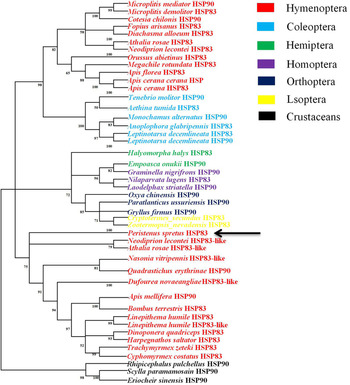
To clarify the evolutionary relationship of PsHSP83, the multiple alignments based on 44 HSP83/HSP90 proteins from other insect and non-insect species was performed by neighbor-joining (NJ) tree construction method. The dendrogram placed PsHSP83 with other insect HSP83/HSP90 proteins as the three clear clusters and especially with hymenoptera HSP83/HSP90 sequences as the two clear clusters (fig. 6). Moreover, different insect species were sub-classified into specific orders in a quite coherent manner, reflecting a greater sequence similarity at the same branch. Bootstrap values are showed on each node with the change of various clades.
A protein phylogenetic tree of insect and non-insect HSP83/HSP90. A distance analysis of HSP83/HSP90 amino acid sequences from P. spretus and 44 other insect and non-insect species was performed using neighbor-joining tree construction program (MEGA 5.0). Bootstrap value (%) is indicated at each node. Only support values >50% are shown.

Like other HSP83/HSP90, the PsHSP83 has five typical signature sequences and five conserved amino acids MEEVD within the C-terminus (720–724th) (fig. S1). The α-helix, β-sheet and random coil accounted for 53.45, 11.46 and 30.80%, respectively, of all secondary structures in the PsHSP83 protein (fig. S2). The predicted three-level structure of the PsHSP83 showed a similarity of 85.84% with that of HSP90-alpha, containing no transmembrane domains and signal peptides.
Expression of Pshsp83 in the whole body
The P. spretus 18S rRNA and actin were used as endogenous controls. In the following, only the mRNA levels normalized by actin are shown. The Pshsp83 transcript level in whole body peaked at 13th-day post-emergence and was significantly affected by adult age (fig. 7A). Temperature also had significant effects on Pshsp83 transcription (fig. 7B). The transcript levels at 35°C and 38°C were about 20 and 80%, respectively, higher than that at 23°C. No obvious difference was observed in transcript levels between 23°C and other temperatures (26°C, 29°C and 32°C).
The relative expression of the Pshsp83 gene at different conditions. The relative expression level of the Pshsp83 in the whole body at different days (A) and different temperatures (B) was normalized to the expression of P. spretus actin. Data are presented as mean ± SE (n = 3). Histogram bars with different letters are significantly different. One-way ANOVA (LSD).

Localization and expression of PsHSP83 in the ovary
Titer of the antiserum was determined by ELISA. Immuno-localization of PsHSP83 in ovaries was performed using polyclonal anti-PsHSP83 antibodies. The P. spretus ovarioles exhibited a string of successively older follicles. In ovaries of adults continuously kept at 23°C, PsHSP83 protein was observed within the cytoplasm of both germarium and egg chambers throughout the ovariole (fig. 8A), showing a ubiquitous action mode during oogenesis. But the PsHSP83 protein was more abundant in stages 10–13 egg chambers than in earlier and later egg chambers. After a heat shock at 35°C for 1 h and subsequent recovery at 23°C for 2 days, the PsHSP83 expression was elevated in most regions of the ovariole (fig. 8B). However, in matured follicles (stage 14), PsHSP83 immunostaining was weakened (fig. 8B). Based on microscopic observation, we drew a schematic of a P. spretus ovariole, in which the ovarian follicles are almost oval when first germinate from the germarium, then become bigger and elongate differentially along the anterior-posterior axis during stages 7–14 (fig. 9).
Immuno-localization of HSP83 protein in ovariole of P. spretus. When adult females were kept at 23°C, PsHSP83 protein was observed within the cytoplasm of both germarium and egg chambers throughout the ovariole (A). When adult females were exposed to 35°C, the PsHSP83 expression was elevated in most regions of the ovariole (B). The ovariole germarium and stages 10–14 follicles were labeled by arrows. A and B are in A488 channel; A′ and B′ are in DAPI channel; A″ and B″ are in A488 and DAPI mix channel. Scale bar = 20 μm.

The schematic drawing of a P. spretus ovariole. The drawing shows that the anterior germarium (ger) is followed by a string of 14 successively older ovarian follicles connected by interfollicular stalks (arrow). Egg chamber stages are indicated above. As a result of egg elongation during stages 7–14, the egg chambers of stage 14 are about 4 times longer and 3 times wider than those of stage 2. HSP83 protein marker is shown in fluorescent green, whereas nurse cells are shown in green. The egg chambers are surrounded by follicle cells (in blue).

Effects of increased Pshsp83 expression on longevity and reproduction
As the Pshsp83 showed maximum expression at 35°C, this temperature was chosen to evaluate the effects of heat shock on P. spretus development and reproduction. The life-span of adult females after heat shock at 35°C was significantly longer than that of individuals continuously maintained at 23°C (df = 24, 30, F = 6.51, P < 0.0001). However, heat shock had no significant effects on fecundity (df = 6, 415, F = 1.52, P = 0.1705, n = 50), cocoon weight (df = 6, 136, F = 0.43, P = 0.8612, n = 20), emergence rate (df = 6, 266, F = 1.06, P = 0.388, n = 30), sex ratio (df = 6, 263, F = 1.02, P = 0.4128, n = 30) of the treated generation and on the developmental duration of the progenies (df = 1, 203, F = 0.22, P = 0.9766, n = 30) (table 2).
Effects of heat shock on development and reproduction of P. spretus adult females

Means bearing the same lower case letters were not significantly different in a column.
Discussion
Endoparasitoids such as P. spretus have a distinct life cycle. P. spretus adult females oviposit into their host. After hatching, P. spretus larvae still live inside the host by using the host body as a resource of nutrition for growth and development (Yu et al., Reference Yu, Shi, Huang and Chen2008; Luo et al., Reference Luo, Li, Lu, Zhang, Haye, Kuhlmann and Wu2014, Reference Luo, Zhang and Wu2015). Here, we analyzed the P. spretus ovarian proteome by mass spectrum and by BLASTx against GO and KEGG databases. Totally, 1382 proteins were identified and their abundance in the ovary was revealed. Our results will greatly contribute to the understanding of the genetic basis underlying the special life cycle in Endoparasitoids.
Vitellogenin (Vg) is a common protein in eggs of oviparous insects (Tufail and Takeda, Reference Tufail and Takeda2008). But there has been a long dispute over whether Braconidae can synthesize vitellogenin by its self, just like non-parasitic insects. SDS-PAGE and Western blot analysis have demonstrated that wasps, such as Pteromalidae, Eupelmidae, Ichneumonidae and Aphelinidae species, cannot produce typical Vg protein (Dong et al., Reference Dong, Ye and Hu2009). Here, by mass spectrometry, we identified a short peptide of 16 amino acids (QTVMLGDVISENEAGR) in the P. spretus ovaries, which showed 100% similarity with the Vg in its host, A. lucorum. So, for the first time, we provided evidence that Endoparasitoid can synthesize Vg protein.
It is very intriguing that the Vg-like protein in P. spretus showed highest sequence identity with the Vg in its host A. lucorum, rather than other species. We inferred that this is due to the horizontal gene transfer (HGT). HGT, the transfer of genetic information between different species, is an unexpected and transformational discovery resulting from the expansion of whole-genome sequence data. So far, there have been a number of cases where transposons have been transferred between parasite species and their host species (Gilbert et al., Reference Gilbert, Schaack, Pace, Brindley and Feschotte2010, Reference Gilbert, Chateigner, Ernenwein, Barbe, Bézier, Herniou and Cordaux2014; Walsh et al., Reference Walsh, Kortschak, Gardner, Bertozzi and Adelson2013; Schneider and Thomas, Reference Schneider and Thomas2014). In the present paper, the high sequence identity between the 16-amino-acid peptide in P. spretus and the Vg protein in A. lucorum cannot determine whether the P. spretus Vg sequence is originated from the A. lucorum genome or the A. lucorum Vg gene is transferred from the P. spretus genome. The transfer direction needs to be further studied.
Among the top 5 ovary proteins of high content in each band, most of them are HSPs, including the HSP83 (table 1, Band number 1) and HSP70 (table 1, Band number 2). This suggested the crucial roles of HSPs in P. spretus oogenesis. So far, the roles of HSP90 in protecting insects from damage caused by environmental stresses, such as heat, cold and CO2, have been demonstrated in quite a few species. For instance, exposure to 37°C led to a significantly higher expression of hsp83 in Plutella xylostella moth when compared to the exposure to 25°C (Sonoda et al., Reference Sonoda, Ashfaq and Tsumuki2006). In newly emerged and matured flour beetle, T. castaneum, the expression of hsp83 in the whole body and in the ovary was also induced by a heat shock (40°C for 1 h) (Xu et al., Reference Xu, Shu and Zhang2010). Here, in a Hymenoptera species, we reported a similar rise of hsp83 expression in response to high temperature, suggesting the functions of P. spretus hsp83 in protecting wasp from heat stress.
Like the HSP83 in other species such as T. castaneum (Xu et al., Reference Xu, Shu and Zhang2010), the PsHSP83 protein was detected in cytoplasm of all ovarian cell types in P. spretus adult females with and without heat shock (fig. 8). The PsHSP83 protein also exhibited unique expression characteristics, such as the higher abundance in follicles of stages 10–13 than in those of stages 1–9. But, in the ovary of T. castaneum, HSP83 expression was merely observed in the follicle of stages 6–8, not in those of earlier stages (Xu et al., Reference Xu, Shu and Zhang2010). Based on the cell cycle programs of main-body follicles, insect egg chamber stages can be divided into three different phases: the mitotic cycle (stages 1–6), the endocycle (stages 7–10a) and gene amplification (stages 10b–13). The period from egg chamber stage 10b to stage 13 is a process of gene amplification, during which, the follicle cells stop whole-genome duplication and selectively expand specific genomic regions, mainly related to chorion (eggshell) production. At stage 14, egg chamber becomes a mature egg (Berg, Reference Berg2008; Wu et al., Reference Wu, Tanwar and Raftery2008; Tootle et al., Reference Tootle, Williams, Hubb, Frederick and Spradling2011; Jia et al., Reference Jia, Huang and Deng2015). So, the accumulation of PsHSP83 in egg chambers of stages 10–13 suggested its important roles in the gene amplification during P. spretus oogenesis. It is worth mentioning that the PsHSP83 signals were clearly weaker in follicles of stage 14 than in follicle of stages 10–13, especially in insects exposed to heat stress. Maybe this is because the eggshell at the last oocyte stage has been well-shaped and becomes too thick to allow good penetration of the staining.
Insects exposed to 35°C showed higher PsHSP83 expression level and longer life-span compared with those kept at 23°C. This led us to speculate that the HSP83 in P. spretus is involved in life-span regulation. The positive impact of increased PsHSP83 protein on the longevity of P. spretus is in accordance with the roles of the homologous HSP83 in D. melanogaster and A. pisum (Chen and Wagner, Reference Chen and Wagner2012; Will et al., Reference Will, Schmidtberg, Skaljac and Vilcinskas2017). In D. melanogaster females harboring HSP83 mutation, the average lifespan is 14.9% shorter compared to wild-type individuals (Chen and Wagner, Reference Chen and Wagner2012). In A. pisum treated with HSP83 dsRNA, lifespan was also significantly shorter when compared to wild-type animals.
To thoroughly elucidate the functions of PsHSP83, we have tried to deplete its expression by RNA interference (RNAi). A double-stranded RNA (dsRNA) specific to PsHSP83 mRNA were synthesized (fig. S3). Regretfully, injection of Pshsp83 dsRNA into newly emerged females neither dramatically reduced the targeted gene transcripts nor caused remarkable effects on biological features of the treated generation and their offspring. This led us to infer that dsRNA mediated RNAi is not a feasible strategy for gene knockdown in P. spretus. Because of the unavailability of defective phenotypes derived from the silencing target gene, presently, we cannot draw such a conclusion that the function of Pshsp83 is merely restricted to the regulation of longevity. In model species, the various roles of HSP83 protein have been proved by RNAi. Take, for example, T. castaneum females were not able to produce mature oocytes when hsp83 was knocked out (Xu et al., Reference Xu, Shu and Zhang2010). In D. melanogaster and A. pisum, depletion of HSP83 expression by RNAi produced significant damages to reproduction (Chen and Wagner, Reference Chen and Wagner2012; Will et al., Reference Will, Schmidtberg, Skaljac and Vilcinskas2017). In the present study, elevated Pshsp83 expression had no obvious effects on P. spretus ovarian development and reproduction. Whereas, the abundance of PsHSP83 protein in most ovarian regions, especially in egg chambers of late stages, suggested that PsHSP83 is involved in these physiological processes in this endoparasitoid.
Supplementary material
The supplementary material for this article can be found at https://doi.org/10.1017/S0007485320000607
Acknowledgements
This study was supported by the National key R&D plan project (No. 2017YFD0201000) and China's donation to the CABI Development Fund.
Author contributions
Miaomiao Tian, Ducheng Cai, Jianjun Mao and Shuping Luo conceived and designed the experiments. Yayun Xia and Miaomiao Tian did the experiments. Miaomiao Tian analyzed the data. Miaomiao Tian and Jianjun Mao wrote the manuscript and all authors read and approved the manuscript.
Conflict of interest
The authors declare that they have no conflict of interest.