INTRODUCTION
The title of this article comes from a seminal text in queer people of color (QPOC)Footnote 1 theory, Gloria Anzaldúa's Borderlands/La frontera: The new mestiza (Reference Anzaldúa1987). In this text, after pointing out that queer people of color ‘have always been at the forefront (although sometimes in the closet) of all liberation struggles in this country; have suffered more injustices and have survived them despite all odds’ (Reference Anzaldúa1987:85), Anzaldúa implores, ‘People, listen to what your jotería is saying’ (Anzaldúa Reference Anzaldúa1987:85). Although the meaning of the term jotería is difficult to simplify and translate, it can be glossed somewhat simply as ‘queer Mexican/Chicano people’.Footnote 2 By incorporating Anzaldúa's quotation into the title of my article, I echo her exhortation, as I believe sociolinguists also need to ‘listen’ to what queer Mexicans/LatinxsFootnote 3 are saying. Specifically, my discussion provides a critique of the stance that queer theory has taken against identity by listening to Phoenix's jotería. Like other articles in this special issue on language and normativity, my work engages and contributes to a burgeoning sociolinguistic literature that seeks to understand how gender and sexual norms are contested and negotiated in everyday discourse.
My interest in normativity and jotería voices was sparked by two questions posed by two of this special issue's co-editors. Many queer theorists view identity, of whatever kind, as complicit with heteronormativity. This position, which has come to be called anti-identitarian, is in line with queer theory's broader interest in rejecting the systems of normativity that uphold heterosexuality and gender binarism. Questioning this view, Milani (Reference Milani2013) points out that queer theory's anti-identitarian stance is ‘itself an act of identity’.
This interpretation of queer as being necessarily anti-normative and anti-identitarian has not remained unchallenged, as some have argued that queer theory might be losing sight of its basic anti-essentialist tenet of distrusting any identity consolidation by reifying an anti-identitarian, anti-foundationalist, and anti-normative stance (Wiegman Reference Wiegman2012). And this itself is an act of identity. In other words, is the act of embracing a particular (sexual) identity always and necessarily normative? (Reference Wiegman and Wilson2013:209, emphasis added)
Similarly, in an article from the same year, Hall (Reference Hall2013) revisits the place of identity in queer linguistics and argues that the practices valorized by queer theorists as ‘queer’ are likewise constitutive of identity, if viewed from a queer linguistic perspective.
[Q]ueer linguistics, while born from the queer critique of heteronormativity and gender binarism, would do well to counter the analytic distinction between identity and practice that characterizes much of contemporary queer theory. In the latter strain of scholarship, identity is viewed as always feeding the project of heteronormativity. (2013:635)
In this article, I am interested in how norms are negotiated in queer US Mexican/Latinx multimodal discourse, particularly with respect to identity categories and labels. Following Hall's (Reference Hall2013) call for sociolinguists to use our specific disciplinary skills to question queer theory's distinction between practice and identity and its privileging of the former, this article offers a close analysis of several texts representing a variety of ‘sites of display’ (Jones Reference Jones and Carey2009) in order to better understand how social practices, language, and identities jointly become invested with social meaning. The article's goal is to explore what Hall (Reference Hall2013) calls the ‘complexities of normativity’ because, as Wiegman & Wilson (Reference Wiegman and Wilson2015:2) argue, ‘norms are more dynamic and more politically engaging than queer critique has usually allowed’.
Of course, an interest in norms has long played a central role in the sociolinguistic enterprise. Normativity in the original queer theory sense (that is, through the lens of gender intersecting with sexuality) has been central to studies situated in the field of language, gender, and sexuality (Barrett Reference Barrett and Bucholtz2004; Mendoza-Denton Reference Mendoza-Denton and Bucholtz2004; Levon Reference Levon2012). Yet normativity is also central to sociolinguistics more generally, even if not specifically related to gender and sexuality. The question of how norms are enforced or changed, for instance, has been explored through social network approaches (Milroy Reference Milroy1987) as well as narrative approaches focused on ‘norming’ (Johnstone & Baumgardt Reference Johnstone and Baumgardt2004). Likewise, at the very heart of variationist sociolinguistics is the notion of the speech community, which is defined by its practitioners as ‘participation in a shared set of norms’ for language use (Labov Reference Labov1972:120). Growing out of these perspectives, Backus & Spotti (Reference Backus and Spotti2012:192) have defined normativity simply as ‘the sense of the hegemonic pressure exerted on individuals to conform to the norm’. They trace a close connection between normativity and sociolinguistics, arguing that speakers acquire not only linguistic forms and meanings but also ‘associated aspects of usage, such as typical context of use and, if appropriate, of connotative meaning, such as the style the form is typically found to belong to (its indexicality)’ (Backus & Spotti Reference Backus and Spotti2012:189). Normativity, in this broader sense, has also been analyzed with regard to who uses what languages in multilingual settings as well as when and how (Quist Reference Quist2008; Dong Reference Dong2012; Juffermans Reference Juffermans2012; Androutsopoulos Reference Androutsopoulos2012; Jaspers Reference Jaspers2014). As Backus & Spotti (Reference Backus and Spotti2012:203) summarize, ‘Using language, therefore, involves choices, about whether to follow those norms or not… Choices might have to do with indexing style, register, accent or language variety, and they may be conventional, if one produces what is expected, or unconventional (or creative) if they break the norm’.
During ethnographic fieldwork in Phoenix, Arizona, I was struck by how queer US Mexicans/Latinxs in Phoenix negotiated visibility and representation in normative, hegemonically white spaces of the Phoenix LGBTQ ‘community’.Footnote 4 In particular, I became interested in how identity categories and labels were deployed and manipulated to make visible that which had been invisible. There is a great need for a broader and more inclusive understanding of the diversity of LGBTQ expression and for further research in non-Anglo,Footnote 5 non-English speaking communities. Motschenbacher (Reference Motschenbacher2011:150) claimed in an article on the future of queer linguistics that the task of ‘put[ting] lesbian and gay male speakers on the sociolinguistic map’—which was what motivated much of the first generation of research on language and sexuality—is ‘a task that today has been widely achieved’. That is not, however, the case for the ‘sociolinguistic map’ of Mexicans and Latinxs in the United States, where LGBTQ speakers remain less visible. E. Pérez (Reference Pérez, Aldama, Sandoval and García2012:193) explains that ‘[m]aking sense of the wide-ranging circumstances of Chicana/o queers on the United States-México border in the twenty-first century is not an easy task’, noting that queer Mexicans ‘are often neglected in more dominant discourses about queers in the United States’. This article aims to contribute to the sociolinguistic understanding of queer US Mexican/Latinx identities and communities.
GROUNDWORK
Guiding this discussion is the concept of anthropolitical linguistics (Zentella Reference Zentella1997, original emphasis), an approach that aims ‘to understand and facilitate a stigmatized group's attempts to construct a positive self within an economic and political context that relegates its members to static and disparaged ethnic, racial, and class identities, and that identifies them with static and disparaged linguistic codes’ (Zentella Reference Zentella1997:13). The approach is openly and unabashedly political, underscoring the interrelatedness of language and politics. Making the connection between language and politics in the spirit of anthropolitical linguistics includes, for example, looking not only at the ways that queer US Mexicans/Latinxs are marginalized and disparaged, but also at how they respond to and resist that reality (Zentella Reference Zentella and Summer2003, Reference Zentella2014).
My approach aligns with jotería studies, the aim of which D. Pérez (Reference Pérez2014a:145) describes as a sustained critical engagement with ‘nonheteronormative gender and sexuality as related to mestiza/o subjectivities and identities’. The emerging field of jotería studies is informed by a variety of disciplines. Madrid (Reference Madrid2018:87) calls it ‘an intrafield located at the intersection of gender and queer studies, of Chicana/o and Latina/o studies’, while Bañales (Reference Bañales2014) emphasizes its centering of concerns regarding colonialism and power within research on gender, sexuality, and ethnicity. One important point, however, is that unlike queer theory, which has been characterized by an antinormative and anti-identitarian stance, as discussed above, jotería studies pairs an interest in antinormativity with a focus on subjectivities, positionalities, and social identities. In fact, both Hames-García (Reference Hames-García, Hames-García and Martínez2011b) and D. Pérez (Reference Pérez2014a) have criticized queer theory's ‘subjectlessness’ or anti-identitarian approach. Hames-García (Reference Hames-García, Hames-García and Martínez2011b:39) pointedly asks: ‘If a ‘subjectless’ queer critique continues to hide the significant differentiation still necessary between queers of color and white queers, queer women, queer men, and trans queers, rich queers and poor queers, first-world queers and third-world queers, then which ‘identity politics’ precisely has ‘queer epistemology’ successfully ‘deconstructed’?’ H. Perez (Reference Perez2005:171) articulated a similar position well over a decade ago when he noted that ‘[q]ueer theory is very particular about the kinds of trouble with which it troubles itself. The problem of race in particular presents queer theory with dilemmas over which it actively untroubles itself’. This critique is echoed by Hall (Reference Hall2013:640): ‘I am concerned that queer theory, by maintaining its analytic distinction between practice and identity, ignores the subjectivity of those it was initiated to defend’.
This analysis employs a critical queer multimodal discourse analysis approach. Although research employing a multimodality approach has blossomed since Kress & van Leeuwen's (Reference Gunther and van Leeuwen2006) early work on the subject, as seen in work on linguistic landscapes (Shohamy & Gorter Reference Shohamy and Gorter2009) and semiotic landscapes (Jaworski & Thurlow Reference Jaworski and Thurlow2010), Milani (Reference Milani2013) notes that both gender and sexuality have been overlooked in this research. The addition of ‘critical’ in the name of my approach, as in the phrase ‘critical discourse analysis’ (CDA), therefore aims to underscore a central interest in power relations. Machin, Caldas-Coulthard, & Milani (Reference Machin, Caldas-Coulthard; and Milani2016) argue for a critical multimodality—that is, ‘a multimodal approach that is in the first place problem solving, and, like CDA, reveals the discourses buried in texts, which may not be apparent to a casual viewer’ (Reference Machin, Caldas-Coulthard; and Milani2016:304). This critical approach requires that the texts being studied not be separated from their social context, and more specifically, that the analysis provides insight into real-life questions by leading to a better understanding of the ideological purpose of the texts’ semiotic choices (Machin et al. Reference Machin, Caldas-Coulthard; and Milani2016). Just as Machin and colleagues describe gender as ‘a fundamentally multimodal project’ (Reference Machin, Caldas-Coulthard; and Milani2016:306), so, too, is sexuality. Queer multimodality responds to the ‘rather logocentric approach’ (Milani Reference Milani2013) that has traditionally characterized queer linguistics. In sum, a critical queer multimodal discourse analysis approach, in addition to recognizing that ‘[l]anguage always has to be realized through, and comes in the company of, other semiotic modes’ (Kress & van Leeuwen Reference Gunther, van Leeuwen, Bell and Garrett1998:186) and striving to ‘uncover, reveal or disclose what is implicit, hidden or otherwise not immediately obvious’ (van Dijk Reference van Dijk1995:18), also has a guiding interest in exposing what Warner (Reference Warner1991) has called ‘default heteronormativity’, the totalizing, pervasive, and often invisible assumption that heterosexuality is the norm. Allied with this interest is the exposure of ‘homonormativity’, both in the traditional sense described by Stryker (Reference Stryker2008:147), which refers to the ways that gay and lesbian ‘norms marginalize other kinds of sex/gender/sexuality difference’, and in the newer sense described by Duggan (Reference Duggan2003), which refers to the trading of radical queer politics for a neoliberal vision of equality narrowly defined as access to heternormative institutions such as marriage or military service.
QUEER, MEXICAN/LATINX PHOENIX
Phoenix, Arizona is an important site for the multimodal exploration of queer mexicanidad/latinidad.Footnote 6 This city of 1.5 million people in the US Southwest has been a battleground for the backlash against civil rights gains that has characterized the first decades of the twenty-first century (Santa Ana & González de Bustamonte Reference Santa Ana and Celeste González2012; Magaña Reference Magaña, Magaña and Lee2013). Arizona has approved English only legislation, banned bilingual education, and passed two laws known as SB1070 and HB2281. SB1070 codifies racial profiling and forces local police to enforce immigration law, which was formerly the province of federal law enforcement. HB2281 bans the teaching of ethnic studies in Arizona primary and secondary schools. These efforts, and the inhospitable climate they have helped to create, have compelled many to leave the state, and they have caused incalculable stress on those who remain (Rubio-Hernandez & Ayón Reference Rubio-Hernandez and Ayón2016). Phoenix has accordingly been the site of a groundswell of community organizing, community building, and resistance—what Chávez (Reference Chávez2013) calls ‘coalitional moments’—seeking to counter the effects of the growing structural inequality that marginalizes and oppresses queer people of color. There is urgency around visibility, even as it carries increased risk.
While it is not yet a majority-minority city, Phoenix boasts a ‘Hispanic or Latino’Footnote 7 population that comprises 42.5% of the city's total population.Footnote 8 The overwhelming majority of the Hispanic or Latino population in Phoenix is Mexican; Mexican-origin individuals make up 38.6% of the total Phoenix population (see n. 8). More than three in every ten Phoenix residents report speaking Spanish at home.Footnote 9 Yet mainstream gay and lesbian organizations in Phoenix tend to be either oblivious to the demographics summarized above or uninterested in broadening their imagining of an LGBTQ community to include Mexicans, immigrants, or people who may not speak English. This erasure should come as no surprise, however, as it is yet another enactment of hegemonic whiteness and US American-ness in LGBTQ communities (Alimahomed Reference Alimahomed2010). The two cases that are examined below construct queer mexicanidad/latinidad in relation to the dynamics of this particular setting at this particular time, and the projects of visibility contribute in different ways to queer Mexican/Latinx survival.
DATA
This article examines two cases in detail in order to explore how an individual and an organization choose to represent themselves—how they exercise agency in achieving visibility in a social context that is hostile toward queer Mexicans/Latinxs. The objective is to analyze two different public articulations of queer Mexican/Latinx identity, including the resources employed for doing identity and community against the backdrop of the politics of the closet (pride/shame), the xenophobic hostility of the present sociopolitical climate, and the social evaluation of Spanish and English. The texts analyzed are drawn from traditional media and social media: a mainstream LGBT weekly magazine, a mainstream newspaper, and photos and videos posted on the social media sites of individual public figures or organizations.
LESBIAN MEXICAN CHEF
Born into a family of bakers and raised in a farming community in California's Central Valley, chef Silvana Salcido Esparza owns several restaurants and has been named a finalist for the prestigious James Beard award several times. She is in her fifties, and she identifies as a lesbian and as Mexican. She is at once a member of an elite group of chefs in the flourishing urban food scene of the Phoenix metropolitan area and an organizer/activist who was instrumental in the public face of resistance against recent anti-immigrant legislation in Arizona generally and in Phoenix/Maricopa County particularly. This section of the article analyzes Salcido Esparza's radical multiplicity and public identity construction (in social and traditional media) in relation to sexual identity (lesbian), ethnic identity (Mexican), and socioeconomic status (successful business owner and entrepreneur). The analysis examines three texts: a magazine advertisement, a T-shirt (embedded in a newspaper photograph), and a billboard mock-up (embedded in a social media post).
An advertisement in Phoenix's Echo Magazine for Salcido Esparza's original restaurant, Barrio Café, caught my eye during fieldwork for an ethnographic research project in 2010 (see Figure 1). Founded nearly thirty years ago, Echo Magazine’s monthly print edition reaches almost 60,000 readers, plus nearly an additional 100,000 readers on-line.Footnote 10 The editors claim that the magazine is ‘Arizona's most widely read and respected gay and lesbian publication’, offering ‘more original content than any other gay and lesbian publication in Arizona’.Footnote 11 This content includes editorials, monthly columns on politics, arts, and entertainment, and feature articles on the LGBT community, with an emphasis on bars/nightlife and corporate/business stories, complemented by limited national and international news.
Barrio Caféadvertisement in Echo Magazine, 2010 © 2010 Silvana Salcido Esparza. Used with permission.

The background image echoes the design of the Arizona state flag, the top half of which features a fan-shaped array of alternating red and yellow stripes emanating from a gold star at the center with a blue section across the bottom. The advertisement displays three block words at the top of the image—LESBIAN, MEXICAN, and CHEF. Within the context of the SB1070 legislation of the time this ad ran, this seemingly straightforward ad does much more than simply describe the chef-owner of the business. The large, thicker-type LESBIAN at the top of the ad stakes out Salcido Esparza's membership in the LGBTQ community. The words MEXICAN and CHEF are positioned below LESBIAN. Given the erasure of people of color within the Phoenix LGBTQ community, this assertion of multiplicity is remarkable. Of course, the ad also has a commercial purpose—to promote Salcido Esparza's business; however, it simultaneously articulates a multiplicity (Hames-García Reference Hames-García2011a) that is often invisible. Salcido Esparza uses the social identity terms lesbian and Mexican as a tactic of visibility (Phelan Reference Phelan2001; Milani & Kapa Reference Milani and Kapa2015) to push back against the erasure of Mexicans/Latinxs in the Phoenix LGBTQ community—against a backdrop of racism and xenophobia. The placement of the ad in the mainstream gay publication underscores Salcido Esparza's aim to ‘represent’. While the mainstream LGBTQ community may have preferred to maintain a single-axis view of identity—that is, LGBTQ on the one hand, Mexican/Latinx on the other—Salcido Esparza insists on her place in the imagining of the LGBTQ community, foregrounding her LESBIAN identity by the prominent placement of this term in the advertisement.
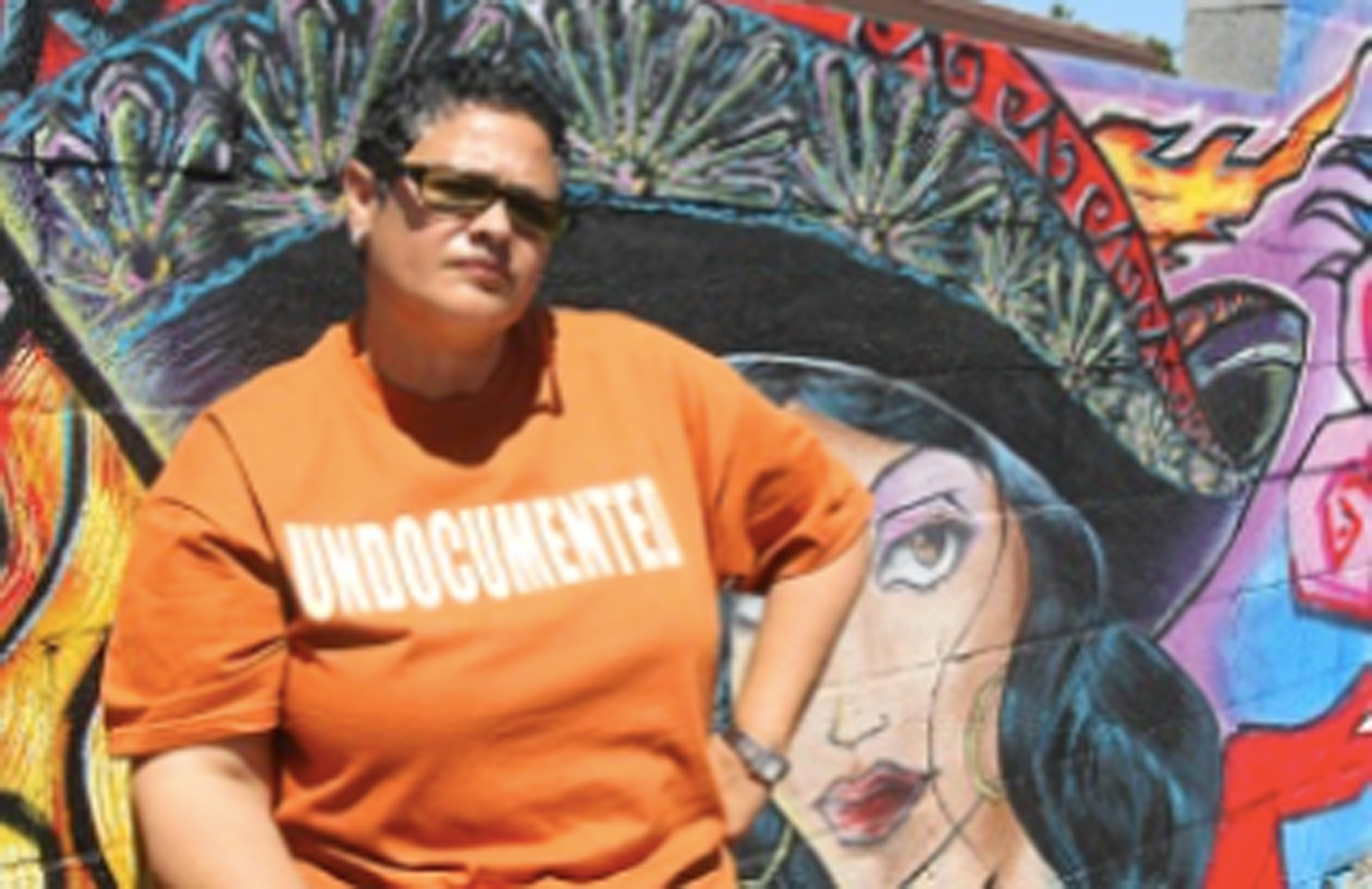
In the above text, social identity categories can be seen as describing Salcido Esparza in a relatively straightforward way. In a second text, however, this is not the case. The T-shirt Salcido Esparza is pictured wearing in Figure 2 below, a photo that appeared in the city's largest daily newspaper The Arizona Republic, is her own creation. This is noted in the caption of the photo: ‘Silvana Salcido Esparza, chef and co-owner of the popular Barrio Cafe in (sic) Phoenix and 2010 finalist in the James Beard Awards, wears a T-shirt she had printed in protest of Senate Bill 1070’. Appearing on the front page of the ‘Valley and State’ section, the article carried the title ‘Barrio Cafe chef speaks her mind’, a sentiment reiterated again on the second page of the article's continuation in the header ‘Barrio Cafe chef doesn't shy away from speaking her mind’. The article reports on the chef's political activities related to protesting SB 1070, from attending a protest the week prior to the publication, giving out paletas (Mexican-style ice cream bars), talking with other protesters, and designing the shirt pictured, which she ordered from a local print shop.
Photo of chef Silvana Salcido Esparza, 2010, by Deirdre Hamill From The Arizona Republic. © 2010 Gannett-Community Publishing. All rights reserved. Used under license.

Salcido Esparza was born in the United States and is thus a US citizen; yet the term undocumented displayed prominently on her T-shirt refers to someone who does not have legal authorization to live and work in the United States. The ‘undocumented’ shirt comes from a moment when undocumented people, particularly so-called DREAMers,Footnote 12 were ‘coming out of the shadows’ and publicly disclosing their undocumented status (Seif Reference Seif2014, Reference Seif2011). The public disclosure of one's undocumented status carries obvious legal risks, such as arrest or deportation. This T-shirt, then, rather than representing Salcido Esparza's own identity, is an expression of solidarity with undocumented people and an act of resistance to the xenophobic legislation that was being debated. By wearing the T-shirt, especially in such public contexts as a photo shoot for a mainstream newspaper, Salcido Esparza seeks to disrupt what could be called a ‘good immigrant’ or ‘good Mexican’ discourse by creating ambiguity around her identity and legal status. Behdad (Reference Behdad2005:13) describes the ‘good immigrant’ or ‘super citizen’ trope as one that serves to ‘reaffirm the nation's capitalist values and nationalist norms’ and provide ‘proof of America's exceptionalism’. Honig (Reference Honig2001:78) explains that in this representation the good immigrant ‘works harder than we do, … values his family and community more actively than we do, and … also fulfills our liberal fantasy of membership by way of consent’. While others might seek to emphasize the achievements of Salcido Esparza as a ‘model minority’, she rejects this. This ‘coalitional moment’ (Chávez Reference Chávez2013) responds to mainstream LGBTQ and immigrant rights movements that seek legal equality within normalizing institutions.
The mural behind Salcido Esparza in the photo adds another layer to the tactics of visibility in this image. Commissioned by Salcido Esparza and painted by local artist El Moisés in 2009, the mural on the wall behind her restaurant depicts indigenous, religious, Mexican, and Chicano imagery. Of particular interest is the figure of a woman, which is visible to the immediate right of Salcido Esparza in the photograph; she wears a sombrero and has a hyper-feminine presentation, including full eye makeup, high-arched eyebrows, and dark red lips with darker lip liner. She wears large hoop earrings and her long, jet-black hair is glossy and wavy. The juxtaposition here of Salcido Esparza—with short-cropped hair, no make-up, small earrings, and androgynous clothing (T-shirt)—and the male gaze fantasy of the hyper-feminine Chicana serves to put in high relief her gender expression and nonheteronormative sexuality.
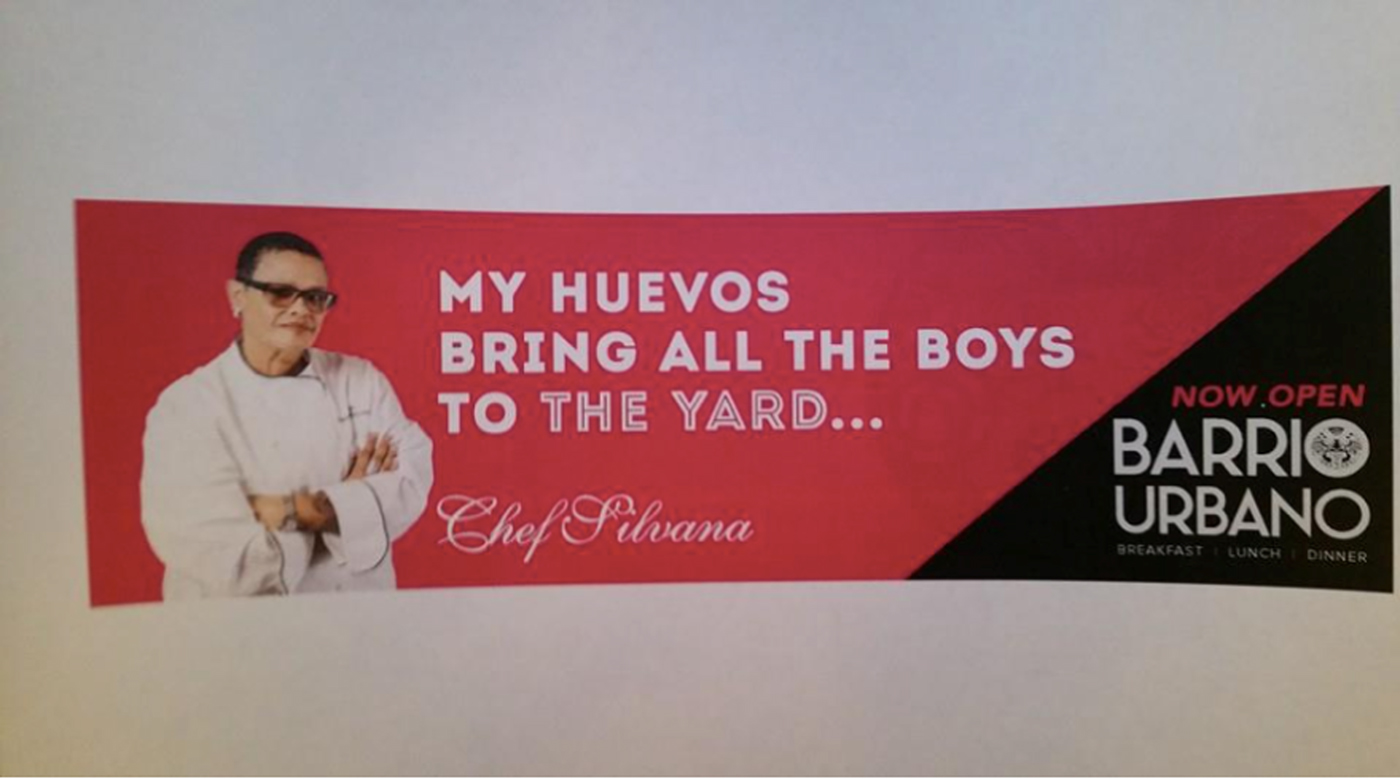
Salcido Esparza uses the platform provided by traditional media to brand herself and promote her business, but also to make multiplicity (Hames-García Reference Hames-García2011a) and thick intersectionality (Yep Reference Yep2010, Reference Yep, Sorrells and Sekimoto2016) visible (see Cashman Reference Cashman2018 for a detailed discussion). Turning to a third text, we see that she uses social media for the same ends. Salcido Esparza opened a restaurant in January 2015 called Barrio Urbano, located in a development called The Yard. The final text I examine in this section is a social media post featuring a photo of a mockup of a billboard advertising the opening of Barrio Urbano at The Yard (see Figure 3). Salcido Esparza posted this photo on her personal-professional Facebook page, which at the time of this writing in February 2019 had over 3,300 likes and over 3,200 followers. She captioned the photo “…and the girls”. (She also posted a photo of herself and an employee in front of the billboard on her restaurant's Facebook page in February 2015, which at the time of this writing had earned over 13,000 likes and well over 12,500 followers.)
Barrio Urbano billboard mockup, January 2015 © 2015 Silvana Salcido Esparza. Used with permission.

The mockup of the billboard features a head-and-torso photo of Salcido Esparza in the far-left quarter of the rectangular space, wearing a very close-cropped short haircut, trendy dark-framed eyeglasses, and a monogrammed white chef's jacket, with her arms crossed over her chest. A watch on her wrist and tattoos on her left forearm are visible before the cuff of the jacket. She looks directly at the viewer. The white chef's jacket stands out against a mostly bright fuchsia background, as does the white lettering that occupies the majority of the billboard. The main text is comprised of under a dozen words in three different fonts spread across four lines. The name of the restaurant development (‘THE YARD’) is set off from the rest of the all-caps, sans serif, bold white text in a different font with serif and with a slightly aged or distressed quality; the last word is followed by an ellipsis. Salcido Esparza's name (‘Chef Silvana’) is rendered on the last of the four lines in a cursive handwriting style, evoking a signature. In all, the impression is that the all-caps text is itself a quote from the chef. In the restaurant's name, a stylized representation of the Aztec sun god Tonatiuh, such as that found at the center of the Aztec Sun Stone, fills the ‘o’ at the end of ‘Barrio’.
The billboard is a complex joke that derives its humor both from the bilingual word play and the chef's sexuality, drawing on the geographical and social context of the advertisement. To briefly break it down, we look at three main elements: (i) huevos, (ii) boys, and (iii) the yard. First, huevos is a Spanish word that means ‘eggs’ but is also often used as a slang word for ‘testicles’. While one does not need to be bilingual to understand this joke, familiarity with the word's double meaning is necessary. On a surface level, my huevos, with the first person possessive pronoun my referring to Silvana (indicated by the signature ‘Chef Silvana’ below the statement), can be read as referring to the egg dishes that one associates with breakfast or brunch, such as the huevos divorciados that are reportedly one of the signature items on the restaurant's brunch menu. Yet a native speaker of this Mexican variety of Spanish would be quick to recognize the polysemy of the phrase my huevos, given that ‘eggs’ are not usually introduced by the possessive. The first part of the joke, then, hinges on the fact that Salcido Esparza, a cisgender woman, does not have huevos.
At the same time, however, tener huevos ‘to have balls/guts’ can refer to someone's courage and strength in adversity, which is another meaning referenced here. This meaning is highlighted by Salcido Esparza in the caption she provides for the image on Facebook: ¡Tengo muchos huevos! Still, this metaphorical meaning is complicated by the billboard's intertexual reference to the hit song ‘Milkshake’ from the American recording artist Kelis in her 2003 album Tasty. In this song, which features the chorus ‘My milkshake brings all the boys to the yard’, the term milkshake appears to carry a feminized sexual meaning. The phrase all the boys in the billboard's text therefore originates from a text that presumably expresses heterosexual desire. By substituting huevos for milkshake, the billboard subverts the heterosexual reading of the original text to suggest same-sex desire. Yet because this adaption of the lyric comes from a female chef who is open about her lesbian identity, the billboard complicates the already nonheteronormative text even further, and, as a consequence, is even funnier.
Salcido Esparza's billboard uses humor in a very public text articulating a queer Mexican identity, brought about by using both verbal and nonverbal elements. Salcido Esparza is not only making herself visible as a Mexican lesbian, but she is telling queer Mexicans/Latinxs in Phoenix—as the biculturally and bilingually literate readers of this billboard—that they are seen and valued. Queer Mexicans/Latinxs, however, are not the only or even primary target audience for the billboard, which also inserts the use of Spanish in an area of the city where it is less likely to be seen. This might be seen, along with the Aztec god symbol and the name of the restaurant itself, as granting a certain authenticity to the restaurant that an Anglo audience might appreciate, even without any Spanish proficiency, as is a common practice in so-called ethnic restaurants (Ferraro 2002). The billboard represents a frankness and openness, as well as playfulness, with respect to sexuality that fits with the more progressive and younger clientele to which the restaurant is appealing. In sum, the billboard appeals to different audiences, with different messages, which makes it a successful advertising tool. It presents a public image of queer mexicanidad in a queer-friendly scene (uptown Phoenix) within a broader setting (Arizona) that is generally hostile toward LGBTQ and particularly Mexican individuals.
To summarize this first section of analysis, we have three texts. It could be argued that the billboard text is the most transgressive of the three, although the level of cultural and linguistic knowledge needed to interpret its multiple meanings may also make it less legible to a broader audience. The use of social identity labels in the print ad and T-shirt, by contrast, are more easily interpreted by a wider population and may therefore have greater impact on queer Mexican/Latinx visibility. Although the billboard is in many ways antinormative, it could be that the identity-based approaches of the simpler texts pack a greater political effect. Salcido normalizes queer Mexican-ness and markets authenticity while making multiplicity visible. Yet by celebrating the power and status that affords a more nuanced and agentive visibility, she also pushes back against ‘Euro-homo normativity’ (Heidenreich Reference Heidenreich1999).
TRANS QUEER PUEBLO
This section examines Trans Queer Pueblo, an organization that grew to contest the backlash against immigrants, particularly Mexicans, exemplified by SB1070 in Arizona. In sharp contrast to the noninclusive language still employed by the mainstream LGBTQ community, Trans Queer Pueblo takes the last two letters of the LGBTQ label, puts them first, spells them out, and connects them with pueblo, a Spanish word that can be glossed as ‘the people’. But just as la raza (as used, for example, in the Chicano civil rights movement) transcends the simple gloss ‘the race’ and captures an entity of Mexican indigenous identity beyond race and nationality, so too does pueblo. In the name, one can hear the echo of the widespread protest chant el pueblo unido jamás será vencido ‘the people united will never be defeated’. The name Trans Queer Pueblo could be considered Spanish (to the extent that both trans and queer have been taken into Spanish) or, at the very least, ambiguous in terms of language origin.
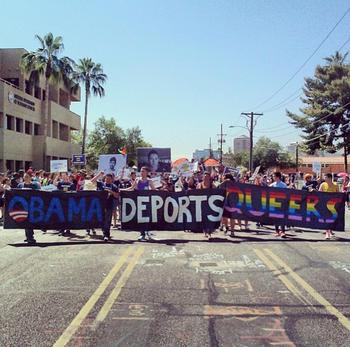
QUIP, one of the initial groups that merged to form Trans Queer Pueblo, has participated in the annual Phoenix Pride parade since at least 2014. In this section of the article, three examples of the organization's Phoenix Pride parade participation are analyzed. The first image, reproduced as Figure 4, shows a contingent of QUIP group members in the 2014 Pride parade walking behind three large banners with black backgrounds. The banner on the left features the word OBAMA in bright blue capital letters, with the first letter O mirroring the familiar campaign logo of then-President Barack Obama. The red stripes of the logo and blue lettering reference the US flag. The center banner features the word DEPORTS in white capital letters, which stand out against the mostly black background. Finally, the banner on the right read QUEERS in capital letters that are rainbow striped with red at the top and purple at the bottom, echoing the rainbow flag of the LGBT rights movement. At least two large black-and-white photos of several recent LGBTQ deportees are held aloft by group members marching behind the banners.
Obama deports queers, April 2014 (photographer unknown; used with permission of Trans Queer Pueblo).

The banners’ message calls into question the LGBTQ community's support of a president under whose administration a massive increase in deportation had taken place by pointing out that some of those deportees were queer. Their participation disrupted the prevailing celebration frame of the parade and confronted parade-goers with an ‘undocuqueer’ perspective.
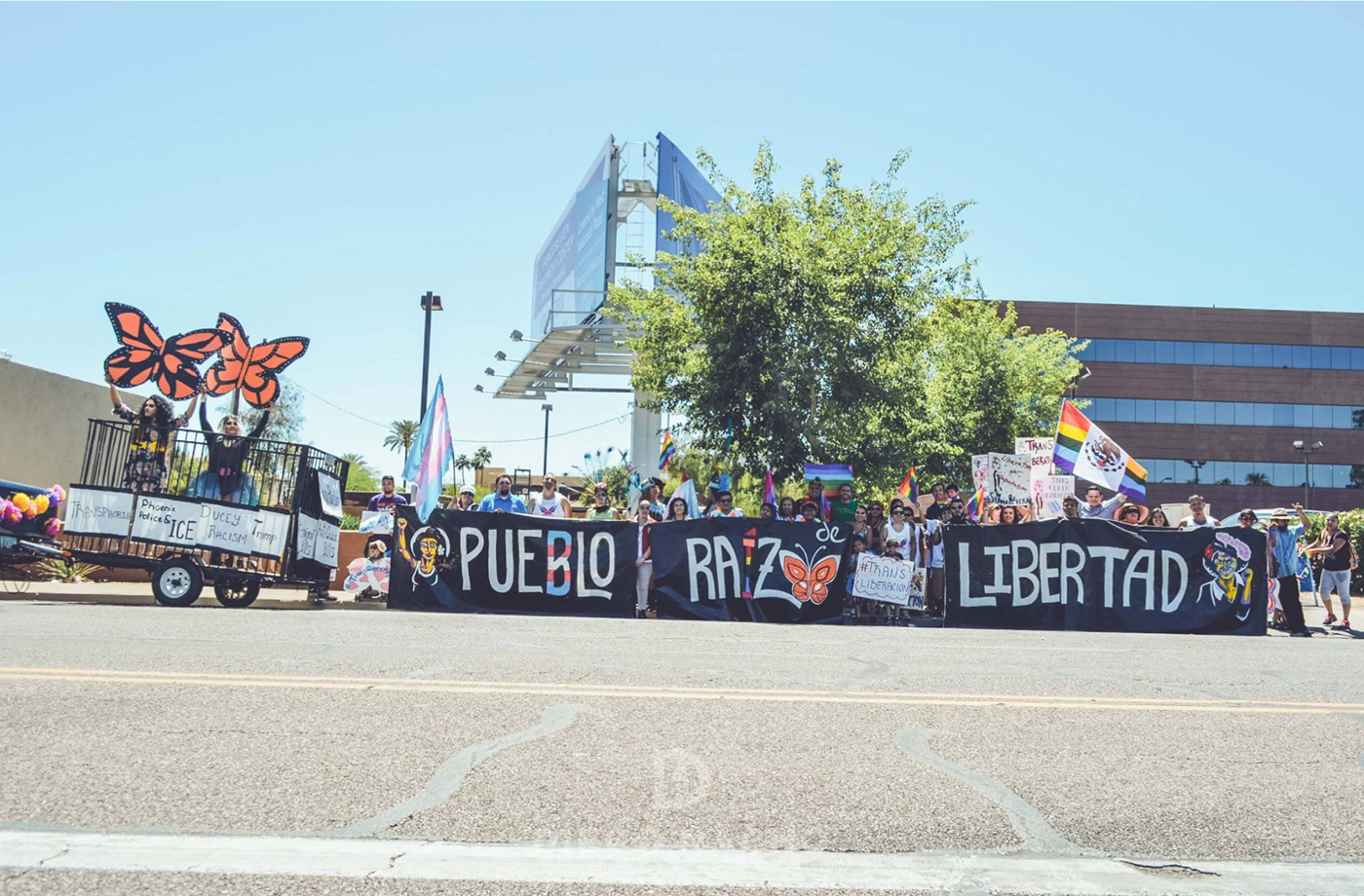
Trans Queer Pueblo's parade entry in April 2016 is the second text examined here. The entry features the message PUEBLO RAÍZ de LIBERTAD, again spread out across three banners. As seen in Figure 5, the capital letters, mostly white, stand out against the banners’ black background. The banner on the left, PUEBLO, contains one letter (B) that is painted the colors of the trans liberation flag. To the left of the word, there is a (presumably trans) female figure with a raised fist. In the center banner RAÍZ de, one letter (Í) is painted with the horizontal stripes of the rainbow flag. A bright orange butterfly to the right of the Z floats below the preposition de in the top right corner of the banner. The banner on the right reads LIBERTAD. Behind the banners, a bright blue pickup truck decorated with paper flowers pulls a cage with two people in drag holding aloft large cardboard monarch butterfly figures, representing—one might venture to guess—N. and D., two queer people who were at the time incarcerated in the immigration detention center in Eloy, AZ.Footnote 13 The cage is papered with hand-drawn signs with messages that include: transphobia, Phoenix police & ICE, Footnote 14 DUCEY RACISM, Footnote 15 Trump, Project Rose, Footnote 16 Racism, and Obama.
Pueblo Raíz de Libertad, April 2016 © 2016 Diego Ignacio Lozano. All rights reserved. Used under license.

The Spanish language of the hand-painted banners works together with the English language of the hand-written signs to create a bilingual visual presentation. The language is accompanied by visual and embodied elements of the group's participation in the Pride parade. Dancers in native dress precede the banners, highlighting and foregrounding indigenous identities. Behind the banner reading libertad, a version of the Mexican flag is flown in which the red and green of the panels on either side of the center panel are replaced with rainbow stripes. The butterfly references the undocumented queer Mexican migrant, drawing on the transborder migration pattern of the monarch butterfly in North America as well as the fact that mariposa, the Spanish word for ‘butterfly’, is one of several terms ‘historically used as epithets to describe queer males in several Hispanic cultures’ (D. Pérez, Reference Pérez2014b:96). While perhaps less direct than the 2014 ‘Obama deports queers’ intervention, the ‘Pueblo Raíz de Libertad’ theme serves to critique the mainstream Pride parade's homonormative position on what the source of liberation is, insisting that it is the people (or community), not acceptance by the state or recognition by the corporation.
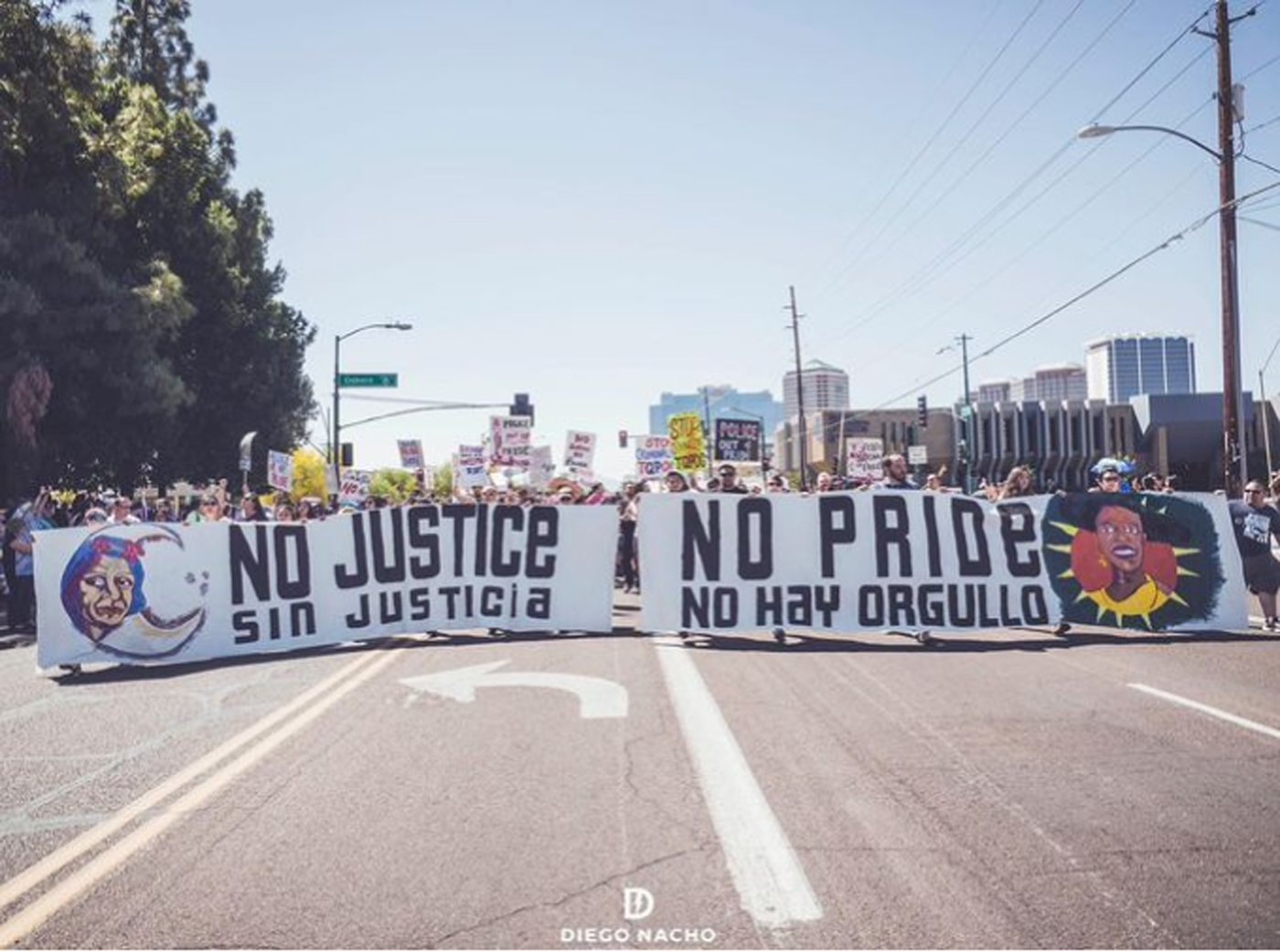
One year later in 2017, Trans Queer Pueblo's intervention in the Phoenix Pride parade again disrupted the dominant narrative of LGBTQ unity and celebration. Members of the organization walked behind two side-by-side banners that stretched nearly all the way across the four-lane width of the broad downtown city street. As seen in Figure 6, the left banner features the phrase No Justice and the right banner the phrase No Pride, both displayed in large black letters on a white background. Underneath, in smaller black lettering, the banners read sin justicia ‘without justice’ on the left and no hay orgullo ‘there is no pride’ on the right. The left side of the left banner features a drawing of trans icon and Stonewall veteran Sylvia Rivera inside a crescent moon shape. The right side of the right banner features a drawing of trans icon and Stonewall veteran Marsha P. Johnson inside a black circle background. Sylvia Rivera and Marsha P. Johnson were friends and activists in New York City in the 60s and 70s who challenged the white, middle-class hegemony of the gay and lesbian rights movement as well as the tyranny of the acceptability politics that pushed trans people of color to the margins. This reference to the Stonewall Riots and the parade's activist origins was echoed in the handmade picket-style signs held by participants marching behind the banner: Stonewall was an anti-police riot, Police out of pride, Policía fuera de pride, Make Pride Safe, Las raíces del orgullo (‘the roots of pride’), Stop Criminalizing TQPOC, No justice no pride, Sin justicia no hay Pride.
No justice no Pride, April 2017 © 2017 Diego Ignacio Lozano. All rights reserved. Used under license.

When the participants reached the reviewing stand, they stopped, effectively stopping the parade. Group leaders led chants on bullhorns; some group members sat or crouched in the street, while others positioned themselves along the perimeter of the group with their arms outstretched to create a protective circle around the protestors. This increasingly transgressive and disruptive form of protest is reminiscent of the actions of the group One in Nine at Joburg Pride in 2012, as described by Milani (Reference Milani2015). As in the South African case, where the ‘unanticipated interruption was not met with sympathy by the jubilant walkers’ (Milani Reference Milani2015:432), many of the Phoenix Pride parade spectators lining the street booed, some gave ‘thumbs down’ gestures, and some are reported to have yelled racist slurs. Several spectators entered the street to confront the protesters, coming up from behind the group and yelling “shame”, “get out of the way”, and “this is not your day”, and some tried to remove the protestors physically from the parade route by shoving them. Phoenix police stepped in to prevent the escalation of physical confrontations between the protestors and the people trying to get them to clear the route, although the police agreed not to arrest anyone provided that they did not block the route for too long.
The organizers and many attendees of the Phoenix Pride parade and the members of Trans Queer Pueblo participate in strikingly different acts of staking claim to an urban space (a main street in downtown Phoenix) and to an ideological position about the celebration of Pride (cf. Milani Reference Milani2015). The position held by Trans Queer Pueblo vis-à-vis Phoenix Pride was articulated in a video posted on the video co-producer/director's site on VIMEO months before the 2017 Pride festival. The Spanish original is reproduced here, followed by the translation provided in the video's subtitles.
A caso nos hemos olvidado de Stonewall? 1969. Una noche dos guerreras trans (llevaron) a la comunidad a resistir en contra de las redadas policiales. Aquel suceso fue el motivo de la primera celebración de Pride. Hoy en el 2017 estamos celebrando el matrimonio igualitario, la inclusión, la adopción, pero ¿tú crees que la igualdad matrimonial nos protege? Nuestra familia cae a diario asesinada en la calle. Estamos presos en los centros de detención. Hasta quién sabe cuándo. Somos LGBTQ de piel negra y morena. Indocumentados. Y mientras nosotros luchamos por nuestras vidas, el desfile de Pride es publicidad para productos y colaboración con los mismos policías que nos deportan. Fíjate, el patrocinador principal de Pride, el Banco de América, financia la encarcelación de nuestro pueblo. Pero el futuro no está escrito. Las cartas cuentan de un mañana cuando regresemos a nuestras raíces de orgullo. Invitamos a Pride a que tome las siguientes acciones: nieguen la participación de la policía en el desfile, corten sus enlaces con los patrocinadores carcelarios, denuncien públicamente la ley SB1070 y la orden 4.48 de la ciudad y la ley de manifestación. Y usen su influencia para mover al alcalde y terminar las dos leyes. Sin justicia no hay de orgullo.
‘Have we forgotten Stonewall? 1969. One night, two trans warriors led the community in resisting police raids. That's what the first Pride march celebrated. In 2017, we're celebrating. Marriage equality. Inclusion. Adoption. But do you think marriage equality keeps us safe at night? Our families are being murdered on the streets. We're locked up in detention centers for who-knows how long? We're LGBTQ. We're black and brown. We're undocumented. But while we're in the fight for our lives, Pride is product placement. And cooperating with the same police forces that deport us. Take note: Pride's main sponsor, Bank of America, finances the incarceration of our people. But the future is not written. The cards tell of a future when we return to the roots of Pride. We invite Phoenix Pride to take the following actions. Deny the police a parade float. Cut your ties with corporate sponsors that fund our incarceration. Publicly denounce SB1070 and the city ordinance 4.48 and the “manifestation law.” And use your influence to pressure the Mayor to put an end to both laws.’
At the end of the video, the following words are printed on the screen: No justice Sin justicia No pride No hay orgullo.
The use of both Spanish and English in the signs and the video push back against the erasure of Spanish. The mobilization of identity categories such as trans, queer, brown, QPOC, LGBTQ, and undocumented, among others, insists on a visibility that those who shout “this is our day!” do not want to acknowledge: there are people of color and undocumented people among the LGBTQ population in Phoenix. These visibility moves underscore the reality for undocumented queer folks in Phoenix: they are not safe, yet this is ignored by mainstream LGBTQ leaders, chief among them the organizers of Phoenix Pride. The demands of Trans Queer Pueblo detailed in the video take a stance against the inclusion of police in the Pride parade. Although the annual celebration of Pride originated as a riot against police harassment and brutality in 1960s New York City, the parade is now sponsored by a corporation that invests in the private prisons used to detain migrants. Like the One in Nine participants in the 2012 Joburg Pride protest, Trans Queer Pueblo attempts to reveal that the limited corporate and state embrace of gay and lesbian individuals and organizations evidenced by contemporary Pride celebrations is ‘a fragile and nasty accomplishment’ (Milani Reference Milani2015:450). Trans Queer Pueblo's participation in and disruption of Pride normalizes pueblo queerness and queer pueblo-ness, undermines elitism, and opposes erasure, appropriation, and corporatization of transqueer voices and bodies, while capturing the complexity of multiple, interconnected issues, from violence against trans women of color and racial profiling of people of color, to prison privatization and the safety of trans migrants in detention. Their transformative project resists ‘Euro-homo normativity’ (Heidenreich Reference Heidenreich1999) by making visible alternative ways of being queer and Mexican/Latinx.
DISCUSSION
In other work, I describe in more detail the racism and xenophobia in the Phoenix LGBTQ community and the homophobia in the Phoenix Mexican/Latinx community that backgrounds the identity work performed by Salcido Esparza and Trans Queer Pueblo (Cashman Reference Cashman2018). LGBTQ Phoenix, despite on-the-ground demographic realities, is imagined and represented as Anglo, English-speaking, and middle class. This norm has been actively maintained and regulated through the erasure of languages other than English and through mainstream organizations untroubled with the concerns of people of color, many of whom are transgender. This includes the policing and profiling of brown and trans bodies as well as the abuse of migrant people in detention centers, which often involves sexualized violence against trans people of color.
The two cases presented in this article reveal very different examples of queer Mexican/Latinx visibility in Phoenix, Arizona. A critical queer multimodal analysis reveals that linguistic and nonverbal resources are mobilized in both cases to destabilize the hegemonic whiteness of the LGBTQ community. Queer mexicanidad/latinidad is represented through wordplay, the use of Spanish and English, the combination of symbols, the juxtaposition of non-normative and normative feminine representations, and the use of social identity category labels.
Can identity-based participation in an event like Pride be antinormative, even subversive? Can advertisements by a business owner in mainstream gay publications or public billboards be antinormative, even subversive? Is it possible to embrace a particular identity in a way that resists normativity? My analysis suggests that participation in Pride can indeed be antinormative, as can advertisements produced by a business owner for mainstream publications. Against the erasure of queer people of color that is found in Phoenix, chef Silvana Salcido Esparza and Trans Queer Pueblo make use of traditional media, advertising, and social media to carry out a project of disidentification (Muñoz Reference Muñoz1999), working against dominant ideologies that negatively impact LGBTQ Mexicans/Latinxs. One of their most prominent tactics is the mobilization of social identity category labels: they take them up, manipulate them, and deploy them in ways that resist dominant discourses regarding who belongs in Phoenix's LGBTQ community. While queer theory's commitment to anti-identiarianism might write off each of these cases as an essentialist privileging of identity, theory rooted in the tradition of jotería studies insists on resisting queer theory's subjectlessness (Hames-García Reference Hames-García, Hames-García and Martínez2011b; D. Pérez Reference Pérez2014a).
Hall describes Boellstorff's (Reference Boellstorff2013) argument for theorizing ‘normaling’ in order to better understand ‘how subjects associated with heteronormativity can both be in the norm and shift the norm’ (Hall Reference Hall2013:638; see also Hall, this volume). We see such shifts in Salcido Esparza and Trans Queer Pueblo's tactics of visibility, which promote the ‘normaling’ of diversity with respect to ethnic, racial, and migrant status, as well as gender expression. By advocating for the inclusion of undocumented people, refugees, and asylees in LGBTQ politics, the multimodal texts examined here do multiplicity and thicker intersectionality to push back against a homonormative ideology. It is in this way that processes like these make homonormativity, in both senses described earlier, slightly less homonormative.