Introduction
The prevalence of mental disorders among prisoners is considerably higher than in the general population (Singleton et al. Reference Singleton, Meltzer, Gatward, Coid and Deasy1998; Fazel & Danesh, Reference Fazel and Danesh2002). Prison-based health-care services have been criticized historically as ineffective, reflective neither of current best practice nor of actual clinical need, delivered by inadequately qualified staff in unsuitable physical environments, yet at higher cost than services delivered to the wider community (HM Inspectorate of Prisons for England and Wales, 1996; Health Advisory Committee for the Prison Service, 1997; BMA, 2001; Birmingham, Reference Birmingham2003). The effectiveness of screening for health problems and suicide risk in custody has also been questioned, with routine screening practices picking up only 23–33% of prisoners with severe mental illness (SMI; Birmingham et al. Reference Birmingham, Mason and Grubin1996; Parsons et al. Reference Parsons, Walker and Grubin2001). To address these issues, mental health inreach services were established to provide specialist input for prisoners with SMI (DH, 2001). Inreach services were envisaged as being equivalent to Community Mental Health Teams, which provide specialist mental health input to the community. Evaluation of inreach has, to date, been limited to studies into operational, rather than clinical, considerations (Armitage et al. Reference Armitage, Fitzgerald and Cheong2003; Meiklejohn et al. Reference Meiklejohn, Hodges and Capon2004; Steel et al. Reference Steel, Thornicroft, Birmingham, Brooker, Mills, Harty and Shaw2007; Brooker & Gojkovic, Reference Brooker and Gojkovic2009). Such studies have shown wide variation in models of care, poor awareness among prison discipline staff about the role of inreach leading to inappropriate referrals, and problems implementing the Care Programme Approach (CPA; DH, 1990) in custody (Telfer, Reference Telfer2000; Lee, Reference Lee2003; Meiklejohn et al. Reference Meiklejohn, Hodges and Capon2004). Thus far, there has been no robust large-scale assessment into inreach teams' abilities to identify or manage the needs of prisoners with SMI.
The current study used a multi-site two-phase prevalence survey to determine rates of mental illness and subsequently assess the extent to which inreach teams were identifying and managing prisoners with SMI.
Method
The study took place in six prisons, chosen to ensure representation of a range of different prisoner and prison types. Four sites were local prisons receiving both remand and convicted adult men directly from court; two of these also fulfilled a high security function, housing prisoners presenting specific security risks. One establishment was a training prison, receiving convicted adult men transferred part way into their sentence. The sixth site housed adult and young women, accepting both convicted and unconvicted women directly from court. Two prisons were in the South East of England, one in the South and three in the North West. Ethical approval for the research was obtained from the National Health Service (NHS) ethics service and research governance approval granted from the NHS Trusts and the private sector company that provided inreach services to the research prisons.
The minimum sample size was determined using an estimate of the proportion of prisoners with SMI, to a confidence level (CI) of 95% (5% error). An estimated proportion of SMI was calculated by combining rates for different disorder types from the existing research literature. Psychosis rates for male and female prisoners, both on remand and sentenced, were obtained from Singleton et al. (Reference Singleton, Meltzer, Gatward, Coid and Deasy1998) and mood disorder rates from Brooke et al. (Reference Brooke, Taylor, Gunn and Maden1996). Rates were then calculated for individual sites based on the legal status and gender of each prison's population. For the four sites dealing with both remand and sentenced prisoners, the mid-point between the two relevant rates was selected. Psychosis rates were then combined with rates of depression and bipolar disorder to yield aggregate rates of SMI across each prison population. Estimated rates of SMI and overall prison population figures were used to determine the number of participants to be recruited at each prison. In total, a sample of 1110 participants was required, comprising 189 women and 921 men; a final sample of 1181 was achieved over an 18-month period (212 women, 969 men). This represented 1.5% of adult men and 5.4% of women in prison across England and Wales when data collection ceased in April 2007 (Ministry of Justice, 2007).
The study adopted a two-phase prevalence survey design. A random sample of prisoners newly received into custody was approached for inclusion. In the training prison, with a very low rate of receptions, prisoners were selected randomly from the prison roll. Following receipt of information about the study and informed consent being obtained, participants were asked to complete the Prison Screening Questionnaire (PriSnQuest), an eight-item screening tool validated to screen for mental illness in Criminal Justice System populations (Shaw et al. Reference Shaw, Tomenson and Creed2003). A score of three or more on PriSnQuest indicates the need for further detailed examination for possible mental illness. Those screened positive and 5% of those screened negative were asked to complete a longer clinical interview, incorporating: a demographic proforma designed specifically for the study; the Schedule for Affective Disorders and Schizophrenia (SADS; Endicott & Spitzer, Reference Endicott and Spitzer1978); the expanded Brief Psychiatric Rating Scale (BPRS-E; Lukoff et al. Reference Lukoff, Nuechterlein and Ventura1986); the Michigan Alcoholism Screening Test (MAST; Selzer et al. Reference Selzer, Vinokur and Van Rooijen1975); and the Drug Abuse Screening Test (DAST; Skinner, Reference Skinner1982). Additional questions were asked regarding past contact with mental health services in the community.
To assess the ability of inreach teams to identify SMI and any subsequent management, information about the care received by participants following health screening at reception in their first month in custody was documented from case notes including core clinical records, electronic systems and mental health inreach records.
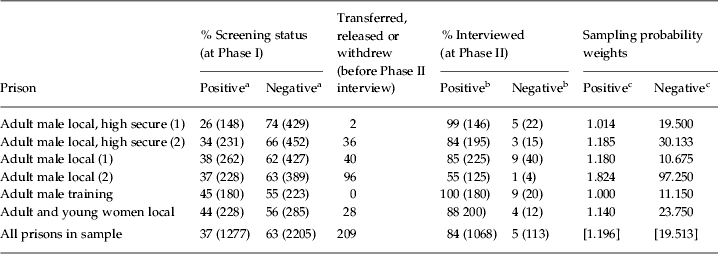
Data were initially double entered to enable the identification and correction of data entry errors, thereby producing an accurate data set for analysis. All statistical analyses were conducted using Stata version 10 (StataCorp, 2008) to properly account for the stratified sampling design. Following screening (Phase I), screen-positive and screen-negative sampling probability weights for each prison were derived as the reciprocal of the number of subjects who received the full clinical interview (Phase II) divided by the number within each screening status stratum at Phase I. The prison-specific probability weights (Table 1) were applied to all prevalence estimates and regression analyses to derive valid point and variance estimates from the two-phase sampling design. Weighted prevalence estimates were obtained from the coefficients generated by logistic regression models, as described by Dunn et al. (Reference Dunn, Pickles, Tansella and Vazquez-Barquero1999). Where analyses were performed across all six prisons, sampled variance estimates were further corrected for prison clustering effects using the Huber/White sandwich estimator (Rogers, Reference Rogers1993). All differences reported in the text are significant at the 5% level (two-sided).
Percentage of all prisoners who screened positive versus negative on the PriSnQuest (Phase I); by screening status, percentage of screened prisoners given Phase II clinical interview; sampling probability weights used for prevalence estimation

PriSnQuest, Prison Screening Questionnaire.
a Figures in parentheses give the number of prisoners per prison by screening outcome (positive versus negative) at Phase I.
b Figures in parentheses gives the number of prisoners per prison interviewed at Phase II, according to Phase I screening status.
c Probability sampling weights calculated as the reciprocal of number of subjects interviewed at Phase II divided by the number within each screening status stratum at Phase I (see Dunn et al. Reference Dunn, Pickles, Tansella and Vazquez-Barquero1999).
Among prisoners with SMI, log binomial regression models were used to derive risk ratios (RRs) and 95% CIs for mutually independent predictors of (a) assessment by inreach services and (b) acceptance onto caseloads. Independent variables that were significantly associated with outcome variables in univariate analyses (χ2 tests) were selected for inclusion in multivariate models and assessed together in single blocks. Subsequently, demographic variables thought to potentially influence outcome variables were added as covariates, namely gender, age, ethnicity and legal status. Variables significant at the 5% level were retained in the final models.
Results
In the Phase I screening, an overall consent rate of 90% (n=3482) was obtained from those approached for initial screening (n=3871). Participants screened were representative of the prisons from which they were drawn with respect to age distribution, ethnicity and offence characteristics, based on comparisons made between study and HM Prison Service data sources. Across the six sites, 1277 (37%) participants were PriSnQuest positive, scoring three or more, indicating the need for further examination for possible mental illness. Data for those who did not consent for screening were unavailable and it was not therefore possible to assess any potential bias due to non-consenting. In all, 84% of those who were screen positive (n=1068) and 5% of screen negatives (n = 113 of 2215) completed the full follow-up interview schedule (Table 1). Sixteen per cent of prisoners screening positive on PriSnQuest were transferred, released or withdrew from the study before being able to undertake the full clinical interview (n = 209).
Prevalence of SMI
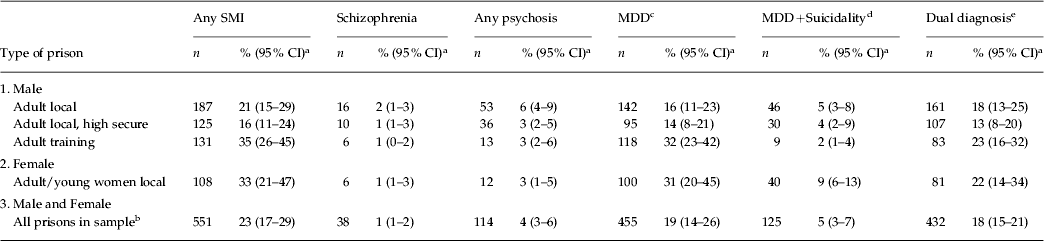
We defined SMI as a current episode of major depressive disorder (MDD), bipolar disorder and/or any form of psychosis, including schizophrenia, schizo-affective disorder and any other non-affective, non-organic psychosis, measured using the SADS. On this basis, the overall prevalence rate for SMI across all prisons was 23% (Table 2). In addition to the SADS measure of MDD, a second measure was used to calculate the rate of those with MDD accompanied by a clinically significant risk of suicide, measured by the BPRS-E. The prevalence of MDD with current, clinically significant suicide risk was 5%, with a significant gender difference (men: 4%, women: 9%; χ2 = 6.3, 1 df, p = 0.01).
Prevalence (%) of severe mental illness (SMI) as diagnosed by SADS, by prison type
SADS, Schedule for Affective Disorders and Schizophrenia; CI, confidence interval.
a % and CI are probability weighted to account for two-phase sampling design.
b For analyses conducted across all prisons, CI also corrected for prison clustering effects.
c Major depressive disorders (excluding psychotic disorders).
d Major depressive disorders (excluding psychotic disorders) with expanded Brief Psychiatric Rating Scale (BPRS-E)-assessed suicidality.
e Defined as alcohol or drug disorder + any type of SMI.
Prevalence rates of disorder varied markedly according to prison type. Adult male prisoners in the long-stay training establishment were twice as likely to have MDD as men in local prisons. Similarly higher rates of MDD were found in women. Conversely, men in local prisons were almost twice as likely to have a psychotic illness as either men, or women, in the training establishment. Rates for dual diagnosis of SMI and substance misuse were high among both sexes; 78% (95% CI 67–85) of those with SMI had a co-occurring alcohol and/or substance misuse problem, as measured by MAST and/or DAST. There was no evidence of a difference in rates of dual diagnosis between male (17%) and female (22%) prisoners (χ2 = 1.2, 1 df, p = 0.28).
Contact with mental health inreach services in custody
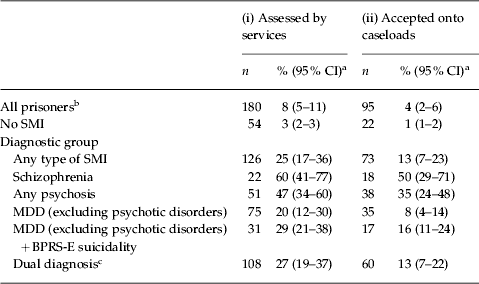
Overall, 25% of those with SMI (as determined by SADS) were assessed by inreach and 13% were accepted onto inreach caseloads within a month of reception into custody (Table 3). Rates of both assessment and acceptance onto caseload varied markedly according to psychiatric diagnosis. Thus, 47% of those with a psychotic illness were assessed and 35% taken onto caseload, whereas of those with MDD, 20% were assessed by inreach and 8% accepted onto inreach caseloads. These proportions increased when accompanied by a clinically significant risk of suicide, as measured by the BPRS-E, of which 29% were assessed and 16% accepted onto caseload. The rates of assessment and acceptance onto caseload for those with psychotic illness versus MDD were significantly different (χ2 = 23.3, 1 df, p < 0.001 and χ2 = 101.3, 1 df, p < 0.001 respectively).
Percentage of prisoners, by psychiatric status and diagnosis: (i) assessed by inreach services; (ii) accepted onto inreach caseloads
SMI, Severe mental illness; CI, confidence interval; MDD, major depressive disorder; BPRS-E, Brief Psychiatric Rating Scale – Expanded.
a % and CI are probability weighted to account for the two-phase sampling design; CI also corrected for prison clustering effects.
b All prisoners with Phase II measurements (n=1181) irrespective of psychiatric status.
c Defined as alcohol or drug disorder + any type of SMI.
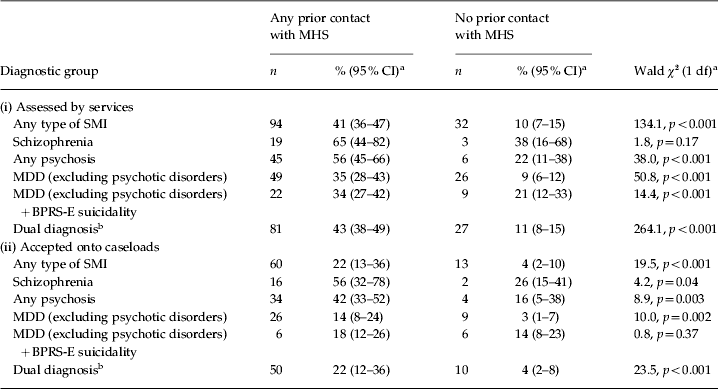
Among prisoners with a current episode of SMI, the likelihood of being either assessed by inreach services or accepted onto caseload was higher if they also reported past contact with mental health services (Table 4). Overall, 41% of those in a current episode of SMI reported having had previous contact with mental health services in the community; however, only 18% reported active service contact immediately before custody. Fifty-six per cent of those with a psychotic illness and a past history of contact with mental health services were assessed by inreach. By contrast, only 22% of those with a current psychotic illness but no previous contact with mental health services were assessed; this difference was highly significant (χ2 = 38.0, 1 df, p < 0.001). Similarly, 35% of those with MDD and a past history of contact with services were assessed, in comparison to 9% of those with the illness but no past contact with services (χ2 = 50.8, 1 df, p < 0.001).
Percentage of prisoners with and without any history of contact with mental health services (MHS), by psychiatric diagnosis: (i) assessed by inreach services; (ii) accepted onto caseloads
SMI, Severe mental illness; MDD, major depressive disorder; BPRS-E, Brief Psychiatric Rating Scale – Expanded; CI, confidence interval; df, degrees of freedom.
a %, CI and the Wald χ2 test are probability weighted to account for the two-phase sampling design; CI also corrected for prison clustering effects.
b Defined as alcohol or drug disorder + any type of SMI.
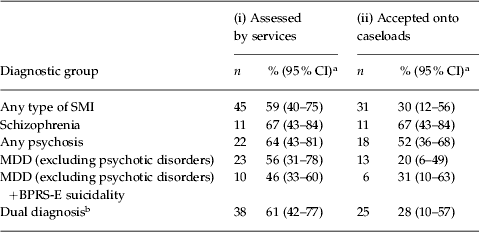
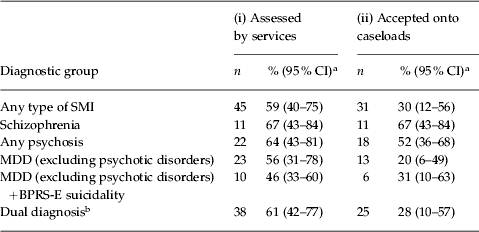
Rates of assessment and acceptance onto caseload were highest for those with SMI who had been in contact with community-based mental health services immediately before custody. Sixty-four per cent of those in a current episode of psychotic illness and in contact with services immediately before prison were assessed by inreach services, with 52% accepted onto caseloads. Similarly, 56% of those with MDD and current service contact were assessed by inreach, yet only 20% of this group were accepted onto caseload (Table 5).
Percentage of prisoners with current mental health service contact before custody, by psychiatric diagnosis: (i) assessed by inreach services; (ii) accepted onto inreach caseloads
SMI, Severe mental illness; MDD, major depressive disorder; BPRS-E, Brief Psychiatric Rating Scale – Expanded; CI, confidence interval.
a % and CI are probability weighted to account for two-phase sampling design; CI also corrected for prison clustering effects.
b Defined as alcohol or drug disorder + any type of SMI.
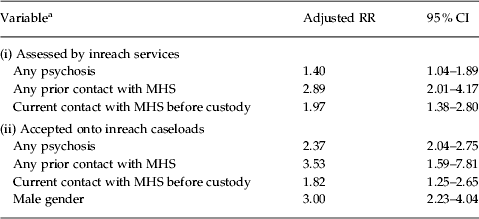
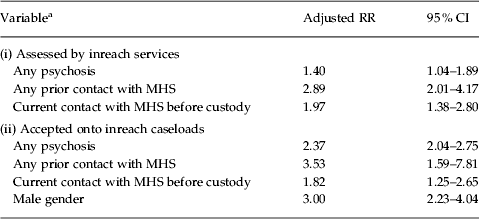
In multivariate regression models, any psychosis, any prior contact with MHS and current contact with MHS before custody were significantly and independently associated with both inreach assessment and acceptance onto caseload. In the final models, predictors of acceptance onto inreach acceptance were essentially the same as those for assessment, except that male gender was also independently associated with acceptance onto caseload (Table 6).
Multivariate models showing mutually independent predictors of (i) assessment by inreach services and (ii) acceptance onto inreach caseloads, among prisoners diagnosed with SMI
SMI, Severe mental illness; RR, risk ratio; CI, confidence interval; MHS, mental health services.
a The variables tested were any psychosis, major depressive disorder (MDD, excluding psychotic disorders), MDD + Suicidality (excluding psychotic disorders), dual diagnosis, any prior contact with MHS, current contact with MHS before custody, gender, age, legal status and ethnicity.
Contact with mental health services in the community
Fifty-one per cent (n = 270) of prisoners in a current episode of SMI reported previous contact with community-based mental health services; however, only 18% (n = 98) were in recent, active contact with services immediately before reception into custody. Those with schizophrenia had the highest rate of engagement with services immediately before custody, with 45% (n = 17) in contact compared to 16% (n = 68) of those with MDD.
Discussion
Overall, the results showed that specialist mental health inreach teams had assessed only a quarter of all prisoners with SMI, and that even fewer were taken onto their caseloads for treatment. The rationale for inreach services was to manage prisoners with SMI so we suggest that they are missing the majority of people intended for their input. However, before any firm conclusions can be drawn, the limitations to this study should be considered.
First, the six prisons used were not wholly representative of the entire prison estate; open/trainer prisons and young offender institutions were not included. However, participants screened were representative of the prisons from which they were drawn with respect to age distribution, ethnicity and offence characteristics, based on comparisons made between study and HM Prison Service data sources. This would have had a limited effect on introducing potential bias as our survey aimed to measure inreach services in terms of their success engaging with a random sample of adults with SMI. This was fully congregant with the original policy aim. Rates of contact with mental health services in the community were based on self-reports and may therefore be inaccurate, perhaps most for prisoners reporting current contact with services. This was defined to participants as recent, active engagement with services; however, it is possible that prisoners included levels or types of contact that mental health workers would not consider as active or satisfactory engagement from a clinical viewpoint. A second limitation was the study's reliance on the PriSnQuest measure to screen for SMI. Although research suggests this has good sensitivity (Shaw et al. Reference Shaw, Tomenson and Creed2003), analysis of the 113 ‘screen negatives’ revealed that seven of them had an SMI, diagnosed by SADS. However, the estimation of prevalence of SMI in the prisons correctly accounted for the proportion of false positives and negatives on PriSnQuest (Rogers, Reference Rogers1993; Dunn et al. Reference Dunn, Pickles, Tansella and Vazquez-Barquero1999). Data for assessment and treatment by inreach services were extracted from core clinical records, electronic medical note systems and mental health inreach records in prisoners' first month in custody only. It is possible that prisoners with SMI were identified, assessed and treated by inreach teams during a later point in their custody period.
Comparison of the SMI rates found here and in other research is problematic because of differences in tools and definitions. Most studies have reported the prevalence of mental illness as a whole rather than focusing on SMI (Gunn et al. Reference Gunn, Maden and Swinton1991; Brooke et al. Reference Brooke, Taylor, Gunn and Maden1996; Singleton et al. Reference Singleton, Meltzer, Gatward, Coid and Deasy1998; Fazel & Danesh, Reference Fazel and Danesh2002); however, rates of individual disorders can be compared. At 4%, the prevalence of psychosis among prisoners in our sample was identical to that reported by a systematic review of nearly 23000 prisoners across 12 countries (Fazel & Danesh, Reference Fazel and Danesh2002), and similar to a study of 750 male remand prisoners using comparable methodology (i.e. semi-structured interview and case-note review), which found 5% (Brooke et al. Reference Brooke, Taylor, Gunn and Maden1996). However, the rate is higher than a study using non-structured clinical diagnosis, which found 2% psychosis among 1769 male prisoners on remand (Gunn et al. Reference Gunn, Maden and Swinton1991). It has been suggested that studies such as ours, conducted by non-clinical researchers using standardized assessments, may overestimate the prevalence of mental illness (Anthony et al. Reference Anthony, Folstein, Romanoski, Von Korff, Nestadt and Chahal1985; Romanoski et al. Reference Romanoski, Folstein, Nestadt, Chahal, Merchant, Brown, Gruenberg and McHugh1992). Conversely, the psychosis rate from this study is lower than the most quoted prevalence study of prisoners in England and Wales, which found rates of 9% and 6% among remand and sentenced male prisoners respectively, and 13% for a mixed sample of females (Singleton et al. Reference Singleton, Meltzer, Gatward, Coid and Deasy1998). However, in that study, the methodology used allowed the reporting of rates of ‘probable psychosis’, possibly resulting in an overestimation of disorder, compared to the more narrow definition resulting from our methods.
Despite the limitations, we suggest that the data reliably show insufficient identification of SMI by inreach teams following reception into prison. An earlier study (Birmingham et al. Reference Birmingham, Mason and Grubin1996) reported that only 23% of those with mental disorder were detected by routine screening upon reception into prison and, if not identified at reception, mental disorder was unlikely to be detected later in a person's prison term. This study shows that the proportion of prisoners with SMI being identified in the first month of custody seems not to have changed following the introduction of these specialist services.
Detection of SMI currently relies heavily upon initial health screening on reception into custody. This is a busy and stressful time and there are several procedures requiring completion. Health-care assessment is but one of these processes, and one that may be considered less important than the legal procedures required to ensure a person's custody is lawful. In local prisons with many new receptions, prisoners invariably arrive in large numbers from courts during the late afternoon and early evening, and the imperative is to move prisoners from the reception area onto residential units as quickly as possible. Health screens may be completed in areas that are barely private and routinely noisy. This is not an environment conducive to an effective assessment of mental health needs.
The current standard health screening tool requires health-care staff to refer a person to mental health services for further assessment if they report past contact with mental health services or a past prescription of psychotropic medication. However, only 59% of those in a current episode of SMI who were in contact with mental health services immediately before custody were assessed by inreach. This suggests a fundamental problem in using past contact with services as an indicator to ensure continuity of care for a large proportion of severely mentally ill prisoners.
The original principle of the reception health screening process was that it should serve as a quick screen of urgent or significant needs, to be then followed by a later comprehensive assessment (Grubin et al. Reference Grubin, Carson and Parsons2002). In many prisons, this process does not take place because of practical difficulties in health-care staff accessing all prisoners within a few days after initial reception. In our view, this principle should be revisited so that health screening upon initial reception focuses on detecting whether a prisoner has an acute physical or mental health problem requiring immediate treatment, or whether there is an acute risk of suicide. Following this, all prisoners should be ‘kept safe’ overnight. We would go further and suggest that comprehensive mental health assessments should be conducted on everyone the following day by trained staff in an appropriate environment. This would prevent an over-reliance on historical factors for detection of mental illness, such as past contact with services, to one that proactively seeks out current need. There then needs to be an effective triage mechanism whereby those with SMI are routed to inreach, and those with common mental disorders remain in primary care as would happen in the community.
Currently, primary care mental health services are underdeveloped generally in prisons (Bradley, Reference Bradley2009), and there is an urgent need to examine ways of successfully importing and adapting evidence-based best practice from the wider community to effectively meet the clinical and psychosocial needs of prisoners with mild to moderate mental health problems. Consideration also needs to be given to ways of replicating the plurality of specialist mental health-care services available to the wider community; for example, early intervention and assertive outreach services, to fully achieve equivalence of provision between prison and community. In this way, inreach services become part of a holistic, functional mental health system in prisons rather than an isolated resource expected to provide care to a population in flux, with very diverse needs, as is currently too frequently the case.
Finally, the study findings suggest a much broader problem of engagement with this group. Although only 25% of those received into prison custody with SMI were assessed by specialist mental health inreach services and 13% accepted onto caseload, only 18% of those in a current episode of SMI were in contact with mental health services immediately before prison. Thus, community-based services, in addition to those in prison, clearly have a long way to go in effectively providing services for this difficult to engage group. This has implications for robust discharge planning upon release from prison, including the development of creative and flexible ways of providing services in the community to maximize engagement; effective treatment modalities for those with dual mental health and substance misuse problems; and efficient communication strategies to ensure appropriate and proportional sharing of clinical and risk pertinent information across both health and criminal justice agencies.
Acknowledgements
We acknowledge the invaluable contribution that the following colleagues made towards the prison mental health inreach study: C. Brooker, R. Clayton, G. Coffee, N. Coxon, K. Foster, D. Gojkovic, K. Gournay, J. Hookway, M. Jarrett, K. Justo, P. Kelly, P. Ralphs, T. Ricketts, M. Rose, J. Steel and D. Toseafa. We gratefully acknowledge the practical help and assistance given to the research team by prison discipline and health-care staff and managers in facilitating our work in the study sites.
This study was funded by the NHS Forensic Health R&D Programme. Grant reference: MRD12/61.
This report/article presents independent research funded by the Department of Health under the Forensic Mental Health programme. The views expressed in this publication are those of the author(s) and not necessarily those of the NHS or the Department of Health.
Declaration of Interest
None.