Introduction
Weevils of the genus Naupactus are known pests of citrus in Australia, Brazil, the USA (Florida) and New Zealand (Tarrant and McCoy, Reference Tarrant and McCoy1989; Lanteri et al., Reference Lanteri, Guedes and Parra2002; Steven, Reference Steven2005). In Brazil, Naupactus curtus Boheman has caused defoliation in only three crops: coffee Coffea arabica L. (Rubiaceae), the mulberry tree Morus alba L. (Moraceae) and the Acerola tree Malpighia glabra L. (Malpighiaceae) (Sanchez-Soto et al., Reference Sanchez-Soto, Guedes and Nakano2005). According to these authors, adults of this species feed on the borders of leaves, which commonly present an engrailed aspect, reducing the leaf area and, consequently, the photosynthetic rate. In spite of its occurrence, little is known on its potential damage to coffee crops.
Ascochyta (Ascochyta coffeae) is a disease that attacks several plant species and has caused losses in many crops in Brazil, including coffee (Waller and Bigger, Reference Waller, Bigger and Hillocks2007). This work aimed to elucidate the relationship between N. curtus and A. coffeae on coffee plants in Brazil.
Materials and methods
From August to October 2008 (the period of N. curtus occurrence), six coffee crops were monitored and, in total, 565 coffee plants were evaluated. On each plant, four branches and the fourth pair of leaves were verified for the number of lesions caused by N. curtus, and the incidence of the disease was recorded. Leaves showing symptoms of the A. coffeae disease were collected and transported to the Phytopathology Laboratory of the Federal University in Viçosa (Brazil) in order to identify the disease. Data on number of lesions caused by N. curtus per plant with and without the presence of the disease were submitted to the Pearson correlation analysis.
Results
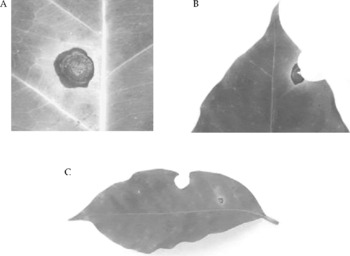
Leaves showing lesions caused by both N. curtus and strains of A. coffeae were found in the municipalities of Ponte Nova and Jaboticatubas, Minas Gerais, Brazil (Fig. 1A–C). A positive and significant correlation between the number of lesions by N. curtus and those of A. coffeae was recorded (r = 0.87, P < 0.0001). Out of 125 plants with lesions by N. curtus, 35% also showed symptoms of an A. coffeae infection.
Ascochyta (Ascochyta coffeae) disease symptoms (A), lesion caused by Naupactus curtus with the ring stains caused by an A. coffeae infection (B), and damage caused by N. curtus (C) in leaves of Coffea arabica.

Discussion
Insects are important vectors for many diseases. However, so far it was not known that N. curtus can act as a facilitator for the Ascochyta disease in coffee. Presumably, the defoliation caused by the weevils enables the pathogen to subsequently infect the plants, resulting in leaf yellowing and leaf fall. Our results suggest that possibly the control of N. curtus may be an alternative to reduce the proliferation of the Ascochyta disease in coffee stands.
Acknowledgements
We would like to thank CAPES, FAPEMIG, CNPq, Dr Miguel Angel Monné from Museu Nacional do Rio de Janeiro (Brazil) for his help in verifying the identification of N. curtus, and Mr Jeff Oar for supporting in the English language.