Introduction
Research on lattices, origami and kirigami structures, and hybrid materials made of a range of solids is currently driving the development of architected materials with unique physical properties that promise to boost the performance of future technology. In the past few years, a wealth of unique functionalities has been pioneered, each tapping into the potential of material architecture, a term often loosely used to indicate the primary factor enabling their extreme performance.
Pioneering works on architected materials (cellular materials in particular) primarily focus on the ideal state—a nominal architecture with defect-free geometry and homogenous base material.Reference Gibson and Ashby1–Reference Sigmund4 The main goal was to first understand the mechanisms of deformation that underpin their mechanics and structural properties. The focus then steered toward the realistic state, given that ideal conditions are seldom attained in a real-life setting, where structural deviations from the ideal target appear in both material and geometry. Due to manufacturing or damage, defects are not merely confined to a visual departure from the ideal state, but can also critically impact the mechanics and design of an architected material. Their influence can become even more acute in service conditions, when conventional assumptions on length-scale separation, periodicity, and boundary homogeneity typically break down or cannot be satisfied.
Deviations from the ideal state might create disruptions in the expected mechanical and functional response at levels that depend on the interplay between the base material and length scale of the constituent elements. Even when very small in amplitude, perturbations can generate a dramatic effect that can either serve to generate unprecedented responses, or jeopardize the function an architected material is designed for. For example, tiny perturbations in the architecture of elastomers have been exploited to generate a sequence of topological reconfigurations that are guided by buckling and self-contact between the elements of a metamaterial.Reference Coulais, Sabbadini, Vink and van Hecke5 For elastoplastic architectures, geometric defects can cause dramatic changes in the failure modes that are not visible in their defect-free counterparts.Reference Liu, Kamm, García-Moreno, Banhart and Pasini6 For brittle materials, the principle of reducing the characteristic feature size of the material architecture has been pursued to create large recoverable deformation in ceramics, and exceptional strength-to-density ratio in glassy carbon, among many others.Reference Bauer, Schroer, Schwaiger and Kraft7,Reference Meza, Das and Greer8
In architected materials that are highly optimized, the deleterious effect of imperfections may be amplified even further. For example, the pursuit of lightweight materials with high stiffness and strength leads to architectures that are sparse and composed of thin members, potentially leading to nonredundant load paths and elements defined at a scale that may approach the scale of randomness. Such structures may perform well in a deterministic computational setting, but may fail under small load perturbations when tiny imperfections exist, thereby limiting their use in engineering applications.Reference Guest and Igusa9 Similarly, optimized auxetic (negative Poisson’s ratio) materials often feature small-size hinges that facilitate rotation to maximize auxeticity; here, slight deviations in thickness may lead to disconnected features that can drop elastic stiffness.Reference Sigmund10,Reference Andreassen, Lazarov and Sigmund11
In functional applications, the impact of imperfections can go beyond alteration of mechanical properties. Fluidic permeability, for example, is highly sensitive to the size, shape, and interconnectedness of pores, because it generally scales quadratically with pore diameter; thus imperfections in feature sizes (over- or under-deposition) or location (misplacement) may dramatically impact expected flow profiles, flow rates, and pressure drops in transport applications.Reference Zhao, Ha, Sharp, Geltmacher, Fonda, Kinsey, Zhang, Ryan, Erdeniz, Dunand, Hemker, Guest and Weihs12,Reference Lin, Zhao, Guest, P Weihs and Liu13 Similarly, in additively built porous materials for bone replacement, manufacturing defects can lead to complete pore occlusion that hinders bone ingrowth and generates mechanical property shifts that might hamper the properties tuning of mechanically biocompatible implants.Reference Arabnejad, Burnett Johnston, Pura, Singh, Tanzer and Pasini14–Reference Moussa, Tanzer and Pasini17 Several other examples of defect-driven performance abound in properties governed by other physics, including nanoelectronics, photonic, and phononic crystals, among others.
This article presents a brief review of two intertwined topics on architected materials with imperfections—their solid mechanics with an emphasis on defect sensitivity, and their tailored design cast through a topology optimization formulation. The purpose of this article is not to be exhaustive, but rather to emphasize the role of defects beyond the elastic regime and the importance of accounting for them in the design of optimized material architecture.
Factors governing defect sensitivity
Generally, architected materials contain imperfections due mainly to manufacturing, although they can certainly have inherent imperfections also. With a focus on architected materials, Figure 1 is an attempt to summarize the main factors that govern defect sensitivity. Designated with a bubble, each group collects a nonexhaustive list of its characteristics. Material refers to the ideal base material, in particular, the intrinsic properties of a flawless material without any variations in composition, porosity, crystallographic texture, or other process-induced anomalies. Architecture mainly includes the nominal descriptors of the target geometry starting from the characteristic length scale, unit-cell topology, nodal connectivity, and constituent geometry, as well as cell arrangement and distribution.
Origins of sensitivity of macroscopic mechanical properties to defects in an unbounded architected material.
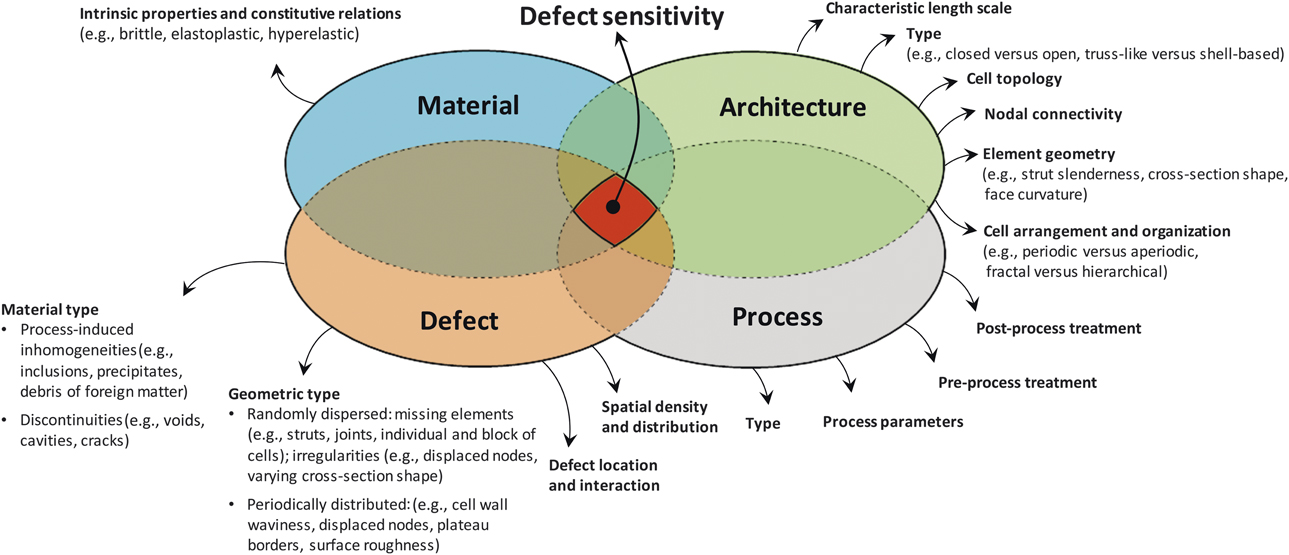
Process specifies the fabrication technology, with no specific reference here to a given process yet with an emphasis later placed on additive processes. Defect is the fourth cluster. This is an umbrella term used here to collect multiple deviators, with type distinguishing between geometric and base-material perturbations from the ideal state. Defects in the base material refer to microstructural imperfections, such as undesired process-induced inhomogeneities as well as discontinuities, which can lead to local variations and anisotropy in the bulk properties of the constituent solid. Geometric defects can be randomly dispersed or periodically distributed in a cellular material. Besides defect type, other characteristics include defect location, defect density, its spatial distribution, as well as the interaction between multiple defects.
At the intersection (red) of the four clusters stands the sensitivity of the macroscopic properties of an architected material with unbounded size to defects for given loading and boundary conditions. On top of the four groups can be added the role of sample size (i.e., the overall extent of an architected material), which is particularly relevant in real-life applications, where small-scale samples tend to mechanically perform better than larger samples of given relative density.
Defect characterization
A convenient distinction can be made between as-designed and as-manufactured imperfections for architected materials. The former are perturbations intentionally introduced in an ideal architecture with the goal of providing at most a qualitative account of the real response of an architected material. Studying the sensitivity to as-designed imperfections leads to establishing knock-down relations, or safety factors, between a given type of defect and a specific structural property, thereby indicating the importance of avoiding that defect during manufacturing. In this case, the assumption made a priori is for the initial distribution of a given defect type (e.g., periodic or normal), which does not necessarily reflect the actual defect distribution rendered by a given manufacturing process. On the other hand, as-manufactured imperfections are actual irregularities generated during fabrication and quantified in magnitude and dispersion from the analysis of an as-built architecture.
Given that the real defect distribution varies strongly with the manufacturing process, nondestructive techniques become handy for defect detection and quantification. Their use establishes a direct correlation between process parameters and factual anomalies in both geometry and base material. For the assessment of the former, optical imaging, scanning electron microscopy (SEM), microcomputed tomography, and other metrology techniques, are effective in characterizing morphology and dispersion of defects. For the assessment of base-material imperfections, SEM and electron backscatter diffraction (EBSD) are among prominent techniques that can shed light on the microstructure of crystals, grain size, crystallographic texture, and crystal orientation of the constituent solid.
For additively built architected materials, the physics of the deposition process, which is complex and goes far beyond the scope of this work, governs the mechanisms of defect formation, and hence influences defect morphology, distribution and interaction. In laser powder-bed fusion (LPBF),Reference Arabnejad, Burnett Johnston, Pura, Singh, Tanzer and Pasini14,Reference Melancon, Bagheri, Johnston, Liu, Tanzer and Pasini15 for example, process parameters (e.g., heat source energy, scan rate, spot size and pattern, laser-beam characteristics, and powder feed rate), and raw material characteristics (e.g., particle size and distribution, internal porosity, particle shape, and topography) control part quality and may generate defects in each part of the architecture. Due to high thermal gradients and complex thermal histories that vary spatially, local anisotropies can easily form. Microstructural anomalies, such as porosity due to lack of fusion, inclusions, anisotropy, and variation in phase stability, appear in the base material along with geometric irregularities. Strut waviness, node misalignment, mass agglomeration, nonuniform cross sections, thickness oversizing and undersizing are some of the other geometric defects that depend not only on the process parameters, but also on the building direction (i.e., the sample orientation in the building chamber). As metamaterials typically feature multiple elements inclined dissimilarly with the building direction, material deposition throughout all metamaterial’s members is not uniform, thereby generating effective responses that deviates from their defect-free counterparts.Reference Bagheri, Melancon, Liu, Johnston and Pasini18,Reference Mueller and Shea19
Solid mechanics and defect sensitivity
Each type of defect has its own impact on the structural properties of an architected material. Several works have shed light into the role and interplay between defect type, cell topology, nodal connectivity, and load type on a range of effective properties (e.g., moduli, yield, buckling, and fracture toughness) of two-dimensional and three-dimensional (3D) architectures.
For elastic planar lattices with high nodal connectivity (e.g., triangular honeycombs), misplaced nodes generate a reduction in the modulus that is less severe than in those with low connection number, such as hexagonal lattices.Reference Symons and Fleck20 Cell wall waviness is another type of defect that strongly reduces the elastic moduli of stretching-dominated lattices, yet its impact in lattices deforming via bar bending is negligible.Reference Symons and Fleck20 Other imperfections in the form of rigid inclusions, holes, and missing cell walls lead to other distinctive outcomes. Rigid inclusions have almost no influence on elastic honeycombs as opposed to holes or missing cell walls, which yield an additional degree of bending that sharply drops the bulk modulus.Reference Chen, Lu and Fleck21 The absence of cell walls can severely reduce modulus and strength, and lead to complex mechanisms of cooperative collapse when the defect inter-distance is above a critical threshold.Reference Simone and Gibson22 Similarly, in 3D architectures, such as open cell foams, plateau borders and randomly displaced nodes only mildly influence mechanical properties,Reference Gan, Chen and Shen23 whereas missing bars can dramatically knock down ductility.Reference Ronan, Deshpande and Fleck24 In 3D truss lattice materials, nodal connectivity, defect arrangement, and void sizes also play an important role. In particular, degradation of elastic moduli has been demonstrated for highly connected 3D lattices, which are not only more robust than those with lower coordination number, but also less sensitive to randomly excluded struts than to uniformly added voids.Reference Gross, Pantidis, Bertoldi and Gerasimidis25
For elastoplastic honeycombs under biaxial loading, the largest penalty on yield strength is produced by fractured cell edges, followed by missing cells, wavy cell edges, cell edge misalignments, cell-size variations, and nonuniform wall thickness.Reference Chen, Lu and Fleck26 The main cause can be ascribed to a switch in deformation mode from cell wall stretching to cell wall bending under hydrostatic loading. Defects can thus reduce the high hydrostatic strength of ideal honeycombs to a level similar to their deviatoric strength.
In elastobrittle planar lattices under tensile and shear load, cell topology and nodal connectivity control the transition crack length, above which fracture switches from strength control to toughness control, and contribute to govern fracture toughness sensitivity. For triangular and hexagonal lattices, the flaw transition size is on the order of the cell size, a factor that makes them extremely flaw sensitive. In contrast, for the kagome lattice, the transition flaw size is several times the cell size, thereby boosting fracture toughness and leading to high damage tolerance. For elastobrittle cellular materials with largely displaced nodes, nodal connectivity is even more influential than cell topology; the higher the nodal connectivity, the larger the fracture toughness.Reference Tankasala, Deshpande and Fleck27–Reference Romijn and Fleck29
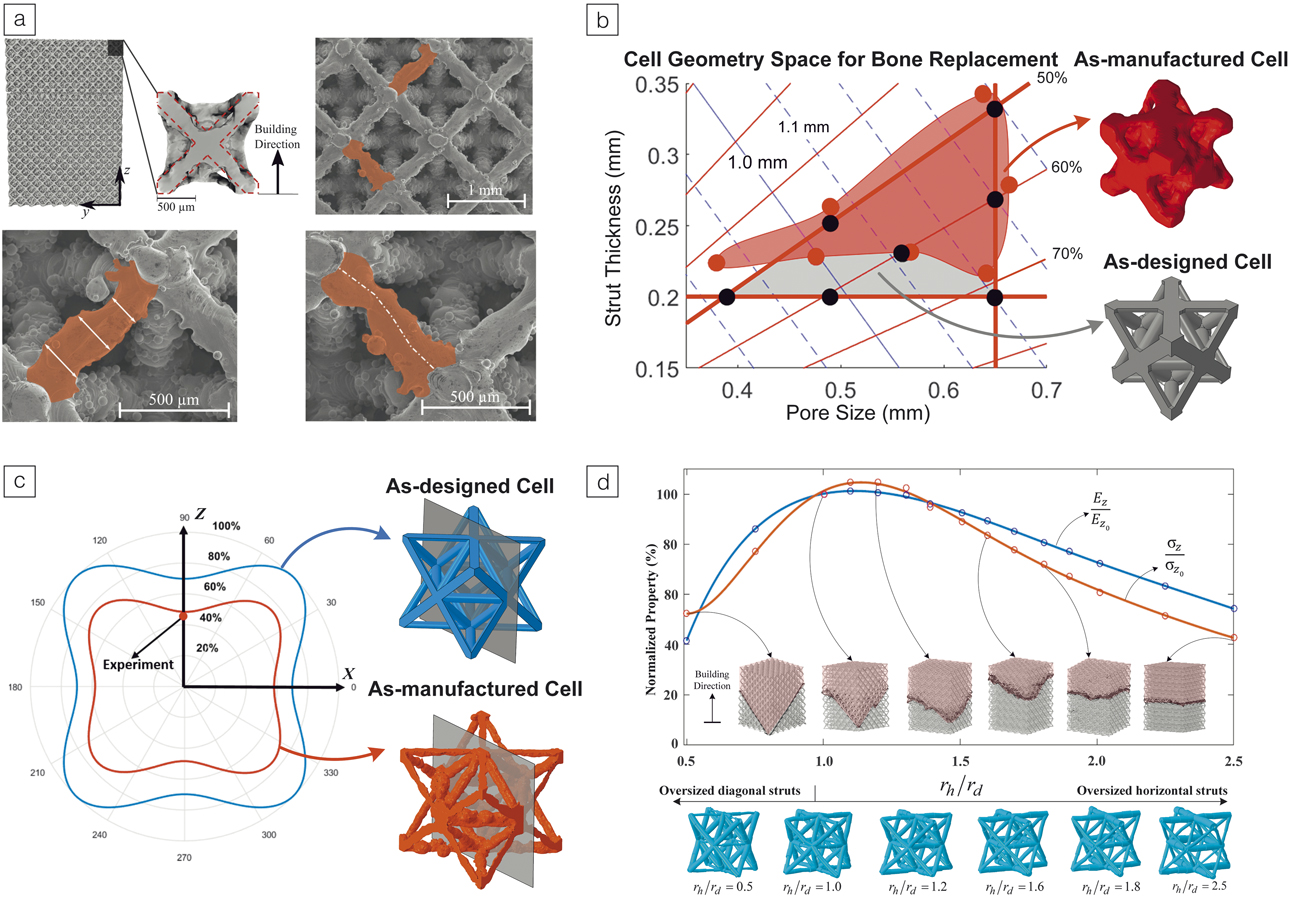
Beside as-designed defects, the impact of as-manufactured defects is of particular interest for the rapidly evolving field of additive manufacturing, where formation, morphology, and dispersion of defects are intrinsic to the physics of the process, and the building direction.Reference Liu, Kamm, García-Moreno, Banhart and Pasini6,Reference Melancon, Bagheri, Johnston, Liu, Tanzer and Pasini15,Reference Bagheri, Melancon, Liu, Johnston and Pasini18,Reference Ferrigno, Di Caprio, Borrelli, Auricchio and Vigliotti30 The impact is not only on static properties but also on fatigue properties, as sharp surface irregularities at the nodes can severely reduce fatigue resistance.Reference Dallago, Winiarski, Zanini, Carmignato and Benedetti31 Geometric inaccuracies induced by additive manufacturing (Figure 2a) in porous materials can lead to partial pore occlusion (Figure 2b) and alter elastic moduli (Figure 2c), strength, and failure mechanisms (Figure 2d). The heterogeneous variation of strut thickness within a unit cell can create a modulus knockdown that is most severe along the building direction due to over-melting of the horizontal struts. In addition, for given relative density, variation in the thickness ratio of horizontal to diagonal struts can generate failure mode transitions from shear band to horizontal localizations that are not visible in defect-free lattices.
(a) Computed tomography-reconstructed sample of representative additively built metallic lattice. Hidden lines (red; top left) represent the nominal geometry. Scanning electron microscope images highlight nonuniform cross-sectional shape and thickness (b) and strut axis deviation (c).Reference Melancon, Bagheri, Johnston, Liu, Tanzer and Pasini15 (b) Shift in the geometric space (from gray to red) of a porous bone replacement biomaterial defined by isometric lines of porosity (%), minimum manufacturable strut thickness, and pore size range for bone ingrowth.Reference Melancon, Bagheri, Johnston, Liu, Tanzer and Pasini15 (c) Uneven knockdown of normalized Young’s modulus in the X-Z plane for as-designed and as-built cell.Reference Liu, Kamm, García-Moreno, Banhart and Pasini6 (d) Impact of uniform undersizing and oversizing of strut thickness (ratio between the average radius of horizontal struts, r h, and the average radius of diagonal struts, r d, on effective elastic moduli (blue curve), compressive strength (red curve), and failure modes (sample inserts below curves) in additively built octet-truss material.Reference Liu, Kamm, García-Moreno, Banhart and Pasini6

Topology optimization
With improved understanding of defect sensitivity, a natural question arises: how should architectures be designed to minimize the impact of imperfections on the effective properties and, ultimately, component performance? Topology optimization is a systematic tool to potentially address this.
Topology optimization involves the representation and solution of engineering design problems as formal optimization problems. Design variables represent the distribution of base materials within a geometric domain and the resulting layout represents the structure design. The key advantage of topology optimization is that material connectivity may change throughout the design process, thereby enabling the exploration of alternative architectures and the discovery of novel designs.
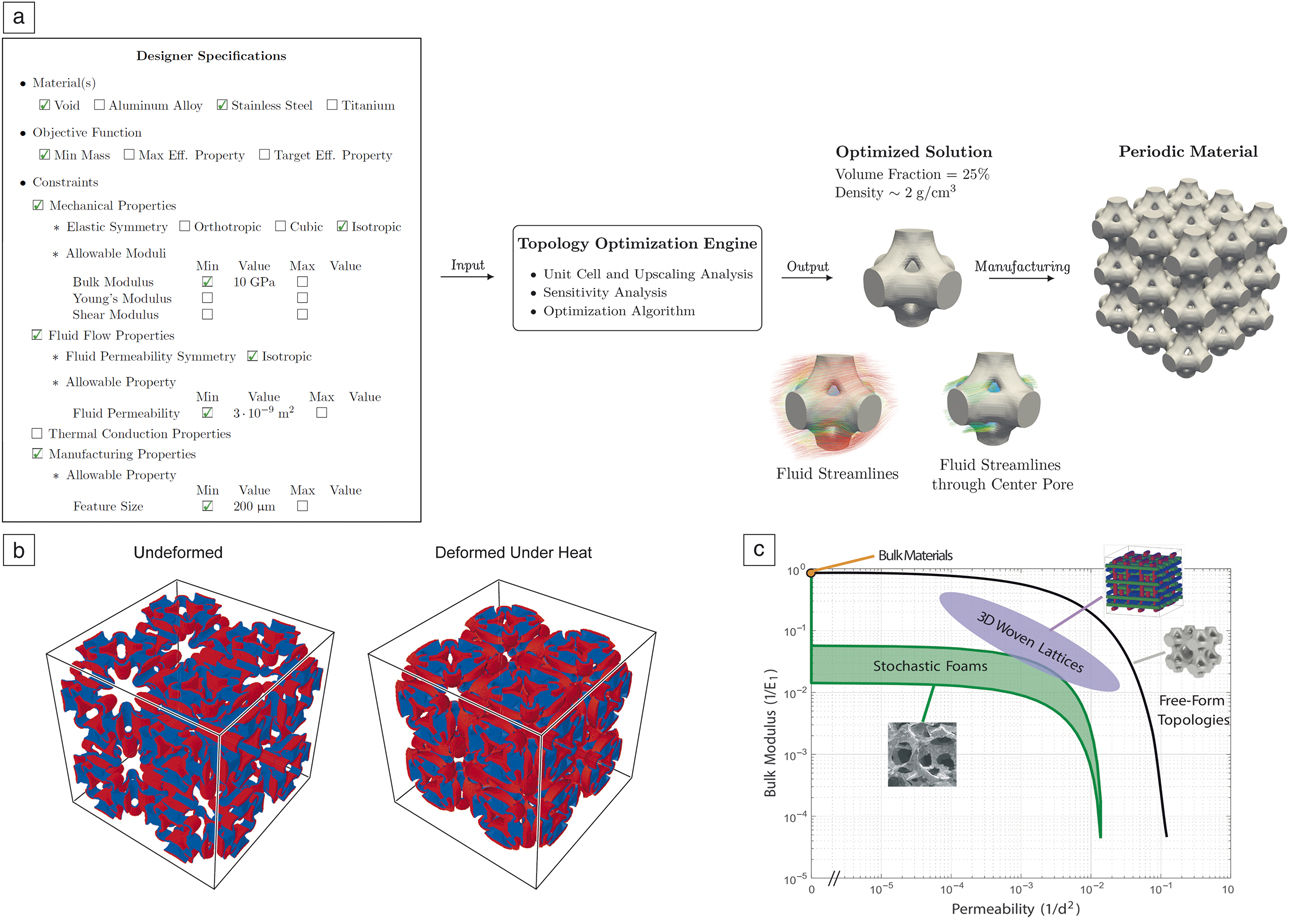
Although primarily applied at the component scale, the idea of applying topology optimization to design unit cells stems from the early days of topology optimization more than 25 years ago,Reference Bendsøe and Kikuchi32 with direct application to architected materials soon after.Reference Sigmund4 Figure 3a illustrates the general framework, where the designer may prescribe desirable or required properties as well as the manufacturing process along with its associated constraints and materials properties. Topology optimization then uses mathematical programming, with the governing physics and homogenization equations embedded within the search algorithm. This approach has been successful at identifying designs that are computationally predicted to achieve exceptional performance, including elastic moduliReference Sigmund4,Reference Sigmund33 and thermal conduction performance at the theoretical upper bounds,Reference Challis, Roberts and Wilkins34 unusual material behavior, such as negative Poisson’s ratioReference Sigmund4 and negative coefficient of thermal expansionReference Sigmund and Torquato35,Reference Andreassen36 (Figure 3b), as well as exceptional combinations of elastic moduli and permeability not available to typical porous materialsReference Challis, Guest, Grotowski and Roberts37 (Figure 3cReference Osanov and Guest38).
(a) A requirements-driven, topology optimization framework for architected materials design, demonstrated for minimizing mass of an additively manufactured architecture with stiffness and fluid permeability property requirements. (b) Example of bending-dominated architected material with negative coefficient of thermal expansion obtained via topology optimization.Reference Andreassen36 Courtesy of E. Andreassen. (c) Maximum identified combinations of stiffness and fluid permeability in architected materials: topology-optimized designs for additive manufacturing offer the highest performance combinations, compared with topology-optimized 3D woven lattices and stochastic foams.Reference Osanov and Guest38
For linear problems, a key advantage is that a single unit cell may serve as the representative volume element (RVE), and be used for the design domain and analysis. In contrast, for certain nonlinear properties, such as plasticity, predicting the effective macroscale properties from a single unit cell analysis is challenging, if not unfeasible. In such cases, researchers typically must enlarge the RVE to include multiple unit cells so as to capture the distribution and coalescence of nonlinearity between cells.Reference Vigliotti, Deshpande and Pasini39 This often requires a convergence study and significantly increases the computational cost.
As interest in the topology optimization of architected materials continues to grow, an important limitation of existing works is that the manufacturing precision is assumed to be perfect, leading to design formulations that are deterministic and do not account for the presence of defects. This trend is posed to change with an increasing focus on topology optimization under uncertainty, aimed at designing structures that perform robustly, or that are insensitive, to the presence of geometric imperfectionsReference Guest and Igusa9,Reference Sigmund10,Reference Jalalpour, Igusa and Guest40–Reference Jansen, Lombaert and Schevenels42 and materials property variations.Reference Chen, Chen and Lee43,Reference Tootkaboni, Asadpoure and Guest44 These methods integrate uncertainty quantification within the topology optimization algorithm and seek to design structures that perform statistically better when uncertainties arise. Architectures robust to imperfections typically exhibit redundant load paths that dramatically improve structural stiffness and stability.
Figure 4, for example, shows planar lattices designed to offer maximal stiffness in the horizontal and vertical directions. A grid topology (Figure 4a) results when assuming deterministic conditions (no imperfections). Although theoretically offering high stiffness, the long-unbraced members are susceptible to buckling and failure when geometric defects are present. In contrast, a dissimilar architecture (Figure 4b) arises when geometric imperfections are included in the design formulation, using for instance, the method in Reference 40. This design is highly redundant and insensitive to geometric defects.
Topology optimization of a lattice material for maximal stiffness in horizontal and vertical directions. (a) Deterministic design of a straight grid offering high stiffness in an idealized setting, but with significantly more compliance as well as vulnerability to buckling in the presence of geometric imperfections. (b) Topology-optimized design accounting for geometric imperfections yielding robust stiffness and insensitivity to geometric defects. (c) Comparison of representative responses of a deterministic and robust design, the latter showing superiority in both the load-displacement curve characteristics and failed sample performance.
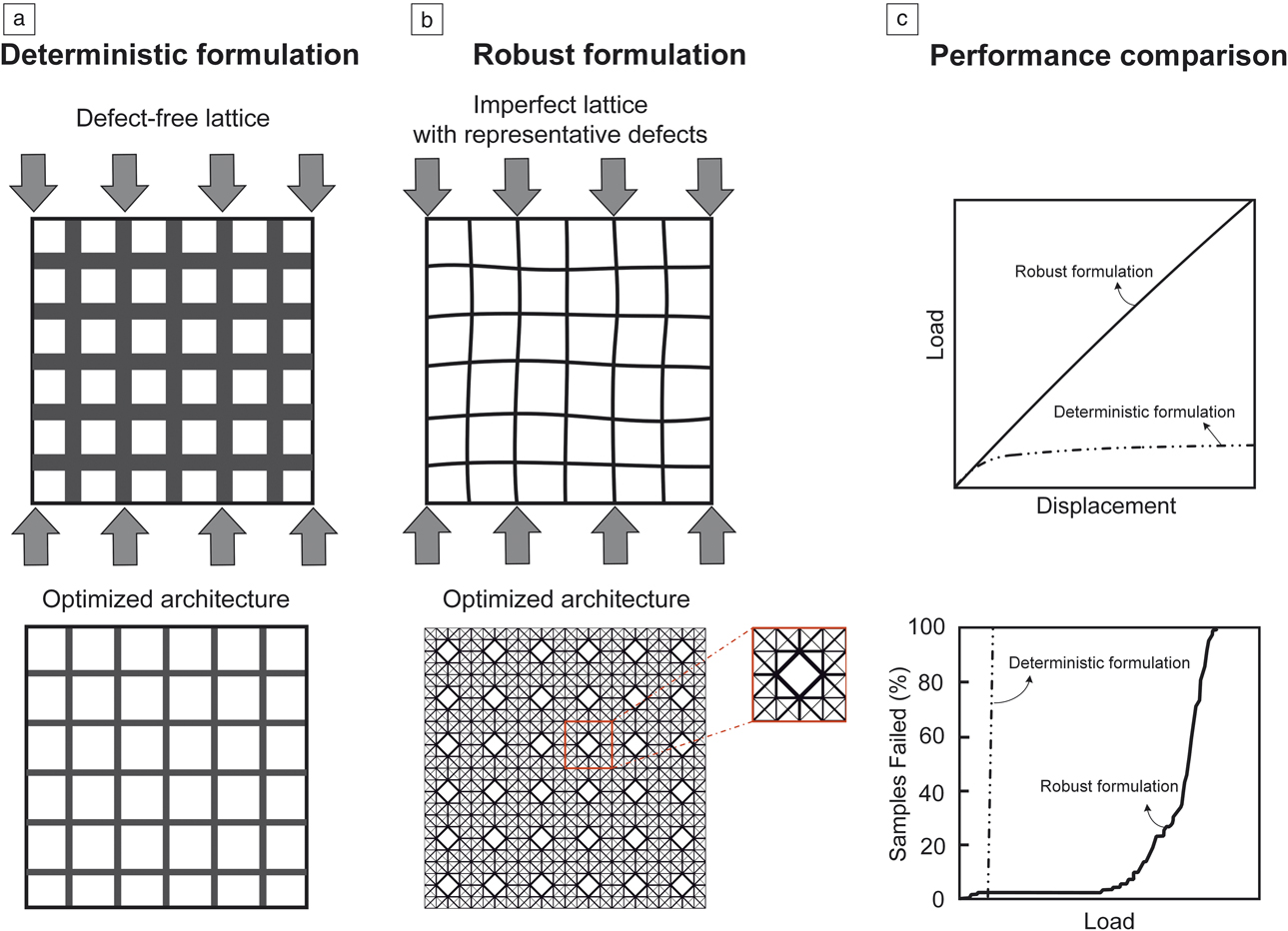
Although this illustrates one example of robust topology optimization applied to architected materials, a major challenge is how to efficiently estimate the effect of uncertainties defined at the unit-cell scale on the resultant macroscale properties. Classical inverse homogenization-based topology optimization assumes that the unit cell is infinitely periodic, and thus any randomness defined in the unit cell is also repeated exactly in the adjacent neighboring cells. This is reasonable when considering uniform defects that may occur for an entire batch,Reference Andreassen, Lazarov and Sigmund11 but is generally incompatible with correlated randomness and defect dispersion typical of additive processes that may cross unit cell boundaries. Similar to optimizing nonlinear properties, one option to address this issue is to enlarge the RVE to include multiple unit cells in the estimation of macroscale properties that are stochastic. More research must be done in this area.
Outlook
To support the uptake of architected materials in real-life applications, it is essential to deepen our understanding of their mechanics and functionality under nonideal conditions. For additively built architectures, incessant improvements in manufacturing technology along with the development of effective strategies to improve accuracy, such as machine parameter tuning, compensation strategies, and post-processing treatments (e.g., hot isostatic pressing, machining, electropolishing, and acid etching), will contribute to increase part quality. Yet, manufacturing flaws are unlikely to completely disappear in the foreseeable future. Efforts to increase our understanding of the root causes that control defect sensitivity will be essential to design metamaterials that can work robustly under realistic conditions. In particular, the use of systematic campaigns of defect characterization to assess morphology and dispersion of as-manufactured (as opposed to as-designed) defects will be instrumental to extend our current knowledge to complex stress states and to develop higher fidelity predictive models for defects in metamaterials.
On the design front, a comprehensive platform that fully integrates manufacturing, defect characterization, mechanics, and optimal design would be highly desirable for the design of robust architected materials. For example, defects observed through characterization can inform mechanics models validated through experiments, as well as motivate the development of robust design algorithms of topology optimization that minimize the deleterious impact of flaws on performance. A workflow can then be envisioned, starting from fabrication of a statistically relevant set of architected materials of prescribed geometry and material, followed by metrology to assess variability between nominal and as-built architecture, uncertainty quantification to estimate the impact of defects, and robust topology optimization for the design of architected materials that are defect-insensitive.
Acknowledgments
D.P. acknowledges the support provided by the Natural Sciences and Engineering Research Council of Canada (NSERC). J.K.G. acknowledges support provided by the National Science Foundation (NSF) under Grant No. 1538367 and the National Aeronautics and Space Administration (NASA) under Grant No. 80NSSC18K0428, as well as collaborations with M. Tootkaboni and M. Jalalpour related to the work in Figure 4. The opinions, findings, and conclusions or recommendations expressed in this paper are those of the authors and do not necessarily reflect the views of the NSF or NASA.

Damiano Pasini is a full professor of mechanical engineering at McGill University, Canada. He received his master’s degree in civil engineering from the University of Pavia, Italy, and his PhD degree in mechanical engineering from the University of Bristol, UK. His research interests include solid mechanics, advanced materials, and structure optimization. His current research focuses on mechanical metamaterials. His most recent awards include the James McGill Professorship Award in 2019 and appointment as Louis-Ho Faculty Scholar of the Faculty of Engineering in 2018. Pasini can be reached by email at damiano.pasini@mcgill.ca.

James Guest is an associate professor of civil engineering at Johns Hopkins University and deputy director of the Johns Hopkins Center for Additive Manufacturing and Architected Materials. He received his PhD degree from Princeton University and his BSE degree from the University of Pennsylvania. His research interests focus on topology optimization, including algorithm development and applications spanning manufacturing processes, scales, and physics. His awards include the Engineering Mechanics Institute Leonardo da Vinci Award in 2015 and the American Society of Civil Engineers Walter L. Huber Civil Engineering Research Prize in 2017. Guest can be reached by email at jkguest@jhu.edu.