Introduction
The Mediterranean fruit fly, Ceratitis capitata (Wiedemann) (Diptera: Tephritidae) is a widely distributed pest in the fruit-growing areas throughout the world (EPPO, 2013) with a wide host range (Liquido et al., Reference Liquido, Shinoda and Cunningham1991; Aluja & Mangan, Reference Aluja and Mangan2008). This insect causes direct damage mostly to fruit and therefore it is considered a major economically important pest in fruit production (White & Elson-Harris, Reference White and Elson-Harris1992). C. capitata is highly mobile and shows resistance to a wide range of environmental conditions, which facilitates its prevalence and ability to reinvade pest-suppressed areas (Papadopoulos et al., Reference Papadopoulos, Katsoyannos, Carey and Kouloussis2001; Meixner et al., Reference Meixner, McPheron, Silva, Gasparich and Sheppard2002; Martínez-Ferrer et al., Reference Martínez-Ferrer, Navarro, Campos, Marzal, Fibla, Bargues and Garcia-Marí2010). In addition, C. capitata is characterized by a mating system based on the complex traits regarding leks, remating, and sperm transfer (Burk & Calkins, Reference Burk and Calkins1983; Hendrichs et al., Reference Hendrichs, Robinson, Cayol and Enkerlin2002). Damage caused to fruits and the difficulties in managing this pest are substantial enough to consider the application of large-scale projects focused on reducing or suppressing populations of this insect (Myers et al., Reference Myers, Savoie and Van Randen1998; Hendrichs et al., Reference Hendrichs, Kenmore, Robinson, Vreysen, Vreysen, Robinson and Hendrichs2007).
The application of tactics designed to interfere with mating as a method to reduce insect populations is a strategy often considered against pest species of economic importance (Liebhold & Tobin, Reference Liebhold and Tobin2008; Yamanaka & Liebhold, Reference Yamanaka and Liebhold2009). The sterile insect technique (SIT) is a species-specific form of birth control for pest populations. It is a powerful tool when applied as a tactic in a system deployed on an area-wide (aw) basis (Klassen, Reference Klassen, Dyck, Hendrichs and Robinson2005). In Spain, after years of an area-wide control program based on insecticide applications, an aw-integrated pest management program (aw-IPM) has been implemented to reduce the long-term costs of its control. Mass trapping, biological control, selective pesticide applications, chemosterilization, and aw -SIT are used in combination, as part of this aw-IPM (Sabater-Muñoz et al., Reference Sabater-Muñoz, Martins, Skouri, Laurín, Tur and Beitia2009; Urbaneja et al., Reference Urbaneja, Chueca, Montón, Pascual-Ruiz, Dembilio, Vanaclocha, Abad-Moyano, Pina and Castañera2009; Navarro-Llopis et al., Reference Navarro-Llopis, Vacas, Sanchis, Primo and Alfaro2011: Tormos et al., Reference Tormos, Asis, Sabater-Muñoz, Baños, Gayubo and Beitia2012; Juan-Blasco et al., Reference Juan-Blasco, Urbaneja and Sabater-Muñoz2013a , Reference Juan-Blasco, Sabater-Muñoz, Argilés, Jacas, Castañera and Urbaneja b ). The combination of all these management strategies is aimed at reducing C. capitata populations and consequently the presence of infested fruit and its economic implications.
Successful aw-IPM programs designed against C. capitata in Spain and elsewhere rely on the application of the SIT (Hendrichs et al., Reference Hendrichs, Vreysen, Enkerlin, Cayol, Dyck, Hendrichs and Robinson2005). In the context of aw-IPM, the population reduction obtained in economically important pest populations should vastly outweigh the cost of establishing an SIT program, which needs mass-rearing of sterile insects and regular aw releases (Mumford, Reference Mumford, Dyck, Hendrichs and Robinson2005; Nagel & Peveling, Reference Nagel, Peveling, Dyck, Hendrichs and Robinson2005). Therefore, tools to accurately measure how sterile males interact with the wild populations of C. capitata at the field level are needed in order to apply this technique successfully and cost effectively (Vreysen, Reference Vreysen, Dyck, Hendrichs and Robinson2005).
For SIT to be a viable management technique, the success of mating interference must be measured, and this makes the evaluation of SIT efficacy a complex aim to achieve (Katsoyannos et al., Reference Katsoyannos, Papadopoulos, Kouloussis, Heath and Hendrichs1999; Vreysen, Reference Vreysen, Dyck, Hendrichs and Robinson2005; Yamanaka & Liebhold, Reference Yamanaka and Liebhold2009). Currently, SIT programs obtain information about the density of their target wild populations using monitoring trap network systems distributed throughout the release area. The trap network systems are also used to measure the relative abundance of sterile flies, using mark and recapture methods. Finally, program managers use these data to assess the number of sterile males for release (ratios of theoretical wild-type (wt) to sterile male) that will be effective to reduce pest populations (Calkins & Parker, Reference Calkins, Parker, Dyck, Hendrichs and Robinson2005; Itô & Yamamura, Reference Itô, Yamamura, Dyck, Hendrichs and Robinson2005; Vreysen, Reference Vreysen, Dyck, Hendrichs and Robinson2005). However, the quality of the released sterile males in the field, specifically their sexual competitiveness, is much more important than the overflooding ratio (Barclay, Reference Barclay, Dyck, Hendrichs and Robinson2005; Itô & Yamamura, Reference Itô, Yamamura, Dyck, Hendrichs and Robinson2005). Owing to their dependence on the reproductive performance of sterile males, ongoing SIT programs should regularly measure the sexual competitiveness of sterile strains competing with wild strains in field-cage trials (FAO/IAEA/USDA, 2003; Calkins & Parker, Reference Calkins, Parker, Dyck, Hendrichs and Robinson2005). Moreover, environmental variables play a determinant role in other biological traits of fruit flies such as mating behavior, population dynamics, breeding areas, distribution, or movement patterns (Christenson & Foote, Reference Christenson and Foote1960). Therefore, the development of more effective monitoring tools including environmental and behavioral ecology traits such as sexual competitiveness could continue to greatly minimize aw-SIT control failures (Vargas et al., Reference Vargas, Harris and Nishida1983; Hendrichs & Hendrichs, Reference Hendrichs and Hendrichs1990; Yamagishi et al., Reference Yamagishi, Kakinohana, Kuba, Kohama, Nakamoto, Sokei and Kinjo1993; Papadopoulos et al., Reference Papadopoulos, Katsoyannos, Carey and Kouloussis2001; Barry et al., Reference Barry, Blessinger and Morse2004; Itô & Yamamura, Reference Itô, Yamamura, Dyck, Hendrichs and Robinson2005).
To date, the impact of the sexual competitiveness of sterile males on offspring has been indirectly measured only by counting the inherent sterility of eggs in fruits and the ratio of wt to sterile males in traps in the release area (Wong et al., Reference Wong, Kobayashi and McInnis1986; McInnis et al., Reference McInnis, Tam, Grace and Miyashita1994; Rendón et al., Reference Rendón, McInnis, Lance and Stewart2004; Shelly et al., Reference Shelly, McInnis, Rodd, Edu and Pahio2007a ). Nowadays, the use of molecular techniques is expanding the possibilities to reliably evaluate the role of sterile males in the tephritid species Anastrepha suspensa (Loew) and Bactrocera dorsalis (Hendel) under natural conditions (Fritz et al., Reference Fritz, Dhakal, Fritz and Kirby2010; Aketarawong et al., Reference Aketarawong, Chinvinijkul, Orankanok, Guglielmino, Franz, Malacrida and Thanaphum2011). A polymerase chain reaction-restriction fragment length polymorphism (PCR-RFLP) method has been developed to measure the sexual competitiveness of sterile C. capitata males based on identifying the sperm (wt or sterile Vienna-8 (V8) male) in the spermathecae of field-trapped females (San Andrés et al., Reference San Andrés, Urbaneja, Sabater-Muñoz and Castañera2007a ; Juan-Blasco et al., Reference Juan-Blasco, Urbaneja and Sabater-Muñoz2013a ). Models could help us to understand the mating behavior of the sterile males released in the environment and therefore their impact on wild populations. Given that offspring reduction by the SIT is a function of the number of matings between the sterile males and the wild females (McInnis et al., Reference McInnis, Tam, Grace and Miyashita1994), an additional achievement was accomplished by Juan-Blasco et al. (Reference Juan-Blasco, Sabater-Muñoz, Argilés, Jacas, Castañera and Urbaneja2013b ) who validated the method developed by San Andrés et al. (Reference San Andrés, Urbaneja, Sabater-Muñoz and Castañera2007a ), which relates the relative increase of mating success of V8 males with a decrease in fruit damage.
The purpose of this study was to investigate the role of environmental factors in affecting the mating activity of sterile C. capitata males after release. This could help to develop new tools to further improve SIT efficacy. The main objective of this research has been to model the population reduction of C. capitata due to the mating success of sterile males, using sterile mating data obtained under field conditions.
Material and methods
The study was conducted from June 2010 to June 2011 in Montcada (Valencia, Spain), where C. capitata is a prevalent pest (Urbaneja et al., Reference Urbaneja, Chueca, Montón, Pascual-Ruiz, Dembilio, Vanaclocha, Abad-Moyano, Pina and Castañera2009) and subjected to an aw-SIT program. Ten field-cage tests following the same handling methods, experimental set-up, and evaluation described in Juan-Blasco et al. (Reference Juan-Blasco, Sabater-Muñoz, Argilés, Jacas, Castañera and Urbaneja2013b ) were carried out every ∼ 30 days under different environmental conditions.
Field-cage site
The field trial was conducted in an experimental Clementine mandarin [(Citrus clementina Hort. es Y. Tan.) cv. Clemenules] orchard. The site included eighteen 32-year-old Clementine mandarin trees distributed in a row. Each tree was equipped with an anti-thrips screen cage (3×3×3 m3) with a zippered-door (1.5 m high) on one of the sides of the cage. The trees were drip-irrigated and fertilized, weeds were mechanically removed and pesticide treatments were avoided. Trees were pruned to prevent the canopies from touching the walls of the cages or the ground. The physical barrier Tangle-Trap® (Insect Trap Coating, Contech Enterprises Inc. Victoria, BC, Canada) was sprayed monthly on the trunk to exclude ants (Juan-Blasco et al., Reference Juan-Blasco, Tena, Vanaclocha, Cambra, Urbaneja and Monzó2011) due to the high number of individuals observed on the trees prior to the trial.
Environmental conditions
Two data logger instruments (Model Testo 175-H2, Testo Ltd., Alton, Hampshire, UK) were randomly placed in the canopy of two trees of the selected row to measure mean temperature and relative humidity (RH) inside the cages during the test period (Supplementary table 1). Daily minimum and maximum temperatures, hours of daylight (number of hours from sunrise to sunset), cold hours (hours with temperature <7 °C), precipitation and evapotranspiration during the test were obtained from the IVIA Irrigation Technology Service Montcada station (STR-IVIA) (UTMX: 23368.000, UTMY: 4385233.000, 58 m asl) located 150 m south from the caged trees site (Supplementary table 1).
Insect strains
The insects used in the trials were obtained from the SIT mass-rearing and emergence facilities located in Caudete de las Fuentes (Valencia, Spain) and Montcada (Valencia, Spain), respectively. The mass-rearing facility of Caudete de las Fuentes is designated to mass-rear the sterile V8 temperature-sensitive lethal (tsl) genetic sexing strain (GSS) mix 2002 strain of C. capitata from egg to pupa. During the mass-rearing process, sterile V8 puparia are externally dusted with pink fluorescent dye (Day-Glo® Color Corp., Cleveland, OH, USA). As a consequence, particles of dye are transferred to the ptilinum of the male adults during emergence from pupae. Sterile V8 puparia are irradiated under hypoxia, using an electron accelerator at 105±10 Gy dose, to avoid impairing adult longevity (San Andrés et al., Reference San Andrés, Ortego and Castañera2007b ). The SIT emergence facility is used to maintain sterile males from adult emergence from pupae until they reach field release age. In the present study, sterile V8 males were separated after emergence in two types of polypropylene (PP) jars; 4000 ml jars with a ventilated area of 12×11 cm2 holding 250 males and 1000 ml jars with a ventilated area of 9×8 cm2 holding 50 males. V8 males were fed ad libitum only with sugar and water after emergence, the standard pre-release diet in the Spanish SIT program. To simulate actual pre-release conditions at the emergence facility, V8 males were maintained in complete darkness and were subjected to aromatherapy treatment with ginger root oil (GRO) [Zingiber officinale Roscoe (Zingiberaceae)] (Lluch Essence S.L., Prat de Llobregat, Barcelona, Spain) to enhance mating competitiveness (Juan-Blasco et al., Reference Juan-Blasco, San Andrés, Martínez-Utrillas, Argilés, Pla, Urbaneja and Sabater-Muñoz2013c ). The SIT emergence facility also hosted a laboratory colony of the wt strain of C. capitata, refreshed annually with wild flies collected from field-infested fruits. Newly emerged wt males and females [generations V–IX (year 2010); generations III–VI (year 2011)] were separated by sex into 1000 ml PP jars as before. Jars containing wt flies were maintained at 25±4 °C, 75±5% RH, with natural light in different rooms to prevent any effect due to contact with pheromones from the opposite sex. Wt adult flies were fed ad libitum with water and a mixed diet of sugar and hydrolyzed yeast (Biokar Diagnostics Co., Pantin, France) (4:1; w:w) to simulate natural food sources (San Andrés et al., Reference San Andrés, Pérez-Panadés, Carbonell, Castañera and Urbaneja2009).
Field-cage test
The first day of the test, ten sentinel apples (commercial quality) were individually fitted inside a polyethylene-netting material with a mesh size of 1 cm, and randomly hung within the canopy of each caged tree. Soon after, C. capitata males (wt and sterileV8) were released inside the cages and 15–30 min later, females (wt) were introduced. Five different treatments of C. capitata ratios of wt female to wt male to sterile V8 male (1:1:0, 1:1:1, 1:1:5, 1:1:10, and 1:1:20) were considered. Treatments consisted of 50 wt females, 50 wt males, and 0, 50, 250, 500, or 1000 sterile V8 males, respectively. A female-control treatment 1:0:0 (no males) was included. Three replicates per treatment were included in each test. Replicates were randomly distributed among the 18 cages. V8 males were 3 days old, which corresponded with the release age in the Spanish SIT program, to simulate real field conditions (Juan-Blasco et al., Reference Juan-Blasco, San Andrés, Martínez-Utrillas, Argilés, Pla, Urbaneja and Sabater-Muñoz2013c ). Wt males and wt females were 7- and 9 days old, respectively, which corresponded to the ages when they are considered to be sexually matured (Shelly et al., Reference Shelly, Edu and Pahio2007b ). Twelve hours after release of the females, a Mosquitrap (SanSan Prodesing S.L., Valencia, Spain) baited with BioLure Tripack MedFly Lure® (Suterra Corporate, Bend, OR, USA), with 1/6 of a tablet of Dichlorvos insecticide (Suterra España Biocontrol S.L., Cerdanyola del Vallès, Spain) was hung on each tree. The apples and the trap were removed from trees 2 days after the start of the test.
Capture of wt females in traps
Females captured in the traps were used to study the mating activity of V8 males following the method developed by San Andrés et al. (Reference San Andrés, Urbaneja, Sabater-Muñoz and Castañera2007a ). Females were collected from traps and stored in 70% ethanol at room temperature until their spermathecae were dissected under binocular microscope (Leica MZ6, 6:3:1 zoom range, Leica, Wetzlar, Germany).
Male sperm identification (sperm ID)
The DNA from each spermathecae was extracted to identify the origin of its sperm content by means of PCR. Two PCRs with the specific markers CcYsp and Ccmt, and a restriction with the HaeIII enzyme were used to determine sperm identity (wt or V8) (San Andrés et al., Reference San Andrés, Urbaneja, Sabater-Muñoz and Castañera2007a ; Juan-Blasco et al., Reference Juan-Blasco, Sabater-Muñoz, Argilés, Jacas, Castañera and Urbaneja2013b ). The markers CcYsp and Ccmt detect male sperm (wt or V8) and presence of DNA from C. capitata in the sample, respectively. The digestion with HaeIII of the Ccmt PCR product determines sperm identity in the sample, wt type (sample remains undigested, only a 330 pb band is visualized in agarose gel) or V8 type (sample yields two bands of 190 and 140 pb).
F1 generation
The apples exposed to females under the different treatments in the caged trees were individually placed in isolated cups with vermiculite (Europerlita Española S.A., Rubí, Spain) as pupariation substrate. Cups were maintained at 25±4 °C, 75±5% RH with natural light. The number of puparia obtained from each fruit was counted weekly for 1 month.
Statistical analysis
The numbers of females captured per trap, mated females, females whose spermathecae contained V8 sterile sperm, and F1 puparia per fruit, were counted for each tree. These values were the basis of the model developed to explain the mating efficacy of V8 males in the field. As a first step, these values were expressed as proportions per tree. Treatments were compared with a χ2 test for homogeneity of proportions. To investigate if mating efficacy of V8 males in the field was significantly affected by the treatment and environmental factors, a generalized linear mixed model (GLMM) (Breslow & Clayton, Reference Breslow and Clayton1993) was performed for each variable. Treatments (wt female:wt male:sterile V8 male ratio) and environmental factors were included as fixed effects. For the F1 puparia, an additional GLMM was obtained considering the proportion of positive V8 sperm detections in spermathecae and environmental factors as fixed effects. The month in which each test was carried out was considered a random effect in all the GLMMs due to the presence of immeasurable effects in the field which could affect the set of data obtained. Selection of the best model was based on the Akaike Information Criterion. Binomial distribution was used to analyze the number of females captured in traps and the detection of sterile V8 sperm in spermathecae. The Poisson distribution was selected to analyze the number of F1 puparia per fruit.
Pearson's product-moment correlation was used to study the relationship among the mean data of the environmental factors recorded during days of the tests. The results of these correlations were used to obtain simplest models when possible by including them in only one environmental factor when it resulted correlated with other two or more factors. This method was also used to study the correlation between the females mated per tree and mated females with V8 male sperms per tree.
The predicted values of F1 puparia (determined from positive V8 sperm detections and environment data), were used to calculate the percentage of C. capitata population reduction in treated trees, using Abbott's formula (Abbott, Reference Abbott1925). The population reduction was used to estimate the impact of released sterile males (treatments 1:1:1, 1:1:5, 1:1:10, and 1:1:20), compared with the control (treatment 1:1:0). In addition, a logarithmic regression was performed to further investigate the relationship between the percentage of C. capitata population reduction and the proportion of V8 sperm positive detections in the field.
All statistical analyses were performed using Software R (R Development Core Team, 2013).
Results
Environmental conditions
The range of environmental data collected during the tests is shown in Supplementary table 1. Mean temperature was strongly correlated with cold hours (r=−0.80; P<0.0001), minimum temperature (r=0.91; P<0.0001), maximum temperature (r=0.84; P<0.0001), hours of daylight (r=0.72; P<0.0001), evapotranspiration (r=0.88; P<0.0001), and RH (r=−0.59; P<0.001). Precipitation (r=−0.05; P=0.781) was marginally correlated with mean temperature. RH and precipitation were poorly correlated as well (r=0.23; P=0.206).
Capture of wt females in traps
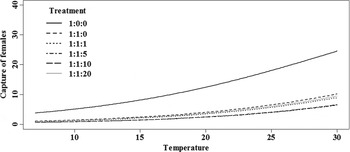
Throughout the field-cage tests, 709 wt females were captured in traps when they were exposed to the different male ratios (wt:V8). Females were captured under the entire range of observed temperatures from 7 to 27 °C. The maximum number of females captured in a single trap was 36 in the treatment 1:0:0 at a mean temperature of 16 °C. The mean number of captures per tree is shown in Supplementary table 2A. The GLMM analysis revealed that treatment, mean temperature, and RH had a significant effect (P<0.0001) on the number of females captured (number of females captured=50×℮(−7.32+0.11×Temperature+0.06×RH−1.33| 1:1:0 −1.48| 1:1:1 −1.87| 1:1:5 −1.85| 1:1:10 −1.41| 1:1:20 )/(1+℮(−7.32+0.11×Temperature+0.06×RH−1.33| 1:1:0 −1.48| 1:1:1 −1.87| 1:1:5 −1.85| 1:1:10 −1.41| 1:1:20 )), whereas precipitation did not (P>0.05). The expected number of captures was higher under the 1:0:0 treatment, compared to treatments 1:1:0, 1:1:1, 1:1:5, 1:1:10, and 1:1:20 (P<0.0001). Under all treatments tested, the probability to capturing wt females in traps gradually increased with temperature (fig. 1).
Probability of capture C. capitata females in traps at different treatments consisting of fly ratios of 1:0:0, 1:1:0, 1:1:5, 1:1:10, and 1:1:20 (wild female:wild male:sterile Vienna-8 males) in relation to temperature and RH. For each treatment the number of released females was 50 individuals, with the corresponding males according the ratios established. The female capture (y) probability is calculated by the formula y=50×℮(−7.32+0.11×Temperature+0.06×RH−1.33| 1:1:0 −1.48| 1:1:1 −1.87| 1:1:5 −1.85| 1:1:10 −1.41| 1:1:20 )/(1+℮(−7.32+0.11×Temperature+0.06×RH−1.33| 1:1:0 −1.48| 1:1:1 −1.87| 1:1:5 −1.85| 1:1:10 −1.41| 1:1:20 )).

Sperm ID
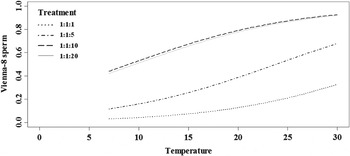
Three hundred and forty-seven females (347) (=48.9%) out of the 709 captured, proved positive for molecular sperm detection (Supplementary table 2B). V8 sperm was detected in females (n=127) exposed to treatments in which sterile males were released in ratios of 1:1:1, 1:1:5, 1:1:10, and 1:1:20 (Supplementary table 2C). The detection of V8 sperm in females was strongly correlated with the number of mated females (wt or V8 male) per tree under the treatments 1:1:1 (r=0.67; P<0.0001), 1:1:10 (r=0.76; P<0.0001), and 1:1:20 (r=0.89; P<0.0001) (fig. 2). However, this relation was not strong in treatment 1:1:5 (r=0.31; P<0.0001). No significant differences were found between treatments 1:1:10 and 1:1:20 in the number of positive V8 sperm detections (χ2=8.81; df=7; P=0.27). Analysis of the spermathecae content indicated that V8 matings were determined by treatment (P<0.0001) and mean temperature (P<0.05), and were not influenced by RH (P>0.05) and precipitation (P>0.05). The probability to detect V8 sperm increased with mean temperature in all treatments where V8 males were released. At a mean temperature of 9 °C and below, the probability of obtaining positive V8 sperm detections in treatments 1:1:10 and 1:1:20 was below 50%. On the contrary, V8 sperm detection was above 80% when mean temperature reached 22 °C (fig. 3).
Relationship between the number of females mated per tree (wt or Vienna-8) and the number of C. capitata mated females with Vienna-8 males per tree under treatments (a) 1:1:1, (b) 1:1:5, (c) 1:1:10, and (d) 1:1:20 (wt female:wt male:sterile Vienna-8 male).

Proportion of sterile Vienna-8 sperm detections in spermathecae of C. capitata females at different fly ratios 1:1:1, 1:1:5, 1:1:10, and 1:1:20 (wild female:wild male:sterile Vienna-8 male) and in relation to temperature. For each treatment the number of released females was 50 individuals, with the corresponding males of each type according to the above indicated ratios. The probability of obtain a proportion of Vienna-8 sperm ID (y) is calculated by the formula y=℮(−4.34+0.12×Temperature+1.46| 1:1:5 +3.25| 1:1:10 +3.18| 1:1:20 )/(1+℮(−4.34+0.12×Temperature+1.46| 1:1:5 +3.25| 1:1:10 +3.18| 1:1:20 )).

Puparia from F1 generation
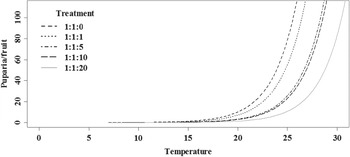
Puparia were only obtained in treatments where females were exposed to males (wt or V8), and this proves that no wild males entered the cages during the assays. No puparia were obtained from fruits exposed to mean temperatures between 7 and 10 °C (Supplementary table 2D). Treatment and mean temperature had a significant effect on the number of puparia obtained (P<0.001). As expected, the highest number of predicted puparia was obtained in treatment 1:1:0, compared with treatments 1:1:1, 1:1:5, 1:1:10, and 1:1:20 (P<0.001). Furthermore, significant differences from homogeneity were found among ratios where V8 males were released (χ2 test, P<0.0001). For all treatments, the number of puparia increased with mean temperature. Under all the temperatures tested, the numbers of predicted puparia in treatments 1:1:10 and 1:1:20 were respectively, 3- and 7-fold lower, compared with treatment 1:1:0. Estimations indicated less than one puparia per fruit at temperatures below 14 °C, irrespective of the male ratio (wt:V8) used. For treatment 1:1:20, the probability of obtaining less than one puparia per fruit was estimated for mean temperatures up to 19 °C (fig. 4).
Number of C. capitata puparia obtained from sentinel apple fruits exposed to different fly ratios 1:1:0, 1:1:5, 1:1:10, and 1:1:20 (wild female:wild male:sterile Vienna-8 males) and in relation to temperature. For each treatment the number of released females was 50 individuals, with the corresponding males of each type according the above indicated ratios. The probability of obtain pupae per fruit (y) is calculated by the formula y=℮(−5.87+0.41×Temperature −0.35| 1:1:1 −1.13| 1:1:5 −1.23| 1:1:10 −1.99| 1:1:20 ).

Predicting the offspring
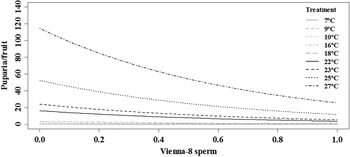
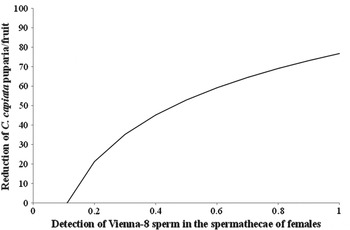
The number of F1 C. capitata puparia was estimated based on the proportion of V8 positive detections (P<0.001) and the mean temperature (P<0.001) (fig. 5). This relationship, although showed high numbers of V8 matings at higher temperatures, resulted in low puparia reductions. A logarithmic regression was used to show the relationship between V8 sperm detection and population reduction in treated areas, compared with a control area exposed to the same environmental conditions (fig. 6). The corrected percentage of C. capitata population reduction was strongly related to the proportion of V8 sperms detected in the captured females. When V8 sperm detection in females reached 50%, the predicted population reduction was 52%. The maximum population reduction predicted was 78%, which occurred when V8 sperm was positively detected in 100% of the females captured.
Probability to obtain C. capitata puparia/fruit at different temperatures and in relation to the proportion of molecular Vienna-8 sperm detected in spermathecae. The number of puparia (y) is determined by temperature and the proportion of molecular Vienna-8 sperm detected in spermathecae (GLMM Poisson, P<0.0001) and is calculated by the formula y=℮(−5.83−(1.50×Proportion of positive V8 detections)+(0.39×Temperature)).

Reduction of C. capitata puparia (%) obtained in an SIT area in relation to the variation in the proportion of molecular Vienna-8 sperm ID in spermathecae. y=34.50 ln (x)+76.80; R 2=0.939.

Discussion
In agreement with the previous studies, our results demonstrate the influence of environmental factors on the traits that involve reproductive success in insects (Lance & McInnis, Reference Lance, McInnis, Dyck, Hendrichs and Robinson2005). In the case of SIT releases in the field, both sterile V8 sperm presence in spermathecae and offspring of C. capitata females could be predicted using two variables: (1) ratio of wt females:wt males:V8 males and (2) temperature. Additionally, the number of females captured in traps was also affected by RH. However, the influence of RH in the final balance of the model was low. Our model was developed for a Mediterranean climate, with low variations in RH (Supplementary table 2). Therefore, RH may have to be taken into account in SIT programs applied in other climatic areas where RH variations could play a more important role.
The females captured in traps were a suitable field source of information about the mating success of V8 males. C. capitata female catches are influenced by temperature and RH in the Mediterranean citrus agroecosystems (Miranda et al., Reference Miranda, Alonso and Alemany2001; Navarro-Llopis et al., Reference Navarro-Llopis, Alfaro, Domínguez, Sanchis and Primo2008). Previous studies have showed a decrease in the number of female catches for temperatures ≤10 °C, and at low population densities compared to high temperatures when traps contain food-attractants (Miranda et al., Reference Miranda, Alonso and Alemany2001; Martínez-Ferrer et al., Reference Martínez-Ferrer, Campos and Fibla2012). It is possible that the male sexual stimulus caused females to be less interested in feeding (Hendrichs & Hendrichs, Reference Hendrichs and Hendrichs1990) and therefore, they were less attracted to traps that were baited with food attractants. The interpretation of these declines in the number of insects trapped is complex as they may be affected by numerous (often unknown) factors such as age and physiological state (Vreysen, Reference Vreysen, Dyck, Hendrichs and Robinson2005). Trap biases or behavioral response of the insects to traps are two factors that could play a role in female captures (Katsoyannos et al., Reference Katsoyannos, Papadopoulos, Kouloussis, Heath and Hendrichs1999; Rendón et al., Reference Rendón, McInnis, Lance and Stewart2004; Vreysen, Reference Vreysen, Dyck, Hendrichs and Robinson2005). It is known that trap density is critical and needs to be adjusted based on factors that include trap and lure/attractant efficiency, climate and geographical location, as well as presence and type of host. Indeed, trapping is a dynamic process that changes according to survey objectives and control applications (IAEA, 2003). Further investigations should therefore explore the efficacy of V8 males using the method proposed on the adjustment of trap density, timing of sampling, and adoption of the molecular method to volume of females trapped at the aw-field scale.
Classic mathematical models have linked the sexual competitiveness of released insects to the wt:sterile ratio obtained from the field traps (Knipling, Reference Knipling1955; Vreysen, Reference Vreysen, Dyck, Hendrichs and Robinson2005). Sterile V8 matings measured using molecular markers showed a higher success rate of male performance with increasing wt:V8 ratios. This result demonstrates that V8 males were as competitive as wt males in sexual and other quality-related parameters such as survival and mating propensity (Holbrook & Fujimoto, Reference Holbrook and Fujimoto1970; Barry et al., Reference Barry, McInnis, Gates and Morse2003; Lance & McInnis, Reference Lance, McInnis, Dyck, Hendrichs and Robinson2005; Vreysen, Reference Vreysen, Dyck, Hendrichs and Robinson2005). V8 males were inferior competitors at temperatures below 9° C than at warmer temperatures. The effect of decreasing the temperature at which males are reared in the emergence facility (e.g., from 24 to 15 °C) some days before their actual release in the field could improve their competitiveness. The improvement would also imply an increase in the developmental time of their life cycle and therefore of the cost of the program. Further studies are necessary before implementing these changes. The temperature-ratio models obtained (figs 3 and 4) provide useful information to evaluate and therefore, to support the decision-making process to improve the efficacy of SIT programs currently underway. The differences between the analysis of field samples and the expected proportion of matings could serve to detect failures of V8 releases in real-time. Similarly, they could be used to detect deviations in the actual wt:V8 male ratios present in the field. Both models, together with the V8 matings-temperature model (fig. 5) highlight the influence of temperature on the mating, oviposition activities, and offspring of C. capitata (Bateman, Reference Bateman1972; Hendrichs & Hendrichs, Reference Hendrichs and Hendrichs1990; Warburg & Yuval, Reference Warburg and Yuval1997; Duyck & Quilici, Reference Duyck and Quilici2002). For example, at temperatures below 15 °C, less than one puparia per fruit was predicted even under the 1:1:0 ratio, whereas at temperatures above 19 °C, one or more puparia per fruit was predicted (even at 100% V8 sperm content in the spermathecae). This result can be taken as indicative of the higher frequency of female remating at high temperatures, a phenomenon that would occur even if wt:V8 male ratio increased. On the other hand, the release of higher numbers of V8 males at low temperatures could be a poor use of resources that could be saved to increase the fitness of the sterile males (Pereira et al., Reference Pereira, Yuval, Liedo, Teal, Shelly, McInnis and Hendrichs2013). Observations may also assist in improving the management of both low pest densities at the end of winter, and pest outbreaks in summer in Mediterranean climates, which could be satisfactorily managed by implementing other control techniques such as mass trapping (Martínez-Ferrer et al., Reference Martínez-Ferrer, Campos and Fibla2012) or chemosterilization (Navarro-Llopis et al., Reference Navarro-Llopis, Vacas, Sanchis, Primo and Alfaro2011).
Quantifying the pest offspring reduction in a treated area compared to control area where no sterile males are released constitutes the most powerful straightforward tool to assess the progress in SIT programs (Waterhouse et al., Reference Waterhouse, LaChance, Whitten, Huffaker and Messenger1976; Vreysen, Reference Vreysen2001) since the reproductive potential of the pest in the treated and control areas is determined by the same biological, ecological, and environmental factors (Hendrichs et al., Reference Hendrichs, Robinson, Cayol and Enkerlin2002). C. capitata offspring reduction in an SIT-treated area was predicted using the V8 mating success measured directly with molecular markers under Mediterranean climatic conditions (fig. 6). This model helped us to refine the observed over estimations when only ratios and temperature were considered. The maximum offspring reduction estimated was 78%. Therefore, these results confirm the significant influence that traits not specifically considered here can cause increases in the C. capitata population under field conditions. These include traits such as remating (Hendrichs & Hendrichs, Reference Hendrichs and Hendrichs1990; Bonizzoni et al., Reference Bonizzoni, Katsoyannos, Marguerie, Guglielmino, Gasperi, Malacrida and Chapman2002), mobility, and dispersal, or ability to recolonize areas from alternative hosts (Papadopoulos et al., Reference Papadopoulos, Katsoyannos, Carey and Kouloussis2001; Meixner et al., Reference Meixner, McPheron, Silva, Gasparich and Sheppard2002; Martínez-Ferrer et al., Reference Martínez-Ferrer, Navarro, Campos, Marzal, Fibla, Bargues and Garcia-Marí2010). Furthermore, information about the spermathecal content of females not recaptured remains unknown. The possibility to include these parameters to construct the model would qualitatively improve it as a tool to predict the impact of SIT on wild populations.
The molecular method has proved to be a good predictor of C. capitata offspring reduction related with V8 mating success in the field. This method has allowed the development of less laborious and tedious tools to evaluate releases with regards to both efficiency and cost effectiveness in SIT programs. Logically, the essential next step is to validate the models developed using female samples from wild populations. Additionally, this method provides new opportunities for other environmental conditions or fruit fly species under SIT.
Supplementary Material
The supplementary material for this article can be found at http://www.journals.cambridge.org/BER
Acknowledgements
M.K. Billah (The University of Ghana) and one anonymous reviewer provided useful comments on early draft of the manuscript. We thank SIT emergence facility (GVA-IVIA) personnel for technical assistance and supply of material, and María Estarlich, Helga Montón and Jose Catalán for technical support in the IVIA laboratory. This work was partially supported by the Ministerio de Ciencia e Innovación, Spain (AGL2010-21349-C02 and AGL2011-30538-C03), IAEA Contract no. 15848, Conselleria d'Agricultura, Pesca i Alimentació de la Generalitat Valenciana and FEOGA. María Juan-Blasco was supported by an IVIA pre-doctoral fellowship and Beatriz Sabater-Muñoz is a recipient of a co-funded Generalitat Valenciana-Instituto Nacional de Investigaciones Agrarias EC-SF fellowship.