Understanding how biting flies are alerted by the presence of their host and how they are attracted to it has been an important research agenda in insect behaviour for decades (Allan et al. Reference Allan, Day and Edman1987, Clements Reference Clements1999, Sutcliffe Reference Sutcliffe1987). It is well known that distinct sensory modalities, not-mutually exclusive, are useful in host location. Amongst others, there are at least: (i) olfaction - where odorous compounds, such as carbon dioxide and host-related doors work as active stimulus (Sutcliffe Reference Sutcliffe1987); (ii) vision - where simple responses to illumination levels and perception of shape and colours are important (Allan et al. Reference Allan, Day and Edman1987); and (iii) hearing - where a variety of host-emitted sounds are used to localise and attack the signaller (Zuk & Kolluru Reference Zuk and Kolluru1998).
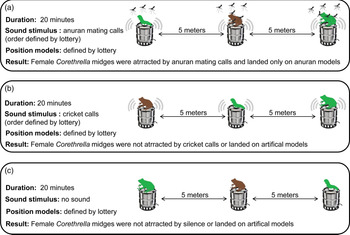
Female adult frog-biting midges (Corethrellidae) are crepuscular and nocturnal eavesdropping that feed on frog blood and use their mating calls to localise their hosts (McKeever Reference McKeever1977, McKeever & French Reference McKeever and French1991). Several studies have evaluated how anuran mating call attributes influence long-distance host location by Corethrella midges (Bernal et al. Reference Bernal, Rand and Ryan2006, McKeever Reference McKeever1977, Meuche et al. Reference Meuche, Keller, Sah, Ahmad and Grafe2016). However, as observed in blood-sucking mosquitoes (Borkent & Belton Reference Borkent and Belton2006), the use of mating calls may be only one cue used to seek hosts. Bernal and de Silva (Reference Bernal and de Silva2015) demonstrated that, unlike Culicidae, Simuliidae, and some Ceratopogonidae, the emission of carbon dioxide or the body temperature of host frogs had no effect in midge attraction. However, little is known if other cues such as vision play a role in the orientation of frog-biting midges at short distances. Here, we performed field playback experiments to test two cues used in host-seeking behaviour of Corethrella midges (Figure 1). We tested whether Corethrella are attracted by different sound stimuli. Then, after long-distance attraction by mating calls, we evaluated if they can distinguish landing sites by using colour and/or shape of frogs. We hypothesise that to avoid the potentially high cost associated with approaching incorrect hosts, Corethrella midges will use shape and/or colour of frogs as cues for landing on their hosts from short distances.
Details of the field playback experiment. Two artificial frog models (light green and dark brown) and an artificial caterpillar model (light green) were placed on the top of speakers. The experiment consists of three treatments of 20 minutes each, using different sound stimuli: (a) advertisement calls of Boana albomarginata; (b) mate calls of Gryllus assimilis; and (c) no sound, each with only models of frog and caterpillar on the top of speakers. Two experiments were completed per night, totalling six replicates per treatment. The order of sound stimuli in the experiment was randomised for each treatment and night.

This study was conducted on January 2016, during three consecutive nights under a last quarter moon (˜69% of illuminated moon surface according to programme MoonTool, Walker Reference Walker1999), in a protected area - Juréia-Itatins Ecological Station (24°22′43.47″S, 47°4′43.13″W) - in Brazilian Atlantic forest. The experiment was carried out in an area in which the vegetation is characterised by dense rainforest encompassing small streams and artificial pools within a radius of 50 m. Natural calls were recorded in the field 1 m apart from six individuals of Boana albomarginata (Spix) and Gryllus assimilis (Fabricius) using a directional microphone (Shotgun Yoga ht-81, frequency of response: 100–16 000 Hz and sensitivity: −44 ± 2 dB) and a digital record (Sony PCM D100, LPCM A 44.1 kHz, 16-bit resolution). Then, to encompass the variability in acoustic parameters between individuals of the same species, we combined, at intervals of two seconds, the natural calls of six individuals of each species using Raven software Pro 1.6.1. (Supplementary Material Table S1, Figures S2 and S3). The average frequency of the advertisement calls of B. albomarginata was measured from each note emitted in the acoustic file. Spectral analysis was performed considering all calls (512 pt dFFT with Hanning Window; frequency resolution of 124 Hz). The same procedure was done for each chirp emitted during playbacks of the crickets. Spectral analysis was performed considering all chirps (512 pt dFFT with Hanning Window; frequency resolution of 202 Hz). These consecutive natural calls were recorded onto a SD card and were broadcast over 20 minutes using a speaker (model Beatbox 4.0 Speaker, Frequency band: 280 Hz to 16 kHz and signal-to-noise: 95dB). All stimuli were broadcast at 75 dB sound pressure level (Akoso, model AK823) measured at a distance of 1 m from speakers.
The experimental design consisted of two artificial frog models (light green and dark brown) and an artificial light green caterpillar model (same colour of frog model) placed on the top of speakers (Figure 1). Frog models were 40 mm of snout-vent length and were in a calling posture with their heads up at a 25° angle (position commonly adopted by frogs, Wells Reference Wells2007). The caterpillar model was 50 mm long with its head and a third of the body raised at a 30° angle. We used a Sphingidae caterpillar model as the control treatment of the frogs’ body shape because these insects are not parasitised by Corethrella (Borkent Reference Borkent2008) and they are common in the habitats where the frogs naturally occur. These models were coated with a standardised amount of Tree Tanglefoot Insect Barrier (The Scotts Company, LLC), without any pesticides or harmful chemicals, so that the attracted midges would stick when landed. The experiment consists of three treatments of 20 minutes each, with 15 minute interval between each treatment, using different sound stimuli (Figure 1): (i) advertisement calls of Araponga Tree Frog (Boana albomarginata) which is widely distributed in the Brazilian Atlantic forest and commonly parasitised by midges (see Supplementary Material Figure S1). Advertisement calls of B. albomarginata have two harmonics, with the second harmonic partitioned into two subunits. Both harmonics contain notes rhythmically emitted at regular intervals (Giasson & Haddad Reference Giasson and Haddad2006); (ii) mating call of the field cricket (Gryllus assimilis) which occurs in the West Indies and parts of southern United States, Central America, Mexico, and South America. Although field cricket is an exotic species in Brazil, we included its call as a control because it is a common species in the study area and it emits mating calls in the same habitats that the frogs use for reproduction. Furthermore, its courtship call (Table S1) is within spectral bandwidth of hearing in midges (e.g. de Silva et al. Reference De Silva, Nutter and Bernal2015, Grafe et al. Reference Grafe, Sah, Ahmad, Borkent, Meuche and Konopik2018); and (iii) no sound, with only models of frog and caterpillar on the top of speakers. We performed two experiments per night, totalling six replicates per treatment. The order of sound stimuli was randomised for each treatment and night (Figure 1). After each treatment, specimens of Corethrella midges were preserved in ethanol and counted in the laboratory. Voucher specimens are housed in the Laboratório de Ecologia Teórica: Integrando Tempo, Biologia e Espaço (LET.IT.BE), Departamento de Ciências Ambientais, Universidade Federal de São Carlos, campus Sorocaba, São Paulo, Brazil.
Since our response variable (number of Corethrella midges) has high frequency of zeroes, we fitted generalised linear mixed effects models (GLMM) using zero-inflated Poisson distribution (Lambert Reference Lambert1992) and log link function (Bolker et al. Reference Bolker, Brooks, Clark, Geange, Poulsen, Stevens and White2009). We considered nights and sequence of stimuli (i.e. order that the sound stimulus was carried out in the field) as random effects and sound stimuli, shape, and colour as fixed effects. Alternative models were generated with different combinations of predictor variables. Model selection procedure was conducted using Akaike’s information criterion, corrected for small sample sizes (AICc; Burnham & Anderson Reference Burnham and Anderson2002) and Akaike weights (wAICc), which express the weight of evidence favouring a given model in a set of models (Burnham & Anderson Reference Burnham and Anderson2002). Furthermore, to control the fact that two frog models versus one caterpillar model could increase the probability that Corethrella midges lands on frogs, we performed new analyses comparing caterpillar model with only one of the frog models (i.e. brown or green model). Results were similar, and for brevity, only the results with the whole data set are presented in the main text (see supplementary material for all results). All analyses were conducted in R version 3.5.0 (see Supplementary Material for all data and R script).
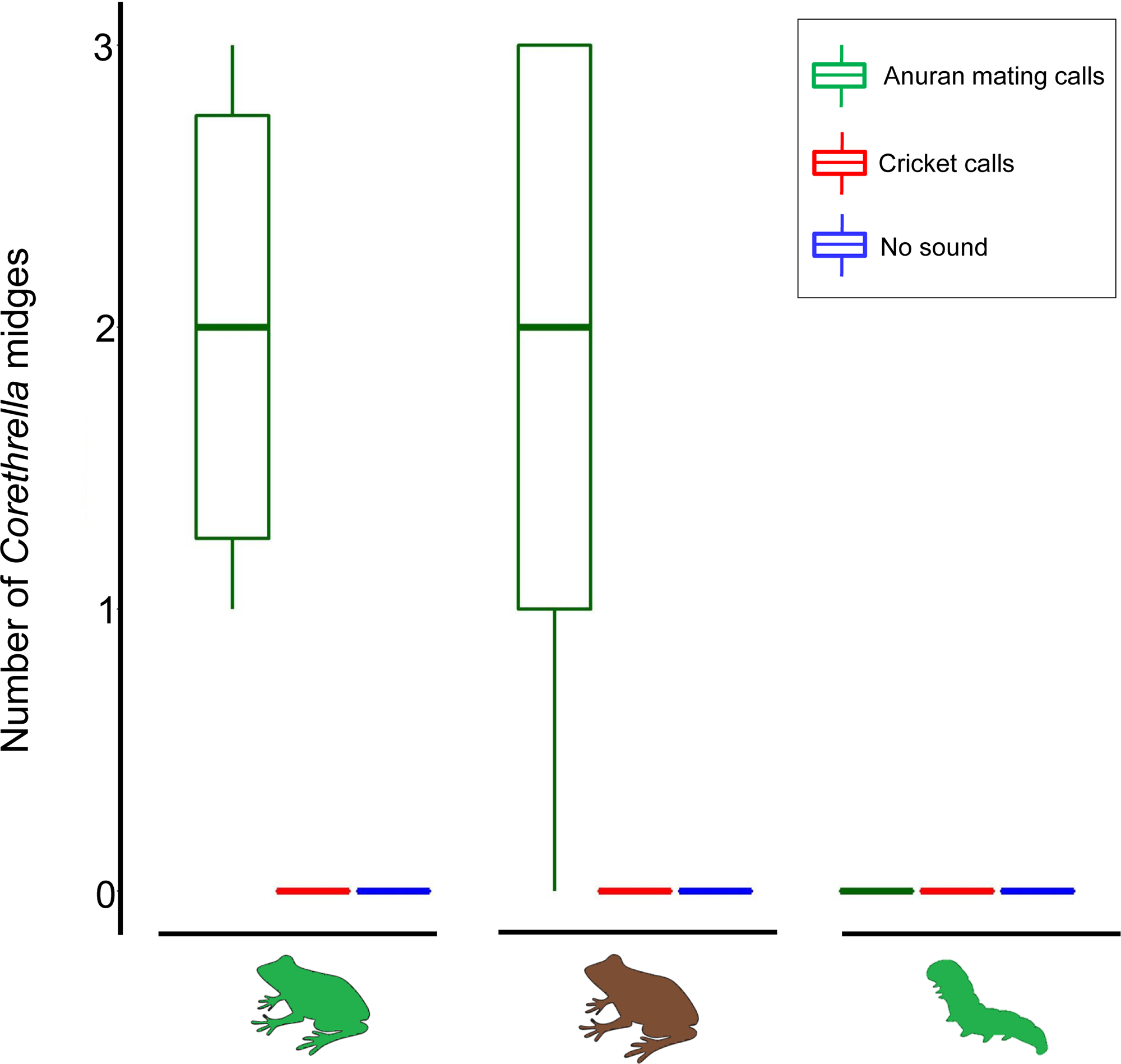
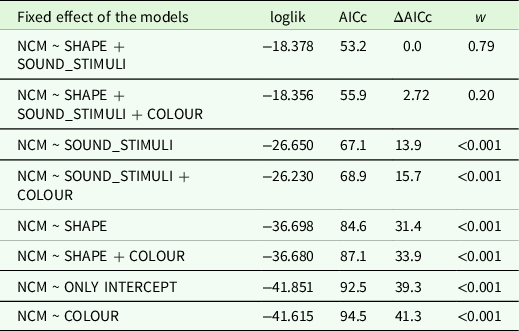
Our results showed that Corethrella female midges, in the presence of models, were attracted by frog mating calls and not by either cricket calls or silence (Figure 2, Table 1). Bernal and de Silva (Reference Bernal and de Silva2015) described similar results, in which frog-biting midges were not attracted to silent túngara frogs (Physalaemus pustulosus) in experiments in Panamá. After long-distance host detection, Corethrella midges landed only on frog models regardless of colour, suggesting that frog shape, but not their colour, is an important cue for them to detect their host at a short distance (Figure 2, Table 1). According to Allan et al. (Reference Allan, Day and Edman1987), crepuscular and nocturnal species are unlikely to have well-developed colour vision. However, their abilities to detect intensity contrast may be well developed, enabling them to discern movement and shape. Interestingly, frog presence alone is not sufficient in facilitating location of host by Corethrella midges. This result reinforces why female frogs are not targeted by Corethrella midges, except during amplexus, when calling males are almost certainly they primary attractant (Bernal & de Silva Reference Bernal and de Silva2015).
Boxplot showing the number of Corethrella midges that landed on artificial models of frogs (dark brown and light green) and caterpillars (light green) associated with different sound stimuli: anuran mating call (Boana albomarginata), cricket call (Gryllus assimilis), and no sound. The horizontal line and box show the median and 50% quartiles, respectively, and the error bars display the range of the data.

Generalised linear mixed effects models showing the relationship between number of Corethrella female midges (NCM) with sound stimuli (advertisement call of Boana albomarginata, mating call of Gryllus assimilis, and no sound), colour (light green and dark brown), and shape (anurans and caterpillar) of artificial replicas. Only intercept represents a model without explanatory predictors providing the average value for the sample

loglik = log likelihood of the model; AICc = Akaike information criterion corrected for small samples; ΔAICc = difference between a given model and the best model; w = AICc weight that expresses the weight of evidence favouring a given model among the set of models.
This is the first study evaluating alternative host-emitted cues in Corethrella midges, discarding the effect of carbon dioxide and body temperature of their hosts (Bernal & de Silva Reference Bernal and de Silva2015). Here, we present the first evidence that Corethrella midges use frog mating calls for long-distance host detection, while at short distance, they use at least vision to distinguish frog shape and detect their host and potential landing sites. We recognise that these new findings about the biology of Corethrellidae should be interpreted with caution due to our small sample size and the use of cricket calls as a control in playback experiments. However, the pattern of midges landing only on frog models was so robust that we see no reason to expect that it would change increasing the number of replicates or using white noise as a control (e.g. Caldart et al. Reference Caldart, Santos, Iop, Pinho and Cechin2016). Finally, the long- and short-distance cues used to detect their host seem to be only part of the complex behaviour of frog-biting midges (Borkent Reference Borkent2008, Bernal et al. Reference Bernal, Rand and Ryan2006, this study) since after landing on host, frog-biting midges still use other cues (e.g. vascular properties of the skin in different body areas of the frogs) to select a feeding site (de Silva et al. Reference De Silva, Jaramillo and Bernal2014).
Supplementary material
To view supplementary material for this article, please visit https://doi.org/10.1017/S0266467421000286
Acknowledgements
We thank Art Borkent for his careful reading of the manuscript and constructive and helpful comments. We thank Diogo Provete for reviewing the writing of the first version of the manuscript. We thank the Instituto Florestal de São Paulo for permission to undertake the study at Juréia-Itatins Ecological Station (Proc. 260108-004.608/2014). FRS was supported by Fundação de Amparo à Pesquisa do Estado de São Paulo — FAPESP within the Biota programme (Grant number 13/50714-0).