The first linguistic descriptions of American Sign Language (ASL) by Stokoe, Casterline, and Croneberg (1965) and Klima and Bellugi (1979) showed that meaningful signs could be broken down into meaningless smaller handshape, movement, and location segments. Just as minimal pairs in spoken languages differ by one phoneme only, for example, [ki] versus [ti], the same is true of signs that differ in only one segment. For example, the British Sign Language (BSL) signs NAME and AFTERNOON (Figure 1) have the same handshape and outward movement, but differ in the location (the hand moves from the forehead in NAME and the chin in AFTERNOON).1
Signs are glossed in uppercase with hyphens where more than one English word is required. When describing different handshapes in sign language research, it is customary to use symbols (e.g. 5, A, B, etc.) derived from the handshapes associated with the American one-handed alphabet (with the addition of some handshapes associated with numbers).

A minimal phonological pair in British Sign Language differing onthe location part of the sign: the forehead in NAME (left) and the chin in AFTERNOON. The sign moves outward from both locations. All other parts ofthe sign are identical. [A color version of this figure can be viewed online at www.journals.cambridge.org]
The movement and location segments of a sign can also be characterized as containing sets of minimal meaningless features. In spoken languages, consonant segments can be specified as coronal or labial; in sign, the location segments can be specified as being, for example, at the forehead, chin, shoulders, or chest. How a sign language organizes these phonological segments and features into a hierarchical feature geometry is captured in one theory of ASL phonology: the “prosodic model” (Brentari, 1998). Hierarchical organization in the prosodic model underlies how phonological markedness of form is determined. The term markedness has many different interpretations within linguistic theory. Here “marked” refers to the most complex segments (i.e., the most numbers of features). Markedness also refers to the set of least commonly occurring forms in the language. Conversely, “unmarked” forms are phonetically and phonologically simple, and are the most frequently occurring in the language.
HANDSHAPE
In the prosodic model, handshapes are represented in terms of a hierarchy of selected phonetic features (such as which fingers get extended or flexed, and how contact between fingers is made). In spoken language, marked sounds (e.g., nasal vowels) are less common and acoustically/articulatorily more difficult than others (e.g., oral vowels). In a sign, different handshapes will select a differing number of features, which determines the markedness of particular handshapes. Marked handshapes are more phonologically complex (i.e., contain the greatest number of selected features) than unmarked, as well as being motorically more difficult. Unmarked handshapes involve the fewest number of selected features. For example, the index finger point handshape (G) has only two features: a value for which of the fingers are selected (one index finger), and a value for the flexion of the nonselected fingers (all flexed). A marked handshape, such as one where the thumb, index, and middle finger are extended (v + thumb), requires more selection of features in its phonological representation. Unmarked handshapes appear most often in the lexicons of the world's different sign languages. For example, the handshapes flat hand (B),open hand (5),fisted hand (A), and G are found in 50% of all BSL signs (Sutton-Spence & Woll, 1999, p. 162). In addition, some researchers include a relaxed open hand handshape (lax-5) in the unmarked class with no overt formational features (Meier, 2005).
MOVEMENT
Signs differ in their path of primary movement. For example, the BSL sign SAD is produced with a straight path down, while the sign FARM has a curved path. Signs also vary in whether the movement takes a simple linear path (e.g., RENT moves forward and backward in a straight line) or a more complex circular path (e.g., SHEEP). These last two types of movement (circular vs. linear) differ in their motoric difficulty also. The development of the motor coordination needed to move the hands in straight lines or circles will play some part in how these components are learned by children.
A sign may have no path movement itself but will incorporate a hand-internal movement, such as open–closes, finger flicks, or rubs (e.g., UNDERSTAND, LIGHT, and DUCK). More phonologically and phonetically complex signs have these secondary hand-internal movements in addition to their primary path movement. As the sign moves along a path, the hand also makes a secondary movement. The prosodic timing of these movement combinations is important, as the hand-internal movement is often reduplicated and spread throughout the sign's movement rather than at the start or end of the sign. For example, in the sign FIRE, the hands move up and down while simultaneously the fingers wiggle several times during the sign's movement. These signs are made up of two movement features: a path and a hand-internal change (which is sometimes reduplicated). In the prosodic model, different movements are made up of a combination of hierarchical features in a similar way to the phonological representation of handshapes, allowing markedness of movement to be represented. Signs with simultaneous path and hand-internal movements would be represented as the most marked forms in this model. There is no process directly comparable to simultaneous path and hand-internal movement of hands in spoken language phonology. Spoken words can have several elements produced in close proximity, as for example, in consonant clusters. Perhaps more comparable are spoken words with simultaneous features such as nasality or retroflexion.
LOCATION
Many signs are formed in a neutral location in front of the signer, but signs also contrast with each other in where they are located on the body (see the minimal pair NAME and AFTERNOON). In the prosodic model, a sign is specified first for one of three planes in sign space, then its region on or around the body and finally for eight place distinctions (forearm, elbow, shoulder, etc.) at each region (Brentari, 1998). Currently, it is not clear in the prosodic model how markedness of different place distinctions can be predicted. The production complexity of different signs at different locations is also relevant, for example, in BSL there is a fine-grained minimal pair distinction between the mouth and chin location in the signs JEALOUS and CHOCOLATE, respectively. Signers spend most time looking at the lower face of their conversation partner during interaction (see Agrafiotis, Canagarajah, Bull, & Dye, 2003; Siple, Hatfield, & Cacamise, 1978).
PROSODIC PATTERNS
Prosody consists of intricate patterns of rhythmic and intonational structure. The study of sign language prosody is less well documented than the phonological and syntactic levels, but some studies have proposed that sign languages exploit sets of regular prosodic features. Nespor and Sandler (1999) found the following phonetic correlates to the phonological phrase: reduplicated final signs, holds at the end of the final sign, or pauses after the last sign of the phrase. As part of the prosody many signs are also produced with an identical reduplicated movement, for example, DOG, BROTHER, or SCHOOL. A difference between signs and words is that the majority of signs are monosyllabic (bisyllabic signs occur but are less frequent). Different theories argue that, like all spoken words, signs must consist of at least one syllable, and specifically for sign, this must be a movement of some type (e.g., Brentari, 1998; Sandler, 1989). In spoken languages, monomorphemic words with reduplicated identical syllables (e.g., [m∧m∧]) are far less common than in sign languages (Channon, 2002; MacNeilage & Davis, 2000; Meier, 2005).
The prosody of the sign is thus based on both the timing of the sign's complete articulation from beginning to end (including reduplications and holds) and the fixed ordering of different segments within the movement. A common pattern in spoken words is for vowels and consonants to be articulated in slots in the prosodic structure in a fixed order with different lengths of time for each slot. One striking aspect of sign language prosody is that the different phonological segments get expressed simultaneously. Signers do not first fully articulate the handshape and then move the sign; instead, both elements are produced simultaneously. This coordination of elements contrasts with spoken words that have clear linear segmental structure.
THE ACQUISITION OF SIGN LANGUAGE PHONOLOGY
Most previous research on sign development at the level of phonology has been carried out on ASL, for example, McIntire (1977), Boyes-Braem (1990), Marentette and Mayberry (2000), Meier, Mauk, Mirus, and Conlin (1998), and Meier (2005). In contrast, there have been very few studies of the adult phonology of BSL (Brennan, 1984) or its development (Carter, 1983; Clibbens & Harris, 1993; Harris et al., 1989). Clibbens and Harris (1993), following McIntire's work on ASL, suggested that the differences between children's early signs and the adult sign target might be the result of modification processes akin to those proposed for children's spoken language development. Studies of the development of different sign languages have reported that children produce more errors in the production of handshapes than for the movement and location segments, and that the first handshapes in children's signs are the unmarked kind (ASL: Cheek, Cormer, Repp, & Meier, 2001; Marentette & Mayberry, 2000; Siedlecki & Bonvillian, 1997; BSL: Clibbens & Harris 1993; Brazilian Sign Language: Karnopp, 2002; Norwegian Sign Language: von Tetzchner, 1994; Finnish Sign Language: Takkinen, 2003).
For BSL, Clibbens and Harris (1993) reported that the child in their study used only the A and 5 handshapes until 19 months, after which she added the G handshape. In naturalistic signing the child replaced the marked handshapes in the target with unmarked handshapes in her production. In spoken language development children replace adult target sounds not yet mastered, with sounds already part of their productive speech. Children also begin with the simplest and most unmarked speech sounds and then gradually extend their repertoires (Locke, 1990; Vihman, 1996). However, children do sometimes produce sounds in one word but not in another, suggesting ease of articulation is not the whole story (Smith, 1973). Each modality provides different solutions for how first signs or words get produced during this stage. In speech development, substitutions are created through several processes including: fronting, stopping, and gliding. In sign, the development of the marked handshapes requires increasingly independent operation of individual fingers. Boyes-Braem (1990) proposed handshape errors were caused by the culmination of several factors rather than just fine motor control. She argued that across all sign languages, patterns of handshape development could be predicted by the motoric and phonological complexity of the sign, as well as the availability of visual and tactile feedback during production. Visual feedback is also involved in spoken language development, where children need to see mouth patterns to distinguish between similar speech sounds (e.g., Mills, 1983). Because of the modality, visual feedback may play more of a role during sign acquisition than in speech.
The literature on children's motor development suggests extralinguistic factors may play a role in signing children's articulation of different types of signs. In all children's motor development, the reduplication of cycles of movement or stereotypes (rocking, waving, kicking, etc.) is a common occurrence (Thelen, 1979). The emergence of an adequate timing control mechanism is essential to the development and learning of such rhythmic coordinated actions. Reduplication is considered an important cue in monitoring the timing of these types of movement cycles (Thelen, 1995). Another important motor development is the ability to inhibit movement. Children during the first 12 months of life have difficulty inhibiting the action of one hand when the other hand is moving, as seen in their early reaching and placing of objects. A final component that needs to be considered is proximalization. This process is again typical in children up to 12 months of age, and describes infants as first having control of those limb joints closest to the torso (e.g., the shoulder or elbow). During maturation, the child develops control of more distant joints, but before this happens movements that are normally carried out on distal joints (e.g., writing) may incorporate proximal joints, shoulders, and elbows (Gesell & Thompson, 1934).
Cheek et al. (2001) reported that during the first 18 months of ASL development, hand-internal movements (wiggles, rubs, etc.) are either displaced to different locations or likely to be deleted altogether (see also Meier, 2005, pp. 217–218). Location causes children fewer linguistic problems than handshape and movement. However, signs located on the face and head where phonological contrasts are fine grained, continue to cause problems after 24 months (Juncos et al., 1997; Marentette & Mayberry, 2000; Siedlecki & Bonvillian, 1993). In spoken language, speech contrasts that require subtle changes in place of articulation, for example, /f/ and /ø/ are difficult to master at the start of development. Despite the difficulty in getting target locations on the face correct, signs located on the face and head are very prevalent in first signs (the other location being in front of the body), so much so that the head and face are sometimes used as replacements for other locations (Conlin et al., 2000). The head and face may give the child more salient information through tactile feedback as to where the hands are. These parts of the body may also be more salient in children's developing body schema (e.g., Butterworth, 1992). There have been very few studies of children's development of the prosodic properties of sign language (Hamilton, 1986; Seidl, Johnson, Redman, & Brentari, 2004). Overreduplication of signs by children is a common occurrence through the addition of reduplications to single-movement and multiple-movement signs (Cheek et al., 2001; Meier et al., 1998). Clibbens and Harris (1993) noted that children sometimes improved on a sign form, making it more like the adult target, over the series of additional reduplications.
Turning to the present study, we ask how theoretical models of sign language phonology shed light on developmental data, and also how developmental processes in children's first signs compare with those previously described for the development of first words.
METHOD
Subject
Gemma is a deaf child of deaf parents, and at the time of data collection had no other siblings. All of Gemma's grandparents are hearing. She was identified as deaf in the first weeks of life through targeted screening. This meant that her parents knew from the outset that their child was deaf and used BSL with her from birth onward. At the start of data collection Gemma was 19 months old and had attended a private nursery 3 days a week from the age of 6 months. The staff had a developing vocabulary of BSL signs and used these to communicate with Gemma. Although there are no available norms for BSL development for a child of this age, her language at 19 months was similar to other reported studies for same age deaf children learning ASL (e.g., Newport & Meier, 1985), and also similar to typically developing hearing children acquiring spoken language. Gemma received regular assessments by speech and language therapists who reported no intellectual or social impairments.
Data collection and coding
Gemma's signing between the ages of 19 and 24 months was recorded in the family home with 19 recordings each of 50 min. The language sample consisted of a total of 1,018 sign tokens. All of these data were based on naturalistic interaction between the child and her mother in free play. A general methodological issue in sign language acquisition research is what should be counted as a sign and what is nonlinguistic gesture (see Meier & Newport, 1990; Volterra & Erting, 1994). We adopted the Casey (2003) definition of a sign whereby manual productions are evaluated on form (how close to target); semantic content (used in semantically appropriate ways); linguistic content (combined with other linguistic devices, e.g., pronouns, negation, etc.); the child's age (by 18 months most native signers have an established vocabulary) and native signer intuition (see Vihman & McCune, 1994, for similar criteria used in spoken language research).
All signs were compared with the mother's input to Gemma as the target. Data coding took place in two rounds. All possible signs were identified with times on the videotape recorded. Once the child's signs were identified, they were then described with respect to the three main phonological segments (handshape, location, and movement) as well as coding for the timing and reduplication of the sign.
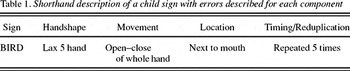
Any differences between the adult target and the child's sign were noted using a written shorthand description of the child form.2
Currently, there are no standard written phonetic transcription alphabets such as the IPA available for sign languages, although different transcription systems do exist (see Crasborn, 2001).

As convention, intercoder reliability was carried out on 10% of the data, and agreement was established at over 80%. Coders discussed any disagreements until a consensus was reached. If this was not possible, the form was discounted.
RESULTS
Handshape development
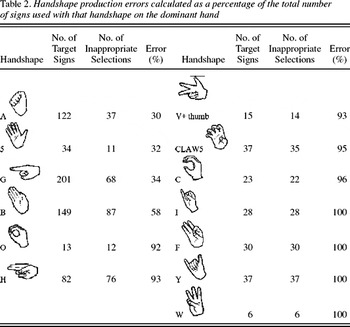
There were 416 recognizable signs produced with an unadultlike selection of handshape (41% of total corpus). The number of occurrences of different handshapes varied greatly across the child's data (between 2 and 201 tokens). Several attempted target handshapes were never used appropriately by the child during the period of data collection (e.g., W, Y, F, and I). Figures for each type of handshape are shown in Table 2.

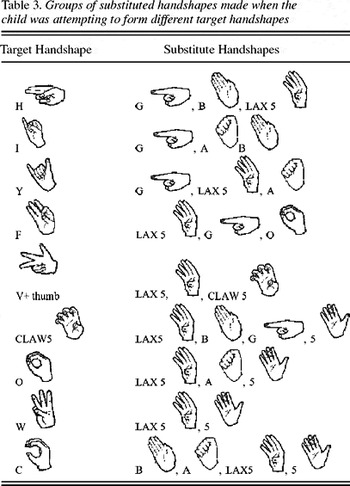
The unmarked BSL handshapes (G, A, B, 5) and the neutral handshape (lax 5) were the most frequently attempted (57%), and produced most appropriately by the child (42–72% correct). It was not the case that there were one-to-one substitutions of handshapes, for example, G always for H. Substitutions fell within groups (e.g., 5 and A for O, A and B for I). This pattern is shown in Table 3.

Movement development
Gemma changed the target movement of her signs in three ways: (a) by using a different path of movement (e.g., linear instead of circular), (b) by changing the sign's hand-internal movement (e.g., a target finger flick changed to an open–close), and (c) by changing the combination of path and secondary hand-internal movements (e.g., producing one but not the other or producing both but not simultaneously). Each of these is described in turn.
Path changes
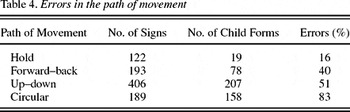
There were 462 signs with changes in the movement (45% of total). Signs with complex circular movement were produced least accurately across the data. Table 4 shows the range of movement paths that Gemma used in her first signs, as well as the frequency and appropriateness of each movement.
Primary hand-internal movement changes
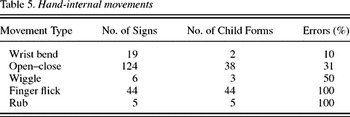
There were 198 signs in the corpus that required a primary hand-internal movement but no path movement. Nearly half of these (92) were produced differently to the adult target by the child. The most frequent type of target hand-internal movement attempted was open–close, but the hand-internal movement wrist bend was most accurately used by the child. Child errors were through omissions, proximalizations, and substitutions. Gemma's overall use of hand-internal movements is shown in Table 5.


Path and secondary hand-internal movement combination changes
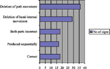
Gemma attempted 118 signs that required a simultaneous path and hand-internal movement. In 100 of the signs, Gemma made an error compared with the adult target, and the rest were produced correctly. The error types observed were through the child: (a) producing the two components sequentially rather than simultaneously (17%), (b) producing one movement appropriately but not both (only path 29%; only hand-internal 36%), or (c) producing both components inappropriately (18%). The numbers of signs produced with different types of errors are shown in Figure 2.

Different types of path and hand-internal combinations attemptedby the child. [A color version of this figure can be viewed online at www.journals.cambridge.org]
Location
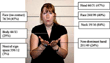
This was the most accurate part of the child's signs, and produced with only 25% errors or 255 signs. This is somewhat higher than in reported ASL data (e.g., Marentette & Mayberry, 2000). Within these 255 sign errors, 71% were through enlargement of the location from the target to the child form, for example, from the temple to the cheek. Withstanding only a 25% error rate, difficulty in getting the location correct varied systematically. The neck with a small size of target space and minimum visual feedback for the child was the most difficult (84% errors; see Figure 3).

Changes in the location of signs. Figures refer to the number ofsigns attempted at that location, the number of errors, and percentageerror. [A color version of this figure can be viewed online at www.journals.cambridge.org]
Prosodic structure
Reduplication
Many of Gemma's signs were produced with the unadultlike addition of reduplication (47%). Signs that in the adult target had one movement, for example TABLE, were produced with several movements. Similarly signs that in the adult target had two or three identical movements, for example HORSE or BIRD, were also produced with reduplications of the whole sign. From the 482 signs there was an improvement in the sign's target form during the reduplications in only 50 cases, and conversely, in 27 cases the overreduplication caused the sign's form to deteriorate compared to the target.
Timing
We observed 19% of signs produced with an error in the timing of the articulation. Timing refers to the coordination of the execution of each part of the sign's articulation. The most common type of error observed (115 tokens) was through the insertion of an extraneous hold into the movement segment of the sign.
DISCUSSION
This study was based on an analysis of 1,018 BSL signs used by one child during a period of 19–24 months. Errors were observed for 41% of handshapes, 45% of movement paths, 25% of locations, and with 47% of the sign's prosodic features. Some of the child forms observed in this single case study (such as substitution) have been reported in earlier studies of BSL development (e.g., Clibbens & Harris, 1993) and also in research on children's acquisition of other sign languages (e.g., Karnopp, 2002; Takkinen, 2003; von Tetzchner, 1994).
Other child forms (i.e., changes to prosodic structure and hand-internal movement errors) have not been reported on in as much detail previously. Cheek et al. (2001) and Meier (2005) mention that hand-internal movements tend to be deleted in children's first signs. In keeping with hearing children's phonological development in English, Gemma's age and language development put her in the period where phonological processes are understood to be present in the development of the lexicon (Bernhardt & Stemberger, 1998). Two questions are asked here: How do children's first signs follow phonological processes from within a sign phonology theory? Which processes identified in spoken language development can account for children's first signs? We tackle both questions in the following sections.
Structural changes
In research on spoken language development a set of processes change the shape of the target word including deletion of final word consonants, deletion of weak syllables, reduplication of strong syllables, and finally, consonant cluster reduction. For example, some children insert an unstressed syllable into words with consonant clusters thus producing [b

læk] instead of [bæk]. In Gemma's signing, structural changes leading to changes in the shape of the sign were rendered in four main ways: movement deletion, sign reduplication, movement and location enlargement, and movement insertion.
Movement deletion
A consistent error was deletion of hand-internal movements when they needed to be combined with a path movement. Within the 100 errors there were interesting subtypes. In 17 cases, the child pulled apart the two movement components and articulated them sequentially. For example, in the sign HOW-MANY the hands move side to side repeatedly while the fingers wiggle. In Gemma's sign the side–side movement was first completed then followed by the finger wiggle hand-internal movement. At this age, Gemma has not yet mastered the production of targets with overlapped path and hand-internal movement. A difficulty with the coordination of the path and hand-internal features is predicted in the prosodic model, as these are the most marked features of a sign's movement. One way to deal with this complex production is to delete one element in the combination. For example THROW (a putative iconic sign) moved outward but had no open–close movement at the end of the path (see Figure 4).

Deletion of hand-internal movement (hand-close) in the sign THROW.In the adult target on the left, the hand opens as the sign moves forward.In the child's sign, only the forward movement is retained. [A color version of this figure can be viewed online at www.journals.cambridge.org]
In the signs with hand-internal but not path movement (e.g., UNDERSTAND), the hand-internal movement was always substituted rather than deleted altogether. Data from development therefore strengthens the notion that the syllable structure of the sign must contain some movement feature. In a hierarchical model of sign phonology it is just these hand-internal movements that appear (hand aperture) as the most complex features in the tree (Brentari, 1998). The phonological markedness of the sign's movement is based on the addition of features to more basic movement forms. In signs with only hand-internal movement the child's strategy was to use an open–close movement rather than the target hand-aperture feature (e.g., wiggle, rub, etc.). This suggests that the child recognized that movement is obligatory in the sign's phonological representation and filled this slot in the template with an easier to articulate movement. When the path requires a hand-internal feature this adds another level of complexity to the representation. In these complex signs the child chooses to delete one of the movements, as there is already an alternative movement feature in the phonological representation. The hand-internal feature is not obligatory when a path has been used, and vice versa. The phonology of the sign means that deletion does not target weak syllables as it does in speech development (Smith, 1973; Vihman, 1996). The movement segment needs to appear throughout the sign's articulation rather than on individual syllables or parts. It was not the case that all hand-internal and path combinations were deleted.
Sign reduplication
In 482 signs (47% of sample) Gemma produced signs with overreduplication. These cases were made up of the reduplication of whole signs that do not require reduplication in the citation form (e.g., AEROPLANE) as well as the reduplication of whole signs that already had reduplications in their citation form (e.g., BIRD). The addition of reduplications was to the whole sign rather than parts of the sign. Clibbens and Harris (1993) suggested that reduplication might enable the child to improve the form of the sign over the course of the reduplications. In this sense reduplication is a “practice” strategy adopted by the child. We observed improvements in only about 10% of the 482 cases. In spoken English, development reduplication of strong syllables is common between ages 18 and 24 months, but not whole word reduplication (Grunwell, 1997). The sign TABLE in the adult target comes to a stop once the hands separate out to shoulder distance after one movement without any reduplication of movement. Gemma signed TABLE with several reduplicated movements, and it was noticeable that she reduced the size of the movement (to less than shoulder width) with each cycle. If these reduplicated forms were considered to be single signs for Gemma, then in her phonological representation the sign would actually be increasing in complexity, as each cycle would add syllables rather than simplifying. A sign with a hypothetical structure 1-2 would turn into 1-2-1-2-1-2. If these are instead separate signs for Gemma, the complexity is not increased but only repeated during the reduplication. The structure would therefore be 1-2, 1-2, 1-2.
Another linguistic explanation may lie in the prosodic structure of the sign. If these reduplicated signs were single signs rather than sequences, then reduplication increases the time between the start and end of the sign, and therefore elongates the prosody. If the signs were multimorphemic, elongating the prosody would function to allow the child more time to assemble the word. However, at this stage in development Gemma was still using single signs without morphological inflections. Meier (2005) writes that monomorphemic forms with reduplication of identical syllable structure are more common in sign than spoken languages. This difference may mean syllable reduplication is adopted with whole signs rather than internal parts. Meier et al. (2006) emphasize the role of children's inability to inhibit movement as being a major factor in signing children's problems with reduplication, and found that signing infants between 8 and 17 months were more accurate with signs that in the target input had reduplicated movements. In the present study, Gemma reduplicated both single and repeated movement signs, and indeed, other studies of similar aged children have reported no problems in reduplication at all (Bonvillian, Orlansky, & Novack, 1993; Juncos et al., 1997).
A final piece of the reduplication puzzle comes from characteristics of the input to signing children. Adult signers spend a considerable time adjusting their signing so as to make it more visually salient (e.g., Harris et al., 1989; Holzrichter & Meier, 2000; Spencer & Harris, 2005). Woll, Kyle, and Ackerman (1988) discuss how mothers' models for children to repeat (“sign it like this”) often include overreduplications or a single movement extended in space and time, while acknowledgements of children's attempts to sign appear without reduplication. Therefore, one part of this child-directed signing may involve overreduplication of signs (Kantor, 1980).
Enlargement
Only 25% of Gemma's signs were produced with an error in the location segment.3
It is possible in certain registers (e.g., shouting or whispering) to move signs to noncitation locations, if the pragmatic context allows: above the head if shouting, below a table surface if whispering (Crasborn, 2001). The examples were cases of child errors rather than pragmatic modifications.
In the present data, the child preferred larger location features in her own signing. This did not seem to be a function of a difference in numbers of signs produced at that location, that is, fewer attempts leading to fewer errors. There were 358 signs articulated in neutral sign space in front of the trunk (the largest specified location) with 3% error, and 324 signs on or near the face with a far greater 41% error. These figures strongly suggest smaller locations are more marked features within the sign's representation. In addition, locations not in direct vision were most difficult for the child. Within this category, size of location also predicted error rate: there were far fewer errors for signs articulated on the head (47%) than on the neck (84%). Previous research has reported more errors in handshape articulation with signs with less visibility (Siedlecki & Bonvillian, 1993; Volterra & Erting, 1994). Nonlinguistic factors may also be involved. Poor motor control may have led Gemma to “miss” target signs in small locations and arrive instead at approximate neighbors. The development of proprioceptive perception would help children to self monitor their signs not in direct vision (e.g., Thelen, 1995).
Insertions
Gemma regularly changed the sign's structure by altering the target prosody in different ways. In 115 signs she inserted extraneous holds between handshape changes and movements. In one instance, CAKE was produced with a pause between the up–down movements in the middle of the sign. In another example, THANK-YOU was produced with a hold at the chin location at the start and end of the movement. Added holds change the overall shape of the sign by stretching out the time between the realized segments.
Children acquiring spoken words often separate out clusters of consonants by deleting consonants or adding unstressed vowels. A similar connected process in Gemma's signing is the splitting apart of simultaneously articulated segments in the target input so that the timing of the handshape and movement was not coordinated correctly. The signs involving hand-internal and path movement combinations (e.g., FIRE) posed problems for Gemma because of the coordination of two movement features. There were 20 signs where the timing of the handshape was either too early or too late, and so not spread across both location segments of the sign. These child forms may be due to a difficulty in the coordination of the segmental and prosodic features of the sign. Gemma's strategy is to change a sign's simultaneous realization of more than one segment into a sequential realization of the form. This lengthens the sign's prosodic form by the concatenation of the individual phonological segments.
Substitutions
Substitution is widely reported on in the spoken language acquisition literature (e.g., Vihman, 1996). Substitutions or replacements of sounds in children's first words are guided by feature markedness, as well as the child's own rule system at that point in development. Sometimes sounds are replaced in one word but appear in other words (Smith, 1973). When Gemma made a handshape substitution, in many cases she substituted the sign's target marked handshape for more frequently occurring handshapes with higher degree of appropriateness in her current phonological inventory. For example, the features V in CHERRY and V + thumb in RABBIT were replaced with the unmarked handshapes G and 5, respectively (see CHERRY in Figure 5).

Hand-shape substitution in the sign CHERRY. The adult targethandshape (V) on the left is replaced in the child form with a G handshape. [A color version of this figure can be viewed online at www.journals.cambridge.org]
Brentari (1998) makes clear predictions for which handshapes are marked, based on the number of features present in the phonological representation. Simultaneous extension and flexion of fingers is one more feature in the representation than one of these movements in isolation. In development, children will simplify their production by reducing the number of features specified in the output. In contrast to spoken language development where children have phoneme–phoneme replacement rules, Gemma's errors were all through a marked handshape being replaced by a group of different unmarked forms. There may be some systematic visual correspondence between target handshapes and replacements. The G handshape appears as a replacement in all the handshapes that have a “pointing” appearance (I, Y, H,F), while not at all as a replacement for the more “fistlike” handshapes (C, W, O, claw 5) where LAX 5 was common. Marentette and Mayberry (2000) report the same pattern for ASL acquisition, where substitution of handshape revolved around “handshape primes,” which are maximally perceptually distinctive (i.e., fully open fingers, fully closed, extended single finger).
The preference for unmarked forms could also be seen in Gemma's movement substitutions. For example, she replaced the circular movement in BOAT with a linear up–down movement. The circular movements in BLUE and SHEEP were replaced with forward–backward movements. Instead of deleting movement entirely she used linear movements as possibly the default feature for this slot in the phonological representation of the sign. Brentari's prosodic model does not specify which path of movement features are more marked than others.
Modality issues
Although we identified several examples of substitution processes in early BSL, only hand-internal movement substitutions have what looks like to be a one-to-one correspondence between adult target movement and child movement (although it is largely open–closes for all the different hand-internal movement). Substitution processes in BSL development represent consistent interchanges between groups of forms, for example, unmarked handshapes for marked handshapes and linear for circular movements. Substitution between groups of sounds rather than individual phonemes is a process not reported on in spoken language development where phoneme–phoneme substitutions are more common. An additional modality difference was that structural changes through reduplication, deletion of movement features or prosodic elongation were realized as whole sign changes instead of as in speech through the deletion of individual weak syllables or initial consonants. This difference may be related to the preference for a monosyllabic structure in sign.
Signing and speaking are different types of communicative behaviors in other ways. Children acquiring sign need to perceive linguistic forms in different parts of their visual field. Although signs with visible locations have fewer errors than those in the periphery, the size of the peripheral location is important, so that the head is less problematic than, for example, space on the neck.
CONCLUSIONS
The patterns observed in this single case of a child acquiring BSL as a first language point to the role of rules for representing signs at the level of phonology. The detailed description of one child's signing presented in this study has therefore allowed us to confirm different types of child forms reported across studies of various children of the same age acquiring diverse sign languages, and has provided us with valuable developmental data on normal first-language acquisition in BSL. This study also presents a preliminary theoretical account of prosodic development in a signed language. Right from the beginning of sign and spoken language acquisition, children are guided by constraints such as ease of articulation and markedness of phonological form. Although not complete mirror reflections of each other, the parallels across sign and spoken language development are far greater than the differences. These findings lend weight to the idea that children approach language learning whether on the tongue or off the hands in broadly the same way.
ACKNOWLEDGMENTS
The authors thank Chloe Marshall, Rachael-Anne Knight, Elisabeth Johnson, Tanya Denmark, and anonymous reviewers for comments on earlier versions of the manuscript. Part of this research was funded by the ESRC.