


Introduction
Prostate cancer is the most common cancer in UK men with most presenting with localised disease. Low-dose-rate (LDR) brachytherapy is a treatment option as monotherapy or combined with external beam radiotherapy (EBRT) as a boost treatment in patients with higher risk localised disease. Reference Henry, Pieters and Siebert1 LDR brachytherapy involves permanent implantation of radioactive seeds into the prostate, most commonly using iodine-125 (I-125).
Prostate cancer can be a heterogeneous disease, and there is evidence that clinically significant disease spreads from a dominant intra-prostatic lesion (DIL). Reference Henry, Pieters and Siebert1 Local recurrence can occur after radiation, usually at the same site as the DIL. Reference Bauman, Haider and Van der Heide2,Reference Pucar, Hricak and Shukla-Dave3
Prostate cancer displays a dose response to radiation, hence escalating the dose to the DIL is expected to improve local control. Reference Pollack, Zagars and Starkschall4 A randomised trial using EBRT alone to escalate dose to the DIL demonstrated improved 5-year biochemical control with no increase in normal tissue toxicity. Reference Kerkmeijer, Groen and Pos5 In focal boost treatments, the therapeutic aim is to deliver the prescription dose to the whole prostate gland and escalate dose to the DIL to improve the tumour control probability while maintaining organ at risk (OAR) constraints. Reference Henry, Pieters and Siebert1,Reference Mason, Bownes and Carey6
The literature supports escalation of dose using different treatments and DIL localisation techniques. Gaudet et al. Reference Gaudet, Vigneault and Aubin7 treated 120 patients with LDR brachytherapy focal boost with DILs identified by sextant biopsies and increased the mean coverage of the DIL by 150% of the prescription by 9% in comparison to 70 standard plans with no difference in acute and late toxicities at follow-up. Mason et al. Reference Mason, Bownes and Carey6 compared focal boost optimisation methods for high-dose-rate (HDR) prostate brachytherapy boosting a focal planning target volume (F-PTV) or sector to 150% of the prescription and maintaining coverage of the whole prostate. Both optimisation methods were achievable without compromising OAR tolerances.
Conventionally, LDR plans use seeds of a single-source-strength (SSS). When escalating dose to focal volumes, increased seed density leads to an increase in number of needles and subsequent prostate trauma. Reference Mahdavi, Spadinger and Salcudean8 Seed density could be reduced by utilising a mixture of standard source strength and higher source strength (HSS) seeds. Mahdavi et al. Reference Mahdavi, Spadinger and Salcudean8 investigated the use of dual-source-strength (DSS) planning for treating focal-only targets to the prescription dose and sparing the rest of the prostate gland and achieved acceptable coverage with approximately half the number of needles and sources compared to SSS plans.
Positional errors in seed placement and the migration of seeds post-implant reduce prostate coverage and increase OAR doses on average. Reference Gao, Wang and Nag9 Kaplan et al. found an average radial migration of stranded seeds of 3·7 mm from intended positions. Reference Kaplan, Meskell and Lieberfarb10 SSS focal boost planning improves plan robustness as a greater number of seeds are used; however, there are necessarily fewer seeds on the opposite side of the prostate to the involved sectors. Random shifts in those individual seeds could cause a significant loss of coverage of the prostate. DSS plans are likely to have reduced numbers of seeds with respect to SSS plans; therefore, it must be established if the robustness of these plans is reduced and the technique infeasible.
The main outcome of this study was to evaluate the potential for dose escalation to the DIL using LDR prostate brachytherapy with SSS and DSS treatment planning prior to clinical implementation. Dose-volume histogram (DVH) parameters for targets and OAR were compared between clinical and sector boost plans produced using a SSS and DSS approach to determine the achievable dose escalation to involved sectors without compromising OAR toxicity. Robustness of SSS, DSS and clinical plans to seed displacement was assessed using an in-house Monte Carlo (MC) simulation.
Methods
Data preparation
Patients previously treated with 145 Gy LDR brachytherapy as a monotherapy and those treated with 110 Gy LDR brachytherapy followed by a course of EBRT of 46 Gy in 23 fractions (combined therapy) were included in this retrospective study. These treatment groups were chosen to ensure a range of disease stages. Patients were selected chronologically back in time until 10 monotherapy patients and 10 combined therapy patients were identified. All 110 Gy patients and 2 of the 145 Gy patients received hormone therapy prior to brachytherapy. Clinical stage ranged from T1c to T3a N0M0, and Gleason score ranged from 6 to 9. Presenting prostate-specific antigen level (PSA) had a median of 8·6 ngml−1 (0·5–48·5 ngml−1).
Multiparametric magnetic resonance imaging (mp-MRI) series, trans-rectal ultrasound (TRUS) imaging with prostate capsule, PTV, urethra and rectal wall contours and the original clinical plan were retrieved. PTV was a 3 mm expansion of the prostate capsule clipped posteriorly at the prostate–rectal interface. All patients were imaged at Leeds Teaching Hospitals with the same imaging protocols. Patient cases with identifiable DILs progressed to the planning stage.
Mp-MRI series included a T2-weighted fast spin echo (T2W-FSE) scan, diffusion-weighted-imaging (DWI) scan and dynamic-contrast-enhanced (DCE) scan with a gadolinium-based contrast agent. Prostate capsule and visible DILs were contoured on the T2W-FSE by an experienced consultant radiologist and informed by the DWI and DCE scans. A rigid registration between mp-MRI prostate and TRUS prostate was performed in VariSeed, which had no deformable registration solution.
Planning
All plans were produced using the VariSeed v9.0 treatment planning system and the AAPM TG-43U1S2 calculation algorithm. Reference Rivard, Ballester and Butler11 AgX100 TheraStrand (Theragenics, Georgia, USA) stranded I-125 seeds were used. Clinically delivered plans for which a source strength other than the standard 0·453U seed strength had been used were re-planned with 0·453U seeds to reduce confounding. The aim was to produce plans boosting involved sectors. All plans were reviewed to be clinically acceptable by experienced planners.
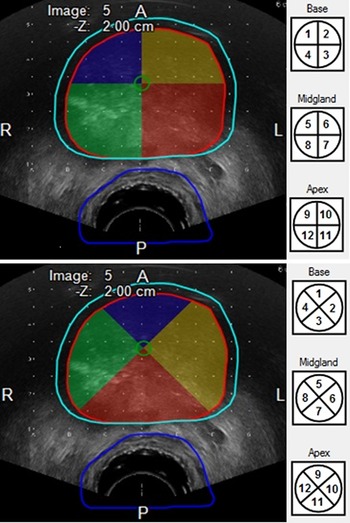
For sector planning, prostate volumes were split into three sections of equal length—base, mid-gland and apex—each with four transverse sectors for a total of 12 sectors centred on the urethra in one of two orientations demonstrated in Figure 1. DIL volume locations after rigid registration informed the selection of sectors to boost; the orientation of the transverse sections was chosen to minimise the number of involved sectors.
A single TRUS slice from VariSeed from the same case demonstrating the two orientations of transverse sectors centred on the urethra to produce 12 sectors in total with subfigures demonstrating the classification of sectors throughout the prostate in each method. The orientation of the transverse sections was chosen to minimise the number of involved sectors.

SSS plans were produced with 0·453U seeds aiming to maximise the dose escalation to the boost volume (BV) while remaining within the local rectum, urethra and target constraints specified in Table 1. DSS plans were produced to meet the same aims using 0·453U and 0·682U seeds. A strength of 0·682U was selected for the HSS seeds as this was as close to 150% of the standard source strength as could be ordered. Mahdavi et al. Reference Mahdavi, Spadinger and Salcudean8 used source strengths of 0·4 U and 0·8-0·9 U for focal DSS plans where only a focal region identified by mp-MRI was treated; however, it was decided that a lower source strength would be more appropriate for focal boost treatments where the whole prostate was still to receive the minimum peripheral dose in addition to the DIL dose escalation.
Local planning aims for non-focal boost 145 Gy and 110 Gy LDR prostate brachytherapy

Abbreviations: Vn%, percentage of the target receiving n% of the prescription dose; Dn%, minimum dose received by n% of the target; Dncm3, minimum dose received by n cm3 of the target.
Planning techniques followed local planning protocols using stranded sources with one seed strength per needle and avoiding single seeds except at the apex. Sources were nominally constrained to template positions; however, small shifts off-template locations were allowed for one or two needles in each plan to optimise positioning. Sources were not placed in directly adjacent template positions except within the BV. HSS needles were manually constrained to pass through the BV. HSS seeds were allowed superiorly and inferiorly to the BV to ensure coverage with only one seed strength per needle.
Local planning aims for standard seed planning are detailed in Table 1. For boost plans, the prostate D90, V150 and V200 statistics were expected to exceed these limits due to the escalation of dose to the DIL, which is contained within the prostate volume. This was deemed acceptable because of the expected clinical benefit from DIL dose escalation.
As data from monotherapy and combined therapy patients were used, the distribution of individual DVH parameters was not normally distributed; therefore, statistical significance was assessed using the two-tailed Wilcoxon signed-ranks test with a significance level of 5% to compare the distribution of DVH parameters from the SSS and DSS boost cases to the clinical plans and to each other.
Robustness
In-house code previously described by Al-Qaisieh et al. Reference Al-Qaisieh, Mason and Bownes12 was adapted for this project. Structure sets and planned source positions were exported from VariSeed. Random positional shifts were applied to the individual seed coordinates. Dose distribution and DVH parameters were calculated in MATLAB by superimposing MC dose distribution data for an AgX100 seed. Reference Mason, Al-Qaisieh and Bownes13 Resulting dose to the target and OAR volumes was quantified to evaluate the robustness of SSS, DSS and clinically delivered plans against post-implant seed migration.
Random shifts applied to seed coordinates were based on a Gaussian distribution with a mean of zero and a standard deviation increasing from 2 mm to 5 mm in 1 mm increments as in work by Al-Qaisieh et al. Reference Al-Qaisieh, Mason and Bownes12 For each increment, 50 random shifts were applied and mean DVH parameters were calculated. The MC code was previously validated against TG43 source data as described by Mason et al. Reference Mason, Al-Qaisieh and Bownes13
Results
Fourteen out of 20 cases had identifiable lesions on mp-MRI, 7 from each treatment group. A single lesion was identified in 11 cases and 2 lesions were identified in 3 cases. Fifteen lesions were in the mid-gland, one in the base and one in the apex.
These 14 patients were rigidly registered. The average mean-distance-to-agreement between the TRUS prostate contour and the registered mp-MRI prostate contour was 5·3 mm (3·87–7·95 mm). Contoured DILs were used to identify sectors to be included in the BV; the use of sectors mitigates uncertainties in delineation and registration and allows the movement of dose within the BV to better spare OAR. Reference Mason, Bownes and Carey6
Planning
Median 2·5 sectors were involved per patient case with a median BV of 6·22 cm3 (range: 3·09–13·71 cm3) (Table 2). This corresponded to a median BV of 25% (range: 8–40%) of the total TRUS prostate volume.
Treatment prescriptions and volumes for patients included in the planning study

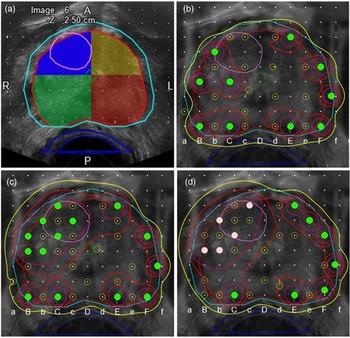
The median percentage change in key parameters from the clinical plan for SSS and DSS is detailed in Table 3. Figure 2 compares isodoses from a single slice of a single case with the clinically delivered SSS and DSS plans.
Median and range for DVH values and deliverability parameters for 145 Gy and 110 Gy clinical plans and the median change from clinical plans for the SSS boost, DSS boost and OAR sparing boost plans. P-values were obtained using the two-tailed Wilcoxon signed-rank test.

Abbreviation: TRAK, total reference air kerma rate.
A single TRUS slice from a 110 Gy patient: (a) transverse sectors at midgland, (b) clinical plan, (c) SSS plan and (d) DSS plan. Structures are red = TRUS prostate capsule; light blue = PTV; green = urethra; dark blue = rectal wall; pink = rigidly registered DIL. Isodoses are yellow = 100%; red = 150%; burgundy = 200%. Needle paths are shown in yellow with 0·453 U seeds filled in green and 0·682 U seeds in light pink.

Statistically significant increases in sectors D90, V150 and V200 were obtained with both boost planning methods without compromising prostate and PTV coverage. There was a statistically significant increase in median rectum D2 cm3 and urethra D10 from both the SSS and DSS planning methods, but for all cases, the local dose constraints were met for rectum and urethra. No statistically significant differences were found when comparing DVH parameters for the sectors, prostate, PTV and OAR between SSS and DSS plans. The SSS plan total reference air kerma (TRAK) rate increased by median of 8% from clinically delivered plans, which was statistically significant. The DSS plan TRAK was not statistically significantly different from the SSS plans.
SSS plans for monotherapy (145 Gy) had a median rectum D2cc increase of 13%, whereas for combined therapy (110 Gy), the median increase was 15%. For DSS plans, the rectum D2cc mean increase compared to clinical plans for monotherapy was 11% and for combined therapy 10%. This result was not statistically significant due to the small sample size of each type of therapy.
Robustness
The MC code was validated by assessing the mean percentage change in DVH parameters from those reported by VariSeed for the unchanged SSS and DSS boost and clinical plans for each patient case (Table 4).
Mean percentage change from TPS for selected DVH statistics when re-calculated using the MC method for the SSS boost, DSS boost and clinical plans for all patients

Abbreviation: SD, standard deviation.
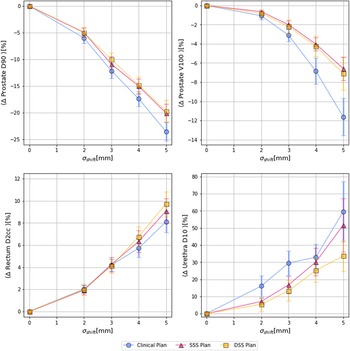
As the standard deviation of random shifts in all directions was increased, overall prostate coverage was lost and OAR doses increased (figure 3) for the clinical plans and SSS and DSS boost plans when compared to the original unchanged plan. After a random shift with a standard deviation of 5 mm, prostate D90 was decreased by a mean of 24% for clinical plans and 20% for SSS and DSS boost plans.
Mean percentage change in DVH statistics for SSS, DSS and clinically delivered plans calculated using the MC code for increasing standard deviations of random shifts (σshift). Each case was recalculated 50 times. Error bars represent 95% confidence intervals.

Discussion
Focal boost techniques could improve outcomes for patients with localised disease and DIL; however, there are no recommendations on the level of dose escalation required for the most appropriate technique. Reference Henry, Pieters and Siebert1,Reference Yamazaki, Masui and Suzuki14 The key dosimetric focus of this work was to ascertain the dose escalation achievable using SSS and DSS techniques while not exceeding current clinically implemented OAR constraints.
This sector boost approach proved feasible for a statistically significant escalation in sector V150 of 31% using SSS and 32% using DSS planning. When boosting mp-MRI-identified DILs using HDR brachytherapy with an inverse planning optimiser, Mason et al. Reference Mason, Al-Qaisieh and Bownes15 achieved an increase in DIL D90 of 16% and in DIL V150 of 48·6% for DILs with a median volume of 1·9 cm3. Tissaverasinghe et al. Reference Tissaverasinghe, Crook and Bachand16 achieved a DIL D90 of 151% of the prescription dose for LDR monotherapy patients where the average BV was 1·9 cm3. We boosted a larger volume of the prostate (median: 6·22 cm3) than these cases and therefore would not be able to achieve as high a boost without exceeding urethra and rectum constraints and risking increased toxicity.
A key clinical impact is that the escalation achieved is comparable to HDR and LDR techniques presented in the literature when the size of the BV is considered and was achieved using the current clinical system without significant changes to planning techniques. Consequently, implementation of this technique would not require significant additional training burden.
HDR boost treatments produce fewer severe urethral toxicities than LDR boost treatments and are indicated for more advanced diseases. Reference Henry, Pieters and Siebert1 However, there is no current evidence-based recommendation for HDR as monotherapy. LDR monotherapy treatments have the advantage of a single treatment visit and may have less impact on long-term sexual function. Reference Henry, Pieters and Siebert1 This work demonstrates dose escalation feasibility for monotherapy treatments prescribed to 145 Gy and combined therapy treatments prescribed to 110 Gy while maintaining dose constraints to rectum and urethra.
The study is limited by having a single consultant radiologist for contouring and a single treatment planner and consequently does not account for inter-operator variability. However, all plans were validated by two members of physics staff with combined planning experience of 35 years, and a selection of plans was reviewed by a consultant oncologist.
The study has demonstrated that the SSS and DSS plans were similar to clinical plans in dosimetric robustness to random seed migration (Figure 3). Consequently, the post-implant dosimetry of the SSS and DSS plans would be expected to be not significantly different to that of the standard clinical plans at our centre. These results support the feasibility of both techniques. Boost plans were less robust than the clinical plans in absolute dose to OARs; however, this is due to these plans starting with a higher urethra D10 and rectum D2cc.
A weakness of this dosimetric robustness assessment is that it did not account for the stranded nature of the seeds within each needle, which suggests seed motions would be likely to be systematic within each strand. This could be addressed in a future study by modifying the existing model.
Mahdavi et al. Reference Mahdavi, Spadinger and Chng17 investigated plan robustness to source displacement for DSS plans for focal-only LDR prostate brachytherapy treating a hemi-gland target volume. Random seed displacement was modelled for 50 simulated cases. They found that DSS plans were superior in robustness of target volume coverage to the SSS planning technique used clinically at their centre. Our work adds to these findings by applying a similar robustness assessment for focal boost plans based on clinical patients.
There were statistically significantly more needles and seeds used in SSS plans than DSS plans (median [range]: 2 [0–10] needles, 8 [1–16] seeds); however, in practice, on average this might not translate into a practical time-saving for every patient. This is clinically significant as achieving the same dosimetric result with a reduction in seeds and needles can result in reduced trauma to the patient and reduced time in theatre, which means the patient can be under general anaesthetic for a shorter period. Additionally, reducing the number of seeds and needles can reduce the overall cost of the procedure, which is a compelling advantage considering the current economic climate in healthcare. Reference Narayana, Troyer and Evans18 SSS boost planning would have fewer risks in implementation due to the practical aspects of handling multiple source strength seeds in one treatment.
It could have been expected that the DSS plans would be less robust than the SSS due to the reduced number of seeds and needles used; however, the DSS plans were not statistically significantly different to the clinically delivered plans in numbers of seeds and needles, and this combined with the higher strength of the boost seeds resulted in similar robustness.
SSS plans for monotherapy (145 Gy) had a median rectum D2cc increase of 13%, whereas for combined therapy, (110 Gy) the median increase was 15%. For DSS plans, the rectum D2cc median increase compared to clinical plans for monotherapy was 11% and for combined therapy 10%. This result was not statistically significant due to the small sample size of each type of therapy; however, this observation suggests further work investigating the dosimetry of boost plans for different plan prescriptions could demonstrate the efficacy of one plan type over another with respect to rectum sparing and lead to improved personalisation of patient treatment.
LDR focal boost techniques are feasible and produce escalations comparable to HDR techniques. Next steps are the clinical implementation of the technique and audit of long-term patient outcomes.
Conclusions
DILs were identifiable in mp-MRI in 70% of cases and informed the involvement of sectors for sector-based planning. A statistically significant median escalation in sector D90 of 27% was achieved using SSS and DSS boost planning methods. Using the DSS planning method, this was achieved with a median of eight fewer seeds and two fewer needles. This dose escalation was achieved without exceeding local OAR constraints or loss of prostate coverage. The robustness of SSS and DSS plans was not significantly different to clinical plans.
Acknowledgements
None.
Financial support
This research received no specific grant from any funding agency, commercial or not-for-profit sectors.
Competing interests
AH discloses institutional research funding from NIHR, CRUK and MRC. The other authors have no conflicts of interest to disclose.