INTRODUCTION
Developmental language disorder (DLD), also referred to by a variety of terms, most commonly Specific Language Impairment (SLI), is a disorder of language acquisition and processing in the absence of obvious explanatory factors, such as hearing loss, neurological abnormality, genomic, or other co-occurring neurodevelopmental disorders. A hallmark of the disorder is a weakness with grammatical morphology (see Leonard, Reference Leonard1998, for a review), the basis of which remains unresolved, and which has been attributed to a diminished input processing capacity and/or an underlying syntactic deficit. In this article, we investigated to what extent the agreement system is impaired in Russian-speaking children with DLD.Footnote 1 In particular, we probed children's sensitivity to agreement relations and agreement violations by comparing children with typical and atypical language on their sensitivity to gender features of verb agreement and adjectival concord markers as cues when making gender decisions about the nouns that hold an agreement relation with a given verb or adjective.
Approaches to understanding grammatical morphology deficits in children with SLI
SLI presentation is highly heterogeneous, yet certain characteristics are commonly reported, such as a delay in reaching major early linguistic milestones and lower than expected scores on standardized language assessments. One type of deficit commonly reported is grammatical morphology. Thus, English-speaking children with SLI have been shown to underperform on verbal morphology compared to typically developing (TD) children matched on either age or mean length of utterance (MLU; Oetting & Horohov, Reference Oetting and Horohov1997; Rice & Wexler, Reference Rice and Wexler1996; Rice, Wexler & Cleave, Reference Rice, Wexler and Cleave1995). They also frequently omit free functional elements, such as prepositions, determiners, and auxiliaries (Grela & Leonard, Reference Grela and Leonard2000). Deficits with grammatical morphology have been documented in cross-linguistic studies of DLD (Clahsen, Reference Clahsen1989; Dalalakis, Reference Dalalakis1999; Hamann et al., Reference Hamann, Ohayon, Dube, Frauenfelder, Rizzi, Starke and Zesiger2003; Hansson & Nettelbladt, Reference Hansson and Nettelbladt1995; Ito, Fukuda & Fukuda, Reference Ito, Fukuda and Fukuda2009; Leonard & Bortolini, Reference Leonard and Bortolini1998). In languages with extensive noun-related morphology, such as Greek, Spanish, and French, in addition to verbal morphology, children with SLI also exhibit difficulties with noun-related morphemes, such as adjective-concord markers and direct object clitics (Bedore & Leonard, Reference Bedore and Leonard2001).
A number of accounts of the morphosyntactic deficits in children with DLD have been proposed (for reviews, see Marinis, Reference Marinis2011; Penke, Reference Penke, Kiss and Alexiadou2011), with most adopting either a processing or syntactic competence approach. The processing view includes the Generalized Slowing (Kail, Reference Kail1994), the Auditory Processing Deficit (Tallal, Miller & Fitch, Reference Tallal, Miller and Fitch1995), and the Phonological Short-term Memory (Gathercole & Baddeley, Reference Gathercole and Baddeley1990) accounts, among others. For example, according to the Generalized Slowing hypothesis (Kail & Salthouse, 1994), children with SLI have a general limitation in processing speed, which affects the efficiency of their language and cognitive processing (Kail, Reference Kail1994; Windsor & Hwang, Reference Windsor and Hwang1999). The Phonological Short-term Memory hypothesis maintains that the core causal deficit in SLI is a limitation in verbal or phonological short-term memory capacity (PM; Gathercole & Baddeley, 1990; Montgomery, Reference Montgomery2000). Another approach, the surface hypothesis (Leonard, Sabbadini, Leonard, & Volterra, 1987), suggests that rather than impaired ability to process abstract syntactic features, children with SLI have deficits in auditory processing. These deficits affect children's ability to process phonetically non-salient material and lead to a delayed acquisition of inflectional morphemes, often unstressed and brief in duration.
The theories within the processing deficit approach share the idea that the source of the grammatical impairment lies outside the syntactic system, making the latter secondary to a weakness in processing systems. Despite the appealing parsimony of such accounts, they may not always be adequate in accounting for the range of linguistic deficits in children with SLI (Norbury, Bishop & Briscoe, Reference Norbury, Bishop and Briscoe2001) or demonstrating a causal link rather than a covariation between the observed syntactic and processing deficits (Ullman & Pierpont, Reference Ullman and Pierpont2005).
An alternative approach attributes morphological deficits in SLI to a breakdown in the system of syntactic representational knowledge involved in identification and application of abstract grammatical operations. Thus, SLI has been proposed to involve syntactic agreement due to either defective featural composition/specification of lexical items or to faulty syntactic operations. For example, one approach conceptualized the posited underlying deficit as a problem with uninterpretable features, that is, those that are relevant for grammatical computation, but not for semantic interpretation (Clahsen, Bartke & Göllner, Reference Clahsen, Bartke and Göllner1997; Tsimpli, Reference Tsimpli2001; Tsimpli & Mastropavlou, Reference Tsimpli, Mastropavlou, Liceras, Zobl and Goodluck2007). A strong version of this approach maintains that all uninterpretable features are affected; that is, Case features of nouns, Tense features of verbs, and the so-called ϕ-features or person, gender, and number features of verbs and adjectives (Tsimpli & Mastropavlou, Reference Tsimpli, Mastropavlou, Liceras, Zobl and Goodluck2007). Under the narrow version of this approach, only the ϕ-features of verbs and adjectives are affected (Clahsen et al., Reference Clahsen, Bartke and Göllner1997). A similar earlier proposal, the Missing Agreement hypothesis (Clahsen, Reference Clahsen1989, Reference Clahsen1991) maintained that the core impairment in SLI involved the mechanism of matching grammatical features of syntactic categories, as required for subject–verb agreement, gender and number concord, structural case marking, and other kinds of syntactic dependencies.
Another syntactic account, the Representational Deficit for Dependent Relations (RDDR) and its later version, the Computational Grammatical Complexity (CGC; van der Lely, Jones & Marshall, Reference van der Lely, Jones and Marshall2011) proposed a broad deficit in representing complex discontinuous syntactic dependencies. According to this approach, children with SLI lack the ability ‘to consistently form hierarchical, structurally complex forms in one or more of the components of grammar’ (van der Lely et al., Reference van der Lely, Jones and Marshall2011: 411). CGC seeks to incorporate the notion of computational complexity, stating that the probability of errors increases with the syntactic complexity of the structure. Thus, it predicts a deficit in building clausal dependencies, but not phrasal level dependencies, suggesting, for example, that due to a lower complexity, ‘the syntactic dependencies within the nominal phrase are normal’ (van der Lely et al., Reference van der Lely, Jones and Marshall2011: 411).
The processing and syntactic approaches often adopt a parallel, albeit reverse, strategy. In the case of the processing deficit view, an attempt is made to show that morphosyntactic deficits in SLI co-occur with processing deficits, implying a causal relationship. Conversely, the syntactic deficit proponents often attempt to demonstrate that syntactic computation can be impaired selectively. The debate between the two approaches often concerns the larger issue of the structure of cognitive systems involved in language acquisition and processing, and whether patterns of impaired performance can provide evidence for or against the existence of autonomous neurocognitive circuits specialized for encoding grammatical information. However, because interpreting co-occurrence and dissociation of deficits is frequently problematic (Caramazza, Reference Caramazza1984), there is a recognized need for new approaches capable of probing linguistic competence and isolating facets of performance in a theory-based way without relying on their co-occurrence or selectivity (Marinis, Reference Marinis2011).
The current study is aimed at clarifying the respective roles of grammatical knowledge, processing speed, phonological memory, and phonetic salience of the inflectional element during on-line processing of subject–verb agreement and adjectival concord by Russian-speaking children with language disorder. Rather than relying on production or off-line comprehension measures, we have designed an experimental procedure looking at both the implicit processes of agreement processing, and explicit processes of gender decision, which allows us to discern whether children with language disorder are sensitive to the presence and function of the agreement markers and at the same time evaluate to what extent their processing speed and phonological memory affect the accuracy of their gender decision.
Previous studies of grammatical processing in children with SLI
To date, there have been only a relatively small number of studies of on-line sentence processing in children with SLI (e.g., Montgomery, Reference Montgomery2000; Montgomery, Scudder & Moore, Reference Montgomery, Scudder and Moore1990). In one study using a word-monitoring task, reaction times (RTs) were compared for conditions where the target word was presented in contexts, in which it followed a verb inflected with morphemes of low (e.g., -s and -ed) and higher perceptual salience (e.g., -ing), or an anomalous uninflected verb (Montgomery & Leonard, Reference Leonard1998). The results indicated that, unlike the TD children, the children with SLI did not display an improved performance in the conditions with the morphemes of low perceptual salience compared to the uninflected conditions. These results, however, were compatible with both the surface hypothesis (Leonard et al., Reference Leonard, Sabbadini, Leonard and Volterra1987) and a syntactic deficit theory since the contrast between the more and less salient markers was also a contrast between the aspectual -ing and the tense/agreement markers -ed/-s.
Because sparse morphology of English provides little opportunity to examine morphological knowledge, research in languages with richer agreement systems is of pivotal importance. Gender agreement is an excellent tool for this purpose. Previous research on gender processing in SLI focused mainly on gender concord between the noun and the determiner and/or adjectival modifier, and relied mainly on elicitation and sentence completion tasks, as well as word categorization tasks, in Spanish, French, Brazilian Portuguese, and Dutch. Together, these studies showed that, whereas children with SLI had a higher error rate in their productions, in categorization tasks they showed sensitivity to agreement violations and agreement cues similar to that of TD children by being slower on the conditions, in which the target word was presented in a context of an anomalous agreement (e.g., a gender discordant adjective; Anderson & Lockowitz, Reference Anderson and Lockowitz2009; Cantú-Sánchez & Grinstead, Reference Cantú-Sánchez and Grinstead2004; Orgassa & Weerman, Reference Orgassa and Weerman2008; Roulet-Amiot & Jakubowicz, Reference Roulet-Amiot and Jakubowicz2006; Silveira, Reference Silveira2006).
We sought to add to the existing body of research by investigating the processing of subject–verb agreement and adjectival concord by comparing the accuracy and speed of gender decision by Russian-speaking children with and without language disorder on sentences varied with respect to whether the sentence contained an agreement marker that can be used as a cue for the noun gender.
Russian gender and gender agreement
Gender agreement is a system, in which the class of a noun is reflected in the forms taken by other elements syntactically related to it, such as the verb or adjectival modifier. In Russian, nouns trigger gender agreement as heads of NPs containing an attributive adjective, as in the examples in (1), and as subjects of a past tense verb, as in the examples in (2) (and in co-indexed pronouns):
- (1)
a. interesn-aja knig-a
interesting-fem.nom.sg book-fem.nom.sg
‘interesting book’
b. interesn-yj zhurnal-Ø
interesting-masc.nom.sg journal-masc.nom.sg
‘interesting journal’
- (2)
a. knig-a lezh-al-a na stole
book-fem.nom.sg lie-past-fem.sg on table
‘The book lay on the table’
b. zhurnal-Ø lezh-al-Ø …
journal-masc.nom.sg lie-past-masc.sg
‘The journal lay …’
In contrast, in the present tense, nouns do not trigger gender agreement:
(3) knig-a / zhurnal-Ø lezh-it
book-fem.nom.sg/ journal-masc.nom.sg lie-3rd.sg
‘The book/journal is lying …’
Thus, while in (1)–(2), the morphological form of the verb (and adjective) contain cues to the gender of the noun, in (3), it does not.
Gender in Russian is considered to be an inherent feature of noun stems, which determines the morphological class of nouns, traditionally called masculine, feminine, or neuter. Only for some nouns, there is a correspondence between their grammatical gender and the semantic features [+male] or [+female] (since only a few nouns denote male or female entities).Footnote 2 For most nouns, gender is a semantically arbitrary formal feature assigned based on the morphophonological form of the noun in its citation form, nominative singular (nom sg), that is, its declension class.
Nouns of each gender form distinct declension classes, each with a corresponding inflectional paradigm. We assume four main declension classes in Russian (Corbett, Reference Corbett1982; Doleschal, Reference Doleschal and Unterbeck2000), focusing on the masculine (masc) nouns of the 1st and feminine (fem) nouns of the 2nd declensions (i.e., nouns whose nom sg form ends with a phonetically null masc sg inflection: a stem-final consonant, and the fem sg inflection -a, respectively), which are assigned gender according to the following rules (Corbett, Reference Corbett1982):
a. [+male] → masculine
b. [+female] → feminine
c. [decl. I] → masculine
d. [decl. II] → feminine
Because of the fairly regular declension–gender correspondences, most nouns have transparent morphophonological gender cues: most nouns whose nom sg form ends in an -a are feminine (with an exception of a small group of animate masculine nouns in the 2nd declension, which would be assigned masc gender according to rule (a)), and those that end in a consonant are masculine (with the exception of nouns of the 3rd declension, which end in a palatalized consonant and are feminine).
Acquiring the morphological system of declension/gender involves rote learning of stems and inflectional paradigms, as well as forming morphophonological generalizations with regard to gender–declension correspondences. In contrast, the morphosyntactic phenomenon of agreement involves constructing complex discontinuous dependencies between constituents of different levels (e.g., noun heads and adjective phrases). If we ask the child to make a conscious decision about the gender of the target noun presented in a syntactic context that includes gender agreement, we can examine the implicit intrasentential processes that should influence gender decision. By examining whether children link nouns' gender and agreement markers during sentence processing, we can deduce their ability to perform both abstract (syntactic) and surface (morphological) operations and probe their grammatical and lexical knowledge.
Current study
The experiments reported here capitalized on the property of Russian grammar that provides a natural contrast between sentences with and without subject–verb gender agreement (past vs. present tense). In addition, the morphological form of the adjective exhibits concord with the gender and case/number of the noun it modifies. Because adjectival modifiers precede nouns and the verb may precede the subject, it is possible to investigate whether the presence of gender agreement markers on the verb and/or adjective makes the gender decision on the sentence-final subject noun more accurate and/or faster.
Thus, if children with language disorder are sensitive to syntactic agreement, encountering the verb and/or the adjective with morphologically expressed gender agreement should measurably decrease the reaction time and/or increase accuracy on the gender decision task compared to a sentence in which there are no gender cues preceding the presentation of the target noun. This would allow us to rule out a representational deficit involving uninterpretable features and building structural dependencies, and seek explanations for morphosyntactic deficits documented for children with language disorder in surface morphology, processing speed, and/or phonological memory capacity. We also asked whether phonetic salience of the inflection influences children's performance, capitalizing on the phonetic contrast between first declension masculine (with the less salient, consonantal), and second declension feminine (with the more salient, vocalic) endings.
In summary, in Experiment 1, we investigated whether Russian-speaking children with DLD differed from their TD counterparts in (1) their knowledge of declension/gender mappings and (2) their sensitivity to agreement features of verbs and adjectives controlled by the gender of nouns. In Experiment 2, we also asked whether the knowledge of declension/gender mappings in children was generalized to pseudo-words and morphologically complex pseudo-words. Lastly, we asked whether children with DLD were sensitive to agreement violations.
EXPERIMENT 1
We asked whether the children could assign gender to familiar nouns, and whether gender agreement markers facilitated their accuracy and speed on that task. Specifically, Experiment 1 addressed the following questions:
• Can children with DLD assign gender to nouns based on their declension class that follow regular morphophonological gender assignment rules?
• Is their accuracy in gender decision affected by the relative phonetic salience of the inflection?
• Do children with DLD use verb agreement and adjectival concord markers as gender cues during gender decisions?
• Does the performance of children with DLD and TD differ quantitatively and qualitatively in speed and accuracy, and to what extent are these differences related to their differences in PM?
METHOD
Population
The participants came from a small Russian-speaking population that has been the focus of an epidemiological study of developmental language disorder because of its atypically high prevalence in this population. The population resides in the north-western part of Russia. At the time of this study, it consisted of 861 individuals, of whom 138 were between the ages of three and eighteen. Our previous investigation showed that about 30% of school-aged children in the population had impaired language based on their performance on a set of expressive measures (see Rakhlin, Kornilov, Palejev, Koposov, Chang & Grigorenko, Reference Rakhlin, Kornilov, Palejev, Koposov, Chang and Grigorenko2013).
Participants
The sample included forty-one children aged 7;2 to 15;10 (M = 10·51, SD = 2·29; 24 boys). All children in the study population undergo annual health exams by the local nurse practitioner and visiting physicians. Their medical records were used to identify exclusionary diagnoses, such as autism, genomic, or other severe neurodevelopmental disorders, and determine each child's eligibility for inclusion in the study. Based on expressive language measures using a narrative task (see below) and non-verbal IQ, eighteen children were classified as DLD (13 boys) and twenty-three as TD (11 boys). The two groups were matched on gender (χ2(1) = 2·48, p = ·116), age (t(39) = 1·08, p = ·286), and handedness as assessed by WHQ-R (Elias, Bryden & Bulman-Fleming, Reference Elias, Bryden and Bulman-Fleming1998) (t(39) = −1·21, p = ·232).
Behavioral measures
Expressive language
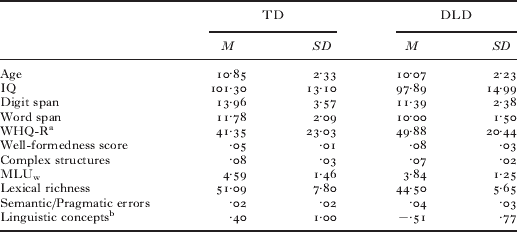
Every child was assessed using two wordless storybooks: those under thirteen using Frog, Where Are You? and One Frog too Many (Meyer, Reference Meyer1969), and those over thirteen using Tuesday and Free Fall (Wiesner, Reference Wiesner1997, Reference Wiesner2008). The audio and the transcripts were analyzed by two native-Russian linguists and rated on a number of characteristics in the phonological, syntactic, and semantic/pragmatic domains, combined to form the following measures: (1) phonetic and prosodic characteristics (i.e., phonological simplifications and omissions, substitutions, and prosodic abnormality), (2) well-formedness (frequency of lexical and grammatical errors and false starts), (3) syntactic complexity (the frequency of complex structures, e.g., subordinate and conjoined clauses, passives, participial constructions, wh-questions, and mean length of utterance in words, MLUw), (4) narrative quality (elaboration and narrative structure), and (5) semantic/pragmatic characteristics (lexical richness; i.e., a ratio of distinct lexemes to the number of words, and frequency of semantic/pragmatic errors). The overall impairment status was determined by using the cut-off criterion of performance of 1 SD below the mean of the peer sample from a comparison population on at least two of the domains listed above (Rakhlin et al., Reference Rakhlin, Kornilov, Palejev, Koposov, Chang and Grigorenko2013). Descriptive statistics for study measures are presented in Table 1.
Descriptive statistics for study measures
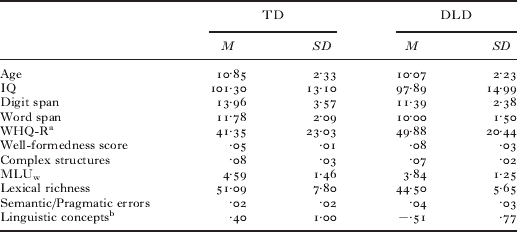
notes: N = 18 for DLD, n = 23 for TD, and total n = 41, except for an = 18 and 16 for TD and DLD groups, respectively; bn = 23 and 17 for TD and SLI groups, respectively. Higher values of Well-formedness score and Semantic/Pragmatic errors indicate worse performance (more errors), whereas higher scores on Complex structures, MLUw, Lexical richness, and Linguistic concepts indicate better performance.
A one-way MANCOVA controlled for age with the scores for well-formedness, complex structures, MLUw, lexical richness, and semantic/pragmatic errors as dependent variables, and group status as an independent variable, illustrates the differences in language functioning between the DLD and TD groups: the main effect of group was significant with a large effect size (Pilai's Trace = ·49, F(5, 34) = 6·64, p < ·001, ηp2 = ·49). Thus, the DLD group in the study underperformed on expressive language compared to the TD group, which was largely driven by significantly lower well-formedness (F(1, 38) = 29·04, p < ·001, ηp2 = ·43), lower lexical richness (F(1, 38) = 7·11, p = ·011, ηp2 = ·16), and a higher semantic/pragmatic error rate in the DLD group (F(1, 38) = 4·25, p = ·046, ηp2 = ·10).
Receptive language
Most children (18 with TD and 16 with LI) were administered an individual standardized assessment of Russian language development (ORRIA; Babyonyshev et al., unpublished assessment).Footnote 3 The two groups were compared on the subtest ‘Linguistic Concepts’, a measure assessing children's comprehension of sentences with quantifiers, negation, and temporal and logical operators. The analysis of the age-adjusted z-scores (based on an external preliminary standardization sample; n = 484) revealed that children with DLD significantly underperformed (t(32) = 2·93, p = ·006, d = − 1·02), indicating a marked deficit in receptive grammar in addition to their expressive language deficits reported above.
Non-verbal intelligence
A standardized non-verbal IQ score for each child was obtained using the Culture-Fair Intelligence Test (CFIT Scale 2; Cattell & Cattell, Reference Cattell and Cattell1973), a measure of fluid intelligence as a cognitive ability relatively independent of cultural and verbal influences in individuals aged seven and above. All scores were above the cut-off for intellectual disability, and the two groups did not differ in non-verbal IQ (t(39) = ·78, p = ·441).
Phonological memory
Standard Digit Span (backward and forward) modeled after the analogous subtest of WISC-III (Wechsler, Reference Wechsler1991) and Word Span measures were used to investigate group differences in PM capacity and to control for their effects on performance in the experimental tasks. The groups differed on both the Digit Span (t(39) = 2·62, p = ·009, d = ·84 (forward: t(39) = 2·27, p = ·029, d = ·73; backward: t(39) = 2·15, p = ·039, d = ·65)), and Word Span (t(39) = 3·06, p = ·004, d = ·98), consistent with the established pattern of PM deficits in children with DLD (Estes, Evans & Else-Quest, Reference Estes, Evans and Else-Quest2007).
Hearing screening
All participants were administered a bilateral hearing screening with a Beltone 119 audiometer at 500, 1,000, 2,000, and 4,000 Hz, and passed the screening at 25 dB, with the exception of one, who passed it at 35 dB.
Materials
The children were tested on sentences systematically varied with respect to three factors: (i) gender/declension class of the noun (1st declension masculine vs. 2nd declension feminine); (ii) the presence of gender agreement marker on the verb (examples (4), (5a–b)); and (iii) the presence of an adjective (5a–b, 6a–b). Thus, the overall design of the materials was 2 × 2×2.
The word order across all conditions was uniform: a locative prepositional phrase followed by the verb and the subject noun phrase with or without an adjective, a pragmatically neutral word order for sentences of this type (i.e., locative inversion construction with unaccusative verbs; Babyonyshev, Reference Babyonyshev1997).
(4) Na stene visit kartin-a /portret-Ø
on wall hang-pres.3rd.sg painting-fem.nom.sg. /portrait-masc.nom.sg
‘On the wall there hangs a painting/a portrait’
- (5)
a. Na stene vise-l-a kartin-a
on wall hang-past.fem.sg painting-fem.nom.sg
‘On the wall there hung a painting’
b. Na stene visel-Ø portret-Ø
on wall hang-past.masc.sg portrait-masc.nom.sg
‘On the wall there hung a portrait’
- (6)
a. Na stene visit krasiv-aja kartin-a
on wall hang-pres.3rd.sg beautiful-fem.nom.sg. painting-fem.nom.sg
‘On the wall there hangs a beautiful painting’
b. Na stene visit krasiv-yj portret-Ø
on wall hang-pres.3rd.sg beautiful-masc.nom.sg portrait-masc.nom.sg
‘On the wall there hangs a beautiful portrait’
To avoid semantic gender cues, all nouns were inanimate. All words were selected from the Frequency Dictionary for Russian (Sharoff, Reference Sharoff2001). Masculine and feminine nouns were matched on frequency (t(78) = ·19, p = ·849), length in phonemes (t(78) = ·75, p = ·456), and the number of complex onsets and codas (χ2(1) = 1·00, p = ·317). All verbs were judged to be equally plausible for masculine and feminine inanimate subjects by two native speakers. The same verbs were used across all conditions to control for unintended lexical effects of individual verbs. Thus, each verb was presented four times, each time with a different noun balanced for the noun's gender: in two conditions it was combined with a masculine and in two with a feminine noun. Two counterbalanced lists were created, so each verb appeared with both feminine and masculine nouns in each adjective/verb form condition.
Each of the eight conditions had ten items. Twenty filler items (four additional verbs repeated five times each paired with genders and syntactic frames in a pseudo-random way) were constructed to mask the balance between the verbs and the corresponding nouns' gender to prevent implicit learning of the verb/gender combination patterns and anticipating the gender of the nouns in later trials. The sentences were recorded by a female native speaker of Russian using PRAAT sound-editing software (Boersma & Weenink, www.praat.org).
Procedure
All children were tested individually in a quiet room using a PC laptop. They were instructed to listen to sentences and decide whether the last word in each sentence was feminine or masculine (i.e., whether it is a ‘she’, like the words devochka ‘girl’ and tucha ‘cloud’ or a ‘he’, like mal ychik ‘boy’ and poyezd ‘train’). The participants were asked to press the left trackpad button for feminine and the right one for masculine as quickly and accurately as possible. The buttons were labeled mnemonically with a picture of a girl and a boy. At the beginning of each trial, a fixation cross appeared on the screen, alerting the participants that the sentence was about to be presented. After 2,000 ms, the sentence was presented (through Sennheiser HD215 headphones at 70 dB SPL), during which the fixation cross remained on the screen. At the offset of the last word, the prompt ‘?’ appeared on the screen, and the participants had 2,000 ms to respond. The order of the trials was randomized for each participant. The first fifty trials were followed by a break.
The participants were familiarized with the task by two examples with semantic gender, followed by five practice trials with examples of each syntactic frame progressing from nouns with semantic gender to inanimate nouns with formal gender. Feedback was given after each practice trial. All children succeeded with the practice trials.
RESULTS AND DISCUSSION
Accuracy
Following Jaeger (Reference Jaeger2008), we analyzed the item-level data using a mixed logit model with crossed random effects for items and subjects. The modeling of conditional response probabilities was performed in R using the lmer function from the lme4 library (Bates & Maechler, 2010) with Laplace approximation. Only the trials with an overt response (94%) were analyzed. The proportion of excluded trials did not differ between the groups (χ2(1) = ·001, p = ·972). All continuous predictors were mean-centered, the trial rank-order was centered at the value of 1.
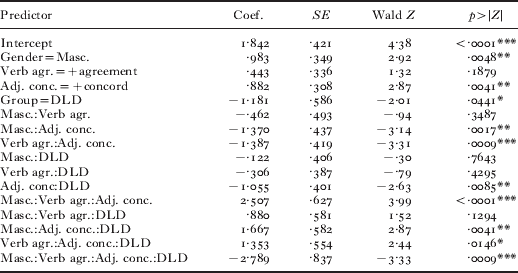
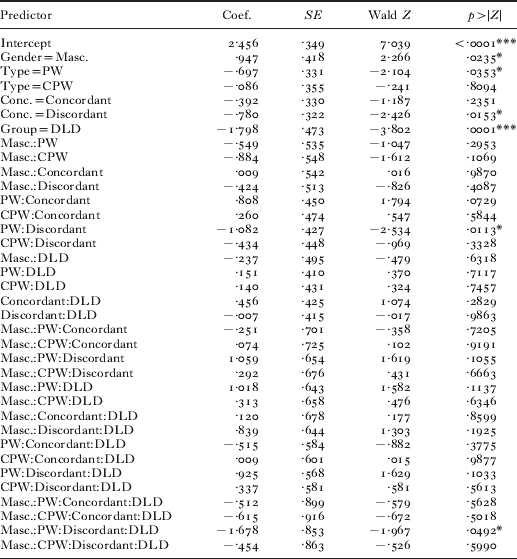
The initial model (M1) included the fixed effects of gender, verb agreement, adjectival concord, and group, as well as random effects of subjects and items on the intercept. The model displayed a significantly better fit (log-likelihood = −1281·80) than the null model (M0) with random intercepts (log-likelihood = −1314·50; χ2(15) = 65·49, p < ·001). The addition of log-transformed word frequency (Estimate = ·04, p = ·504) and length of words in phonemes (Estimate = ·01, p = ·829) as predictors in the model (M2) did not result in the improvement in the model fit (log-likelihood = −1281·60; χ2(2) = ·45, p = ·797), and indicated that neither variable was reliably linked to overall accuracy. Since the pattern of results did not differ between M1 and M2, we will present the results from M1 (summarized in Table 2).
Summary of the fixed effects in the mixed logit model M1 for Experiment 1 (Accuracy)

notes: ‘:’ indicates an interaction term. * – p < ·05, ** – p < ·01, *** – p < ·001. N=3071; log-likelihood = −1281·80. Masc. – masculine, Verb agr. – verb agreement, Adj. conc. – adjectival concord.
First, the analysis revealed a significant effect of gender (Estimate = ·98, p = ·005), indicating that the children were more accurate assigning masculine to the nouns of the 1st declension, as opposed to feminine to the nouns of the 2nd declension. The effect of verb agreement was not significant (Estimate = ·44, p = ·188), but the effect of adjectival concord was significant (Estimate = ·88, p = ·004), indicating that the presence of a concordant adjective improved the accuracy of gender decision, confirming that children used gender concord as a cue in gender decisions.
Second, we found the effect of group to be significant (Estimate = −1·18, p = ·044), with the DLD group underperforming in comparison to the TD group. This effect, however, disappeared when the digit span scoresFootnote 4 (Estimate = ·36, p < ·001) were entered in the model (M3) as covariates (for the group effect, Estimate = −·43, p = ·383; log-likelihood = −1270·20, χ2(1) = 23·25, p < ·001), suggesting that the difference in the accuracy scores between the groups was related to their differences in PM; for both experiments, the word span scores did not contribute significantly to the models after controlling for the digit span.
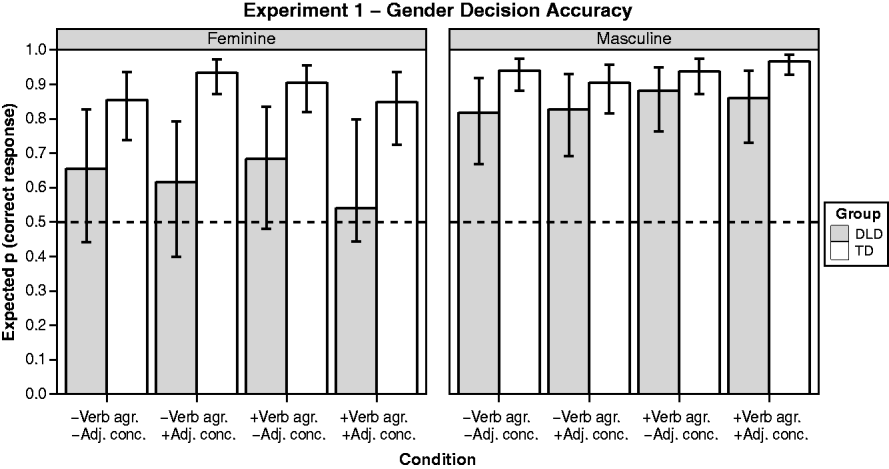
There was a four-way interaction between gender, agreement, adjectival concord, and group (Estimate = −2·79, p = ·001; see Table 2). Therefore, the three-way interaction between gender, agreement, and adjectival concord was investigated separately in each group. The interaction was not significant for children with DLD (Estimate = −·26, p = ·638); the only significant effect was that of gender (Estimate = ·88, p = ·007). The expected correct response probability plot (Figure 1; the estimates were obtained using the Zelig library in R; Imai, King & Lau, 2008) shows that the absence of the interaction in the DLD group might be due to their at-chance expected performance on the feminine nouns.
Expected probabilities of correct responses (Experiment 1). Bars represent 95% confidence intervals. Verb agr. – verb agreement. Adj. conc. – adjectival concord.
The three-way interaction was significant for children with TD (Estimate = 2·57, p < ·001), and was further analyzed separately for each gender. Although the interaction between verbal agreement and adjectival concord was present for both masculine (Estimate = 1·13, p = ·016) and feminine nouns (Estimate = −1·63, p < ·001), further analyses revealed no significant effects for masculine nouns (all ps > ·05). For feminine nouns, the effect of adjectival concord differed depending on the verb agreement condition. While it increased accuracy in the gender-neutral verb condition (Estimate = ·98, p = ·003), the effect was the opposite in the gender-agreeing verb condition (Estimate = −·60, p = ·044); i.e., the presence of adjectival concord improved accuracy if it was the only gender-agreeing element in the sentence, but had a detrimental effect if it was the second such element.
In sum, these results indicate that both groups had higher accuracy with masculine in comparison to feminine nouns. However, while the TD group showed sensitivity to agreement features (in the feminine condition), the DLD group did not. The DLD group was also less accurate overall, but when controlled for the differences in PM, the group difference in overall performance decreased in size two-fold and became non-significant, indicating that phonological memory could be largely responsible for the differences in the gender decision accuracy between the two groups.
Reaction time
Next, the item-level log-transformed reaction time (RT) data for correct trials were analyzed using a mixed linear model. The analyses were performed in R using the lmer function (fitted with the restricted maximum likelihood method). The p values were estimated with the pvals.fnc function from the languageR (Baayen, Reference Baayen2012) library using a Markov chain Monte Carlo (MCMC) sampling from the posterior distribution of the parameters. The log-transformed RT data were screened for normality on the individual subject basis using the Shapiro-Wilk's test. For children who displayed significant deviations from normality, the outlying latencies (7%) were trimmed on the basis of the visual analysis of the Q-Q plots.
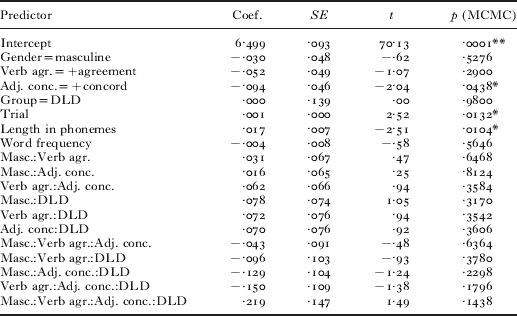
The fitting of the model proceeded in an iterative fashion through the successive inclusion of predictors that reflected stimuli characteristics and temporal trial dependencies (Baayen & Milin, Reference Baayen and Milin2010). The initial modelFootnote 5 (M1) included fixed effects of gender, verb agreement, adjectival concord, and group, and random effects of subjects and items on the intercept. The addition of log-transformed frequency and length of words in phonemes in the model (M2) as predictors resulted in an improvement in the model fit (χ2(2) = 6·67, p = ·036). Furthermore, to control for the longitudinal dependencies in the RTs at the scale of the experiment (indicating practice effects), the trial rank-order was included as a temporal predictor in M3, which displayed a better fit than M2 (χ2(1) = 6·34, p = ·012). The resulting model included the fixed effects of the condition variables and the group, word frequency, length of words in phonemes, trial rank-order, and the random effects of subjects and items on the intercept. This model displayed a significantly better fit (log-likelihood = −1240·20) than the null model (M0) with just random intercepts (log-likelihood = −1256·50; χ2(18) = 32·82, p = ·018), and is summarized in Table 3.
Summary of the fixed effects in the mixed linear model M3 for Experiment 1 (Reaction Time)
notes: ‘:’ indicates an interaction term. * – p < ·05, ** – p < ·001. N=2179; log-likelihood = −1240·20. Masc. – masculine, Verb agr. – verb agreement, Adj. conc. – adjectival concord.
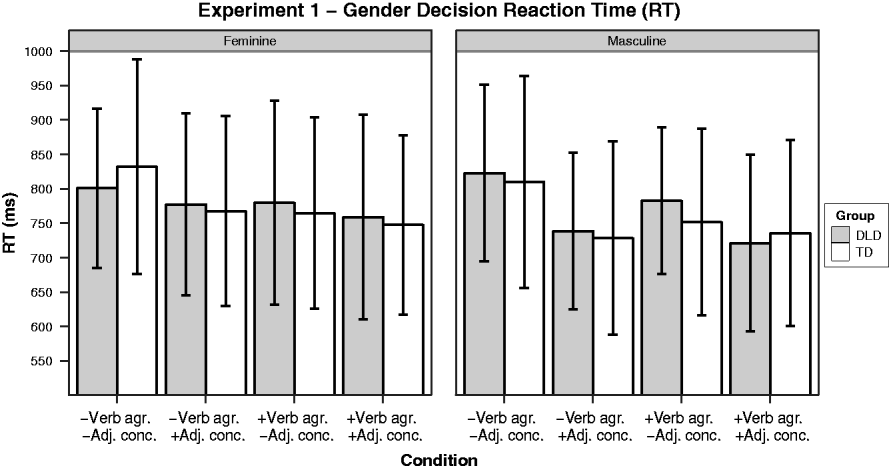
The analysis indicated that the effect of gender was not significant (Estimate = −·03, p = ·5346), and neither was the effect of verb agreement (Estimate = −·05, p = ·287; see Figure 2). However, the children displayed faster RTs to sentences containing adjectival concord (Estimate = −·09, p = ·044) compared to those without adjectives, suggesting that gender cues facilitated their responses. Crucially, the children with DLD were not slower than the children with TD (Estimate = ·0001, p = ·980) and the absence of a significant interaction between group and adjectival concord (Estimate = ·02, p = ·812) indicated that the responses of both groups were facilitated by the adjectival concord. No other interactions were statistically significant (all ps > ·05; see Table 3). These results indicate that despite the differences in accuracy, the DLD group did not differ from the TD group in the speed of processing and was equally facilitated by adjectival concord.
Mean reaction times (in milliseconds) for Experiment 1. Only correct trials were analyzed. Bars represent 95% confidence intervals. Verb agr. – verb agreement. Adj. conc. – adjectival concord.
In sum, the results of Experiment 1 indicated that children with DLD displayed quantitatively different performance compared to the TD group, as reflected in their accuracy scores. As expected, they displayed an overall lower performance on accuracy and a somewhat different pattern of responses. While the TD group showed an increased accuracy in certain conditions, in which the target noun was preceded by an element containing an agreement marker providing a gender cue, the children with DLD did not display such sensitivity. On the other hand, when the performance was assessed via RTs, the two groups displayed no quantitative or qualitative differences, and both groups' responses were sped up by the presence of adjectival concord. These differences between accuracy and RT results suggest that although children with DLD may have a deficiency with respect to adjectival concord, this knowledge is not completely absent and can be revealed in implicit characteristics of their responses, namely, the increased speed on the trials with concord. Furthermore, the overall quantitative group difference in performance disappeared when controlled for PM, suggesting that deficits in PM at least partly account for the impaired gender processing in this group.
EXPERIMENT 2
In Experiment 2, we investigated whether children with DLD possess the knowledge of the declension-to-gender correspondence rules independent from their lexical knowledge of noun stems. For this purpose, in addition to real words, the stimuli included pseudo-words with phonological forms analogous to nouns of the 1st and 2nd declensions, and pseudo-words with real derivational suffixes (complex pseudo-words). Thus, the targets varied with respect to their degree of lexicality: real words (fully stored), complex pseudo-words (containing a novel ‘root’ and a stored suffix), and pseudo-words (novel word-like items). In addition, we included sentences with discordant adjectives.
In sum, Experiment 2 addressed the following questions:
• Does lexicality influence the performance of children with DLD and their TD counterparts in gender decisions?
• Are both groups equally sensitive to adjectival concord violations?
METHOD
Participants
The same group of forty-one children (18 with DLD and 23 with TD) who took part in Experiment 1 participated in Experiment 2.
Materials
The participants were tested on sentences analogous to those from Experiment 1, systematically varied with respect to three factors: declension/gender, target type, and the presence and match of gender agreement. The overall design was 2 (1st declension masculine and 2nd declension feminine) × 3 (words with non-derived stems, pseudo-words, and complex pseudo-words) × 3 (no concord, gender concordant adjective, and an ungrammatical gender discordant adjective). All sentences had gender-neutral present tense verbs in all conditions. The examples of real words are provided in (7), pseudo-words in (8), and complex pseudo-words in (9).
All pseudo-words were judged to be word-like by two native speakers. The complex pseudo-words consisted of the items from the pseudo-word condition combined with expressive (Exp) suffixes, that is, suffixes conveying size and speaker's attitude; for example, diminutive, affectionate, or pejorative: masculine -ik, as in p yos-ik ‘doggy’; -ets, as in brat-ets ‘brother-dear’; -un, as in bolt-un ‘chatter-box’; and feminine -k-a, as in ptich-k-a ‘birdy’; -its-a, as in sestr-its-a ‘sister-dear’; etc. (Steriopolo, 2008).Footnote 6 All suffixes used in the study were gender-specific (i.e., resulted in a derived noun being unambiguously masculine or feminine) but varied in productivity and frequency. Thus, the diminutives are highly productive and can be combined with most concrete nouns, while other suffixes are limited to certain semantic or syntactic classes. In previous research, diminutives have been found to have a facilitative effect on gender processing in children (Seva, Kempe, Brooks, Mironova, Pershukova & Fedorova, Reference Seva, Kempe, Brooks, Mironova, Pershukova and Fedorova2007). By adding other types of suffixes, we could address whether the facilitative effect extended to other expressive suffixes, apart from the diminutives, ubiquitous in child and child-directed speech.
- (7)
a. Eto sidit (bolysh-aja/*-oj) voron-a
this sit-pres.3rd.sg large-fem.nom.sg/masc.nom.sg crow-fem.nom.sg
‘There sits a (large) crow’
b. Eto bezhit (dik-ij/*-aja) kaban-Ø
this run-pres.3rd.sg wild-masc.nom.sg./fem.nom.sg boar-masc.nom.sg
‘There runs a (wild) boar’
- (8)
a. Eto sidit (pushist-yj/*-aja) balos-Ø
this sit-pres.3rd.sg fluffy-masc.nom.sg/fem.nom.sg balos-masc.nom.sg
‘There sits a (fluffy) balos’
b. Eto kipit (vkusn-aja/*-yj) falat-a
this boil-pres.3rd.sg delicious-fem.nom.sg/masc.nom.sg falata-fem.nom.sg
‘There simmers a (tasty) falata’
- (9)
a. Eto plyvyot (zelyon-yj/*-aja) balos-ik-Ø
this swim-pres.3rd.sg green-masc.nom.sg/fem.nom.sg balos-exp-masc.nom.sg
‘There swims a (green) balosik’
b. Eto letit (ser-aja/*-yj) falat-k-a
this fly-pres.3rd.sg gray-fem.nom.sg/masc.nom.sg falat-exp-fem.nom.sg
‘There flies a (gray) falatka’
The word order across conditions was uniform: a demonstrative pronoun eto ‘this’ in the sentence-initial position, followed by a gender-neutral verb, the adjective (in either a concordant or discordant form) and the subject noun in the sentence-final position, a pragmatically neutral word order for such sentences. Masculine and feminine words were matched on frequency (t(14) = −·24, p = ·816). The feminine targets were on average longer than the masculine (t(46) = 3·40, p = ·001), and complex pseudo-words were longer than words (t(30) = −6·69, p < ·001) and pseudo-words (t(30) = −7·69, p < ·001). Words and pseudo-words did not differ in length (t(30) = ·23, p = ·820).
Each verb appeared in three frames: with a word, a pseudo-word, and a complex pseudo-word subject. Two counterbalanced lists were created to pair each verb with a feminine and masculine noun for each target type. The adjectives were balanced: the same adjective was used for a pseudo-word and a corresponding complex pseudo-word in both concordant and discordant conditions. In total, there were eighteen conditions with eight items each (the resulting 144 trials were divided into two blocks with a break in between).
Procedure
Experiment 2 was administered following Experiment 1 after a break, using the same procedure. The children were told that this time, in addition to ordinary words, some sentences would contain ‘funny’ words or sound ‘odd’, and were instructed to perform the task the same way for all sentences.
The participants were given four examples: 1st and 2nd declension words and pseudo-words presented in the no adjective and concordant adjective frames followed by the practice phase consisting of five trials with examples of words, pseudo-words, and complex pseudo-words in each syntactic frame. Feedback was given after each practice trial. All children succeeded on the practice trials. The order of the test trials was randomized for each participant.
RESULTS AND DISCUSSION
Accuracy
The trials with an overt response (93%) were analyzed using the mixed logit model. Since the factors of target type and adjectival concord both had three levels, they were dummy-coded with the word and no concord condition served as a baseline, to which other conditions were compared.
The initial model (M1) included the fixed effects of gender, target type, adjectival concord, and group, as well as the random effects of subjects and items on the intercept. The model displayed a significantly better fit (log-likelihood = −2615·90) than the null model (M0) with random intercepts (log-likelihood = −2777·70; χ2(35) = 323·73, p < ·001). The inclusion of frequency in the analysis performed separately for words (Estimate = ·05, p = ·552; χ2(1) = ·34, p = ·558) and length in phonemes for all items (Estimate = ·11, p = ·1221; χ2(1) = 2·31, p = ·129) did not result in a significant improvement in the model fit, and the results were nearly identical. Therefore, we will present the results from M1 (summarized in Table 4).
Summary of the fixed effects in the mixed logit model M1 for Experiment 2 (Accuracy)
notes: Baseline – words, no concord. Conc. – adjectival concord, PW – pseudo-words, CPW – complex pseudo-words, Masc. – masculine, ‘:’ indicates an interaction term. * – p < ·05, ** – p < ·01, *** – p < ·001. N=5474; log-likelihood = −2615·90.
First, the analysis revealed a significant effect of gender (Estimate = ·95, p = ·024), again with a higher accuracy for masculine than feminine nouns. The accuracy was significantly higher for words than pseudo-words (Estimate = −·70, p = ·035) but not complex pseudo-words (Estimate = −·09, p = ·809). The accuracy on pseudo-words did not differ significantly from that on complex pseudo-words when the model was re-run with pseudo-words as a baseline (Estimate = ·51, p = ·065). The presence of adjectival concord did not increase accuracy compared to the unmodified conditions (Estimate = −·39, p = ·235). However, the presence of a discordant adjective significantly decreased accuracy (Estimate = −·78, p = ·015). Moreover, this effect was significantly stronger for pseudo-words than words (Estimate = −1·08, p = ·011).
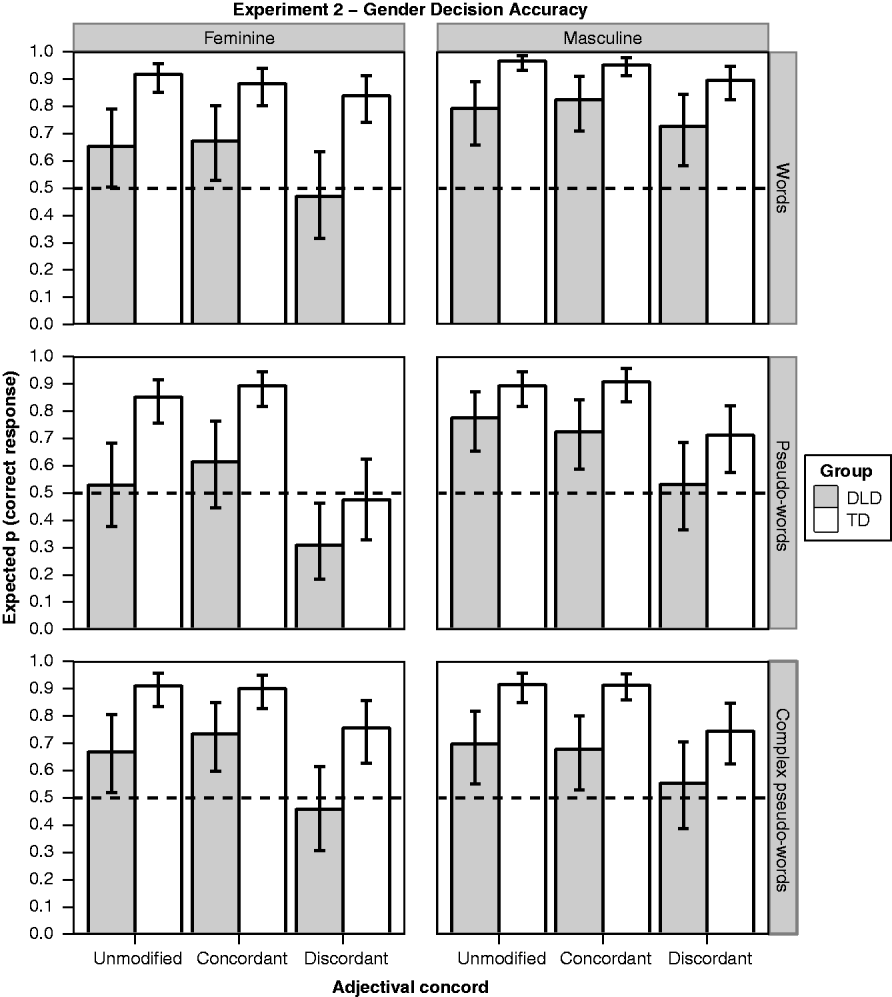
The effect of group was also significant (Estimate = −1·80, p < ·001), with the DLD group displaying lower accuracy than the TD group. It remained statistically significant (Estimate = −1·36, p = ·002) when the digit span scores (Estimate = ·20, p < ·001) were entered in the model. Figure 3 shows expected probability of correct responses for both groups. It reveals that, for both groups of children, accuracy was lower in the feminine in comparison to masculine, pseudo-words compared to words, and discordant compared to gender-neutral conditions. Although there were no significant interactions between target type and group, the children with DLD displayed above-chance performance on words and complex pseudo-words, but performed at chance on pseudo-words (particularly in the feminine condition) and below chance on the discordant adjective condition. Moreover, the four-way interaction between group, word type, gender, and concord with a negative coefficient (Estimate = −1·68, p = ·049) indicated that children with DLD showed a greater drop in performance when presented with discordant versus gender-neutral sentences containing masculine pseudo-words as opposed to masculine words. In contrast, the coefficient that would indicate a similar effect for TD children was not significant (Estimate = 1·06, p = ·106). This result is suggestive of a greater reliance on concord markers when judging the gender of pseudo-words in comparison with judging the gender of words in the former but not the latter group. The absence of this effect in the feminine conditions is likely due to the floor-level performance of the DLD group on feminine pseudo-words. No other interactions were significant (all ps > ·05).
Expected probabilities of correct responses (Experiment 2). Bars represent 95% confidence intervals.
Reaction time
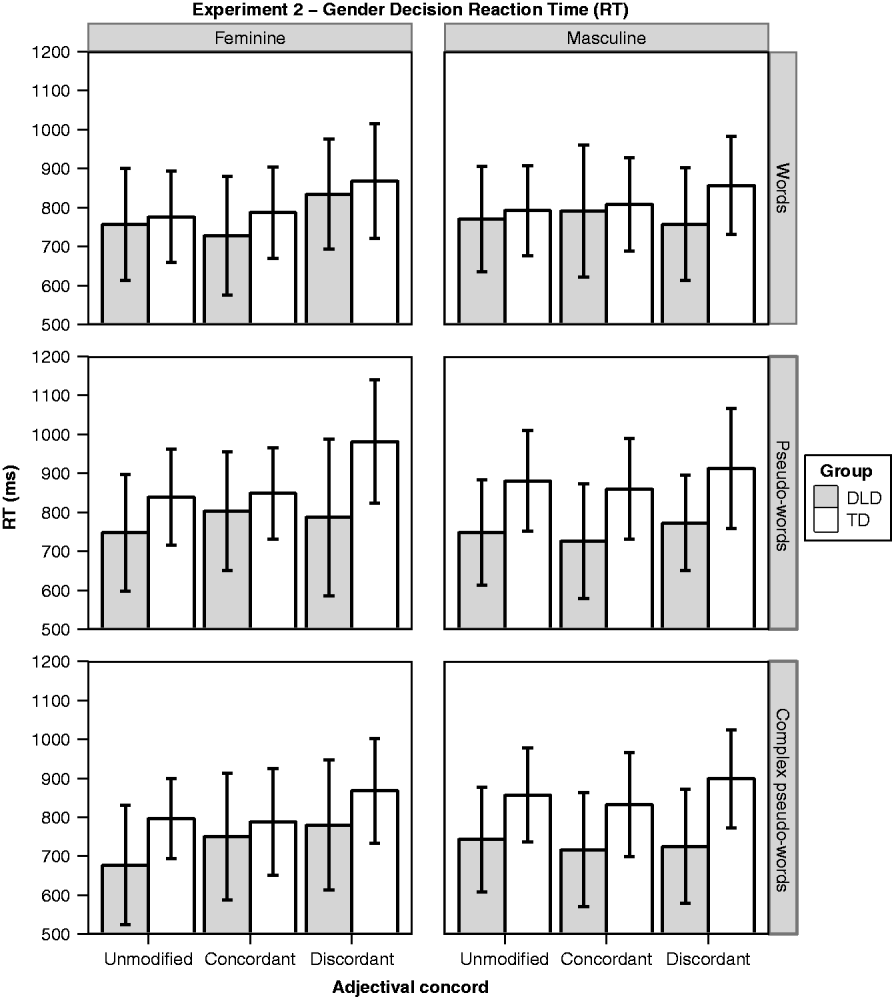
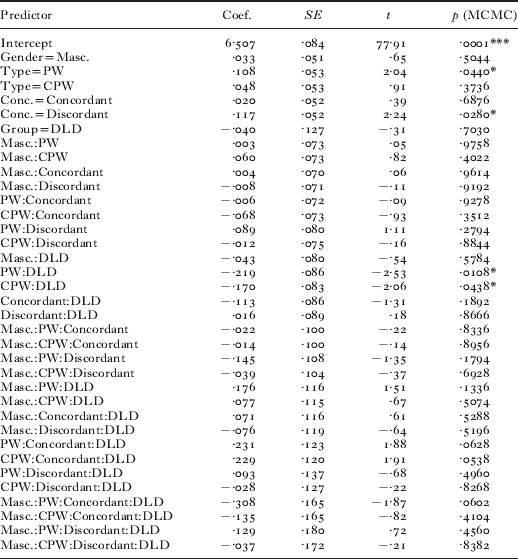
After screening for normality, 9% of the trials were trimmed following the same procedures as for Experiment 1.The initial model (M1) included the fixed effects of gender, target type, adjectival concord, and group, and the random effects of subjects and items on the intercept. The addition of length of words in phonemes and the trial rank-order as predictors in the model (M2) did not result in an improvement in the model fit (χ2(2) = 4·89, p = ·087). Thus, the initial model, which included the fixed effects of the condition variables and the group and the random effects of subjects and items on the intercept, was retained. This model displayed a significantly better fit (log-likelihood = −1997·30) than the null model (M0) with just random intercepts (log-likelihood = −2042·10; χ2(37) = 89·63, p < ·001; see Table 5). The RTs are plotted in Figure 4.
Mean reaction times (in milliseconds) for Experiment 2. Only correct trials were analyzed. Bars represent 95% confidence intervals.
Summary of the fixed effects in the mixed linear model M1 for Experiment 2 (Reaction Time)
notes: Baseline – words, no concord. Conc. – adjectival concord, PW – pseud-owords, CPW – complex pseudo-words, Masc. – masculine, ‘:’ indicates an interaction term. * – p < ·05, ** – p < ·01, *** – p < ·001. N=3608; log-likelihood = −1997·3
The analysis indicated that the effect of gender was not significant (Estimate = ·03, p = ·504), with similar RTs to masculine and feminine nouns. Slower RTs were observed for pseudo-words (Estimate = ·11, p = ·044) compared to words. The responses to sentences with discordant adjectives were slower than to unmodified sentences (Estimate = ·12, p = ·028), whereas the presence of a concordant adjective did not result in shorter RTs (Estimate = ·02, p = ·6876).
As in Experiment 1, the children with DLD did not differ from the children with TD in RTs (Estimate = −·04, p = ·703). However, children with DLD were differentially affected by pseudo-words – the negative coefficient for the estimate of the two-way interaction (Estimate = −·22, p = ·011) indicated that they responded more quickly to pseudo-words than words. A similar effect was observed for complex pseudo-words (Estimate = −·17, p = ·044).
In sum, the results of Experiment 2 indicated quantitatively different performance between the groups, with the DLD group significantly underperforming. Unlike in Experiment 1, this difference could not be accounted for by the group difference in PM. In addition, the children with DLD displayed a somewhat different pattern of performance, in particular by being selectively more affected by the discordant adjectives in the pseudo-word as opposed to the word condition. This is suggestive of their greater reliance on the concord features of the adjective when the target was a pseudo-word, without lexically specified gender. Since this effect was not observed in the TD group, this might mean that the latter were more successful in applying morphophonological gender assignment rules in the pseudo-word condition than the DLD group.
The RT results showed that although the groups did not differ in their overall processing speed, they differed in the pattern of their performance. Only the TD group was slowed on the pseudo-word and complex pseudo-word compared to the word conditions. This lack of response inhibition with respect to pseudo-words on the part of the DLD group may be due to their close-to-chance accuracy resulting in (or from) the speed–accuracy trade-off.
GENERAL DISCUSSION
We investigated whether Russian-speaking children with DLD differed from their TD peers in gender assignment accuracy and speed, and the role of lexicality in this process. In addition, we explored whether they were sensitive to the presence of gender agreement and agreement violations. With respect to the first question, the DLD group showed a marked deficit in the accuracy of gender assignment. We obtained indirect evidence for the lexicality effect in the DLD group: even though the difference in expected accuracy between pseudo-words and words was around 10% for both groups, for the DLD group it indicated a drop to floor-level performance consistent with guessing. Thus, collapsed across conditions, the DLD group's expected accuracy for words was 69% (95% CI from 58% to 80%) and for pseudo-words 58% (CI from 46% to 70%). A higher error rate leading to below-chance performance and a group-by-target type interaction would have only been possible if the DLD group had adopted a consistent response strategy, but would not necessarily indicate a greater deficit. In contrast, the expected accuracy of the TD children for words was 91% (CI from 87% to 95%) and for pseudo-words 81% (CI from 72% to 88%). Thus, children with DLD exhibited deficits in the knowledge of grammatical gender, both in its lexical aspects and in morphophonological gender assignment generalizations.
With respect to sensitivity to agreement, our results were mixed. On the one hand, both the TD and DLD groups showed differences in their sensitivity to gender agreement. Thus, in Experiment 1, unlike the TD group, children with DLD did not exhibit sensitivity to adjectival concord in their accuracy results. However, the RT results did not reveal differences between the two groups in the facilitative effect of the agreeing, or the slowing effect of the mismatching, adjective. In addition to the observed dissociation between the accuracy and RT results, we found that children with DLD showed an increase in their sensitivity to adjectival gender features in the adjectival mismatch conditions, particularly when gender was not specified lexically (i.e., with pseudo-words). This is a paradoxical finding suggesting that, on the one hand, when children with DLD heard an adjective in the mismatching condition, they (1) expected the upcoming noun to match its gender feature, and (2), when the pseudo-word did not match it, reacted to the violation. On the other hand, even though they had recognized the mismatch (and hence must have evaluated the morphophonological form of the pseudo-word, determining that it did not match the adjective), the accuracy of their judgments of the pseudo-words' gender was at chance level. Thus it appears that children with DLD possess the knowledge of gender and gender concord at an implicit level, but are impaired in their explicit performance.
These results seem at odds with theories positing a broad representational deficit of agreement, uninterpretable features, or the ability to build complex structural dependencies. They are better compatible with an approach suggesting that these mechanisms may be present in the grammar of children with DLD, but are difficult to put to use on-line, perhaps due to the high processing load for individuals with reduced processing capacity.
Another argument against a representational deficit explanation is its ‘all-or-nothing’ character, implying that a certain aspect of grammatical ‘machinery’ is either impaired or intact, a notion not easily accommodated by our data or indeed those of others (Penke, Reference Penke, Kiss and Alexiadou2011). This assumption is at odds with the previously attested observation confirmed in our study that, although the DLD group underperformed overall, they also exhibited a great amount of variability in their performance; for example, for the feminine condition with both verb agreement and adjectival concord in Experiment 1, the CI was from 44% to 80% for the correct response probability. Furthermore, since the CI for the TD group on the same condition ranged from 72% to 94% correct response probability, there was an overlap between the two groups. Thus, what we see is a continuum of accuracy rather than a sharp boundary between the two groups. A processing approach seems better amenable to the variability and continuous distribution of the results than a syntactic deficit approach.
We found that generalized slowing (Kail, Reference Kail1994) was not the source of group differences, as there was no main effect of group in the RT results. Children with DLD did not exhibit slower processing speed and followed the same patterns of facilitation on RT across the experimental conditions as their TD counterparts. Furthermore, although accuracy was related to RT, controlling for RT in both experiments did not change the pattern of the results; hence, we cannot attribute the group differences in accuracy to slowed processing.
Our results also did not support the surface hypothesis (Leonard et al., Reference Leonard, Sabbadini, Leonard and Volterra1987), according to which, children with a language disorder should have greater difficulty with morphological markers of lower phonetic salience. The DLD group, just as their TD counterparts, experienced 2nd declension feminine nouns, marked with a salient vocalic marker, as more challenging than 1st declension masculine nouns with a phonetically null marker. As discussed previously, masculine nouns in nominative singular end in a stem-final consonant. Furthermore, word-final obstruents in Russian undergo devoicing (Halle, Reference Halle1959), making them even less phonetically prominent (Alm, Behne, Wang & Eg, Reference Alm, Behne, Wang and Eg2009). Thus, contrary to the auditory deficit theories, in our study the children with DLD (as their TD peers) had greater difficulty with morphemes of a higher phonetic salience, suggesting that auditory perception was not the source of the difficulty.
We obtained some evidence of the explanatory role of PM. Thus, we found that individual differences in PM accounted for the main group effect in Experiment 1 and were related to accuracy in Experiment 2. This suggests that PM must be at least part of the explanation of the impaired performance in the DLD group. Although there are multiple aspects of the task used in our study, on which a reduced PM could have an effect (e.g., keeping in memory the gender features of the verb and adjective until processing the sentence-final subject or maintaining in memory the phonological form of the pseudo-word), it appears that we have statistical evidence for a link between PM capacity and the child's accuracy in assigning gender to familiar nouns (i.e., linking the phonological form of nouns to their semantic/syntactic features). The precise nature of the relationship between PM and gender processing warrants further investigation.
Our observation that PM failed to fully account for the performance gap between the groups in Experiment 2 is noteworthy because Experiment 2 included targets that could not be assigned gender via lemma look-up, as was arguably the case with the targets in Experiment 1. Of course, a direct comparison of the results across the two experiments is not possible because of multiple differences in their design, in addition to the inclusion of pseudo-words (e.g., inclusion of animate subject nouns, only gender-agreeing verbs, differences in sentence composition and number of items). However, we believe our results suggest that memory limitations were not the single explanatory factor behind the impaired performance of the DLD group. Our results may indicate that in Experiment 2 we were able to tap into gender-assignment rule application indexing a deficit in the DLD group that could not be fully explained by their reduced PM capacity. If this is correct, the results would be best compatible with the theoretical views of a language architecture that separates the aspects of language involving lexical storage from those involving grammatical computation; that is, productive, combinatorial operations that assemble meaningful linguistic components into larger units (e.g., ‘words-and-rules’ theory; Pinker, Reference Pinker1997) and the claim that the pattern of deficits observed in children with DLD can be best explained by separating these two aspects of language.
Another interesting observation was that the feminine targets presented greater difficulty for both groups in all conditions. For the DLD group, it resulted in the lowest rate of correct responses in the mismatched pseudo-word condition (expected probability of correct response 31%, CI from 18% to 46%), markedly below chance, indicating that when confronted with a mismatched feminine pseudo-word, the child was likely to go with the gender of the adjective (or make a random guess). Furthermore, even in Experiment 1, in which only high-frequency nouns were used as targets, the DLD group displayed at-chance performance on all feminine conditions, pointing to a high cost associated with processing feminine nouns.
A greater difficulty of the feminine conditions is compatible with the observation that 1st declension and masculine gender constitute morphological defaults in Russian (Corbett & Fraser, Reference Corbett, Fraser and Unterbeck2000). If the notion of grammatical default indeed correctly captures this finding, it would also support an explanation attributing low accuracy in DLD children to their reduced ability to map phonological form onto a morphological category; that is, to form stable morphophonological generalizations and/or apply them reliably. As long as gender decision involved familiar (high-frequency) masculine nouns, children with DLD supplied the default masculine gender. When, however, the default did not apply, their accuracy dropped.
Another possibility is that the extra difficulty of feminine nouns indexes the process of morphological decomposition: while 1st declension masculine nouns in nominative singular (the form used for all targets in both experiments) have a null inflection (word = bare stem), the feminine nouns have an overt 2st declension marker -a, which may be stored as a separate lexical entry and merged with the stem on-line. Perhaps the greater difficulty of the feminine conditions was due to having to perform this morphological operation, which increased the processing complexity of sentences in the feminine conditions. The floor effect in the DLD group in feminine conditions, however, precluded us from determining whether children with DLD were disproportionately affected by those conditions.
It is worth investigating whether the vulnerability in DLD can be generalized as a compromised ability to map multiple levels of linguistic structure. The idea that the components that link the levels of structure across language domains and language with non-linguistic cognitive systems are associated with developmental instability has been discussed in the context of adult second language acquisition, bilingual first language acquisition, and native language attrition (Sorace, Reference Sorace2011). This instability has been attributed to high processing demands and the complexity of the structures where knowledge from multiple domains is integrated. Whether language deficits in DLD can be reduced to such compromised ability, whether they are limited to certain types of interface phenomena and if so why, and whether the deficit stems from processing limitations (i.e., inefficient access to knowledge, coordination of information, and/or allocation of resources) or unstable representational knowledge (or both) are important questions, to be resolved empirically.
The study has a number of limitations. Our task was not a full on-line measure of sentence processing and time-course methods might be required to further elucidate the specifics of grammatical processing in DLD. In addition, our design did not allow us to sobserve the role of PM in the real-time processing of agreement. This limitation should be addressed in further studies by manipulating memory load across conditions.
CONCLUSION
Our results suggest that an extensive representational deficit that would result in children's inability to build or parse complex syntactic relations or manipulate grammatical features is an unlikely causal factor for DLD, at least in the studied population. Instead, our findings imply that the representational syntactic knowledge is present in children's grammar at the implicit level, but due to processing capacity limitations, their ability to put it to use on-line is challenged. Our results did not support the Generalized Slowing and surface hypotheses. We found that although the DLD group underperformed overall, their lower accuracy was related to their PM limitations. Yet, in turn, memory could not explain the entire pattern of results. We argue that in addition to memory-based deficits affecting lexical processes, children with DLD also have another deficit, namely in their ability to form and/or reliably apply grammatical generalizations, in this case those involving morphophonological gender assignment rules. These results are consistent with a theory posing a dual language architecture separating lexical storage from grammatical computation, with a possibility that the two systems may be selectively (or differentially) impaired in DLD.