

Siblings of children with chronic illness may have unique experiences related to their brother or sister's diagnosis. These experiences occur within family and school contexts, and at the individual level. Siblings may present with internalising behaviours, increased somatic symptoms and post-traumatic stress symptoms, and may describe experiences of poor overall adjustment (Alderfer et al., Reference Alderfer, Long, Lown, Marsland, Ostrowski, Hock and Ewing2010; Incledon, Reference Incledon2015; Knecht, Hellmers, & Metzing, Reference Knecht, Hellmers and Metzing2015; O'Brien, Duffy, & Nicholl, Reference O'Brien, Duffy and Nicholl2009; Vermaes, Van Susante, & Van Bakel, Reference Vermaes, Van Susante and Van Bakel2012). A child's illness can also cause disruptions to family functioning and routine (Alderfer et al., Reference Alderfer, Long, Lown, Marsland, Ostrowski, Hock and Ewing2010) that lead to increased sibling caregiving duties or roles at home and reduced attention from parents (Alderfer et al., Reference Alderfer, Long, Lown, Marsland, Ostrowski, Hock and Ewing2010; McLoone, Wakefield, & Cohn, Reference McLoone, Wakefield and Cohn2013; Prchal & Landolt, Reference Prchal and Landolt2012; Sidhu, Passmore, & Baker, Reference Sidhu, Passmore and Baker2005; Wilkins & Woodgate, Reference Wilkins and Woodgate2005).
Although a small number of studies have reported healthy siblings’ psychological adjustment to be the same as control populations (Berbis et al., Reference Berbis, Oudin, Alessandrini, Vercasson, Barlogis, Chambost and Auquier2015; Labay & Walco, Reference Labay and Walco2004), the literature generally indicates that siblings are at greater risk for psychological problems than the general child and adolescent population (Alderfer et al., Reference Alderfer, Long, Lown, Marsland, Ostrowski, Hock and Ewing2010; Knecht et al., Reference Knecht, Hellmers and Metzing2015; O'Brien et al., Reference O'Brien, Duffy and Nicholl2009; Vermaes et al., Reference Vermaes, Van Susante and Van Bakel2012). Siblings’ psychological adjustment has generally been measured in the family context. The focus on familial experiences has resulted in insufficient evidence about how to support siblings’ psychological health in contexts outside of the family environment. In terms of health and development, school is a particularly important context for both monitoring adjustment and delivering support.
The few studies in the literature concentrating on the school experiences of siblings have focused on siblings of children with cancer. These studies indicate that siblings of children with cancer report difficulty in concentrating and performing well in school (Long, Marsland, Wright, & Hinds, Reference Long, Marsland, Wright and Hinds2015; Nolbris, Enskär, & Hellström, Reference Nolbris, Enskär and Hellström2007; Prchal & Landolt, Reference Prchal and Landolt2012; Samson, Rourke, & Alderfer, Reference Samson, Rourke and Alderfer2016). They may also have poorer school attendance resulting from time with or commitments relating to the ill child (Donnan et al., Reference Donnan, Webster, Wakefield, Dalla-Pozza, Alvaro, Lavoipierre and Marshall2015; French et al., Reference French, Tsangaris, Barrera, Guger, Brown, Urbach and Nathan2013; Nolbris et al., Reference Nolbris, Enskär and Hellström2007). Studies also suggest that having a sibling with cancer can contribute to negative sibling interactions with peers and teachers, with siblings describing feelings of isolation and a decrease in levels of social engagement with peers at school (Alderfer & Hodges, Reference Alderfer and Hodges2010; Labay & Walco, Reference Labay and Walco2004; Sidhu et al., Reference Sidhu, Passmore and Baker2005; Wakefield, McLoone, Butow, Lenthen, & Cohn, Reference Wakefield, McLoone, Butow, Lenthen and Cohn2013). Siblings may also have difficulty in sharing their experiences with friends and seeking friends’ understanding of their cancer experience (Samson et al., Reference Samson, Rourke and Alderfer2016). Increased support provided by peers and teachers can help the sibling to separate experiences at home and school, thereby engaging adaptive coping strategies (Alderfer et al., Reference Alderfer, Stanley, Conroy, Long, Fairclough, Kazak and Noll2015; Long et al., Reference Long, Marsland, Wright and Hinds2015; Prchal & Landolt, Reference Prchal and Landolt2012).
Although there is some available literature relating to cancer, there is a dearth of research examining support needs and strategies for siblings of children with a broader range of chronic illnesses. As a constant and familiar presence in the lives of children, school may counteract or provide a stabilising effect for the sibling as they cope with a family life affected and changed by the ill child's diagnosis (Gilligan, Reference Gilligan1998). Thus, this study aimed to explore the school experiences of siblings of children with chronic illness. We recruited parents, as changes in family connectedness and levels of parental attachment may translate into siblings’ feelings of school and peer connectedness (Shochet, Smyth, & Homel, Reference Shochet, Smyth and Homel2007; Wilkinson, Reference Wilkinson2004). Therefore, parents may have insight into siblings’ experiences of changes in school functioning that are related to and independent of family functioning. We asked the following research questions: (1) What are the problematic school and educational experiences of siblings of children with chronic illness that are linked to the experience of being the sibling of an ill child? (2) What support options are available for siblings of children with chronic illness and do these meet their needs?
Methods
Participants
Parents or carers were included if: (a) the child with chronic illness and the sibling were, at the time of the interview, attending a primary school or high school in Australia or had graduated from or discontinued primary or high school in the last 5 years (aged 4–25 years); and (b) the ill child had been diagnosed with one of six chronic illnesses (see below).
The six chronic illnesses included in this study were determined using data from the independent Ronald McDonald Learning Program (RMLP) national database, a program delivered by Ronald McDonald House Charities, Australia. The RMLP is an educational support program for school-aged children and adolescents with serious chronic illness who have missed more than 40 days of school because of illness. The six illness groups with the highest average number of days absent from school in the RMLP database were chosen to be included in the study. These illnesses were cancer, persistent asthma, heart disease, gastrointestinal disease, kidney disease, and cystic fibrosis. Parents were excluded if: (a) the ill child did not have any siblings who have attended primary and secondary education, (b) the sibling did not reside in the same household as the ill child, or (c) the sibling had a chronic illness themselves.
Eligible parents were recruited through four purposive sampling techniques: (1) using contact details from the RMLP database (n = 1,753), parents were sent an email or postcard invitation, with a follow up email four months later; (2) 195 parents were invited face to face through outpatient clinics at Sydney Children's Hospital; (3) the study was advertised through Facebook using paid, targeted advertisements (advertisements to a total cost of AUD$100); and (4) parents were invited through parent groups on Facebook, parental advocacy groups, and national associations representing our targeted illnesses to advertise the study in newsletters, on their websites, and through social media. Six of the 20 (30%) invited national associations advertised the study. Twenty-six of the 93 (28%) invited Facebook parent groups advertised the study. These 26 parent groups included 56,565 members, or 39% of the 143,452 parents who were members of the 93 parent groups. The Facebook advertisements and posts were reported to ‘reach’ 7,970 Facebook users (see Acknowledgments for the list of participating groups).
Data Materials
Each recruitment method invited parents to complete a survey (hard copy or online) examining the educational experiences of students with a serious chronic illness. Interested parents either proceeded to the study website to read an information sheet or were provided a hard-copy information and consent sheet by a researcher. Participants who completed the survey online were advised that consent to participate was given by completing the survey. Signed consent by participants who completed a hard-copy survey was required for inclusion in the study. On completion of the survey, parents were invited to participate in a voluntary telephone interview to provide more in-depth data (i.e., voluntary sampling), including data about the sibling.
Data Collection Procedures
This study formed a substudy as part of a larger study examining the educational experiences of students with a serious chronic illness. The survey collected data about the demographic characteristics of the parents and the child with illness. A semi-structured telephone interview schedule was developed to collect data exploring sibling educational experience and further obtain demographic data with relation to the sibling. Past research indicates that semi-structured interviews allow for an interview to be shaped by the interviewee's own understandings and the researcher's interests (Mason, Reference Mason, Lewis-Beck, Bryman and Liao2004). Additionally, telephone interviews appear to have comparable or possibly greater quality when compared with interviews that are conducted in person (Holt, Reference Holt2010; Sturges & Hanrahan, Reference Sturges and Hanrahan2004). Telephone interviews also mitigate problems associated with distance, as many eligible participants resided in different states and localities from the primary research location at Sydney Children's Hospital.
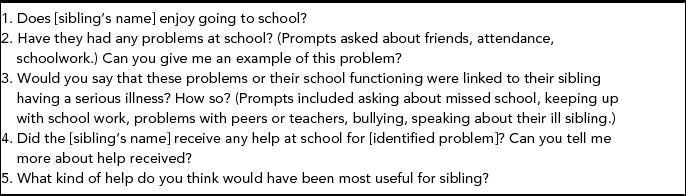
We contacted eligible participants a maximum of three times. Eligible participants who were non-contactable within three attempts were considered as lost to follow-up. Trained researchers conducted interviews with one parent at a time from the primary research site at the Sydney Children's Hospital. All investigators completed internal training on interviewing for qualitative research. One investigator completed external training from an international qualitative research group to support the other two investigators. The interview schedule was developed in a way that attempted to elicit the interviewee's unique lived experience or ‘story’. The interviewer used prompts to address other relevant sibling experiences; prompts were developed following an extensive review of the relevant literature regarding sibling school experiences (Gan, Lum, Wakefield, Nandakumar, & Fardell, Reference Gan, Lum, Wakefield, Nandakumar and Fardell2017). The interview schedule revolved around five key questions (Table 1). Parents of multiple well siblings were asked to describe the sibling or siblings they felt were most affected in school.
Sample Questions From the Sibling Semi-Structured Interview Schedule

We aimed to adhere to the Consolidated Criteria for Reporting Qualitative Research checklist (COREQ; Tong, Sainsbury, & Craig, Reference Tong, Sainsbury and Craig2007; http://cdn.elsevier.com/promis_misc/ISSM_COREQ_Checklist.pdf) throughout the study as a measure to produce gold-standard, qualitative research. This study was granted ethics approval by the Sydney Children's Hospital Network Human Research Ethics Committee and Site Specific Research Governance (ID number: HREC/14/SCHN/428).
Data Analysis
Phone interviews were audio-recorded and transcribed verbatim. Three investigators used the qualitative data analysis software QSR NVivo11 (http://www.qsrinternational.com/nvivo/nvivo-products/nvivo-11-for-windows) to organise the transcribed interviews. One investigator independently coded seven transcripts, and two investigators independently coded six transcripts. Each investigator also coded an additional four transcripts that overlapped with another investigator to ascertain interrater reliability. Qualitative data analysis was guided by the conceptual framework of Miles and Huberman (Reference Miles and Huberman1994). We used inductive content analysis techniques to interpret the data. Investigators coded each interview line by line using a codebook that organised data into broader themes (e.g., school experiences, support) and subthemes (e.g., academic, psychological, social) relating to problematic sibling school experiences and the type of school support that was received. We developed this codebook using our research questions and understanding of the relevant literature. Once we had organised the data according to the codebook, we used an iterative process to identify themes that best represented the data. This reflexive iterative process involved reviewing the coded data to identify new themes, recoding the data using these new themes, and then re-reviewing and revisiting the data in an attempt to identify any new themes (Srivastava & Hopwood, Reference Srivastava and Hopwood2009). We achieved data saturation once we were unable to identify any new themes (Saunders et al., Reference Saunders, Sim, Kingstone, Baker, Waterfield, Bartlam and Jinks2017). Once coding was completed, the coders met to review and address any coding disagreements.
Results
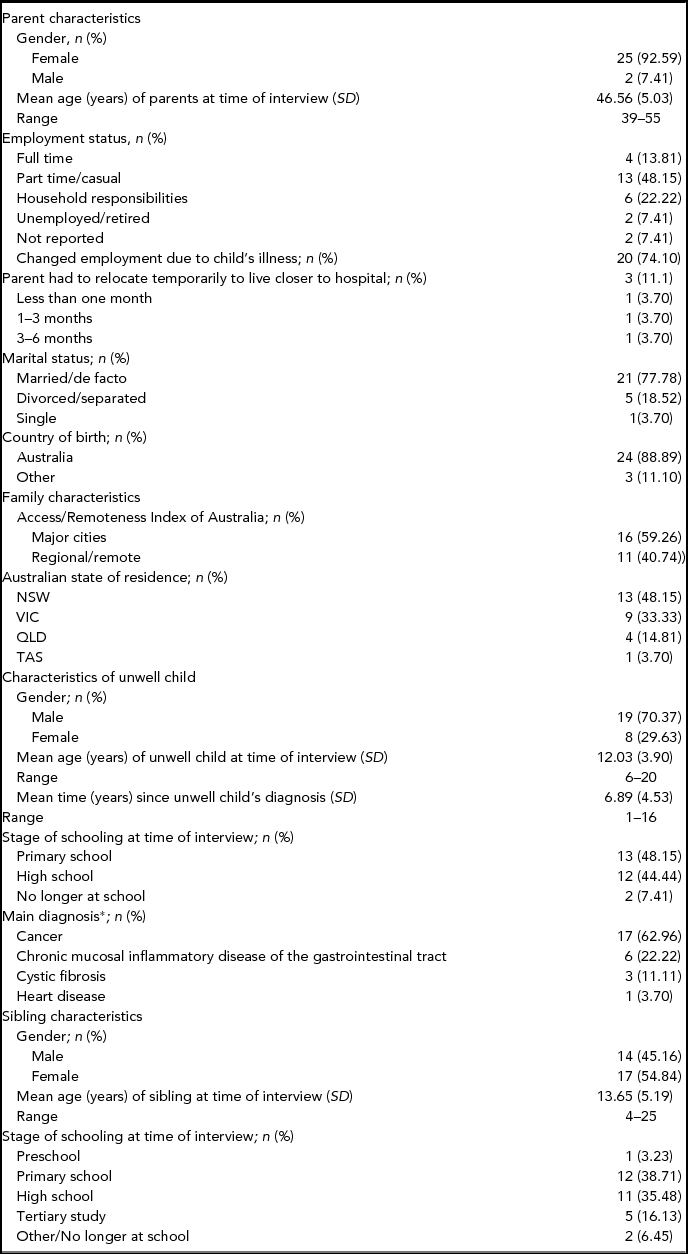
In total, 27 parents (2 fathers and 25 mothers) relayed the experiences of 31 siblings. Characteristics about participants and their ill and healthy children are presented in Table 2, including age, sex, and state of residence. The total duration of the interviews ranged from 17 minutes to 1 hour and 18 minutes. At the time of the interview, the sibling's mean age was 13.7 (SD = 5.2), parents’ mean age was 46.56 years of age (SD = 5.0), and the ill child's mean age was 12.0 (SD = 3.9). Of 31 siblings, 17 (54.8%) were female and 14 (45.2%) were male. The illnesses represented were cancer (n = 17; 63%), chronic mucosal inflammatory disease of the gastrointestinal tract (n = 6; 22.2%), cystic fibrosis (n = 3; 11.1%), and heart disease (n = 1; 3.7%). Of the 27 parent participants, 4 discussed more than one sibling who they identified as having school problems. Of the 31 siblings, 7 had left high school; parents discussed their retrospective accounts.
Demographic and Clinical Characteristics of Participant Sample

Note: *Counts include siblings with multiple main diagnoses. SD = standard deviation.
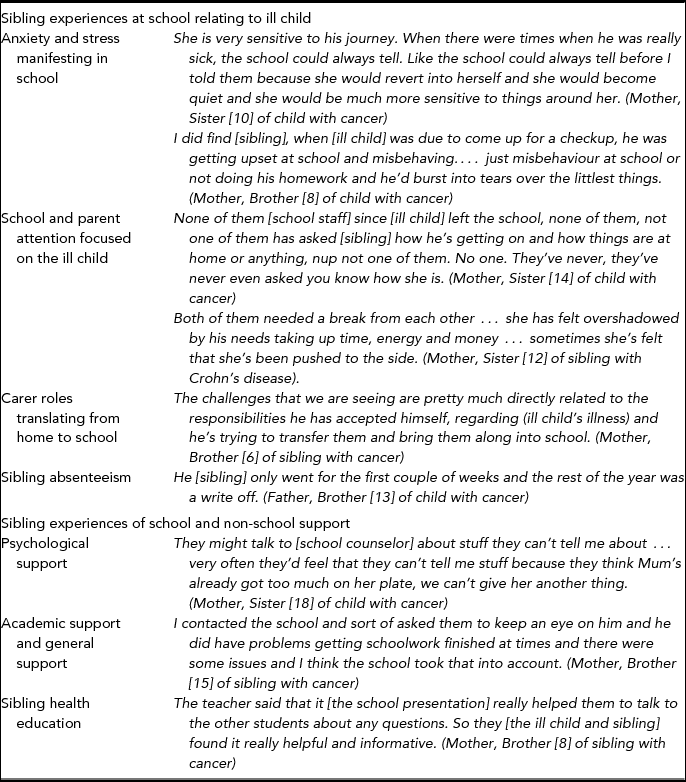
Interrater reliability between the three investigators was 83.1% (12 disagreements over 71 points of coded data) based on agreements on coding of the same higher order themes. A precise response rate based on direct contact cannot be ascertained due to the open-ended recruitment approach; however, out of 95 parents who completed the study survey, 38 (40%) opted in for an interview. Of the 38, 11 were lost to follow-up. The main themes and associated quotes are also summarised in Table 3.
Main Themes of Results With Subthemes and Associated Quotes

Sibling Experiences at School Relating to the Ill Child
Fourteen of the 31 siblings (45.2%) were perceived by parents to have had problematic school experiences that were related to the ill child. Parents primarily recognised symptoms of anxiety and distress relating to the ill child that manifested in school (8/31; 25.8%). Parents described diverse social and behavioural problems relating to the anxiety, which included siblings truanting school, withdrawing from social activities, and misbehaving or acting out at school. Three parents reported that the siblings’ anxiety led to academic difficulties.
Parents commented on the diverse factors that generally preempted anxious behaviours. First, anxiety may have resulted from concern or worry about the ill child. Parents reported that problems often coincided with when the ill child was due for a check-up or when the ill child was particularly unwell (3/31; 10%).
She is very sensitive to his journey. When there were times when he was really sick, the school could always tell. Like the school could always tell before I told them because she would revert into herself and she would become quiet and she would be much more sensitive to things around her. (Mother, Sister [10] of child with cancer)
Second, parents reported sibling distress when school staffs’ attention to the sibling was focused on the ill child rather than the sibling themselves (5/31; 16.1%). Parents describe sibling frustration due to teachers’ questioning about the ill child without concern for the sibling. Parents also describe siblings requesting to be at a different school to their ill sibling, with one parent expressing that ‘both of them needed a break from each other’ (Mother, Sister [12] of sibling with Crohn's disease). Two parents reported that teachers or school staff never enquired about the sibling (2/31; 6.5%). More than one third of parents (10/27; 37%) expressed concern about the impact of their own absence and sibling-parent separation on siblings’ emotional functioning. Lack of sibling-directed attention at school may have compounded the impact of reduced parental attention at home.
Third, additional carer roles at home translated into the sibling exhibiting carer responsibilities at school (4/31; 12.9%), such as being overprotective of the ill child at school.
The challenges that we are seeing are pretty much directly related to the responsibilities he has accepted himself, regarding [ill child's illness] and he's trying to transfer them and bring them along into school. (Mother, Brother [6] of sibling with cancer)
Fourth, parents reported that siblings were sometimes late to school, missed days of school at a time, or experienced sporadic absenteeism related to the ill child (5/31; 16.1%). Siblings who had prolonged absences from school experienced anxiety about school re-entry. Parents reported that siblings had difficulty with integrating back into schoolwork, with three out of five accounts of academic difficulties being attributed to absence from school. Some parents also believed that siblings felt excluded from previous friendship groups (2/31; 6.5%).
Sibling School and Non-School Support
Eight parents described their siblings’ experiences of receiving psychological support at school through a school counsellor (6/31; 19.4%) or by engaging with specific school personnel such as a teacher or social worker (2/31; 6.5%). Some parents reported that basic counselling benefitted siblings who felt they were not able to talk to their parents.
Additionally, teachers assisted in the management of the siblings’ psychological needs by moving the sibling away from students when they were losing focus, or providing extra work to prevent the sibling from distracting other students during periods of misbehaviour. Schools also offered extra orientation days and increased flexibility with exam or assessment deadlines to reduce siblings’ anxiety. In some cases, school support was more general, such as offering to monitor the siblings’ educational and psychological progress.
I contacted the school and sort of asked them to keep an eye on him, and he did have problems getting schoolwork finished at times and there were some issues, and I think the school took that into account. (Mother, Brother [15] of sibling with cancer)
Parents described the importance of focusing on the sibling and making them feel important, such as by offering the sibling the opportunity to organise a charity fundraiser or interest club at the school. Alternatively, for siblings who were absent from school for long periods to be with the ill child, teachers showed their support by assisting their class to write letters to the sibling.
Parents also highlighted the importance of educating the sibling and their entire school about the ill child (2/31; 6.5%). This was described by parents as contributing to an improvement in sibling general wellbeing. Two schools permitted parents or external organisations to come in to talk to the school about the ill child and their illness; parents felt that this was highly beneficial.
The teacher said that it [the school presentation] really helped them to talk to the other students about any questions. So they [the ill child and sibling] found it really helpful and informative. (Mother, Brother [8] of sibling with cancer)
Parents commented on the value of mentor groups to provide academic support. Academic support during prolonged absenteeism, such as that provided in hospital schools, was also important for the siblings’ psychological health. Two non-school organisations and parents provided support for the sibling, such as tutoring and cognitive testing (2/31; 6.5%). Six parents felt that the sibling received insufficient school support (6/31; 19.4%) and desired increased academic tutoring to replace the educational support that would normally occur with the parent at home. One parent expressed concern regarding the limitations of school psychological support in managing general anxieties and disengagement at school, emphasising that support was limited to situations of ‘major crises’.
Parents outlined the challenges in facilitating school support for the sibling and the desire for a school advocate who understood the family situation and could engage the correct services to meet the siblings’ needs (4/31; 12.9%). Despite the challenges, parents described trying their best to reduce the impact on the sibling and their everyday functioning (4/31; 12.9%). Parents attempted to maintain ‘stability’ at home and give more attention to siblings; parents endeavored to ensure that siblings attend school (2/31; 6.5%), organising for siblings to stay with family members or friends in order to attend school as normal.
Discussion
Twenty-seven parents of children with chronic illness, representing the experiences of 31 siblings, described the impact of chronic illness and the ill child on siblings’ school experiences and provision of support. Parents reported that 14 of the 31 siblings (45.2%) had school-related difficulties related to the ill child. Parents described school experiences related to siblings’ anxiety and distress, such as concern for the ill child, carer responsibilities, school staff's attention focused on the ill child, and prolonged absenteeism. Parents’ accounts of initiating or leading support in this study demonstrate parental insight into their child's experiences and their need for support within the school. Overall, successful school support strategies revolved around additional monitoring of siblings’ school and psychological needs.
Parents most commonly gave accounts of difficulties related to siblings’ social functioning and behaviour at school, such as expressing worry for the ill child or withdrawing socially. These behaviours reflect past research describing sibling ‘anger’ in school and the manifestation of post-traumatic stress symptoms within the school environment (Jenholt Nolbris, & Ahlström, Reference Jenholt Nolbris and Ahlström2014; Kaplan, Kaal, Bradley, & Alderfer, Reference Kaplan, Kaal, Bradley and Alderfer2013). Siblings’ social and behavioural difficulties at school are of high concern as siblings may lack attention and support from their parents, and may not actively seek their parents’ help for fear of creating extra burden (Woodgate, Reference Woodgate2006). Some parents believed that extra school-based academic and psychological support for their child would help alleviate the impact related to the ill child.
Implementing a Family-School Partnership
The effect of changes in family functioning, such as increased caregiving undertaken by siblings and frequent or prolonged parent absences, appeared to translate into problems within the school context. Changes in functioning may extend from the family environment into the school environment, corroborating the usefulness of a family-school partnership (Alderfer & Hodges, Reference Alderfer and Hodges2010). The family-school partnership, a therapeutic triad that involves linking the sibling, their family, and the school psychologist may help interpret the context for the sibling's difficulties (Kazak, Simms, & Rourke, Reference Kazak, Simms and Rourke2002). This partnership may facilitate increased communication between parents and school psychologists or teachers, and fulfill parents’ desires for increased advocacy for the sibling at school.
As exemplified by findings in the current study as well as past findings, school psychologists or counsellors may be well positioned to monitor siblings for emotional or behavioural problems and subsequently provide support for siblings experiencing these problems (Alderfer & Hodges, Reference Alderfer and Hodges2010; Lamb & Holley-Boen, Reference Lamb and Holley-Boen2016; Samson et al., Reference Samson, Rourke and Alderfer2016). The core of the family-school partnership may reside in shared responsibility in identifying signs of sibling distress (Lamb & Holley-Boen, Reference Lamb and Holley-Boen2016). Regular meetings between teachers and parents to discuss the sibling's progress and support needs can help to strengthen this partnership and provide consistency in sibling support across home and school environments. School-based social support may help reduce siblings’ externalising and internalising behaviour (Barrera, Fleming, & Khan, Reference Barrera, Fleming and Khan2004; Jackson & Frick, Reference Jackson and Frick1998).
Normalising Changes in Sibling Daily Routine
Increased carer roles, school absenteeism, and a lack of parental sibling attention reflect the impact of changes in family functioning and dynamics, such as role changes and relocation of family members (Kobayashi, Hayakawa, & Hohashi, Reference Kobayashi, Hayakawa and Hohashi2015). Past research has described families attempting to re-establish or develop a new sense of ‘normality’ and family routine following diagnosis (Björk, Wiebe, & Hallström, Reference Björk, Wiebe and Hallström2005; Clarke-Steffen, Reference Clarke-Steffen1997; Long et al., Reference Long, Marsland, Wright and Hinds2015). Family members may develop a story of normalisation following acknowledgment of the illness in order to cope with their circumstances and redefine their family situation, integrating management of the chronic illness into ongoing family life (Knafl, Darney, Gallo, & Angst, Reference Knafl, Darney, Gallo and Angst2010; Knafl & Deatrick, Reference Knafl and Deatrick1986). As such, a goal of sibling school support may be to collaborate with parents to normalise the chronic illness experiences of siblings and reduce the impact of parent absence or inattention. As part of a family-school partnership, schools can collaborate with parents to normalise sibling's daily routines. Normalisation may involve providing allowances for homework and increased flexibility with deadlines, or the provision of extra school-based tutoring support. Teachers and parents have been described as having a symbiotic role in ‘co-constructing reality’ for children (Roffey, Reference Roffey2004). Thus, the unique position of school psychologists within the school environment may help validate the story of normalisation developed by the family and understand how the family lives this story (Gjengedal, Rustøen, Wahl, & Hanestad, Reference Gjengedal, Rustøen, Wahl and Hanestad2003; Robinson, Reference Robinson1993).
Psychoeducational Support
Parents have also described the value of psychoeducational support for siblings. Psychoeducational interventions can improve siblings’ knowledge of the illness and also their emotional functioning (Hartling et al., Reference Hartling, Milne, Tjosvold, Wrightson, Gallivan and Newton2014; Lobato & Kao, Reference Lobato and Kao2002). Educational interventions led by nurse specialists or social workers may improve the knowledge and attitudes of students and school personnel, and also improve sibling school functioning. Health professionals may also play an initial informative role in creating a family-school partnership by training school personnel to screen and identify siblings at risk and provide appropriate support mechanisms (Alderfer & Hodges, Reference Alderfer and Hodges2010; Samson et al., Reference Samson, Rourke and Alderfer2016). Currently, there are information booklets directed to schools that focus on the child with cancer, with only a subsection or minor sections that discuss the needs of siblings (Broyd, Pritchard-Jones, & Edwards, Reference Broyd, Pritchard-Jones, Edwards and Chambers2008; Cancer Council NSW, 2015). Providing school personnel with resources focusing on the sibling can help to put siblings in the spotlight.
Strengths and Limitations of This Study
The strengths of this study include the range of families and siblings’ ages and geographical representation within Australia. This contributes to a wider range of experiences that can provide us with varied insight into the experiences of siblings of children with chronic illness. The semi-structured interview allowed the capture of the unique ‘lived’ story of the participant, which facilitated freedom of expression guided by the parent. Study participants were recruited from a wide range of sources, and were from metropolitan, regional and rural geographical localities. General psychosocial experiences described in this study are reiterated in past literature (Alderfer et al., Reference Alderfer, Long, Lown, Marsland, Ostrowski, Hock and Ewing2010; Nolbris et al., Reference Nolbris, Enskär and Hellström2007; Woodgate, Reference Woodgate2006) but have not previously been well described within the school context.
However, only four chronic illnesses were addressed, with the experiences of families of children with cancer somewhat overrepresented. In future studies, it would be valuable to analyse the experiences of more siblings of children with chronic illnesses other than cancer. There is also a limit to the transferability of these findings due to the high variability in each family's demographic characteristics, the limited sample size of this study, and the concise nature of the interview. During data analysis, we identified the impact of the ill child on the sibling when they attended the same school. Unfortunately, the exact numbers of siblings that attended the same school as the ill child was not obtained during data collection, and this may have affected our results. Additionally, the current study focused on problematic school experiences and corresponding support, limiting our understanding of the protective factors that facilitate school-based resilience and mental wellbeing of siblings of a child with chronic illness. This study used parent proxy accounts of the siblings’ experiences as opposed to sibling self-reports. However, the parent perspective is unique and may provide an insight into siblings’ experiences that they themselves may not be aware of. The parent perspective was also not limited by the age of the sibling and their ability to effectively engage in qualitative interviewing (Faux, Walsh, & Deatrick, Reference Faux, Walsh and Deatrick1988). Parents were recruited primarily from a database held by a tutoring service for students with chronic illness and from hospital clinics, which may be an indicator of illness severity. Thus, the sample may not be representative of the needs of all siblings of young people with chronic illness.
Future Directions and Implications for Practice
Integrating the support-based findings from this study, including acknowledging the diversity of siblings’ experiences at home and at school, will help shape school-based support. We encourage future researchers to explore protective school, family, and individual factors that promote healthy school experiences among siblings of a child with chronic illness. Further development of a model that emphasises a central family-school partnership with input from health professionals is key to the provision of future individualised sibling support. Future research may explore schools’ current capacity to service a family-school partnership and the need for additional resourcing.
Past research demonstrates that siblings self-report a desire for emotional and instrumental support that differs from parent reports (Murray, Reference Murray2001). Further research that interprets the sibling's self-reported experience of school and school-related support could further elucidate the role of school personnel in supporting siblings of children with chronic illness.
Conclusion
Siblings of chronically ill children are an ‘overlooked’ population who may experience difficulties in everyday functioning as a result of their brother or sister's illness, which can manifest socially, emotionally, or behaviourally at school. As school is a context away from home, school psychologists, counsellors and teachers can partner with parents/carers to cater to the specific school needs of siblings. A family-school partnership support model may be a flexible approach that promotes the best school and psychological experiences for siblings of children with chronic illness.
Acknowledgments and Funding Sources
The Behavioural Sciences Unit is proudly supported by the Kids with Cancer Foundation. This research was partly funded by Cancer Council NSW Program Grant PG16–02, with the support of the Estate of the Late Harry McPaul and the Kids Cancer Project.
We would like to acknowledge the recruitment support provided by Ronald McDonald House Charities; Cystic Fibrosis Federation Australia; the asthma experts (National Asthma Council of Australia); Lung Foundation Australia; the Gut Foundation; ausEE; Conquer Cystic Fibrosis; and all of the supporting parent groups across Australia.
Claire Wakefield is supported by a Career Development Fellowship from the National Health and Medical Research Council of Australia (APP1067501) and Cancer Council NSW. Alistair Lum is supported by an Australian Government Research Training Program Scholarship in association with the Kids Cancer Alliance, the Kids Cancer Centre and Ronald McDonald House Charities. Joanna Fardell is supported by the Kids Cancer Project and Cancer Council NSW. Glenn Marshall is supported by the National Health and Medical Research Council of Australia, Cancer Council NSW and Cancer Institute NSW. The authors declare no conflicts of interest.
Conflicts of Interest
None.
Ethical Standards
The authors assert that all procedures contributing to this work comply with the ethical standards of the relevant national and institutional committees on human experimentation and with the Helsinki Declaration of 1975, as revised in 2008.
Informed Consent
Informed consent was obtained from all individual participants included in the study.