INTRODUCTION
Schizophrenia-spectrum disorders such as schizophrenia and schizoaffective disorder (defined in the Diagnostic and Statistical Manual of Mental Disorders IV (American Psychiatric Association, 2000), as schizophrenia with prominent mood symptoms), are associated with abnormalities in important emotion processing parameters, such as theory of mind, emotion regulation, and decoding facial expressions of emotion (Brüne, Reference Brüne2005; Edwards, Jackson, & Pattison, Reference Edwards, Jackson and Pattison2002; Henry, Green, de Lucia, Restuccia, McDonald, & O’Donnell, Reference Henry, Green, de Lucia, Restuccia, McDonald and O’Donnell2007; Langdon, Coltheart, & Ward, Reference Langdon, Coltheart and Ward2006; Phillips, Drevets, Rauch, & Lane, Reference Phillips, Drevets, Rauch and Lane2003). In this latter literature, particular attention has been devoted to how the perception of threat-related emotions (fear and anger) is affected. This emphasis is unsurprising given that dysfunctional threat perception has been attributed a causal role in the development and maintenance of psychosis, such as persecutory delusions (Freeman, Reference Freeman2007) and the evolution of paranoia (Green & Phillips, Reference Green and Phillips2004), with psychosis specifically linked to violent behavior (Douglas, Guy, & Hart, Reference Douglas, Guy and Hart2009). Although still relatively rare, individuals with schizophrenia are more likely to engage in violence relative to other members of the general population (Swanson et al., Reference Swanson, Swartz, Van Dorn, Elbogen, Wagner and Rosenheck2006).
Several reviews have concluded that the recognition of fear (Edwards et al., Reference Edwards, Jackson and Pattison2002; Mandal, Pandey, & Prasad, Reference Mandal, Pandey and Prasad1998; Morris, Weickert, & Loughland, Reference Morris, Weickert and Loughland2009) and possibly anger (Mandal et al., Reference Mandal, Pandey and Prasad1998) may be disproportionately affected in those with schizophrenia spectrum disorders, relative to the other basic emotions of happiness, disgust, sadness, and surprise. It has been suggested that deficits recognizing fear may reflect aberrant visual scan paths, because individuals with schizophrenia show a particular deficit in attending to the eyes—the critical region used to discriminate fear from other emotions (Adolphs, Reference Adolphs2008).
Evidence now indicates that not only the processing of facial threat cues, but threat signals more generally, may be disrupted in schizophrenia spectrum disorders. Scholten, van Honk, Aleman, and Kahn (Reference Scholten, van Honk, Aleman and Kahn2006) found that although participants with schizophrenia did not differ from controls in their perceived reward sensitivity, they reported heightened threat sensitivity. Furthermore, abnormal processing of specific non-social visual threat cues has been linked to violent behavior in this group (Kumari et al., Reference Kumari, Das, Taylor, Barkataki, Andrew and Sumich2009). However, while impairment recognizing the threat-related emotions of anger and fear is now well documented, we are not aware of any prior study that has assessed whether individuals with schizophrenia-spectrum disorders differ from controls when asked to make direct appraisals of the degree of danger or threat posed by others. In addition, no study has directly tested how the ability to use non-facial information to infer potential situational threat is affected. Misinterpreting a situation or individual as threatening can lead to increased anxiety and/or psychosis among people with schizophrenia (Green & Phillips, Reference Green and Phillips2004; Scholten et al., Reference Scholten, van Honk, Aleman and Kahn2006). As such, there are potential deleterious consequences for people who perceive threat when none exists.
The primary aim of the present study was, therefore, to provide a novel test of how threat perception is affected in those with schizophrenia spectrum disorders by using stimuli depicting normatively judged high- and low-danger faces, and high- and low-danger situations. These stimuli have previously been used to identify threat perception abnormalities in both normal aging (Ruffman, Sullivan, & Edge, Reference Ruffman, Sullivan and Edge2006), as well as mild cognitive impairment and dementia (Henry et al., Reference Henry, Thompson, Ruffman, Leslie, Sachdev and Withall2009). Based on earlier schizophrenia research identifying heightened threat sensitivity (Scholten et al., Reference Scholten, van Honk, Aleman and Kahn2006), it was predicted that participants with schizophrenia spectrum disorders would over-estimate the degree of danger posed by both high and low threat faces and high- and low-threat situations.
Less clear was whether this clinical group would also exhibit difficulties differentiating between high- and low-threat stimuli. Potentially informing this issue is a study by Hall et al. (Reference Hall, Whalley, McKirdy, Romaniuk, McGonigle and McIntosh2008), in which it was suggested that amygdala hyperactivation may represent a key pathogenic process in those with schizophrenia which leads to the aberrant attribution of affective meaning to neutral stimuli, and that this in turn may contribute to the development of psychotic symptoms. In another study, however, only delusional participants showed such an affective misattribution bias (Holt et al., Reference Holt, Titone, Long, Goff, Cather and Rauch2006), and others have also suggested that threat-perception difficulties may be specific to, or at least disproportionate in, deluded schizophrenia (Green, Williams, & Davidson, Reference Green, Williams and Davidson2003). Thus, in addition to clarifying more general relationships with positive and negative symptom severity and cognitive function, the second aim was to clarify whether any observed abnormalities perceiving threat are related to delusion severity specifically.
Finally, as noted, schizophrenia spectrum disorders are associated with deficits recognizing emotion, but no study to date has assessed whether difficulties are seen when affective cues are represented by biological motion. Biological motion refers to the perception of dynamic movement typically represented by moving dots depicting a human form in motion (point-light walkers), therefore, isolating body posture, gait, and movement as particular behavioral cues (Heberlein, Adolphs, Tranel, & Damasio, Reference Heberlein, Adolphs, Tranel and Damasio2004). Successful processing and integration of information presented in biological motion cues is considered to be crucial in inferring the intention of others (Puce & Perrett, Reference Puce and Perrett2003). Consequently, the final aim was to assess whether, as for other aspects of emotion recognition, inferences of affect from biological motion are affected in schizophrenia spectrum disorders, and whether perception of “threat-related” emotion is particularly affected and related to any observed abnormalities on the danger rating task.
METHODS
Participants
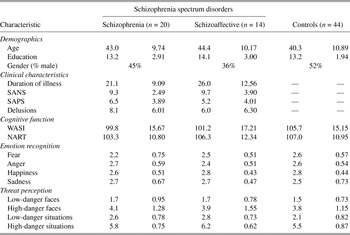
Thirty-four clinical participants were recruited from the Prince of Wales Hospital in Sydney and through a research participant register maintained by the Schizophrenia Research Institute. Diagnoses of schizophrenia (n = 20) or schizoaffective disorder (n = 14) were made by treating psychiatrists according to the Diagnostic and Statistical Manual of Mental Disorders IV (American Psychiatric Association, 2000). None of the participants with schizoaffective disorder were in a current mood episode, and no significant differences were observed between schizoaffective or schizophrenia participants on any of the dependent variables of interest (see Table 1). Furthermore, the two groups did not differ on a measure of negative affectivity (the Depression Anxiety Stress Scales-21; Lovibond & Lovibond, Reference Lovibond and Lovibond1995), M = 49.4, SD = 26.13, and M = 44.2, SD = 23.6, respectively; t(32) = 0.59, p = .559. All clinical participants were aged over 18 and stable. All but one of the clinical participants was medicated, with most receiving combination therapies. Typical antipsychotic medications received included clozapine, olanzapine, resperidone, amisulpride, and aripiprazole. The average age of illness onset was 20.5 years (SD = 5.51) and duration of illness 23.1 years (SD = 10.76). Other than participants who met criteria for schizoaffective disorder (which is defined in DSM-IV-TR as a comorbid diagnosis, that is, schizophrenia with prominent mood symptoms), no other participant reported any comorbid diagnosis.
Demographic, clinical, cognitive, and emotion test performance for clinical and non-clinical participants

Note
SANS = Scale for the Assessment of Negative Symptoms; SAPS = Scale for the Assessment of Positive Symptoms; WASI = Wechsler’s Abbreviated Scale of Intelligence; NART = National Adult Reading Test.
On the Scale for the Assessment of Negative Symptoms (SANS; Andreasen, Reference Andreasen1984a) and the Scale for the Assessment of Positive Symptoms (SAPS; Andreasen, Reference Andreasen1984b), the mean composite scores were 9.5 (SD = 3.07) and 5.9 (SD = 3.95), respectively. These composite scores were derived by adding together the five global negative symptom scores, and four global positive symptom scores, each of which were rated out of five. Consequently, scores of 9.5 (of a possible 25), and 5.9 (of a possible 20) are equivalent to mean global scores of 1.9 and 1.5 for negative and positive symptoms, respectively. This indicates that on average, both negative and positive symptoms were in the questionable to mild range. For the specific clinical symptom of delusions, the mean score was 7.2 (SD = 6.15) of a possible 60, equating to a mean global score of 0.6. This indicates that delusional symptoms were in the none to questionable range. Consequently, this is a clinical group that can be regarded as stable, presenting with low levels of psychosis and negative symptomatology.
Forty-four controls were recruited via advertisements placed in local newspapers. All control participants were screened before participation to ensure no history of psychiatric or neurological illness, and none reported use of antipsychotic medication. The two groups did not differ in age, (M = 40.3, SD = 10.87; M = 43.6, SD = 9.79, respectively), t(1,76) = 1.38, p = .17, years of education, (M = 13.3, SD = 1.94; M = 13.6, SD = 2.94, respectively), t(1,76) = 0.64, p = .52, or gender (52% and 41% male, respectively), χ2(1, n = 78) = 0.95, p = .33; Cramer’s phi (ø) = .11. Exclusion criteria for all participants included an inability to communicate adequately, history of neurological insult, the presence of sensory or perceptual difficulties that interfered with testing, and severe alcohol/drug abuse as indexed by self-reported regular use of illicit substances, or regularly drinking to intoxication.
The schizophrenia spectrum disorders group did not differ from the control group on either IQ as estimated by Wechsler’s Abbreviated Scale of Intelligence (WASI, Wechsler, Reference Wechsler1999, M = 100.4, SD = 16.07 vs. 105.7, SD = 15.15, respectively; t(76) = 1.51, p = .14), or premorbid IQ as estimated by the National Adult Reading Test (NART, Nelson, Reference Nelson1991, M = 104.5, SD = 11.38 vs. 107.0, SD = 10.95, respectively; t(76) = 0.99, p = .32).
Procedure and Measures
All participants provided informed consent, and the study was approved by the South Eastern Sydney Illawara Area Health Service Ethics Committee and was in compliance with the regulations of the University of New South Wales. The measures listed below were administered in a counterbalanced order. The cognitive assessments and clinical interviews were conducted by a qualified clinical psychologist.
Danger rating task - faces
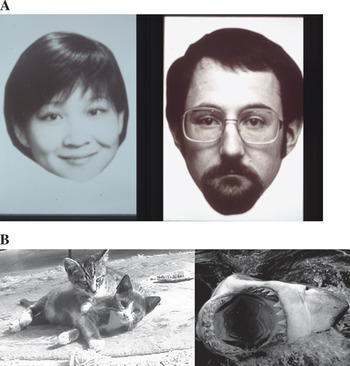
We used the stimuli of Ruffman et al. (Reference Ruffman, Sullivan and Edge2006) to examine participants’ ratings of danger in faces. These were 20 black-and-white photographs of people’s faces taken from a larger stimuli set developed by Adolphs, Tranel, and Damasio (Reference Adolphs, Tranel and Damasio1998) for which Ruffman et al. (Reference Ruffman, Sullivan and Edge2006) obtained normative judgments to identify the 10 faces that were most approachable, and the 10 faces that were most unapproachable (see Figure 1A). These stimuli were also used to solicit danger judgments, with the 10 faces that were judged most approachable also judged to be the least dangerous, and the 10 faces that were judged least approachable also judged to be the most dangerous. The typical low-danger individual was young, female, and smiling, whereas the typical high danger individual was middle-aged, male, and not smiling. The bias linking a smiling female with low danger and an unsmiling male with high danger provide the stimuli with ecological validity (for further details, see; Henry et al., Reference Henry, Thompson, Ruffman, Leslie, Sachdev and Withall2009; Ruffman et al., Reference Ruffman, Sullivan and Edge2006).
Examples of threat perception stimuli for (A) low- and high-danger faces, and (B) low- and high-danger situations.

Danger rating task - situations
The pictures for the situation task were also black and white photos, and were selected by Ruffman et al. (Reference Ruffman, Sullivan and Edge2006) from a larger set of 47 pictures (see Figure 1B). The pictures included different activities (e.g., rally car driving vs. swimming), animals (e.g., tiger vs. kittens), and environmental conditions (e.g., storm clouds vs. non-storm clouds). Human faces were not present in the photos depicting situations. The 10 high-danger situations and the 10 low danger situations were again selected based on normative judgments of non-clinical volunteers (Ruffman et al., Reference Ruffman, Sullivan and Edge2006).
Face and situation photos (169 mm height × 132 mm width) were presented 90 degrees to line of sight as separate tasks, with order of task presentation counterbalanced. Items within each of these two tasks were randomized, and were presented one at a time on a computer monitor. While not all stimuli were identical in size, there were no systematic differences between high- and low-danger exemplars. Participants used a mouse to reveal each new photo and made a verbal response to rate each face and situation on a scale of 1 (not at all dangerous) to 7 (very dangerous) which was recorded by the experimenter. Participants on average took 10–15 min to complete each of the two tasks.
Bioemotion recognition
The Point Light Biological Motion Stimuli (Heberlein et al., Reference Heberlein, Adolphs, Tranel and Damasio2004) were used to index sensitivity to non-verbal emotion cues. These stimuli depict point light walkers, which represent human emotion by presenting moving lights located on the joints of a human figure. Participants were asked to rate three video clips for each of the four basic emotions assessed. Two of the target emotions were threat-related emotions (fear, anger), and the remaining two were non-threat related (happiness, sadness). To illustrate how emotion may be conveyed via point light motion, for one of the clips depicting sadness, the point light walker is shown to move slowly across the screen, head bowed, and arms hanging loosely. In contrast, one of the clips depicting happiness shows a point light walker moving far more energetically, with head held high and pumping the air with their fists in a rhythmic manner. Presentation of the 12 video clips was counterbalanced. After exposure to each video, participants were shown the words “angry,” “afraid,” “happy,” and “sad,” and asked to select which of these emotions best described the emotion portrayed by the point-light walker.
RESULTS
Danger Rating Tasks
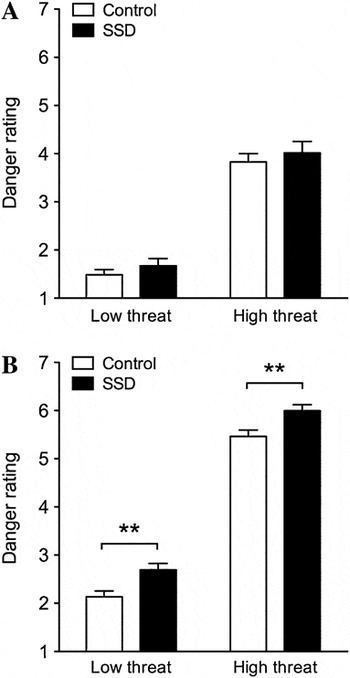
Figures 2A and 2B show danger ratings for the clinical and control participants. The Faces data (see Figure 2A) were analyzed with a 2 (group: control, schizophrenia spectrum disorders) × 2 (danger level: high, low) analysis of variance (ANOVA), with danger ratings as the dependent variable. These analyses indicated a main effect of danger level, F(1,76) = 292.69, p < .001,  , which reflected higher danger ratings on normatively rated high-danger than low-danger faces. However, there was no main effect of group, F(1,76) = 0.92, p = .341,
 , and no interaction between danger level and group, F(1,76) = 0.01, p = .99,
 .
Danger scores (and standard errors) for (A) high- and low-danger faces, and (B) high- and low-danger situations for controls and participants with schizophrenia spectrum disorders (SSD; minimum and maximum scores are 1 and 7, respectively). Note: Neither of the group contrasts involving faces attained significance; for low danger, t(76) = 1.03, p = .306, Cohen’s d = 0.23; for high danger, t(76) = 0.66, p = .508, Cohen’s d = 0.15. However, both contrasts involving situations attained significance; for low danger, t(76) = 3.10, p = .003, Cohen’s d = 0.71; for high danger, t(76) = 2.88, p = .005, Cohen’s d = 0.66.

The Situations data (see Figure 2B) were similarly analyzed with a 2 (group: control, schizophrenia spectrum disorders) × 2 (danger level: high, low) ANOVA, with danger ratings as the dependent variable. Again, there was a main effect of danger level, F(1,76) = 1367.40, p < .001,  , which reflected higher danger ratings on normatively rated high- relative to low-danger situations. There was no interaction between danger level and group, F(1,76) = 0.03, p = .873,
 , but there was a main effect of group, F(1,76) = 11.72, p = .001,
 . This reflected a tendency for the clinical group to provide higher danger ratings for situations overall (collapsed across both high- and low-danger situations, average Ms = 4.85 vs. 3.78, respectively).
Biological Motion Measure of Emotion Recognition
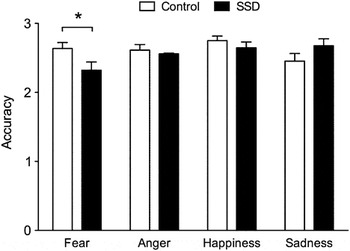
Bioemotion data were analyzed with a 2 × 4 ANOVA with the between-subjects variable of group (control, schizophrenia spectrum disorders), and the within-subjects variable of emotion (fear, anger, happiness, sadness). These data are shown in Figure 3. There was no main effect of emotion, F(3,228) = 2.14, p = .10,  , or group, F(1,76) = 0.62, p = .44,
 , but there was an interaction between the two, F(3,228) = 3.20, p = .02,
 . To follow-up this interaction, tests of simple effects were conducted. These indicated that, relative to the control group, the clinical group had difficulties recognizing fear, F(1,76) = 4.82, p = .03, but not anger, F(1,76) = 0.19, p = .66, happiness, F(1,76) = 0.97, p = .33, or sadness, F(1,76) = 2.09, p = .15.
Correlates of Threat Perception
The only abnormality identified for the clinical group on the danger rating task was in the form of a general tendency to attribute higher threat ratings to situational stimuli. Consequently, a total threat rating score, collapsed across both high- and low-threat stimuli, was calculated separately for faces and situations, for which higher scores indicated greater attributions of danger overall.
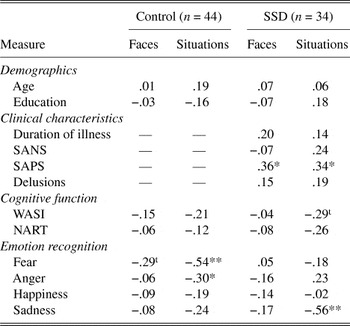
Correlations between these two danger rating measures with demographic variables (age, education), cognitive function (WASI, NART), recognition of the four target emotions (fear, anger, happiness, sadness), and clinical characteristics of the schizophrenia spectrum disorders group (duration of illness, global SANS and SAPS scores, and delusion severity) are shown in Table 2. It can be seen that, for the clinical group, higher attributions of threat to situations was associated with increased difficulty recognizing sadness and positive symptoms as indexed by the SAPS. For facial stimuli, the only significant correlation observed was between higher threat ratings and higher SAPS scores. However, of particular interest was the finding that individuals with schizophrenia spectrum disorders who presented with more prominent delusions did not show any tendency to attribute higher threat to either faces or situations. Thus, contrary to predictions, there was no evidence of any association between delusion severity and perception of threat. For the bioemotion recognition measure, only for the control (but not the clinical) group was higher situational threat ratings associated with increased difficulty recognizing the two threat-related emotions (anger and fear). These were the only correlations to attain significance in the control group.
Correlates of threat attributions for clinical and non-clinical participants

tp < .10; *p < .05; **p < .01.
Note. All correlations are based on normally distributed data, with estimates of Skewness ranging between ± .057 and 1.48, and Kurtosis between ± .019 and 1.92. SSD = schizophrenia spectrum disorders; WASI = Wechsler Abbreviated Scale of Intelligence; NART = National Adult Reading Test; SANS = Scale for the Assessment of Negative Symptoms; SAPS = Scale for the Assessment of Positive Symptoms.
DISCUSSION
The present results indicate that individuals with schizophrenia spectrum disorders do not differ in their ability to detect threat in the facial expressions of others relative to age-matched controls. There were no group differences either in overall levels of danger perceived, or in the ability to differentiate normatively judged high- and low-danger faces. However, although the clinical group also did not differ from controls in their ability to differentiate high- and low-threat situations, they provided higher threat ratings overall to these stimuli. These data indicate that individuals with schizophrenia spectrum disorders exhibit a general bias to perceive situational stimuli as higher in potential danger. It is not immediately clear why perceived threat should be greater for situations relative to faces. However, it is of interest that other studies have also identified a disconnect between these two sets of stimuli. Specifically, similar to the present findings, Henry et al. (Reference Henry, Thompson, Ruffman, Leslie, Sachdev and Withall2009) found that participants with mild dementia did not differ in their ability to detect threat in the facial expressions of others relative to age-matched controls, but were less able to differentiate high- and low-threat situations. In contrast, Ruffman et al. (Reference Ruffman, Sullivan and Edge2006) found that healthy older adults exhibited difficulty differentiating high- and low-threat faces (but not situations) relative to their younger counterparts. It, therefore, appears that there may be meaningful differences between the ability to perceive threat from facial relative to non-facial stimuli. Indeed, it has been argued that responses to threatening scenes are likely to be learned more through experience whereas the ability to detect threat in faces has likely been selected for in evolution because it would enhance survival (Hariri, Tessitore, Mattay, Fera, & Weinberger, Reference Hariri, Tessitore, Mattay, Fera and Weinberger2002). These two abilities, therefore, may impose demands upon overlapping, but also partially dissociable neural substrates.
Of particular interest was the finding that higher threat ratings for both faces and situations were related to increased positive symptoms as indexed by the SAPS. Although it has previously been argued that delusion severity specifically is the critical predictor of threat perception abnormalities in this group (Green et al., Reference Green, Williams and Davidson2003), this clinical symptom was not related to elevated danger ratings for either type of stimuli. Instead, these data suggest that the presence of psychosis per se is related to increased perception of threat, consistent with broader models that have highlighted psychosis more generally as a risk factor for violence to others (Douglas et al., Reference Douglas, Guy and Hart2009). However, a caveat is that very few clinical participants in the present study exhibited no delusional behavior (making group contrasts between those with and without delusions underpowered). Furthermore, on average, those participants who did exhibit delusional behavior in the present study were only very mild in severity. Consequently, future research is needed to directly test the degree to which delusional behavior specifically relates to threat perception in this group.
Also of interest was the finding of impairment on the biological motion measure of affect recognition. While there is a considerable literature documenting schizophrenia-related difficulties identifying emotions in other modalities, such as via facial cues and affective prosody (Edwards et al., Reference Edwards, Jackson and Pattison2002), and visual everyday scenarios (Bozikas, Kosmidis, Anezoulake, Giannakou, & Karavatos, Reference Bozikas, Kosmidis, Anezoulaki, Giannakou and Karavatos2004), this is the first study to show that this deficit extends to affective information as conveyed by point-light stimuli. However, the results also indicated that this effect was specific to only one of the four basic emotions assessed—fear. These data are important because fear is the most difficult emotion to identify from facial expressions (Adolphs, Reference Adolphs2002), and some have suggested that increased schizophrenia spectrum disorder difficulties recognizing this emotion may, therefore, simply reflect task difficulty effects (Edwards et al., Reference Edwards, Jackson and Pattison2002). The finding that fear is specifically impaired on a non-facial emotion recognition task does not support this possibility. Indeed, of the four target emotions presented in the bioemotion task, fear was the second easiest to identify in terms of control group accuracy (see Figure 3). Importantly, Kohler et al. (Reference Kohler, Turner, Bilker, Brensinger, Siegel and Kanes2003) also found that those with schizophrenia were more impaired than controls at recognizing high- (relative to low-) intensity facial expressions, with this difference most pronounced when decoding facial expressions of fear. The present results, therefore, add to a growing literature showing that, relative to the other basic emotions, perception of fear may be disproportionately impaired in schizophrenia spectrum disorders, and that this effect is unlikely to be an artifact of task difficulty.
Bioemotion scores (and standard errors) for clinical and non-clinical participants (SSD refers to schizophrenia spectrum disorders).

Higher danger ratings were related to recognition of threat-related emotions, but only for the control participants. Thus, higher ratings of situational threat were associated with increased difficulties recognizing fear, with a non-significant trend also observed for attributions of facial threat. Additionally, higher situational threat ratings were associated with increased difficulties identifying anger. Because both anger and fear are regarded as threat-related emotions, the absence of any association between recognition of these emotions with danger ratings in the clinical group suggests that there may be a disconnect between the usual processes used to make inferences regarding potential threat. An important topic for future research is to ascertain whether this reflects a problem at the cognitive level, or as suggested in a recent study by Leitman et al. (Reference Leitman, Loughead, Wolf, Ruparel, Kohler and Elliott2008), neural disconnectivity among brain regions that comprise the affective appraisal network.
It might be argued that one limitation of these data was the combining of participants with both schizophrenia and schizoaffective disorder. As noted, both of these disorders are schizophrenia spectrum disorders. This diagnostic grouping is used to refer to psychiatric diagnoses that overlap clinically, etiologically and in terms of underlying disease mechanism. Indeed, the Diagnostic and Statistical Manual of Mental Disorders (DSM-IV-TR) defines schizoaffective disorder as schizophrenia with prominent mood symptoms, and does not make any a priori distinction between disease course and outcome. Because one of the exclusion criteria in the present study was the presence of a current mood episode for participants with schizoaffective disorder, it was considered appropriate to collapse data across these two groups. Supporting this decision, no significant differences were found between the two disorders on any of the clinical, demographic, cognitive, or emotion measures of interest, and importantly, a measure of negative affectivity. Nevertheless, while these data appear to support the conclusions from recent reviews which have questioned whether schizoaffective disorder really exists as a separate diagnostic entity from schizophrenia (see, e.g., Cheniaux et al., Reference Cheniaux, Landeira-Fernandex, Lessa Telles, Lessa, Dias and Duncan2008), there remains the need for future empirical study that directly tests the comparability of these two clinical disorders on other aspects of emotion processing.
Furthermore, there are several limitations to the current data that should be noted. In particular, future research is needed that directly maps underlying schizophrenia-related neuropathology onto threat perception performance. Such an assessment would permit a stronger test of how abnormalities in the “social brain” map onto threat perception difficulties in this group. In addition, cross-validation of the present results is warranted because all clinical participants in the present study were chronic, stabilized and all but one were receiving medication—the extent to which these findings generalize to other schizophrenia spectrum disorder sub-groups, therefore, remains to be tested. In particular, it would be of considerable interest to assess whether individuals with a diagnosis of paranoid schizophrenia differ qualitatively and/or quantitatively from other subtypes within the schizophrenia spectrum. Based on previous research, it seems likely that over perception of threat may be particularly high among people with paranoid schizophrenia.
In conclusion, participants with schizophrenia spectrum disorders were accurately, and comparably, able to differentiate high- from low-danger faces and high- from low-danger situations, and did not differ in overall threat attributed to facial stimuli. However, the clinical group exhibited a general bias to perceive greater threat in situational stimuli which was related to the presence of positive symptoms. The findings of a selective deficit recognizing fear, coupled with a lack of convergence between recognition of threat-related emotions with danger ratings for the clinical (but not the control) group, are consistent with other evidence showing that there may be a disconnect between the usual processes used to make inferences regarding potential threat in schizophrenia spectrum disorders.
ACKNOWLEDGMENTS
This research was supported by an Australian Research Council Discovery Project Grant. The authors thank Kandice Varcin, Alexis Whitton, and Polly Pulford for assisting with data collection, and also the participants themselves. The authors have no financial or other relationships that could be interpreted as a conflict of interest affecting this manuscript.