


Introduction
Sexual dysfunctions represent a diverse class of disorders (Frühauf et al., Reference Frühauf, Gerger, Schmidt, Munder and Barth2013). Premature ejaculation (PE; i.e. ejaculating sooner than desired) and erectile dysfunction (ED; i.e. the inability to obtain and retain an erection for sex) are the two most ubiquitous sexual dysfunctions experienced by men (Nicolosi et al., Reference Nicolosi, Moreira, Shirai, Tambi and Glasser2003; Porst et al., Reference Porst, Montorsi, Rosen, Gaynor, Grupe and Alexander2007; Quek et al., Reference Quek, Sallam, Ng and Chua2008). Prevalence rates for PE and ED vary depending on assessment criteria and methodologies (e.g. varying psychometric measures, multifactorial genesis, pathological standards; McDonagh et al., Reference McDonagh, Bishop, Brockman and Morrison2014; Nicolini et al., Reference Nicolini, Tramacere, Parmigiani and Dadomo2018). The analysis by Colson et al. (Reference Colson, Cuzin, Faix, Grellet and Huyghes2018b) of epidemiological data found rates of ED varying by 1–9% from 18 to 39 years; 2–30% from 40 to 59 years; 20–40% from 60 to 69 years; and 50–75% over 70 years of age. Evidently, increased age is an independent risk factor for ED (Colson et al., Reference Colson, Cuzin, Faix, Grellet and Huyghes2018a; Nicolosi et al., Reference Nicolosi, Moreira, Shirai, Tambi and Glasser2003). In contrast, rates of PE vary from 3 to 30% (Althof et al., Reference Althof, McMahon, Waldinger, Serefoglu, Shindel, Adaikan and Torres2014; Komlenac et al., Reference Komlenac, Siller, Bliem and Hochleitner2018; Porst et al., Reference Porst, Montorsi, Rosen, Gaynor, Grupe and Alexander2007). Substantial rates of co-morbid PE and ED have also been established (Chen et al., Reference Chen, Wang, Hu, Yang and Dai2018b; McMahon et al., Reference McMahon, Lee, Park and Adaikan2012; Quek et al., Reference Quek, Sallam, Ng and Chua2008), with the incidence of ED found in over half of men with PE (Serefoglu et al., Reference Serefoglu, McMahon, Waldinger, Althof, Shindel, Adaikan and Torres2014). Interestingly, research indicates possible differences in prevalence rates of PE and ED across sexual orientations (McDonagh et al., Reference McDonagh, Nielsen, McDermott, Davies and Morrison2018); i.e. higher rates of ED and lower rates of PE in homosexual men compared with heterosexual men (Bancroft et al., Reference Bancroft, Carnes, Janssen, Goodrich and Long2005; Peixoto and Nobre, Reference Peixoto and Nobre2015). Yet, potential differences compared with bisexual men remain unclear. Such findings may be explained by sexual concerns specific to gay men (e.g. perceived masculinity; HIV transmission; painful anal sex; performance anxiety) that impact erection quality and the possible distress of premature ejaculation due to expectations of heterosexual men (e.g. negative impact on partner’s enjoyment; Bancoft et al., Reference Bancroft, Carnes, Janssen, Goodrich and Long2005; McDonagh et al., Reference McDonagh, Nielsen, McDermott, Davies and Morrison2018; Peixoto and Nobre, Reference Peixoto and Nobre2015).
PE and ED aetiology
Contributing factors in PE and ED have been conventionally divided into organic and psychological classifications. However, the distinction between the two categories is not definitive as these factors can overlap for individuals (Rajkumar and Kumaran, Reference Rajkumar and Kumaran2015). Regarding psychological issues, anxiety and depression are implicated in the development and maintenance of sexual dysfunctions, including PE and ED (Chen et al., Reference Chen, Chen, Gao, Chen, Dai, Yao and Lu2018a; Chen et al., Reference Chen, Wang, Hu, Yang and Dai2018b; Mourikis et al., Reference Mourikis, Antoniou, Matsouka, Vousoura, Tzavara and Ekizoglou2015), alhough research has highlighted that PE and ED may be differentially influenced by anxiety and depression symptomology (Sugimori et al., Reference Sugimori, Yoshida, Tanaka, Baba, Nishida, Nakazawa and Iwamoto2005). For example, whilst depression has been found to play a role in both PE and ED, performance and free-floating anxiety (i.e. worry without an external threat) are recognised as prominent contributors to the development and maintenance of ED (Mourikis et al., Reference Mourikis, Antoniou, Matsouka, Vousoura, Tzavara and Ekizoglou2015). It is worth noting that homosexual, bisexual, and other same-sex attracted people are at a higher risk of mental health issues including depression and anxiety, with research supporting significant positive associations between minority stress and psychological distress (Lea et al., Reference Lea, de Wit and Reynolds2014). Similarly, co-morbid PE and ED are associated with higher levels of psychological distress (Chen et al., Reference Chen, Wang, Hu, Yang and Dai2018b). Taken together, factors that are relevant to both emotional dysregulation and sexual dysfunction, such as cognition, have clinical value in treatment planning for PE and ED across sexual orientations.
Metacognitive theory
Recently, emerging research has focused on the contribution of metacognitive factors in emotional distress and sexual dysfunction (Bagcioglu et al., Reference Bagcioglu, Altunoluk, Bez, Soylemez, Asik and Emul2012; Giuri et al., Reference Giuri, Caselli, Manfredi, Rebecchi, Granata, Ruggiero and Veronese2016; Zarbo et al., Reference Zarbo, Brugnera, Compare, Secomandi, Candeloro, Malandrino and Frigerio2019). Metacognition refers to knowledge of one’s cognitive processes (i.e. thinking about thinking) and, accordingly, is involved in the appraisal, monitoring, or control of cognition (Flavell, Reference Flavell1979; Yılmaz et al., Reference Yılmaz, Gençöz and Wells2011). The metacognitive model of psychological disorder, the Self-Regulatory Executive Function Model (S-REF; Wells and Mathews, Reference Wells and Matthews1994; Wells and Mathews, Reference Wells and Matthews1996), proposes that psychological distress is caused and maintained perseverative thinking that occurs in the form of cognitive-attentional syndrome (CAS), consisting of worry, rumination, fixated attention, and unhelpful self-regulatory strategies (Wells, Reference Wells2013). This style of thinking is considered problematic as it allows negative thoughts and emotions to persist, which then prevents the modification of dysfunctional self-beliefs and increases the accessibility of negative information (Caselli and Spada, Reference Caselli and Spada2013).
The CAS is controlled by metacognitive beliefs, which are primarily divided into two domains: positive metacognitive beliefs and negative metacognitive beliefs (Wells, Reference Wells2009). Positive metacognitive beliefs concern the perceived benefit of engaging in rumination, worry, threat monitoring, thought suppression, and other similar strategies (Wells, Reference Wells2013). For example, ‘if I worry, I will be prepared’ or ‘focusing on danger will keep me safe’ (Wells, Reference Wells2009; p. 15). Alternatively, negative metacognitive beliefs consist of two broad domains, (1) those that concern the uncontrollability of thoughts and (2) those that concern the danger, importance, and meaning of them (Wells, Reference Wells, Herbert and Forman2011). For example, ‘I have no control over my worrying’ and ‘psychological distress can make me lose my mind’ (Wells, Reference Wells2009; p. 16). It is through the adoption of these metacognitive patterns and coping strategies that individuals develop and maintain psychological conditions (Wells, Reference Wells2009).
Relevant research
Substantial research has established that metacognitive beliefs and processes are implicated in a range of psychological problems, including anxiety (Bailey and Wells, Reference Bailey and Wells2015; Wells, Reference Wells2013), addictive behaviours (Allen et al., Reference Allen, Kannis-Dymand and Katsikitis2017; Caselli and Spada, Reference Caselli and Spada2013; Hamonniere and Varescon, Reference Hamonniere and Varescon2018), anger (Ramos-Cejudo et al., Reference Ramos-Cejudo, Salguero, Kannis-Dymand, Garcia-Sancho and Love2017; Simpson and Papageorgiou, Reference Simpson and Papageorgiou2003) and depression (Papageorgiou and Wells, Reference Papageorgiou and Wells2001; Papageorgiou and Wells, Reference Papageorgiou and Wells2003). Moreover, a recent meta-analysis reported that those with a psychological disorder, including generalised anxiety disorder, eating disorders, major depressive disorder, schizophrenia, or obsessive-compulsive disorder had increased levels of metacognitive beliefs compared to healthy controls (Sun et al., Reference Sun, Zhu and So2017). Thus, it is plausible that metacognitions are related to emotional distress experienced by sexual minorities and individuals who struggled with sexual dysfunction.
Currently, there is limited research exploring the role of metacognitions in PE and ED, with only two published studies to date. First, Bagcioglu and colleagues (Reference Bagcioglu, Altunoluk, Bez, Soylemez, Asik and Emul2012) investigated metacognitive processes of 40 participants with ED and 40 participants with PE who were diagnosed using a semi-structured interview based on the DSM-IV-TR and compared with 40 healthy controls. The short form of the Metacognition Questionnaire (MCQ-30; Wells and Cartwright-Hatton, Reference Wells and Cartwright-Hatton2004) was used to evaluate the presence of both positive and negative metacognitive beliefs and maladaptive coping strategies (e.g. excessive focus on thoughts or over-reliance on worry). Bagcioglu and colleagues (Reference Bagcioglu, Altunoluk, Bez, Soylemez, Asik and Emul2012) found that positive beliefs and negative beliefs subscale scores were significantly higher in participants with PE or ED than healthy controls with no significant difference between the PE or ED groups. There were no significant differences between the groups on the uncontrollability-danger and cognitive confidence subscale scores. However, cognitive self-consciousness was significantly higher in participants with PE than participants with ED and healthy controls, whilst there was no difference between participants with ED and healthy controls. The researchers proposed that this difference may be due to participants with ED being significantly older than participants with PE and the healthy control group. Bagciouglu et al. stated that their study highlighted that metacognitions may play a role in PE and ED through the development of maladaptive metacognitive coping strategies associated with higher endorsement of positive and negative metacognitive beliefs.
The second study by Giuri et al. (Reference Giuri, Caselli, Manfredi, Rebecchi, Granata, Ruggiero and Veronese2016) investigated metacognitive beliefs and the processes of the CAS in 11 participants with ED and 10 with PE (DSM-IV criteria). A semi-structured interview based on Well’s (Reference Wells2000) metacognitive profiling interview was utilised to evaluate the presence of metacognitive beliefs concerning a recent episode of sexual dysfunction. From the results, Giuri et al. concluded that positive and negative metacognitive beliefs and the CAS may play a role in the maintenance of sexual dysfunction and in the exacerbation of negative emotional states. For example, participants held negative metacognitive beliefs about the uncontrollability of thoughts (i.e. ‘the negative thoughts keep coming back’) and the negative impact of their CAS thought patterns (i.e. ‘worrying doesn’t help me get an erection’), which may play a role in promoting negative affect and loss of arousal that in turn may further exacerbate CAS. Furthermore, these findings highlighted that there may be both differences and similarities in the CAS models of men with ED or PE. For example, ED participants reported higher CAS activation in the form of rumination or worry. PE participants reported higher negative appraisal of triggers and the activation of thought control strategies, such as seeking distraction or using suppression, in an attempt to move their attention away from negative thoughts or physical sensations. However, the possibility that individual participants may have been impacted by more than one kind of sexual dysfunction was deemed to be a limitation in this study, because this may have confounded the support for differential metacognitive profiles corresponding to a single diagnosis only.
Both Giuri et al. (Reference Giuri, Caselli, Manfredi, Rebecchi, Granata, Ruggiero and Veronese2016) and Bagcioglu et al. (Reference Bagcioglu, Altunoluk, Bez, Soylemez, Asik and Emul2012) stated that their studies were exploratory and highlighted the need for future research to recruit a larger number of participants. Additionally, they encouraged the adoption of validated psychometric measures for all variables to enable the collection of robust data to compare with their findings. Importantly, neither the Giuri et al. nor Bagcioglu et al. study investigated the sexual orientation of the participants and there appears to be no published research investigating whether metacognitive processes vary in PE and ED according to sexual orientation. Therefore, given that previous research highlights variances in rates of PE and ED between heterosexual, bisexual and homosexual men, it would be beneficial to investigate this regarding metacognition.
The present study
Building on the research of Bagcioglu et al. (2016) and Giuri et al. (2012), implementing their suggestions, and addressing the gap in the literature regarding sexual orientation, the current study investigated the differences in metacognitive processes in heterosexual, bisexual, and homosexual men with PE and/or ED compared with healthy controls using validated psychometric measures. Specifically, it was hypothesised that metacognitive beliefs reported by participants with PE and/or ED would be significantly higher than participants without PE and/or ED. A second aim of the study was to explore potential significant differences in metacogntive beliefs reported by heterosexual, homosexual, and bisexual participants with PE and/or ED.
Method
Design and procedure
The study implemented a cross-sectional, online survey design. Following ethical approval from a university board, male participants ≥18 years were recruited via social networking and sexual health websites with a survey link. Volunteers who accessed the link were informed of the study’s purpose, length (i.e. 20 minutes), risks and safeguards, along with information about consent, anonymous participation, and access to information. The study was described as an investigation of thoughts processes associated with ED and PE. After obtaining consent, participants were invited to complete the demographic questionnaire followed by psychometric measures. All participants were provided with the contact details of suitable support services pre- and post-completion to assist with any distress experienced during participation. Participants were also able to leave the survey at any time without consequence.
Participants
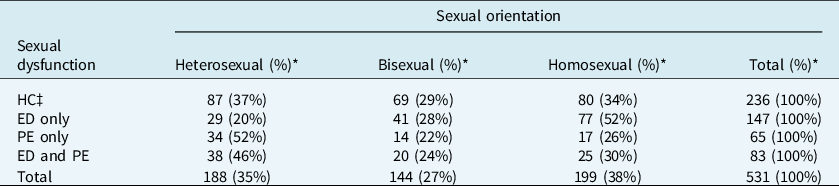
A total of 731 participants undertook the survey, with 531 complete responses included in the MANCOVA. Sixty-five participants satisfied the criteria for PE (12.2%), 147 for ED (27.7%), 83 with PE and ED (15.6%), and 236 with neither (44.4%; referred to as healthy controls). Analysis of total responses revealed that complete responders were significantly older (mean = 42.63 years, SD = 14.34) than partial responders (mean = 39.98 years, SD = 15.06), t 729 = –2.196 (two-tailed), p = .028, partial η2 = .007. There was no significant difference in sexual orientation between complete (heterosexual = 35.4%, bisexual = 27.1%, homosexual = 37.5%) and partial responders (heterosexual = 34.6%, bisexual = 26.2%, homosexual = 39.3%), χ2 (–2) = .194, p = .908. Details of the participants are provided in Tables 1 and 2.
Sexual orientation and sexual dysfunction

* Percentage of total sexual dysfunction; ‡healthy controls.
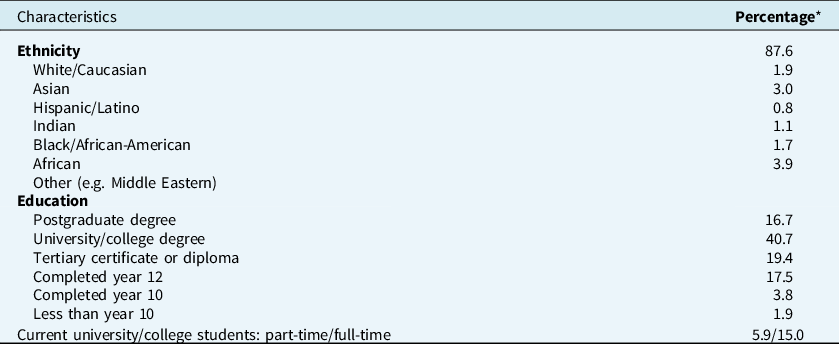
Demographic characteristics as percentages

*n = 474 (i.e. completed relevant question).
Measures
Sexual orientation
As a multi-dimensional construct, sexual orientation is often conceptualised as one aspect of human sexuality (Pachankis et al., Reference Pachankis, Hatzenbuehler, Mirandola, Weatherburn, Berg, Marcus and Schmidt2017). For the current study, sexual orientation was gauged using a self-report measure of sexual attraction. Self-reported sexual attraction has been found to differ from sexual identity (Diamond et al., Reference Diamond, Dickenson and Blair2017), and may be associated with greater honesty in responses (Smith et al., Reference Smith, Rissel, Richters, Grulich and de Visser2003). Therefore, a sexual attraction question was employed as recommended by the Sexual Minority Assessment Research Team (SMART, 2009): ‘People are different in their sexual attraction to other people. Which best describes your feelings? Are you: 1. Only attracted to females; 2. Mostly attracted to females, 3. Equally attracted to females and males; 4. Mostly attracted to males; 5. Only attracted to males?’. For the purpose of the current research, responses were coded as: 1 = heterosexual; 2, 3 and 4 = bisexual; and 5 = homosexual.
Ejaculation control
The Premature Ejaculation Diagnostic Tool (PEDT 5; Symonds et al., Reference Symonds, Perelman, Althof, Giuliano, Martin, May and Morris2007a) is a 5-item measure for assessing premature ejaculation (e.g. ‘How difficult is it for you to delay ejaculation?’). Respondents rate items on a 5-point Likert scale from 0 (not at all) to 4 (extremely). Total scores range from 0 to 20, with higher scores indicating poorer control over ejaculation. The PEDT 5 is extensively validated, with good internal consistency (α = 0.71) and test–re-test reliability (α = 0.88; Symonds et al., Reference Symonds, Perelman, Althof, Giuliano, Martin, Abraham and May2007b). Cut-offs were scored at 0–8 as indicating without PE, and 9 and above indicating with PE (Breyer et al., Reference Breyer, Smith, Eisenberg, Ando, Rowen and Shindel2010; Pakpour et al., Reference Pakpour, Yekaninejad, Nikoobakht, Burri and Fridlund2014).
Erectile function
The Sexual Experiences Questionnaire (SEX-Q) is a validated questionnaire used to measure erectile function, individual satisfaction, and couple’s satisfaction (Cappelleri et al., Reference Cappelleri, Bushmakin, Symonds and Schnetzler2009; Mulhall et al., Reference Mulhall, King, Kirby, Hvidsten, Symonds, Bushmakin and Cappelleri2008). The erection function subscale of the SEX-Q was used as a measure of erectile function as other questionnaires were primarily developed for heterosexual men with the assumption of penetrative vaginal sex (Coyne et al., Reference Coyne, Mandalia, McCullough, Catalan, Noestlinger, Colebunders and Asboe2010) and the SEX-Q erection function subscale had only one question that focused on penetration. Furthermore, not all men who have sex with men practise penetrative anal sex, and they may play the passive or active role only, or both (Vansintejan et al., Reference Vansintejan, Vandevoorde and Devroey2013). The wording for sexual intercourse/penetration was expanded to include ‘entering your partner’s mouth, vagina, or anus’ (Breyer et al., Reference Breyer, Smith, Eisenberg, Ando, Rowen and Shindel2010). The erectile function subscale contains six items measured on a 5-point Likert scale, from 1 (never or almost never) to 5 (almost always or always). A sample item is ‘How often were you able to maintain an erection for as long as you wanted to?’. Scores are converted to percentages, with lower scores representing higher ED. The erectile domain of the SEX-Q has demonstrated high internal consistency (α = .88) and good test–re-test reliability (α = .76; Mulhall et al., Reference Mulhall, King, Kirby, Hvidsten, Symonds, Bushmakin and Cappelleri2008). Cut-offs were scored at 0–67% indicating with ED and 68% and above without ED (Cappelleri et al., Reference Cappelleri, Bushmakin, Symonds and Schnetzler2009).
Metacognitions
The Metacognition Questionnaire-30 (MCQ-30; Wells and Cartwright-Hatton, Reference Wells and Cartwright-Hatton2004) is a well-validated brief 30-item version of the 65-item Metacognition Questionnaire for assessing metacognitions. A sample item is ‘When I start to worry, I cannot stop’. Respondents indicate their agreement with each item on a 4-point Likert scale from 1 (do not agree) to 4 (agree very much). The questionnaire has an overall score (30–120) and five subscale scores (6–24) The five subscales are (1) cognitive confidence, which assesses the confidence a person has in their attention and memory; (2) positive beliefs about worry, which measures the extent to which a person believes that perseverative thinking is useful; (3) cognitive self-consciousness, which measures the tendency to monitor one’s thoughts and focus attention inward; (4) beliefs about the uncontrollability and danger of thoughts, which assesses the extent to which a person thinks that perseverative thinking is uncontrollable and dangerous; and (5) negative beliefs – the need to control thoughts, which assesses the extent to which a person believes that certain types of thoughts need to be suppressed. Higher scores indicate lower cognitive confidence in attention and memory, greater belief that worry is beneficial, increased tendency towards self-focused attention, greater belief that thoughts are uncontrollable and dangerous, and a greater belief in the need to control thoughts, respectively. The MCQ-30 possesses good internal consistency and convergent validity as well as acceptable test–re-test reliability (α = .59–.87; Spada et al., Reference Spada, Georgiou and Wells2010; Wells and Cartwright-Hatton, Reference Wells and Cartwright-Hatton2004).
Data analysis
To assess the first and second hypotheses, a single between-participants two-way (sexual orientation: heterosexual, bisexual, and homosexual, by sexual dysfunction: healthy control, ED only, PE only, and PE with ED) multivariate analyses of covariance (MANCOVA) was calculated, with the five subscales of the MCQ-30 representing multiple dependent variables. Age was entered as a covariate as it is an independent risk factor for ED (Colson et al., Reference Colson, Cuzin, Faix, Grellet and Huyghes2018a). After significant MANCOVA effects or interactions, post hoc analyses were undertaken to assess differences between cell and marginal means where appropriate. There were no issues with multicollinearity.
Results
Numerous a priori G*Power 3.1 calculations, dependent on the type of statistical analysis to be undertaken, indicated a sample size of n = 120–196 to achieve a medium population effect size (f = .25), power of .80 (β = .20), and significance criterion a = .05. However, these calculations did not take into consideration the high variability of the distribution of the groups (i.e. heterosexual, bisexual, and homosexual males) within the general population. Accordingly, as suggested by Wilson et al. (Reference Wilson VanVoorhis and Morgan2007), approximately 30 participants per group were required to achieve a medium to large effect size with about 80% power. However, in the current study, not all groups achieved this goal and varied in size. According to Tabachnik and Fidell (Reference Tabachnik and Fidell2013), when there are unequal sample sizes across the groups, then MANCOVA is considered robust against such challenges.
Data screening
Data were exported from the Survey Monkey platform to the IBM Statistical Product and Service Solutions (SPSS) program version 26 for analysis. All data were screened, and incomplete responses were removed. Data had significant Shapiro–Wilks test of normality; however, MANCOVA is robust against violations of the normality assumption when groups exceed 30 (Field, Reference Field2013). Multicollinearity was not violated – all correlations were below .90. Box’s test of covariance matrices significance was above alpha of .001. An examination of box-plots and z-scores revealed a total of 20 univariate outliers. However, the extreme nature of standardised scores depends on the size of the sample and, in larger samples, a few standardised scores in excess of ±3.29 are acceptable. Upon inspection, the univariate outliers were considered a part of the population and were retained for further analysis (Tabachnick and Fidell, Reference Tabachnik and Fidell2013).
Differences in metacognitions
Results of the MANCOVA to examine the differences in metacognitions across sexual orientation and of sexual dysfunction groups indicated that there was a significant multivariate main effect for both sexual dysfunction (Wilks’ lambda = .895, F 15,1419.33 = 3.87 p < .001, partial η2 = .036, observed power = 1.00) and for sexual orientation (Wilks’ lambda = .945, F 10,1028 = 2.97 p = 001, partial η2 = .028, observed power = .982). However, the interaction between sexual dysfunction and sexual orientation was non-significant (Wilks’ lambda = .951, F 30,2058 = .864 p = .679, partial η2 = .010, observed power = .696).
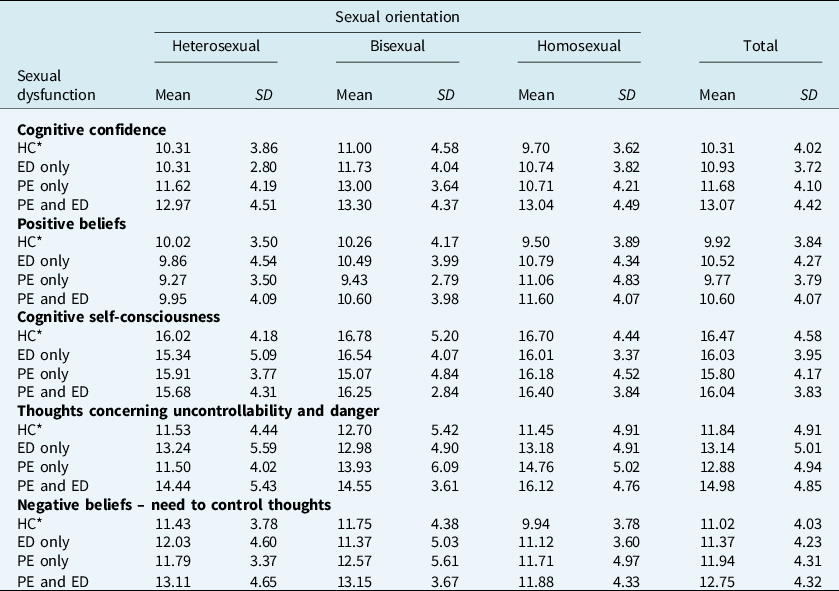
Significant univariate main effects of sexual dysfunction on the MCQ-30 subscales were identified for cognitive confidence (F 1,518 = 10.119, p < .001, partial η2 = .055, observed power = .998); thoughts concerning uncontrollability and danger (F 3,518 = 10.734, p < .001, partial η2 = .059, observed power = .999); and negative beliefs – need to control thoughts (F 3,518 = 4.457, p = .004, partial η2 = .025, observed power = .878). Table 3 shows mean and standard deviation (SD), sexual orientation, MCQ-30 subscale, and sexual dysfunction scores.
Mean and standard deviation (SD), sexual orientation, MCQ-30 subscale and sexual dysfunction

* Healthy controls.
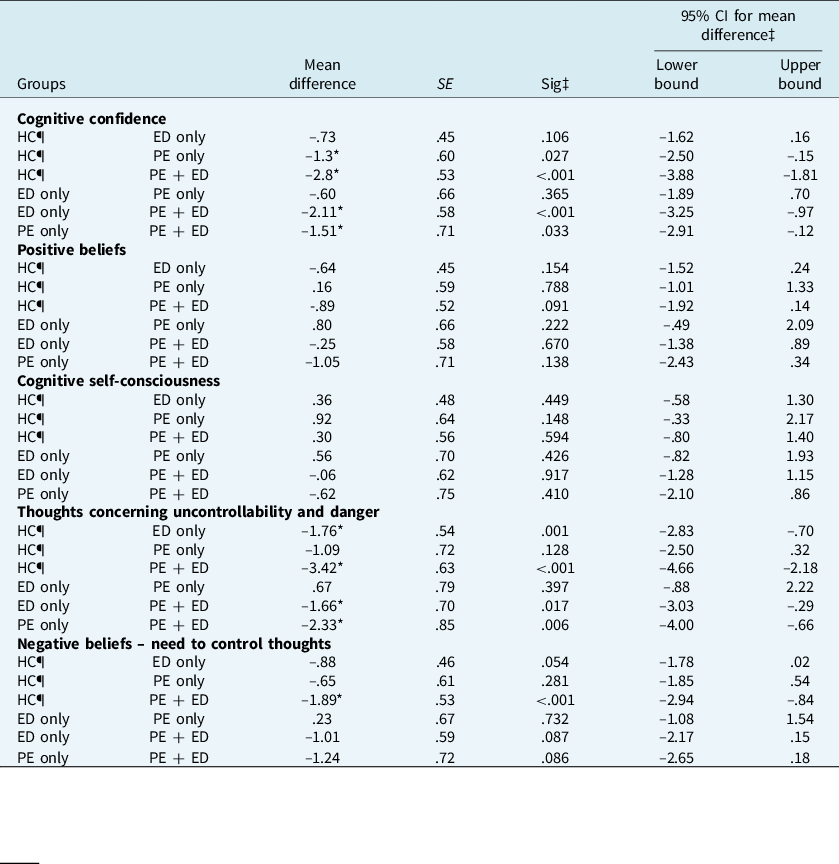
Table 4 shows the mean difference between sexual dysfunction groups and significance level for the MCQ-30 subscale, and 95% confidence interval for the mean difference. Regarding cognitive confidence, results indicated that the PE and ED group score was significantly higher than ED only, PE only, and healthy controls groups, and the PE only group score was significantly higher than the healthy control group; there were no other significant differences. Regarding thoughts concerning uncontrollability and danger, results indicated that the PE and ED group score was significantly higher than ED only, PE only, and healthy controls groups, and the ED only group score was significantly higher than the healthy control group; there were no other significant differences. Regarding negative beliefs-need to control thoughts, results indicated that the PE and ED group score was significantly higher than the healthy controls group; there were no other significant differences.
Mean difference between sexual dysfunction groups and significance level for the MCQ-30 subscale and 95% confidence interval for the mean difference

*The mean difference is significant at the .05 level; ‡adjustment for multiple comparisons: least significant difference (equivalent to no adjustments); ¶healthy controls.
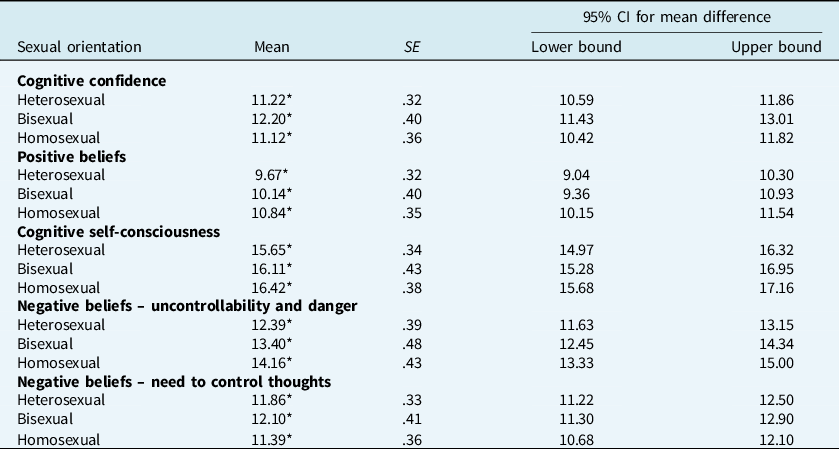
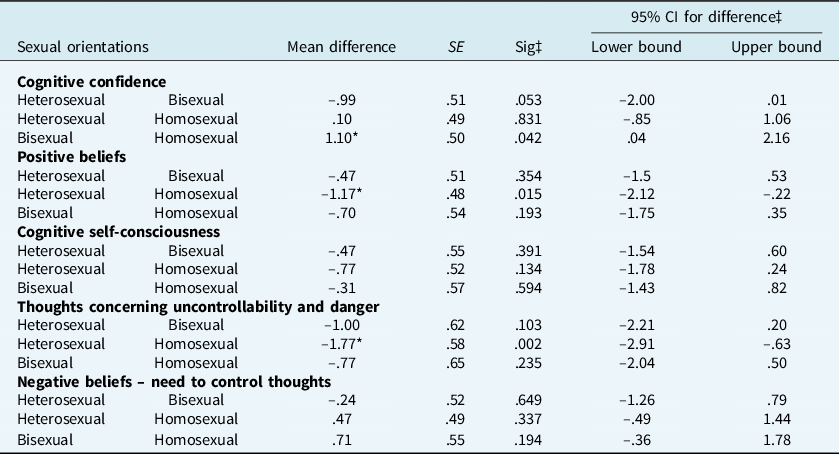
Significant univariate main effects of sexual orientation on the MCQ-30 subscales were identified for thoughts concerning uncontrollability and danger only (F 2,518 = 4.728, p = .009, partial η2 = .018, observed power = .998); whilst positive beliefs (F 2,518 = 2.957, p = .053 partial η2 = .011, observed power = .575) approached significance. Details of mean of sexual orientation for MCQ-30 subscales and sexual dysfunction are shown in Table 5 and the mean difference between sexual orientation and significance level for the MCQ-30 subscale and 95% confidence interval for the mean difference are shown in Table 6. Regarding thoughts concerning uncontrollability and danger, results indicated that the homosexual men’s score was significantly higher than heterosexual men; there were no other significant differences. Regarding positive beliefs, results indicated that the homosexual men’s scores was significantly higher than heterosexual men; there were no other significant differences. Also, results indicated that bisexual men reported significantly higher levels of low cognitive confidence than homosexual men.
Mean of sexual orientation for MCQ-30 subscale and sexual dysfunction

* Covariates appearing in the model are evaluated at the following values: What is current your age in years? = 42.63.
Mean difference between sexual orientation and significance level for the MCQ-30 subscale and 95% confidence interval for the mean difference

Values are based on estimated marginal means. *The mean difference is significant at the .05 level. ‡Adjustment for multiple comparisons: least significant difference (equivalent to no adjustments).
Discussion
The current study aimed to investigate the differences in metacognitive processes in heterosexual, bisexual, and homosexual men with PE and/or ED compared with healthy controls. It was hypothesised that the metacognitive beliefs reported by participants with PE and/or ED would be significantly higher than participants without PE and/or ED. Results from the current study partially supported this hypothesis in that specific types of metacognitive beliefs were significantly higher for participants with PE and/or ED than without PE and/or ED. That is, participants with PE and ED were significantly higher in low cognitive confidence, thoughts concerning uncontrollability and danger, and the need to control thoughts subscales than PE only, ED only, and healthy controls. Furthermore, the PE only group was significantly higher than healthy controls for low cognitive confidence, with the ED significantly higher for thoughts concerning uncontrollability and danger subscales.
Therefore, the findings of this study suggest that specific metacognitive beliefs may be involved in PE and ED. Reduced levels of cognitive confidence have been associated with increased anxiety by possibly limiting the choice of effective coping strategies when under stress (Spada et al., Reference Spada, Georgiou and Wells2010). This may reflect low levels of belief in the effectiveness of cognitive abilities and may lead to a cycle of perceived failure, which could, in turn, increase sexual dysfunction such as PE or ED (Bagcioglu et al., Reference Bagcioglu, Altunoluk, Bez, Soylemez, Asik and Emul2012; Spada et al., Reference Spada, Zandvoort and Wells2007). Also, high levels of concern about uncontrollability and danger and the need to control thoughts have been found to lead to the utilisation of unhelpful coping strategies with a focus being centred on controlling thoughts along with the anxious anticipation of failure (Bagcioglu et al., Reference Bagcioglu, Altunoluk, Bez, Soylemez, Asik and Emul2012). Paradoxically, attempts to control thoughts or worries have been found to increase their salience and associated distress (Cook et al., Reference Cook, Salmon, Dunn and Fisher2014). Also, according to Spada et al. (Reference Spada, Georgiou and Wells2010) the combination of low levels of cognitive confidence and high levels of concern about uncontrollability and danger and the need to control thoughts, as seen in the PE and ED group, has been found to increase levels of state anxiety.
Regarding the differences in the specific types of metacognitive beliefs between the sexual dysfunction groups, Giuri et al. (Reference Giuri, Caselli, Manfredi, Rebecchi, Granata, Ruggiero and Veronese2016) found that strategies to control either PE or ED had a detrimental effect on the other (e.g. ‘using distraction to control my PE makes my erection weaker’), which may lead to increased negative metacognitive beliefs and lower confidence in coping strategies as found in the PE and ED group. Furthermore, the differences in the specific metacognitive beliefs found for PE and ED only groups may reflect the focus of the PE only group on their lack of confidence in their strategies to control their PE (e.g. ‘Distraction doesn’t help me fix things’; Giuri et al., Reference Giuri, Caselli, Manfredi, Rebecchi, Granata, Ruggiero and Veronese2016). Whilst the ED only group may be more focused on the uncontrollability of their thoughts and the negative consequences of their impaired erections (e.g. ‘I have no control over the worry’; ‘It keeps my attention on my flabby penis and I can’t get an erection’; Giuri et al., Reference Giuri, Caselli, Manfredi, Rebecchi, Granata, Ruggiero and Veronese2016). Both Giuri et al. and Bagcioglu et al. found differing associations for metacognitive beliefs with PE and ED.
Considering the second aim of the study, there were no significant differences for metacognitive beliefs between differing sexual orientations for men with/or without PE and/or ED. This result may reflect previous findings regarding the complexity of human sexuality and the difficulties in how sexual orientation is categorised (Pachankis et al., Reference Pachankis, Hatzenbuehler, Mirandola, Weatherburn, Berg, Marcus and Schmidt2017). Whilst a sexual attraction measure was used for this research, future research may benefit from exploring different measures. However, results evidenced significant differences relating to sexual orientation and metacognitive beliefs. Homosexual men were found to have higher levels of beliefs concerning the uncontrollability and danger of thoughts, and positive beliefs about the benefits of worry, and were significantly lower than bisexual men in cognitive confidence. This result appears to be consistent with previous research findings of increased levels of psychological disorders, including depression and anxiety, for sexual minority groups including homosexual and bisexual men (e.g. Lea et al., Reference Lea, de Wit and Reynolds2014). Currently, there has been minimal research investigating the differences in metacognitive beliefs for differing sexual orientations independent of sexual dysfunction, warranting further research.
The results of this study highlight that metacognitive beliefs may play a role in PE and/or ED. Furthermore, whilst metacognitive beliefs may vary based on sexual orientation, it would appear that sexual orientation does not play a role in metacognitive beliefs related to PE and/or ED. From a therapeutic perspective, these findings suggest that the techniques and principals of metacognitive therapy (Wells, Reference Wells2000; Wells, Reference Wells2009) may be beneficial for men with PE and/or ED. However, the current results indicate that the modification of such therapy depending on sexual orientation may not be necessary; however, this requires further investigation.
The findings of the current study should be considered in the context of several limitations. First, the study employed a cross-sectional internet survey design, with a sample that was primarily Caucasian with higher education degrees. Thus, the results may not be generalisable to the broader population, nor could causal inferences be supported. Second, the use of self-report, internet-based, and retrospective measures may result in biased responses due to social desirability, self-report bias, and selective or poor memory. Third, participants’ anxiety and depression were not explicitly assessed. However, beliefs regarding worry provide an implicit measure of anxiety. Regardless, future studies may benefit from including validated measures of anxiety and depression and investigating the relationships between anxiety and depression with PE and ED, as well as interactions with metacognitive beliefs. Additionally, the current study used the MCQ-30, which is a measure of generalised metacognitive beliefs rather than a validated measure of metacognitive beliefs specific to sexual dysfunction. Future studies would also benefit from larger sample sizes for various sexual orientation groups.
Summary
Given a paucity in research, the present study represents a significant contribution to the literature, providing further support for the implications of metacognitive beliefs in sexual dysfunction such as PE and/or ED. Furthermore, this research provides further support for the S-REF model and metacognitive theory in the understanding of psychopathology, including sexual distress associated with male sexual dysfunction. Our findings, collectively with the previous work of Bagcioglu et al. (Reference Bagcioglu, Altunoluk, Bez, Soylemez, Asik and Emul2012) and Giuri et al. (Reference Giuri, Caselli, Manfredi, Rebecchi, Granata, Ruggiero and Veronese2016), establish that the CAS and metacognitive beliefs are active in male sexual performance difficulties across sexual orientations.
Acknowledgements
None.
Financial support
None.
Conflicts of interest
No potential conflict of interest was reported by the authors.



Comments
No Comments have been published for this article.