Introduction
Impulsivity is currently discussed as a key feature of borderline personality disorder (BPD) (APA, 2000). However, previous research in this domain has revealed discrepant findings suggesting that the nature of impulsivity in BPD is not yet completely understood. Impulsivity is a complex feature comprising different components that can be assessed by multiple methods. As well as self-report measures (subjective appraisals), various laboratory paradigms have been established to assess behavioural impulsivity (Moeller et al. Reference Moeller, Barratt, Dougherty, Schmitz and Swann2001). For example, reward choice paradigms (e.g. gambling tasks) can be used to measure impulsive decision making. To assess response disinhibition/attention, laboratory paradigms such as go/no-go and stop-signal tasks have been established.
Studies that relied on self-reports consistently demonstrated higher levels of impulsivity in BPD patients compared with healthy controls (HCs) and patients with other psychiatric disorders (Dougherty et al. Reference Dougherty, Bjork, Huckabee, Moeller and Swann1999; Henry et al. Reference Henry, Mitropoulou, New, Königsberg, Silverman and Siever2001; Berlin et al. Reference Berlin, Rolls and Iversen2005; Bornovalova et al. Reference Bornovalova, Lejuez, Daughters, Zachary Rosenthal and Lynch2005; McCloskey et al. Reference McCloskey, New, Siever, Goodman, Koenigsberg, Flory and Coccaro2009; Jacob et al. Reference Jacob, Gutz, Bader, Lieb, Tüscher and Stahl2010; Lynam et al. Reference Lynam, Miller, Miller, Bornovalova and Lejuez2011; Sebastian et al. Reference Sebastian, Jacob, Lieb and Tüscher2013a ). Studies that applied laboratory tasks in part revealed impaired response inhibition (Leyton et al. Reference Leyton, Okazawa, Diksic, Paris, Rosa, Mzengeza, Young, Blier and Benkelfat2001; Hochhausen et al. Reference Hochhausen, Lorenz and Newman2002; Rentrop et al. Reference Rentrop, Backenstrass, Jaentsch, Kaiser, Roth, Unger, Weisbrod and Renneberg2008), difficulties in feedback-directed decision making (Haaland & Landrø, Reference Haaland and Landrø2007; Kirkpatrick et al. Reference Kirkpatrick, Joyce, Milton, Duggan, Tyrer and Rogers2007; Maurex et al. Reference Maurex, Zaboli, Wiens, Asberg, Leopardi and Ohman2009; Schuermann et al. Reference Schuermann, Kathmann, Stiglmayr, Renneberg and Endrass2011; Svaldi et al. Reference Svaldi, Philipsen and Matthies2012; Mak & Lam, Reference Mak and Lam2013), a stronger tendency to discount delayed reward (Dougherty et al. Reference Dougherty, Bjork, Huckabee, Moeller and Swann1999; Lawrence et al. Reference Lawrence, Allen and Chanen2010) and more impulsive aggression (Dougherty et al. Reference Dougherty, Bjork, Huckabee, Moeller and Swann1999; New et al. Reference New, Hazlett, Newmark, Zhang, Triebwasser, Meyerson, Lazarus, Trisdorfer, Goldstein, Goodman, Koenigsberg, Flory, Siever and Buchsbaum2009) in BPD patients compared with HCs. However, other studies could not reveal overall deficits (Kunert et al. Reference Kunert, Druecke, Sass and Herpertz2003; Dinn et al. Reference Dinn, Harris, Aycicegi, Greene, Kirkley and Reilly2004; Ruchsow et al. Reference Ruchsow, Groen, Kiefer, Buchheim, Walter, Martius, Reiter, Hermle, Spitzer, Ebert and Falkenstein2008; Völker et al. Reference Völker, Spitzer, Limberg, Grabe, Freyberger and Barnow2009; McCloskey et al. Reference McCloskey, New, Siever, Goodman, Koenigsberg, Flory and Coccaro2009; Jacob et al. Reference Jacob, Gutz, Bader, Lieb, Tüscher and Stahl2010, Reference Jacob, Ower and Buchholz2013; Beblo et al. Reference Beblo, Mensebach, Wingenfeld, Rullkoetter, Schlosser and Driessen2011; Coffey et al. Reference Coffey, Schumacher, Baschnagel, Hawk and Holloman2011; LeGris et al. Reference LeGris, Links, van Reekum, Tannock and Toplak2012). These inconsistencies may be due to different task or sample characteristics concerning co-morbidities, medication or the influence of negative emotional states (Sebastian et al. Reference Sebastian, Jacob, Lieb and Tüscher2013a ). For example, several studies showed impaired inhibitory functions in BPD patients when emotional (compared with neutral) material was used (Arntz et al. Reference Arntz, Appels and Sieswerda2000; Kunert et al. Reference Kunert, Druecke, Sass and Herpertz2003; Domes et al. Reference Domes, Winter, Schnell, Vohs, Fast and Herpertz2006; Hurlemann et al. Reference Hurlemann, Hawellek, Maier and Dolan2007; Sieswerda et al. Reference Sieswerda, Arntz, Mertens and Vertommen2007; Mensebach et al. Reference Mensebach, Wingenfeld, Driessen, Rullkoetter, Schlosser, Steil, Schaffrath, Bulla-Hellwig, Markowitsch, Woermann and Beblo2009; Wingenfeld et al. Reference Wingenfeld, Mensebach, Rullkoetter, Schlosser, Schaffrath, Woermann, Driessen and Beblo2009; Baer et al. Reference Baer, Peters, Eisenlohr-Moul, Geiger and Sauer2012). In a study by Silbersweig et al. (Reference Silbersweig, Clarkin, Goldstein, Kernberg, Tuescher, Levy, Brendel, Pan, Beutel, Pavony, Epstein, Lenzenweger, Thomas, Posner and Stern2007), BPD patients exhibited a higher number of commission errors when instructed to withhold responding in the presence of emotional words. Other studies investigated relationships between aversive emotional states and aspects of impulsivity in BPD. For example, Jacob et al. (Reference Jacob, Gutz, Bader, Lieb, Tüscher and Stahl2010) found positive correlations between commission errors and self-reported aversive emotions during the experiment in BPD patients, but not in HCs. Chapman et al. (Reference Chapman, Dixon-Gordon, Layden and Walters2010) showed more impulsive responses in participants with high BPD features after a fear induction compared with a neutral condition. However, other studies in BPD patients observed no effects of experimentally induced mood (Lawrence et al. Reference Lawrence, Allen and Chanen2010; Jacob et al. Reference Jacob, Ower and Buchholz2013) or even improved behavioural performance (Chapman et al. Reference Chapman, Leung and Lynch2008; Krause-Utz et al. Reference Krause-Utz, Sobanski, Alm, Valerius, Kleindienst, Bohus and Schmahl2013).
Recently, our group (Krause-Utz et al. Reference Krause-Utz, Sobanski, Alm, Valerius, Kleindienst, Bohus and Schmahl2013) investigated self-reported impulsive states and response inhibition before and after an experimental stress induction (Paced Auditory Serial Addition Task; PASAT-C; Lejuez et al. Reference Lejuez, Kahler and Brown2003) in BPD patients with versus without co-occurring attention deficit hyperactivity disorder (ADHD) compared with ADHD patients and HCs. Results of this study suggest that response inhibition is particularly prominent in a subgroup of BPD patients with co-occurring ADHD, which is in line with other studies (Lampe et al. Reference Lampe, Konrad, Kroener, Fast, Kunert and Herpertz2007; Sebastian et al. Reference Sebastian, Jacob, Lieb and Tüscher2013a ). Since the co-morbidity of BPD and ADHD is high (Fossati et al. Reference Fossati, Novella, Donati, Donini and Maffei2002; Philipsen, Reference Philipsen2006; Philipsen, et al. Reference Philipsen, Limberger, Lieb, Feige, Kleindienst, Ebner-Priemer, Barth, Schmahl and Bohus2008), current ADHD symptoms should be considered when investigating impulsive behaviour in BPD. In our previous study (Krause-Utz et al. Reference Krause-Utz, Sobanski, Alm, Valerius, Kleindienst, Bohus and Schmahl2013), we further observed a stress-dependent increase in self-perceived impulsivity in BPD patients with and without ADHD, but not in clinical controls and HCs. At the same time, no overall effect of stress on behavioural performance was observed. In this study, we had applied a predominately cognitive stressor (mental arithmetic under time pressure), which might have produced only moderate distress. Moreover, the order of resting and stress conditions in this study was fixed, which might have caused learning effects. Furthermore, only one laboratory paradigm on behavioural impulsivity, a go/no-go task, was applied. Therefore, further studies are necessary to clarify whether other components of behavioural impulsivity (e.g. the ability to withhold ongoing reactions or feedback-related decision making) are influenced by stress in individuals with BPD.
The aim of the present study was to overcome the reported limitations and to extend findings of our explorative study (Krause-Utz et al. Reference Krause-Utz, Sobanski, Alm, Valerius, Kleindienst, Bohus and Schmahl2013) by investigating different components of impulsivity in relation to stress, and to test whether the expected findings can be seen independently from current ADHD symptoms in BPD. A broader test battery including more self-report measures of trait impulsivity and other laboratory tasks (a stop-signal task and a decision-making task) was applied during two different sessions in randomized order. In one of these sessions stress was induced by the Mannheim Multicomponent Stress Test (MMST; Kolotylova et al. Reference Kolotylova, Koschke, Bär, Ebner-Priemer, Kleindienst, Bohus and Schmahl2010), which comprises emotional, cognitive, sensory and motivational stress components. Self-reported ADHD symptoms were assessed and included as a covariate in the analyses of behavioural impulsivity. Another aim of our study was to investigate correlations between self-reported emotion-regulation capacities and measures of impulsivity in BPD patients.
Based on previous research, we expected significantly higher levels of self-reported impulsivity and a significantly stronger increase in state impulsivity after stress induction in BPD patients compared with HCs. Additionally, we expected a significant effect of stress on behavioural impulsivity (i.e. impaired response inhibition and decision making compared with baseline performance) in BPD patients, independent from current ADHD symptoms.
Method
Sample
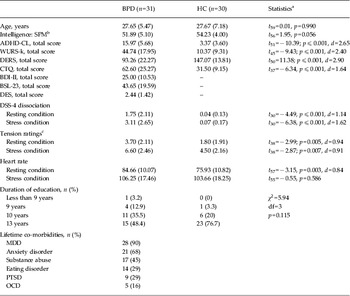
A total of 65 females aged between 18 and 46 years were recruited via advertisements in newspapers and on websites or referred from the residential unit of the Department of Psychosomatic Medicine and Psychotherapy at the Central Institute of Mental Health (CIMH) in Mannheim, Germany. All participants underwent diagnostic assessments including the Structured Clinical Interview for DSM-IV Axis I Disorders (SCID-I; First et al. Reference First, Spitzer, Gibbon and Williams1997) and the whole BPD section of the International Personality Disorder Examination (IPDE; Loranger, Reference Loranger1999; inter-rater-reliability κ = 0.77), which is based on the Diagnostic and Statistical Manual of Mental Disorders, fourth edition (DSM-IV) criteria for BPD. Diagnostics were assessed by well-trained clinical psychologists who were regularly supervised and trained by experts. In addition, all participants completed the Standard Progressive Matrices (SPM) test (Raven et al. Reference Raven, Raven and Court2003) as an estimator of general intelligence. Patients were included when meeting DSM-IV criteria for BPD (APA, 2000). Exclusion criteria were psychotropic medication within 2 weeks prior to the study, substance abuse within the last 6 months, current major depression, lifetime history of bipolar affective disorder or psychotic disorder [including brief psychotic disorder and psychotic disorders not otherwise specified, but not stress-related paranoid and dissociative symptoms in the context of the ninth DSM-IV criterion (APA, 2000) for BPD], current suicidal crisis, mental deficiency and developmental disorder, pregnancy, and significant somatic diseases. Exclusion criteria for the HC group were lifetime history of mental disorders and/or significant somatic disorders. The total sample comprised 35 patients with BPD and 30 HCs. Three BPD patients cancelled participation before the end of the study; one patient had to be excluded because of alcohol abuse. There were no significant group differences regarding age, educational level and general intelligence (see Table 1).
Demographic and clinical variables in patients with BPD and HC participants

Data are given as mean (standard deviation).
BPD, Borderline personality disorder; HC, healthy control; SPM, Standard Progressive Matrices; ADHD-CL, Attention Deficit Hyperactivity Disorder Checklist according to DSM-IV; WURS-k, Wender Utah Rating Scale short version; DERS, Difficulties in Emotion Regulation Scale; CTQ, Childhood Trauma Questionnaire; BDI-II, Beck Depression Inventory; BSL-23, Borderline Symptom List-23; DES, Dissociative Experience Scale; DSS-4, Dissociation Stress Scale-4; df, degrees of freedom; MDD, major depressive disorder; PTSD, post-traumatic stress disorder; OCD, obsessive compulsive disorder.
a Statistical group comparisons were by t tests and χ 2 test.
b Sample size of BPD patients for SPM is 28.
c Sample size for tension ratings in both groups is 20.
Clinical diagnostics and basic assessments
Further clinical assessments in the patient group comprised questionnaires on symptom severity [Borderline Symptom List-23 (BSL-23); Bohus et al. Reference Bohus, Limberger, Frank, Chapman, Kuehler and Stieglitz2007], childhood trauma history [Childhood Trauma Questionnaire (CTQ); Bernstein et al. Reference Bernstein, Stein, Newcomb, Walker, Pogge, Ahluvalia, Stokes, Handelsman, Medrano, Desmond and Zule2003], trait dissociation [Dissociative Experience Scale (DES); Bernstein & Putnam, Reference Bernstein and Putnam1986] and dysphoric mood [Beck Depression Inventory-II (BDI-II); Beck et al. Reference Beck, Steer, Ball and Ranieri1996].
Current ADHD symptoms were assessed by the ADHD Checklist (ADHD-CL), which is based on the DSM-IV criteria for ADHD (APA, 2000) and rated on a three-point scale (0 = ‘not applicable’ to 2 = ‘applicable’). In addition, all participants completed the short version of the Wender Utah Rating Scale (WURS-k), a self-report scale consisting of 25 items on ADHD symptoms in childhood that are answered on a five-point Likert scale (0 = ‘not applicable’ to 4 = ‘applicable’) (Retz-Junginger et al. Reference Retz-Junginger, Retz, Blocher, Stieglitz, Georg, Supprian, Wender and Rösler2003). Emotion-regulation capacities were assessed by the total score of the Difficulties in Emotion Regulation Scale (DERS; Gratz & Roemer, Reference Gratz and Roemer2004). The DERS consists of 36 items that reflect difficulties within different dimensions of emotion regulation: awareness, clarity, and acceptance of emotions, access to emotion-regulation strategies perceived as effective, ability to engage in goal-directed behaviour as well as refrain from impulsive behaviour, when experiencing negative emotions. Items are answered on a five-point Likert scale (1 = 'almost never’ to 5 = 'almost always’). Higher DERS scores indicate better emotion-regulation capacities.
Stress levels were assessed via heart rate and by a 10-point Likert scale for subjective stress levels, which is part of the Dissociation Stress Scale-4 (DSS-4; Stiglmayr et al. Reference Stiglmayr, Schmahl, Bremner, Bohus and Ebner-Priemer2009). The other four items of the DSS-4 assess current dissociative experiences (derealization, depersonalization, altered pain perception and hearing) and are answered on a 10-point Likert scale (0 = ‘not at all’ to 9 = 'extremely’). Means and s.d.s of all ratings and co-morbid psychiatric disorders in BPD patients are presented in Table 1.
Self-reports of impulsivity
Impulsive traits were assessed by three different self-report scales. The Barratt Impulsiveness Scale-11 (BIS-11; Patton et al. Reference Patton, Stanford and Barratt1995) consists of 30 items, which are answered on a four-point Likert scale (1 = 'rarely/never’ to 4 = 'always’) and refer to the subscales motor impulsiveness, non-planning impulsiveness, and attentional impulsiveness. The Urgency (lack of) Premeditation (lack of) Perseverance Sensation Seeking Impulsive Behaviour Scale (UPPS; Whiteside & Lynam, Reference Whiteside and Lynam2001) is a 45-item self-report scale that measures four different personality traits related to impulsive behaviour: ‘urgency’ describes a tendency to act rashly during negative affective states; ‘(lack of) premeditation’ refers to difficulties in anticipating consequences of an act before executing it; ‘(lack of) perseverance’ assesses the ability to maintain attention during frustrating tasks; and ‘sensation seeking’ measures the tendency to seek exciting and potentially dangerous experiences. Items are answered on a four-point Likert scale (1 = 'very applicable’ to 4 = ‘not applicable’). The trait version of the State-Trait Anger Expression Inventory (STAXI; Spielberger, Reference Spielberger1996) consists of 10 items assessing the tendency to express anger (1 = 'hardly ever’ to 4 = 'almost always’).
State impulsivity was assessed by the State Impulsivity Questionnaire (STIMP; Wingrove & Bond, Reference Wingrove and Bond1997), a self-report scale consisting of 18 items that was developed for repeated measurement of impulsivity. Every item is introduced by the sentence ‘I am in the sort of mood in which I …’ and has to be answered on a 4.5-cm visual analogue scale with one end indicating impulsive reactions and the other end indicating non-impulsive reactions. In the present study an 11-point Likert scale was used instead of the 4.5-cm visual analogue scale.
Laboratory tasks
The go/stop task (Dougherty et al. Reference Dougherty, Mathias, Marsh and Jagar2005) is a stop-signal test that assesses the ability to withhold ongoing responses. Series of randomly generated black five-digit numbers (e.g. 59 213) are presented subsequently on the computer screen (each appearing for 500 ms). Every time the present number matches the previous number identically, participants are instructed to press a mouse button as quickly as possible (‘no-stop trials’). If the colour of a target changes from black to red (‘stop signal’, occurring between 50 and 350 ms after stimulus onset), the response has to be withheld (‘stop trials’). If the five-digit number does not exactly match the previous number, the participant is instructed to withhold responding as well (‘novel trials’). The proportion of trial types in our study was 25% no-stop trials, 25% stop trials, and 50% novel trials. Higher percentages of failed inhibitions (during ‘stop trials’) indicate more difficulties in response inhibition.
In the computerized version of the Iowa Gambling Task (IGT; originally developed by Bechara et al. Reference Bechara, Damásio, Damásio and Anderson1994), four decks of cards are displayed face down on a computer screen. In every trial, participants are asked to turn over one card of these decks by pressing the button 1, 2, 3 or 4 on the keyboard. Participants start with an initial amount of €2000 and are instructed to gain a maximum of (fake) money by detecting ‘advantageous’ card decks. ‘Disadvantageous’ decks (1 and 2) yield immediate high rewards, but even higher losses at unpredictable points of time, whereas ‘advantageous’ decks (3 and 4) yield smaller losses in combination with smaller immediate rewards. After every choice, feedback in terms of net gain or loss is presented on the computer screen. Participants are not informed about the overall number of trials. High percentages of disadvantageous deck choices are considered an indicator for impulsive decision making.
Stress induction
Stress was induced by the MMST, which involves simultaneous exposure to different types of stressors: an emotional (aversive pictures), a sensory (white noise displayed over headset), a cognitive (calculation under time pressure: PASAT-C; Lejuez et al. Reference Lejuez, Kahler and Brown2003), and a motivational component (loss of money due to calculation errors). In previous studies this combination successfully induced stress within a short period of time (Kolotylova et al. Reference Kolotylova, Koschke, Bär, Ebner-Priemer, Kleindienst, Bohus and Schmahl2010; Reinhardt et al. Reference Reinhardt, Schmahl, Wüst and Bohus2012, Reference Reinhardt, Kleindienst, Treede, Bohus and Schmahl2013).
Procedure
The study was approved by the ethics committee of the University of Heidelberg and conducted in accordance with the Declaration of Helsinki. All participants were informed about the background and procedure of the experiment, signed a written informed consent, underwent diagnostics (SCID-I, IPDE, SPM) and completed the basic clinical assessments. The experiment took place at a laboratory of the CIMH during two different sessions (within a 3-day interval) in randomized order to compensate for order and learning effects. During one session, participants completed the STIMP and DSS-4 (including the item on current stress) and performed behavioural tasks (go/stop, IGT) under resting conditions. At the beginning of the other session (‘stress condition’), baseline heart rate was assessed for 5 min. Afterwards, the instruction of the MMST was given and participants practised the PASAT-C. To ensure that participants are willing to tolerate the kind of pictures presented later on during the MMST, four exemplary pictures were shown. Then, the MMST was performed for a total duration of 5 min and heart rate was measured again. After the practice session and after stress induction participants completed the STIMP and DSS-4 once more. At the end of the study, participants were debriefed, thanked, and paid for their participation.
Data analyses
All data were congruent with normal distribution according to Kolmogorov–Smirnov tests. Equality of variance was tested by Levene's test. Threshold for statistical significance was set at p < 0.05, two-tailed. Effect sizes partial eta square (η p 2) and Cohen's d (Cohen, Reference Cohen1988) are reported.
Correlation analysis between ADHD symptoms, impulsivity measures and emotion-regulation capacities
Bivariate Pearson's product-moment correlations for the whole sample between ADHD-CL and WURS-k, BIS-11 subscales, UPPS subscales, STAXI, STIMP in resting and stress conditions, and DERS total scores were calculated. In BPD patients, additional bivariate Pearson's product-moment correlations between self-reported emotion-regulation capacities (DERS) and measures of impulsivity were computed. Bonferroni correction was used to account for multiple comparisons.
Manipulation check
Subjective ratings of stress during resting conditions and after stress induction as well as heart rate during baseline and stress induction were compared using paired t tests.
Self-reports on impulsivity
To compare mean scores of trait impulsivity questionnaires between groups, analyses of variance (ANOVAs) were computed: a univariate ANOVA with STAXI scores, a multivariate ANOVA (MANOVA) with BIS-11 subscales, and another MANOVA with UPPS scales as dependent variables. STIMP scores (state impulsivity) after MMST practice session and after MMST performance were averaged and compared with STIMP scores under resting conditions using a 2 × 2 repeated-measures (rm) ANOVA with group (BPD v. HC) as between-factor and condition (resting v. stress condition) as within-factor. In the case of significant effects post-hoc group comparisons were computed using t tests.
Behavioural impulsivity
Percentage of failed response inhibition in the go/stop task and percentage of disadvantageous card choices in the IGT were used as dependent variables for behavioural impulsivity. For both variables, separate 2 × 2 rm-analyses of covariance (ANCOVA) with group (HC v. BPD) as between-factor, condition (resting v. stress) as within-factor, and ADHD-CL as covariate were computed. In case of significant effects, post-hoc multivariate ANCOVA (dependent variables: percentage of failed response inhibition and disadvantageous card choices at resting and stress conditions; ADHD-CL as covariate) were computed.
Results
Manipulation check: stress induction
Means and s.d.s for subjective tension ratings (DSS-4 item) and heart rate are depicted in Table 1. Participants in both groups reported significantly higher stress levels after MMST performance (HC: t 19 = 6.47, p ⩽ 0.001, d = 1.32; BPD: t 19 = 4.68, p ⩽ 0.001, d = 1.27). Likewise, the increase in baseline heart rate to peak rate, which was defined as the highest level of heart beat during stress induction, was significant in both groups (HC: t 28 = 9.21, p ⩽ 0.001, d = 1.85; BPD: t 27 = 7.30, p ⩽ 0.001, d = 1.52).
Correlation analysis: ADHD symptoms, impulsivity measures and emotion-regulation capacities
For the whole sample, a significant positive correlation between ADHD-CL scores and WURS-k scores (r = 0.733, p ⩽ 0.001) was found highlighting the association between severity of childhood and adult ADHD symptoms. ADHD-CL scores and DERS total scores were negatively correlated (r = − 0.811, p ⩽ 0.001), indicating that current ADHD symptoms are accompanied by reduced emotion-regulation capacities. There were also strong correlations between ADHD-CL and BIS-11 subscales, UPPS subscales, STAXI, and STIMP at resting and stress conditions (median r = 0.711, maximum r = 0.849, p ⩽ 0.001). Because of these high correlations of the self-report measures, the ADHD-CL score was omitted as covariate in the following analyses of self-reported emotion-regulation capacities, trait and state impulsivity, but not in the analyses of behavioural impulsivity measures.
In the BPD group, significant negative correlations were found between DERS scores and scores of the BIS-11 subscale attentional impulsiveness (r = − 0.563, p ⩽ 0.001), UPPS urgency (r = − 0.677, p ⩽ 0.001) and STAXI (r = − 0.660, p ⩽ 0.001) (Bonferroni correction: α’ = 0.004). There were no significant correlations between DERS scores and other self-reports or behavioural impulsivity measures.
Self-reported trait impulsivity: BIS-11, UPPS and STAXI
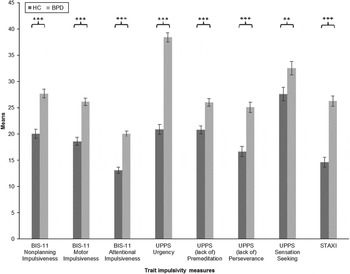
Means and s.e.m.s of BIS-11 subscales, UPPS subscales and STAXI total scores are presented in Fig. 1. The MANOVA with BIS-11 subscales revealed a significant main effect of group (F 3,57 = 31.54, p ⩽ 0.001, η p 2 = 0.62). There were significantly higher impulsivity levels in BPD patients for all BIS-11 subscales: motor impulsiveness (F 1,59 = 52.42, p ⩽ 0.001, η p 2 = 0.47), non-planning impulsiveness (F 1,59 = 40.65, p ⩽ 0.001, η p 2 = 0.41) and attentional impulsiveness (F 1,59 = 81.00, p ⩽ 0.001, η p 2 = 0.58). The MANOVA with UPPS subscales also revealed a significant main effect of group (F 4,56 = 43.92, p ⩽ 0.001, η p 2 = 0.76). BPD patients reported significantly higher scores in the subscales urgency (F 1,59 = 177.40, p ⩽ 0.001, η p 2 = 0.75), (lack of) premeditation (F 1,59 = 22.68, p ⩽ 0.001, η p 2 = 0.28), (lack of) perseverance (F 1,59 = 39.88, p ⩽ 0.001, η p 2 = 0.40) and sensation seeking (F 1,59 = 7.47, p = 0.008, η p 2 = 0.11). BPD patients also showed significantly higher STAXI scores than HCs (F 1,59 = 75.97, p ⩽ 0.001, η p 2 = 0.56).
Self-reported trait impulsivity [Barratt Impulsiveness Scale-11 (BIS-11), Urgency (lack of) Premeditation (lack of) Perseverance Sensation Seeking Impulsive Behaviour Scale (UPPS) and State-Trait Anger Expression Inventory (STAXI)] in patients with borderline personality disorder (BPD) and healthy control (HC) participants. Values are means, with standard errors represented by vertical bars. Mean values were significantly different: ** p < 0.01, *** p ⩽ 0.001.

Self-reported state impulsivity: STIMP scores
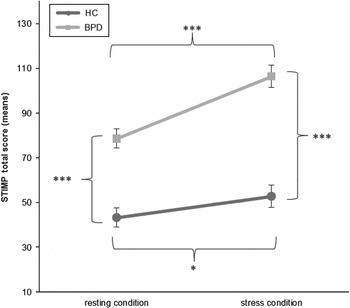
Fig. 2 shows the mean values and s.e.m.s of STIMP total scores under resting and stress conditions as well as post-hoc t tests. The rm-ANOVA revealed a significant main effect of condition (F 1,59 = 35.07, p ⩽ 0.001, η p 2 = 0.37), with significantly increased STIMP total scores after stress induction in both groups. In addition, we found a significant main effect of group (F 1,59 = 59.71, p ⩽ 0.001, η p 2 = 0.50), with significantly higher STIMP scores under both conditions in BPD patients compared with HCs. Moreover, there was a significant condition x group interaction effect (F 1,59 = 8.56, p = 0.005, η p 2 = 0.13): post-hoc t tests indicated a significantly stronger increase in state impulsivity after stress induction in BPD patients compared with HCs.
Self-perceived impulsivity [State Impulsivity Questionnaire (STIMP) scores] in patients with borderline personality disorder (BPD) and healthy control (HC) participants. Values are means, with standard errors represented by vertical bars. Mean values were significantly different: * p < 0.05, *** p ⩽ 0.001.

Behavioural impulsivity: response inhibition (go/stop task)
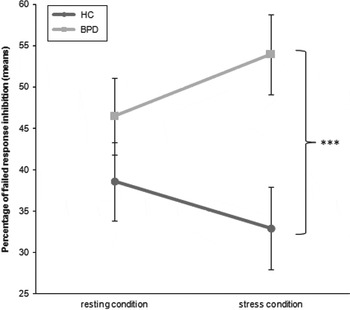
Means and s.e.m.s of percentages of failed response inhibition in the go/stop task under resting and stress conditions in BPD patients and HCs are depicted in Fig. 3. The rm-ANCOVA with ADHD-CL as covariate revealed a significant main effect of condition (F 1,58 = 5.71, p = 0.020, η p 2 = 0.09) and a significant condition x group interaction effect (F 1,58 = 4.56, p = 0.037, η p 2 = 0.07). The main effect of group was not significant (F 1,58 = 3.59, p = 0.063). Post-hoc group comparisons revealed higher percentages of failed response inhibition in BPD patients compared with HCs under stress conditions (F 1,58 = 6.28, p = 0.015, η p 2 = 0.10), but not under resting conditions (F 1,58 = 0.95, p = 0.333), when including ADHD-CL as covariate (results of a rm-ANOVA without ADHD as covariate are shown in online Supplementary Fig. S1).
Percentage of failed response inhibition (go/stop task) in patients with borderline personality disorder (BPD) and healthy control (HC) participants with Attention Deficit Hyperactivity Disorder Checklist according to DSM-IV score as covariate. Values are means, with standard errors represented by vertical bars. Mean values were significantly different (*** p ⩽ 0.001).

Behavioural impulsivity: feedback-directed decision making (IGT)
No significant rm-ANCOVA effects for percentages of disadvantageous card choices in the IGT under resting and stress conditions were found.
Discussion
The aim of our study was to investigate the impact of stress on different components of impulsivity considering ADHD symptoms in patients with BPD compared with HCs. Participants completed questionnaires on trait and state impulsivity and two laboratory paradigms (go/stop task, IGT) under resting conditions and after stress induction (MMST; Kolotylova et al. Reference Kolotylova, Koschke, Bär, Ebner-Priemer, Kleindienst, Bohus and Schmahl2010). The main findings of our study were:
-
(1) Self-reports: patients with BPD showed higher levels of impulsive traits and states under resting conditions and a stronger stress-dependent increase in impulsivity compared with HCs. Significant correlations between self-reported difficulties in emotion regulation and attentional impulsiveness, urgency and anger expression were found in the patient group.
-
(2) Behavioural impulsivity: compared with HCs, BPD patients showed more failures in response inhibition under stress, even when considering self-reported ADHD symptoms, but not under resting conditions. No significant group differences were observed for feedback-related decision making.
Higher self-appraisals of impulsivity in BPD
BPD patients reported higher levels of impulsive traits than HCs, which is consistent with our hypothesis and previous studies applying the same self-report scales (Dougherty et al. Reference Dougherty, Bjork, Huckabee, Moeller and Swann1999; Henry et al. Reference Henry, Mitropoulou, New, Königsberg, Silverman and Siever2001; Berlin et al. Reference Berlin, Rolls and Iversen2005; McCloskey et al. Reference McCloskey, New, Siever, Goodman, Koenigsberg, Flory and Coccaro2009; Jacob et al. Reference Jacob, Gutz, Bader, Lieb, Tüscher and Stahl2010; Lynam et al. Reference Lynam, Miller, Miller, Bornovalova and Lejuez2011) or other questionnaires (Bornovalova et al. Reference Bornovalova, Lejuez, Daughters, Zachary Rosenthal and Lynch2005; Sebastian et al. Reference Sebastian, Jacob, Lieb and Tüscher2013a ). To be more specific, patients with BPD scored higher on the BIS-11, which comprises motor, non-planning, and attentional impulsiveness. In the UPPS scale, BPD patients reported a lower perseverance in frustrating tasks (lack of perseverance), a higher tendency to seek exciting activities (sensation seeking), more difficulties in anticipating consequences of their behaviour (lack of premeditation), and, most prominently, stronger urges to act rashly during negative affective states (urgency). Patients with BPD further reported an elevated tendency to express their anger (STAXI).
In addition, BPD patients demonstrated higher state impulsivity (STIMP) than HCs even under resting conditions, confirming findings of a previous study from our group (Krause-Utz et al. Reference Krause-Utz, Sobanski, Alm, Valerius, Kleindienst, Bohus and Schmahl2013). Contrary to findings of the previous study, both BPD patients and HCs reported increased state impulsivity after stress induction in the present study. These discrepancies may be related to the use of different stressors: while in the previous study stress was induced by the PASAT-C, in the present study we induced stress by the MMST, which involves a simultaneous exposure to various stressors. Notably, the stress-dependent increase in self-reported state impulsivity was stronger in the BPD group, which suggests that self-perceived impulsive states in individuals with this disorder are aggravated by stress.
Self-reported ADHD scores have not been included as a covariate when analysing self-reported measures of impulsivity. The broad spectrum of impulsivity domains assessed by ADHD scores resulted in a level of overlap between ADHD scores and the impulsivity self-reports that was too high to be reliably disentangled by the participants of the study. Statistically, this high level of overlap has been verified by correlations and tolerance scores that indicated a high level of multicollinearity between these self-report measures.
Impulsive decision making
On the behavioural level, no differences in the IGT were observed, independently from the stress level. While previous studies observed significantly more difficulties in feedback-related decision making in BPD patients (Haaland & Landrø, Reference Haaland and Landrø2007; Kirkpatrick et al. Reference Kirkpatrick, Joyce, Milton, Duggan, Tyrer and Rogers2007; Maurex et al. Reference Maurex, Zaboli, Wiens, Asberg, Leopardi and Ohman2009; Schuermann et al. Reference Schuermann, Kathmann, Stiglmayr, Renneberg and Endrass2011; Svaldi et al. Reference Svaldi, Philipsen and Matthies2012), patients in the present study did not make more disadvantageous card choices compared with HCs.
Deficient response inhibition
As another component of behavioural impulsivity, we assessed response inhibition under resting and stress conditions. Compared with HCs, patients with BPD showed significantly impaired performance in the go/stop task after stress induction, even when considering self-reported ADHD symptoms. In contrast, group differences under resting conditions did not remain significant when current ADHD symptoms were statistically controlled as a covariate. This finding suggests that response-inhibition deficits observed under normal conditions were partly explained by the presence of clinically relevant ADHD features (ADHD-CL) in our sample of BPD patients. These data are in line with previous studies reporting that impulse-control problems are more pronounced in a subgroup of BPD patients with co-morbid ADHD (Lampe et al. Reference Lampe, Konrad, Kroener, Fast, Kunert and Herpertz2007; Krause-Utz et al. Reference Krause-Utz, Sobanski, Alm, Valerius, Kleindienst, Bohus and Schmahl2013; Sebastian et al. Reference Sebastian, Jacob, Lieb and Tüscher2013a ), whereas impulse-control deficits in BPD patients without co-occurring ADHD may become prominent only in stressful emotional contexts (Sebastian et al. Reference Sebastian, Jacob, Lieb and Tüscher2013a ). The heterogeneity of co-morbid ADHD may explain why previous studies in BPD samples investigating response inhibition (under resting conditions) revealed discrepant results (Leyton et al. Reference Leyton, Okazawa, Diksic, Paris, Rosa, Mzengeza, Young, Blier and Benkelfat2001; Rentrop et al. Reference Rentrop, Backenstrass, Jaentsch, Kaiser, Roth, Unger, Weisbrod and Renneberg2008) and no overall deficits (Kunert et al. Reference Kunert, Druecke, Sass and Herpertz2003; Dinn et al. Reference Dinn, Harris, Aycicegi, Greene, Kirkley and Reilly2004; Ruchsow et al. Reference Ruchsow, Groen, Kiefer, Buchheim, Walter, Martius, Reiter, Hermle, Spitzer, Ebert and Falkenstein2008; McCloskey et al. Reference McCloskey, New, Siever, Goodman, Koenigsberg, Flory and Coccaro2009; Jacob et al. Reference Jacob, Gutz, Bader, Lieb, Tüscher and Stahl2010; LeGris et al. Reference LeGris, Links, van Reekum, Tannock and Toplak2012; Jacob et al. Reference Jacob, Ower and Buchholz2013).
The finding of impaired response inhibition under stress is in line with several other studies in BPD patients demonstrating neuropsychological deficits in negative emotional contexts (Domes et al. Reference Domes, Winter, Schnell, Vohs, Fast and Herpertz2006; Silbersweig et al. Reference Silbersweig, Clarkin, Goldstein, Kernberg, Tuescher, Levy, Brendel, Pan, Beutel, Pavony, Epstein, Lenzenweger, Thomas, Posner and Stern2007; Wingenfeld et al. Reference Wingenfeld, Mensebach, Rullkoetter, Schlosser, Schaffrath, Woermann, Driessen and Beblo2009; Chapman et al. Reference Chapman, Dixon-Gordon, Layden and Walters2010; Krause-Utz et al. Reference Krause-Utz, Oei, Niedtfeld, Bohus, Spinhoven, Schmahl and Elzinga2012; Prehn et al. Reference Prehn, Schulze, Rossmann, Berger, Vohs, Fleischer, Hauenstein, Keiper, Domes and Herpertz2013). However, some studies in BPD patients observed no effects of (experimentally induced) mood on behavioural impulsivity (Lawrence et al. Reference Lawrence, Allen and Chanen2010; Jacob et al. Reference Jacob, Ower and Buchholz2013) or even improved performance under stress conditions (Chapman et al. Reference Chapman, Leung and Lynch2008; Krause-Utz et al. Reference Krause-Utz, Sobanski, Alm, Valerius, Kleindienst, Bohus and Schmahl2013). These discrepancies may be explained by different sample or task characteristics. For example, stop-signal tasks differ from go/no-go tasks in regard to automatic or controlled response-inhibition processes (Lenzenweger et al. Reference Lenzenweger, Clarkin, Fertuck and Kernberg2004; Sebastian et al. Reference Sebastian, Pohl, Klöppel, Feige, Lange, Stahl, Voss, Klauer, Lieb and Tüscher2013b ) and future studies should include both kinds of tasks when investigating response inhibition dependent on stress induction in BPD. It is also possible that BPD patients are able to compensate subjective impulsivity by enhancing inhibitory-control mechanisms during moderate stress levels. In situations of high stress, their efforts may break down and lead to unexpected behavioural changes.
Correlations between measures of impulsivity and emotion-regulation capacities
In the present study, we observed significant correlations between self-reports of emotion-regulation capacities and impulsive traits: BPD patients, who reported more difficulties in emotion regulation, also reported more difficulties in focusing attention, stronger urges to act rashly without thinking and to express their anger during negative affective states. Since correlational findings do not imply causality, it is also possible that individuals with BPD with high impulsive traits have more difficulties in acquiring emotion-regulation skills. To further clarify the relationship between emotion dysregulation and impulsivity in BPD, future studies could investigate whether aspects of impulsivity are altered after emotion-regulation training. Moreover, future studies in BPD patients could compare behavioural performance under moderate versus high stress levels to further elucidate this issue.
A strength of our study is the relatively large sample of well-characterized and unmedicated participants. BPD patients and HCs did not differ in age, level of education and general intelligence. However, some limitations have to be mentioned. First, we investigated only female BPD patients and cannot draw conclusions regarding the effects of stress on impulsivity in male patients. Moreover, we assessed ADHD symptoms only by self-report measures (WURS-k and ADHD-CL) and controlled for the symptoms only statistically. The presence of ADHD symptoms is highly representative of clinical samples of BPD patients and there is an ongoing debate whether BPD and adult ADHD are distinct disorders or rather two different expressions of one continuum (Philipsen, Reference Philipsen2006; Philipsen et al. Reference Philipsen, Limberger, Lieb, Feige, Kleindienst, Ebner-Priemer, Barth, Schmahl and Bohus2008, Reference Philipsen, Feige, Hesslinger, Scheel, Ebert, Matthies, Limberger, Kleindienst, Bohus and Lieb2009; Ferrer et al. Reference Ferrer, Andión, Matalí, Valero, Navarro, Ramos-Quiroga, Torrubia and Casas2010; Van Dijk et al. Reference Van Dijk, Lappenschaar, Kan, Verkes and Buitelaar2011). Therefore, studies using dimensional approaches can help to gain deeper insight into the role of ADHD features in impulsivity in BPD. Nevertheless, studies including a clinical control group of ADHD patients are needed to distinguish different components of impulsivity in BPD and adult ADHD.
Beyond response inhibition and decision making/reward choice, there are several other laboratory paradigms (e.g. punished/extinction paradigms) that should be included in further studies on impulsivity. Furthermore, the kind of experimentally induced stress in our study may not resemble the stressful situations in the everyday life of individuals with BPD. The significant increase in heart rate and stress ratings observed in HCs and BPD patients indicates that the MMST successfully induced stress in our study. Nevertheless, future studies could include other stressors such as social stress, which might be of higher ecological validity in BPD.
Conclusion
Impulse control is essential for goal-directed behaviour in different areas of life (e.g. social interactions, education and employment). Deficient impulse control in general can have devastating consequences (Magen & Gross, Reference Magen, Gross and Hoyle2010). Beyond that, impulsive behaviour in individuals with BPD – such as anger outburst, sudden relationship breakups, binge eating, shoplifting, reckless driving or drug abuse – is predominantly self-destructive and oftentimes life threatening. Teaching skills to improve distress tolerance and impulse control is an essential feature of established psychosocial treatments like dialectical behaviour therapy (Linehan, Reference Linehan1993). Utilization of learned skills under daily life conditions is of uppermost importance for treatment response. Expanding our knowledge about the specific conditions of impulse-control deficits in BPD should improve this need. Findings of our present study indicate a positive correlation between stress and self-perceived impulsive states as well as response inhibition in BPD. These findings indicate that BPD patients ought to be trained to self-administer impulse-control skills mainly under stressful conditions.
Supplementary material
For supplementary material accompanying this paper visit http://dx.doi.org/10.1017/S0033291714000427.
Acknowledgements
We thank all participants of this study for their collaboration. The present study was funded by a grant of the German Research Foundation (DFG, grant no. SCHM 1526/13-1-).
Declaration of Interest
None.