Introduction
The prevalence of diabetes increases with age, and in the UK half the diabetic population is aged over 65 years, and a quarter over 75 years.1 As the number of obese adults is predicted to rise,Reference Haslam and James2 the proportion of those in middle age with diabetes is likely to increase, with subsequent complications in older age. Despite the fact that a significant proportion of people with diabetes are elderly, in many large clinical trials they are excluded and so we are forced to extrapolate clinical trial results from younger populations to this heterogeneous group. A literature review was performed using Medline 1980–2009 to identify literature relevant to older people with diabetes. Full details of the search methods are available from the corresponding author.
The pathophysiology of diabetes in older people differs from that at younger ages. Older people diagnosed with diabetes tend to be leaner than their younger counterparts and may have normal fasting glucose levels, but an abnormal response to a glucose load. This has implications for both diagnosis and treatment. Insulin resistance may occur due to lipid accumulation within muscle as body composition changes with age. In addition, impairment of insulin secretion due to age-related pancreatic islet cell dysfunction, a reduction in insulin-mediated glucose disposal and a decrease in non-insulin-mediated glucose uptake into organs such as the brain all produce alterations in glucose tolerance.Reference Chang and Halter3 This has led to the proposal of ‘Type 1½ diabetes’.Reference Morley4 Glycated haemoglobin levels (HbA1c) are positively associated with age in non-diabetic people and in the elderly population the upper limit of HbA1c may be as high as 6.6%.Reference Pani, Korenda and Meigs5
Since 1998, the United Kingdom Prospective Diabetes Study (UKPDS) has been the principal study in type 2 diabetes and has formed the basis for guidelines of care. The study recruited 5102 patients with newly diagnosed type 2 diabetes aged 25–65 years (mean age 53 years) between 1977 and 1993 and followed them up for an average of 10 years. The aim was to determine whether ‘tight’ glycaemic control with drugs could reduce diabetes-related complications. The study also looked at whether specific glucose-lowering therapies had advantages or disadvantages. A separate arm looked at whether blood pressure lowering with a beta-blocker or ACE-inhibitor deceased microvascular or macrovascular complications.
A progressive loss in pancreatic beta-cell function was observed with time, regardless of treatment. Although intensive blood glucose control with either sulphonylureas or insulin reduced microvascular complications by 25%, there was no significant reduction in cardiovascular disease.6 Those more tightly controlled with treatment had significant weight gain and hypoglycaemia (more so with insulin than sulphonylureas). By comparison, obese patients treated intensively with metformin had a reduction in diabetes-related end-points (including diabetes-related deaths, all cause mortality and myocardial infarction) by about one third,7 and an additional advantage of less weight gain and fewer hypoglycaemic episodes. For those in the blood pressure-lowering arm of the study, tight blood pressure control (defined as 144/82 mmHg) produced significant reductions in diabetes-related deaths, strokes, microvascular disease and visual loss, with a non-significant reduction in all-cause mortality.8 The effect was seen regardless of antihypertensive used.9 There was a continuous relationship between diabetes-related outcomes and systolic blood pressure above 130 mmHg.
Recommendations developed from these findings were that blood glucose should be lowered to as near normal levels as possible, as ‘there was a direct relationship between the risk of complications of diabetes and glycaemia over time and no threshold of glycaemia was observed for a substantive change in risk for any of the clinical outcomes examined’ and that blood pressure should be targeted at <140/80.10
This was the state of evidence until 2008, with the UKPDS being the single major clinical trial that informed guideline development. However, in 2008 and 2009, five major clinical trials were published in the New England Journal of Medicine Reference Gaede, Lund-Andersen, Parving and Pedersen12–Reference Duckworth, Abraira and Moritz16:
1 Effect of a multifactorial intervention on mortality in type 2 diabetes (Steno-2).
2 Action in Diabetes and Vascular Disease: Preterax and Diamicron Modified Release Controlled Evaluation trial (ADVANCE).
3 Action to Control Cardiovascular Risk in Diabetes (ACCORD).
4 10 year follow-up of intensive glucose control in type 2 diabetes (post UKPDS).
5 Glucose control and vascular complications in veterans with type 2 diabetes (VADT).
These trials can be usefully divided into two groups: post randomized controlled trial (RCT) studies lasting 13–30 years (Steno 2 and UKPDS legacy trial) and trials of the effect of tight glycaemic control, lowering HbA1c below 7%, on major vascular outcomes (ADVANCE, ACCORD and VADT).
Post RCT studies
Effect of a multifactorial intervention on mortality in type 2 diabetesReference Gaerde, Vedel, Larsen, Jensen, Parving and Pedersen11, Reference Gaede, Lund-Andersen, Parving and Pedersen12
The Steno-2 study was a randomized controlled trial of an intensified targeted multifactorial intervention aimed at modifiable risk in patients with type 2 diabetes and microalbuminuria. A follow-up study to Steno-2 was carried out 5.5 years after the original randomized controlled trial ended to address the question of mortality and whether risk reductions achieved for micro- and macrovascular disease were maintained.
160 people with type 2 diabetes and persistent microalbuminuria were originally randomized in 1993 to conventional treatment or intensive treatment, and followed up for a mean of 7.8 years. The targets for intensive treatment included HbA1c <6.5%, total cholesterol <4.5 mmol/l and blood pressure (BP) of less than 130/80 mmHg. At randomization, the patients’ average age was 55 years, with a mean body mass index (BMI) of approximately 30 kg/m2, BP of 146–149/85–86 mmHg and HbA1c of 8.4–8.8%. The targets achieved at the end of the intervention study were mean HbA1c 7.9%, compared with 9% in the conventional group (a difference that was statistically significant), BP 131/73 mmHg compared with 146/78 mmHg and total cholesterol of 4.1 mmol/l compared with 5.6 mmol/l. The intensive therapy group had a significantly lower risk of cardiovascular events, nephropathy, autonomic neuropathy and retinopathy. The conclusion from this initial intervention study was that targeted, long-term, intensified intervention of multiple risk factors in patients with type 2 diabetes and microalbuminuria reduced the risk of cardiovascular events.
By follow up at 13.3 years, the mean age of the patients was 66 years and the mean BMI for men was 31.1 kg/m2 for the intensive group and 30.2 kg/m2 for the standard arm, with a mean BP of 140/74 mmHg compared with 146/73 mmHg. The total cholesterol was 3.8 versus 4.0 mmol/l and the mean HbA1c was 7.7% compared with 8.0%. These differences between the intensive therapy and conventional therapy group were not statistically significant. Smoking rates fell by almost half in both groups.
During the entire time of follow-up, 30% of people died in the intensive treatment group compared with 50% in the standard group – an absolute risk reduction for death of 20%. There were nine patients who died in the intensive group from cardiovascular causes compared with 19 in the conventional therapy group (P = 0.03). There was an absolute risk reduction for cardiovascular events (a secondary outcome measure) of 29% in the intensive group, with a hazard ratio of 0.41 (95% confidence interval (CI) 0.25–0.67; P < 0.001). Progression of diabetic retinopathy occurred in 41 patients in the intensively treated group, compared with 54 patients in the conventional treatment arm (relative risk 0.57; 95% CI 0.37–0.88; P = 0.01). Diabetic nephropathy developed in 20 patients in the intensive therapy group, in contrast to 37 patients in the conventional therapy group (relative risk 0.44; 95% CI 0.25–0.77; P = 0.004), with a reduction in progress to end stage dialysis. There was no statistical difference in incidence of major hypoglycaemic episodes between the groups.
Therefore, after a mean of 13.3 years (which included 7.8 years of multifactorial intervention and then 5.5 years of follow-up), there was an absolute risk reduction of 20% for death from any cause in patients with type 2 diabetes and microalbuminuria who were initially treated intensively in terms of blood pressure, lipids and glycaemic control. There was a statistically significant reduction in the progression of nephropathy, retinopathy and autonomic neuropathy in the intensively treated group. Of note, glycated haemoglobin at the end of follow-up remained relatively high, even in the intensively treated group, at 7.7%.
10 year follow-up of intensive glucose control in type 2 diabetesReference Holman, Paul, Bethel, Matthews and Neil13
The UKPDS showed that intensive glucose therapy in people with newly diagnosed type 2 diabetes reduced the risk of microvascular complications, but the effect on myocardial infarction (MI) and death from any cause was not significant. MI was reduced within the metformin arm (relative risk reduction of 39%; P = 0.01). The 10 year post-interventional follow-up study was to determine whether there was a continued microvascular benefit and if there was any effect on long-term macrovascular outcomes.
The mean age of the whole group at final follow-up was 62 years, with a mean BP of 137/77 mmHg, median HbA1c 8.0% and a mean total cholesterol of 5.1 mmol/l. Those treated intensively in the sulphonylurea–insulin group had a lower HbA1c of 7.9% compared with 8.5% in the conventional group (P < 0.001), but they had a higher body weight and BMI, whereas those treated with metformin had a median HbA1c of 8.4% compared with 8.9% in their comparative conventional group (P = 0.12). Baseline differences in mean HbA1c were lost after 1 year of post-trial follow-up. No differences in lipid levels, BP, albumin/creatinine ratio or creatinine were seen between groups.
Outcomes were presented as:
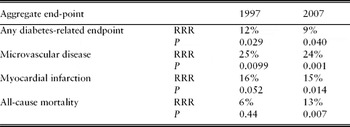
(1) Sulphonylurea–insulin group. At the end of the additional follow-up, the risk reduction for microvascular disease was 24% (P = 0.001). The post-trial risk reduction for MI had achieved significance at 15% (P = 0.01), with a clinically relevant risk reduction for death from any cause of 13% (P = 0.007). However, there was no significant risk reduction in stroke or peripheral vascular disease (PVD). The results are shown in Table 1.
(2) Metformin group. These patients continued to have risk reduction for MI, which had increased to 33% (P = 0.005), but again there was no significant risk reduction for stroke and peripheral vascular disease (PVD).
The conclusion from this study was that good glucose control in the early stages of diabetes reduces microvascular disease, myocardial infarction and mortality in future years. Conversely, poor control early on means an increase in the burden of the disease in later years, even if glycaemic control is improved at that time.
Legacy effect of earlier glucose controlReference Holman, Paul, Bethel, Matthews and Neil13 (from Holman et al., N Engl J Med, 2008)

RRR, relative risk reduction; P, significance level.
In summary, tight glycaemic control is beneficial and continues to convey long-term advantage for people with newly diagnosed diabetes and those with type 2 diabetes and microalbuminuria. The targets achieved for HbA1c in Steno-2 were 7.9% for the intensive group compared with 9% for the conventional group and in UKPDS were 7% for the intensive group compared with 7.9% in the conventional group.
Effect of tight glycaemic control on major vascular outcomes: ‘How low to go?’
Three clinical trials looked at the effect of reducing HbA1c below 7% on vascular outcomes in type 2 diabetes. These were ADVANCE (with target HbA1c <6.5%), ACCORD (with target HbA1c <6.0%) and VADT (with target HbA1c <6.0%).
Intensive blood glucose control and vascular outcomes in patients with type 2 diabetes14
The Action in Diabetes and Vascular Disease: Preterax and Diamicron Modified Release Controlled Evaluation (ADVANCE) trial was established to assess the effects on major vascular outcomes of lowering HbA1c to a target of 6.5% in people with type 2 diabetes. There were two arms to the study – a BP-lowering arm which confirmed that lowering BP reduces major vascular events and death, and a glucose-lowering arm. The end-points were a composite of macrovascular (macrovascular death, non-fatal MI, non-fatal stroke) and microvascular events, including retinopathy and nephropathy.
The trial recruited 11,140 people with type 2 diabetes aged 55 years at entry and duration of diabetes of 8 years, with a history of macrovascular or microvascular disease or at least one cardiovascular risk factor. The mean age at recruitment was 66 years and 42.6% were women. The mean baseline HbA1c was 7.5% and mean BMI was 28 kg/m2.
During the study both statin use and BP-lowering treatment use increased, with a subsequent reduction in low-density lipoprotein (LDL) to 2.65 mmol/l and BP to 135/74 mmHg at the end of follow-up, with no difference between groups. Smoking rates fell in both groups. The HbA1c achieved by the intensive group was 6.5% compared with the mean standard HbA1c of 7.3%. The event rate was lower than predicted and hence the protocol was amended so that follow-up was extended by 18 months.
There was no reduction in macrovascular events; however, there was a 21% significant relative risk reduction in renal events, defined as new or worsening nephropathy and new onset microalbuminuria (4.1% compared with 5.2%; P = 0.02), but there was no significant effect on retinopathy. Macroalbuminuria was reduced to 2.9% compared with 4.1% (P < 0.001) in the standard control group. More patients undergoing intensive control were hospitalized for any cause (44.9 versus 42.8%; P = 0.03). Some of this was due to severe hypoglycaemia (that is, hypoglycaemia requiring treatment from a third party) and overall the severe hypoglycaemia rate was 2.7% compared with 1.5% in the standard group (P < 0.001).
Interestingly, in the subgroup of patients aged over 65 years, there was no significant difference in renal events.
This study confirms the importance of lipid and BP reduction and smoking cessation in reducing macro- and microvascular events as shown by the reduction of observed versus predicted events. Tight glycaemic control reduced the progression of the microvascular complication of nephropathy, but at the risk of increased hypoglycaemia. Subgroup analysis of the older patient group did not, however, show this.
Effects of intensive glucose lowering in type 2 diabetes15
The Action to Control Cardiovascular Risk in Diabetes (ACCORD) was designed to determine whether a therapeutic strategy targeting ‘normal’ HbA1c levels of less than 6.0% would reduce the rate of cardiovascular events, compared with a strategy that maintained HbA1c between 7.0 and 7.9% in middle-aged and older people with type 2 diabetes and either established cardiovascular disease or additional cardiovascular risk factors. The study was terminated 17 months before the scheduled end, and follow-up was for a mean of 3.5 years.
The study recruited people with type 2 diabetes aged 40–79 years with cardiovascular disease, or aged 55–79 years with evidence of left ventricular hypertrophy, albuminuria and atherosclerosis who had a HbA1c greater than 7.5%. There were 10,251 patients assigned to a target HbA1 less than 6.0% or HbA1c 7.0–7.9%. Additional randomization allocated patients to receive intensive BP reduction (target <120 mmHg systolic) or to standard therapy (BP target <140 mmHg) and also to intensive lipid-lowering arm or conventional treatment. The pre-specified primary outcomes were non-fatal MI, non-fatal stroke or death from cardiovascular causes, but there were no primary microvascular outcomes.
At randomization, 38% of the cohort were women, mean age was 62.2 years and median HbA1 was 8.1%. By 4 months after randomization, the HbA1c had fallen from 8.1 to 6.7% in the intensive group and to 7.5% in the standard group. The HbA1c values were achieved at 1 year and remained stable during follow-up, at 6.4 vs. 7.5%. The intensive group had significantly higher rates of severe hypoglycaemia requiring medical assistance (10.5 vs. 3.5%) and requiring any assistance (16.2 vs. 5.1%; P < 0.001), as well as more weight gain at 3 years (3.5 kg compared with 0.4 kg).
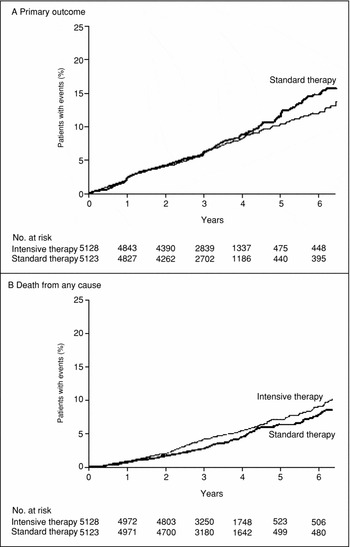
In the intensive group, the rate of non-fatal MI was lower than the standard group (3.6% compared with 4.6%, hazard ratio (HR) 0.76, 95% CI 0.62–0.92; P = 0.004), but the rate of death from cardiovascular causes was higher (2.6% compared with 1.8%, HR 1.35, 95% CI 1.04–1.76). There was no difference in non-fatal stroke. However, the rate of death was significantly higher from any cause in the intensive group (5.0% compared with 4.0%; P = 0.04). The rates of death began to separate after 1 year and the difference persisted during the follow-up period (see Figure 1). Patients in both groups had a lower mortality than reported in epidemiological studies of similar patients, but those in the intensive group had an absolute increase of 1% mortality and a relative risk increase of 22%. It is not possible to unravel the intervention strategy to help explain this increase in mortality, but a proportion of this may be due to the rates of hypoglycaemia.
Kaplan-Meier curves for the primary outcome and death from any cause in the Action to Control Cardiovascular Risk in Diabetes (ACCORD) trial.15 Copyright © (2008) Massachusetts Medical Society. All rights reserved.

Glucose control and vascular complications in veterans with type 2 diabetes (VADT)Reference Duckworth, Abraira and Moritz16
The primary goal of this trial was to compare the effects of intensive and standard glucose control on cardiovascular events. Patients recruited for this trial had poorly controlled type 2 diabetes with an inadequate response to insulin and/or were on maximal oral glucose-lowering treatment. The primary outcome was time to first major cardiovascular event (including MI, stroke and congestive cardiac failure).
The study enrolled 1791 people, of whom approximately 3% were women. The mean age was 60.4 years and diabetes was present for a mean 11.5 years. Of those recruited, 40% had had a previous cardiovascular event, 72% had hypertension and 62% had microvascular complications. At enrolment the mean BMI was 31.3 kg/m2 and the mean HbA1c was 9.4%. Hence these were mainly overweight male patients at high risk of micro- and macrovascular complications with poor diabetes control.
The patients were randomised to intensive treatment with a target HbA1c <6% or standard treatment (HbA1c <9%). During the study, LDL cholesterol in both groups was reduced to 2.1 mmol/l and mean BP was reduced over the 6 years to 125/69 mmHg in the standard group and 127/68 mmHg in the intensive group. The standard group mean HbA1c was maintained from 3 months after baseline at 8.4%, whereas the intensive group achieved HbA1c of 6.9%.
Both the standard and intensive groups had fewer events than predicted. The standard group had been predicted to have 40% events but the observed rate was 33.5%, a relative risk reduction of 16%. This reduction is probably related to the increased intensity of lipid lowering and blood pressure treatment. Additionally, smoking rates in both groups fell significantly. The intensive group also had fewer events than predicted, but there was a significant increase in severe hypoglycaemia (P < 0.001). There was no difference in primary or secondary outcome measures as determined by cardiovascular events and no difference for microvascular outcomes.
So in summary, for men aged 60 years with diabetes for longer than 11 years who had previous cardiovascular events and microvascular disease, intensive treatment with lipid-lowering treatment and blood pressure-lowering treatment reduces the chance over 6 years of a serious cardiovascular event. Intensive treatment with glucose-lowering treatment aiming to reduce HbA1c from 9.4 to 6.0% did not improve outcome but instead increased the risk of hypoglycaemia.
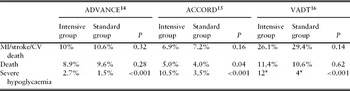
Together, these three studies suggest that in the short term, intensive glucose control (HbA1c 6.4–6.9%) does not reduce cardiovascular events in those aged over 60 years with previously diagnosed type 2 diabetes, but does significantly increase risk of severe hypoglycaemia (see Table 2).
Relative effect of tight glycaemic control on vascular outcomes and hypoglycaemia (from ADVANCE study group, ACCORD study group, N Engl J Med, 2008 and Duckworth et al., N Engl J Med, 2009)

*No/100 patient-year episodes of hypoglycaemia.
Implications for management of elderly patients
HbA1c and cognitive function
Over the past ten years, there has been increasing interest in cognitive function and diabetes. A longitudinal study of women over the age of 65 living in the community showed not only that those with diabetes had lower baseline scores of cognitive functioning, but also that they had accelerated cognitive decline over 6 years.Reference Gregg, Yaffe and Cauley17 One study demonstrated that those with diabetes had a relative risk of developing Alzheimer's disease of 1.8 and of vascular dementia of 2.3.Reference Peila, Rodriguez and Launer18 In addition to established dementia, diabetes is related to a higher risk of mild cognitive impairmentReference Luchsinger, Reitz and Patel19 with a suggestion that earlier age of diagnosis of diabetes, longer duration and presence of diabetes-related complications all increase risk.Reference Roberts, Geda, Knopman and Christianson TJH20 The pathophysiology of cognitive decline in type 2 diabetes is uncertain, with possible mechanisms postulated as neurodegenerative changes manifest as atrophy of the medial temporal lobe, or association with cerebrovascular pathology (both microvascular and macrovascular components).Reference Arvanitakis, Wilson and Bennett21 Other possible mechanisms suggested have been a direct action of insulin on the brain, a rise in levels of oxidative stress, blood–brain barrier dysfunction, or autonomic dysfunction.Reference Aspray22
A recent post-mortem study revealed a difference between those with dementia who had their diabetes treated and those who did not. All those with dementia and diabetes had more microvascular infarcts and increased cortical interleukin-6 concentrations than those without diabetes, but those with their diabetes treated had larger volumes of microvascular infarct compared with untreated patients, who tended towards a higher level of amyloid plaques.Reference Sonnen, Larson and Brickell23 To further confuse this area of uncertainty, many of the anti-psychotics used to manage behavioural symptoms in dementia may themselves be associated with the development of diabetes.Reference Lean and Pajonk24 The practicalities of managing those with diabetes and cognitive impairment may be complicated by the person's inability to communicate symptoms of hypoglycaemia, swallowing disturbances, irregular eating patterns and propensity to metabolic decompensation with intercurrent infection.
Is there evidence to suggest that better management of diabetes improves cognition? The ACCORD-MIND trial demonstrated an age-adjusted inverse relationship between cognitive function and HbA1c level throughout a variety of cognitive tests covering an array of different domains.Reference Cukierman-Yaffe, Gerstein and Williamson25 It remains to be seen if this translates to a clinically meaningful effect.
Hypoglycaemia
Intensive glucose control is associated with clinically significant hypoglycaemia.6 In elderly patients, hypoglycaemia is the commonest diabetic emergency and is associated with considerable morbidity and mortality.Reference Bertoni, Krop and Anderson26, Reference Kagansky, Levy and Rimon27 The risk increases with older age, polypharmacy, intercurrent illness, malnutrition, renal and hepatic impairment and recent hospitalisation.Reference Shorr, Ray and Daugherty28, Reference Chelliah and Burge29 A recent study suggests that hypoglycaemic episodes severe enough to require medical input are associated with an increased risk of dementia, especially in those patients with multiple episodes.Reference Whitmer, Karter and Yaffe30 The absolute risk increase of dementia in those with diabetes and hypoglycaemic events severe enough to warrant admission to hospital or treatment in the Emergency Department was 2.39% per year, which would lead to a considerable cumulative effect in the future. The trials discussed in this paper (ADVANCE, ACCORD and VADT) saw a significant increase in episodes of severe hypoglycaemia in intensively treated patients, where patients required third party input to terminate these episodes. More worryingly, in the ACCORD trial there was a statistically significant increase in death from any cause. The benefits of tight glucose control should therefore be carefully balanced against the risks in older patients, especially in those at high risk of such events.
Conclusions
There is evidence from Steno-2 and the UKPDS follow-up trials that tight glycaemic control matters in the long-term (after 13 years), but the applicability of this to the oldest old (and often frail) population is questionable. There is certainly evidence from these trials that controlling blood glucose and hence HbA1c reduces microvascular disease and would therefore reduce the burden of co-morbidities. However, tight glycaemic control (that is, lowering the HbA1c to less than 7%) significantly increases the risk of severe hypoglycaemia. There is no significant effect on macrovascular disease in the short term (up to 6 years) shown by these recent RCTs, although a recent meta-analysis suggests that non-fatal cardiovascular risk is reduced by 17%, although stroke and death are not affected.Reference Ray, Seshasai and Wijesuriya31 Results from these recent trials also indicate that vascular risk factors should be treated appropriately, as the majority of older diabetic patients will die from cardiovascular disease. However, it should be remembered that in these patients the benefits of interventions should be weighed against the adverse side effects, including postural hypotension, bradycardia and myalgia, and risks of falls and fractures in frail older people.
Our main aim in treating this older heterogeneous patient population should be to individualize treatment goals. Currently, the National Institute of Clinical Excellence (NICE) recommend a target HbA1c of <6.5% in those treated with diet alone or on two oral hypoglycaemic agents, and a target of <7.5% for those on insulin or triple therapy. The European Diabetes Working Party Guidelines have recently revised their guidelines to suggest a target HbA1c of <7.0% for elderly people with minimal co-morbidities and <8.0% for the more frail.32 In light of the evidence from the recent clinical trials, these targets seem appropriate. The quality and outcomes framework (QOF) targets for general practitioners (GPs) in primary care have recently changed, so that in 2009/2010 GPs will need to achieve HbA1c values of 7% or less in 50% of their patients. It is more important than ever to ensure that diabetes care is individualized and patients are treated to targets that are appropriate and safe.
Conflicts of interest
AJY has no conflicts of interest. GCH has been a member of the Lilly Insulin Advisory Board.