Introduction
Conventional external beam radiotherapy (RT) is a treatment option for patients with localised prostate cancer and is used in patients with low-risk, intermediate-risk and high-risk disease with androgen deprivation according to the risk of the disease. In the last few years, hypofractionated RT has been found to be as safe as conventional RT if given over a shorter time than conventional RT with larger doses per fraction.1,Reference Brenner and Hall2,Reference Brenner, Martinez and Edmundson3 External RT for localised prostate cancer typically delivers 37–42 fractions of 1·8–2·0 Gy per fraction given 5 days per week over 7·5–8·5 weeks. Hypofractionated RT delivers 20–28 fractions of 2·5–2·6 Gy per fraction given 5 days per week over 4–5·6 weeks.Reference Dearnaley, Sydes and Graham4–Reference Lee, Dignam and Amin7
One of the most important trials is the Canadian trial 2005 that compared conventional treatment (66 Gy in 33 fractions) with hypofractionated treatment (52·5 Gy in 20 fractions) in prostate cancer. The rationale for a shorter treatment time was to increase patient convenience and optimise the use of resources. The study was also supported by data from the linear-quadratic model of radiation dose response showing that prostate cancer exhibits a low a/b value, which suggests that RT of fewer and larger fractions would increase therapeutic efficacy. The total doses of radiation in both arms were suboptimal by current standards and associated with high rates of recurrence.Reference Catton, Lukka and Gu8
Ibrahim et al. followed up 854 patients with localised prostate cancer over 11 years who were being treated with moderately hypofractionated 70 Gy in 28 fractions, which is biologically equivalent to 80 Gy in 2 Gy per fraction, assuming an a/b ratio of 1·5. Treatment was delivered using intensity-modulated radiation therapy with daily image guidance. Outcomes beyond 10 years remained excellent, with low rates of late grade 3 genitourinary and gastrointestinal toxicities at 2% and 1%, respectively, and the 5-year biochemical failure (BCF) disease-free survival was 85%.Reference Abu-Gheida, Reddy and Kotecha9,Reference Hoffman, Voong and Levy10
Modern RT techniques are used to deliver hypofractionated RT without increased toxicity. We hypothesised that a moderately hypofractionated RT regimen of 70 Gy in 28 fractions over 4 weeks would demonstrate the same disease control as conventional RT for men with prostate cancer, and that there would be no increase in treatment-related toxicity if highly conformal image-guided external beam radiation techniques were used.Reference Catton, Lukka and Gu8–Reference Hoffman, Voong and Levy10
The purpose of this analysis is to present 2-year outcomes of moderately hypofractionated RT for patients with prostate cancer and in all risk categories.
Methods
A retrospective analysis was undertaken from 2016 to 2018 in 30 patients with prostate cancer who were being treated with hypofractionated RT 70 Gy in 28 fractions, with 2 years of follow-up.
Patients eligible to be reviewed had a histologic diagnosis of low-, intermediate- and high-risk carcinoma of the prostate and had received 12 weeks of hormone therapy for the treatment of prostate cancer. All eligible patients presented no evidence of disease spread to the lymph nodes, had not received previous pelvic RT, nor had a history of inflammatory bowel disease.
Treatment was to a risk-adapted clinical target volume (CTV) defined as the prostate gland alone if the risk of seminal vesicle involvement was 15% by Partin tables. CTV was expanded to include the seminal vesicles for patients with an involvement risk of 15%.Reference Partin, Kattan and Subong11 A target volume was created by expanding the CTV 5 mm posteriorly and 7 mm in all other directions. CTV was planned to receive at least 95% of the intended dose. Patients were planned and treated each day with the use of a bowel-and-bladder preparation protocol.Reference Martin, Frantzis and Chung12
Results
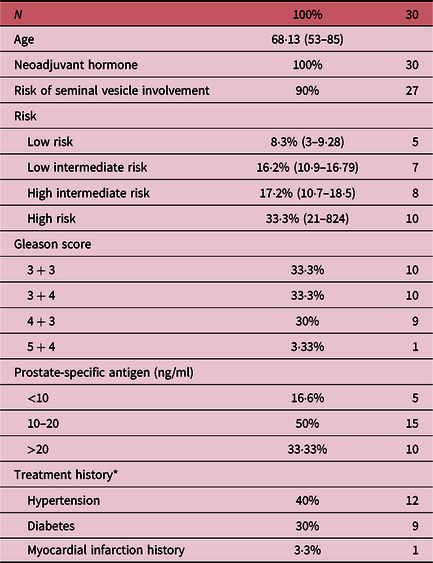
Between March 2016 and March 2018, 30 patients were treated with hypofractionated RT 70 Gy in 28 fractions. The average age was 68·13 years (53–85); all the patients received treatment with neoadjuvant hormone therapy; 90% of the patients had a risk of seminal vesicle involvement. As for the risk, 8·3% were low risk, 16·2% low intermediate risk, 17·2% high intermediate risk and 33·3% high risk. Gleason scores for the patients were 33·3% for 3 + 3 Gleason, 33·3% for 3 + 4 Gleason, 30% for 4 + 3 Gleason and 3·3% for 5 + 4 Gleason. 16·6% of patients had prostate-specific antigen (PSA) <10; 50% had PSA 10–20; and 33·3% had PSA >20. Regarding other comorbidities that patients presented with, 40% had hypertension, 30% diabetes and 3·3% had a history of one myocardial infarction (Table 1).
Baseline characteristics

Subjects may fit into more than one category.
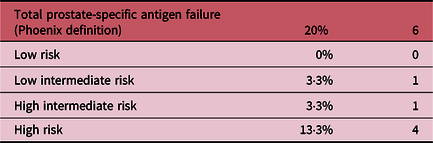
BCF with hypofractionated RT at 2 years of follow-up was found in a total of 20% of patients. In the classification by risk groups, there were no patients with BCF in the low-risk group; in the low intermediate course, 3·3% patients; in the high intermediate group, 3·3% patients; and the high-risk group was one with the highest number of patients with a BCF of 13·3% (Table 2).
Biochemical failure

Toxicity due to the hypofractionated treatment were evaluated according to Radiation Therapy Oncology Group's acute rectal and urinary and late rectal and urinary toxicities.13
For acute urinary toxicity; grade I was 56·6%; grade II, 6·6%. For acute rectal toxicity, grade I was 46·6%; grade II, 3·3%. There were no patients with late urinary and rectal toxicity.
Discussion
The results support that a moderately hypofractionated regimen of 70 Gy in 28 fractions over 6 weeks is non-inferior to a conventional regimen of 78 Gy in 39 fractions over 8 weeks for intermediate-risk prostate cancers.Reference Lee, Dignam and Amin7 The results are consistent with two recently published randomised non-inferiority trials that compared moderately hypofractionated RT regimens with conventionally fractionated regimens for localised prostate cancer.Reference Dearnaley, Syndikus and Mossop14,Reference Pollack, Walker and Horwitz15
The biochemical outcomes in low- and intermediate-risk prostate cancers are consistent with other trials reported in the literature, but high-risk patients had relatively poorer biochemical control than other studies.Reference Abu-Gheida, Reddy and Kotecha9
The toxicities reported in this study were acute, rectal and urinary grade 1 and grade 2; no grade 3 toxicities were reported. No patient had chronic toxicities. The levels of toxicities in this study are similar to those reported by several studies on prostate cancer hypofractionation.
There are many limitations to this study, including the number of patients treated and the medical records were retrospectively reviewed. However, the results of this study have validated our practice, and we intend to continue using hypofractionated RT in the treatment of prostate cancer, and we are soon to undertake a large-scale study in the future.
Conclusion
This is one of the first studies of hypofractionated RT in prostate cancer in Latin America. The results of this study showed that the outcomes were similar to conventional RT in all risk groups. The adoption of this methodology has improved the quality of treatment at our hospital by reducing treatment times and increasing service capacity, thereby reducing patient waiting times.
Acknowledgement
We are grateful for the collaboration of the Radiotherapy Service of Bajio High Specialty Hospital of the Mexican Social Insurance Institute for their support.