Child maltreatment is destructive to children's health and emotional, cognitive, and biobehavioral development (Cicchetti & Valentino, Reference Cicchetti, Valentino, Cicchetti and Cohen2006; Miller, Chen, & Parker, Reference Miller, Chen and Parker2011). Maltreating families expose children to harmful and severe disruptions in adequate parenting practices including violence between parent and child as well as intimate partner violence (IPV). Rates of the co-occurrence of child maltreatment and IPV are estimated to be as high as 70% (Bidarra, Lessard, & Dumont, Reference Bidarra, Lessard and Dumont2016). Moreover, maltreating families often fail to provide the positive caregiving necessary to buffer the effects of such toxic stress (Hostinar, Sullivan, & Gunnar, Reference Hostinar, Sullivan and Gunnar2014). This inadequate caregiving initiates a probabilistic path of epigenesis that increases children's risk for failures in the achievement of normative developmental tasks, as well as for significant psychological and physical health problems across the life span (Masten & Cicchetti, Reference Masten and Cicchetti2010; Miller et al., Reference Miller, Chen and Parker2011).
Dysregulation in the development of children's physiological stress systems, such as the hypothalamic–pituitary–adrenal (HPA) axis, has been conceptualized as a key process in explaining how early adversity gets under the skin to eventuate in poor health and psychopathology (Essex et al., Reference Essex, Shirtcliff, Burk, Ruttle, Klein, Slattery and Armstrong2011; McEwen, Reference McEwen1998). As such, interventions that are able to improve children's stress physiology may have a critical role in preventing deleterious health outcomes. Reminiscing and Emotion Training (RET) is a brief relational intervention for maltreated preschool-aged children and their mothers that was designed to improve maternal caregiving support by enhancing mothers’ capacity to engage in elaborative reminiscing with their children about past emotional events. In the context of a longitudinal randomized clinical trial, this study evaluated associations between maltreatment, IPV, and the RET intervention with changes in children's diurnal cortisol regulation across the 1 year following the intervention, as well as the extent to which trajectories of improvements in maternal elaborative reminiscing differed between intervention groups and mediated change in children's physiological functioning.
Children living in high-conflict families are chronically exposed to stressors, resulting in heightened physiological arousal (e.g., Davies, Sturge-Apple, Cicchetti, & Cummings, Reference Davies, Sturge-Apple, Cicchetti and Cummings2007; El-Sheikh, Reference El-Sheikh2005; Hibel, Granger, Blair, Cox, & Family Life Project Key Investigators, Reference Hibel, Granger, Blair and Cox2011). Constant threat and conflict prevent sufficient recovery and recuperation from such arousal, sensitizing children to subsequent conflict, and overwhelming emotional and physiological resources (Davies & Cummings, Reference Davies and Cummings1998; Davies, Myers, Cummings, & Heindel, Reference Davies, Myers, Cummings and Heindel1999). When confronted with conflict, threat, or frustration, individuals experience physiological changes to cope with and respond to the adversity (e.g., McEwen, Reference McEwen1998). A major component of the psychobiology of the stress response involves activation of the HPA axis (e.g., Chrousos & Gold, Reference Chrousos and Gold1992). Cortisol, the hormonal end product of the HPA axis stress response, makes energy stores available to allow the individual to deal with the challenges at hand. In addition to mobilizing resources and enabling response to acute stressors, cortisol follows a diurnal rhythm characterized by a dramatic rise during the first 30 min following awakening, and a steady decline across the afternoon. The morning rise in cortisol is thought to prepare the individual for the challenges of the upcoming day and is sensitive to mental and physical health (Fries, Dettenborn, & Kirschbaum, Reference Fries, Dettenborn and Kirschbaum2009).
Mother–child interactions are critical for the development and regulation of children's stress response systems (Adam, Klimes-Dougan, & Gunnar, Reference Adam, Klimes-Dougan, Gunnar, Coch, Dawson and Fischer2007). During early childhood, children lack the resources to successfully self-regulate, and thus the role of the caregiver is particularly salient, providing a scaffold for the development of biobehavioral regulation (e.g., Campos, Reference Campos1994; Gunnar, Fisch, & Malone, Reference Gunnar, Fisch and Malone1984; Hunziker & Barr, Reference Hunziker and Barr1986). As such, the HPA axis is vulnerable to disruptions when caregivers fail to provide sufficiently sensitive responses and external regulation. Deficiencies in maternal and caregiver behavior have been related to dysregulations in stress physiology including the organization of cortisol rhythms across the day. Specifically, atypical cortisol diurnal rhythms have been found in children with maternal deprivation (Carlson & Earls, Reference Carlson and Earls1997; Gunnar, Morison, Chisholm, & Schuder, Reference Gunnar, Morison, Chisholm and Schuder2001) and in maltreated children (Bernard, Butzin-Dozier, Rittenhouse, & Dozier, Reference Bernard, Butzin-Dozier, Rittenhouse and Dozier2010; Cicchetti & Rogosch, Reference Cicchetti and Rogosch2001a, Reference Cicchetti and Rogosch2001b; Cicchetti, Rogosch, Gunnar, & Toth, Reference Cicchetti, Rogosch, Gunnar and Toth2010). A variety of patterns of cortisol regulation have been observed among maltreated children including both hyper- and hypocortisolism (e.g., Cicchetti, Rogosch, Toth, & Sturge-Apple, Reference Cicchetti, Rogosch, Toth and Sturge-Apple2011; Tricket, Noll, Susman, Shenk, & Putnam, Reference Trickett, Noll, Susman, Shenk and Putnam2010). However, the dysregulation associated with early adversity is most often characterized by a flattening of diurnal cortisol activity, including lower early morning cortisol, and less cortisol decline across the day (Bernard et al., Reference Bernard, Butzin-Dozier, Rittenhouse and Dozier2010; Gunnar & Vasquez, Reference Gunnar and Vazquez2006).
Though there have been relatively fewer studies examining the impact of IPV on child diurnal cortisol rhythms compared to studies of maltreatment, two sources of evidence suggest IPV might also be a powerful dysregulator of child diurnal physiology. First, there is a well-documented association between IPV and acute cortisol reactivity (e.g., Davies, Sturge-Apple, Cicchetti, & Cummings, Reference Davies, Sturge-Apple, Cicchetti and Cummings2008; Hibel et al., Reference Hibel, Granger, Blair and Cox2011; Martinez-Torteya, Bogat, Levendosky, & Von Eye, Reference Martinez-Torteya, Bogat, Levendosky and Von Eye2016). Likewise, a recent study has shown IPV-exposed children have higher basal cortisol as measured in hair (Boeckel, Viola, Daruy-Filhoa, Martinez, & Grassi-Oliveira, Reference Boeckel, Viola, Daruy-Filho, Martinez and Grassi-Oliveira2017). Second, children living in high-conflict homes have lower morning cortisol (Pendry & Adam, Reference Pendry and Adam2007) and flatter diurnal slopes (Slatcher & Robles, Reference Slatcher and Robles2012). Thus, though the pattern of diurnal cortisol dysregulation associated with exposure to IPV remains unclear, IPV exposure is likely to impact daily fluctuations in cortisol. Further, it is important to note that exposure to IPV is recognized as a category of maltreatment (McTavish, MacGregor, Wathen, & MacMillan, Reference McTavish, MacGregor, Wathen and MacMillan2016). Specifically, operational definitions of maltreatment include exposure to IPV among the defining characteristics of emotional maltreatment (Barnett, Manly, & Cicchetti, Reference Barnett, Manly, Cicchetti, Cicchetti and Toth1993). To better understand and modify children's physiological dysregulation, it is essential to delineate the specific mechanisms that may explain how maltreatment and IPV uniquely lead to disrupted physiology.
Positive caregiving is conceptualized as a mechanism central to the development of children's physiological regulation. Attachment security, which emerges from consistent sensitive and responsive caregiving, has a critical role in supporting subsequent positive development, including affect regulation, coping, emotional and behavioral functioning, peer relationships, and physiological regulation (Schore, Reference Schore2001; Toth, Gravener-Davis, Guild, & Cicchetti, Reference Toth, Gravener-Davis, Guild and Cicchetti2013; Valentino, Reference Valentino2017). To date, the strongest evidence for the role of positive caregiving in children's stress physiology emerges from randomized clinical trials of parenting interventions wherein improvements in children's diurnal cortisol were observed following treatment-related improvements in parenting. For example, Fisher, Stoolmiller, Gunnar, and Burraston (Reference Fisher, Stoolmiller, Gunnar and Burraston2007) demonstrated that an intervention aimed at improving foster parent sensitivity and responsiveness was associated with normalization of diurnal cortisol among foster children who initially displayed a flat diurnal profile (Fisher et al., Reference Fisher, Stoolmiller, Gunnar and Burraston2007). Similarly, evaluation of the Attachment and Biobehavioral Catch-up intervention (Dozier et al., Reference Dozier, Peloso, Lindhiem, Gordon, Manni, Sepulveda and Ackerman2006), which focuses on increasing parental nurturance, has indicated that children (aged 6 months to 2 years) involved with child welfare after allegations of neglect who received the Attachment and Biobehavioral Catch-up intervention intervention had greater rates of secure attachment (Bernard et al., Reference Bernard, Dozier, Bick, Lewis-Morrarty, Lindhiem and Carlson2012). Moreover, children receiving the intervention exhibited a more normative pattern of diurnal cortisol regulation than children who received the control intervention (Bernard, Dozier, Bick, & Gordon, Reference Bernard, Dozier, Bick and Gordon2015), and these physiological effects were sustained 3 years following treatment (Bernard, Hostinar, & Dozier, Reference Bernard, Hostinar and Dozier2015). In addition, evidence from other relational interventions with maltreating mothers and their 12-month-old infants have shown that nurturing interventions can enhance attachment security (Cicchetti, Rogosch, & Toth, Reference Cicchetti, Rogosch and Toth2006) and prevent the development of blunted diurnal cortisol patterns over time (Cicchetti et al., Reference Cicchetti, Rogosch, Toth and Sturge-Apple2011).
Taken together, there is an accumulating body of evidence to support the critical role of sensitive and responsive caregiving (or lack thereof) in influencing children's physiological regulation. Furthermore, relational interventions focused on improving the parent–child relationship have taught us much about the potential for nurturing caregiving to enhance cortisol regulation among maltreated children (Toth et al., Reference Toth, Gravener-Davis, Guild and Cicchetti2013; Valentino, Reference Valentino2017). Nonetheless, there are limitations to the extant research. First, we know relatively little about the specific positive parenting mechanisms that account for children's physiological regulation beyond infancy and toddlerhood, especially among maltreating families. Second, the aforementioned intervention research implies that improved caregiving is a key mediating mechanism that may explain treatment-related improvements in stress physiology, but has yet to test this hypothesis directly. Thus, to advance the field, it is necessary to evaluate whether enhancement of caregiving is the mechanism of change leading to improved physiological regulation. Third, given that IPV has the potential to both directly and indirectly (through parenting) impact child outcomes, it is important to account for IPV exposure, as interventions that only target positive parenting mechanisms may not fully ameliorate child dysregulation. The current investigation aims to address these limitations.
As development proceeds beyond the toddler years, children's physiological and emotional regulation shifts from being primarily externally supported to more internally mediated processes, with the emergence of more effortful regulation of emotions and behavior (Calkins, Reference Calkins, Olson and Sameroff2009; Kopp, Reference Kopp1989). Similarly, sensitive parenting behavior to support children's development of regulatory skills shifts to include more verbal and cognitive coping strategies such as reappraisal, redirection, or emotion coaching to help their children regulate distress and overcome challenge (Gottman, Katz, & Hooven, Reference Gottman, Katz and Hooven1996; Sameroff, Reference Sameroff2009; Sroufe, Reference Sroufe2000). In particular, mothers’ ability to co-construct elaborative and emotionally supportive narratives (i.e., elaborative reminiscing) about children's emotional experiences becomes central for supporting children's cognitive and socioemotional development through the preschool years and beyond (Fivush, Haden, & Reese, Reference Fivush, Haden and Reese2006; Salmon & Reese, Reference Salmon and Reese2016; Thompson, Reference Thompson2006). It is important to note that maternal sensitivity during infancy has been identified as a key predictor of maternal elaborative reminiscing during the preschool years (Reese, Meins, Fernyhough, & Centifanti, Reference Reese, Meins, Fernyhough and Centifanti2019). Mothers who engage in an elaborative reminiscing style talk in rich, detailed ways about past events with their children by asking numerous open-ended questions, providing new elaborative details, and confirming children's contributions to the conversation (Salmon & Reese, Reference Salmon and Reese2016).
Furthermore, when reminiscing focuses on children's past emotional events, the parents’ reminiscing style provides a context for children to understand their emotions, to learn how to cope with those emotions, and to understand how to integrate these events into a coherent autobiography or self-concept (e.g., Fivush, Reference Fivush, Goodman and Bottoms1993; Nelson, Reference Nelson1993). Supportive parental responses to child emotion have been positively associated with children's emotion regulation, as well as with children's physiological regulation of the peripheral nervous system (Gottman et al., Reference Gottman, Katz and Hooven1996; Johnson, Hawes, Eisenberg, Kohlhoff, & Dudeney, Reference Johnson, Hawes, Eisenberg, Kohlhoff and Dudeney2017; Perry, Calkins, Nelson, Leerkes, & Marcovitch, Reference Perry, Calkins, Nelson, Leerkes and Marcovitch2012). Recently, reduced maternal elaborative reminiscing has been identified as a key mechanism linking child maltreatment to children's behavioral and physiological functioning (Valentino et al., Reference Valentino, Hibel, Cummings, Comas, Nuttall and McDonnell2015). Specifically, in a subset of the current sample evaluated at baseline, maltreatment was associated with less maternal elaborative reminiscing, which in turn was related to children's lower receptive language and emotion knowledge as well as to blunted diurnal cortisol slopes across the day. These findings raise the possibility that enhancement of maternal elaborative reminiscing may lead to improvement in child diurnal cortisol regulation.
The aforementioned basic research highlights reduced maternal elaborative reminiscing as a potentially modifiable mechanism linking maltreatment to poor behavioral and physiological outcomes. Thus, the RET intervention was developed as a brief relational intervention aimed at improving maternal elaborative reminiscing about children's past emotional events among families with substantiated maltreatment. The RET intervention has been associated with improvements in maternal elaborative reminiscing, child memory and child emotion knowledge immediately following the intervention (Valentino, Comas, Nuttall, & Thomas, Reference Valentino, Comas, Nuttall and Thomas2013, Valentino et al., Reference Valentino, Cummings, Borkowski, Hibel, Lefever and Lawson2019), and with greater positive change in children's emotion regulation over time (Speidel, Wang, Cummongs, & Valentino, Reference Speidel, Wang, Cummings and Valentinoin press). The current study investigated associations among maltreatment, IPV, and the RET intervention with change in children's diurnal cortisol regulation 1 year following the intervention. We specifically focus on the extent to which enhancement of elaborative reminiscing may explain intervention effects on diurnal physiology.
In a prior analysis with this sample, we demonstrated that RET was related to positive change in reminiscing immediately after the intervention (Valentino et al., Reference Valentino, Cummings, Borkowski, Hibel, Lefever and Lawson2019); however, we have yet to examine the extent to which treatment-related gains in elaborative reminiscing would be maintained over time. In the current study, we first hypothesized that the intervention would be associated with more elaborative reminiscing at Time 2, immediately after the intervention, and greater change in reminiscing across the 6 months following the intervention (Time 1 to Time 3) compared to the other groups. Second, we expected that receiving the RET intervention would be associated with increases in overall levels of cortisol and changes toward a steeper diurnal decline 1 year later (controlling for maltreatment and IPV), whereas we expected that maltreatment would be related to continued reductions in cortisol levels and increasingly blunted cortisol slopes over time (controlling for intervention effects and IPV). With regard to IPV, previous analysis of these data at baseline found higher morning cortisol in relation to IPV (Hibel, Nuttall, & Valentino, Reference Hibel, Nuttall and Valentino2019); building off this work, we expected this association to persist into the 1-year follow-up. Furthermore, because randomized clinical trials provide a unique opportunity to test mechanisms of development that underlie intervention outcomes among maltreating families (Cicchetti & Gunnar, Reference Cicchetti and Gunnar2008), we tested elaborative reminiscing as the mechanism of change. Specifically, we hypothesized that the intervention would be associated with more elaborative reminiscing and greater change in reminiscing over time, which would be related to more change in child cortisol levels and in children's diurnal cortisol slope.
Method
Participants
Maltreating and nonmaltreating mother–child dyads were recruited to participate in a longitudinal randomized controlled trial (RCT) in a midsized, midwestern city. Participating children were between the ages of 36 and 86 months (M = 59.08, SD = 13.68) at enrollment. Maltreating dyads were recruited through the Department of Child Services (DCS). Inclusion criteria included being biological mother–child pairs with at least one substantiated case of child maltreatment, in which the mother was a perpetrator and in which the child resided in the custody of the mother at the time of enrollment. Inclusion criteria also specified children should be aged 3 to 6 years at the time of recruitment; however, five children turned 7 before completion of the baseline assessment. DCS case workers introduced the project to eligible participants with a verbal script and informational flyer, and those interested shared their contact information with the research staff. Nonmaltreating dyads had no prior involvement with the DCS and were recruited from the local community in locations that serve similar demographic populations to the maltreating families, including the Office for Women, Infants, and Children and the housing authority. All participants provided informed consent and signed release forms granting access to their DCS records. A maternal interview and an intensive review of each family's case history were employed to corroborate the presence or absence of maltreatment. Only families that never received child protective services through the DCS and indicated no evidence of maltreatment on the maternal interview were included in the nonmaltreating comparison sample.
A number of variables were considered for exclusion. Participants were screened for endocrine disorders or continual corticosteroid use (Granger, Hibel, Fortunato, & Kapelewski, Reference Granger, Hibel, Fortunato and Kapelewski2009), which affect cortisol levels; however, no families were excluded for these reasons. To minimize the influence of language impairments or potential intellectual disability on the results of the study, mothers with Peabody Picture Vocabulary Test, Fourth Edition (Dunn & Dunn, Reference Dunn and Dunn2007), standard scores less than 2 SD below the sample mean (standard score <60) were excluded from all analyses (n = 6 dyads dropped; n = 1 nonmaltreating, n = 2 maltreating intervention, n = 3 maltreating control). In addition, given that maltreatment might occur in demographically matched nonmaltreatment comparison groups in prospective, longitudinal studies (Shenk, Noll, Peugh, Griffin, & Bensman, Reference Shenk, Noll, Peugh, Griffin and Bensman2016), families’ DCS records were reevaluated at the final time point (Time 4; T4). Records revealed that n = 5 comparison children experienced maltreatment before their T4 assessment. These 5 dyads were dropped from all analyses. The final baseline sample included 237 mother–child dyads (n = 160 maltreating, n = 77 nonmaltreating). After the Time 1 (T1) assessment, maltreating families were randomly assigned to a brief intervention, (RET; n = 81), or a community standard (CS) control condition (n = 79).
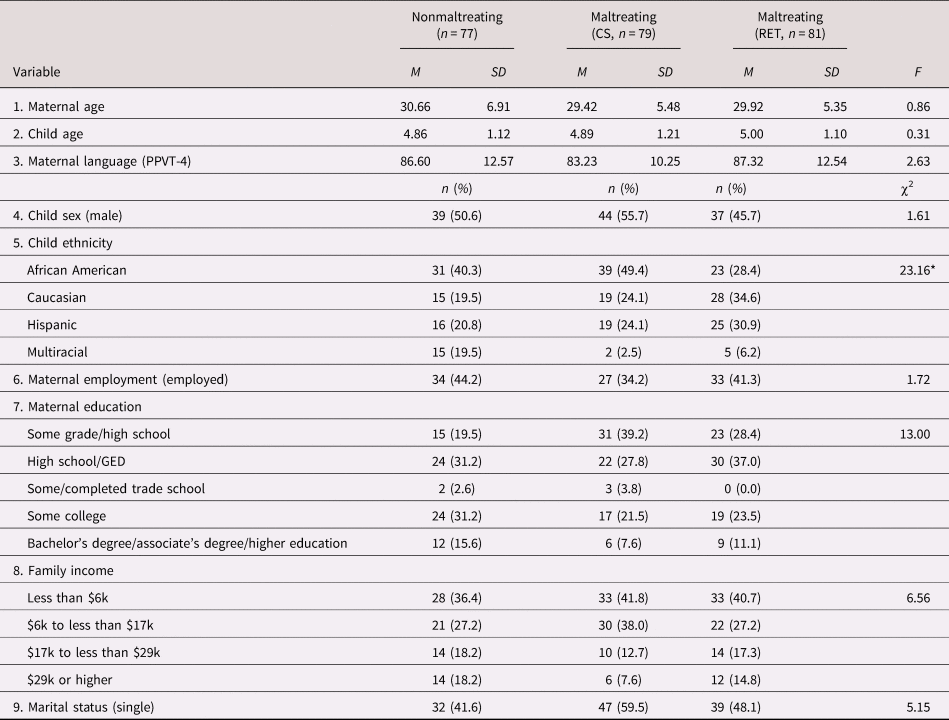
Demographic characteristics for the final sample by group status are presented in Table 1, including test statistics from one-way analyses of variance and chi-square tests of independence used to assess for differences by group. The groups were matched on all demographic characteristics except for child ethnicity, χ2 (6, N = 237) = 23.16, p < .01, in that there were more Hispanic children in the nonmaltreatment group compared with both maltreatment groups. Follow-up t tests were conducted to evaluate for differences in outcomes based on ethnicity and showed that Hispanic status did not relate to any of the study outcomes. Thus, child ethnicity was not statistically controlled for in the analysis.
Sample characteristics by maltreatment and intervention group

Note: Analyses of variance and chi-square tests of independence were used to assess for differences by maltreatment group. CS, community standard. RET, Reminiscing and Emotion Training. PPVT-4, Peabody Picture Vocabulary Test, Fourth Edition. *p < .01.
Maltreatment classifications
Maltreating families’ DCS records were coded for subtype and severity of maltreatment using the Maltreatment Classification System (Barnett et al., Reference Barnett, Manly, Cicchetti, Cicchetti and Toth1993). Sexual abuse was coded when there was any sexual contact or attempted contact between the child and an adult. Physical abuse was coded when the child experienced physical harm or injury by intentional means. Physical neglect was coded when the child's basic needs were not met, including not providing adequate food, clothing, shelter, or a safe environment. Emotional maltreatment was coded when the child's emotional needs were chronically or extremely disregarded or neglected. Moral–legal or educational maltreatment was coded when the child was exposed to or encouraged to participate in illegal activities or when children did not receive adequate education for their age. Approximately 20% (n = 32) of the maltreating families’ DCS records were double coded by trained graduate-level coders and excellent reliability was established (κ = .81–1.00). Mothers were also given the Maternal Maltreatment Classification Interview (Cicchetti, Toth, & Manly, Reference Cicchetti, Toth and Manly2003) to gain more information about children's maltreatment experiences. The full DCS records for two of the maltreating families were unable to be retrieved and so, in these cases, only information obtained from the maternal interview was used to determine eligibility. Children's DCS records were reassessed at the 1-year follow-up to see if there had been new incidences of substantiated and/or codeable maltreatment for all dyads.
Across the maltreatment group, 4.4% of children experienced sexual abuse, 12.7% experienced physical abuse, 65.2% experienced physical neglect, 60.8% experienced emotional maltreatment, and 38.6% experienced moral–legal or educational maltreatment; these percentages reflect all incidents of maltreatment, not just those perpetrated by mothers. There was a high rate of comorbidity across subtypes, with 60.8% of children experienced more than one type of maltreatment. Given this high rate of comorbidity and the limited sample size, maltreatment subtypes were not entered separately into the analyses.
Procedure
The design and procedures of the current study were reviewed and approved by the University of Notre Dame Institutional Review Board. Consent forms were signed by the mothers from each dyad. The study consisted of an initial assessment period (T1), after which maltreating mother–child dyads were randomized into a RET intervention or a CS control. The randomization was stratified by child age and gender to ensure that the groups were similar on these demographics. Nonmaltreating dyads served as a nonmaltreating comparison (NC) group and did not receive an intervention; these families participated in assessments only. For all families, home and laboratory visits occurred at baseline (T1), following the intervention 8 weeks later (Time 2; T2), and again at 6 months (Time 3; T3) and 1 year (Time 4; T4). At each time point, dyads participated in a joint reminiscing task. At T1 and T4, mothers collected three saliva samples (waking, midday, and bedtime) on their child for 2 consecutive days, from which cortisol values were extracted, and mothers provided information on their history of IPV.
Mothers first participated in an enrollment visit completed in their homes where they signed consent paperwork and filled out demographic questionnaires. Dyads then scheduled a baseline assessment, which included a home and a lab component. During the home visit, questionnaires were completed and assessors explained the procedure for saliva sampling at T1 and T4. Assessors completed a practice collection with each mother and child and left supplies for each mother to collect her child's saliva over 2 days when mother and child would be together, typically over the weekend. The lab visit was completed within 1 week of the home visit, and mothers brought their collected saliva with them on ice to the lab. During the lab visit, dyads completed several separate assessment tasks as well as a joint reminiscing task, which is described in more detail below. All assessors were naive to families’ maltreatment status and intervention condition.
Intervention conditions
RET
The RET intervention consisted of six, weekly, 1-hr sessions conducted by bachelor's-level family coaches. Training sessions were conducted within each participant's home and trained mothers to increase their elaborative reminiscing and sensitive guidance. Specific target behaviors include training mothers to (a) increase mother–child time in narrative conversation, (b) ask more open-ended questions (e.g., “Where were we? What else happened?”), (c) use detailed descriptions that are responsive and build on the children's descriptions, (d) ask children to identify their emotions and/or label their children's emotions, (e) make causal connections between children's experiences and their children's emotions (e.g., “I could tell you were sad because …”), and (f) talk about resolutions for emotions (e.g., “What did we do to help you feel better?”).
Following training in the key reminiscing skills, which occurred during Session 1, all sessions included asking the mother to practice the reminiscing skills with her child during the session. This practice was videotaped by the family coach and immediately viewed with the mother for positive feedback. At the conclusion of each session, mothers were asked to practice the reminiscing skills with their child one time every day, and to record one practice session on the cell phone provided to them per week. The next session began with a review of the recorded practice. During sessions, reminiscing conversations focused on everyday past events, and explicitly did not target traumatic events; however, negative emotions, such as sadness, anger, and fear, were emphasized by encouraging mothers to practice reminiscing about each of these emotions at least once across the intervention sessions. In addition to reminiscing skills, Sessions 2–4 included one activity each to focus on emotion identification, emotion causes, and emotion regulation, respectively.
For assessment and monitoring of fidelity, family coaches completed a fidelity checklist following each session. Average fidelity per session ranged from 94.0% to 98.0%, with an average of 96.16% across sessions. These checks were supplemented by weekly, individual supervision with the first author, which included reviewing the videotaped mother–child reminiscing session practice and the coaches’ feedback in addition to the fidelity checklists after each session. More details regarding this intervention are available in previously published work (Valentino et al., Reference Valentino, Cummings, Borkowski, Hibel, Lefever and Lawson2019).
CS
Maltreating mothers in the CS condition received case management such as general written information regarding effective parenting practices and referrals to community resources as needed for each family. All mothers were provided with a cell phone for the duration of their participation in the project so that could they could contact and be contacted by the family coaches and also so that they could more easily access the referrals provided to them as part of the case management services. More details regarding the CS condition are available in previously published work (Valentino et al., Reference Valentino, Cummings, Borkowski, Hibel, Lefever and Lawson2019).
Measures
Diurnal cortisol
Mothers were trained in collecting saliva samples for their child by a project assessor within their homes. Collection occurred at T1 and T4. During the training, mother and child completed a practice collection with the assessor present. Dyads collected saliva on 2 consecutive weekend days when mother and child were home together throughout each day. Collections were based on each individual's schedule, occurring at waking, before lunch (i.e., midday), and before bed (i.e., bedtime). Participants were instructed to drink water 10 min before collection (except at waking), and not to brush their teeth, eat, or drink within the 20 min before providing salivary samples. Mothers were also instructed to write down exact wake time for the child and exact times of saliva collection. Once each sample was collected, mothers were trained to place the samples into special Medical Electronic Monitoring System (MEMS; Aardex Ltd.) cap bottles, providing an objective measure of saliva collection time. On the day of their lab assessment, mothers brought the samples in the MEMS bottles to the lab in a provided cooler on ice. Samples were centrifuged and then frozen at –80 °C until assayed.
Adherence to the collection design was checked in two ways. First, collection times were considered adherent if MEMS cap openings and the self-reported log sheets did not differ by more than 30 min for the waking sample, or by 60 min for the midday and bedtime samples. Families without at least 1 adherent day of collection were asked to resample. Ultimately, the maltreating and nonmaltreating families did not significantly differ on most indices of adherence to the collection protocol (for additional details, see Valentino, DeAlba, Hibel, Fondren, & McDonnell, Reference Valentino, De Alba, Hibel, Fondren and McDonnell2017). Second, adherence was also assessed relative to wake time. Waking saliva samples with MEMS collections times within 15 min of self-reported wake time were considered compliant. Cortisol waking compliance was employed as a control variable in the final model.
Samples were sent to be assayed for salivary cortisol using a highly sensitive enzyme immunoassay at Salimetrics. Duplicate assays were performed for all samples, and the average of the duplicates were used in the analyses. Coefficients with a variation exceeding 15% (unless the absolute value of the difference between repeats was less than .03 μg/ml) as well as cortisol values greater than or equal to 3.0 μg/ml were trimmed from the data. At each time point, the six cortisol samples collected across the 2 days were combined into two composites, area under the curve with respect to ground (AUCg) and area under the curve with respect to increase (AUCi; see Pruessner, Kirschbaum, Meinlschmid, & Hellhammer, Reference Pruessner, Kirschbaum, Meinlschmid and Hellhammer2003, for equations). These composites measure the two key aspects of daily cortisol (Smyth, Hucklebridge, Thorn, Evans, & Clow, Reference Smyth, Hucklebridge, Thorn, Evans and Clow2013), namely, the overall cortisol secretion across the day and the diurnal cortisol slope, respectively. AUCi is a reflection of change from baseline, with positive values indicating increases from baseline and negative values indicating decreasing values. In these calculations, baseline is the first sample (waking), and therefore the AUCi reflects decreasing cortisol across the day. Time was coded in hours and minutes elapsed. The T1 and T4 AUCg variables were both skewed (T1 skew statistic = 2.27, T4 skew statistic = 2.22) and subjected to natural log transformations. This transformation alleviated the skew (T1 skew statistic = 0.53, T4 skew statistic = 0.55). The T1 AUCi skew value was 1.48 and the T4 AUCi skew value was –0.654. In order to maintain the same scale for each input variable and given that evidence of skew was minimal, no transformation was applied to the T1 or T4 AUCi data.
Mother–child reminiscing
During each lab visit, mothers initially worked with assessors to identify four joint past events in which their child felt happy, sad, angry, and scared. Events had to occur in the past, be something the child could remember, and the mother had to have been present for the event (see Fivush et al., Reference Fivush, Haden and Reese2006; Salmon, Dadds, Allen, & Hawes, Reference Salmon, Dadds, Allen and Hawes2009). Assessors documented brief notes of each identified event onto index cards so that mothers could refer to them as a reminder during the task. Then, mothers were asked to discuss each event with their child as they normally would at home. Dyads were left alone in a room for this task, and their conversations were video- and audio-recorded. The happy event was discussed first while the order of the three negative events were counterbalanced across participants.
Reminiscing discussions for each dyad were transcribed verbatim. Maternal elaborative quantity was then coded with a frequency-based scheme at the utterance level (see Fivush & Sales, Reference Fivush and Sales2006; Fivush & Vasudeva, Reference Fivush and Vasudeva2002; Harley & Reese, Reference Harley and Reese1999; Reese & Newcombe, Reference Reese and Newcombe2007; Valentino et al., Reference Valentino, Nuttall, Comas, McDonnell, Piper, Thomas and Fanuele2014; Van Bergen, Salmon, Dadds, & Allen Reference Salmon, Dadds, Allen and Hawes2009 for similar schemes). Utterances were coded for the presence or absence of Wh-questions (open-ended elaborative questions), yes/no questions (closed-ended elaborative questions), elaborative statements, and confirmations. Elaborative statements are utterances that provided the child with new information about the event. Confirmations included maternal positive affirmations of child contributions to the memory conversation (i.e., “Yes, you're right”). The total number of each type of elaborative utterance made by each mother (Wh-questions, yes/no questions, elaborative statements, and confirmations) was counted and summed across event discussions. Interrater reliability was assessed with 20% of the full sample (n = 50). Absolute agreement, two-way mixed effect, single-measure interclass correlation coefficient ranges were as follows: open-ended questions (.969–.989), closed-ended questions (.957–.986), elaborations (.919–.975), and confirmations (.744–.990).
At each time point, the four elaborative reminiscing variables (Wh-questions, yes/no questions, elaborative statements, and confirmations) were square root transformed to alleviate skew in the data and then averaged together to form a composite maternal elaborative reminiscing variable (from T1 to T3, transformed skew statistics ranged from .30 to .71, correlations among the reminiscing codes at each time point ranged from r = .22 to r = .70, ps < .01, and internal consistencies of the elaborative reminiscing composites ranged from α = .68 to α = .76).
IPV
IPV between mothers and their romantic partners within the past year was assessed using the Revised Conflict Tactics Scale—Short Form (Straus & Douglas, Reference Straus and Douglas2004) at T1 and again at T4. Mothers reported the number of times physical assault, injury, psychological aggression, and sexual coercion occurred by themselves or by their partners within the past year on 16 items. The number of times these instances occurred was then classified into one of seven response categories (0 = never in the past year, 1 = once, 2 = twice, 4 = 3–5 times, 8 = 6–10 times, 15 = 11–20 times, and 25 = 20 + times), following Straus and Douglas (Reference Straus and Douglas2004). Maternal reports of her own and her partners’ behaviors for each subscale were then summed to form the IPV variable, which had acceptable internal consistency (T1 α = .70).
Data analytic plan
As is common of longitudinal studies with at-risk populations, there was some missingness and attrition throughout the course of the project. Of the 237 dyads who participated in the T1 assessment, n = 217 (91.6%) participated in the T2 assessment, n = 205 (86.5%) participated in the T3 assessment, and n = 206 (86.9%) participated in the T4 assessment. There were no differences by intervention group in whether families were lost to attrition or remained in the study, χ2 (2, N = 237) = 4.43, p = .11. Little's test of missing completely at random (Little, Reference Little1998) was conducted in SPSS (Version 24, IBM Corp) and was nonsignificant, indicating that missing data could be assumed to be missing completely at random, χ2 (95) = 106.72, p = .19.
The primary objectives of the current investigation were to assess: (a) change in maternal elaboration across time by group and whether RET treatment-related improvements in reminiscing are sustained over time; (b) direct effects of maltreatment, the RET intervention, and intimate partner violence on change in child cortisol levels and slope from T1 to T4; and (c) indirect effects of maltreatment, the RET intervention, and IPV on change in child cortisol through maternal elaborative reminiscing at posttest (T2) and change from T1 to T3. We examined the first objective using three univariate latent growth curve models examining the patterns present in the longitudinal elaborative reminiscing data in each maltreatment group. We examined the second and third objectives using longitudinal mediation analysis with a latent growth curve component to examine change in the single time-varying mediator (maternal elaborative reminiscing assessed at T1, T2, and T3), and a latent change score component to model change in the two outcomes (child cortisol levels and slopes assessed at T1 and T4). The three input variables (maltreatment, RET intervention, and IPV) were modeled to predict the latent intercept and slope of maternal elaborative reminiscing and latent change in child cortisol levels and slope. Maltreatment was assessed at enrollment and reflected maltreatment that occurred anytime prior to T1. Random assignment of maltreating families into either the RET intervention or CS group was conducted following the T1 assessment. IPV was assessed at T1 and reflected IPV that occurred within the year prior to T1. Child cortisol waking compliance at T1 and T4 (whether the first sample was collected within 15 min of waking) was included as a control variable on the latent change cortisol factors. Finally, new maltreatment (as substantiated by the DCS or the Maltreatment Classification System coding system) and new IPV that occurred during the course of the study (i.e., between T1 and T4) were included as additional predictors of latent change in cortisol levels and slope to control for the effects of subsequent maltreatment or IPV on the direct and indirect effects.
The outcomes (child cortisol levels and slopes) were modeled using the change-regression adaptation of McArdle's (Reference McArdle2009) latent change score model method. Per this approach, a latent change score variable was estimated for each outcome by constraining the manifest T1 → T4, and latent change factor → T4 pathways to be 1.0 so that the latent change factor captured change from T1 to T4. In addition, T1 cortisol variables were regressed onto their respective latent change score factor in order to remove the part of the individual change attributed to initial levels of child cortisol levels and slope. Compared with traditional autoregression methods, this approach provided us the opportunity to examine our specific research question of interest regarding change in physiological regulation from T1 to T4, while still controlling for T1 levels (McArdle, Reference McArdle2009).
The time-varying mediator (maternal elaborative reminiscing) was modeled using two latent growth curve factors, one representing T2 levels of elaborative reminiscing (i.e., intercept) and the other representing change in elaborative reminiscing (i.e., slope) from T1 to T3. Latent intercept factor loadings were fixed as 1.0 as the intercept is a constant for each individual across time. Given that we wished to evaluate effects of the intervention, and contingent upon whether the univariate latent growth model results also supported this decision, we planned to set the intercept to examine elaborative reminiscing at T2 (which reflects performance immediately after the intervention), so the slope loading at T2 was set to zero. Thus, the interpretation of the model's estimated intercept mean and variance terms reflected mean elaboration and between-person variance in elaboration at T2, respectively. Prior to fitting the longitudinal mediation model, to answer our first investigative objective, latent growth curve models examining the patterns present in the longitudinal elaborative reminiscing data by maltreatment group were run in R 3.4.0 (R Core Team, 2017) using the lavaan package (Rosseel, Reference Rosseel2012). In these models, T1 and T3 slope loadings were fixed or freed to reflect no-change, linear change, and latent basis change models, and model fit was compared to determine which change pattern best fit the data. Following McArdle and Nesselroade's (Reference McArdle and Nesselroade2014) recommendation, the residual variances of the three self-regulatory manifest variables were constrained to be the same to maintain a more parsimonious, theory-based model. The final full structural equation model, including the input variables, the time varying mediator, and the latent change outcomes, was run in Mplus (Mplus Version 8.0; Muthén & Muthén, Reference Muthén and Muthén2017) using full information maximum likelihood estimation to handle missing data. The bias-corrected bootstrap method (MacKinnon, Lockwood, & Williams, Reference MacKinnon, Lockwood and Williams2004) with 5,000 resamples was used to construct 95% confidence intervals for the indirect effects to test the significance of the indirect effects.
Results
Descriptive statistics
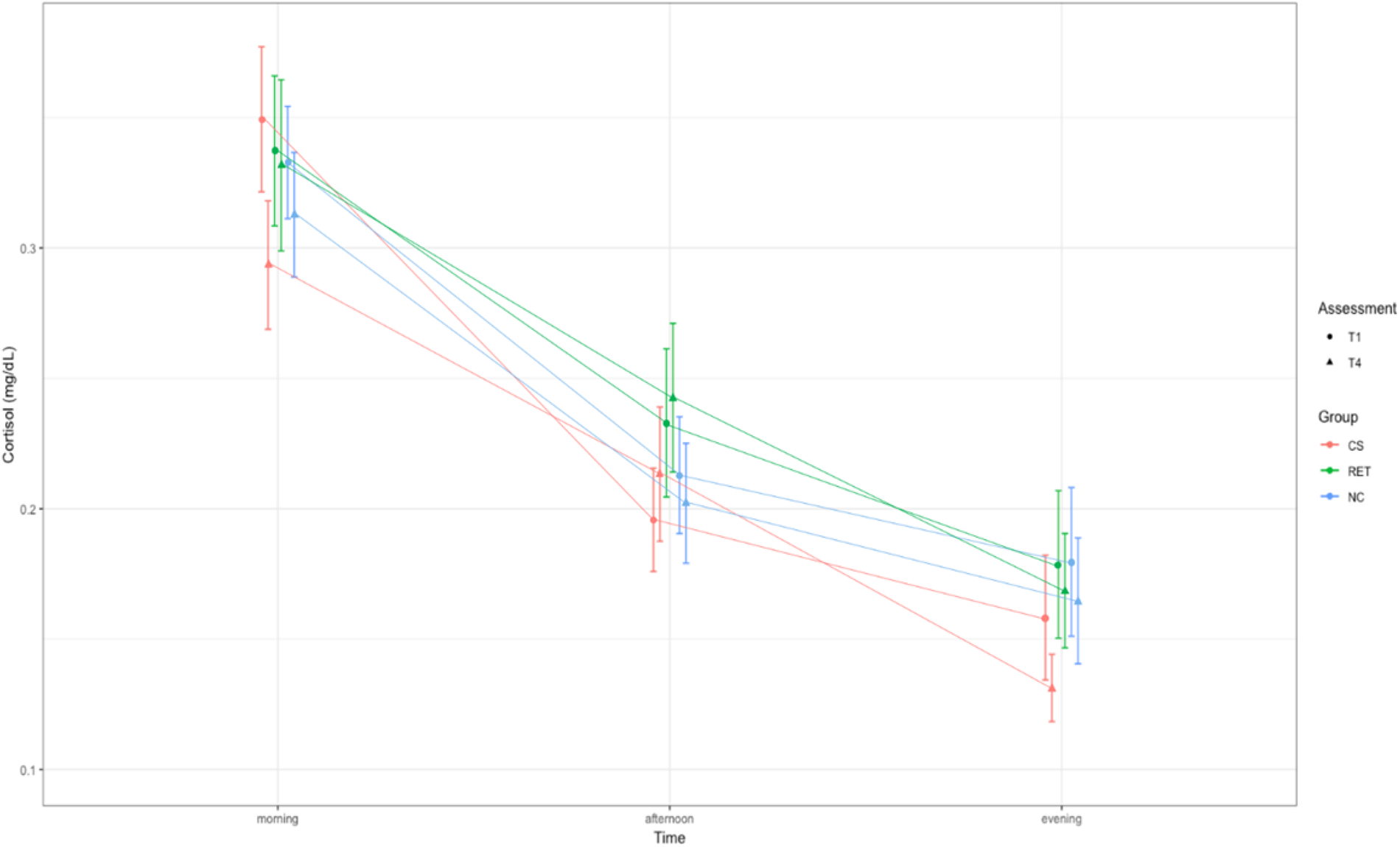
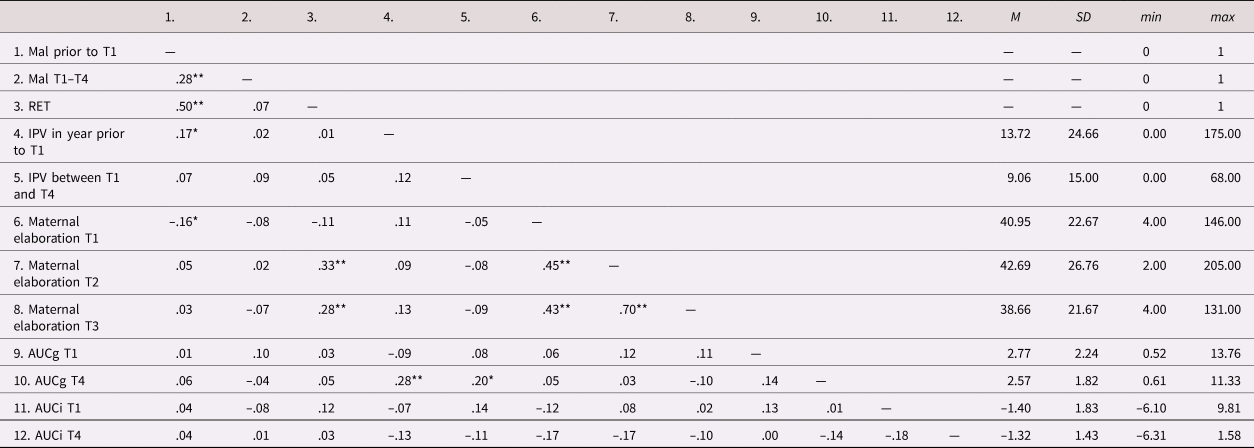
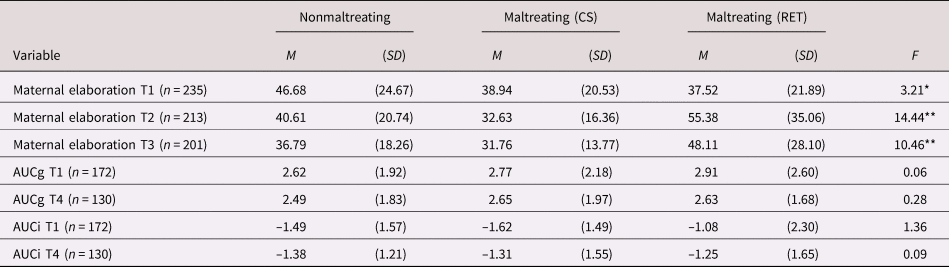
Means, standard deviations, and intercorrelations among the primary variables are presented in Table 2. Descriptive statistics for maternal elaborative reminiscing and child cortisol levels and slopes across the time points are presented by maltreatment and intervention group in Table 3. In addition, Figure 1 presents the observed, untransformed diurnal pattern of children's cortisol data by plotting the morning, midday, and evening samples (averaged across the 2 days of collection) for each group at T1 and T4.
Trajectories of diurnal cortisol across the day by maltreatment group and assessment. Plotted values reflect untransformed morning, afternoon, and evening cortisol values. NC, nonmaltreatment control. CS, community standard. RET, Reminiscing and Emotion Training. T1, Time 1. T4, Time 4. Cortisol levels in μg/dL.

Intercorrelations, means, and standard deviations among variables

Note: Transformed elaborative reminiscing and AUCg values were used in computing intercorrelations, but untransformed means and standard deviations are reported on the right. Mal, maltreatment (1 = maltreatment, 0 = nonmaltreatment). RET, Reminiscing and Emotion Training intervention (1 = RET intervention provided, 0 = no RET intervention provided). IPV, intimate partner violence. AUCg, area under the curve with respect to ground. AUCi, area under the curve with respect to increase. T1, Time 1. T2, Time 2. T3, Time 3. T4, Time 4. *p < .05. **p < .001.
Means and standard deviations of study variables by maltreatment group

Note: F values reflect uncorrected one-way analysis of variance results of study variables by maltreatment group using transformed variable values where relevant. Untransformed means and standard deviations are reported. Elaboration values represent total elaborations across all emotion conversations. AUCg, area under the curve with respect to ground. AUCi, area under the curve with respect to increase. CS, community standard. RET, Reminiscing and Emotion Training. T1, Time 1. T2, Time 2. T3, Time 3. T4, Time 4. Using Tukey correction, post hoc pairwise comparisons of statistically significant omnibus F tests revealed that at T1 RET was significantly different from NC (p = .04), at T2 RET was significantly different from NC (p = .002) and CS (p < .001), and at T3 RET was significantly different from NC (p = .02) and CS (p < .001). *p < .05. **p < .01.
Elaborative reminiscing trajectories by maltreatment group
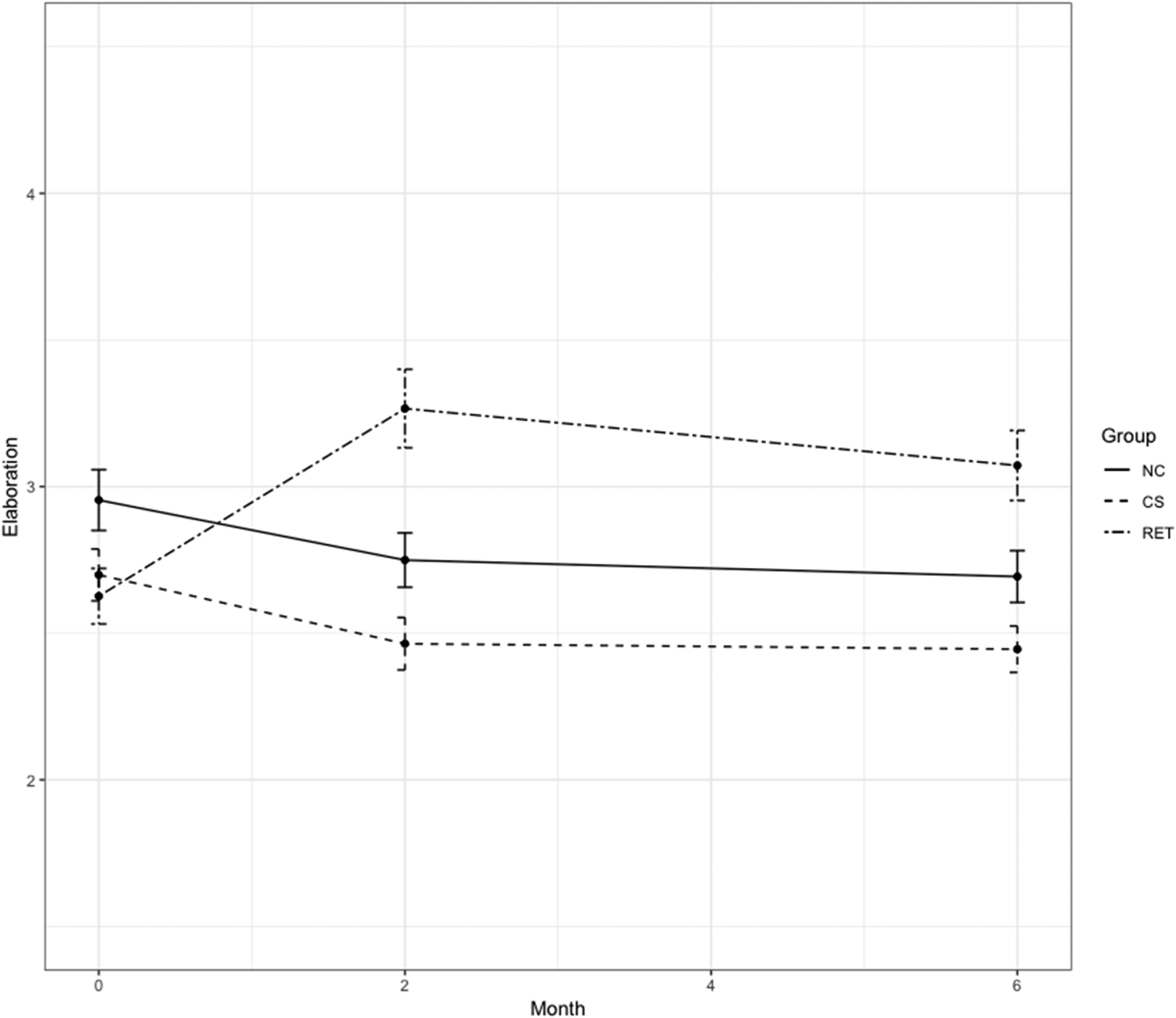
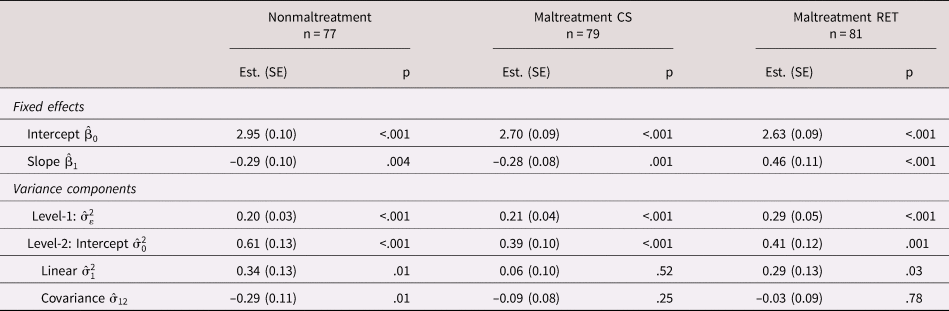
Average longitudinal trajectories from T1 to T3 by maltreatment group are depicted in Figure 2. The model fit results for no change, linear change, and latent basis change models by maltreatment group are reported in Table 4. As indicated by the fit indices (i.e., chi-square tests, comparative fit index [CFI], and root mean square error of approximation [RMSEA]), latent basis growth, where the T3 slope loading was freely estimated, was the best fitting model for all three groups. Of note, the nonmaltreatment and maltreatment CS groups showed significant decline and leveling off in elaborative reminiscing from T1 to T3 (nonmaltreatment: $\hat{\beta }_1 ={-}.29$ , SE = .10, p = .004; maltreatment CS: $\hat{\beta }_1 ={-}.28$
 , SE = .08, p = .001), whereas the maltreatment RET group showed significant increase and leveling off in elaborative reminiscing from T1 to T3 ($\hat{\beta }_1 ={-}.46$
 , SE = .11, p < .001). The remaining fixed intercept and slope effects and variance components for the latent growth model are presented by maltreatment group in Table 5.
Longitudinal trajectories in elaborative reminiscing by maltreatment group. Plotted values reflect transformed elaborative reminsicing variables. NC, nonmaltreatment control. CS, community standard. RET, Reminiscing and Emotion Training.

Model fit of latent growth models of elaborative reminiscing by maltreatment group

Note: CS, community standard. RET, Reminiscing and Emotion Training.
Fixed effects and variance components of the latent basis model by maltreatment group

Note: The intercept is set to reflect values at Time 2 in elaborative reminiscing. CS, community standard. RET, Reminiscing and Emotion Training.
Longitudinal mediation model
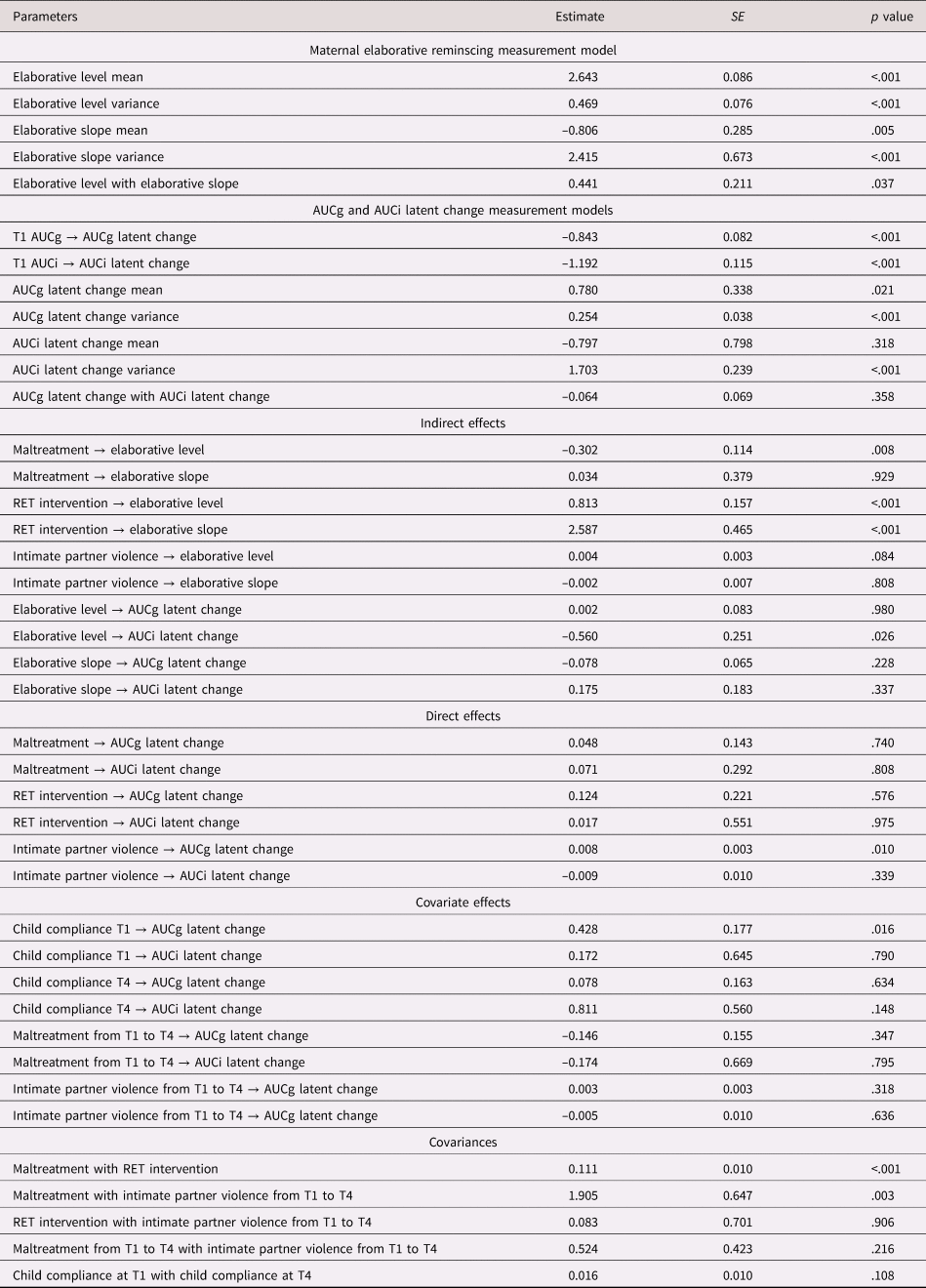
Given that latent basis change was the best fitting model of change in maternal elaborative reminiscing, in the full structural equation model, a latent basis growth model was used to specify the change in the elaborative reminiscing data. We set the intercept at T2 because we were interested in elaboration immediately following the intervention, and because our change analysis indicated peak elaboration at T2, with little to no change between T2 and T3. In the full model, the T3 slope loading was estimated to be –.040, suggesting a steep initial change in maternal elaborative reminiscing from T1 to T2, and a plateau in improvement by T3. The model fit of the full structural equation model (see Figure 3) was good, χ2 (27) = 33.59, p = .18, CFI = .98, RMSEA = .03. Standardized results for the main pathways of interest are enumerated below. Unstandardized path coefficient estimates, standard errors, and p values are reported in Table 6.
Mediation model. Structural equation model depicting the indirect effects of maternal elaborative reminiscing at T2 and its change from T1 to T3 on associations between maltreatment, the RET intervention, and IPV on latent change in child cortisol levels and slopes from T1 to T4, controlling for cortisol compliance at T1 and T4 and new IPV and maltreatment between T1 and T4. Nonsignificant pathways are indicated by thin dashed lines and statistically significant pathways are indicated by solid lines. Standardized coefficients are reported with the exception of latent intercept, slope, and change factor loadings, which reflect unstandardized values for ease of interpretation. IPV, intimate partner violence. RET, Reminiscing and Emotion Training intervention (1 = RET intervention provided, 0 = no RET intervention provided). Mal., maltreatment (1 = maltreatment, 0 = nonmaltreatment). T1, Time 1. T2, Time 2. T3, Time 3. T4, Time 4. ME, maternal elaboration. AUCg, area under the curve with respect to ground. AUCi, area under the curve with respect to increase. *p < .05. **p < .01.

Parameter estimates for the full structural equation model

Note: This table reflects unstandardized values. Standardized values are reported in the manuscript text and in Figure 2. T1, Time 1. T4, Time 4. AUCg, area under the curve with respect to ground. AUCi, area under the curve with respect to increase. RET, Reminiscing and Emotion Training.
The direct effects maltreatment (b* = 0.03, SE = 0.08, p = .74) and RET intervention status (b* = 0.07, SE = 0.13, p = .58) on latent change in child cortisol levels were nonsignificant. The direct effect of IPV on latent change in child cortisol levels was statistically significant (b* = 0.24, SE = 0.10, p = .01), in that higher IPV in the year prior to T1 predicted an increase in child cortisol levels from T1 to T4. There were no significant direct effects of maltreatment (b* = 0.01, SE = 0.05, p = .81), RET intervention (b* = 0.003, SE = 0.10, p = .98), or IPV (b* = –0.09, SE = 0.09, p = .35) on latent change in child cortisol slopes.
Maltreatment was significantly associated with maternal elaborative reminiscing at T2 (b* = –0.18, SE = 0.07, p = .006) in that maltreating mothers were lower in elaborative reminiscing compared with nonmaltreating mothers. However, maltreatment was not significantly associated with change in elaborative reminiscing from T1 to T3 (b* = 0.01, SE = 0.09, p = .93). The RET intervention was significantly associated with elaborative reminiscing at T2 (b* = 0.50, SE = 0.07, p < .001) in that mothers who received the RET intervention were more highly elaborative than mothers who did not receive the intervention. The RET intervention was also significantly associated with change in elaborative reminiscing from T1 to T3 (b* = 0.62, SE = 0.08, p < .001) in that mothers in the intervention showed more positive improvement in elaborative reminiscing from T1 to T3. IPV measured at T1 was not associated with elaborative reminiscing at T2 (b* = 0.14, SE = 0.08, p = .06) or its latent change from T1 to T3 (b* = –0.02, SE = 0.08, p = .80).
Maternal elaborative reminiscing at T2 was not significantly associated with latent change in child cortisol levels (b* = 0.002, SE = 0.08, p = .98), but was associated with latent change in child cortisol slopes (b* = –0.18, SE = 0.07, p = .03) in that higher maternal elaboration at T2 was associated with steeper decline in child cortisol slopes from T1 to T4. Change in elaborative reminiscing from T1 to T3 was not significantly associated with latent change in child cortisol levels (b* = –0.19, SE = 0.14, p = .18) or latent change in child cortisol slopes (b* = 0.13, SE = 0.12, p = .28).
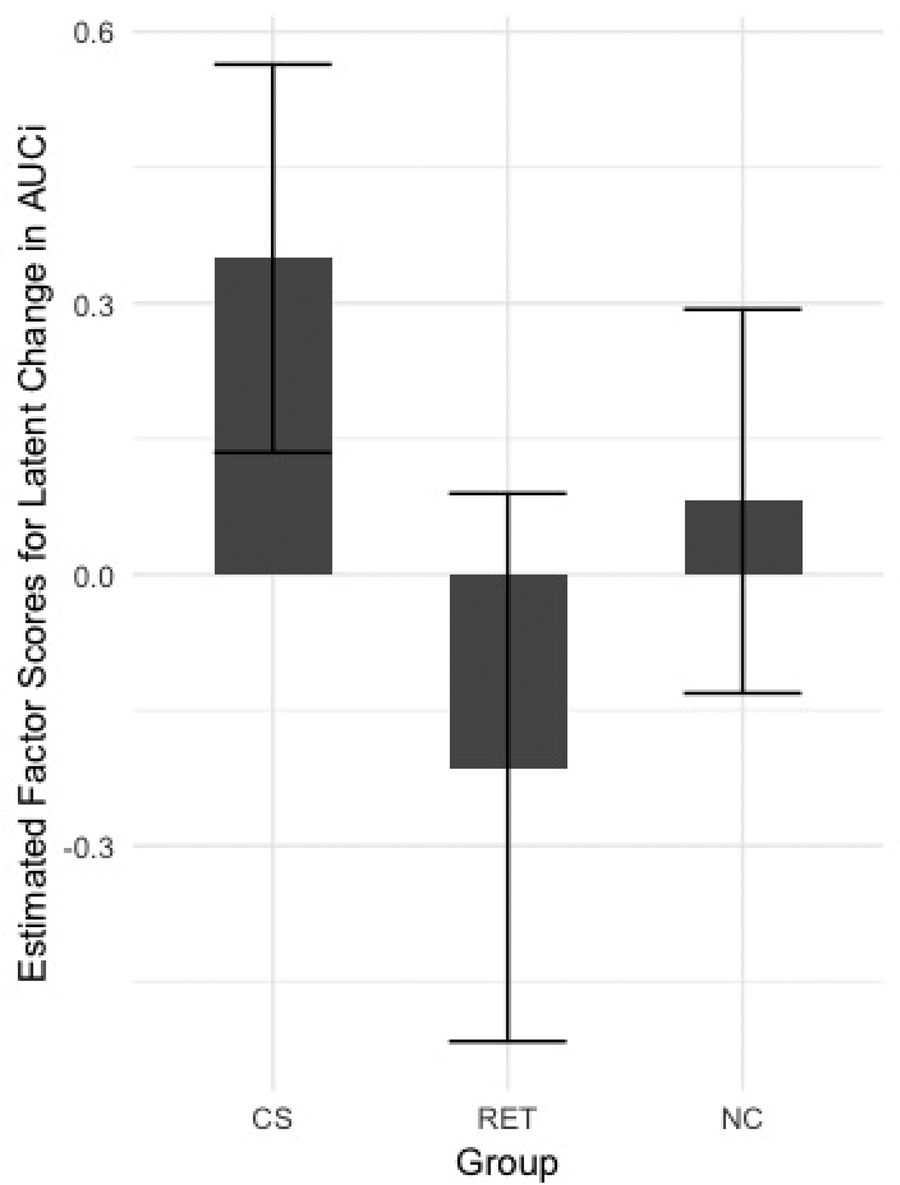
In the indirect effects analysis, there was a statistically significant indirect effect of maltreatment on latent change in child cortisol slopes from T1 to T4 through maternal elaboration at T2, 95% confidence interval (CI) [.003, .077]. In addition, there was a statistically significant indirect effect of the RET intervention on latent change in child cortisol slopes through maternal elaborative reminiscing at T2, 95% CI [–.178, –.014]. To further illustrate our results, estimated factor scores for latent change in cortisol slopes (AUCi) are plotted in Figure 4. Of note, the cortisol waking compliance variable (first sample within 15 min of waking) at T1 was a significant predictor in our analyses. We reran the longitudinal mediation model using a narrower adherence window (first sample within 10 min of waking) as a covariate, and the pattern of results remained the same.
Estimated factor scores for latent change in AUCi from Time 1 to Time 4 by group. CS, community standard. RET, Reminiscing and Emotion Training. NC, nonmaltreatment control. AUCi, area under the curve with respect to increase.

Discussion
The current study advances the literature by evaluating associations among maltreatment, IPV, and the RET intervention with changes in children's diurnal cortisol regulation in the 1 year following the intervention. Moreover, we determined the extent to which trajectories of maternal elaborative reminiscing differed between intervention groups and mediated change in children's physiological functioning. Overall, we found that the RET intervention was associated with significant positive change in elaborative reminiscing, which was sustained over time, and identified mothers’ elaboration immediately after the intervention as a mediator of RET's positive effects on children's diurnal cortisol regulation across the year following treatment.
Building on prior work that demonstrated positive change in elaborative reminiscing immediately following the intervention (Valentino et al., Reference Valentino, Cummings, Borkowski, Hibel, Lefever and Lawson2019), the current study revealed that RET was positively associated with elaboration at the 8-week posttest (T2) as well as change in reminiscing from baseline (T1) to the 6-month follow-up visit (T3). Closer inspection of the trajectories of reminiscing by group revealed a significant positive change in reminiscing for the RET group from T1 to T2, followed by stability in reminiscing to T3. In contrast, the CS and NC groups exhibited a significant decline and then stability in reminiscing over time. These results demonstrate that following brief training, mothers who received the RET intervention were able to maintain behavioral treatment effects on elaborative reminiscing over time, and did not return to preintervention behavior, and are consistent with previous evaluations of reminiscing-based interventions, which demonstrate that parents are able to improve their elaboration skills following brief training (Corsano & Guidotti, Reference Corsano and Guidotti2019; Salmon & Reese, Reference Salmon and Reese2016; Van Bergen, Salmon, & Dadds, Reference Van Bergen, Salmon and Dadds2018). Furthermore, our results reveal that maltreating mothers can continue to demonstrate improved elaboration 6 months following training. These results cohere with and add to findings from other reminiscing-based interventions, which have reported that mothers who receive these interventions continue to maintain their elaboration skills over time (Reese, Macfarlane, McNaally, Roberston, & Taumoepeau, Reference Reese, Macfarlane, McAnally, Roberston and Taumoepeau2020; Reese & Newcombe, Reference Reese and Newcombe2007; Van Bergen et al., Reference Van Bergen, Salmon, Dadds and Allen2009).
Critically, we then directly evaluated improvement in elaborative reminiscing as a mediating mechanism in the association between RET intervention and changes in children's stress physiology from baseline to 1 year following the intervention. Our results demonstrated an indirect effect of RET on change in children's diurnal cortisol slopes through elaborative reminiscing. Specifically, RET was positively associated with elaboration at T2, immediately postintervention, which was associated with greater negative latent change in child cortisol slopes. In other words, children's diurnal slopes became steeper across the day from T1 to T4. In contrast, while controlling for RET, there was a significant indirect effect of maltreatment on children's diurnal slopes through reduced elaboration at T2. As such, maltreatment was predictive of lower maternal reminiscing at T2, and a flattening in diurnal slopes from T1 to T4. The data presented in Figure 4 demonstrates that the diurnal slopes of the maltreated children who received RET became more steep whereas the diurnal cortisol slopes of children who did not receive the RET intervention (the CS group) became more flat/blunted over time. Evidence suggests that children exposed to early adversity and chronic stress tend to display flat or blunted diurnal cortisol patterns, and blunted slopes reflect dysfunction of the stress regulatory system (Gunnar & Vasquez, Reference Gunnar and Vasquez2001). Likewise, children in the CS group exhibited a blunting in their diurnal rhythms across the study period. Thus, our finding that RET is indirectly related to the development of steeper diurnal declines over time suggests that our intervention is facilitating maltreated children's stress regulation by preventing dysregulation and promoting healthier regulatory capabilities. These results are mostly consistent with our hypotheses, wherein improvements in maternal behavior (elaboration) would explain improvements in children's stress physiology. We did expect, however, that the mediator would be the slope of (or overall change in) elaborative reminiscing over time, rather than the intercept, which was set at posttest (T2). However, when examining the trajectories of change (Figure 2), it is clear that families in the RET group showed the most change in their elaborative reminiscing from T1 to T2 and then remain stable. As such, it makes sense that gains immediately following the intervention, rather than total change over time, is more salient as the mechanism through which to understand changes in children's diurnal cortisol 1 year later.
Overall, these results are consistent with findings from other relational interventions for maltreated children whereby improvements have been demonstrated in caregiving as well as in children's diurnal cortisol slopes (e.g., Bernard, Dozier, et al., Reference Bernard, Dozier, Bick and Gordon2015; Bernard, Hostinar, et al., Reference Bernard, Hostinar and Dozier2015; Cicchetti et al., Reference Cicchetti, Rogosch, Toth and Sturge-Apple2011; Fisher et al., Reference Fisher, Stoolmiller, Gunnar and Burraston2007). Furthermore, our work advances the literature by directly testing our hypothesized mechanism of effects, and by showing how a specific caregiving behavior following intervention can explain improvements in child stress physiology. While the RET intervention is similar to other short- and long-term relational interventions by focusing on the enhancement of caregiving behavior and supporting the parent–child relationship (Toth et al., Reference Toth, Gravener-Davis, Guild and Cicchetti2013; Valentino, Reference Valentino2017), RET is novel in its specific focus on enhancing maternal elaborative reminiscing as a form of positive caregiving that is central to facilitating children's adaptive development. These results support the notion that maternal engagement in elaborative discussions with their children about children's past emotional events is a central form of maternal caregiving support during early childhood that, when enhanced, facilitates children's physiological development.
The current study is also novel in modeling the effects of both maltreatment and exposure to IPV on children's diurnal cortisol within the same design. Witnessing intense conflict and violence between parents erodes children's feelings of safety and security, causing children to respond to these threats with fear and vigilance. Emotional security theory (EST) hypothesizes that the heightened emotions surrounding repeated violent exposures leaves children vulnerable to dysregulated distress responses and eventual psychopathology (Cummings & Miller-Graff, Reference Cummings and Miller-Graff2015). EST posits that witnessing conflict between parents directly influences children's regulatory development independent of attachment-related processes (Davies & Martin, Reference Davies and Martin2014).
In line with EST, the current analyses uncovered a direct effect of IPV on latent change in child diurnal cortisol levels, specifically finding higher levels of IPV to be associated with increases in cortisol levels. These findings also corroborate our initial examination of IPV using only baseline data, where we found higher IPV during the prior year was associated with higher morning cortisol (Hibel et al., Reference Hibel, Nuttall and Valentino2019). The current analysis extends these findings, showing that when controlling for maltreatment and the RET intervention, IPV continues to have a dysregulatory impact on children's cortisol levels even after controlling for IPV that occurred between T1 and T4, highlighting the salience of earlier exposure to IPV. The association with overall child cortisol levels across the day implies that children's hyperarousal is pervasive. Cortisol is secreted across the day in a pulsatile fashion. Animal models demonstrate that under chronic stress, these pulsatile secretions occur more frequently (Young, Abelson, & Lightman, Reference Young, Abelson and Lightman2004), perhaps leading to the heightened cortisol levels experiences by children from IPV families. This finding extends previous work on the effects of IPV on child stress physiology, which has largely been limited to examinations within the context of acute stress reactivity (e.g., Hibel et al., Reference Hibel, Granger, Blair and Cox2011; Martinez-Torteya et al., Reference Martinez-Torteya, Bogat, Levendosky and Von Eye2016) or specifically in response to conflict exposure (Koss et al., Reference Koss, George, Davies, Cicchetti, Cummings and Sturge-Apple2013).
It is interesting to note that though IPV predicts increasing levels of cortisol across the study, RET, through enhancements in reminiscing, predicts steepening of cortisol slopes. Almost every cell in the body contains a 24-hour clock, which, collectively, depend on strong neural signals to maintain synchrony. Chronic disruption to daily rhythms increases susceptibility to a number of disease processes (Manoogian & Panda, Reference Manoogian and Panda2017). A recent meta-analysis found disruptions in cortisol diurnal patterns (e.g., flatter slopes across the day) in particular to be a primary mechanism associated with poorer mental and physical health outcomes (Adam et al., Reference Adam, Klimes-Dougan, Gunnar, Coch, Dawson and Fischer2007). The authors highlight the importance of targeting slopes in the next generation of interventions, and specifically call for prioritizing righting cortisol rhythms over the righting of levels to ameliorate the negative effects of stress-related circadian dysregulations. Thus, despite not reducing the cortisol levels of maltreated or IPV-exposed children, a large body of literature suggests the RET intervention has clinical value for children's health beyond the benefit to the parent–child relationship because of its association with steepening the slopes of children's diurnal cortisol over time.
Although the current study has several methodological strengths including a longitudinal RCT design with repeated measurements and minimal attrition, a number of limitations exist. In particular, in the context of an RCT with two comparison groups (CS and NC), we have limited statistical power to evaluate more complex models such as considering interactions among IPV, maltreatment, and RET on these processes over time. For example, to further clarify the complex associations between IPV and the RET intervention on child stress physiology, future research should evaluate whether IPV moderates the effects of RET on maternal elaborative reminiscing or on child cortisol levels and slopes. Similarly, given our age range of 3 to 7 years of age, an important research direction will be to determine whether child age moderates treatment effects. In addition, we did not incorporate measurement of the sensitive guidance with which mothers’ engaged in reminiscing into our models. Although demonstrating that mothers increased in elaboration is important, we did not differentiate between reminiscing that is autonomy-supportive from reminiscing that is elaborative and controlling (Cleveland & Reese, Reference Cleveland and Reese2005). Research on child memory suggests that elaboration that is not accompanied by sensitive guidance or autonomy may interfere with child performance (Cleveland & Reese, Reference Cleveland and Reese2005; McDonnell et al., Reference McDonnell, Valentino, Nuttall and Comas2016). It is important to note, however, that although not incorporated into the current study, other research with this sample has indicated that RET is associated with positive change in both elaboration and sensitive guidance during reminiscing (Speidel et al., Reference Speidel, Wang, Cummings and Valentino2020; Valentino et al., Reference Valentino, Cummings, Borkowski, Hibel, Lefever and Lawson2019).
Moreover, we recruited the current maltreatment sample to be representative of families currently involved with child welfare services in our county. As such, our intervention results are generalizable to child welfare populations where children who have experienced neglect are overrepresented relative to experiences of physical or sexual abuse; however, our sample also has relatively high rates of emotional maltreatment, likely attributable to state law whereby DCS involvement has become mandated for instances of IPV when children are present. Our elevated rates of emotional maltreatment may limit the generalizability of our findings, as does our exclusive focus on biological mothers with substantiated maltreatment. In addition, our cortisol collection was limited to the baseline and 1-year data, preventing us from more precisely modeling change in stress physiology over time. However, the collection of diurnal cortisol can be burdensome for participants, and in high-risk samples some methodological trade-offs are often necessary (Valentino et al., Reference Valentino, De Alba, Hibel, Fondren and McDonnell2017). Therefore, we decided to wait until the 1-year follow-up to reassess children's stress physiology to reduce participant burden and attrition over time.
Overall, the current study adds to accumulating evidence that improvements in the parent–child relationship, and in positive caregiving behaviors, can have significant positive effects on remediating the physiological dysregulation associated with maltreatment. Our results further underscore elaborative reminiscing as an important parenting process that can support child regulation during the preschool years and beyond, adding to the literature that has been more focused on infancy/toddlerhood and on improving maternal sensitivity and nurturance or attachment security (Bernard et al., Reference Bernard, Dozier, Bick, Lewis-Morrarty, Lindhiem and Carlson2012; Cicchetti et al., Reference Cicchetti, Rogosch and Toth2006). It is important to consider that our intervention specifically targeted the parent–child relationship and did not address other important relationships and experiences that affect child development such as interadult relationships and IPV. Interventions that focus on the prevention and/or reduction of IPV and/or are geared toward improving parents’ romantic relationships may also prove beneficial as an adjunct to the RET intervention to best support adaptive physiological regulation among maltreated children. Overall, the current study adds to our knowledge about the effectiveness of the RET intervention, which has now been shown to have positive behavioral (Speidel et al., in press; Valentino et al., Reference Valentino, Cummings, Borkowski, Hibel, Lefever and Lawson2019) and biological outcomes.
Acknowledgments
The authors wish to thank Heidi Miller and the H2H2 project staff for their invaluable assistance with this project. In addition, we are grateful to the children and families who participated in this study and the Department of Child Services of St. Joseph County.
Financial support
This research was supported by Grants R01 HD071933 and R01HD091235 to K. Valentino. A full list of publications supported by these grants can be found at https://www.ncbi.nlm.nih.gov/myncbi/kristin.valentino.1/bibliography/public/