I. Introduction
Theorising around the practice of feminist judging has burgeoned in recent years, most notably in feminist judgment projects.Footnote 1 Much of this work has focused on appellate courts, and on written judgments (the outputs of judging) and their contents. At the other end of the court hierarchy, by contrast, judicial officers in lower courts handle a high volume of mostly criminal cases with very little time for each matter.Footnote 2 Decisions often address routine procedural matters such as adjournments or granting or denying bail which are rarely contested (see Roach Anleu and Mack, Reference Roach Anleu and Mack2009). Even when giving judgment or imposing sentence, formal, elaborated, written judgments are rare; decisions are usually given orally, ex tempore and with only a brief explanation (Bolton, Reference Bolton, Gray, Hinton and Caruso2012; Hunter, Reference Hunter2008b; Mack and Roach Anleu, Reference Mack and Roach Anleu2007; Reference Mack and Roach Anleu2010).
This gives rise to the question: what might constitute feminist judging in the lower courts? In order to answer this, it is necessary to analyse the process of judging – the way judicial officers manage the courtroom and interact with litigants, witnesses, lawyers and prosecutors, as well as (or instead of) the content of decisions (Hunter, Reference Hunter2008a; Mack and Roach Anleu, Reference Mack and Roach Anleu2012). In contrasting feminist judging with conventional judging,Footnote 3 it is also necessary to consider other approaches to judging which a judicial officer may take. When examining judicial practices, as opposed to the content of written decisions, how different is feminist judging from other, newer forms of ‘engaged’ judging (Mack and Roach Anleu, Reference Mack and Roach Anleu2011)?
This paper develops a conception of feminist judging in the lower-court context, distinguishing it from a conventional approach to judging and from two major forms of more engaged judging: procedural justiceFootnote 4 and therapeutic jurisprudence. Our focus is on lower courts in common-law adversarial systems, and hence we draw primarily on literature from the US, UK, Canada, Australia and New Zealand.
Distinguishing feminist judging from the other forms of judging requires careful accounts of all four approaches. Judging is a practice which consists of an accumulation of individual and institutional behaviours, norms, attitudes, approaches and actions, enacted or performed by a judicial officer in a specific context (in this analysis, a lower court). Practices are integrally connected with an approach or a guiding philosophy about the nature of judging or the judicial role, even if that guiding philosophy is implicit and not articulated by the practitioner. For this reason, approach can sometimes be discerned from practice.
The accounts that follow first articulate the underlying philosophy or goals of each approach, and second identify practices that are associated with each philosophy or set of goals. This structure is adopted for the purposes of analysis, to enable clearer accounts of the similarities and differences of the four approaches. It is not intended to imply a necessary linear or causal relationship between philosophy and practices, nor to reify a categorical distinction between them which may in reality be somewhat blurred. The accounts of both philosophies and practices are based largely on academic commentaries, but sources also include judicial reflections, empirical studies, and law-reform and policy documents. These accounts consider elements such as the judicial officer's orientation to law and procedure, concepts of fairness, the view of the defendant, ethical orientation, and judicial qualities and capacities. They concentrate on judicial work in criminal matters and on its performance in lower courts, which impose particular constraints on and opportunities for different approaches to judging. Once the philosophies and practices associated with each approach are identified, they can be compared and contrasted to discern key points of convergence and divergence. Disentangling the key characteristics of different approaches is essential for gaining a clear understanding of what scholars and practitioners mean when they refer to particular approaches to judging.
However, identifying differences among judicial philosophies and practices is complex. Newer forms of judging, such as therapeutic jurisprudence, which demand a more engaged judicial officer may share features with feminist approaches, in their critique of abstract, rule-bound decision-making, for example. These forms of judging all argue for a shift from judging that is essentially ‘people-processing’ (Lipsky, Reference Lipsky2010, p. 10; see also Borowski, Reference Borowski2013), treating people as abstractions or categories, such as ‘defendant’ (Borowski, Reference Borowski2013, p. 283), to judicial engagement with individual people in particular situations.Footnote 5 As Margaret Davies points out, characteristics associated with feminist judging such as a relational approach or empathy are not exclusive to feminist judging (Davies, Reference Davies2012). Because of this potential for overlap, distinctions will need to be drawn explicitly and concretely.
II. The context for judicial performance: judging in lower courts
Judicial performance is undertaken in a context made up of many different elements including local practices and case variation, organisational requirements and wider social or political structures (Annison, Reference Annison2014; Gibson, Reference Gibson1980). Courts and judging are bounded and diverse at all levels, so it is necessary to articulate the institutional context of courts generally and lower courts specifically, to identify ways that different approaches to judging can be manifest even within a bounded location. In all courts, the nature of judging generally will limit the capacity of judges to judge differently. In adversarial systems, judicial legitimacy is linked to a particular judicial role constrained by law, by fact and by commitments to judicial values of impartiality, integrity and the rule of law (Epstein et al., Reference Epstein, Landes and Posner2013; Hunter, Reference Hunter2008a; Reference Hunter2015b).
However, judicial officers might adopt a variety of styles of performing their work and these styles of judging can be context-dependent or relational, rather than simply a function of personal attributes or judicial philosophy (Cowan and Hitchings, Reference Cowan and Hitchings2007; Cowan et al., Reference Cowan, Blandy, Hitchings, Hunter and Nixon2006; Hunter et al., Reference Hunter, Nixon and Blandy2008; Lens, Reference Lens2012; Smith and Blumberg, Reference Smith and Blumberg1967). The work of judicial officers relies on the activities and inputs of others; it is not just a product of their own individual behaviour (Eisenstein et al., Reference Eisenstein, Flemming and Nardulli1988; Mather, Reference Mather1979; Tata, Reference Tata2007). In analysing judicial practices, therefore, it is important to be mindful of the conduct of others to which the judicial officer may be responding as well as the recipient or audiences for the behaviour. Such an approach avoids viewing judicial performance as abstracted from the multiple contexts of judicial work (Roach Anleu and Mack, Reference Roach Anleu and Mack2014).
A key aspect of context for the analysis of judging in lower courts is the opportunity and/or demand for judicial interaction. Unrepresented litigants present particular challenges in all courts, but especially so in summary proceedings (Moorhead, Reference Moorhead2007). For example, 57 per cent of Australian magistratesFootnote 6 indicate that their time is always or often taken up explaining things to unrepresented litigants compared with less than 10 per cent of judges in the higher courts (Mack and Roach Anleu, Reference Mack and Roach Anleu2011). Unrepresented defendants may require or enable more direct engagement from the magistrate, in contrast to a legally represented defendant. This face-to-face interaction may create greater demand and/or opportunity for engagement (Goffman, Reference Goffman1955). Even where defendants appear with legal representation, the nature of many of the proceedings in lower courts, especially sentencing, entails direct communication between the magistrate and the defendant (Mack and Roach Anleu, Reference Mack and Roach Anleu2011).
Other features of the lower-court environment include the pressure of time and the volume of cases coupled with the need to meet court efficiency performance measures, limited information or ability to elicit information (whether from the parties or other sources), and limited responses in terms of decisions, including sentencing (Mack and Roach Anleu, Reference Mack and Roach Anleu2011; Roach Anleu and Mack, Reference Roach Anleu and Mack2013b; Hunter, Reference Hunter2005; Mileski, Reference Mileski1971). Judicial officers are aware of the practical contingencies of their work context and need to manage them in various ways (Fielding, Reference Fielding2011; Mack and Roach Anleu, Reference Mack and Roach Anleu2007). The effect is that there may be limited opportunities for varied approaches to judging to take place in lower courts, when routinisation appears so inevitable and necessary (Hunter, Reference Hunter2005; Mack and Roach Anleu, Reference Mack and Roach Anleu2010; Mileski, Reference Mileski1971).
In spite of these distinct lower-court challenges, this is a site where feminist and other engaged forms of judging could have broad scope and relevance. These courts deal directly with a large number of individuals; inequalities and disadvantages are starkly visible. Legal representation is limited and, where it exists, may be poorly prepared or inexperienced (Bolton, Reference Bolton, Gray, Hinton and Caruso2012; Mack et al., Reference Mack, Wallace and Roach Anleu2012). As the ‘peoples' court’ or the metaphorical face of the justice system, they provide more opportunity for judicial officers to interact directly with individuals (Roach Anleu and Mack, Reference Roach Anleu and Mack2007). Lower courts are also the courts where there are more women judicial officers (Australasian Institute of Judicial Administration, 2015; Courts and Tribunal Judiciary (UK), 2014), though being a woman does not necessarily entail taking a feminist approach (see, for example, Hunter, Reference Hunter2008a). Further, lower courts are the location where the most common form of gendered crime – domestic violence – appears regularly, whether in the form of restraining order applications or criminal charges (Hunter, Reference Hunter2008b). And they are the courts which deal most often with the kind of repeat, low-level offending, sanctioning and reoffending which has given rise to calls for new interventions to halt the ‘revolving door’ of criminal justice (King et al., Reference King, Freiberg, Batagol and Hyams2014).
III. Conventional judging
3.1 Philosophy
Judicial legitimacy in an adversarial legal system is based on a particular concept of neutrality of judicial authority (Australasian Institute of Judicial Administration, 2002; Australian Law Reform Commission, 2000; King et al., Reference King, Freiberg, Batagol and Hyams2014). The judge is expected to display a particular form of detached impartiality, participating actively only when a decision, ruling or order is required by the parties (Australian Law Reform Commission, 2000; Berman, Reference Berman2000; Farole, Reference Farole2009; King et al., Reference King, Freiberg, Batagol and Hyams2014; Shaman, Reference Shaman1996). This conventional judge is disembodied, objective, unemotional and impersonal (Maroney, Reference Maroney2011a; Reference Maroney2011b; Maroney and Gross, Reference Maroney and Gross2014; Shaman, Reference Shaman1996). Law, fact and reason are the legitimate sources for judicial decisions, not a personal choice of the judicial officer (Malleson, Reference Malleson1999; Moorhead, Reference Moorhead2007; Tamanaha, Reference Tamanaha2010). This view was reflected by Justice Sonia Sotomayor at her US Senate confirmation hearings, where she asserted ‘[i]t's not the heart that compels conclusions in cases, it's the law’ (United States Senate Committee on the Judiciary, 2009; see also Lithwick, Reference Lithwick2009). Under this conception of judicial authority, the judge embodies impartial legal authority. When applying law, personal views, biases, values and emotions should be set aside, and so the identity or social characteristics of judges should not affect the decisions made (Bybee, Reference Bybee2010; Moran, Reference Moran2009; Reference Moran2010).
The focus of this approach is on formal procedures defined by law, as the means to enforce existing substantive law. Such conventional judging is thought to reflect the importance of formal due process (Chriss, Reference Chriss and Nolan2002) to protect legal rights and to limit ‘scope for accusations of bias and favouritism’ (Bean, Reference Bean and Nolan2002, pp. 249–250). Depersonalisation and abstraction are central to conventional understandings of the adversarial judicial role (Bandes, Reference Bandes2009; Maroney, Reference Maroney2011a; Reference Maroney2011b). Litigants and facts are abstracted and categorised to ensure that ‘like cases are treated alike’. Even in the context of sentencing, when a defendant's personal characteristics and individual circumstances must be taken into account, this is done in a structured, often routinised and categorical way which is designed to achieve consistency between similar cases (Heimer, Reference Heimer2001; Emerson, Reference Emerson1983). Abstraction enables cases to be determined according to law, without (illegitimate) regard to a defendant's personal characteristics, and limits the impact of individual judicial attitudes or preferences.
An important consequence of this legalistic approach is to insulate the judicial officer from personal responsibility to address the wider social needs of those who appear in court (Farole et al., Reference Farole, Puffett, Rempel and Byrne2005; King et al., Reference King, Freiberg, Batagol and Hyams2014; McCoy, Reference Mccoy1997). As former Chief Justice John Doyle of the South Australian Supreme Court has stated, the judicial role
‘is to decide disputes [and to] administer justice according to law … [and to] decide cases on the material presented. … It is not for us to pursue social policies, or to press for social change. We have no charter to remedy social problems.’ (Doyle, Reference Doyle2001, emphasis omitted; see also Roach Anleu and Mack, Reference Roach Anleu and Mack2007)
3.2 Practice
The legitimacy of judicial decisions is formally based in law, and judicial officers exercise their authority every day in court settings bounded by legally defined rules, procedures and roles (Gleeson, Reference Gleeson2010; Heydon, Reference Heydon2012; Australasian Institute of Judicial Administration, 2002). Using legal language, following prescribed procedures and observing delineated professional roles reinforce formal judicial authority and legitimacy as does courthouse and courtroom design (Mulcahy, Reference Mulcahy2007; Reference Mulcahy2011; Resnik and Curtis, Reference Resnik and Curtis2011; Tait, Reference Tait, Tata and Hutton2002; Tamanaha, Reference Tamanaha2010).
Legal authority must be supported by appropriate performance on the part of the judicial officer – the ‘outward countenance’ (in Hochschild's terms) (Hochschild, Reference Hochschild1983, p. 7). The conventional judging philosophy is thought to require judges to display a demeanour that communicates impartiality through impersonality, emotional detachment and disinterestedness (Baker, Reference Baker1994; Bandes, Reference Bandes2009; Bean, Reference Bean and Nolan2002; Bybee, Reference Bybee2010; Maroney, Reference Maroney2011a; Reference Maroney2011b; Moorhead and Cowan, Reference Moorhead and Cowan2007; Popovic, Reference Popovic2002; Shaman, Reference Shaman1996; Nussbaum, Reference Nussbaum1996). An impersonal demeanour and a lack of emotional expression are thought to demonstrate that judicial decisions are impartial, compelled by law, fact and reason and not based on personal choice or emotion (Mack and Roach Anleu, Reference Mack and Roach Anleu2010; Reference Mack and Roach Anleu2011; Moorhead and Cowan, Reference Moorhead and Cowan2007; Roach Anleu and Mack, Reference Roach Anleu and Mack2005; Reference Roach Anleu and Mack2013a). The capacity to produce such a performance may be among the qualities identified by judicial appointments processes, and feature in professional training programs (see, for example, Judicial Appointments Board for Scotland; Judicial Appointment Commission (England and Wales); see also Australasian Institute of Judicial Administration, 2002; American Bar Association, 2007; Gleeson, Reference Gleeson1998; Thomas, Reference Thomas1997).
The conventional understanding of neutrality in an adversarial system, for example, would ordinarily prevent a judicial officer from engaging directly with a legally represented participant present in court. If the participant is legally represented, the judicial officer formally interacts with the lawyer, not the party. While legal representation is undoubtedly beneficial to participants, it can have the effect of rendering them more removed from and less visible in the proceedings, especially if the judicial officer does not engage with them in any way (Douglas and Laster, Reference Douglas and Laster1992; Freiberg, Reference Freiberg2007; King et al., Reference King, Freiberg, Batagol and Hyams2014; Popovic, Reference Popovic2002).
Sentencing is a key location where a philosophy of judging may manifest itself in everyday practice. Sentencing in Australia, for example, is often an area of wide judicial choice (Mackenzie et al., Reference Mackenzie, Stobbs and O'Leary2010), and most sentencing decisions in lower courts are given ex tempore (Bolton, Reference Bolton, Gray, Hinton and Caruso2012; Roach Anleu and Mack, Reference Roach Anleu and Mack2013b). An impersonal judicial manner may be especially appropriate during sentencing, as a way to reinforce the wrongfulness of the criminal conduct (Hunter, Reference Hunter2005; Ptacek, Reference Ptacek1999; Were v. Police [2003] SASC 116).
When a judicial officer imposes sentence, giving reasons is often legally required (Australian Law Reform Commission, 2006; Mackenzie, Reference Mackenzie2005). Communicating reasons allows the magistrate to highlight the law and facts that underpin the sentence, distancing her- or himself from personal responsibility for the substance and effect of the decision (Roach Anleu and Mack, Reference Roach Anleu and Mack2013b; Tata, Reference Tata2007). Stating the basis for the decision, including specific legal requirements, reinforces the conventional adversarial norm of the judge as a neutral decision-maker who must apply the law, and demonstrates that the sentence results from a dispassionate evaluation rather than from bias or emotional reaction (Roach Anleu and Mack, Reference Roach Anleu and Mack2005; Thomas, Reference Thomas1963).
These elements of practice can reflect a conventional judging philosophy and reinforce the formal legitimacy of the exercise of judicial authority in conventional terms.
IV. Procedural justice judging
4.1 Philosophy
A different philosophy of the judicial role is derived from research which emphasises the importance of relational or interactive qualities to the legitimate exercise of authority, including judicial authority (Fiss, Reference Fiss1983; Tyler, Reference Tyler1984; Reference Tyler1988). While conventional judging implicitly values judicial behaviours such as courtesy, a procedural justice approach to judging recognises the extent to which judicial authority depends on the ‘quality of the interpersonal treatment that people experience’ (Tyler, Reference Tyler2003, p. 350). Those who experience or observe judicial behaviours which effectively communicate respect for the humanity and individuality of people appearing in court may attribute legitimacy-enhancing attitudes or feelings to the judicial officer. Showing human respect for another human person may indicate, or be perceived as indicating, that the judicial officer cares about the welfare of the person appearing in court, or is committed to values of justice and fairness. Tyler expands on the nature of the treatment which will elicit this legitimacy-enhancing response:
‘treatment with dignity and respect, acknowledgment of … rights and concerns, and general awareness of the importance of recognizing people's personal status and identity and treating those with respect, even while raising questions about particular conduct. … [A] key issue to people when dealing with legal authorities is the respect and dignity with which they are treated.’ (Tyler, Reference Tyler2003, pp. 350–351; see also Tyler, Reference Tyler2000)
Empirical research confirms the value of procedural justice as an approach to judging. This procedural justice effect has been observed in defendants in summary proceedings, including when being sentenced. A judicial officer who treats the defendant with respect when imposing a sentence will elicit greater acceptance of the decision than a sentence delivered in way that does not display elements of procedural fairness (Tyler, Reference Tyler1984; Casper et al., Reference Casper, Tyler and Fisher1988).
The finding that the way a judicial officer delivers a decision, including imposing sentence, can have as much or even more impact on perceptions of fairness and legitimacy than the actual decision or sentence itself raises the question of the relationship between the display of procedural justice behaviours and the substance of the decision. The procedural justice literature tends not to question substantive decisions, or assumes that they are themselves ‘correct’ and ‘legitimate’ (MacCoun, Reference Maccoun2005). The procedural justice focus is on the conduct of the person in authority, and the impact of that conduct on perceptions of legitimacy. A ‘judge [who] is seen as having taken enough time to consider the case carefully and as unbiased’ (Tyler, Reference Tyler1984, p. 67) will enhance the authority and legitimacy of the court's decisions.
In a sense, these findings confirm the importance of a perception that the judge is doing his or her job properly in light of conventional norms. Arguably, procedural justice is partly about behaviour that better operationalises conventional judging norms and values than the conventional detached performance. However, a humanist element distinguishes the procedural justice approach from the conventional approach, with its explicit concern with the litigant's dignity and their experience of the proceedings. It is the difference between the litigant or defendant as a category and the litigant/defendant as an individual deserving to be listened to, to receive explanations and to have their voice validated by the judge.
4.2 Practices
Four key elements of procedural justice as a practice are:
-
1 Voice, allowing opportunities for parties to participate or express views.
-
2 Neutrality, including transparency, principled decisions, lack of bias.
-
3 Respect shown by treating people with dignity.
-
4 Trustworthiness, generated by listening, explaining, justifying decisions (Tyler, Reference Tyler2007–2008, pp. 30–33; Burke and Leben, Reference Burke and Leben2007–2008, p. 6).
Burke and Leben provide more concrete advice about judicial practices to implement a procedural justice approach. This entails qualities and behaviours such as:
-
• Using understandable language, even if the participant has a lawyer.
-
• Listening better.
-
• Showing patience and thanking those in court for their patience.
-
• Explaining ground rules early, such as the order in which cases are called.
-
• Making the courtroom work for all participants, including unrepresented parties.
-
• Developing court procedures to support communication that will enhance perceived fairness (Burke and Leben, Reference Burke and Leben2007–2008, pp. 18–19).
The considerable, relatively informal interaction which may occur between the judicial officer and the parties in lower courts, especially with unrepresented parties, may allow judicial officers to communicate with a participant in ways that will enhance perceived procedural fairness (Tyler, Reference Tyler1984; Reference Tyler1988; Reference Tyler1990). Conduct associated with procedural fairness might include a judicial officer communicating effectively to a defendant, such as by explaining processes and decisions carefully (Mack and Roach Anleu, Reference Mack and Roach Anleu2011; Roach Anleu and Mack, Reference Roach Anleu and Mack2013b). Meeting ordinary conversational expectations, such as looking at and speaking directly to a defendant, conveys respect. This kind of direct engagement and the respect it implies are key elements of the values of procedural justice, going beyond conventional judicial norms and behaviours of formal courtesy.
The content of the judicial officer's engagement with the defendant may also evince procedural justice. When a defendant is to be sentenced, the judicial officer will be given information about the defendant, including personal and family background, any work history or previous offending. The judicial officer is expected to listen carefully so that this material is part of the process of reaching a decision on sentence. A judicial officer who clearly communicates how the individual circumstances of the defendant have been considered shows that the defendant is regarded as a person, not as an abstraction or category, such as defendant or shoplifter.
While the practical context of a lower court can enhance opportunities for procedural justice practices, it can also limit them. In particular, there are severe limits on the time available for a judicial officer to engage with each participant and to provide the more individualised attention necessary to achieve procedural justice (Mack and Roach Anleu, Reference Mack and Roach Anleu2007). This time pressure may sometimes lead to rushed or inconsiderate treatment of participants and so undermine procedural justice goals (Mack and Roach Anleu, Reference Mack and Roach Anleu2010; Burke and Leben, Reference Burke and Leben2007–2008).
Active judicial conduct to achieve procedural justice goals also depends on the practical cooperation of others, in and out of court. Because such engagement may appear to conflict with the formally passive judicial role of conventional norms, there may be resistance to greater judicial engagement (Burke and Leben, Reference Burke and Leben2007–2008). This may require the judicial officer to ensure visible compliance with important adversarial norms, while implementing procedural justice values, to maximise the support for judicial authority.
V. Therapeutic judging
5.1 Philosophy
Therapeutic jurisprudence conceptualises legal processes in relation to the physical, emotional and psychological well-being of the participants (King and Ford, Reference King and Ford2006; Wexler and Winick, Reference Wexler and Winick2003, p. 54; McMahon and Wexler, Reference Mcmahon and Wexler2002; Wexler, Reference Wexler2000). In the past, law, particularly in the form of criminal punishment, has had harmful consequences for defendants, especially those experiencing mental illness and/or other psycho-social problems (King et al., Reference King, Freiberg, Batagol and Hyams2014). Judicial and academic proponents of therapeutic jurisprudence put forward a new way of thinking about law and legal authority as a vehicle to maximise the therapeutic and minimise the non-therapeutic effects of law, bring about positive change, enhance well-being or at least ‘to do no harm’ (Winick, Reference Winick2002–2003, p. 1063; King, Reference King2008). The general philosophy of therapeutic jurisprudence is that certain law-breaking behaviour is symptomatic of deeper social, economic and personal problems. Because conventional legal process does not effectively address these problems, or disclaims responsibility for addressing them, offending behaviour will often continue. Therapeutic jurisprudence, by contrast, recognises that people in court have unaddressed problems and seeks to encourage them to acknowledge and address these problems (Winick, Reference Winick2002–2003, pp. 1061, 1067). Rather than regarding the defendant as a rational actor responding to the level and probability of sanctions for their behaviour, the role of a therapeutic judge is ‘to motivate offenders to engage in treatment and to develop plans to eliminate or reduce unhealthy or anti-social behaviours…and replace them with healthy behaviours' (Wiener et al., Reference Wiener, Winick, Georges and Castro2010, pp. 419–422). In doing so, persuasion rather than coercion is key (Winick, Reference Winick2002–2003, p. 1078). ‘Therapeutic jurisprudence values self-determination as it activates motivation and other inner resources needed for successful action, and recognises that coercion and paternalism have the reverse effect and promote resistance to change’ (King, Reference King2008, p. 1115).
A judicial officer who implements a therapeutic-jurisprudence approach to judging will provide a more individualised intervention, which aims to enable a defendant to overcome drug addiction or other problems which have led to criminal offending. These interventions, which may require participation in drug treatment, education or training programmes, coupled with stringent conditions such as drug-testing, overseen regularly by a judicial officer, are expected to promote self-esteem and to help ameliorate some of the consequences of economic disadvantage and social marginalisation (Nolan, Reference Nolan1998; Burns and Peyrot, Reference Burns and Peyrot2003; see also Berman and Feinblatt, Reference Berman and Feinblatt2001; Freiberg, Reference Freiberg2001; Goldberg, Reference Goldberg2005; Phelan, Reference Phelan2003; Reference Phelan2004).
Therapeutic jurisprudence thus espouses a commitment to therapeutic agency on the part of the judicial officer that emphasises engagement, understanding, assistance, motivation, guidance, encouragement, affirmation and treatment (Winick, Reference Winick2002–2003, pp. 1065–1068). Goldberg reiterates this: ‘Direct interaction between a judge and court participants is a foundation of problem-solving judging, and a prerequisite for effective behaviour modification and for change’ (Goldberg, Reference Goldberg2005, p. 9). This contrasts with the conventional judicial emphases on detachment and neutrality (Emerson, Reference Emerson1969). The judicial officer committed to a therapeutic-jurisprudence approach cares what will happen to the defendant, but that care is bounded by strong limits: the participant must comply with treatment requirements and be committed to change or provide an acceptable account. If these elements do not exist, judicial ‘care’ may revert to conventional judicial authority to impose sanctions.
The philosophy of therapeutic judging necessarily implies power and inequality in a relationship (see Rieff, Reference Rieff1966; Winick, Reference Winick2002–2003, p. 1060; Wright, Reference Wright2010). Perhaps implicitly, therapeutic jurisprudence adopts a model of the individual participant as sick and requiring treatment. It draws on sources of authority and social control in addition to law – medicine and psychology – to provide diagnosis, treatment and cure. The care and treatment provided within the therapeutic process thus operate as a form of regulation – an exercise of biopower in Foucauldian terms (Rabinow and Rose, Reference Rabinow and Rose2006; Rose, Reference Rose1993; Rose and Miller, Reference Rose and Miller1992; Rose et al., Reference Rose, O'Malley and Valverde2006). The relationship and interaction between the judge and the participant are asymmetrical, not egalitarian. The judicial officer's role is to help, seek information on, support and empathise with the participant, not vice versa. It is the problems of the participant that require correction, and the judicial officer retains legal authority to offer solutions and to punish non-compliance (Moore, Reference Moore2007; Moore et al., Reference Moore, Freeman and Krawczyk2011).
5.2 Practices
The active problem-solving agenda which is central to the therapeutic-jurisprudence philosophy operates on two levels in practice: the interaction between the judicial officer and the court participant; and the adoption of an interdisciplinary approach to problem-solving, involving a range of professional input, most often institutionalised in problem-solving courts.
Therapeutic jurisprudence focuses on the relationship between the judicial officer and court participant, and the interaction between the two as having therapeutic potential. In this interaction, the input of the judicial officer is key (King, Reference King2003; Reference King2006; McIvor, Reference Mcivor2009). Therapeutic jurisprudence values warmth, openness, emotional attachment, empathy, respect, active listening, a positive focus, non-coercion, non-paternalism, clarity and plain language (Winick, Reference Winick2002–2003, p. 1068; Winick and Wexler, Reference Winick, Wexler, Winick and Wexler2003; Goldberg, Reference Goldberg2005).
The practical implementation of therapeutic jurisprudence occurs most typically in problem-solving courts. Although ‘it is important to distinguish problem-solving courts (a practical legal innovation) from therapeutic jurisprudence and restorative justice (theories of justice generated within the academic world)’ (Nolan, Reference Nolan2003, p. 1546; see also Braithwaite, Reference Braithwaite1989; Hora et al., Reference Hora, Schma and Rosenthal1999), these courts are the primary site where the philosophy of therapeutic jurisprudence is practised.
The therapeutic solution to personal problems as practised in problem-solving courts requires an interdisciplinary approach. Judicial authority, in tandem with other professional disciplines (especially helping professions, social work, counselling, psychology), develops a programme which the court participant must follow in order to change their life and desist from offending.Footnote 7 ‘[E]xpert knowledges are freed from expert actors' (Moore, Reference Moore2007, p. 44). Judges adopt the language of therapy and draw on information and knowledge from psychology and well-being, while counsellors and psychologists frame information and concerns in legal language and processes.
Often in problem-solving courts, the judicial decision may not be about punishing the defendant's criminal behaviour as in sentencing, or about legal process as in a bail application, but is directed towards determining the defendant's compliance with the treatment programme and the appropriate consequence of non-compliance, often relying on advice from social services or other ‘expert’ personnel.
Proponents argue that therapeutic jurisprudence need not be limited to problem-solving courts, and that all judicial officers can implement a therapeutic-jurisprudence approach (Bartels, Reference Bartels2009; Goldberg, Reference Goldberg2005). ‘Every judicial officer is able to minimise negative effects and to promote positive effects on participant well-being through the nature of the interaction that takes place between the bench and the party involved’ (King, Reference King2003, p. 172; see also Wexler and Winick, Reference Wexler and Winick1991). A judicial officer who wishes to take a therapeutic-jurisprudence approach in a general criminal court will need to understand social or psychological factors relating to criminal behaviour, which may involve working with social services professionals. In court, a judge implementing therapeutic-jurisprudence principles will engage more actively and less formally with the defendant and will undertake steps to facilitate access to necessary services.
Whether in general criminal courts or in problem-solving courts, a key element in therapeutic jurisprudence is a more active judicial officer (King, Reference King2003; King and Auty, Reference King and Auty2005; King and Wager, Reference King and Wager2005; McMahon and Wexler, Reference Mcmahon and Wexler2002; Wexler, Reference Wexler2000). As Popovic has pointed out, ‘the therapeutic jurisprudence approach requires judicial officers who are prepared to modify their judicial style and to embark on a new form of “court-craft”’ (Popovic, Reference Popovic2002, p. 128). A judicial officer who undertakes a therapeutic-jurisprudence approach will develop enhanced interpersonal skills, be more aware of the personal circumstances of defendants when they appear in court, be more interested in their welfare and will be more positive when interacting with them. The judge will engage with the defendant, listening actively and communicating directly, often informally and more personally (Popovic, Reference Popovic2002; Winick, Reference Winick2002–2003; King, Reference King2003; Reference King2006; Satel, Reference Satel1998). In discussing the defendant's problems, the judge should ‘communicate a sense of caring, sympathy, genuineness and understanding’ (Winick, Reference Winick2002–2003, p. 1069).
While therapeutic-jurisprudence practices of judicial interaction overlap with those espoused for procedural justice, therapeutic jurisprudence is not simply about making people feel that justice has been done, or that they have been listened to, and will therefore be more accepting of legal outcomes. Rather, procedural justice is seen as instrumental to the achievement of therapeutic goals. If defendants are treated with dignity and respect and given a sense of voice and validation, it is thought they will comply more willingly with treatment programmes and be more likely to choose healthy behaviours (Winick Reference Winick2002–2003, pp. 1088–1089; Wiener et al., Reference Wiener, Winick, Georges and Castro2010, pp. 422–423). The focus remains on encouraging individuals to address the root causes of offending – drug addiction, mental illness, violence and other psycho-social problems – and thereby enabling them to change their behaviour, in response to the positive, direct relationship with the judicial officer.
VI. Feminist judging
6.1 Philosophy
It is more difficult to articulate a philosophy of feminist judging than it is to do so for procedurally just judging and therapeutic jurisprudence. First, unlike procedural justice and therapeutic jurisprudence, feminism is not primarily a theory of judging or a theory which has been developed in relation to judging. Feminism is a wider social theory and political practice which seeks to explain the causes of and to remedy women's disadvantages, inequalities and subordination. Second, feminism is not unitary. There are multiple feminisms providing different answers to these questions. Thus, there is also the possibility of varying approaches among feminist judges (see Hunter et al., Reference Hunter, Mcglynn and Rackley2010).
Taking all this together, we would identify the basic philosophy of feminist judging as being to achieve gender justice, to the extent possible within the constraints of the judicial role. Many feminist judges are also concerned to achieve justice for other traditionally excluded groups (Hunter, Reference Hunter2008a).Footnote 8 This philosophy is based on the understanding that law does not currently provide equal justice for all, that it is not in fact neutral and objective, but demonstrates a persistent bias towards the experiences, perspectives and interests of privileged White men. The role of a feminist judge is therefore to achieve justice by being alert to the ways in which apparently neutral or objective legal rules and practices may impact differently on women and men (Bartlett, Reference Bartlett1990), and by acknowledging and incorporating, where relevant, the experiences, perspectives and interests of women and other traditionally excluded groups into decision-making (Boyle, Reference Boyle1985; Douglas et al., Reference Douglas, Bartlett, Luker and Hunter2014a; Graycar, Reference Graycar and Thornton1995; Hunter, Reference Hunter2008a; Reference Hunter, Hunter, Mcglynn and Rackley2010; Reference Hunter, Schultz and Shaw2013; L'Heureux-Dubé, Reference L'Heureux-Dubé1997). This may be based on the judicial officer's knowledge of women's and ‘other’ lives, and of the historic and systemic disadvantages experienced by women and other traditionally excluded groups. At the same time, the feminist judge will be aware of the limits of her own knowledge (Lawrence, Reference Lawrence2004) and will be open to wider evidence and to hearing and trying to comprehend perspectives and experiences far removed from her own. Feminist judging may also be based, at least implicitly, on feminist theoretical knowledge, such as knowledge about the dynamics of abusive relationships; the objectification of women; the gender division of labour; the gendered effects of the public/private divide; the difference between formal and substantive equality; the feminisation of poverty; rape myths; feminist theories of sexual, reproductive and relational autonomy; intersectionality; and so forth (Hunter et al., Reference Hunter, Mcglynn and Rackley2010).
Notably, feminist judging has substantive rather than simply procedural goals. It aims to achieve gender justice in the outcomes of cases as well as in the process of judging, and to consider the effects of decisions on broader social relationships. At the same time, there are many aspects of the process of judging which may be susceptible to a feminist approach.
6.2 Practices
In the process of hearing evidence and analysing facts, it has been argued that feminist judicial officers should engage in ‘feminist practical reasoning’ (Bartlett, Reference Bartlett1990, pp. 849–850) – that is, reasoning from context, focusing on the reality of women's lived experience in each situation and producing a decision which considers the specific individual(s) before the court rather than relying on abstractions, generalisations or stereotypes. Contextualisation, as a feminist method, requires considering the specific situation of the parties, as well as the broader social context within which legal rules operate (Hunter, Reference Hunter2008a; see also Hunter, Reference Hunter, Hunter, Mcglynn and Rackley2010; Douglas et al., Reference Douglas, Bartlett, Luker, Hunter, Douglas, Bartlett, Luker and Hunter2014b). In a criminal case, according to Helen O'Sullivan, the judge should take into account the particular circumstances of the accused, the accuser and the case, and should ‘really look’ at the parties before her, treating both the accused and the accuser as people with reason, emotion and vulnerabilities, and as worthy of equal respect and dignity (O'Sullivan, Reference O'Sullivan2007). Similarly, Patricia Cain has offered the following feminist recasting of Judge Learned Hand's advice to judges:
‘When you listen as a judge, you must transcend your sense of self, so that you can really listen. Listen to the story that is being told. Do not prejudge it. Do not say this is not part of my experience. But listen in such a way as to make it part of your experience. Find some small part of your own self that is like the Other's story. Identify with the Other. Do not contrast. Only when you have really listened, and only then, should you judge.’ (Cain, Reference Cain1988, p. 1955)
Ensuring that the context is properly understood might include specifically ascertaining facts, such as a woman defendant's domestic situation, whether she is the primary carer of young children and what the impact on the children would be of sending her to jail (Daly, Reference Daly1989).
In making assessments of credibility, a feminist judicial officer would challenge rather than rely upon stereotypical or biased assumptions about sexual, racial and other forms of difference in behaviour (Hunter, Reference Hunter2008a; cf. Elvin, Reference Elvin2010). Challenging gender bias and stereotypes may include rejecting ‘stock stories’ and myths about victims' reactions, and challenging prosecutors and defence lawyers who attempt to rely on such myths and stereotypes in building their cases, cross-examining witnesses and making submissions (Hunter, Reference Hunter2008a; Reference Hunter, Hunter, Mcglynn and Rackley2010; Reference Hunter, Schultz and Shaw2013; Douglas et al., Reference Douglas, Bartlett, Luker, Hunter, Douglas, Bartlett, Luker and Hunter2014b). Conversely, a feminist judicial officer's background understanding of women's lives and of feminist theory might make her more inclined to believe a witness's story, more understanding of a defendant's behaviour, more inclined to assess matters as serious or more able to understand a victim's fear in the context of domestic violence (see, for example, Hale, Reference Hale2001; Reference Hale and Johnston2007; Hunter, Reference Hunter2008a; Reference Hunter, Schultz and Shaw2013).
In lower courts, one of the key practices of a feminist judicial officer will be her management of the courtroom, including her own interactions with participants and her management of interactions between participants. A feminist judicial officer may (though will not necessarily) subscribe to and attempt to implement a feminist ethic of care, which is marked by a view of one's position in relation to others as connected, relational, caring, nurturing and responsible, as opposed to the abstract, distanced, disengaged and legalistic stance of the conventional ethic of justice (see Crock and Steer, Reference Crock, Steer, Douglas, Bartlett, Luker and Hunter2014; Gilligan, Reference Gilligan1982; Resnik, Reference Resnik1988; Sevenhuijsen, Reference Sevenhuijsen1998; Sherry, Reference Sherry1986). The therapeutic judge, for example, is clearly expected to evince an ethic of care towards the offenders appearing before her (King, Reference King2009) and some feminist judicial officers may share this approach.
A feminist judicial officer might also seek to manage the courtroom so as to provide a process which supports, affirms and validates – rather than minimises – the experiences of victims of violence, expressing support and sympathy, naming harm and impressing on perpetrators the unacceptability of violent behaviour (O'Shane, Reference O'Shane1994; Ptacek, Reference Ptacek1999; Resnik, Reference Resnik1988). More generally, a feminist magistrate might seek to manage the courtroom so as to provide a process that minimises trauma for victims of crime (Martin, Reference Martin1989; Hale, Reference Hale and Johnston2007; Hunter, Reference Hunter2008a), which might include enforcing available protections for vulnerable witnesses (Easteal, Reference Easteal1998; Hale, Reference Hale and Johnston2007; Hunter, Reference Hunter2015b) or close supervision of cross-examination (Schultz, Reference Schultz2001). As Hale has noted:
‘properly protecting the prosecution witnesses while allowing the defence properly to deploy its case is a hugely demanding task. It is so much easier to sit back and let defence counsel rip. … Enabling all the witnesses, on either side, to give their best evidence is a much more radical idea than you might think.’ (Hale, Reference Hale and Johnston2007, p. 24)
In summary, while feminist judicial officers in the lower courts, by contrast with appellate judges, may have limited scope to take a critical approach to legislation or legal doctrine, there are a range of ways in which they may implement a feminist approach in the process of fact-finding, in their interactions with defendants and witnesses, and in their management of the courtroom to provide a fair and just experience for all participants. As noted earlier, the lower courts are most likely to deal with women defendants and gendered subject matter such as domestic violence, and so the possibilities for feminist judging may be much greater than in higher courts.
VII. Comparing conventional, procedural justice, therapeutic and feminist judging
These four approaches to judging involve differences in judicial philosophy as well as different judicial practices, though there is also considerable overlap between them. While all are concerned with core values of neutrality, impartiality and fair procedures, the three newer approaches to judging grow out of critiques of conventional judging. Common goals of the newer forms of judging, which contrast with conventional judging, are to ‘address the whole person, not simply a depersonalised offender’ (King et al., Reference King, Freiberg, Batagol and Hyams2009, p. 83) and to ‘consider the effects … [of the legal process] on people in court’ (Goldberg, Reference Goldberg2005, p. 3). However, these new approaches also differ in the nature and extent of their divergence from conventional judging.
7.1 Philosophy
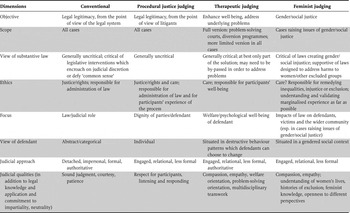
The four approaches posit different goals for the judicial process. In conventional judging, the aim is to achieve and project legal legitimacy from the internal perspective of the legal system, through the impartial application of legal rules. Procedural justice is also concerned with legal legitimacy, but from an external perspective – that of the litigant. Procedural justice argues that court users are more likely to attribute legitimacy to a system which treats them with respect and dignity and makes them feel they have been heard. Therapeutic jurisprudence focuses instead on the capacity of law to do good rather than harm, to enhance the personal well-being of court users and, in particular, to address the root causes of offending behaviour and thereby to cure rather than merely punish the offender. By contrast, the substantive goal of feminist judging is to achieve gender or wider social justice – a goal which has potentially broader impacts than reforming individual offenders. At the same time, and unlike the other three approaches, feminist judging may not be applicable in every case, but only in those where an issue of gender or wider social justice arises. Moreover, feminist judging is constrained by the demands of (internal) legitimacy. A feminist judicial officer cannot pursue gender justice in disregard of the law, but may only do so within the limits of the law, such as through the legitimate exercise of discretion, assessment of evidence, and management of the courtroom and the proceedings (Hunter, Reference Hunter2008a; Reference Hunter, Hunter, Mcglynn and Rackley2010; Reference Hunter2015b).
The different philosophical underpinnings of the four approaches result in different views of substantive law, different ethical orientations, different focuses of attention and different views of criminal defendants. Neither conventional judging nor procedural justice tends to question substantive legal rules: they are simply the rules which must be applied, according to thinner or thicker conceptions of procedural justice. The exception to this may be a resistance within conventional judging to rules which are perceived to unduly limit judicial discretion (such as mandatory sentencing provisions), to contravene ‘fundamental’ common-law principles or to offend judicial ‘common sense’ (Fielding, Reference Fielding2011; Hunter, Reference Hunter2015b). Therapeutic jurisprudence in its full sense does not so much question legal rules as work around them. Criminal punishment is suspended while the offender undergoes the treatment regime but, if she or he fails to complete the course, the punishment regime is reinstated with full force. Feminist judging, on the other hand, may, at higher levels of the court hierarchy, involve changing legal rules to achieve more just results for women and other outsiders. In the lower courts, however, while there is no scope for changing rules, there may be scope for criticising them and working for reform (Roach Anleu and Mack, Reference Roach Anleu and Mack2007). At the same time, feminist judicial officers may be concerned fully to implement progressive laws designed to achieve gender or wider social justice, such as laws on discrimination, domestic violence and protections for vulnerable witnesses (Hunter, Reference Hunter2015b).
In terms of ethical orientations, conventional judging employs the traditional ethic of justice, which abstracts the issues and typically resolves conflicts by resort to a hierarchy of rights. Procedural justice and therapeutic jurisprudence might be seen, by contrast, to implement an ethic of care, in that the judicial officer seeks to establish a relationship with the parties, engages with them directly and takes responsibility for their experience of the process (in the case of procedural justice) or for their well-being (in the case of therapeutic judging). Indeed, therapeutic jurisprudence in problem-solving courts relies on the judge developing an ongoing personal relationship of honesty, trust and rapport with the offender. Feminist judging may or may not involve an ethic of care: an ethic of care is certainly consistent with feminist judging, but its absence does not belie a feminist approach.
The focus of conventional judging is on the law and the judicial role. Litigants are regarded in abstract, categorical terms; thus, a defendant in criminal proceedings is someone whose personal circumstances may only be relevant to the extent that they may operate as aggravating or mitigating factors in the sentencing calculus. The focus of procedural justice in a criminal matter, on the other hand, is on the dignity of the defendant, who is regarded as a subject who deserves to feel included, heard and understood, and whose experience of the judicial process matters, whatever the result may be. Therapeutic jurisprudence focuses on the defendant's welfare and psychological well-being. She or he is regarded as an individual situated in unfortunate circumstances, who has the capacity to work to change his or her life. Therapeutic jurisprudence is about developing the moral self as indicated by compliance with the treatment regime, assisted by advice, guidance, motivation and inspiration from the judge and the interdisciplinary experts. Like therapeutic jurisprudence, feminist judging sees the defendant as an individual situated in a particular context, but it lacks therapeutic jurisprudence's moral goals. Feminist judging sees the problems for individuals before the court as located in law and in society – that is, as political, the product of systemic power differentials – rather than in the offender's personal choices, and thus it is more likely to seek empowerment for those who have been disempowered rather than individual moral reform. Its focus is also broader, taking in not only the defendant, but also the victim,Footnote 9 family members and the wider social, cultural and economic context.
There is scope for overlap between feminist judging, procedural justice and therapeutic jurisprudence, in that feminist judging may incorporate a procedurally just approach (while incorporating other feminist elements as well), and feminist judicial officers may incorporate therapeutic goals and practices. For example, in Australia, some feminist magistrates sit in specialist domestic violence courts, and have also been involved in the establishment of other problem-solving courts such as drug courts and Koori/Murri courts (see, for example, Auty, Reference Auty2006; Hennessy, Reference Hennessy, Reinhardt and Cannon2007; Hunter, Reference Hunter2004; King and Auty, Reference King and Auty2005; Previtera, Reference Previtera2006). But a feminist judicial officer with a therapeutic orientation may also be aware of the dangers of trying to be too interventionist or maternalist and thinking that she and the experts know best, rather than acknowledging and validating the defendant's expertise in her own life.
7.2 Practice
At the level of practice, while it should be possible to distinguish between more conventional and newer approaches to judging, it may be difficult to distinguish among the latter. For example, a key performance element in the newer approaches to judging is more direct judicial interaction with court users, as opposed to the detachment of conventional judging. This entails treating those before the courts with respect and dignity, acknowledging them as individuals rather than as a type, being concerned about their welfare, explaining the process, actively interacting with and listening to participants, engaging in direct dialogue with them, and being less formal and impersonal than more traditionally oriented judicial officers (King et al., Reference King, Freiberg, Batagol and Hyams2014; Mack and Roach Anleu, Reference Mack and Roach Anleu2011). This will require different judicial communication skills and perhaps greater emotional capacities such as empathy and compassion (Henderson, Reference Henderson1987; see also Acorn, Reference Acorn2004; Avgoustinos, Reference Avgoustinos2007; Bandes, Reference Bandes2009; Massaro, Reference Massaro1989). At the same time, it may be difficult to tell whether the philosophy behind these practices is procedural justice, therapeutic jurisprudence or feminism.
Potentially, the only way to distinguish between procedural justice, therapeutic jurisprudence and feminist judicial practices would be by reference to the context and content of the judicial performance. If the judge actively engaged with all defendants without more, that would appear to be a procedural justice approach. If the judge took a holistic view of the situation of all defendants and attempted to identify and address underlying problems, that would appear to be a therapeutic-jurisprudence approach. If the case involved a woman defendant or complainant or otherwise involved a gender or feminist issue, and the judge took steps to protect the complainant and/or affirm her experience, to understand the defendant's particular circumstances, to condemn male violence and/or to combat gender stereotypes, that would appear to be a feminist approach.
Table 1 summarises the similarities and differences identified in this section.
Comparing approaches to judging

VIII. Conclusion
These accounts of approaches to judging in the lower courts demonstrate that feminist judging clearly differs from other approaches to judging, but in ways which may be difficult to discern in terms of observable judicial performance. Therapeutic jurisprudence and feminism have most in common in terms of embracing substantive goals, taking a more critical view of law, (potential) deployment of the ethic of care and judicial engagement, compassion and empathy. Both appear to incorporate procedural justice but go beyond it. However, therapeutic jurisprudence is still individualistic and moralistic, while feminist judging takes a more structural view. On the other hand, therapeutic jurisprudence in the sense of promoting participants' well-being and minimising the harms caused by the legal system is arguably applicable to a wide range of cases, whereas feminist judging might be more limited in scope.
This is not to suggest that, because of their substantive goals, therapeutic jurisprudence and feminist judging as practices in the lower courts risk violating norms of judicial decision-making. Fidelity to judicial legitimacy, understood as impartiality, neutrality, application of law and following legal procedures, remains central to all approaches to judging in courts at all levels and, indeed, the conventional approach to implementing these values exerts considerable ‘gravitational pull’ over all approaches to judging.Footnote 10 However, newer forms of judging challenge the assumption in conventional judging philosophy that these values can only be performed in specific, limited ways. Indeed, proponents of feminist judging have argued that a feminist approach is likely to be more fair and truly impartial than conventional judging, because it overcomes conventional partiality towards masculine experience and perspectives (Hale, Reference Hale and Johnston2007; Hunter, Reference Hunter2008a; Reference Hunter2015b).
This paper provides a detailed analysis and comparison of ways the four approaches to judging might manifest in lower-court practice as ‘ideal types’, but these distinctions may not be so sharp or so readily perceptible in actual courtroom processes. Versions of procedural justice and therapeutic jurisprudence might be weak or minimal. Implementation of philosophical ideals may be inconsistent, perhaps due to the constraints of the forum, the type of matter and/or the way participants interact with the judge. Judicial philosophies may be more or less consciously pursued. Nonetheless, conceptually differentiating these four approaches to judging in the lower-court context, and identifying key similarities and differences, provides an essential foundation on which to further specify and extend understandings of the scope and nature of feminist judging beyond the higher courts.