Democratic accountability relies on the ability of citizens to judge the performance of governments and reward or punish the responsible politicians at the ballot box. Theoretically, this feedback loop is normatively appealing because it incentivizes politicians to respond to the preferences of their constituents. In turn, via regular elections, it helps citizens get policies that represent their wishes.
The correspondence between economic conditions and the voteshare of incumbent politicians is often used as evidence of this type of democratic accountability. Yet this research is far from conclusive: it has often indicated a mild connection between performance and voting patterns, or one that is dependent on certain conditions. Much of the research on the subject focuses on the information environment and suggests that the media may play a crucial role in enabling accountability by giving voters information about performance.
Political communication may also influence this process. This communication may enable citizens to directly learn about politicians’ performance. Yet conventional wisdom in political science holds that politicians communicate strategically with their constituencies (e.g., Mayhew, Reference Mayhew1974; Fenno, Reference Fenno1978). This strategic communication may allow politicians to present information about their own performance in order to emphasize positive performance. Though the news media and people's own knowledge and experiences, among other factors, may counteract this communication, some citizens may still form opinions and choose representatives based on it. Democratic accountability relies on the ability of voters to select politicians through elections, but if they base these decisions on a distorted picture of their representatives’ performance then this may not be fulfilled.
Existing scholarly attention to the communication and representational styles of politicians has focused largely on members of Congress and the President. Less attention has been given to the communication patterns of politicians at other levels of government, such as in cities, despite the fact that such levels of government provide the greater variation needed to empirically test many theories of political communication. The wide variation in the performance of local politicians provides an opportunity to test political communication's role in a central theory of political accountability.
In this paper, I gather a large-scale data set of political communication in cities in the United States to directly answer questions about politicians’ strategic behavior. Using a temporally dense and geographically broad database of over 110,000 municipal press releases in large cities, I examine patterns in local politicians’ communication. I combine these data with fine-grained economic and crime data to assess one mechanism behind retrospective voting—that of the informational inputs to voter knowledge. Using panel difference-in-differences models that take advantage of within-city variation in performance, I show that politicians communicate more about the economy when economic performance is improving. On the other hand, when economic performance becomes worse, they communicate less about it. In contrast, they communicate more about crime when violent crime rates fall, and less when crime rates rise. Politicians communicate strategically in a way that may, therefore, over-emphasize positive performance and contribute to failures of retrospective voting. This pattern may help to explain evidence elsewhere showing that accountability for performance is limited or conditional on other factors, especially in local elections.
This paper proceeds as follows. First, I discuss previous research on retrospective voting and the mechanisms behind it, including politicians’ communication and representational styles. Next, I introduce the press releases data, along with my sources of economic and crime data and my research design. I then discuss my findings and demonstrate how politicians strategically communicate about both economic growth and crime. Finally, I briefly conclude and discuss the implications for future research on accountability, political communication, and urban politics.
1. Background
Central in scholarly discussions of electoral accountability is the observation that incumbent electoral fortunes often correspond with economic conditions. Such economic voting is an example of the more generalized phenomenon of retrospective voting, in which voters reflect on past performance in their evaluations of incumbent candidates or parties. For decades, researchers have documented this pattern using data from national (e.g., Fiorina, Reference Fiorina1978; Tufte, Reference Tufte1978), state (e.g., Peltzman, Reference Peltzman1987), and local elections (Arnold and Carnes, Reference Arnold and Carnes2012; Hopkins and Pettingill, Reference Hopkins and Pettingill2018). This kind of performance-driven accountability is generally assumed to lead to normatively favorable outcomes.Footnote 1
The evidence of this phenomenon has resulted in a number of contingent theories. Recent examinations of this question that have evaluated retrospective voting across levels of government have identified small but consistent effects of local economic conditions on the incumbent party's electoral fortunes (de Benedictis-Kessner and Warshaw, Reference de Benedictis-Kessner and Warshaw2020a). Yet previous research on retrospective voting has claimed that different types of economic circumstances affect evaluations of government—either personal economic conditions (e.g., Fiorina, Reference Fiorina1978), or generalized, societal conditions (e.g., Kinder and Kiewiet, Reference Kinder and Kiewiet1981). Moreover, while survey data have often documented a robust relationship between subjective evaluations of the economy and approval of the national government, similar evidence in state and local elections has been more mixed. Why has an area with such devoted scholarly attention come to such mixed conclusions?
One central contingency that researchers have focused on is access to information about performance. Especially when research has relied on election data, it has demonstrated that retrospective voting is dependent upon information. When more information is available to voters—and it is of better quality—voters may be better able to make retrospective judgments (Hopkins and Pettingill, Reference Hopkins and Pettingill2018). The news media may play an important role in providing this type of information to voters (e.g., Soroka et al., Reference Soroka, Stecula and Wlezien2015; Bisgaard et al., Reference Bisgaard, Dinesen and Sønderskov2016). Especially in local elections, where information is less easily available (Bernhard and Freeder, Reference Bernhard and Freeder2020; Crowder-Meyer et al., Reference Crowder-Meyer, Gadarian and Trounstine2020) and attribution of responsibilities more difficult (Arceneaux, Reference Arceneaux2006; Sances, Reference Sances2017; de Benedictis-Kessner, Reference de Benedictis-Kessner2018), the provision of additional information may be crucial in enabling democratic accountability. When provided by an impartial source, we might expect that accurate information enables better voting decisions (Kogan et al., Reference Kogan, Lavertu and Peskowitz2016).
At the same time, longstanding wisdom in political science holds that politicians behave strategically to best ensure their reelection (Mayhew, Reference Mayhew1974). Political communication is often used to secure this support among the electorate. Politicians might selectively communicate about certain events to proactively define the standards on which they are judged by voters (Fenno, Reference Fenno1978; Grose et al., Reference Grose, Malhotra and Van Houweling2015). Mayhew (Reference Mayhew1974) describes a subset of this communication as credit claiming, whereby politicians highlight the work they have done on behalf of their constituents. In contrast, they may also attempt to shift blame to others for negative outcomes (McGraw, Reference McGraw1991). This credit-claiming and blame-shifting communication might distort the information environment for voters. It could cause voters to pay more attention to the topics elites communicate about—especially in the absence of other information from media coverage or opposing campaigns. Voters may therefore judge those politicians based on a biased version of the performance. This dynamic could explain the conditional evidence of retrospective voting, especially in subnational elections. Assessing whether this potential fault in accountability exists, however, requires an empirical comparison of communication patterns and objective performance.
Much of the research on politicians’ strategic communication has relied on indirect evidence of credit claiming. In particular, it has focused on legislators’ spending behavior to demonstrate that representatives in Congress and elsewhere spend money on projects for which they can later claim credit. This spending, often in the form of strategically-targeted pork-barrel projects, can help an incumbent subsequently gain constituents’ electoral support (e.g., Reeves, Reference Reeves2011; Kriner and Reeves, Reference Kriner and Reeves2012). A primary theoretical explanation for this is that politicians communicate about such spending to voters, or claim credit, in order to gain their support (Mayhew, Reference Mayhew1974). Yet the actual communication mechanism by which this particularistic spending is translated into votes has remained in large part “a black box” in research on the subject (Bickers and Stein, Reference Bickers and Stein1996).
Recent research has begun to answer the question of this mechanism at least partially by uncovering patterns in elites’ strategic communication, but has focused almost exclusively on national politicians (e.g., Kernell, Reference Kernell1993; Vavreck, Reference Vavreck2009). National politicians strategically communicate in order to sway voters’ perceptions of politicians’ efficacy and their support for those politicians (Grimmer et al., Reference Grimmer, Messing and Westwood2012; Grimmer, Reference Grimmer2013). Less attention has been paid to whether subnational politicians—the vast majority of elected government officials in the US—communicate in similar ways.Footnote 2
Understanding patterns in accountability and representation at the local level is crucial for understanding how they may feed into broader processes of democratic accountability across levels of government. Moreover, direct evidence of the phenomenon of credit claiming is crucial to support broad theories of elite behavior—yet such evidence directly from politicians’ communication is currently sparse.
1.1 Theoretical expectations from local politics
Explaining how politicians communicate in response to objective conditions is crucial in assessing this mechanism behind retrospective voting. Though theories behind credit claiming are ordinarily applied to communication about positive performance, they can be naturally extended to communication about negative outcomes as well.Footnote 3 The theory presented here expands the predictions of credit claiming to political communication more broadly and presents contrasting expectations for both positive and negative performance, which I apply to two areas of government performance.
Economic growth is one policy area that is especially apt for such strategic communication at the local level. Much of urban policymaking is unified around bringing businesses and workers to cities in order to raise additional tax revenue for the city and attract residents (Stone, Reference Stone1946; Peterson, Reference Peterson1981; Logan and Molotch, Reference Logan and Molotch1987). These policies may take the form of tax breaks to incentivize companies to relocate their headquarters, or simply dedicating more funding to business districts.
Existing research in urban politics has shown that mayors are, indeed, likely to communicate about economic development. Mayors discuss economic development and the state of the economy prominently in their annual State of the City addresses (Holman, Reference Holman2016). Mayors also cite economic development as one of the highest priority parts of their job (Einstein and Glick, Reference Einstein and Glick2018). Survey evidence suggests that perceptions of the local economy may in turn structure voters’ decisions (e.g., Park and Reeves, Reference Park and Reeves2020). When voters hear about positive economic growth, they may be more likely to support the incumbent government—giving politicians an incentive to discuss such growth more when communicating with voters.
Theories of accountability also suggest that strategic communication may arise around issues of crime and public safety. Local politicians discuss crime (Marion and Oliver, Reference Marion and Oliver2013; Holman, Reference Holman2016), and political communication more generally can shape constituents’ beliefs about crime (Oliver, Reference Oliver1998). Crime may also be an area in which voters engage in retrospective judgments of local politicians—punishing the government when crime rates are higher and rewarding the government when crime decreases (Arnold and Carnes, Reference Arnold and Carnes2012). Voters who have more information about crime easily available may judge the government less favorably (Kalmoe et al., Reference Kalmoe, Pingree, Watson, Sui, Darr and Searles2019). Politicians therefore have an incentive to communicate less about crime in order to bolster their support among the electorate.
These areas of government performance present two contrasting expectations for communication. On the one hand, local politicians might discuss the economy and crime both when performance is good and when it is worse—without asymmetry. This would suggest that political communication does not hinder accountability but instead simply raises awareness of objective conditions. On the other hand, if politicians communicate about economic growth and crime in a way that presents information about performance in these two areas differentially based on whether conditions are improving or worsening, then this communication may threaten voters’ ability to hold politicians accountable.
2. Data
In this section I describe the communications, economic, and crime data that I use to test these theoretical questions.
First, I use data on municipal press releases ranging from 1989 to 2017 in 50 of the largest cities in the United States—such as Buffalo, NY, at the smaller end of the spectrum, and Los Angeles, CA, at the larger end. These press releases are often picked up by local newspapers and used as the start of a story or reprinted either partially or wholesale (Turk and Franklin, Reference Turk and Franklin1987; Franklin, Reference Franklin2008), especially in an age of declining local media resources (Martin and McCrain, Reference Martin and McCrain2019; Peterson, Reference Peterson2020; Rubado and Jennings, Reference Rubado and Jennings2020). Apart from their widespread availability to voters both directly and via the media, they also offer a pure picture of politicians’ strategic behavior via a direct window into their expressed priorities.
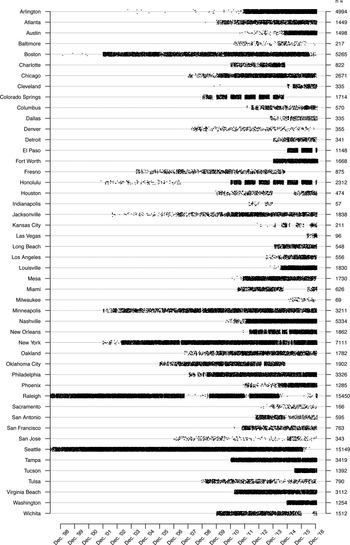
I gather the press releases from the websites of each individual city, where they are generally posted in some sort of municipal press release archive. To gather these text documents I developed a scraper, or automated text retrieval tool, for each of these 50 individual municipal websites, which extracts the text and posting date of all available press releases that each city has stored online. For cities where this approach yielded very few or no press releases, I supplemented the scraped data by contacting the city and requesting all available press releases that they had stored digitally or on paper. I then added these press releases to the scraped press releases. For some cities, this set of press releases encompasses 27 years of communication, while for others it captures only several recent months.Footnote 4 Together, my resulting database encompasses 111,892 individual press releases between 1989 and 2017. The temporal range of data within each city is shown in Figure 1, with the date along the horizontal axis, the city along the vertical axis, and each individual press release plotted as a black point.Footnote 5 Though the data are sparse in some cities and in earlier years, this corpus represents the largest collection of municipal political communications data available. My research design, which I discuss in the next section, allows me to use these data to leverage within-unit changes in communication and performance without fear of bias due to the imbalance in coverage between cities.Footnote 6
Press releases data set.

Next, I combine these text data with information on economic performance from the Quarterly Census of Wages and Employment (QCEW). The QCEW consists of quarterly information on total wages and employment collected by the Bureau of Labor Statistics from 1991 to the present. It is based on the unemployment insurance filings provided by business establishments. These data cover nearly all businesses in the United States, decreasing the degree of measurement error and therefore enabling more valid analyses of the effect of the economy (Healy and Lenz, Reference Healy and Lenz2017; Sances, Reference Sances2017). I use the average quarterly wages per worker from the QCEW as a measure of economic performance aggregated at the metropolitan area level for each of the cities in my press releases data.Footnote 7 For each press release, this gives me a measure of objective economic performance in that city at that specific point in time.
Finally, I combine my text data with information on crime from the FBI's National Incident-based Reporting System (NIBRS) data. The NIBRS data consist of all information about criminal incidents reported by police agencies in the United States through a centralized system to the FBI. These data are unfortunately not as comprehensive as the economic conditions data, as many police agencies do not report any data to the FBI via this system. However, those agencies that do report their crime data do so in its entirety and with great detail, making these data an objective source of information about crime. I calculate the monthly total of violent crimes, classified by the FBI as all murder and non-negligent manslaughter, rape, robbery, and aggravated assault for each city, divided by the city's population to create a measure of the violent crime rate.Footnote 8 For each press release, this gives me a measure of crime conditions in that city at that specific point in time.Footnote 9
3. Research design
In order to assess strategic political communication about the economy and crime, I use a combination of methods to analyze these data. First, I use structural topic models (STMs) (Roberts et al., Reference Roberts, Stewart, Tingley, Lucas, Leder-Luis, Gadarian, Albertson and Rand2014), a form of unsupervised machine learning, to broadly categorize the content of the press releases data. Next, I use these machine-identified categories to develop dictionaries that enable me to code whether each press release is about economic growth or crime.
STMs are one of a number of automated methods for describing text-as-data, which more generally develop a structure for eliciting latent themes present in documents expressed by the co-occurrence of certain words. Topic models such as STM allow researchers to describe patterns within a large data set of text, though each method comes with its own tradeoffs (see, e.g., Grimmer and Stewart, Reference Grimmer and Stewart2013). STMs, in particular, allow for incorporation of the covariate structure of the corpus of documents with the content of the documents’ text (Roberts et al., Reference Roberts, Stewart, Tingley, Lucas, Leder-Luis, Gadarian, Albertson and Rand2014). Crucially for my purposes, STMs can incorporate a covariate such as the municipality producing each document, which allows me to model topic structure that varies across cities—in other words, allowing each city to talk about the same topic but using slightly different language.
I apply a variety of pre-processing steps to the text data in order to make it more useful for eliciting meaningful topics. This includes search-and-replace substitution of each city's name with, instead, the generic word “cityname,” elimination of all non-alphanumeric characters and common html tags that were included when the data were collected from the municipal websites, and removal of all English-language stopwords (e.g., articles, prepositions, and conjunctions). I run the STMs on the processed text data to produce semantically coherent topics as a first step at assessing the content of these communications generally.
Then, for the primary analyses of this paper, I use the machine-coding to guide my own human coding decisions about the data. Specifically, I dig further into two topics that appeared in the STM-generated topical clusters: economic growth and crime. I then generate two dictionaries that precisely match the concepts of economic growth and crime and therefore provide a better conceptual measure of communication about these topics (Muddiman et al., Reference Muddiman, McGregor and Stroud2019).
I use these human-created dictionaries to classify each press release in my data set if it uses more than a threshold number of the words in these dictionaries. I designate a press release as being about economic growth when it uses multiple words in a list of words about job growth, job training, and economic returns to the localized area.Footnote 10 Similarly, I designate a press release as being about crime when it uses multiple words in a list concerning specific types of crimes, arrests, and police investigations.Footnote 11
To assess my hypotheses about strategic political communication, I use temporal aggregates of press releases within cities as the unit of analysis and operationalize my main dependent variables as the proportion of press releases within that city and time period containing the threshold number of words in these topical dictionaries.Footnote 12 Then I examine the influence of objective city-level conditions on this communication. For communication about the economy, I assess whether economic conditions in a given city—operationalized by the change in the natural log of quarterly wages per worker between the past quarter and the current quarter—influences the proportion of press releases about economic growth.Footnote 13 For communication about crime, I assess whether objective crime conditions—operationalized as the change in the natural log of the city's violent crime rate per 100,000 residents between the past month and the current month—affect the proportion of press releases about crime.
Specifically, I use differences-in-differences panel regression models with city- and time period-level fixed effects to isolate the causal effect of changes in the economy or crime on local politicians’ communication (Wooldridge, Reference Wooldridge2002; Angrist and Pischke, Reference Angrist and Pischke2008). These regressions take the following forms:


In both cases, the dependent variable is the proportion of press releases belonging to the relevant topic in a given city and time period, while the main independent variable is the measure of performance described above, and γi represents city-level fixed effects. τt represents time period fixed effects, which in the first equation are at the year-quarter level and in the second equation are at the year-month level. In all models, I weight each city-time period aggregation of press releases by the total number of press releases made during that time period in that city. In addition, I cluster standard errors at the level of measurement of the independent variable—either by Metropolitan Statistical Area (MSA) and quarter, for the effects of the economy, or by city and month, for the effects of crime—in order to account for serial correlation within geographic units and time periods (Beck and Katz, Reference Beck and Katz1995).
City-level fixed effects allow me to assess the impact of variation in performance within cities in my press releases data that eliminates the impact of time-invariant confounders that might also affect communication. The inclusion of time period fixed effects as well allows me to account for the impact of specific time period shocks to communication.Footnote 14 Together, these two-way fixed effects allow me to interpret the effects of the economy or crime in a causal manner if I assume that there are no time-varying confounders—that is, no unobserved factors that might affect certain cities in only certain time periods and lead to the observed differences in communication.
This main assumption, often called the assumption of parallel trends, is fundamentally untestable without knowledge of unobservable factors. Yet in the context of a binary treatment (say, in a program evaluation framework) this assumption can be easily falsifiable if there exist pre-treatment trends between different groups (say, the treatment and control groups). In a continuous treatment context such as mine, the same assumption can be tested in a similar framework. Specifically, to test for the potential presence of time-varying confounders, I regress lagged versions of my main outcome variables on contemporaneous economic growth and criminal activity to see if cities with different trends in performance are proceeding along similar paths prior to treatment. The results from these placebo checks are shown in Appendix B, and indicate little evidence of pre-treatment trends. This assuages concerns about the validity of this research design for assessing the causal effects of performance on communication.
The main quantity of interest that this research design enables me to identify, despite non-random assignment of economic conditions or crime to cities, is β, the causal effect of performance on communication patterns. This model takes advantage of variation in performance within cities and time periods across the entire data set of press releases.Footnote 15 Interpretation of the effects of performance, therefore, are the within-city effects of different changes in economic conditions and crime rates. If performance has an effect on communication patterns—in other words, if β is non-zero—this would represent evidence of strategic communication.
4. Results
What do municipal governments communicate about? To best describe the overall content of local politicians’ communication, I examine the latent topic structure of municipal press releases, as identified by the STM. The STM identifies coherent groupings of language into topics that appear across the corpus of press releases and demonstrates the most common topics discussed and the ways that they are each discussed. Table A1 in Appendix A shows these topics, with the summary label that I create for each, the words that the STM identified as the most predictive of that topic, and the frequency of the topic across all press releases in the entire corpus of documents. The topics frequently discussed in municipal press releases are, unsurprisingly, matters associated with cities, the programs they provide to residents, and other routine business of a government.
Most common among these topics are subjects related to the business of running a city: crime, infrastructure, utilities, events, and administrative announcements. The topics also adhere to the areas of city policy that urban politics literature most often describes as the focus of municipal politicians. Perhaps surprising is how distinct these topics are from much of what politicians at other levels of government talk about in their communication. Particularly absent are most of the political issues present in national-level discourse in US politics. The common topics of Congressional press releases, identified by Grimmer (Reference Grimmer2013), are conspicuously missing from these local press releases.
4.1 Strategic communication
The overall prevalence of these categories of communication, of course, masks their potential correspondence with reality. To assess this correspondence—and politicians’ potential use of communication for strategic gain—I next examine two of the common topics within these press releases, those about crime and economic growth, using my manually created dictionaries. Using my indicator of topic membership based on these dictionaries, I quantify the prevalence of both of these topics across the entire corpus of press releases. This approach indicates that press releases about economic growth are 6.5 percent of the universe of press releases, while those about crime are 5.7 percent of the total.Footnote 16 The press releases about economic growth in these data generally concern new businesses and jobs brought to the city, while the press releases about crime concern recent crimes, arrests that were made, and ongoing police investigations.
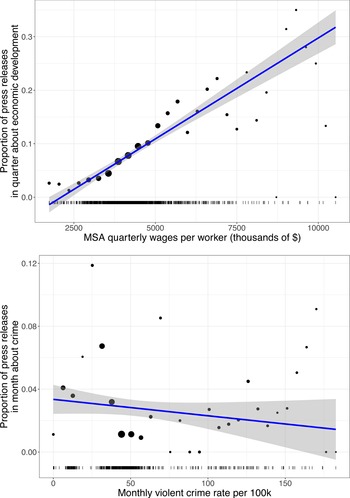
As a first cut at investigating the possibility of such strategic communication, I compare the objective conditions in these two areas of performance with the prevalence of press releases about these two topics. In the top panel of Figure 2, I plot the mean proportion of press releases in a city-quarter about economic growth, along the vertical axis, within bins of the associated MSA's quarterly wages per worker, along the horizontal axis. The positive-sloped linear trend line in this plot demonstrates that, when economic conditions are better, the proportion of press releases about economic growth is much higher. In the bottom panel of Figure 2, I likewise plot the mean proportion of press releases about crime in a city-month along the vertical axis, within bins of the associated city's violent crime rate along the horizontal axis. The negative-sloped linear trend line in this second plot indicates that as the violent crime rate increases, press releases from city governments are less likely to be about crime.
Plots show the cross-sectional relationship between objective conditions and communication in two areas of performance. Filled circles show the mean quarterly or monthly proportion of press releases containing >10 words in the respective dictionary within bins of equal width along the horizontal axis. Size of circles is proportional to the total number of press releases within each bin. Tick marks at the bottom of each plot indicate the density of the data along the horizontal axis.

Both of these plots are consistent with a story of strategic communication by local politicians, but they are subject to a variety of issues that threaten a causal interpretation. A number of confounding factors could lead to the observed relationships in Figure 2. For instance, cities with higher wages may also elect politicians who are more concerned with business and economic growth, leading to a cross-sectional correspondence between economic conditions and communication about the economy. It would, therefore, be inaccurate to interpret these cross-sectional relationships as evidence of economic conditions or crime causing differences in communication.
To better assess the causal effect of economic conditions and crime rates on communication, I next move to the difference-in-differences models that incorporate city and time-period fixed effects to account for these potential confounders. In Table 1 I show the results of these models for both topics of communication. In the first column I present the coefficient for economic conditions and in the second column the coefficient for crime rates, with standard errors clustered at the level of treatment below them in parentheses.Footnote 17 These results indicate that the cross-sectional relationship observed in Figure 2 holds true within-city as well.
Effect of Economic Conditions and Crime on Communication

Note: * p < 0.1; ** p < 0.05; *** p < 0.01
Standard errors clustered by MSA and year-quarter in model 1 and by city and year-month in model 2.
Within a given city, as economic conditions improve, as measured by the change in the log of quarterly wages per worker, the proportion of press releases about economic growth increases, as shown in the lefthand column. Crime rates demonstrate a similar effect on communication, albeit in the opposite direction: as crime rates increase, as measured by the change in the log of the violent crime rate, the proportion of press releases about crime decreases, as shown in the righthand column. Because both independent variables are measured using the change in the log of their respective levels, their interpretation is similar and straightforward. When the change in quarterly wages increases by one percentage point, the proportion of press releases about economic growth increases by five percentage points, and when the change in crime rates increases by one percentage point, the proportion of press releases about crime decreases by two percentage points. These effects are statistically significant and their magnitude, given the baseline rates of these types of communication—8.5 percent for economic growth and 5 percent for crime—is substantively large. The effect of a one percentage point increase in the change in wages per worker increases the proportion of press releases about economic growth by 64 percent, while the parallel effect for crime rates reduces the proportion of press releases about crime by 31 percent. As these effects are the result of changes in economic conditions and crime rates, the lower or higher rates of communication that occur do not simply reflect a lack of events in these policy areas to discuss, but a shift in emphasis following changes in performance in both policy areas.
However, the shifts that actually occur in both wages and crime rates within city are ordinarily small. In reflection of the realistic amount of variation in these measures of performance and following the recommendations of Mummolo and Peterson (Reference Mummolo and Peterson2018), these effects can be better characterized in terms of the typical changes within cities in the independent variables. The within-city change in logged wages ranges from − 0.33, at the lowest, to 0.25, at the highest, with a standard deviation of 0.07. The results from the fixed-effects model in Table 1 indicate that moving from the 25th percentile of this within-city measure, at − 0.043, to the 75th percentile, at 0.084, would be equivalent to two-thirds of a percentage point increase in the proportion of press releases about economic growth. Within cities, the proportion of press releases about economic growth has a standard deviation of 8.5 percentage points. This effect, therefore, represents a small but consistent shift in the average city's discussion patternscity changes in economic conditions. I plot the change in the log of wages per worker, residualized at the city and quarter level, along the horizontal axis, while I plot the residualized proportion of press releases about economic growth along the vertical axis. Filled circles indicate the mean proportion about that topic within bins of equal width along the horizontal axis. The positive trend line reproduces the effect shown in column 1 of Table 1.
Change in MSA economic conditions and communication about economic growth. Open circles show the city- and quarter-residualized mean proportion of press releases containing >10 words in the economic growth dictionary within bins of equal width along the horizontal axis, which represents the city- and quarter-residualized change in the log of quarterly wages per worker in that MSA. Size of circles is proportional to the number of press releases within each bin.

Similarly, the within-city variation in the change of logged violent crime rates is also small on average, with a standard deviation of 0.23, a minimum of − 1.01, and a maximum of 1.74. The results from the model in Table 1 indicate that moving from the 25th percentile of this within-city measure, at − 0.133, to the 75th percentile, at 0.112, would be equivalent to a decrease in the proportion of press releases about crime of slightly less than half a percentage point. Given that within cities, the proportion of press releases on crime has a standard deviation of 8.9 percentage points, this effect represents a small but substantively important shift. Figure 4 demonstrates the impact of these within-city changes in crime rates. I plot the residualized change in the log of the violent crime rate along the horizontal axis and the residualized proportion of press releases about crime along the vertical axis. Filled circles indicate the binned mean proportion of topic membership, and the negatively sloped trend line reproduces the effect of crime rates shown in column 2 of Table 1.
Together, these results indicate the small but consistent impact of performance on communication. For both economic growth and crime, political communication varies as objective conditions change within cities. When performance is better—measured by rising wage growth or falling crime rates—local politicians communicate more about these areas than when performance is worse. Rather than communication patterns that reflect real conditions in an unbiased manner, these patterns reflect an emphasis on positive performance. These distortions suggest strategic motivations behind the production of press releases that may result in biases in voters’ information environment.
Change in city crime rate and communication about crime. Open circles show the city- and month-residualized mean proportion of press releases containing >10 words in the crime dictionary within bins of equal width along the horizontal axis, which represents the city- and month-residualized change in the log of the monthly crime rate in that city. Size of circles is proportional to the number of press releases within each bin.

5. Conclusion
Evidence of retrospective accountability for performance has often led to mixed or conditional theories. The theory behind some such contingent results is that accountability is contingent upon access to information about performance. In this paper, I examine politicians’ patterns of communication in cities in the United States. I utilize three sources of data and a robust causal inference research design to demonstrate that politicians communicate strategically in relation to both economic growth and crime. Their communication strategically emphasizes issues where they are performing well—and de-emphasizes areas where performance is worse. While these effects are small, they reflect the causal effects of changes in objective conditions within cities. This type of within-city change affords the econometric leverage to assess causal effects, but it likely ignores additional variation in conditions across cities—for instance, at the national level—that may also influence politicians’ communication patterns. The direct evidence of causal influences on politicians’ behavior presented here helps to explain why previous research may have found such contingent evidence of retrospective accountability, especially in subnational elections (e.g., Hopkins and Pettingill, Reference Hopkins and Pettingill2018; de Benedictis-Kessner and Warshaw, Reference de Benedictis-Kessner and Warshaw2020a). These findings contribute to broad theories of political communication and democratic accountability.
Political scientists have long pointed to the numerous ways that local politics is distinct from the debates and phenomena occurring at other levels of government. More recently, work on local politics has shown that local representation and accountability may function more similarly to national-level politics than previously thought (e.g., Tausanovitch and Warshaw, Reference Tausanovitch and Warshaw2014; Einstein and Kogan, Reference Einstein and Kogan2015; de Benedictis-Kessner and Warshaw, Reference de Benedictis-Kessner and Warshaw2016, Reference de Benedictis-Kessner and Warshaw2020b; Sances, Reference Sances2018). The results from this paper provide evidence that local politicians, unsurprisingly, are strategic in their communication in accordance with longstanding theories about national politicians’ behavior. Given research on the low levels of knowledge that citizens have about government responsibilities and performance, especially in cities (Crowder-Meyer et al., Reference Crowder-Meyer, Gadarian and Trounstine2020), this type of communication may powerfully sway voters’ perceptions of government performance (Larsen and Olsen, Reference Larsen and Olsen2020). These perceptions may in turn shape voters’ judgments of politicians in elections and subvert accountability.
Moreover, such strategic communication may sway voters’ decisions at multiple levels of government. While local politics in the United States has become more nationalized, local political communication may still influence national politics, especially as the role of local media outlets has declined (Darr et al., Reference Darr, Hitt and Dunaway2018; Martin and McCrain, Reference Martin and McCrain2019; Peterson, Reference Peterson2020; Rubado and Jennings, Reference Rubado and Jennings2020). Voters incorporate information about localized economic conditions and crime rates into their judgments of the president and downballot politicians (Healy and Lenz, Reference Healy and Lenz2017; Kalmoe et al., Reference Kalmoe, Pingree, Watson, Sui, Darr and Searles2019; de Benedictis-Kessner and Warshaw, Reference de Benedictis-Kessner and Warshaw2020a; Park and Reeves, Reference Park and Reeves2020). Strategic behavior by local politicians may therefore have effects that spill over into national politics.
Of course, voters may be protected from these influences for a variety of reasons. For one, citizens—especially politically knowledgeable ones—are critical consumers of information. Though less knowledgeable voters may be more susceptible to strategic communication, they may not subsequently connect their perceptions of performance to their votes (Alt et al., Reference Alt, Lassen and John2016). Second, the government's own communication is only one source of information for citizens. Alternative presentations of performance elsewhere, such as by the news media, may counteract strategic government communication (Chong and Druckman, Reference Chong and Druckman2007). Institutions such as the media may therefore be crucial in enabling citizen's judgments based on performance. Finally, people's perceptions are often shaped by their own experiences and their surroundings (Bisgaard et al., Reference Bisgaard, Dinesen and Sønderskov2016; Larsen et al., Reference Larsen, Hjorth, Dinesen and Sønderskov2019). When communication departs from reality, these personal observations may provide a contrasting influence on opinions. Yet despite these counterbalancing forces, not all voters are likely to be immune to the effects of strategic communication. At the margins such communication may still sway voters’ perceptions and behavior.
Normative expectations for democratic accountability often rely on voters having accurate information about government. If this information is slanted in one direction or another because it is influenced by politicians’ strategic communication, voters’ ability to hold government accountable may be hindered. Though the evidence from this paper shows that local politicians’ communication in two areas is strategic, future research should continue to assess such strategic elite behavior in other areas of performance. Furthermore, developing an understanding of the direct effects of such strategic communication on voters is also an important agenda for future research. This type of work can shed light on how substantially such communication influences voters’ perceptions—and which voters are most susceptible to these influences. Moreover, this paper only examines patterns of communication in large cities. Information on local politics and elections may be hard to find in big cities, but it may be even more difficult to find in smaller towns where local news coverage is uncommon and rapidly disappearing (Martin and McCrain, Reference Martin and McCrain2019; Peterson, Reference Peterson2020). Examining the contextual conditions under which these communication effects are more—or less—powerful is also deserving of future attention. Answering these questions is crucial for democratic accountability not just in cities, but at all levels of government.
Supplementary material
The supplementary material for this article can be found at https://doi.org/10.1017/psrm.2021.7.
Acknowledgement
For comments, suggestions, and advice on previous versions I thank Parrish Bergquist, Peter Bucchianeri, Elisha Cohen, Dan de Kadt, Nicolas Dumas, Katie Einstein, Meg Goldberg, Mirya Holman, Trish Kirkland, Krista Loose, Christopher Lucas, Lauren Mattioli, Rich Nielsen, Erik Peterson, Stephen Pettigrew, Mike Sances, Jaime Settle, Maurits van der Veen, Christopher Warshaw, Steven Webster, Ariel White, participants at the 2017 APSA meeting, and seminar participants at the College of William & Mary, Boston University, and Aarhus University.