Introduction
Fleas (Insecta: Siphonaptera) comprise more than 2500 species and subspecies described worldwide (Whiting et al., Reference Whiting, Whiting, Hastriter and Dittmar2008). Their life cycles include non-parasitic omnivorous larvae and obligate-haematophagous imagoes that parasitically feed on birds and mammals; almost 95% of all flea species have been collected from rodents (Marshall, Reference Marshall1981; Krasnov, Reference Krasnov2008; Whiting et al., Reference Whiting, Whiting, Hastriter and Dittmar2008).
Fleas may have great negative impacts on host populations and communities (Marshall, Reference Marshall1981; Krasnov et al., Reference Krasnov, Poulin, Morand, Morand, Krasnov and Poulin2006a). Moreover, they have tremendous medical and economic importance as vectors of several causative agents of diseases in animals and humans, such as cat scratch disease (Bartonella henselae), Q fever (Coxiella burnetii), murine typhus (Rickettsia typhii), flea-borne spotted fever (Rickettsia felis) and bubonic plague (Yersinia pestis) (Linardi & Guimaraes, Reference Linardi and Guimaraes2000; Bitam et al., Reference Bitam, Dittmar, Parola, Whiting and Raoult2010). Due to the potential vectorial capacity of fleas, their distribution may have important consequences for host survivorship and disease dynamics. According to the WHO (2011), arthropod-transmitted diseases represent 17% of infectious diseases worldwide, and are determined by a complex and dynamic system that involves vectors, hosts and infectious agents, as well as environmental factors.
Parasitism rates by fleas in rodents remain poorly understood. This knowledge gap has important implications for the health of wildlife and humans in communities that are affected by fleas and flea-borne diseases, mostly because rodents are the main reservoir for aetiological agents that cause such diseases (Linardi & Guimaraes, Reference Linardi and Guimaraes2000; Krasnov, Reference Krasnov2008). Among parasitological indexes, flea prevalence and abundance strongly impact the likelihood of disease transmission among hosts, and influence the emergence of flea-borne epizootics among humans (Lorange et al., Reference Lorange, Race, Sebbane and Hinnebusch2005; Eisen et al., Reference Eisen, Eisen and Gage2009; Tripp et al., Reference Tripp, Gage, Montenieri and Antolin2009). Thus, understanding the mechanisms driving heterogeneity in flea distributions will lead to better spatial and temporal predictions of epizootics. Furthermore, better comprehending what governs parasite distributions will enable the development of a framework for targeting disease control efforts based on environmental correlates (Tripp et al., Reference Tripp, Streich, Sack, Martin, Griffin and Miller2016; Sackett, Reference Sackett2017). In this sense, a predictive framework for characterizing the most heavily parasitized hosts and the most favourable areas for the fleas will provide deeper insight of flea-borne disease transmission dynamics.
Fleas are distributed across all continents and in a wide range of host species and habitats (Krasnov, Reference Krasnov2008). Their community structures (species richness, abundance and prevalence) may vary with geographical distributions. These variations are generated by interactions between intrinsic parasite factors (e.g. host specificity, biology), host factors (e.g. body size, immunology, physiology, geographic range) and environmental characteristics (e.g. temperature, humidity, vegetation), which limit or favour the parasite development (Marshall, Reference Marshall1981; Krasnov, Reference Krasnov2008; Linardi & Krasnov, Reference Linardi and Krasnov2012).
Ecological aspects of flea communities on rodents have been mostly studied in the Holarctic region (e.g. Krasnov et al., Reference Krasnov, Shenbront, Khokhova and Degen2004; 2005; 2007). In South America, most ecological studies on rodent ectoparasites comprise the whole community including fleas and other arthropods such as mites, ticks and/or lice. The most relevant studies are from Brazil (e.g. Linardi et al., Reference Linardi, Botelho, Ximenez and Padovani1991; Linardi & Krasnov, Reference Linardi and Krasnov2012), Chile (Bazán-León et al., Reference Bazán-León, Lareschi, Sanchez, Soto-Nilo, Lazzoni, Venegas, Poblete and Vásquez2013) and Argentina (e.g. Lareschi et al., Reference Lareschi, Ojeda and Linardi2004; Lareschi & Krasnov, Reference Lareschi and Krasnov2010; Nava & Lareschi, Reference Nava and Lareschi2012). In the Andean biogeographic region and the South American transition zone, ecological studies exclusively of rodent fleas were carried out by Lareschi et al. (Reference Lareschi, Ojeda and Linardi2004) and Bazán-León et al. (Reference Bazán-León, Lareschi, Sanchez, Soto-Nilo, Lazzoni, Venegas, Poblete and Vásquez2013).
Within South America, the highest flea diversity occurs in Argentina, with over 60% of flea species and subspecies distributed in Patagonia (Andean region), mostly parasitizing sigmodontine rodents (Lareschi et al., Reference Lareschi, Sanchez and Autino2016). Argentinian Patagonia, the southernmost region of South America, is the largest area of the Argentinian territory (Rabassa, Reference Rabassa and Rabassa2008). About 80 species of land mammals are known from this region. The most abundant are Cricetid rodents (Cricetidae, Sigmodontinae), represented by 17 genera and about 25 species in the tribes: Abrotrichini, Akodontini, Euneomyini, Oryzomyini, Phyllotini and Reithrodontini (Pardiñas et al., Reference Pardiñas, Teta and Salazar-Bravo2015; Patton et al., Reference Patton, Pardiñas and D'Elia2015). Moreover, high endemism of rodents and fleas occurs in Patagonia (Pardiñas et al., Reference Pardiñas, Teta, D'elía and Lessa2011; Lareschi et al., Reference Lareschi, Sanchez and Autino2016), and flea endemism is likely the result of long host–flea co-evolutionary processes. However, flea parasitism rates and the factors driving their variation, as well as the ecological aspects that modulate the distribution of flea–host associations, are unknown in this region.
This study was conducted in Central Patagonia where the size of the territory, its environmental heterogeneity and its rodent diversity provide a great potential for ecological studies of flea assemblages. Despite the biological relevance of the Patagonian region, current information about fleas comprises only faunal catalogues and taxonomic revisions (e.g. Sanchez & Lareschi, Reference Sanchez and Lareschi2013, Reference Sanchez and Lareschi2014; Sanchez et al., Reference Sanchez, Beaucournu and Lareschi2015). Our study focused on describing the diversity, prevalence, abundance and distribution of fleas in different Patagonian ecoregions and sigmodontine host species. Thus, we provide the first published ecological study on flea assemblages of the most representative sigmodontine species from Patagonia. This approach contributes to a better understanding of flea–host–environment complexes and will assist epidemiological studies of flea-borne diseases.
Materials and methods
Study areas
Biogeographically, Patagonia represents the environmental conditions of the Patagonian subregion of the Andean region (Morrone, Reference Morrone2006). This area can be defined as temperate or cool-temperate region. The climatic heterogeneity of the territory results from combined influences of the latitudinal temperature gradient and the west–east precipitation gradient. The predominance of the west wind is also a characteristic of the Patagonian climate (Paruelo et al., Reference Paruelo, Jobbágy, Sala, Lauenroth and Burke1998).
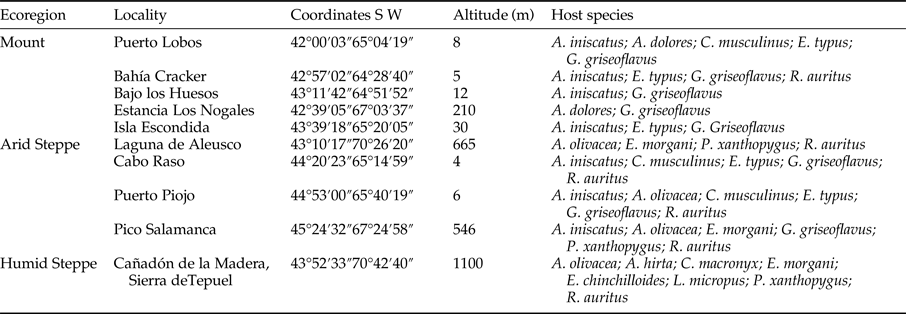
Samples were collected between 2008 and 2010 at ten sites, or localities, in the Chubut Province, Central Patagonia of Argentina (Patagonian subregion) (fig. 1, table 1). These sites are included in the ecological regions of ‘Monte de Llanuras y Mesetas’ (termed Mount region in this study) and ‘Estepa Patagónica’. For comparative purposes, in this study, the sites included in this ecoregion were subgrouped into ‘Arid Steppe region’ and ‘Humid Steppe region’ (Burkart et al., Reference Burkart, Bárbaro, Sánchez and Gómez1999). The Mount region has a temperate-arid climate, rainfall of around 100 mm, annual average temperatures between 10 and 14°C, frequent soil salinity and stoniness. Floristic physiognomy show marked homogeneity and is characterized by low coverage shrubland steppe. The Arid Steppe region has an annual average temperature between 8 and 13°C and annual average rainfall between 150 and 200 mm. Its vegetation is characterized by high shrub steppes and shrub-grassy steppes. The Humid Steppe region has a colder and wetter climate than the rest of the ecoregions mentioned above. The average annual temperature is below 7°C. It has around 600 mm of precipitation annually, mostly in the form of winter snows. Physically homogeneous, it is characterized by a grassy steppe with high coverage and few shrubs. In the eastern sector, where precipitation is greater, the deciduous forests of Nothofagus enter a wide ecotone-forming patches (León et al., Reference León, Bran, Collantes, Paruelo and Soriano1998).
Localities studied from Central Patagonia: (1) Puerto Lobos, (2) Ea. Los Nogales, (3) Bahía Cracker, (4) Bajo los Huesos, (5) Isla Escondida, (6) Cabo Raso, (7) Puerto Piojo, (8) Pico Salamanca, (9) Laguna de Aleusco, (10) Cañadón de la Madera, Sierra de Tepuel. See table 1 for exact location of each study site.

Sites along Central Patagonia where field captures were carried out and rodent species collected from each site.

Sample collection and flea identification
Rodents were captured with Sherman live traps. Processing and taxonomic determination of the rodents was made by U. Pardiñas and D. Udrizar Sauthier, and deposited at the Colección de Mamíferos del CENPAT (CNP, Puerto Madryn, Chubut Province, Argentina). For taxonomic arrangement of the rodents, we followed Wilson & Reeder (Reference Wilson and Reeder2005). Fleas were recovered from the host by examining the furs under a magnifying lens, combing and brushing them, and all fleas recovered were preserved in 96% ethanol. In the laboratory, fleas were cleared in KOH, dehydrated in an increasing ethanol series (from 80 to 100%), diaphanized in eugenol and mounted in Canada balsam. Identification keys used included those of Smit (Reference Smit1987), Johnson (Reference Johnson1957) and Hopkins & Rothschild (Reference Hopkins and Rothschild1953, Reference Hopkins and Rothschild1956, Reference Hopkins and Rothschild1962, Reference Hopkins and Rothschild1966). For names of higher taxa, we followed Whiting et al. (Reference Whiting, Whiting, Hastriter and Dittmar2008). Voucher specimens were deposited in the Colección de Entomología, Museo de La Plata (MLP, La Plata, Buenos Aires, Argentina).
Data analysis
Flea diversity in each ecoregion, locality and host species was estimated by calculating the specific richness (S = number of flea species) and Shannon diversity species index (H = Σ pi ln pi; where pi = proportion of each flea species in the sample) (Begon et al., Reference Begon, Harper and Towsend1988; Bush et al., Reference Bush, Lafferty, Lotz and Shostak1997). The following epidemiological parameters were calculated: mean abundance (MA = number of specimens of a flea species/number of hosts examined) and prevalence (P = number of host specimens parasitized/number of hosts examined × 100) were calculated for each ecoregion, locality and host species (n ≥ 7), according to Bush et al. (Reference Bush, Lafferty, Lotz and Shostak1997). Prevalences were compared by Fisher's exact test using the Quantitative Parasitology 3.0 software (Rózsa et al., Reference Rózsa, Reiczigel and Majoros2000). Specificity index (SI) or preference was calculated for each host species and ecoregion according to Marshall (Reference Marshall1981): (SI) = number of fleas of a particular species on hosts of a particular species or ecoregion × 100/total number of fleas of the same species on total hosts or ecoregions. SI will vary between 0 and 100, where 100 represents maximum specificity.
Results
A total of 438 sigmodontine rodents (Rodentia, Cricetidae) from Central Patagonia were examined:
Tribe Abrothrichini: Abrothrix hirta (Waterhouse) (n = 26), Abrothrix olivacea (Waterhouse) (n = 57), Chelemys macronyx (Waterhouse) (n = 7), Tribe Akodontini: Akodon iniscatus Thomas (n = 49), Akodon dolores Thomas (n = 13), Tribe Phyllotini: Graomys griseoflavus (Waterhouse) (n = 63), Phyllotis xanthopygus (Waterhouse) (n = 32), Eligmodontia typus F. Cuvier (n = 85), Eligmodontia morgana J. A. Allen (n = 41), Calomys musculinus (Thomas) (n = 11), Loxodontomys micropus (Waterhouse) (n = 25), Tribe Reithrodontini: Reithrodon auritus (Fisher) (n = 22),Tribe Euneomyini: Euneomys chinchilloides (Waterhouse) (n = 7).
In total, 624 fleas from 11 species and subspecies were collected from all host species (P = 46%; AM = 1.44), identified as:
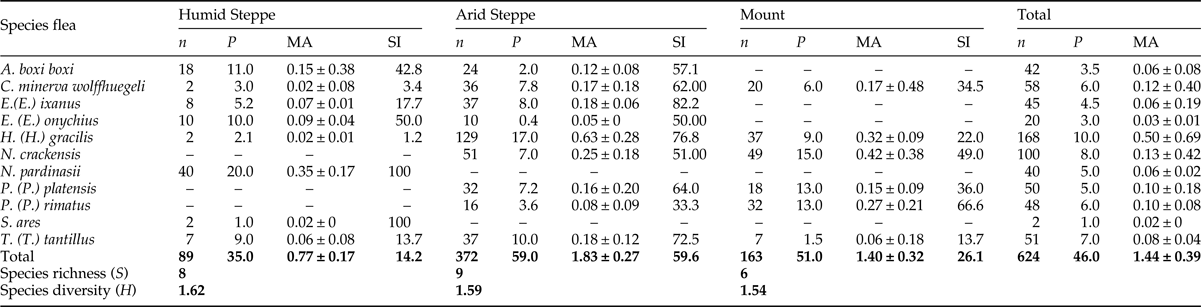
Ctenophthalmidae, Ctenophthalminae: Neotyphloceras crackensis Sanchez & Lareschi (Reference Sanchez and Lareschi2014), Neotyphloceras pardinasii Sanchez & Lareschi (Reference Sanchez and Lareschi2014), Agastopsylla boxi boxi Jordan & Rothschild, 1923; Rhopalopsyllidae: Parapsyllinae: Tetrapsyllus (Tetrapsyllus) tantillus (Jordan & Rothschild, 1923), Ectinorus (Ectinorus) ixanus (Jordan, 1942), Ectinorus (Ichyonus) onychius Jordan & Rothschild, 1923; Rhopalopsyllinae: Polygenis (Polygenis) platensis (Jordan & Rothschild, 1908); Polygenis (Polygenis) rimatus (Jordan, 1932); Tungidae: Hectopsylla (Hectopsylla) gracilis Mahner, 1982; and Stephanocircidae, Craneopsyllinae: Craneopsylla minerva wolffhuegeli (Rothschild, 1909) and Sphinctopsylla ares (Rothschild, 1911). The most frequently captured flea species were H. (H.) gracilis (n = 168; P = 10.0%; MA = 0.50) and N. crackensis (n = 100; P = 8.0%; MA = 0.13) (table 2).
Number of specimens (n), mean abundance (MA ± 1 SE) and prevalence (P, %) of identified flea species from each ecoregion from Central Patagonia.

The Arid Steppe region presented the highest values of specific richness of fleas (S = 9), whereas the values of Shannon diversity species index were similar in all ecoregions. The variance comparison test associated with this index did not show significant differences between the studied ecoregions (0.12; P ≤ 0.05). In addition, the Arid Steppe region presented the highest total values of fleas for all parasitological indexes analysed (n = 372; P = 59.0%; MA = 1.83; SI = 59.6) (table 2). In this ecoregion, the most frequently captured flea was H. (H.) gracilis (n = 129; P = 17.0%; AM = 0.63), showing significant differences in its prevalence compared with the rest of the species recorded in this ecoregion (P < 0.01, Fisher's exact test). This flea is distributed in all three ecoregions, but showed greater preference for the Arid Steppe region (SI > 75).
In the Mount region, the most frequently captured species was N. crackensis (n = 49; P = 15.0%; AM = 0.42), which was also recorded in the Arid Steppe region, with similar levels of infestation in both ecoregions (P = 0.716, Fisher's exact test). In the Humid Steppe region, N. pardinasii was the most frequently found species (n = 40; P = 20.0%; AM = 0.35) (table 2), and its prevalence significantly differed from all other species of fleas in this ecoregion (P = 0.01, Fisher's exact test). Moreover, N. pardinasii was captured in all host populations from the Humid Steppe region, except A. olivacea (tables 3 and 4).
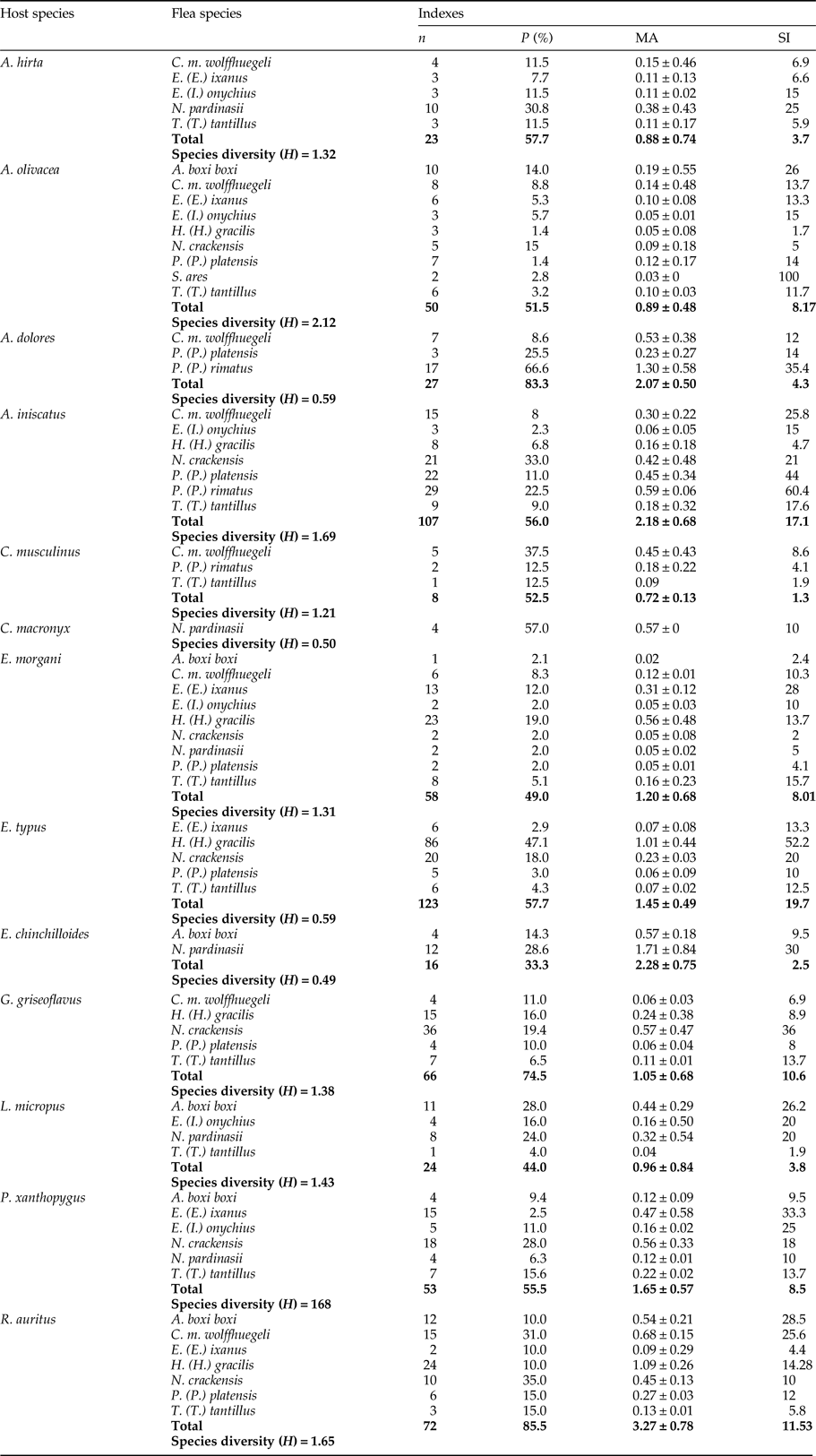
Total values of number of specimens (n), mean abundance (MA ± 1 SE), prevalence (P, %) and specificity index (SI) of flea species captured from each sigmodontine species.

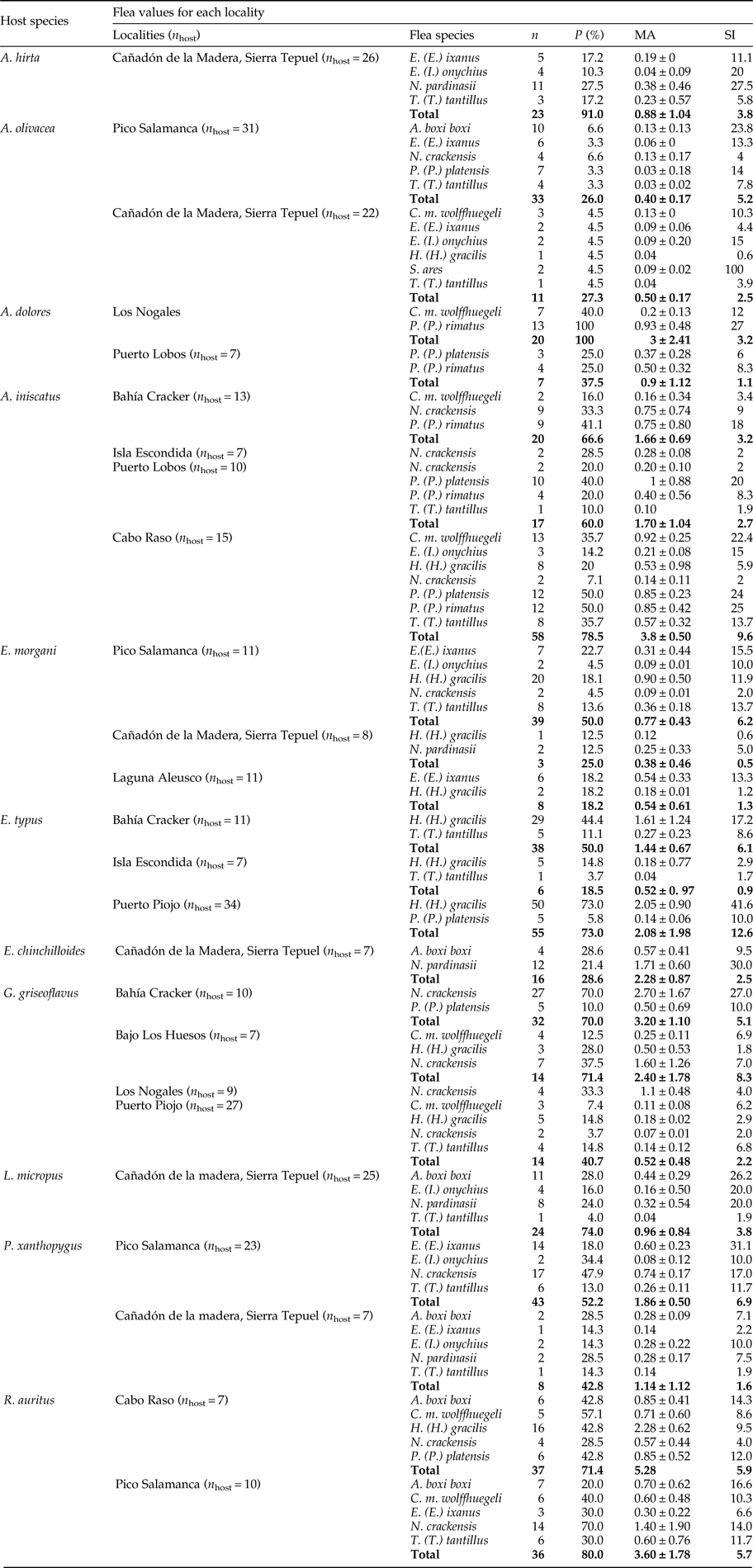
Number of specimens (n), mean abundance (MA ± 1 SE), prevalence (P, %) and specificity index (SI) of flea species captured from each sigmodontine species by each assessed locality.

The flea species with the highest host range was T. (T.) tantillus, which parasitized nine of the 13 species. In contrast, S. ares was found parasitizing only one host species (A. olivacea). The remaining fleas parasitized between four and seven sigmodontine species (table 3).
The specific richness ranged from one to nine flea species among the 13 hosts analysed, while the species diversity index (H) was between 0.49 and 2.12, with no significant differences between host species (0.08; P ≤ 0.05%). Considering each host species, A. olivacea had the highest richness and diversity of fleas (S = 9; H = 2.12), E. typus had the highest total number of fleas (n = 123), and R. auritus had the highest flea prevalence and median abundance (P = 85.5%; MA = 3.27) (table 3).
Flea assemblages of rodents varied by locality, with the exception of the following associations that remained consistent across all or most of the host geographic ranges: H. gracilis/Eligmodontia spp.; N. crackensis/G. griseoflavus; P. rimatus/Akodon spp.; E. ixanus and T. tantillus/Abrothrix spp. (table 3). Of these associations, H. gracilis presented the highest P, MA and SI with E. typus (table 3). In E. typus, the prevalence of H. (H.) gracilis showed significant differences to the rest of the flea species (P < 0.01, Fisher's exact test); also, the prevalence of H. (H.) gracilis in this rodent showed significant differences to other host species (P < 0.01, Fisher's exact test). Polygenis rimatus presented the highest P, MA and SI in Akodon spp. The prevalence of P. rimatus in A. dolores showed significant differences to other host species (P = 0.02, Fisher's exact test). In contrast, the associations between E. ixanus and T. tantillus with Abrothrix spp., and N. crackensis with G. griseoflavus presented similar values of P, MA and SI in all their hosts.
Discussion
The 11 flea species and subspecies identified in this study have been previously documented in Central Patagonia (Lareschi et al., Reference Lareschi, Sanchez and Autino2016). Among them, N. crackensis and N. pardinasii are endemic to Argentinean Patagonia. In addition, A. boxi boxi, T. (T.) tantillus, E. (I.) onychius, N. pardinasii, N. crackensis and H. (H.) gracilis have their type locality in Chubut Province (Lareschi et al., Reference Lareschi, Sanchez and Autino2016). The majority of identified fleas are exclusively distributed within the Andean biogeographic region and the South American transition zone (Chile and Argentina: Northwestern, Cuyo and Patagonia). This distribution is also adjusted to known taxa integrating the flea communities of Argentinean Patagonia (families Ctenophthalmidae, Stephanocircidae, Rhopalopsyllidae and Tungidae) (Johnson, Reference Johnson1957; Hopkins & Rothschild, Reference Hopkins and Rothschild1966; Smit, Reference Smit1987; Bazán-León et al., Reference Bazán-León, Lareschi, Sanchez, Soto-Nilo, Lazzoni, Venegas, Poblete and Vásquez2013; Beaucournu et al., Reference Beaucournu, Moreno and González-Acuña2014; Lareschi et al., Reference Lareschi, Sanchez and Autino2016).
Our results are consistent with previous records for other arid regions (e.g. Krasnov et al., Reference Krasnov, Shenbront, Khokhova and Degen2004; Bazán-León et al., Reference Bazán-León, Lareschi, Sanchez, Soto-Nilo, Lazzoni, Venegas, Poblete and Vásquez2013; Acosta & Fernández, Reference Acosta and Fernández2015), and could be explained by the dominance of fleas among ectoparasite assemblages of Patagonian sigmodontines (Sanchez & Lareschi pers. obs.). Moreover, comparing different regions of Argentina, Patagonia presents the greatest flea diversity, with the highest number of flea families, genera and species, followed by the Pampa Subregion (Neotropical region) where species belonging to the Subfamily Rhopalosyllinae (Rhopalopsyllidae) (Lareschi et al., Reference Lareschi, Sanchez and Autino2016) are dominant. Some studies have shown a correlation between the parasite diversity and the diversity of their hosts, but this relationship is not universal for the Order Siphonaptera. Positive correlations have been reported between flea diversity and the diversity of their small mammalian hosts in the Palaearctic (Krasnov et al., Reference Krasnov, Shenbront, Khokhova and Degen2004) and localities of Brazil (Linardi & Krasnov, Reference Linardi and Krasnov2012). However, a similar relationship was found neither in the Nearctic (Krasnov et al., Reference Krasnov, Shenbront, Khokhova and Poulin2007), nor in North America and Mexico (Acosta & Fernández, Reference Acosta and Fernández2015). In the Argentinian Patagonia, the most diverse mammals are the sigmodontine rodents, represented by 17 genera and about 25 species (Patton et al., Reference Patton, Pardiñas and D'Elia2015), but this diversity is not the highest for Argentina. The greatest diversity of sigmodontines is recorded in Northeast Argentina (Patton et al., Reference Patton, Pardiñas and D'Elia2015), wherein the diversity of fleas is the lowest known for the country (Lareschi et al., Reference Lareschi, Sanchez and Autino2016). It should be noted that between years 2007 and 2013, one of the authors (ML) collected numerous annual samples from the Argentinian Northeast, and verified that the prevalence and abundance of fleas in this region are lower than 25%, and almost 95% of all flea species belong to the Subfamily Rhopalopsyllinae.
Regarding flea abundance by region, in agreement with observations by the author ML in Northeast Argentina, other ecological studies have shown higher prevalence of rodent fleas in arid zones than in humid areas. For example, for Ñacuñán, Mendoza Province, Argentina (Mount, South American transition zone), northern and central Chile (Central Chilean subregion, Andean region) and Oriental Basin, Mexican deserts (Caribbean subregion, Neotropical region), the prevalence of fleas was ≥70% (Lareschi et al., Reference Lareschi, Ojeda and Linardi2004; Bazán-León et al., Reference Bazán-León, Lareschi, Sanchez, Soto-Nilo, Lazzoni, Venegas, Poblete and Vásquez2013; Acosta & Fernández, Reference Acosta and Fernández2015), whereas in wetlands of the Rio de La Plata, Argentina and in Belo Horizonte and Santa Catarina, Brazil (Chacoan and Parana subregions), prevalences were lower than 25% (Linardi et al., Reference Linardi, Botelho, Ximenez and Padovani1991; Lareschi & Krasnov, Reference Lareschi and Krasnov2010). The elevated total flea prevalence obtained in this study and their heterogeneous distribution along the Central Patagonia, with the highest values in Mount region along with Arid Steppe region, and the lowest in the Humid Steppe region, are consistent with previous records for other arid regions.
Flea density dynamics are influenced by several factors (Krasnov, Reference Krasnov2008). For example, for some hosts, mean flea abundance increased with an increase in mean annual air temperature/proximity to equator, while for others the abundance decreased with altitude (Linardi & Krasnov, Reference Linardi and Krasnov2012). Another contrasting study found that the abundance of fleas increased with elevation (Meliyo et al., Reference Meliyo, Kimaro, Msanya, Mulungu, Hieronimo, Kihupi, Gulinck and Deckers2014). In our study, lower values of flea prevalence and abundance were observed in the areas with higher elevations (such as the Humid Steppe region, see table 1). Further, the highest values for these parameters were obtained in the region with intermediate elevations (Arid Steppe region, see table 1), followed by the Mount region, of lowest elevation (see table 1). In this sense, our results suggest that humidity is the factor that most influences flea abundance in Patagonia. Because most of the biological cycle of fleas occurs in soil, abiotic conditions such as air temperature, relative humidity and precipitation affect profoundly both the imago and pre-imago stages of fleas, especially at a regional scale, resulting in variation in their survival and developmental time (Marshall, Reference Marshall1981; Krasnov, Reference Krasnov2008; Linardi & Krasnov, Reference Linardi and Krasnov2012). Thus, arid areas like Patagonia would provide a better environment for the Siphonaptera habitat, favouring their survival and development.
Regarding host distribution, our study recorded 63 flea–host associations (table 3). Most of the identified fleas have been previously reported for sigmodontine rodents in South America (Linardi & Krasnov, Reference Linardi and Krasnov2012; Beaucournu et al., Reference Beaucournu, Moreno and González-Acuña2014; Lareschi et al., Reference Lareschi, Sanchez and Autino2016). However, the following flea–host associations are reported here for the first time: A. boxi boxi/A. olivacea; E. (I.) onychius/E. morgani; E. ixanus/E. typus, N. crackensis/P. xanthopygus and T. (T) tantillus/A. iniscatus, C. musculinus, E. morgani, E. typus, G. griseoflavus, L. micropus and P. xanthopygus.
Host geographic range and abundance showed relationships with the parasitological indexes. The highest flea prevalence and abundance occurred in host species with high-density populations. For example, in the host community of Cabo Raso, the most abundant rodent was A. iniscatus; in Puerto Piojo, E. typus; and in Cañadón de la Madera, Sierra Tepuel, A. hirta and L. micropus. All these host populations had the highest index values in their rodent communities (table 4). Several authors have suggested that host population density is an important factor influencing dispersion and/or propagation, as well as distribution of parasites among individuals (Krasnov et al., Reference Krasnov, Poulin, Morand, Morand, Krasnov and Poulin2006a). Moreover, high abundance of a host species in a particular region is associated with a decrease in its members’ health, along with increases in contact frequency between them (Beldoménico, Reference Beldoménico2007). Both situations favour the colonization of new hosts by parasites, and thus the subsequent increase of their populations. These facts provide a possible explanation for the results obtained.
The highest specific richness and diversity of fleas were obtained in a rodent widely distributed in Patagonia, A. olivacea (Pardiñas et al., Reference Pardiñas, Teta, D'elía and Lessa2011). In contrast, rodent species geographically restricted, such as C. macronyx or E. chinchilloides, showed the lowest values for these indexes (tables 1 and 3). These results indicate a positive correlation between the specific richness and diversity of fleas and the size of the host geographic range, and could be explained in terms of greater exposure opportunities of the widely distributed rodents to the flea species present in different environments (Krasnov et al., Reference Krasnov, Stanko, Khokhlova, Miklisova, Morand, Shenbront and Poulin2006b).
Regardless of the host's intrinsic characteristics, Krasnov (Reference Krasnov2008) suggests that the diversity of flea assemblages in a host species is mostly influenced by local factors such as environmental variables. In agreement, in our work, the flea assemblages of the studied rodents varied by locality, except for some flea–host associations that remained across all geographic ranges of their hosts (table 4). However, some of the flea species most frequently recorded in the flea assemblages of the studied hosts, were not found in this study. For example, A. boxi boxi and Ctenoparia inopinata Rothschild 1909, endemic fleas of the Argentinian and Chilean Patagonia, parasitize mainly Abrothrix rodents (Beaucournu et al., Reference Beaucournu, Moreno and González-Acuña2014; Lareschi et al., Reference Lareschi, Sanchez and Autino2016), their most frequent host being A. hirta (Hopkins & Rothschild, Reference Hopkins and Rothschild1966; Sanchez & Lareschi, Reference Sanchez and Lareschi2013). However, we do not find these flea species on this host. Similarly, the flea genus Plocopsylla, for which ten of the 33 described species occur in the Argentinian and Chilean Patagonia, commonly occur on Abrothrix (Beaucournu et al., Reference Beaucournu, Moreno and González-Acuña2014; Lareschi et al., Reference Lareschi, Sanchez and Autino2016), but none were found in our study.
The host affinity of fleas varies from sensu stricto specific to generalists, and among them, many flea species are specific when they are associated with higher taxa of their hosts (Krasnov, Reference Krasnov2008; Whiting et al., Reference Whiting, Whiting, Hastriter and Dittmar2008). Following Poulin (Reference Poulin2011), the host breadth of a parasite may vary geographically or temporally, and may also be limited by phylogenetic relationships with potential host species. Flea species from sigmodontine rodents were recorded with varying degrees of host preference. Several of these flea species have a broad host range, although the majority of their hosts are sigmodontine rodents (Hopkins & Rothschild, Reference Hopkins and Rothschild1956, Reference Hopkins and Rothschild1962, Reference Hopkins and Rothschild1966; Johnson, Reference Johnson1957; Smit, Reference Smit1987; Beaucournu et al., Reference Beaucournu, Moreno and González-Acuña2014; Lareschi et al., Reference Lareschi, Sanchez and Autino2016), indicating an affinity for the subfamily Sigmodontinae.
Among the studied fleas, H. gracilis showed host preference at the genus level, exhibiting greater prevalence, MA and preference in the genus Eligmodontia than in other hosts (tables 2 and 3). The association between H. (H.) gracilis and Eligmodontia has been observed along the entire geographic distribution of the host, in Patagonia, Northwestern Argentina (Lareschi et al., Reference Lareschi, Sanchez, Ezquiaga, Autino, Díaz and Barquez2010; Sanchez & Lareschi, Reference Sanchez and Lareschi2013) and in the centre of the country (Mendoza and San Juan provinces; Sanchez, unpublished data). Hectopsylla gracilis comprises a group of fleas with a particular lifestyle known as stick-tight fleas (Blank et al., Reference Blank, Kutzscher, Masello, Pilgrin and Quillfeldt2007). Females of these fleas attach to their host with serrated lacinae and feed for extended periods. Within the flea community studied in this work, this species is the only one that exhibits such behaviour. Following Poulin et al. (Reference Poulin, Krasnov, Morand, Morand, Krasnov and Poulin2006), the geographic distribution of parasites is influenced by the distribution of their hosts. In this sense, the highest values of the parasitological indexes of H. (H.) gracilis in rodents of the genus Eligmodontia, plus the wide distributional record of this host–parasite association, suggests that the particular sessile stick-tight behaviour of this flea species influences its host preference, and consequently, this flea distribution parallels that of its preferred host.
The rest of the flea species studied did not show host specificity at the genus or species level, but were instead associated with higher prevalence and abundance of the most abundant sigmodontines at each site. Furthermore, flea assemblages that occurred in sympatric hosts were more similar than those among congeneric host species (table 4). According to Krasnov et al. (Reference Krasnov, Mouillot, Khokhova, Shenbront and Poulin2012), the species composition of flea assemblages depends little on host phylogeny. Indeed, a parasite may occur in a region if it either originated there or if it arrived from elsewhere. In either of these cases, it may switch to a different host if its original host, whether it was autochthonous or invading, became extinct. In this context, these results raise the possibility that the associations established by the fleas with their hosts in Central Patagonia mainly respond to host switching events, and may be principally influenced by environmental characteristics.
Although synanthropic fleas are those with the highest interest to public health, climate change and humans continuing encroachment on natural areas may provide new lines of transmission for largely unknown pathogen populations among wild fleas (Bitam et al., Reference Bitam, Dittmar, Parola, Whiting and Raoult2010; Eisen & Gage, Reference Eisen and Gage2012). Flea-borne infections are emerging or re-emerging throughout the world and their incidence is on the rise since their distribution, as that of their vectors, are shifting and expanding (Bitam et al., Reference Bitam, Dittmar, Parola, Whiting and Raoult2010). Among them, plague is the most notorious flea-borne disease and is a re-emerging public health issue, mainly in Africa and South America (Bolivia, Brazil, Ecuador and Peru) (Eisen & Gage, Reference Eisen and Gage2012; PAHO, 2012). In Bolivia and Perú, plague is endemic in the Andean region and several rodents have been identified as reservoirs (Ruiz, Reference Ruiz2001; Schneider et al., Reference Schneider, Najera, Aldighieri, Galan, Bertherat, Ruiz, Dumit, Gabastou and Espinal2014).
Rodents play a major role in flea-borne diseases because they are the principal reservoir of several zoonotic pathogens (Linardi & Guimaraes, Reference Linardi and Guimaraes2000; Krasnov, Reference Krasnov2008). Since our study shows that Patagonia has the highest diversity of rodent fleas in South America, with high prevalence and abundance of parasitism and low host specificity in most of the fleas studied, our results indicate that better surveillance of potentially emerging flea-borne zoonoses in the Andean region is warranted.
Our results contribute to the knowledge of the flea–host–environment complex and support the importance of the environment as the main factor in determining the structure and composition of the flea assemblages in Central Patagonia. In addition, our analysis of flea distribution and parasitism rates may be useful in epidemiological studies and should provide public health agencies with a useful tool for implementing surveillance systems for better risk assessment of emerging flea-borne zoonoses in the region.
Acknowledgements
The authors thank Ulyses Pardiñas, Daniel Udrizar Sauthier, Walter Udrizar Sauthier, Anahí Formoso, Adela Bernardi and Gabriela Mendos for their help in fieldwork; Ulyses Pardiñas and Daniel Udrizar Sauthier for the identification of the hosts; Ulyses Pardiñas for the contribution and correction on the host and area data; and Lucila Pérez Gianmarco for the revision of the English. Laboratory work was carried out with funds from ANPCyT (PICT 201-338) and UNLP (N752) to M. Lareschi. This article is part of the doctoral dissertation of J. Sanchez at the FCNyM, UNLP, La Plata, Argentina. The authors are members of CONICET.